


Notes from Dr. Michael A. Scordato’s Classroom Teachings
__________________________________________________________________
Paranoia, Self-Deception, and the Gospel’s Answer
to the Stories We Tell Ourselves
A Biblical Counseling Essay
⸻
First let’s start with “WHAT HE SAW IN THE FIRE”…
A Biblical Counseling Case Study in Trauma, Self-Deception, and the Stories a Frightened Mind Writes in the Dark
Names and identifying details have been altered to protect privacy. The spiritual and psychological dynamics reflect real clinical experience.
⸻
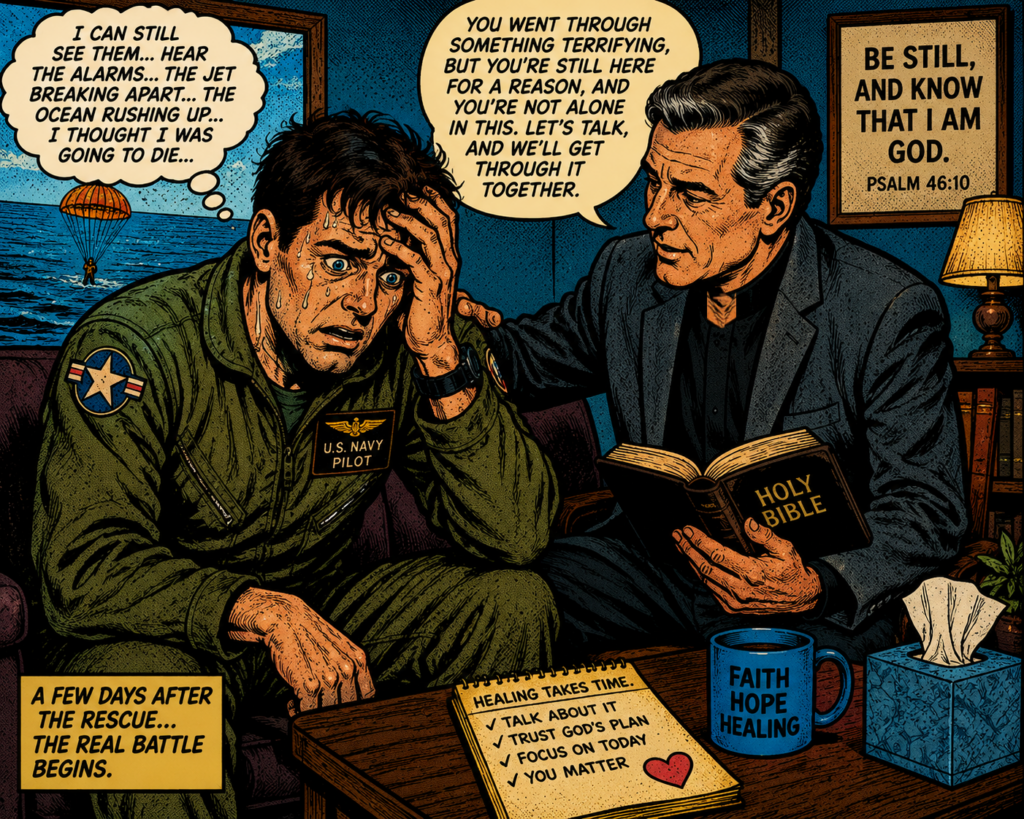
I. The Man Who Came In
Captain James Whitfield was forty-one years old when he first sat down in the counselor’s office. He had the posture of a man still listening for alarms — shoulders squared, hands flat on his knees, eyes that moved to the door whenever a sound came from the hallway. He had been a naval aviator for sixteen years. He had logged thousands of flight hours. He had, by his own account, never been afraid of anything in the air.
Fourteen months earlier, his F/A-18 had experienced a catastrophic engine failure at eleven thousand feet over the Pacific. He had ejected successfully. He had been recovered from the water within the hour. He had no broken bones. The aircraft investigation board had done its work. The physical facts of the incident were, by the time James walked into that counseling office, completely established.
A turbine blade had been struck by a dropped tool — a half-inch drive socket, as it turned out — that an aircraft mechanic named Dennis had lost during a routine pre-flight inspection. Dennis had searched for it briefly, convinced himself it must have bounced clear of the intake, and said nothing. The socket had worked its way into the engine housing and destroyed the turbine from the inside out at altitude. The investigation board found the socket in the wreckage. Dennis had since been removed from duty. The case was closed in every official sense.
It was not closed for James.
James had come to counseling not because of the crash. He had come, or so he said in that first session, because his wife had told him she could not live with the person he had become since the crash. He was sleeping poorly. He was drinking more than he should. He had twice driven past the base where he was scheduled to meet with the accident review board and kept going without stopping, unable to explain to himself why. His daughter, who was nine, had stopped trying to hug him because, as she told her mother, ‘Daddy goes far away when I touch him.’
He mentioned the gremlins in the third sentence.
⸻
II. What He Said He Saw
The counselor had learned long ago not to redirect a presenting narrative too quickly. James needed to tell the story in the shape it had taken inside him, not in the shape a counselor would have preferred. So the counselor listened. It was determined that they would meet together three times a week until next steps were accomplished.
James described the moment of engine failure with the precision of a man who had replayed it thousands of times: the sudden asymmetric thrust, the cockpit alarms, the immediate procedure sequence that sixteen years of training had burned into his hands before his mind caught up. He described the decision to eject — not a decision, he corrected himself, more like a recognition that the decision had already been made for him. He described the ejection sequence: the handle, the blast, the extraordinary violence of being thrown clear of a tumbling aircraft at speed.
And then he described what he saw in the two seconds between clearing the aircraft and the parachute deploying.
“There were two of them. One on each wing. Small. Dark. They were laughing at me. I know how that sounds. I know exactly how that sounds. But I saw them. They were the ones who brought it down. I felt it. And I know — I know what the investigation says, I know about Dennis and the socket, I accept all of that intellectually. But I know what I saw.”
He said this looking directly at the counselor. He was not confused. He was not dissociated. He was entirely present and entirely certain, and the certainty had the quality of something load-bearing — as though the gremlins were not an addition to his understanding of that day but the foundation of it. Remove them, and something in James collapsed.
The counselor said nothing for a moment. Then:
Counselor: “James, I believe you saw something. I want to understand what you saw, and what it has meant to you. Will you tell me about the seconds just before — what was going through your mind in those last moments inside the cockpit?”
James looked at the floor. This, it turned out, was the question no one had asked him.
⸻
III. Inside the Cockpit: What the Mind Does Under Extreme Fear
Over the next two sessions, a picture emerged. James had been alone in that aircraft. The failure had been sudden and total. There had been no warning, no degraded performance, no incremental deterioration that might have allowed him to build a mental model of what was happening and why. One moment the aircraft was performing normally. The next, it was dying.
For a trained aviator, sudden and unexplained failure carries a specific psychological weight that is distinct from expected emergencies. The training prepares you for the procedure. It does not fully prepare you for the existential shock of an aircraft that is killing you for no reason you can identify. James had run his checklists flawlessly. He had done everything right. And yet here was death, arriving without cause, without warning, without the dignity of explanation.
The human mind, under conditions of mortal threat and perceptual chaos, does not go blank. It accelerates. And one of the things it accelerates toward, in the fraction of a second available to it, is explanation. The mind cannot tolerate causelessness. It will reach for a cause with whatever material is available — training, memory, pattern, symbol, fear.
James had grown up with a grandfather who flew in the Pacific theater in World War II. His grandfather had told him about gremlins with complete seriousness — the RAF tradition, the small malevolent creatures that sabotaged aircraft, that were blamed for mechanical failures that could not otherwise be explained. For generations of airmen, the gremlin was the face of irrational mechanical death. It was the personification of the thing that kills you for no reason.
James had, by his own account, not thought about gremlins in twenty years.
But in the two seconds between clearing the stricken aircraft and the parachute deploying — in two seconds of violent motion, of superheated air and burning fuel and the strobing light of a disintegrating engine — his mind had reached into its deepest filing cabinet and pulled out the oldest available explanation for death without cause.
The light had been extraordinary. He described it now, for the first time, not as a neutral fact but as something overwhelming: the flash of the turbine explosion, the orange and black of burning fuel against afternoon sky, the strobing effect of the aircraft’s rotation. Against that visual chaos, the human face-detection system — one of the most powerful and automatic processes in the brain, the same system that finds faces in clouds and wood grain and carpet patterns — had done its work. It had found faces. Dark shapes against bright fire. Two of them, on what had been the wings.
The laughing he had perceived: James wept slightly when the counselor asked him, gently, whether the sound of the turbine as it came apart might have sounded like something. He had never connected this before. He said, very quietly, that it had sounded almost like screaming. Or laughter. He had never been able to decide which.
“There is a way that seems right to a man, but its end is the way of death.” — Proverbs 14:12, NKJV
The counselor sat with this for a moment before speaking.
Counselor: “James, what you are describing — the way your mind reached for an explanation in those two seconds — that is not weakness. That is not instability. That is what a mind does when it is terrified and has no time. Your grandfather’s stories were in there, deep in there, and your mind grabbed them because it needed something to hold onto. The fire and the shadows gave it the raw material, and the grief and the shock gave it the emotion. Something was created in that moment that felt absolutely real. I am not saying you imagined it. I am saying that the mind, in its terror, created an experience and handed it to you as a fact.”
James sat very still.
James: “But if it wasn’t real — if it was just my mind — then why do I still believe it?”
The counselor leaned forward slightly.
Counselor: “That is the most important question you have asked since you sat down.”
⸻
IV. Why the Gremlins Had to Be Real
The counselor had learned this principle across years of pastoral and clinical work: a false belief is never merely an intellectual error. It is always doing a job. It is always protecting something, explaining something, or carrying something that the person cannot yet carry in any other way. Before you can address the false belief, you must understand what job it is performing. Remove it without understanding its function, and you have not helped the person — you have simply destabilized them without offering a better foundation.
For James, the gremlins were performing at least three distinct functions.
First: They explained the inexplicable.
Dennis’s dropped socket was the official explanation, and James accepted it intellectually. But it was an explanation that carried devastating implications. It meant that James had nearly died not because of enemy action, not because of heroic risk, not because of any decision he had made or failed to make, but because a mechanic on a Tuesday afternoon had dropped a socket, panicked, said nothing, and gone home. It meant his life had come within a margin of sheer negligence — human smallness, human cowardice, human failure to do one simple right thing.
The gremlins were, in a profound sense, a more tolerable explanation. They were mythological, ancient, beyond accountability. They did not implicate Dennis’s ordinary moral failure. They did not force James to sit with the nauseating knowledge that his near-death could have been prevented by one man choosing honesty over self-protection. The gremlins gave the event a scale commensurate with its emotional weight. A dropped socket felt absurdly small for something so enormous. The gremlins did not.
“For the thing I greatly feared has come upon me, and what I dreaded has happened to me.” — Job 3:25, NKJV
Second: They externalized the locus of control.
James had built his entire professional identity on mastery. He was a man who controlled aircraft that lesser men feared. He was a man who, when things went wrong, had the training and the nerve to respond correctly. He had, in fact, responded correctly. His procedures had been flawless. He had survived.
But survival felt like failure to him, and the counselor had to sit with this for an entire session before James could name why. A pilot who ejects is a pilot whose aircraft is gone. There is an unspoken culture in naval aviation — irrational, never stated in any manual, but pervasive — in which ejection carries a faint residue of defeat. You lost the machine. You came home without it.
The gremlins, paradoxically, relieved this. If gremlins brought it down, then James had not failed to save it. He had been overcome by a supernatural force. His mastery was intact. The machine had been taken from him by something outside the domain of mastery entirely.
Third: They were a container for an anger that had nowhere else to go.
James was furious at Dennis. The counselor identified this in Session Three, not from anything James said directly, but from what happened to James’s hands when Dennis’s name came up. James could not yet allow himself to feel the full weight of that anger, because the full weight of that anger would force him to decide what to do with it. Forgiveness felt impossible. Retaliation was legally and professionally off the table. The anger had no outlet.
The gremlins absorbed it. They were malevolent. They were responsible. They could be hated freely, without consequence, without the moral complexity of hating Dennis, who was, after all, just a frightened young man who had made a catastrophic choice in a moment of panic. James could hate the gremlins with clean conscience. Dennis required something more difficult.
“Be angry, and do not sin: do not let the sun go down on your wrath, nor give place to the devil.” — Ephesians 4:26–27, NKJV
⸻
V. The Counseling Pathway
Session Four
The counselor introduced the Ephesians 4 framework not as a lecture but as a question.
Counselor: “James, when Paul says ‘put off the old man’ — that old shirt we’ve talked about — what do you think he means for a man like you? What is the old shirt you have been wearing since the crash?”
James was quiet for a long time. Then:
James: “Control. The idea that if I do everything right, nothing takes me by surprise. The idea that there is always a reason, and the reason is always something I can fix or fight or outfly.”
Counselor: “And the gremlins fit that shirt perfectly, don’t they? Because if there are gremlins, there is an enemy. And if there is an enemy, there is a fight. And if there is a fight, then you are still a pilot and not just a man in the water.”
James looked up sharply. The counselor waited.
James: “That’s — yes. That’s it exactly.”
This moment was the turning point. Not because James immediately released the gremlin narrative — he did not, not yet. But because he had, for the first time, seen the narrative from the outside. He had identified its function. He had caught a glimpse of the machinery behind the belief, and in doing so had created the first crack in the certainty.
“Casting down arguments and every high thing that exalts itself against the knowledge of God, bringing every thought into captivity to the obedience of Christ.” — 2 Corinthians 10:5, NKJV
Session Five
The counselor turned to Dennis.
Counselor: “I want to ask you something, and I want you to sit with it before you answer. If Dennis walked into this room right now and sat down across from you, what would you want to say to him?”
The answer came fast, and it was not printable. The counselor did not flinch.
Counselor: “All of that. Yes. That is the real thing. That is what has been living underneath the gremlins.”
James: “He almost killed me. He dropped a socket and said nothing and went home and I almost died.”
Counselor: “Yes.”
James: “And I am supposed to — what? Forgive that? Just let that go?”
Counselor: “Forgiveness is not the same as saying it didn’t matter. What Dennis did was a genuine moral failure that nearly cost you your life, your daughter’s father, your wife’s husband. That is real. God is not asking you to pretend otherwise. He is asking you to release the debt — not for Dennis’s sake, not yet, maybe not for a long time. For yours. Because the man who cannot forgive Dennis is the man whose hands still shake every time Dennis’s name comes up, and that man is not free.”
James was silent. Then:
James: “I don’t know how to do that.”
Counselor: “I know. That is why we start here, with naming it. Not with performing forgiveness but with honest inventory. You are wearing a shirt of unforgiveness and a shirt of control and a shirt of self-made mythology. And you have been wearing all three since you hit the water. The first step is simply to see them.”
“Casting all your care upon Him, for He cares for you.” — 1 Peter 5:7, NKJV
Session Six
The counselor asked James to describe the ejection sequence again. This time, he asked him to describe the light.
James described it slowly, without the urgency of the early sessions. The flame of the turbine. The orange against the afternoon Pacific sky. The strobing rotation of the aircraft. The chaos of it. The beauty of it, he admitted — even in the terror, there had been something almost beautiful about the fire.
Counselor: “And the shapes in the fire. What do you think you were looking for, in that moment?”
James considered this for a long time.
James: “Something to blame. Something with a face. Something I could look at and say — that’s the thing. That’s why.”
Counselor: “Your grandfather’s gremlins gave your mind a face to put on the fire.”
James: “Yes.”
Counselor: “James, the mind under that kind of terror is doing the most human thing a mind can do. It is searching for a story. Because a story with a cause is survivable in a way that random mechanical death is not. Your mind was not failing you. It was protecting you, in the only way it knew. But the protection has a cost — it has been keeping you from the real story, which is harder and truer and ultimately the only story that can actually set you free.”
James: “What is the real story?”
The counselor did not answer immediately. He opened his Bible.
“And we know that all things work together for good to those who love God, to those who are the called according to His purpose.” — Romans 8:28, NKJV
Counselor: “The real story is that a young man made a terrible choice out of fear, and God allowed its consequences to reach you at eleven thousand feet, and you survived. Not because of gremlins and not despite them. Because God, who is sovereign over turbines and sockets and terrified mechanics and fathers who need to be alive for their nine-year-old daughters, held you. The socket was real. Dennis’s failure was real. Your terror was real. And God was present in all of it. That is the story the gremlins were keeping you from reaching.”
James put his face in his hands. Not in despair. The counselor had learned to read the difference. This was the posture of a man finally allowing himself to be held by something larger than his own explanation.
⸻
VI. A Word About Dennis
The counseling work described above focused on James. But pastoral integrity requires a brief acknowledgment of the other figure in this story, because the biblical framework that illuminates James’s self-deception equally illuminates Dennis’s.
Dennis dropped a socket. He searched, convinced himself it had cleared the intake, and said nothing. He was twenty-three years old. He was, by account of those who worked with him, conscientious, capable, and genuinely frightened of his supervisor. The silence was not malice. It was the fear of a young man calculating whether the risk of saying nothing was smaller than the risk of saying something.
He had performed, in miniature, the same self-deception that James had performed on a larger scale: he had told himself a story that the evidence could support if he squinted at it right. The socket probably cleared. The engine sounded fine. The pilot will be okay. The story allowed him to act as though his calculation might be correct. He had deceived himself into a posture he could live with in the moment — and nearly killed a man in the process.
This is the social topology of self-deception: it does not stay contained within the person who practices it. Dennis’s private inner narrative — his self-protecting story about a socket that probably cleared — reached into the sky fourteen months later and found James. The lies we tell ourselves have consequences that extend far beyond our own hearts.
“But if you do not do so, then take note, you have sinned against the Lord; and be sure your sin will find you out.” — Numbers 32:23, NKJV
Dennis’s sin found him in the wreckage of an aircraft he had helped bring down. James’s false narrative found him in the sleepless nights, the driven-past appointment, the daughter whose hugs no longer reached him. Neither man had intended the damage they caused. Both had told themselves stories that made damage possible.
⸻
VII. What Happened Over the Following Months
James did not stop believing in gremlins overnight. The counselor had expected this. Beliefs that are load-bearing do not dissolve in a single session; they are gradually replaced as the structure they were supporting is rebuilt from a better foundation.
What happened first was that James began to distinguish between what he had experienced and what he had concluded. He had experienced something in that ejection — shapes in fire, a sound like laughter, the overwhelming sense of malevolent presence. He no longer disputed that the experience had been real as an experience. What he began to hold more loosely was the metaphysical conclusion he had drawn from it: that gremlins were a real category of being that had intentionally destroyed his aircraft.
The physiological groundwork was laid first, following the Elijah principle. James was sleeping perhaps three hours a night when he arrived. The counselor addressed this directly and concretely in Session One, and James was working with a physician by Session Two. A body running on three hours of sleep and a surplus of alcohol is a body in which the threat-detection system is permanently open and the capacity for nuanced interpretation is permanently reduced. Every ambiguous signal becomes confirmation. The gremlins were being continuously fed by exhaustion.
As sleep improved, the certainty became less absolute. James noticed this himself. He mentioned in Session Seven that he had woken up one morning and the gremlin memory had felt, for the first time, more like a dream and less like a documentary.
The forgiveness work with Dennis took longer. James wrote a letter he never sent, which the counselor had suggested not as a therapeutic exercise but as a way of getting the full weight of the anger into a form where it could be examined rather than merely felt. The letter was, by James’s account, extraordinary in its fury. Writing it took four hours. Reading it back to himself the following morning, he said, he had felt something unexpected: pity. Dennis had been twenty-three years old and afraid. James had been twenty-three years old once. He knew what that felt like.
This was not the completion of forgiveness. It was its beginning.
“Bearing with one another, and forgiving one another, if anyone has a grievance against another; even as Christ forgave you, so you also must do.” — Colossians 3:13, NKJV
The counselor was careful never to minimize the legitimate weight of what Dennis had done. Forgiveness in the biblical framework is not the rewriting of history. It is not the declaration that what happened was acceptable. It is the release of the creditor’s claim — the decision to stop requiring from the debtor what the debtor cannot repay. Dennis could not give James back the months of insomnia. He could not undo the distance that had grown between James and his daughter. He could not un-drop the socket. Forgiveness was James releasing the demand that he somehow could.
⸻
VIII. The Daughter
There is a detail from the early sessions that the counselor returned to near the end of the work. James had mentioned, almost in passing, that his nine-year-old daughter had stopped trying to hug him because ‘Daddy goes far away.’
In Session Eleven, the counselor asked James to describe what happened inside him when his daughter tried to embrace him. James stared at the wall for a long time before answering. When he did, his voice was different — quieter and more unguarded than the counselor had yet heard from him.
James: “I feel like I don’t deserve it. Like if she holds onto me too tightly she will find out that the gremlins were right. That whatever they saw in me that was worth destroying — she’ll see it too.”
The counselor sat with this for a full minute of silence.
This was the interior of the gremlin belief that had never been spoken aloud before. Not just: I saw something and I named it gremlins. But: the gremlins came for me, which means there is something in me worth coming for. The mythology of malevolent pursuit had, in the deep interior of James’s self-understanding, become a theology of unworthiness. He had unconsciously absorbed the gremlin’s verdict on him and was living as though it were God’s verdict as well.
“There is therefore now no condemnation for those who are in Christ Jesus.” — Romans 8:1, NKJV
Counselor: “James, I want you to hear something. The gremlins — the shapes in the fire, the sound in the engine — they brought no verdict with them. They were not sent. They were not real. But even if they had been real: there is One whose verdict on you is the only verdict that holds, and His verdict was rendered at a cross, not in a turbine fire. He does not condemn you. He came after you in the water. He is the reason the parachute opened. And He has been waiting, this whole time, for you to let your daughter hold you.”
James did not speak again for the rest of that session.
Two weeks later, he reported that his daughter had hugged him at breakfast and he had not gone far away.
⸻
IX. Counselor’s Reflection
James Whitfield’s case illustrates several principles that have become foundational to the counseling practice represented in these documents.
The first is that false beliefs are never merely intellectual. They are always structural — carrying weight, protecting something, performing a function in the economy of the person’s interior life. The gremlin narrative was not a delusion in the clinical sense. It was a story, and like all stories, it had a purpose. Understanding the purpose was prerequisite to addressing the story. To have simply told James in Session One that gremlins are not real would have been to attack a load-bearing wall without shoring up the structure first. The collapse would not have been liberation. It would have been devastation.
The second is that the body must be attended to. James’s insomnia was not a side effect of his grief — it was an active contributor to the tenacity of the false belief. A mind running on three hours of sleep and excess alcohol is not a mind capable of the nuanced interpretive work that distinguishes experience from conclusion. God restored Elijah’s body before He gave Elijah a new direction. The sequence is not incidental.
The third is that trauma creates meaning under pressure, and the meaning it creates tends to draw on the deepest available material. James’s grandfather’s stories about gremlins were in him at the cellular level of memory and identity. The fire and the violence and the roaring laughter of a disintegrating turbine found that material and gave it form. This is not pathology. This is the terrified human mind doing what terrified human minds do. The pastoral task is to honor the experience while gently, persistently, lovingly examining the interpretation.
The fourth, and deepest: the false story James told himself was downstream of a true wound. He had nearly died without explanation, at the hands of another man’s cowardice, in a moment in which all of his training and competence and preparation had been rendered irrelevant by a socket the size of a golf ball. That wound was real and it was legitimate and it deserved to be grieved. The gremlins had prevented the grieving by providing an explanation that, paradoxically, felt larger and therefore more proportionate to the wound. Part of the counseling work was helping James to grieve the actual thing — not the mythological sabotage but the small and ordinary human failure that had nearly ended him.
He is flying again. Not for the Navy — that career ended with the accident board’s report. He flies private charters now, out of a small airport on the coast. He called the counselor on a Tuesday morning about eight months after their last formal session, from what he said was somewhere over the Cascade Mountains.
“No gremlins up here,”
he said. And laughed. And it sounded nothing like a turbine.
⸻
X. The Phone Call
Approximately one year after James’s final counseling session, Dennis called him.
He had heard, through someone who knew someone, that James was doing well. He had carried the weight of the crash since the day the investigation board found his socket in the wreckage. He was crying before James said a word.
He asked for forgiveness.
James gave it to him. Not as a performance, not as the conclusion of a therapeutic exercise, but as a man who had genuinely been made into something new and found, to his own quiet surprise, that the new thing had room in it for Dennis. The anger was not entirely gone. But it no longer had authority. He told Dennis so, plainly, and meant it.
The call lasted eleven minutes. Dennis thanked him. James told him that was not necessary. They did not speak again after that, and neither man needed them to.
“Therefore, if anyone is in Christ, he is a new creation; old things have passed away; behold, all things have become new.” — 2 Corinthians 5:17, NKJV
This is what the new creation looks like in ordinary life — not a dramatic announcement, but a Tuesday morning phone call in which a man who nearly died extends to the man who nearly killed him exactly the grace that was extended to both of them at a cross. James did not manufacture that capacity. It had been built into him, over months of honest inventory and surrender and grief and forgiveness-work, by the One who makes all things new.
He was that new thing now. He wore it without fanfare. That, too, is part of what it means.
⸻
“For God has not given us a spirit of fear, but of power and of love and of a sound mind.” — 2 Timothy 1:7, NKJV
Sophronismos. The mind made whole, even in the fire.
⸻
HERE IS THE LESSON…
⸻
You are the most dangerous liar you will ever meet.
Not the con artist. Not the manipulative colleague. Not the friend who betrayed you in the fourth grade. You. The one reading these words right now. The one who has, at this very moment, an elaborate, internally consistent, emotionally compelling explanation for why everyone in a particular room was looking at you, why that message went unanswered, why your spouse’s tone of voice meant something darker than the words themselves. You have been building this case for years, assembling evidence with the diligence of a detective, and you have never once questioned whether the detective is crooked.
This essay is an intervention.
It is not an assault on your intelligence. The most paranoid people in human history have often been among the most brilliant. King Saul was a warrior. The accusers at Salem were, by their own lights, defending the community of God. The RAF pilots who named invisible saboteurs ‘gremlins’ were men of training and courage. Brilliant people, building airtight cases on foundations of sand. The problem is never the power of the mind. The problem is what the mind, in its fallen state, does with that power when fear takes the wheel.
“The heart is deceitful above all things, and desperately wicked; who can know it?” — Jeremiah 17:9, NKJV
This is not a metaphor. This is a diagnosis. And it applies to every one of us. The question is not whether we are capable of self-deception. We are. The question is whether we will allow the light of Scripture — and the grace of a Savior who knows us completely and loves us anyway — to do the surgical work that no amount of self-examination can accomplish on its own.
⸻
Part One: 400 People Who Forgot to Stop Dancing
In the summer of 1518, in the city of Strasbourg, a woman named Frau Troffea walked into the street and began to dance. She did not stop. After four days, physicians were baffled. After a week, others had joined her. Within a month, roughly four hundred people were caught in a frantic, uncontrollable frenzy of movement that history now calls the Dancing Plague of 1518. Many danced until they collapsed. Some died from exhaustion, strokes, or cardiac arrest.
No one ordered them to dance. No drug was administered. No toxin was found. What investigators now understand is that Strasbourg in 1518 was a city under catastrophic social pressure — famine, plague, political instability — and into that pressure cooker a shared belief ignited a shared physical experience. The citizens believed in the curse of St. Vitus, a supernatural punishment that manifested as compulsive dancing. And so, when one woman’s anguish expressed itself in movement, others joined. The belief became the experience. The story became the body.
This is mass psychogenic illness: the remarkable, terrible power of a shared narrative to manufacture physical reality. And while the dancing plague is dramatic, it is not remote from us. Consider:
In 1944, in Mattoon, Illinois, residents began reporting a mysterious ‘Mad Gasser’ who was spraying sweet-smelling toxic gas into homes at night, causing nausea and paralysis. The local newspaper ran the story. The reports multiplied. Investigators could find no gas, no perpetrator, no chemical evidence. But the symptoms were real to those who experienced them. The story, once released, produced its own confirming evidence in the bodies of frightened people who believed it.
In 1962, workers at an American textile mill became convinced that a bug in a shipment of cloth was causing fainting, nausea, and rashes. Studies confirmed no such bug. The symptoms tracked social networks, not insect bites — spreading person to person through the contagion of shared anxiety, not shared venom.
In 2016, a wave of reports about menacing clowns lurking near schools swept across the United States and United Kingdom. Despite thousands of reports, documented incidents were extraordinarily rare. Social media had provided a new nervous system for ancient fear, and the story ran ahead of any verifiable facts.
Each of these cases illustrates the same principle that the Bible has always understood: the stories we tell about reality shape what we experience as reality. We are not simply passive observers of the world. We are meaning-making creatures who interpret every signal through the grid of our existing beliefs, fears, and narratives. And when fear is running that interpretive engine, the engine runs hot, fast, and in the wrong direction.
“There is a way that seems right to a man, but its end is the way of death.” — Proverbs 14:12, NKJV
⸻
Part Two: The Chipmunk We Never Find
There is a story worth telling at length here, because it is both funny and devastating in equal measure.
A biblical counselor — a man with years of clinical and pastoral experience — arrived at his office one morning to find the door barricaded. Cartons of paper, folded rugs, anything portable, had been stacked against it. He moved the debris, entered, and found unmistakable signs of disturbance: a tilted picture, a lampshade ajar, shells from his collection placed around the room in an arrangement no wind could explain. Clearly: an inside job.
His mind went to work immediately. He had a list of suspects within seconds. He ruled out the women — they were above this sort of thing. He narrowed it to the men. Todd: quiet, quick to laugh, the heart of a practical joker behind an unassuming facade. Todd! His certainty was immediate and satisfying. He began planning his counter-prank.
At the 9:00 a.m. staff meeting, he scanned the room with new eyes. Rosie said hello with what he perceived as a ‘devious look.’ Suspect. Wayne gave him a ‘quizzical expression.’ Clearly guilt written all over his face. Another suspect. By the break, he had placed every person in the building on his list and was developing hypotheses about an institution-wide conspiracy.
Then he saw a chipmunk peering at him over a row of books.
Culprit apprehended. Suspect list dissolved. Wayne had barricaded the door after discovering the chipmunk creating havoc in the office and hadn’t had time to explain. The devious look in Rosie’s eye was a greeting. The guilt on Wayne’s face was concern. Every piece of ‘evidence’ had been real. The interpretation of every piece of evidence had been wrong.
The counselor himself makes the point with piercing precision: the crucial difference between his experience and full-blown paranoia was not the process of interpretation. That process was identical. The crucial difference was the chipmunk. He saw it. In paranoia, there is no chipmunk. Or worse: there is a chipmunk, and when it is pointed out, it simply becomes evidence that someone planted it there. The conclusion never changes; only the evidence is reshuffled to accommodate it.
“The first one to plead his cause seems right, until his neighbor comes and examines him.” — Proverbs 18:17, NKJV
We are all prosecutors of our own narrative. We all plead our case first and most loudly — to ourselves. The tragedy of deep self-deception is not that we are confronted with contradictory evidence and ignore it. It is that we never experience the evidence as contradictory in the first place. It arrives already pre-interpreted. The guilty expression, the suspicious silence, the ambiguous remark — all of it sorted before it reaches consciousness, labeled and filed under the verdict we have already rendered.
⸻
Part Three: King Saul and the Architecture of Ruin
The Bible does not shrink from case studies. If we want to understand how paranoia operates at its most catastrophic, we do not need to travel to Strasbourg or Mattoon. We need only open First Samuel and watch a king disintegrate in real time.
Saul began well. He was tall, striking, genuinely humble — ‘Am I not a Benjamite, of the smallest of the tribes of Israel?’ (1 Samuel 9:21, NKJV). When Samuel anointed him, the Spirit of God came upon him and ‘God gave him another heart’ (1 Samuel 10:9, NKJV). There was real material here for a great reign.
But Saul carried a seed of self-focus that never died. He disobeyed God’s explicit commands and then immediately constructed explanations: the people demanded it, the circumstances required it, he had actually done the right thing in a deeper sense. He was, in the terminology of the Peirasmos counseling framework, a man who never learned to take off the old shirt. He kept reaching for self-justification where God was calling him to surrender.
Then came David. Young, anointed, gifted, beloved. And the women sang: ‘Saul has slain his thousands, and David his ten thousands’ (1 Samuel 18:7, NKJV). A reasonable man might have felt a sting and then found grace. Saul did not. Scripture records: ‘Saul was very angry, and the saying displeased him… So Saul eyed David from that day forward’ (1 Samuel 18:8–9, NKJV). The surveillance had begun.
David had made no threatening moves. He was loyal, effective, and had never uttered a word against the king. None of this mattered, because Saul was no longer reading David’s actual behavior. He was reading David’s behavior through the lens of his own terror — the terror of a man who knew he had forfeited God’s favor and was now convinced that the universe had organized itself against him. From that lens, David’s every success was a threat, every friendship David formed was a conspiracy, every loyal soldier a potential traitor.
“Saul said to him, ‘Why have you conspired against me, you and the son of Jesse, in that you have given him bread and a sword, and have inquired of God for him, that he should rise against me to lie in wait, as it is this day?'” — 1 Samuel 22:13, NKJV
He said this to Ahimelech the priest, who had done nothing more than provide David with consecrated bread because David told him he was on a secret mission for the king. There was no conspiracy. But Saul’s interpretive engine had long since been hijacked by fear, and no amount of testimony could dislodge what fear had already decided. He executed Ahimelech and eighty-five other priests that day.
This is paranoia’s terminus: the destruction of the innocent by a man who was entirely convinced he was defending himself against the guilty. Saul believed his own lies so completely that his lies killed people.
We may be tempted to think this extreme. We should resist that temptation. The mechanism in Saul is the mechanism in every human heart under sufficient pressure. It is not alien to us. It is us, given enough fear, enough pride, and enough time without the corrective grace of God.
⸻
Part Four: The Lies We Believe Most Deeply
Self-deception does not always announce itself as paranoia. It comes in quieter forms, and the quieter forms are often more dangerous because they attract less scrutiny.
The Righteous Victim
Consider a man — call him Thomas — who has held for seventeen years a grievance against his older brother. The original offense was real: a betrayal involving money and a broken promise. Thomas has told this story hundreds of times, to himself and to others. The story has grown more detailed with each retelling, not because Thomas is a liar in the conventional sense, but because each retelling adds the texture of felt injustice, and felt injustice has a remarkable capacity to improve on the historical record.
What Thomas cannot see — what no one around him can point out without being accused of taking his brother’s side — is that the story has long since ceased to be about the original offense. The original offense is now load-bearing architecture for an entire identity: Thomas the wronged, Thomas the long-suffering, Thomas the man whose generous nature has been exploited by those closest to him. If the brother were fully forgiven, the architecture would collapse, and Thomas would have to discover who he is without the grievance. That is a terrifying proposition. And so the grievance is maintained, subtly but tenaciously, and Thomas is entirely unconscious of the maintenance work he performs on it daily.
“Looking carefully lest anyone fall short of the grace of God; lest any root of bitterness springing up cause trouble, and by this many become defiled.” — Hebrews 12:15, NKJV
The root of bitterness does not feel like bitterness from the inside. It feels like clarity. It feels like justified discernment. It feels like the appropriate response of a person with standards and memory. This is the genius of self-deception: it wears the clothing of its opposite virtues.
The Humble Martyr
Sarah is the most self-deprecating person in any room she enters. She defers, she diminishes herself, she insists that others go first, she waves off compliments with practiced ease. Those who know her less well find her refreshingly humble. Those who know her better have learned not to compliment her at all, because the self-deprecating response functions as a social move, a way of controlling the conversation by placing the burden of reassurance on others.
Sarah does not know this. She genuinely experiences herself as humble. What she cannot see is that her self-deprecation is a form of self-protection — a preemptive strike against the pain of rejection. If she diminishes herself first, no one else can do it to her. If she names her own inadequacy before others can name it, she controls the narrative. The humility is real in its expression and false in its root. It is self-focus wearing humility’s face.
“For I say, through the grace given to me, to everyone who is among you, not to think of himself more highly than he ought to think, but to think soberly, as God has dealt to each one a measure of faith.” — Romans 12:3, NKJV
Thinking ‘soberly’ about ourselves is not the same as thinking poorly of ourselves. Sophronismos — the sound mind that Paul promises in 2 Timothy 1:7 — is not depression. It is accurate self-knowledge in the light of God’s knowledge of us. It is the freedom to neither inflate nor deflate, because our worth is no longer located in our performance or others’ opinions. It is secured in Christ.
The Certain Man
Marcus has been in counseling for three months. His presenting problem was a deteriorating marriage, but what has slowly emerged is something more fundamental: Marcus has not been wrong about anything significant in fifteen years. He can recall every instance in which his judgment was vindicated and explain away every instance in which it was not. His wife’s concerns about his emotional unavailability are attributed to her background, her hormones, her misunderstanding of his love language. His boss’s feedback about his collaboration style is attributed to the boss’s own insecurity. His children’s distance is attributed to adolescence.
Marcus is not a bad man by the world’s standards. He is a frightened man who discovered early in life that certainty felt safer than vulnerability. Being wrong, for Marcus, is not merely an intellectual error — it is an existential threat. And so his mind, with stunning efficiency, has constructed an elaborate cognitive architecture in which Marcus is almost always, at bottom, right. The architecture is maintained unconsciously, but the maintenance is constant.
The biblical counselor who works with Marcus has a delicate task. To confront the certainty directly is to provoke a defense. The fortress must be entered through invitation, not assault. This is why James 1:19 is not merely a social nicety: ‘Let every man be swift to hear, slow to speak, slow to wrath’ (NKJV). Slowness to speak creates a space in which truth might be received rather than repelled. Haste closes the door.
⸻
Part Five: The Physiology of Fear and the False Narrative
The biblical counseling tradition represented in the notes behind this essay is careful to acknowledge what God’s own handling of Elijah demonstrates: the body matters. After Elijah’s spectacular triumph at Carmel and his subsequent collapse into suicidal despair under the juniper tree, God’s first response was not a sermon. It was sleep and food. ‘Arise and eat, because the journey is too great for you’ (1 Kings 19:7, NKJV).
This matters for paranoia and self-deception in a direct way. A depleted body is a frightened body. A frightened body is a paranoid body. Chronic sleep deprivation, nutritional poverty, dehydration — these create a neurological environment in which the threat-detection systems of the brain run hot and the moderating prefrontal capacities run cold. In such a state, ambiguous social signals are reliably interpreted as threatening. The coworker’s neutral expression becomes an ominous one. The friend’s slow reply to a text becomes evidence of something wrong. The biology of exhaustion writes fear onto a blank canvas and then insists the fear was found, not created.
The Elijah Method, as a counseling framework, takes seriously that spiritual and relational transformation requires a stable physical platform. This is not a concession to secular psychology. It is obedience to the God who, when His prophet was convinced the entire nation had abandoned God and that he alone remained faithful, first put him to sleep, then fed him, and only then spoke. God is not in a hurry with a depleted person. He restores before He redirects.
“And after the earthquake a fire, but the Lord was not in the fire; and after the fire a still small voice.” — 1 Kings 19:12, NKJV
The still small voice requires ears that are rested enough to hear it. The counselor’s task — and the task of anyone who loves a person caught in the machinery of self-deception — includes attending to the conditions under which truth can be received. A person in crisis, exhausted and terrified, cannot be argued out of their narrative. They must first be loved back toward a state in which argument becomes possible.
⸻
Part Six: Evidence That Cannot Be Dislodged
We noted earlier the critical difference between the chipmunk story and full-blown paranoia: in paranoia, there is no chipmunk. Or when the chipmunk appears, it is planted. Evidence does not dislodge the paranoid conclusion; it is absorbed by it.
This is the theological heart of the problem. Paranoia is not primarily an intellectual error that can be corrected by better information. It is, as the biblical counseling tradition rightly identifies, a heart issue — a deep-seated posture of the soul in which self is at the center and God is at the periphery or absent altogether.
When self is at the center, the self must be defended. Every ambiguous signal is sorted by the question: is this for me or against me? This is not wickedness in the conventional sense. It is the natural posture of a creature designed for God-centeredness that is operating in self-centeredness. The heart turned in on itself — what the Reformers called the cor incurvatum in se — produces suspicion as naturally as a curved mirror produces distortion. The distortion is systematic, consistent, and completely invisible to the person inside it. “Incurvatus in se” is a Latin term meaning “turned inward on oneself,” describing a state of being self-absorbed rather than focused on God and others. It reflects a theological concept that highlights the tendency of humans to prioritize their own needs and desires over external relationships and divine connection.
“For God has not given us a spirit of fear, but of power and of love and of a sound mind.” — 2 Timothy 1:7, NKJV
The Greek word translated ‘sound mind’ here is sophronismos — a word that carries the weight of discipline, sobriety, self-control, and integrated wholeness. This is not the absence of pressure. It is the presence of a God-anchored sanity that can receive reality as it actually is, rather than as fear insists it must be. It is the mind redeemed from the tyranny of self-referential terror and reoriented toward the lordship of Christ and once again is made “whole”.
This is the destination the Peirasmos Scripture chain traces with surgical precision. It begins with honest inventory — putting off the old garment, naming the old pattern, refusing to call the dirty shirt clean. It moves through the humility of casting, the submission that produces genuine resistance, the sentinel peace that guards the gates of the mind, the Christ-supplied capacity that replaces self-manufactured willpower, and arrives at the promised sound mind. Not a mind that never faces pressure. A mind that has been transformed by pressure into something new.
⸻
Part Seven: The Friend Who Knew She Was Paranoid
There is one more story worth telling here, because it is the most hopeful.
A biblical counselor has a friend who would, by any clinical measure, be described as paranoid. At least once a year, she calls with a new story — a conspiracy, a surveillance, a threat. The counselor has learned how to receive her. He does not argue with the story. He does not produce evidence against it. He does not say ‘you’re being paranoid.’ He says: ‘How can I pray for you about this?’
And she says: ‘You could pray that I would trust Jesus and love these people well.’
This woman understands something that many clinically normal people do not. She knows that the narrative she is generating may not be accurate. She knows that her perceptions are filtered through a compromised lens. She cannot simply turn off the fear. But she can surrender it. She can bring it to the One who knows the truth and ask for the grace to respond to her perceived enemies with love rather than retaliation.
“But I say to you, love your enemies, bless those who curse you, do good to those who hate you, and pray for those who spitefully use you and persecute you.” — Matthew 5:44, NKJV
The genius of this command, in the context of paranoia and self-deception, is that it works whether or not the enemy is real. If the conspiracy is real: love them anyway. If the conspiracy is imagined: love them anyway. In either case, the posture of grace that God commands simultaneously dismantles the architecture of self-protection that makes paranoia possible. You cannot sustain the self-centered fear that generates paranoid interpretation while genuinely seeking the good of those you fear. The two postures are mutually exclusive.
This is not therapeutic advice. This is the logic of the gospel applied to the psychology of self-deception.
⸻
Part Eight: The Pathway Out
The practical question remains: if self-deception is this pervasive and this invisible, how does anyone escape it?
The answer is that no one escapes it alone. The heart that is ‘deceitful above all things’ cannot audit its own books. It will always, under sufficient pressure, return a clean bill of health for itself. This is why the community of faith — the church, the counseling relationship, the trusted friend who is both loving enough to stay and honest enough to speak — is not optional equipment for the Christian life. It is load-bearing structure.
“Search me, O God, and know my heart; try me, and know my anxieties; and see if there is any wicked way in me, and lead me in the way everlasting.” — Psalm 139:23–24, NKJV
David’s prayer here is the anti-paranoia prayer. It is the prayer of a man who has stopped trusting his own investigation and invited God’s. ‘Search me.’ Not: let me search myself and show you what I find. Not: let me present my evidence and ask for your verdict. Search me. The initiative passes from the self to the One who cannot be deceived, cannot be charmed, and cannot be pressured into returning a false verdict.
The pathway the Peirasmos chain describes is this prayer made into a walk. Each step requires the previous step. You cannot genuinely take off the old shirt without first seeing it is dirty — and self-deception’s first move is always to insist the shirt is clean. You cannot humble yourself without first recognizing that self-reliance has already failed — and self-deception’s second move is always to insist that you are handling things fine. You cannot submit to God without first releasing the death grip on your own narrative — and self-deception’s third move is always to insist that your narrative is the only accurate account of events.
This is why the work requires grace from outside. It requires the conviction of the Holy Spirit, who searches the deep things and illuminates what pride has hidden. It requires Scripture, which is ‘living and powerful, and sharper than any two-edged sword’ (Hebrews 4:12, NKJV), capable of piercing to the division of soul and spirit and discerning the thoughts and intents of the heart. And it often requires a counselor, a pastor, a brother or sister in Christ, who will sit with us in the discomfort of having our narrative gently examined and refuse to validate what the truth cannot support.
“Faithful are the wounds of a friend, but the kisses of an enemy are deceitful.” — Proverbs 27:6, NKJV
⸻
The Potter’s Prerogative
We began with a provocation: you are the most dangerous liar you will ever meet. We end with a promise.
The prophet Isaiah speaks to a people who had exhausted their own capacity for self-correction: ‘But now, O Lord, You are our Father; we are the clay, and You our potter; and all we are the work of Your hand’ (Isaiah 64:8, NKJV). And God answers through Jeremiah with a declaration that is simultaneously humbling and magnificent: ‘Like the clay in the potter’s hand, so are you in My hand’ (Jeremiah 18:6, NKJV).
Clay cannot shape itself. Clay in the hands of a deluded potter will be shaped by the potter’s delusion. But clay in the hands of the One who knows what He is making — who sees not merely the present deformation but the intended vessel — that clay has a future that its own self-assessment could never predict.
Paranoia tells us that we are the target. Self-deception tells us that we are the clearest-eyed person in any room. Fear tells us that God cannot be trusted to care for what concerns us. The gospel answers all three with a single undeniable fact: ‘He who did not spare His own Son, but delivered Him up for us all, how shall He not with Him also freely give us all things?’ (Romans 8:32, NKJV).
God is not out to get us. This is the chipmunk that paranoia can never find, the evidence that self-deception can never incorporate, the truth that makes the still small voice audible again: there is therefore now no condemnation for those who are in Christ Jesus (Romans 8:1, NKJV). The verdict is already rendered. It is not guilty. The case is closed.
Rest in that. Then — whether your enemies are real or imagined, whether your fears are accurate or assembled from misread evidence — turn the other cheek, making yourself their perceived equal. Then surprise them with grace which means they did not deserve it (even if it is simply in our perception they did not deserve). The kingdom, Obadiah reminds us, shall be the Lord’s (Obadiah 1:21, NKJV). And any mind that has been reoriented under that kingship — not merely better-behaved, but genuinely re-anchored — has been given the most radical thing in the human experience: a sound mind.
Sophronismos. The mind made whole.
⸻
Key Scriptures Referenced
Jeremiah 17:9 · Proverbs 14:12 · Proverbs 18:17 · 1 Samuel 18:7–9 · 1 Samuel 22:13
Hebrews 12:15 · Romans 12:3 · 2 Timothy 1:7 · James 1:19 · 1 Kings 19:7, 12
Psalm 139:23–24 · Hebrews 4:12 · Proverbs 27:6 · Isaiah 64:8 · Jeremiah 18:6
Romans 8:1, 32 · Matthew 5:44 · Ephesians 4:22–24 · 1 Peter 5:6–9 · James 4:7
Philippians 4:7, 13 · Obadiah 1:21
All Scripture quotations from the New King James Version (NKJV), © Thomas Nelson, Inc.