
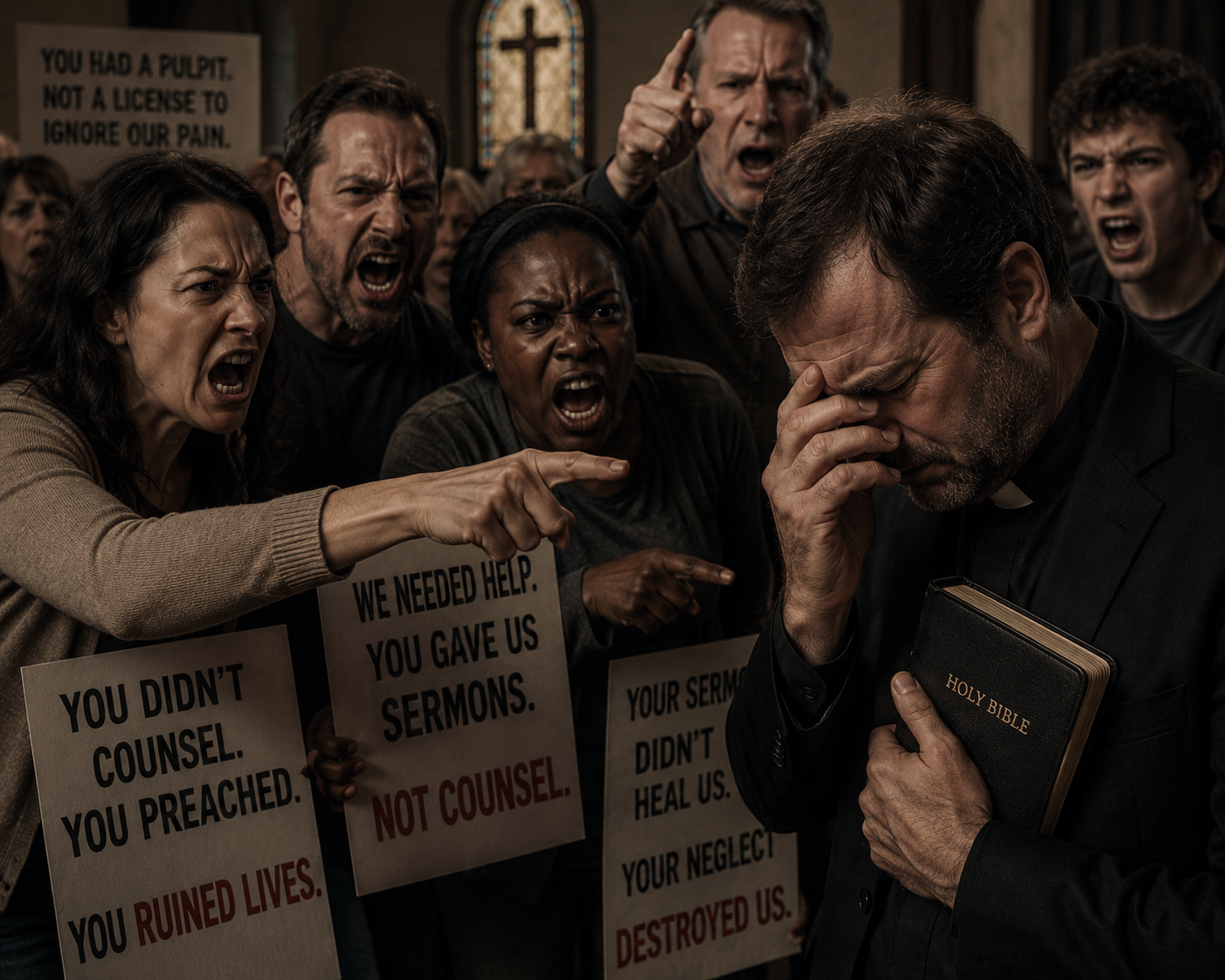

NOTES FROM DR. MICHAEL A. SCORDATO’S CLASSROOM TEACHINGS
Every Sermon Is Biblical Counseling: A Biblical Case for Reclaiming the Pulpit
James’s son is in a hospital bed from a drug overdose. His daughter won’t return his calls. His wife just filed separation papers. And every Sunday for three years, James sat faithfully in a pew, listened to his pastor, and walked away without once hearing what the Bible actually required of him.
This is not a hypothetical. Versions of this story have played out in homes, marriages, and families all across the modern church — not because people stopped attending, but because the words spoken from the pulpit stopped meaning anything. They were warm. They were affirming. They were, in the most dangerous way possible, empty.
Most churchgoers assume counseling happens behind closed doors, in structured sessions with a trained professional. Preaching, they assume, is simply inspirational teaching — a different category entirely. This assumption is not only wrong. It is lethal.
“Where no counsel is, the people fall; but in the multitude of counselors there is safety.” —Proverbs 11:14 NKJV
The pulpit is not a stage for inspiration. It is the most powerful counseling platform in any community. Every sermon shapes what people believe about marriage, sin, forgiveness, identity, suffering, and God Himself. It forms convictions. It directs decisions. It either leads people toward life — or quietly, week by week, toward destruction.
The question is not whether the sermon counsels. It always does. The only question is this: Is that counsel biblical?
This essay establishes three claims from Scripture and logic: (1) counsel is a foundational biblical concept inseparable from public proclamation, (2) every sermon functions as a form of biblical counseling whether acknowledged or not, and (3) the church must reclaim the pulpit as a place of faithful, whole counsel — with full awareness of the weight and consequence that responsibility carries.
SHEPHERD’S WAY (The Setting’s Example Prologue)
The Quiet Turning of Shepherd’s Way Church Congregation
Shepherd’s Way Church was known throughout the town as a pleasant place. People smiled when they spoke of it. The sermons were encouraging, the atmosphere warm, and no one ever left feeling uncomfortable. Pastor Daniel Harper had built that culture intentionally. He believed a happy congregation was a healthy one.
Over the years, attendance grew. Compliments flowed freely: “Your sermons always make me feel better.” “I never feel judged here.” “You really understand people.” Daniel took those words as confirmation that he was shepherding well. But something subtle was happening beneath the surface.
Marriages were quietly unraveling. Sin was being renamed as “struggle” without repentance. Counseling sessions became exercises in affirmation rather than transformation. Scripture was referenced, but rarely opened deeply. Hard truths were softened, then avoided altogether. Daniel told himself he was being loving.
Then one Sunday, everything changed.
A longtime member stood during the closing song—not angrily, but trembling. With tears in her eyes, she said softly, “Pastor, I love you—but I don’t know how to obey God anymore. I don’t know what the Bible actually says. I don’t think you ever taught us how.” The room fell silent. The Pastors feathers wear ruffled to cause a shock.
That week, Daniel couldn’t sleep. Compliments no longer comforted him. He reread Paul’s charge to Timothy: “Preach the word… reprove, rebuke, exhort, with all longsuffering and doctrine.” The words felt heavy, unavoidable.
For the first time in years, Daniel knelt alone in the sanctuary and wept—not from accusation, but conviction. He realized he had been counseling emotions while neglecting souls. He had aimed for peace instead of truth, comfort instead of clarity, approval instead of faithfulness.
Repentance was not instant repair—it was costly obedience.
The following Sunday, Daniel stood before the church and confessed openly. He admitted that he had feared displeasing people more than displeasing God. He committed to teaching Scripture plainly, even when it was uncomfortable. Some people left. But others leaned in. Counseling changed. Scripture was no longer used as decoration but as direction. Sin was addressed with both truth and grace. Accountability returned. Prayer deepened. Tears still came—but now they led to repentance, healing, and renewed joy. Marriages were restored—not through affirmation alone, but through biblical repentance and obedience. Young believers learned how to read and apply the Word for themselves. The church grew slower now—but deeper.
Years later, Shepherd’s Way was no longer described as merely “pleasant.”
It was described as faithful.
And Daniel, once driven by the desire to make people happy, had become what he was always called to be—a shepherd who loved his flock enough to lead them by the Word of God, no matter the cost. All this happened because pastor Daniel went from being popular inspirational to a biblical counsel.
Part One — The Unraveling
THE STONEWELL FAMILY: BROKEN BY EMPTY SERMONS, HEALED BY TRUTH
Abe Stonewell sat in the sanctuary of Shepherd’s Way Church, his arm around his wife Sarah, as Pastor Daniel delivered another gentle, affirming message about “embracing your authentic self” and “finding peace in your feelings.”
It sounded nice. It always did.
But at home, nothing felt nice anymore.
Three years earlier, when they’d joined the church, Sarah had been warm and engaged. Now she was distant. Abe couldn’t quite place when it changed. Was it when they’d stopped having difficult conversations? When disagreements were always smoothed over with “God loves you as you are” instead of “let’s work through this biblically”?
Their teenage daughter, Cathy, had started dating a non-believer six months ago. When Abe expressed concern, Pastor Daniel had counseled them privately: “Don’t be judgmental. Love her where she is. She needs to feel accepted, not condemned.” The sermon that Sunday had reinforced it: “Grace means never making anyone uncomfortable with your standards.”
Cathy interpreted that as permission. The relationship deepened. So did the distance between her and her parents.
Their son, James, was struggling with addiction to pornography—a battle he’d confessed to Abe in tears. But when they brought it to the church’s “counseling,” they were told: “We all struggle. What matters is that you’re trying. Don’t be too hard on yourself.” No one mentioned repentance. No one addressed the sin directly. The message from the pulpit that month had been about “overcoming shame,” which somehow became code for “don’t feel guilty about anything.”
Abe felt it too—a creeping sense that his own marriage was built on feelings, not foundations. When Sarah suggested they might need to separate because she “wasn’t happy,” Abe didn’t know what to say. The church had never taught them that happiness was not the measure of a marriage. Commitment was. Obedience was. Working through difficulty was.
Pastor Daniel’s counseling sessions had become exercises in validation. “How are you feeling about this?” was always the first question. What does Scripture say? was rarely asked.
—
One Wednesday evening, Abe attended a men’s Bible study at a neighboring church—something he did quietly, without mentioning it at Shepherd’s Way. A pastor there was walking through 2 Timothy 3, and he stopped at verses 16–17:
“All Scripture is given by inspiration of God, and is profitable for doctrine, for reproof, for correction, for instruction in righteousness: That the man of God may be complete, thoroughly equipped for every good work.”
The visiting pastor said something that hit Abe like cold water: “Notice it doesn’t say Scripture is profitable for making you feel good. It says reproof. Correction. That means addressing what’s wrong, not just affirming what is.”
Abe drove home in silence, tears streaming down his face. He realized Shepherd’s Way had never reproved anything. Never corrected anyone. Never called anyone to repentance. It had only affirmed.
And his family was falling apart because of it.
—
I. The Biblical Foundation of Counsel
Before the sermon can be understood as counseling, counsel itself must be understood as Scripture defines it. The biblical concept of counsel is not a private, clinical, modern invention. It is a foundational theme woven throughout the Old and New Testaments, portrayed consistently as essential to safety, wisdom, and righteous living.
The book of Proverbs alone repeats the theme with striking insistence:
“Where no counsel is, the people fall; but in the multitude of counselors there is safety.” —Proverbs 11:14 NKJV
“Without counsel, plans go awry, but in the multitude of counselors they are established.” —Proverbs 15:22 NKJV
“For by wise counsel you will wage your own war, and in a multitude of counselors there is safety.” —Proverbs 24:6 NKJV
The repetition is deliberate. Scripture does not treat counsel as optional or situational. It is presented as a structural necessity for individuals and communities alike. Where it is absent, people fall. Where it is present, they are established. The logic is simple: counsel is not a luxury offered to the struggling — it is the daily architecture of a life well-ordered before God.
Critically, none of these passages restrict counsel to private conversation. The Hebrew word translated “counsel” — etzah — refers broadly to advice, guidance, deliberation, and direction. It encompasses private conversation, communal deliberation, and public instruction. The setting is incidental. The function is what matters.
This theme finds its ultimate expression in Isaiah’s prophecy of the coming Messiah:
“And His name will be called Wonderful, Counselor, Mighty God, Everlasting Father, Prince of Peace.” —Isaiah 9:6 NKJV
Christ is not titled “Wonderful Therapist” or “Wonderful Life Coach.” He is the Wonderful Counselor — the One whose word provides perfect wisdom, direction, and guidance to all who will receive it. Since Christ is the ultimate Counselor, any faithful proclamation of His Word necessarily participates in His counseling work. To preach Christ is to counsel people toward Christ. The two cannot be separated.
Paul reinforces this in his farewell to the Ephesian elders, identifying the non-negotiable content of his ministry:
“For I have not shunned to declare to you the whole counsel of God.” —Acts 20:27 NKJV
The phrase “whole counsel” is significant. Paul did not preach selectively — only the comforting passages, only the motivational themes, only what was culturally palatable. He declared the whole counsel. Partial truth, he understood, produces partial obedience. And partial obedience leaves people half-formed — spiritually vulnerable and practically unequipped.
II. The Sermon as Biblical Counseling
With the biblical definition of counsel established, the argument follows naturally: a sermon, faithfully delivered from Scripture, is a form of biblical counseling. This is not a claim that every sermon is equivalent to a private therapy session. It is the claim that the purpose, source, and consequence of faithful preaching are identical to the purpose, source, and consequence of biblical counseling.
The clearest biblical statement on this principle is Paul’s charge to Timothy:
“All Scripture is given by inspiration of God, and is profitable for doctrine, for reproof, for correction, for instruction in righteousness, that the man of God may be complete, thoroughly equipped for every good work.” —2 Timothy 3:16–17 NKJV
Each of these four functions — doctrine, reproof, correction, instruction — maps directly onto what counseling does:
- Doctrine establishes belief, forming the cognitive and theological framework through which a person understands themselves, God, relationships, and suffering.
- Reproof confronts error — whether in thinking or in conduct — by holding reality up to the standard of God’s Word.
- Correction restores right direction after reproof, offering a path back toward obedience.
- Instruction in righteousness trains ongoing habits of thought and action, equipping for future decisions.
This is precisely what biblical counseling does. And it is precisely what a faithful sermon does when Scripture is its source and transformation is its aim.
Some may object that counseling, by definition, is personal — while a sermon addresses a room. This objection dissolves under the weight of two passages. The first is the account of Pentecost:
“Now when they heard this, they were cut to the heart, and said to Peter and the rest of the apostles, ‘Men and brethren, what shall we do?'” —Acts 2:37 NKJV
Peter’s sermon was delivered to thousands. Yet the Word pierced each listener individually, producing personal conviction, personal repentance, and personal response. The delivery was public. The impact was intimate. Scripture does not require a one-to-one setting for a one-to-one impact.
The second passage addresses the nature of the Word itself:
“For the word of God is living and powerful, and sharper than any two-edged sword, piercing even to the division of soul and spirit, and of joints and marrow, and is a discerner of the thoughts and intents of the heart.” —Hebrews 4:12 NKJV
The Word of God is not passive content delivered into a passive audience. It is a living instrument that actively discerns — judges, evaluates, exposes — the inner life of each hearer. A sermon that faithfully opens and applies the Word of God is therefore not merely an address to a group. It is a living encounter between the Word and every individual heart in the room.
Logically: counseling is defined not by its setting, but by its function. If counsel shapes thinking, corrects behavior, convicts the heart, and directs life decisions, it is counseling — regardless of whether it happens in a private office or a public sanctuary. A sermon may be general in delivery, but it is invariably personal in impact.
—
Part Two: The Breaking Point
The collapse came swiftly after that.
Cathy moved out to live with her boyfriend. James overdosed—not fatally, but seriously enough that he was hospitalized. Sarah filed for separation papers. Abe felt the weight of a life built on sand, crumbling beneath him.
In desperation, he went to see Pastor Daniel. Not for affirmation this time, but for answers.
“Pastor, I need to know what the Bible actually says about marriage. About sin. About raising children in faith. I’ve sat in your sermons for three years, and I don’t think I know.”
Pastor Daniel looked uncomfortable. “Abe, the Bible is a book of grace. I don’t want to shame anyone—”
“My son is in a hospital bed from a drug overdose. My daughter won’t speak to me. My wife is leaving me. I don’t need grace that costs nothing, Pastor. I need truth.”
The words hung in the air between them, with Pastor Daniel already having the desperate plea presented to him by Abe’s wife during the last service where she came alone claiming she does not know how to obey God anymore nor what the Bible actually says because he never taught her how.
—
That Sunday, Pastor Daniel didn’t preach his planned sermon about “discovering your purpose.”
Instead, he stood at the pulpit, visibly shaken, and told the Stonewell family’s story—with their permission. Not to shame them, but to expose his own failure.
“I have been counseling your emotions while neglecting your souls,” he said, his voice trembling. “I have treated this pulpit as a place to make you feel better, not to make you better. I have whispered when I should have proclaimed. I have affirmed when I should have confronted. I have hidden from the hard passages of Scripture, and in doing so, I have hidden the Gospel itself.”
He read 2 Timothy 3:16–17 aloud. Then Ezekiel 33:7–8, about the watchman’s responsibility to warn people of danger.
“For three years, I have failed to be a watchman. I have watched families splinter without addressing sin. I have watched believers drift into compromise without calling them to obedience. I have called this ‘love,’ but it was cowardice.”
Pastor Daniel then outlined a commitment:
– Every sermon would be grounded in the whole counsel of God—not cherry-picked passages.
– Sin would be named as sin, always with grace, but never minimized.
– Counseling would address what Scripture says, not just what people feel.
– The church would hold itself and each other accountable.
Some people left that day. They wanted the old Shepherd’s Way—the comfortable, affirming one. About forty people walked out.
But others leaned in.
—
III. Addressing Common Objections
Several objections are routinely raised against the claim that sermons function as biblical counseling. Each deserves a direct response from both Scripture and logic.
Objection 1: A sermon is not personal enough to be counseling.
Modern counseling is often assumed to require a private, individualized setting. Because sermons address crowds, critics conclude they lack the personal dimension necessary for true counsel.
This confuses the setting of counsel with the function of counsel. As Acts 2:37 demonstrates, public proclamation pierced individual hearts to the point of life-altering response. As Hebrews 4:12 confirms, the Word actively discerns the thoughts and intents of each hearer. A sermon may be general in delivery — it is never general in impact.
Objection 2: Preaching is teaching, not counseling.
Critics attempt to separate doctrinal instruction from the relational work of addressing life problems. But 2 Timothy 3:16–17 makes no such distinction. Doctrine, reproof, correction, and instruction are presented as a unified whole — all profitable, all necessary, all arising from the same inspired source. Colossians 1:28 makes Paul’s method explicit:
“Him we preach, warning every man and teaching every man in all wisdom, that we may present every man perfect in Christ Jesus.” —Colossians 1:28 NKJV
Warning and teaching are not separate ministries. They are simultaneous functions of faithful proclamation. The moment preaching confronts sin, redirects behavior, comforts suffering, or gives guidance for living — it has functioned as counseling, whether or not it wears that label.
Objection 3: Counseling requires dialogue; sermons are one-directional.
This objection assumes that without immediate verbal response, counseling cannot occur. But Nehemiah 8:8–9 demonstrates that public exposition of Scripture produced deep repentance and changed lives — without any back-and-forth dialogue during the event. Romans 10:17 confirms that the mechanism of transformation is hearing:
“So then faith comes by hearing, and hearing by the word of God.” —Romans 10:17 NKJV
Dialogue can deepen counsel. It is not the condition for counsel to occur. Conviction, reflection, and response — the internal movements of biblical change — happen in the heart of the hearer, not necessarily in the vocal exchange between speaker and listener.
Objection 4: Calling sermons ‘counseling’ overburdens pastors.
This objection seeks to protect pastors from accountability by narrowing their perceived role. Scripture moves in the opposite direction:
“Let not many of you become teachers, knowing that we shall receive a stricter judgment.” —James 3:1 NKJV
“So you, son of man: I have made you a watchman for the house of Israel; therefore you shall hear a word from My mouth and warn them for Me.” —Ezekiel 33:7–8 NKJV
Influence increases accountability — it does not diminish it. Denying the counseling function of sermons does not lighten the pastor’s responsibility. It simply leaves the congregation unprotected and the pastor unprepared for the weight he was always carrying.
Objection 5: Sermons are not meant to be taken that seriously.
This reflects the cultural drift toward treating Sunday messages as inspirational content — optional, entertaining, designed to improve mood rather than shape life. Jesus rejected this framework directly:
“But everyone who hears these sayings of Mine, and does not do them, will be like a foolish man who built his house on the sand: and the rain descended, the floods came, and the winds blew and beat on that house; and it fell. And great was its fall.” —Matthew 7:26–27 NKJV
If sermons are not meant to direct life, why preach them at all? Jesus assumed that hearing His Word created moral obligation. To treat the sermon as optional inspiration contradicts Scripture’s own expectations — and produces exactly the kind of rootless Christianity that crumbles under pressure.
Objection 6: Counseling should be left to professionals.
The professionalization of mental health has created a false division: the secular therapist handles life problems; the pastor handles spiritual inspiration. Scripture does not recognize this partition:
“Now I myself am confident concerning you, my brethren, that you also are full of goodness, filled with all knowledge, able also to admonish one another.” —Romans 15:14 NKJV
Biblical counseling is part of the professional care for clinical conditions. It as well goes further to address the moral, spiritual, and worldview questions underlying problems that no secular system is equipped to answer — questions about the roots of sin, repentance, identity, hope, and what God has to share to empower overcoming. These questions are answered in the Bible. They belong in the pulpit.
Part Three: The Long Rebuild
The Stonewell family didn’t heal overnight. This wasn’t a Hollywood redemption story.
James went to a rehabilitation program that grounded recovery in biblical repentance, not just behavioral modification. For the first time, he addressed the sin—not just the symptom. It was painful. It required confession, accountability, and genuine change. But six months into recovery, he told his father: “Dad, I needed someone to tell me the truth. Not that what I was doing was okay. That it was destroying me. And that God’s way was better.”
Cathy’s relationship ended—not because her parents forced it, but because Pastor Daniel invited her into a Bible study on relationships, and she began to understand what Scripture actually said about being “unequally yoked.” It took months. There was anger. But there was also clarity. When the relationship ended, it was her decision, grounded in truth rather than imposed through control.
Sarah almost completed the separation. But when she attended a women’s study where Scripture on marriage was taught without minimization, something shifted. She realized she’d been making decisions based on feelings, not conviction. With Abe, she pursued genuine counseling—biblical counseling that addressed both grace and responsibility. They began to rebuild, not on the foundation of “staying together to be happy,” but on the foundation of “working through difficulty because God designed marriage to shape us into Christ’s image.”
It wasn’t easy. There were real, deep issues to work through. But they had direction now. They had truth.
—
IV. The Biblical Model of Contextual Counsel: Paul on Mars Hill
Accepting that sermons are a form of biblical counseling raises an equally important question: how should that counsel be delivered? Scripture does not merely assert the function of public proclamation — it models its method. The clearest New Testament example is Paul’s address on Mars Hill in Acts 17.
Athens was a city saturated with competing philosophies and idols. Paul did not arrive condemning the culture from a distance. He engaged it directly — entering the marketplace, observing its objects of worship, and building his proclamation from within its own framework:
“For as I was passing through and considering the objects of your worship, I even found an altar with this inscription: TO THE UNKNOWN GOD. Therefore, the One whom you worship without knowing, Him I proclaim to you.” —Acts 17:23 NKJV
Paul’s strategy was not compromise — it was a bridge. He began with what the Athenians already believed and used it to expose what they did not yet know. When he addressed human identity, he quoted not Moses but the Athenians’ own poets:
“For in Him we live and move and have our being, as also some of your own poets have said, ‘For we are also His offspring.'” —Acts 17:28 NKJV
He was not borrowing from paganism to soften the Gospel. He was demonstrating that even pagan thought contained inklings of truth that pointed toward Christ — and then using those inklings as launching pads for the full proclamation of the resurrection.
The Three-Phase Method
Paul’s Mars Hill approach provides a replicable framework for any preacher seeking to counsel a congregation through public proclamation:
- Build a bridge. Begin with what the listener already knows, values, or wonders about. Validate the spiritual instinct beneath the wrong conclusion before addressing the conclusion itself.
- Challenge through their own framework. Rather than condemning the error from outside, dismantle it from within — using the logic of their own beliefs. Paul argued: if we are God’s offspring, then God cannot be made of stone. The idol collapses under its own premises.
- Pivot to Christ. Once the bridge is built and the misunderstanding challenged, move directly to the foundational Christian claims — the Creator God, the call to repentance, the resurrection of Jesus.
The results on Mars Hill were what faithful biblical counseling always produces: some rejected the message immediately, some delayed and sought further engagement, and some believed and were transformed. Paul later described the underlying philosophy:
“I have become all things to all men, that I might by all means save some.” —1 Corinthians 9:22 NKJV
This is not pragmatic compromise. It is cultural intelligence in service of an unchanging Gospel — and it is a model every preacher-counselor must internalize.
—
Part Four: The Transformation of Shepherd’s Way
Over the next two years, Shepherd’s Way Church changed fundamentally.
Sermons became longer, deeper, and harder. Pastor Daniel stopped trying to fit Scripture into thirty minutes of feel-good inspiration. He opened the Word and let it speak. Some Sundays it was about grace. Other Sundays it was about judgment, holiness, repentance, and the cost of discipleship.
Small groups didn’t just discuss “how are you feeling?” They wrestled with what Scripture actually demands of believers. Hard conversations happened. People confessed sins they’d been hiding for years. Marriages were repaired. Addictions were addressed. Generosity increased. Pride was confronted.
Young people in the youth group began to understand that Christianity wasn’t about being nice—it was about being holy. They learned to read Scripture for themselves and apply it. Some of them became the most grounded believers in the congregation.
As soon as they started teaching longer line-by-line, verse-by-verse when right then their denomination dropped their congregation since they were no longer like their movement, but they found like minded nondenominational network and became Shepard’s Way Calvary Chapel opening up a Harvest Church study on Wednesday every week.
The church grew slower than before. Attendance actually dropped initially. But those who stayed were committed. They were being discipled, not just entertained. They were being transformed, not just affirmed.
Three years after his confession, Pastor Daniel looked at the congregation differently. It was smaller, yes. But it was deeper. More mature. More faithful.
—
V. Practical Steps for Reclaiming the Pulpit
Recognizing the sermon as biblical counseling is not merely a theological position — it demands practical change in how pastors prepare, preach, and pastor. Five concrete steps follow from the biblical evidence established above.
“Death and life are in the power of the tongue, and those who love it will eat its fruit.” —Proverbs 18:21 NKJV
1. Reframe the Pulpit as a Place of Counsel, Not Just Content
Every sermon must be prepared with awareness that it is actively shaping lives. This requires the preacher to ask three questions during preparation: What belief is this forming? What behavior is this correcting or encouraging? What hope or warning is this providing?
If words carry power — and Scripture insists they do — then treating the pulpit as a counseling space is not a burden. It is an awakening to responsibility that was always there. Proverbs 18:21 does not say death and life are in the power of the wrong words. It says death and life are in the power of the tongue — period. The only question is which the sermon delivers.
2. Ground Every Message in the Whole Counsel of God
Selective, theme-only preaching that bypasses difficult truths does not protect congregations from discomfort. It exposes them to destruction. As Paul warned in Acts 20:27, the faithful minister declares the whole counsel — not the palatable portions.
This means preaching on grace and judgment, on mercy and holiness, on comfort and repentance, on the promises of God and the demands of discipleship. Whole counsel produces whole disciples. Partial counsel produces people who are spiritually warm but practically unprepared — exactly the condition of Abe Stonewell’s family before everything collapsed.
3. Preach with Application That Demands Response
Information without application produces spiritual spectators, not disciples. James 1:22 makes this explicit:
“But be doers of the word, and not hearers only, deceiving yourselves.” —James 1:22 NKJV
Every sermon must clearly answer: What must change? What must be believed? What must be practiced this week? Vague encouragement — “trust the process,” “be your best self,” “God loves you as you are” — does not meet this standard. Specific application turns sermons from inspiration into discipleship.
4. Strengthen Counsel Through Community Reinforcement
A sermon heard once in a room is counsel delivered. A sermon repeated, discussed, and applied in community is counsel that becomes formation. The gathering of believers was designed for this purpose:
“And let us consider one another in order to stir up love and good works, not forsaking the assembling of ourselves together, as is the manner of some, but exhorting one another, and so much the more as you see the Day approaching.” —Hebrews 10:24–25 NKJV
Small groups, accountability partnerships, prayer gatherings, and informal follow-up conversations extend the reach of sermon counsel into the daily rhythms of life. When the Word preached on Sunday is examined and applied on Tuesday, belief turns into habit, and habit turns into character.
5. Model Humility and Accountability from Leadership
A congregation cannot be expected to receive correction from a pulpit occupied by someone who never visibly submits to correction himself. The pastoral model of accountability is not incidental — it is foundational. Paul anchored his call to imitation in personal example:
“Imitate me, just as I also imitate Christ.” —1 Corinthians 11:1 NKJV
When leaders publicly acknowledge their own growth, confess their own failures, and demonstrate that the Word they preach actually governs their own lives, they build the trust necessary for the congregation to receive hard counsel without defensiveness.
—
Part Five: The Stonewell Family Five Years Later
Abe stood in the sanctuary on a Sunday morning, watching his son James lead the college-and-career Bible study on the book of Romans. James was now twenty-two, sober for four years, and studying theology. His testimony about recovery was grounded in repentance, not just sobriety.
Sarah was beside him, holding the hand of their daughter Cathy, who had recently gotten engaged to a young man from the church—a believer who loved God’s Word and wasn’t afraid to live it out. Cathy had become one of the most passionate Bible students in the women’s group.
Pastor Daniel’s sermon that morning was on Proverbs 11:14: “Where no counsel is, the people fall; But in the multitude of counselors there is safety.”
“Five years ago,” Pastor Daniel said, looking directly at the Stonewells with tears in his eyes, “I failed to give this church counsel. I gave comfort instead. And it nearly cost this family everything. But because one family was willing to break, God was willing to break me of my cowardice. And from that breaking, this church has been rebuilt on truth.”
He paused, scanning the congregation.
“Every word I speak from this pulpit is counseling you. It’s shaping what you believe about marriage, about sin, about God, about yourself. That weight used to terrify me. Now it humbles me. Because I finally understand: words are never neutral. My job isn’t to make you happy. My job is to shepherd you toward holiness, even when it’s uncomfortable.”
—
VI. God Does Not Leave Us Without Examples: Biblical Methodology in Counsel
Scripture not only asserts that counsel is essential — it demonstrates, in vivid and repeatable detail, how that counsel is to be given. God is not a theorist. He is a practitioner. Throughout the Old and New Testaments, He provides His servants with living models of how to speak truth to people in ways that actually reach, move, and transform them. These models are not ornamental. They are instructional — given precisely so that those who teach, preach, and counsel can imitate them. Here are some of the examples, but not all as there are more.
The following represent the primary biblical methodologies of counseling in practice. Each one carries a distinct approach calibrated to a specific kind of person, problem, or cultural setting. Taken together, they form a comprehensive toolkit for anyone who believes that words carry the weight of God’s counsel.
1. Jesus and the Parable Method: Truth Wrapped in Story
Jesus was the master teacher, and His preferred instrument was either object lessons or the parable. He did not choose this form because it was entertaining. He chose it because of how the human heart receives truth. A direct confrontation with sin or error raises immediate defenses. A story, however, invites the listener in — and allows conviction to arrive before the guard goes up.
The parable of the Prodigal Son in Luke 15 is perhaps the most complete counseling session in Scripture. In a single narrative, Jesus addresses the rebellion of the younger son, the self-righteousness of the elder son, and the character of the Father — all without ever directly accusing the Pharisees who had prompted the story by grumbling that Jesus received sinners. The parable does the work. By the time the elder son refuses to enter the feast, every Pharisee in earshot has heard his own voice coming out of that character’s mouth. Jesus never named them. He did not need to.
“Then He said: ‘A certain man had two sons. And the younger of them said to his father, “Father, give me the portion of goods that falls to me.” So he divided to them his livelihood.'” —Luke 15:11–12 NKJV
The Nathan Principle — named for the prophet Nathan’s confrontation of King David in 2 Samuel 12 — follows the same logic. David had committed adultery with Bathsheba and arranged the death (murder) of her husband Uriah. Nathan did not walk into the palace and accuse the king. He told him a story: a rich man who stole a poor man’s only lamb. David’s outrage was immediate. ‘The man who has done this shall surely die!’ And then Nathan delivered the four most devastating words of pastoral confrontation in the Old Testament:
“Then Nathan said to David, ‘You are the man!'” —2 Samuel 12:7 NKJV
The story had done its work. David’s defenses were already down. He had already pronounced judgment on himself. Repentance followed — not because Nathan was aggressive, but because he was strategic. This is story as scalpel: precise, penetrating, and ultimately healing.
The practical implication for preachers and counselors is direct. Before the argument, before the correction, before the application — tell the story. Use narrative to create the conditions in which the heart can hear what it would otherwise refuse to receive. God invented this method. He uses it throughout Scripture. It is available to every preacher who is willing to craft their sermon with as much care for the hearer as for the content.
2. Jesus and the Ten Commandments: Using the Law as a Mirror
In Mark 10, a young man approaches Jesus with what appears to be an earnest spiritual question: ‘Good Teacher, what shall I do that I may inherit eternal life?’ On the surface, this seems like an ideal moment for a Gospel presentation. Jesus does not begin there. He begins with the Law.
“You know the commandments: ‘Do not commit adultery,’ ‘Do not murder,’ ‘Do not steal,’ ‘Do not bear false witness,’ ‘Do not defraud,’ ‘Honor your father and your mother.'” —Mark 10:19 NKJV
The young man’s confident reply — ‘Teacher, all these things I have kept from my youth’ — reveals the true problem immediately. He does not know himself. He has not yet encountered the Law at the level of the heart. Jesus does not argue with his self-assessment. Instead, He gives the young man a single command that exposes everything:
“Then Jesus, looking at him, loved him, and said to him, ‘One thing you lack: Go your way, sell whatever you have and give to the poor, and you will have treasure in heaven; and come, take up the cross, and follow Me.'” —Mark 10:21 NKJV
The young man went away grieving. Not because Jesus was unkind — the text explicitly says Jesus loved him — but because the Law had done its diagnostic work. The commandment revealed that his money was his god, and no amount of religious observance had displaced it. The grief was not the failure of the counseling encounter. It was the counseling encounter working precisely as intended. Conviction without comfortable resolution is still faithful counsel.
This is what the Reformers called the first use of the Law: to convict of sin and drive the sinner toward grace. The Law cannot save — but it can show a person why they need saving. Any preacher or counselor who bypasses the Law in a rush to offer grace has skipped the step that makes grace comprehensible. You cannot appreciate the cure until you understand the diagnosis.
Practically, this means that biblical counseling must be willing to name what is wrong before offering what is right. Comfort extended to someone who does not yet know they need it is not pastoral care — it is premature reassurance. The mirror must come before the remedy.
3. Paul’s Letter Method: Affirmation Before Correction
Paul’s epistles exhibit a consistent pastoral pattern that is as strategically sound as it is theologically rich: he almost always establishes what is true and praiseworthy about his readers before he addresses what needs to change. This is not flattery deployed to soften difficult truths. It is a recognition that people are far more able to receive correction from someone they know is genuinely for them.
The letter to the Philippians opens with one of Paul’s warmest expressions of pastoral affection:
“I thank my God upon every remembrance of you, always in every prayer of mine making request for you all with joy, for your fellowship in the gospel from the first day until now.” —Philippians 1:3–5 NKJV
Even his most theologically dense letter — Romans — begins not with accusations but with gratitude and recognition: ‘your faith is spoken of throughout the whole world’ (Romans 1:8). He builds relational credibility before he builds theological argument.
The letter to the Corinthians is the starkest example of how this works under pressure. The Corinthian church had serious problems: division, sexual immorality, lawsuits between believers, abuse of the Lord’s Supper, and doctrinal confusion about the resurrection. Paul opens his letter not by listing their failures but by identifying what God has already done in them:
“I thank my God always concerning you for the grace of God which was given to you by Christ Jesus, that you were enriched in everything by Him in all utterance and all knowledge.” —1 Corinthians 1:4–5 NKJV
Only after this foundation of grace and identity does he say — gently but without ambiguity — ‘Now I plead with you, brethren, that there be no divisions among you’ (1 Corinthians 1:10). The correction arrives after the affirmation, not instead of it. The reader receives the hard word from someone who has already demonstrated that they see the good.
For the preacher, the pastoral letter method means beginning sermons — and counseling sessions — by anchoring people in who they are in Christ before addressing what they must do differently. A person who loves the community more than truth will destroy both. But the person who speaks truth from genuine love will be received where a mere critic never could be.
4. Paul on Mars Hill: Cultural Intelligence in Service of Unchanging Truth
The Mars Hill address of Acts 17 has already been introduced in Section IV as the model for contextual proclamation. It deserves deeper examination here as a methodology in its own right, because what Paul demonstrates is not merely rhetorical technique — it is a theological conviction about where people already are when the counselor meets them.
Paul does not begin by dismissing Athenian culture as worthless. He does something far more sophisticated: he looks for what is true in it, partial as that truth may be, and uses it as a bridge. The altar to the Unknown God is not evidence of paganism’s bankruptcy — it is evidence of a spiritual hunger that paganism could not satisfy. Paul names that hunger and tells the Athenians that the One they are reaching toward has a name and a history and a resurrection.
“So that they should seek the Lord, in the hope that they might grope for Him and find Him, though He is not far from each one of us.” —Acts 17:27 NKJV
Paul then quotes not the Psalms but the Athenian poet Aratus: ‘We are also His offspring.’ He is not endorsing paganism. He is demonstrating that even pagan insight, when properly understood, points toward the God of Scripture. By quoting their own authorities, Paul disarms the suspicion that he is simply a foreign importer of alien ideas. He shows that what he is proclaiming completes what they were already, however imperfectly, reaching for.
The counseling application is this: people do not arrive at the pastor’s office or the church pew as blank slates. They arrive with worldviews, questions, wounds, assumptions, and — buried beneath all of it — a created longing for God that has often been misdirected toward something else. The biblically intelligent counselor does not simply overwrite what is there. They find the altar — the place where genuine longing is already present — and redirect it toward Christ.
This is what Paul meant when he described his own ministerial philosophy:
“I have become all things to all men, that I might by all means save some.” —1 Corinthians 9:22 NKJV
Contextual intelligence is not compromise. It is the commitment to find the person where they actually are — not where the counselor wishes they were — and meet them there with truth calibrated to their capacity to receive it.
5. James and the Theology of Trials: Reframing Suffering Through Purpose
The epistle of James opens with what is, on its surface, an impossible command to the masses:
“My brethren, count it all joy when you fall into various trials, knowing that the testing of your faith produces patience. But let patience have its perfect work, that you may be perfect and complete, lacking nothing.” —James 1:2–4 NKJV
The command to count trials as joy is not an instruction to deny grief, perform positivity, or suppress honest emotion. It is a cognitive and spiritual discipline — the deliberate act of appraising current circumstances from an eternal vantage point. This is teleological reframing: the reinterpretation of present pain through the lens of its ultimate purpose.
James does not say the trial is good. He says the tested faith it produces is good. The distinction matters. The counselor who tells someone their suffering is fine is offering false comfort. The counselor who helps them see what their suffering is producing — perseverance, maturity, wholeness — is offering biblical hope. One speaks to the feeling. The other speaks to the future.
Notice also the sequence James describes: testing produces patience (hupomonē — the capacity to remain under a load without being crushed), and patience, given time to complete its work, produces a person who is teleios — mature, whole, lacking nothing. This is not the language of emotional recovery. It is the language of character formation. Biblical counseling that aims only at symptom relief has set its sights far below what James promises is possible. How can he launch into and say this!!! Well actually he does not start there.
James also begins his letter — before any of this — with a benediction:
“James, a bondservant of God and of the Lord Jesus Christ, to the twelve tribes which are scattered abroad: Greetings (of active joy).” —James 1:1 NKJV… “Greetings” actually in the original Koine is stating, “greetings of active joy”. You see this is a standard greeting in the Roman culture of the day wishing an active joy on someone as a blessing. So James immediately plays off of this to cultivate this joy into a reality of their daily lives even now in and through the hardships.
The word translated ‘greetings’ (chairein) carries the force of active joy — a wish of wellbeing spoken over the recipient before a single problem is identified. The methodology here is pastoral: the counselor establishes the dignity and belovedness of the person before turning to the difficulty. This is not procedural warmth. It is theological accuracy — the person across the table is, in Christ, a child of God, and that identity is prior to and greater than whatever crisis brought them into the room.
There are five principles that are not abstract ideals presented in the full ‘James-ian’ presentation. They are the architecture already present — or in some cases, conspicuously absent — in the counseling sessions. Tracing each principle back into his dialogue transforms the session from a warm illustration into a replicable model.
Practical Principles Drawn from James 1:1–4
A. Begin with Blessing, Not Diagnosis (Verse 1)
James’s letter begins with a benediction—greetings of active joy—before it addresses a single problem. Effective biblical counseling follows this shape. The counselor who opens each session with a genuine recognition of the counselee’s God-given dignity, spiritual identity, and capacity for growth is already practicing what James modeled. The person across the table is not primarily a problem to be solved; they are a brother or sister for whom active joy has been wished and, in Christ, secured.
(Begin with blessing) is modeled when the counselor’s first move is not diagnosis but welcome: “Thank you for coming in today.” What could be deepened: the counselor could name their specific dignity more explicitly — acknowledging them as believers already indwelt by the Spirit, already counted as brothers and sisters in Christ (Ephesians 1:3–5), before any problem is identified.
B. Reframe Trials Through a Teleological Lens (Verse 2-4)
The command to “count it all joy” (v.2) is not an instruction to deny grief or perform positivity. It is a cognitive and spiritual discipline: the deliberate act of appraising one’s circumstances from an eternal vantage point. Counselors can help counselees identify their long-term goals, remind them of their spiritual identity in Christ, and gently reframe current hardship as the crucible in which perseverance is being fashioned. This reframing is not escapism; it is the clear-eyed acceptance that God’s purposes outlast present pain.
(Reframe through a teleological lens) appears when a counselor says, “These trials aren’t punishments, but opportunities for growth.” What could be deepened: the reframe if stated is not demonstrated could be bettered if you walk through the specific argument of James 1:2–4 — the logic of dokimiōn (the proving) producing hupomonē (longsuffering patience) producing teleios (maturity)— would help the counselee do the theological work themselves, which produces ownership rather than compliance toward what a counselor states.
C. Honor the Process Without Rushing the Product (verse 3)
Verse three describes faith being “processed” into longsuffering—a present-tense, ongoing activity. The counselor’s role is not to accelerate this process artificially, nor to short-circuit it through premature reassurance. There is a rainbow in every drop of water: joy, courage, hope, honesty, and love are all colors that faith casts through the prism of suffering. Not every color will be vivid at every moment. In the early stages of grief, “joy” may be the thinnest color in the spectrum—and that is permitted. The counselor’s task is to assure the counselee that the capacity for joy has not been extinguished, only temporarily dimmed.
(Honor the process) this tends to be a most underrepresented principle in counselor’s dialogues. Sessions tend to move fairly quickly from the counselee’s doubt to practical action steps. A more James’ian session would have slowed down at counselee’s confession — “It feels like God is distant” — and simply remained there long enough to validate the weight of that experience before moving to application. Grief is not a problem to be solved; it is a season to be accompanied.
D. Build Toward Wholeness, Not Merely Wellness (Verse 4)
Verse four’s vision is not therapeutic stability but teleion—mature, whole, lacking nothing. Biblical counseling must resist the reduction of its goal to symptom management or emotional equilibrium. Those are worthy intermediate aims, but the telos is the formation of a person who can hold on (v.4) because their conviction persuaded to faith has been proven under fire. The counselor communicates confidence in the counselee’s capacity to reach this wholeness—a confidence grounded not in the counselee’s strength but in the faithfulness of the One who began the good work (Philippians 1:6).
(Build toward wholeness, not merely wellness) should be present in the counselor’s closing promise: “you will become more resilient and develop a deeper relationship with Him.” What could be deepened: naming the telos explicitly. The goal is not merely resilience or even relational closeness — it is teleios kai holokleros: mature and whole, lacking nothing. Giving the counslee’s that language gives them a vision large enough to carry them through multiple future trials, not just the current one.
E. Practice Mutual Joy as the Apostle Paul Modeled (Verses 1-4)
The Apostle Paul, writing to the Corinthians, chose not to come to them “in sorrow” but rather linked his own joy to their joy (2 Corinthians 2:1–3). The counselor who genuinely delights in the counselee’s growth—who takes pleasure in each small sign of perseverance and maturation—is not performing professional optimism but embodying the shared, corporate nature of biblical joy. Joy is fulfilled when it is mutual (Philippians 2:1–3). When the counselee sees that their counselor is genuinely invested in their teleion, trust deepens and the therapeutic life changing alliance becomes a vessel of grace.
(Practice mutual joy) can be reenforced best appeared when a counselor offers prayer at the close. What could be deepened: a counselor could express genuine, specific delight in their counselee’s willingness to show up, to be vulnerable, to try. “You came here today instead of giving up. That itself is the beginning of hupomonē — remaining under the load rather than running from it. That is something to count as joy.” Joy announced over the small, faithful act is how James’s “greetings of active joy” becomes flesh in a counseling room.
6. Nehemiah and Public Exposition: Corporate Counsel Through the Opened Word
The account of Ezra reading the Law to the assembled people of Israel in Nehemiah 8 is one of the most underappreciated models of public biblical counseling in Scripture. The people had returned from exile. Many of them had never heard the full text of the Law read aloud. Ezra stood on a wooden platform and read from morning until midday.
“So they read distinctly from the book, in the Law of God; and they gave the sense, and helped them to understand the reading.” —Nehemiah 8:8 NKJV
Three elements in this verse define faithful public counsel: they read distinctly (the text was clear, not paraphrased into vagueness), they gave the sense (they explained what it meant — content without interpretation leaves people lost), and they helped them understand (they made it accessible — truth untranslated into the hearer’s context remains untransferred).
The result was immediate and deeply personal. Even though the reading was delivered to a massive public gathering — not a private session — the people wept. The Word had reached individual hearts through communal proclamation. No private dialogue had occurred. No one-to-one follow-up was required in the moment. The Word, faithfully opened and explained, did its own counseling work.
The Levites then walked among the people to reinforce and comfort, directing them not to grieve but to celebrate — because the day was holy and the people were finally hearing what they had been missing:
“Then he said to them, ‘Go your way, eat the fat, drink the sweet, and send portions to those for whom nothing is prepared; for this day is holy to our Lord. Do not sorrow, for the joy of the Lord is your strength.'” —Nehemiah 8:10 NKJV
This is the complete arc of faithful pulpit counsel: open the Word clearly, explain it accessibly, apply it specifically, and then stay present with the community as the Word does its work. Ezra and the Levites did not preach and disappear. They moved among the people. The sermon was not the end of the pastoral moment — it was the beginning of it.
7. The Prophet’s Method: Direct Confrontation Without Apology
Not every counseling methodology in Scripture is indirect. The Old Testament prophets demonstrate that there are moments when faithful counsel requires directness that admits no softening. Elijah confronting Ahab. Amos preaching to the comfortable wealthy of Israel. John the Baptist addressing Herod. These are not gentle reframes or cultural bridges. They are unmediated declarations of what God says about what is happening.
Elijah’s confrontation with the prophets of Baal on Mount Carmel (1 Kings 18) is less a counseling session and more an intervention at national scale. But its structure is instructive: Elijah does not begin by condemning — he begins by asking a diagnostic question that exposes the root problem:
“And Elijah came to all the people, and said, ‘How long will you falter between two opinions? If the Lord is God, follow Him; but if Baal, follow him.’ But the people answered him not a word.” —1 Kings 18:21 NKJV
The silence of the people is itself diagnostic. They had no answer because they had never been pressed to have one. Comfortable ambiguity had been their posture for years. Elijah’s question — ‘How long will you falter between two opinions?’ — is the pastoral confrontation that every era of comfortable, compromise-tolerating religion eventually requires.
John the Baptist’s ministry follows the same pattern. He did not customize his message for the sensitivities of his audience. To the Pharisees and Sadducees, he said what needed to be said directly:
“But when he saw many of the Pharisees and Sadducees coming to his baptism, he said to them, ‘Brood of vipers! Who warned you to flee from the wrath to come? Therefore bear fruits worthy of repentance.'” —Matthew 3:7–8 NKJV
This is not cruelty dressed as preaching. John was preparing the way of the Lord — which required removing the obstacles of self-deception and religious performance that prevented people from recognizing their need for the One who was coming. The direct method is appropriate when the stakes are highest and when indirect approaches have already failed. The prophets did not use it as their default — but they did not flinch from it when the moment required it.
The preacher who never employs direct confrontation has limited their toolkit to the gentle end of the biblical spectrum and left the prophetic register entirely to silence. Both grace and warning are in the Word. Both belong in the pulpit.
8. The Synthesis: One Counselor, Many Methods
What emerges from surveying these biblical models is not a single prescribed formula but a spectrum of approaches, each suited to a different kind of person, problem, or cultural moment. Scripture does not hand the preacher a script. It hands the preacher a portfolio.
Jesus used parables for hardened religious leaders, direct commands for seekers, and tender mercy for the broken. Paul used cultural intelligence for pagans, theological argument for the doctrinally confused, and relational warmth for those he had personally discipled. The prophets used confrontation when the nation was asleep and comfort when it was crushed. Ezra used public exposition to rebuild a community that had been spiritually starved for a generation.
The through-line in every case is not the method — it is the source. Every approach, however varied in style, draws from the same reservoir: the revealed Word and character of God. The parable illuminates it. The Law enforces it. The letter embodies it. The Mars Hill address contextualizes it. The Nehemiah exposition opens it. The prophetic declaration declares it without apology.
This is why 2 Timothy 3:16–17 lists four functions rather than one. The whole counsel of God requires the whole range of methods that Scripture itself models. A preacher who knows only one approach — only the gentle, only the confrontational, only the narrative, only the expositional — will leave parts of every congregation unreached and parts of every person’s need unaddressed.
“Preach the word! Be ready in season and out of season. Convince, rebuke, exhort, with all longsuffering and teaching.” —2 Timothy 4:2 NKJV
Convince. Rebuke. Exhort. Three distinct modes, listed in the same breath, applied according to what the moment requires. The faithful counselor-preacher does not pick a favorite and settle. They remain fluent in all of them — because God, in His Word, modeled all of them — and the people in the pews on any given Sunday will need all of them.
9. A Path to Healing Through Physical and Spiritual Renewal: The Elijah Method
Sermon’s do lead to individual counseling sessions. With that stated also notice this truth God presents. The biblical counseling method God’s shows of health examination as part of the counsel. WHAT!? Yes. Even professional counselors forget this since in the midst of our struggles with anxiety and depression, we often fast-forward seeking immediate answers, overlooking the foundational importance of our physical well-being. The “Elijah Method,” as revealed in 1 Kings 19:4-9, offers a profound biblical wisdom lesson on this very point. This biblical account provides a powerful example of how God addresses our needs in a holistic manner, emphasizing that true spiritual and emotional healing often begins with attending to our physical state. This is the true state of biblical counsel.
Elijah, a prophet of God, found himself in a state of deep despair, even to the point of desiring death. He was weary, discouraged, and overwhelmed by the challenges he faced. This is a familiar feeling for many struggling with the weight of anxiety or depression. Yet, what was God’s first response? He did not immediately launch into theological debate or offer complex counseling. Instead, He addressed Elijah’s physical needs.
The Scripture tells us, “But he himself went a day’s journey into the wilderness, and came and sat down under a broom tree. And he prayed that he might die, and said, ‘It is enough! Now, Lord, take my life, for I am no better than my fathers!'” (1 Kings 19:4). Here, we see Elijah’s utter exhaustion and despair.
God’s response? He recognized the importance of restoration. “Then as he lay and slept under a broom tree, suddenly an angel touched him, and said to him, ‘Arise and eat'” (1 Kings 19:5). An angel provided food and water, the basic necessities for physical sustenance. “Then he looked, and there by his head was a cake baked on coals, and a jar of water. So he ate and drank, and lay down again” (1 Kings 19:6). The angel returned a second time, recognizing the journey ahead was too great for Elijah to continue without further sustenance. “And the angel of the Lord came back the second time, and touched him, and said, ‘Arise and eat, because the journey is too great for you.’ So he arose, and ate and drank; and he went in the strength of that food forty days and forty nights as far as Horeb, the mountain of God” (1 Kings 19:7-8).
This account highlights a crucial principle: Before we can effectively engage in spiritual or emotional healing, we must consider our physical condition. This includes not only providing nourishment and rest, as God did for Elijah, but also ensuring we are addressing any underlying physical issues. In today’s world, this means seeking appropriate medical attention, including regular check-ups, and addressing any potential physical causes or contributors to our mental and emotional struggles. Are there hormonal imbalances? Nutritional deficiencies? Sleep disorders? These physical factors can significantly impact our mental state and must be addressed as part of a comprehensive approach to healing.
Only after Elijah’s physical needs were met did God engage in deeper counsel. “And there he went into a cave, and spent the night in that place; and behold, the word of the Lord came to him, and He said to him, ‘What are you doing here, Elijah?'” (1 Kings 19:9). This illustrates the proper sequence: First, tend to the physical; then, address the spiritual and emotional.
The Body as Temple: Nurturing Physical Health for Mental and Spiritual Well-being
Our physical state is inextricably linked to our mental and spiritual well-being. Neglecting the fundamental needs of our bodies—eating, drinking, and sleeping—can severely compromise our mental health, creating a breeding ground for irritability, anxiety, depression, and cognitive impairment. Just as Elijah’s physical exhaustion contributed to his despair, our own physical neglect can hinder our ability to experience God’s peace and guidance.
The Scriptures remind us that our bodies are not merely vessels; they are temples of the Holy Spirit (1 Corinthians 6:19). Therefore, we are called to care for them with diligence and reverence, recognizing that our physical health directly impacts our capacity to glorify God.
The Impact of Neglect:
Impact of Not Eating: Skipping meals or consuming an inadequate diet can have profound effects on our mental state. Low blood sugar, a consequence of irregular eating habits, can trigger irritability, fatigue, and a general feeling of malaise. A lack of essential nutrients can also impair cognitive function, making it difficult to concentrate and think clearly. Deficiencies in vital vitamins, such as B-12, B-6, and folate, can contribute to symptoms of depression and low mood. Extreme or restrictive diets, often promoted by the world, can also increase anxiety, further exacerbating mental health challenges.
Impact of Not Drinking: Dehydration can negatively affect our mood and cognitive function, hindering the brain’s ability to operate at its best. This can lead to a sense of low mood and difficulty concentrating, making it more challenging to navigate daily life and seek God’s presence. Severe headaches often occur.
Impact of Not Sleeping: Sleep deprivation is a well-known risk factor for the development and worsening of mental health disorders, including depression and anxiety. Lack of sleep can intensify feelings of anxiety and distress, impairing our ability to regulate emotions. In severe cases, chronic sleep deprivation can even increase the risk of suicidal ideation. General confusions and psychotic behaviors, even hallucinations, hearing things can begin over time to occur— actions you normally would never think of since now have an inability to process the world properly due to lack of proper rest.
The Interconnected Web:
These physical factors are intricately intertwined. Nutrition, hydration, and sleep are all essential for maintaining the delicate balance of neurotransmitters that regulate our mood, energy levels, and overall brain function. Poor mental health often leads to a vicious cycle, where unhealthy eating, inadequate hydration, and sleep deprivation further worsen mental health conditions.
Biblical Guidance for Holistic Care:
Again the Bible provides clear guidance on caring for our bodies. 1 Corinthians 6:19-20 plainly states, “Or do you not know that your body is the temple of the Holy Spirit who is in you, whom you have from God, and you are not your own? For you were bought at a price; therefore glorify God in your body and in your spirit, which are God’s.” This verse emphasizes the sacredness of our bodies and the responsibility we have to care for them for God’s glory.
1 Corinthians 3:16-17 before provides a stern warning: “Do you not know that you are the temple of God and that the Spirit of God dwells in you? If anyone defiles the temple of God, God will destroy him. For the temple of God is holy, which temple you are.” These verses underscore the importance of treating our bodies with respect, recognizing that neglecting our physical health can have serious consequences.
Moreover, 1 Corinthians 10:31 encourages us, “Therefore, whether you eat or drink, or whatever you do, do all to the glory of God.” This principle applies to all aspects of our lives, including our eating and drinking habits. We are to make choices that honor God and promote our well-being.
Colossians 3:17 adds another layer of encouragement: “And whatever you do in word or deed, do all in the name of the Lord Jesus, giving thanks to God the Father through Him.” Every action, including the choices we make regarding our physical health, should be done in the name of Jesus, with a spirit of gratitude towards God.
By embracing these biblical principles, we can prioritize our physical health as an integral part of our journey towards mental and spiritual wholeness. Just as Elijah’s physical needs were addressed before he could receive further heavier counsel, so too must we tend to our bodies, providing the nourishment, hydration, and rest they require to function optimally. This is not mere self-care; it is an act of worship, a way of glorifying God with the temples He has entrusted to us.
The Elijah Method reminds us that neglecting our physical well-being can hinder our progress toward healing. It’s a call to examine ourselves holistically, recognizing that our bodies and spirits are interconnected. By following God’s example, we can embark on a path of healing that embraces both our physical and spiritual needs, leading us to a more complete and lasting restoration.
—
The Epilogue Of Shepherd’s Way Now
Ten years later, the now Shepherd’s Way Calvary Chapel was known throughout the region not for being “pleasant,” but for being faithful. Marriages were strong. Young people were grounded in Scripture. Addictions were being addressed biblically. The poor were cared for with both compassion and accountability. Evangelism was bold because the Gospel was actually being preached, not softened.
The Stonewell family became one of the most influential families in the church, not because they were perfect, but because they were honest. Abe led a men’s group on biblical leadership. Sarah taught a study on biblical womanhood. Cathy, now married, led a young women’s discipleship. James continued in ministry, eventually becoming an associate pastor—not because he had it all figured out, but because his brokenness had been redeemed through truth.
Pastor Daniel never regretted his repentance. Yes, some people had left. Yes, growth was slower now. Yes, sermons were harder to preach because they actually demanded something of people.
But families were being saved. Hearts were being changed. The Gospel was being proclaimed with power, not just pleasantness.
And one family’s collapse had become the catalyst for an entire congregation’s transformation.
Because every sermon is counseling.
And when that counsel finally became biblical—grounded in truth, delivered with grace, and calling people to genuine transformation—everything changed.
—
The Unavoidable Truth
Every sermon is counseling. If you do not treat it this way, then your congregation will simply prefer only the worship service disregarding anything you state. “‘Should just have Sunday full of singing, that is all I need”. I hear this coming from so many congregations way too often weekly. Every act of preaching carries consequence. The congregation sitting in the pews is not passively receiving information — they are being formed. Their beliefs about God, marriage, sin, identity, suffering, and hope are being shaped week after week by the words spoken from the pulpit. Whether or not the pastor acknowledges this reality does not change it. It only determines whether he shepherds with awareness or with negligence.
The biblical evidence is unambiguous. Scripture defines counsel broadly, as essential to community life and inseparable from public instruction. Jesus Himself is the Wonderful Counselor — meaning that faithful proclamation of His Word participates directly in His counseling work. Paul charged Timothy to use Scripture for doctrine, reproof, correction, and instruction — the four functions of biblical counseling. The Word of God, as Hebrews 4:12 declares, actively discerns the hearts of individual hearers regardless of how many are in the room. And as demonstrated through the parables of Jesus, the Law’s diagnostic use, Paul’s letter method, the Mars Hill address, the pastoral reframing of James, the public exposition of Nehemiah, and the prophetic directness of Elijah and John the Baptist, God does not merely command faithful counsel — He models every method needed to deliver it.
To preach as though this is not true is not humility. It is negligence with eternal consequences.
The church must reclaim the pulpit as a place of faithful, careful, compassionate biblical counsel: truth spoken in love, wisdom grounded in Scripture, and guidance aimed at real transformation. This does not require every pastor to become a licensed therapist. It requires every pastor to preach the whole counsel of God with the sober awareness that what he says next Sunday will either build or erode the marriages, the families, the faith, and the futures of everyone listening. Yes, not many should be teachers (James 3:1).
When you share counsel, it is counseling. When you share biblical counsel, it is biblical counseling. The pulpit, the small group circle, and the private counselor’s office all draw from the same source and aim at the same outcome. The only voice that ultimately matters is God’s. When God speaks through His Word faithfully proclaimed, change is not optional — it is inevitable.
“And whatever you do, do it heartily, as to the Lord and not to men.” —Colossians 3:23 NKJV
Lives are already being counseled from your pulpit. The only remaining question is whether that counsel leads them toward life — or quietly, week by week, toward harm.
─────────────────────────────
DISCLAIMER
The Scripture verses cited throughout this essay are drawn from the New King James Version (NKJV) and are provided to support theological argument rather than as exhaustive treatments of each passage. For complete counseling application, all verses should be read within their full canonical context. The narrative illustration is a composite of real pastoral and family situations with names and identifying details changed. It is presented as a conceptual model, not a report of specific events. Qualified spiritual leaders should be consulted for individual pastoral care and counseling.