


Notes from Dr. Michael A. Scordato’s Classroom Teachings
__________________________________________________________________
Wisdom, Faith, and the Double Mind
The Opening Strike.
YOU ARE GOING TO DIE.
But between now and then, you will face a moment when you have absolutely no idea what to do.
A moment worse than the test you forgot to study for. Past the fear of the homework deadline that you found out was yesterday. We are talking about a defining decision…a real moment.
The moment of total personal inadequacy that is coming for every person in this room. That is the call from the doctor that changes everything. The marriage falling apart in slow motion. The decision that will define the next decade of your life. The moment you look at the person you love most and have nothing left to say.
And in that moment, your strategy will fail you. Your network will not save you. Your GPA (Grade Point Average) will be completely irrelevant. Each one is useless when that moment arrives.
Here is what you are actually doing right now. You are sitting in a class about wisdom. You are thinking about something else. You are not sure this applies to you. That is the condition James is writing about. James wrote a letter to people exactly like you. Not people who had abandoned their faith. But for people who were attending, believing, praying, and still sinking. Functional on the outside. Structurally unsound on the inside.
What? The escalating disruption built here already does not stop you cold? Well if so, what is up next will hit you to the chin in the following combo sequence. So grit your teeth for the 💥punch🥊!
-BOOK OF JAMES CHAPTER ONE OVERVIEW: THEME LESSONS-
1. Reconnecting With The People (James 1:1)
2. Trials and Perseverance (James 1:2–4)
3. Wisdom and Prayer (James 1:5–8)
4. Wealth and Poverty (James 1:9–11)
5. Temptation, God’s Good Gifts, and New Life (James 1:12–18)
6. Listening, Doing, and the Word (James 1:19–27)
=======================================================================
OUR TEXT TODAY:
James 1:5-8 New King James Version (NKJV)
5 If any of you lacks wisdom, let him ask of God, who gives to all liberally and without reproach, and it will be given to him. 6 But let him ask in faith, with no doubting, for he who doubts is like a wave of the sea driven and tossed by the wind. 7 For let not that man suppose that he will receive anything from the Lord; 8 he is a double-minded man, unstable in all his ways.
Wisdom and Prayer (James 1:5–8) King James Literal Version (KJLV)
Greek Sentence: We have access to wisdom
5… If in these circumstances nevertheless any of you guys cannot find she the wisdom, you ask in request God who is close to you Him giving with the simple single intent altogether not expressing shaming disapproval but in contrast the topic shall definitely be given to him.
—
Greek Sentence: Lack of faith is the blockage
6… But requesting without a single shred of persuaded convictions of the momentum of faith, it now tears you apart; matter of fact right now indeed it seems that you are being taken apart by this surging rage of wave she this ocean driven in agitating by the wind together to now be flinging him as such into a hurl.
—
Greek Sentence: A life without faith lacks connection to power and is untrustworthy
7… Let not this man right now suppose that he therefore is going to receive that specific thing from He the Master Lord;
8… for he is a man double minded acting with two souls, unstable and not in order in all things tried in his traveled ways.
=======================================================================
The book of James is written like a fight 🥷🏾💥🤛🏽sequence. And for people like myself, those trained in the arts of self defense as well as combat martial arts, you quickly see the strategy specifically used of taking the force used against you to force the opposition into a flip then pin of submission. Not just physical opponents, but the opposition of strife that comes at us in life. But how?
A Note on The Stories That Follow…
Included in the following are fictional ordinary life concept stories. Any resemblance to real persons is coincidental, though the life styles struggles are real one’s I engage regularly with each story written to illustrate a specific biblical truth from James 1:5–8. So real life problems on fictional characters. These seven stories are object lesson illustrations with biblical life coaches mentoring in to guide toward corrections. The stories purpose is not biographical but diagnostic — each one is designed to show a specific lesson James’ taught working itself out in the grain of an ordinary life. These are incomplete sessions exhibited, so there is much more that go on beyond these points mentioned as well.
Now to James…..
—We again find James’ well-thought-out counsel on the highest of intellectual levels—
….Remember that the great mercy of James’ letter is that it does not restrict wisdom-seeking to the formally educated, the spiritually elite, or the crisis-free. It addresses the person in the middle of trials (James 1:2), the person who honestly lacks (James 1:5), the person who has been divided (James 1:8), and the person who is ready to be settled. That is everyone. That is Denise and Keisha and Marcus and Ray and Tom and Luisa and Walter (the life stories we will read). That is, on most days, the reader of this page.
—James lacking the formal education, yet at a level far surpassing all of his peers, we are left in awe as we see—
The invitation of James 1:5 stands regardless of how long a person has been trying to manage without it: so ask. Come without the cleaned-up version of you. Come with the admission that you do not know what to do. Come to the God who gives haplos — with nothing hidden folded underneath. And come pistei — with the instrument and leaning momentum of faith having the answer about who holds final authority already given.
—At this point James wants to know what is it that holds us back from embracing in examination of these points given—
What follows that posture is not always fast, and it is not always comfortable. But it is ordered. Like a harmony brought together. And James, who knew disorder from the inside — who had spent years watching his own brother and not yet believing — knew that ordered is one of the most grace-filled things a human life can become. This is where trials and wisdom collide.
James does not allow the reader to catch their breath. Having pressed the point in James 1:2-4 that trials are the forge in which perseverance is hammered into shape, he turns immediately in James 1:5 to the most honest cry that comes from any person in difficulty: ‘I do not know what to do’.His answer is not a strategy. It is not a list of steps. His answer is a Person — and the posture required to receive from that Person….Jesus.
Trials and hardships for a Christian is not about a ‘what if’, it is about “when”. Christians are not promised exemption from trials. However we can face these trials with full joy because we know God has a design in letting them happen for our good (Romans 8:28, 32). This is because He is maturing and refining us. Remember in this through that Jesus Christ endured His greatest trial on the cross because of the JOY that was set before Him (Hebrews 12:2-3). What trials are you facing right now? Can you count them as joy?
What follows in James 1:5-8 is one of the most compressed and logically airtight passages in all of Scripture. Three Greek sentences carry four verses. Each sentence builds on the previous, moving from invitation to condition to warning. Together they form a complete theology of wisdom-seeking — grounded not in intellect, but in the relational faithfulness of a God who gives to all liberally and without reproach (James 1:5, NKJV).
Part I — The Gift That Is Already Extended (James 1:5)
“If any of you lacks wisdom, let him ask of God, who gives to all liberally and without reproach, and it will be given to him.” — James 1:5, NKJV
“If in these circumstances nevertheless any of you guys cannot find she the wisdom, you ask in request God who is close to you Him giving with the simple single intent altogether not expressing shaming disapproval but in contrast the topic shall definitely be given to him.” — James 1:5, KJLV
God does not chide […not a scold, reprimand, or have mild disapproval toward…] us when we ask for wisdom; instead He gives it to us with a open hand to help freely (Proverbs 4:5-6). No strings attached, which tends to be more and more uncommon in today’s world. Skimping on giving wisdom means skimping on meeting your needs!And He is in limitless supply of this.
If you or your counselee’s do not think there is a wise solution, then ask ‘do you think that God will only provide for part of your need?’ Hey, this is an EVERYONE promise. Our God gives unreservedly. Make it. Pray for it. A leaning of faith is the only key needed for God’s house door. Stop standing outside of it in the rain with that depressing newspaper of gossip and fake news over your head!!
Listen, if we can trust a horse, how much even more could we trust in God? If you let go of the reigns of a horse in the dark it will naturally know the way back to the barn where the saddle will be taken off. So the same in which we have to do with our lives— humble ourselves and let it go to God trusting He will pour the wisdom to make it through, putting Him in charge through the momentum lean of faith.
How does God see this situation? A plan and purpose? How would Christ Jesus respond in this situation? Comprehending God’s plan and performing actions inside of that purpose— trusting in God’s character of dependency even if we do not know all of the details as of yet.
Some Key Original Language: The Architecture of the Invitation for James 1:5
Three Greek words and phrases carry the structural weight of this verse, and each one deserves careful attention.
1. Leipetai Sophias — The Honest Admission
λείπεται σοφίας leipetai sophias — “to be left behind in wisdom” / “to fall short of wisdom”
The verb leipetai does not mean merely “not knowing the answer.” It carries the image of a person who has been left behind — as in a race or a journey — while wisdom has moved ahead. James does not shame this condition. He names it. The use of the present tense signals a continuous state: not a single moment of confusion, but a season of sustained inadequacy. This is the honest starting place James insists on.
The KJLV captures the relational proximity embedded in this verse: “God who is close to you.” Wisdom is not distant. The God who gives it is not far off. The problem, James will argue, is not geography but orientation — specifically, the divided orientation of the double mind.
2. Didontos Haplos — The Generosity Without Strings
διδόντος ἁπλῶς didontos haplos — “giving with singularity / without fold / with an open and undivided hand”
The word haplos is one of the most beautiful words in this passage. Rooted in the idea of something that has no fold or crease in it, it describes a generosity that is not folded over with conditions, suspicion, or calculation. God’s giving of wisdom has no hidden asterisk to read a hidden note at the end of the document. He does not give and then wait to see if you were worthy. He does not give and later remind you what it cost Him.
The KJLV renders this as “giving with the simple single intent” — the singularity of God’s motive when He gives. He gives because it is His nature to give. Proverbs 2:6 establishes this as foundational: “For the Lord gives wisdom; from His mouth come knowledge and understanding.” The source and the gift are inseparable from the character of the Giver.
Do you remember what happened back with King Solomon in 1 Kings 3:9-12? Solomon got this. He leaned right into it wholeheartedly and asked for wisdom above any treasure of God. And He got it. This whole idea goes opposed from ‘needing to learn from experience’ alone that is taught out there by all too many to destroy life after life with their experimenting mistakes.
Proverbs 17:10, Proverbs 21:11, Proverbs 24:32, 1 Corinthians 10:11, and more is all about learning from other people’s mistakes, let alone 2 Timothy 2:15 shows studying to not make mistakes as well. So James 1:5 wisdom asking, watching others, and also studying— WOW!!! We have an entire arsenal opening up here to fight back and live life with!! BUT how often have we ignored these three things?
3. Me Oneidizantos — The Absence of Shame
μὴ ὀνειδίζοντος me oneidizantos — “not shaming / not casting reproach / not holding it over you”
This phrase is one James adds with clear pastoral intentionality. The person who lacks wisdom often knows they lack wisdom — and that awareness produces shame. The fear of being exposed as ignorant, as underprepared, as failing, can become the very obstacle that prevents the prayer for wisdom from being prayed.
James dismantles that obstacle directly. God, he says, is me oneidizantos — He will not reproach you for asking. He will not roll His eyes at how often you have needed to ask. The KJLV renders this phrase with pastoral clarity: “altogether not expressing shaming disapproval.” This is not sentiment. It is a theological statement about the character of God as the safe and generous Source of all wisdom.
Take a step back… now focus in the fact that James is not talking about the knowledge of knowing things. James is talking about wisdom being practical discernment. This begins with the respect for God, leads into right living, results in the increase ability to balance into correction right and wrong decisions. Again this is not just the ability to have the knowledge but the capability to make wise decisions in adverse and hard situations even when surrounded on all sides by difficulties.
Christians do not have to grope around in the dark simply hoping to stumble upon answers. We can ask God directly for the wisdom to guide our choices since He is willing to hand out wisdom to us….but we will be unable to receive this if our goals are self-centered instead of God centered. Why? Because the wisdom will not line up with those walls put up of our own godhood over His proclaimed like that. His wisdom becomes incompatible. Like the wrong software trying to be installed on the wrong device. To learn God’s will we need to read His Word, while asking Him to show us how to apply and obey it. Then we must choose to do what He tells.
1 Corinthians 2:6 Apostolic wisdom is different from the wisdom of this world, Romans 12:2. Mature believers speak a divine, Spirit-revealed wisdom rather than the hollow, temporary philosophies of the world and its current rulers (James 3:13-18 will deal with this with 1 Corinthians 3:19, 1 Corinthians 1:20, 1 Corinthians 1:27, James 3:15 more specifically stabbing at these issues).
Action Application: Part I
1. Audit Your Avoidance: The person who does not pray for wisdom in trials often avoids not because they doubt God’s ability, but because they fear His disapproval of their need. James eliminates that excuse entirely. Come to God with the specific, named need you have been ashamed to name.
2. Pray with Precision: Haplos — the undivided, open-handed generosity of God — invites precision in asking. Do not pray in vague generalities (“Lord, help me somehow”). Name the decision. Name the confusion. Name the fear. God’s giving is matched to your specific need.
3. Trust the Character Before You Trust the Answer: The promise of James 1:5 rests not on a formula but on a Person. “Who gives” — the present participle — means He is always and continuously giving. You are not interrupting Him. You are arriving at a Source that has never stopped flowing.
Story One
The Thing She Was Too Ashamed to Ask
Denise and Miss Gloria · Concept: λείπεται σοφίας / mē oneidizōntos
λείπεται σοφίας | leipetai sophias — “to be left behind in wisdom” — the honest, named admission of not knowing what to do
μὴ ὀνειδίζοντος | me oneidizantos — “not shaming / not reproaching” — God does not roll His eyes at your need
The Problem
Denise had been sitting in the same pew on Sunday mornings for three years and had never once raised her hand during prayer request time. She was thirty-four, a mother of two, and her marriage was eroding from the inside out — quietly, the way a foundation goes before the walls crack. She knew something was wrong. She did not know what to do.
What she also knew was this: she had made the bed. She had married Marcus against her mother’s counsel, against the advice of her pastor, against the small warning she had felt in her own chest the morning of the wedding. She had no one to blame but herself, and that knowledge had calcified into something she carried like a stone — not grief, exactly, but the specific and airless shame of a woman who had been warned and had not listened.
So she did not ask for wisdom. She did not pray for it with any real expectation. She managed. She strategized. She researched. She made lists. And she was sinking.
The Encounter
Miss Gloria was seventy-one years old and had been attending that church since before Denise was born. She wore orthopedic shoes and kept peppermints in her coat pocket, and she had a way of finding the person in the room who was working the hardest not to be found.
She sat down next to Denise in the fellowship hall one Tuesday night after Bible study and did not begin with a question. She began with a statement.
“You’ve been carrying something a long time,” she said. “And I think part of what’s making it so heavy is that you believe you don’t have the right to ask God about it.”
Denise looked at her. “I made my choices.”
“Yes,” Miss Gloria said. “And God knew every one of them before you made them. James says He gives wisdom freely — that word in the Greek, haplos, means without a crease in it. No hidden conditions. No ‘I told you so.’ No reproach. You can come to Him exactly from where you are.”
Denise was quiet for a long time. Then, very quietly: “I’m embarrassed by what I need to ask Him.”
“That’s exactly what James is addressing,” Miss Gloria said. “The shame that keeps you from asking is the enemy’s most effective tool. Because as long as you’re too embarrassed to bring the real thing to God, you’ll keep managing it yourself. And managing it yourself is what’s wearing you out.”
The Turn
Denise went home that night and prayed the most specific, uncomfortable prayer she had prayed in years. She named the decision. She named the failure. She named what she did not know how to do. She asked.
Nothing changed overnight. But something in her posture changed. She had stopped managing and started seeking. The relief was not in the answer — the answer came slowly, over months — but in the discovery that the Source she had been too ashamed to approach had been waiting for her to come without pretense.
“If any of you lacks wisdom, let him ask of God, who gives to all liberally and without reproach.” — James 1:5 (NKJV) | Leipetai sophias: the honest admission is the first act of faith.
Story Two
The God Who Doesn’t Keep Score
Keisha, Emergency Room Nurse · Concept: διδόντος ἁπλῶς
διδόντος ἁπλῶς | didontos haplos — “giving with singularity / no fold, no crease, no fine print” — generosity with no hidden accounting
The Problem
Keisha had been a nurse for eleven years and had learned, through repetition, that there is always a catch. Insurance authorizations have exceptions. Policies have clauses. Supervisors who offer praise are often building to a request. She was not cynical exactly — she genuinely loved her patients and loved the work. But she had been trained by experience to look for the condition attached to every offer.
This bled into her faith in a way she had not fully examined. She prayed, but she prayed carefully — hedging, qualifying, as though God were a policy document she was reading before signing. She would ask for wisdom and immediately add, “but I know I haven’t been faithful enough for You to answer this.” She would bring a need and then anticipate the reproach. She was, without realizing it, relating to God the way she related to hospital administration: expecting the asterisk (the condition or limitation).
The Encounter
She was sitting in the break room during a slow overnight shift when the charge nurse — a woman named Patricia who had been in nursing for thirty years and in the faith for longer — sat across from her with two coffees and a calm that Keisha had always found slightly irritating.
“You look like you’re arguing with someone who isn’t here,” Patricia said.
“I’ve been trying to figure something out,” Keisha sighed. “A family decision. I keep praying about it and then talking myself out of expecting anything back.”
“What do you think God’s going to do — bill you?”
Keisha almost laughed. “It feels that way sometimes.”
Patricia slid one of the coffees across the table. “James 1:5 has a word, haplos — it’s the Greek word for how God gives wisdom. It means without a fold. Like a piece of cloth laid completely flat, nothing hidden underneath. No conditions on the bottom side. The verse also says He gives without oneidizmos — without reproach, without rubbing your nose in your own need. You can come broke, wrong, tired, late — and He gives exactly the same way. That’s not soft theology. That’s the actual text.”
The Turn
Keisha went back to her locker and prayed on her feet in the narrow space between her coat and the metal door. She prayed without the qualifications. She brought the actual decision without apologizing for needing to bring it.
The answer still took time. But something in her praying changed that night — the bracing was gone. She had always known the theology of grace in her head. That night she experienced, in a small and specific way, what it felt like to approach a God who was not keeping score. The break room coffee was bad. The encounter was not.
“Who gives to all liberally and without reproach.” — James 1:5 (NKJV) | Didontos haplos: God’s giving has no fold in it. You are not being assessed before He answers. Come with the real question.
Part II — The Condition That Opens or Closes the Channel (James 1:6)
The NKJV and KJLV Texts
“But let him ask in faith, with no doubting, for he who doubts is like a wave of the sea driven and tossed by the wind. — James 1:6, NKJV
“But requesting without a single shred of persuaded convictions of the momentum of faith, it now tears you apart; matter of fact right now indeed it seems that you are being taken apart by this surging rage of wave she this ocean driven in agitating by the wind together to now be flinging him as such into a hurl.” — James 1:6, KJLV
There are two types of problems we deal with in counseling. The original problem…and the additional complicating problems normally stemming off of this original problem itself through or that arise from wrong attitudes and sinful ways handling the original problem. Wrong attitudes quickly degrade even right actions into additional complicating problems. Talk about building up a hornet’s nest of a mess! These events even sway further as we live often by the self-fulfilling prediction of asking almost in a mock without faith (asking in doubt). Us proclaiming then after, ‘See I knew He would not give it to me anyway!’.
All counseling is done in an atmosphere of faith.
Often a complicating problem will have to be hacked away at first before getting to the root problem itself since there is so much overgrowth. James 4:8-10 will return to this in a different aspect. Just for now understand that a deluded faith is called doubt. Because I am a Biblical Counselor not secular I often receive those with one hand obedient trustworthy actions based on God’s Word, and the other continuance in sin. They come in limping between two decisions. Tilting one direction at first and then the other. These ‘wavers’ are unsure of any of God’s promises at this point. Turmoil great and overwhelming.
Let me promise you this RIGHT NOW first. Listen well. There is relief. It can come to you through the way humbly resting your heart and soul on God’s Word and promises making this God’s Problem now, not yours. You belong to Him. But there is a beachhead to storm with a fortress to break through first built within yourself. You shouldn’t suppose you will receive anything from God until we break through this pride based point.
Here is the first often complicating factor wall to breach. Doubt. Doubt is a moral problem according to God- not and intellectual or academic one. The only way to doubt God is to turn against Him and His promises (Matthew 12:30, Luke11:23, Mark 9:40).Doubt added to trial…if you ever see the constant rolling of the huge ocean waves you can understand the concept of restlessness. Life is a state where internal energy—fueled by desires, anxieties, or life transitions—keeps the mind in constant motion. An ocean wave visualizes how this energy transfers: the water itself doesn’t move forward, but the relentless energy makes it perpetually rise, crash, and search for calm. Scientifically water only moves forward when a wave breaks near the shore as the bottom of the wave drags on the seafloor, it slows down, causing the top to topple forward and create a current. An ocean wave is a physical event, not considered a physical object; it is energy transferring from one point to another.
Life works exactly the same way. It is not a fixed, permanent trait; it is a build-up of mental or emotional “energy” (worries, goals, or stressors) vibrating through you. During a storm, the surface of the ocean is turbulent, with waves crashing violently. Our hope’s often manifests as this exact urge—a deep, persistent desire to “arrive” at a specific destination, achieve a goal, or find immediate relief. Like a wave, this yearning for an endpoint keeps you in constant, exhausting motion until the energy finally dissipates but then is picked back again to be thrown its another direction. Guess what…God does not answer the prayer always by some sort of instantaneous revelation! And this can stir that energy up into a whirl.
We may be told the reason in general of maturity (James 1:3-4), and purpose of God working things all together with other things (Romans 8:28), but not receiving the direct answer to “why” this is happening fuel’s many people’s doubts. Job frequently asks ‘why this is happening’ to him. In the midst of his anguish, he questions his birth, his suffering, and why God would target him or consider him an enemy.
We cannot always see the “why” amidst suffering, but we can alway see the One who can see the ‘why” (God). Reality though is that we DO NOT NEED GOD’S ANSWERS of “why” during job loss, crises with a child, death of a loved one… WE NEED GOD’S HEART at that point! And for Him to reveal Himself at the wheel, that we are in His hand (Psalm 31:15, John 10:28-29, Isaiah 49:16, ) is enough.
Isaiah 41:10, “Fear not, for I am with you; Be not dismayed, for I am your God. I will strengthen you, Yes, I will help you, I will uphold you with My righteous right hand.”
1 Peter 5:6, “Therefore humble yourselves under the mighty hand of God, that He may exalt you in due time”.
Ecclesiastes 9:1a, “For I considered all this in my heart, so that I could declare it all: that the righteous and the wise and their works are in the hand of God…”
Job 3:11-12, Job curses the day of his birth, asking, “Why did I not perish at birth, and die as I came from the womb?” Job 3:20, He wonders aloud, “Why is light given to those in misery, and life to the bitter of soul?” Job 7:20, Job directly asks God, “Why have you made me your target? Why have I become a burden to you?” Job 13:24, He questions God’s silence, asking, “Why do you hide your face and consider me your enemy?”
In the Book of Job, God ultimately answers Job out of the storm (in Job 38), but instead of providing a direct “why” explaining Job’s suffering, God reminds Job of the vast mysteries of the universe and His divine sovereignty. That Job needs to trust Him since greater things are at work, bigger than himself.
For those who need a review on Job…
God points out Job’s blameless character to “the satan” (a Hebrew title meaning “the accuser” or “prosecutor”). The accuser claims Job is only righteous because God has blessed him with wealth and safety. He challenges God, claiming that if Job loses everything, he will curse God to His face. To prove that human devotion to God can be unconditional and not just transactional, God allows the accuser to strip Job of his family, possessions, and health.
The Losses vs. The Blessings that Job experienced a total, sudden loss of his wealth, family, and health, but his final blessings doubled his initial wealth. What Job Lost (Job 1–2) His Children: All 10 children (7 sons, 3 daughters) died when a house collapsed. His Livestock: 7,000 sheep, 3,000 camels, 1,000 oxen, and 500 female donkeys were stolen or burned. His Servants: Most of his workforce was killed by raiders and fire.His Health: His entire body was covered in painful, weeping sores from head to toe. His Social Standing: His wife told him to “curse God and die,” and his friends accused him of secret sins.
What Job Received at the End (Job 42) Double the Wealth: 14,000 sheep, 6,000 camels, 2,000 oxen, and 1,000 female donkeys. A New Family: 10 more children (7 sons, 3 daughters), with his daughters being the fairest in the land. Long Life: Job lived for 140 more years, seeing four generations of his descendants. Restored Respect: His community and relatives returned to comfort him and bring gifts.
The suffering of Job happened because of a divine challenge in the heavenly court over whether humans love God for who He is, or simply for the blessings He provides. Regarding how this was framed, the entire ordeal was explicitly declared at the beginning to the reader, but it was strictly observed from a position of total ignorance by Job and his friends. Job never learns why it happened, even at the very end in the written text, but of course it was fully revealed by the time He wrote this ancient text as seen at the beginning.
From the book of Job, we learn that true conviction is not about having all the answers, but about maintaining personal integrity and faith when all logic, friends, and circumstances scream that you should give up. And for us conviction will bring to repentance (2 Corinthians 7:10, 2 Timothy 3:16,John 16:7-8, Acts 2:37-38, Romans 2:4). Repentance involves confession of sin, seeking forgiveness from God, and His hand to move forward in His blessings. This is something Job’s friends were trying to push on Job a truthful those in sin, but they did not know that Job was sinless. They guessed that bad things happen only to bad people! Is that true? Absolutely not, because as we see with Job that the good often are the one’s targeted the most!
Romans 10:17, “So then faith comes by hearing, and hearing by the word of God.” Here is where you will find your faith. By listening. Humility is the final stage of conviction. When God finally spoke, Job realized how small his human perspective truly was. It doesn’t require a “why”. Job never found out about the heavenly courtroom challenge during his trial, yet he was satisfied simply by encountering God. Contentment even in the unknown shows a real conviction allowing you to say, “I do not understand my circumstances, but I know the character of the One who holds them.”
Conviction is not the absence of questions. Job screamed “Why?” at the heavens, demanded a trial with God, and expressed deep despair while he was processing things. He despaired the system, not doubted the Creator. Even when Job believed God was treating him unfairly, he still looked only to God for his ultimate vindication, famously declaring, “I know that my Redeemer lives”(Job 19:25). It anchors you through silence: Job’s conviction kept him talking to God, rather than walking away from God, during chapters of absolute divine silence. Even in deep grief, Job did not pretend everything was fine. He did not ‘fake it’. His friends offered neat, formulaic theology, but Job rejected their easy answers because they did not match his reality. At the end, God rebuked the friends and praised Job for speaking truly, proving that God values raw honesty over shallow, polite piety.
1. The Validation of Job’s Pain
The Gap in Job: Job felt utterly abandoned by God and viewed Him as a cold, distant “watcher of mankind” who used humans for target practice (Job 7:20). His friends argued that God is too lofty to care about individual human pain.
The Correlation: Hebrews 4:15 completely shatters the idea of a distant God. It asserts that God does not merely observe human pain from a safe distance; He absorbs it and feels it intimately. This proves Job’s foundational conviction was right: it is entirely okay to weep and cry out, because God is not repulsed or indifferent to our sorrow.
2. The Broken “Sovereign Distance”
The Gap in Job: When God finally speaks from the whirlwind, He highlights His immense power and cosmic scale (Job 38-41). While this comforted Job, it still left God sounding highly transcendent and distant from human frailty.
The Correlation: Isaiah 63:9 and the New Testament portrait of Jesus provide the missing half of the equation. In John 11:35, we see that “Jesus wept” outside the tomb of Lazarus. Jesus already knew he was about to fix the problem by raising Lazarus, yet he still paused to cry simply because his friends were hurting. This bridges the background of the Book of Job with a profound truth: God’s immense sovereign power coexists with deeply tender empathy even when not shown publicly at the moment.
3. Strengthening Our Convictions
The Gap in Job: Job had to hold onto his convictions blindly, without any emotional reassurance or explanation from heaven (Job 19:25 & Job 23:10).
The Correlation: Knowing that God actively feels our pain completely transforms why we hold onto our convictions. It shifts faith from being a duty to a deeply personal relationship. When you know that God is “afflicted in your afflictions,” your conviction is no longer about trying to impress a stoic, demanding judge. Instead, it becomes about trusting a Savior who intimately understands the heavy weight of what you are carrying.
At first glance, James 1:5–8 looks like it contradicts Job. James says a person who doubts is “double-minded” and like a waving wave on the sea. But when you look closer, Job is actually the perfect example of what James is talking about.
The Link to Job: Job lacked wisdom. He did not understand his suffering. So, what did he do? He did exactly what James commanded—he aggressively sought God for an answer. “Without Finding Fault” is beautiful when applied to Job. Even though Job screamed, questioned, and complained, God did not “find fault” with Job’s raw seeking. In the end, God validated Job’s honesty over the friends’ fake religious answers. Job Had Pain, But Not Divided Loyalty. Job had despair about his circumstances, and he despaired his friends’ theology, but he never had divided loyalty, no doubt itself. He Refused to Quit. Job’s wife told him to walk away (“Curse God and die”, Job 2:9.). If Job had done that, he would be the double-minded man James warns about. Instead, Job anchored himself exclusively to God, saying, “Though he slay me, yet will I hope in him” (Job 13:15).
“19 This hope we have as an anchor of the soul, both sure and steadfast, and which enters the Presence behind the veil, 20 where the forerunner has entered for us…”, Hebrews 6:19-20a
Anchor to Christ (Hebrews 6:19) if you want to stop being tossed about, rely on God to show you what’s best for you! Ask Him for wisdom. Trust that He will give it. Then your desires will be sure and solid (Parable of the Wise Builder Matthew 7:24-27 & Luke 6:46-49). It is not the false prophet exaggeration of ‘all you need is more faith!” Since it is either you have faith, or you don’t. God just needs that Matthew 17:20 mustard seed worth, nothing more. But it has to be genuine, not doubting mixed throughout it to access the POWER, LOVE, & SOUND (WHOLLY PUT BACK TOGETHER) MIND He has for you to access (2 Timothy 1:7).
Big topic here as a mind that wavers is not completely convinced that God’s way is best!! Asking in faith without doubting means more than just believing in the vague existence of God! This also means believing in the character and loving care of God!! A wavering mind treats God’s Word on the same level as any human advice, retaining the option to disobey! It facilitates between allegiance to subjective feelings!! Sadly this means the world’s (and our) ideas vs. God’s thoughts and commands. If your faith is new, weak, struggling you need the jumpstart of knowing that you can trust God! That loyalty then embraced can stabilize your wavering doubts lassoing to rope in your mind as you commit yourself wholeheartedly back into God’s embrace and hold.
Learning to trust God is a progressive journey of replacing reliance on your own understanding with a confident resting in His character and promises. It involves meditating on His Word, surrendering your need for control, and actively acknowledging His sovereignty in every circumstance.
1. Reframe Trust as a Choice, Not a Feeling. We acknowledge our emotions but do not let it be the ruler (Jeremiah 17:9). Do not deny or repress anxious these feelings. Instead bring them directly and be honest to God about them in prayer (simply talking or attempting to talk to God), but recognize that feelings do not dictate reality—only show our current emotional states scientifically.
Psalm 51:10, Create in me a clean heart, O God, and renew a right spirit within me.
Proverbs 4:23, Guard your heart above all else, for it determines the course of your life.
2) We need to instead act on truth, like an investigator seeking it (Proverbs 23:23). True trust is demonstrated when you choose to move in God’s commands and walk by faith (a leaning momentum)—even when fear or uncertainty tempts you to take control (John 14:6—Jesus is the Way, Truth, and Life…so if such expect that you will come face to face with Him in your investigation of Truth).
Colossians 3:2,Set your minds on things above, not on earthly things.
Philippians 4:8, Fix your thoughts on what is true, honorable, right, pure, lovely, and admirable.
Romans 8:6, The mind governed by the flesh is death, but the mind governed by the Spirit is life and peace.
3. Dwell in Scripture and Memorize Promises to help Renew your mind: The more you saturate your heart with the Bible, the more you have the potential for your will to align your thoughts with God’s perspective rather than the world’s.
2 Corinthians 10:5: We demolish arguments and take captive every thought to make it obedient to Christ.
Ephesians 4:22-24: Throw off your old sinful nature and let the Spirit renew your thoughts and attitudes.
2 Timothy 1:7: God has not given us a spirit of fear, but of power, love, and a sound mind.
4. Anchor verses: Once you have done this memorize and meditate on verses that highlight God’s faithfulness. Grounding yourself in His character keeps you steady during trials.
Proverbs 3:5-6 (Commanding wholehearted trust over human understanding).
Psalm 37:3-5 (Cultivating faithfulness and committing your way to Him).
Romans 8:28 (Resting in the promise that God works all things together for good).
4. Practice “Holy Detachment”
A. Let go of specific outcomes: Much of our anxiety comes from being overly attached to how we think a situation should unfold.
B. Surrender control: Shift your focus from fixing things on your own to finding God’s Ephesians 2:8-10 grace and Philippians 4:7 peace right in the middle of your current circumstances.
C. Lean on Faithful Christian Community: You do not have to navigate this journey alone. Speaking with a trusted church leader, pastor, or licensed biblical counselor can help you identify deeper heart idols (like a need for control or fear of man) and offer personalized, scriptural encouragement (Hebrews 10:25).
Joshua 1:8, Meditate on the Word day and night so you will be sure to obey everything written in it.
And Lastly…
Psalm 56:8, You number my wanderings; Put my tears into Your bottle; Are they not in Your book?” This verse is a beautiful expression of God’s intimate care for His people, illustrating that He sees, values, and keeps a record of every sorrow and struggle you go through.
So when we get to the point of relying on God this means you expect to hear answers when we pray. Yes, no, wait, I love you…sometimes the answers are quiet and simple. “What does my Word say?” Convictions to study more also occur as an answer. But we must put away our selfish critical attitude since God does not grant every selfish and thoughtless request! We must have confidence that God will align our desires with His purposes.
Matthew 21:22, “And whatever things you ask in prayer, believing, you will receive” is not a blank check, you cannot spend whatever you want—there is a strict limit. This is not a gaming infinite money glitch, or cheat code entered. What, you pray harm on people? What, you pray for infinite wealth? What, you pray for God to violate His own nature!? The requests must be made in the harmony with God’s Kingdom. Your faith leaning is what lines you up with God’s will.
AGAIN:
“But let him ask in faith, with no doubting, for he who doubts is like a wave of the sea driven and tossed by the wind. — James 1:6, NKJV
“But requesting without a single shred of persuaded convictions of the momentum of faith, it now tears you apart; matter of fact right now indeed it seems that you are being taken apart by this surging rage of wave she this ocean driven in agitating by the wind together to now be flinging him as such into a hurl.” — James 1:6, KJLV
Original Language: Faith, Doubt, and the Wave
1. Pistei — The Weight-Bearing Faith
πίστει pistei — “with faith / in a posture of trust / under the weight-bearing conviction of reliance”
The dative case here — pistei — means that faith is not merely the subject of the sentence but the instrument and posture of the asking. You are not simply asking about faith; you are asking inside faith, the way a person stands inside a building. Faith is the structure within which the prayer is made.
This is not intellectual certainty — the absence of all questions. The KJLV’s rendering is revealing: “persuaded convictions of the momentum of faith.” There is movement here. Faith, in the Greek sense James uses, is not a static position but a directional leaning — a leaning of the entire self toward God as the final and sufficient authority in all things.
2. Meden Diakrinomenos — The Divided Condition
μηδὲν διακρινόμενος meden diakrinomenos — “wavering / divided in judgment / torn through the middle”
This is one of the most important words in the passage. Diakrinomenos comes from dia (through) and krino (to judge or divide) — the image is of something cut in two, or more precisely, of a person who is making two separate and conflicting judgments simultaneously. They are asking God for wisdom, and at the same moment, calculating their own alternative.
James is not describing a person who feels afraid. He is not describing a person who is wrestling honestly with God. He is describing a person who has not made a final decision about who is in authority — God or themselves. That unresolved split is what the KJLV names with visceral honesty: “it now tears you apart.” The doubter is not stationary. They are being actively torn
A divided person is the OPPOSITE of what we call whole, the promise of 2 Timothy 1:7 , “‘put back together to whole’ sound mind’. Can’t agree with self. Self debating. Vacillation occurs by mixing unbelief and faith. This is the inability to make a definitive choice, resulting in a constant shifting between different opinions, actions, or decisions. It describes a state of hesitation, indecisiveness, or wavering. Tossed to and fro (James 1:6).
3. Klydoni Thalasses — The Wave That Reveals
κλύδωνι θαλάσσης klydoni thalasses — “a surge of the sea / a wave driven by external force”
James chooses his metaphor with precision. A wave does not have an interior direction. It goes wherever the wind drives it. It cannot hold its position. It cannot commit to a shore. The KJLV presses this image further: “this surging rage of wave she this ocean driven in agitating by the wind together to now be flinging him as such into a hurl.” The double-minded person is not merely passive — they are being flung. Every external wind of circumstance, opinion, or pressure sends them in a new direction because they have no fixed internal center. This also means that this double-mindedness will leak into and impact every area of our life with each crash more and more, worse and worse. You need God’s heart…NOW!!
Proverbs 15:29 stands as the ancient backdrop to this metaphor: “The Lord is far from the wicked, but He hears the prayer of the righteous.” Proximity to God — the very thing James names in James 1:5 — is not given to the person who has divided their allegiance. It is not a punishment. It is a logical consequence: you cannot receive from a Source you have not fully turned toward. This is a huge topic touching almost all of our counselees. This is not saying God cannot hear you when in sin (there is no deafness mentioned), simply that you distance yourself from Him when in sin. Wickedness has no place in the Will Of God, so your prayers are not going to line up with God’s heart at all if there is any. Like trying to use a ‘Worldly’ Apple App on a ‘Godly’ Microsoft based device- it is incompatible, so of course you will not see it work! (NOTE: I actually like Apple devices over Microsoft, but this was simply an example, no background agenda LOL!)
Jesus as the Ultimate Example In the Garden of Gethsemane (Luke 22:42), as He modeled perfectly what it means to align human will with God’s will. Facing immense suffering, He prayed: “Father, if you are willing, take this cup from me; yet not my will, but yours be done.” Jesus was completely honest about His desires, yet He ultimately submitted to God’s greater plan. 1 John 5:14-15, shows prayer is not about bending God’s will to fit our human desires. Instead, it is the process of aligning our hearts, perspectives, and desires with His divine, all-wise plan. Jesus also right here (Luke 22:42) through this plea double verified that there is no other way people could be saved but through this, the Jesus dying on the cross event.
God answers the prayers that are in harmony with His purposes. “According to his will” is the crucial qualification. God does not grant requests that contradict His character, cause us spiritual harm, or derail His broader plans. Asking according to His will means seeking what He desires for us. “He hears us” context, “hearing” means active listening that leads to a favorable response. When we pray for what God wants, He acts on it. “We have what we asked of him” builds supreme confidence. When our will perfectly aligns with God’s will, our prayers are essentially answered before the request is even finished, because we are asking for what He has already purposed to do. Again Yes, No, Wait, I Love You, and What Does My Word Say? are the simple normal answers we receive at a speedy rate outside of larger revelation and interventions.
Jeremiah 29:13, “And you will seek Me and find Me, when you search for Me with all your heart.” Isaiah 29:13, “Therefore the Lord said: “Inasmuch as these people draw near with their mouths And honor Me with their lips, But have removed their hearts far from Me, And their fear toward Me is taught by the commandment of men…”
You often will be stuck in this until you commit wholeheartedly in entirety to the promise without doubt to the fact at the very minimum that God is going to do something.
Matthew 17:20, “So Jesus said to them, “Because of your unbelief; for assuredly, I say to you, if you have faith as a mustard seed, you will say to this mountain, ‘Move from here to there,’ and it will move; and nothing will be impossible for you.” Watch and you will witness something amazing happen! Been there, done that, I have many sidelines t-shirts from participating in these events. People fail again and again because they don’t even realizing yet that they are not even moving in faith, like beating on a door that says ‘pull’ and you keep right on pushing instead!! Talk about a classic scene from the horror movies!!
Action Application: Part II
1. Name Your Divided Loyalties: Before you pray for wisdom, examine the specific “backup plan” you have been running alongside the prayer. The alternative strategy, the person you are also consulting, the outcome you are also managing toward — that is the diakrinomenos, the divided judgment. Name it. Surrender it.
2. Distinguish Fear from Division: James is not condemning honest struggle, grief, or trembling before God. He is condemning divided allegiance. A person can come to God terrified and still be in faith. The issue is not the trembling — it is whether, underneath the trembling, there is a final commitment to God’s authority.
3. Find Your Fixed Center: The wave is moved by external winds because it has no fixed interior. The remedy is not willpower — it is the establishment of a settled conviction about who holds authority in your life. Proverbs 1:7 locates this: “The fear of the Lord is the beginning of knowledge.” The fear of the Lord is not terror; it is the settled acknowledgment that God alone is God.
Story Three
Two Plans Running at Once
Sergeant Marcus Webb, U.S. Army · Concept: πίστει / μηδὲν διακρινόμενος
πίστει | pistei — “in faith / inside faith as a posture” — faith is the structure within which the prayer stands
μηδὲν διακρινόμενος | meden diakrinomenos — “divided in judgment / torn through the middle” — asking God and running a parallel backup plan simultaneously
The Problem
Sergeant Marcus Webb had deployed twice, led men in difficult terrain, and could navigate ambiguity with the kind of calm that younger soldiers mistook for fearlessness. He was not fearless. He was disciplined. There is a difference.
Now he was home, eleven months out of his last deployment, and the ambiguity he was navigating was not a ridge line in a foreign country. It was his own future. His unit was being restructured. He had been offered a position in a new role — safer, desk-bound, better for his family, worse for his sense of purpose. He had also been quietly contacted by a private security firm offering three times the salary.
He prayed about it. Every morning, before his run, he prayed. He also had a spreadsheet. And a conversation with a recruiter he had not mentioned to his wife. And a backup application to a graduate program. And another one to a government contractor. He was, by any measure, covered on all fronts. And because of such he had not slept well in four months.
The Encounter
His chaplain, Captain Glover, noticed the way Marcus held himself in their monthly check-in — upright but coiled, the posture of a man bracing for contact from every direction.
“You’re praying about the decision?” Glover asked.
“Every day,” Marcus said.
“And the spreadsheet?”
A pause. “Yeah.”
“Here’s the question I want to ask you,” Glover said. “When you sit down to pray, do you already have an exit strategy for if God says something you don’t want to hear?”
Marcus was quiet.
“James 1:6 uses a Greek word — diakrinomenos. It means divided in judgment — literally cut through the middle. It’s not describing someone who doubts God’s existence. It’s describing someone who is asking God and hedging at the same time. The recruiter’s number in your phone is not a sin, Marcus. But if it’s your real plan, and God’s the backup — you’ve got the two things inverted.”
The Turn
Marcus went home, opened his laptop, and looked at the spreadsheet for a long time. Then he closed it. Not deleted — he was a practical man — but closed. He sat at the kitchen table and prayed differently than he had been praying: without the exits already mapped.
Three weeks later the clarity came, and it came from a direction none of his four backup plans had covered. He could not have navigated to it with a spreadsheet. The point, he later told a younger soldier who was wrestling with his own crossroads, was not that planning is wrong. The point was that his real authority had to be settled before the planning had any integrity.
“Let him ask in faith, with no doubting.” — James 1:6 (NKJV) | Pistei: faith is not the absence of a spreadsheet. It is the settled answer to who holds final authority.
Story Four
Wherever the Wind Pushed Him
Ray, Sanitation Worker · Concept: κλύδωνι θαλάσσης
κλύδωνι θαλάσσης | klydoni thalasses — “a surge of the sea driven by wind” — movement without an interior direction; flung by whatever external force is strongest
The Problem
Ray drove a sanitation truck for the city and had done so for nineteen years. He was up at 4:15 every morning, on his route by 5:30, done by early afternoon. There was a regularity to it that suited him. He was not a complicated man, or so he believed.
What he was, and what he did not have language for, was permanently reactive. Whatever the loudest voice in his life said last was the direction he went. His brother-in-law told him to invest in a business — he gave him four thousand dollars. The business failed. His coworker Eddie said the union rep was crooked — Ray stopped trusting the union rep entirely, then found out Eddie had his own reasons. His pastor challenged the congregation to begin to donate money consistently for God’s use, not haphazardly by feelings alone — Ray did it for two months, then his hours got cut and he stopped, telling himself he’d restart when things stabilized.
Things never stabilized because the next wind always arrived before the last one had finished blowing.
The Encounter
The men in Ray’s Thursday morning Bible study had been going through James together, and when they hit James 1:6 the guy leading — a contractor named Bernard — read the verse aloud and then asked a simple question: “What makes a wave move the way it moves?”
Nobody knows the wind is coming for them until after it’s left, Ray thought. But he said it out loud, almost by accident.
“That’s exactly right,” Bernard said. “The wave never sees the wind coming. It has no fixed position — no interior. Whatever force arrives, the wave goes. James is saying the double-minded man lives that way. He’s not doing something dramatic. He’s just… going wherever the pressure sends him.”
Ray sat with that for a long moment. He thought about the four thousand dollars. He thought about the union rep. He thought about the two months of tithing that had dissolved the moment the budget tightened.
“The fix isn’t being stubborn,” Bernard continued. “The fix is having a settled center. Not a plan — a Person. When you know who your final authority is, the next wind doesn’t move you the same way. You feel it. But you don’t just go.”
The Turn
Ray started doing something small. Every morning on the truck, before he put it in gear, he prayed a single sentence: “God, you’re in charge today, not whoever talks to me first.” It felt almost too simple. But over three months he noticed something: he was slower to react. He started asking a question before he moved — not a complicated question, just: “Is this something I’m being pushed into, or something I’ve actually decided?”
He was still the same Ray. But the wave had found something to anchor to.
“He who doubts is like a wave of the sea driven and tossed by the wind.” — James 1:6 (NKJV) | Klydoni thalasses: a life without a fixed interior center is not peaceful — it is permanently in motion, going wherever the last wind decided.
Part III — The Warning That Names the Consequence (James 1:7–8)
The NKJV and KJLV Texts
“For let not that man suppose that he will receive anything from the Lord; he is a double-minded man, unstable in all his ways.” — James 1:7–8, NKJV
“Let not this man right now suppose that he therefore is going to receive that specific thing from He the Master Lord; for he is a man double minded acting with two souls, unstable and not in order in all things tried in his traveled ways.” — James 1:7–8, KJLV
The horror movie scene continues! Don’t become a two headed monster!! Seriously! We transform on the inside as we are pushing with our efforts on a one way pull opening door, instead of stopping to pull the door open (like what the sign on it says) through faith. Yes the “Ahah” moment.
This should not be a horror film but be an adventure fantasy movie for life with you wielding the sword that is the Word of God slaying down these dragons to defeat with you in victory as overcomers through Christ…but instead our head splits into two heads painfully, and we become these deformed tow-headed beasts striking at all around us in our pain and suffering agonies, zigzagging int a chaos without direction in life. Can we even rescue such a beast?
Psalm 91:11, Psalm 145:17, Proverbs 3:6 ways equals one’s habitual course of conduct. If someone is unstable generally we are looking at double minded doubt. We need to circle around this person’s life with the Word of God to bear on every area to be the revelation of why in each there is unstability through contradictions with God. All the places where they miss the mark sin, transgress cross the line, trespass infringements of rebellion. Things causing you to trip over your own feet since you cannot go two ways at once.
Ephesians 4:14 warns believers against spiritual immaturity:”that we should no longer be children, tossed to and fro and carried about with every wind of doctrine, by the trickery of men, in the cunning craftiness of deceitful plotting. There is an importance to maturing growing in our faith and knowledge so you can stand firm against false teachings, even the false teachings we create and tell ourselves!! We can no longer use the excuse of being children spiritually immature. Just as children are easily influenced or confused, a lack of deep understanding makes believers vulnerable to false ideas increasing our vulnerabilities to being tossed over board into the ocean of this world. Tossed overboard to in the end be continually kept in a tossing to and fro: A vivid metaphor comparing unstable believers to ships or debris blown about by unpredictable waves and changing winds. Trickery and cunning craftiness truth warns that false teachings are often designed intentionally by people to deceive to think true and manipulate specific people groups for their own gain. Their main goal of course is to keep your eyes off of Jesus. I know a man this happened to once…

Peter began to sink in the water because “double-minded,” causing him to take his eyes off Jesus and focused on the wind and waves instead. His doubt in that moment is a practical example of wavering faith.
The two thousand year ago wind screamed across the Sea of Galilee like a living thing. Waves slammed against the wooden fishing boat, throwing spray into the faces of the exhausted disciples.
The night sky was black, split only by flashes of distant lightning. Every man aboard strained at the oars, fighting a storm that seemed determined to swallow them alive. Then one of them froze.
Out on the raging water — impossible, unreal — a figure was walking toward them through the storm. Not sinking. Not struggling. Walking.
Fear exploded through the boat.
“It is a ghost!” someone shouted.
The disciples recoiled in terror as the figure drew closer through the crashing waves. But then a voice cut through the chaos with calm authority:
“Be of good cheer! It is I; do not be afraid.”
It was Jesus.
Peter stared into the storm, rain pouring down his face, his heart pounding against his ribs. Something inside him burned hotter than fear.
“Lord,” he shouted over the wind, “if it is You, command me to come to You on the water!”
Jesus answered with one word:
“Come.”
The others watched in disbelief as Peter climbed over the edge of the boat. His feet touched the raging sea — and held.
Step by step, Peter walked across the impossible. Wind tore at his clothes. Thunder rolled overhead. But for a moment, his eyes were fixed only on Christ.
Then Peter looked away.
He saw the monstrous waves rising around him. He felt the violence of the storm. Fear flooded his soul.
And instantly, he began to sink. His mind split into as if having two souls no longer whole so the cold sea began swallow up his legs. Water surged around his chest. Panic seized him as he cried out with desperate terror:
“Lord, save me!”
Immediately — without hesitation — Jesus reached down through the storm and caught him.
As Peter gasped for breath in the crashing sea, Jesus looked at him and said,
“O you of little faith, why did you doubt?”
Together they stepped back into the boat.
The moment Jesus entered, the storm died. The wind ceased. The sea became still.
And in the stunned silence, the disciples fell before Him in awe.
“Truly,” they whispered, “You are the Son of God.” —Matthew 14:22-33, Mark 6:45-52, and John 6:16-21
This is the type of experience we need to reflect on for Lord’s Supper (communion) Spiritual Self-Examination Check up: 1 Corinthians 11:28, “But let a man examine himself, and so let him eat of the bread and drink of the cup.” 2 Corinthians 13:5 test self-examination to make sure of the faith.
Hebrews 11:6 style faith must be involved to Biblically solve problems. “But without faith it is impossible to please Him, for he who comes to God must believe that He is, and that He is a rewarder of those who diligently seek Him.” You see faith’s leaning momentum leads to order (discipline). Faith’s leaning momentum is being sure enough on Him and His Word to act on it.
James 4:8-10 for the double minded doubters shows this repentance cycle as the answer. Which starts out with a renewal and Koine Greek metanoeō “change of mindset” as John the Baptist constantly proclaimed. No, John did not ever actually state “🚫repent and be saved🚫” since that is like counting 1,3,4,5… skipping the number 2. The correct literal but minimized translation is “Change your mindset and be saved” seeing his counseling shepherding dynamic over simply blaming people of being sinful (Mark 1:4, 1:15).
Changing mindset leads to works of repentance. Ephesians 2:8-10 faith leaning saves, not the works of repenting. Again, it is never ever said this ‘🚫repent and be saved🚫’ way in Scripture itself. Less words makes it shorter to reprint and read. This simply is the past translators using a single word to reduce a phrase number of words to meet a number quota. But this shorten text of repenting/repent though it includes changing the mindset it still creates a work based salvation misunderstanding as repentance comes AFTER salvation, not to be saved. This is Ephesians 2:8-10 changing of mindset to salvation, repentance’s part of the Ephesians 2:10 follow-on good works God has for us to do through the power of His Ephesians 2:8-9 grace.
Ruffles some traditions with that. trying to talk and teach around this faulty translation with excuses is what I was taught to do in seminary, but we are Proverbs 23:23 truth seekers since Jesus is in the John 14:6 Truth, no where else (Matthew 5:37, John 8:44 & negative examples that happen using God’s Words & heart out of context Genesis 3:4, Matthew 4:1-11, Matthew 16:23). But there are many catches here to beware of, not just this one.
But also as a counselor at this point BEWARE and remember Galatians 6:1-5, “1 Brethren, if a man is overtaken in any trespass, you who are spiritual restore such a one in a spirit of gentleness, considering yourself lest you also be tempted. 2 Bear one another’s burdens, and so fulfill the law of Christ. 3 For if anyone thinks himself to be something, when he is nothing, he deceives himself. 4 But let each one examine his own work, and then he will have rejoicing in himself alone, and not in another. 5 For each one shall bear his own load.”
At first glance, Galatians 6:2 and Galatians 6:5 seem to contradict each other, but they actually describe a perfect balance between community support and personal accountability.
Galatians 6:2 The Burden (Greek: baros) refers to a heavy, crushing weight that is too much for one person to carry alone. This is an invitation to step in and help.
Galatians 6:5 The Load (Greek: phortion) speaks to a personal backpack or a manageable, assigned task. This represents the personal responsibilities, duties, and choices that we cannot—and should not—expect others to do for us.
Carrying someone else’s phortion (personal daily load) leads to unhealthy enablement and causes several negative outcomes for both parties.
They never mature so never develop resilience, life skills, or emotional maturity. Learned helplessness as they become completely dependent on others to solve basic life problems. Lack accountability avoiding facing the natural consequences of their bad choices and actions. Depression bouts they have now occur that will be based out of loss of self-worth: They secretly begin to feel incapable, losing self-respect and confidence.
Consequences for you the enabler occurs as well. You will burnout. Carrying extra, unintended daily loads leads to mental and physical exhaustion. Resentment, bitterness builds up over unequal effort and feeling taken advantage of. You start neglecting duties. You run out of time to manage your own personal responsibilities. You begin to have control issues. It fosters a toxic need to control situations or keep people dependent on you. You need to be setting healthy boundaries without feeling guilty. Proverbs 25:28, “Whoever has no rule over his own spirit is like a city broken down, without walls.” (NKJV)
The Breakdown of “Defensive Walls” In ancient times, walls kept out invaders, looters, and destructive forces.
When you carry someone else’s phortion (personal load) because you lack the self-control to say “no,” you tear down your own walls. You let other people’s chaos, poor choices, and demands invade your life, leaving your schedule, energy, and peace completely destroyed. “Rule over your own spirit” means mastering your own emotions, desires, and impulses—including the impulse to be a “people-pleaser” or a rescuer.
Saying “no” to carrying someone else’s daily load often triggers guilt. Ruling your spirit means choosing truth over that uncomfortable feeling. It takes immense self-control to watch someone struggle with their own load and notjump in to fix it. True self-control allows them to experience the consequences that lead to their growth. A city without walls can be entered by anyone at any time. If you cannot fulfill your own God-given responsibilities because your “city” is constantly being managed, drained, and disrupted by the needs of others.
There are many Scriptural Examples of Broken Walls.
Samson (Judges 16): He lacked rule over his spirit and boundaries finally in the end when with Delilah. She continuously drained his strength until his “walls” were totally destroyed, leading to his captivity.
Eli the Priest (1 Samuel 2-4): He refused to set boundaries or discipline his wicked sons (Hophni and Phinehas). By carrying and excusing their phortion (sins), he brought ruin to his entire household.
King Ahab (1 Kings 21): He lacked self-control over his desires and let his wife, Jezebel, control his actions. His lack of personal boundaries allowed pure evil to conquer his leadership.
What to say? Well these are phrases I have used before.
To encourage their independence: “I love you too much to take this learning experience away from you. I know you can handle this. No worries, I am here to catch you as you climb.”
To offer prayer instead of a rescue: “I am happy to pray and direct you to help through this tough spot, but I cannot step in and fix to take away this problem for you.”
To protect your own capacity: “I want to help you carry your heavy grief right now, but I cannot take on your financial or daily chores.”
To stop a pattern of entitlement: “I am willing to support you when things are critical, but I need to step back so you can manage your daily routine and grow in maturation while not destabilizing myself in the process to make me not be able to help your needs.”
Vs. setting up proper walls like Jesus did.
Jesus (Matthew 16:23) rebuked those who crossed his boundaries, (John 6:66-67) let people walk away, (Luke 12:13-14) refused to carry other people’s Galatians 6:5 phortion’ loads, (Luke 4:42–43) said no to good opportunities, (Luke 5:16) left demanding crowds to physically rest.
Again:
“For let not that man suppose that he will receive anything from the Lord; he is a double-minded man, unstable in all his ways.” — James 1:7–8, NKJV
“Let not this man right now suppose that he therefore is going to receive that specific thing from He the Master Lord; for he is a man double minded acting with two souls, unstable and not in order in all things tried in his traveled ways.” — James 1:7–8, KJLV
Original Language: The Anatomy of the Double Mind
1. Dipsychos — The Two-Souled Person
δίψυχος dipsychos — “double-souled / a person with two animating centers / two sources of life-direction”
The word dipsychos is one of the most theologically loaded words in the New Testament — and some scholars believe James himself coined it. Di means two; psyche means soul, the animating, life-directing center of a person. The double-souled person is not merely confused. They have two separate life-organizing centers running simultaneously — two sources of direction, two authorities, two allegiances.
The KJLV renders this devastatingly: “double minded acting with two souls.” This is not a person who sometimes doubts. This is a person who has structured their interior life around a fundamental split — one soul inclined toward God, one soul inclined toward self, and neither one fully in charge. The result is not neutrality. The result is paralysis masquerading as a spiritual life.
Look into the the mirror. Turn the camera on yourself as you are sitting here in the room, right now. Six paired lines in a red-bordered warning box indicating a box junction, which is a traffic control measure designed to prevent congestion at intersections. Vehicles may not enter the box unless their exit is clear, helping to maintain smooth traffic flow. With this concept each one of a specific behavior is of the dipsychos person: 1. knowing what to do but waiting to feel certain, 2. praying while running a backup plan, 3. being “one more piece of information away” for two years.
The gut-punch landing: James did not write to people who abandoned their faith. He wrote to people who were attending, believing, praying — and still sinking. You already know what you should do. You are waiting to feel more certain before you do it. You are praying to God about it while running a backup plan as if you are god yourself. You have changed your mind five times in the last six months. You are one more piece of information away from deciding. You have been one more piece away for two years.
Again, James wrote a letter to people exactly like you. Not people who had abandoned their faith. People who were attending, believing, praying, and still sinking. Functional on the outside. Structurally unsound on the inside.
James had a word for it. He invented it. δίψυχος dipsychos “Double-souled.” Not half-hearted. Not lazy. Not even faithless. Two souls. Two animating centers. Two final authorities. One soul that genuinely trusts God. One soul that is quietly making sure things go the way you want. Both running. Simultaneously. In opposite directions.
2. Akatastatos — The Structural Instability
ἀκατάστατος akatastatos — “not set in order / structurally unstable / incapable of being settled”
The word akatastatos is an architectural metaphor. It describes a structure whose foundation is compromised — not merely a building that looks shaky but a building that cannot bear weight because its base is unsound.
James says this instability extends not merely to prayer, not merely to spiritual decisions, but to “all his ways” — en pasais tais hodois autou, literally, “in all his traveled paths.” The KJLV captures this spatial dimension: “unstable and not in order in all things tried in his traveled ways.” Every road this person walks is affected by the unsettled interior. The double-mindedness is not contained to Sunday mornings or prayer times. It bleeds into marriage, finances, work, relationships, and every other domain of life.
This is James’ logic, and it is airtight: if God is not the final and settled authority in a person’s life, then nothing in that life has a stable organizing center. Not one domain will be in order — the exact opposite of the sophronismos (the sound, ordered, saved mind) that 2 Timothy 1:7 promises to those who receive the Spirit of God fully.
James says: that person is ἀκατάστατος akatastatos “Not set in order. Structurally unstable.” In all his ways. Not just Sundays. Not just big decisions. All. The. Ways. Now here is the part they do not put on the warning label.
The Greek Words That Name the Problem. I will say it again, two enormous Greek words dominate the page — δίψυχος(dipsychos) and ἀκατάστατος (akatastatos) — rendered large enough to feel like a diagnosis being stamped on a file. The definitions land without mercy: two souls, two final authorities, structurally unsound. The page ends with “All. The. Ways.” — one word per line, spaced out, impossible to skim past.
Action Application: Part III
1. Audit the Spillage: Akatastatos is total — it reaches into all the traveled ways. Examine not just your spiritual life but your financial decisions, relational patterns, and professional choices. Where do you see the same indecision, the same inability to commit, the same paralysis? That is the double mind showing itself in every domain. The solution is the same in every domain: a settled allegiance.
2. Do Not Mistake Motion for Direction: The double-minded person is not idle — they are extraordinarily active. But like a wave, activity without a fixed center produces exhaustion, not progress. The KJLV’s description of “traveled ways” suggests a person who has been moving — but moving without arriving anywhere, because the interior compass spins freely.
3. Choose the One Center: Jesus, in Matthew 6:24, makes the same diagnosis James imitates: “No one can serve two masters.” The remedy is not effort but humble surrender — not a louder version of self-direction, but the full and decided transfer of authority to the Lord. James 4:7 names the sequence: “Submit to God. Resist the devil.” Submission comes first. Stability follows submission, not the other way around.
James does not write to condemn you.
The Pivot and the Offer. The tone shifts. He writes James 1:5 before he writes James 1:8. He shows you the open door before he describes the wreckage.
The God you are afraid to bring your actual mess to? He gives ἁπλῶς haplos. gets its moment: Without a fold in it. Without fine print. Without reproach. Without looking at your record before He answers.
The condition is not worthiness. The condition is πίστει pistei. Faith. Not as a feeling. As a posture. The settled decision, made before the answer arrives, that whatever God says, that is what you are doing. Πίστει (pistei) closes the argument: the leaning momentum. It lands on one question — Who is actually in charge? — followed by two lines: “You already know the answer. The question is whether you have decided to live inside it like a house as if it is true.” Then: “Repent and put it into action.”
Story Five
The Coach Who Coached Two Teams
Tom, High School Football Coach · Concept: δίψυχος
δίψυχος | dipsychos — “double-souled / two animating centers” — a life organized around two competing final authorities, producing interior paralysis
The Problem
Tom had coached junior varsity football for eight years and was, by the account of every parent and player who knew him, an excellent coach and a genuine Christian man. He prayed before games. He ran character sessions on Thursday afternoons. He talked about integrity constantly.
He also wanted, badly, to be the varsity head coach. When the position opened, he was the obvious candidate. He pursued it the way he pursued most things — with effort, prayer, and a secondary strategy running in parallel. He told the athletic director what he wanted. He also had two parents lobbying on his behalf behind the scenes, which the athletic director did not know. He told the Lord he trusted the outcome. He also prepared a quiet speech about leaving the program entirely if he was passed over, designed to create pressure without technically being a threat.
He was not a bad man. He was a divided one. He had two souls running the operation — the one that genuinely trusted God and the one that was making sure things landed correctly regardless of what God did.
The Encounter
A fellow coach named Dwight — older, retired from a long career, who served as an unofficial mentor to the staff — took Tom to breakfast the week before the decision was to be announced. He had not been asked. He had simply shown up at the right moment, which was a thing he was known for.
“I want to ask you a direct question,” Dwight said, “and I want you to be honest with me.”
Tom said he would.
“If God said no and you had done everything right — no lobbying, no pressure, just straight-up trusted Him — could you accept it?”
Tom started to answer and then stopped. He started again. He stopped again.
“That’s what I thought,” Dwight said gently. “The word in James 1:8 is dipsychos. Two souls. Two life-organizing centers. You’ve got one soul that trusts God and one soul that is quietly making sure the outcome goes your way. That’s not strength, Tom. That’s exhaustion. And it means your prayers are being divided before they ever leave your mouth.”
The Turn
Tom called the two parents that evening and asked them to stop advocating. He wrote out what a full surrender of the decision looked like on a piece of paper, which felt embarrassing but necessary. He prayed that night without the exit strategy.
He got the job. But he later said the more important thing was the week before the job, when he had to decide what kind of man he actually was — the one who prayed, or the one who prayed and arranged. He could not be both simultaneously. James, he said, was right about that at the level of the soul.
“He is a double-minded man, unstable in all his ways.” — James 1:8 (NKJV) | Dipsychos: two life-organizing centers cannot produce a stable life. The single-souled person is not less complex. They are simply settled about who is in charge.
Story Six
Not Just Sundays
Luisa, Community College Student and Single Mother · Concept: ἀκατάστατος
ἀκατάστατος | akatastatos — “structurally unstable / not set in order” — the interior division does not stay in one domain; it travels into every road of life
The Problem
Luisa was twenty-seven, in her second year of a nursing prerequisites program, raising a six-year-old by herself, and attending a small church that met in a converted storefront on Clement Street. She was smart and tired and the kind of person who seemed to be doing well from the outside and was just barely doing well from the inside.
She had a faith problem she could not have named precisely. She would trust God with the big things — her daughter’s health, the rent, the coursework. But every smaller decision was made by whichever anxiety was loudest that day. She changed her course schedule three times in one semester. She started and stopped a budget spreadsheet four times. She committed to a small group, missed three weeks, and quietly stopped going. She told herself each of these things was isolated. They were not isolated. They were the same interior condition wearing different clothes.
The Encounter
Her academic advisor, a woman named Dr. Chen who had a habit of asking the question behind the question, sat across from Luisa during a check-in and looked at the revised schedule on the screen.
“This is the third version,” Dr. Chen said. Not unkindly. Just as a fact.
“I keep second-guessing,” Luisa said.
“What are you second-guessing toward?”
Luisa didn’t have an answer.
Dr. Chen was also a woman of faith, and she had known Luisa long enough to speak plainly. “I’m going to say something outside my job description. James 1:8 says the double-minded man is akatastatos — unstable — in all his ways. Not just in prayer. Not just spiritually. All the traveled roads. The instability isn’t compartmentalized. If you’re divided at the center, it shows up in the schedule and the budget and the small group and everywhere else. The fix isn’t a better decision-making framework. The fix is a settled center.”
The Turn
Luisa kept the second version of the schedule. More importantly, she started treating the schedule as a spiritual act — a small, decided commitment rather than an arrangement she could revise whenever anxiety spiked. She rejoined the small group. She told them what had been going on. The transparency was uncomfortable and also the most stable thing she had done in months.
Akatastatos, she thought, reading the verse later with a Greek lexicon open on her phone. Not set in order. That was what her life had felt like. Not chaotic — she was functional, organized even — but fundamentally not set in order, because the center was not settled. She was still figuring out what “settled” meant in practice. But she now knew what the problem was. That was further than she had been.
“He is a double-minded man, unstable in all his ways.” — James 1:8 (NKJV) | Akatastatos: the interior division does not respect the categories you keep it in. It travels. Every road shows the same unsettled center — until the center is settled.
Part IV — The Pathway Assembled
James 1:5–8 is not a collection of loosely related thoughts. It is a tightly constructed argument that moves in a single direction: from the open invitation of a generous God, through the relational condition of faith, to the warning of what is lost when that condition is refused. The logic runs like this:
God is generous without reproach (v. 5) — therefore, the obstacle to receiving wisdom is never God’s unwillingness.
The condition is faith, not feeling (v. 6) — therefore, doubt is not emotion but division. It is an allegiance issue, not an emotional one.
The double-minded person receives nothing (v. 7) — not because God withholds arbitrarily, but because a person facing two directions cannot receive from one Source.
The instability is total, not partial (v. 8) — because an unordered interior produces unordered paths in every direction of life.
The wisdom James describes is not merely intellectual — it is relational. Jesus declares Himself in John 14:6 as the Way, the Truth, and the Life — three dimensions of wisdom that exist only in relationship with Him. Wisdom is not information. It is the capacity to live in alignment with the character and purposes of God. It cannot be generated from inside the self. It can only be received from the One who is its Source.
Proverbs 1:7 provides the theological anchor: “The fear of the Lord is the beginning of knowledge, but fools despise wisdom and instruction.” The beginning — the very first step of wisdom — is the settled acknowledgment that God alone is God. That is the opposite of dipsychos. That is the single-souled posture James is calling every reader back to.
Glory to God Alone and the Sound Mind
James 1:5–8 ends on what sounds like a warning, but is actually an invitation in disguise. The double-minded man is not condemned to stay double-minded. The warning is a mirror — and mirrors are given so that what is seen in them can be corrected.
You can see how the book of James is built as a ‘how to’ for those of a broken mind specifically. The entire trajectory of these four verses runs toward what 2 Timothy 1:7 again calls sophronismos — the sound mind, the saved and ordered mind, the mind now whole, restored to its proper function under the Lordship of Christ. That is where James is leading his reader: not merely to answered prayer, not merely to resolved trials, but to the teleios kai holokleros state of James 1:4 — mature and whole, lacking nothing.
When wisdom is sought from God and received through faith, the life that results is not a monument to the seeker’s discipline. It is a testimony to the character of a God who gives to all liberally and without reproach. The wisdom is His. The generosity is His. The stability that follows is His work in a surrendered life.
James 1:25 brings it home: “But he who looks into the perfect law of liberty and continues in it, and is not a forgetful hearer but a doer of the work, this one will be blessed in what he does.” The one who looks — who examines honestly — and then continues, who does what the Word reveals — that person moves from the instability of the wave to the steadiness of the single-souled life. Not because they tried harder. But because they finally turned, fully, toward the One who is already reaching out to pull them in.
Matthew 7:24-27 NKJV Build on the Rock
24 “Therefore whoever hears these sayings of Mine (Jesus), and does them, I will liken him to a wise man who built his house on the rock: 25 and the rain descended, the floods came, and the winds blew and beat on that house; and it did not fall, for it was founded on the rock. 26 “But everyone who hears these sayings of Mine, and does not do them, will be like a foolish man who built his house on the sand: 27 and the rain descended, the floods came, and the winds blew and beat on that house; and it fell. And great was its fall.”
Story Seven
The Long Way to a Single Soul
Walter, Retired Electrician · The Full Pathway of James 1:5–8
The Full Arc | James 1:5–8 — From the admission of need → the generous Source → the condition of faith → the warning of the divided life → the settled single soul
The Problem
Walter had been an electrician for thirty-eight years, retired now for four, and had been a Christian for most of his adult life. He knew his Bible. He had led a men’s group for twelve years. He could trace the argument of Romans from memory. What he could not do, and what had become painfully clear in his retirement, was make a decision and stay made.
He had retired and then un-retired twice in two years — going back to part-time work, then stopping, then starting again. He had promised his wife they would move closer to their grandchildren and then found fourteen reasons it wasn’t the right time. He had committed to serving at church in two separate ministries, both of which were now waiting on him to follow through.
He prayed over all of it. He was a faithful man who was, somehow, consistently unable to land anywhere.
The Encounter
His pastor, who had known Walter for twenty years, sat with him one afternoon in the church office and walked him through James 1:5–8 slowly, in the original Greek, the way Walter had once walked a young apprentice through the wiring of a complex panel — one circuit at a time.
“Start here,” the pastor said. “Leipetai sophias — the honest admission that you don’t know what to do. Walter, do you actually admit that to God, or do you bring Him a situation you’ve already half-decided and ask Him to confirm it?”
Walter was quiet.
“Now look at the next piece. Didontos haplos — God gives with no crease in it. No fine print. You can come to Him with the actual confusion, not the cleaned-up version. But then James 1:6— you have to ask pistei — in faith as a posture, not just a feeling. Which means you’ve decided, before you pray, that whatever He says, that’s what you’re doing. Not what He says plus your modifications.”
Walter leaned forward. “I pray and then I modify,” he said slowly.
“That’s the diakrinomenos — the divided judgment. And that’s why James 1:7 says that man should not expect to receive anything. Not as punishment. As logic. You’re facing two directions. You can’t receive from one Source when you’re pulling toward two.”
“And the dipsychos — the double-souled man in James 1:8 — isn’t someone who struggles with faith. It’s someone who has never decided whether God or himself is the final word. Walter, you’ve been a Christian for forty years. You know all of this. But I think somewhere along the way the decision about final authority became… negotiable. Especially in retirement, when the external structure fell away and it was just you and your choices.”
The Turn
Walter went home and sat in his garage — the one place in his life that was perfectly organized, where everything had its hook and nothing was out of order. He thought about the word akatastatos, the architectural instability James described. His garage was not akatastatos. His interior life was.
He made a list. Not a decision list — a surrender list. Each open item, written out. And next to each one, a single question: Am I willing to receive the answer and stay decided? Some items he could not answer yes to yet. He left those on the table. The ones he could say yes to, he prayed over with a specificity and a finality he had not allowed himself in a long time.
The move happened. The ministry commitment happened. The part-time work was laid down. None of it happened because Walter became a different person. It happened because the interior settled. One soul, one authority, one direction. The rest was just wiring — and Walter knew, better than most, that a circuit with two competing sources will always trip the breaker.
“Let him ask of God… in faith, with no doubting… he is a double-minded man, unstable in all his ways.” — James 1:5–8 (NKJV) | The full pathway: admit the need honestly, approach the generous Source without shame, ask in settled faith, refuse the divided life, and receive the stability that only a single-souled person can hold.
This was the finale of the seven stories, each one locked to a specific Greek concept from James 1:5–8. Look at the review of who we went over and what each illustrates to us in general:
Story 1 — Denise and Miss Gloria (leipetai sophias / me oneidizantos): A woman too ashamed of her own choices to ask God for wisdom. Miss Gloria, the wise older woman, shows her that the Greek word haplos means God gives with no fine print and no reproach — the shame that prevents asking is the obstacle James is dismantling.
Story 2 — Keisha the ER Nurse (didontos haplos): Years of navigating insurance fine print have trained her to expect the asterisk from God. A veteran charge nurse walks her through the Greek word for a generosity that has nothing folded underneath.
Story 3 — Sergeant Marcus Webb (pistei / meden diakrinomenos): An Army sergeant praying over a career decision while running four backup plans in parallel. His chaplain names the diakrinomenos — the divided judgment — and distinguishes it from fear or honest struggle.
Story 4 — Ray the Sanitation Worker (klydoni thalasses): A good man who goes wherever the last voice told him to go — investments, opinions, commitments. A Thursday Bible study makes the wave metaphor land personally. The fix is not stubbornness but a fixed interior center.
Story 5 — Tom the Football Coach (dipsychos): A genuinely faithful man who prays and quietly arranges outcomes simultaneously. Two souls, two authorities, one exhausted interior. Retired coach Dwight names it plainly over breakfast.
Story 6 — Luisa, Single Mom and Student (akatastatos): The instability is not dramatic — just a schedule changed three times, a budget restarted four times, a small group quietly abandoned. Her advisor shows her that akatastatos travels into every road of life, not just the spiritual ones.
Story 7 — Walter the Retired Electrician (the full arc of vv. 5–8): A forty-year believer who knows his Bible but cannot land a decision. His pastor walks him through every Greek term in sequence. The story ends with Walter in his perfectly organized garage, realizing his interior is everything his garage is not — and doing something about it.
The seven people in this study — the ashamed woman, the exhausted nurse, the soldier, the garbage truck driver, the double-dealing coach, the single mother restarting the spreadsheet, the retired man who could not land —are all one person. They are you, at different moments of the same life, facing the same question: Who is actually in charge?
You already know the answer. The question is whether you have decided to live like it is true.
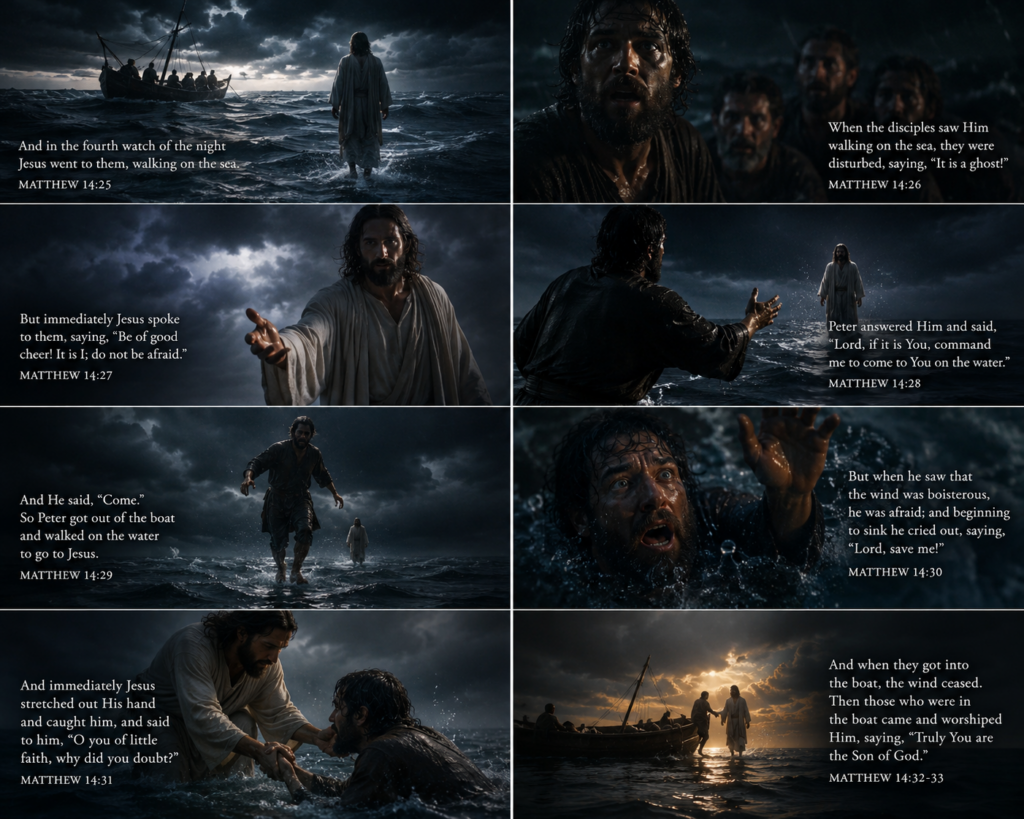
— The Beating Heart Of ‘Soli Deo Gloria’ — (Glory to God Alone)
James 1:5–8 · Wisdom, Faith, and the Double Mind