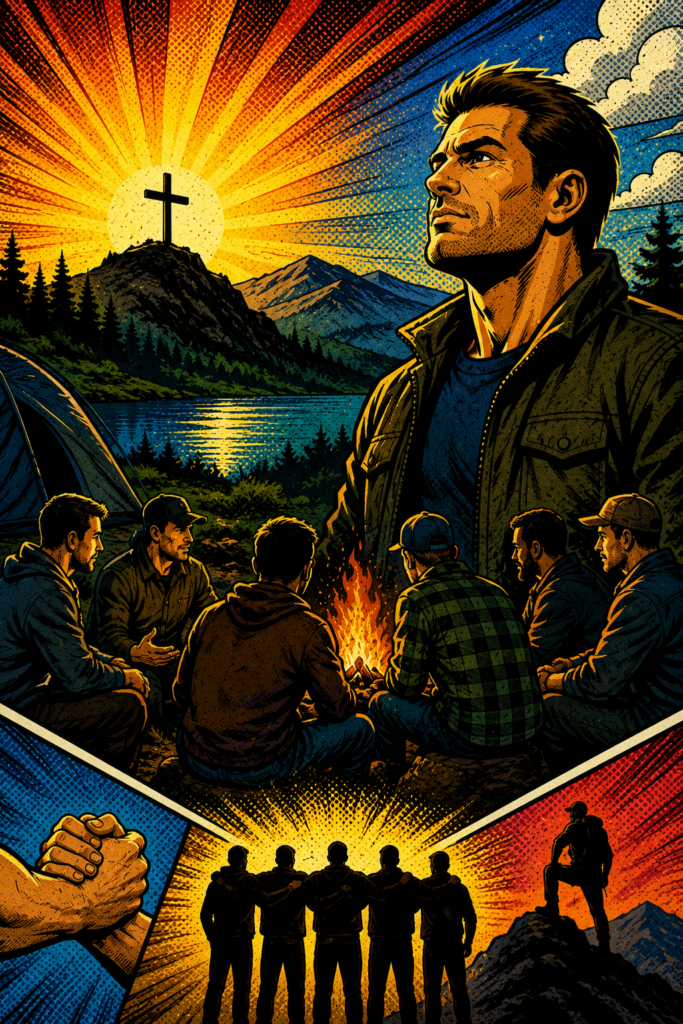


Boys to Men Overnight Campout Retreat
Building Better Men for Him —Compiled and biblically annotated by Dr. Mike
| “As iron sharpens iron, so a man sharpens the countenance of his friend.” — Proverbs 27:17 (NKJV) |
[Church Congregation’s Name] Men’s Ministry
Date: _______________ | Location: _______________
Why Men’s Retreats Matter
Scripture is not subtle on this point. When men walk closely with God, families flourish, churches strengthen, and communities are transformed. When men abdicate, the consequences ripple outward into every sphere of life. God called Adam to spiritual leadership in the garden. He commanded Abraham to lead his household after Him (Genesis 18:19). He instructed fathers to teach their children diligently (Deuteronomy 6:6–9). He charged husbands to love and lead as Christ loves the church (Ephesians 5:25–29).
A men’s retreat is not a camping event. It is a concentrated discipleship environment — a deliberate removal from daily noise — where men are positioned to hear God’s voice, build authentic brotherhood, confront spiritual weaknesses, and strengthen one another for Kingdom service. The goal is not a memorable weekend. The goal is men who, having been sharpened, go home and build something that outlasts the retreat.
| “Be watchful, stand firm in the faith, act like men, be strong.” — 1 Corinthians 16:13 (NKJV) |
This guide is organized around five integrated stages of retreat leadership. Each stage pairs the task with its most common pitfall so that the leader can see both what he should do and what most commonly derails it. The goal is comprehension for retention, not an exhaustive dictionary. Read it, internalize it, then lead.
| STAGE 1 — FOUNDATION: BEGIN WITH GOD, NOT LOGISTICS |
Before selecting a venue, creating a schedule, or recruiting volunteers, a retreat leader must seek God through prayer and Scripture. James 1:5 makes this non-negotiable: “If any of you lacks wisdom, let him ask of God.” The theme, the sessions, and the outcomes should emerge from biblical truth, not from cultural trends or last year’s schedule.
The central question is not ‘What activities should we do?’ It is: ‘What spiritual outcome is God calling us toward, and what does our flock actually need?’ A wise shepherd studies his men before he plans his sessions. Proverbs 27:23 says: ‘Be diligent to know the state of your flocks.’ Young fathers need different teaching than empty nesters. New believers need different formation than men recovering from failure. Programs must serve people, not the other way around.The leader must also examine himself before he examines his men. Paul instructed Timothy: ‘Take heed to yourself and to the doctrine’ (1 Timothy 4:16). Men quickly recognize the difference between a leader who is genuinely dependent on Christ and one who merely performs leadership. Authenticity has more authority than polish. John the Baptist modeled the correct posture: ‘He must increase, but I must decrease’ (John 3:30). Christ is the hero. The leader is the forerunner.
| ✔ THE TASK | ⚠ PITFALL TO AVOID |
| Pray before the first planning meeting. Let the theme emerge from Scripture and from the actual spiritual needs of your men. Survey your group if needed. Study your flock before you build the schedule. | Starting with activities instead of purpose. Many retreats become church-sponsored camping trips because the leader asked ‘What games should we play?’ before asking ‘What does God want to accomplish?’ Proverbs 29:18: ‘Where there is no vision, the people cast off restraint.’ |
| ✔ THE TASK | ⚠ PITFALL TO AVOID |
| The leader should evaluate his own spiritual health, marriage, integrity, and dependence on Christ before leading others. Lead yourself first. A man cannot guide others where he refuses to go himself. | Neglecting prayer during planning. Prayer is not the opening ceremony — it is the foundation. Psalm 127:1: ‘Unless the LORD builds the house, they labor in vain who build it.’ |
| STAGE 2 — PLANNING: COUNT THE COST BEFORE YOU BUILD |
COST 1: Staff & the time to train them up
Leader-to-Participant Ratio for Effective Discipleship
For a classroom-style teaching environment, one instructor may effectively teach a larger group of 20–30 people because the interaction is primarily lecture-based. A discipleship campout, however, is fundamentally different. Campouts are designed for relationship-building, mentoring, discussion, accountability, counseling, and hands-on spiritual growth. Because of this increased level of personal interaction, we recommend a minimum ratio of one trained leader or counselor for every twelve participants.
The Principle of Twelve
Throughout His earthly ministry, Jesus ministered to multitudes, but He intentionally invested His deepest discipleship efforts into a smaller group.
“And He appointed twelve, that they might be with Him and that He might send them out to preach.”
— Mark 3:14 (NKJV)
Jesus taught crowds, but He discipled twelve. This was not because He lacked power or wisdom, but because transformational discipleship requires personal investment, relationship, observation, correction, encouragement, and accountability.
Likewise, effective men’s discipleship events are built not merely on delivering information but on helping men apply biblical truth in their daily lives.
Leadership Planning
When planning a campout, do not assume that willing volunteers automatically possess discipleship leadership skills. Leaders should be intentionally selected, trained, mentored, and equipped before the event.
“And the things that you have heard from me among many witnesses, commit these to faithful men who will be able to teach others also.”
— 2 Timothy 2:2 (NKJV)
A healthy discipleship ministry develops leaders who can, in turn, disciple others. Therefore, for every twelve participants expected to attend, organizers should identify and prepare one mature leader or counselor who can:
- Facilitate discussions.
- Provide biblical encouragement and accountability.
- Help resolve conflicts and challenges.
- Monitor participant well-being and engagement.
- Model Christlike leadership and servant-hearted ministry.
Wisdom Point
Teaching a crowd communicates information; discipling a small group cultivates transformation.
“As iron sharpens iron, so a man sharpens the countenance of his friend.”
— Proverbs 27:17 (NKJV)
Strong discipleship happens when leaders have sufficient time and capacity to personally invest in the men entrusted to their care. Planning for one trained leader per twelve participants helps create an environment where meaningful relationships, spiritual growth, and biblical accountability can flourish.
If desired, I can also rewrite this from a stronger Biblical Counseling, men’s ministry, or military leadership / squad-based discipleship perspective depending on the tone of your campout manual.
COST 2: Physical Money
Budget and Financial Stewardship
Jesus taught the planning principle plainly: ‘Which of you, intending to build a tower, does not sit down first and count the cost?’ (Luke 14:28). Many excellent retreat ideas fail because leaders treat the budget as an afterthought. Begin with a written budget before advertising the retreat. Budget conservatively — unexpected expenses are not exceptional, they are standard. Maintain a contingency reserve of 10–15% beyond projected expenses.
Jesus taught: “Moreover it is required in stewards that one be found faithful.” (1 Corinthians 4:2 NKJV) A retreat leader is not merely managing money. He is stewarding resources that belong to God and have been entrusted to the ministry by His people.Financial handling must be above reproach. Paul’s standard in 2 Corinthians 8:21 is clear: ‘providing honorable things, not only in the sight of the Lord, but also in the sight of men.’ Never allow one person to control all finances. Use written records, issue receipts, and provide a financial report to ministry leadership after the retreat. Two people should verify collected funds. Transparency protects both the ministry and the individuals serving within it.
“Seek first the kingdom of God and His righteousness…” Jesus stated (Matthew 6:33 NKJV) When leaders faithfully steward God’s resources, God often provides exactly what is needed to accomplish His purposes. A retreat budget, fundraising plan, registration system, and advertising strategy are not separate from ministry. They are ministry. Each is an opportunity to glorify God through faithful stewardship, honest leadership, and servant-hearted discipleship.
| ✔ THE TASK | ⚠ PITFALL TO AVOID |
| Calculate total expenses, divide fairly among participants, and communicate clearly what the registration fee covers — lodging, meals, materials, activities. Establish scholarship funds so no man is excluded by financial hardship (Galatians 6:2). Announce scholarship availability quietly and specifically. | Neglecting financial planning. Common failures: underestimating food costs, ignoring contingency expenses, waiting too long to collect registrations, overestimating attendance, or failing to track spending. Poor financial stewardship creates distraction and erodes trust. |
Advertising and Recruitment
Advertising is not worldly marketing — it is communication. Every promotional piece should answer four questions: What is the retreat? Why should a man attend? When and where? How does he register? Keep the message simple. Many men need multiple invitations before committing. The most effective recruitment method is always the personal invitation: as Andrew brought Peter to Jesus, every man attending should be encouraged to personally invite one other man.
Testimonies outperform schedules every time. Men connect with stories of transformation, not activity lists. The strongest testimonies follow a simple pattern:
BEFORE + WHAT HAPPENED + AFTER
“Before the retreat, I felt disconnected from God and isolated from other men. During the weekend, God used His Word and honest conversations to challenge me. I returned home encouraged, equipped, and more committed to following Christ.”
Rotate testimony types across your campaign: brotherhood testimonies early, then marriage and fatherhood, then leadership, and in the final weeks use skeptical-attendee and life-change testimonies. Different men are motivated by different needs, but all roads lead to the same destination: knowing God and walking with Christ alongside other brothers.
Testimonies for Men’s Retreat Advertising Examples and Marketing Purposes
Category 1: First-Time Attendee Testimonies
Testimony Example
“I almost didn’t come because I didn’t know anyone attending. By the end of the weekend, I had several brothers in Christ who still encourage me today. It was one of the best decisions I’ve made.”
Why This Works
Many potential attendees are nervous about attending alone. This testimony addresses a common objection:
“I don’t know anybody.” It lowers anxiety and creates confidence.
Testimony Example
“I expected a camping trip. What I experienced was a weekend where God got my attention and reminded me what really matters.”
Why This Works
This testimony creates curiosity and communicates spiritual impact without sounding exaggerated.
Category 2: Spiritual Growth Testimonies
Testimony Example
“I’ve been a Christian for years, but this retreat helped me reconnect with God in ways I hadn’t experienced for a long time.”
Why This Works
Many church-going men feel spiritually stagnant. This testimony offers hope for renewed spiritual growth.
Testimony Example
“The teaching challenged me, the fellowship encouraged me, and the time in God’s Word gave me a fresh desire to follow Christ.”
Why This Works
Highlights three major retreat strengths:
- Biblical teaching
- Brotherhood
- Spiritual renewal
Category 3: Brotherhood and Friendship Testimonies
Testimony Example
“I didn’t realize how isolated I had become until this retreat. I left with friendships that continue to strengthen my walk with Christ.”
Why This Works
Isolation is one of the most common struggles among men. This testimony speaks directly to that need.
Testimony Example
“For the first time in a long time, I felt like I wasn’t fighting my battles alone.”
Why This Works
Short, emotional, and highly relatable. Especially effective for social media graphics.
Category 4: Marriage Testimonies
Testimony Example
“This retreat helped me recognize areas where I needed to lead my family better. My wife noticed a difference before I even mentioned the retreat.”
Why This Works
Connects retreat participation to real-life family benefits. Many men are motivated by helping their marriages.
Testimony Example
“I came expecting to learn about leadership. I left realizing leadership starts with loving and serving my wife more faithfully.”
Why This Works
Challenges and inspires simultaneously. Communicates maturity rather than self-improvement.
Category 5: Fatherhood Testimonies
Testimony Example
“The retreat reminded me that my greatest ministry is at home. I’ve become more intentional with my children because of what I learned that weekend.”
Why This Works
Appeals directly to fathers who want to improve family relationships.
Testimony Example
“I thought I needed better parenting techniques. What I really needed was a deeper walk with God.”
Why This Works
Points men toward spiritual transformation rather than merely practical advice.
Category 6: Leadership Development Testimonies
Testimony Example
“The retreat helped me understand that biblical leadership isn’t about position or authority. It’s about serving others like Christ.”
Why This Works
Appeals to men interested in leadership while keeping Christ central.
Testimony Example
“I arrived feeling unsure about how God could use me. I left with clarity, confidence, and a desire to serve.”
Why This Works
Addresses uncertainty and inspires action.
Category 7: Overcoming Personal Struggles
Testimony Example
“I came carrying burdens I hadn’t shared with anyone. Through prayer, Scripture, and godly conversations, I found hope and encouragement.”
Why This Works
Communicates authenticity without revealing unnecessary details. Invites struggling men to attend.
Testimony Example
“God used this retreat to remind me that failure doesn’t have the final word. His grace does.”
Why This Works
Powerful message for men carrying shame, regret, or discouragement.
Category 8: Campfire and Fellowship Testimonies
Testimony Example
“The sessions were excellent, but some of the most meaningful conversations happened around the campfire.”
Why This Works
Highlights the relational side of the retreat. Creates anticipation.
Testimony Example
“I expected sermons. I didn’t expect the late-night conversations that challenged and encouraged me the most.”
Why This Works
Shows that ministry happens beyond formal teaching sessions.
Category 9: Skeptical Attendee Testimonies
Testimony Example
“My friend convinced me to come. Honestly, I wasn’t expecting much. Looking back, I’m grateful he didn’t give up inviting me.”
Why This Works
Many potential attendees are skeptical. This testimony helps them identify with someone who shared their hesitation.
Testimony Example
“I almost stayed home. If I had, I would have missed one of the most impactful weekends of my life.”
Why This Works
Creates urgency and fear of missing a meaningful opportunity.
Category 10: Life Change Testimonies
Testimony Example
“This retreat wasn’t the end of something. It was the beginning of a new chapter in my walk with Christ.”
Why This Works
Emphasizes lasting transformation. Ideal for brochures and websites.
Testimony Example
“God used one weekend, one conversation, and one challenge from His Word to change the direction of my life.”
Why This Works
Communicates significant impact while remaining believable.
| ✔ THE TASK | ⚠ PITFALL TO AVOID |
| Use church announcements, bulletins, email, text, social media, and small group leaders — but prioritize personal invitations above all. Promote transformation, not activities. Let last year’s testimonies do the advertising work. | Advertising activities instead of transformation. Men are rarely motivated by schedules, speakers, or facilities. They are motivated by seeing what God has done in the lives of other men. If your flyer leads with the meal plan and the rope course, rewrite it. |
Team Building and Delegation
Moses nearly destroyed himself by trying to carry everything alone. His father-in-law’s counsel was direct: ‘Both you and these people will surely wear yourselves out’ (Exodus 18:18). The retreat leader must recruit, train, and genuinely trust a team. Character should outweigh talent in every selection. The most gifted man is not always the most qualified man.
Every retreat should also function as a leadership development laboratory. Paul’s instruction to Timothy was multiplication-minded: ‘Commit these to faithful men who will be able to teach others also’ (2 Timothy 2:2). Develop future leaders across three phases:
- Observer — attends, watches session transitions, group dynamics, and prayer leadership.
- Apprentice — leads devotionals, facilitates discussions, coordinates logistics.
- Owner — leads the retreat under mentorship and feedback.
| ✔ THE TASK | ⚠ PITFALL TO AVOID |
| Assign specific roles: Retreat Director, Operations Coordinator, Food Coordinator, Small Group Facilitators, Prayer Team. Each role has defined responsibilities. Identify one or two men at every retreat who are being developed toward the Owner phase. | Trying to do everything alone, or failing to develop future leaders. Both failures create the same problem: a ministry that cannot survive without one man. A healthy retreat multiplies leadership — it never concentrates it. |
| STAGE 3 — EXECUTION: LEAD THE RETREAT WELL |
Teaching and Session Flow
Every session should address biblical truth that applies directly to the men in the room — biblical manhood, personal holiness, marriage and family leadership, spiritual disciplines, integrity, and servant leadership. But information alone rarely transforms men. James 1:22 is unambiguous: ‘Be doers of the word, and not hearers only, deceiving yourselves.’ Each session must consistently move men from knowledge to obedience through practical application.
Balance the schedule deliberately. Teaching needs discussion. Activity needs reflection. Fellowship needs solitude. Jesus Himself modeled rhythms of ministry and rest. Over-scheduling is one of the most common retreat mistakes — and one of the most damaging, because it eliminates the margin where God does His deepest work. The most impactful moments of a retreat frequently occur between scheduled events: around the fire, on the trail, over a late meal.
| ✔ THE TASK | ⚠ PITFALL TO AVOID |
| Schedule margin intentionally. Build in unstructured time around sessions. Trust that God works in the gaps. Plan sessions that move from biblical exposition to personal application to group discussion — not exposition alone. | Over-programming the schedule, or mistaking emotional experiences for spiritual growth. A powerful campfire moment is not automatically transformation. Jesus said: ‘If you abide in My word, you are My disciples indeed’ (John 8:31). Spiritual maturity is measured by obedience, not emotional intensity. |
Facilitating People Well
Every retreat will contain different types of men. A skilled facilitator reads the room and shepherds each personality without drawing attention to the process.
- The Silent Man rarely speaks and often requires personal, direct encouragement to engage.
- The Dominating Man speaks frequently and can unintentionally silence others. Redirect him gently, by name, preserving his dignity while creating space for others.
- The Wounded Man carries pain, failure, or shame. He requires patience, not quick answers.
- The Resistant Man attended because someone invited him. Many resistant men become the most transformed by Sunday morning. Do not write him off on Friday evening.
James 1:19 governs the facilitator’s posture: ‘Let every man be swift to hear, slow to speak, slow to wrath.’ Not every wound is healed in a single conversation. Not every struggle has an immediate solution. Job’s friends helped him most when they simply sat with him. Sometimes ministry begins by listening.
| ✔ THE TASK | ⚠ PITFALL TO AVOID |
| Create an atmosphere where men feel safe to share honestly while maintaining biblical accountability. Recognize when a man needs pastoral follow-up beyond what the retreat can address. Know when to encourage, when to pray, when to refer. | Rushing vulnerable conversations, or allowing one man to dominate discussions. Both errors silence the men who most need to speak. Patience is not passivity — it is leadership that honors the pace of the Holy Spirit’s work. |
The Campfire: Unscripted Ministry
The campfire is the emotional center of most retreats. It should be structured enough to have direction and open enough to allow the unexpected. Use it for prayer, testimonies, brotherhood discussion, and worship. Do not over-program it — leave room for the conversation that no schedule could have planned.
Campfire testimonies should exalt Christ and demonstrate transformation. They should not glorify sin in the telling. Revelation 12:11 frames the principle: ‘They overcame him by the blood of the Lamb and by the word of their testimony.’ The testimony should point listeners toward Scripture, not toward the speaker’s past behavior.
Close the campfire with corporate prayer — men laying hands on one another in a rotating blessing and commissioning. The Numbers 6:24–26 priestly benediction over each man by name is not a ritual; it is men speaking God’s Word over one another with intention.
| ✔ THE TASK | ⚠ PITFALL TO AVOID |
| Establish covenant confidentiality before the open floor begins: what is said at the fire stays at the fire. Use prompts if silence needs a start. If a man shares something requiring pastoral follow-up, address it privately after — never redirect the group. | Turning the retreat into a speaker-centered event, or confusing entertainment with discipleship. Great food, games, and facilities can coexist with a retreat that fails spiritually. Activities support discipleship; they do not replace it. John 3:30 applies to every facilitator: ‘He must increase, but I must decrease.’ |
Safety and Risk Management
Proverbs 22:3 is direct: ‘A prudent man foresees evil and hides himself, but the simple pass on and are punished.’ Safety preparation is not a lack of faith; it is wisdom. The retreat leader should have plans in place before they are needed.
Every retreat should establish in advance: who holds medical training, where the nearest hospital is located, how emergency services access the property, and how to contact family members. Assign one person as the emergency coordinator. This is not a bureaucratic task — it is stewardship of the men God entrusted to your care.
| ✔ THE TASK | ⚠ PITFALL TO AVOID |
| Prepare for medical emergencies, severe weather, transportation breakdowns, missing participants, fire safety, food allergies, and evacuation. Collect medical forms from every participant before departure. | Assuming ‘someone else’ will handle safety. Faithfulness does not eliminate responsibility. Preparation protects both participants and the ministry’s credibility. An unaddressed safety gap is not a minor administrative failure — it can become a crisis. |
| STAGE 4 — COMMUNITY: BUILD BROTHERHOOD THAT OUTLASTS THE WEEKEND |
Iron does not sharpen itself. Proverbs 27:17 is not a decorative verse — it is an argument for why brotherhood is not optional. Many men suffer from isolation so normalized they no longer recognize it. A retreat that sends men home to the same isolation has accomplished less than its potential. The counselor-teacher should structure community deliberately across every element of the retreat: small groups, accountability pairings, campfire discussions, testimony sharing, and team challenges.
The strongest retreat moments often occur in the unscheduled spaces — hiking trails, late-night conversations, shared meals. Brotherhood develops through shared experience, voluntary vulnerability, and mutual encouragement. It cannot be rushed, and it cannot be produced by a program. The leader’s job is to create the conditions and then step back.
Build retreat traditions that create continuity across years: annual themes, group photos, commissioning ceremonies, testimony nights, leadership recognitions. Traditions give men a sense of belonging to something larger than themselves and create anticipation for the next retreat.
| ✔ THE TASK | ⚠ PITFALL TO AVOID |
| Structure accountability pairings intentionally, not casually. A handshake between accountability partners is a covenant act, not a networking moment. Provide a simple weekly check-in card that pairs exchange before departure. Follow up with paired men one month after the retreat. | Measuring success by attendance numbers alone. Large attendance can be encouraging. It is not a biblical measure of success. The true questions are: Was Christ honored? Was Scripture faithfully taught? Were men equipped for discipleship? Did men take steps of obedience? God often accomplishes His greatest work through small groups of faithful men. |
| STAGE 5 — FOLLOW-THROUGH: THE RETREAT IS THE LAUNCH POINT |
The most common retreat mistake of all is treating the retreat as the finish line. Ephesians 4:12 states the purpose of gathered ministry: ‘the equipping of the saints for the work of ministry, for the edifying of the body of Christ.’ Equipping is preparation for something beyond the gathering. The retreat should conclude with a concrete plan already scheduled — not a vague intention to ‘stay connected.’
The Legacy Letter written on Day 2 is the retreat’s most durable follow-up tool. Sealed by each man, held by the pastor, and mailed back exactly one year later, it extends the retreat’s work across twelve months. When a man receives his own letter, he is confronted by the man he said he intended to become. That confrontation is a pastoral act. Plan for it deliberately.
Every retreat should also conduct an honest after-action review. Ask what worked, what failed, what surprised the team, and what must never change. Gather feedback from participants, volunteers, and church leadership. Strong retreats become stronger through honest evaluation, not through the assumption that what felt good was effective.
| ✔ THE TASK | ⚠ PITFALL TO AVOID |
| Before departure, every man should answer: ‘What is your next step?’ Establish accountability groups, Bible studies, mentoring relationships, and a monthly men’s breakfast. Schedule the follow-up before the retreat ends, not after the momentum fades. | Neglecting follow-up. A retreat that concludes without a structured next step produces a spiritual high that fades. The biblical model is not a weekend gathering — it is lifelong discipleship. Jesus did not merely gather followers; He continuously formed them. |
| APPENDIX — PLANNING CHECKLISTS AND FORMS |
| ☑ | MASTER PLANNING TIMELINE |
| □ | 6–12 Months Out: Pray for vision — secure leadership team, venue, and budget — establish theme from Scripture — begin fundraising and promotional plan |
| □ | 3–6 Months Out: Launch advertising campaign — open registration — finalize food, transportation, and materials — recruit volunteers — establish emergency procedures |
| □ | 1 Month Out: Confirm registrations and facility — finalize teaching outlines — print materials — confirm assignments — verify medical and emergency information |
| □ | 1 Week Out: Contact all attendees — confirm weather, food, transportation, speaker schedules — leadership prayer meeting — prepare final attendance list |
| □ | Day of Departure: Roster, emergency contacts, first aid, financial records, teaching materials, food inventory, transportation check, facility contact, prayer |
| ☑ | RETREAT LEADER’S FINAL CHECKLIST |
| □ | Did Christ remain the central focus throughout every session and activity? |
| □ | Was Scripture faithfully and accurately taught from the NKJV? |
| □ | Were men loved well, listened to, and shepherded by personality type? |
| □ | Were safety and medical procedures in place and communicated? |
| □ | Were finances handled with two-person accountability and written records? |
| □ | Were future retreat leaders identified and given developmental responsibility? |
| □ | Were accountability pairings formed and weekly check-in cards exchanged? |
| □ | Is the follow-up plan — breakfast, Bible study, accountability groups — already scheduled? |
| □ | Were Legacy Letters sealed and in the pastor’s possession for one-year return? |
| □ | Was God given the glory, regardless of what the weekend produced? |
Budget Worksheet
| INCOME CATEGORY | AMOUNT | EXPENSE CATEGORY | AMOUNT |
| Participant Registrations | $__________ | Facility Rental / Insurance | $__________ |
| Church Support | $__________ | Food and Beverages | $__________ |
| Donations / Fundraising | $__________ | Transportation | $__________ |
| Other | $__________ | Speaker Expenses | $__________ |
| $__________ | Materials and Printing | $__________ | |
| $__________ | Emergency Reserve (10–15%) | $__________ | |
| $__________ | Miscellaneous | $__________ | |
| TOTAL INCOME | $__________ | TOTAL EXPENSES | $__________ |
| Projected Surplus / Deficit: | $__________ |
Attendee Registration Form
| Name | Phone | ||
| Church | |||
| Emergency Contact | Emergency Phone | ||
| Medical Conditions | Food Allergies | ||
| Medications | Roommate Request |
| Transportation Needed? | □ Yes □ No | Retreat Fee Paid? | □ Yes □ No Amount: $______ |
Campfire Discussion Guide
| ☑ | CAMPFIRE FLOW |
| □ | Establish covenant confidentiality: ‘What is said at the fire stays at the fire.’ |
| □ | Opening prayer of gratitude — invite honesty and authenticity (10 min) |
| □ | Scripture reading: Psalm 1, 23, Joshua 1, Ephesians 6, or 1 Peter 5 (10 min) |
| □ | Open floor: ‘Tell us about a man who believed in you before you believed in yourself.’ |
| □ | Open floor: ‘What is the hardest thing you are carrying right now that you have not told anyone?’ |
| □ | Open floor: ‘Where have you seen God show up unexpectedly in your life this past year?’ |
| □ | Open floor: ‘What is one thing you wish someone had told you at 15 about what it means to be a man?’ |
| □ | Rotating corporate prayer — men laying hands on one man at a time, blessing by name |
| □ | Close with Numbers 6:24–26 spoken as priestly benediction over each man |
Post-Retreat Evaluation Form
| POST-RETREAT EVALUATION (Name optional) | |
| What was most helpful? | |
| What should be improved? | |
| Which session impacted you most? | |
| Did the retreat help you grow spiritually? | □ Strongly Agree □ Agree □ Neutral □ Disagree |
| Would you attend again? | □ Yes □ No |
| Would you recommend this retreat? | □ Yes □ No |
| Your next step this week: |
| ☑ | LEADERSHIP AFTER-ACTION REVIEW |
| □ | What worked well and should be repeated or expanded? |
| □ | What failed or underperformed and must be changed? |
| □ | What surprised the leadership team? |
| □ | Budget review completed and reconciled? □ Yes □ No |
| □ | Safety review completed? □ Yes □ No |
| □ | Follow-up plan confirmed and scheduled? □ Yes □ No |
| □ | Future retreat leaders identified by name? □ Yes □ No |
| □ | Legacy Letters sealed and in pastor’s custody? □ Yes □ No |
A FINAL WORD TO THE RETREAT LEADER
The retreat does not belong to the organizer. It does not belong to the leadership team. It belongs to Christ. He is the Builder. He is the Shepherd. He is the One who changes hearts. Leaders are stewards entrusted with the privilege of serving His men for His glory.
Pray diligently. Prepare faithfully. Lead humbly. Teach Scripture boldly. Love men deeply. Trust God completely. If God chooses to work powerfully, give Him the glory. If challenges arise, trust Him anyway.
Successful retreat leadership is not measured by perfection. It is measured by faithfulness to the One who called you to serve.
| “And whatever you do, do it heartily, as to the Lord and not to men.” — Colossians 3:23 (NKJV) |
“He must increase, but I must decrease.” — John 3:30 (NKJV)
Prepared by [Pastor/Ministry Leader Name] | [Church Congregation’s Name] | [Date]