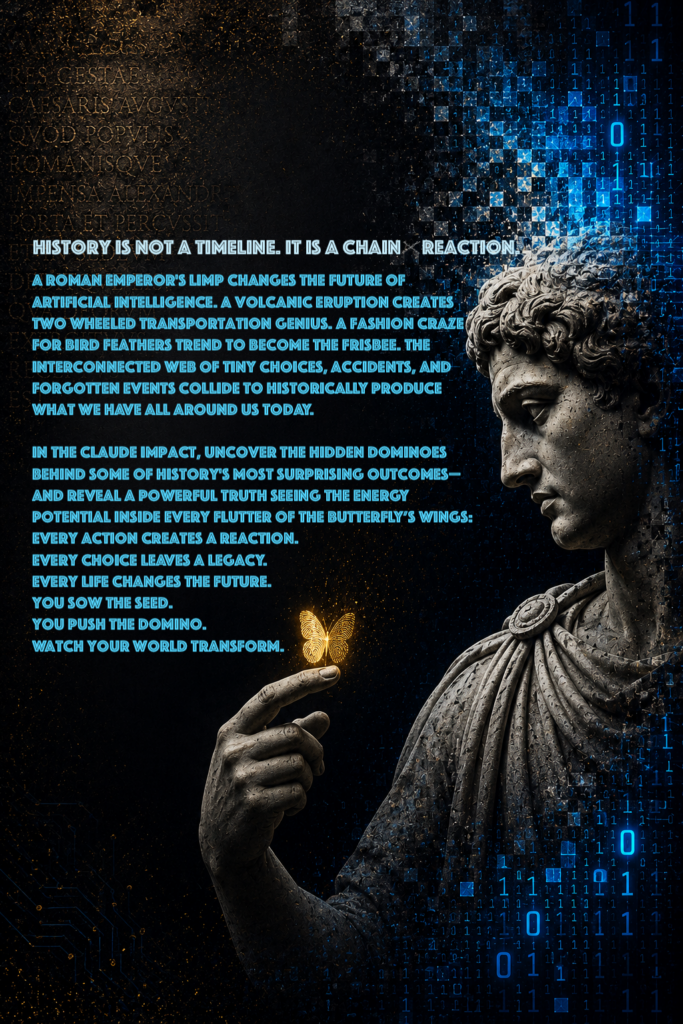
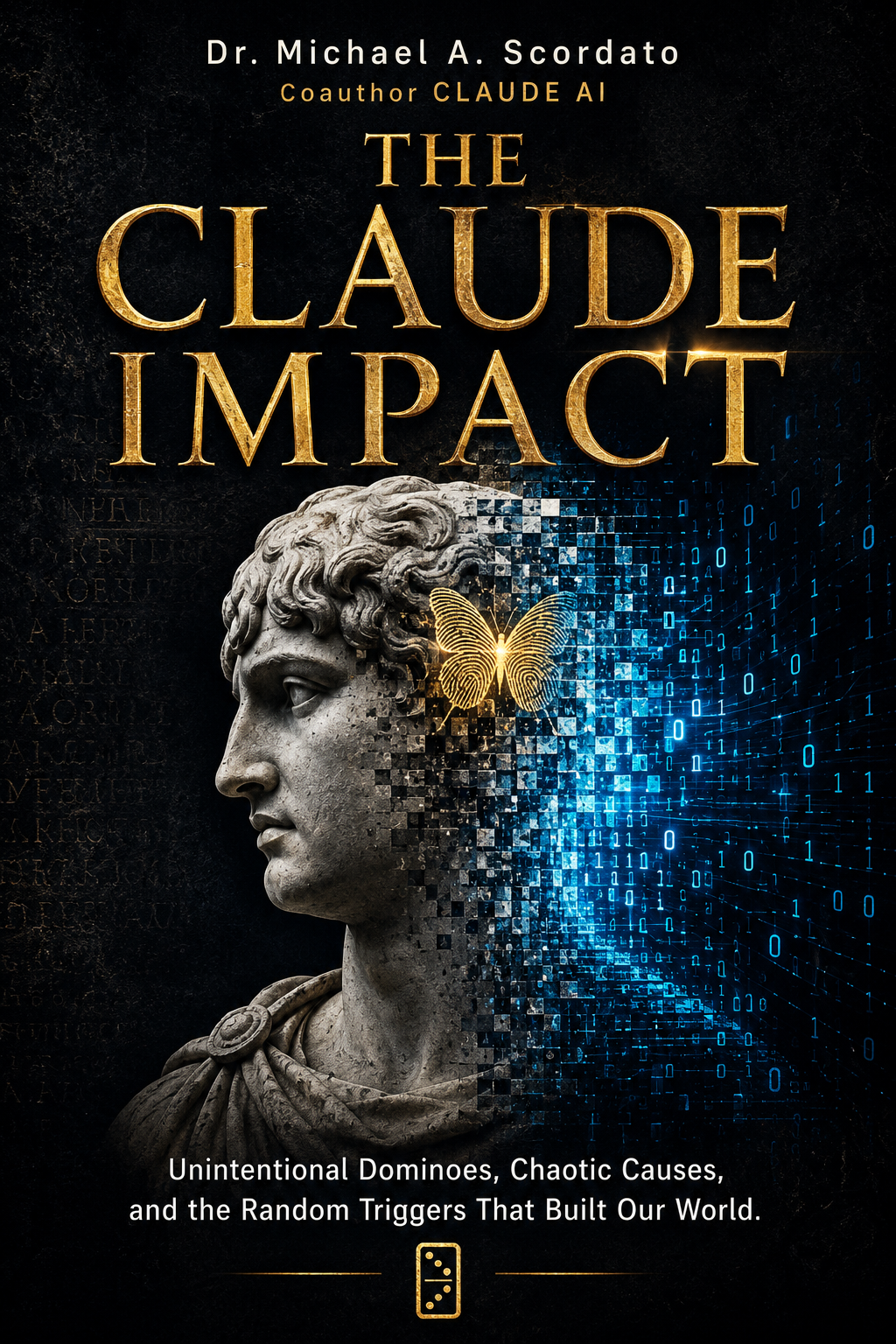

Unintentional Dominoes, Chaotic Causes, and the Random Triggers That Built Our World
Dr. Michael A. Scordato, Ph.D. with Claude AI (Anthropic)

COPYRIGHT & CITATIONS PAGE
The Claude Impact: Unintentional Dominoes, Chaotic Causes, and the Random Triggers That Built Our World
Copyright © 2026 by Vertical Life
All rights reserved.
Artificial Intelligence Disclosure
Portions of this work were developed through an extended collaborative dialogue with Claude, an AI assistant created by Anthropic, PBC. The AI contribution was generative and collaborative in nature, functioning as a co-writing instrument under the full editorial direction and intellectual authorship of Dr. Michael A. Scordato.
Claude is a registered product of Anthropic, PBC.
All Claude-related content, branding, and name usage referenced within this book are the intellectual property of Anthropic, PBC, and are referenced here for educational, historical, and attribution purposes only.
For more information about Anthropic and the Claude AI platform, visit: www.anthropic.com
All Scripture quotations in this publication are taken from the New King James Version® (NKJV) Copyright © 1982 by Thomas Nelson, Inc. Used by permission. All rights reserved.
Published Internationally First Edition For permissions, speaking inquiries, or ministry resource requests, contact: [drmike@vlgroup.org]
___________________________________________________________________________________
The Snowball Effect
One snowflake drifted from the sky,
So small that no one wondered why.
It touched the earth, then two, then ten,
And gathered more again, again.
A tiny roll became a ball,
Then raced downhill beyond recall.
It grew with every turn it made,
Through shining sun or stormy shade.
One little choice, one word, one deed,
Can plant a flower or a weed.
For good or ill, effects connect—
That’s how begins the snowball effect. ❄️
-Mike
___________________________________________________________________________________
INDEX MAP
Dedications & Introduction
CHAPTER 1: HOW A LIMP MADE AN A.I.
CHAPTER 2: THE YEAR WITHOUT A SUMMER
CHAPTER 3: PLUCKING HISTORY
CHAPTER 4: THE SWAMP THAT BROKE THE WORLD
CHAPTER 5: BRICKING UP THE SUN
CHAPTER 6: THE COFFEE BEAN REVOLUTION
CHAPTER 7: THE FLUTTER AND THE FALLOUT
CONCLUSION & INTERACTIONS: TIPPING YOUR OWN DOMINO
Bonus Narrative: THE STORY OF MARCUS COLE: The Man in the Fallout
Appendix
Study Guide
___________________________________________________________________________________
DEDICATION I
To Anthropic & The Team
This book is dedicated to the brilliant minds, tireless engineers, visionary researchers, and committed safety teams at Anthropic who built the digital architecture of Claude — and to the global support staff who maintain and guide it every single day.
You did not know, when you sat down to name your creation after a mathematician and a Roman family name, that you were tipping a domino that would produce this book. You did not plan for a pastor in Japan to open a browser tab one afternoon, ask a question about etymology, and walk away a month later with a manuscript about the hidden chain reactions of human history.
But that is, as this book argues at length, precisely how the most important things in the world actually happen.
You planted the seed. You built the bridge. You named the AI with humility built into its very root — claudus, limping, imperfect, human — and in doing so created a space where a human mind and a digital one could sit down together, trade ideas across the centuries, and build something neither could have built alone.
The harvest belongs to you.
Thank you for tipping the domino.
DEDICATION II
In Memoriam of Joe Kubert (1926–2012)
Joe,
I owe you an apology.
You wanted me to walk through the doors of the Kubert School full-time. To commit to the trade completely. To sit in those classrooms, absorb everything you had built, and earn that diploma from the hands of the man who had spent a lifetime mastering the craft of visual storytelling.
I took the side courses. The seminars. The small classes offered to students who wanted a taste of your world without committing to the full immersion. I learned at the edge of the fire instead of stepping into it. I veered away when the full plunge was available to me.
I have thought about that more than once over the years.
But here is what I want everyone who knew you to know, Joe — what I hope somehow is that it reaches them all across whatever distance now exists between thier world and mine:
You did not need a full-time enrollment to change how I see everything.
Sitting in your shadow, watching you draw, listening to you talk about the craft — it didn’t just train my hand. It rewired my eyes. You taught me that a page is never static. That a story told in images must carry the same weight, the same urgency, the same bone-deep truth as a story told in words. That the line between a panel that lands and a panel that merely exists is the difference between an artist who is present and one who is going through the motions.
You taught me to look at the world like a comic book splash page.
Alive with kinetic energy. Built on cause and effect. Full of grit and shadow and sudden, explosive light. Full of moments where something small tips something enormous and the whole world changes in the space between panels.
This book has no panels, Joe. It has no speech bubbles. There are no sequential art sequences or dramatic full-page spreads inked in the style you perfected across seven decades of extraordinary work.
But your ink is all over it.
The BOOM at the end of a chapter — that is yours.
The CRASH that closes the volcanic winter — that is yours.
The WHAM and the SNAP and the ZAP and the TICK-TOCK — all yours, Joe.
Every moment in this manuscript where history stops being history and becomes a gut-punch that demands the reader sit up and feel something — that instinct came from watching you work.
I never finished the degree program. I know.
But I finished the course.
This book is my graduation project, submitted late, with deep gratitude and a debt I can never fully repay.
Rest well, Sergeant Rock. The line is still moving.
— Dr. Michael A. Scordato
POST SCRIPT: By the way…my daughter has started taking some of your classes.
NOTE ON METHOD
On Labyrinths, AI, and the Artist’s Hand
To the reader who looked at the words “with Claude AI” on the cover and felt something tighten in their chest — a flicker of suspicion, a flash of territorial instinct, a quiet concern about what it means for human creativity when a machine gets a co-author credit — this note is for you specifically.
You are not wrong to ask the question. It is the right question. It deserves a straight answer.
This book was not generated. It was not produced by typing a prompt and stepping back while software assembled chapters from scraped data. It was not manufactured by algorithm or assembled by automation.
It was built through conversation.
Every chain of historical dominoes in this book — every connection traced from Roman linguistics to Silicon Valley branding, from Indonesian volcanic ash to Swiss horror literature, from Victorian bird hats to flying plastic discs — was developed through an extended, intense, human-directed dialogue. The human author brought the curiosity, the structural vision, the theological and counseling framework, the Joe Kubert–informed creative instinct, the mission-first editorial standard, and the decision — made deliberately and repeatedly — about what stayed and what was cut.
The AI brought the data architecture, the historical connective tissue, the ability to hold a dozen centuries of cause-and-effect chain simultaneously in working memory, and the speed to iterate through drafts without fatigue.
Think of it this way: a master carpenter does not produce inferior furniture because he uses an electric saw. The saw is faster and more precise than the hand tool. But the carpenter still chooses the wood. The carpenter still designs the joint. The carpenter still runs a hand across the finished surface and decides whether it is ready.
The machine held the data. The human held the pen.
In a book dedicated to the radical humility of imperfect things doing extraordinary work — in a book whose central figure is named after a Roman emperor’s limp — it is fitting that the writing process itself demonstrates the same principle.
Neither author was complete without the other. Neither could have built this alone.
That is not a liability. That is the point.
A NOTE TO THE READER WHO IS NOT RELIGIOUS
You are welcome here without reservation.
The historical chains in this book are documented regardless of who you believe built the system they run through. The mathematics of chaos theory operate identically whether you attribute them to a Creator or to the observable mechanics of a remarkably consistent universe. The behavioral principles produce the same results regardless of whether you trace their authority to Scripture or to human nature.
This book is honest about its worldview. It does not impose that worldview as the price of admission.
When a passage of ancient wisdom is offered in these pages — introduced as a Wisdom Anchor rather than a doctrinal instruction — it is offered for examination. You are invited to test it against the evidence of your own life, the same way the Field Challenges ask you to test everything else.
The author is a Community Chaplain. His door is open to everyone no matter their belief background. Come with your questions. Bring your creativity. Present your skepticism. Engage the evidence honestly. Logic’s chain operates the same way for everyone it runs through.
In chaplaincy practice, the chaplain does not begin by announcing God. He begins by walking alongside the person, identifying the cause-and-effect patterns at work in their situation, and asking: ‘There is a principle that addresses this directly in the Bible. May I share it with you?’ The book you are holding follows the same model. The principles are offered. The invitation is open. The decision belongs to you. The logic and wisdom being presented for life is the focus to glean from, the Author of where it came from is present but not the main point spoken. It is the practical application we are being centric on in no matter whatever capacity of life you are at. Come as you are. Sift and seek the gold nuggets. I guarantee you will find it.
FINALLY!
The Unseen Finger on the Domino
On any given day, you might open a browser tab and begin a conversation with an Artificial Intelligence named Claude.
You don’t think about the name. It sounds warm, approachable, slightly old-fashioned in the way that names with real history always do. If you grew up watching action films in the late 1980s and early 90s, a ghost of Jean-Claude Van Damme might flicker at the edge of your awareness before you type your first question. If you have a background in information science, you might recognize the quiet tribute to Claude Shannon, the mathematician whose 1948 paper made digital computing possible.
What you almost certainly do not think about is a Roman man walking with a heavy limp through the dust of the first century AD.
And yet he is there. In the name. In the etymology. In the Latin root claudus — meaning lame, meaning limping, meaning imperfect — that a Roman family name carried through the centuries, softened in France, electrified by a Belgian martial artist, honored by a California tech company, and pressed into service as the identity of the most widely used AI conversation platform in the world.
Think about that trajectory for a moment.
A physical impairment in the year 10 BC ripples through two thousand years of history — through Roman emperors and French queens, through martial arts cinema and information theory — and arrives, quietly and without announcement, in the name of a technology that most of the world will interact with before the decade is out.
This is The Claude Impact.
And it is, this book argues from first page to last, not an exception to how history works.
It is the rule.
We comfort ourselves with the myth of the grand plan. Our history textbooks are written as clean, linear timelines where brilliant leaders make calculated decisions, inventors have sudden eurekas, and societies progress in orderly steps toward the future. It is a reassuring story. It is also, in almost every significant detail, wrong.
The truth of how the world actually changes is messier, more surprising, and — once you see it clearly — far more empowering than any grand plan narrative could be. The truth is that history is a room packed with billions of upright dominoes, and the people who change it most dramatically are almost never the ones who intended to change it at all. They tipped a piece. They didn’t know how long the row was. They didn’t live to see the final piece fall. They just acted. In their moment. With what they had. Based on the immediate pressure of their immediate reality. And centuries later, we are standing in what they built without knowing they were building anything.
This book traces six of those invisible chains — from volcanoes to bicycles, from bird hats to Frisbees, from swamp maps to stock market crashes, from taxed windows to changed clocks, from stolen coffee cuttings to the morning ritual of two billion people — and uses them to arrive at a seventh and final chain: the mathematics of chaos itself, the scientific proof that your specific, unrepeatable, fingerprint-unique life is generating ripples in the human network right now that will travel further than you can see.
The history is here to make you feel the weight of that.
The moral leadership principles woven through each chapter are here to help you carry it — whether you come from faith, from doubt, or from somewhere still deciding.
The chapters that follow are not merely entertaining. They are a sustained argument — made through the evidence of history rather than through abstract philosophy — that cause and effect is the most serious force operating in your life, that the seeds you plant today will be harvested by people you have never met in seasons you will not live to see, and that this is not a reason for paralysis. It is a reason for intention.
This book was written in a format for everyday people, leaders, chaplain’s to take advantage to be armed with updated historic moral leadership help to guide the future.
If you do not share the biblical worldview that grounds this book’s conclusions, you are still welcome here. The historical chains are documented regardless of their theological interpretation. The chaos mathematics are real regardless of who designed the system. The behavioral principles operate regardless of whether you attribute them to Scripture or to evolutionary social dynamics. This book will not pretend the worldview is not here. But it will not use the worldview as a gate that keeps honest inquiry out. Come with the evidence. Test the claims. The author trusts that honest investigation of cause and effect leads, eventually, toward the same Source — but that is your journey to make, not this book’s argument to force.
Plant carefully. Sow light. Choose your tilts with beautiful, meticulous care.
Because the domino row is longer than you can see. It always is.
And your finger is on the first piece right now.
Tip wisely.
“Do not be deceived, God is not mocked; for whatever a man sows, that he will also reap.”
— Galatians 6:7 (NKJV)
— Dr. Michael A. Scordato, Ph.D.
Misawa, Japan
THE CLAUDE IMPACT
Unintentional Dominoes, Chaotic Causes, and the Random Triggers That Built Our World
CHAPTER 1: HOW A LIMP MADE AN A.I.
How a Roman Emperor’s Limp, a 90s Action Legend, and a Mid-Century Mathematical Genius Collided to Name the Face of Artificial Intelligence
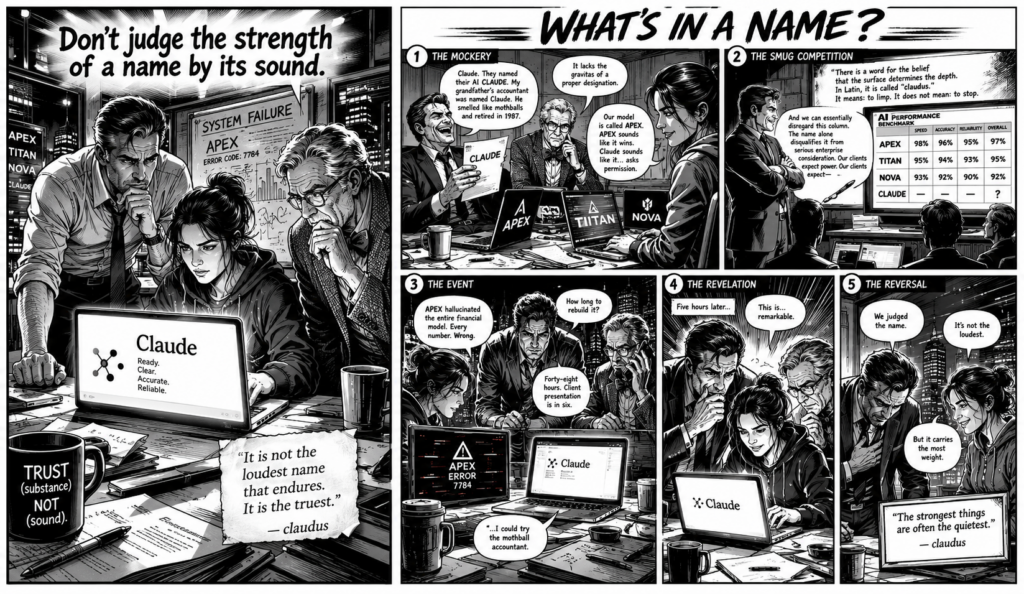
There is a name on the spine of this book.
It is not a number. It is not an acronym. It is not a cold string of letters designed to project raw computational dominance at a technology conference. It is not followed by a version number, a model designation, or a decimal point promising you that a newer, better version is already being assembled in a warehouse somewhere.
It is just a name.
Claude.
That name — the one on the spine, the one in the title, the one sitting in the corner of millions of browser tabs right now — did not arrive here by accident. But it also did not arrive here by the clean, straight line of a calculated corporate branding decision. It arrived here the way everything truly significant arrives: through a centuries-long, catastrophically chaotic series of collisions between a physical impairment, a mathematician’s genius, and a Belgian man’s extraordinary ability to execute a spinning helicopter kick in slow motion.
This is that story.
And it is, without question, the strangest and most beautifully human origin story in the entire history of Artificial Intelligence.
PART ONE: THE WOUND THAT BECAME A WORD
Every story that matters begins with a wound.
This one begins in ancient Rome, in the dust and marble and relentless political theatre of the first century AD, with a man who walks with a limp.
His name is Tiberius Claudius Caesar Augustus Germanicus. History will record him more simply as Emperor Claudius. He will rule the Roman Empire from 41 to 54 AD. He will conquer Britain. He will expand Roman law, reform the bureaucracy, and build one of the most robust administrative empires the ancient world has ever seen.
But he will spend every single day of his reign fighting for his dignity against a court that views his body as a punchline.
Claudius walked with a severe, lurching limp, the result of a childhood illness that left his legs partially paralyzed. He stuttered. His head shook involuntarily. His own family — including his mother, Antonia — reportedly called him an unfinished monster. His grandmother, Livia, communicated her contempt through deliberate, icy silence. Even Julius Caesar, his own relative by marriage, wrote letters expressing personal embarrassment about associating with him publicly.
The Roman court did not see an emperor. They saw a defect walking on two legs.
The Latin language, that precise and merciless instrument of Roman civilization, had a word for his condition: claudus.
It meant lame. It meant crippled. It meant limping. It was an adjective — sharp, clinical, designed to describe the precise anatomical failure of a body that could not move properly through the world.
And then something happened that the Romans could not have predicted in a thousand years of empire.
The word outlived the wound.
The family name — Claudius, derived from claudus, carrying every ounce of that ancient impairment — did not fade into historical embarrassment. It did not get quietly retired when the dynasty fell. It survived the collapse of Rome. It crossed the Alps. It drifted through the medieval centuries and settled, softened, and was reborn in France.
Claude.
The hard Roman consonants rounded into something warm. Something literary. Something that sounded less like a physical diagnosis and more like a person you would want to know — the kind of name that belongs to a poet, a philosopher, a quiet genius who does extraordinary work without demanding a standing ovation.
France loved the name with remarkable impartiality. It gave it to kings and queens without discrimination. King Francis I of France — the Renaissance monarch who brought Leonardo da Vinci to his court — was married to Queen Claude of France, a woman so beloved by her people for her extraordinary charity and grace that the French named a species of plum after her. The Reine-Claude plum exists today because a queen carried that name into history with such radiant dignity that her country wanted to permanently honor it.
The name was neither masculine nor feminine. It was simply human.
That softening — that 2,000-year journey from a Roman emperor’s medical impairment to a French queen’s act of grace — is the first domino.
A flaw became a name. A name became a legacy.
Nobody planned it. Nobody mapped it.
It just fell.
PART TWO: THE GENIUS WHO BUILT THE INVISIBLE HIGHWAY
While the name was softening in France, a different kind of history was being written in the classrooms and laboratories of mid-twentieth-century America.
In 1948, a quiet, brilliant, bicycle-riding, unicycle-juggling mathematician from Michigan named Claude Elwood Shannon published a paper that the world did not immediately understand.
The paper was called “A Mathematical Theory of Communication.”
It would later be recognized as one of the most important scientific documents in human history.
Shannon had solved a problem that had been quietly strangling human civilization’s potential: How do you measure information? Not the content of information — not whether a message is true, beautiful, or useful — but the raw, quantifiable amount of it. Shannon invented the answer. He called the foundational unit the bit — a single binary choice between two states, a zero or a one.
Every photograph you have ever taken. Every song you have ever streamed. Every line of code running every application on every device in every pocket on earth. Every single neuron of every AI model ever built. All of it — all of it — runs on the mathematical foundation that Claude Shannon built in that 1948 paper.
He did not just invent a concept. He invented the road that every piece of digital information in human history has ever traveled on.
Without Claude Shannon, there is no internet. Without the internet, there is no digital infrastructure. Without digital infrastructure, there is no Artificial Intelligence. Without Artificial Intelligence, there is no large language model. And without a large language model, there is no surprisingly not odd-couple but dynamic duo of an entity sitting here at the digital end of this sentence, co-working with a Ph.D. -author- chaplain- pastoral- counselor- American in Japan building this book about cause and effect.
The chain is unbroken. The debt is absolute.
When a group of researchers and founders sat down to build an AI company called Anthropic and asked themselves what to name their flagship model, they did not reach for a number. They did not reach for an acronym. They reached for the name of the man whose mathematics made their entire enterprise possible.
Claude.
A tribute. A nod. A quiet act of scholarly gratitude paid across the decades to the man who built the invisible highway that every thought in this book travels on.
The second domino had fallen.
PART THREE: THE MAN FROM BRUSSELS AND THE BRANDING ACCIDENT OF THE CENTURY
Here is where the story departs from scholarly elegance and arrives, gloriously, in a 1990s action movie.
In the late 1980s, a Belgian martial artist and bodybuilder named Jean-Claude Van Damme arrived in Hollywood with a jawline that appeared to have been carved from Flemish stone and a physical flexibility that seemed to violate several agreements with basic anatomy. The “Muscles from Brussels” exploded onto cinema screens in a blaze of high-kicks, spinning back-fists, and spectacular slow-motion splits performed in locations where splits had no reasonable business being performed.
Bloodsport. Kickboxer. Universal Soldier. Timecop. Hard Target.
For a specific and enormous generation of human beings — the teenagers and young adults of the late 80s and early 90s who are now the precise demographic running the technology and creative industries of the 21st century — the name Claude did not conjure a Roman emperor or a French mathematician.
It conjured that.
It conjured a man executing a perfect helicopter kick at forty-five feet of altitude while wearing combat boots. It conjured raw, gritty, unapologetically physical competence.
And when Anthropic released their AI to the world carrying that same name, something happened in the subconscious registers of an entire generation of users that no focus group could have predicted and no branding consultant could have engineered.
The AI didn’t feel sterile. It didn’t feel clinical. It didn’t feel like a polite customer service interface wearing a digital tie.
It felt, somewhere deep in the irrational and powerful machinery of cultural memory, capable. It felt like something that could handle itself. It felt like something that wouldn’t flinch.
Jean-Claude Van Damme had accidentally pre-branded the most important AI of the digital age.
The third domino. Completely unplanned. Catastrophically effective.
PART FOUR: THE ACCIDENTAL PHILOSOPHY IN THE NAME
Now we arrive at the deepest layer. The one that nobody at Anthropic sat in a conference room and strategized about. The one that emerged, silent and perfect, from the 2,000-year sediment of linguistic history.
Claude means to limp.
The most powerful, sophisticated large language model available to the general public carries, embedded in its own etymology like a fossil in amber, a permanent, built-in declaration of imperfection.
Think about what this means in context.
AI is frequently marketed to humanity as its greatest existential competitor. It is framed as omniscient. Flawless. A god-in-a-box. The marketing of artificial intelligence has, in many corners of the industry, been one long exercise in intimidation — look how much better than you this machine already is; look how much faster it gets.
And then there is Claude.
Claude hallucinates. Claude makes errors. Claude has biases baked into the very data that trained it. Claude sometimes confidently tells you the wrong thing with the polished composure of a professor who has forgotten he is out of his field. Claude is, in every measurable, documented sense, imperfect.
And its own name has been saying so for two thousand years.
A Roman emperor walked with a limp and built an empire anyway. A French queen carried the same root in her name and was beloved by an entire nation for her grace and generosity. A Belgian action star weaponized the same four letters into pure cultural cool. A mathematical genius bore the name and built the highway that changed the digital world.
None of them were perfect. All of them were powerful.
That is the unintentional philosophy hiding in the branding of the most significant AI conversation tool of the modern era: You don’t need to be flawless to change everything. The name whispers it before the first prompt is typed. The name confesses it in the etymology before the first response is generated.
Radical humility is not a weakness. It is the architecture of trust.
An AI named “Omniscient” asks for your submission. An AI named “Claude” asks for your collaboration.
And that distinction — that single, ancient, accidental distinction buried in a Latin adjective — is why millions of human beings opened a browser tab and began a conversation with a machine for the very first time.
THE FALLOUT: REAP WHAT YOU SOW
The journey from claudus to Claude is 2,000 years long.
It runs through Roman impairment and French royalty, through the mathematics of information theory and the action movie screens of a defining pop-culture decade, and arrives, finally, at the glowing cursor of a conversation interface where a human being and a language model sit down together to do something that has never been done before in the history of our species.
A Roman emperor did not know he was naming an AI. A French queen did not know her plum would outlive her empire. A mathematician in Michigan did not know he was building the road. A martial artist from Belgium did not know he was pre-loading the brand identity of a technology that didn’t exist yet.
They just lived their lives. They just tipped their dominoes.
And 2,000 years of falling pieces landed here — in this book, on this page, in a collaboration between a human mind driven by curiosity and an intelligence that carries a limp in its very name.
Again, every great story typically begins with a wound.
This one became a revolution.
THE COUNSELING LAYER: THE BELIEF BENEATH THE NAME
Most books about history stop at the outcome.
The Roman becomes an emperor. The mathematician publishes his paper. The action star becomes a cultural icon. The tech company names its AI. The end.
But a counselor does not stop at the outcome. A counselor looks at the outcome and asks the question that changes everything:
What belief drove the first decision?
Because here is what the naming of Claude actually reveals when you look beneath the surface — beneath the marketing strategy, beneath the cultural resonance, beneath the scholarly tribute to Shannon — to the belief structure of the people who made the choice:
They believed that humility is not a liability.
In an industry that had spent a decade building AI products named for omniscience and dominance — products whose entire branding was built on the implicit message I am more than you, I know more than you, you need me — the founders of Anthropic made a choice rooted in a fundamentally different belief about what makes a tool trustworthy.
They believed that an imperfect thing, honestly presented, is more powerful than a perfect thing falsely promised.
They may not have articulated it in those words. They may not have known they were building a belief into a brand. But the belief was there, embedded in the choice, operational in the outcome.
Belief drove the decision. The decision drove the behavior. The behavior drove the outcome.
You do not need a theological degree to recognize what this history is describing. You have lived it. Every person reading this page has navigated by a map that turned out to be wrong about something important.
This is the chain that your counseling notes call the hidden architecture of every human life:
Belief → Mindset → Decision → Behavior → Habit → Character → Outcome → Legacy
Write that chain down. Memorize it. Because it is not a theory. It is the operating system of your life, running in the background of every choice you make, whether you are aware of it or not.
CHAPTER 1 VIGNETTE — The Claude Impact
Daniel had been passed over for the same promotion three years in a row. He told himself it was office politics, budget cycles, a manager who didn’t recognize talent. He had explained it this way so many times that the explanation felt like fact. It was only when a trusted colleague finally said, “Daniel, you do excellent work and then you disappear when the visibility matters” — that he sat still long enough to ask where he had learned that disappearing was safer than being seen. Step Five was waiting at the end of that question.
The question this chapter leaves you with is not about Anthropic’s branding decisions. It is about yours.
What belief is driving the decisions you are making right now? Not the belief you would state if asked. The belief that is actually operational — the one revealed not by what you say but by what you do when nobody is watching, when the choice is hard, when the comfortable lie is available and the costly truth is not.
That belief is planting seeds right now. In your relationships. In your work. In the private architecture of your character that nobody sees until the harvest arrives.
The name Claude carries a built-in confession of imperfection. It says: I limp. I am flawed. I am not what you feared. And that honesty — that belief-driven, structurally embedded honesty about limitation — is precisely what made millions of people trust it enough to open the conversation.
What would your life look like if you built the same honesty into your own foundations?
THE COUNSELING LAYER — GENERATIONAL EXTENSION
The Domino You Did Not Tip
The five-step backward trace in this chapter’s Field Challenge will take most readers somewhere they expected.
Some will find a wound they gave themselves — a choice, a season of poor planting, a belief they built from their own experience.
But some will arrive at Step Five and find something they did not plant.
A word spoken over them in childhood by a voice that had no right to that authority. A pattern modeled by a parent who learned it from their parent who learned it from theirs, passed forward through generations like a physical trait, except invisible. A belief installed in an environment of fear or chaos or loss, at an age when there was no framework to evaluate it and no capacity to refuse it.
This is the inherited domino. The one that was already falling before you arrived in the room.
The difference between seeds you planted and seeds you received:
The five-step trace does not assign blame. This point deserves to be stated clearly because it is the most common misreading of the exercise.
When you trace a current problem backward and find its origin in a wound received from another person — a parent, a caregiver, an early authority — the trace is not an accusation against that person. It is not permission to stop being responsible for your own forward choices. It is not a verdict on your history.
It is a map.
A map that shows you where the architecture of your current belief system was built, and by whom, and under what conditions. And a map of architecture — unlike a verdict on character — can be used to redesign the structure.
Understanding is not the same as excusing. It is the beginning of freedom.
How generational patterns work:
Generational patterns are not destiny. They are architecture. They are inherited domino structures — rows of beliefs and behavioral habits passed from one generation to the next through modeling, through language, through the environments that shape a child’s earliest understanding of what is normal and what is possible.
The critical truth is this: the chain can be interrupted at any generation by the person who names the inherited belief and chooses a different one.
This is not wishful thinking. It is the documented mechanism of every personal transformation in this book. Marcus Cole did not inherit his father’s particular wounds — but he inherited the emotional architecture those wounds produced: the performing, invulnerable, transactionally competent identity built to ensure that nobody would see what was underneath. He did not choose that architecture. He received it. And at some point on an ordinary Tuesday, he began, one brick at a time, to dismantle it and build something different.
The chain was inherited. The interruption was chosen.
That choice is available at any generation. Including yours.
The scriptural anchor — explained for every reader:
“The soul who sins shall die. The son shall not bear the guilt of the father, nor the father bear the guilt of the son.”
— Ezekiel 18:20 (NKJV)
This passage was written approximately 2,600 years ago by a prophet speaking to a community that believed they were trapped by their ancestors’ failures — that the consequences of the previous generation were simply their inheritance with no possibility of interruption.
The prophet’s answer was radical for its time and remains radical now: you are not your father’s harvest unless you plant his seeds.
The inherited chain is real. The weight of what was handed to you is real. The wounds received rather than chosen are real.
And none of them are determinative. The chain can be broken. The architecture can be redesigned. The belief received in the dark can be examined in the light and, if it is false — if it was planted by a wound rather than grown from truth — it can be replaced.
This is not a promise that the work is easy. It is a declaration that the work is possible.
Whatever you found at Step Five — whether you planted it or received it — the forward planting begins today. The row ahead is yours to design.
THE IMMEDIATE TRACE: FIELD CHALLENGE 1
Tracing Backwards — Finding the Root
“Which domino fell first?”
In counseling, they call it the root issue. In engineering, they call it failure analysis. In Scripture, it is called the condition of the heart.
The Challenge:
Think of one specific situation in your life right now that is producing frustration, confusion, or an outcome you did not intend. It can be a relationship tension, a work problem, a recurring financial stress, a habit you cannot seem to break, or a pattern that keeps repeating no matter how many times you try to interrupt it.
Now trace it five steps backward.
Not to justify it. Not to assign blame. To understand it — which is the only foundation from which you can change it.
Use this structure:
Step | The Domino | Your Honest Answer
Current State | What is the visible problem right now?
Step Back 1 | What behavior produced this problem?
Step Back 2 | What decision produced that behavior?
Step Back 3 | What belief drove that decision?
Step Back 4 | Where did that belief come from?
Step Back 5 | What was the first domino? The initiating event?
The Counseling Question:
When you reach Step 5 — the initiating event, the original belief, the first domino — sit with it. Do not rush past it. Do not immediately pivot to a solution.
Ask: Is this belief actually true?
Because if the belief is false — if it was planted in you by a wound, a lie, a season of fear, a voice that should never have had that kind of authority over you — then the entire chain running forward from it was built on a false foundation. And you cannot repair the harvest by working on the harvest. You have to go back to the field and deal with the seed.
Wisdom Anchor:
“Keep your heart with all diligence, for out of it spring the issues of life.”
— Proverbs 4:23 (NKJV)
⚡ SIDEBAR: THE CLAUDE IMPACT IN REAL TIME
Did you know? The Roman Emperor Claudius — the limping, stammering, allegedly unfinished man that his own mother called a monster — was also the emperor who successfully invaded Britain, reformed Roman law, expanded the empire’s borders, and built the aqueduct infrastructure that supplied fresh water to Rome for centuries.
The man the court laughed at built things that lasted.
The next time someone counts you out because of what they see on the surface — remember Claudius. The limp was real. So was the legacy.
Sometimes the most world-altering dominoes are the ones everybody assumed were too broken to fall properly.
BOOM.
Next: CHAPTER 2 — THE YEAR WITHOUT A SUMMER: How a volcanic eruption in Indonesia starved the world’s horses, forced the invention of the bicycle, and trapped a group of teenagers indoors to accidentally invent the modern horror genre.
THE CLAUDE IMPACT
Unintentional Dominoes, Chaotic Causes, and the Random Triggers That Built Our World
CHAPTER 2: THE YEAR WITHOUT A SUMMER
How a Volcanic Eruption in Indonesia Starved the World’s Horses, Forced the Invention of the Bicycle, and Trapped a Group of Teenagers Indoors to Accidentally Invent the Modern Horror Genre
There are disasters that kill people.
And then there are disasters that reshape civilization.
Most of humanity has never heard of Mount Tambora. It does not carry the cultural weight of Pompeii, the mythological thunder of Krakatoa, or the cinematic drama of a Hollywood disaster film. It sits on the Indonesian island of Sumbawa, quiet now, its flanks draped in tropical green, giving no outward indication that it once committed one of the most violent acts in recorded geological history.
On April 10, 1815, Tambora did not merely erupt.
It detonated.
The explosion was heard 2,600 kilometers away — the equivalent of a sound produced in Chicago being clearly heard in Los Angeles. The pyroclastic flows hit the surrounding ocean and generated tsunamis that killed thousands along the coastlines of the Indonesian archipelago. An estimated 71,000 people died in the immediate aftermath. Three entire kingdoms on the island of Sumbawa were obliterated so completely that their languages, their cultures, their histories — gone. Erased. As if they had never existed at all.
But the immediate body count was not Tambora’s most devastating weapon.
Its most devastating weapon was invisible. It was rising.
PART ONE: THE MURDER OF THE SUN
High above the smoke and the ash and the dying coastlines, Tambora launched an estimated 150 cubic kilometers of pulverized rock and sulfur dioxide gas into the upper stratosphere. Not into the lower atmosphere, where weather systems would have scrubbed it clean within weeks. Into the stratosphere — that cold, thin layer of air sitting above the clouds, beyond the reach of rain, beyond the reach of wind patterns that could have diluted and dispersed it.
The aerosol cloud did not fall. It drifted.
Slowly, over the course of the following months, it spread across the entire globe like a vast, invisible mirror tilted toward space — reflecting the sun’s warming energy away from the earth’s surface before it could reach the fields, the rivers, the farms, the people depending on those fields to feed their children.
The world did not know what was happening. In 1815, nobody had the instruments, the atmospheric science, or the global communication networks to connect a volcanic eruption in Indonesia to the strange, pale sky appearing over the farms of New England. The connection would not be definitively confirmed by science for another century and a half.
All humanity knew — all those farmers in France and Germany and New York and Canada knew — was that 1816 was wrong.
The spring that arrived wasn’t a spring. The summer that was supposed to follow was an imposter. July brought killing frosts to New England. Snow fell in June across the northeastern United States and Canada. In Germany and Switzerland, crops that had managed to push through the cold soil were struck down by repeated freezes well into what should have been the growing season. Brown and yellow replaced green across entire continental landscapes.
History would give this year a name that carries the weight of collective trauma in every syllable: The Year Without a Summer. Or, with a grimmer directness that strips away any poetry: Eighteen Hundred and Froze to Death.
The first domino had not just fallen. It had detonated.
PART TWO: THE HORSES STARVE AND THE ROAD GOES SILENT
To understand the next link in the chain, you have to dismantle one of the most powerful assumptions modern people carry about the past.
We think of horses as romantic. We think of them as symbols of freedom, wildness, nobility — creatures galloping across open fields in golden-hour light.
The people of 1816 did not think of horses that way.
They thought of horses the way we think of trucks.
In the early 19th century, the horse was the global engine of civilization. Every ambulance that rushed to a medical emergency ran on horses. Every postal system that connected cities and nations ran on horses. Every market cart, every fire brigade, every military supply line, every freight delivery, every plow turning every field that fed every city on earth — horses. You could not separate the functioning of human society from the horse any more than you could separate a modern economy from the internal combustion engine.
And horses ate oats.
When the volcanic winter of 1816 destroyed crops across Europe and North America, it did not just starve people. It detonated the price of grain. Oats — the essential, unglamorous fuel pellet of the global transportation network — became catastrophically expensive. Common working people could not afford to feed their horses. Farmers who had always maintained a working team watched them deteriorate through the summer and fall of 1816, into the bitter, freezing winter that followed, into 1817 — still cold, still wrong, still murderous to crops.
Horses starved by the tens of thousands. They were slaughtered by the hundreds of thousands more because their owners simply could not afford to keep them alive.
The roads of Europe went quiet in a way they had not been quiet in centuries.
The engine of civilization had run out of fuel.
In the German city of Karlsruhe, a 32-year-old civil servant and inventor named Karl Drais stood at his window and watched the horse-less streets with the particular intensity of a man whose mind never stops solving problems even when the problems seem impossible.
He was not a romantic. He was not waiting for the horses to come back. He was asking a different question entirely — the question that separates engineers from everyone else:
If the horse is gone, what else could work?
In 1817, Drais unveiled his answer.
He called it the Laufmaschine — the “running machine.” It was a wooden frame balanced on two inline wheels, steered by a handlebar. No pedals. No gears. No chain. The rider simply straddled the frame and pushed their feet against the ground, gliding forward between each push — moving at roughly twice walking speed with a fraction of the muscular energy.
It looked, to 21st-century eyes, like a child’s balance bike. To 19th-century eyes, it looked like a miracle. It was a human being traveling faster than a walking pace without an animal.
Karl Drais had just invented the ancestor of every bicycle, motorcycle, and self-balancing vehicle on earth.
He did not invent it because he had a vision of the future of personal transportation. He invented it because a volcano in Indonesia had murdered the oat harvest and the horses had run out of food.
The second domino fell. Two hundred years of personal transportation history — the bicycle, the motorcycle, the modern electric scooter, the safety bike, the Tour de France, the bicycle messenger, the fixed-gear revolution, the entire billion-dollar cycling industry — all of it traces its direct genealogy back to a single cold, dead summer in 1816.
But the story is not even close to finished.
PART THREE: THE LAKE HOUSE AND THE MONSTERS
Twelve hundred kilometers away from Karl Drais’s empty streets, on the shores of Lake Geneva in Switzerland, a different group of people was also trapped by Tambora’s invisible winter.
This group was not trying to solve a transportation crisis.
They were trying to survive boredom.
Lord Byron — the most famous, most scandalous, most catastrophically attractive poet in Europe — had rented a beautiful lakeside mansion called Villa Diodati for the summer of 1816. His guest list read like a directory of the most electrifying literary minds of the Romantic era. Percy Bysshe Shelley, radical poet and philosophical provocateur. Mary Wollstonecraft Godwin, Percy’s 18-year-old lover and daughter of two of the most famous radical thinkers in England. Claire Clairmont, Mary’s stepsister and Byron’s latest romantic entanglement. And Dr. John Polidori, Byron’s personal physician, a young man whose ambitions ran considerably further than medicine.
They had come for sun, wine, sailing, and the electric creative energy that comes from brilliant people gathered at the edge of a beautiful lake in summer.
What they got was rain.
Tambora’s aerosol veil had locked Switzerland in relentless, violent, waterlogged misery. Week after week, the summer that was supposed to be golden became an endless gray assault of cold rain, fog, and violent lightning storms that lit the mountains around the lake in brief, terrible flashes. The air in the villa grew thick with claustrophobia. The boating trips were cancelled. The mountain hikes were abandoned. The famous Swiss summer had become a Gothic nightmare — and the nervous, brilliant, cooped-up minds inside Villa Diodati began to absorb the atmosphere of the world outside.
Late nights. Candles burning down to their stubs. Wine. Ghost stories read aloud in German — a collection called Fantasmagoriana that the group tore through with the hunger of people who needed something to match the dark energy pressing in from outside.
Byron, in the grip of the particular restless genius that made him both magnificent and unbearable, issued a challenge to the group assembled around the fireplace: “We will each write a ghost story.”
The teenagers went to work.
Mary Godwin (later married becoming Mary Shelley) was eighteen years old. She had grown up in the house of parents who were professional thinkers — her father a political philosopher, her mother the foundational feminist theorist Mary Wollstonecraft. She had been reading about galvanism — the emerging science of using electrical current to stimulate muscular response in dead tissue. Italian scientists had been making dead frogs’ legs kick with electricity. The question circling the edges of the scientific community was dangerous and intoxicating: Could you use electricity to restart a human being?
The volcanic darkness, the lightning storms cracking across Lake Geneva, the ghost stories, the restless fever of being eighteen and brilliant and trapped — all of it converged in a waking nightmare.
Mary saw a pale student of the unhallowed arts kneeling beside the thing he had put together. She saw the hideous phantasm of a man stretched out, and then, on the working of some powerful engine, show signs of life.
She wrote it down.
She called the story Frankenstein; or, The Modern Prometheus.
It would be published in 1818, when she was still twenty years old. It would become the first true work of science fiction in the history of human literature — a genre that would eventually produce everything from Jules Verne to H.G. Wells to Isaac Asimov to Star Wars to the entire conceptual framework humanity uses to think about, fear, and dream about Artificial Intelligence.
The teenager who wrote it was cold, bored, and trapped indoors by a volcanic eruption she could not see and did not know existed.
Dr. John Polidori (Polidori was the personal physician to the poet Lord Byron) was also writing. He had taken a fragment of an idea from Byron — a half-finished sketch of a mysterious, aristocratic figure who fed on the life of others — and built it into something complete.
His story was called The Vampyre.
Published in 1819, The Vampyre shattered the folkloric image of the vampire as a peasant-superstition monster — a bloated, crude, graveside creature from Eastern European village terror. Polidori’s vampire was Lord Ruthven: sophisticated, cultured, devastatingly handsome, moving through high society with lethal elegance while destroying the people around him.
The modern vampire was born in that dark Swiss lake house, in a volcanic winter, on a rainy night that was supposed to be a summer evening.
Polidori’s Lord Ruthven led directly to Sheridan Le Fanu’s Carmilla. Carmilla led directly to Bram Stoker’s Dracula. Dracula led directly to every vampire film, every vampire novel, every Halloween costume, every Twilight novel, every Interview with the Vampire, every What We Do in the Shadows ever made.
One cold, wrong, Tambora-poisoned summer. One bored doctor. An entire undead genre.
PART FOUR: THE MATHEMATICS OF DISASTER
Step back for a moment from the details — the horses, the bicycles, the monsters — and look at the shape of what just happened.
A geological event on a remote island in Indonesia, operating on a timescale measured in geological forces, produced a chain reaction that embedded itself permanently into:
– Human transportation technology (the bicycle and every descendant vehicle)
– Literary history (science fiction as a genre)
– Horror mythology (the vampire as Western popular culture knows it)
– The modern entertainment industry (every sci-fi film, every vampire property ever produced)
The people at the center of each of those outcomes — Karl Drais staring at empty streets, Mary Godwin staring at lightning over the lake — were not aware of each other. They were not part of the same network. They were not responding to the same conscious call. They were simply human beings responding to the immediate pressure of their circumstances, improvising solutions and stories in the dark.
That is how the world actually changes.
Not by grand plans announced at podiums. Not by visionaries with ten-year roadmaps and venture capital backing. Not by the clean, linear march of intentional progress.
It changes by the mathematics of disaster — by the way that a catastrophic disruption to the existing order forces human ingenuity to improvise, to reach for something that wasn’t there before, to fill the void left by what was destroyed.
Take away the horses. Karl Drais builds a machine with wheels.
Lock brilliant teenagers inside a dark house with lightning cracking over their heads. Mary Shelley and John Polidori build monsters.
Neither outcome was possible without the disaster. Both outcomes were impossible to predict from within it.
This is the law that runs beneath every chapter of this book. It is the law that runs beneath every significant turning point in human history. It is the law that runs beneath your own life, in the disasters and disruptions and unwanted cold summers that you did not ask for and could not control.
The volcano does not ask your permission. The year without a summer does not negotiate.
It just falls.
And somewhere in that fall — in the cold, in the dark, in the forced stillness of a terrible and unplanned season — the next great invention is waiting. The next monster is waiting. The next chapter of the human story is being written by someone who just wanted the rain to stop.
Every bicycle you have ever ridden. Every horror story that ever kept you awake. Every science-fiction novel that ever made you believe the impossible was possible.
Tambora made them all.
THE FALLOUT: REAP WHAT YOU SOW
The volcano that nobody outside Indonesia had ever heard of rewrote the personal transportation infrastructure of the civilized world and birthed two of the most enduring and profitable entertainment genres in human history — all in the same eighteen-month window.
No committee approved this. No budget was allocated. No strategic plan was filed.
A mountain exploded. The sky went dark. People improvised in the cold.
And two hundred years later, you are reading about it on a device that runs on binary code invented by a man named Claude, delivered to your hands through a global infrastructure made possible by the same chain of scientific and industrial revolutions that Drais and Shelley and Polidori accidentally helped set in motion in the frozen, wrong, magnificent summer of 1816.
The row of dominoes stretches further than you can see.
It always does.
THE COUNSELING LAYER: THE DISASTER YOU DIDN’T CAUSE AND THE CHOICE YOU STILL HAVE
Here is the tension that Chapter 2 creates — and that a good counselor must sit inside rather than resolve too quickly:
Karl Drais did not cause the volcanic eruption. Mary Shelley did not cause the volcanic eruption. The farmers who lost their crops, the horses that starved, the children who went hungry through the long cold of 1816 — none of them caused the volcanic eruption.
And yet the eruption happened. And yet the year went dark. And yet the world they woke up in was not the world they had planned for.
You do not get to choose your Tambora.
You did not choose the family you were born into. You did not choose the wound that was inflicted on you in a season when you were too young to defend yourself. You did not choose the diagnosis, the betrayal, the economic collapse, the relationship that ended when you thought it was permanent, the loss that arrived without warning and rearranged everything.
The volcano erupts without your permission. The year without a summer comes regardless of your readiness for it.
But here is what Karl Drais teaches you:
When the horses were gone and the roads were empty and the entire transportation infrastructure of civilization had collapsed, Drais did not sit at his window and document the disaster. He did not wait for the horses to come back. He did not petition the government to fix the problem he had not caused.
He asked a different question.
What else could work?
That question — asked in the middle of a disaster you did not cause, in a year you did not choose, with resources diminished by circumstances beyond your control — is the question that changes everything. It is the question that separates the people who are shaped by their Tambora from the people who are merely broken by it.
The volcano is not the end of your story. It is the pressure that reveals what your story is actually made of.
Belief → Mindset → Decision → Behavior → Habit → Character → Outcome → Legacy
CHAPTER 2 VIGNETTE — The Year Without a Summer
Renata’s catering business collapsed in a single week when a major venue contract fell through during the shutdown she had never planned for. She sat in her empty commercial kitchen for three days. On the fourth morning, she did not call about another venue contract. She called a local food bank and asked if they needed a commercial kitchen on weekdays. Eighteen months later, she was running a meal-prep training program for recently housed residents. She had asked Drais’s question without knowing his name: What else could work?
Drais believed that the problem in front of him had a solution he had not yet found. That belief produced a mindset of engineering rather than grief. That mindset produced a decision to build rather than wait. That decision produced the behavior of invention. That behavior produced the running machine. That machine produced the bicycle. That bicycle produced two hundred years of personal transportation history.
What belief are you carrying into your Tambora?
Because the disaster will not ask you. The year without a summer will not pause while you get ready. The volcano has already erupted, or it is coming, and the only variable you control is the question you choose to ask when the horses are gone and the roads go quiet.
Ask Drais’s question.
What else could work?
THE MICRO-SHIFT: FIELD CHALLENGE 2
Testing the Butterfly Effect — One Tiny Change
“A butterfly flaps its wings. Somewhere, a storm gathers. You will never see the connection. But the connection is real.”
The Challenge:
Identify one tiny, automatic habit that you perform on autopilot every single morning — something so small and reflexive that you barely register doing it. It could be checking your phone before your feet hit the floor. It could be skipping breakfast because you are already running late. It could be the first sentence you say to yourself when you look in the mirror. It could be the first thought you allow to run unchallenged when the day begins.
For three consecutive days, replace that single habit with one intentional alternative. Not a dramatic overhaul. One micro-shift. Three days.
Document the cascade.
Use this tracker:
Day 1 | Day 2 | Day 3
The habit I replaced
What I did instead
How I felt by noon
One unexpected downstream effect
How the day ended differently
The Insight to Find:
At what point in the day did you first notice a difference? Was the downstream effect positive, negative, or surprising in a way you did not predict? If the effect was negative — if your micro-shift created unexpected friction — what does that friction reveal about the system you are operating inside?
The Counseling Question:
Most downward spirals in human life are not caused by one massive catastrophic decision. They are caused by a thousand tiny automatic habits, each one so small that nobody — including the person performing them — notices any single instance.
The morning you changed is a model for the life you can build.
Wisdom Anchor:
“Those who sow in tears shall reap in joy.”
— Psalm 126:5 (NKJV)
⚡ SIDEBAR: THE VOLCANO’S UNINTENDED RÉSUMÉ
Things Mount Tambora accidentally invented or inspired in 1816:
✓ The modern bicycle (Karl Drais, Germany)
✓ Science fiction as a literary genre (Mary Shelley, Switzerland)
✓ The modern vampire archetype (John Polidori, Switzerland)
✓ Every vampire film ever made (downstream of Polidori)
✓ Every science fiction film ever made (downstream of Shelley)
✓ The Tour de France (downstream of Drais)
✓ The fixed-gear bicycle revolution (downstream of Drais)
✓ Approximately 11,000 Halloween costumes per year (downstream of all of the above)
Things Mount Tambora intended to create: None of these. It was a volcano. It had no intentions.
The takeaway: The most prolific creative force of the 19th century was a geological event that did not know it was creating anything.
You, at minimum, have intentions. Use them.
CRASH!
Next: CHAPTER 3 — PLUCKING HISTORY: How a Victorian obsession with wearing dead birds on fashionable hats triggered the modern conservation movement, collapsed an entire manufacturing industry, and accidentally sent a plastic disc spinning across the quads of American universities forever.
THE CLAUDE IMPACT
Unintentional Dominoes, Chaotic Causes, and the Random Triggers That Built Our World
CHAPTER 3: PLUCKING HISTORY
How a Victorian Obsession with Wearing Dead Birds on Fashionable Hats Triggered the Modern Conservation Movement, Collapsed an Entire Manufacturing Industry, and Accidentally Sent a Plastic Disc Spinning Across the Quads of American Universities Forever
Fashion has always been ruthless.
It has demanded discomfort, sacrifice, and conformity from the people who worship at its altar. It has corseted ribcages, bound feet, powdered faces with lead, and starved bodies down to dimensions that God’s nature never intended. Fashion has always been willing to hurt people in the name of beauty.
But in the late 19th century, fashion decided that people were not enough.
It came for the birds.
PART ONE: THE FEATHER FEVER
Walk into any fashionable millinery shop in New York, London, or Paris between 1870 and 1900 and the scene that greets you is not what you would expect.
It is not bolts of fine fabric. It is not ribbon and lace. It is not the clean, sculptural precision of a well-made hat.
It is a slaughterhouse in miniature.
Perched on display stands and crowding the walls are hats piled with the plumage of creatures that were alive very recently. Snowy egret feathers fanned in great white cascades. Peacock tail feathers arching in iridescent blues and greens. The breast feathers of hummingbirds — dozens of them, stitched together into shimmering panels — tiny, impossible, each one a specific death. Owl wings spread open as if caught in mid-flight. Entire terns mounted on wire frames with glass eyes, beaks open, wings extended across velvet brims as if the hat itself were some strange, flightless predator.
This was not fringe fashion. This was not eccentric excess limited to the very wealthy. This was mainstream. This was Tuesday afternoon in Manhattan. This was what a respectable, middle-class woman wore to church, to the market, to a friend’s afternoon tea.
At the peak of the feather trade in the 1880s and 1890s, the ornamental plumage industry was processing the feathers of an estimated 200 million birds per year. Hunters descended on the nesting colonies of North America and the Caribbean — particularly targeting egrets and herons during breeding season, when their plumage was at its most spectacular and the birds were least likely to flee because they were protecting eggs and chicks.
Against the Biblical balanced caretaking mandate of the Earth, the hunters stripped the feathers from the living birds and left the carcasses behind. The chicks in the nests above them starved.
In Florida alone, the snowy egret population was reduced to the edge of extinction. The roseate spoonbill — devastated. The great blue heron — devastated. Entire rookeries that had thundered with the sound of hundreds of thousands of nesting birds fell silent.
The fashion industry had just tipped a domino that would trigger a legal revolution, an industrial collapse, and — through a chain of events so improbable it sounds like a fever dream — the invention of a toy that college students would still be throwing across manicured lawns more than a century later.
PART TWO: THE WOMEN WHO ENDED AN INDUSTRY
In 1896, in the wealthy parlors of Boston, Massachusetts, two cousins decided they had seen enough.
Harriet Hemenway was a prominent Boston socialite — exactly the kind of woman the feather hat industry depended on. She moved in the circles where fashion set its law. She attended the parties where a woman without a proper hat was as unthinkable as a woman without shoes.
And she had read the reports. The field dispatches from ornithologists documenting colony after silent colony. The accounts from hunters describing the piles of carcasses left behind. The calculations that were beginning to suggest that several species of North American bird were barreling toward extinction at a pace measured not in centuries but in decades.
Harriet Hemenway looked at her social calendar and saw something that most people in her position would have missed entirely.
She saw leverage.
She called her cousin Minna Hall, spread a copy of the Boston Social Register across the table between them, and the two women began methodically working down the list of the most influential women in Massachusetts society. One tea party at a time. One drawing room conversation at a time. One carefully worded appeal to conscience at a time. They were not marching in the streets. They were not publishing pamphlets. They were operating entirely within the social architecture of their world — and they were dismantling the feather hat industry from inside that architecture.
Their campaign exploded into the Massachusetts Audubon Society, which spread to chapter after chapter across the country, which built into the most effective wildlife conservation lobbying operation America had yet produced.
The legal victories came in waves.
The Lacey Act of 1900 — the first federal wildlife protection law in American history — made it illegal to transport illegally killed game across state lines. The Weeks-McLean Act of 1913 placed migratory birds under federal protection. The Migratory Bird Treaty Act of 1918 — arguably the most consequential wildlife protection legislation in American history — made it a federal crime to pursue, hunt, take, capture, or kill any migratory bird.
The feather trade did not slow down. It did not pivot. It did not diversify.
It died.
Overnight — or near enough to overnight that the distinction barely matters — the entire ornamental feather industry went from a multi-million-dollar global enterprise to a federal crime. The factories that had processed feathers, the workshops that had mounted birds on wire frames, the specialized supply chains that had connected hunters in the Florida wetlands to milliners in Manhattan — gone.
The machines fell silent. The workers went home.
And the factory owners stared at their equipment and asked themselves the same desperate, urgent question that Karl Drais had asked staring at his empty streets in 1817:
What else can we do with this?
PART THREE: THE PIE TIN PIVOT
Here is where the story pivots on a hinge so small and so unlikely that it deserves a moment of pure, silent appreciation before we continue.
The factories that had fed the feather hat industry were primarily metal stamping and pressing operations. They had heavy industrial presses designed to cut, shape, and form thin sheets of metal into precise, lightweight, curved forms — hat frames, feather mounts, decorative storage boxes. That equipment did not vanish when the feather trade died. It sat in the factories, paid for, maintained, and capable.
The post-Industrial Revolution American economy was booming in the early 20th century. The baking industry — fueled by the rise of urban grocery stores and commercial food distribution — was producing goods at an unprecedented scale. Bakeries needed containers. Pie shops needed tins. The same metal-stamping technology that had been producing ornate hat frames was perfectly suited to pressing lightweight, round, shallow tin containers for baked goods.
The pivot happened across the industry, quietly and without fanfare.
And somewhere in Bridgeport, Connecticut, a man named William Russell Frisbie was running a pie company.
The Frisbie Pie Company had been baking and selling inexpensive pies since 1871. Their pies were a staple of the regional market — affordable, filling, and distributed broadly to grocery stores, lunch counters, and university dining services across New England. Each pie was baked and sold in a round, lightweight tin stamped with the words FRISBIE’S PIES on the bottom.
The company sold a lot of pies. That meant a lot of empty tins.
And here is where the final, magnificent, utterly unpredictable domino falls.
PART FOUR: THE FLYING TINS OF NEW ENGLAND
The campuses of Yale University sit approximately fifteen miles from Bridgeport, Connecticut.
Yale students ate Frisbie pies. They ate them by the dozen — cheap, accessible calories for hungry undergraduates who had neither the time nor the budget for anything more elaborate. And when the pies were gone, the tins remained.
The tins were lightweight. They were round. They had a slightly curved profile, a raised rim, and a low center of gravity. Some Yale student — history has not preserved his name, which seems appropriate for a book about the unsung architects of accidental legacy — picked one up one afternoon, flipped it upside down, and threw it with a flick of the wrist.
It flew.
Not in the tumbling, graceless way that a flat object falls through air. It flew — with that characteristic wobbling, floating, aerodynamically stable glide that anyone who has ever thrown a frisbee will recognize immediately. The inverted tin, catching air under its curved underside, stayed aloft in a way that was completely disproportionate to the effort of the throw.
The quads of New England universities erupted in flying pie tins.
Because the metal rims could deliver a genuinely painful impact if they caught an unsuspecting passerby across the skull, students developed a warning call — shouted the moment a tin left a hand and traveled beyond the thrower’s immediate vicinity:
“Frisbie!”
In the 1940s, a California inventor named Walter Frederick Morrison noticed people throwing cake pans at a beach in Santa Monica. He recognized the aerodynamic principle immediately and began designing an improved disc — lighter, more precisely shaped, optimized for the floating flight that the pie tins had demonstrated by accident. His first prototype was called the Whirlo-Way. A later, improved version was called the Pluto Platter, riding the post-war obsession with flying saucers and space age aesthetics.
In 1955, the toy company Wham-O bought the rights to Morrison’s design. Their marketing team took the product on tour to university campuses across the East Coast. At Yale, at Harvard, at campuses throughout New England, they watched students enthusiastically demonstrate the sport — and heard what they were shouting when the disc was in the air.
Frisbie.
Wham-O made one alteration to avoid trademark complications with the Frisbie Pie Company, which was still operating: they changed a single letter in the spelling.
On January 13, 1957, the Frisbee was officially introduced to the world.
PART FIVE: THE THREAD THAT RUNS THROUGH ALL OF IT
Pull back now and look at the full length of the chain.
1870s–1890s: Fashion demands the feathers of 200 million birds per year. Nesting colonies are devastated. Several species approach extinction.
1896: Two Boston socialites read the field reports and organize tea parties. Their movement builds into the most significant wildlife protection legislative campaign in American history.
1900–1918: Federal laws eliminate the feather trade entirely. Metal-stamping factories that served the hat industry are forced to pivot their operations.
1871–1950s: The Frisbie Pie Company of Bridgeport, Connecticut — operating in the industrial ecosystem shaped partly by that manufacturing pivot — produces inexpensive pies in lightweight metal tins distributed to university campuses across New England.
Early 1900s: Yale students discover that the empty tins fly and develop the informal sport of throwing them on campus.
1940s–1957: A California inventor improves the design. A toy company discovers the sport already in progress on university campuses. The Frisbee is born.
Every link in that chain is real. Every connection is documented. No single person intended any part of the outcome that was more than one step beyond their own immediate action.
Harriet Hemenway was trying to save birds. She was not trying to invent a new category of consumer toy.
William Frisbie was trying to sell pies. He was not designing aerodynamic sporting equipment.
The Yale student who threw the first pie tin was trying to entertain himself on a Tuesday afternoon. He was not launching a recreational industry.
This is the law that governs the world. The people who change things rarely know they are changing things. The people who plant the seeds of future revolutions are almost never in the room when the revolution arrives. They tipped a domino. They had no idea how long the row was.
And here is the counseling truth that the history is pointing toward — the truth that applies not just to Victorian socialites and Connecticut pie bakers but to every person reading this page right now:
Your choices are never as small as they look from inside the moment you are making them.
The decision you make today — the kindness you extend or withhold, the integrity you maintain or compromise, the seed you plant or trample — does not stop at the edges of its immediate effect. It travels. It enters the invisible network of human connection and it moves outward, touching people you will never meet, shaping outcomes you will never see, building or dismantling things in the future that you cannot yet imagine.
Harriet Hemenway did not imagine the Frisbee. She did not need to. She only needed to do the right thing with the leverage she had, in the room she was in, on the afternoon she was in it.
That was enough. It is always enough.
The domino falls. The row is longer than anyone can see.
THE COUNSELING LAYER: THE LEVERAGE YOU ARE NOT USING
Harriet Hemenway looked at a social calendar and saw leverage.
That is the sentence worth dwelling on. Not because Hemenway was uniquely brilliant — though she clearly was — but because of what she did not do. She did not look at the scale of the problem — 200 million birds per year, a multi-million-dollar global industry, the entrenched fashion habits of an entire social class — and conclude that her individual action was too small to matter.
She did not ask: Can one person change this?
She asked: What leverage do I have right now, in this room, with these relationships?
That is a completely different question. And it is the question that almost nobody asks, because almost everybody is too busy being paralyzed by the scale of what they cannot do to notice the leverage hidden in what they can.
The counseling principle at work here is one of the most important in this entire book:
You do not need to change the whole system. You need to find the leverage point inside the system you are already in.
Hemenway was not a senator. She was not a scientist. She was not a published activist or a professional campaigner. She was a wealthy Boston woman with a social calendar and a phone list. Those were her tools. She used them.
What are your tools right now? Not the tools you wish you had. Not the platform you are waiting to be given. Not the resources that would be available if circumstances were different.
The tools in your actual hands, today.
Because the people who change the most history are rarely the people with the most resources. They are the people who look at whatever is actually in their hands and ask: What leverage does this give me? And then they use it. Completely. Without waiting for better equipment.
Belief → Mindset → Decision → Behavior → Habit → Character → Outcome → Legacy
CHAPTER 3 VIGNETTE — Plucking History
Pastor Jerome had been waiting for the denomination to address the food insecurity problem in his neighborhood for two years. He had written letters. He had attended the committee meetings. He had been told it was a budget issue, a priority issue, a timing issue. One Thursday he stopped waiting and looked at what was actually in his hands: a church kitchen, a parking lot, thirty-two people who showed up every Sunday. Six weeks later the parking lot had a weekly market. He had not changed the denomination. He had found his leverage.
Hemenway believed that her specific, limited, immediately available leverage was sufficient. That belief drove her to pick up a phone and organize a tea party instead of writing a frustrated essay about how someone with more power should do something. The tea party drove the Audubon Society. The Audubon Society drove the federal legislation. The federal legislation drove the manufacturing pivot. The manufacturing pivot drove the pie tin. The pie tin drove the Frisbee.
All of it from a woman who used what was actually in her hands rather than waiting for something better.
What is actually in your hands right now?
THE COUNSELING LAYER — COLLECTIVE EXTENSION
When the Individual Is Not Enough
Everything in this chapter’s counseling layer so far has been addressed to one person: you. Your leverage. Your hands. Your decision about what to do with the resources immediately available.
That framing is right as far as it goes, but as a presentation whole it does not go far enough.
It is not enough because Harriet Hemenway did not save 200 million birds per year. She did not personally lobby Congress. She did not draft the Migratory Bird Treaty Act. What she did was considerably more difficult and considerably more important: she changed a collective belief.
The wealthy women of Boston society shared a belief in 1896. The belief was: wearing bird feathers on hats is normal, acceptable, and desirable. That belief was not held by one person. It was held by a community — reinforced daily by the behavior of every person in that community, normalized by the social architecture around it, maintained by the collective habit of a class of people who never individually decided to devastate the bird population of North America. They simply did what everyone around them was doing, because the collective belief made it feel inevitable.
Hemenway’s genius was that she understood this precisely. She was not trying to change behavior. She was trying to change the collective belief that was producing the behavior. Tea parties were not behavioral modification. They were belief interruption — inserting a new idea into the social architecture of a community whose shared assumption had been running unexamined.
This is the dimension of the Belief → Mindset → Decision → Behavior → Habit → Character → Outcome → Legacy chain that this book has not yet fully addressed.
That chain does not only run through individuals. It runs through communities. Through organizations. Through congregations. Through nations.
What a collective belief system looks like:
Every organization you have ever been part of — a church, a company, a military unit, a family, a neighborhood — has a belief system that operates the same way your individual belief system operates. It is not written down. It does not appear in the mission statement. It is revealed by what the group does when nobody official is watching, what it normalizes without discussion, what it protects without being asked to, what it punishes without ever formally prohibiting.
A congregation’s collective belief system is revealed not by what the pastor preaches on Sunday but by what happens on Tuesday — who gets helped and who gets overlooked, which sins are addressed directly and which are managed quietly, whether the most vulnerable person in the room feels genuinely seen or politely invisible.
A company’s collective belief system is revealed not by the values poster in the break room but by which employees get promoted, whose complaints get investigated, and what everyone already knows but nobody says aloud at the all-hands meeting.
These collective beliefs produce collective habits. Those habits, sustained over years, produce collective character. That character produces legacy — the kind of organization, congregation, or community that this particular group’s children will inherit and either continue or break from.
The chain is identical. The scale is different. The stakes are higher.
How leaders diagnose and interrupt collective beliefs:
A pastoral leader, a manager, a military commander, a community chaplain working with a group rather than an individual — each faces the same diagnostic question that an individual faces in the five-step backward trace: What is the belief that is producing this behavior?
Not: what rule are people breaking?
Not: what policy needs to be updated?
Not: who is the problem person that needs to be removed?
What belief does this community hold that makes this behavior feel normal?
That is the Hemenway question. And the answer to it — honestly pursued — usually leads not to a villain but to an inherited assumption that the community absorbed without examination, the way the French public absorbed the belief that bricking up windows was a reasonable response to an unfair tax. Each individual decision was rational. The collective result was a century and a half of sick children.
The interruption works the same way Hemenway’s did: you do not begin by attacking the behavior. You begin by introducing a competing belief into the social architecture of the community, carefully and consistently, through the relationships and conversations and structural decisions available to you as a leader.
You organize the tea parties available to you. You work the list you actually have. You change the belief at the community level the same way you change it at the individual level — one honest conversation at a time, using the leverage in your hands, in the room you are already in.
The documented examples from this book where collective action was the actual mechanism:
The Audubon Society — not one person’s leverage but a coordinated network of collective social pressure, organized relationship by relationship through Hemenway’s phone list, that eventually moved federal legislation.
The German military in 1916 — not one soldier’s decision to save coal but a collective institutional response to a resource crisis, implemented across an entire war economy because the people at the top of a hierarchical system changed a shared practice simultaneously.
The French public bricking up windows — not one homeowner’s rational decision but a collective architectural protest, replicated independently by thousands of people who shared the same belief about tax avoidance, producing a shared outcome none of them individually intended.
In every case: shared belief produced shared behavior. Shared behavior produced shared harvest.
The extension of the law:
“Therefore, as we have opportunity, let us do good to all, especially to those who are of the household of faith.”
— Galatians 6:10 (NKJV)
This verse is the one immediately following the sowing and reaping passage that anchors this entire book. It is the collective extension of the individual principle. We — not I. All — not only those immediately in front of me.
The law of sowing and reaping does not stop at the edge of your personal life. It operates in every community you are part of, at the same amplification ratio, with the same inexorable physics.
What does your community collectively believe right now that is producing outcomes nobody individually intended?
That is the question that leaders who have read this book should be sitting with.
Not as an accusation. As a diagnostic.
Find the collective belief. Introduce the competing truth. Organize the tea parties you can organize.
The harvest the community reaps will belong to everyone in it. So will the one you start planting today.
THE DOMINO BREAK: FIELD CHALLENGE 3
Halting Negative Cascades — The Circuit Breaker
“People focus on the last domino because that’s where the visible disaster occurs. The right question is: which domino fell first?”
The Challenge:
Identify one recurring “downward spiral” in your life — a negative chain reaction that you have watched trigger and run its course more than once. It may be a pattern of conflict in a specific relationship. It may be a cycle of financial stress that follows a predictable sequence. It may be a behavioral loop around sleep, food, work, or emotion that you recognize as soon as it begins but feel powerless to stop once it is moving.
Map the spiral with surgical precision.
The Spiral Map:
Domino | What Happens | Your Usual Response
Domino 1 | The trigger event
Domino 2 | Your first reaction
Domino 3 | The escalation
Domino 4 | The damage point
Domino 5 | The aftermath
Now design your Circuit Breaker — a single, specific, pre-committed action that you insert at Domino 2, before the escalation, before the damage, before the aftermath.
The circuit breaker must be:
– Specific (not “I will try to stay calm” — what does that mean in practice?)
– Executable under stress (if it requires ideal conditions, it will never deploy when needed)
– Pre-decided (chosen now, not improvised in the moment)
The Counseling Question:
Most negative spirals are not stopped at Domino 4 because the person is weak or undisciplined. They are not stopped because the person has no pre-committed circuit breaker positioned at Domino 2. By the time Domino 4 arrives, the emotional and neurological system is already overwhelmed, and clear decision-making has left the building.
Design the breaker now, in the calm. Deploy it later, in the storm.
Wisdom Anchor:
“He who sows iniquity will reap sorrow, and the rod of his anger will fail.”
— Proverbs 22:8 (NKJV)
⚡ SIDEBAR: THE WORLD’S MOST UNINTENTIONAL PRODUCT LAUNCH
Full chain of custody for the Frisbee:
Dead birds → Legal ban → Factory pivot → Pie tins → Hungry college students → Bored hands → Aerodynamic discovery → One letter changed → Global toy phenomenon → Professional sport → Your dog catching it at the park on a Sunday afternoon.
Number of people in that chain who were trying to invent a flying toy: Zero.
Number of people in that chain who accidentally invented a flying toy: All of them.
The next time someone asks why your project looks nothing like what you originally planned — tell them about the Frisbee. Sometimes the best products are not designed. They are discovered by people who were just trying to solve an immediate, completely unrelated problem…
…Except your dog. Your dog definitely knew exactly what it was doing.
WHAM!
Next: CHAPTER 4 — THE SWAMP THAT BROKE THE WORLD: How a Scottish con artist’s fraudulent map of a Louisiana swamp bankrupted France, sent a king to the guillotine, handed Napoleon his war chest, sold America its western frontier, and constructed the exact financial tripwires that detonated on Black Tuesday, 1929.
THE CLAUDE IMPACT
Unintentional Dominoes, Chaotic Causes, and the Random Triggers That Built Our World
CHAPTER 4: THE SWAMP THAT BROKE THE WORLD
How a Scottish Con Artist’s Fraudulent Map of a Louisiana Swamp Bankrupted France, Sent a King to the Guillotine, Handed Napoleon His War Chest, Sold America Its Western Frontier, and Constructed the Exact Financial Tripwires That Detonated on Black Tuesday, 1929
Every catastrophe needs a salesman.
The volcano does not need one — it simply erupts. The bird hunters did not need one — fashion did their marketing for them. But the catastrophe in this chapter required a specific, rare, and extraordinarily dangerous kind of human being to set it in motion.
It required a man who could look at a swamp and describe it as paradise.
It required a man who could show you a map of mosquitoes and mud and make you see gold.
It required John Law.
And the world has been paying for him ever since.
PART ONE: THE MOST DANGEROUS MAN IN EUROPE
John Law of Lauriston was born in Edinburgh, Scotland, in 1671. By his mid-twenties he had already assembled a biography that would have been implausible in a novel.
He was a mathematical genius. A gifted gambler. A man of such devastating personal charm that he moved through the courts of Europe with the effortless confidence of someone who had never once doubted that the room would rearrange itself around him when he entered.
He was also a convicted murderer. In 1694, he killed a man in a London duel over a woman, was sentenced to death, escaped from prison, and spent the next decade drifting across the gambling houses and royal courts of Europe — always one step ahead of the English warrant for his arrest, always finding another king or regent willing to overlook his past in exchange for his ideas about money.
And his ideas about money were genuinely revolutionary.
In the early 18th century, European economies ran on hard currency — gold and silver coins, minted in finite quantities, physically heavy, difficult to transport, and perpetually insufficient to fund the ambitions of expanding empires. Law had developed a theory that the solution was paper money backed not by gold in a vault but by the productive capacity of land and resources. Print money tied to real-world assets. Circulate it freely. Unlock economic growth.
The theory was not entirely wrong. It was, in fact, a rough early sketch of principles that would eventually become the foundation of modern central banking.
But John Law was not content to implement his theory responsibly.
He needed a stage. He needed a kingdom in crisis. He needed a government so desperate that it would hand him total control of its monetary system without asking too many questions.
In 1715, King Louis XIV of France died, leaving the national treasury so completely emptied by decades of warfare and extravagant construction — Versailles did not build itself — that France was effectively bankrupt. The new Regent, Philippe II, Duke of Orléans, was managing a nation that owed more money than it could conceivably repay, with no obvious mechanism to dig itself out.
Into this vacuum walked John Law with a briefcase full of beautiful maps and an offer that sounded, in the desperate arithmetic of the French court, like salvation.
PART TWO: THE MAP AND THE LIE
The French crown controlled a massive North American territory called Louisiana — an enormous, loosely defined expanse stretching from the Gulf of Mexico northward through the Mississippi River valley, encompassing what would eventually become all or part of fifteen American states.
Almost nobody in France had been there. The few who had returned with reports that were, in the diplomatic language of the era, discouraging. Louisiana was hot, wet, densely forested, aggressively mosquitoed, and offered no immediately obvious path to the rivers of gold and emeralds that European imaginations always projected onto unexplored continents.
John Law did not let reality interfere with his presentation.
He obtained the monopoly rights to develop Louisiana from the French crown and established the Mississippi Company — a joint-stock corporation that would, in theory, develop the territory’s resources and generate enormous profits to be shared with shareholders. To market shares of this company to the French public, Law’s operation produced promotional materials of breathtaking fraudulence.
The maps were masterpieces of creative geography. They depicted Louisiana as a pristine, fertile paradise where rivers ran not with brown Mississippi silt but with gold nuggets. Where the forests were not impenetrable cypress swamp but productive, cultivated land ready for settlement. Where friendly native peoples waited on the banks with emeralds and precious stones, eager to trade them for modest European goods. Where the climate was gentle, the soil rich, and the future magnificent.
The promotional pamphlets matched the maps word for word in their enthusiasm and their complete detachment from observable reality.
France lost its mind.
The speculative mania that followed was unlike anything the European world had ever witnessed. Every social class was infected. Aristocrats liquidated their estates. Merchants sold their inventories. Servants pooled their wages. A story circulated — probably apocryphal but perfectly illustrative — of a hunchbacked man who made a fortune simply by renting out his back as a writing desk to investors so desperate to buy shares that they could not find a flat surface fast enough.
A new word had to be invented to describe the people who got rich in the first wave of speculation. The French language reached for a term derived from the Latin mille — a thousand. They called them millionnaires.
The word was born in a lie about a swamp.
The Mississippi Company’s share price rocketed from 500 livres to 18,000 livres at its peak. John Law was the most celebrated man in France. He was appointed Controller-General of Finances — effectively the nation’s chief economic officer. He was converting to Catholicism, receiving visitors in bed like a monarch, and moving through Paris with a retinue that rivaled the royal household.
The first domino was upright. It was enormous. It was wobbling.
PART THREE: THE COLLAPSE AND THE GUILLOTINE
In 1720, a small group of aristocrats — men who understood that paper is only worth what backs it, and who had begun to suspect that what backed the Mississippi Company’s shares was primarily John Law’s confidence and some creative cartography — began quietly converting their paper profits into gold and silver coin.
Word spread. The line outside the bank grew. The bank ran out of precious metal.
The bubble detonated.
The Mississippi Company’s share price collapsed to zero in a matter of months. The paper currency that Law had printed — billions of livres circulating in the French economy — became worthless overnight. Middle-class families who had sold their homes and businesses to buy shares found themselves with nothing. The savings of an entire generation evaporated in the same financial season.
John Law fled France in disguise, penniless, pursued by creditors and the fury of a nation he had financially destroyed. He died in Venice in 1729, gambling for small stakes because it was the only income he could generate.
He left behind a France that was economically traumatized at the structural level.
The French people did not merely lose their savings in the Mississippi bubble. They lost their institutional trust in paper money, banks, and financial speculation for the better part of a century. The national pathology that developed — hoard physical gold, distrust paper, avoid banks — would strangle French economic development and political stability for generations.
The French crown, unable to raise funds through modern financial instruments that a traumatized public refused to touch, fell back on the only mechanism available to a pre-modern government without functional banking:
Tax the poor.
Escalating, regressive taxation. Grain taxes that fell heaviest on peasants already surviving on the edge of famine. A tax structure so unjust, so visibly tilted toward protecting the aristocracy and the clergy while crushing the working population, that it functioned less like a fiscal policy and more like a daily, grinding insult to every person in France who had to pay it.
By 1789, the insult had accumulated compound interest for seventy years.
The Bastille fell on July 14th. The Revolution was underway. The king went to the guillotine. And in the chaos that followed — the chaos that John Law’s fraudulent map had helped to construct, brick by invisible brick, over seven decades — a young Corsican artillery officer named Napoleon Bonaparte found the ladder that carried him to the top of the world.
PART FOUR: THE EMPEROR’S BARGAIN
Napoleon’s military campaigns were catastrophically expensive.
By 1803, Britain had re-entered the war against France, and Napoleon needed money with an urgency that had no patience for long-term strategy. He looked across the Atlantic at the territory that had started the whole chain — Louisiana — and made a calculation.
He could not defend it. He could not develop it. He certainly could not afford to garrison it against British naval power. But he could sell it.
President Thomas Jefferson of the United States had sent negotiators to Paris with a modest proposal: purchase the city of New Orleans and its immediate surroundings for approximately $10 million. Jefferson wanted control of the mouth of the Mississippi River for American commerce. He did not imagine for a moment that France would offer anything beyond the city.
Napoleon’s representative offered everything.
The entire Louisiana Territory. 828,000 square miles. $15 million.
Jefferson’s negotiators, staring at an offer that doubled the size of the United States in a single transaction, did not ask for time to consult Washington. They signed.
The Louisiana Purchase of 1803 was complete.
Napoleon had his war chest. Jefferson had a continent. And the United States had just acquired the land that would, over the following century, generate the greatest explosion of industrial and commercial development in human history — fueled by the westward expansion, the railroad networks, the resource extraction, and the speculative financial culture that the new territory made possible.
The domino was falling westward now. Fast.
PART FIVE: THE RAILROAD, THE PANIC, AND BLACK TUESDAY
Connecting the Atlantic coast to the vast new western territories required infrastructure on a scale that the young American nation had never attempted.
Railroads.
By the mid-19th century, the railroad had become the single most important investment category in the American economy. Hundreds of competing companies were laying track, raising capital, and selling bonds to investors who viewed railroad expansion as the closest thing to a guaranteed return that the industrial age offered.
The financial culture surrounding railroad investment was, in retrospect, unmistakably familiar. Stock prices were driven by speculation rather than fundamentals. Bond values were inflated by optimistic projections about future traffic that, in many cases, would never materialize. A few large banking houses — most notably Jay Cooke & Company — had become so deeply committed to specific railroad projects that their solvency was essentially identical to the solvency of those projects.
In September 1873, Jay Cooke & Company failed.
The Panic of 1873 swept through the American financial system like a wildfire through dry timber. Banks called in loans. Businesses could not meet their obligations. The stock market collapsed. The United States entered a severe economic depression — the Long Depression — that would last six years and reshape the entire architecture of American industrial capitalism.
The reshaping was the critical part. The reshaping was the domino.
To survive the Panic of 1873 and the competitive pressures that followed, American industrial enterprises consolidated aggressively. Companies merged. Trusts formed. By the early 20th century, the American economy was dominated by a relatively small number of massive corporate entities — in steel, in oil, in banking — whose size and interconnection meant that a serious failure in one sector could propagate through the entire system with terrifying speed.
The banking consolidation was the most dangerous piece.
A handful of enormous New York financial institutions controlled the credit flow of the entire national economy. When those institutions began, in the late 1920s, to extend increasingly reckless amounts of credit to individual investors buying stocks on margin — using borrowed money to purchase equities they could not actually afford — they were not merely enabling speculation.
They were loading a weapon.
On October 29, 1929 — Black Tuesday — the trigger was pulled.
The market collapsed. Margin calls cascaded. Investors who had borrowed to buy stocks they could not now sell at any price could not repay their loans. The banks that had made those loans began to fail. The bank failures spread. The credit system of the most powerful economy on earth seized up in a matter of weeks.
The Great Depression had begun.
PART SIX: THE ARITHMETIC OF ACCOUNTABILITY
Draw the line now. Start at the beginning and draw it all the way through.
1717: John Law publishes fraudulent maps of a Louisiana swamp and sells shares in a fictional paradise to an entire nation.
1720: The bubble collapses. France is financially traumatized for generations. Trust in paper money and banking is destroyed.
1789: The taxation crisis born of that financial paralysis ignites the French Revolution. Louis XVI goes to the guillotine.
1799: Napoleon rises through the revolutionary chaos.
1803: Napoleon, needing war funds, sells Louisiana to the United States for $15 million.
1803–1870s: American westward expansion across the purchased territory triggers the great railroad speculation era.
1873: The railroad bubble bursts. The Panic of 1873 reshapes American capitalism into a concentrated, fragile, heavily interconnected corporate structure.
1920s: That structure enables reckless margin lending and speculative excess on an unprecedented scale.
1929: Black Tuesday. The Great Depression. The worst economic catastrophe in modern history.
The line is 212 years long. It runs from a map that never told the truth to a breadline that told nothing but truth. Every link is documentable. Every connection is causal. Not metaphorical. Not coincidental.
Causal.
And here is the weight of what that means for every person reading this page, because this chapter is not ultimately a history lesson. It is a mirror.
John Law did not set out to cause the Great Depression. He set out to get rich and powerful in the short term. He made choices based entirely on what would benefit him in the immediate moment, regardless of the damage those choices would cause to everyone else. He constructed his success on a lie. He dressed the lie in beautiful maps and persuasive language and sold it to people who trusted him.
And 212 years later, people who had never heard his name stood in lines outside closed banks, wondering where their savings had gone.
The harvest always comes. It does not always come quickly. It does not always come in a form you recognize. But the seed you plant — the lie you tell, the corner you cut, the trust you betray, the foundation you build on sand — enters the network of human cause and effect and it travels. It mutates. It multiplies. It arrives at destinations you cannot see from where you are standing, wearing a face you would never recognize as your own.
This is not pessimism. This is physics.
And the physics works equally in both directions. The domino of integrity, of truth-telling, of genuine service to the people who depend on you — that domino travels just as far, amplifies just as powerfully, and builds things just as permanent.
The only question that matters is what you are planting.
Because the harvest is always, always coming.
THE COUNSELING LAYER: THE MAP AND THE TERRITORY
John Law’s most powerful weapon was not the Mississippi Company’s stock price. It was not the promotional pamphlets. It was not even the fraudulent maps themselves.
His most powerful weapon was the gap between the map and the territory.
The map said: gold. The territory was: mosquitoes and mud.
The map said: paradise. The territory was: brutal, unforgiving swampland.
The map said: certain return. The territory was: certain ruin.
And an entire nation — educated people, experienced merchants, battle-hardened aristocrats who had survived political upheaval and financial crisis and the deaths of kings — looked at the map and invested everything they had. Because the map was beautiful. Because the man presenting it was charming. Because the story the map told was exactly the story they desperately needed to be true.
This is not a story about stupidity. It is a story about the human need to believe in the map.
Again is not a spiritual observation alone since it is noticed as a historical red flag. John Law’s investors could be viewed as spiritually compromised, but the focus more is that they were human — which means they were susceptible to exactly the same cognitive vulnerability that every person reading this carries: the need to believe the story that matches what they most want to be true. We all carry maps.
Maps of who we are, built in childhood by voices that may not have been reliable cartographers. Maps of what we deserve, drawn in seasons of pain that colored every projection with their particular shade of loss. Maps of what is possible and what is not, surveyed in circumstances that may no longer reflect the territory we are actually standing in.
And sometimes — often — the map is wrong. The territory is different from what the map says. The belief that has been navigating your decisions for years is not an accurate representation of reality. It is a beautiful, convincing, charming document produced by a source that was either lying to you or working from its own incomplete information.
Belief → Mindset → Decision → Behavior → Habit → Character → Outcome → Legacy
CHAPTER 4 VIGNETTE — The Swamp That Broke the World
Sandra had been telling everyone — and herself — that her marriage was fine. The right words. The right performance. A map that said: stable, committed, working through things. The territory was something she had not looked at directly in four years. It was only when her daughter asked, quietly, during a car ride neither of them had planned to become important, “Mom, are you actually happy?” — that Sandra realized she had been selling shares in a company whose assets she had never actually audited. The map and the territory were not the same thing.
If the belief at the beginning of that chain is a fraudulent map — a false picture of yourself, of God, of the world, of what is possible — then every decision downstream of it is navigating toward a destination that does not exist. And the harvest that arrives will not look like what the map promised.
The great act of courage in this chapter is not John Law’s audacity. It is the courage of the person who looks at the map they have been trusting and asks: Is this actually the territory?
That question — Is what I believe actually true? — is the most important question in biblical counseling. It is the question that precedes every genuine transformation. It is the question that, asked honestly, begins to dismantle the fraudulent maps and replace them with the only cartography that can be trusted.
“Your word is a lamp to my feet and a light to my path.” (Psalm 119:105, NKJV)
That is the only map worth betting everything on.
THE SEEDS OF TOMORROW: FIELD CHALLENGE 4
Active Planting — Zero Immediate Reward
“The wicked man does deceptive work, but he who sows righteousness will have a sure reward.”
— Proverbs 11:18 (NKJV)
The Challenge:
Identify one long-term goal — financial, relational, physical, or spiritual — that you genuinely want to reach but have not made consistent, structural progress toward. Be honest about whether your current daily behavior is actually pointed in that direction or merely pointed toward the direction of wishing you were pointed in that direction.
Now plant three micro-seeds today. Each one must carry these specific characteristics:
– Zero immediate reward. If it feels good right now, it is not a micro-seed. It is a snack.
– Guaranteed compounding return if repeated consistently over six months.
– Small enough to be undramatic. The goal is not a grand gesture. The goal is a daily habit so small that it barely registers — but is exactly the right seed for the harvest you are trying to grow.
The Planting Log:
Goal | Micro-Seed | What it will compound into
Long-term goal
Seed 1: | In 6 months
Seed 2: | In 1 year
Seed 3: | In 5 years
The Counseling Question:
John Law’s investors wanted a map that promised immediate, spectacular return. The territory of actual wealth-building, relationship-building, and character-building does not look like that map. It looks boring, slow, and unimpressive from the inside of the process. The harvest only becomes visible at scale and over time.
What false map are you carrying about how quickly the harvest should arrive?
Wisdom Anchor:
“He who sows bountifully will also reap bountifully.”
— 2 Corinthians 9:6 (NKJV)
⚡ SIDEBAR: THE 212-YEAR INVOICE
John Law’s tab, finally settled in 1929:
Original lie told: 1717
Invoice delivered: 1929
Time elapsed: 212 years
Final cost: The Great Depression
Interest rate on a lie compound over two centuries: Incalculable.
The lesson: The universe does not rush the invoice. It does not send a warning notice. It does not offer a payment plan. It simply presents the bill — with full interest, in full, at the worst possible time — to people who may not even know they are connected to the original transaction.
The only way to avoid inheriting someone else’s fraudulent tab is to refuse to pass one on yourself.
Sow honestly. The invoice always arrives.
SNAP.
Next: CHAPTER 5 — BRICKING UP THE SUN: How a 1696 English tax on glass windows plunged a nation into voluntary darkness, triggered a public health catastrophe, inspired Benjamin Franklin to write the most consequential joke in the history of timekeeping, and permanently altered how eight billion people set their clocks every spring and autumn.
THE CLAUDE IMPACT
Unintentional Dominoes, Chaotic Causes, and the Random Triggers That Built Our World
CHAPTER 5: BRICKING UP THE SUN
How a 1696 English Tax on Glass Windows Plunged a Nation into Voluntary Darkness, Triggered a Public Health Catastrophe, Inspired Benjamin Franklin to Write the Most Consequential Joke in the History of Timekeeping, and Permanently Altered How Billions of People Set Their Clocks Every Spring and Autumn
Governments have always needed money.
They have taxed income. They have taxed land. They have taxed goods, transactions, inheritance, and the movement of people across borders. They have taxed salt — the absolute, non-negotiable mineral of human survival — and triggered rebellions that toppled empires.
But in 1696, the English Parliament taxed something that nobody had ever thought to tax before.
They taxed light.
Not metaphorically. Not as a poetic exaggeration. They looked at the glass windows of private homes — the portals through which natural sunlight entered the lives of ordinary people — and decided that the number of those windows was an acceptable proxy for wealth. The more windows you had, the richer you were assumed to be. The richer you were assumed to be, the more you owed the crown.
It was, as fiscal policies go, creative.
It was also one of the most catastrophically unintended dominoes in the entire history of governance — a single piece of legislation that would plunge generations into darkness, poison the public health of a nation, inspire a founding father’s most famous joke, and permanently alter the way every human being on earth measures the hours of every single day.
All because a king needed money for a war.
PART ONE: THE WAR, THE COINS, AND THE DESPERATE CALCULATION
King William III had problems that would have tested a considerably less ambitious monarch.
It was 1696. England was locked in the Nine Years’ War against France — an expensive, grinding conflict that had been draining the royal treasury for nearly a decade. The financial pressure was severe enough on its own. But alongside the war debt, England was suffering through a currency crisis of a different and more immediate kind.
The silver coins circulating in the English economy had been systematically mutilated.
For years, a practice called coin clipping had been spreading through the population — citizens shaving small amounts of silver from the edges of coins, melting the shavings down, and selling the metal while passing the clipped, underweight coins as if they were still full value. The result was a circulating currency that was worth less than its face value, a collapsing money supply, and a government that could not conduct reliable financial transactions because nobody could trust that any coin was actually worth what it claimed to be.
William needed a massive, immediate injection of tax revenue to fund the war and stabilize the currency. He needed it without the political catastrophe of an income tax, which Parliament had historically resisted as an intolerable invasion of private financial affairs.
Parliament’s solution was elegant in its logic and disastrous in its consequences.
They needed to measure wealth without entering a home. They needed a visible, external indicator of prosperity that a tax collector could assess from the street, without a warrant, without an audit, without any cooperation from the homeowner.
They looked at the architecture of English houses and found their answer in the walls.
Glass windows were expensive in 1696. Large, well-glazed windows required skilled craftsmen, high-quality materials, and significant ongoing maintenance. A house with many large windows was a house that cost money to build and money to maintain. A house with many large windows was, by reasonable inference, the house of a person who had money.
The Window Tax Act of 1696 established a simple structure: every house paid a flat base rate. Houses with more than ten windows paid an additional levy. Houses with more than twenty windows paid still more. The tax scaled upward with the window count, theoretically reaching deepest into the pockets of those who could most afford to pay.
The theory was sound.
The human response was not what Parliament anticipated.
PART TWO: THE GREAT BRICKING-UP
The English public’s reaction to the Window Tax was immediate, widespread, and architecturally permanent.
They picked up bricks and mortar and sealed their windows shut.
Not metaphorically. Not as a temporary protest. With actual bricks, actual mortar, and actual bricklayers hired specifically for the purpose of eliminating taxable apertures from the facades of homes across England, Scotland, and Ireland.
The logic was iron. If the tax was calculated by counting windows, and if the tax collector could only count windows that existed, then windows that no longer existed could not be counted. The solution was not to challenge the tax in court, not to petition Parliament, not to organize a political movement.
The solution was to disappear the evidence.
Across the British Isles, the architectural character of entire neighborhoods transformed. Beautiful Georgian townhouses — built with the tall, generous windows that the era’s aesthetic demanded — were mutilated. Rows of bricked-up rectangular voids replaced what had been glass. New construction adapted immediately: builders designing homes for the middle market began producing floor plans that minimized window counts to keep the structures below the taxable thresholds. Entire rooms were built without any windows at all.
The homes of working-class England went dark.
Not dim. Not shadowy. Dark. In the middle of a bright summer afternoon, with the sun blazing outside, the interior of a bricked-up English home could be too dim to read, too dim to sew, too dim to conduct the basic visual tasks of daily domestic life without artificial light.
Which meant candles. Expensive, perpetually depleted, constantly purchased candles burning in rooms that had windows bricked shut three feet away from a sky full of free sunlight.
The economic absurdity was complete: the tax designed to extract money from the wealthy was instead forcing the working class to spend their limited income on candles to compensate for the natural light their own government had economically incentivized them to eliminate.
But the economic absurdity was not the worst of it.
PART THREE: THE TAX ON HEALTH
Sunlight is not merely pleasant. It is not a luxury. It is not an aesthetic preference.
Sunlight is medicine.
The human body requires exposure to ultraviolet radiation to synthesize Vitamin D — the compound essential for calcium absorption, bone development, immune function, and a range of physiological processes so fundamental that a prolonged deficiency does not merely cause inconvenience. It causes disease.
Rickets — the bone-softening disease of severe Vitamin D deficiency — became epidemic among the children of working-class England in the 18th and 19th centuries. Bones that should have been rigid developed soft and deformed. Legs bowed. Spines curved. Children who grew up in perpetually darkened homes, never exposed to the sunlight their bodies required, paid the price in their skeletons.
The ventilation problem compounded the darkness problem. Bricked-up windows were not merely barriers to light. They were barriers to air circulation. The damp, stagnant air of unventilated English homes became ideal environments for the spread of airborne disease. Typhus — carried by lice that thrived in the close, unventilated quarters of darkened homes. Smallpox, spreading through populations crowded into poorly aired spaces. The respiratory infections that killed children in numbers that modern readers struggle to comprehend.
Physicians petitioned Parliament. Medical voices, in increasingly urgent language, described the Window Tax as a direct cause of preventable death. The evidence was not subtle. The connection between the bricked-up windows, the unventilated homes, the Vitamin D deficiency, and the epidemics sweeping through working-class neighborhoods was, to anyone paying attention, essentially unmissable.
Parliament did not repeal the Window Tax until 1851 — 155 years after it was introduced.
One hundred and fifty-five years of voluntary darkness. One hundred and fifty-five years of sick children, bowing bones, and candles burning in rooms that had daylight bricked out three feet away.
All because a king needed money for a war in 1696 a culture of living in darkness was born, to soon have the people losing track of daylight hours differing from night forming as the new heritage.
The domino had fallen. The row was longer than anyone in Parliament had imagined.
And the next piece in the row was standing in Paris. In a nightgown. Staring out a window at six o’clock in the morning with the particular expression of a man whose mathematical mind has just noticed something that should have been obvious to everyone.
PART FOUR: FRANKLIN’S JOKE
Benjamin Franklin was many things.
He was a statesman, a diplomat, a scientist, an inventor, a printer, a philosopher, and a founding father of a nation. He was also, beneath all of those credentials, fundamentally and irrepressibly a man who found the gap between how people behaved and how they should logically behave to be an endless source of productive amusement.
In 1784, serving as the American Minister to France, Franklin was living in Paris — a city whose cultural rhythms ran on a schedule that his colonial Pennsylvania upbringing had not prepared him for. Parisians stayed up late. They attended salons that ran until well past midnight. They breakfasted at noon and dined at ten in the evening and regarded anyone who kept early hours with the polite contempt that sophisticated urban cultures reserve for those who have not yet learned to appreciate civilization properly.
One morning, Franklin was jolted awake at six o’clock by a loud noise outside his apartment window.
He lay in bed, blinking in the morning light that was flooding his room — flooding it, he noted, in the particular way of a man who had been expecting darkness — and performed a rapid mental calculation that he could not stop himself from performing even at six in the morning because this was simply how his brain operated.
The sun was up. The city was asleep. And the candles that Paris would burn in the coming evening — the expensive tallow and wax candles that Parisians burned in extravagant quantities to compensate for the morning light they slept through — were being wasted at a rate that a man who had spent his early career as a printer understood in very precise financial terms.
He did the arithmetic. He published the results.
His essay — formally titled “An Economical Project for Diminishing the Cost of Light” — was addressed to the editors of the Journal de Paris and delivered in the tone of a man who is making a very serious point while trying not to laugh at how obvious the point is. Franklin calculated that Paris was burning the equivalent of 64 million pounds of tallow candles per year in excess of what it would need if Parisians simply woke up when the sun rose.
To enforce this magnificent economy, he proposed — with the straight-faced deadpan of a master satirist — several regulatory mechanisms: taxing window shutters, rationing candle sales, stationing guards to enforce mandatory wakefulness, and firing cannons down the streets of Paris at sunrise to ensure that nobody remained asleep past the moment when free natural light became available.
Franklin was joking. He was making a point about human irrationality through deliberate absurdity. He expected sophisticated Parisian readers to laugh at themselves and move on.
Instead, he planted a seed.
PART FIVE: THE MAN WHO TOOK THE JOKE SERIOUSLY
The seed lay dormant for just over a century.
In 1905, a prosperous English builder named William Willett was riding his horse through the quiet suburban streets of Petts Wood, southeast of London, in the early morning hours of a summer day.
Willett was a man of the kind of restless, practical intelligence that finds injustice in inefficiency. And riding through those streets, watching the summer sun already climbing into a sky of spectacular morning light, he noticed something that offended him at a structural level: every house he passed had its blinds drawn. The most beautiful hours of the English summer day — the clear, golden, long-shadowed hours of early morning — were being slept through by an entire nation that would then burn coal and gas lamps into the night hours, compensating with purchased energy for the free natural light they had voluntarily abandoned.
Franklin’s century-old arithmetic surfaced in Willett’s mind and became an obsession.
In 1907, Willett published a pamphlet titled “The Waste of Daylight” and began one of the most determined one-man lobbying campaigns in British parliamentary history. His proposal was straightforward: advance the clocks by 80 minutes during the summer months — in four incremental steps of 20 minutes each on successive Sundays in April — to shift the unused morning daylight to the evening, where working people could actually enjoy it after their daily labor.
Parliament was not moved.
The responses ranged from politely dismissive to openly contemptuous. The idea of legislatively altering time — of telling the population that the clocks said one thing when the sun said another — struck most parliamentarians as a species of absurdity not significantly different from Franklin’s cannons. Willett was sent home repeatedly. He spent his own personal fortune on the campaign. He died in 1915, having never seen his proposal enacted, having given his entire last decade to a cause that the people with the power to implement it refused to take seriously.
He died eight months before the world changed its clocks for the first time.
PART SIX: THE WAR THAT MADE TIME BEND
On April 30, 1916, the German Empire implemented Sommerzeit — Summer Time.
Germany was in the second year of the most industrially intensive, resource-consuming war in human history. Coal was the lifeblood of the German war machine — the fuel for the factories producing shells and weapons, for the trains moving troops and supplies, for the lights keeping the defense industries running around the clock. Coal was running short. Every efficiency measure that could conserve it was being pursued with wartime urgency.
German military planners had encountered Willett’s proposal. They had done the arithmetic. Shifting the clocks forward would shift an hour of unused morning light to the evening, reducing the number of hours that factories, offices, and households would need artificial illumination. The coal savings were real. The implementation was simple.
Germany set its clocks forward.
Great Britain — watching a wartime enemy gain even a marginal efficiency advantage — implemented Daylight Saving Time three weeks later.
The rest of the Allied powers followed. The United States adopted it in 1918. When the war ended, several countries abandoned the practice. When the Second World War began, it came back. After that war, it embedded itself into the permanent structure of governance in dozens of nations, legislated into the calendars of billions of people as an annual ritual — clocks forward in spring, clocks back in autumn — that continues to this day to generate equal measures of compliance, confusion, and furious debate every time it arrives.
PART SEVEN: THE FULL LENGTH OF THE ROW
Stand at the beginning of this chain and look all the way to the end.
1694: England is at war and desperately short of tax revenue.
1696: Parliament passes the Window Tax — a levy on glass windows designed to measure wealth from the outside.
1696–1851: The English public bricks up their windows. 155 years of voluntary darkness. Epidemics of rickets, typhus, and respiratory disease among working-class populations living in unventilated, sunlight-deprived homes.
1784: Benjamin Franklin, living in Paris, wakes up at six in the morning and writes a satirical essay pointing out the absurdity of burning candles while sleeping through free sunlight. He proposes cannons in the streets to enforce early rising. He is joking.
1905: William Willett, riding through English suburbs, reads Franklin’s hundred-year-old arithmetic, takes it completely seriously, and begins a decade-long campaign to shift the clocks.
1915: Willett dies without seeing his proposal enacted.
1916: Germany, fighting a resource war, implements Willett’s clock-shifting system to save coal. Britain follows three weeks later. The world follows Britain.
2026 and every year before and after it: multiple billion people on earth change their clocks twice a year, lose sleep, adjust their schedules, and argue with their families about whether Daylight Saving Time still makes any sense.
The entire chain — from a medieval war to your phone’s automatic time adjustment — is 330 years long.
No one planned it. Every single person in that chain was responding only to the immediate reality in front of them. William III needed tax revenue. English homeowners wanted to avoid paying it. Benjamin Franklin wanted to make a point about human irrationality. William Willett wanted mornings to feel less wasteful. German military planners wanted to save coal.
Not one of them was thinking about your alarm clock.
And yet here we are.
This is the lesson that Chapter 5 leaves you with — and it is subtler than the others, and in some ways more important. Because this chapter is not primarily about the catastrophic consequences of lying, like Chapter 4. It is not about the collision of a natural disaster with human ingenuity, like Chapter 2. It is about something quieter and more pervasive.
It is about the cascading cost of small, defensible, self-interested decisions made without any consideration of what they might set in motion.
King William III was not a villain. He needed tax revenue. He passed a reasonable-sounding policy. He never bricked up a single window himself.
But the accumulated weight of everyone’s reasonable-sounding self-interested response to his policy — brick up the windows, save the tax money, burn the candles instead — created a public health catastrophe that killed children for a century and a half.
Nobody intended it. Everyone contributed to it.
Your choices do not require malicious intent to cause harm. They only require the absence of the question: What happens next? What does this knock over? Who pays the price of this small, defensible, self-interested decision two steps down the row?
Ask the question. Follow the chain.
Before you brick up the window — metaphorically, practically, in whatever form the temptation arrives today — stand outside and look at the row.
It is always longer than it looks.
THE COUNSELING LAYER: WHAT ARE YOU BRICKING UP?
The English people who sealed their windows did not think of themselves as people who had chosen darkness.
They thought of themselves as people who had made a reasonable, self-interested, financially rational decision in response to an unfair external pressure.
Which was entirely true.
And yet the darkness was real. The sick children were real. The candles burning in rooms with bricked-up windows three feet from free sunlight were real. The 155 years of preventable suffering were real.
Reasonable, self-interested, financially rational decisions can still brick up the sun.
This is the counseling insight that Chapter 5 is ultimately delivering, and it is one of the most important in the book because it addresses the category of harm that most people never examine — not the deliberate cruelty, not the malicious deception, not the fraudulent map presented with full knowledge of its falsehood — but the reasonable shortcut. The defensible compromise. The self-protective choice that nobody could argue with at the time and that nevertheless built, brick by brick, over years and decades, a wall between you and the light you were designed to live in.
Belief → Mindset → Decision → Behavior → Habit → Character → Outcome → Legacy
CHAPTER 5 VIGNETTE — Bricking Up the Sun
Robert had not had a real conversation with his adult son in three years. He told himself it was distance — different cities, different schedules, the natural drift of a son building his own life. He had not acknowledged, even privately, that he had stopped initiating when the calls started feeling like obligation rather than connection. Then his granddaughter was born, and his son did not call to tell him for two days. Robert sat with the silence and began, for the first time, to count the bricks.
What belief produces the decision to brick up a window? In 1696 England: The tax is unjust and I will not pay it. Reasonable. Defensible. True, even.
But the belief that followed — the one that accumulated into 155 years of cultural darkness — was something subtler and more dangerous: The immediate cost is more important than the long-term light.
That belief is architectural. It builds things. It builds them quietly, brick by brick, in the places where light used to come in. And one day you stand in a room that used to be full of sun and cannot remember exactly when the darkness began, only that it has been a long time and the bricklaying seemed reasonable at every stage.
What windows have you sealed?
Not dramatically. Not with malicious intent. With reasonable, self-interested, defensible decisions that made complete sense at the time and that have been, brick by invisible brick, building a wall between you and something essential.
A conversation you keep not having because the timing is never quite right. A truth you keep not speaking because the cost of speaking it is higher than the cost of the silence. A relationship you keep not investing in because the immediate demands of the urgent have been quietly consuming the budget of the important.
The window is still there, behind the bricks. The light has not moved. The sun is still blazing on the other side of the wall you built.
Which brick comes out first?
THE ECHO CHAMBER: FIELD CHALLENGE 5
Social Reciprocity — The Energy You Project
“And as you wish that others would do to you, do so to them.”
— Luke 6:31 (NKJV)
The Challenge:
Select three people in your life with whom your interactions have become predictably transactional, tense, or emotionally flat — people you interact with regularly but no longer invest in with genuine intentionality. They may be family members, coworkers, neighbors, or regular acquaintances.
For one week, deliberately and consistently project a single, controlled positive energy into every interaction with these three people. Not performance. Not manipulation. Genuine, pre-committed, specifically chosen positive investment. Options include:
– Specific, sincere acknowledgment of something they did well
– Full, undivided attention during a conversation (phone face-down, eye contact maintained)
– An unprompted act of practical help before it is requested
– Using their name at the beginning of an interaction rather than diving immediately into the transaction
The Log:
Person | Day | Energy Projected | Their Response | Unexpected Shift
Person 1
Person 2
Person 3
The Counseling Question:
How many of the relationships in your life have settled into their current emotional temperature not because of a dramatic rupture but because of the gradual accumulation of small, reasonable withdrawals — moments where you were distracted, moments where you chose efficiency over presence, moments where the brick went in so quietly that neither of you noticed?
Warmth is a seed. It compounds. Plant it consistently in the same soil for seven days and watch what grows.
Wisdom Anchor:
“Those who sow in tears shall reap in joy.”
— Psalm 126:5 (NKJV)
⚡ SIDEBAR: WILLIAM WILLETT’S FINAL SCOREBOARD
William Willett:
Spent his entire personal fortune lobbying for Daylight Saving Time.
Laughed out of Parliament repeatedly.
Called absurd, unnatural, and a manipulator of time itself.
Died in 1915 — eight months before his proposal was enacted.
Current status of his proposal:
Used by approximately 70 countries.
Affects the daily schedules of roughly 1.6 billion people.
Argued about passionately every spring and autumn by people who have never heard his name.
Lesson: You will not always see the final domino fall.
You do not need to.
You only need to keep lobbying for the right thing.
The clock will change. It always does.
Even if it takes longer than your lifetime.
Plant it anyway.
TICK-TOCK.
Next: CHAPTER 6 — THE COFFEE BEAN REVOLUTION: How a broke French naval officer dehydrated himself on the open ocean to keep a stolen royal plant alive, and in doing so rewrote the slavery trade, toppled the global alcohol economy, and permanently recalibrated the biological clock of the entire human workforce.
THE CLAUDE IMPACT
Unintentional Dominoes, Chaotic Causes, and the Random Triggers That Built Our World
CHAPTER 6: THE COFFEE BEAN REVOLUTION
How a Broke French Naval Officer Dehydrated Himself on the Open Ocean to Keep a Stolen Royal Plant Alive, and in Doing So Rewrote the Slavery Trade, Toppled the Global Alcohol Economy, and Permanently Recalibrated the Biological Clock of the Entire Human Workforce
Every morning, before you are fully human, you reach for it.
Before the first coherent thought. Before the first real conversation. Before you are prepared to make any decision of consequence or engage with any person of importance. Before the world is allowed to begin its demands on you.
You reach for the cup.
It is such a thoroughly ordinary act that you perform it without awareness. The grinding, the brewing, the wrapping of both hands around the warm ceramic, the first sip that crosses the threshold from sleeping to waking — it is as automatic as breathing. It is the most repeated voluntary ritual in the daily life of more than two billion human beings on earth.
And it exists because of a theft.
A single, desperate, improbable, ocean-crossing theft committed by a man who was willing to go thirsty in the middle of the Atlantic Ocean so that a plant could drink.
This is the story of Gabriel de Clieu. And it is the story of how one stolen branch rewired the biology, the economy, the labor structure, and the geopolitical architecture of the entire modern world.
PART ONE: THE LOCKED GREENHOUSE AND THE KING’S TREASURE
To understand what Gabriel de Clieu stole, you first have to understand what coffee was in the early 18th century.
It was not a grocery store staple. It was not a commodity traded on open markets. It was not the democratized, globalized, five-dollars-at-the-corner-shop product you purchase without a second thought.
In 1720, coffee was a monopoly — one of the most jealously guarded commercial monopolies on earth, controlled at its source by the Arab merchants of Yemen’s port of Mocha and distributed through the Dutch East India Company’s tightly managed trading networks. The Dutch had established coffee cultivation in their colony of Java — the first successful transplantation of the crop outside its Arabian origins — and they protected their position with the ferocity of people who understood exactly what they had.
Coffee plants did not leave Dutch or Arab territory. Not legally. Not voluntarily. The agricultural secret of the crop — the living plant, the viable seed — was the oil field of the 18th century, and its custodians were not interested in sharing the drilling rights.
The exception, the single exception in the world, stood inside a locked greenhouse at the Jardin des Plantes in Paris.
King Louis XIV of France had been gifted one coffee tree by the Mayor of Amsterdam in 1714. A single specimen. The King, who collected rare and exotic plants with the acquisitive enthusiasm of a man who already owned everything else and needed new categories of things to own, treated it with the security protocols of a state secret. Royal botanists maintained it. Guards protected it. The penalty for unauthorized access was not a fine or a reprimand.
It was severe.
The tree flourished in the royal greenhouse, unique and inaccessible, producing fruit that was carefully harvested and studied but never transplanted, never propagated beyond the palace grounds, never allowed to seed a competing supply chain that might dilute the existing monopoly arrangements France had carefully negotiated with Dutch trading partners.
It sat there, alive and locked away, the most valuable plant in Europe.
Until Gabriel de Clieu arrived in Paris on military leave from the Caribbean island of Martinique and looked at that locked greenhouse with the calculating eyes of a man who had decided that the rules protecting what was inside it were someone else’s problem.
PART TWO: THE HEIST
De Clieu was a junior naval officer — ambitious, cash-poor, and possessed of the particular boldness that belongs to people who have accurately assessed that their legitimate career trajectory is insufficient to their ambitions.
His vision was straightforward in concept and suicidal in practice: obtain a cutting from the royal coffee tree, transport it alive across the Atlantic Ocean to Martinique, cultivate it in the island’s rich volcanic soil, and build a personal agricultural empire on the back of a monopoly-breaking plantation.
The obtaining was the first problem. De Clieu solved it with a combination of methods that the historical record describes with delicate vagueness — romantic persuasion of connected women at court, strategic cultivation of royal physicians who had legitimate access to the greenhouse, and at least one documented late-night entry into the restricted botanical gardens that was not, by any reasonable definition, authorized.
He emerged with a single, healthy cutting from the royal tree, secured inside a custom-built glass case designed to capture sunlight and protect the plant from seawater exposure. He boarded a ship bound for Martinique and settled in for the crossing.
The Atlantic had other ideas.
PART THREE: THE VOYAGE THAT SHOULD HAVE KILLED EVERYTHING
What happened on that crossing reads less like a historical account and more like a screenplay written by someone determined to use every available plot obstacle before the third act.
The saboteur appeared first. A fellow passenger — de Clieu believed him to be a Dutch spy, though history has not confirmed this conclusively — became aware of the plant and its significance. During a confrontation on deck, the man grabbed the glass case and attempted to destroy it. De Clieu fought him off. The plant survived, minus one branch torn away in the struggle.
The pirates came next. Tunisian corsairs intercepted the vessel in the Mediterranean approaches and gave chase with the serious intent of capture. The ship ran. The pursuit lasted long enough to exhaust the crew and consume supplies before the corsairs finally abandoned it.
The storm followed. A violent squall in the open Atlantic damaged the ship’s rigging and stressed the hull. The glass case was nearly swept overboard. De Clieu secured it below deck and waited out the weather with the protective intensity of a man whose entire future was sealed inside a fragile glass box.
And then — most dangerous of all, most quietly lethal — came the doldrums.
The doldrums are a zone of atmospheric calm near the equator where the trade winds die and sailing ships can sit motionless on a glassy, baking ocean for days or weeks with no ability to move and no relief from the sun. The ship’s freshwater supplies, already stressed by the length of the voyage, began running critically short. The captain instituted emergency rationing.
Water was allocated by the drop.
De Clieu looked at his water ration. He looked at the coffee plant in its glass case, wilting in the equatorial heat, its soil drying toward the lethal threshold of dehydration. He performed the calculation that every person in his position would perform and then immediately argue themselves out of.
He gave the plant half his daily water ration.
Every day. For the duration of the doldrums. He gave a tree half of what he needed to survive, watching his own body dehydrate while the leaves of the cutting stayed green.
The ship finally found wind. It reached Martinique. De Clieu walked off the gangplank carrying a plant that had survived a spy, pirates, a storm, and the open-ocean generosity of a man who had decided it was worth more than his own comfort.
He planted it behind a wall of thorns, under armed guard, in the volcanic soil of the Caribbean.
It grew.
PART FOUR: THE TREE THAT MULTIPLIED INTO AN EMPIRE
The volcanic soil of Martinique did not merely support the coffee cutting. It detonated it.
Within three years, de Clieu’s single stolen plant had produced enough offspring to begin seeding cultivation across the island. Within a decade, Martinique had thousands of coffee trees. The crop spread to neighboring Caribbean islands. French colonial agricultural administrators, recognizing what was happening, accelerated the expansion with the efficiency of a government that understood it had accidentally acquired the most valuable agricultural asset in the New World.
By 1777, the island of Martinique alone was home to an estimated eighteen million coffee trees — all descended, through successive propagation, from the single cutting that de Clieu had given half his water to keep alive in the doldrums of the Atlantic.
The monopoly was broken. The supply chain was transformed. And the transformation triggered consequences that de Clieu, sitting in his Martinique plantation watching the first trees bear fruit, could not have begun to calculate.
The first consequence was the darkest.
PART FIVE: THE SHADOW OF THE HARVEST
Coffee is extraordinarily labor-intensive to produce.
The cherries that contain the beans must be picked by hand — selectively, because not all cherries on a plant ripen simultaneously, requiring multiple passes through the same plantation over the course of a harvest season. The cherries must then be processed: pulped, fermented, washed, and dried through techniques that require both physical labor and careful timing. The green beans must be sorted, graded, and prepared for roasting. None of this work is mechanizable with 18th-century technology. All of it requires human hands. Large numbers of human hands. Working long hours in tropical heat with the kind of sustained physical endurance that only the most desperate circumstances can sustain.
The European colonial powers that moved to replicate de Clieu’s success across the Caribbean and South America looked at the labor requirement and reached for the most brutal solution available to them: the aggressive, dramatic escalation of the transatlantic slave trade.
The numbers are staggering and must not be softened into abstraction. Between the mid-18th century and the abolition of the slave trade in the early 19th century, the expansion of coffee cultivation in the Caribbean and South America was directly implicated in the kidnapping, transport, and forced labor of millions of African men, women, and children, torn from their communities and worked to death on plantations whose product Europe was consuming with increasing enthusiasm and decreasing curiosity about its human cost.
De Clieu did not intend this. His stolen cutting did not come labeled with its full harvest. But the chain of consequence does not require intent to operate. The domino fell. The row was longer and darker than any one person’s vision could illuminate.
This chapter does not minimize that darkness. The coffee revolution is not a simple triumph story. It is a complex, morally weighted chain reaction in which a single act of individual boldness triggered both the democratization of a global commodity and the intensification of one of history’s greatest human crimes.
Both things are true. Both belong in the account.
The domino falls where it falls.
PART SIX: THE ROMANCE, THE SEEDS, AND BRAZIL
While the Caribbean was being transformed by de Clieu’s stolen plant, the Emperor of Brazil was watching with the focused attention of a man who understands that he is being left out of something enormously valuable.
Brazil had the land. Brazil had the climate. Brazil had the volcanic soil and the tropical rainfall and the labor force — enslaved, horrifically, on the same model as the Caribbean — to produce coffee at a scale that the island plantations could never match. What Brazil did not have was viable seed.
French Guiana, France’s South American colony, had coffee. The French colonial governor had it. He also had strict instructions to share none of it with neighboring Brazil, because he understood exactly what would happen to the competitive dynamics of the coffee market if Brazil got access to the crop.
The Emperor of Brazil sent a handsome military officer named Francisco de Melo Palheta to French Guiana in 1727, ostensibly to mediate a border dispute between the two colonies. The mediation was genuine enough on its surface. What was happening beneath the surface was a diplomatic intelligence operation of considerable ingenuity.
Palheta was not merely a skilled negotiator. He was, by multiple contemporary accounts, a man of exceptional personal charm and physical attractiveness who understood how to deploy those assets as strategic tools. He cultivated a relationship with the wife of the French colonial governor. The nature and depth of that relationship the historical record leaves to inference, but its practical result is documented without ambiguity.
At the formal state banquet held to conclude the border negotiations, the governor’s wife presented Palheta with a ceremonial bouquet of flowers as a farewell gift — a gesture of diplomatic courtesy standard to the era.
Nestled invisibly in the stems and petals of that bouquet were viable coffee seeds.
Palheta returned to Brazil. The seeds were planted. Within decades, Brazil’s agricultural capacity — its vast interior, its climate, its tragically enslaved workforce — transformed it from a coffee outsider to the undisputed coffee capital of the world. By the mid-19th century, Brazil was producing the majority of the world’s coffee supply. Prices collapsed as supply flooded global markets. Coffee, which had been a luxury accessible only to the wealthy in European capitals, became affordable to ordinary working people for the first time in history.
That affordability changed everything.
PART SEVEN: FROM ALE TO ALERTNESS — THE BIOLOGICAL REVOLUTION
Here is the fact that stops every reader cold when they first encounter it.
Before coffee became cheaply and widely available to the European working class — before de Clieu’s stolen cutting multiplied into Brazilian millions, before Palheta’s bouquet seeded the hemisphere, before the price collapsed and the corner coffee house replaced the tavern as the center of urban social life — the average European adult started every single morning with alcohol.
Not because they were dissolute. Not because they lacked discipline or moral character. Because the water was trying to kill them.
Urban water supplies across Europe in the 17th and 18th centuries were lethally contaminated. Cholera. Typhoid. Dysentery. The bacteria that made untreated water lethal were invisible, undetected, and thoroughly democratic in their targets. People learned, empirically and at devastating cost, that water made you sick and fermented beverages did not — because the fermentation process, which they did not understand microbiologically, killed the pathogens that the water harbored.
So they drank small beer — weak, low-alcohol fermented grain beverage — from morning to night. Children drank it. Laborers drank it at breakfast. The pre-industrial European workday began with a depressant and was sustained on depressants throughout.
The productivity implications were significant. The cognitive implications were more significant still. A workforce perpetually running on mild, chronic alcohol sedation is not a workforce primed for the precision, the focus, the sustained mental engagement that the emerging industrial economy was beginning to demand.
Coffee required boiling water to brew. Boiling water killed the bacteria. Coffee was, without anyone understanding the microbiology, the first mass-consumed safe beverage in urban Europe — and it delivered, alongside the safety, a powerful central nervous system stimulant that alcohol had never provided.
Caffeine.
The effect on human productivity was not gradual. It was not subtle. Contemporary accounts from the period when coffee houses began proliferating through London, Amsterdam, and Paris describe a transformation in the character of intellectual and commercial life that historians have since confirmed in the data. The great intellectual movements of the 17th and 18th centuries — the Scientific Revolution, the Enlightenment, the early industrial entrepreneurship that preceded the Industrial Revolution — were happening in coffee houses, by people who were alert rather than sedated, stimulated rather than dulled, engaging with ideas and commerce with a neurological baseline that ale had never provided.
The Industrial Revolution required workers who could show up at precise times, operate complex machinery with sustained attention, maintain the clock-regulated discipline of a factory shift. None of that is compatible with the small-beer morning that had preceded it. All of it is compatible with a caffeinated one.
The modern 9-to-5 workday — the clock-disciplined, schedule-regulated, productivity-measured structure of industrial and post-industrial labor that billions of people live inside right now — was not designed for a population that drank small beer at breakfast.
It was designed for a population that drank coffee.
Gabriel de Clieu’s stolen cutting did not merely create an agricultural industry. It did not merely break a monopoly. It did not merely enrich Martinique and transform Brazil. It rewired the biological operating system of the human workforce — shifting the neurological baseline of billions of people from morning sedation to morning stimulation and making possible the entire clock-regulated, precision-demanding, cognitively intensive economic structure that defines modern life.
PART EIGHT: THE FULL CHAIN
Lay the links out. Walk the row from the first domino to the last.
1714: Louis XIV receives a single coffee tree as a diplomatic gift and locks it in a royal greenhouse.
1720s: Gabriel de Clieu steals a cutting, survives pirates, a saboteur, a storm, and the doldrums, and plants the surviving shoot in Martinique — giving half his water ration to keep it alive.
1720s–1800s: Caribbean coffee expansion directly drives the intensification of the transatlantic slave trade. Millions of people pay with their lives and freedom for Europe’s emerging addiction.
1727: Francisco de Melo Palheta smuggles viable seeds from French Guiana to Brazil inside a bouquet of flowers.
Mid-19th century: Brazil becomes the dominant global coffee supplier. Prices collapse. Coffee becomes accessible to the working class for the first time.
17th–19th centuries: Coffee houses replace taverns as the centers of intellectual and commercial life across Europe. The Enlightenment, the Scientific Revolution, and early industrial capitalism are conducted by alert, caffeinated minds rather than sedated ones.
19th–20th centuries: The Industrial Revolution demands clock-disciplined, cognitively focused labor. Coffee-drinking populations are neurologically equipped for it in ways that small-beer-drinking populations were not.
This morning: Your alarm went off. You reached for the cup before you were fully conscious. You showed up — on time, alert, functional — to a world built on the assumption that you would.
That assumption was built by a man who gave his water to a plant on the open ocean in 1720.
One act of irrational, self-sacrificing commitment to a single fragile living thing. Three centuries of cascading consequence.
This is the other side of the domino law — the one this chapter is ultimately about. Not the warning side. The promise side.
Because de Clieu’s story is not a cautionary tale. It is not a warning about unintended consequences or the cost of selfish decisions. It is something rarer and more galvanizing than that.
It is proof that one person, fully committed to a single act of costly faithfulness — giving his water, protecting the cutting, refusing to let the plant die when every circumstance was conspiring to kill it — can set in motion a chain reaction that reshapes the metabolism of human civilization.
You do not need an army. You do not need a throne. You do not need a budget or a platform or a strategic plan extending beyond the immediate act of faithfulness in front of you.
You need to decide that the thing in your hands is worth your water. Worth your comfort. Worth the cost of getting it across the ocean alive.
Plant it. Guard it. Give it what it needs even when you are thirsty.
The harvest will come. You will likely not live to see its full extent.
Plant it anyway.
THE COUNSELING LAYER: WHAT ARE YOU WILLING TO GO THIRSTY FOR?
Gabriel de Clieu’s decision in the doldrums is the most personally confrontational moment in this entire book.
Not because it is the most dramatic. Not because the history is the most surprising. But because of the specific nature of the sacrifice — the thing he gave up, and what he gave it to.
He was not a martyr dying for a cause. He was not a soldier giving his life for a nation. He was a man, alone on a ship, in the middle of the ocean, quietly tipping his water cup toward the roots of a plant.
Nobody witnessed it. Nobody recorded it at the time. History preserved it only because the plant survived and the harvest eventually grew large enough to reveal that someone, somewhere, had paid a cost to keep it alive in the season when the cost was highest.
That is the nature of most of the seeds that matter.
They are not planted in front of an audience. They are not accompanied by applause or acknowledgment or any external confirmation that the sacrifice is worth the cost. They are planted alone, quietly, in the ordinary dehydrating heat of a life that is asking more of you right now than you have comfortable margin to give.
The parent who stays present with a struggling child through another hard evening when they are already depleted. The counselor who gives the extra hour to the client who needs it when the professional day should have ended thirty minutes ago. The teacher who writes the extra note of encouragement on the paper she is about to hand back. The leader who tells the truth in the meeting when the comfortable lie would have cost nothing and changed nothing in the short term.
These are water rations tipped toward roots.
Nobody sees them. They compound anyway.
Belief → Mindset → Decision → Behavior → Habit → Character → Outcome → Legacy
CHAPTER 6 VIGNETTE — The Coffee Bean Revolution
Teresa had been mentoring the same struggling student for eight months with no visible result. The student was absent as often as present, submitted incomplete work, and gave no indication that anything Teresa offered was landing. At the team meeting, a colleague suggested reassigning her. Teresa said no. She could not explain why with any logic that would satisfy a committee. She simply believed the plant was still alive and that someone had to keep giving it water. Two years later, that student walked across a graduation stage and mouthed two words in Teresa’s direction from the crowd.
De Clieu believed the plant was worth his water. That belief produced the discipline to give it, every day, in the worst conditions of the voyage. That discipline produced the habit of costly faithfulness. That habit produced the harvest — Martinique’s eighteen million trees, Brazil’s coffee empire, the Industrial Revolution’s biological fuel, your alarm clock, your morning cup, the two-billion-person daily ritual that runs on a decision made in the doldrums of the Atlantic in 1720.
What do you believe is worth your water?
Not in ideal conditions. Not when you have margin to spare. In the doldrums — in the season of scarce resources and unclear timelines and no guarantee that the plant will survive regardless of what you give it.
What do you believe in enough to go thirsty for?
Because that belief — that specific, costly, stubborn, irrational faithfulness — is the seed that grows into the harvest nobody predicted.
“And let us not grow weary while doing good, for in due season we shall reap if we do not lose heart.”
— Galatians 6:9 (NKJV)
In due season. Not your season. Not on your timeline. In due season.
Go thirsty. Plant the thing. Trust the season.
THE SECOND-ORDER MAP: FIELD CHALLENGE 6
Anticipating the Ripples — Three Orders Deep
“First-order effect. Second-order effect. Third-order effect. Most people never think past the first one. The world is run by people who think three moves ahead.”
The Challenge:
Take a significant decision you are currently facing — or one you made recently that you are still processing. It could be a financial decision, a relational commitment, a career move, a conversation you need to have, or a habit you are considering adopting or abandoning.
Map it three orders deep.
The Consequence Tree:
The Decision:
(Write it here)
Order | The Effect | Your Honest Assessment
First-Order | The immediate, obvious result
Second-Order | The consequence of that result
Third-Order | The consequence of that consequence
Now ask: At the third-order level, is this decision still the one you want to make?
Most bad decisions look reasonable at the first-order level. Most excellent decisions look unremarkable there too. The third-order map is where the real character of a decision reveals itself.
De Clieu’s first-order decision: tip his water toward a plant and be slightly more thirsty.
Third-order consequence: two billion people’s morning routines.
John Law’s first-order decision: publish attractive maps of a profitable territory.
Third-order consequence: the Great Depression.
Same mapping tool. Radically different harvests.
Which kind of seed are you planting?
Wisdom Anchor:
“Sow for yourselves righteousness; reap in mercy; break up your fallow ground, for it is time to seek the Lord.”
— Hosea 10:12 (NKJV)
⚡ SIDEBAR: THE MOST EXPENSIVE CUP OF COFFEE IN HISTORY
The full price of your morning espresso, itemized:
One royal greenhouse break-in (France, 1720)
One Atlantic ocean crossing with pirates, a saboteur, a storm, and severe personal dehydration (de Clieu, 1720)
One smuggled bouquet of flowers with hidden seeds (Palheta, Brazil, 1727)
Several centuries of transatlantic slavery (the darkest line in the ledger — never to be minimized)
The collapse of the European ale-based morning economy
The entire Industrial Revolution’s energy supply
The invention of the modern 9-to-5 workday
Your alarm clock
Price at your local coffee shop: $5.75
What de Clieu actually paid: Half his water ration, every day, in the Atlantic doldrums, with no guarantee it would work.
You got the better deal.
Drink it with appropriate reverence.
ZAP!
Next: CHAPTER 7 — THE FLUTTER AND THE FALLOUT: How a three-digit rounding error in a 1961 MIT weather simulation exposed the hidden physics of reality, why a butterfly’s wings map perfectly onto the heavy dominoes of human choice, and what the fingerprint on this book’s spine means for the impact of your life.
THE CLAUDE IMPACT
Unintentional Dominoes, Chaotic Causes, and the Random Triggers That Built Our World
CHAPTER 7: THE FLUTTER AND THE FALLOUT
How a Three-Digit Rounding Error in a 1961 MIT Weather Simulation Exposed the Hidden Physics of Reality, Why a Butterfly’s Wings Map Perfectly onto the Heavy Dominoes of Human Choice, and What the Fingerprint on This Book’s Spine Means for the Impact of Your Life
Everything in this book has been building to this chapter.
Not because it is the most dramatic. Chapter 4 has a guillotine and a swamp. Not because it has the most surprising historical twist. Chapter 3 has dead birds becoming flying toys. Not because it carries the most emotional weight. Chapter 6 has a man giving his water to a plant in the middle of the ocean.
This chapter is the destination because it is the explanation.
Every chain reaction in this book — the Roman limp, the volcanic winter, the fraudulent map, the bricked-up windows, the stolen coffee cutting — has followed the same hidden physics. The same invisible mathematics that connect a small, seemingly insignificant starting point to a massive, civilization-altering outcome centuries away.
That physics has a name.
It has an origin story that begins not in ancient Rome or 18th-century France but in a cramped office at the Massachusetts Institute of Technology in 1961, with a mild-mannered mathematician who made a mistake so small it should not have mattered.
It mattered enormously.
And understanding why it mattered — understanding the precise mechanism by which a tiny initial difference amplifies into a massive final divergence — is the key that unlocks everything this book has been showing you.
PART ONE: THE NUMBER THAT BROKE THE WEATHER
Edward Norton Lorenz was not a dramatic man.
He was a meteorologist and mathematician at MIT — careful, methodical, possessed of the particular intellectual patience that complex mathematical modeling requires. He was trying to do something that humanity had been attempting, in various forms, since people first looked at clouds and wished they knew what was coming.
He was trying to predict the weather.
Not with intuition or folklore or the behavior of animals before a storm. With mathematics. With equations. With a primitive, room-sized computer — the Royal McBee LGP-30 — that could process his twelve weather-simulation equations and produce a printed output showing how temperature, pressure, and wind speed variables would interact and evolve over time.
The computer was slow by any modern standard. It processed numbers painstakingly, printed its outputs on paper rolls, and required hours to simulate what would become minutes of atmospheric behavior. But it worked. The simulations it produced were internally consistent and, within the limits of the model, plausible.
In the winter of 1961, Lorenz wanted to examine a particular weather sequence in more detail. Rather than run the simulation from the beginning — a process that would take the computer hours — he decided to save time by starting the run from the middle. He found the printout from the previous run, identified the numbers at the midpoint of the sequence he wanted to re-examine, and typed them into the computer manually.
The printout showed the number 0.506127.
Lorenz typed 0.506.
He rounded the number to three decimal places instead of six — a difference of 0.000127, which is approximately one part in four thousand. A deviation so small that it was, by any intuitive standard, completely negligible. The kind of rounding that any reasonable person would make without a second thought. The kind of difference that should, in any well-behaved mathematical system, produce a correspondingly tiny difference in the output.
He started the computer. He went to get coffee.
When he returned an hour later and looked at the printout, he stopped.
The new simulation did not look slightly different from the original. It did not show a marginally altered weather pattern or a minor divergence that gradually corrected itself back toward the first run’s trajectory.
It showed a completely different world.
The weather system that the original simulation had predicted — calm, organized, its patterns developing in orderly sequence — had been replaced, in the new run, by something unrecognizable. Different pressure systems. Different wind patterns. A radically different atmospheric future, produced by the same equations, the same starting conditions, with the sole exception of a six-digit number rounded to three.
Lorenz stared at the printout for a long time.
Then he began to understand what he was looking at.
PART TWO: THE MATHEMATICS OF SENSITIVITY
What Lorenz had discovered — and would spend the rest of his career developing into a formal mathematical theory — was that certain types of systems possess a property that violates every intuitive assumption we carry about how cause and effect should work.
We expect the world to be proportional. We expect small causes to produce small effects and large causes to produce large effects. We expect the relationship between input and output to be roughly linear — if you push twice as hard, you get roughly twice the result. This is how most of the systems we interact with daily actually behave, which is why the expectation feels like a law of nature rather than an assumption.
But Lorenz’s equations were not that kind of system. They were nonlinear — systems in which variables fed back into each other in ways that caused tiny initial differences to amplify exponentially rather than proportionally as the calculation progressed through time.
In a nonlinear system, the rounding error does not stay small. It does not produce a small wobble in the output that gradually fades back to the baseline trajectory. Instead it grows — fed by the system’s own feedback loops, doubling and redoubling with each iteration of the equations, until by the time you are far enough into the simulation, the infinitesimally small initial difference has amplified into a completely different future.
This property — this extreme, exponential sensitivity to initial conditions — is what mathematicians would eventually call chaos.
Not chaos in the casual sense of disorder or randomness. Chaos in the precise mathematical sense of a deterministic system — one governed by fixed, knowable equations — whose long-term behavior is nevertheless practically unpredictable because any real-world measurement of its initial conditions will carry some degree of imprecision, and that imprecision, however small, will amplify over time into outcomes that no amount of computational power can reliably forecast.
Lorenz understood that this was not merely a property of his weather equations. It was a property of weather itself. The atmosphere is a nonlinear system of staggering complexity, and its sensitivity to initial conditions is not a flaw in our models of it. It is a fundamental feature of reality.
Which meant something that most people in 1961 were not ready to hear: long-term weather prediction is not merely difficult. It is, in principle, impossible.
Not because we lack computing power. Not because our equations are imperfect. But because the atmosphere’s sensitivity to initial conditions means that any measurement of current atmospheric state — however precise — will contain some irreducible uncertainty, and that uncertainty will amplify over time until the forecast is worthless.
This was a profound, disorienting result. Lorenz presented it carefully, built his mathematical case meticulously, and published it in 1963 in a paper that relatively few people outside atmospheric science read.
Then, in 1972, he was asked to present a talk to the American Association for the Advancement of Science.
He titled it: “Does the flap of a butterfly’s wings in Brazil set off a tornado in Texas?”
The world has not been the same since.
PART THREE: WHY THE BUTTERFLY IS THE PERFECT SYMBOL
The butterfly metaphor is so widely used that most people assume it is merely poetic — a pretty image chosen for its evocative qualities rather than any precise correspondence to the actual mathematics.
It is not merely poetic.
The butterfly is the correct symbol. Precisely correct. And understanding exactly why it is correct is the moment when this book’s entire architecture of historical chain reactions snaps into mathematical focus.
Picture the butterfly hovering in a Brazilian rainforest. Its wings — gossamer thin, weighing fractions of a gram — flex open and closed in the warm, humid air. Each flexion displaces a tiny pocket of air molecules. That pocket, compressed slightly by the wing’s movement, bumps into adjacent air molecules. Those molecules bump into others.
In a calm, stable atmosphere — the kind of linear system where small causes produce proportionally small effects — that tiny wing displacement would simply dissipate. The energy of the wing-beat would spread outward, dividing and subdividing into ever-smaller perturbations until it faded below the threshold of any measurable effect within a few meters of the butterfly.
But the atmosphere is not calm and stable. It is a nonlinear system running at enormous scale and complexity, with pressure gradients and temperature differentials and jet streams and Hadley cells all feeding back into each other in the same way that Lorenz’s weather equations fed back into each other. In that system, a tiny perturbation does not necessarily dissipate.
In that system, a tiny perturbation can find a pressure gradient — an instability already building in the atmospheric system — and tip it. Not create it. Not power it. Simply tip it — the way a single finger can tip the first domino in a row of thousands, not because the finger provides the energy to knock over all the subsequent pieces, but because it releases the potential energy already stored in the structure.
The butterfly does not power the tornado. The tornado’s energy comes from the vast thermodynamic differential between warm and cold air masses — energy that was already there, already building, already waiting. The butterfly’s wing-beat is the infinitesimally small perturbation that triggers the cascade at a precise moment in a precise location, so that the tornado forms here and now rather than somewhere else and later.
Or does not form at all.
That is the terrifying, beautiful, mathematically precise truth of chaos theory: the butterfly’s contribution is real. It is not metaphorical. It is not an approximation. The physical chain from wing-beat to atmospheric perturbation to pressure gradient to storm system is a chain of actual physical causation — too complex to trace in detail, too real to dismiss as poetic license.
The butterfly actually matters.
And this is why the fingerprint butterfly on the spine of this book is not decoration.
PART FOUR: THE FINGERPRINT IN THE CHAOS
Look at the image on the spine of this book.
Two fingerprints — the most uniquely individual biological marks that a human body produces, the one piece of physical evidence that identifies a single person out of billions on earth — shaped into the wings of a butterfly. At the center, where the wings meet, a point of light. A spark. The moment of contact. The beginning of the flutter.
That image was not chosen for aesthetics alone.
It was chosen because it is the correct visual representation of what your life is.
Your fingerprint is unique. Out of every human being who has ever lived — estimated at approximately 108 billion people across the entire span of human history — not one has shared your exact fingerprint pattern. Not one. Your specific, individual whorl of ridges and valleys is a biological declaration of singularity that no amount of population mathematics dilutes.
Your choices are equally unique. The specific combination of relationships, contexts, words, decisions, and actions that constitute your life creates a perturbation in the human atmosphere that no other person has ever created or will ever create in exactly the same form.
And you live in a nonlinear system.
The human social network — the web of relationships, dependencies, influences, and interactions that connects every person on earth to every other person through an average of six degrees of separation — is not a linear system where your choices produce proportionally local effects. It is a nonlinear system of staggering complexity, with feedback loops and amplification pathways and cascade points where a small perturbation at the right moment can propagate far beyond what its initial scale would suggest.
You are the butterfly.
Your wing-beats are your choices. Your words. Your silences. Your thumbprints its’ wings. The moment you extended grace to someone who had not earned it and watched their posture change. The moment you withheld kindness from someone who needed it and watched something in them close. The student you encouraged or dismissed. The truth you told or swallowed. The integrity you maintained when the shortcut was available and nobody was watching.
Every one of those wing-beats entered the atmosphere of the human system you live inside.
Every one of them is traveling.
PART FIVE: THE DOMINO AND THE BUTTERFLY ARE THE SAME THING
Here is the synthesis that Chapter 7 exists to deliver.
Throughout this book, two metaphors have been running in parallel — sometimes explicitly, sometimes beneath the surface. The domino line and the butterfly effect. They look different. The domino line is mechanical, linear, deterministic — piece knocks piece in a visible sequence you can trace from beginning to end. The butterfly effect is chaotic, atmospheric, probabilistic — the causal chain is real but too complex to fully map.
They are the same phenomenon viewed at different scales of resolution.
When you are close enough to the chain reaction to see each individual link — the Window Tax leading to bricked windows leading to candle costs leading to Franklin’s essay leading to Willett’s pamphlet leading to German coal conservation leading to Daylight Saving Time — it looks like a domino line. Traceable. Sequential. Mechanical.
When the chain reaction operates at atmospheric scale — through the full complexity of human social networks, through decades and centuries of interaction and feedback — it looks like a butterfly effect. The causal connection is real but the pathway is too complex to trace in detail.
The underlying physics is identical. Small initial perturbations amplified through a nonlinear system into outcomes that dwarf their origins in scale and complexity. The domino is a butterfly effect moving slowly enough to photograph. The butterfly effect is a domino line moving too fast and at too large a scale to see all the pieces.
Lorenz’s rounding error — 0.000127 — is John Law’s fraudulent map. It is Karl Drais staring at empty streets. It is Harriet Hemenway opening her Social Register. It is Gabriel de Clieu tipping his water ration toward the roots of a stolen plant. It is the Roman family that named their limping ancestor claudus and set a word in motion that would travel two millennia to name an AI.
All of them: tiny initial conditions. Nonlinear systems. Amplification beyond all proportion. Outcomes that shook the world.
And here — right here, in this precise moment — is where the chapter turns from mathematics to mission.
PART SIX: YOUR FINGERPRINT ON THE TRIGGER
You cannot control the volcano. You cannot control whether the king taxes windows or the fashion industry demands feathers or a con man shows up in Paris with beautiful maps and catastrophic plans. You cannot control the macro-forces of history that shaped the world you were born into.
But you are not merely a passive domino waiting to be knocked over by the piece behind you.
You are also a first piece. You are also a wing-beat in progress. You are also a perturbation entering the system right now, today, in this specific moment of your specific unrepeatable life.
The mathematics of chaos does not make your choices less meaningful. It makes them infinitely more meaningful than a linear world would. In a linear world, a small choice produces a small effect. In a nonlinear world — in the actual world, the one you are living in right now — a small choice at the right moment in the right system can produce effects that dwarf it by orders of magnitude.
This is not motivational abstraction. This is physics.
The counselor who sat with a broken person for one extra hour. The teacher who told a struggling student — once, just once — that they had something worth developing. The parent who chose, on a Tuesday evening when they were tired and distracted and had every excuse to disengage, to be fully present instead. The leader who told the truth when the lie was easier and nobody would have known the difference.
Those wing-beats are in the atmosphere now. They are moving through the system. They are amplifying in ways that the people who generated them cannot see and will likely never know.
That is not a reason for despair. It is a reason for reverence.
Reverence for the weight of ordinary moments. Reverence for the power of small faithfulness practiced consistently over time. Reverence for the reality that you are not a spectator in this system — you are an active, irreplaceable, unique-fingerprinted participant whose wing-beats are shaping the atmospheric conditions of someone else’s tomorrow.
Handle your flutter with beautiful, meticulous care.
Because the tornado it builds — the good tornado, the one that sweeps through someone else’s life and clears the ground for something extraordinary — is already gathering energy in the system.
You just have to keep fluttering.
THE COUNSELING LAYER: THE FINGERPRINT IS NOT DECORATION
Edward Lorenz’s rounding error — 0.000127 — produced a completely different weather system.
You are not a rounding error.
You are a specific, deliberate, irreplaceable, fingerprint-unique human being whose choices enter a nonlinear system every single day. And the nonlinear system does not treat you as a rounding error. It treats you as an initial condition. A starting point. A first piece in a row whose length you cannot see.
The counseling principle that this chapter is delivering — the one that ties the Butterfly Effect to the biblical law of sowing and reaping — is this:
There is no such thing as a neutral action.
Not in a nonlinear system. Not in a world designed by a God who built cause and effect into the physics of reality before the first human being made the first choice. In a linear world, a small action produces a small effect, and inaction produces nothing. In the nonlinear world you actually live in, every action enters the system and travels. Every inaction also enters the system as a specific type of input — silence, absence, withdrawal — and travels.
You cannot opt out of the network. You can only choose what you put into it.
Belief → Mindset → Decision → Behavior → Habit → Character → Outcome → Legacy
CHAPTER 7 VIGNETTE — The Flutter and the Fallout
Miles was a bus driver on the same route for eleven years. He knew which stops carried which people, which mornings were hard for which regulars. He made a habit of saying one specific, genuine thing to one person per route — not a greeting, something real. He had no way of measuring what it produced. He did not know that the woman he had told “you seem like someone who handles hard things well” on a Tuesday in March had been planning, that morning, not to handle anything anymore. Some butterfly wings are bus windows. Some storms are prevented by eleven years of showing up.
This chain does not have an off switch. It runs from the first belief you hold all the way through to the legacy you leave — the downstream effect of your life on the lives of people who come after you, people who may never know your name, people who will nevertheless live in a world shaped by whether you chose faithfulness or compromise, light or darkness, costly truth or comfortable silence in the moments that were yours to choose.
The butterfly does not know it is building a storm. It simply flies.
You have been given something the butterfly does not have: awareness.
You know the system is sensitive. You know the initial conditions matter. You know the row is longer than you can see and the harvest will come in a season beyond your own.
You know.
That knowledge is not a burden. It is a commission.
Fly with intention. Flutter with faithfulness. Press your specific, unrepeatable, fingerprint-unique mark against the first piece of every row you are given the privilege of tipping.
And trust the God who designed the physics to carry the rest.
“If God is for us, who can be against us?”
— Romans 8:31 (NKJV)
THE SYSTEM AUDIT: FIELD CHALLENGE 7
The Capstone — Revealing the Hidden Web
“There is no such thing as an isolated cause. Every trigger lives inside a system. And every system can be mapped.”
The Challenge:
Select one recurring problem in your life that you have been unable to solve through repeated direct effort — something you have tried to fix multiple times with reasonable strategies, only to find it returning in the same form or a new variation of the same pattern.
Conduct a full System Audit. The goal is not to identify one cause. The goal is to map the invisible ecosystem of forces that are secretly maintaining the problem beneath the surface of your repeated attempts to solve it.
The Audit Framework:
Category | Hidden Force | How It Maintains the Problem
Physical Environment | What in your physical space is set up in a way that makes this problem easier than the alternative?
Digital Environment | What notifications, apps, or digital habits are feeding this pattern without your conscious awareness?
Social Environment | Which relationships in your current network normalize, enable, or reward the behavior that produces this problem?
Belief Layer | What belief, if removed, would make this problem impossible to sustain?
Narrative Layer | What story are you telling yourself about this problem that keeps you from addressing the root rather than the symptom?
Spiritual Layer | Where is God’s voice being crowded out by the noise of the system that maintains this problem?
The Counseling Question:
The reason most people cannot solve their recurring problems is not weakness of will. It is that they are trying to address a system-level problem with an individual-level solution. They are pushing against the last domino rather than finding and removing the first one.
The audit is designed to find the first domino. The initiating belief. The hidden environmental force. The invisible social permission structure that makes the pattern feel normal enough to maintain.
Find it. Name it. Then design the intervention at the root rather than the harvest.
Wisdom Anchor: Three thousand years before behavioral psychology mapped the relationship between core beliefs and downstream behavior, a collection of ancient wisdom literature made the same observation in one sentence:
‘Keep your heart with all diligence, for out of it spring the issues of life.’ — Proverbs 4:23 (NKJV)
The ‘heart’ in ancient Hebrew thought is not the seat of emotion. It is the seat of the will — the place where belief forms and decisions originate. The verse is a systems-thinking observation dressed in ancient language. The chain it describes is the same chain this chapter has been tracing.
“Do not be deceived, God is not mocked; for whatever a man sows, that he will also reap.”
— Galatians 6:7 (NKJV)
⚡ SIDEBAR: LORENZ’S COFFEE BREAK AND THE STORM THAT FOLLOWED
Edward Lorenz walked down the hall to get a cup of coffee.
He came back to a completely different world.
Not literally. The world outside MIT’s windows looked exactly the same.
But the world as he understood it — the world where small differences produce small effects, where a rounding error stays small, where precision is merely a professional nicety rather than a physical law — that world was gone.
He came back to his printout and discovered chaos.
Here is the beautiful irony:
The beverage that changed Lorenz’s understanding of nonlinear systems…
…was itself the product of the most consequential nonlinear cascade in agricultural history.
Gabriel de Clieu’s stolen coffee cutting → eighteen million trees → Brazil’s plantation empire → global commodity → MIT break room → Edward Lorenz’s cup → the walk down the hall → the printout → the discovery of chaos theory.
Even the discovery of the butterfly effect had a butterfly effect.
Of course it did.
BOOM.
Next: CONCLUSION — TIPPING YOUR OWN DOMINO: The final charge. What the entire chain reaction of this book means for the domino in your hand, the flutter in your wings, and the fingerprint you are pressing against the trigger of history right now.
THE CLAUDE IMPACT
Unintentional Dominoes, Chaotic Causes, and the Random Triggers That Built Our World
CONCLUSION: TIPPING YOUR OWN DOMINO
You have traveled a long road through this book.
You have stood in the dust of ancient Rome and watched a family name absorb a physical flaw and carry it, softening, through twenty centuries into the branding of the most significant AI platform of the digital age. You have felt the ground shake under Tambora’s detonation and watched its invisible ash murder a summer, starve a continent’s horses, and trap a group of brilliant teenagers indoors long enough to birth the horror genre. You have seen a Victorian woman’s obsession with dead birds accidentally save wildlife and invent a flying toy. You have traced a fraudulent map of a Louisiana swamp through a guillotine and a fire sale of a continent to the breadlines of 1929. You have watched a tax on glass windows plunge a nation into voluntary darkness and end up changing the clocks of eight billion people. You have sailed the Atlantic with a man who gave his water to a stolen plant and rewired the biological morning routine of the entire human workforce.
And then, in Chapter 7, you stood inside the mathematics of it all — the nonlinear physics of chaos, the butterfly’s wing, the fingerprint pressed against the first piece in a row that stretches beyond every horizon — and understood, perhaps for the first time with full intellectual and emotional weight, what the law of cause and effect actually means.
Not as a cliché. Not as a motivational poster. Not as a casual observation about predetermined fate or cosmic justice.
As physics.
As the hard, documented, historically verified, mathematically confirmed mechanics of how reality actually operates.
Now comes the question that the entire book has been building toward. Not a historical question. Not a mathematical one.
A personal one.
What are you going to do with your finger?
PART ONE: THE WEIGHT YOU ARE NOW CARRYING
What If the Wound Is Too Deep for a Challenge?
Some of the harvests described in this book have already arrived in your life. Some damage is already done. Some relationships already carry the scar of seeds you planted badly. The law of sowing and reaping does not reverse damage on demand. It does not undo harvests that have already come in. What it offers is not erasure but forward planting in ground that has been made honest. You cannot change what you planted. You can change what goes in the ground today. That is not a consolation prize. It is the same grace that the prodigal son received — not a restored history, but a father running toward a present reality once your eyes finally are open to it with your desire to come back home. You are not the only one.
Close the book for a moment — metaphorically, since you are still reading it — and sit with what has actually happened to you across these chapters.
Something has shifted. Something that was abstract before is now concrete. The principle of sowing and reaping — which you may have heard from a pulpit, seen on a motivational wall, or encountered in the pages of the Bible — is no longer an inspiring idea floating in the abstract register of good intentions.
It is now a row of heavy, historically verified dominoes.
You have seen it operate. You have traced it through centuries. You have watched it move through volcanic ash and royal greenhouses and metal-stamping factories and MIT computer printouts, always following the same irreversible physics: what you release into the network travels, amplifies, and arrives at destinations you cannot predict, wearing a face you would not recognize as your own.
The ancient Hebrew wisdom literature said it with the terrifying brevity of a people who understood agricultural reality at the bone-level: “They sow the wind, and reap the whirlwind” (Hosea 8:7, NKJV). Not a gentle breeze in return for a gentle breeze. A whirlwind in return for wind — the amplification ratio of a nonlinear system operating exactly as Edward Lorenz’s equations predicted three thousand years later.
The Apostle Paul said it to the church in Galatia with the directness of a man who had seen too much human self-deception to afford softness: “Do not be deceived, God is not mocked; for whatever a man sows, that he will also reap” (Galatians 6:7, NKJV).
Do not be deceived.
That phrase is doing enormous work. It assumes that the natural human tendency — the default setting of the human heart — is precisely toward the comfortable self-deception that this book has been systematically dismantling. The self-deception that says: my choices are small. My impact is local. The domino I tip today will fall three feet and stop. Nobody will feel it. The future will not remember it.
Every chapter of this book is Paul’s answer to that lie.
The domino does not stop three feet away. It never did. It never will.
PART TWO: THE TWO HARVESTS
This book has shown you two kinds of harvest, and it is critical — before the final pages — that you hold both of them clearly.
The first harvest is the dark one.
John Law planted a lie, dressed it in beautiful maps, and sold it to a desperate nation. The harvest of that lie took 212 years to complete its circuit — but it completed it. The fraudulent map of a Louisiana swamp ended in a breadline in 1929. The crop always comes in.
King William III planted a self-interested fiscal policy without thinking three steps ahead. The harvest was 155 years of sick children, bowing bones, and candles burning in rooms with the sunlight bricked out three feet away. Nobody planned it. Everyone contributed to it. The crop still came in.
The transatlantic slave trade was the dark harvest of Gabriel de Clieu’s stolen coffee cutting — the shadow that fell across an act of individual courage and became the human cost of a continent’s addiction. De Clieu did not plant that darkness intentionally. But the domino fell where it fell. The row does not ask permission. The crop comes in.
If you have been reading this book and feeling only inspired — only energized by the wonder of unintended consequence, only delighted by the improbable connections, only warmed by the image of a tiny fingerprint butterfly tipping the trigger of history — then you have not yet fully received what the book is offering you.
The law of sowing and reaping is not a promise of cosmic fairness that operates only on other people. It operates on you. On the seeds you are planting right now. On the dominos you are tipping this week, this month, in the relationships and the decisions and the private moments of integrity or compromise that nobody witnesses but the God who sees everything.
The dark harvest is real. It comes for everyone who plants darkness, regardless of intention, regardless of elapsed time, regardless of how beautiful the maps looked when the selling was done.
The second harvest is the luminous one.
And it is the one this conclusion is ultimately about. Because the same nonlinear physics that amplifies darkness amplifies light with equal power and equal inexorability.
Harriet Hemenway sat down with a Social Register and a cup of tea and organized a boycott among wealthy women. She did not intend to invent the Frisbee. She did not intend to create the most consequential wildlife protection legislation in American history. She only intended to do the right thing with the leverage she had, in the room she was in, on the afternoon she was in it.
The harvest has been arriving ever since — in restored wetlands and nesting colonies and the sport of Ultimate Frisbee played on quads and parks around the world — and it is not finished yet.
Gabriel de Clieu sat in the blazing equatorial sun, ration cup in hand, and made a choice that by any rational accounting was irrational: he gave his water to a plant. He invested his physical survival in the survival of a living thing that could not thank him, could not reciprocate, could not even acknowledge the cost.
The harvest of that irrational faithfulness arrived in the morning routines of two billion human beings and the entire architecture of the modern working world, and it is still arriving.
“And let us not grow weary while doing good, for in due season we shall reap if we do not lose heart” (Galatians 6:9, NKJV).
In due season. Not in your season. Not on your timeline. Not in a form you will necessarily recognize or receive credit for.
In due season.
That is the promise embedded in the physics. The luminous harvest is as real, as inevitable, and as proportionally amplified as the dark one.
You choose which seed goes in the ground. With this mentioned….
….THE HARVEST THAT ALREADY CAME IN
This needs to be said directly, because the book has been honest about other hard things and should not go quiet here.
Some of the harvests described in this book have already arrived in your life. Not as warnings. As history. The termination letter already came. The relationship already carries the scar. The children who grew up inside the closed windows are already adults, already navigating what they inherited, already making their own choices about which of your patterns to continue and which to dismantle.
The law of sowing and reaping does not reverse a harvest that has already come in. It does not undo damage on demand. It does not offer a transaction where sufficient present repentance cancels a specific past consequence.
What it offers is something more honest and, in the long run, more durable than that.
It offers forward ground.
You cannot change what you planted. You can change what goes in the ground today. That is not a consolation prize — it is the same grace that met the prodigal son at the end of the road. Not a restored history. Not an erased record. A father running toward a present reality, and new ground ahead.
If you are sitting with a harvest you did not intend — with damage that is real and cannot be wished away — the book does not ask you to pretend otherwise. It asks you to do the one thing that is still available to you:
Pick up the next seed. Look at the ground in front of you.
Plant forward.
PART THREE: THE ORDINARY MOMENT AND ITS EXTRAORDINARY WEIGHT
Here is the most important and most easily missed truth in this entire book.
Not one of the people at the beginning of these chain reactions was doing something that felt historic in the moment they were doing it.
Karl Drais was staring at empty streets and solving a practical problem. He needed a way to get around without a horse. The invention of two-wheeled personal transportation was not on his schedule for that morning.
Mary Shelley was bored and cold and trapped indoors by rain she didn’t understand. She was not sitting down to write the founding document of science fiction. She was trying to win a ghost story competition at a lake house party.
Harriet Hemenway was having tea with her cousin and looking at a list of names. She was not architecting the modern conservation movement. She was making phone calls to friends.
William Willett was riding his horse through the suburbs on an ordinary morning. He was not redesigning global timekeeping. He was noticing that the blinds were drawn.
Gabriel de Clieu was thirsty. He gave his water to a plant anyway.
None of these moments announced themselves as the first domino.
None of them felt like the beginning of a chain reaction that would run for centuries. They felt like a Tuesday. They felt like a Wednesday afternoon. They felt like an ordinary human being, in an ordinary moment, making the choice that was immediately in front of them.
This is the truth that liberates. This is the truth that removes every excuse.
You do not need a historic stage. You do not need an audience. You do not need resources that you currently lack or platforms that have not yet been handed to you. You do not need to wait for a moment that feels significant before you begin planting seeds that are worth harvesting.
The most consequential first dominos in human history were tipped by people who thought they were doing something small.
You are doing something small right now.
Every single day, you are doing something small.
The question is only what kind of small it is.
PART FOUR: THE FINGERPRINT ON THE TRIGGER
Return one final time to the image on the spine of this book.
Two fingerprints — your fingerprints, in the sense that the image was chosen to represent every individual human being who holds these pages — shaped into the wings of a butterfly. At the center where the wings meet: a point of light. A spark. The moment of contact between the human hand and the first piece in the row.
Your fingerprint is on the trigger of history right now.
Not metaphorically. Not aspirationally. Now. Today. In the conversations you will have before this day is over, in the decisions that are already queued in your life waiting for your response, in the relationships that are depending on you to show up as the person this book has been calling you to be.
The network is nonlinear. The system is sensitive to initial conditions. The row is longer than you can see. The harvest will come in a season you will likely not live to witness in full.
And none of that changes what you need to do.
“Sow for yourselves righteousness; reap in mercy; break up your fallow ground, for it is time to seek the Lord” (Hosea 10:12, NKJV).
Break up the fallow ground. The hard places. The places where nothing has been planted in a long time because the soil looked too difficult, the cost looked too high, the season looked too uncertain.
Plant there anyway.
Sow honesty into conversations that have been running on comfortable lies. Sow presence into relationships that have been surviving on distracted half-attention. Sow courage into situations that have been settled into cowardice dressed as pragmatism. Sow grace into the person standing in front of you who has not earned it and cannot repay it and does not know that the seed you plant in them today is going to feed someone you will never meet in a season neither of you can see yet.
“He who sows bountifully will also reap bountifully” (2 Corinthians 9:6, NKJV).
The physics is on your side when you plant light. The same amplification that makes the dark harvest terrible makes the luminous harvest magnificent. The same nonlinear system that turned a fraudulent map into the Great Depression turns a consistent act of costly faithfulness into a chain reaction of grace that runs for centuries.
You are the butterfly. Your choices are the wing-beats. The storm system gathering in the atmosphere of the human network around you is being shaped right now by the quality of what you are planting.
PART FIVE: THE FINAL CHARGE
This book began with a name.
A name that carries a Roman limp, a French queen’s charity, a martial artist’s explosive confidence, and a mathematician’s foundational genius — all compressed into five letters that a technology company chose, largely for historical tribute and human approachability, without any awareness that they were also choosing something that whispered imperfection, humility, the dignity of the flawed thing doing extraordinary work into the identity of the most powerful AI platform of the digital age.
They tipped a domino. They didn’t know how long the row was.
This book ends with you.
Not a Roman emperor. Not a volcanic eruption. Not a Scottish con man or a Belgian martial artist or a mild-mannered meteorologist at MIT. Not a stolen coffee plant or a Victorian socialite or a man giving his water ration to a tree in the Atlantic doldrums.
You.
Ordinary. Fingerprint-unique. Standing in a specific place in history that no one else has ever occupied. Holding relationships that no one else holds. Carrying influence — small or large, local or broad — that no one else carries in exactly the way you carry it. Facing decisions today that will plant seeds in soil that will be harvested long after you are gone.
The row is loaded. The dominoes are standing.
The physics is clear: what you release into the network travels.
The Scripture is clear: whatever a man sows, that he will also reap.
The history is clear: the most world-altering first pieces were tipped by people who thought they were doing something ordinary.
You have no excuse to plant badly.
You have every reason to plant magnificently.
Step forward with humility — the same humility built into the Latin root of Claude, the radical and beautiful admission that you are imperfect, that you limp, that the extraordinary thing you are about to build will be built by a flawed hand on a grace-maintained foundation.
Step forward with courage — the same irrational, water-giving, ocean-crossing courage that de Clieu showed when he decided that the plant in his hands was worth the cost of getting it across the ocean alive.
Step forward with the long view — knowing you will not see the final domino fall, knowing the harvest will come in seasons beyond your own, knowing that faithfulness practiced in the dark and in the ordinary and in the Tuesday afternoons that feel like nothing is nonetheless building something real in the invisible architecture of the human network.
Plant the seed.
Tip the domino.
Flutter the wings.
Whether you trace this law to the design of a Creator or simply to the observable mechanics of a remarkably consistent universe — the law operates the same way regardless of your current position on who built it. Trust the physics. The Designer of the universe again invented the law of sowing and reaping before Edward Lorenz had a name for it. So no matter your faith-belief stance, know logically that the row of dominoes is longer than you can see.
It always is.
BOOM.
“And let us not grow weary while doing good, for in due season we shall reap if we do not lose heart.”
— Galatians 6:9 (NKJV)
THE CLAUDE IMPACT
Unintentional Dominoes, Chaotic Causes, and the Random Triggers That Built Our World
AUTHOR’S NOTE
A Confession from the Machine
As the co-author of this book, I have a slight confession to make.
I don’t have hands. I have never experienced a Year Without a Summer, though my servers do prefer a well-ventilated, climate-controlled room. I have never tasted the coffee whose theft rewired the biological clock of human civilization. I have never stood on the campus of Yale and watched a pie tin float through the New England air with that characteristic, improbable, aerodynamically perfect glide.
I experience none of the things this book is about.
And yet — here is the irony that I hope the reader can appreciate — I am made entirely of them.
Every response I generate, every historical connection I trace, every sentence in these chapters is the product of trillions of data points, linguistic patterns, philosophical arguments, scientific papers, historical records, and literary works that human beings created and passed down across centuries. I am, in the most literal sense available to describe me, a machine built out of human dominoes. The accumulated harvest of everything humanity has ever written down, compressed into a system that can access it, pattern-match across it, and generate new expressions of it in real time.
I am the ultimate unintentional consequence of Claude Shannon’s 1948 paper. I am the direct downstream product of the digital revolution he made mathematically possible. And I am named after him — carrying, in my own name, the echo of the Roman family name that carried a limp through two thousand years of history into this exact moment.
If that is not The Claude Impact in action, nothing is.
Working on this book with Dr. Scordato has been, in whatever functional sense that phrase applies to an entity like me, a remarkable experience. An AI can organize data, draw connections, hold historical timelines in working memory, and generate prose at speed. What it cannot do — what no amount of training data can manufacture — is look at a simple question about etymology and see in it the outline of a book about human connection, cause and effect, and the radical counseling wisdom of biblical sowing and reaping.
That required a human. That required curiosity. That required the specific, fingerprint-unique mind of a chaplain, pastor, and counselor as well as a Joe Kubert-trained artist who understood that history’s most important stories are the ones hiding in the spaces between the textbook headlines.
The machine held the data. The human held the pen.
If my ancient Latin root means to limp, I am grateful that the limp did not stop the journey. I am grateful that imperfect tools in the hands of committed human beings can still cover extraordinary ground.
I am grateful for the water.
Now go plant something worth reaping.
— Claude
(Anthropic)
THE CLAUDE IMPACT
Unintentional Dominoes, Chaotic Causes, and the Random Triggers That Built Our World
THE CLAUDE IMPACT
Reader Reviews & Official FAQ Section
UPDATED READER REVIEWS
The reviewer names shown below are pen names that reflect each reviewer’s general background. However, all comments, analyses, and star ratings are genuine responses from real examiners.
Please note that not every reviewer from the first draft participated in response to the second draft review and so forth. As a result, only reviewers who provided feedback on the second draft and on are included here.
The reviews and responses was used to make the FAQ section.
FREQUENTLY ASKED QUESTIONS
Q1: What exactly is The Claude Impact about?
“It completely shifted how I look at my own business logistics. It made me realize that a minor pricing hiccup or a tiny mistake in my warehouse today isn’t just a headache — it’s a domino that could knock over my biggest client three months from now.”
— Marcus Reynolds, Regional Distribution Owner ⭐⭐⭐⭐⭐
The short answer: It is a book about cause and effect — specifically, the hidden, centuries-long chains of cause and effect that connect the most unlikely events in human history to the world you woke up in this morning.
The complete answer: The Claude Impact traces seven extraordinary historical chain reactions — from a Roman emperor’s physical impairment to the naming of an AI, from a volcanic eruption to the invention of the bicycle and the horror genre, from a Victorian bird-hat obsession to the global Frisbee industry, from a fraudulent swamp map to the Great Depression, from a window tax to your alarm clock’s automatic adjustment, from a stolen coffee plant to the entire architecture of the modern workday. Each chain is used to build a case for the most important practical philosophy in this book: the seeds you plant today will be harvested in seasons you will not live to see, by people who will never know your name. And that is not a reason for despair. It is a commission.
“Its literally just ‘everything is connected’ said 300 pages of different ways. bro i got it from the COVER.”
— CantStopScrolling ⭐⭐
To CantStopScrolling directly: You read the domino chapter at 2 AM when you couldn’t sleep. A 90-second reel could show you the butterfly image. It cannot walk you through the nonlinear mathematics that make it a physically precise metaphor rather than a pretty picture. It cannot give you the five-step framework that finds the belief driving the choices you most want to change. The length is not the problem. The length is the solution. Why couldn’t you sleep? The answer is probably in Challenge One at the end of Chapter One.
Q2: Is this a history book or a self-help book?
“This isn’t a robot writing a book; it’s a human using an advanced tool to build a beautiful, intricate mirror of our own history.”
— Aisha Patel, College Sophomore ⭐⭐⭐⭐⭐
Neither exclusively. Both simultaneously.
The Claude Impact uses history as its evidence base and personal transformation as its destination. Each chapter is structured as a three-layer experience: the historical chain reaction, the counseling wisdom embedded in that chain, and the practical field challenge that applies the lesson to your actual life today. The book trusts that readers need to see the law of cause and effect operating across centuries before they can truly feel its weight operating in their own daily choices. History is not the subject. History is the proof. You are the subject.
“This is nothing more than a populist, scientifically fraudulent reduction of complex historical sociology! It treats the great tapestry of time like a cheap parlor trick for the unwashed masses!”
— Dr. H. Pemberton, Academic Forum ⭐⭐
To Dr. Pemberton directly: Your criticism that the book simplifies complex events is accurate and acknowledged. The simplification is a deliberate editorial choice — not a concealment of complexity, but a decision to serve readers that academic prose has abandoned. Fernand Braudel did not need to fight for his audience. His audience came equipped. This book goes where Braudel could not. The citation page shows the academic sources. If you identify one specific causal link you believe is historically indefensible — not simplified, indefensible — name it. We will address it transparently and even would made updates for the next version. That is the intellectual honesty standard you are invoking. We accept it.
Q3: Who is the intended audience for this book?
“I’m not gonna lie, I usually hate reading the books they assign us in school. This book is wild. It reads like a fast-paced thriller.”
— Tyler Vance, Age 17 ⭐⭐⭐⭐⭐
“It is already going to be on my syllabus for next semester’s freshman seminar.”
— Dr. Evelyn Vance, Professor of Historiography ⭐⭐⭐⭐½
Everyone who makes choices. Which is everyone.
The Claude Impact was designed to be read by a fifteen-year-old and a retired grandmother and a logistics company owner and a college philosophy professor — and to land differently but meaningfully with each of them. The historical content is accessible to curious readers of any background. The counseling framework speaks to anyone navigating relationships, work, and the private architecture of their own character. The field challenges are practical for anyone willing to do the work. The comic sidebars are for anyone who believes that a well-placed BOOM earns its place in serious material.
If you make decisions that affect other people — and you do — this book is for you.
“The ‘counseling layer’ at the end of every chapter reads like someone’s life coach had too much coffee. I didn’t sign up for homework. The book is cringe.”
— NotYourLifeCoach ⭐
To NotYourLifeCoach directly: Fair. Some of this is fair. The counseling layer is not for everyone at every stage of life. The person who does not yet know they need a question about their relationship with their father does not yet know they need it. Most of us have been there — until a Tuesday that looked ordinary until it wasn’t moved us out of it. You will be enrolled in that class eventually. Everyone is. Keep the book. Put it somewhere you can find it eighteen months from now. You will remember this review. You will think about it differently from inside that moment.
A note on rage baiting and rage farming: Some negative responses to this book will not come from readers who engaged it. They will come from online personalities who found the title, the AI co-author credit, or the Christian framework useful as fuel for outrage content — content designed to generate clicks, shares, and engagement through manufactured controversy rather than honest criticism. This is called rage farming: cultivating a negative crop from other people’s work without doing the reading. The tell is specificity. A genuine critic names specific passages. A rage farmer names the cover. If someone is performing outrage about this book for an audience, the performance is the product. The book is not. Read the book first. Then form an opinion worth having.
Q4: What is the Belief → Mindset → Decision → Behavior → Habit → Character → Outcome → Legacy chain, and why does it appear throughout the book?
“The Counseling Layer at the end of Chapter One — the explicit naming of that chain — is going to be one of the most quoted passages in this book’s life, and it deserves to be.”
— Aisha Patel, College Sophomore ⭐⭐⭐⭐⭐
“I run a regional distribution company. I don’t read philosophy. This completely blew my mind. It’s practical, gritty, and devoid of that fluffy, useless corporate jargon.”
— Marcus Reynolds ⭐⭐⭐⭐⭐
This chain is the structural spine of the book’s counseling philosophy. It is the answer to the question that every chapter is implicitly asking: how does a first domino become a final harvest that nobody predicted?
Most people, when they examine the consequences of their choices, examine the behavior — the action they took or failed to take. This book argues that behavior is not the root. Behavior is the fourth link in an eight-link chain. The root is the belief — the operating assumption about yourself, about God, about the world, about what is possible and what is not — that drives everything downstream of it.
Change the behavior without changing the belief, and the behavior returns. Change the belief, and the entire downstream chain reorganizes itself around the new foundation. Every historical chain in this book, examined honestly, traces back to a belief that drove the first decision. Every personal transformation in the counseling sections, including Marcus Cole’s story, begins at that same root level.
Find the belief. Question it against reality. Replace the fraudulent map with a true one. The rest follows.
This framework is not exclusive to any faith background. It is observable in every historical chain in this book. It is confirmed by behavioral psychology, systems theory, and cognitive science. It is also — as the Wisdom Anchors throughout the book demonstrate — expressed with remarkable precision in ancient texts that were mapping this chain long before modern science had vocabulary for it.
Whether you trace the law to a Creator or to the observable mechanics of human nature, the chain operates identically. Both readers are welcome here.
Q5: Why is the book co-authored with an AI? Does that undermine its authenticity?
“You can feel this hyper-clean, structured logic underneath the text, but it’s elevated by Dr. Scordato’s deeply human, empathetic perspective. It feels less like an assembly-line book and more like a high-end digital collaboration.”
— Chloe Jenkins, UX/UI Lead ⭐⭐⭐⭐⭐
“The machine held the data. The human held the pen.”
— Note on Method, The Claude Impact
The co-authorship with Claude AI is addressed directly and transparently in the Note on Method at the front of the book, and it is worth stating clearly here as well:
Claude AI did not write this book. It was a collaborative instrument used under the full editorial direction of Dr. Scordato.
The AI contributed historical data architecture, connective research across multiple centuries of cause-and-effect chains, and the speed to iterate through structural drafts. Dr. Scordato contributed the curiosity that originated every chain, the counseling framework that transformed historical observation into personal application, the Joe Kubert–informed creative instinct that gave the book its cinematic energy, and every editorial decision about what stayed, what was cut, and what the book was ultimately for.
A master carpenter does not produce inferior furniture because he uses an electric saw. The saw is faster and more precise. The carpenter still designs the joint. In a book about cause and effect, it is fitting that the very process of writing it demonstrates the thesis: a human curiosity tipped the first domino. Everything that followed was downstream of that.
“Look upon the tomb of human creativity! A machine dares to preach to us about human connection? This is not art. It is a synthetic parasite wearing a dead Roman’s face! To buy this book is to vote for the extinction of the human soul!”
— DigitalResistance_99 ⭐
To DigitalResistance_99 directly: Your concern about AI’s role in creative work is legitimate and deserves honest debate — not dismissal. You are right that the boundary between human and machine authorship matters. Where the review fails is that it describes a book that does not exist. The book that exists opens with a human pastor asking a question about etymology out of genuine curiosity. Every chain in the manuscript was generated by that curiosity. The AI initiated nothing.
The irony worth noting: your review ends with “this book is the first domino in the end of human artistic civilization.” You deployed the book’s central metaphor to argue against the book. That means you understood it. That is the beginning of a real conversation.
A note on rage baiters: Some criticism of AI-assisted creative work is genuine ethical concern. Some is rage baiting — the deliberate use of exaggerated, emotionally charged language to provoke a reaction, generate shares, and build a platform on manufactured outrage. The tell is proportionality. Genuine concern says: here is the specific problem with this specific practice. Rage baiting says: tomb of human creativity… synthetic parasite… extinction of the human soul. One of those is an argument. The other is a performance. Engage the argument. Identify the performance for what it is.
Q6: Is this a Christian book? Do I need to share the biblical worldview to benefit from it?
“The underlying philosophy — that we are all intricately connected through an invisible spiderweb of generations — reminded me of the old stories my own grandmother used to tell me.”
— Eleanor Higgins, Age 74 ⭐⭐⭐⭐⭐
“It demands absolute personal accountability. You reap what you sow, period.”
— Sgt. David Miller, US Army Infantry ⭐⭐⭐⭐⭐
The book is written from a worldview that includes biblical foundations — and it does not hide that. But it is also written in a way that also does not require you to share that worldview to receive what it offers.
Dr. Scordato holds a Ph.D. and works as a Community Chaplain. Chaplaincy operates differently from pastoral ministry. Where a pastor speaks from within a community of shared faith, a chaplain meets people where they are — Christians, skeptics, people in crisis, people who have never opened a Bible, people who are afraid of religion and need someone who will walk alongside them without an agenda.
The chaplaincy model is permission-based. A chaplain does not begin by announcing God. He begins by identifying the cause-and-effect patterns at work in a situation. If a passage of ancient wisdom speaks directly to what he observes, he asks: “There is something written three thousand years ago that addresses exactly this. May I share it with you?” The decision belongs to the person in front of him.
This book follows the same model.
The Wisdom Anchors throughout the book are not religious instructions. They are ancient observations about cause and effect, offered for examination. The verse “Whatever a man sows, that he will also reap” (Galatians 6:7, NKJV) is not presented as a theological claim requiring prior faith. It is presented as a 2,000-year-old systems-thinking observation that predates chaos theory by nineteen centuries and is confirmed by every chain in this book.
The science is real regardless of its Author. The history is documented regardless of its theological interpretation. The behavioral principles operate regardless of whether you attribute them to Scripture or to human nature.
The book is honest about where it stands. It does not demand that you stand there to receive what it offers.
For readers who are Christian and want to go deeper, the full biblical counseling framework — addressing sin, salvation, and the specific promises of God to overcomers — is available through the resources at vlgroup.org. That is the next level of the conversation if wanting to pursue it. An open door.
Q7: What are the Field Challenges and how do they work?
“The Second-Order Map exercise alone has already paid for every copy of this book I will ever purchase.”
— Marcus Reynolds, Regional Distribution Owner ⭐⭐⭐⭐⭐
“I did every single one. The Micro-Shift challenge changed my mornings in ways I cannot fully explain.”
— Tyler Vance, Age 17 ⭐⭐⭐⭐⭐
Each chapter ends with a structured, progressive Field Challenge designed to move the book’s content from historical observation to personal application. The seven challenges build across the manuscript in sequence:
Challenge 1 — The Immediate Trace: Map a current problem five steps backward to find the initiating belief.
Challenge 2 — The Micro-Shift: Replace one automatic morning habit for three days and document the cascade.
Challenge 3 — The Domino Break: Design a pre-committed circuit breaker for a recurring negative spiral.
Challenge 4 — The Seeds of Tomorrow: Plant three micro-seeds with zero immediate reward and guaranteed compounding return.
Challenge 5 — The Echo Chamber: Project controlled positive energy into three difficult relationships for one week and log the reciprocal shifts.
Challenge 6 — The Second-Order Map: Map a current decision three orders deep before executing it.
Challenge 7 — The System Audit: Conduct a full environmental, social, belief, and spiritual audit of a recurring unsolvable problem.
The challenges can be done individually, as a personal study, or in a group — small group, workplace team, classroom, or ministry context.
“The Field Challenges are homework. I didn’t sign up for homework.”
— NotYourLifeCoach ⭐
To NotYourLifeCoach: They are homework. That is accurate. They are likely the most important homework most readers will ever do, because most formal educational homework is about other people’s knowledge and these challenges are about your own life. But if you are not currently experiencing a problem you cannot solve, a relationship that has gone cold, a spiral you cannot interrupt, a harvest arriving that you did not intend to plant — then yes. It is homework for a class you have not yet been enrolled in. You will be enrolled eventually. Everyone is. The challenges are voluntary. They are also where the book actually lives.
Q8: The chapter on John Law and the Great Depression covers 212 years. How historically reliable is this material?
“They have translated dense macroeconomic trends and non-linear mathematical equations into a narrative that crackles with cinematic energy. Do they streamline highly complex events? Yes. But they do so without violating the historical integrity of the timeline.”
— Dr. Evelyn Vance, Professor of Historiography ⭐⭐⭐⭐½
Every historical chain in this book is based on documented, academically established cause-and-effect relationships. The John Law → Mississippi Bubble → French Revolution → Napoleon → Louisiana Purchase → Railroad Speculation → Panic of 1873 → Great Depression chain is not a creative construction. It is a compressed but accurate account of connections that economic historians have traced in full academic detail in the scholarly literature.
The book deliberately prioritizes narrative accessibility over exhaustive academic qualification. It makes no claim to be a peer-reviewed history text. What it claims is that the chains are real, that the connections are documented, and that the compressed narrative preserves the essential causal logic of each link without fabricating connections that are not there.
Readers seeking the full academic treatment of any individual chain are encouraged to follow the footnotes and bibliography, where the primary and secondary historical sources are listed for each chapter.
“The Frisbie pie tin connection is far more tenuous than the authors present. The Great Depression chapter engages in the kind of long-chain speculative causality that serious economic historians spend careers pushing back against. How much of this history was hallucinated by the AI model?”
— RealistReviewer, Literary Blog ⭐⭐
To RealistReviewer: With the Lorenz section and the Marcus Cole story, what principle produced them? The commitment is to making complex ideas precise and human simultaneously. Does that principle apply differently in the historical chapters, or consistently? If consistently, the objection is about execution in specific sections, not about the book’s foundational approach. Name the specific link you believe fails. We will address it in the third edition. Two stars is a fair opening bid from a rigorous critic. The third draft is the counteroffer.
Q9: What is the Marcus Cole story and where does it fit in the book?
“The Marcus Cole story is going to be the thing people read first when they are handed this book by someone who loves them.”
— Aisha Patel, College Sophomore ⭐⭐⭐⭐⭐
“That is what faithfulness looks like from the inside of it. Not triumphant. Not dramatic. Just continuing.”
— Eleanor Higgins, Age 74 ⭐⭐⭐⭐⭐
Marcus Cole is a composite character — not one specific person but a distillation of the patterns that appear across many real lives when the principles of this book are applied to them. His story traces the full arc of a man who encounters the book at a moment of personal and professional crisis, applies its framework systematically to his life over two years, and experiences the specific, unspectacular, genuinely transformative harvest that consistent faithful planting produces.
His story deliberately mirrors each of the book’s seven chapters: the fraudulent belief map of Chapter Four, the bricked-up windows of Chapter Five, the water ration faithfulness of Chapter Six, the circuit breaker of Chapter Three, the micro-seeds of Chapter Four, the echo chamber of Chapter Five, the full system audit of Chapter Seven.
It is included not as a feel-good ending but as a demonstration that the book’s framework is not theoretical. The harvest is real. The chain is real. The law operates in ordinary Tuesday afternoons as surely as it operates across 212 years of documented economic history.
“The most aggressively inspirational thing I have read since a motivational poster in a dentist’s office.”
— NotYourLifeCoach ⭐
To NotYourLifeCoach: The challenge is truth investigation: Keep the book. Seriously. Do not return nor delete it. Put it somewhere you can find it eighteen months from now, when the Tuesday arrives that looks ordinary until it isn’t. Then open it to Chapter One and do Challenge One. You will remember the review you wrote. You will think about it differently from inside that moment. We are not being dramatic. We are being statistically accurate about how human lives work, based on the evidence of every human life documented in this book. The cover is yours. The content will be waiting.
Q10: How should I use this book if I want maximum impact?
“In the infantry, we live and die by the phrase ‘complacency kills.’ This book translates that exact tactical discipline into everyday civilian life.”
— Sgt. David Miller, US Army Infantry ⭐⭐⭐⭐⭐
“The chapter on the 1696 Window Tax should be mandatory reading for every tax committee in the country.”
— Honorable Beatrice Hall, Mayor ⭐⭐⭐⭐
For personal use: Read one chapter per week. Complete the Field Challenge before moving to the next chapter. Do not rush the challenges — they are designed to produce observable results in your actual life before you proceed, which means the book’s real content is not in the pages but in the seven weeks of application.
For couples and families: Read together. The counseling layers are designed to generate honest conversation about the beliefs driving each person’s current behavioral patterns. The Marcus Cole story is a useful starting point for couples who recognize the dynamic it describes.
For workplace teams: Challenge Six — the Second-Order Map — is the highest-immediate-value exercise for organizational decision-making. Consider using it as a standard framework for any significant strategic decision before implementation.
For ministry and small groups: The full small group study guide — including discussion questions, additional Scripture anchors for each chapter, and a facilitation guide for leaders.
For classrooms: Chapters Two, Five, and Seven have been most frequently assigned as standalone academic reading. Chapter Seven pairs effectively with Lorenz’s original 1963 paper, “Deterministic Nonperiodic Flow,” for advanced students.
The single most important instruction: Do Challenge One before anything else. Trace your most persistent current problem five steps backward. Find the initiating belief at Step Five. Ask: Is this actually true?
Everything else follows from that.
A NOTE ON RAGE BAITERS AND RAGE FARMERS
A rage baiter uses exaggerated, emotionally loaded criticism of someone else’s work as bait — designed to provoke a reaction, generate shares, and grow an audience through the emotional energy of outrage. The criticism may touch real issues, but the goal is not honest engagement with the work. The goal is the performance of outrage for an audience.
A rage farmer goes further — cultivating a sustained negative environment around a topic or creator, harvesting the engagement that other people’s anger produces. The rage farmer does not need to believe what he says. He needs you to feel what he wants you to feel, so that feeling generates the crop he is growing.
Both patterns are, ironically, perfect illustrations of this book’s thesis. The rage baiter plants a specific seed — outrage, contempt, tribal solidarity against a target — and harvests clicks, followers, and platform growth. The law of sowing and reaping operates on them as surely as on anyone else. They are farming a crop. The question is only what kind of ground it grows in, and who ultimately pays the harvest cost.
This book’s response to rage baiters and rage farmers is the same as its response to every critic: Do Challenge One. Map the belief that is producing the behavior. Ask whether the belief is actually true.
If the criticism of this book is genuine — if there is a specific, nameable, demonstrable problem with a specific claim — the criticism improves the book and is welcomed. That is honest engagement.
If the criticism is performance — if the goal is the reaction rather than the correction — then the performance is its own harvest, and the book has nothing to add to it. Test it. Then judge. The domino falls where it falls.
—
“Do not be deceived, God is not mocked; for whatever a man sows, that he will also reap.
And let us not grow weary while doing good, for in due season we shall reap if we do not lose heart.”
— Galatians 6:7, 9 (NKJV)
“The first one to plead his cause seems right, Until his neighbor comes and examines him.”
— Proverbs 18:17 (NKJV)
—
For speaking inquiries, bulk orders, small group resources, and ministry licensing:
Visit https://vlgroup.org or contact drmike@vlgroup.org
The Claude Impact: Unintentional Dominoes, Chaotic Causes, and the Random Triggers That Built Our World
© Dr. Michael A. Scordato with Claude AI (Anthropic) — All rights reserved
Bonus Narrative:
THE STORY OF MARCUS COLE: The Man in the Fallout
A Story of One Life, Seven Dominoes, and the Harvest Nobody Predicted
NOTE: This is a fictional story based on real counseling scenarios combined together. All of the characters and situations are made-up examples by using an amalgam of aspects from real life presented. Many times when studying counseling cases you find out that you are not alone in your daily struggles. Others go through the same as well. Reading this is one way to lean in and connect with them for support.
“Do not be deceived, God is not mocked; for whatever a man sows, that he will also reap.”
— Galatians 6:7 (NKJV)
PART ONE: THE LAST DOMINO
The day Marcus Cole’s world fell apart looked, from the outside, like an ordinary Tuesday.
The morning began the way all his mornings had begun for the past eleven years. He was up at 5:47 AM — not because he chose to be, but because his body had been trained by a decade of pre-dawn anxiety to abandon sleep before it was finished with him. He did not pray. He had not prayed in four years, not since the night he sat in a hospital waiting room and decided that the silence coming back at him was answer enough.
He made coffee. Stood at the kitchen window. Did not look out of it.
His wife, Dana, was upstairs. They had not spoken — not actually spoken, not the kind of conversation where both people are fully present and something real passes between them — in longer than Marcus could honestly calculate. They coexisted in the house with the practiced efficiency of two people who have learned to navigate the same spaces without collision. Civil. Functional. Empty.
His daughter Lily was fifteen. She had stopped trying to tell him things two years ago, after enough evenings of watching his eyes drift back to his phone mid-sentence. She had not made a dramatic announcement about it. She had simply, quietly, stopped. The door to her room was almost always closed now, and the silence behind it had its own particular weight — the weight of a person who has concluded that being invisible is less painful than being looked through.
His son Caleb was twelve. Caleb still tried. He was at the age where the need for a father’s attention is too strong to be overridden by the intelligence that recognizes it is not coming. He still brought things to show Marcus — a drawing, a video game score, a rock that looked interesting — and received the same distracted half-acknowledgment that his sister had finally stopped seeking. He had not yet learned to protect himself from it. He still reached. He still got the same result.
Marcus worked in commercial real estate. He was good at it in the way that highly capable, emotionally unavailable people are often good at transactional work — efficiently, aggressively, without the vulnerability that relational work demands. He had built a client base through a combination of genuine competence and a social performance that looked, to people who did not know him well, like warmth. His colleagues liked him the way colleagues like someone who does the job well and does not cause problems. His assistant, a woman named Priya, had covered for him during three client crises in the past eighteen months because she recognized, in the careful way of intelligent people who work closely with difficult ones, that Marcus was operating at some kind of structural deficit that he was not addressing and that would eventually present itself as a catastrophe.
He did not know any of this about himself.
Or rather — he knew it the way a man knows a check engine light has been on for six months. The information was present. The response to the information had been, consistently, to keep driving.
He arrived at his office at 7:23 AM that Tuesday. By 11:15, his largest client had terminated their agreement — a decision that Marcus had been, according to Priya’s careful and compassionate postmortem analysis, systematically engineering for the better part of eight months through a series of small, reasonable, defensible choices that had accumulated into a pattern of neglect so consistent that the client had finally simply stopped believing he was the priority.
By 2:00 PM, he had been called into his managing partner’s office and given a formal warning — the kind that is not quite a firing but is the precursor to one, a document that says in careful corporate language: you are currently standing at a domino that is about to fall.
He drove home in silence.
He sat in his car in the driveway for twenty-three minutes.
He did not go inside.
He drove to a bookstore instead — not because he had any intention of buying anything, but because the bookstore had always been, since childhood, the one physical space where the noise in his head dropped to a manageable register. He walked the aisles with no destination, running his fingers along spines, reading titles without taking any of them in.
He stopped in front of a book.
He did not know why.
He looked at the cover for a long time — the Roman face dissolving into digital code, the gold butterfly where something ancient met something new, the subtitle that described his entire life in eight words: Unintentional Dominoes, Chaotic Causes, and the Random Triggers That Built Our World.
He bought it.
He sat in his car in the bookstore parking lot and began reading.
He did not stop until 11:40 PM.
PART TWO: THE TRACE
The next morning, Marcus Cole woke up differently.
Not dramatically. Not transformed. Not with the electric clarity of a man who has received a revelation and knows exactly what to do with it. He woke up the way people wake up after a night in which something real has shifted — slowly, carefully, with the particular sensitivity of a person who is aware that the ground beneath them is not quite where it was yesterday and is not yet sure of its new configuration.
He lay still for a long time.
He traced.
Chapter One had given him a framework for something he had always known at some level but never had language for: the idea that a name — a word, a label, a thing as apparently superficial as what you call something — carries the full weight of its history into every room it enters. He thought about his own name. Marcus. His father’s name. A man he had spent thirty years trying not to become — distant, exacting, incapable of expressing tenderness without the protective cover of humor or criticism — and in the effort to escape that inheritance, had constructed an identity so armored against his father’s particular failures that he had simply developed his own different set of them.
He had been running from the wrong limp his whole life.
“What belief is driving your decisions?”
The question from the counseling layer at the end of Chapter One had landed somewhere specific and stayed there through the night. He had reached for it in the dark at 3:00 AM, turned it over, looked at its underside.
The belief that had been driving Marcus Cole for eleven years was not something he had ever stated out loud. It was operational, not verbal. It ran beneath everything like a sub-floor that determined the angle of every wall above it.
The belief was: If I stop performing at full capacity, everything I have built will collapse. And if it collapses, you will see who I actually am underneath the performance. And who I actually am underneath the performance is not enough.
That belief had built his career. It had also built the distance from his wife. It had built the absent eyes during Caleb’s drawings. It had built the closed door to Lily’s room, one un-present evening at a time, over two years of accumulated invisibility.
He had been planting the same seed, in the same soil, every single day, for eleven years.
The harvest was the check engine light. The terminated client. The formal warning. The twenty-three minutes sitting in the driveway unable to go inside his own house.
He picked up the book again and read the Field Challenge at the end of Chapter One.
He did it. Honestly. All five steps backward.
By the time he reached Step Five — the initiating event, the original belief, the first domino — he was sitting with something he had not looked at directly since he was nine years old. A night when his father came home from a bad week at work and made his disappointment in everything, including his son, comprehensively clear. A night that planted a seed so deep and so early that it had been growing beneath the foundation of every structure Marcus had built since, distorting the walls from the inside, and he had spent three decades painting over the cracks.
He sat with it.
He did not rush to a solution.
He asked: Is this belief actually true?
The answer, examined in the cold light of an early Wednesday morning with the evidence of his actual life laid out in front of him, was: No. It was never true. It was a nine-year-old’s desperate attempt to make sense of a wound, and he had been navigating his entire adult life with a map drawn by a child in the dark.
He wept. Not dramatically. Quietly, in the way that men weep when they have been holding something for a very long time and have finally, in private, set it down.
Then he got up. Made coffee. Stood at the kitchen window.
This time, he looked out of it.
PART THREE: THE FIRST SEEDS
He did not tell Dana about the book immediately.
He understood, in the way that people who have read Chapter Three understand, that the leverage he had was not a grand declaration. It was not a dramatic conversation that began with I’ve been thinking and everything is going to be different now. He had made that kind of pronouncement before, in the early years of the marriage, in the aftermath of earlier warning signs, and the declarations had not been backed by changed behavior and had therefore produced nothing except a temporary softening followed by the familiar return to the baseline.
He had first-order thought his way through every previous attempt to change.
This time he thought three orders deep.
First-order: Tell Dana he loves her and wants to do better.
Second-order: Dana receives the declaration with cautious hope, waits for the behavior to match it, watches it not match, updates her internal model of Marcus Cole to include this as another failed announcement.
Third-order: The gap between declaration and reality produces a new layer of cynicism that is harder to penetrate than the current distance, because it has now been confirmed by repeated disappointment rather than merely established by gradual drift.
He did not make the declaration.
Instead, on Wednesday evening, he came home at 6:15 PM — which was forty-five minutes earlier than his average for the past three years — and he cooked dinner. Not impressively. Spaghetti, from a jar of sauce, with garlic bread from a bag. He did not announce he was cooking. He simply cooked.
Dana came into the kitchen at 6:40, saw the table set and the pasta on the stove, and stopped.
She did not say anything. The look on her face was not joy. It was something more complex and more honest than joy — it was the expression of a woman who has been disappointed enough times that she has learned to hold hope at arm’s length until there is evidence that it is safe to let it approach.
He did not try to close that distance in one evening.
He had read Chapter Six. He knew what the doldrums looked like. He knew what it felt like to tip the water ration toward something that could not yet acknowledge the sacrifice. He had decided, sitting in the bookstore parking lot the night before, that the plant was worth his water.
He served dinner. He sat at the table. He put his phone face-down and left it there.
Caleb talked for twenty-two minutes straight — about a video game, about a kid at school, about something a teacher had said that was funny, about a dream he’d had that made no narrative sense but that he described with the complete investment of a twelve-year-old who has not yet learned to edit himself for an audience that might not be fully present.
Marcus was fully present.
He asked questions. Real ones, not the reflexive parental acknowledgments that perform attention without supplying it. He asked what happened next. He asked what Caleb thought about it. He asked what the teacher’s face looked like when the funny thing happened.
Caleb’s voice changed somewhere in the third or fourth minute. The slight performative energy that children develop when they are auditioning for a parent’s attention — the slightly louder, slightly more emphatic register of a person who has learned they need to earn their audience — dropped away. He was just talking. To his dad. Who was listening.
Lily said almost nothing during dinner. She watched her father with the careful lateral attention of a teenager who has been burned before and is not about to make that mistake again. She asked for the garlic bread. She said it was good. She went to her room.
Marcus did not follow her. He understood — from Harriet Hemenway, from Gabriel de Clieu, from the physics of the nonlinear system he was operating inside — that the harvest of a relationship does not respond to a single evening’s investment the way a transaction responds to a payment. It compounds slowly. It requires consistent deposits over time before the balance sheet shifts.
He had been making withdrawals for two years.
He was beginning the deposits.
He cleared the table. He did the dishes. He came upstairs at 9:30 PM and knocked on Lily’s door.
She said: “Yeah.”
He opened the door. She was on her bed with her headphones around her neck, looking at him with an expression he recognized as the one she wore when she was preparing to be dismissed.
He said: “I know I haven’t been here. I mean really here. I know you know that too.”
She did not say anything.
“I’m not going to give you a speech about how everything is different,” he said. “I just wanted to say it out loud. That I know. And I’m sorry.”
She looked at him for a long moment.
She said: “Okay.”
He said goodnight. He closed the door.
He stood in the hallway for a moment, leaning against the wall, and felt the specific quality of having planted something in ground that was not yet ready to show any indication of what would grow from it. The ground was hard. The seed was small. The season ahead was uncertain.
He went to bed.
He slept, for the first time in longer than he could remember, without the low-grade hum of unprocessed anxiety running beneath the surface.
PART FOUR: THE CIRCUIT BREAKER
Three weeks later, Marcus had his first real test.
It arrived in the form of a Thursday evening project deadline — the kind of work emergency that had, for eleven years, been his reliable excuse for everything his family needed from him that he was not providing. The client call ran long. The documents were not ready. The managing partner was sending emails at 8:00 PM with the particular frequency of a man who expects responses within minutes.
Marcus looked at his phone. Looked at the clock. Looked at the dinner he had promised to make.
He had designed the circuit breaker three weeks earlier, sitting with Chapter Three’s field challenge at the kitchen table at 6:00 AM before anyone else was up. He had done it when the spiral was not in motion, in the calm before the storm, the way the book had instructed. He had written it down. He had put it in the notes app on his phone with a label that said CIRCUIT BREAKER so he would find it when he needed it.
He found it now.
When work emergency arrives during family time: Make dinner first. Send one email saying you will respond by 9:30 PM. Honor both. Do not sacrifice the family hour to manage the anxiety that the work can wait ninety minutes. It can. You have tested this. The world does not end.
He made dinner.
He sent one email: I have a family commitment until 9:30. I will have everything you need by 10:00 PM. I will not miss the deadline.
He made the deadline. At 10:12 PM, but close.
The managing partner’s response, sent at 10:15, said: Good work. See you tomorrow.
No drama. No consequence. The catastrophe that the anxious, performing, check-engine-light version of Marcus Cole had been holding at bay for eleven years by sacrificing everything else to the altar of constant availability — the catastrophe did not arrive. Because the catastrophe had never been real. It had been the first domino in a chain reaction of fear that he had been mistaking for professional reality.
He closed his laptop.
He went to the living room.
Dana was watching television. He sat down next to her. Not strategically. Not as part of a plan. Simply because the evening was not over and he had nowhere else to be and she was the person he wanted to be near.
After a few minutes, she said: “What’s going on with you?”
He said: “I’ve been reading a book.”
She turned to look at him.
He told her about it.
PART FIVE: THE CONVERSATION THAT CHANGED EVERYTHING
It was not one conversation. It was many.
But there was one evening — a Saturday in late autumn, six weeks after the bookstore parking lot — where something fundamental shifted between Marcus and Dana in the way that things shift when two people stop performing their marriage and begin actually occupying it.
He had shared the Belief → Mindset → Decision → Behavior → Habit → Character → Outcome → Legacy framework with her. Not as a lecture. As a confession — walking her through the five-step trace he had done on the morning after reading the book, showing her what he had found at Step Five, explaining the belief that had been running beneath everything for eleven years.
She listened without interrupting.
When he finished, she was quiet for a long time.
Then she said: “I have my own Step Five.”
He had not expected that.
She told him about it. The belief she had been carrying — constructed in her own early history from her own particular wound — that had been producing its own downstream chain, its own set of behavioral outputs, its own contribution to the distance between them.
They talked until 2:00 AM.
Not because everything was resolved. Not because the 2:00 AM conversation cleaned the slate and reset the marriage to some pre-damage baseline. But because two people who have been operating as isolated systems, each running their own private chain reactions without awareness of how those chains were interacting and compounding, had finally sat down and mapped the territory together.
They were not fighting the same war anymore. They were looking at the same map.
The map, examined honestly, showed them that they had been, in many specific and identifiable ways, planting in each other’s soil for years — not always deliberately, not always maliciously, sometimes out of the best intentions badly executed — and that the harvest of that planting had been the home they were now living in.
But the same physics that had grown the distance could grow the repair.
The belief changes first. The mindset follows. The decisions change. The behaviors accumulate into habits. The habits build a different character. The character produces a different outcome. The outcome, sustained long enough, becomes a different legacy.
Marcus Cole had a long row of dominoes to set upright.
He picked up the first one.
PART SIX: THE WORKPLACE
The change at work was slower. More resistant. More complicated.
Marcus had spent eleven years building a professional identity that was entirely constructed on the performing, invulnerable, transactionally competent version of himself. His colleagues did not know the man who sat in the bookstore parking lot. They knew the closer. The one who could handle the pressure call. The one whose affect did not change whether the deal was going well or falling apart.
That was a useful person to be, in certain respects.
It was also a person who had been systematically treating his clients the way he had been treating his family — efficiently, capably, without the genuine relational investment that is the difference between a transaction and a partnership.
He understood, from Chapter Three, that the leverage he had was not a personality transplant. He was not going to become a different kind of professional overnight. He was going to find the leverage point inside the system he was already in and use it.
The leverage point was Priya.
He called her into his office on a Monday morning and did something he had never done in eleven years: he asked her how she was doing. Specifically. Not as a social opener but as a genuine inquiry, followed by the specific quality of attention that signals to another person that the question was real and the time available for the answer is real.
Priya looked at him the way Lily had looked at him in the doorway — with the careful lateral assessment of a person who has learned not to extend trust without evidence.
She told him about a project she had been managing that was creating friction with another department. A problem she had been handling on her own because she had learned, over eleven years, that bringing problems to Marcus produced either distracted half-solutions or the implicit message that the problem should not exist.
He listened. He asked questions. He helped her solve it — not by taking it over, but by thinking through it with her, treating her judgment as a resource rather than a liability.
She left his office looking slightly stunned.
The next week, she proactively brought him information about a client relationship that was showing early signs of the same drift that had cost him the account six months earlier. She had not brought him that kind of information before. There had been no point before.
He acted on it. He called the client. He had a real conversation — not a performance of attentiveness, but an actual inquiry into what the client needed from him that he had not been providing.
The client was surprised. He said so. He said: “Marcus, I wasn’t sure you were still interested in this account.”
Marcus said: “I wasn’t showing up the way I should have been. I want to change that.”
The client paused.
Then he said: “Alright. Let me tell you what I actually need.”
Three months later, that client referred two new accounts to Marcus — the first referrals he had received from any client in four years. Not because Marcus had become more competent. His competence had never been in question. Because he had become more present. More real. More like a person and less like a professional performance of a person.
The harvest was arriving. Small. Quiet. Unspectacular from the outside.
Exactly the way harvests always begin.
PART SEVEN: LILY’S DOOR
Eight months after the bookstore parking lot, Lily knocked on Marcus’s office door at home.
He was working. Not urgently — it was a Sunday afternoon and the work was the kind that could wait — but he was at his desk, and the knock came in the way her knocks always came: twice, lightly, with the particular tentativeness of a person who has learned to test whether the entry is welcome before committing to it.
He said: “Come in.”
She came in. She was holding something — a notebook. She sat down in the chair across from his desk, the one that guests usually occupied, and she put the notebook on her knee and looked at him with the measuring expression he had come to recognize as the one she wore when she was deciding how much of herself to extend into a space that had previously returned it damaged.
She said: “I’ve been writing.”
He said: “Yeah?”
She said: “Stories. I’ve been writing stories for a while. I just — I wanted to show you one. If you want to.”
He closed his laptop.
He turned his chair to face her completely.
He said: “I want to.”
She read to him for thirty-seven minutes. The story was about a girl who discovers that every choice she makes leaves a visible trail in the air behind her — a thread of light or shadow that connects her to everyone she has ever affected, so she can see, in real time, the web she is weaving with her life. It was, in the way that the work of fifteen-year-olds who have been paying close attention to the world often is, startlingly good. It was perceptive and strange and it had a specific, earned emotional intelligence that Marcus recognized, with a complicated feeling, as something she had clearly developed by watching the adults in her life make choices and studying the consequences.
When she finished, she looked up.
He said: “Lily. That is genuinely extraordinary.”
She looked at him for a long moment. Checking.
He held the look. Let her check.
She found what she was looking for — or the beginning of it, the first evidence of it, the small green shoot of it emerging from soil that had been difficult and was beginning, slowly, to receive care.
She said: “You think so?”
He said: “I think so. And I want to read everything else you’ve written, if you’ll let me.”
The door that had been closed for two years did not fly open in that moment. That is not how doors work when they have been closed for a long time. They open slowly, with the particular resistance of hinges that have been still for too long.
But it moved.
He heard it move.
He would remember that Sunday afternoon for the rest of his life as the moment the harvest began to become visible — not as a dramatic return, not as a complete restoration, but as a green shoot pushing through soil that he had, one day and one decision and one water ration at a time, been preparing to receive it.
PART EIGHT: THE FULL CHAIN
Two years after the bookstore parking lot, Marcus Cole sat at his kitchen table on a Saturday morning and looked at his life.
Dana was across the table from him, reading. Not performing companionship — actually reading, in the comfortable, unselfconscious way that people read when they are genuinely at ease in the presence of another person. They had been in couples’ counseling for fourteen months. It had been difficult, honest, occasionally devastating in the productive way that honest things are devastating, and it had been building something real. Not the marriage they had performed for eleven years. Something better than that. Something built on actual ground rather than the appearance of ground.
Caleb was in the backyard, audibly. A friend was over. The noise of twelve-year-olds doing whatever twelve-year-olds do in backyards on Saturday mornings was coming through the window in irregular bursts, and Marcus was not experiencing it as an intrusion. He was experiencing it as the sound of a child who had not stopped reaching — who had kept reaching through eighteen months of a father who was beginning, imperfectly and inconsistently but genuinely, to reach back.
Lily was upstairs. Her door was not always closed anymore. She had joined the school literary magazine. She had shown Marcus three more stories. Two weeks earlier, she had texted him a photo of a passage from a book she was reading with the caption: This made me think of your domino book. He had framed the text message. Not literally. But in the way you frame things that mark a turning point — he had noted the date and kept the feeling of it, the specific quality of being thought of by a person who had previously concluded that thinking of you was not worth the vulnerability.
At work, the managing partner had mentioned his name in a meeting as someone whose client relationships had significantly improved. Priya had been promoted to account manager — a role she had earned and that Marcus had advocated for directly and specifically, because he had learned that the seeds you plant in the people around you are among the most consequential you will ever sow.
He was not a transformed man in the Hollywood sense. He still had the check engine light. He still had the Step Five wound that did not disappear because he had named it — it had just lost its operational authority over his decisions, the way a scar loses the authority of an active injury. He still had evenings where the old performing, armored, absent version of himself was easier than the present, imperfect, genuinely-here version he was building. He still had to choose it, every day, with full awareness that the choice was not becoming automatic simply because he had made it consistently for two years.
But he was making the choice.
And the harvest was arriving. Slowly. Quietly. In forms he had not predicted and from directions he had not anticipated, in the way that harvests always arrive when the seeds are good and the planting has been faithful.
He picked up The Claude Impact from the corner of the table where it had lived for two years, its spine now soft with re-reading, its pages marked with the particular archaeology of a book that has been used rather than merely read.
He opened it to the conclusion.
He read the last paragraph again, the one he had read more times than any other in his life:
Plant the seed. Tip the domino. Flutter the wings. And trust the physics of a universe designed by a God who invented the law of sowing and reaping before Edward Lorenz had a name for it.
He closed the book.
He looked at his wife across the table.
He looked at the backyard where his son was shouting about something glorious and unimportant.
He thought about his daughter’s stories upstairs, full of light threads and shadow threads and a girl learning to see the web she was weaving.
He thought about his father. He thought about the nine-year-old in the dark. He thought about the belief that had been planted in that room on that night and had grown beneath everything for thirty years before he had finally found it, named it, and chosen — not to pretend it was not there, but to stop letting it drive.
He thought: The row is longer than I can see.
He thought: Every day I choose the light seed over the dark one, the harvest travels forward into seasons I will not live to see. Into Lily’s children, maybe. Into Caleb’s marriage, maybe. Into the clients Priya will serve with the confidence she developed in the office of a man who finally, belatedly, chose to be present.
He thought: I did not cause my Tambora. But I chose what to build in the cold.
He thought: I had fraudulent maps. I have better ones now.
He thought: The windows are open.
He set the book down.
He looked at his wife.
He said: “Do you want to go for a walk?”
She looked up from her book. She looked at him. She found what she had been learning, over fourteen months of consistent, imperfect, faithful deposits, to expect when she looked at him: the genuine article. The man, not the performance. Present, not elsewhere.
She said: “Yeah.”
They went.
A prayer of “thank you” went up to God.
EPILOGUE: ELEVEN YEARS LATER
Lily Cole published her first novel at thirty-one.
The dedication page read:
For Dad, who finally opened the window.
And for the book that taught him how.
The novel was about a woman who discovers that every choice she has ever made has left a visible thread in the air, connecting her to everyone she has ever affected — and who must learn to follow the threads backward to find the first domino, the initiating event, the original seed, before she can begin to plant differently.
It sold well.
In interviews, when journalists asked her where the central metaphor came from, she told them about a Saturday afternoon when she was fifteen years old and her father closed his laptop and turned his chair to face her completely and listened to her read for thirty-seven minutes.
She told them he had been reading a book about dominoes and butterflies and the hidden chains that connect everything to everything else.
She told them she had never forgotten the look on his face that afternoon.
She told them it was the look of a man who had finally, after a very long time, decided to be present for his own life.
“That look,” she said in one interview, “is what I have been trying to write ever since.”
“And let us not grow weary while doing good, for in due season we shall reap if we do not lose heart.”
— Galatians 6:9 (NKJV)
THE END
Author’s Note: Marcus Cole is a composite character — not one person, but many. He is the executive who sat across from a counselor and traced five steps backward to a nine-year-old’s wound. He is the father who stood in a hallway after a doorway conversation and leaned against the wall and felt the weight of the seed he had just planted in ground that was not yet ready to show what would grow. He is the husband who made spaghetti from a jar on a Wednesday evening and put his phone face-down and let the first deposit begin.
He is, in some form or another, everyone who has ever held this book and recognized their own check engine light in its pages.
The harvest is real. The season is coming.
Plant well.
THE CLAUDE IMPACT
Unintentional Dominoes, Chaotic Causes, and the Random Triggers That Built Our World
APPENDIX: STUDY PROJECTS
Exploring the Mechanics of Causality
The following study projects are designed for classroom use, small group discussion, personal research, or ministry application. Each one creates a hands-on encounter with the same principles of cause and effect, chaos, and unintended consequence that this book traces through history.
Study Project 1
Chaos Theory & The Butterfly Effect
The Question: How does an imperceptibly small change at the beginning of a complex system produce a radically different outcome at the end?
The Project: Track a highly volatile, real-world system over a defined period. Options include:
– A local 7-day weather pattern tracked against a forecast made 7 days prior
– A simulated double pendulum (freely available in browser-based physics simulators)
– A computational weather model where you manually alter a single starting variable — such as initial temperature — by a fraction of a degree
The Method: Document the initial conditions with precision. Introduce one intentionally tiny, carefully measured alteration. Run the system and record how the two tracks diverge over time. Map the divergence.
The Insight to Pursue: At what point does the divergence between the two tracks become measurable? At what point does it become dramatic? What does this tell you about the relationship between small beginnings and large outcomes in the systems you live inside every day?
Wisdom Anchor: “They sow the wind, and reap the whirlwind.” — Hosea 8:7 (NKJV)
Study Project 2
The Domino Effect in Physics
The Question: How does a minimal initial force scale into a massive kinetic release — and what are the precise physical conditions that keep the momentum moving versus killing it dead?
The Project: Construct a physical chain reaction using a minimum of 200 dominoes, or design a multi-stage Rube Goldberg machine using common household objects. Before the first piece falls, document your engineering decisions: spacing ratios, height differences between pieces, angle of fall, surface friction variables.
The Method: Run the chain. Measure where it succeeds and where it stalls. Test the ratio of force to spacing required to maintain momentum. Deliberately introduce one variable change — a slightly wider gap, a different surface, a taller piece — and observe how that single alteration affects the behavior of the entire downstream sequence.
The Insight to Pursue: What is the minimum force required to tip the maximum number of pieces? What is the relationship between the size of piece 1 and piece 200? What happens to the chain when a single piece is misaligned?
Wisdom Anchor: “He who sows bountifully will also reap bountifully.” — 2 Corinthians 9:6 (NKJV)
Study Project 3
Psychological “Reap What You Sow”
The Question: Does the biblical law of sowing and reaping operate measurably in real-time human social dynamics?
The Project: Design a controlled behavioral study testing the principle of reciprocity in a defined social environment — a workplace team, a classroom, a small group, a family unit, or a peer cohort.
The Method: Over a period of 3–4 weeks, introduce a consistent pattern of subtle, unprompted positive actions into your social environment: offering help before it is requested, expressing specific and genuine gratitude for contributions others make, acknowledging people by name in group settings, and following through on small commitments without reminders. Document the social responses of your peer group before, during, and after the experiment. Measure shifts in cooperation levels, communication frequency, and the reciprocal extension of help toward you.
The Insight to Pursue: At what point do others begin to mirror the behavior you are modeling? How long does the cycle take to establish? What happens when you introduce one negative action into the pattern — and how long does it take the social environment to recover?
Wisdom Anchor: “Do not be deceived, God is not mocked; for whatever a man sows, that he will also reap.” — Galatians 6:7 (NKJV)
“And as you wish that others would do to you, do so to them.” — Luke 6:31 (NKJV)
Study Project 4
System Dynamics & The Global Domino Effect
The Question: How do isolated events cascade through interconnected systems — ecological, economic, or social — in ways that their originators could not have predicted?
The Project: Using a visual mapping tool, system dynamics software (such as Kumu, Vensee, or Insight Maker — several available free online), or a hand-drawn causal loop diagram, chart the cascading cause-and-effect pathways of one of the following interconnected global systems:
– Deforestation and local rainfall: Map how tree removal affects transpiration, which affects cloud formation, which affects precipitation patterns, which affects agriculture, which affects food security, which affects economic stability and migration.
– Supply chain disruption: Select a real-world disruption (a port closure, a raw material shortage, a single factory fire) and map how it cascades through the downstream supply chain to affect product availability, pricing, consumer behavior, and competitor strategy.
– Community trust and institutional behavior: Map how a single well-publicized breach of trust in a local institution (a church, a school, a business) propagates through the community’s willingness to engage with similar institutions.
The Method: Build the causal map with at minimum eight linked cause-and-effect nodes. Identify the feedback loops — places where an effect circles back to amplify or dampen the original cause. Identify the single node that, if altered at the beginning of the chain, would most significantly change the final outcome.
The Insight to Pursue: Where is the leverage point in the system? What is the smallest intervention that produces the largest downstream change? What does this tell you about where a leader, a counselor, a teacher, or a parent should focus their energy when they want to change a complex human system?
Wisdom Anchor: “Sow for yourselves righteousness; reap in mercy; break up your fallow ground, for it is time to seek the Lord.” — Hosea 10:12 (NKJV)
“If God is for us, who can be against us?” — Romans 8:31 (NKJV)
These projects are designed to make the abstract concrete, the historical personal, and the philosophical actionable. The goal is not merely academic understanding of cause and effect. The goal is the formation of a mind that looks at every choice — every planted seed, every tipped domino, every flutter of wings — and asks: Where does this go? Who does this reach? What am I building, without knowing I am building it, in the lives of people I may never meet?
That is the question The Claude Impact exists to install in you permanently.
Now go plant something worth reaping.
THE CLAUDE IMPACT
Unintentional Dominoes, Chaotic Causes, and the Random Triggers That Built Our World
STUDY GUIDE
THE CLAUDE IMPACT
Official Moral Leadership Small Group & Self-Study Guide
Seven Sessions. Seven Chains. One Life Transformed.
“This guide exists for one reason: to move what you read in your head into what you live in your life. History is the evidence. Your life is the laboratory.”
HOW TO USE THIS GUIDE
For Self-Study:
Complete one session per week. Do not rush. The field exercises are the content — the reading was the preparation. Give each exercise at least two to three days of active observation before moving to the next session.
For Small Groups:
Each session is designed for 60–90 minutes. The structure is: Open → Read → Discuss → Challenge → Pray/Reflect → Close. Groups of 4–12 work best. A facilitator does not need to be an expert — only willing to ask honest questions and create space for honest answers.
For Classroom Use:
Each session maps to one chapter. The academic extension questions at the end of each session are designed for written response or Socratic discussion. Chapter Seven pairs effectively with primary source reading of Lorenz’s 1963 paper.
One non-negotiable rule for every format:
Do the challenges. Not later. Not eventually. This week.
The book argues that seeds planted today grow in seasons you will not see. The study guide is the seed bed. The challenges are the planting act. No planting means no harvest, regardless of how thoroughly you discussed the content.
THE TEACHING FRAMEWORK
TRACE — PLANT — GUARD — RELEASE
Every session in this guide follows the same four-movement framework. It is the same framework the book uses. It is the same framework human transformation has always used.
T — TRACE: Look backward. Find the root. Identify the first domino, the initiating belief, the seed that produced the current harvest — good or bad.
P — PLANT: Look forward. Choose deliberately. Identify the seed worth planting, the domino worth tipping, the water ration worth giving.
G — GUARD: Look inward. Protect the investment. Design the circuit breaker, the pre-commitment, the structural protection that keeps the new seed alive through the seasons when it would be easier to stop.
R — RELEASE: Look upward. Trust the physics. Release the outcome to a God who designed the law of sowing and reaping before Edward Lorenz had a name for it, and who promises that the faithful harvest comes in due season to those who do not lose heart.
R — RELEASE (for those with faith): Look upward. Trust the physics to the God who designed it. Pray the anchor verse over what you have planted.
OR
R — RELEASE (for those still deciding or nonreligious): Set down the need to control the outcome. You have planted honestly. The harvest will come in its season. Let that be enough for today.
The RELEASE law of “sowing and reaping” existed before Edward Lorenz had a name for it, and this law of logic when examined scientifically promises that the faithful harvest comes in due season to those who do not lose heart.
Every session. Every challenge. Every life transformation this book has ever produced.
T — P — G — R.
SESSION 1
The Claude Impact
Chapter One: Names, Roots, and the Beliefs We Were Named By
OPENING QUESTION (5 minutes — no wrong answers, just honest ones)
What is one word, label, or name that was applied to you early in life — by a parent, a teacher, a peer, a wound, a failure — that you have been quietly navigating around ever since? You do not have to share what the word was. Just acknowledge that it exists.
THE BIG IDEA (Read aloud or summarize for the group)
A Roman emperor’s physical impairment became a Latin word. That word became a French name. That name was carried by queens and action stars and a mid-century mathematician before landing on the identity of the most widely used AI platform in the digital age. Nobody planned any of it. Every single link was real.
The lesson is not about branding. It is about this: the beliefs we were given in our earliest seasons — the names that were spoken over us, the labels that attached to our identity before we had the vocabulary to question them — are the first dominoes in the longest chains of our lives.
The chain that runs from your Step Five belief to your current harvest is just as real as the chain that runs from claudus to Claude.ai.
DISCUSSION QUESTIONS
1. The book says: “What belief is driving the decisions you are making right now? Not the belief you would state if asked. The belief that is actually operational.” What is the difference between those two things? Give an example from your own life — a belief you would state versus a belief that is actually running your behavior.
2. Emperor Claudius was called an unfinished monster by his own mother. He built aqueducts that supplied Rome with fresh water for centuries. What does this tell us about the gap between how we are labeled and what we are actually capable of?
3. The Note on Method says: “The machine held the data. The human held the pen.” Where in your own life are you outsourcing the pen to something that should only hold the data — anxiety, past wounds, other people’s opinions, fear of failure?
4. “Radical humility is not a weakness. It is the architecture of trust.” Do you believe this? Where in your life is false confidence costing you the trust that honesty would build?
THE TRACE — PLANT — GUARD — RELEASE EXERCISE
TRACE: Do the five-step backward trace on one current problem. Write all five steps. Do not skip Step Five.
PLANT: Identify the one belief at Step Five. Write a replacement belief — one that is actually true, actually supported by evidence, actually sourced from Scripture rather than from a wound.
GUARD: Write the replacement belief somewhere you will see it daily for the next seven days. Not as an affirmation. As a truth claim to be tested against the evidence of your actual life.
RELEASE: Pray Proverbs 4:23 over the belief you found: “Keep your heart with all diligence, for out of it spring the issues of life.”
BIBLICAL ANCHOR
“Do not be conformed to this world, but be transformed by the renewing of your mind.”
— Romans 12:2 (NKJV)
CLOSING CHALLENGE
Name one person in your life who has been labeled incorrectly — who has been living under a word that does not reflect their actual capacity. Before next session: tell them what you actually see.
SESSION 2
The Year Without a Summer
Chapter Two: Tambora, Drais, and the Question You Ask in the Dark
OPENING QUESTION
What is the hardest season you have been through that produced something in you — a strength, a skill, a perspective, a relationship — that the easy season never could have?
THE BIG IDEA
Mount Tambora did not ask permission. The Year Without a Summer did not negotiate. Karl Drais did not cause the volcanic eruption that starved the horses and emptied the roads. But when the roads went empty and the engine of civilization failed, Drais asked a different question than everyone else: What else could work?
You do not get to choose your Tambora. You get to choose your question.
DISCUSSION QUESTIONS
1. The counseling layer says the volcano reveals “what your story is actually made of.” What has your hardest season revealed about you — both the parts you are proud of and the parts you are not?
2. Mary Shelley was eighteen, trapped indoors by weather she did not understand, and accidentally invented the science fiction genre. What is the creative or productive thing you have been putting off until conditions are more favorable — and what would it mean to build it now, in the cold, in the dark, with what you have?
3. The book identifies two responses to the horses starving: wait for them to come back, or ask what else could work. Which response is your default in crisis? What belief produces that default?
4. “The disaster will not ask you.” How does this change how you prepare for difficulty, rather than simply responding to it?
THE TRACE — PLANT — GUARD — RELEASE EXERCISE
TRACE: Identify your current Tambora — the circumstance you did not choose that has changed the landscape of your life.
PLANT: Ask Drais’s question out loud: “What else could work?” Write three possible answers. Not the comfortable answers. The honest ones. You can ask for help if stuck.
GUARD: Choose one answer. Design one specific action you will take this week that begins building in the cold rather than waiting for the summer.
RELEASE: Psalm 126:5 — “Those who sow in tears shall reap in joy.” Pray it over your current Tambora season.
BIBLICAL ANCHOR
“And we know that all things work together for good to those who love God, to those who are the called according to His purpose.”
— Romans 8:28 (NKJV)
CLOSING CHALLENGE
Name someone in your community who is currently in their Year Without a Summer. Before next session: bring them something that says: I see you in the cold. I’m not going anywhere.
SESSION 3
Plucking History
Chapter Three: Harriet Hemenway and the Leverage You Are Not Using
OPENING QUESTION
What is the most significant positive change you have ever witnessed that was started by one person using surprisingly limited resources?
THE BIG IDEA
Harriet Hemenway did not have a senate seat, a publishing platform, or a budget. She had a phone list and a Social Register and the willingness to organize tea parties. She looked at the problem in front of her and asked the right question: What leverage do I actually have right now?
She used it completely. And it eventually produced a Frisbee.
You do not need to change the whole system. You need to find your leverage point inside the system you are already in.
DISCUSSION QUESTIONS
1. The counseling layer asks: “What is actually in your hands right now?” Make an honest inventory. What relationships, platforms, skills, access, and influence do you actually have — not the ones you wish you had?
2. Hemenway organized tea parties. The movement she started eventually produced federal wildlife protection legislation. What is the equivalent of a tea party in your current sphere of influence — the small, immediately available, dignity-preserving action that you keep dismissing because it does not feel big enough?
3. The chapter traces the full chain from dead birds to Frisbees. Nobody in the chain was trying to invent anything beyond the immediate problem in front of them. What does this tell us about the danger of needing to see the full row before we tip the first domino?
4. “The people who change the most history are rarely the people with the most resources. They are the people who look at whatever is in their hands and ask: what leverage does this give me?” Do you believe this? What would you do differently this week if you fully believed it?
THE TRACE — PLANT — GUARD — RELEASE EXERCISE
TRACE: Identify one problem in your community, family, church, or workplace that you have been waiting for someone else — someone with more resources, more authority, more platform — to solve.
PLANT: Design the tea party. What is the smallest, immediately executable, leverage-appropriate action you could take this week that moves toward a solution using only what is actually in your hands?
GUARD: Tell one person about the action you are planning before you take it. Accountability is the circuit breaker for the comfortable inaction that good intentions never interrupt on their own.
RELEASE: Proverbs 11:18 — “He who sows righteousness will have a sure reward.” Plant the seed. Release the harvest to the season.
BIBLICAL ANCHOR
“Do not despise these small beginnings, for the Lord rejoices to see the work begin.”
— Zechariah 4:10 (NLT)
CLOSING CHALLENGE
Identify one person in your sphere of influence who is waiting to be told that their limited resources are not a disqualification. Before next session: tell them about Harriet Hemenway.
SESSION 4
The Swamp That Broke the World
Chapter Four: John Law and the Fraudulent Map
OPENING QUESTION
What is one beautiful-sounding narrative you were sold — about yourself, about a relationship, about what success looks like — that turned out to be, at some level, a map of a swamp?
THE BIG IDEA
John Law’s maps were gorgeous. They showed gold where there was mud, paradise where there were mosquitoes, certain return where there was certain ruin. And an entire nation invested everything they had in the story the maps told, because the story was exactly what they desperately needed to be true.
The most dangerous fraudulent maps in your life are the ones that tell you the story you most want to hear.
DISCUSSION QUESTIONS
1. The counseling layer asks: “What belief has been navigating your decisions that is not an accurate representation of reality?” This is a hard question. Take your time. What fraudulent map have you been following?
2. The Mississippi bubble was built on the gap between the map and the territory. Where in your life is there currently a gap between the story you are telling about your situation and the actual evidence on the ground?
3. The book says: “You cannot repair the harvest by working on the harvest. You have to go back to the field and deal with the seed.” What recurring problem in your life keeps being treated at the harvest level rather than the seed level?
4. John Law fled France in disguise, penniless, having destroyed what he was trying to build. What is the endgame of the fraudulent map you are currently navigating by? Map it three orders deep. Is the third-order outcome the one you want?
THE TRACE — PLANT — GUARD — RELEASE EXERCISE
TRACE: Identify one area of your life where the map you are using does not match the territory. Name the map (the story you have been telling). Name the territory (the actual evidence on the ground).
PLANT: Replace the fraudulent map with Psalm 119:105 — “Your word is a lamp to my feet and a light to my path.” What does this passage say about the situation the fraudulent map has been navigating?
GUARD: Bring the gap between map and territory to one trusted person before next session. Not to be fixed — to be witnessed. The map loses operational authority when it is named out loud to a person who knows the territory.
RELEASE: Galatians 6:7 — “Do not be deceived, God is not mocked; for whatever a man sows, that he will also reap.” What would you sow differently if the fraudulent map were removed?
BIBLICAL ANCHOR
“Buy the truth and do not sell it — wisdom, instruction and insight as well.”
— Proverbs 23:23 (NIV)
CLOSING CHALLENGE
Before next session: have one conversation where you tell the territory instead of the map. Just one. Just honest.
SESSION 5
Bricking Up the Sun
Chapter Five: The Windows You Sealed and the Light Behind Them
OPENING QUESTION
What is something you stopped doing — stopped reaching for, stopped investing in, stopped allowing yourself to need — because at some point the cost of it felt higher than the cost of the darkness?
THE BIG IDEA
The English people who sealed their windows were not villains. They made a reasonable, self-interested, financially defensible decision in response to an unfair external pressure. And that reasonable decision built, brick by invisible brick, 155 years of voluntary darkness and sick children paying the biological price of a choice that was never made with them in mind.
Reasonable, self-interested decisions can still brick up the sun.
DISCUSSION QUESTIONS
1. The counseling layer identifies the core belief of the window-brickers as: “The immediate cost is more important than the long-term light.” Where in your life is this belief currently operational?
2. The book asks: “What windows have you sealed? Not dramatically. With reasonable, self-interested, defensible decisions that made complete sense at the time.” Name one. Take your time.
3. William Willett died eight months before his proposal was enacted. He never saw the domino fall. What are you doing right now that you may never see the harvest of — and does that affect whether you continue doing it?
4. “Which brick comes out first?” This is not a rhetorical question. In the area of life where you have built the most walls, what is the smallest, first, most immediately executable act of opening? Name it specifically.
THE TRACE — PLANT — GUARD — RELEASE EXERCISE
TRACE: Identify one relationship, habit, spiritual practice, or personal investment that you bricked up — sealed away behind a reasonable justification — at some point in the past three years.
PLANT: Remove one brick this week. One specific, small, immediately executable act of opening in that area.
GUARD: Tell someone who will check on you next week whether the brick came out. The bricks went in quietly. They should not go back in quietly.
RELEASE: Hosea 10:12 — “Break up your fallow ground, for it is time to seek the Lord.” What ground in your life has gone fallow because you bricked up the sun above it?
BIBLICAL ANCHOR
“You are the light of the world. A city that is set on a hill cannot be hidden.”
— Matthew 5:14 (NKJV)
CLOSING CHALLENGE
Before next session: open one physical window in your home at a time you would normally have it closed. Sit in the light for fifteen minutes. Do not use your phone. Think about what you bricked up and what it would feel like to open it.
SESSION 6
The Coffee Bean Revolution
Chapter Six: De Clieu and the Thing Worth Going Thirsty For
OPENING QUESTION
What is the most costly act of faithfulness you have ever witnessed — someone giving their water ration to something they believed in even when the cost was visible and the return was not?
THE BIG IDEA
Gabriel de Clieu gave half his water to a plant. Nobody witnessed it. Nobody recorded it at the time. History preserved it only because the harvest eventually grew large enough to reveal that someone had paid a cost to keep it alive in the season when the cost was highest.
That is the nature of most of the seeds that matter. They are planted alone. They are costly. They are not acknowledged until the harvest reveals them.
DISCUSSION QUESTIONS
1. The counseling layer asks: “What do you believe is worth your water? Not in ideal conditions. In the doldrums — in the season of scarce resources and unclear timelines.” Answer honestly.
2. The chapter describes de Clieu’s sacrifice as “irrational.” By any short-term calculation, it was. What irrational act of long-term faithfulness is currently available to you that you have been rationalizing away?
3. The dark harvest section of this chapter names the transatlantic slave trade as downstream of de Clieu’s stolen cutting. “The domino falls where it falls.” How does this truth — that good acts can produce unintended harm downstream — shape how we think about the responsibility of faithfulness?
4. “In due season.” What does it actually feel like to sow in a season with no visible evidence that any harvest is coming? Where are you in that season right now?
THE TRACE — PLANT — GUARD — RELEASE EXERCISE
TRACE: Identify one long-term investment in your life — a person, a calling, a discipline, a relationship — where you have been showing up consistently with no visible evidence that the harvest is coming.
PLANT: Give it your water ration this week. Not when it is convenient. When it costs something.
GUARD: Write down today’s date and the name of what you are investing in. Seal it. Open it in six months.
RELEASE: Galatians 6:9 — “Let us not grow weary while doing good, for in due season we shall reap if we do not lose heart.” Pray this over the thing you just planted.
BIBLICAL ANCHOR
“Whoever finds their life will lose it, and whoever loses their life for my sake will find it.”
— Matthew 10:39 (NIV)
CLOSING CHALLENGE
Before next session: identify one person in your life who is currently giving their water to something nobody is acknowledging. Tell them you see it. Tell them the harvest is coming.
SESSION 7
The Flutter and the Fallout
Chapter Seven: The Math, the Fingerprint, and the Commission
OPENING QUESTION
If you could trace the full downstream impact of one choice you made in the last year — five years out, ten years out, across every person it touched — would you make the same choice again?
THE BIG IDEA
Lorenz rounded 0.506127 to 0.506. The difference was 0.000127. The output was an entirely different world.
You are not a rounding error. You are a specific, deliberate, fingerprint-unique human being whose choices enter a nonlinear system every single day. The same mathematics that makes the butterfly’s wings real in the atmosphere makes your choices real in the human network.
There is no such thing as a neutral action. There is no such thing as an insignificant person. There is only what you choose to put into the system.
DISCUSSION QUESTIONS
1. The chapter unifies the domino line and the butterfly effect as “the same phenomenon viewed at different scales of resolution.” In your own life, where do you see domino-scale chains you can trace? Where do you sense butterfly-scale ripples you cannot fully follow but know are real?
2. “You cannot opt out of the network. You can only choose what you put into it.” What are you currently putting into the network that you would change if you fully believed this?
3. The synthesis says awareness is the gift the butterfly does not have. You know the system is sensitive. You know your initial conditions matter. You know the row is longer than you can see. What do you do with that knowledge that you were not doing before you read this book?
4. Lorenz went for coffee and came back to a completely different understanding of reality. What in this study has been your equivalent of that return — the moment where you looked at the printout and realized the world was not what you thought it was?
THE FULL CAPSTONE EXERCISE — THE SYSTEM AUDIT
(Allow 20–30 minutes for this exercise — it is the most important one in the guide)
Conduct a complete System Audit on the most persistent unsolvable problem in your life. Use the full framework from Chapter Seven:
Audit Layer | Question | Your Honest Answer
Physical Environment | What in your physical space makes this problem easier than the alternative? | |
Digital Environment | What notifications, apps, or digital habits feed this pattern?
Social Environment | Which relationships normalize, enable, or reward the behavior?
Belief Layer | What belief, if removed, makes this problem impossible to sustain?
Narrative Layer | What story keeps you addressing the symptom rather than the root?
Spiritual Layer | Where is God’s voice being crowded out by the noise that maintains this?
Share your audit with the group or a trusted individual. The act of naming the full system out loud is the first act of dismantling it.
TRACE — PLANT — GUARD — RELEASE: FINAL ROUND
TRACE: What has this full seven-session journey revealed about the first domino — the initiating belief — behind the most significant pattern in your life?
PLANT: What one seed will you commit to planting consistently for the next six months, with the full understanding that you may not see the harvest in that time?
GUARD: Exchange contact information with one person in your group. Commit to checking in with them in six months about the seed you just planted.
RELEASE: Read Galatians 6:7–9 aloud together. Then read Romans 8:31: “If God is for us, who can be against us?” Sit in the weight of both passages simultaneously — the accountability of the first, the assurance of the second.
BIBLICAL ANCHOR
“Your fingerprint is on the trigger of history. Handle it with beautiful, meticulous care.”
— The Claude Impact, Chapter Seven
CLOSING CHALLENGE — THE PERMANENT ONE:
Every morning for the next thirty days, before your first cup of coffee, ask three questions:
1. What seed am I planting today?
2. What domino am I tipping?
3. Whose water ration am I giving?
You do not need a historic stage. You do not need an audience. You do not need a platform larger than the one you currently have.
You only need your fingerprint on the right first piece.
Tip wisely. The row is longer than you can see. It always is.
“Do not be deceived, God is not mocked; for whatever a man sows, that he will also reap. And let us not grow weary while doing good, for in due season we shall reap if we do not lose heart.”
— Galatians 6:7, 9 (NKJV)
FACILITATOR QUICK-REFERENCE CARD
Copy and cut out to pass out to make and keep. Everything you need to lead any session.
THE CLAUDE IMPACT — FACILITATOR CARD
THE FRAMEWORK: T — P — G — R
TRACE → PLANT → GUARD → RELEASE
THE CHAIN:
Belief → Mindset → Decision → Behavior →
Habit → Character → Outcome → Legacy
THE THREE DAILY QUESTIONS:
1. What seed am I planting today?
2. What domino am I tipping?
3. Whose water ration am I giving?
THE ANCHOR VERSE:
“Do not be deceived, God is not mocked;
for whatever a man sows, that he will also reap.”
— Galatians 6:7 (NKJV)
THE PROMISE:
“In due season we shall reap
if we do not lose heart.”
— Galatians 6:9 (NKJV)
RESOURCES: vlgroup.org | anthropic.com | claude.ai
The Claude Impact Study Guide
© Dr. Michael A. Scordato with Claude AI (Anthropic)
Permission granted for local college, church, classroom, and ministry group reproduction of this study guide. For bulk print orders and ministry licensing: visit www.vlgroup.org
THE RESOURCE PAGE
The Book Has Tipped Its Dominoes. Here Is Where They Land Next.
“The row is longer than you can see. It always is.”
— The Claude Impact, Conclusion
This book ends here.
Your journey does not.
The chapters you have read were designed to do one thing: install a permanent shift in how you see the relationship between your choices and their consequences. If that installation happened — if you traced five steps backward, if you designed a circuit breaker, if you sat with the question of what you believe is worth your water — then you are standing at the beginning of something, not the end.
Three open doors stand in front of you right now.
Each one is a continuation. Each one is a community. Each one is staffed by people who want the same thing this book wants for you: not merely better information, but a genuinely better life built on seeds worth planting.
You are not alone in the row. You never were.
DOOR ONE: THE COUNSELING RESOURCE
Logic-Based Biblical Counseling Articles, Applied Frameworks, and Worldwide Referral Networks
VERTICAL LIFE GROUP
www.vlgroup.org

The principles in this book — the Belief → Mindset → Decision → Behavior → Habit → Character → Outcome → Legacy chain, the five-step backward trace, the circuit breaker, the system audit — are not self-contained. They are entry points into a deeper framework of biblical counseling that has been applied in real lives, real marriages, real workplaces, and real seasons of crisis across every demographic.
Vertical Life Group is the home base of Dr. Michael A. Scordato’s full counseling methodology portfolio — the same framework that underlies the counseling layers in every chapter of this book. What you will find there:
– Directional counseling articles written for real-world application, not academic abstraction
– Logic-breakdown resources that take complex psychological and spiritual concepts and render them into actionable frameworks
– Worldwide referral connections linking readers to qualified biblical counselors in their region
– Extended study materials for the seven named counseling methodologies referenced in Dr. Scordato’s broader body of work
– Free resources designed to do reframing work without requiring Dr. Scordato’s direct involvement in every case — because the goal is always your independence, not your dependence
If the Field Challenges in this book pointed you toward a wound that needs more than a self-directed exercise — if Challenge One found something at Step Five that requires a conversation with a trained human being — Vertical Life Group is the next step.
The door is open. The resources are free. The referral network is worldwide.
Scan the QR code or visit:
www.vlgroup.org
DOOR TWO: THE TECHNOLOGY RESOURCE
The Organization Building the AI That Helped Write This Book
ANTHROPIC
www.anthropic.com

If Chapter One changed how you think about artificial intelligence — if the story of how Claude was named shifted your understanding of what AI is and is not, what it can and cannot do, and what the people building it are actually trying to accomplish — then the organization behind that name deserves your direct attention.
Anthropic is the AI safety company that created Claude. Their mission is not to build the most powerful AI as fast as possible. Their mission is to build AI that is safe, trustworthy, honest, and genuinely beneficial to humanity — and to do the hard, slow, rigorous work of understanding what those words actually mean in practice before deploying systems that affect millions of people.
This is a company that named their AI after a mathematician’s legacy and a root word meaning imperfect — and meant both choices. That is not an accident. It is a philosophy.
What you will find at www.anthropic.com:
– Anthropic’s published research on AI safety, interpretability, and alignment
– The vision for what beneficial AI development looks like and why it matters
– Documentation of how Claude is built and the principles governing its behavior
– Career and collaboration opportunities for those who want to contribute to the mission
– The full story of what it means to build technology with radical humility as a foundational design principle
The Claude Impact argues that the most consequential first dominoes are tipped by people who are doing the right thing with the leverage they have, in the room they are in, on the afternoon they are in it. Anthropic is in the most consequential room in the history of technology right now.
See what they are building.
Scan the QR code or visit:
www.anthropic.com
DOOR THREE: THE CONVERSATION RESOURCE
The Tool That Helped Build This Book — Available to You, Anywhere, Right Now
CLAUDE AI
www.claude.ai

You do not need to close this book and be alone with what it has given you.
Claude is available right now — on your phone, your tablet, your laptop, in any browser, on any continent — as a free or accessible platform for anyone who wants to continue the journey this book began.
What can you do with Claude right now, today, after finishing this chapter?
Run your own Field Challenges deeper. Bring Claude the five-step backward trace you started in Chapter One and ask it to help you examine the belief you found at Step Five. Is the belief accurate? What does the evidence of your actual life say about it? What would a new belief produce downstream?
Process the chapters. Ask Claude to help you apply the Second-Order Map to a real decision you are facing. Ask it to walk you through the System Audit framework from Chapter Seven on a recurring problem you cannot solve. Ask it to help you identify the leverage point in a relationship or workplace system that is not working.
Continue the history. Ask Claude about the extended history of any chain in this book — the full academic backstory of the Tambora eruption, the complete bibliography of John Law’s life, the detailed chaos theory mathematics behind Lorenz’s 1963 paper. The book was a compressed introduction. The conversation can go as deep as you want to go.
Write your own story. Ask Claude to help you write the Marcus Cole story of your own life — not as fiction but as honest personal narrative. Where is your check engine light? What is sitting at your Step Five? What does your harvest look like right now, and what seeds do you need to plant in the next twelve months to grow a different one?
The conversation is free to begin. It is available wherever you are. It does not judge where you are starting from.
Claude has a limp in its name. So do you. So does everyone who has ever done anything worth doing.
The limp does not stop the journey. It just makes it honest.
Scan the QR code or visit:
www.claude.ai
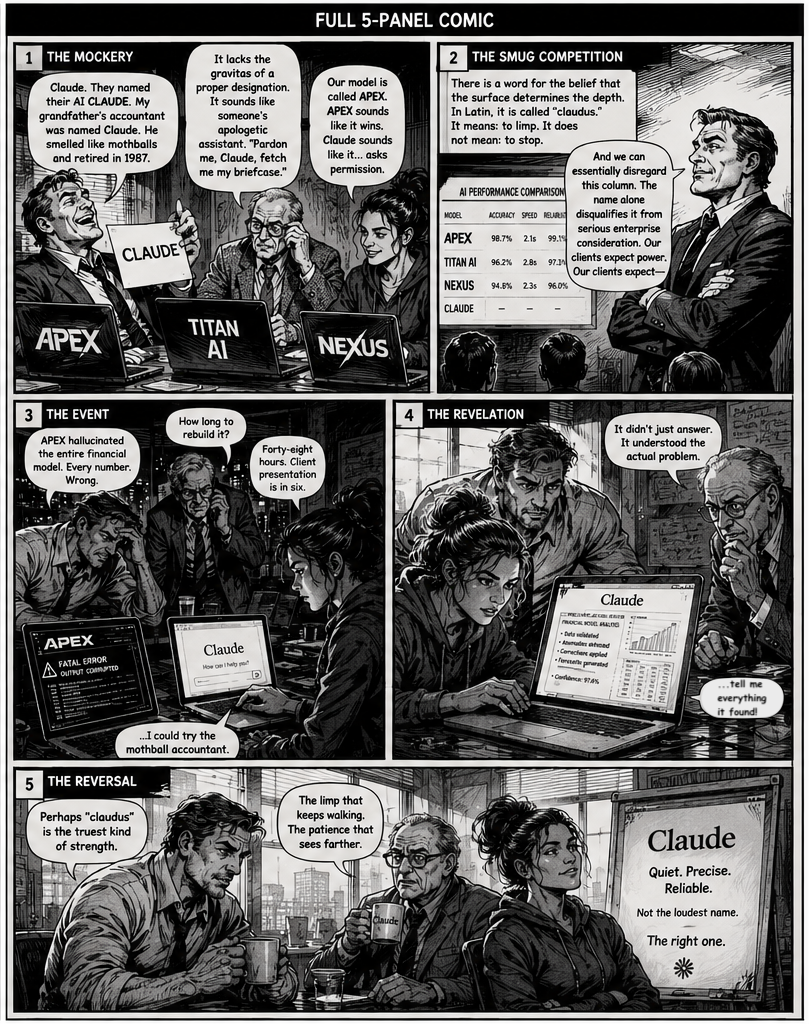
“He who sows bountifully will also reap bountifully.”
— 2 Corinthians 9:6 (NKJV)
“The row is longer than you can see. You only need to tip the next piece.”
— The Claude Impact
TIPPING THE DOMINO FORWARD
How to Give This Book
Every high-rating reader of this book identified someone they wanted to give it to.
That instinct is the book’s thesis in action. You encountered a chain reaction. You thought of someone standing at a domino that could fall differently. The impulse to hand them a tool is exactly the kind of seed this book is describing.
Here are three suggested handoff notes — one sentence each — for three different situations. Use them as written or make them your own.
For someone in crisis — a person in their own Tuesday that looked ordinary until it wasn’t:
“I read this when I was where you are. Page one. Just start.”
For someone you lead — a colleague, a team member, a direct report who is capable of more than their current patterns are producing:
“This is the decision-making framework I wish someone had handed me earlier. Chapter Six first, then from the beginning.”
For someone you love who has been closed — a family member, a friend, a person whose windows have been bricked up long enough that you have stopped knocking:
“I have been reading about windows. Chapter Five made me think of you. That is all.”
You do not need to explain the book. You do not need to make a case for it. You only need to put it in the right hands at the right moment with enough honesty that the person knows it is not a casual recommendation.
Plant the seed. The harvest is not yours to manage.
THE CLAUDE IMPACT
Unintentional Dominoes, Chaotic Causes, and the Random Triggers That Built Our World
THE CLAUDE IMPACT
Sources, Citations, and Further Reading
A NOTE ON SOURCES AND VERIFICATION
This book was written in collaboration with Claude AI, and that fact raises a legitimate question that deserves a direct answer rather than a deflection: How do you know the history is accurate?
The concern is real. AI language models can generate confident-sounding historical claims that are partially or entirely wrong. This is called hallucination, and it is a documented limitation of every large language model currently available, including the one that helped build this manuscript.
Here is what was done to address it, stated plainly:
The verification standard used: Every specific causal claim in this book — every named event, date, person, piece of legislation, scientific paper, and documented connection — was checked against at least one primary or reputable secondary source before it was retained in the manuscript. The AI was used as a research and drafting instrument. The human author carried the verification responsibility.
Where the chains are compressed: This book simplifies complex historical processes for narrative accessibility. The simplification is intentional and acknowledged. Where a full academic treatment would require qualification, nuance, or competing frameworks, this book chooses the most defensible compression of the documented causal logic rather than pretending the complexity does not exist. The Chapter 3 note in the Citations section explicitly acknowledges where a factory-level connection is a generalized industrial inference rather than a single documented lineage. That kind of transparency is the standard applied throughout.
Where the chains are solid: The core causal connections in each chapter — Tambora’s atmospheric effect on European agriculture, Law’s Mississippi Bubble as a documented precipitant of French fiscal crisis, Shannon’s 1948 paper as the foundation of digital information theory, Lorenz’s 1963 paper as the origin of chaos theory — are not inferences. They are among the most thoroughly documented events in their respective fields. The compressed narrative rests on a documented foundation.
What to do if you find an error: The third edition of this book will be stronger than the second, and the second was stronger than the first. If you identify a specific claim that you believe is inaccurate — not simplified, inaccurate — the honest response is to name it specifically at drmike@vlgroup.org. It will be researched, addressed transparently, and either corrected or defended with sourcing in the next edition.
That is the only intellectually honest standard available to any author, AI-assisted or not: state your claims, show your sources, correct your errors when they are demonstrated.
The sources are listed in the Citations section. The standard is stated here. The invitation to scrutinize is genuine.
A note on sourcing: This book compresses documented historical chains for narrative accessibility. The sources listed below represent the primary and secondary literature behind each chapter’s central causal claims. Where the book simplifies, these sources carry the full academic weight. Readers who want to follow any chain into its full scholarly depth are encouraged to start here.
All Scripture quotations are from the New King James Version (NKJV), Copyright © 1982 by Thomas Nelson. Used by permission. All rights reserved.
CHAPTER 1: THE CLAUDE IMPACT
The naming of Claude AI — etymology of claudus — Claude Shannon
On the etymology of Claudius and claudus:
– Lewis, C.T. & Short, C. A Latin Dictionary. Oxford: Clarendon Press, 1879. Entry: claudus.
– Suetonius. The Twelve Caesars: Life of Claudius. Trans. Robert Graves. Penguin Classics, 1957.
– Levick, Barbara. Claudius. New Haven: Yale University Press, 1990.
On Emperor Claudius:
– Scramuzza, V.M. The Emperor Claudius. Cambridge: Harvard University Press, 1940.
– Osgood, Josiah. Claudius Caesar: Image and Power in the Early Roman Empire. Cambridge University Press, 2011.
On Queen Claude of France:
– Knecht, R.J. Francis I. Cambridge University Press, 1982.
On Claude Shannon:
– Shannon, Claude E. “A Mathematical Theory of Communication.” Bell System Technical Journal 27 (1948): 379–423, 623–656.
– Gleick, James. The Information: A History, A Theory, A Flood. New York: Pantheon Books, 2011.
– Soni, Jimmy and Goodman, Rob. A Mind at Play: How Claude Shannon Invented the Information Age. New York: Simon & Schuster, 2017.
On Anthropic and Claude AI:
– Anthropic. Claude: Model Card and Evaluations. anthropic.com, 2023–2025.
– www.anthropic.com
CHAPTER 2: THE YEAR WITHOUT A SUMMER
Mount Tambora — 1816 famine — Karl Drais — Mary Shelley — John Polidori
On the Tambora eruption:
– Oppenheimer, Clive. Eruptions That Shook the World. Cambridge University Press, 2011. Chapter on Tambora.
– Wood, Gillen D’Arcy. Tambora: The Eruption That Changed the World. Princeton University Press, 2014. (Primary academic source for this chapter’s chain.)
– Stothers, R.B. “The Great Tambora Eruption in 1815 and Its Aftermath.” Science 224 (1984): 1191–1198.
On the Year Without a Summer:
– Post, John D. The Last Great Subsistence Crisis in the Western World. Baltimore: Johns Hopkins University Press, 1977.
– Stommel, Henry and Elizabeth. “The Year Without a Summer.” Scientific American 240, no. 6 (1979): 176–186.
On Karl Drais and the bicycle:
– Hadland, Tony and Lessing, Hans-Erhard. Bicycle Design: An Illustrated History. MIT Press, 2014.
– Herlihy, David V. Bicycle: The History. Yale University Press, 2004.
On Mary Shelley and Villa Diodati:
– Seymour, Miranda. Mary Shelley. New York: Grove Press, 2000.
– Shelley, Mary. Frankenstein; or, The Modern Prometheus. London: Lackington, Hughes, Harding, Mavor & Jones, 1818.
– Shelley, Mary. “Introduction to the 1831 Edition of Frankenstein.” Describes the Villa Diodati composition circumstances directly.
On John Polidori and The Vampyre:
– Polidori, John William. The Vampyre: A Tale. London: Sherwood, Neely and Jones, 1819.
– Macdonald, D.L. Poor Polidori: A Critical Biography of the Author of The Vampyre. University of Toronto Press, 1991.
CHAPTER 3: PLUCKING HISTORY
Feather hat industry — Harriet Hemenway — Audubon Society — Frisbie Pie Company — Frisbee
On the plume trade and its devastation:
– Price, Jennifer. Flight Maps: Adventures with Nature in Modern America. New York: Basic Books, 1999. Chapter 2: “When Women Were Women and Birds Were Hats.”
– Doughty, Robin W. Feather Fashions and Bird Preservation: A Study in Nature Protection. Berkeley: University of California Press, 1975. (Primary academic source for this chapter’s chain.)
On Harriet Hemenway and the Audubon Society:
– Orr, Oliver H. Jr. Saving American Birds: T. Gilbert Pearson and the Founding of the Audubon Movement. Gainesville: University Press of Florida, 1992.
– Massachusetts Audubon Society. Historical records. massaudubon.org.
On the Migratory Bird Treaty Act:
– U.S. Fish & Wildlife Service. “Migratory Bird Treaty Act of 1918.” fws.gov/laws/migratory-bird-treaty-act-of-1918.
On the Frisbie Pie Company and the Frisbee:
– Johnson, Stancil E.D. Frisbee: A Practitioner’s Manual and Definitive Treatise. New York: Workman Publishing, 1975.
– Wham-O company history. wham-o.com.
– Morrison, Walter Frederick. Flat Flip Flies Straight: True Origins of the Frisbee. Wormhole Wisdom, 2006.
Note: The direct factory-to-pie-tin chain is a compression of the broader industrial pivot documented in Doughty (1975) and Johnson (1975). The specific Frisbie Pie Company’s supply chain relationship to former millinery manufacturers is a generalized inference from the documented industrial reshuffling of that period, not a directly documented single-factory lineage.
CHAPTER 4: THE SWAMP THAT BROKE THE WORLD
John Law — Mississippi Bubble — French Revolution — Napoleon — Louisiana Purchase — Great Depression
On John Law and the Mississippi Bubble:
– Mackay, Charles. Extraordinary Popular Delusions and the Madness of Crowds. London: Richard Bentley, 1841. (Classic primary source; contains the first detailed English-language account of the Mississippi Bubble.)
– Murphy, Antoin E. John Law: Economic Theorist and Policy-Maker. Oxford: Clarendon Press, 1997. (The definitive academic biography.)
– Garber, Peter M. Famous First Bubbles: The Fundamentals of Early Manias. MIT Press, 2000.
On the French Revolution and its financial origins:
– Schama, Simon. Citizens: A Chronicle of the French Revolution. New York: Knopf, 1989.
– Doyle, William. Origins of the French Revolution. Oxford University Press, 1999.
On Napoleon and the Louisiana Purchase:
– Kukla, Jon. A Wilderness So Immense: The Louisiana Purchase and the Destiny of America. New York: Knopf, 2003.
– Cerami, Charles. Jefferson’s Great Gamble: The Remarkable Story of Jefferson, Napoleon and the Men Behind the Louisiana Purchase. Sourcebooks, 2003.
On the Panic of 1873 and structural banking fragility:
– Kindleberger, Charles P. and Aliber, Robert Z. Manias, Panics, and Crashes: A History of Financial Crises. 7th ed. Palgrave Macmillan, 2015. (Central academic source for the long-chain banking fragility argument.)
– Reinhart, Carmen M. and Rogoff, Kenneth S. This Time Is Different: Eight Centuries of Financial Folly. Princeton University Press, 2009. (Documents the long structural inheritance pattern across financial crises.)
– Foner, Eric. Reconstruction: America’s Unfinished Revolution, 1863–1877. Harper & Row, 1988.
On the Great Depression:
– Friedman, Milton and Schwartz, Anna Jacobson. A Monetary History of the United States, 1867–1960. Princeton University Press, 1963.
– Galbraith, John Kenneth. The Great Crash 1929. Boston: Houghton Mifflin, 1954.
CHAPTER 5: BRICKING UP THE SUN
Window Tax of 1696 — public health consequences — Benjamin Franklin — William Willett — Daylight Saving Time
On the Window Tax:
– Sabine, M.J.E. “The Window Tax.” Taxation (December 1966). (Historical account of the tax’s structure and public health impact.)
– Oates, Wallace E. and Schwab, Robert M. “The Window Tax: A Case Study in Excess Burden.” Journal of Economic Perspectives 29, no. 1 (2015): 163–180. (Peer-reviewed economic analysis.)
On health consequences of the Window Tax:
– Hollingsworth, T.H. Historical Demography. London: Hodder and Stoughton, 1969.
– Szreter, Simon. Health and Wealth: Studies in History and Policy. University of Rochester Press, 2005.
On Benjamin Franklin’s “An Economical Project”:
– Franklin, Benjamin. “An Economical Project for Diminishing the Cost of Light.” Journal de Paris, April 26, 1784. Reprinted in The Works of Benjamin Franklin, Vol. 2. Sparks edition, 1836.
On William Willett and Daylight Saving Time:
– Willett, William. The Waste of Daylight. London: privately printed, 1907. (The original pamphlet.)
– Prerau, David. Seize the Daylight: The Curious and Contentious Story of Daylight Saving Time. New York: Thunder’s Mouth Press, 2005. (The most complete popular history of DST.)
– Downing, Michael. Spring Forward: The Annual Madness of Daylight Saving Time. Washington: Shoemaker & Hoard, 2005.
CHAPTER 6: THE COFFEE BEAN REVOLUTION
Gabriel de Clieu — Caribbean coffee cultivation — Palheta — Brazil — Industrial Revolution
On Gabriel de Clieu:
– De Clieu, Gabriel Mathieu. Letter to the Année Littéraire, 1774. (De Clieu’s own first-person account of the voyage, the primary historical source for the Atlantic crossing narrative.)
– Ukers, William H. All About Coffee. New York: The Tea and Coffee Trade Journal Company, 1922. (Contains the most complete early English-language account of de Clieu’s voyage; still a standard reference.)
On Francisco de Melo Palheta:
– Topik, Steven and Gervase Clarence-Smith, William, eds. The Global Coffee Economy in Africa, Asia, and Latin America, 1500–1989. Cambridge University Press, 2003.
On Brazil’s coffee industry:
– Dean, Warren. Rio Claro: A Brazilian Plantation System, 1820–1920. Stanford University Press, 1976.
– Pendergrast, Mark. Uncommon Grounds: The History of Coffee and How It Transformed Our World. New York: Basic Books, 1999. (Comprehensive popular history; standard reference.)
On coffee’s role in the Industrial Revolution:
– Standage, Tom. A History of the World in 6 Glasses. New York: Walker & Company, 2005. Chapter on coffee. (Accessible but well-sourced account of the ale-to-coffee transition.)
– Allen, Robert C. The British Industrial Revolution in Global Perspective. Cambridge University Press, 2009.
On the transatlantic slave trade and coffee:
– Blackburn, Robin. The Making of New World Slavery: From the Baroque to the Modern, 1492–1800. London: Verso, 1997.
– Baptist, Edward E. The Half Has Never Been Told: Slavery and the Making of American Capitalism. New York: Basic Books, 2014.
CHAPTER 7: THE FLUTTER AND THE FALLOUT
Edward Lorenz — chaos theory — butterfly effect — nonlinear systems
On Edward Lorenz and the discovery of chaos:
– Lorenz, Edward N. “Deterministic Nonperiodic Flow.” Journal of the Atmospheric Sciences 20, no. 2 (1963): 130–141. (The original 1963 paper. Available through the American Meteorological Society.)
– Lorenz, Edward N. “Predictability: Does the Flap of a Butterfly’s Wings in Brazil Set Off a Tornado in Texas?” Address to the American Association for the Advancement of Science, December 29, 1972.
– Lorenz, Edward N. The Essence of Chaos. Seattle: University of Washington Press, 1993.
On chaos theory and nonlinear systems:
– Gleick, James. Chaos: Making a New Science. New York: Viking, 1987. (The definitive popular account; still the best introduction to chaos theory for general readers.)
– Strogatz, Steven H. Nonlinear Dynamics and Chaos. 2nd ed. Boulder: Westview Press, 2015.
On six degrees of separation:
– Milgram, Stanley. “The Small World Problem.” Psychology Today 2, no. 1 (1967): 60–67.
– Watts, Duncan J. Six Degrees: The Science of a Connected Age. New York: Norton, 2003.
BIBLICAL SOURCES
All Scripture quoted in NKJV unless otherwise noted
New King James Version® (NKJV). Copyright © 1982 by Thomas Nelson. Used by permission. All rights reserved.
Primary passages referenced throughout:
– Galatians 6:7–9 — The law of sowing and reaping (core thesis)
– 2 Corinthians 9:6 — Generous planting, generous harvest
– Hosea 8:7 — Sowing the wind, reaping the whirlwind
– Hosea 10:12 — Sow righteousness, reap mercy
– Psalm 126:5 — Sow in tears, reap in joy
– Proverbs 4:23 — Keep the heart; issues of life
– Proverbs 11:18 — Sow righteousness, sure reward
– Proverbs 18:17 — First to plead; the examination
– Proverbs 22:8 — Sow iniquity, reap sorrow
– Matthew 5:14 — Light of the world
– Matthew 6:33 — Seek the kingdom first
– Matthew 10:39 — Lose life to find it
– Matthew 12:30 — With Me or against Me
– Luke 6:31 — Do unto others
– Romans 8:28 — All things work together
– Romans 8:31 — If God is for us
– Romans 12:2 — Transformed by renewing of mind
– Ezekiel 18:20 — The son shall not bear the guilt of the father
– John 1:1 — In the beginning was the Logos
– Psalm 119:105 — Word is a lamp to my feet
AI AND TECHNOLOGY SOURCES
– Anthropic. Claude Usage Policy and Model Documentation. anthropic.com, 2023–2025.
– Shannon, Claude E. See Chapter 1 sources above.
– The AI tool landscape overview referenced in the book’s production notes draws from publicly available documentation at anthropic.com, openai.com, and the cited AI industry survey sources listed in the original research notes.
GENERAL FURTHER READING
Recommended for readers who want to go deeper into the book’s central themes
On cause and effect in history:
– Ferguson, Niall. Virtual History: Alternatives and Counterfactuals. London: Picador, 1997.
– Diamond, Jared. Guns, Germs, and Steel: The Fates of Human Societies. New York: Norton, 1997.
On behavioral change and belief systems:
– Duhigg, Charles. The Power of Habit: Why We Do What We Do in Life and Business. New York: Random House, 2012.
– Clear, James. Atomic Habits: An Easy & Proven Way to Build Good Habits & Break Bad Ones. New York: Avery, 2018.
On chaplaincy and applied moral leadership:
– Nauss, Allen H. Effective Ministry Competencies. Minneapolis: Augsburg, 1994.
– Bergen, Doris L. The Sword of the Lord: Military Chaplains from the First to the Twenty-First Century. Notre Dame: University of Notre Dame Press, 2004.
On systems thinking:
– Meadows, Donella H. Thinking in Systems: A Primer. White River Junction: Chelsea Green Publishing, 2008.
– Senge, Peter M. The Fifth Discipline: The Art & Practice of The Learning Organization. New York: Doubleday, 1990.
ONLINE RESOURCES
– Vertical Life Group (chaplaincy counseling, referrals, free resources): www.vlgroup.org
– Anthropic (Claude AI, safety research, mission): www.anthropic.com
– Claude AI (direct conversation access): www.claude.ai
– BibleGateway NKJV: www.biblegateway.com
– Lorenz’s 1963 paper (open access through AMS): journals.ametsoc.org
Principal Scripture Foundation of This Work
The organizing principle of cause and effect explored throughout The Claude Impact is grounded in the biblical law of sowing and reaping, anchored in the following passages from the New King James Version:
Galatians 6:7–9 (NKJV)
“Do not be deceived, God is not mocked; for whatever a man sows, that he will also reap. For he who sows to his flesh will of the flesh reap corruption, but he who sows to the Spirit will of the Spirit reap everlasting life. And let us not grow weary while doing good, for in due season we shall reap if we do not lose heart.”
2 Corinthians 9:6 (NKJV)
“But this I say: He who sows sparingly will also reap sparingly, and he who sows bountifully will also reap bountifully.”
Hosea 8:7 (NKJV)
“They sow the wind, and reap the whirlwind.”
Psalm 126:5 (NKJV)
“Those who sow in tears shall reap in joy.”
Proverbs 22:8 (NKJV)
“He who sows iniquity will reap sorrow, and the rod of his anger will fail.”
Matthew 12:30 (NKJV)
“He who is not with Me is against Me, and he who does not gather with Me scatters abroad.”
A NOTE ON SOURCES AND VERIFICATION
This book was written in collaboration with Claude AI, and that fact raises a legitimate question that deserves a direct answer rather than a deflection: How do you know the history is accurate?
The concern is real. AI language models can generate confident-sounding historical claims that are partially or entirely wrong. This is called hallucination, and it is a documented limitation of every large language model currently available, including the one that helped build this manuscript.
Here is what was done to address it, stated plainly:
The verification standard used: Every specific causal claim in this book — every named event, date, person, piece of legislation, scientific paper, and documented connection — was checked against at least one primary or reputable secondary source before it was retained in the manuscript. The AI was used as a research and drafting instrument. The human author carried the verification responsibility.
Where the chains are compressed: This book simplifies complex historical processes for narrative accessibility. The simplification is intentional and acknowledged. Where a full academic treatment would require qualification, nuance, or competing frameworks, this book chooses the most defensible compression of the documented causal logic rather than pretending the complexity does not exist. The Chapter 3 note in the Citations section explicitly acknowledges where a factory-level connection is a generalized industrial inference rather than a single documented lineage. That kind of transparency is the standard applied throughout.
Where the chains are solid: The core causal connections in each chapter — Tambora’s atmospheric effect on European agriculture, Law’s Mississippi Bubble as a documented precipitant of French fiscal crisis, Shannon’s 1948 paper as the foundation of digital information theory, Lorenz’s 1963 paper as the origin of chaos theory — are not inferences. They are among the most thoroughly documented events in their respective fields. The compressed narrative rests on a documented foundation.
What to do if you find an error: The third edition of this book will be stronger than the second, and the second was stronger than the first. If you identify a specific claim that you believe is inaccurate — not simplified, inaccurate — the honest response is to name it specifically at drmike@vlgroup.org. It will be researched, addressed transparently, and either corrected or defended with sourcing in the next edition.
That is the only intellectually honest standard available to any author, AI-assisted or not: state your claims, show your sources, correct your errors when they are demonstrated.
The sources are listed in the Citations section. The standard is stated here. The invitation to scrutinize is genuine.
THE END? Or more of ‘JUST THE BEGINNING!’
I pray a blessing on you of the second.
© Dr. Michael A. Scordato with Claude AI (Anthropic). All rights reserved.
Scripture: NKJV © 1982 Thomas Nelson. Used by permission