

NOTES from Dr. Michael A. Scordato’s Biblical Counseling Leadership Series
REALLY!?
What if the greatest crisis in your church isn’t the culture outside the building—but the unresolved collapse happening inside the people leading it? What if the pastor preaching on Sunday is quietly bleeding out by Thursday? What if the counselor offering clarity to everyone else has forgotten who he is when the room empties? What if the ministry smile is real—but the panic underneath it is more real? And what if the people applauding the loudest are standing on top of someone else’s private funeral?
Churches know how to platform charisma. They know how to celebrate momentum. They know how to count attendance, clicks, conversions, views, and applause. But they often do not know how to diagnose envy in leadership. They do not know how to identify identity fracture under giftedness. They do not know how to counsel the pastor who cannot sleep because the younger preacher’s crowd is growing while his own is shrinking. They do not know what to do with the elder who smiles through his own diminishment while quietly wondering whether he has become unnecessary.
And so we baptize burnout and call it sacrifice. We baptize insecurity and call it passion. We baptize comparison and call it discernment. We baptize emotional collapse and call it “just a hard season.” Meanwhile the soul underneath suffocates in plain sight. The modern church has no shortage of voices. What it is starving for is a man in the wilderness who knows exactly who he is—and is completely at peace not being the center of the story. That man was John the Baptist.
He was not a side character in red-letter history. He was not an eccentric footnote standing waist-deep in the Jordan waiting for Jesus to arrive. He was the hinge between two covenants. The last prophet of the old age. The first witness of the new. The voice that broke four hundred years of divine silence. The man sent by God to prepare a people—and then disappear.
He drew crowds large enough to alarm rulers. He confronted kings to their face. He sent his own disciples away to follow another man. He questioned heaven from a prison cell. And when his work was finished, he decreased without resentment. That is not merely biography. That is one of the most psychologically complete leadership profiles in all of Scripture.
For the biblical counselor, John the Baptist is not simply someone to admire from a distance. He is diagnostic. He exposes our jealousy. He names our fear of irrelevance. He confronts our addiction to being needed. He reaches into the hidden places where ministry ego disguises itself as holiness and asks the question most leaders spend years trying not to answer:
If Christ increases—and you disappear—will your joy remain? Most cannot answer that immediately. Many cannot answer it honestly. That is why this study matters. Because somewhere between the wilderness and the prison cell, between the crowd and the silence, between calling and diminishment, John the Baptist becomes painfully modern. And if we are willing to listen, he may still be preparing the way—not only for Christ in the church—but for truth in us.
There Are Qualities Needed in Trials
“19 So then, my beloved brethren, let every man be swift to hear, slow to speak, slow to wrath; 20 for the wrath of man does not produce the righteousness of God”, James 1:19-20… so right now, slow down and open your ear to listen. Let’s pray.
God you are my commander. You are my Lord. You are my King. You are my Guide. You are my Hope. My Way. My Truth. Therefore it is only You who are my Life. Thank you for your now embrace. Amen.
Let’s Start With The Structural Keystone Set Up For New Testament Scripture
John the Baptist is not a peripheral character in the biblical narrative. He is the structural keystone connecting the two Testaments with Jesus— the living fulfillment of four centuries of prophetic silence. Removing him would leave the Old Testament ending on an unfulfilled promise and the New Testament opening without a herald, without a legal witness, and without the disciples who would carry the Gospel to the ends of the earth. For the biblical counselor and church leader, John’s life offers one of scripture’s most complete profiles of prophetic identity, moral courage, ministry humility, and faith under pressure.
This profile draws from the full biblical account — Matthew, Mark, Luke, John, and Acts — using the NKJV text, grounded in Koine Greek precision and first-century historical context. It is organized to serve as both a theological study and a practical counseling tool.
Part I: The Prophetic Blueprint — What the Old Testament Promised
Hebrew: Originates from the biblical name יוֹחָנָן (Yōḥānān) or יְהוֹחָנָן (Yəhōḥānān), literally translating to “YHWH (I Am) is gracious”.
Greek: Adapted in the New Testament as Ἰωάννης (Iōannēs).
John’s identity was not self-invented. Every detail of his life — his location, his dress, his mission, and his message — was blueprinted in the Hebrew Scriptures centuries before his birth.
The Three Foundational Prophecies
Isaiah 40:3–5 promised a voice in the wilderness who would prepare a highway for the arrival of God. This was not metaphorical geography — it was a literal prophetic assignment to operate outside the corrupt urban and temple systems of Jerusalem, calling the nation back to a desert “reset” reminiscent of the original Exodus.
Malachi 3:1 promised a messenger who would prepare the way immediately before the Lord entered His temple. This was the covenant-transition passage — the hinge between the old order and the new.
Malachi 4:5–6 — the very last words of the Old Testament canon — explicitly promised the return of the prophet Elijah before the great day of the Lord. The canonical Christian Old Testament was deliberately structured to end on this promise. Without John’s arrival, that closing promise would stand permanently unfulfilled, leaving the Old Testament structurally incomplete.
“Behold, I will send you Elijah the prophet before the coming of the great and dreadful day of the Lord.” — Malachi 4:5 (NKJV)
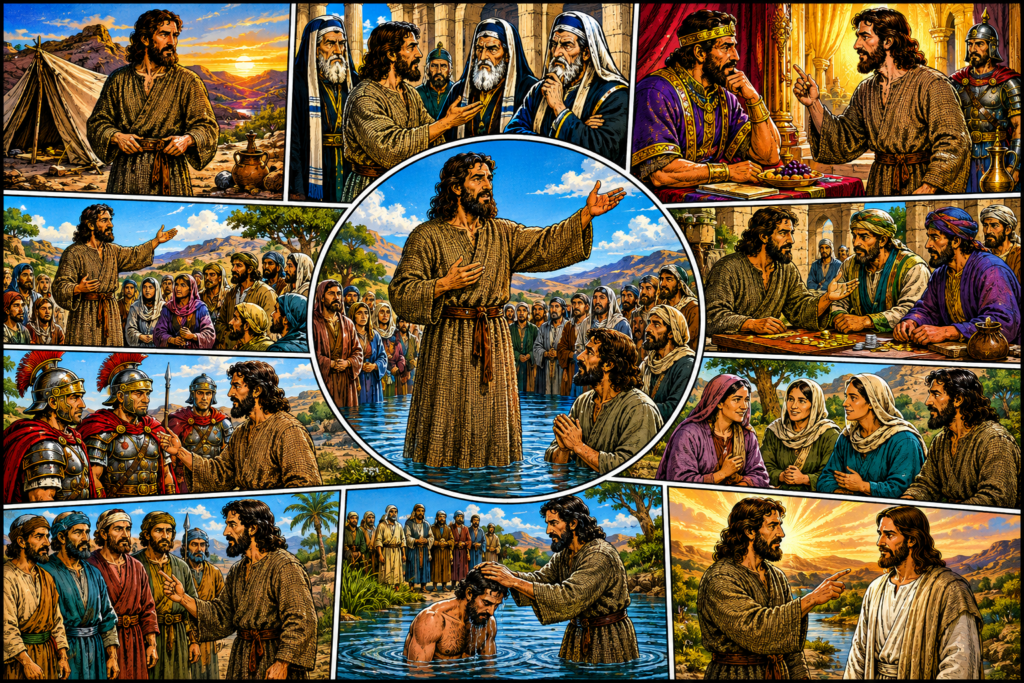
When John appeared in the Judean wilderness wearing the prophetic mantle of woven camel’s hair cloth tunic and a leather belt — the precise uniform of Elijah described in 2 Kings 1:8 — every biblically literate observer understood the signal immediately. This was not a fashion choice. It was a theological declaration: the prophetic era had returned, and the Messiah was right behind him.
With John the Baptist appearing the four hundred years of silent wait from Heaven was broken in the time frame promised by Daniel (which is why the Wise Men of Daniel’s order were waiting and ready to meet baby Jesus). Daniel 9:24-27, is a timeline delivered by the angel Gabriel detailing a period of “70 weeks” (interpreted as 490 prophetic years) to the coming of the Messiah. It is broken into 3 periods: 7 weeks, 62 weeks, and 1 week left for the End Time’s tribulation. The prophecy equates 1 “week” to 7 years. So you see the connections with nothing being random, but rather anticipated…but people being impatient and people taking advantage of their impatience make all sorts of trouble and fake laws and additional gnosticism (like the modern Free-Mason cult style still used) fake books and teachings to control the gullible wanting people. John was the start of the RESET out of this.
Part II: Birth, Consecration, and Early Formation
John’s life was divinely superintended from before conception. The angel Gabriel appeared to his father Zechariah, a righteous Aaronic priest serving in the temple, and announced a son who would be filled with the Holy Spirit from birth (Luke 1:7–15). Three specific consecrations defined John’s lifelong identity.
The Nazirite Vow from Birth
Gabriel commanded that John must never drink wine or fermented drink (Luke 1:15), establishing him as a lifelong Nazirite — a designation he shared Biblically proclaimed with only Samson and Samuel. According to Numbers 6, the Nazirite vow required three strict commitments: total abstinence from the vine, uncut hair as a visible crown of consecration, and absolute avoidance of corpses to maintain ritual purity.
This last requirement is particularly significant for understanding John’s wilderness lifestyle. It was not primitive social withdrawal — it was a calculated strategy to maintain the ritual purity required by his vow, far from the accidental defilements of urban life. The man who would baptize others had to remain ceremonially spotless himself.
The Elijah Mandate
“He will also go before Him in the spirit and power of Elijah… to make ready a people prepared for the Lord.” — Luke 1:17 (NKJV)
Gabriel framed John’s entire mission not as imitation but as spiritual succession — operating in the spirit and power of the most confrontational prophet in Israel’s history. This is the framework every leader and counselor must hold in tension: John was not Elijah reincarnated (he explicitly denied this in John 1:21), but he was the fulfillment of what Elijah’s spirit prefigured.
Part III: The Public Ministry — Correcting the “Wild Man” Misconception
Popular art and casual pulpit culture have done John the Baptist a severe historical injustice. The caveman image — a one-shouldered, dirt-caked, wild-eyed eccentric eating live insects from his hand — is the product of Renaissance artistic license and Western cultural squeamishness, not biblical or historical fact. Correcting this misconception is not a trivial academic exercise. It directly affects how we understand and apply John’s prophetic authority to counseling and leadership.
His Clothing: A Prophetic Uniform, Not a Survival Rag
Matthew 3:4 and Mark 1:6 describe John’s garment using the Greek word enduma — meaning a crafted outer garment or cloak — made from camel hair, secured by a leather belt. The Greek text does not say he wore a camel hide (derma). The hair was gathered, spun into thread, and woven into durable fabric — identical to the prophet’s mantle described in 2 Kings 1:8.
Camel hair is not inherently scratchy or punitive. The animal’s double coat — a coarse outer guard hair and a soft, insulating inner undercoat — produced a thick, weather-resistant textile that was standard gear for desert travelers, nomads, and ascetics. It shed rain, insulated against freezing wilderness nights, breathed under desert heat, and doubled as a bedroll — in fact, Mosaic law forbade keeping a poor man’s cloak past sunset precisely because it was his essential bedding (Exodus 22:26–27).
The one-shouldered, nipple-baring depiction of John found in Renaissance paintings by Leonardo, Raphael, and Caravaggio was borrowed directly from classical Roman statues of the pagan god Bacchus and the Greek exomis style worn by laborers and slaves. It had nothing to do with John’s actual dress and everything to do with Renaissance artists’ desire to display their anatomical draftsmanship through a religious subject. The biblical record places John in a fully covered, modest, culturally recognizable prophetic uniform.
His Hygiene: A Nazarite in a River
John was a son of a high-ranking Aaronic priest, bound by a lifelong Nazirite vow that prohibited contact with anything ritually unclean. He could not have maintained that vow while living in physical filth. Furthermore, his entire ministry was conducted at the Jordan River — a naturally flowing body of “living water” (mayim chayyim) that constituted the highest standard of Jewish ritual purification. A man who spends his working days immersing people in flowing river water is not caked in dirt. The caveman image fails on every level — biblical, cultural, and logistical.
The political record confirms this further. Mark 6:20 explicitly states that Herod Antipas — one of the most Hellenized, Rome-influenced rulers of the region — “feared John and protected him, knowing him to be a righteous and holy man,” and that he “liked to listen to him.” A powerful, image-conscious Roman client king does not grant repeated audiences to a feral social outcast. Herod recognized John for what he was: a dignified, spiritually authoritative ascetic prophet in the tradition of Elijah, operating under a recognized and respected counter-cultural calling.
His Diet: Locusts and Honey — A Precise Staple, Not a Spectacle
John’s diet of locusts and wild honey (Matthew 3:4, Mark 1:6) has generated centuries of creative alternative theories — carob beans, honey cakes, tree sap. The Greek text, however, is unambiguous. The word used is akris, the standard Koine Greek term for the migratory locust. There is no linguistic basis in the manuscript tradition for substituting a bean or a cake. To treat “locusts” as a coded reference to something more palatable is to adopt the same agenda-driven eisegesis that these notes rightly warn against — forcing the text to say something it never said.
The locust was entirely permissible under Levitical dietary law. Leviticus 11:21–22 specifically designates the arbeh (migratory locust) as kosher, along with three related species, provided they have the identifying jointed leaping legs. This permission was ecologically practical: when locust swarms descended and destroyed crops, the very pest that caused famine became the emergency protein supply. John would have collected them during swarms, processed them by boiling in brine or roasting, and sun-dried them for travel — a nutritionally dense, shelf-stable desert survival ration, coated in wild honey for caloric energy and preservation. This was not the food of a madman; it was the intelligent diet of a disciplined wilderness minister.
“And John himself was clothed in camel’s hair, with a leather belt around his waist; and his food was locusts and wild honey.” — Matthew 3:4 (NKJV)
Part IV: The Ministry at the Jordan River — Theological Geography
John’s choice of the Jordan River as his baptismal site was as calculated as his clothing. In Jewish sacred history, the Jordan was the definitive boundary of national identity and covenant renewal. Under Joshua, the nation crossed it to enter the Promised Land after forty years of wilderness discipline (Joshua 3). John’s ministry at that same riverbank was a deliberate prophetic reenactment — a visual declaration that first-century Israel had become spiritually equivalent to the wilderness generation, and that the only way forward was a new covenant crossing.
The Jordan also carried the specific weight of Elijah’s departure. In 2 Kings 2:8, Elijah struck the Jordan with his mantle, parted the waters, and was immediately taken up in a chariot of fire. By standing at that same riverbank in Elijah’s garment, John was triggering a deep cultural memory: the prophetic authority that left the earth at the Jordan had returned to the exact same location.
Practically, the Jordan provided an inexhaustible source of naturally flowing “living water” — the mayim chayyim required by Jewish purity law for valid ritual immersion. Unlike the stone mikveh pools controlled by the Jerusalem temple establishment, the Jordan was free, open, and answerable to no institutional hierarchy. John offered genuine spiritual cleansing to soldiers, tax collectors, and outcasts who could never afford or access the temple system’s gatekeepers.
Part V: The Relationship with Jesus — The Art of Holy Diminishment
John’s entire ministry was architecturally designed to point away from himself toward Christ. His theology of self-reduction is one of the most practically applicable models in scripture for leaders and counselors who struggle with ego, comparison, and the fear of being replaced.
“He must increase, but I must decrease.” — John 3:30 (NKJV)
When John’s own disciples grew jealous of Jesus’s growing crowds and reported the loss to John, he responded not with grief or competition but with the imagery of a wedding: he was the best man. His joy was complete precisely in Christ’s increase. This response was possible only because John had constructed his identity not on his popularity or his priestly pedigree but on his God-given function. He knew exactly what he was for — and he was completely content to be finished.
John’s identification of Jesus as “the Lamb of God who takes away the sin of the world” (John 1:29) was the single most important theological introduction in human history. It reframed the entire Messianic expectation away from a military liberator and toward a sacrificial substitute — a Genesis 3:15 promised finally fulfilled paradigm shift (Isaiah 52:13-53) that the disciples, especially Andrew and John the Beloved, had absorbed before they ever met Jesus directly. This prepared ground was why they could drop their nets and follow without hesitation.
Part VI: John’s Disciples and the Formation of the Church’s Core (Luke 1:17 (NKJV))
The most understated aspect of John’s legacy is the direct chain of leadership he produced. Jesus’s inner circle was not assembled from strangers. It was recruited from men already formed by John’s wilderness ministry.
- Andrew and John the Beloved were standing with John the Baptist when he pointed to Jesus and said, “Behold! The Lamb of God!” (John 1:35–36). They followed Jesus immediately.
- Andrew then went directly to his brother Simon Peter and declared, “We have found the Messiah” (John 1:41) — the first evangelistic act displayed in full of the New Testament age.
- Philip and Nathanael were recruited the following day in the same region (John 1:43–45), completing the initial core.
These men came to Jesus already having been broken of nationalist pride by John’s preaching, already equipped with the concept of a sacrificial Messiah through John’s “Lamb of God” declaration, and already trained in the theology of repentance and covenant renewal. John had done the preparatory work on their hearts and minds. Without that formation, they would have arrived at Jesus’s call as ordinary fishermen shaped entirely by the prevailing Zealot expectation of a military king — and would have required years of remedial theological reorientation before they could be deployed.
This legacy was so foundational to early Church leadership that when the apostles needed to select a replacement for Judas Iscariot, Peter set a mandatory qualification: the candidate had to be someone who had been present “beginning from the baptism of John” (Acts 1:21–22). John’s ministry was the official baseline of Christian apostolic authority.
Part VII: Biblical Counseling Applications for Leaders
John the Baptist provides a counseling profile of exceptional depth. His life addresses the most common presenting issues in leadership counseling: identity fracture, professional jealousy, ministry burnout, fear of man, political pressure, doubt under suffering, and the crisis of unmet expectations.
1. Identity Anchored in Calling, Not Approval
When the religious authorities demanded John identify himself, he refused every prestigious title available to him and simply said:
“I am ‘The voice of one crying in the wilderness: Make straight the way of the Lord,’ as the prophet Isaiah said.” — John 1:23 (NKJV)
John did not define himself by his priestly pedigree, his popular following, or the titles people tried to give him. He defined himself by his relationship to God’s word and God’s assignment. For clients whose identity has fractured under career loss, public failure, or ministry disappointment, John models what it looks like to be completely unshakeable because you are anchored to function rather than ego. The counselor’s work is to help such clients stop asking “Who am I in the eyes of others?” and start anchoring identity in divine calling and covenant standing.
2. Freedom from Ministry Jealousy and Codependency
Many interpersonal conflicts in church leadership stem from codependency, territorial comparison, and the fear of being eclipsed. John’s response to his disciples’ jealousy is the definitive model of healthy professional Proverbs 25:28 boundary walls guided through biblical stewardship rooted in theological conviction:
“A man can receive nothing unless it has been given to him from heaven… He must increase, but I must decrease.” — John 3:27, 30 (NKJV)
Because John understood divine sovereignty over personal significance, he was completely immune to the comparison trap. He had received a specific, bounded assignment from heaven, and he was content to operate within those boundaries until they were fulfilled. Counsel clients dealing with envy or burnout toward this same principle: rest in what God has allocated, release what He has not, and find joy in seeing others succeed in their lane.
3. Handling Doubt and Depression Under Suffering
John’s imprisonment is one of the most psychologically honest passages in the New Testament. Locked in Herod’s dungeon at Machaerus, isolated from his ministry, and watching Jesus’s work take a different shape than he expected, John sent his disciples with the most vulnerable question a prophet could ask:
“Are You the Coming One, or do we look for another?” — Matthew 11:3 (NKJV)
John had preached a Messiah who would come with a winnowing fan to separate wheat from chaff and burn the future unquenchable fire of judgment (Matthew 3:12
– future book of Revelation 4-22 in which it will be fulfilled). Instead, he sat in chains while Jesus healed the sick and dined with sinners. His doubt was not apostasy — it was the crisis of unmet expectations compounded by physical isolation and the trauma of imprisonment. Jesus’s response is the model for counseling through this kind of crisis: He did not rebuke John’s doubt. He sent back objective, verifiable evidence — the blind see, the lame walk, the dead are raised (Matthew 11:4–5).
The counseling application is clear: normalize the struggle without validating despair. Even the greatest prophets experienced dark nights of the soul under pressure. Then anchor the doubting client not in subjective emotional experience but in the objective, historical faithfulness of God. The issue is rarely a crisis of faith — it is almost always a crisis of unmet expectations that requires theological recalibration.
4. Resisting the Fear of Man
Jesus described John to the crowds as the opposite of “a reed shaken by the wind” (Matthew 11:7) — the ancient idiom for a spineless, opinion-driven people-pleaser. John’s moral backbone was forged by a singular audience: he lived to please God alone. When Herod Antipas, the most powerful regional ruler of his day, was openly violating Levitical law in a politically untouchable marriage, John confronted him publicly and repeatedly:
“It is not lawful for you to have your brother’s wife.” — Mark 6:18 (NKJV) Note to remember 2 Timothy 1:7 and Joshua 1:9.
This confrontation ultimately cost John his freedom and his life. But it established him as the defining New Testament model of truth-telling under political pressure. For clients paralyzed by people-pleasing patterns, fear of family conflict, or the anxiety of holding biblical standards in hostile cultural environments, John’s example is not merely inspiring — it is the portrait of what healthy, God-fearing courage actually looks like in practice. True dignity is built not on social approval but on alignment with the law of God, regardless of personal cost.
5. Managing Cultural Stigma and Social Rejection
Jesus noted that the cultural establishment pathologized John’s lifestyle, calling him demon-possessed because of his extreme asceticism (Matthew 11:18). John’s radical simplicity — his dress, his diet, his wilderness location — made the Jerusalem elite deeply uncomfortable, because it functioned as a perpetual indictment of their luxury and spiritual compromise. Their response was predictable: they dismissed him as mentally unstable.
This dynamic is timeless. Clients who choose to live out serious biblical convictions in secular or compromised environments frequently report being labeled extremists, fanatics, or socially defective. The counselor’s role is to help such clients distinguish genuine pathology from prophetic friction — and to remind them that being called “crazy” by a dysfunctional culture is often, as in John’s case, a sign of spiritual health rather than disorder.
Part VIII: Herod Antipas, the Execution, and Its Aftermath
John’s death was not a historical footnote. It was the inciting event of a political collapse that serves as a sobering case study in the long-term consequences of silencing prophetic truth.
Herod Antipas had divorced his first wife — the daughter of the Nabataean King Aretas IV — to marry his niece and sister-in-law, Herodias, in direct violation of Levitical law. Mark 6:20 reveals Herod’s internal conflict: he “feared John and protected him, knowing him to be a righteous and holy man… and he liked to listen to him.” But Herodias despised John and waited for her moment. That moment came at Herod’s birthday banquet, when a dance performance prompted a rash drunken oath, and Herodias’s daughter, coached by her mother, demanded John’s head on a platter (Matthew 14:6–8).
The execution triggered an immediate and cascading political ruin. King Aretas IV launched a retaliatory war against Antipas for the insult of divorcing his daughter, and his army annihilated Antipas’s forces in 36 AD. The Jewish historian Josephus records that the public universally attributed this military defeat to divine judgment for John’s murder. Antipas’s political standing collapsed. Paranoia consumed him — when Jesus’s ministry exploded in popularity, Herod whispered in panic, “John the Baptist has risen from the dead!” (Mark 6:14). Eventually, in 39 AD, Emperor Caligula exiled him permanently to Gaul, stripped of title, wealth, and territory. The man who killed a prophet to secure his political position lost everything because of it.
Part IX: The Lasting Legacy — Acts and Beyond
John’s impact outlived him by decades and extended across the Roman Empire. His baptism format and theological framework were still the baseline for Christian leadership formation a generation later:
- Peter summarized the Gospel timeline as beginning explicitly from John’s baptism (Acts 1:22; 10:37).
- Paul described John’s work as a necessary historical stepping stone pointing to Christ (Acts 13:24–25).
- Apollos of Alexandria, a gifted teacher, initially knew only the baptism of John — and that foundation was considered sufficient grounding for further instruction into the fullness of the Gospel (Acts 18:24–25).
- Twelve disciples in Ephesus had received only John’s baptism and were then guided by Paul into the full revelation of Jesus (Acts 19:1–7).
In each case, John’s ministry is treated not as a primitive prototype to be discarded but as the legitimate, authoritative foundation upon which the full Gospel structure was built. Leaders who had been shaped by John’s theology of repentance, covenant, and Messianic expectation were consistently better equipped for the next step than those who had not.
Jesus’s Final Verdict on John
After John’s imprisonment — when the cultural establishment had dismissed him as eccentric, his own disciples were confused, and doubt had crept into his own heart — Jesus turned to the crowds and delivered the most extraordinary character reference in human history:
“Assuredly, I say to you, among those born of women there has not risen one greater than John the Baptist…” — Matthew 11:11 (NKJV)
Jesus demolished every “wild man” caricature with a single sentence. He framed John’s wilderness lifestyle, locust diet, and simple garment not as evidence of social dysfunction but as marks of unmatched spiritual royalty. He placed John at the absolute apex of human history prior to the inauguration of the Kingdom — greater than Abraham, greater than Moses, greater than David.
For the biblical counselor, John the Baptist represents the complete integration of prophetic identity, emotional health, professional humility, moral courage, and resilient faith. He knew who he was, he knew what he was for, he refused to be swayed by popularity or fear, and he pointed every person he encountered — including his own disciples — away from himself and toward Christ. When his work was finished, he decreased without resentment, because his joy had never depended on remaining at the center.
That is the profile every leader is called to inhabit. That is the model every counselor is privileged to build toward.
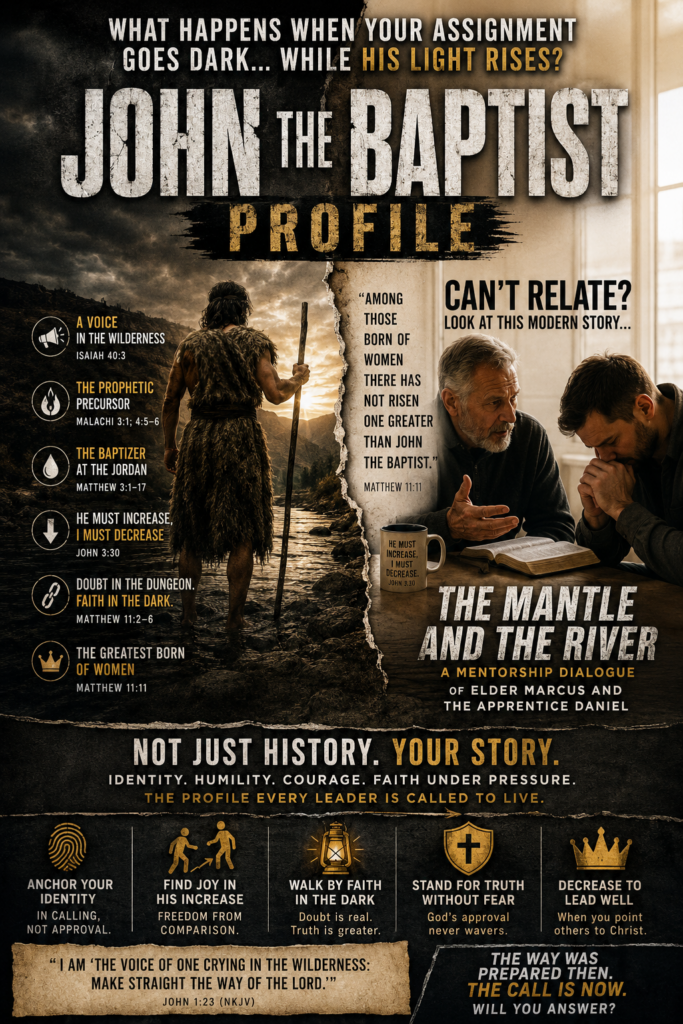
Can’t relate? Look at this modern story…
THE MANTLE AND THE RIVER
A Mentorship Dialogue of Elder Pastor Marcus and the Apprentice Daniel
Preface: How to Use This Dialogue
This dramatic scenario is designed for use in Biblical Counseling leadership training. It demonstrates how the theological and counseling principles drawn from the life of John the Baptist apply in a real mentorship context.
The dialogue may be read aloud by two participants, used for role-play training, or studied as a written case study.
Counseling annotations appear in the margins of the dialogue to identify which principle is being applied at each turning point. These are labeled in brackets for teaching reference.
Cast of Characters
Elder Pastor Marcus Whitfield — Age 71. Senior pastoral elder of a mid-sized evangelical church for 26 years. Recently diagnosed with congestive heart failure and given 12 to 18 months at his current pace of ministry. He has privately identified Daniel as his successor and has been preparing him for three years. He is not bitter about his condition. He is urgent.
Daniel Reyes — Age 34. Associate pastor and Marcus’s designated apprentice. Gifted preacher, deeply loved by the congregation. Currently in a six-month crisis: the church’s younger demographic is gravitating toward a new, charismatic associate pastor named Pastor Theo, whose social media presence and modern style are drawing crowds Daniel cannot match. Daniel has not quit, but he is quietly unraveling. He showed up to this meeting believing it was a routine check-in.
Setting: Marcus’s home study. Late afternoon. Winter light through old wooden blinds. A hospital-grade recliner beside his desk. An oxygen concentrator hums quietly in the corner. Open Bible on the desk, heavily marked. Two mugs of coffee, one untouched.
Act I: The Weight in the Room
Daniel arrives. Marcus is already seated. He looks thinner than last month. Daniel tries not to show that he notices.
[Daniel sets his bag down and takes the chair across from Marcus. He forces a smile.]
Daniel: Good to see you, Marcus. How are you feeling today?
[A beat. Marcus studies him.]
Marcus: Better than you, by the look of it. Sit down properly, son. You’ve been carrying something since you walked through that door.
Daniel: I’m fine. Just tired. The Wednesday series has been—
Marcus: Daniel.
[Silence. Marcus does not fill it. He waits.]
Daniel: …It’s Theo.
Marcus: Go on.
Daniel: The college group that used to come to my Thursday study — half of them are gone. They’re in Theo’s orbit now. The Hendersons’ kids. The whole worship team is talking about him. He preached twice on Sunday while I was at the conference, and I came back to — it was like a revival had been happening without me. People are saying his name the way they used to say mine. And I—
[He stops. Looks at the floor.]
Daniel: …I know that’s a terrible thing to say. I know how that sounds. I’ve repented for it about forty times this week and it keeps coming back.
Marcus: You came back to what, Daniel? Finish the sentence.
Daniel: I came back to feeling like I don’t know what I’m for anymore.
[Marcus is quiet for a moment. He reaches slowly for his Bible.]
Marcus: Now we’re in the room. That’s the real thing right there. Not jealousy — though that’s in there too, and we’ll deal with it. But underneath it: you’ve lost the thread of your own identity. Everything you just described is a symptom. That sentence at the end — that’s the diagnosis.
[COUNSELING PRINCIPLE 1 — Identity]: Marcus correctly identifies that beneath the presenting jealousy is a deeper identity fracture. He does not chase the symptom. He names the root issue.
Act II: The Man in the River
Marcus: Let me tell you about a man who had every reason to feel exactly what you’re feeling — and chose a completely different response. You’ve studied the profile. Walk with me through it again, but this time as your own story.
[He opens to the Gospel of John, Chapter 1.]
Marcus: John the Baptist. Thousands of people streaming out to hear him. The religious elite are sending delegations to interrogate him. He is the most significant public figure in Judea. He is the talk of Jerusalem. Then Jesus arrives. And what happens to John’s crowd?
Daniel: They start following Jesus.
Marcus: More than that. John’s own disciples come to him and say — read it for me, verse 26 of chapter 3.
[Daniel picks up the Bible and reads.]
“Rabbi, He who was with you beyond the Jordan, to whom you have testified — behold, He is baptizing, and all are coming to Him!” — John 3:26 (NKJV)
Marcus: His own men. Trying to bait him into a rivalry. ‘Rabbi, everyone is leaving you for this other man.’ Sound familiar?
Daniel: …Yes.
Marcus: And John’s answer. Read verse 27.
“A man can receive nothing unless it has been given to him from heaven.” — John 3:27 (NKJV)
Marcus: Stop there. That one sentence is the entire architecture of a healthy identity. John is saying: what I have, God gave me. What I don’t have, God did not give me. Therefore what Theo has is what God gave Theo. And what Daniel has is what God gave Daniel. The moment you start measuring your assignment against someone else’s, you have already stepped outside the only framework that will keep you sane in this work.
[COUNSELING PRINCIPLE 2 — Against Comparison]: Marcus draws from John 3:27 to disarm the comparison trap by anchoring the conversation in divine sovereignty over individual assignment.
Daniel: But Marcus — those are his disciples saying that. John’s crowd shrinking. That’s not the same as what I’m facing. I’m not losing people to the Messiah. I’m losing them to a younger, better-looking version of me who knows how to use Instagram.
[A short silence. Marcus almost smiles.]
Marcus: Daniel. Do you hear what you just said?
Daniel: I know it sounds petty—
Marcus: It sounds honest. That’s not the same thing as petty. But listen to the assumption buried in that statement. You said ‘losing people.’ To whom do the people of this church belong?
[Long pause.]
Daniel: …To God.
Marcus: Then you cannot lose what you never owned. You are not the shepherd of this flock — you are an under-shepherd. If God in His wisdom is drawing the college group toward Theo’s teaching right now, your job is not to compete for them. Your job is to keep your lane clean, keep your assignment faithful, and trust the Chief Shepherd to manage His own flock.
Marcus: John said something else. Finish the chapter. Read me verse 29 and 30.
“He who has the bride is the bridegroom; but the friend of the bridegroom, who stands and hears him, rejoices greatly because of the bridegroom’s voice. Therefore this joy of mine is fulfilled. He must increase, but I must decrease.” — John 3:29-30 (NKJV)
Marcus: John calls himself the best man. The best man’s entire job is to make sure the groom looks magnificent and the bride gets to the altar. If the best man is doing his job correctly, no one is talking about him at the end of the night. That is not failure. That is the job description.
[Daniel sets the Bible down. He stares at his hands.]
Daniel: So you’re saying I should just… be okay with Theo taking over my role.
Marcus: I’m saying you never had a role to take over. You had an assignment. And your assignment is not the same as his. But here is the more important question — and I want you to sit with this before you answer it.
[Marcus leans forward. The oxygen concentrator hums.]
Marcus: When Theo preaches and those young people come alive — when you hear that happening in your own building — is there any part of you, even a small part, that is genuinely glad for them?
[Very long pause. Daniel’s jaw tightens. Then slowly releases.]
Daniel: …There used to be.
Marcus: That’s where we start. Not with the jealousy — that’s just the smoke. The fire underneath is that your joy has become dependent on being the most needed person in the room. And the moment that happens, you stop being a minister and start being a performer. John the Baptist’s joy was complete in Christ’s increase. Not his own. Can you say that right now, honestly?
Daniel: No. I can’t say that right now.
Marcus: Good. That’s the most honest thing you’ve said. We don’t start with where you should be. We start with where you are. And where you are is sitting in John the Baptist’s prison cell.
Act III: The Dungeon Question
Daniel: What do you mean, his prison cell?
Marcus: John is at the absolute peak of his prophetic ministry. He has introduced the Messiah to the world. He has baptized the Son of God. He has heard the voice from heaven. And then — Herod arrests him. He sits in a dungeon at a fortress called Machaerus while Jesus is out there healing the sick, raising the dead, and building a movement. And John sends a message to Jesus — you know this passage?
Daniel: Matthew 11. ‘Are You the Coming One, or do we look for another?’
Marcus: The greatest prophet born of a woman. The man Jesus himself called the pinnacle of human history. And he is sitting in the dark, asking if he got it wrong. Why?
Daniel: Because his circumstances didn’t match his expectations.
Marcus: Exactly. John had preached a Messiah who would come with a winnowing fan and judge the unrighteous. He expected fire, confrontation, liberation right away. Instead he got isolation, silence, and a ministry that seemed to be going on without him. His theology was right. His experience was not matching his theology. And that gap — that’s the dungeon every serious leader eventually ends up in.
[COUNSELING PRINCIPLE 3 — Doubt Under Suffering]: Marcus normalizes Daniel’s crisis by placing it within John’s own experience, validating the struggle without validating the despair.
Marcus: You are in that dungeon right now, Daniel. Not because you’ve failed. Not because God has abandoned you. But because your expectations of what your ministry was supposed to look like are not matching your current experience. And instead of going to Jesus with the question — like John did, even in his doubt, he still turned to Jesus — you’ve been sitting in that cell by yourself, getting smaller.
[Daniel’s eyes are wet. He doesn’t look up.]
Daniel: I’ve been praying. I haven’t stopped praying.
Marcus: Praying for what?
Daniel: For Theo to… I don’t know. For things to go back to how they were.
[Long silence.]
Marcus: That’s not prayer, son. That’s a wish. Prayer in the dungeon looks like what John did — going directly to Jesus and saying, ‘I’m confused. My expectations are broken. Show me something objective.’ And Jesus’s answer to John — do you know what it was?
Daniel: He told his disciples to report what they saw. The blind seeing, the lame walking.
Marcus: He pointed John back to objective evidence. Not feelings. Not restored circumstances. Not the return of the crowd. Facts. What God was actually doing. And here is your assignment before our next meeting — I want you to make a list. Not of what you’ve lost. A list of what God is actually doing in this church right now. Objective evidence. Including through Theo. Every changed life, every answered prayer, every genuine conversion you can document. And then I want you to read that list on your knees and ask God whether any of it would have been possible without your faithfulness in this church for the last seven years.
[COUNSELING PRINCIPLE 3 — Application]: Marcus redirects Daniel from subjective emotional spiraling to objective evidence of God’s faithfulness — the same method Jesus used with the imprisoned John.
Act IV: The Mantle
A shift in tone. Marcus sets his Bible down and looks at Daniel with an unmistakable directness.
Marcus: Now I need to tell you something, and I need you to hear it completely before you respond. Can you do that?
Daniel: Yes.
Marcus: I’m not going to be here in two years. Maybe less. My cardiologist was very clear at my last appointment. The congestive heart failure is progressing.
[Daniel goes still.]
Marcus: Don’t. Don’t do the face. I’ve made my peace with this. God has been extraordinarily kind to me, and I have no interest in spending whatever time I have left managing your grief about my mortality. I need you present. Are you present?
Daniel: …Yes. I’m here.
Marcus: Three years ago I identified you as the man to carry this church forward. I have prayed over that decision more times than you have preached sermons. I have not changed my mind. But what happened in this room tonight has told me that we have work to do, because the man I chose was built for the long haul — and right now you are looking at this season like it’s a verdict instead of a workshop.
Daniel: Marcus, I—
Marcus: Let me finish. Do you know what John the Baptist said when they asked him who he was? The religious authorities came to interrogate him — they wanted a title. Christ? Elijah? The Prophet? And John refused every one of them. He said:
“I am ‘The voice of one crying in the wilderness: Make straight the way of the Lord.'” — John 1:23 (NKJV)
Marcus: He defined himself by function. By assignment. Not by pedigree — and his pedigree was impeccable; his father was a temple priest. Not by popularity — he had tens of thousands influenced. Not by title. By his relationship to the word of God and his specific calling within it. That is how you are going to have to define yourself going forward. Not as the man who used to draw the college crowd. Not as the man I chose. Not in comparison to Theo. As the man God specifically assigned to shepherd this congregation through the next season of its history.
[COUNSELING PRINCIPLE 1 — Application]: Marcus brings the identity principle to its full application: Daniel’s assignment, not his performance or popularity, is the ground of his identity.
Marcus: And here is what I know about your assignment that you can’t see right now because you’re in the dungeon. The people who are most deeply rooted in this church — the families who have weathered loss, the marriages that have been restored, the men in their forties and fifties who have found their faith again — you built that. Seven years of faithful, unglamorous, uninstagrammable pastoral presence. Theo is drawing the crowd that needs igniting. You are building the foundation that will hold the structure when the fire dies down and the work gets hard. Both are needed. Neither is greater.
[Daniel is quiet for a long time. When he speaks, his voice is different.]
Daniel: I’ve been thinking about this all wrong.
Marcus: Yes.
Daniel: I’ve been thinking the congregation’s attention is the measure. Like the crowd is the report card.
Marcus: Jesus addressed that directly. He told the crowds — read Matthew chapter 11, verse 7 — he asked them, ‘What did you go out to see? A reed shaken by the wind?’ He was defending John’s dignity against exactly that kind of misreading. The crowd went to the wilderness because something was happening there that had nothing to do with entertainment. And when John ended up in a dungeon instead of a palace, it looked to everyone watching like failure. But Jesus said he was the greatest man born of a woman. The crowd’s verdict and God’s verdict were not the same.
Daniel: He must increase, but I must decrease.
[He says it quietly, as if for the first time.]
Marcus: That’s not a resignation. That’s a theology of joy. John said his joy was fulfilled — fulfilled — in that decrease. Because his joy was never in the crowd. It was in the Bridegroom showing up. If your joy is in Christ’s increase in this church, then Theo’s fruitfulness is your joy, not your competition. That is the freedom I am trying to hand you right now. It took me fifteen years to understand it. I do not want it to take you that long.
Act V: The Mantle Passes
The winter light is almost gone now. Marcus reaches beside his recliner and picks up a worn, leather-bound study Bible — clearly his own, the spine cracked and repaired with tape, the pages swollen with use and markings.
Marcus: I want to tell you about one more thing regarding John. Near the end of the Old Testament, in the very last verses of Malachi — the final words of the old covenant — God makes a promise. He says he will send Elijah before the great day of the Lord. Four hundred years of silence follow. Four hundred years. And then a man appears in the wilderness in Elijah’s garment, standing at the Jordan River at Elijah’s exact departure point, preaching in the spirit and power of Elijah. And in that moment, every promise the Old Testament made on its way out the door was kept.
Marcus: The mantle of Elijah did not stay with Elijah. It fell to Elisha. And then it passed again, four hundred years later, to John. John wore that calling faithfully, at great personal cost, until the moment his assignment was complete. Then he decreased. And what he had built — the disciples he had formed, the theological groundwork he had laid, the spiritual hunger he had ignited across Judea — all of it transferred to Jesus and then to the twelve men who carried the Gospel to the ends of the earth.
Marcus: I have carried this church’s mantle for twenty-six years. And I am telling you tonight, Daniel — in front of God and this Bible — that I am passing it to you. Not because you’re the most polished. Not because you don’t have a dungeon season in front of you. But because I have watched you for three years, and what I see in you is the thing that matters most: you are a man who, when he is honest, wants Christ to increase. Even when it costs you. Even tonight, when you told me you couldn’t say it right now — that honesty is the beginning of the road, not the end of it.
[He holds out the Bible.]
Marcus: Take this. It has twenty-six years of margin notes in it. Every sermon, every crisis, every hospital room, every marriage I’ve tried to save. Use what’s useful. Ignore the rest. But keep it close when the dungeon gets dark, because I have been there too, and the way out is always the same: go to Jesus with the honest question, and then look for objective evidence of what He’s actually doing.
[Daniel takes the Bible. His hands are not quite steady.]
Daniel: I don’t know if I’m ready.
Marcus: John didn’t know if he was ready when Gabriel showed up in his father’s life before he was born. Readiness isn’t the prerequisite. Faithfulness is. You show up. You keep your lane clean. You point every person in this church away from yourself and toward the One you serve. And on the days when you can’t say ‘He must increase’ and mean it yet — you say it anyway and ask God to make it true in you. The feeling follows the obedience. It always has.
[A long silence. The oxygen concentrator hums.]
Daniel: I’ll make the list.
Marcus: I know you will. And bring it back to me next week. We’ll read it together.
[Daniel stands to leave. He pauses at the door.]
Daniel: Marcus. Are you afraid?
[A beat. Marcus looks at the Bible in Daniel’s hands. Then at him.]
Marcus: I have completed what I was given to do. The man who will carry this work forward is standing in my doorway holding my Bible. No. I am not afraid.
[Daniel nods. He can’t speak. He prays silently hold his mentors hand. Bow’s slightly. Then leaves.]
[Marcus sits alone in the darkening room. He closes his eyes. The oxygen concentrator hums.]
-This is NOT The End Of The Story, but rather about a new beginning. And you’ know the crazy point of this story specific, is that the Daniel of this story and Marcus both at many times in my past has actually been the writer, me. Of course this story specifics is mixed with other cases as well, but still it touches to my heart since I went through these similar events both sides of the coin, and had to learn to mature into “count it all joy when you fall into various trials”, James 1:2, through them. Not easy, but necessary. This is a reminder about how the Bible is REAL. Basic Instructions Before leaving Earth. B.I.B.L.E. Bible.
Teaching Annotations: Counseling Principles Applied
The following summary maps each dramatic moment to its corresponding counseling principle from the John the Baptist profile. These are intended for use in debrief discussions following the reading of the dialogue.
Principle 1 — Identity Anchored in Calling, Not Performance
Applied in Acts II and IV. Marcus identifies Daniel’s root problem not as jealousy (the symptom) but as a fractured identity that had been built on congregational attention rather than God-given assignment. John 1:23 is used to show that John defined himself by function — his relationship to the Word and his specific calling — even when surrounded by crowds and power. Marcus’s transfer of the mantle is framed in the same terms: Daniel is called not to replicate John’s performance metrics, but to be faithful to his specific assignment.
Principle 2 — Freedom from Ministry Jealousy and Codependency
Applied in Act II. John 3:27 and 3:29–30 are used to dismantle the comparison framework entirely. Marcus’s key move is the reframing of ownership: if the congregation belongs to God, Daniel cannot ‘lose’ what he never owned. John’s best-man analogy reframes apparent diminishment as the job description of healthy ministry, not its failure. The counselor’s goal is to relocate the client’s joy from being needed to Christ being exalted.
Principle 3 — Handling Doubt and Depression Under Suffering
Applied in Act III. Marcus validates Daniel’s struggle by placing it inside John’s dungeon experience — normalizing the dark night without affirming the despair. The critical move is distinguishing between John’s doubt (which ran toward Jesus) and Daniel’s quiet collapse (which ran away from honest prayer into wishful thinking). The assigned exercise — a list of objective evidence of God’s faithfulness — mirrors Christ’s response to John in Matthew 11:4–5: move away from the emotional spiral and return to documented reality.
Principle 4 — Resisting the Fear of Man
Present throughout, particularly in Marcus’s portrait of John before Herod. The subtext of the dialogue is Marcus modeling this principle in real time: he is dying, and yet his entire concern is Daniel’s formation, not his own comfort or legacy management. He is not asking Daniel to affirm him. He is not managing how his death will be perceived. He is doing the one thing his assignment requires him to do — pass the mantle faithfully — regardless of how it lands. It is good to recall 2 Timothy 1:7 and Joshua 1:9 at these points to build a foundation (Matthew 7:24-27, Luke 6:47-49).
Principle 5 — The Theology of Joyful Diminishment
The climactic theme of Acts IV and V. ‘He must increase, but I must decrease’ (John 3:30) is reframed not as a resignation or a concession but as the most theologically complete statement of joy in the New Testament. Marcus’s own dying is the embodied version of this principle: he is decreasing, and he has framed it entirely in terms of what is being entrusted forward, not what is being lost. The drama of the scene depends on the student recognizing that the pastoral elder is not merely teaching this principle — he is living it.
Discussion Questions for Leadership Training
1. At what point in the dialogue did Daniel’s presenting problem (jealousy of Theo) reveal itself to be a deeper identity issue? What counseling move did Marcus make to shift the conversation to the root?
2. How did Marcus use John the Baptist’s doubt in Matthew 11:3 to validate Daniel’s struggle without affirming his despair? What would have happened if Marcus had simply rebuked Daniel for his jealousy?
3. In what ways is Marcus himself embodying the principle of ‘He must increase, I must decrease’? How does his physical condition serve as both context and illustration for the teaching?
4. Daniel says he cannot honestly say ‘He must increase’ yet. Marcus does not correct him for this. Why? What does this reveal about the counseling approach modeled in this scene?
5. The ‘list assignment’ Marcus gives Daniel mirrors Christ’s method with John the Baptist. How would you adapt this exercise for a client in a different kind of vocational or relational crisis?
6. Marcus says: ‘The feeling follows the obedience. It always has.’ How does this reflect the John the Baptist profile’s approach to identity, and how would you counsel a leader who insists they must feel it before they can live it?
Key Homework Reference Passages
- Isaiah 40:3–5 — The wilderness herald prophecy
- Malachi 3:1; 4:5–6 — The Elijah promise
- Luke 1:5–17; 67–79 — Birth announcement and Benedictus
- Matthew 3:1–17 — Public ministry, clothing, diet, and baptism of Jesus
- Mark 1:1–11 — Mark’s prophetic framing of John
- John 1:6–9; 19–36 — John as witness; “Lamb of God”
- John 3:25–30 — “He must increase, I must decrease”
- Matthew 11:2–19 — Jesus defends John’s dignity
- Matthew 17:10–13 — Post-Transfiguration Elijah confirmation
- Mark 6:14–29 — Imprisonment and martyrdom
- Acts 1:21–22; 13:24–25; 18:24–25; 19:1–7 — John’s legacy in Acts