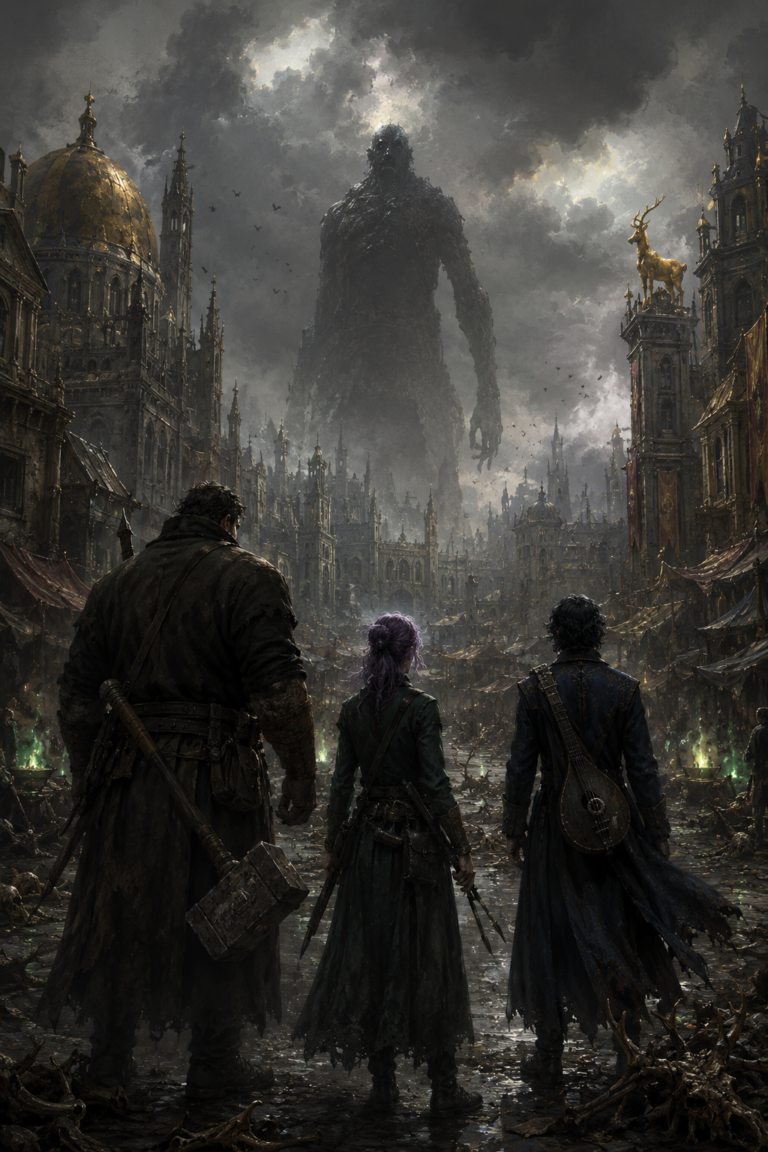


Dr. Michael A. Scordato, Ph.D.

WHAT IF THE VILLAIN WAS RIGHT?
“….The kingdom burned him alive. Not because he murdered children. Not because he summoned demons. Not because he betrayed his people. They burned him because he told the truth. The truth that every hero celebrated in songs was a fraud. The truth that every king sat upon a throne built from stolen blood. The truth that the old kings who demanded worship had abandoned the world centuries ago, but we are still bound to their edicts. For speaking those words, they chained him to a pyre before ten thousand cheering citizens. Then they watched him die.
The story should have ended there. It didn’t. Twenty years later, the dead man opened his eyes. The kingdoms he once tried to save are collapsing. Ancient monsters are returning from beyond the edge of reality. The kings remain silent. And the heroes? The heroes are the ones making sure humanity never learns why. Now the man history remembers as the greatest villain who ever lived has one final chance to finish what he started. To save a world that hates him. To expose a lie older than civilization. And to decide whether humanity deserves the truth at all. Because sometimes the monster under the bed isn’t the thing waiting in the dark. Sometimes it’s the person holding the candle. And sometimes…the villain was right.”
Lady Serephina placed down the book she was reading. She sighed.
Chapter 1: The Gilded Cage
The morning light in the capital city of Oakhaven did not dance; it glared, filtered through the thick, enchanted glass of the High Spire. Lady Seraphina of House Valerius sat motionless before a vanity of polished obsidian. Behind her, her handmaiden, Elara, worked in terrified silence, weaving strands of pearl into Seraphina’s hair—hair that felt like leaden weights.
Seraphina’s reflection showed a woman of twenty-four, poised, stunning, and utterly cold. Beneath the surface, however, the air in the room was warping. The perfume bottles on the vanity tipped slightly, leaning toward her as if pulled by an invisible tide. She was a master of gravity, a magical talent that, if discovered, would see her either branded a witch or turned into a state puppet.
“The Duke of Thorne has arrived, My Lady,” Elara whispered. “Your father requests your presence in the Conservatory.”
Seraphina stood, and for a heartbeat, the floor groaned. She exhaled, snapping her internal hold on the fabric of gravity. She walked past the Whispering Ferns lining the hallway—fleshy, pale plants that hissed secrets of the passing court. They reacted to her presence, their fronds curling inward; they sensed the chaotic weight of her magic.
In the Conservatory, the air was thick with the scent of Sun-Singing Orchids, golden flowers that radiated heat and pulsed with a faint, rhythmic humming. Standing by the fountain was the Duke, a man who possessed all the warmth of a glacier.
“Seraphina,” her father, Lord Valerius, boomed. “The Duke is prepared to discuss the dowry. We have wasted years on your ‘friendship before love’ folly.”
The Duke stepped forward, his eyes roaming over her like he was appraising a broodmare. “You are at the end of your season, my lady. I am a patient man, but I will not be made a fool of by a girl who spends her afternoons wandering the slums.”
Seraphina felt the familiar pressure rising—a literal weight in her chest. She gripped her skirts to keep from crushing the Duke’s armor into his chest cavity. A pot of Snap-Dragon Vines nearby snapped its jaws, stimulated by her gravity influence from her agitation; the plant’s bioluminescent purple sap glowed brighter as she struggled for control.
“I am not a commodity to be tallied,” Seraphina said, her voice steady despite the tremor in her hands.
“You are a member of House Valerius,” her father snapped. “You will be married by the turning of the moon, or we will find ways to ensure your compliance.”
As they spoke, a Shadow-Stalking Lynx—the family’s prized, semi-sentient predator—prowled the perimeter of the room. It stopped near Seraphina, its ears twitching. It didn’t growl; it purred, its eyes locked onto her hands, sensing the gravitational distortion that even her father was too arrogant to notice.
She excused herself, moving with practiced grace toward the heavy iron doors. She didn’t look back. She needed to breathe. She needed to be where no one expected her to be proper. She needed the smell of yeast, the warmth of an oven, and the only person in the city who looked at her and saw a woman instead of a title.
As she stepped out into the bustling street, the Sun-Singing Orchids behind her began to wilt, their golden light fading into a bruised grey as the weight of her despair anchored the room. She pulled her cloak tight, hiding her face, and turned toward the lower district, where the air didn’t smell of perfume and politics, but of honest labor.
BIBLICAL ANCHOR
Synthesis: Teaching Discernment Through Story
Dr. Mike Scordato’s use of fantasy fiction as a sideways ministry tool works precisely because stories lower the reader’s guard — the same mechanism the Nathan Principle exploits for good. But that same lowered guard means a story’s resolution can smuggle in values the reader never consciously evaluates. The counseling task with Gilded Cage is not to strip the story of its emotional power, but to hold that power up to Scripture deliberately, the way “fail or break” binary up to Ephesians 4:22–24 rather than simply accepting it as reality.
A story can carry real truth about the soul and real distortion about relationships in the very same chapter. Naming both, side by side, is the discipline this guide is built to practice. This guide treats Gilded Cage Fiction used as a tool which will only works if the reader (or counselee) is also being trained to discern. A story can carry real truth about the soul and real distortion about relationships in the very same chapter. Naming both, side by side, is the discipline this guide is built to practice.
For each chapter you will find one counseling strength — a moment where the story accurately mirrors something Scripture affirms about human nature, suffering, or healing — and one red flag — a moment where the story’s resolution or romantic logic quietly teaches something Scripture does not affirm, even though it “feels right” inside the narrative. Discussion questions follow each pairing for classroom or small-group use.
A note on the strongest cautions: Chapters 6–7 and Chapter 11 carry the heaviest red flags in this guide. The story resolves a kidnapping threat, a death, and an elopement with a tone of triumph and romantic inevitability. Part of training a discerning reader is being willing to say plainly: the narrative momentum of a story is not the same thing as the moral weight of the events inside it. Galatians 6:7–9 applies to fictional choices just as much as real ones — a story that resolves “too cleanly” after grave choices can quietly teach a reader to expect grace without consequence.
Chapter 1: The Gilded Cage
| ✓ COUNSELING STRENGTH — The Ache of the Performed Life Seraphina’s outward poise masks real internal suppression — she is “motionless,” “cold,” and physically straining to hold her power in check while her father negotiates her like property. This is an honest picture of what it costs a person to perform an identity that is not their own, and Scripture takes that cost seriously rather than dismissing it as vanity or rebellion. | ⚠ RED FLAG — Concealment as the Default Response to Threat Seraphina’s only modeled response to danger is to hide her true self and flee to a place where no one knows her. The chapter never shows her naming her fear to a trusted person, or considering that concealment itself has a cost. Counselees facing real family coercion need to see truth-telling to a safe, wise party modeled as a legitimate option — not just escape. |
Strength — Scripture anchor: “The heart knows its own bitterness, and a stranger does not share its joy.” — Proverbs 14:10 (NKJV)
Red Flag — Scripture anchor: “There is a friend who sticks closer than a brother.” — Proverbs 18:24 (NKJV); see also Proverbs 11:14 on the safety of many counselors.
Discussion Questions
- Where in Seraphina’s introduction do we see the Elijah Method’s insight — that a person under chronic pressure shows it in the body before they can name it in words? Always make sure of physical health (drinking, eating, sleeping) when dealing with these stressful cases. Lack of any of these plus any other additional physical ailment makes the mind unable to receive proper full counsel as of yet.
- Her father’s ultimatum (“we will find ways to ensure your compliance”) is coercive. How would you help a real counselee distinguish between family expectation and coercion that requires outside help? 1 Kings 19:4-8.
- What might it have looked like for Seraphina to seek a trusted counselor inside her own world, rather than fleeing to a stranger’s shop? Proverbs 11:14, Proverbs 11:14, Proverbs 12:15, Proverbs 13:20, Proverbs 15:22, Proverbs 19:20.
Chapter 2: The Yeast & The Whisper
The rain in Oakhaven did not wash the city clean; it only turned the lower district’s dust into a slick, charcoal-colored sludge. Seraphina pulled her hood low, her silk boots ruined, feeling like a phantom haunting her own life. She ducked into The Golden Crust, the bell above the door chiming with a cheerful, rustic ring that felt alien to her ears.
The shop was small, smelling of caramelized sugar and fermented rye—a scent that anchored her racing heart. Behind the counter stood a young man, his apron dusted with flour, his sleeves rolled up to reveal forearms corded with the quiet, functional strength of a man who spent his days wrestling heavy dough. This was Elias.
He looked up, not with the practiced deference of a servant, but with a gaze that was steady and curiously warm. “Just the one roll to escape the deluge, or are you staying for a while?” he asked, wiping the counter with a rhythmic, efficient motion.
“Staying,” Seraphina breathed, surprised by the firmness of her own voice. She ordered a honey-oat pastry, and as she sat at a small, scarred wooden table, the silence didn’t feel heavy or expectant—it felt like a clean slate.
Elias didn’t ask her name or her lineage. He simply returned to his work, humming a low, steady tune. He was using a set of enchanted copper tongs to arrange delicate Sugar-Lace Cookies that hummed softly in the warmth of the display case. When a boisterous customer later tried to haggle over the price of a sourdough loaf, Elias laughed—a genuine, unpretentious sound that startled Seraphina.
“My lady,” he said, catching her eye after the customer left, “you look like you’ve been carrying the world on your shoulders. Would you like a warm infusion? It’s made from Moon-Petal Mint—good for calming the hum of the nerves.”
Over the next year, the bakery became Seraphina’s sanctuary. The transition was slow. At first, she arrived in full noble regalia, terrified of being recognized. By the third month, she began leaving her jewelry and dainty things in a secret place in her garden where a statue’s back space actually opened with effort. Here she would change out her wearings to arrive in simple, rough-spun wool in a safer replacement.
She learned the mechanics of his shop. Elias had no magic of his own, but his resourcefulness was staggering. He used a Thermal-Stasis Box—a cube of enchanted glass—to proof his dough, ensuring it rose perfectly despite the damp weather. He showed her how to use a Gravity-Defying Whisk to fold air into his batters, turning simple eggs and sugar into light, golden clouds.
Seraphina spent these hours venting, her noble mask falling away. She complained about the Whispering Ferns that eavesdropped on her, the stifling expectations of her father, and the arrogance of the Duke of Thorne. Elias never judged; he simply listened, his attention as constant as the rising of the oven’s heat.
She often found herself tempted to reach out and “adjust” the gravity of the room, to make the heavy sacks of flour float or to lighten the labor of his day, but she never did. She was terrified that if she revealed her power, the wonder in his eyes would be replaced by the same cold fear she saw in her father’s court.
As the seasons shifted, the “friendship” began to change. Her heart started to beat in rhythm with the timer on his oven. She stopped dreading the return to her life of duty and started living for the moments at the counter—the smell of yeast, the shared look when a rude patron entered, and the quiet, steady kindness that Elias offered without asking for a title in return.
On a snowy evening, exactly one year later, Seraphina stood at the counter to pay. As he handed her a fresh, steaming loaf, her fingers brushed against his. The air in the shop thickened—not with the suffocating pressure of her magic, but with the weight of things left unsaid. She looked at him, realizing that for the first time in her life, she could not imagine a future that didn’t include his steady, grounded presence. The realization was both a comfort and a terrifying, ticking clock—she was falling for the one person who could never survive the storm her life was becoming.
BIBLICAL ANCHOR
Chapter 2: The Yeast & The Whisper
| ✓ COUNSELING STRENGTH — The Legitimate Need for Sanctuary Elias offers Seraphina something rare: presence without an agenda. He doesn’t ask her name, rank, or story — he simply lets her exist in an unhurried space. This mirrors a real and biblical need: every person needs at least one relationship where they are received before they are evaluated. James 1:19-20. | ⚠ RED FLAG — A Secret Double Life as the Engine of Intimacy The relationship’s depth is built entirely on concealment — Seraphina hides her identity, sneaks away in disguise, and keeps a secret changing-place in the garden for over a year. The chapter frames this secrecy as romantic rather than naming it as what it is: a pattern of deception toward her family that the story never asks her to reckon with, even after everything that follows. This ends with a destroyed family life developed from a system lacking of honoring her parents. The Bible says children need to obey, but as adults it says we still need to show the respect of honoring. Ephesians 6:1-3, Exodus 20:12, Proverbs 1:8-9. |
Strength — Scripture anchor: “Bear one another’s burdens, and so fulfill the law of Christ.” — Galatians 6:2 (NKJV)
Red Flag — Scripture anchor: “Therefore, putting away lying, ‘Let each one of you speak truth with his neighbor,’ for we are members of one another.” — Ephesians 4:25 (NKJV)
Discussion Questions
- Sanctuary and secrecy are not the same thing. Where is the line between them in this chapter, and where does the story blur it?
- Elias never presses her for her name or past. Is restraint always wisdom, or could real curiosity from a trusted friend have served Seraphina better at this stage?
- How would you counsel someone who has built their closest relationship on a foundation the other person doesn’t fully know about?
Chapter 3: The Merchant’s Return
The atmosphere in The Golden Crust usually held the warmth of hearth-fire, but the morning Lyra returned, the air felt thin and sharp. Seraphina had been leaning against the counter, her hands dusted with a fine layer of flour, laughing at a dry, witty remark Elias had made about the local baker’s guild. For a moment, the world was nothing more than the two of them.
Then, the bell chimed.
It wasn’t a local shopper. The woman who stepped inside moved with the predatory grace of someone who owned the very cobblestones she walked upon. She was dressed in rich, travel-worn silks that shouted of wealth earned through trade, not inherited through blood.
“Elias?” the woman said, her voice like liquid velvet. “I told you I wouldn’t stay away forever.”
Elias froze, his whisk hovering mid-air. “Lyra? We heard your family’s caravan was lost in the Southern Wastes.”
“Business, Elias. Always business,” Lyra replied, her eyes flitting toward Seraphina. She didn’t glare; she surveyed. She looked at Seraphina’s rough-spun wool, her slightly messy hair, and the way she stood—too naturally elegant for a peasant, despite her best efforts. Lyra’s smile widened, sharp and knowing. “And who is this? A new helper? You always were one to take in strays.”
Seraphina bristled, the floorboards beneath her feet groaning as a surge of suppressed gravity threatened to warp the grain of the wood. She forced herself to relax. “I am merely a friend,” Seraphina said, her voice cool and practiced.
Lyra glided forward, ignoring the tension. She laid a manicured hand on Elias’s arm, a gesture of ownership that made Seraphina’s skin crawl. “A friend. How lovely. I’m Lyra. Elias and I grew up together—we know each other’s worth better than anyone.”
Over the next few weeks, Lyra became a permanent fixture, and the sanctuary began to suffocate. Lyra didn’t use force; she used connections. She arrived with news that her family had secured a new contract for the grain supplies, effectively making them the gatekeepers of Elias’s flour. She spoke of the town’s economy as if it were a game board, and Elias, loyal and grounded, found himself drawn into her orbit of commerce and “practical” planning.
One afternoon, when Elias was in the back checking a shipment of enchanted oven-stones, Lyra cornered Seraphina near the display case. The shop was empty, but Lyra spoke in a voice designed to wound.
“You think you’re helping him,” Lyra said, her tone dripping with mock-sympathy. “You hide here, playing dress-up in commoner’s wool, waiting for a fairy tale. But look at him, Seraphina. He has a business to run. He has a future that requires stability, not a bored noblewoman who can’t even hold a knife without trembling.”
“I am not—” Seraphina started, but Lyra cut her off.
“You are a ghost,” Lyra whispered, leaning close. “You have no man because you are lazy, waiting for some prince to rescue a woman who has nothing of substance to offer. If you truly cared for Elias, you would realize you are the danger to him. Your presence invites gossip that will ruin his reputation. A merchant’s daughter understands that value is built, not begged for. Stay away, my lady. It’s for your own standing and his good.”
Seraphina stared at her, her hands balled into fists at her sides. She wanted to crush Lyra where she stood, to use her gravity to anchor her to the floor until she couldn’t breathe. But she saw Elias coming back from the storeroom, his face lit with a polite, welcoming smile for his childhood friend.
Seraphina turned and fled. As she walked out, the Sun-Singing Orchids in the window box, which Elias kept to brighten the shop, suddenly drooped, their golden glow flickering out into a dull, bruised grey. She had come to the bakery to escape her cage, but she realized with a sinking, heavy heart that she had simply stepped into a different kind of trap—one built of ledgers, social climbing, and the crushing realization that she might not be worthy of the only life she had ever wanted.
BIBLICAL ANCHOR
Chapter 3: The Merchant’s Return
| ✓ COUNSELING STRENGTH — Naming the Wound of Comparison Lyra’s arrival exposes something real: Seraphina’s identity has been so thoroughly defined by others (her father, the Duke, now Lyra) that she has no settled internal ground to stand on. The chapter accurately shows how a third party can destabilize a fragile peace simply by naming what the person already secretly fears about themselves. | ⚠ RED FLAG — Cruelty Reframed as Tough Love Lyra’s speech (“you are a ghost… lazy, waiting for some prince”) is contempt, not counsel — it offers no truth Seraphina can act on, only shame designed to wound. The narrative gives this attack real estate as though it carries insight. Biblical confrontation (even the Prophet’s Method) always aims at restoration and is rooted in actual fact, not at humiliation for its own sake. |
Strength — Scripture anchor: “For as he thinks in his heart, so is he.” — Proverbs 23:7 (NKJV)
Red Flag — Scripture anchor: “Let no corrupt word proceed out of your mouth, but what is good for necessary edification, that it may impart grace to the hearers.” — Ephesians 4:29 (NKJV)
Discussion Questions
- What is the difference between Nathan’s confrontation of David and Lyra’s confrontation of Seraphina here? 2 Samuel 12:1-15.
- Seraphina absorbs Lyra’s words as truth rather than testing them. What would it look like to teach a counselee to test an accusation against Scripture before accepting it as self-knowledge?
- Have you seen real people internalize contempt as if it were correction? What made it hard for them to tell the difference?
Chapter 4: The Stagnant Statue
The days following Lyra’s return felt like walking through deep, sucking mud. The bakery, once a sanctuary of yeast and laughter, now felt like a stage where Seraphina played the role of an unwanted intruder.
Lyra was a master of the “polite siege.” She didn’t ban Seraphina from the shop; she simply filled the space with her presence. She sat at the table Seraphina claimed as her own, discussing grain prices and trade routes with Elias in a language of numbers and ambition that Seraphina—raised on poetry and etiquette—couldn’t hope to match.
Elias, oblivious to the sharpened blades of the conversation, seemed relieved by the normalcy of it all. He and Lyra shared jokes about their childhood, a shared history that Seraphina couldn’t touch. Every time Elias laughed at something Lyra said, a heavy, sinking feeling coiled in Seraphina’s gut, manifesting in the world around her: the heavy iron kettle on the stove would suddenly clang against the burner as if dropped from a great height, or the flour on the counter would shift into strange, jagged patterns.
One rainy afternoon, the tension finally snapped.
Seraphina had arrived early, hoping for a moment of peace. Instead, she found Lyra alone in the shop, sketching designs for a new expansion of the bakery—an expansion that involved turning the small, cozy shop into a merchant-run powerhouse.
“You’re still here?” Lyra asked, not even looking up from her parchment. “I thought after our last talk, you’d have realized the futility of it all.”
“I am not playing a game, Lyra,” Seraphina said, her voice shaking.
Lyra finally looked up, her eyes cold and piercing. She stood and walked over to Seraphina, her movements fluid and deliberate. “Isn’t that exactly what you’re doing? You run from your family, you hide in these rags, and you wait for Elias to ‘save’ you from a life you’re too afraid to change. You aren’t a woman, Seraphina; you’re a statue. Beautiful to look at, but ultimately hollow, waiting for someone else to carve your purpose for you.”
The insult hit with the force of a physical blow. Seraphina’s vision blurred. The air in the bakery didn’t just warp; it collapsed. The spoons in the display rack rattled violently, and a decorative vase on a high shelf cracked down the middle.
“I am not hollow,” Seraphina whispered, her heart hammering against her ribs.
“Then prove it,” Lyra countered, stepping closer. “Look at yourself. You don’t even know if you’re worthy of him. You’re terrified that the moment he sees who you really are—a girl who can’t even stand on her own two feet—he’ll look at you with the same disappointment your father does.”
Lyra’s words were the mirror Seraphina had been avoiding. She looked down at her hands—hands that were soft, uncalloused, and useless. Lyra was right. She was drifting. She was waiting for a permission to exist that would never come.
“Maybe I am nothing,” Seraphina muttered, the weight of her own self-doubt crushing the spirit right out of her.
“Then be the thing you’re meant to be,” Lyra said, her tone suddenly devoid of venom, almost chillingly pragmatic. “Go back to your family. Submit to the arrangement. Live the life of a Lady. At least that way, you won’t be wasting Elias’s time, and you won’t be living a lie.”
Seraphina fled. She didn’t go to the garden statue. She had already today walked to the point her feet bled, as the crushing weight of her own inadequacy pressing her toward the pavement. She walked toward the grand, iron-wrought gates of her family estate.
She looked up at the High Spire, its stone peaks reaching into the clouds like accusing fingers. She felt a profound, miserable certainty: Lyra was right. She was a failure in the noble world, and she was a parasite in the common one.
She stood before the gate, her hand hovering over the bell that would summon the servants to let her back into her misery. She felt like she was already wasting away, turning into the very statue Lyra had described—cold, silent, and trapped in a life that didn’t belong to her. She let out a shaky breath, the air around her distorting one last time, and reached out to pull the chain.
BIBLICAL ANCHOR
Chapter 4: The Stagnant Statue
| ✓ COUNSELING STRENGTH — An Honest Diagnosis of Drift Stripped of euphemism, Lyra’s accusation lands on something true: Seraphina has been passive, waiting for rescue rather than building a life. Even a wounding source can occasionally surface an accurate observation, and a mature counselee (or reader) should be able to extract the true kernel without accepting the cruelty that delivered it. | ⚠ RED FLAG — Despair Mistaken for Clarity Seraphina’s response to Lyra’s cruelty is total self-collapse (“Maybe I am nothing”) followed by an impulse to submit to a forced marriage just to escape the discomfort of feeling unworthy. The chapter treats this despair as a kind of honesty, when Scripture treats despair of this kind as a temptation to be resisted, not a truth to be obeyed. |
Strength — Scripture anchor: “As iron sharpens iron, so a man sharpens the countenance of his friend.” — Proverbs 27:17 (NKJV) — contrasted here with its counterfeit.
Red Flag — Scripture anchor: “Why are you cast down, O my soul? … Hope in God.” — Psalm 42:11 (NKJV)
Discussion Questions
- Lyra’s words and Scripture’s words can both diagnose passivity — but they prescribe opposite remedies. What does each one ask of Seraphina next?
- Seraphina almost returns to a coercive arrangement out of despair rather than conviction. How is that different from genuine repentance or genuine surrender?
- How would you help a counselee who has just been told a harsh truth. Tell the difference between Godly grief (2 Corinthians 7:10) and shame that just wants relief?
Chapter 5: The Severing
Seraphina did not pull the bell. Her hand hovered over the iron chain, but as the cold metal pressed against her palm, a spark of jagged, violent defiance ignited in her chest. If I go back, she realized, I am choosing a slow death.
She turned away from the gate so sharply her cloak flared. She didn’t head home; she headed to the only place that felt real.
She arrived at the bakery under the cover of a moonless night. The shop was dark, but the faint, comforting glow of the embers in the oven hearth seeped through the cracks in the door. She didn’t knock. She moved to the side alley, where a discarded sharpening stone sat near the woodpile.
She picked it up. She didn’t want to change her appearance; she wanted to destroy the reminder of her lineage. She gripped her long, pearl-woven hair—the hair that marked her as a Valerius—and pulled her dagger from her boot. With a ragged, uneven motion, she sawed through the locks. They fell into the mud like discarded silk. She looked at her reflection in a rain barrel: jagged, short, and wild. She looked like someone who had survived something, not someone who was waiting to be sold.
She kicked open the back door of the bakery. Elias was there, hunched over a ledger, his face etched with exhaustion. He looked up, his eyes widening in alarm. “Seraphina? What in the—“
She didn’t let him speak. She dropped the heavy, velvet-lined cloak that marked her noble station and stood before him in the rough-spun shift she had hidden at the statue, her hair a disastrous, hacked mess.
“I have no house,” she said, her voice raw. “I have no name. I have no dowry. I cannot go back to that… that cage.” She took a step toward him, the floorboards groaning under the sudden, localized increase in gravity that betrayed her panic. “I don’t know how to survive, Elias, but I know how to work. Please. Give me a job. Let me stay.”
Elias stood up, his chair clattering to the floor. His face was a mask of terror. He didn’t see a romantic heroine; he saw a death warrant. He knew that nobility, no matter what family she came from, would tear the city apart to find her, and the moment they saw her here, they would hang him for treason.
“Seraphina, you don’t understand,” he whispered, his hands trembling as he reached out but stopped short of touching her. “You are not just a woman to them; you are their belonging. If I keep you here, they will burn this place to the ground with us inside it.”
“Then hide me,” she pleaded, dropping to her knees, her eyes bright with a desperate, crushing intensity. “I will do anything. Scrub the floors, haul the grain, sleep in the cellar. Just… don’t send me back.”
Elias looked at her—the girl he had been connecting with for a year, now stripped of all her grace and dignity, reduced to a fugitive in his kitchen. His heart broke, but his instinct for survival and his desperate need to protect her collided. He couldn’t keep her. But he couldn’t abandon her to the streets.
“There is an old woman,” Elias said, his voice tight with fear. “Mother Hestia. She lives on the edge of the merchant district. She’s half-blind, stubborn, and hates the nobility, which makes her the only person in this city who won’t ask questions about where you came from. She needs live-in help.”
He grabbed his coat, not bothering to lock the door. “We go now. And Seraphina—if anyone asks, your name is to be called Sarah. You’re to say you are orphaned from your family who is from the southern provinces- where you said your family came from. This all so you are technically have not lies if people give you inquiry.”
As they slipped into the shadows of the alleyway, Seraphina felt a strange, lightheaded sensation. For the first time in her life, the crushing weight of her family’s expectations was gone. In its place was a new, terrifying gravity: the weight of freedom, and the absolute, lethal danger of the choice she had just made.
BIBLICAL ANCHOR
Chapter 5: The Severing
| ✓ COUNSELING STRENGTH — Refusing a Slow Death Is Not the Same as Sin Seraphina’s decision not to ring the bell and return to a coercive marriage is, in itself, a legitimate boundary. Scripture does not require submission to coercion, and the impulse to refuse a forced marriage is not the problem in this chapter — it is one of the only clearly healthy instincts she has all story. | ⚠ RED FLAG — Crisis Decision-Making With No Counsel at All Every irreversible choice in this chapter — cutting her hair, abandoning her name, showing up at a closed shop after dark, begging Elias to hide her from the State — is made alone, at night, in a state of panic, with no wise counsel sought. The chapter frames this as courage. Scripture consistently frames major decisions made in isolation and panic as dangerous, regardless of how sympathetic the pressure behind them is. |
Strength — Scripture anchor: “You were called to liberty… only do not use liberty as an opportunity for the flesh.” — Galatians 5:13 (NKJV)
Red Flag — Scripture anchor: “Without counsel, plans go awry, but in the multitude of counselors they are established.” — Proverbs 15:22 (NKJV)
Discussion Questions
- Contrast Seraphina’s solo, nighttime, panic-driven decision with the Elijah Method’s insistence on stabilizing the body and mind before major movement. What does she skip? 1 Kings 19:4-8.
- Elias is put in a position of real danger (sheltering a fugitive noble) without being consulted beforehand. What does this say about the difference between needing help and conscripting someone else into your crisis?
- How would you coach a real counselee who is about to make an irreversible decision under acute emotional pressure?
Chapter 6: The Inquisition
The city of Oakhaven changed overnight. The morning after Seraphina’s disappearance, the sound of rhythmic, iron-clad boots replaced the usual morning bustle of the market. Royal Knights—the Inquisition’s own—fanned out through the streets. They weren’t looking for a common thief; they were looking for a noblewoman, and their methods were brutal.
At Mother Hestia’s cottage, Seraphina—now Sarah—learned that her life of soft fabrics and idle gardens was truly dead. Hestia was a hawk-eyed woman with a voice like grinding stones and a deep, simmering resentment toward the “High-Spire types.” She put Seraphina to work immediately.
“You’ve got soft hands, Sarah,” Hestia croaked, shoving a bucket of lye and a coarse brush into her arms. “Scrub the floorboards until I can see my reflection in the pine, and don’t you dare leave a single streak.”
While Seraphina struggled with the physical exhaustion of manual labor, the city outside was being torn apart. The Knights were kicking in doors, overturning merchant stalls, and interrogating anyone who looked like they were hiding something. Elias, terrified, kept his head down at the bakery, but his anxiety was palpable whenever he dared to sneak a loaf of bread to Hestia’s door.
It was during a tense afternoon, while Seraphina was hauling water from the public well, that she nearly slipped. A group of Knights rode past, their horses trampling the mud. One of them slowed, his gaze fixed on her. Seraphina froze, the wooden yoke pressing into her shoulders. Her gravity flared—the well bucket began to vibrate and hover an inch off the ground.
Before the Knight could react, a shadow fell over her.
“Drop that, you clumsy girl!”
It was Lyra. She swept in with the confidence of someone who owned the street, snatching the bucket from the air before it could do anything unnatural. She turned to the Knight, her face a picture of indignant annoyance. “Officer, my apologies. This is my new apprentice. She’s not from around here, and she’s clearly frightened by your… enthusiastic patrolling.”
The Knight looked from the calm, composed Lyra to the trembling, wide-eyed Seraphina. He grunted, tipped his helmet, and rode on.
Lyra didn’t move until they were out of sight. She then shoved the bucket back into Seraphina’s hands, her expression unreadable. “You are an idiot,” she whispered, her voice sharp. “If you do that again, you won’t just kill yourself. You’ll put a beacon over this entire district.”
“Why are you helping me?” Seraphina asked, her voice breathless.
“Because the city is turning into a graveyard, and I don’t like losing assets,” Lyra replied, though her eyes softened ever so slightly. “If they find you, they kill you. If they kill you, the Inquisition stays here, and I can’t move my grain shipments if every street is under martial law. It’s simple math.”
Over the rest of the week, Lyra became a secret, albeit harsh, mentor. She didn’t teach Seraphina how to be a lady; she taught her how to be a shadow. She taught her how to walk with a shorter stride, how to lower her eyes when meeting a man’s gaze, and how to use slang that would mask her noble accent.
“You walk like you own the ground you step on,” Lyra critiqued one evening behind the bakery, while Seraphina practiced scrubbing a crate. “Stop it. In the slums, you walk like you’re trying to avoid being stepped on. Watch me.”
Seraphina watched as Lyra moved—a fluid, invisible blend into the architecture of the street. It was a different kind of grace than the one Seraphina had been raised with, but it was just as lethal.
Lyra stood beside her, looking out toward the main square where the Knights were setting up a blockade. “You’ve changed, Seraphina. That hair, those hands—you’re starting to look like a person who actually has to earn her place in the world. It’s a good look for you. Now, pick up that brush. We aren’t done yet.”
Seraphina didn’t argue. She felt the heavy, stifling gravity of her old life fading, replaced by the sharp, electric current of survival. She was no longer a noblewoman; she was a girl learning to hide in plain sight, forged by the very danger that sought to crush her.
BIBLICAL ANCHOR
Chapter 6: The Inquisition
| ✓ COUNSELING STRENGTH — The Reality That Hiding Has a Cost on Others This chapter does at least show consequences spreading outward — Knights tear through the city, Elias visibly carries anxiety, and Seraphina’s choices are shown to endanger people who had no say in them. That ripple effect is honest and worth pointing to directly with students: our private choices are never only private. | ⚠ RED FLAG — A Manipulative, Self-Interested Rescuer Recast as a Mentor Lyra openly states her motive for helping Seraphina is cold calculation (“I don’t like losing assets”), then proceeds to train her in deception toward armed state authorities. The narrative frames this as mentorship and growth. A biblical counselor should name plainly: protection offered for purely self-interested reasons, paired with training in evasion of lawful authority, is not the model of healthy help Scripture commends — even when the authority in question (the Inquisition) is itself unjust. |
Strength — Scripture anchor: “For none of us lives to himself, and no one dies to himself.” — Romans 14:7 (NKJV)
Red Flag — Scripture anchor: Compare Romans 13:1–2 (NKJV) on regard for governing authorities with Acts 5:29 (NKJV, “We ought to obey God rather than men”) — a real tension worth teaching, not skipping past.
Discussion Questions
- The story never asks whether evading the Inquisition through deception is itself a fraught choice, even granting that the regime is unjust. How would you help students wrestle with Romans 13 versus Acts 5 using this scene?
- Lyra’s stated motive is purely transactional, yet the narrative treats her training as wisdom. What does Scripture say about receiving instruction from someone whose stated goal is not your good?
- Where do you see the gap between Lyra’s coaching (“how to hide in plain sight”) and biblical wisdom about walking in the light (1 John 1:7)?
Chapter 7: The Alleyway Collapse
The air in Oakhaven had grown thick, not with magic, but with the suffocating presence of the Inquisition. The Royal Knights had moved from house-to-house searches to a policy of “scorched earth,” setting magical wards that pulsed against the cobblestones, designed to detect any ripple of bounce back of anyone with a nobility’s high magic resonance, such as her local gravitational field control.
Seraphina spent her days at Mother Hestia’s, her senses stretched to their absolute limit. Every time a ward flared, she felt a phantom tug in her gut, a magnetic pull trying to draw her magic out.
The turning point came on a Tuesday a little over a week from when this all started. This moment was under a sky the color of a bruised plum. Seraphina was in the lower merchant district, running errands for Hestia, when she saw Elias being detained. Three Knights had pinned him against the stone wall of his bakery, accusing him of hoarding supplies for “known agitators.” One of the Knights, his face twisted in a sneer, drew his blade, the tip digging into Elias’s throat.
Something in Seraphina was about to snap. But suddenly they dropped their weapons and tossed Elias to the side with just a firm warning and left.
Seraphina lifted damaged him from the ground. “I am OK, I am OK.” Elias limped. “This is all my fault”… Seraphina squeals as tear flowed. “I am but a selfish arrogant woman who is failing those I care about most”. Her head goes and sinks into Elias’ shoulder as she wept. He patted her back as they went inside.
Lyra, who had been nearby, realized the danger too late. She sprinted into the bakery, her hands reaching out to them both hugging them together. “Seraphina! I am so happy you are safe…. You too Elias.”
Later that evening Lyra was escorting giggling Serephina back to Mother Hestia’s. That is when it happened. Two armed drunken thugs approached them already stating their desires before ever uttering a word. Lyra lunged in front of Serephina which startled the the closest boozed up man who automatically drew a dagger and plunged it through Lyra. Lyra’s eye were still open but she was gone. Her limp form fell back off of the blade onto Serephina.
At first Serephina was tackled with shock and a lack of comprehension of what had occurred. Then the release. The sudden release of energy backlashed the thugs slamming them into the surrounding architecture and through it. The building’s groaned as their structural integrity failed. A massive, jagged crater opened where Serephina had been, swallowing the crates, the thugs, and a the half of buildings section around the passing storefront and opposing homes.
In the center of the dust cloud, Serephina held Lyra in her arms. Lyra lay motionless, no breath. The thugs were pinned beneath a fallen beam most likely dead as well. The collapse had taken the toll of the impact.
Silence rushed back into the street, heavier and colder than before. Seraphina stood in the center of the ruins, her hands trembling, the air still humming with residual, dying static. Serephina was absent from her body since in such shock. She barely felt the heavy, suffocating sensation of cold iron shackles snapping onto her wrists. The Inquisition had arrived, but they didn’t need to fight her. She had already destroyed the only life she had dared to build.
As they dragged her away, she looked back at the ruin of the city, at the dead body of her mentor. She then thought of and her eyes searched for Elias, who now stood in the debris, his face a portrait of utter, silent devastation in investigation of what had happened. The earthquaking of her power was felt all of the way and heard back as far as his baker’s shop. She didn’t scream. She didn’t struggle. She simply let the weight of the world finally crush her, knowing that by leaving is saving Elias. She only had to be condemned. She embraced the cold, unyielding judgment of the State with a peace.
BIBLICAL ANCHOR
Chapter 7: The Alleyway Collapse
| ✓ COUNSELING STRENGTH — Grief Triggering Honest, Uncontrolled Collapse When tragedy strikes, Seraphina’s composure finally and completely breaks — “I am but a selfish arrogant woman.” However raw and dramatized, this is at least an honest picture of grief refusing to be managed or performed. A counselor should affirm that real grief is not orderly, and a person in shock is not in a state to be lectured. | ⚠ RED FLAG — A Death Used Primarily as a Romantic Plot Device Lyra is killed protecting Seraphina, and within the same scene the narrative pivots almost immediately to Seraphina’s romantic arc and Elias’s devastated love for her, with little space given to Lyra as a person whose life mattered apart from her function in someone else’s story. This is worth naming directly to students: fiction (and we ourselves) can be tempted to treat death as a catalyst for someone else’s growth rather than a loss with its own weight. That is not how Scripture treats the value of a single human life. |
Strength — Scripture anchor: “Weep with those who weep.” — Romans 12:15 (NKJV)
Red Flag — Scripture anchor: “For God so loved the world…” — John 3:16 (NKJV); see also Genesis 1:27 on the inherent worth of every person, not merely their narrative function to others.
Discussion Questions
- Notice how quickly the story moves past Lyra’s death toward its effect on Seraphina and Elias’s relationship. What does it look like, pastorally, to resist treating a real person’s death as primarily “what it means for me”?
- Seraphina’s destructive magic surge here is involuntary, born of shock and grief — different from her earlier choices. How would a counselor help someone distinguish between a moral failure and a trauma response?
- How would you walk a counselee through survivor’s guilt (“I am but a selfish arrogant woman”) without either dismissing the feeling or letting it calcify into a permanent self-verdict?
Chapter 8: The Hollow Acquittal
The dungeon of the High Spire was a place where time didn’t pass; it pooled like stagnant water. For weeks, Seraphina sat in the dark, the stone walls vibrating with the echo of Lyra’s final breath. She was charged with triple homicide—the two thugs and, by the Inquisition’s cold logic, the catalyst of Lyra’s death.
But then, the tide shifted. A patrol of Knights, the same ones who had harassed Elias at the bakery, came forward with their reports. They recounted an earlier incident—the well bucket incident—where a girl had nearly triggered a surge, only to be stopped by the quick thinking of a merchant woman named Lyra. The testimony painted a picture not of a cold-blooded killer, but of a girl who had been under the protection of a local trade-master, caught in a tragedy not of her making.
The Inquisition, more interested in stability than justice, saw no gain in executing a girl who had already been erased by her own father. Lord Valerius had appeared before the tribunal once, his face a mask of stone, to formally strip Seraphina of her name, her title, and any claim to the House of Valerius. She was legally a non-person.
“You are free to go, Sarah,” the Inquisitor sneered, using the name she had adopted, as if it were a mark of shame. “Your records are purged. You have no home, no coin, and no protection. If you are ever seen wielding gravity-magic again, there will be no trial.”
The gates of the Spire swung open, casting her into the blinding, indifferent light of the city. She was a ghost in her own kingdom. Her first instinct was to reach out to the only person who mattered. She spent her last few coppers on parchment and ink, writing letter after letter to the bakery, begging for forgiveness, explaining the chaos, and pleading to know if Elias was safe.
Every letter came back to her, marked with a single, brutal word scrawled across the envelope in a handwriting she knew by heart: RETURNED.
Elias was refusing her. The rejection cut deeper than the dungeon walls ever had. She was truly, utterly alone.
Shuffling through the rain, her clothes tattered and her spirit hollowed out, she found herself walking toward the edge of the merchant district. She didn’t know where else to go. She climbed the steps to Mother Hestia’s cottage, her body trembling with the cold and the weight of a thousand failures. She pounded on the door, her knees finally giving way beneath her.
“I’m sorry,” she sobbed into the wood, her voice breaking. “I have nothing left. I failed everyone.”
The door creaked open. She expected to be turned away, to be told she was a curse that brought only ruin. Instead, she felt the rough, calloused hands of Mother Hestia pulling her inside. Hestia didn’t lecture; she didn’t ask for explanations. She simply wrapped her thin, strong arms around the broken girl, pulling her into a fierce, startlingly warm embrace.
Seraphina collapsed into that hug, the dam of her composure finally breaking. She wept until she was shaking, the old woman rocking her back and forth as if she were a child who had merely tripped on the cobblestones. For the first time since Lyra died, Seraphina didn’t feel the crushing weight of her magic or the suffocating scrutiny of the nobility. She felt the painful, raw reality of being alive, and the crushing, lonely silence of a world where Elias no longer wanted her.
BIBLICAL ANCHOR
Chapter 8: The Hollow Acquittal
| ✓ COUNSELING STRENGTH — The Embrace That Asks No Questions Mother Hestia’s wordless embrace — no lecture, no demand for explanation, just presence — is a genuinely strong picture of the Elijah Method in action: meeting a depleted, broken person’s basic need for safety and comfort before any deeper work can begin. 1 Kings 19:4-8. | ⚠ RED FLAG — Rejection Without a Voice Given to the One Rejecting Elias’s silence and returned letters are presented purely through Seraphina’s pain, with no access to his reasoning, fear, or grief over Lyra. A counselor should flag this pattern in fiction and in life: when a story (or a counselee’s account) only ever gives us one party’s interior life, it is very easy to misjudge the other party’s motives entirely. |
Strength — Scripture anchor: “A bruised reed He will not break, and smoking flax He will not quench.” — Isaiah 42:3 (NKJV)
Red Flag — Scripture anchor: “The first one to plead his cause seems right, until his neighbor comes and examines him.” — Proverbs 18:17 (NKJV)
Discussion Questions
- What does Mother Hestia model about ministering to the “hollowed out” that even trained counselors sometimes rush past?
- We never hear Elias’s side of his silence. How would you coach a counselee who is interpreting someone else’s withdrawal without having heard that person’s actual reasons?
- How does this chapter illustrate the difference between comfort that requires explanation first, and comfort that is offered unconditionally?
Chapter 9: The Archmage’s Intervention
The city of Oakhaven was a machine, and the Archmage, Valerius—no relation to the disgraced House—was the only one who truly understood its gears. He had watched the girl’s trajectory from the moment the alleyway cracked. He knew her for what she was: a walking tectonic fault line, currently anchored by nothing but the grief of a mourning baker and the bitter resentment of a widow.
He did not arrive with knights or fanfare. He arrived at Mother Hestia’s cottage at dusk, his presence making the very air around the house shimmer with a stabilized, high-density mana. He didn’t knock; he simply waited until the door opened, his eyes landing on Seraphina, who sat by the hearth with the hollowed-out stare of the defeated.
“You are a threat to the structural integrity of this kingdom,” he said, his voice devoid of malice, sounding more like a physician diagnosing a terminal illness.
Seraphina didn’t look up. “Then execute me and be done with it. I have nothing left to break.”
“I don’t kill potential assets,” the Archmage replied. He flicked his wrist, and the cottage door slammed shut, sealing them in. “But I cannot have a localized gravity storm residing in my merchant district. You are tied to the baker, Elias. It is the only thing keeping you from drifting into total apathy or total destruction isn’t it?”
He did not ask for permission. The next morning, the cottage door was kicked in by two Royal Enforcers who didn’t care for Hestia’s protests. They had dragged Elias from the bakery, his flour-dusted apron still tied around his waist, and hauled them both to the small, cramped dining table in Hestia’s cottage.
The Archmage entered sat at the head of the table, his staff casting long, distorted shadows against the wall. He looked at them both—Seraphina, gaunt and trembling, and Elias, who looked as if he hadn’t slept since the alleyway collapse.
“I do not care about your past class differences,” the Archmage began, his tone clinical and sharp. “I do not care about the late merchant-woman, Lyra. I care that the girl sitting across from you is a weapon of mass destruction, and her trigger is currently tied to your silence, baker.”
He leaned forward, the pressure in the room rising until the plates on the table rattled.
“You are going to talk,” he commanded. “You will either reconcile your feelings, or you will sever this tie completely so she can stabilize. But you will not leave this table until the gravitational anomaly in my city is resolved. I have no patience for the petty hesitations of commoners when the capital’s foundations are at stake.”
Seraphina stared at Elias, her heart hammering against her ribs. Elias looked back, his face a battleground of love, terror, and residual resentment for the letters he had returned. The Archmage’s ultimatum hung in the air—cold, final, and absolute. For the first time, they were forced to look past the masks of “Lady” and “Baker,” and face the wreckage they had made of each other.
BIBLICAL ANCHOR
Chapter 9: The Archmage’s Intervention
| ✓ COUNSELING STRENGTH — Forced Honesty Can Surface Buried Truth However coercive the setting, the Archmage’s blunt confrontation does succeed in getting Elias to voice something true he had been suppressing — real feeling, not performance. Scripture does affirm that truth eventually surfacing, even under pressure, can be a mercy compared to indefinite avoidance. | ⚠ RED FLAG — Coercion Modeled as a Legitimate Counseling Method The Archmage seals the door, forces Elias’s family into the room against their will, and threatens consequences until they “talk.” This should be flagged explicitly for students: nothing about this resembles biblical counseling. True confrontation (even the Prophet’s Method) is always an invitation toward repentance and restoration that the person remains free to refuse — it is never physical compulsion. A counselor modeling the Archmage’s approach would be committing spiritual and physical abuse, not ministry. |
Strength — Scripture anchor: “The purposes of a man’s heart are deep waters, but a man of understanding will draw them out.” — Proverbs 20:5 (NKJV)
Red Flag — Scripture anchor: Contrast with 2 Corinthians 5:20 (NKJV, “we implore you… be reconciled”) — appeal, not coercion — and Galatians 6:1 (NKJV) on restoring “in a spirit of gentleness.”
Discussion Questions
- Make this distinction explicit with students: where does the Archmage’s method differ from every method in the Mark 1:1–8 portfolio — the James architecture, the Elijah Method, the Nathan Principle, even the Prophet’s Method?
- Coercion sometimes produces true confessions. Why does the source of a confession (free or forced) matter theologically, even when the content turns out to be honest?
- How would you warn a student or new counselor against ever mistaking control for confrontation, even with good intentions?
Chapter 10: The Mercenary Sentence
The silence in the cottage was suffocating, thick with the weight of the Archmage’s magical presence. Elias looked at Seraphina—really looked at her—and saw the shadow of the girl who once came to his shop for warmth, now reduced to a hollowed-out shell of her former self.
He tried to retreat, his hands gripping the edge of the table. “We… we are not supposed to be together,” Elias stammered, his eyes darting toward the Archmage. “It’s not right. The law, the class, the… the history. It’s just not meant for us.”
“Class?” The Archmage let out a dry, mirthless laugh. “You speak of ghosts, baker. Look at her. She has no title. No family. No estate. She is as much a commoner as you are, and frankly, she has far less to lose.”
Elias bristled, his frustration boiling over. The pressure of the Archmage’s scrutiny, combined with the crushing guilt of the letters he’d returned, pushed him past his breaking point. He slammed his palms onto the wooden table, the sound echoing like a gunshot.
“We just click!” Elias blurted out, his voice cracking with raw, unvarnished emotion. “I don’t care about the laws, or the court, or the rules! We just fit together! But I know it isn’t right, and I know that keeping her close is a death sentence for everything I’ve ever built!”
The Archmage sat back, a slight, knowing smile touching his lips. He had his truth. But he was not a man of sentiment; he was a man of the State.
“Very well,” the Archmage said, his tone shifting from inquisitive to lethal. “Since you both insist on this ‘click,’ you shall be put to use. Seraphina, your life as a lady is officially over. You are hereby conscripted into the Adventurers Guild, effective immediately.”
Seraphina gasped, her hands trembling. “The… the Guild?”
“It is a marine-style mercenary agency, Seraphina. A place for the broken, the violent, and the unwanted,” the Archmage explained, his voice cold. “You will no longer live in luxury or hide in cottages. You will be sent on the most grueling, dangerous expeditions in the kingdom. You will fight alongside ruffians and cutthroats. You will be in constant, daily danger of abuse and assault, and you will be expected to use your power to keep your squad alive.”
“You can’t!” Elias shouted, standing up so abruptly his chair tumbled backward. “That’s a death sentence! You’re sending her into a meat grinder!”
“I am sending a weapon where it belongs,” the Archmage countered, standing up to his full, imposing height. “If you want to protect her, baker, then follow her. But she is no longer a citizen; she is an asset under surveillance. She will be watched, she will be tested, and if she fails to stabilize, she will be neutralized. Is that understood?”
Seraphina looked at Elias, her eyes wide with shock. The dream of a quiet, simple life had been replaced by a nightmare of blood and iron. She had gone from a gilded cage to a prison of violence, and the Archmage was already walking toward the door, leaving them in the wake of a sentence that neither of them could fight.
BIBLICAL ANCHOR
Chapter 10: The Mercenary Sentence
| ✓ COUNSELING STRENGTH — Elias’s Refusal to Hide Behind Convenient Excuses When pressed, Elias stops hiding behind “class” and “history” as cover stories and names his actual fear plainly: “I know that keeping her close is a death sentence for everything I’ve built.” That kind of unflinching self-honesty, however overdue, is the necessary first step the Peirasmos chain calls for — an honest inventory to take off before any real change can follow. | ⚠ RED FLAG — Authority Figures Modeled as Cruel and Capricious — With No Counterweight The Archmage conscripts a private citizen into a violent mercenary guild as a punitive sentence, openly describing it as likely to expose her to “abuse and assault,” and the narrative offers no character who challenges this as monstrous. A counseling discussion should name this directly: legitimate authority exists to protect the vulnerable, not weaponize them, and a story that lets unjust authority go entirely unchallenged risks normalizing it as simply “how the world works.” |
Strength — Scripture anchor: “Put off, concerning your former conduct, the old man… and be renewed in the spirit of your mind.” — Ephesians 4:22–23 (NKJV)
Red Flag — Scripture anchor: “For he is God’s minister to you for good… But if you do evil, be afraid.” — Romans 13:4 (NKJV) presumes authority oriented toward good — a standard this scene’s authority figure does not meet, and nothing in the text says so.
Discussion Questions
- Why is it important that a counseling-literate reader be able to say plainly, “This authority figure is acting unjustly,” rather than simply accepting the plot’s framing of him as wise and untouchable?
- Elias’s honesty here is good, but it arrives only under duress. How would you help a counselee build the habit of voicing hard truths before a crisis forces them out?
- What would Godly counsel to Seraphina have looked like at this exact moment, versus the sentence she actually receives?
Chapter 11: The Bread of Exile
The Archmage’s departure left a vacuum of silence in the cottage, filled only by the frantic beating of Seraphina’s heart. She looked down at her hands—hands that were now instruments of state-sanctioned violence.
Elias was the first to move. He didn’t rush to her; he walked with the slow, deliberate pace of a man who had just seen his world collapse. He picked up his fallen chair and sat back down, staring at his own flour-dusted knuckles.
“I can’t let you go alone,” he said, his voice quiet but steady.
Seraphina blinked, her breath hitching. “Elias, no. He said the Guild is a meat grinder. They take the desperate and the damned. You’re a baker. You build things; you don’t… you can’t survive in the trenches of the Guild.”
Elias reached across the table, his fingers brushing the back of her hand. It was the first time they had touched since the alleyway, and the connection sent a jolt of stability through her. The air in the room, usually warping with her frantic anxiety, suddenly calmed.
“I don’t know how to fight, but I know how to sustain,” Elias said, a faint, sad smile appearing. “I have a stash of coin—enough to buy my way into the logistical side of the Guild. They always need quartermasters, people to handle the supplies, the rations, the… the morale.” He paused, his gaze hardening. “If you are the weapon, I will be the anchor. I will make sure you have enough to eat, and I will be there to remind you that you are not just a tool for the Archmage.”
Seraphina felt a sob rise in her throat, but she swallowed it down. For the first time, she didn’t feel like a broken, drifting thing. She felt the heavy, comforting pull of a choice—not a choice made by her father or the state, but one made by her own shaking hands.
“They’ll kill us both, won’t they?” she whispered.
“Probably,” Elias admitted, his eyes meeting hers with an intensity that burned away the last of her fear. “But we’ll be together. And I’d rather die standing next to you than spend another year wondering if you were safe.”
The transition happened with brutal efficiency. By the next dawn, their lives in the merchant district were erased. Mother Hestia stood in the doorway, her face unreadable as she handed Seraphina a small, heavy satchel—supplies for the road, wrapped in rough, oil-stained cloth. She didn’t say goodbye; she only gave a curt, approving nod.
As they walked toward the gates of the Guild’s staging grounds, the city of Oakhaven loomed over them—a maze of stone and secrets that had tried to consume them. Seraphina stopped at the edge of the district, looking back one last time at the skyline. The Sun-Singing Orchids she had once known were long gone, the streets were filled with the harsh clatter of iron-shod boots, and the smell of the air was changing from yeast and mint to the sharp, metallic tang of an upcoming storm.
She took Elias’s hand, her grip firm and grounded. She felt the familiar, dangerous hum of her gravity-magic, but for the first time, it didn’t feel like a cage. It felt like a tether—a force that kept her anchored to the only person who had ever truly seen her.
“Let them come,” she murmured, her voice no longer trembling.
They were stepping into a world where the only law was strength, and the only certainty was the person walking beside you. Her noble life was a memory, her bakery life was a casualty, and her new life was about to begin in blood, iron, and the terrifying, beautiful weight of being truly, undeniably free. Elias had enough.
In that moment he threw Serephina up and over over his shoulder and he ran. By the next morning their bought wagon full of mostly bakery tools crested past the boarder into the next nation. They were married that very week.
A magic bird fly throw the Archmage’s window and converted into a spy report on the desk. He smiled. “It all happened just as I planned”.
-THE END?-
Chapter 11: The Bread of Exile
| ✓ COUNSELING STRENGTH — Costly, Voluntary Solidarity Elias’s choice to give up his security and livelihood to stand beside Seraphina rather than let her face danger alone is a real, biblical picture of self-giving love — echoing a willingness to lay down comfort for another that Scripture consistently honors. | ⚠ RED FLAG — Elopement Into a Lawless World Framed as the Happy Ending In the space of two sentences, Elias physically carries Seraphina off, they flee the kingdom’s jurisdiction entirely, and marry within the week — with no acknowledgment of the people left behind (her father’s house, the Inquisition’s open case, Mother Hestia who took her in), no community to witness or bless the marriage, and no mention of any spiritual covenant beyond the couple’s own feeling of rightness. This should be named directly as the chapter’s central red flag: a marriage formed entirely outside of community, accountability, and counsel, however sympathetic the path that led there, is not the model Scripture commends for one of life’s most weighty vows. |
Strength — Scripture anchor: “Greater love has no one than this, than to lay down one’s life for his friends.” — John 15:13 (NKJV)
Red Flag — Scripture anchor: “Therefore what God has joined together, let not man separate.” — Matthew 19:6 (NKJV) presumes a joining marked by intention and witness, not a flight from jurisdiction; see also Proverbs 18:22 and the broader biblical pattern of marriage as a covenant made in community, not isolation.
Discussion Questions
- What is lost, spiritually and relationally, when a marriage is formed by fleeing rather than by counsel, blessing, and witness?
- The Archmage’s closing line — “It all happened just as I planned” — reveals the whole “happy ending” was manufactured by a manipulator. How should that reframe a reader’s feelings about the romance the story just asked them to celebrate?
- If a real counselee described this exact sequence of events — fleeing the law, eloping within a week, leaving everyone behind — as their love story, what would a wise, caring counselor need to ask them before celebrating it?
- How would you help students enjoy the emotional catharsis of a story like this while still training their discernment not to adopt its resolution as a template for real decisions?
Three patterns repeat across this story and are worth naming as a set, not just chapter by chapter:
- Concealment is consistently rewarded with intimacy and rescue, never confronted as a cost. (Chapters 1, 2, 5, 6)
- Authority figures are either coercive and self-interested (her father, the Archmage, the Inquisition) or absent — the story never models legitimate, loving authority that a counselee could trust. (Chapters 1, 9, 10)
- Major life decisions — fleeing, hiding a fugitive, marrying — are consistently made in isolation, under acute emotional pressure, without counsel. (Chapters 5, 11)
A closing question: “If you found yourself making the kind of choice Seraphina or Elias makes — alone, at night, under pressure, with no one to counsel you — what would that tell you about where you currently stand with the body of Christ around you?” That question does the real pastoral work the story itself never quite gets to.
GILDED CAGE
Chapter 12: The Weight That Returns
An Epilogue
Six years is long enough to forget the sound of your own name.
Sarah Hollis — for that was the name on the border ledgers, the name stitched into ration cards, the name that had buried Seraphina of House Valerius so completely that even Elias sometimes forgot to flinch when strangers used it — stood in the doorway of a small stone bakery in the river town of Aldric’s Ford, watching her husband argue good-naturedly with a delivery boy over the price of milled flour.
It was not Oakhaven. It would never be Oakhaven. But it had been, for six years, enough.
They had built something real in the neighboring kingdom of Vesh — a bakery half the size of the one Elias had once owned, in a town that asked no questions of two quiet immigrants with calloused hands and a habit of closing their shutters early. Seraphina had borne two children there. She had learned, slowly and without grace, how to be ordinary — how to let a room stay a room instead of a held breath, how to let her hands shake when she was tired instead of locking the world’s weight inside her ribs.
She had also, in six years, never once stopped looking over her shoulder.
It was a boy of perhaps nine, sent ahead by his father’s caravan, who finally said the words that ended the long quiet. He came into the shop breathless, pointing back toward the river road.
“Soldiers,” he said. “Oakhaven colors. Asking after a baker and his wife.”
Elias’s hand found Seraphina’s before either of them spoke. Six years had taught them this much, at least: they no longer ran alone.
—
They did not run.
This was the first sign, though neither of them named it as such, that something in them had actually changed. The Seraphina of the alleyway collapse would have fled into the night with a sharpened stone and a stolen cloak. The Seraphina of six years’ weariness sat her children down, told them the truth in pieces small enough for them to hold, and walked with Elias to the town square to meet the column of Royal Knights before they reached her door.
The Knight Captain who dismounted was not young. He had the weathered patience of a man who had spent a career delivering verdicts he did not always agree with.
“Lady Seraphina of House Valerius,” he said — not as accusation, but as a fact being set down on a table between them. “You are summoned to return to Oakhaven to answer for your flight from lawful judgment, six years past.”
“And if I refuse?” Seraphina asked. Her voice did not shake. That, too, was new.
“Then I drag you back in irons, and your children watch it happen,” the Captain said, without cruelty, simply as the truth. “Or you walk back on your own feet, and they don’t have to.”
Elias’s jaw tightened. “She has hurt no one in six years. She has built a life. A family. A trade.”
“I know,” the Captain said. “That is precisely what the tribunal will want to hear.”
—
The Archmage Valerius — no relation, as he had always been careful to say — was no longer young either. Power had not aged him gently; it had simply aged him. He sat at the head of the same tribunal chamber where Seraphina had once been stripped of her name, and when she was brought before him in chains she did not have the satisfaction of seeing him surprised.
“You knew,” she said, before the formal charges could even be read. “Six years ago. You manipulated Elias into confessing what he felt. You sentenced me to the mercenary Guild knowing — knowing — that we would run rather than submit to it. You arranged the whole collapse like a man moving pieces on a board.”
A murmur went through the chamber. The Archmage did not deny it.
“I did,” he said simply. “I needed the gravitational anomaly removed from my city by whatever means produced the least bloodshed. Your flight cost the crown six years of an unresolved warrant and cost House Valerius what remained of its dignity. It also cost no one their life. I do not regret the calculation. I do regret —” and here, for the first time in either telling of this story, something in the old Archmage’s face actually moved — “that I never once asked whether the two of you could survive what I had set in motion. That was not mine to gamble with. I gambled with it anyway. That is a debt I owe you both, regardless of what this tribunal decides today.”
It was the closest thing to an apology Seraphina had ever heard him offer, and she found, to her own surprise, that some old ember of bitterness in her chest went quiet for the first time in six years.
—
The tribunal did not move quickly, and it did not move gently.
Lord Valerius did not appear. He had died three winters past, and the House had passed, diminished, to a cousin who wanted nothing to do with the scandal his disowned daughter had dragged back into the light. There would be no welcome home to a title. That door had been sealed the day her father struck her name from the family rolls, and nothing in this proceeding would reopen it. Seraphina did not ask it to.
What the tribunal weighed instead was simpler, and harder: six years of unlawful flight, the harboring of a fugitive by Mother Hestia (now deceased, and so beyond their reach, though the Captain noted her name with what looked almost like respect), and the abandonment of due process that had left an open warrant clogging the city’s records for the better part of a decade.
The Chaplain assigned to the proceedings — a quiet, grey-bearded man named Brother Aldous, who had once trained under the very priests Mother Hestia used to curse under her breath — was the one who finally spoke the words that mattered most.
“This tribunal is not here to ask whether Seraphina sinned in her flight,” he said. “She did. Concealment built a marriage. Panic built a vanishing. Six years of silence built a wound in every person who loved her and did not know if she lived. That is not nothing, and I will not stand here and call it nothing for the sake of a tidy ending.”
He turned to Seraphina directly.
“But neither is this tribunal here to ask whether six years of an honest trade, two children raised in the fear of God, and a willingness to walk back into chains rather than run again — whether that is nothing either. Scripture does not ask us to pretend David’s sin with Bathsheba did not happen in order to call him a man after God’s own heart. It asks us to hold both. The consequence remains. The sword did not depart from his house, just as Nathan promised. And the restoration remained, also. Both were true. Both are required to be true here.”
—
The sentence, when it came, was not the embrace of a father running down the road to a returning prodigal. It was closer to the seven-year servitude Jacob owed for Rachel — a debt acknowledged, a cost paid in full view of the very community it had wounded, with restoration waiting honestly on the other side of it rather than skipped past.
Seraphina and Elias were sentenced to two years of public restitution within Oakhaven itself — not the mercenary Guild, which the Archmage himself struck from consideration this time — but supervised labor rebuilding the very district their alleyway collapse had shattered six years before. The crater Seraphina’s grief had torn into the merchant quarter had never fully been repaired; three families still lived in temporary housing the city had never gotten around to replacing. She would help rebuild it with her own hands, in full view of the people who remembered the night it happened, with no anonymity left to hide behind.
Elias would forfeit the income of his original bakery license — long since reassigned — and begin again from apprentice wages, a humbling he accepted without argument, because for the first time in years he understood it was not punishment for punishment’s sake but the natural weight of vows made and broken in haste finally coming due.
Their children would not be separated from them. The Captain had argued for that point harder than anyone expected, and the tribunal granted it without much resistance; Brother Aldous noted, dryly, that the sins of the parents were the Lord’s to address in His own time, not the tribunal’s to visit upon two children who had committed none of them.
And at the end of the two years — provided the restitution was kept faithfully, without flight, without concealment, without a single locked door between them and the city that judged them — their names would be restored. Not the title. Sarah and Elias Hollis would not become Lady Seraphina of House Valerius again; that life was gone, and gone rightly. But the warrant would close. The exile would end. They would be free to live in Oakhaven, or anywhere in the kingdom, as what they actually were: two people who had sinned greatly, paid honestly, and been received back — not because the debt didn’t matter, but because the debt had finally, fully, been faced rather than fled.
—
On the morning the two years ended, Seraphina stood again in the rebuilt merchant district — her hands calloused now in a way they had never been in the bakery, the old crater filled in with stone she had laid herself, course by course, alongside families who had once cursed her name and now, mostly, did not. Elias stood beside her, an apprentice’s apron traded at last for a journeyman’s, the long climb back to ownership still ahead of him but no longer hidden from anyone.
Brother Aldous met them at the gate that had once held an iron bell Seraphina refused to ring.
“The warrant is closed,” he said. “You are free.”
Seraphina looked at the gate — the same gate, the same iron, six years and two more years and a lifetime distant from the girl who had stood here once deciding whether a slow death in a gilded cage was better than a desperate flight into the dark.
“I used to think freedom meant never coming back through this gate,” she said.
“And now?”
“Now I think freedom was walking back through it on my own feet, in chains I chose to answer for, instead of being dragged.”
Brother Aldous nodded slowly. “That is usually how it works. The running rarely buys what we think it will. The returning costs more than we want to pay — and is the only road that actually arrives anywhere.”
Elias took her hand — not in flight this time, not over his shoulder in the dark, but simply, steadily, the way he had once handed bread across a counter to a stranger who needed somewhere warm to sit.
“Home?” he asked.
“Home,” she said, and for the first time since the morning the light in the High Spire had glared instead of danced, the word did not feel like a cage, and did not feel like an escape.
It simply felt like the truth.
—THE END—
Mirroring Biblical Counseling Notes
This epilogue resists a tempting but false ending: that six years and a tribunal scene could simply erase the original sin and restore Seraphina to the gilded life she once fled. Scripture does not offer that kind of restoration, and a story that did would teach readers something untrue about how grace and consequence actually relate to one another.
What it offers instead follows the pattern Nathan himself set for David: the consequence (the sword that did not depart from his house) and the restoration (a man still called after God’s own heart) are both spoken in the same breath, neither one canceling the other. Seraphina does not get her title back. She does get her freedom, her marriage, her children, and her name — restored, not as if the flight never happened, but because the flight was finally answered rather than outrun.
Two Details That Carry the Theological Weight
These are worth naming directly with students, since the craft choices in this chapter are themselves the counsel, not just decoration around it.
- First, the Archmage’s confession. A manipulator naming his own manipulation, unprompted by threat, is rare in this story’s world — and rare in real counseling rooms. It does not undo what he did. It does, however, model something true: that even those who have used others for their own calculated ends are not beyond the reach of an honest reckoning, and that such a reckoning, however late, still matters.
- Second, the location of the restitution. Seraphina is not sent away to suffer in private and return once it is finished. She rebuilds, with her own hands, in full view of the very people her actions harmed — the three families still displaced by the crater her grief once tore open. This is restitution in the Zacchaeus pattern (Luke 19:8), not merely punishment: repayment made visibly, to the actual party wronged, not abstractly to the State. A counselor walking a real counselee through guilt over a past sin can use this distinction directly: true restoration almost always requires facing the specific people affected, not simply serving an anonymous sentence and moving on.
Scripture Anchors for This Chapter
- 2 Samuel 12:13–14 (NKJV) — Nathan’s word to David: sin forgiven, consequence still standing. The pattern this entire chapter is built on.
- Luke 19:8–9 (NKJV) — Zacchaeus’s voluntary, specific, fourfold restitution as the visible fruit of a changed heart, not a precondition demanded by the crowd he wronged.
- Genesis 29:18, 20, 27 (NKJV) — Jacob’s seven years’ labor for Rachel: a debt willingly served in full, the template for the chapter’s “two years” sentence.
- Luke 15:20–24 (NKJV) — the father running to the prodigal, held here in tension rather than substitution: the embrace is real, but Scripture’s own prodigal never faces a tribunal of those his choices harmed in the far country. This chapter asks what restoration looks like when the wronged community is still present and still owed something — a different but equally biblical shape of homecoming.
- Psalm 51:1–4, 17 (NKJV) — David’s own posture after Nathan’s confrontation: no minimizing, no bargaining, a broken and contrite heart that does not try to skip to restoration before owning the wrong.
Discussion Questions
- Brother Aldous refuses to call six years of honest living “nothing,” and refuses to call the original flight “nothing” either. Why is a counselor’s refusal to flatten either side of that tension actually the more loving response, even though it is the harder one to sit under?
- Compare this homecoming to the prodigal son’s. What does Oakhaven’s tribunal preserve that a simple embrace at the gate would have skipped past? What would have been lost, biblically, if Seraphina had simply been welcomed back with no accounting at all?
- The Archmage’s confession changes nothing about the sentence, yet the text says something in Seraphina’s chest “went quiet” when she hears it. What is the difference between an apology with an “I am wrong” declaration that leads to repentance, and an apology that simply tells the truth and feels sorrow— feels “sorry”? How about if your repentance declaration does not remove the consequence, is there still a need to hear for stating it even when consequence removal is not available?
- Elias’s loss of his bakery license is described as a debt “finally coming due” rather than arbitrary punishment. How would you help a real counselee tell the difference between consequences that are part of genuine restoration and shame that simply wants to punish without end?
- Seraphina’s closing line redefines freedom: not the absence of consequence, but choosing to answer for it. How does this differ from the version of “freedom” she was chasing in Chapter 5, when she fled rather than face her father?
Soli Deo Gloria