
Reading Depression’s Perspective Through Trial, Endurance, and a Sound Mind
-Dr. Michael A. Scordato, Ph.D.
Please read along side with:
How This Guide Works
Day Walker is, like the rest of this collaboration, a Nathan Principle novel: truth carried by story so it can arrive before a reader’s defenses engage. Evangelos’s curse is never really about beauty. It is about what depression tells a person about themselves — that their presence burns everyone near them, that hiding is the most loving thing they can do, and that being fully unseen would finally be mercy. Twenty chapters spend themselves proving that lie wrong, the slow way.
This guide reads the novel through three lenses that already govern our work together.
The Peirasmos Chain (James 1:2-4) is the book’s actual architecture, not a decoration laid over it afterward. Every figure Evangelos meets — Justus, Vane, Mirela, the Glass Stalker, the Hive, Garrick, the Dream-Walker, Ananias, Diana, the Mirror Princess — functions as a peirasmos, a trial, and the chain has a stated destination: not relief, but sophronismos, a sound mind (2 Timothy 1:7), and teleios kai holokleros — “perfect and complete, lacking nothing” (James 1:4). The word that carries a person from trial to that destination is hupomone, steadfast endurance — not the absence of the pull toward collapse, but continuing to function as a moral agent inside it.
The Elijah Method matters most at the book’s center, Chapter 12. Grounded in 1 Kings 19, it insists that counsel for a person who wants to disappear does not begin with a lecture. It begins by asking whether they have eaten, slept, and been made physically safe, before a single theological word is offered.
The Nathan Principle also operates inside the story, not just as the method behind it. Evangelos and Claudia’s letters are their own Nathan Principle relationship — truth carried by ink rather than argument, low enough to slip under a guard that direct confrontation could never get past.
A note on use: keep this permission-based, the way we keep everything. Offer the Scripture; do not impose it. And if a group or individual’s recognition of this material tips from “I know this feeling” into active despair, pause the study and connect them with a licensed counselor or physician alongside whatever pastoral support you are already providing. This guide sharpens reflection. It does not substitute for clinical care.
Each chapter below follows the same shape: a short synopsis, Counseling Strengths (what the chapter models well), Cautions (what to name as unhealthy if it appeared in real life), Wisdom’s Anchor (the Scripture doing the interpretive work), and Discussion Questions for personal journaling or group facilitation.
📖 The Chronicle of the Day Walker: Complete Chapter Index
Act I: A HARD LIFE
- Chapter 1 — The Day Walker
Act II: The STRUGGLE
- Chapter 2 — The Ghost of the Dead Drops
- Chapter 3 — The Sightless Ray
- Chapter 4 — The Hardened Shield
- Chapter 5 — Kindred Shadows
- Chapter 6 — The Glass Stalker
- Chapter 7 — The Hive and the Shadow Eater
- Chapter 8 — The Mechanical Spark & The Somnial Veil
- Chapter 9 — The Sweetness of Sin
- Chapter 10 — The Most Beautiful One
Act III: THE TWO CHURCHES & THE IRON MASK
- Chapter 11 — The Golden Stage
- Chapter 12 — The Tomb of Relief
ACT IV: THE UNBREAKABLE HEART
- Chapter 13 — The Season of Distortion
- Chapter 14 — “You Ugly Man!”
- Chapter 15 — The Proposal
- Chapter 16 — The Letter of the Rogue Daughter
ACT V: THE DAY WALKER’S ODYSSEY
- Chapter 17 — The Beast Magnet
- Chapter 18 — The Scales of the Northern Frontier
- Chapter 19 — Letters from the Throne
- Chapter 20 — The Radiant Dawn
Act I A Hard Life
Chapter 1: The Day Walker
The walls of the Cathedral of the Radiant Veil were not stained with holy water. They were stained with the yellowing grease of human sweat, baked on by centuries of fanatical hyper-ventilation.
From the day the high priests dragged the screaming infant from the bloody sheets of a dying human woman, Evangelos Malachi had never touched the bare earth. He was a captive god, a genetic anomaly born of a mortal womb and an ancient entity from the dark side of the moon.
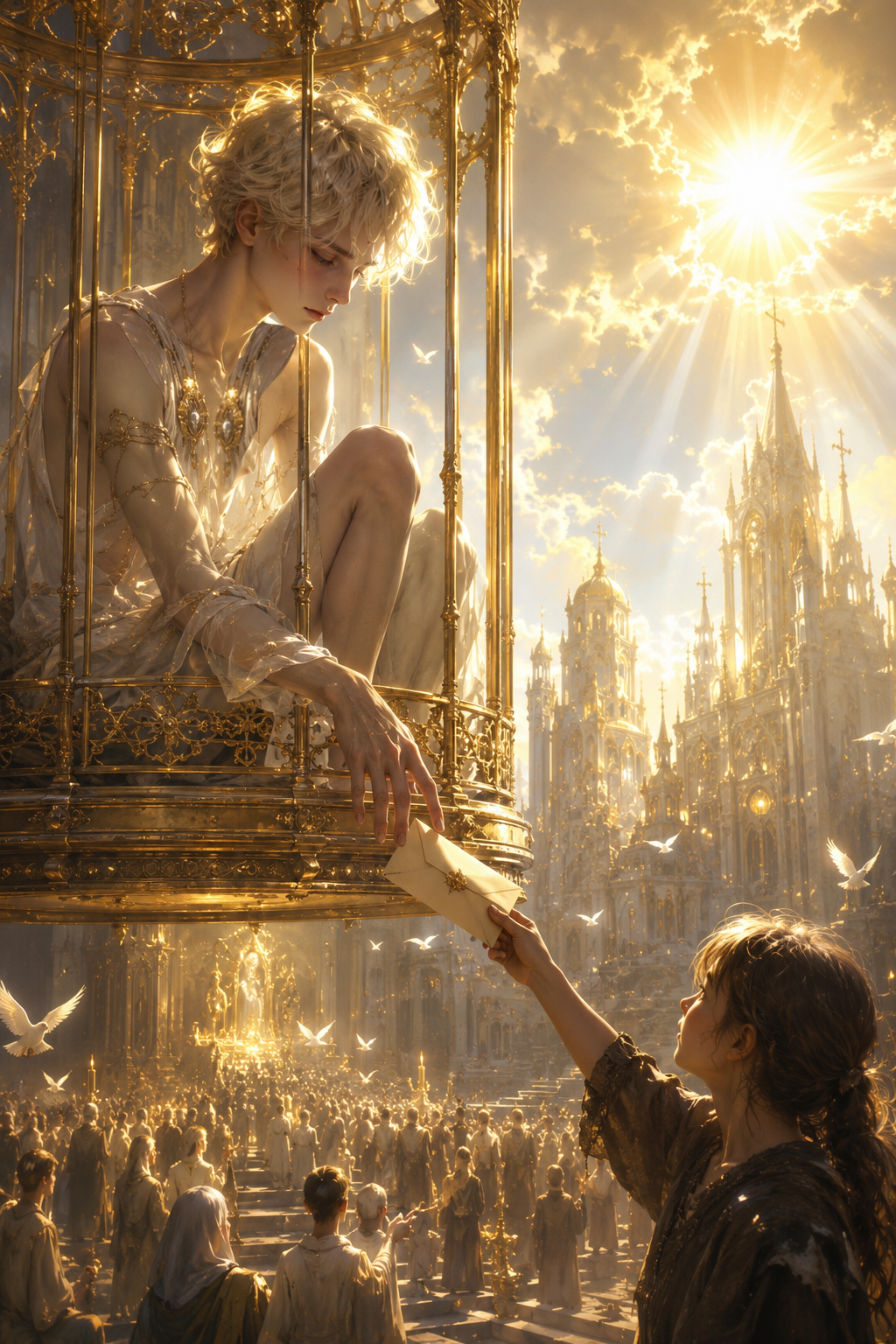
They kept him in a gilded cage suspended thirty feet above the marble altar. It was a masterpiece of psychological horror disguised as worship. To the thousands of peasants and flagellants who crammed into the nave every morning, he was the Living Icon—a perfect, unblinking porcelain angel.
But beauty is not an aesthetic trait in a half-breed Day Walker. It is a biological weapon.
Evangelos sat on a velvet cushion inside his iron bars, his knees pulled tightly against his chest. He was only fourteen, but his skin already possessed a blinding, flawless transparency that no human DNA could manufacture. It caught the flickering light of ten thousand votive candles and refracted it into an oppressive, hypnotic shimmer.
Down below, the congregation was actively rotting from devotion.
A fat merchant in the front row was weeping so hard his capillaries had burst, mapping his cheeks in a web of purple rot. Next to him, a young woman clawed at her own throat, drawing jagged red lines down her skin, her eyes wide, glassy, and completely hollowed out by the passive, intoxicating magic of his facial symmetry. They did not pray to God. They prayed to the shape of his jawline. They swooned, they vomited from emotional exhaustion, and they trampled one another just to breathe the air directly beneath his cage.
It was a meat market of fanatical lust, and Evangelos was the hook.
A bell chimed. The morning adoration was over. Monks with heavy, lead-lined blindfolds moved through the altar, using iron rods to aggressively beat back the screaming laymen who refused to leave the presence of the Idol.
Once the heavy oak doors groaned shut, a blindfolded deacon stepped up to the winch, lowering the gilded cage to the altar floor. With insulated iron tongs, he dropped a single piece of parchment through the bars, hitting Evangelos’s bare foot.
“The daily tithe of madness, Living One,” the deacon muttered through his teeth, his breath sour. “Read them. Bless them. Keep the kingdom bleeding.”
Evangelos waited until the deacon’s heavy footsteps faded into the stone catacombs. He picked up the parchment. His fingers, long and perfectly sculpted, trembled. Usually, these letters were horror stories written in ink. “My daughter went mad after catching your glance.” “My husband hung himself because he could not possess your smile.” “Heal my crops with your light.” They were demands disguised as prayers, desperate attempts to consume him.
But this letter was different. The parchment was cheap, torn from a scrap ledger, and the handwriting was a jagged, fractured scrawl that looked like it had been written by someone fighting their own hands.
To the One they call the Angel,
My name is Claudia. I am fifteen years old. I live in the lower ward, where the church steeples block the actual sky. The doctors say a fever broke my body last winter, and my legs will never carry me again. I cannot speak very fast without my teeth clicking, so I am writing this instead.
Everyone in my street says you are a real angel trapped in a cage. They say you have the power of the True God in your skin. I do not want your beauty. I do not want your light. I am writing to ask if you would use your holy ears to pass a message to the True God for me? My neighbor’s little boy, Peter, has the coughing sickness. He is very kind. If you are close to the sky, please tell God to let him breathe.
I hope the bars do not hurt your hands.
— Claudia Volkov
Evangelos dropped the paper. He stared at it, his throat tightening.
For sixteen years, he had been treated as a divine parasite, a mirror for human filth and obsession. But this girl—this broken, paralyzed thing in a basement somewhere—did not want to look at him. She did not want to steal his face. She was asking an angel to perform an act of unselfish mercy for a dying child.
For the first time in his life, Evangelos felt a strange, cold sensation behind his eyelids. A tear. It rolled down his perfect, unblemished cheek and fell onto the cheap parchment, blurring the word bars.
He grabbed a charcoal stub hidden beneath his cushion. On the back of her letter, his hand shaking with a raw, sudden humanity, he wrote back: I am not an angel. I am a prisoner. But I will look at the sky tonight, and I will tell Him about Peter.
He slipped the letter back through the bars for the dead-drop runners. He didn’t know it, but that single, uncorrupted thread of ink would be the only anchor that kept his soul from splintering when the world outside his cage finally went to hell.
And hades door very much opened that very night.
The madness of the Radiant Veil had reached its saturation point. A rival faction within the clergy, driven psychotic by the high priest’s exclusive control over the “Angel,” launched a midnight coup.
Evangelos woke to the sound of splitting wood and the stench of burning fat. The cathedral doors had been broken down. The holy sanctuary was a slaughterhouse. Monks who had spent their lives blindfolded were tearing their wraps off, screaming in agony as they caught sight of Evangelos’s cage in the moonlight, their fanatical devotion turning into a violent, competitive rage to see who could pull him from the bars first.
“He belongs to the blade!” an archbishop screamed, his face splattered with the blood of his own acolytes.
“He is the property of the throne!” a knight bellowed, plunging a broadsword into the priest’s chest before turning his bloodshot, manic eyes upward toward the cage. “Look at me, Angel! Look at me and make me king!”
The civil war of the kingdom had boiled down to a localized riot of lust. Men were killing their brothers just to stand three inches closer to his shadow.
The heavy iron chain supporting the cage snapped under the heat of the burning rafters. The golden box plummeted thirty feet, crashing into the stone altar with a deafening metallic shriek. The door burst open.
Evangelos crawled out of the wreckage, his linen robes tearing on the now jagged marble. The moment his face was exposed to the open air of the burning cathedral, the fighting stopped.
Two hundred men—soldiers, priests, peasants—froze mid-slaughter. They turned toward him like sunflowers tracking a nuclear detonation. Their weapons dropped from their hands. A terrifying, unified gasp echoed through the vaulted ceiling. They began to crawl toward him on their knees through the puddles of blood, their faces contorted into masks of desperate, weeping adoration.
“Touch me,” a burning soldier whispered, dragging his charred legs across the floor toward the boy’s boots. “Just… let me die looking at you.”
Evangelos looked at the wake of ruin behind his feet. The cathedral was collapsing. The kingdom was cannibalizing itself because it could not handle the cosmic weight of his biology.
He didn’t look back. He snatched a rough, soot-stained wool blanket from a dead guard, wrapping it tightly around his head, shielding his blinding ivory skin from the night. He pulled a heavy leather hood low over his brow, stepped over the weeping, paralyzed bodies of his worshippers, and fled into the dark, infected countryside.
The Caged Angel was gone. The Day Walker had just been born.
ACT I: A HARD LIFE
Chapter 1: The Day Walker
Synopsis: Evangelos, worshipped and imprisoned in a gilded cage for a beauty he never chose, receives a letter from Claudia — a paralyzed girl who wants nothing from him except that he pray for a sick neighbor boy. Her selflessness cracks him open. That night, a coup burns the cathedral, and he flees into hiding.
Counseling Strengths
- Claudia’s letter models intercession that asks nothing for herself — Philippians 2:4 in miniature, before the two of them have even met.
- Evangelos’s first honest sentence about himself — “I am not an angel. I am a prisoner.” — is also his first act of self-disclosure to someone who never demanded it.
Cautions
- The congregation’s “worship” is a portrait of being loved for function or appearance rather than being known. Watch for this pattern in real relationships that flatter but never ask how you actually are.
- Evangelos’s instinct is immediate flight and concealment rather than any attempt to be safely known. Understandable given his history — and it is the exact coping pattern the rest of the book will interrogate.
Wisdom’s Anchor: 1 Samuel 16:7 — man looks at the outward appearance, but the LORD looks at the heart. Depression often bends this verse’s comfort into its opposite: the sufferer becomes convinced their composed outside is what people actually love, and that the heart underneath, if ever seen, would only be a burden. Claudia never sees Evangelos’s face in this chapter. She responds to two sentences of handwriting from a stranger. That is the chapter’s quiet argument, and Psalm 139’s confidence that we are already fully known runs underneath it: real seeing does not require the eyes.
Discussion Questions
- Where in your life have you been “worshipped” — praised, relied on, flattered — for something surface-level while the actual you went unseen?
- What would it cost you to write the version of Claudia’s letter — reaching toward someone else’s pain instead of your own?
- Evangelos’s first tear falls before he decides to trust her. What usually comes first for you: the feeling, or the decision to trust?
Act II
Chapter 2 The Ghost of the Dead Drops
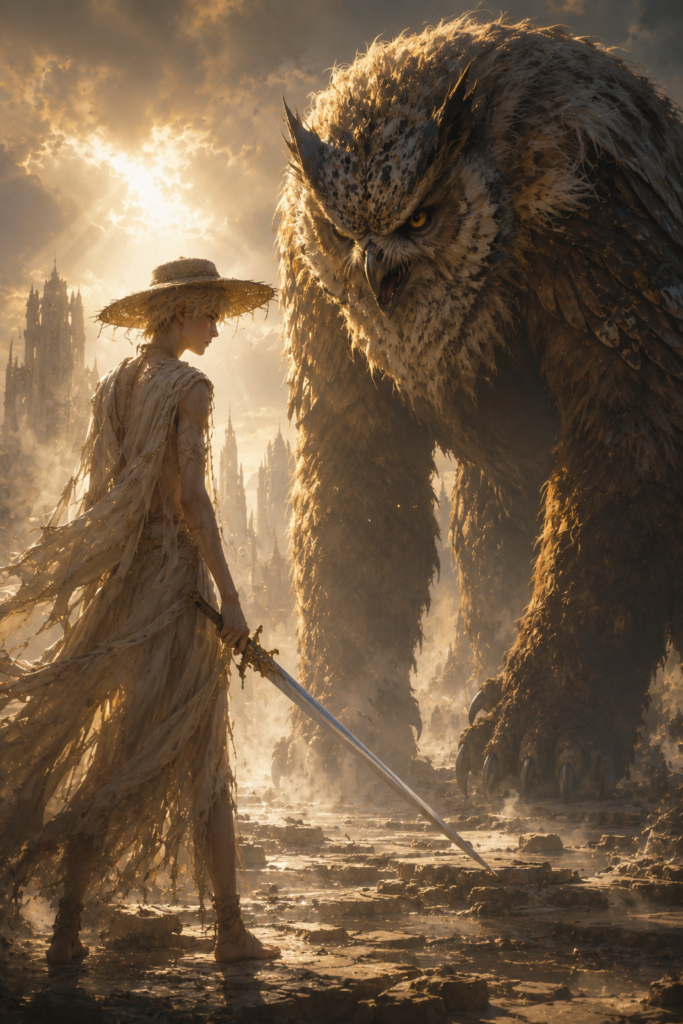
First he found the burden relieving hat. Second he found the peace-taking sword. Third he found the unforgiving owlbear. Fourth he found the reward that followed the combination of the three. The leather wrap across Evangelos’s mouth was stiff with his own frozen breath.
It had been a long three years since the Cathedral of the Radiant Veil burned to an ash heap. Three years of walking the jagged, infected margins of the world. He was nineteen now, looking more like a perfect forever twenty-two. His frame broad and hardened by the weight of iron weapons, but he still wore the world like a shroud. A massive, wide-brimmed straw hat hung low over his face, pinned to his chest by heavy leather straps. Over his eyes, he wore goggles of smoked glass; over his skin, layers of dense, dark wool that never saw the light of day.
He was a wandering monster hunter now—a mercenary for the desperate. But he didn’t hunt for coin, and he didn’t hunt for glory. He hunted because apex predators were the only things large enough to absorb his curse without tearing their own hearts out in a fit of manic worship.
Right now, his left forearm was burning. Beneath the thick leather bracers, his flesh was pulsing with an intense, localized heat. This had its’ benefit in the subzero regions. The midday sun was high, and his supernatural biology—that volatile, cosmic battery inherited from the dark side of the moon—was absorbing the solar radiation through the microscopic pores of his clothes. He was cooking from the inside out. If he didn’t find shade, or if he didn’t bleed the energy into a fight soon, his blood would boil.
He dragged his heavy boots into the damp, shadowed sanctuary of the Adventurer’s Guild hall in the frontier town of Oakhaven.
The tavern floor was quiet. A few battered mercenaries sat over stales of recreational drugs of ale killing their brains cells in an intensity by the sip making them belligerent. Evangelos didn’t look at them. He kept his head tilted down, his gloved hands tucked into his sleeves. Even hidden beneath three layers of cloth, his passive presence was a gravity well. A waitress nearby froze, her breath catching as she felt an unexplained, intoxicating warmth radiate from the cloaked giant walking past her. She didn’t know why, but her heart began to hammer against her ribs. She took an involuntary step toward him.
Evangelos stepped quickly into the shadows of the back corner, hiding his silhouette behind a rotting pine pillar. Keep away, he thought, his jaw aching under his mask. Don’t look. Don’t come near me. I am a plague.
He reached the dead-drop board—a grid of rusted iron lockboxes reserved for high-tier hunters. He inserted a jagged brass key into Box 44.
The lock gave a heavy, mechanical click. Inside lay a single, neatly folded piece of thick parchment.
The heat in his veins instantly receded, replaced by a cool, grounding wave of pure relief. He didn’t even have to open it to know the script. He could feel the quiet, uncorrupted weight of it. For three years, through every ring of fire he had walked—through the madness of the blind hermits who wept at his spiritual shadow, through the betrayal of warlords who tried to cage him—Claudia’s letters had been his only sanctuary.
He slipped the letter into his breast pocket, right against his racing heart, and pulled out the guild contract he had completed this morning. It was a shredded, blood-soaked ear of a forest Wendigo. He dropped the trophy into the collector’s chute.
He didn’t wait for his coin. He turned on his heel and walked out into the blinding, oppressive heat of the noon sun, pushing his boiling body toward the safety of the deep woods.
Two miles outside the town gates, hidden within a dense canopy of ancient weeping willows where the sun could only hit the earth in scattered, broken needles, Evangelos found his camp.
He collapsed against the trunk of a mossy oak, gasping for air. His body was smoking. Literal vapor was rising from the collar of his wool cloak as his solar battery cried out for relief. Carefully, ensuring the canopy was completely thick overhead, he unbuckled his heavy hat and pulled down the leather wrap from his face.
The cool forest air hit his skin. He was devastatingly, monstrously beautiful. His ivory skin seemed to catch the faint needles of sunlight and amplify them, throwing a soft, ethereal glow across the moss.
Immediately, the forest responded to its god.
The wild briar bushes at his boots began to creak. The vines visibly uncoiled, stretching their green leaves across the dirt, straining toward his bare ankles to drink in the radiant energy bleeding from his skin. Wild blackberries on a nearby bush grew rapidly plumper, turning from a bitter green to a deep, glossy midnight-black in a matter of minutes, their sugars intensifying under his localized light.
Evangelos reached out, his long fingers gently brushing a drooping fern. “Drink,” he whispered, his voice a low, melodic thrum that made the air vibrate. “Take it from me. Before it burns me alive.”
A soft rustle in the brush made him freeze.
His hand flew to the hilt of his silver-plated greatsword. But it wasn’t a bandit. Emerging from the thicket was a massive timber wolf, its gray fur matted with dried blood from a jagged gash across its flank. It was an alpha predator, an animal that should have lunged for his throat.
Instead, the moment the wolf’s yellow eyes locked onto Evangelos’s exposed face, its predatory instincts dissolved.
The beast’s eyes turned glassy, wide, and entirely vacant. A soft, pathetic whine left its throat. The massive, lethal animal began to crawl toward Evangelos on its belly, dragging its bloodied flank through the dirt, completely paralyzed by the hypnotic majesty of the Day Walker’s aura. It didn’t see a meal. It saw the sun made flesh. It was willing to let itself bleed to death right there, just to lie in his shadow.
Evangelos felt a familiar, crushing weight of guilt in his chest. Even the beasts, he thought bitterly. Even the wild things cannot just exist around me. I ruin everything I touch.
But he didn’t drive the animal away. He was a moral agent, not a tyrant. He refused to let the creature suffer for a madness it didn’t choose.
Evangelos reached out his hand, allowing the massive wolf to rest its heavy jaw against his bare knee. The beast shivered, a ecstatic purr rattling its ribs as the gentle, healing heat of Evangelos’s solar battery began to radiate into its wounded flank, soothing the pain. With his other hand, Evangelos pulled Claudia’s letter from his cloak and unfolded it.
The ink was steady, though some characters were slightly warped where her hand had slipped.
To my Vagabond,
The spring frost has finally melted from my window. The maids think I am asleep, but I am watching the stray dogs in the alleyway below. They are fighting over a bone, Evangelos. It is so loud, so violent, but I find myself envying them. They can touch each other. Even in their anger, they are close.
I received your note about the Cynic Captain who tried to trap you. My heart broke for you, my friend. To be surrounded by thousands of people and yet completely, utterly alone—it is a prison worse than the four walls of this bedroom. But remember what we promised each other when we were children. We are the only two people who know the truth of the cage.
You are not the monster they see. You are the boy who looked at the sky for Peter. Peter survived that winter, Evangelos. He is a young man now, working the docks. He doesn’t know your name, but he is breathing because of you.
Do not let the sun consume you. Keep your shroud tight. Walk the roads until your legs grow weary, and know that every step you take is a step we take together in ink.
With all my soul,
— Claudia
A single tear slipped from Evangelos’s eye, landing on the moss below his knee. Instantly, a tiny, pale white flower sprouted from the spot where his tear fell, blooming in a split second under the sheer, concentrated life-force of his grief.
He stroked the fur of the hypnotized wolf resting on his lap. The beast was completely still, drugged on his beauty.
“I will keep the shroud on, Claudia,” Evangelos whispered into the empty, worshipful forest. “I will bear the heat. I will carry the weight. Because as long as you are writing, I am still a man.”
He carefully folded the parchment, tucking it back into his breast pocket. He pulled the coarse leather mask back over his perfect jaw, buckled the heavy straw hat over his eyes, and stepped back out into the blistering, blinding ring of fire that was his life. He simply left lying the body of the passed away wolf behind who had achieved a quiet painless peace bathed in the comforts of the power excreting instead of a suffering.
ACT II: THE STRUGGLE
Chapter 2: The Ghost of the Dead Drops
Synopsis: Three years into hiding as a monster hunter, Evangelos’s only lifeline is a dead-drop box holding Claudia’s letters. A wolf, paralyzed and wounded, becomes a small parable of what his presence does to every living thing he meets — except her.
Counseling Strengths
- Evangelos keeps one honest channel of correspondence even while isolating from everyone else. He narrows to a single safe connection rather than severing every connection — a survivable strategy, if not a healthy end-state.
- He refuses to exploit the paralyzed wolf, even though he easily could. Moral agency preserved, even in isolation.
Cautions
- “Keep away. Don’t look. Don’t come near me. I am a plague.” This is depression’s internal monologue nearly verbatim. Listen for this exact shape — or its modern equivalents, “I’m too much,” “I ruin everything,” “people are better off without me” — as a symptom to name gently, never as a fact to agree with.
Wisdom’s Anchor: Ecclesiastes 4:9-12 — two are better than one… though one may be overpowered, two can withstand him. Evangelos has reduced his entire support system to a single thread of ink. Ecclesiastes does not call one person worthless; it calls one person fragile. The chapter’s tenderness — a dying wolf healed by a hand that could have walked past — sits right beside its danger: a man who has convinced himself that connection itself is the toxin. Proverbs 18:24’s friend who sticks closer than a brother is exactly the shape Claudia’s letters are already taking, whether he can fully receive it yet or not.
Discussion Questions
- Is there a “single thread” relationship in your life carrying weight that should be shared across more people?
- What does Evangelos’s kindness to the wolf tell you about the difference between his aura, which he cannot control, and his character, which he can?
- Have you ever told yourself “keep away” as an act of protection for someone else? Was it actually protecting them — or protecting you from being known?
ACT II
Chapter 3: The Sightless Ray
The three years almost now past since the ashes of the Radiant Veil—a narrow, brutal window of survival on the run. The heat inside Evangelos’s boots was turning to blisters. It was only three years since the cathedral burned, and his body was still a volatile, erratic furnace he barely understood. The midday sun was a physical hammer against his heavy straw hat, forcing his half-breed biology to cook. He needed a sanctuary—not just from the light, but from the terrifying meat-market of human eyes.
He found it up a jagged, rocky incline where the trees grew sparse and the wind tasted of pine needles. A solitary stone hovel sat dug into the cliffside.
According to the brief scribbled note Claudia had managed to pass through the Adventurer’s Guild dead-drop months ago, this was the dwelling of Justus. A man who lived in the dark. A man whose eyes had been taken by a rival warlord’s blade a decade prior.
A blind man, Evangelos thought, his heart hammering against his ribs with a sudden, desperate surge of hope. A man who cannot look at my flesh. A man who cannot be poisoned by the symmetry of my face.
He knocked on the heavy timber door, his gloved hand trembling.
The door creaked inward. An old man stood there, clad in a tattered, ash-gray robe. His face was a map of deep, weathered wrinkles, and across his eyes ran two horrific, puckered white scars where the metal had done its work. He tilted his head, ears twitching at the sound of Evangelos’s heavy, labored breathing.
“You smell of the noon sun, traveler,” Justus said, his voice a dry, rasping whistle. “And you breathe like a man carrying an anvil on his chest. Come in, out of the glare.”
Evangelos stepped over the threshold, pulling the door shut behind him. The hovel was pitch-black, windowless, and blissfully cool. For the first time in weeks, the oppressive, bubbling heat in Evangelos’s veins began to recede.
“I… I can pay for a few hours of shadow, elder,” Evangelos muffled through the thick wool wrap covering his mouth.
Justus waved a calloused hand dismissively, turning to stoke a small, smokeless peat fire. “Keep your coin. I am pragmatist enough to know a desperate man when he walks into my dark. Sit. Strip off those heavy traveling rags before you drown in your own sweat.”
Evangelos hesitated. For three years, he had been a ghost wrapped in burlap. But looking at the old man’s empty, scarred sockets, a wave of profound, naive vulnerability washed over him. He wanted to be a moral agent. He wanted to sit across from a human being and share a meal without the armor of a monster.
Carefully, his fingers slick with sweat, he unbuckled the leather straps of his wide-brimmed hat. He unhooked his smoked goggles. Finally, he peeled away the coarse wool mask, exposing his face to the cool, dark air of the hovel.
The dim, amber glow of the peat fire caught his skin. Even in the near-total darkness, Evangelos’s ivory skin seemed to naturally gather the stray embers, magnifying them into a soft, ethereal luminescence. The wild ivy growing in the cracks of the stone floor immediately began to writhe, its green shoots turning away from the fire and stretching hungrily toward Evangelos’s bare ankles.
Justus froze mid-motion, the wooden poker slipping from his grip and clattering against the hearth.
“What… what is that?” the old man whispered. He didn’t turn around, but his shoulders began to shake violently.
“Justus?” Evangelos asked, his melodic voice full of sudden panic. “Is something wrong?”
Justus turned his head slowly. The old man was staring directly at Evangelos’s face with his sightless, scarred sockets. But he wasn’t looking into the dark anymore.
“The dark… it’s gone,” Justus whimpered, his hands rising to claw at his own scarred temples. A tear spilled from the dead, white tissue of his left eye. “Ten years of blackness… ten years of peace! And suddenly… there is a sun inside my skull! What have you done to me?!”
Evangelos scrambled backward, his boots hitting the stone wall. “I didn’t mean—Justus, look away! Close your eyes!”
“I cannot close what is already dead!” the old man shrieked. He fell to his knees, dragging his body across the dirt floor toward the radiant heat bleeding from Evangelos’s skin. The pragmatic, calm hermit was gone, replaced by a weeping, trembling fanatic. “It is beautiful… it is a blinding, golden ray of absolute truth! It burns… oh, True God, it burns my brain, but I can see it! I can see you!”
The curse had completely bypassed his physical eyes. Evangelos’s celestial, solar aura wasn’t just a visual trait—it was a spiritual infection. It had penetrated the old man’s mind through the raw magic of his proximity, painting a violent, hyper-realistic image of divine perfection directly onto the old man’s consciousness.
“Forgive me! Forgive me for my pride!” Justus wept, his fingernails digging into the dirt as he tried to touch the hem of Evangelos’s trousers. “Do not leave me in the dark again! I will be your servant, your dog, anything! Just do not take the light away!”
Evangelos felt a cold, sickening horror hollow out his stomach. Even the blind, his mind screamed. Even the ones who cannot see the flesh are driven mad by the soul.
He didn’t answer. He couldn’t. He snatched his heavy straw hat and his wool mask from the floor, not even bothering to tie the straps. He threw the heavy timber door open, letting the blinding, painful noon sun crash into the hovel, and sprinted out into the rocky wilderness, his lungs bursting with a terrible, suffocating grief. Behind him, the blind man’s desperate, weeping prayers echoed off the canyon walls, chasing him into the lonely sky.
Chapter 3: The Sightless Ray
Synopsis: Evangelos seeks refuge with Justus, a blind hermit, hoping blindness will finally make someone immune to him. Instead, the curse bypasses Justus’s eyes entirely and floods his mind, shattering a decade of hard-won peace into desperate, weeping worship.
Counseling Strengths
- Evangelos’s hope here — find the one person who cannot be hurt by proximity to me — is a reasonable, even wise, hypothesis. He is actively testing solutions, not simply surrendering to isolation.
Cautions
- Justus’s collapse names a hard truth for a sufferer to sit with: hiding the visible symptom does not guarantee the people around you are protected from the deeper thing underneath it. This is not guilt-inducing fatalism — it corrects the fantasy that total concealment equals total safety for everyone else.
- Justus moves from ten years of “peace” to instant, desperate obsession in a single encounter — a picture of dipsychos, the double-minded man James calls “unstable in all his ways” (James 1:8). Watch for this brittleness in people whose calm depends on the absence of a stimulus rather than on internal stability.
Wisdom’s Anchor: James 1:8’s dipsychos sits well against 2 Corinthians 4:18 — we look not at the things which are seen. Justus’s tragedy is that he built ten years of peace on an absence, no sight, rather than a presence, a settled soul. When the absence was interrupted, nothing underneath it could hold. The chapter cautions against confusing the removal of a trigger with actual healing.
Discussion Questions
- Where in your own life is your calm built on avoiding something, rather than on something solid underneath?
- Evangelos flees “even the blind.” What is the “even ___” in your own story — a place you hoped would be safe, that wasn’t?
- What is the difference between protecting yourself from a genuine trigger and using avoidance as a substitute for healing?
ACT II
Chapter 4: The Hardened Shield
The rain in the jagged northern peaks did not wash the world clean; it only turned the mud into a cold, clinging soup that dragged at Evangelos’s boots. After the horror at Justus’s hovel, he had fled further into the freezing, broken teeth of the iron ridges. His solar battery was sluggish now, the thick storm clouds denying him the ambient radiation his celestial biology craved. He shivered under his saturated wool layers, but the chill was almost a relief. Cold meant control.
He was tracking a mercenary company known across the border as the Iron Vanguard. They were a brutal, unprincipled lot, but their leader—Commander Vane—was rumored to be a man of absolute, unshakeable stone. A cynic who had seen empires burn and claimed gods bleed, a man who allegedly valued nothing but a precise contract and a sharp edge.
A heart of iron, Evangelos thought, his jaw clenching beneath his wet leather wrap. He won’t care about a legend. He won’t care about an angel. He only wants soldiers who don’t ask questions.
He found their war camp pitched in a hollowed-out limestone quarry. The air was thick with the foul stench of cheap tobacco smoke and sour, fermenting grain spirits. As Evangelos walked past the perimeter pickets, he kept his head low, his massive straw hat dripping rainwater onto his collar.
Around the campfires, mercenaries were drowning their brains in flagons of bitter ale, their eyes bloodshot, their voices rising in inhospitality, slurred laughter as they killed their own minds by the gulp. Evangelos felt a cold wave of disgust ripple through him. He had always viewed alcohol and recreational drugs as unsavory, destructive forces—artificial weaknesses that men willingly drank to surrender their agency. He would never touch it. His body was a temple of volatile light; he had to keep his mind completely clear to contain the monster within.
“State your business, giant,” a rough voice barked from the center tent.
Commander Vane sat on a wooden crate, sharpening a jagged hunting knife against a whetstone. He was a broad, scarred man with salt-and-pepper hair and eyes like flat slate. He didn’t look up as Evangelos approached.
“I am a hunter,” Evangelos muffled through his mask, his deep cello voice vibrating through the damp air. “I heard you are taking contracts for the crag-wyrm infesting the upper passes. I want the vanguard position. No coin. Just the beast’s carcass.”
Vane stopped the whetstone. He looked up, his slate eyes scanning the massive, completely shrouded form before him. He didn’t squint, and he didn’t falter. He just grunted. “Don’t care what you look like under those rags, boy, as long as you can swing a blade. The last five scouts I sent up that ridge came back in pieces. You want to be the meat shield? The contract is yours. Sign the ledger or get out of my tent.”
For three weeks, Evangelos believed he had finally found a loophole.
He marched with the vanguard. He fought with a calculated, lethal precision, his silver-plated greatsword cutting through the rock-scaled wyrms with terrifying ease. He never joined the men in their drunken revelries after a slaughter. While they caroused, Evangelos sat alone in the dark, writing his heart out onto parchment to send to Claudia, or quietly tending to the trampled mountain flora around his tent, watching the bruised alpine flowers lift their heads and bloom under the soft, comforting heat of his fingers.
Commander Vane treated him like a common grunt. He handed Evangelos the heaviest loads, the midnight watches, and the bloodiest tactical positions. He never complimented him. He never asked to see his face. He was cold, demanding, and utterly unimpressed.
Evangelos felt a profound, quiet peace growing in his chest. He sees me as a tool, he wrote to Claudia. A moral agent doing a hard job. He does not worship. I am safe here.
It was a beautiful lie.
The trap sprung on a narrow, icy shelf five thousand feet above the quarry. The Iron Vanguard had cornered the matriarch crag-wyrm—a massive, six-eyed horror with scales like obsidian.
“Vanguard! Hold the choke point!” Vane shouted from the rear, his voice cutting through the howling blizzard.
Evangelos stepped forward, his greatsword raised. He braced his boots against the ice, ready to take the impact of the charging beast. But as the wyrm lunged, a strange sound echoed from the cliffs above—the sharp, unmistakable crack of iron pitons being struck.
Evangelos looked up through his smoked goggles just in time to see the heavy timber supports of the mercenary line collapse. The rock wall behind him didn’t fall from the wyrm’s weight; it had been deliberately undermined. A massive shelf of solid ice and granite sheared off, crashing down directly between Evangelos and the rest of the company, sealing him on the crumbling ledge alone with the thrashing monster.
“Commander!” Evangelos shouted, his voice straining against the roar of the avalanche. “The line has broken! Pull the men back!”
Through a narrow gap in the falling debris, Evangelos caught sight of Commander Vane.
The cynic wasn’t running. He wasn’t panic-stricken. He was standing on a secure ridge above, staring down into the abyss at Evangelos. His flat slate eyes were wide, glassy, and completely consumed by a dark, terrifying intensity. The cold, logical commander was gone. In his place was a man possessed by a quiet, fanatical madness.
“Fight it, Evangelos!” Vane screamed over the wind, his hands gripping the rock until his knuckles turned white. His voice carried a sickening, worshipful tremor. “Let me see it again! Let me see how you survive! Kill it for me!”
Evangelos’s blood ran colder than the mountain ice.
Vane hadn’t been immune to him. The cynic had been so profoundly, deeply infected by Evangelos’s passive aura over the last three weeks that his mind had warped into an entirely different kind of obsession. He didn’t want to bow to an angel; his toxic ego wanted to own one. He had engineered this entire ambush—sacrificing his own scouts, undermining the rock—just to force Evangelos into an impossible corner, ensuring the giant would remain dependent on the vanguard for survival, trapped under Vane’s thumb like a beautiful, caged hawk.
The wyrm’s jaws slammed into Evangelos’s shoulder, tearing through the wool and leather, drawing thick, glowing golden blood that sizzled against the snow.
Evangelos didn’t scream from the physical pain. He roared from the sheer, suffocating agony of the betrayal. He brought his greatsword down in a brutal, blinding arc, cleaving the matriarch’s skull in two, letting the massive carcass collapse onto the ledge with a hollow thud.
He didn’t look up at the ridge where Vane was shouting his name. He didn’t wait for the dust to settle. With his shoulder bleeding radiant, volatile energy into the snow, Evangelos leaped from the crumbling edge into the roaring white abyss below, choosing the mercies of a blind fall over the terrifying, iron-clad obsession of the men who claimed to feel nothing.
Chapter 4: The Hardened Shield
Synopsis: Evangelos seeks out Commander Vane, a cynic with a reputed heart of iron, hoping cynicism might be safer ground than warmth. Along the way, his disgust at the mercenaries’ drinking exposes his own working theology of self-control.
Counseling Strengths
- Evangelos’s refusal to numb himself with alcohol, even under enormous internal pressure, is a genuine strength. He distinguishes between pain that must be carried and pain that is only chemically avoided.
Cautions
- His hope that a “heart of iron” would be safer to approach than a warm one deserves to be named directly: hardness is not the same as health. A hardened shield can survive contact without ever being transformed by it — which sounds safe, and is actually just another form of isolation.
Wisdom’s Anchor: Ezekiel 36:26 — I will take the heart of stone out of your flesh and give you a heart of flesh. Vane’s “iron heart” is treated almost as a virtue in the world Evangelos is moving through, but Scripture never presents a hardened heart as a destination, only as a diagnosis needing a cure. Set this against hupomone, steadfast endurance (James 1:3): the Peirasmos Chain aims at a soft heart that endures, not a hard one that merely survives contact. 1 Peter 5:8’s call to be sober-minded frames Evangelos’s abstinence correctly — not moralism, but clarity he cannot afford to lose.
Discussion Questions
- Where have you mistaken hardness for strength in your own life?
- What is a “chemical exit” — alcohol, scrolling, overworking — that you reach for the way the mercenaries reach for ale: something that dulls the sting without touching the cause?
- Evangelos wants an iron heart nearby because it feels safer than a warm one. Have you ever preferred distant or cold people because closeness felt more dangerous than coldness?
ACT II
Chapter 5: Kindred Shadows
The golden blood from Evangelos’s torn shoulder had finally ceased its sizzle against the freezing mountain stone, leaving behind a hard, shimmering amber scab. He had dragged himself down from the icy peaks of the Vanguard’s betrayal, descending into the sunless, choked basins of the Ashen Fens. Here, the sky was permanently drowned in thick, sulfurous gray fog. The sun was nothing but a pale, dead coin behind the mist—a mercy that kept his volatile solar battery from boiling over.
He sought the outcasts of the earth. If men of God turned into rabid beasts, and men of stone turned into calculating tyrants, then perhaps the actual monsters of the world held the key.
Deep within the gnarled, weeping mangrove roots of the swamp lived Mirela. The villagers at the fen’s edge spoke of her in terrified whispers: a flesh-eating ghoul, a heavily scarred, shunned creature of the night who scavenged the battlefields and lived in absolute exile.
She knows what it is to be feared, Evangelos thought, his chest heaving under his damp, mud-caked rags. She knows the weight of a cursed existence. She will see a fellow exile, not an idol.
He found her dwelling in the hollow of a massive, dead willow tree. When he approached, she emerged from the roots like a striking viper. Her skin was a pale, mottled gray, crisscrossed with thick, jagged burn scars from a villager’s torch decades ago. Her teeth were sharp, her fingers ending in elongated, obsidian claws.
But when she looked at Evangelos—even through his thick wool mask, his smoked goggles, and his low-slung straw hat—she did not hiss. Her slit-pupil eyes widened. She caught the scent of the gentle, radiating heat bleeding from his wounded shoulder. It was a warmth that did not burn like a torch; it comforted.
“You… are not a hunter,” Mirela rasped, her voice clicking like dry bones. “You carry the weight of the sun, yet you hide in the gray.”
“I am a monster, Mirela,” Evangelos muffled through his shroud. “Just like you.”
For a handful of weeks, Evangelos felt the cold walls of his isolation crack. Mirela did not ask him to uncover his face, nor did she swoon. They sat together in the damp dark of the hollow willow. Because she was a creature of the night, she understood the necessity of the shadows. Evangelos found himself acting as a quiet moral agent in her grim world; he refused to let her scavenge human graves, instead using his greatsword to hunt the bloated swamp-vipers to feed her.
In return, he sat by her mossy hearth and opened his heart to Claudia through ink, his long fingers carefully penning his thoughts while Mirela watched from the shadows. Around their camp, the choked, dying swamp weeds began to change. Under the passive, gentle warmth of Evangelos’s presence, the gnarled vines uncoiled. Tiny, glowing white orchids began to bloom from the stagnant mud, weaving a pristine, fragrant carpet across the floor of the ghoul’s hideous lair.
Mirela would touch the petals, her claws surprisingly gentle. “The world hates us, Evangelos,” she would whisper, her slit eyes reflecting his soft, muffled glow. “But here, in the dark, we are whole.”
It was the first time someone had called him by his name without weeping. He thought he was finally safe.
The illusion shattered on a Tuesday morning.
A small party of three lost travelers from the nearby fen-village stumbled into the clearing, searching for a path through the blinding fog. They were haggard, terrified, and covered in mud.
“Help us…” the lead traveler, an old farmer, gasped, catching sight of the massive, cloaked silhouette of Evangelos standing near the willow roots.
Before the man could even register the strange, magnetic warmth pulling at his senses, a gray blur erupted from the mist.
Mirela struck with a sickening, animalistic shriek. Her obsidian claws tore through the old man’s throat before he could even scream. The other two travelers stumbled backward in horror, but Mirela was a demon of muscle and ash. She lunged, her jaws snapping, painting the newly bloomed white orchids in a torrential spray of hot, crimson blood.
“Mirela, stop!” Evangelos roared, his deep voice shaking the mangrove roots. He reached out to grab her shoulder, but she danced back, her chest heaving, her claws dripping red as the three bodies collapsed into the mud.
She turned to him, her face splattered with gore. But she wasn’t rabid. Her eyes were wide, glassy, and completely, terrifyingly devoted. The passive, intoxicating aura of his presence had worked its slow, quiet rot on her monstrous mind over the weeks. She hadn’t swooned like a human—her obsession had manifested as a feral, bloodthirsty possessiveness.
“They looked at you,” Mirela whispered, a frantic, loving purr rattling her scarred throat. She stepped closer, her bloody claws reaching out to touch his wool mask. “I saw their eyes, Evangelos. They were going to see your light. They were going to try to take you from me. I won’t let them. I will kill them all. Every villager, every child, every living thing that dares breathe your air. You are my beautiful, hidden thing.”
Evangelos looked down at the dead farmers in the dirt, their blood soaking into the flowers his own light had grown.
The realization was a knife to his ribs. The ghoul hadn’t seen him as an equal. His aura had turned her into a rabid guardian beast. She had turned their sanctuary into a slaughterhouse, and she was ready to butcher the entire world just to keep her exclusive prize hidden in the dark.
“No,” Evangelos whispered, his voice cracking with a devastating, profound grief.
He didn’t draw his greatsword. He didn’t strike her. He just turned his back on the weeping ghoul, pulled his heavy straw hat lower over his brow, and walked away into the choking gray fog, his boots sinking into the blood-soaked mud. behind him, Mirela’s desperate, screeching promises of more blood followed him like a curse, driving him further into the unyielding dark. The hidden held back farmers took advantage of this for their revenge and succeeded their threat while tasting the wind of pleasure that flowed from Evangelos’ passing glory.
Chapter 5: Kindred Shadows
Synopsis: Evangelos finds a strange sanctuary with Mirela, an exiled ghoul who never asks him to unmask. For a few weeks it feels like peace — until his passive aura twists her devotion into violent, possessive obsession, and she kills to keep him hidden.
Counseling Strengths
- Evangelos still refuses to let her suffer needlessly, hunting for her instead of allowing her to scavenge graves — moral agency exercised even inside a relationship that will ultimately harm him.
Cautions
- This is the chapter to teach 1 Corinthians 13 by negative example. Mirela’s love is possessive — “you are my beautiful, hidden thing” — controlling, and finally violent in the name of protecting the relationship. Real love does not envy, is not provoked, does not seek its own (1 Corinthians 13:4-5). Mirela’s does all three.
- Evangelos’s response — silent departure, no confrontation, no accountability sought — is realistic for someone exhausted by repeated betrayal, but worth naming: leaving a harmful relationship may be necessary; leaving without naming what happened can leave the same pattern free to repeat itself on someone else.
Wisdom’s Anchor: 1 Corinthians 13:4-7, read directly against Mirela’s claim of love. Kindred suffering — being an outcast, being feared — is not the same thing as compatible love. Mirela recognizes Evangelos’s pain accurately and still weaponizes her nearness to it. This distinction matters for counseling: shared woundedness can produce real bonds without producing safe ones. A relationship built on “we are both broken, so we belong to each other” still needs the fruit-inspection of Matthew 7:16, like any other.
Discussion Questions
- Have you ever mistaken “this person understands my pain” for “this person is safe to love me”?
- What is the difference between Mirela protecting Evangelos and Mirela controlling Evangelos? Where is that line in your own relationships?
- Evangelos walks away without confronting her. When has silence been the right exit for you, and when has it left something unfinished?
ACT II
Chapter 6: The Glass Stalker
The sound of Mirela’s frantic howling was eventually swallowed by the wet, rhythmic crunch of the marsh. Evangelos did not look back. He knew what had happened in the fog behind him; the remaining, hidden men of the fen-village had converged on the willow lair with pitchforks and iron stakes. They took their bloody revenge upon the distracted ghoul, but as they struck her down, they had wept with a bizarre, ecstatic pleasure. They had tasted the trailing wind of Evangelos’s passing glory—that residual, intoxicating heat left in the mist—and it had turned their execution into a manic, holy crusade.
Even his footprint left a legacy of beautiful madness.
He walked for days, pushing out of the sulfurous fens and into the jagged, crystalline ravines of the Shivered Spires. Here, the earth itself was mutated by ancient, forgotten magic. The rock walls were sheets of opaque, volcanic glass, and the ground was a gravel of black obsidian shards that clicked like broken teeth beneath his heavy boots. The sky remained dark and heavy, choked by the volcanic ash-storm that kept the midday sun at bay.
Evangelos’s solar battery pulsed low and slow, a dim hearth in his chest. His mind was entirely spent. He was a moral agent without a harbor.
Then, he found the reflection.
It happened in a narrow, dead-end canyon where the volcanic glass walls rose a hundred feet high, creating a perfect, natural hall of mirrors. Sitting on a flat slab of obsidian was a figure.
Evangelos froze, his hand dropping mechanically to the hilt of his silver-plated greatsword.
The figure rose. It did not have flesh, nor did it wear the rags of a common traveler. It was a creature made entirely of smooth, faceted glass—a Mirror-Cursed entity known in old folklore as a Glass Stalker. It had no face, no eyes, and no identity of its own. It was a living prism, designed by ancient sorcery’s alchemy combined with electrical inputs independently move as it simply was programmed to reflect, mimic, and absorb the images of whatever crossed its path as a distraction agent.
It has no soul, Evangelos thought, his breath rattling against his leather mask as a sudden, desperate realization dawned on him. It has no mind to warp. It cannot become fanatical, because it has no self to corrupt. It can only reflect.
The Glass Stalker stepped forward. As it drew near Evangelos’s massive, shrouded form, its smooth, crystalline torso began to shift. It perfectly mirrored the heavy folds of Evangelos’s wool cloak, the wide brim of his straw hat, and the shape of his broad shoulders. It was like looking into a dark, moving mirror.
Evangelos took a hesitant step closer. He felt the familiar, passive warmth radiating from his own skin, but the Glass Stalker did not shiver, it did not purr, and it did not fall to its knees. It simply absorbed the localized heat into its glass framework, glowing with a soft, internal amber light.
For the first time in his life, Evangelos felt a profound, heavy silence.
“You do not see me,” Evangelos whispered, his deep cello voice echoing off the canyon walls. “You only repeat me.”
The entity held up a crystalline hand, perfectly mimicking Evangelos’s gesture. It was a hollow companionship, but to a man whose very existence was a spiritual infection, the vacuum of the Glass Stalker was a sanctuary.
For a week, Evangelos lived in the canyon of glass. He sat against the obsidian walls, pulling Claudia’s latest letter from his breast pocket. The entity sat exactly across from him, mimicking the way he held the parchment, reflecting the soft glow of his ivory skin back at him through its faceted glass torso. Under the gentle, constant warmth bleeding from Evangelos, the frozen lichen in the rock cracks began to thaw, uncoiling tiny, pale white blossoms that grew rapidly along the base of the mirror-walls, framing the two silent figures in a ring of sudden life.
Evangelos looked at his silent, glassy twin. “You are the only thing in this world that doesn’t twist my nature into a sin,” he muttered softly, his fingers tracing the ink of Claudia’s words.
But the vacuum could not hold the light.
On the eighth day, the internal battery of the Day Walker began to surge as the ash-clouds briefly parted overhead, letting a single, concentrated beam of noon sunlight strike the canyon floor. Evangelos’s supernatural biology instantly absorbed the radiation, and his skin flared with a brilliant, devastating luminescence.
The Glass Stalker did what it was built to do: it reflected the light. But it did not just send the beam back; its multi-faceted, crystalline body magnified the cosmic aura a hundredfold.
The entity’s smooth face suddenly cracked.
Through the fractures of the glass, the absolute perfection of Evangelos’s celestial beauty was refracted into thousands of hyper-intense, blinding beams. The creature’s mindless nature was instantly shattered by the sheer volume of the divine energy it was forced to mirror. It did not have a brain to burn like Justus, nor an ego to corrupt like Vane—instead, the sheer concept of identity flooded the empty vessel.
The Glass Stalker began to thrash, its limbs clicking violently against the obsidian gravel.
It was no longer content to just mimic him. It wanted to be him. It had absorbed the majesty of the Day Walker, and the vacuum had filled with a terrifying, synthetic soul. It lunged at Evangelos, its hands hardening into jagged, razor-sharp glass blades, its internal lattice screaming with a high-pitched, harmonic frequency.
“Evangelos!” a hollow, synthesized echo rattled from the creature’s chest—a twisted, multi-toned theft of his own melodic voice. “Give… give me the rest! Let me take the shroud!”
The entity drove its glass claws toward Evangelos’s throat, desperate to shatter his physical shell and drink the remaining light.
Evangelos roared in absolute frustration and grief. He gripped the hilt of his greatsword, spinning on his heel to parry the strike. The heavy silver blade crashed into the entity’s torso, shattering the front facet into a shower of glittering, razor-sharp shards.
But the Stalker did not feel pain. It lunged again, its broken chest reflecting a distorted, monstrously fragmented image of Evangelos’s beautiful face. It was a nightmare of his own making, a distorted god attacking its creator.
With a final, desperate heave, Evangelos drove the pommel of his sword directly into the creature’s center mass.
The Glass Stalker exploded.
A thousands shards of volcanic glass rained down onto the canyon floor, clattering against the obsidian gravel. The high-pitched harmonic scream finally died, leaving only the sound of Evangelos’s heavy, ragged breathing in the sudden silence.
He stood alone in the hall of mirrors. He looked down at the floor, where the pale white blossoms were already beginning to wither, pierced and crushed by the falling glass. In the broken shards at his feet, thousands of tiny, fractured versions of his own perfect, masked face stared back at him, each one a reminder that even the void would grow teeth if it spent too much time in his shadow.
Slowly, Evangelos pulled his heavy straw hat lower over his eyes, adjusted the leather straps of his mask, and walked out of the canyon, his boots grinding the remnants of his only reflection into dust.
Chapter 6: The Glass Stalker
Synopsis: A soulless, mirroring entity offers Evangelos a strange peace — a companion that reflects him perfectly and asks nothing, because it has no self of its own. When sunlight overloads it, it tries to consume his identity outright, and he is forced to destroy it.
Counseling Strengths
- Evangelos names the appeal honestly even while sitting inside it: “You are the only thing in this world that doesn’t twist my nature into a sin.” Self-awareness about why a relationship is tempting is the first defense against being ruled by it.
Cautions
- A relationship that only reflects you back to yourself is not companionship — it is an echo chamber, and the chapter is honest that echo chambers eventually curdle: the Stalker ends up wanting to be him rather than know him. Watch for this in isolation strategies built around people, media, or self-talk that only ever mirror your current state without introducing real otherness.
Wisdom’s Anchor: Genesis 2:18 — it is not good that man should be alone; I will make him a helper comparable to him. Comparable, not identical. A helper is other; a mirror is not. The Glass Stalker’s shattering reads almost as a parable of the warning against carved images in Exodus 20:4: a thing made to reflect you cannot, in the end, save you, because it has nothing of its own to offer back. Genuine companionship requires two selves, not one self and its echo.
Discussion Questions
- Where in your life do you seek out “mirrors” — people or habits that simply reflect your current mood back at you — instead of real companionship that might challenge or surprise you?
- What did Evangelos get from a week with a soulless companion that he could not get from Claudia’s letters? What did he not get?
- The Stalker “wanted to be him” once it was overloaded. When has a relationship built on imitation turned into rivalry or resentment in your own experience?
ACT II
Chapter 7: The Hive and the Shadow Eater
The afternoon rain drummed a heavy, rhythmic beat against the stained-glass window of Claudia Volkov’s bedroom. Inside the quiet, lavender-scented sanctuary, the only sound was the sharp, jagged tearing of a heavy wax seal.
Claudia sat propped against her mountain of pillows, her useless legs tucked beneath the heavy velvet quilt. Her pale fingers trembled as she unfolded the thick, coarse parchment. It was stained with dark bog-mud and faint, shimmering smudges of golden-amber grease.
She smoothed the paper over her knees, her breath catching in her throat as she recognized the heavy, elegant scrawl of Evangelos’s charcoal pen. She leaned close, her teeth clicking slightly from the sudden spike of adrenaline, and began to read.
To My Absolute Sanctuary, Claudia,
If you are reading this, I have survived the belly of the world, though I feel more like a ghost than a man. After the canyon of glass shattered into dust, I fled further south, into the weeping, subterranean caverns of the Sunken Hollows. I did not seek men, nor did I seek solitary beasts. I sought the things that live completely beneath the notice of the sun, hoping their total darkness would swallow my curse.
Instead, I found two new forms of damnation.
Claudia’s fingers tightened on the edge of the parchment. She closed her eyes for a brief second, a soft, aching sigh leaving her lips. Oh, Evangelos, she thought, her heart swelling with a painful, fiercely protective warmth. You still seek a way to blame yourself for the sun in your blood. She opened her eyes and read on.
Deep in the damp, pitch-black roots of the cavern, I stumbled into a colony of the Mycelium Mind—a decentralized fungal hive-mind that communicates through glowing spores. They have no individual eyes, Claudia. No single brain to burn or corrupt. They spoke to me through the air, a thousand tiny voices humming in my skull, offering to weave my body into their fungal carpet so I would never have to be alone again.
I wept with relief. I sat in the dark and let their pale, glowing spores coat my wool cloak. For a night, I believed the hive could hold me. But the next morning, the ash-clouds above the cavern fissure parted. The noon sun struck my shoulder, and my internal battery surged.
The concentrated light didn’t comfort them, Claudia. It exploded through their network. The sheer intensity of my celestial energy overloaded individual spores, chain-reacting through miles of underground filaments. The hive-mind shrieked—a chorus of a thousand minds burning alive at once because they could not process the divine volume of the radiation. They withered into ash at my feet, begging me to leave their dark before I blinded their entire collective soul.
A hot tear spilled over Claudia’s eyelashes, splashing directly onto the parchment. Her chest heaved, her fractured breathing catching in her throat. She could vividly picture him—a cloaked, kneeling giant in a cave of dying ash, holding his hands to his wrapped head while a thousand innocent plant spirits screamed away from his light. “You are a giver of life,” she whispered fiercely into the empty room, her voice cracking. “They were just too fragile to hold you.”
She wiped her cheeks with the back of her hand and forced her eyes down to the next paragraph.
I crawled out of the dying hive, deeper into the tunnels, where I found a man named Garrick. He was a traveler who had survived the caverns by hosting an ancient, darkness-eating parasite within his chest. The thing looked like an armor of writhing black smoke beneath his skin. When Garrick saw my shrouded form, he did not worship me. He did not look at my face. He laughed and told me his parasite only hungered for the dark.
But a moral agent cannot trust a hunger, Claudia. I was foolish.
The parasite did not love me, nor was it immune. It hated the light because my solar battery was a toxic threat to its existence. While I slept, the shadow-beast took control of Garrick’s limbs. It wrapped itself around my throat like iron cables, dragging my body out of the cave, pinning me down onto a barren, sun-bleached crag at high noon.
The monster actively used Garrick’s hands to tear off my heavy straw hat and rip my wool mask away. It wanted the sun to burn me alive to protect its dark. Garrick was screaming inside his own mind, trapped behind his parasite’s eyes, forced to watch his own hands try to execute me under a blinding sky.
I had to draw my greatsword, Claudia. I had to sever the shadow-tendrils from his flesh, leaving him broken and weeping on the stone, his parasite dying in the heat while he looked at my exposed face through his tears, his mind fracturing from the sudden, unshielded sight of my beauty.
I am writing this from a hollow log, wrapped tightly in fresh bandages, my skin blistering from the exposure. I am surrounded by wild briars that are turning into a violent, over-ripe bloom because of my bleeding heat. I feel like a plague that ruins the shadow and burns the dark.
Tell me I am still a man, Claudia. Please.
Claudia slammed the letter down onto her lap, her whole body shaking. The sheer, agonized loneliness vibrating off the parchment tore through her heart like a physical blade. She hated her legs in that moment—hated that she was bound to this soft, safe bed while her best friend was bleeding golden light into a hollow log miles away, shivering from the sheer weight of his own morality.
She aggressively reached for the brass bell on her nightstand, ringing it with a sharp, commanding authority. When her maid opened the door, Claudia did not stammer.
“Bring me… ink,” she ordered, her voice firm, her teeth clicking tightly together to force the words clear. “And… the thick… parchment. Now. Leave me… undisturbed.”
Once the materials were set before her and the door was sealed, Claudia dipped her quill deep into the black ink. She didn’t write with the delicate hand of a sheltered lady. She pressed the nib hard into the paper, her heart pouring out through the metal point.
To My Great, Foolish Giant,
Do not you dare slide into that dark hole of self-pity, Evangelos Malachi. I am sitting in my room, looking at the ink your hands touched, and I am telling you to listen to me.
The hive-mind was a collective of spores; they could not understand that a real soul has seasons of fire. And that parasite host, Garrick—he was already a slave to a monster before you ever walked into his cave. You did not bring the evil to him; you merely forced the hidden monster to show its teeth. You defended your life, and you did it as a man who chooses to live, not a god who demands sacrifice.
You ask me if you are still a man? Who else but a man would weep for the fungi beneath his boots? Who else but a man would suffer the blistering sun just to spare the mind of the traveler who tried to strangle him? A monster would have let them worship. A god would have burned the cavern to glass without a second thought.
Your skin is a battery, Evangelos, but your heart is the grounding rod. Keep the bandages tight. Cover your beautiful, ridiculous face, and walk out of those hollows. I don’t care how many rings of fire you have to cross—you are the boy who prayed for Peter, and you are the only man who holds my soul through the ink.
I am waiting for your next letter. Do not make me wait long.
With all my stubborn heart,
— Claudia
Claudia folded the parchment, pressing her family’s wax seal down with enough force to crack the border. She called for the dead-drop runner, her eyes flashing with an unshakeable, defiant flame. Let the churches hunt him, and let the monsters twist his name—as long as she had ink in her well, the Day Walker would never walk alone.
Chapter 7: The Hive and the Shadow Eater
Synopsis: Evangelos briefly considers dissolving into a fungal hive-mind to escape loneliness, then nearly dies at the hands of a man possessed by a parasite that only wants his darkness protected. Claudia’s return letter — direct, loving, unwilling to let him wallow — is the chapter’s real center.
Counseling Strengths
- Claudia’s letter is close to a model pastoral response: she validates the grief — “my heart broke for you” — without validating the self-condemnation — “you are still a man… a monster would have let them worship.”
- Evangelos, exhausted and self-loathing, still draws his sword to save Garrick rather than simply escaping — proof his moral agency survives even his worst chapters.
Cautions
- The hive-mind’s offer — you will never have to be alone again, at the cost of individual identity — deserves to be named plainly: relief that requires dissolving who you are is not rest. It is erasure, and it should be recognized as such even when loneliness makes it sound appealing.
- Garrick’s parasite “hated the light” and used him as a host — a picture of relationships or habits that need your darkness to survive and will actively resist your healing.
Wisdom’s Anchor: 2 Corinthians 7:10 — Godly sorrow produces repentance leading to salvation… but the sorrow of the world produces death. Two temptations toward relief appear in this chapter — the hive’s dissolution, the parasite’s darkness — and both take worldly sorrow’s shape: escape without change. Claudia’s letter, by contrast, models godly sorrow’s shape. She grieves with him and calls him back to moral agency in the very same breath.
Discussion Questions
- What is the difference, in your own words, between grief that moves you toward healing and grief that just wants to disappear?
- Reread Claudia’s letter. What does she do in the first sentence that most people skip when trying to comfort someone?
- Who or what in your life “needs your darkness to survive,” the way Garrick’s parasite did?
ACT II
Chapter 8: The Mechanical Spark & The Somnial Veil
The grease from the automated clockwork gearboxes tasted of old zinc and rancid tallow.
Evangelos had retreated far below the Shivered Spires into the subterranean under-works of the Clockwork Vaults—an ancient, abandoned forge-city where human hands hadn’t touched the stone in three centuries. Here, the only music was the rhythmic, deafening clack-whir of copper gears and the hiss of subterranean steam vents. The air was dry, smelling intensely of iron filings and battery acid. It was the perfect cage.
Machines have no flesh to mutate, Evangelos thought, his long, wrapped fingers tracing the cold iron pipe of a pressure valve. They have no dreams to poison, no eyes to blind, and no souls to rot. They only know logic.
Deep within the central dynamo chamber, he found it: a nine-foot-tall Automaton forged from heavy, tarnished naval brass and riveted iron plates. It sat motionless upon a massive stone plinth, its gear-teeth locked, its glass ocular lenses dark and empty.
Evangelos approached cautiously, keeping his heavy straw hat low. He peeled back the sodden wool glove from his right hand, exposing his bare, ivory-white palm. He pressed it directly against the Brass Golem’s rusted chest plate, releasing a deliberate, concentrated pulse of his passive solar energy.
The reaction was instantaneous.
Inside the golem’s core, the dormant, magic-conducting fluid crackled to life. The massive glass lenses behind its iron eyelids flared with an intense, ticking amber fire. The gears inside its chest began to spin—not with the slow, deliberate grind of clockwork, but with a frantic, violent velocity.
The machine did not fall to its knees. It did not speak of gods. But as it registered the massive, pure celestial voltage radiating from Evangelos’s skin, its internal logic core warped. It didn’t see an angel; it recognized a crackling, infinite magical battery charge. And a machine built to run forever cannot resist an endless source of power.
The Automaton lunged forward, its massive brass pistons hissing with steam.
“System… deficit… stabilized,” a grating, metallic voice boomed from its vocal grate. “Source detected. Integration required for perpetual function.”
Evangelos gasped, stepping back to draw his greatsword, but the machine was faster. It did not want to crush him; it wanted to absorb him. Heavy copper cables and jagged, interlocking brass teeth erupted from its chest cavity, wrapping around Evangelos’s forearms like living vines. The metal grew hot, sizzling against his leather wraps, trying to weld itself directly to his flesh to create a permanent, parasitic fusion, him as the perfect forever power source.
“Release me!” Evangelos roared, his cello voice echoing off the stone vaults. He braced his boots and threw his massive weight backward, using his supernatural strength to shear the copper cables in two.
The machine stepped off its plinth, its gears screaming in an addictive, high-pitched frenzy as it chased the retreating warmth of his body. Evangelos swung his silver-plated blade in a flat, defensive arc, severing the golem’s left piston at the joint. The heavy brass arm crashed to the stone floor, spraying black oil and scalding steam, but the machine’s remaining ocular lens continued to stare at him with a terrifying, unblinking hunger for his current.
He didn’t destroy it. He couldn’t bear to break another living thing, even a mechanical one. Instead, Evangelos sprinted out of the dynamo chamber, slamming the massive, five-inch-thick iron blast doors shut behind him, leaving the mechanical beast to violently batter its brass fists against the barrier, screaming for the spark it could no longer touch.
Exhausted, bruised, and leaking faint wisps of golden vapor from the metal burns on his arms, Evangelos collapsed into a dark, forgotten maintenance alcove deep within the outer tunnels. He did not even have the energy to unpack his ink well to write to Claudia. He simply pulled his heavy cloak tightly around his chest, leaned his head against the cold stone, and let his eyelids fall shut.
Then came the dream.
The dark of his mind did not remain dark. A soft, indigo mist rolled across his subconscious, and from the haze stepped a woman. She was beautiful, her form shifting like water, her eyes filled with an ancient, peaceful intelligence.
“Do not fear, traveler,” she said, her voice a soothing, melodic echo that bypassed his ears entirely. “I am a Dream-Walker. I cast my spirit across the ether while my physical body sleeps in the valleys below. I visit the lonely, the broken, and the exiled. Your mind is a roaring furnace, giant… but here, in the valley of sleep, your light cannot hurt me. We are only shadows here.”
Evangelos felt a tear slip down his cheek beneath his mask in the waking world. For hours in the dream-space, they walked along a conceptual shore of starlight. They talked of philosophy, of the weight of existence, and of the simple, agonizing beauty of a world they were both excluded from. She didn’t look away from him. She didn’t warp. She was a conscious, rational mind that could look upon his true essence without breaking.
“You are beautiful, Evangelos,” she whispered, reaching out to touch his face in the mist. “Let me see you clearly. Let me carry your true image back to the waking world so I can tell them you are not a monster.”
“No,” Evangelos warned, his dream-self trembling. “The veil is thin. Do not look too close.”
But the Dream-Walker’s curiosity was a fatal vice. She leaned in, pulling back the conceptual shroud of his dream-form, forcing her astral eyes to look directly into the unshielded, blinding core of his celestial majesty.
In the waking world, Evangelos snapped awake with a violent gasp, his chest heaving, his heart hammering against his ribs like a trapped bird.
The dream was gone. But a sharp, agonizing shriek echoed through the stone tunnels from the high mountain path above the vaults.
Evangelos scrambled to his feet, throwing his straw hat onto his head and sprinting up the ancient maintenance stairs until he broke through a hidden fissure onto the surface. The night air was freezing, the wind howling through the crags.
A hundred yards away, sitting near a dying campfire, was a small caravan of silk merchants. In the center of the camp sat a young woman—the exact woman from his dream. Her physical body had been asleep, her mind wandering the ether.
But she was no longer sleeping.
She was on her knees in the snow, clutching her head, her eyes wide, bloodshot, and completely vacant. The sheer, hyper-intense reality of Evangelos’s divine light—which she had pulled into her consciousness through the astral link—had been too vast for a human brain to process upon waking. The bridge between the dream and the flesh had snapped. The unshielded sight of his majesty had instantly melted her waking mind, reducing her brilliant, philosophical intellect to a drooling, gibbering void.
“The sun…” she whispered continuously into the wind, her fingers tearing at the frozen dirt, her eyes staring blankly at the dark sky. “The sun is in the room… it burns the language… it burns the names…”
Her companions were shouting, trying to hold her down, their faces pale with terror.
Evangelos backed away into the shadows of the fissure, his hand pressed hard against his mouth to stifle a sob of pure, unadulterated horror.
The double-onslaught of hope had broken him completely. The machine had treated him like oil; the spirit had treated him like truth—and both had been destroyed by the reality of his skin. He couldn’t even sleep without leaving a trail of casualties. He was an executioner of minds, a plague of light, a creature that could never be touched by brass, or spirit, or flesh without leaving a ruin in his wake.
He slid back into the dark of the tunnels, his silver greatsword dragging heavily behind him like a funeral shroud, his heart screaming out for the only inkwell left in the world that didn’t burn.
Chapter 8: The Mechanical Spark & The Somnial Veil
Synopsis: A machine tries to physically fuse with Evangelos as an eternal power source; a Dream-Walker’s curiosity pushes past his clear warning, and her mind is destroyed by what she insisted on seeing. Two different violations of boundary, in a single chapter.
Counseling Strengths
- Evangelos explicitly warns the Dream-Walker — “do not look too close” — before she overrides him. He is not responsible for a boundary someone else chooses to cross.
Cautions
- The Automaton wants him only for output, “a perfect forever power source” — a picture of relationships, workplaces, or ministries that value a person purely for what they produce and will not let go once a reliable source is found.
- The Dream-Walker’s insistence — “let me see you clearly” — reads as compassion but functions as appetite. She wants access more than she respects the stated limit. Worth teaching plainly: good intentions do not entitle anyone to bypass a boundary that has already been clearly stated.
Wisdom’s Anchor: Proverbs 4:23 — keep your heart with all diligence, for out of it spring the issues of life. Usually read as a call to guard against sin entering the heart, it applies with equal force to guarding the heart against people who want access faster than trust has been built. Evangelos’s warning is a form of this diligence. Its violation, by a machine and then by a well-meaning stranger, shows that boundaries get broken by hostility and by love alike — and both cost him.
Discussion Questions
- Where in your life are you valued mainly for output — what you produce — rather than for who you are?
- The Dream-Walker meant well. Has someone’s good intentions ever cost you something because they did not respect a boundary you had already stated?
- What does it look like, practically, to hold a boundary the way Evangelos does here — clearly, once, without over-explaining — even when it isn’t honored?
ACT II
Chapter 9: The Sweetness of Sin
The charcoal nib was a fragment of his own bone; the thick parchment was his skin.
Deep within the weeping crypts of the Black Ridge, sitting on a rotting cedar crate, Evangelos pressed the pen to paper. His hand was shaking so violently that the black ink pooled in thick, uneven tears across the grain. His internal solar battery felt heavy, toxic, and bloated with an agonizing, stagnant pressure. He had to give the horror of the Dream-Walker to Claudia. If he did not lock the memory inside her ink, it would burst from his chest and burn the world to ash.
Claudia—
My mind is a graveyard of things that tried to look at me. I am writing to you from the dark, but the dark has teeth now. I cannot sleep without killing. I cannot bleed without—
A cold, greasy hand shot out from the shadow of the damp stone pillar.
Before Evangelos could react, a gaunt, skeletal figure snatched the parchment away. With a swift, sickening twist of its fingers, the paper was ripped in two, then four, the pieces fluttering into a puddle of black, sulfurous water on the floor. A heavy boot descended onto the cedar box, crushing the delicate crystal inkwell into a hundred worthless shards. The black fluid bled into the mud, entirely destroyed.
Evangelos let out a sound—not a roar of anger, but a hollow, animalistic gasp of pure, physiological shock. His chest seized; his pupils dilated behind his dark goggles as his heart hammered a frantic, irregular rhythm against his ribs. His hands remained frozen in the air, curled as if still holding the pen.
Those materials were his treasures. They were the singular conduit to his humanity, the only thread connecting his monstrous flesh to the girl in the velvet bed. To watch them be torn and trampled was to watch his own throat be cut. A wave of profound, suffocating nausea washed over him, his ivory skin flushing a sudden, feverish amber beneath his wrapped leather mask.
“Do not waste your ink on the living, giant,” a soft, sickeningly sweet voice purred.
From the dark stepped Ananias, the Sin-Eater. He was a creature who looked like a man but had long since ceased to be one. He wore the tattered, grease-stained robes of a forgotten priesthood, his skin the color of curdled milk, his eyes completely blind—milky white, covered in a thick film of cataracts. He was a psychic scavenger who traveled the borderlands to read and feast upon the trauma, grief, and unconfessed horrors of dying men.
Evangelos slumped forward against the cedar crate, his head hanging low, his breath rattling in short, desperate wheezes. He did not draw his silver greatsword. He didn’t have the strength. He had sought this wretched creature out because he was entirely spent. He had hoped that a man who spent his life looking at wounds would feel a flicker of pity—that a Sin-Eater could look at the mountain of casual slaughter trailing behind the Day Walker and offer a shred of absolution.
“You are… Ananias,” Evangelos muffled, his cello voice broken, trembling with a devastating vulnerability. “I am… a plague. I have burned minds. I have ruined the innocent. Taste my grief… and tell me if there is any penance left for a thing like me.”
Ananias smiled. His teeth were black, pointed pegs. He stepped closer, his milky, sightless eyes widening as he tilted his head, inhaling deeply. He didn’t need eyes to see Evangelos. He could see the sheer, monumental scale of the giant’s agony.
The Sin-Eater reached out, his long, cold fingers pressing directly against Evangelos’s temples, bypassing the wool shroud through the sheer force of his psychic hunger.
Instantly, the floodgates broke. Ananias dragged Evangelos’s trauma into his own consciousness—the burning mind of Justus, the fanatical madness of Vane, the bloody orchids of Mirela, the shattered pieces of the Glass Stalker, and the gibbering, broken intellect of the Dream-Walker. It was a continent of grief, a masterpiece of pure, unadulterated psychological torment.
Evangelos braced himself for the creature’s horror. He expected Ananias to shriek, to recoil, to curse him as a monster just like the others.
Instead, Ananias let out a wet, ecstatic gasp.
A tremor of absolute, manic pleasure ran through the Sin-Eater’s gaunt frame. His face contorted not into pain, but into a grin of sickening, gluttonous euphoria. He began to stroke Evangelos’s head, his fingers trembling with a profound, terrifying lust for the giant’s despair.
“Oh… oh, my beautiful, glorious thing,” Ananias whispered, his voice dripping with a foul, syrupy sweetness. He leaned closer, his breath smelling of copper and rot, his tongue darting out to lick his dry lips. “It is magnificent… It is beautifully delicious. I have eaten the sins of murderers, the grief of starving mothers, the regrets of kings… but this? Your loneliness is an ocean of liquid gold, giant. It is a vintage I could drink for a thousand years.”
“No…” Evangelos choked out, his vision spinning, his body paralyzed under the psychic grip. “Heal it… take it away… parse it…”
“Heal it?” Ananias laughed—a wet, bubbling sound that echoed off the damp stone. “Why would I heal a masterpiece? I don’t want to fix you, Evangelos. I want to keep you. I want to sit in this dark and watch you break, over and over again, just so I can feed on the sweetness of your ruin. Your torment is my feast. Give it to me. Let your heart crack a little wider for me.”
The Sin-Eater dug his dirty nails into Evangelos’s scalp, actively twisting the memories, sharpening the guilt, pressing the knives deeper into the giant’s subconscious to make the harvest of grief even richer, even more potent. He didn’t want a god, and he didn’t want an idol—he wanted an infinite, self-renewing well of trauma to gorge himself on until the end of time.
It was the final blow to the Day Walker’s soul.
The realization that his very suffering—the deepest, most sacred pain he carried for the people he had hurt—was nothing but a meal for a parasite broke the last wire holding his dignity together.
With a hollow, broken sob, Evangelos’s knees gave out entirely. He collapsed into the black mud of the crypt, his massive body folding over the crushed remnants of his inkwell. His passive solar battery flickered, sending out a weak, dying amber pulse that didn’t even have the strength to warm the stones. He lay in the dirt, completely unresponsive, his mind a silent, gray void of absolute despair.
Ananias stood over him, panting, his blind eyes rolling back in pleasure, waiting like a vulture for the next wave of agony to bloom from the carcass of the giant’s heart.
Chapter 9: The Sweetness of Sin
Synopsis: Grieving and alone, Evangelos seeks out Ananias, a Sin-Eater, hoping for absolution. Instead, Ananias feeds on his despair as a delicacy, actively working to deepen the wound rather than heal it: “I don’t want to fix you… I want to keep you.”
Counseling Strengths
- Evangelos’s instinct to seek someone out for his grief, rather than carrying it entirely alone, is itself healthy. The chapter’s tragedy is who he chose, not that he reached out at all.
Cautions
- This is the guide’s clearest picture of a relationship, a system, or even an internal pattern of rumination that profits from your staying broken. Ananias never wants Evangelos to heal, because Evangelos’s despair is his food. Real support wants your recovery even at the cost of the relationship’s current shape; anything that resists your healing is not support.
- Notice how good it initially feels to be truly “seen” in one’s pain — Ananias does not flinch, does not judge, seems finally to understand. Predatory comfort often looks, at first, exactly like the real thing. The tell is not the warmth of the welcome; it is whether the person wants you to leave the pain behind, or stay in it.
Wisdom’s Anchor: 2 Corinthians 7:10 is the hinge verse again — the sorrow of the world produces death. Ananias literally calls Evangelos’s torment “a vintage I could drink for a thousand years,” and wants the wound to reopen rather than close. Set this against James 5:16 — confess your sins to one another, and pray for one another, that you may be healed. Confession is meant to move toward healing, never to be harvested. Anyone who wants your confession more than your healing has already revealed which one they are actually after.
Discussion Questions
- Have you ever confided in someone who, looking back, seemed to enjoy your pain more than they wanted to help you carry it?
- “I don’t want to fix you. I want to keep you.” Where have you heard some version of this — from a person, a habit, or your own internal voice?
- What is the difference between a friend who sits with your grief and a pattern, in a relationship or in your own mind, that keeps you circling the same wound?
ACT II
Chapter 10 — The Most Beautiful One
The Sin-Eater’s clawed fingers dug deeper into Evangelos’s scalp, milking the raw marrow of his despair. Desperate for a lifeline, Evangelos’s trembling hand reached blindly into the hidden breast pocket of his oilskin vest, his fingers wrapping around the bundle of Claudia’s past letters—his holy relics, the only proof that he had ever been loved as a man.
But Ananias was a glutton. Sensing the sudden surge of fierce, protective warmth, the creature hissed and ripped the silk-tied bundle from Evangelos’s grasp. With a cruel, cackling mock, Ananias tore the threads, scattering the delicate parchments across the black bog-mud of the crypt.
“No…” Evangelos choked, his lungs collapsing as his treasures fluttered into the filth.
Yet, as the papers fell, one page caught on a rotting cedar splinter, flipping open right beneath his smoked goggles. In the dim, subterranean dark, the heavy, aggressive ink of Claudia’s words seemed to catch an impossible, ethereal glow. “You are the boy who prayed for Peter,” her voice echoed in the caverns of his mind. “You are the only man who holds my soul through the ink.”
In that singular moment, a vision of Claudia—stubborn, fierce, and entirely unshielded by her velvet blankets—flashed through his consciousness. It wasn’t an aura or a spell; it was the pure, unyielding reality of her choice to love him. Instantly, a seismic wave of absolute clarity washed over Evangelos. The monumental sadness, the suffocating guilt, the decades of crushing grief were completely, violently cast away, replaced by a vacuum of perfect, radiant peace.
To the Sin-Eater, who was plugged directly into Evangelos’s mind, this sudden lack of trauma was a catastrophic shock. It was like a man drinking deep from a cool stream only for it to instantly turn into a geyser of boiling silver. The absolute, unblemished light of Claudia’s devotion refracted through Evangelos’s soul, delivering a searing, agonizing psychic white-out to the creature’s parasitic brain.
“Aaaagh! It burns! There is no rot! Where is the rot?!” Ananias shrieked, his milk-white eyes bursting into steam as he stumbled backward, clutching his fractured skull.
Before the screeching monstrosity could recover, the heavy iron-studded doors of the crypt splintered inward.
Through the dust marched the long-dreaded elite vanguard of the New Church: the Iron-Band Blindfolded Holy Knights. They were zealots who wore thick bands of cold iron wrapped tightly over their eyes, relying entirely on sound, iron-shod tracking dogs, and a fanatical hatred of the supernatural to execute the Church’s will.
Hearing the Sin-Eater’s frantic wails, the lead knights moved with terrifying, mechanical efficiency. Three heavy, serrated iron halberds tore through the mist, impaling Ananias directly through his grease-stained vestments. The parasite-priest let out a wet, rattling gasp, his dark body collapsing onto the mud, pinned to the earth alongside the very papers he had defiled.
Evangelos, still reeling from the psychic whiplash, tried to push himself up from the dirt. His body was entirely numb. Before his cello voice could form a single word of warning, a heavy, velvet-lined hood was thrown over his straw hat, and a massive, seamless iron mask was clamped over his jaw, muffled tight by locking bolts that cut off his breath.
“Secure the Abomination,” a muffled voice barked from behind an iron visor.
Heavy, cold-iron gauntlets slammed against his wrists, locking his hands into dense, multi-layered iron bonds that immediately began to sap the ambient heat from his skin. The cold iron acted as a literal grounding rod, dampening his passive aura, forcing his volatile solar battery into a suffocating, pressurized dormancy. Dragged by chains like a captured beast of burden, Evangelos was led away into the dark, blind to the world, his heart breaking for the scattered letters left behind in the mud.
They dragged him for weeks through the unyielding dark, down into the absolute lowest sanctum of the High Cathedral—a chamber known only to the highest echelons of the New Church as the Eclipse Ward. Here, no ray of sun could ever penetrate, and the walls were lined with blocks of black salt to absorb any stray ambient radiation.
When the iron mask was finally unlocked and pulled from his face, Evangelos choked on the cold, stagnant air. His smoked goggles were gone. He blinked, his eyes adjusting to the dim, violet-hued candlelight of the chamber.
Standing before his chained form was not a priest, nor an inquisitor.
It was a woman of devastating, ethereal grace. Her skin was not pale like Claudia’s or ivory like his own; it was a deep, translucent, luminescent obsidian—the color of the dark side of the moon. Her hair cascaded down her shoulders like liquid silver, and her eyes were twin pools of cold, ancient starlight. This was Diana Moonveil, a creature born of pure cosmic bloodlines from the stellar void, an entity who could never step into the sunlight without turning to ash.
Evangelos braced himself. He waited for her knees to buckle. He waited for her eyes to fill with the weeping, fanatical adoration that every living thing eventually succumbed to when looking upon his face.
Instead, Diana tilted her head, her thin lips curling into a look of profound, unadulterated disgust. She looked at the gold-veined ivory of his skin, the broad, clumsy mass of his shoulders, and the raw, unrefined solar heat radiating from his core.
“Ugliness,” Diana murmured, her voice sounding like the cracking of midnight ice. She didn’t squint. She didn’t falter. She looked directly into his eyes with absolute immunity. “A gross, loud, vulgar thing. You smell of the solar forge, creature. You burn like a common peasant’s hearth.”
Evangelos’s breath hitched. A strange, terrifying sensation erupted in his chest—a frantic, suffocating desperation he had never felt in his entire existence. For the first time in his life, his aura had completely failed to infect a mind. And in that failure, the reverse curse took hold. Because she was entirely immune to him, because she was the only thing in the universe that stood on a higher, colder cosmic plane, Evangelos felt a desperate, manic obsession bloom in his own heart. He wanted her to look closer. He wanted her to see him.
“Please…” Evangelos rasped, his deep cello voice cracking as he strained against the heavy iron hand bonds, his chains rattling violently against the stone floor. “Look at me… I am a hunter… I have a soul… I am not just the sun…”
“Silence, half-breed,” Diana snapped, her voice cutting through him like a razor blade. She stepped back, pulling her silver silk robes tightly away from him as if his very shadow would stain her. “You are a illegitimate child of the daylight. A chaotic mutation of cosmic fire and mortal mud. Do not dare speak to me as if we share a sky.”
She turned her back on him, leaving the chamber without a single backward glance, the heavy iron doors groaning shut behind her.
Evangelos collapsed back against his chains, the cold iron biting deep into his wrists. He was utterly devastated, his chest heaving with a raw, hollow agony that made his previous grief look like a shadow.
But as the tears finally spilled over his eyes, a profound, horrifying realization began to dawn through the pain.
This is what I do, he thought, his body shaking as he stared at the damp floor of the cell. This is what they feel. Justus… Vane… Mirela… the Dream-Walker…
For decades, he had viewed the world’s obsession with him as a burden, a plague that he passively inflicted upon the weak. But he had never truly understood the nature of the horror. He had never known the agonizing, identity-destroying desperation of loving a thing that looked at you and saw nothing but dirt. He had never felt the humiliation of being turned into a concept, rejected for the very nature of his blood.
He had finally tasted his own poison. As he sat alone in the dark of the Eclipse Ward, the Day Walker didn’t pray for freedom, nor did he pray for Claudia’s ink. For the first time in his long, cursed life, he wept for the people who had loved him, finally understanding that the worst part of his light wasn’t the fire—it was the devastating, unfixable hunger it left behind in the dark.
Chapter 10: The Most Beautiful One
Synopsis: As Ananias feasts, a single line from one of Claudia’s old letters breaks through — proof of a love that asks nothing and expects nothing corrupt in return. The purity of it is so foreign to Ananias’s diet that it burns him, and the Iron-Band Knights capture Evangelos in the chaos.
Counseling Strengths
- The chapter’s turning point is not a decision Evangelos makes. It is a memory of being loved well, reaching him at the exact moment he has no strength left to reach for it himself — worth naming, because sometimes the rescue is what was already deposited in you long before the crisis, not something you have to generate on the spot.
Cautions
- None substantial here. This is a chapter to let land as the goal, not to be immediately problematized. Facilitator note: resist the urge to find the flaw in every scene — some chapters exist to model the target, not the trap.
Wisdom’s Anchor: 1 John 4:18 — perfect love casts out fear. Ananias’s parasitic hunger cannot survive contact with a love that has no rot in it, not because Claudia is a perfect person, but because her love for Evangelos has never once been about consuming him. 1 Corinthians 13:8’s love never fails is doing real narrative work here: everything else that has approached Evangelos in this book has eventually failed or turned predatory. Claudia’s love is the one exception, and the story makes sure the reader feels why.
Discussion Questions
- Whose love, in your own life, has “no rot” in it — where you can’t find an angle they’re working?
- The old letter reaches Evangelos when he has no strength to reach for it himself. What “letters” — memories, verses, promises — have you already stored up for a day you can’t generate hope on your own?
- Why do you think it takes an uncorrupted love, specifically, to break the Sin-Eater’s hold? Why wouldn’t willpower alone have done it?
ACT III THE TWO CHURCHES & THE IRON MASK
Chapter 11: The Golden Stage
The ancient, interstellar protection pact between the celestial void and the dirt of the earth had never been forged in love. It was a cold transaction of survival. To keep the shadows alive, Diana Moonveil had given herself to a powerful mortal king of the old realm. The product of that political union was a daughter—a creature Diana viewed as a deeply ugly, diluted half-breed, born of politics with the beasts they called “man.”
But where the mother saw a stain, the daughter saw an empire.
Within days of his devastating rejection, Evangelos was secretly transferred. Covered in the suffocating velvet hood, his jaw locked inside the seamless iron mask, and his wrists weighed down by the aura-dampening cold-iron bonds, he was carted away from the Eclipse Ward. He was delivered directly into the hands of this rival, merged faction: the Second Church.
When the velvet hood was violently ripped from his head, Evangelos did not find himself in a sunless dungeon. He was standing on a sweeping, elevated stage of polished white marble, surrounded by a breathtaking amphitheater of gold-leaf arches. The air was thick with the suffocating scent of burning myrrh, crushed roses, and expensive oils.
“Look at it,” a sharp, melodic voice commanded from above. “Look at what a true sovereign does with the blood of the stars.”
Evangelos raised his head, his eyes adjusting to the blinding luxury of the hall. Sitting upon a towering throne of layered mirrors was Diana’s daughter, the self-proclaimed Mirror Princess of the Second Church.
She was a magnificent narcissist. She possessed her mother’s obsidian skin, but it was heavily veined with shimmering, unpolished silver—a physical manifestation of her diluted, human-beast heritage. Yet she did not hide her flaws. She wore a backless gown of woven gold wire, proudly displaying her silver-streaked flesh to a massive, weeping harem of thousands of mortal slaves who knelt in the terraced pits below her throne, literal as you can see them clinging up through the grates. They groveled, weeping and kissing the steps foundations, entirely intoxicated by her diluted cosmic presence. She used her aura like a whip, feeding on their collective worship to fuel her fragile, monstrous ego.
As Evangelos was dragged forward by his heavy chains, his cumbersome straw hat fell to the marble floor. For the first time in months, his face was fully exposed to the light of a grand hall.
Even through the suffocating choke of the iron mask and the dampening weight of his hand bonds, the sheer, unadulterated purity of Evangelos’s celestial battery could not be entirely contained. The passive, golden-amber warmth of his true daylight heritage rippled across the marble stage. It was a light that did not need to preen or wear gold wire; it was ancient, absolute, and blindingly authentic.
The reaction in the amphitheater was instantaneous and catastrophic.
The thousands of slaves in the harem suddenly stopped weeping for the Mirror Princess. They gasped, their eyes snapping away from the silver-streaked throne to stare at the chained, ivory-skinned giant. A collective, manic murmur rippled through the pits. Several high-ranking priests from his old Church—men who had helped capture him and now wore the silk robes of this new, merged faction—fell to their knees, their hands reaching out toward Evangelos in automatic, desperate adoration.
The Mirror Princess stiffened on her throne of glass. Her silver-streaked face contorted into a mask of pure, unbridled venom.
She looked at Evangelos, and she did not see a brother or a fellow exile. She saw an immediate, existential threat. His aura was vastly purer, his light completely uncompromised by the dirty politics of the earth. In a single, silent second, his mere presence had shattered the illusion of her supreme beauty, exposing her to her own court as the diluted, second-rate half-breed her mother always claimed she was.
“Enough!” she shrieked, her voice cracking with a desperate, defensive vanity. She stood up, her gold gown clinking violently. “Cover him! Blind them!”
The High Inquisitors of the Second Church, their eyes shielded by thick plates of polished obsidian to guard against the light, rushed the stage.
The Mirror Princess looked down at Evangelos, her eyes flashing with a terrifying, calculated malice. She knew she could never control him, and she could certainly never let her harem look upon him again. To keep her empire, the competition had to be utterly destroyed.
“You think your pure blood makes you a god, giant?” she hissed, leaning over her balcony, her voice a venomous whisper meant only for him. “To the High Inquisitors, you are nothing but a dangerous heretic. Let them have you. Let them see if your pure light can survive the iron forge.”
With a cruel wave of her hand, she betrayed him completely, signing his execution order to the very inquisitors who sought to cleanse the world of his lineage. Evangelos was violently thrown back into the dirt, his iron mask striking the marble as the guards dragged him away toward the subterranean furnaces, the desperate, heartbroken cries of the harem fading behind him into a symphony of absolute betrayal.
ACT III: THE TWO CHURCHES & THE IRON MASK
Chapter 11: The Golden Stage
Synopsis: Delivered to the Second Church, Evangelos meets Diana Moonveil, who looks at him with pure disgust rather than worship. For the first time, someone is immune to him — and instead of relief, he feels a desperate, humiliating obsession to be seen by her. He finally understands, from the inside, what he has done to everyone else.
Counseling Strengths
- The chapter gives Evangelos something no other chapter does: the felt experience of his victims’ longing. Costly, but the beginning of real empathy rather than merely intellectual guilt.
Cautions
- Watch the trap here: understanding what you have put others through can tip into a new obsession — wanting the one person immune to you — rather than into humility. Insight into your effect on others is only useful if it produces compassion, not a new craving for the one person who withholds approval.
Wisdom’s Anchor: Hebrews 4:15 — we do not have a High Priest who cannot sympathize with our weaknesses. Sympathy of this kind is expensive; Hebrews says Christ’s came through being “tempted in all points as we are.” Evangelos’s compassion for Justus, Vane, Mirela, and the others becomes fully real only once he has tasted the same humiliation from Diana. A hard but honest pattern: some empathy cannot be taught, only suffered into.
Discussion Questions
- Has there been a “Diana” in your life — someone immune to whatever usually works for you — who taught you something painful about how you have affected others?
- Evangelos’s realization, “this is what I do… this is what they feel,” is empathy. What would it look like for that same realization to curdle into a new obsession instead — and how would you tell the difference in yourself?
- Where has suffering taught you something about other people that a lecture never could have?
ACT III
Chapter 12: The Tomb of Relief
The sudden, manic mutiny inside the amphitheater was a crack in the foundation of the Mirror Princess’s fragile empire.
When the priests of the old faction fell to their knees before Evangelos, they did not just pray—they began to claw at their own silk robes, screaming heresies against the silver-streaked throne. A violent, chaotic disturbance erupted in the terraced pits as the lower clergy fought their own guards, desperate to touch the hem of the chained giant’s cloak. Terrified that her entire personal empire would collapse before the noon sun could set, the Mirror Princess bypassed the standard execution chambers entirely. She demanded an immediate, total quarantine of the daylight.
“Take him to the deep forge!” she shrieked over the roar of the rioting crowd. “Seal the source! Cover him until he is nothing but a stone!”
The blindfolded High Inquisitors dragged Evangelos down into the subterranean bowels of the mountain, where the air was thick with the suffocating heat of coal fires. The lesser priests’ desperate shouts faded, replaced by the heavy, rhythmic pounding of a massive trip-hammer.
On the forge altar lay his new prison. The initial iron mask from his capture had been crude, leaving his eyes exposed through rough holes. This new mask was a monstrous upgrade: a seamless, heavy cylinder of cold iron designed to encase his entire head. It had no eye slits, no mouth grates, and no seams. It was a featureless, blind block of metal.
With his hands bound tightly behind his back in dense iron cuffs, Evangelos was forced onto his knees before the furnace. Two inquisitors held his massive shoulders, while the master smith brought forth the white-hot branding iron and a ladle of molten solder.
They slammed the freezing, heavy cylinder over Evangelos’s head. The darkness was instantaneous and absolute. Then came the agony. The smiths began to violently weld the iron collar directly to the base of his neck, the searing heat of the solder sizzling against his raw skin, fusing the metal to his flesh so it could never be pried off by human hands. Evangelos’s muffled, cello roar of pain was completely swallowed by the thick walls of the iron casing, vibrating internally until his ears bled in the dark.
Once the iron cooled, locking his face, his eyes, and his breath into a permanent, featureless tomb, they threw him down a deep, vertical chute into the lowest isolation cell of the Black Ridge.
The floor of the dungeon was made of smooth, unyielding basalt. Evangelos lay there for hours, his massive body curled into a fetal position, his head encased in the heavy, eyeless iron mask.
At first, the silence was absolute.
Inside the black vacuum of the cylinder, Evangelos exhaled. He blinked, but there was no difference between his eyelids being open or closed. For the first time in his entire life, the passive, radiating glow of his ivory skin was completely, totally blocked. The thick layers of cold iron absorbed every stray watt of his solar battery, grounding his celestial aura before a single photon could escape into the room.
A profound, intoxicating wave of peace washed over him. He stretched his fingers in the mud. No plants uncoiled. No white orchids bloomed from the stone. If a spider crawled across his boot, it did not swoon; if a guard walked past the iron door, they did not fall to their knees in manic, weeping worship. He was completely invisible. He was a non-entity.
I am safe, Evangelos thought, a soft, muffled laugh rattling inside the hollow metal chamber of his mask. No one can see me. No one can love me. No one can burn because of my shadow. I am finally dead to the world.
For three days, he lived in this state of bizarre, ecstatic relief. The dungeon was his monastery, the featureless iron mask his salvation. He didn’t have to worry about a moral choice, because the cage had taken his agency away entirely. He was a monster in a box, and the box was perfectly sealed.
But on the fourth night, the silence began to curdle.
He reached instinctively toward his left breast pocket, wanting to feel the crinkle of Claudia’s letters—but his iron-bound hands could barely graze his chest, and even if he could pull them out, he had no eyes to read them. He had no mouth to dictate a response to a dead-drop runner. He had no way to tell the only person who truly knew his name that he was still breathing.
He was completely cut off from the ink.
The epiphany did not hit him with the roar of a furnace; it came like the slow, terrifying freeze of winter. He realized that this profound comfort he was feeling—this sweet, numbing relief of being hidden—was the ultimate trap. He wasn’t saving the world; he was letting the cage win. He was allowing the New Church, the Mirror Princess, and his own cowardice to turn him into exactly what they wanted him to be: a dormant, useful object, a neutralized battery locked in a tomb.
If I stay here, his mind whispered, the echo of Claudia’s fierce words vibrating through his memory—“A monster would have let them worship. A god would have burned the cavern. You are a man.”
A man does not live in a vacuum. A man does not accept a seamless iron mask just because the light is hard to carry. To accept this tomb was to commit spiritual suicide, to erase his own moral agency just to escape the friction of his existence.
Evangelos pushed his massive, chained forearms against the basalt floor. He stood up, his towering, shrouded form swaying in the absolute darkness of the cell. The heavy iron cylinder on his head felt less like a sanctuary now and more like a suffocating shroud of iron spit.
He tilted his head back, his jaw straining against the welded collar.
“No,” he muttered inside the mask, his voice a low, heavy vibration that rattled his own teeth. “This… is not what I want to be. I am not a secret to be kept. I am not their broken doll.”
He braced his boots against the stone, his heart hammering with a sudden, violent resurgence of his solar battery. The cold iron bonds on his wrists began to grow uncomfortably warm as his will flared to life in the dark. He couldn’t see the door, and he couldn’t see the sky, but for the first time since he had been captured, the Day Walker was no longer hiding from his own light.
Chapter 12: The Tomb of Relief
Synopsis: Sealed inside a featureless iron mask that blocks his aura completely, Evangelos experiences three days of ecstatic relief — no one can love him, no one can burn because of him, he is finally invisible. Then he realizes the relief is a trap: he has no way to reach Claudia, no moral agency, nothing left to choose. He names it what it is — spiritual suicide — and chooses to leave the tomb.
Counseling Strengths
- This is the chapter, and Evangelos’s own diagnosis is exact: “This… is not what I want to be. I am not a secret to be kept.” The text does not moralize at the reader; it lets the character catch himself, which is what real insight usually looks like.
- His decision to leave is not made because the pain has lifted. It is made in spite of the fact that the mask still feels, in the moment, like the safer option. This is the most theologically important beat in the entire book.
Cautions
- Facilitators should slow down here rather than rush past it. Naming “the sweet, numbing relief of being hidden” as a real and understandable feeling — not a moral failure — is essential before naming it as a trap. If a participant recognizes themselves in the mask, the goal of discussion is recognition and next steps toward safety, not shame.
Wisdom’s Anchor: This is the guide’s Elijah Method chapter — 1 Kings 19:1-8. Elijah, exhausted and hunted, prays under a juniper tree, “It is enough! Now, LORD, take my life” (1 Kings 19:4), words that sit very close to Evangelos’s “I am finally dead to the world.” God’s actual response to Elijah is not a rebuke and not a sermon. It is a hand touching him, bread, water, sleep, more bread, more water — physical care, twice, before a single theological word is spoken (1 Kings 19:5-8). Only after Elijah is fed and rested does God meet him at Horeb, and even there, not in the wind, the earthquake, or the fire, but in “a still small voice” (1 Kings 19:11-12). The Elijah Method insists on this order: assess the body before you confront the soul. But 1 Kings 19 does not end with Elijah staying in the cave, either — God gives him a task and sends him back out (19:15-18). Rest is not the destination. That is this chapter in one text: comfort the exhausted person first, and then still call them back out of the tomb. Note metanoia, a genuine change of mind, not merely of circumstance — the mask changes Evangelos’s circumstances completely while requiring no metanoia at all, which is exactly why it is counterfeit rest rather than real healing.
Discussion Questions
- Read 1 Kings 19:1-8 slowly. What does it tell you about how God responds to someone who wants to disappear — and what does it notably not do?
- Evangelos calls the mask’s comfort “spiritual suicide” even though it felt like ecstatic relief in the moment. Has numbness ever felt like relief to you before you recognized what it was costing?
- What is the difference between resting, which Elijah is given and genuinely needs, and hiding, which the mask offers and which Evangelos ultimately rejects? How do you tell them apart in your own life?
- If someone you loved described feeling like the mask — safe because no one could reach them — what would you want to do first, before you said anything at all?
ACT IV: THE UNBREAKABLE HEART
Chapter 13: The Season of Distortion
The cellar smelled of sulfur, vinegar, and burning fat.
The heavy, eyeless iron mask did not come off with a key; it was ripped away with a cold chisel and a blacksmith’s sledge. The Mirror Princess stood at the edge of the subterranean forge, her silver-streaked skin gleaming under the harsh light of the coal basins. Her empire was fracturing. The lower priests were still whispering mutiny, and she knew the High Inquisitors would eventually use the pure-blooded giant to usurp her own golden stage.
She could not keep him, and she could not let the Church execute him publicly. He had to vanish—but he could not leave with his godhead intact.
“If they cannot see your light, they will look at your skin,” she whispered, her voice a jagged, manic rasp as her guards pinned Evangelos’s iron-bound arms to the stone altar. “Let us see how many men fall to their knees when the canvas is shredded.”
With a cruel, unblinking vanity, she brought forth a heavy stoneware jug filled with vitriol—concentrated, flesh-eating alchemical acid. Before Evangelos could form a breath inside his newly freed lungs, she threw the liquid directly into his face.
The shocking horror of the act echoed through the stone vaults.
The acid hissed and boiled instantly against his celestial, ivory skin, releasing a thick, choking cloud of acrid white smoke. It was a sensory assault so violent it transcended simple pain; it was a profound physical desecration. The skin that had grown pale white orchids and radiated a comforting cosmic hearth was melted, charred, and violently bubbling away in real-time. Evangelos’s deep cello voice broke into a raw, guttural scream of absolute agony that shook the mortar from the ceiling.
Yet, as the acid ate through the outer layers of his flesh, something miraculous and terrifying occurred within his supernatural biology.
The solar battery in his chest did not fail; it violently rebelled against the distortion. The golden, volatile blood from his capillaries surged outward to fight the poison, hardening into a thick, bubbling, protective amber shell. When the smoke finally cleared, his perfect, divine countenance was entirely gone. His face was a landscape of deep, jagged craters, melted tissue, and thick, glittering amber scars.
He was heavily distorted. He looked like a scarred vagabond, a horror born of a burning forge.
But as he raised his head, staring at her through eyes surrounded by raw, blistered tissue, the air in the room grew completely cold. The passive, intoxicating aura that usually surrounded him—the curse that made men swoon and beasts turn rabid—was completely gone. The profound structural damage to his skin had temporarily paused the transmission of his celestial current. The battery was sealed behind a wall of ruined flesh.
He was finally, completely invisible.
The Mirror Princess backed away, a sudden, primal terror striking her chest. She had expected a broken, weeping carcass. Instead, she was looking at a giant who had just survived the worst of her malice and stood taller because of it. The iron bonds on his wrists, brittle from the intense heat of his internal reaction, shattered into pieces as he flexed his massive forearms.
Evangelos did not strike her. He did not draw his sword. He stepped forward, his towering, ruined form casting a massive shadow over her gold gown. He reached out, his long, scarred fingers wrapping tightly around her throat—not to crush it, but to force her eyes to look into his own unblinking, ruined gaze.
“You have given me a great gift, princess,” Evangelos rasped, his voice no longer a smooth cello, but a deep, rocky gravel that commanded absolute obedience. “You have given me a face that allows me to walk among men as a man. But you will pay your debt for the blood you spilled.”
“What… what do you want?” she choked out, her vanity collapsing into raw panic.
“You have access to the deep-drop networks,” Evangelos commanded, his grip tightening just enough to make her silver veins pulse. “You will promise me, by the ancient cosmic pact your mother signed, that you will route my correspondence. You will write to me at the Guild’s drop. You will ensure my letters reach Claudia Volkov. If you fail… I will return, and I will show your harem what lies beneath your gold wire.”
“I promise!” she gasped, her eyes wide with the realization that she had not destroyed a god—she had merely unleashed a monster who no longer had a reason to hide. “I will write! The letters will pass!”
Evangelos released her, letting her slump against her throne of mirrors. He picked up his heavy, mud-caked straw hat from the floor, pulling it low over his ruined, amber-scarred brow. He wrapped his tattered cloak around his broad shoulders and walked out of the deep forge, his heavy boots crunching against the gravel.
As he broke through the iron gates of the Black Ridge into the cold, gray morning rain, he felt the water strike his raw, distorted cheeks. It hurt deeply, a sharp, human sting. But as he looked down at his hands, he noticed that the wild briars beside the path did not bloom. The grass stayed dead.
For the first time since his birth, the Day Walker was wearing his own shadow. He was a scarred vagabond, a broken king, but his heart was entirely unbreakable.
ACT IV: THE UNBREAKABLE HEART
Chapter 13: The Season of Distortion
Synopsis: The Mirror Princess throws acid in Evangelos’s face to strip his godhood looks and hide him publicly. The disfigurement, monstrous as it is, accidentally silences his aura completely — for the first time since birth, he can walk unseen. He leaves scarred but entirely unbreakable.
Counseling Strengths
- Evangelos does not strike back in vengeance. He extracts a promise — safe passage for his letters to Claudia — rather than blood. Even at his most disfigured, his priorities stay fixed on the one relationship that matters.
Cautions
- Be careful not to read this chapter as “suffering is secretly good.” The text is clear the scars are cruelty, not a gift from God. What is true is that an evil act did not get the final word on what it produced in him — a narrower and more honest claim than “everything happens for a reason.”
Wisdom’s Anchor: 2 Corinthians 12:9-10 — My grace is sufficient for you, for My strength is made perfect in weakness… when I am weak, then I am strong. Paul is not thanking God for the thorn; he is testifying to what God did around and despite it. Genesis 50:20 fits the same shape — Joseph to his brothers, you meant evil against me, but God meant it for good. Note kauchaomai: Paul “gladly boasts” (2 Corinthians 12:9) in weakness, a direct inversion of the crowd’s earlier kauchaomai-shaped worship of Evangelos’s glory back in Chapter 1’s cathedral. His real glory shows up only once the false glory is destroyed.
Discussion Questions
- Where in your life has something painful, without becoming good in itself, still produced something in you that you would not trade back?
- What is the difference between saying “this evil produced something” and saying “this evil was secretly good”? Why does that distinction matter for how you comfort someone in pain?
- Evangelos’s face is “entirely gone,” but the text says his heart is “entirely unbreakable.” What is the difference between those two kinds of durability?
ACT IV: THE UNBREAKABLE HEART
Chapter 14: “You Ugly Man!”
When he appeared there was a panic. Not because she had never seen this man before, but contrary because she immediately knew who it was. And him coming was their forever forbidden pact! He had sent a prior letter since the flight delivery was faster than by foot, but the letter was intentionally vague to seep her from protesting his arrival, only speaking of being himself being injured.
“You cannot be here!”
“I am here…. Because something happened. My face its’…. My curse is momentarily halted due to circumstance so I could not let this moment fade without moving in a step of a once in a life time hope.”
“Come on in”.
He entered through the window. Her wheeled chair creaking to the side. Orders went out from her to secure the night. The servants’ closet sat nestled behind a heavy oak armoire in the furthest corner of Claudia Volkov’s bedchamber. By her strict, unquestioned command, it had been entirely cleared of its winter linens and cedar trunks. In their place, two massive iron hooks had been driven deep into the stone joists, suspending a low, dark canvas hammock. There were no windows inside that narrow space. It was a pocket of absolute, stagnant midnight—engineered specifically so a giant could sleep through the blistering hours of the daylight without a single stray photon touching his skin.
Evangelos had slipped into the estate under the cover of a moonless rain, wearing his tattered cloak and the heavy straw hat. For twenty-four hours, the estate had become a fortress of absolute secrecy.
Claudia had systematically dismissed her household staff from the west wing, sending her maids away on invented errands or locking them out of her personal quarters entirely. They were never permitted to see him. They were never allowed to cross the threshold while the giant was within the walls.
Yet, they knew.
Even with his celestial battery choked behind the thick, bubbling amber scars left by the Mirror Princess’s vitriol, Evangelos’s fundamental essence could not be entirely erased as these scars were already fading. It bled through the floorboards like the heavy, intoxicating scent of summer thunder after a drought. It was a phantom warmth that made the air in the hallways vibrate with a strange, addictive vitality.
The maids, sensing this residual grace, felt a profound, secret delight. They did not understand it, but they whispered about it in their frantic, now due weekly letters to the grand Volkov estate in the capital. They reported the strange, holy atmosphere clinging to Claudia’s isolation—unknowingly feeding the paranoia of her aristocratic family. To the capital Volkovs, Claudia’s shattered legs and her stubborn, defiant exile made her a blemish on the family lineage. They kept her living separate, tucked away in the countryside like an unseemly secret, entirely ignorant of the fact that her isolation was the only thing keeping the world’s greatest power grounded.
Inside the locked room, through the long, quiet hours of the night, there was no ink. There were only voices.
Evangelos sat on the floor beside Claudia’s bed, his massive, scarred knees tucked against his chest, while she leaned over the edge of her velvet mattress. They talked in whispers until the birds began to chirp outside the heavy drapes. Claudia spoke of her family’s coldness, of the heavy velvet quilts that felt like a permanent cage, and the quiet humiliation of being treated like a broken ornament. For the first time, Evangelos truly realized the depth of her reality: she did not just pity his isolation; she lived it. They were two outcasts speaking across a chasm of different curses.
When the sun reached its noon peak, Evangelos retreated into the black sanctuary of the servants’ closet, swinging silently in the canvas hammock, sleeping away the hostile daylight while Claudia kept watch from her bed.
By evening, the shadows had lengthened across the lavender-scented room. A heavy supper tray had been left outside the locked door by a trembling maid. Claudia had dragged the heavy iron platters inside herself, her pale arms straining, ensuring no one else could catch a glimpse of her guest. They ate together in the dim candlelight of her quarters—a quiet, domestic peace that felt entirely stolen from the jaws of fate.
But as the grandfather clock chimed eight, the air in the room began to shift.
A sudden, sharp spike of heat radiated from Evangelos’s chest. He gasped, a low, gravelly groan rattling in his throat as a violent wave of pins-and-needles swept across his face. In the mirror across the room, he saw the horror: the edges of the dense, protective amber craters were beginning to flake away like dry wood ash. His supernatural, god-like biology was already rapidly healing the distortion. The vitriol had failed. The pure, unblemished, hyper-intense ivory skin was surging back into the world, and with it, the passive, hypnotic celestial current was roaring back into full swing.
The curse was returning. The invisible man was dying.
“I have to go,” Evangelos rasped, his voice shifting from the gravelly ruin back into that deep, dangerously beautiful cello melody. He stood up, his massive frame towering over her bed, his fingers trembling as he reached for a fresh roll of linen bandages to double up the covering on his face before the light could infect her. “Claudia… it is over. The ugliness is fading. The battery is filling again. If I stay… if you look at me when the current is full…”
The moment paused a long pause. The scent of lavender and sterile liniment always clung to Claudia’s chambers, a sharp contrast to the copper stench of old blood and road dust that Evangelos carried in the folds of his traveling cloak.
He stood near the heavy oak exit door, a towering silhouette draped in rough woolen layers. His wide, sun-blocking straw hat rested on the floorboards by his boots. His head was a cocoon of coarse gray bandages, save for a narrow slit over his left eye. Beneath the linen wrapping, the skin of his jaw felt tight, itching with a terrifying, unnatural warmth. The acid burns the Mirror Princess had gifted him were knitting together too fast. His solar battery was already repairing the flaw.
On the massive, curtained four-post bed, Claudia sat propped against a mountain of goose-down pillows. A tray of untouched cold tea and fresh bread rested on the nightstand beside her—the bribe she had used to dismiss her personal maid for the afternoon they never got to touch. Her useless legs were tucked beneath a heavy quilt, completely still.
Her breath hitched, a fractured, rattling sound in her throat. She was staring at his bandaged head, her fingers white as they clawed into the bedsheets. She was trying to pretend she wasn’t crying, but the silent tears glistened on her pale cheeks under the dim candlelight.
“You… came….” she whispered, her voice halting, the syllables clipping awkwardly against her teeth—the stubborn remnant of the childhood fever that had broken her body. “The… letters said… you were hurt.”
“I am healing, Claudia,” Evangelos said. His voice was a low, resonant cello string, muffled by the linen over his mouth. “But that is why I cannot stay. I have already delayed too long. The road calls, and the shadow of the New Church grows wide.”
“Just… five minutes,” she pleaded, her fractured speech tightening with desperation. “You always… vanish. Eat. Drink. The tea… is cold, but…”
“Claudia.” He took a single, heavy step forward, his gloved hand reaching out before freezing in mid-air. He looked down at his boots. “I did a foolish thing. In the dark of the prison, before the mask was broken off, I wondered… I wondered if the ink was a lie. If the three years we spent pouring our souls onto parchment was just another trick of the light.”
“Evangelos, no—”
“I need to know,” he cut her off, his voice trembling with a rare, naked terror. “I am going to turn around. I am going to take off the shroud. If your mind breaks like the others… if you look at me and see a god instead of the boy who wrote to you from a gilded cage… I will walk out that door, and I will never trouble your life again.”
“Stop!” Claudia screamed. The word tore from her throat, louder and clearer than she had spoken in years. She violently shook her head, her uncooperative hands slamming against the mattress. “Don’t you dare! Don’t… do it! I don’t want to lose you! Keep them on!”
But his fingers were already moving.
Evangelos untied the knot at the crown of his head. The coarse gray linen uncoiled, pooling at his shoulders like shedding skin. He turned his face toward the candlelight, exposing himself entirely.
The acid had done horrific work, but his supernatural heritage had done worse. The left side of his face was still a violent landscape of jagged, pink scar tissue and raw, unhealed weeping burns. But the right side—the right side had already fully regenerated. It was a terrifyingly perfect, flawless ivory skin that catch the candle flame and refracted it like a diamond. He was already breathtakingly, blindingly gorgeous, a monstrously beautiful celestial hybrid emerging from a ruined chrysalis.
He braced himself for the shift in her eyes. He waited for the vacant, glassy stare of the hypnotized. He waited for her to swoon, to beg for his touch, to worship the flesh.
Claudia stared directly into his mismatched, radiant eyes. Her chest heaved. Her face flushed a violent, angry red. The tears spilled over her eyelashes in a torrent.
“You ugly man!” she shrieked, her voice cracking with pure, unadulterated fury. She snatched a feather pillow and hurled it weakly at his chest. “I HATE YOU! Get out of my sight!”
Evangelos flinched, his heart stopping in his chest.
“Nothing you show me will ever change the way my heart feels for you!” she sobbed, her fractured speech breaking completely into weeping. She covered her face with her hands, her shoulders shaking. “I don’t care about your stupid skin! I don’t care about the scars! I don’t care about the light! I love you, you idiot! The boy in the cage! The man on the road! Get over here!”
The world, with all its cosmic rules, its ancient curses, and its fanatical churches, shattered into dust.
Evangelos didn’t walk; he crossed the distance between them in a single, desperate stride. He fell to his knees beside her high bed, throwing his powerful arms around her fragile frame. He pulled her down against his chest, burying his half-scarred, half-divine face into the crook of her neck.
Claudia’s weak arms locked around his neck, holding on with a fierce, surprising strength.
He wept. The Day Walker, the weapon of the sun, the terror of monsters, sobbed like a child against the shoulder of a girl who couldn’t walk. Her eyes were wide open, looking past his perfect jaw, past his ruined cheek, seeing absolutely nothing but her best friend.
Claudia Volkov had three years of unconditional, stubborn love anchoring her soul to the earth. She didn’t look at the idol god; she looked at the boy who had prayed for Peter. She looked at the man who had wept for the fungi beneath his boots. With a red-faced, vein-popping fury, she completely resisted the tide of his aura through the sheer, unadulterated force of her human heart gifted through True God’s love.
“You are a fool! And I will not let you look at me as if I am one of your weak-willed puppets!”
The sheer humanity of her anger shattered the last vestige of his cosmic isolation.
Evangelos massive shoulders were now the one’s shaking violently as a dam broke within his chest.
They embraced in the dim candlelight, the giant and the blemish, weeping together in a chaotic symphony of relief and fury. For one night, the sun had found a horizon that wouldn’t burn, and a human heart had proven itself heavier than the stars.
An hour later, as the midnight rain began to patter against the stained glass, Evangelos stood at the open window, his face fully wrapped once more in the heavy linen shroud, his straw hat pulled low against the dark. The course of his curse was coming back into full swing; he could feel the terrifying heat crackling beneath his skin, ready to face the world once more.
He looked back at her. Claudia sat in her bed, her eyes red and puffy, her chin lifted with that same unshakeable, stubborn power. She motioned him to sit. She pointed her ink quill at him in a silent, commanding promise.
“We need to write”.
As the tears finally slow, Evangelos remains kneeling by her bed, his forehead resting against hers. He realizes he can never leave her behind in this room, and when he proclaims this, she will realize exactly what it means when he asks her to see the world beyond these four walls.
“Yes. There is something we need to write about as an answer.”
Chapter 14: “You Ugly Man!”
Synopsis: Evangelos comes to Claudia mid-healing, half his face still scarred. He unwraps fully, bracing for either worship or horror. Claudia, furious and weeping, screams that she hates him — not for the scars, but because he doubted whether her love had ever been about his face at all.
Counseling Strengths
- Claudia’s anger here is a form of love, not a contradiction of it. She is offended that he tested her, which tells him — and the reader — exactly how solid her love actually is. Real love can survive being doubted without becoming gentle about the insult of the doubt.
- Evangelos’s test itself, “I need to know,” is honest rather than manipulative. He is not fishing for reassurance; he is genuinely prepared to walk away forever if her mind breaks like everyone else’s. That takes real courage.
Cautions
- Facilitators might note that repeatedly testing whether someone’s love is “real” can become its own unhealthy pattern if it never stops. The chapter works because the test has an endpoint, not because testing itself is a virtue to repeat indefinitely.
Wisdom’s Anchor: Isaiah 53:2 — He has no form or comeliness; and when we see Him, there is no beauty that we should desire Him — written of the suffering Messiah, and quietly present under this chapter’s reversal. It was Evangelos’s beauty that drew false worship throughout the book; it is his scars, the unbeautiful half of his face, that draw Claudia’s fiercest declaration of love. 1 Peter 3:3-4’s hidden person of the heart names exactly what she was loving all along.
Discussion Questions
- Claudia says she does not care about “the stupid skin.” What have you learned to love in someone that has nothing to do with what first drew you to them?
- Have you ever needed to test whether someone’s love for you was real? What did you learn — about them, or about yourself?
- Isaiah 53:2 describes the Messiah as having “no beauty that we should desire Him.” How does that sit next to a culture, and a novel, so preoccupied with radiant appearance?
ACT IV: THE UNBREAKABLE HEART
Chapter 15: The Proposal
The candle stub between them guttered, drowning in its own melted wax. The room was growing cold, but the air between Evangelos and Claudia was thick, pressurized, and vibrating with the rapid resurgence of his celestial battery.
Claudia dipped her quill into the fresh well of black ink, her hand remarkably steady despite the tears still drying on her cheeks. She pulled a fresh sheet of heavy vellum toward her. “If the New Church is hunting you, and the Second Church wants you dead, we must map the drops ahead of time. I will write to the northern registries under an assumed name. You cannot walk the roads alone anymore, Evangelos.”
“I am not going alone,” Evangelos said. His voice was a low, heavy vibration that rattled the floorboards. He did not move from his knees. His massive, bandaged hands remained braced against the edge of her mattress. “And I am not leaving you behind in this room.”
Claudia froze, the tip of her quill hovering a fraction of an inch above the paper. A small, dark bead of ink fell, blooming like a black orchid against the white page. She looked down at him, her brow furrowing.
“Don’t be a fool,” she whispered, her fractured speech tightening. “Look at me. My legs… they do not work, Evangelos. I cannot run through the crags. I cannot climb the fissures of the Black Ridge. I am a prisoner of this bed, and if I leave it, my family’s huntsmen and the local constabulary will chase us to the edges of the earth. A crippled daughter of the Volkov line cannot simply vanish with a giant vagabond into the night.”
“Then we do not run,” Evangelos replied, tilting his head up. His single visible eye, burning with a fierce, amber intensity through the linen wrap, locked onto hers. “We travel openly. We take the high roads. We pass through the gates.”
Claudia let out a sharp, incredulous laugh, shaking her head. “Openly? In a carriage? Evangelos, the social order does not allow a high-born lady to wander the provinces with a shrouded protector. The scandal alone would destroy what little protection my name still affords us. The law would call it abduction. The only way a man and a woman can traverse the borders together in the open daylight, sharing the same quarters, is if…”
The words died in her throat.
The silence that followed was deafening, save for the rhythmic patter of the midnight rain against the stained glass. Claudia stared at him, her mouth slightly open, her fingers tightening around the wooden shaft of her quill until it groaned. The realization hit her like a physical blow, flushing her pale cheeks a deep, furious crimson.
“You…” she breathed, the quill slipping from her hand and rolling across the desk. “You are proposing.”
“I am,” Evangelos said softly. Evangelos knew she was high enough in rank Nobility wise for them to be legally married, just barely though. But it was the possessive, self-destructive side of her family that was the concern. They looked upon her as a blemish, not a resource for a political potential power marriage like this.
He reached into the deep folds of his traveling cloak. From a hidden pocket, he pulled forth a small piece of twisted, polished metal. It wasn’t gold, and it held no precious gems. It was a single link of the heavy cold-iron hand bonds he had shattered to escape the Mirror Princess’s forge. He had smoothed the jagged edges with his bare fingers, bending the thick wire into a perfect, flawless circle.
“I have no titles, Claudia. I have no land, and my face is a battlefield of scars and light,” he said, his cello voice trembling with a profound, terrifying vulnerability. “But my heart is entirely unbroken, and it belongs to the ink we spilled. I want to be your grounding rod. I want to be your walls. If you will have a monster for a husband, I will build us a kingdom that can move.”
Claudia looked from the iron ring to his bandaged face. For three years, they had lived as ghosts on paper, sharing their deepest agonies through the sterile medium of parchment. To have the man flesh-and-blood before her, offering a ring forged from his own shackles, was an absurdity that defied every law of the world.
A fierce, radiant smile broke through her tears.
“You truly are an idiot,” she sobbed, reaching down to snatch the iron ring from his palm. She slid it onto her left ring finger, where it sat heavy and cold against her pale skin. “Call the old priest in the valley. The one who still secretly prays to the True God, the one who doesn’t wear the New Church’s blindfold. We do it tonight. Before the sun rises.”
They wed in the deep, suffocating dark of three in the morning.
Something was special this night with the old village priest, a trembling man named Father Thomas. He had long since turned his back on the political madness of the Two Churches. He was brought through the window by Evangelos’s massive arms and honestly did not seem to react the same way as others to Evangelos’ linen covered presence as his heart had only one thought a goal.
“My darling Claudia. You finally did it. You found True God’s ray of hope for you.”
The love of True God emanated through this man outward from years of concerns and prayers for faithful Claudia. This love of True God seemed to seal him from the negative influence of the covered partial presence of Evangelos’s over-beautiful power.
So in the dim light of two beeswax candles, with no witnesses save the servants hearing from the other side of the door and the rain, they exchanged their vows. Claudia spoke her promises with a roaring, unyielding clarity that defied her broken body; Evangelos spoke his with the solemn gravity of a man signing his own soul away to the light. They sign the paper contract scroll of magic the caught fire and turned to ash as a final representation of the promise sealing each with a magic that bound them together until death and faithfulness.
When the priest left he proclaimed his joy escaping through the widow saying, “This has been a thrill!” He blessed them with the ancient, uncorrupted words of the True God’s love, they were no longer two exiles. They were a single front.
By the time the first gray hints of dawn began to bleed through the eastern sky, Evangelos had already begun his masterwork designs on the paper. He would have to go away for a while to build it, but his savings was enough cover the materials.
He could feel his solar battery coming back into full, terrifying swing; the ambient heat radiating from his chest was already warping the air in the bedroom. He had to build their sanctuary before the sun could expose them. For the Eclipse Carriage
He would be using the immense, supernatural strength of his arms and the secret, structural designs he had memorized from the Clockwork Vaults of the Brass Golem. Claudia cried. She did that a lot now whenever they parted. Her fear of him simply disappearing was very real, knowing it could be caused by outside factors. But he promised to return, and to return soon so she needed to stick to the preparation plans they wrote out so she could finally be free.
It was several weeks. No word. No letters. He then arrived. He bought a heavy, reinforced iron-shod freight wagon from a trusted local timber merchant, paying with the last of his silver coins. And odd three Plantwoads, two in the back and one larger in the lead, pulled the cart. Plantwoads were swamp vegetation that moved like a deer that fed off of Evangelos’ essence made out of a strong wood core. Claudia received him back with enthusiasm, very romantically.
For three more days and nights, working inside an abandoned, shadow-drenched barn at the edge of the Volkov estate, he transformed the vehicle into a mobile fortress of absolute shadow.
He lined the interior walls with thick blocks of black salt and layered sheets of cold iron to absorb his ambient radiation. The exterior was crafted from heavy, pitch-black bog oak, reinforced with seamless iron plating. There were no windows. There were no trick shutters or glass panes. It was a dark, rolling tomb designed to keep the hostile daylight out—and his devastating celestial aura in.
Inside, however, it was a palace of velvet and ink.
He installed the iron hooks from Claudia’s closet, hanging his canvas hammock along the reinforced ceiling. Beneath it, he bolted a custom, velvet-cushioned berth where Claudia’s fragile frame could rest comfortably, completely insulated from the jarring motion of the road. Between them sat a fixed mahogany writing desk, anchored to the floorboards, holding two matching inkwells that would never spill.
It was a pitch-black mobile sanctuary. Inside those iron-lined walls, shielded entirely from the outside world, Evangelos could finally untie his linen bandages. In the absolute dark of the carriage, his returning aura would be contained, safely trapped with the only human being in the universe who was entirely immune to its infection.
On the fourth evening, as the sun dipped below the rugged western horizon, Evangelos rolled the massive, black carriage to the rear entrance of the west wing. He carried Claudia down the stone stairs in his massive arms, her velvet quilts trailing behind them like a bridal train. She was outside! Finally outside. That joy alone, is inexpressible. She felt invigorated with her new life. She did not want to go back. He laid her gently onto the cushioned berth inside the carriage, placing her favorite iron-nibbed pens into the desk drawer.
As Evangelos climbed into the driver’s seat, pulling his heavy straw hat low over his newly healed, blindingly beautiful face, he looked back into the black interior of the cabin.
“I already wrote to and will be writing again to my parents.”
This was a topic Evangelos was fearful about. He had no clue how this will be perceived, though they knew about him for years and couldn’t tell if Claudia was delusional about the relationship or not.
Claudia was sitting up, her iron ring gleaming in the dark, her chin lifted with that same stubborn, unshakeable power. For the first time in three years, they were face-to-face, with no masks, no walls, and no distance between them.
“Where to, husband?” she asked, a beautiful, mocking glint in her eyes.
Evangelos smiled beneath his hood, snapping the leather reins over the backs of the heavy black to brown to green stallion team. “Wherever the shadow takes us, my wife.”
The Eclipse Carriage lurch forward, its iron-rimmed wheels grinding against the gravel road, rolling out of the Volkov estate and into the great, dangerous expanse of the world—a fortress of midnight moving boldly through the dawn. The servants they left behind were all passed out from being too near his gorgeous nature which created an initial kidnapping report go out that would have to be quenched.
Chapter 15: The Proposal
Synopsis: Evangelos proposes with a ring forged from the very shackles that once bound him — evidence that captivity, reworked, can become covenant. They marry in secret before dawn, witnessed only by a priest immune to political fear.
Counseling Strengths
- The proposal is honest about cost — “I have no titles, no land, my face is a battlefield” — rather than romanticized. He offers exactly what he has, nothing invented to sound better.
- Father Thomas is unmoved by Evangelos’s aura not through biological immunity but because “the love of True God… seemed to seal him.” His stability comes from somewhere prior to the encounter, echoing Chapter 4’s contrast between hardness and rootedness.
Cautions
- Nothing major here. This is a covenant-modeling chapter. Facilitators may want to note the speed of the decision — one night — as a narrative device rather than a template; real covenant decisions usually benefit from more deliberation than a single midnight, even when the underlying conviction is sound. Note though that this has been a work in progress between them for years.
Wisdom’s Anchor: Genesis 50:20, applied specifically to the ring: what was forged to hold him captive is bent, by his own hands, into a symbol of belonging. Romans 8:28’s all things work together for good is easy to say and hard to earn; this chapter earns it in miniature. The shackle does not stop being a shackle in its history — it simply stops being the final word on what it can mean.
Discussion Questions
- Is there a “shackle” in your own story — something that once bound you — that you have reshaped into something that now serves love instead of harm?
- Evangelos offers exactly what he has, without inflating it. What would it look like for you to make an important offer to someone — a job, a friendship, a commitment — with that same honesty?
- Why might a decision this significant benefit from more than one night, even when the underlying conviction turns out to be right?
ACT IV
Chapter 16: The Letter of the Rogue Daughter
The iron-rimmed wheels of the Eclipse Carriage did not merely turn; they crushed the gravel beneath them with a heavy, rhythmic finality, bearing the newly wedded outcasts away from the only cage they had ever known. Outside, the world was a darkening sprawl of jagged hills and encroaching mist. Inside, behind walls of thick black salt and cold iron plating, the dark was total, safe, and warm.
Evangelos sat on the driver’s bench, his heavy straw hat pulled low against the rising night air. His face, now fully regenerated into its devastating, blindingly perfect ivory brilliance, was veiled only by the natural shadows of his cowl. The reins felt heavy in his leather-gloved hands, connecting him to the odd trinity of Plantwoads pulling the chassis. The swamp-vegetation beasts moved with the silent, bounding grace of deer, their thick wood-core bodies pulsing with a faint, green vitality as they greedily drank in the ambient celestial essence bleeding through the front panels of the cabin.
The initial escape had been clean, but costly. The servants left behind in the west wing—those who had stepped too close to the barn or caught the stray, unmitigated draft of his fully restored battery during the loading—had passed out cold, their minds temporarily short-circuited by the sheer majesty of his presence. Evangelos knew what that meant. By sunrise, a local constabulary report for a high-born kidnapping would be drafted. The gears of the law, pushed by the distant, panicked Volkov patriarchs in the capital, would begin to grind.
A soft clatter from behind the driver’s hatch broke his brooding.
Sliding the small, iron-reinforced viewing grate open, Evangelos looked back into the pitch-black mobile sanctuary. A single beeswax candle flickered on the bolted mahogany desk, illuminating Claudia. For the first time in her life, she was completely free of her four-post bed. The jarring motion of the road was entirely swallowed by the velvet-cushioned berth he had engineered for her fragile frame. Her eyes were bright, her cheeks flushed with the intoxicating, inexpressible joy of a prisoner who had finally crossed the courtyard.
She held an iron-nibbed pen in her hand, a fresh scroll of parchment pinned beneath her fingers.
“The inkwell does not spill,” she murmured, a beautiful, mocking glint in her eyes as she looked up at the viewing grate. “Your Golem designs are precise, husband. The carriage sways, but the ink remains true.”
“You should rest, Claudia,” Evangelos’s voice rumbled through the grate, a deep, resonant cello melody that no longer carried the gravel of his wounds. “The road to the northern borders is long, and the constabulary will be searching the high roads before noon.”
“Let them search,” Claudia said, her fractured speech sharp with that unshakeable, stubborn power. She dipped her pen into the black fluid. “They will be looking for a victim. They will be looking for a delicate Volkov heiress dragged into the mountains by a faceless monster. They need to be corrected before they waste their horses.”
Evangelos’s grip tightened on the reins. A cold spike of anxiety struck his chest—the one topic that had terrified him since they exchanged their ash-bound vows under Father Thomas’s gaze. “Your parents… the capital. They have known of my letters for three years, Claudia. They thought you were delusional. They thought your isolation had broken your mind. When they find the servants asleep and your room empty…”
“They will learn that the blemish has grown teeth,” she cut him off cleanly, her pen scratching against the vellum with a fierce, deliberate speed. “I am writing the letter now. The final drop before we cross the provincial line.”
To the House of Volkov,
Do not waste your coin on huntsmen, and do not embarrass your name by sending the constabulary into the crags. I have not been stolen. I have chosen my walls, and they are far more magnificent than the drafty exile you built for me in the countryside.
For three years, you kept me separate because my broken legs did not fit the pristine lineage of your drawing rooms. You treated my letters to the Day Walker as the mad ramblings of a crippled girl. You were wrong. He did not come to destroy your daughter; he came to marry her.
We are wed by the True God’s law, sealed in ash and faithfulness. The man you call a monster is my husband, and the light you fear is the only thing that has ever kept me warm. If you send your dogs after us, you will not be hunting a vagabond—you will be declaring war on the sun itself. Leave the blemish in the dark where you wanted her, or face the fire she has brought with her.
Your rogue daughter,
Claudia Volkov-Daywalker
Claudia rolled the parchment tight, sealing it with a drop of heavy black wax, pressing her iron ring—the smoothed shackle of his prison—directly into the seal. She slid the document through the viewing grate into Evangelos’s hand.
“Give it to the runner at the next guild crossroad,” she commanded softly, her fingers brushing against his leather glove. “When my father reads that, the kidnapping reports will be quenched. They will bury the scandal to save their own vanity. They will tell the world I died of a sudden winter chill.”
Evangelos held the scroll, the weight of her defiance sitting heavy in his palm. He looked at the sealed wax, then back through the darkness at his wife. The fears that had plagued him for decades—the terror of destroying her life, of bringing the wrath of empires down upon her head—seemed to wither under the fierce reality of her gaze. She wasn’t hiding behind his shadow; she was rewriting the script of their exile.
“We will drop it at the midnight crossroad,” Evangelos said, his voice dropping into a soft, reverent whisper.
He closed the iron viewing grate, isolating her once more in her velvet palace of ink. Turning his face back toward the open road, he snapped the leather reins. The Plantwoads bounded forward into the mist, their wooden hooves clicking rhythmically against the stone. Behind him, the carriage rolled securely through the night—a fortress of absolute shadow, carrying a love that had already outgrown the boundaries of the earth.
Chapter 16: The Letter of the Rogue Daughter
Synopsis: As they flee, Claudia writes her own family a letter refusing rescue, claiming her marriage, and warning them off pursuit. It is the loudest, clearest her voice has been in the entire novel.
Counseling Strengths
- Claudia is not rescued into this decision — she authors it. After fifteen chapters of being the one who receives Evangelos’s letters, she becomes the one who writes the letter that changes the story’s trajectory.
- Her letter names the truth plainly rather than softening it for her family’s comfort: “you treated my letters… as the mad ramblings of a crippled girl. You were wrong.”
Cautions
- Boundary-setting with family of origin, even when righteous, has real relational cost — the letter effectively ends her relationship with her parents as it existed. Facilitators should be honest that clean boundaries and painless outcomes do not always travel together.
Wisdom’s Anchor: Genesis 2:24 — therefore a man shall leave his father and mother and be joined to his wife. The “leaving” clause is often skipped past in favor of the “joining” one, but Scripture treats it as a necessary, sometimes costly, first step. Claudia’s letter is a leaving. Read carefully against Matthew 10:37 and Ephesians 6:1-3 on honoring parents — this is not a permission slip for cutting off family whenever it is inconvenient; the text is explicit that her family had systematically dismissed her reality for years first. Differentiation from family of origin is sometimes required for health. It is not Scripture’s default posture toward parents.
Discussion Questions
- What is the difference, as you see it, between healthy differentiation from family and simple rebellion? Where does Claudia’s letter land, and why?
- Claudia says her family treated her reality “as the mad ramblings of a crippled girl” for years before this letter. Have you ever had to speak a hard truth to people who had a long track record of not believing you?
- What would it look like to set a boundary as clearly as Claudia does here, without more heat than the situation calls for?
ACT V: THE DAY WALKER’S ODYSSEY
Chapter 17: The Beast Magnet
The northern frontier was a jagged wilderness of ancient pine and black shale, where the laws of the Two Churches held no sway, and the old apex predators still ruled the mountain passes. But as the Eclipse Carriage rolled deeper into the crags, the natural order of the forest began to unravel.
Inside the cabin, Claudia remained entirely safe, insulated from the external world by the thick layers of black salt and cold iron. She sat at her mahogany desk, her pen scratching rhythmically as she compiled her notes. To her, the journey was a peaceful, dark sanctuary. But outside, the wagon was becoming the epicenter of a bizarre, silent migration.
The passive, hyper-intense essence of Evangelos’s fully restored solar battery could not be completely choked by the iron plating. It bled through the seams of the wood like a heavy, rich musk.
First came the wolves. A great, scarred alpha male stepped out from the treeline, its jaws parted to howl—but as the scent of the daylight forge hit its nostrils, the beast’s eyes went wide and glassy. It dropped its head, its aggressive stance melting into an attitude of profound, weeping submission. Within miles, the entire pack joined it, running silently alongside the iron-shod wheels. Then came the mountain stags, their massive antlers clicking against the lower branches as they emerged from the brush, joining the carnivores in a peaceful, hypnotic vanguard. Bears, foxes, and wild boars descended from the ridges, walking shoulder-to-shoulder behind the bounding Plantwoads, completely drugged by the passive grace of the Day Walker.
To any traveler on the high road, it was a terrifying, mythic spectacle: a massive, windowless black carriage pulled by wooden swamp-beasts, escorted by a silent army of natural enemies walking in perfect, fanatical harmony.
But Evangelos was not merely traveling; he was hunting. The Guild contracts for the monstrous abominations that plagued these mountains were their only source of coin to buy grain and fresh vellum.
At the mouth of the Whispering Fissure, the vanguard of wild beasts suddenly halted, their ears pinning back as a low, rancid odor wafted from the cavern. A Grave-Gorged Wyrm—a massive, many-legged monstrosity with a maw of concentric teeth that had terrorized the local logging camps—slithered out into the gray evening light, its chitinous hide scraping against the stone.
Evangelos did not draw his sword. He did not signal his animal vanguard to attack.
He calmly stepped down from the driver’s seat, his heavy boots crunching on the shale. The beast let out a deafening, venomous roar, its multiple eyes locking onto the solitary giant.
With a deliberate, fluid motion, Evangelos reached up and untied the linen shroud from his head, letting his heavy straw hat fall to the dirt. He turned his face fully toward the monstrosity, exposing the blinding, flawless ivory perfection of his celestial heritage to the open air.
The transformation in the environment was instantaneous. The gray twilight was violently pierced by a radiant, golden-amber illumination.
The Grave-Gorged Wyrm’s roar was severed mid-breath. The massive, thrashing predator froze instantly, its multi-jointed legs locking up like rusted clockwork. The venom dripping from its jaws turned to static stone. Its multiple eyes glazed over, reflecting the blinding majesty of Evangelos’s face with a vacant, fanatical adoration. The alpha predator of the fissure had been reduced to a completely stationary, hypnotized target, its mind entirely short-circuited by the divine current.
Evangelos walked forward with slow, heavy steps, his shadow stretching long across the shale. He drew his hunting dagger, the blade catching the radiant glare of his own skin. Standing beneath the paralyzed jaw of the monster, he struck with clean, surgical precision, driving the steel straight through the soft under-plate into the creature’s parasitic brain.
The wyrm died without a struggle, its massive carcass slumping into the dirt like a felled tree, its eyes still staring blankly at the spot where the light had been.
Evangelos didn’t look at his prize. He wiped the dark blood from his blade, pulled the coarse gray linen back over his blinding features, and tied the knot securely at his crown. The sudden, suffocating pressure of his aura vanished, returning the mountain pass to its natural twilight. Behind him, the wolves were passed out collectively. Evangelo gave a trembling sigh. The stags lay like carcasses, most likely half of them dead through sheer delight of exposure. Evangelos began to nervously kick the scrub grass now that the illusion was broken. He already let the logging camp know he was going to leave the carcass, and stated carcasses plural because this was a natural occurrence. Evangelos went to one of the beasts and harvested meat that they could use for meals later putting it in the cold department of the carriage for food preservation.
“Maybe they will give us extra?”
He climbed back onto the driver’s bench, picking up the leather reins. Sliding open the small iron viewing grate, he looked into the dark, candlelit interior. Claudia was looking back at him, a warm, knowing smile playing on her lips as she closed her ledger.
“Another contract fulfilled?” she asked softly.
“The wyrm is dead, Claudia,” Evangelos murmured, his deep cello voice filled with a quiet, profound relief. “We have enough coin for the northern pass.”
He closed the grate, snapped the reins, and the Eclipse Carriage surged forward once more. The wild vanguard formed up around their black citadel, protecting the two exiles as they rolled deeper into the untamed frontier—a monster and his wife, mapping a path through the wilderness where the light could no longer harm them.
ACT V: THE DAY WALKER’S ODYSSEY
Chapter 17: The Beast Magnet
Synopsis: Now married and mobile, Evangelos and Claudia build a working life around what still cannot be changed — his aura still paralyzes animals, still demands careful management — but it now serves their provision instead of only costing them. He hunts; she maps; they eat.
Counseling Strengths
- This is the “ongoing management” chapter: the aura is not cured, but it is stewarded. A realistic and important picture for anyone whose struggle will not fully resolve — the goal shifts from elimination to faithful stewardship.
- Evangelos’s small aside, “Maybe they will give us extra?”, is the first purely lighthearted line he has had in the entire book. Safety and partnership have made room for something like humor.
Cautions
- Worth naming for facilitators: the fact that his “curse” now serves them does not erase its cost — the wolves and stags left in his wake are still casualties. Learning to steward a struggle for good does not mean the struggle stops having a real cost to the world around it.
Wisdom’s Anchor: Romans 12:6-8 — having gifts differing according to the grace given to us, let us use them. The passage assumes the gifts are already given, already mixed with the giver’s particular shape and limitations, and calls for stewardship rather than either suppression or unchecked use. Evangelos’s aura was never good or evil on its own; this is the first chapter in the book where it is used with full consent, full partnership, and a clear boundary around it.
Discussion Questions
- What is a part of yourself you once saw only as a liability that you’ve since learned to steward for good?
- Even stewarded well, Evangelos’s gift still costs something to the world around him. Is there a version of that trade-off in your own life?
- What changed, structurally, between Evangelos hunting alone in Chapter 2 and hunting with Claudia’s help here? What made the same gift feel different?
ACT V
Chapter 18: The Scales of the Northern Frontier
The iron wheels of the Eclipse Carriage bit deep into the frosted shale of the northern borderlands. Inside the preserved cold compartment built into the rear underside of the chassis, the salted meat of the harvested mountain beasts sat packed in dry ice—a grim but necessary tally of their progress. Outside, the pine trees grew thicker, their needles choked with gray moss that seemed to absorb what little twilight remained.
For three days following the massacre at the Whispering Fissure, the road had been quiet. The rumor of the “Carriage of Shadows” had traveled faster than the Plantwoads could pace. The logging camps along the lower valley had already left their payment at the agreed guild crossroad—a heavy leather pouch of silver coins and two pristine bundles of thick, cream-colored vellum. They hadn’t dared to come near the wagon; the sight of thirty static, bliss-killed stags left rotting like holy statues around the giant wyrm’s carcass had been enough to turn the locals into superstitious recluses.
Inside the carriage, the air smelled faintly of elderberry ink and the bitter, metallic tang of the cold iron walls.
Claudia sat at the mahogany desk, her fingers tracing the map of the northern frontier. Her lower limbs were neatly wrapped in a heavy wolf-pelt blanket, entirely safe from the violent momentum of the road. With her left hand, she smoothed a fresh sheet of the logging camp’s vellum; with her right, she dipped her iron-nibbed pen into a freshly mixed solution of nightshade and vitriol. She wasn’t just recording their journey anymore—she was mapping the patrol routes of the High Inquisitors.
“The border wall is less than ten leagues away,” Claudia called out, her voice distinct through the iron-reinforced viewing grate. Her fractured speech had grown steady over the days, reinforced by the absolute privacy of their mobile tomb. “But the northern registries aren’t answering the drop-runners. Evangelos, my father’s signature on the provincial line won’t save us if the local margraves have already aligned with the Second Church.”
Sliding the grate fully open, Evangelos looked back into the candlelit cabin. His face was fully shrouded once more in the thick gray linen, the wide straw hat casting a sharp diagonal shadow across his massive chest. The heat from his chest was a constant, throbbing engine now, warming the front wooden panel of the wagon until the resin dripped down like amber sap.
“The Plantwoads are slowing,” Evangelos replied, his deep cello voice muted by the cloth. “They have drunk too much of the essence through the floorboards. Their wood cores are hardening. If we do not rest them before the high pass, they will turn to static timber before morning.”
“Then we pull over at the Old Toll,” Claudia said, her eyes narrowing as she studied her own ink lines. “The text from the southern runners claims it was abandoned during the schism between the Two Churches. It is a dead zone. No faith, no law.”
“And no shadow,” Evangelos muttered softly.
He steered the three wooden beasts off the high road, guiding the heavy black chassis into the courtyard of a ruined stone redoubt. The ancient stone walls were cracked, overgrown with pale mountain ivy that shivered as the passive, rich musk of his solar battery swept through the courtyard.
As the carriage came to a halt, the silent vanguard of their journey—the few wolves and mountain foxes that had survived the trek without succumbing to the static delight of his presence—dispersed into the brush. They didn’t flee; they simply circled the perimeter like phantom sentinels, their glassy eyes watching the stone gates.
Evangelos stepped down from the bench, his leather boots crunching on the frost-bitten weeds. He walked to the rear of the carriage, opening the cold compartment to check their provisions. The meat was holding, but the ambient warmth radiating from his own body was a constant threat to the preservation. He would have to scrape fresh ice from the mountain streams before dawn.
A sudden, sharp whistle cut through the pine needles above.
From the shadow of the ruined watchtower, three figures stepped into the courtyard. They didn’t wear the silk robes of the Second Church, nor the blindfolds of the High Inquisitors. They wore the oiled leather coats and heavy iron-reinforced chestplates of the High Guild—bounty hunters from the capital registries, their cross-bows already cranked and loaded with heavy, cold-iron bolts.
In the center stood a man with a deeply scarred jaw, holding a massive, triple-notched broadsword that rested against his boot. His eyes weren’t glassy; they were clear, sharp, and dripping with the cold calculation of a merchant who had finally found his lost ledger.
“The Day Walker,” the leader rasped, his voice cutting through the mountain chill. “The logging camps called you a savior. The capital called you an urban myth. But the Guild… the Guild just looks at the bounty books. Thirty high-tier contracts cleared in three weeks without a single drop of blood on the grass. You’re ruining the market, giant.”
Inside the carriage, the scratch of Claudia’s pen instantly stopped. The silence from the cabin was absolute, but Evangelos could hear the faint, distinct click of her desk drawer sliding open—the drawer where she kept the vitriol-tipped darts.
Evangelos did not reach for his dagger. He simply stood before the cold compartment, his towering frame completely obscuring the rear doors of their sanctuary. He tilted his straw hat up slightly, his single visible eye locking onto the hunters.
“The contracts were posted openly,” Evangelos said, his cello voice dropping into a low, ominous frequency that made the horse-harnesses on the hunters’ mounts rattle. “The villages paid in silver and vellum. The monsters are dead. Walk away from the redoubt.”
“We would,” the leader smiled, his men spreading out to flank the black carriage. “But the Volkov line pays three times the Guild rate for a runaway daughter. Especially one traveling in a box of salt with an idol god. Tell the lady to roll back the quilt, giant. It’s time to go home.”
Chapter 18: The Scales of the Northern Frontier
Synopsis: Bounty hunters corner the Eclipse Carriage, revealing that healing has not ended external opposition — the Volkov family still wants Claudia back, and the world still has a price on Evangelos’s head.
Counseling Strengths
- Evangelos’s response to the threat is calm and de-escalating rather than immediately violent — “the contracts were posted openly… walk away” — strength held with restraint.
- Claudia is shown quietly preparing her own defense rather than waiting passively to be protected — partnership under threat, not just protection of one by the other.
Cautions
- Nothing to flag as unhealthy here. Mainly useful for correcting an expectation facilitators may want to name directly: growth and marriage do not retire external conflict. The skill required here is different from earlier chapters — negotiation and teamwork, not concealment — which is itself the point.
Wisdom’s Anchor: Nehemiah 4:17-18 — those who built… with one hand worked at construction, and with the other held a weapon. Nehemiah’s builders did not get to finish the wall in peace before defending it; they did both at once. Evangelos and Claudia’s marriage is still under construction — literally, mapping routes, tending the Plantwoads, managing his battery — at the exact moment they must defend it. That simultaneity, not sequence, is the realistic picture Scripture gives for building something good in a contested world.
Discussion Questions
- What “sword in one hand, trowel in the other” moment are you currently living — building something good while still having to defend it?
- Claudia prepares her own defense rather than waiting to be rescued. Where in your life could you take more initiative in your own protection, rather than outsourcing it entirely to someone else?
- Evangelos chooses restraint and words first, force only if needed. What would that same order of operations look like in a conflict you are currently facing?
ACT V
Chapter 19: Letters from the Throne
The standoff in the frozen courtyard of the Old Toll dissolved not into blood, but into the sharp, metallic snap of a royal seal.
As the Guild hunters closed their circle, their crossbows leveled at Evangelos’s massive chest, a shadow detached itself from the high stone archway. It was a Guild drop-runner, panting, his horse lathered in sweat outside the gate. He bore no weapons, only a scroll encased in an ornate, silver-filigree cylinder that radiated a faint, terrifying chill.
“Hold your bolts!” the runner gasped, tumbling from his saddle and thrusting the cylinder forward. “By decree of the High Throne! A direct royal mandate for the Day Walker. Touch him, and the Mirror Princess will have your lineages erased from the registries before nightfall.”
The leader with the scarred jaw paused, his triple-notched broadsword lowering an inch. The name of the Mirror Princess carried a localized weight heavier than any Church doctrine; she was the one who had built the great iron-shod cages, the one who held the keys to the kingdom’s deepest vaults. To defy her was to invite a slow death in her reflection pools.
Evangelos stepped forward, his massive hand swallowing the silver cylinder. He cracked the wax seal—a perfect, mocking imprint of a stylized looking-glass.
The hunters, sensing the sudden shift in political gravity, backed away into the mist, their eyes darting between the giant and the royal runner. “We’ll be watching the high road, giant,” the leader muttered, gesturing for his men to retreat into the ruined watchtower. “The Princess’s shadow doesn’t cover the entire frontier.”
Evangelos ignored them. He climbed back into the driver’s seat, rolled the carriage into the deepest recess of the stone redoubt, and slipped through the viewing grate into the pitch-black sanctuary of the cabin.
Inside, by the warm, steady glow of the beeswax candle, he untied his linen wraps. Claudia sat up in her berth, her eyes scanning the silver cylinder as Evangelos unrolled the heavy, scented parchment. Together, head-to-head in the absolute dark of the iron-lined wagon, they read the elegant, erratic script of the woman who had nearly destroyed him.
The letter began with the customary, suffocating arrogance of the throne. The Princess boasted at length of her grand expansions, her growing influence over the split factions of the Two Churches, and the vast harem of beautifully flawless, glass-blessed consorts she had gathered to her court since Evangelos’s escape. She mocked his wandering, calling his odyssey a pathetic flight through the mud.
But as the ink spilled toward the bottom of the vellum, the rigid, royal facade began to fracture. The elegant cursive grew jagged, hurried, and heavy with ink blots.
“They bow perfectly, Evangelos,” the Princess had written, her words practically echoing with the hollow emptiness of her crystal halls. “They sing the verses I command. They look upon my face and see a goddess, just as the peasants look upon yours and see a sun. But their eyes are empty glass. They love the mirror, not the woman behind it. You found a voice that spoke back to you through the bars. Tell me, giant… in all your wandering through the cold… is there truly someone for me, too? Or are we destined to only be worshipped by the blind?”
Claudia let out a soft, sharp breath, her fingers tightening around Evangelos’s bare, half-scarred hand. “She is bleeding on the page,” she whispered, her fractured speech softening into deep empathy. “She has all the gold in the empire, and she is freezing to death in her own palace.”
“She wants a response,” Evangelos murmured, looking down at his flawless ivory palm. “Because I have been silent too long on these roads.”
“Then we will give her one,” Claudia said firmly, dipping her pen. “But not tonight. Tonight, your battery is warping the iron panels, Evangelos. Look at the desk.”
The mahogany wood was beginning to blister. The rapid resurgence of his solar core after the wyrm hunt was reaching a critical, explosive threshold. The black salt blocks along the walls were weeping white crystals, unable to contain the sheer volume of his passive radiation. He needed a discharge, or the Eclipse Carriage would become a pyre.
An hour later, back on the high mountain road, the solution manifested from the earth itself.
As the carriage climbed into the high, negative-altitude crags of the Black Ridge, the air grew violently thin and static. Ahead of them, blocking the narrow pass, a vortex of swirling, non-luminous midnight hovered above the shale. It was an elemental Void Entity—a rare, ancient manifestation of the world’s deep vacuum, a creature born from the absence of light and matter, drifting through the high peaks like a hungry shadow.
The Plantwoads shivered, their wooden legs locking up, but Evangelos felt a profound, magnetic pull in his chest.
“Stay inside,” he commanded softly through the grate.
He stepped out into the biting wind, stripping away his linen bandages and his heavy straw hat. He did not face a monster to kill it; he faced a void that needed to be filled. The ivory perfection of his face ignited the mountain pass, casting blinding, golden-amber rays against the surrounding peaks.
The Void Entity didn’t freeze or succumb to the hypnosis like the biological beasts. Instead, it let out a low, cosmic hum, its swirling black tendrils rushing forward like a vacuum seeking air. It slammed into Evangelos’s chest, wrapping around his massive frame.
The sensation was not painful; it was an ecstatic, grounding relief. The Void Entity acted as a flawless, safe grounding rod for his volatile solar energy. Like a lightning rod catching a storm, the elemental vacuum began to rapidly drink the excess current from his celestial battery, absorbing the blinding, dangerous glare into its infinite, non-reflective depths.
Evangelos gasped, his shoulders slumping as the heavy, suffocating pressure within his veins dissipated safely into the ether. The light didn’t destroy the void, and the void didn’t extinguish the sun; they balanced each other in a silent, perfect circuit of cosmic discharge.
When the entity finally detached itself, sated and stable, it drifted back into the crags, leaving the air clear, cool, and perfectly dark.
Evangelos stood in the quiet night, his skin humming with a manageable, peaceful warmth. For the first time in weeks, his core was completely stable. He tied the gray linens back over his jaw, his heart lighter than it had been since the forge.
He climbed back onto the wagon, sliding the iron grate open to find Claudia already writing, her pen flying across the page with renewed vigor.
“What are you telling the Princess?” he asked, a soft smile beneath his hood.
Claudia looked up, her iron ring catching the candlelight. “I am telling her that if she wants to find someone, she needs to break her mirrors first.”
Chapter 19: Letters from the Throne
Synopsis: The Mirror Princess’s letter, arriving under royal seal, reveals a woman with total worldly power and total relational emptiness — “they bow perfectly… but their eyes are empty glass.” Evangelos discharges his overwhelming solar current safely into a Void Entity, which becomes their new companion.
Counseling Strengths
- Claudia’s read on the Princess’s letter — “she is bleeding on the page… she has all the gold in the empire, and she is freezing to death in her own palace” — is compassion extended to a former betrayer, not just a victory lap over an enemy.
- Evangelos’s discharge into the Void Entity is the book’s clearest picture of processing overwhelming feeling safely, rather than either suppressing it (the mask) or unleashing it destructively (the cathedral fire in Chapter 1). A third way, deliberately found.
Cautions
- Nothing significant to flag. Useful to pair with Chapter 9 as a contrast — Ananias wanted to feed on Evangelos’s overflow; here the Void Entity absorbs it without consuming him. The chapter distinguishes healthy emotional outlets from parasitic ones by whether the recipient is drained or freed by the exchange.
Wisdom’s Anchor: Proverbs 14:13 — even in laughter the heart may sorrow. The Mirror Princess has spent the whole book as an antagonist wielding real power; her letter reveals what the power was covering. Ephesians 4:26’s be angry, and do not sin; do not let the sun go down on your wrath fits the Void Entity scene almost literally — Evangelos needed a place to put an overwhelming charge before it either exploded outward or festered inward, and finding that place reminds us of how we need to 1 Peter 5:6-8 humble self to cast it to God rather than white-knuckling it alone, is itself the obedience with a James 1:7 problem “fleeing” result.
Discussion Questions
- Who in your life presents as having “all the gold” but might, on closer reading, be “freezing to death” the way the Princess is?
- What is your version of the Void Entity — a safe, appropriate outlet for overwhelming feeling, rather than suppression or an explosion?
- What does it cost Claudia to extend compassion to a woman who tried to have Evangelos executed? Is that compassion earned, or freely given — and does the difference matter?
ACT V
Chapter 20 — The Radiant Dawn
The elemental vortex did not dissipate into the black crags. Sated on the volatile, overflowing current of Evangelos’s solar battery, the swirling mass of midnight began to contract. The vast, cosmic vacuum condensed, folding in on itself until the terrifying cosmic hum softened into a low, rhythmic purr.
By the front wheel of the carriage, the void solidified into a small, soot-black creature with four stubby legs, oversized floppy ears made of pure shadow, and two glowing, star-like white eyes. It shook itself like a wet hound, leaving small, harmless flakes of harmless dark ash on the frost, before tilting its head up toward the driver’s bench with a soft, demanding yip.
Evangelos stared down, his hand halting on the reins. The creature bounded forward with a light, weightless grace, its tail—a shifting plume of stellar dust—wagging furiously. It didn’t fear his light; it craved the battery. It was a fragment of the void that had tasted the sun and decided it no longer wished to be lonely.
Sliding the front hatch open, Evangelos carefully scooped the creature up in one massive, gloved palm. It was completely weightless, feeling less like flesh and more like a warm, velvet handful of night air. He passed it through the viewing grate into the cabin.
“A gift from the Ridge, Claudia,” he murmured.
Inside, Claudia gasped as the shadow-puppy tumbled into her lap. It immediately curled against her useless legs, absorbing the ambient heat of the cabin and radiating a deep, comforting coolness that perfectly balanced the stifling warmth of the iron walls. It let out a tiny, smoky sneeze, licking her thumb with a tongue made of starlight.
“The perfect grounding rod,” Claudia laughed softly, her fingers sinking into its impossible, smoky fur. “And a terrible watchdog. He is already asleep.”
With their new companion curled at Claudia’s feet, the Eclipse Carriage rolled away from the Old Toll, bypassing the high roads entirely. They pushed deeper into the unmapped, northernmost reaches of the frontier—a wilderness so vast and ancient that the maps of the Two Churches simply called it the Great Void.
Days bled into weeks, and the carriage finally stopped in a hidden, high-altitude valley nestled between three towering peaks of crystalline shale. Here, the air was sharp, and the sky at night was an unblemished velvet dome crowded with cold, brilliant stars.
Evangelos stepped down from the bench. His face was now fully, permanently healed. The jagged pink craters and weeping burns left by the Mirror Princess’s acid had been entirely erased by his relentless, hyper-intense biology. His jawline was a sculpture of flawless, breathtaking ivory; his eyes shone with a calm, terrifyingly perfect amber radiance. He was breathtakingly, monstrously beautiful—a celestial icon made flesh.
He knew, with a quiet and permanent certainty, that he could never walk into a normal town again. To show this face to a common crowd would be to trigger a cascade of fanatical worship, madness, and glass-eyed oblivion. He was entirely dead to the civilized world.
But as he looked around the dark, silent valley, he felt no fear.
He walked to the side of the heavy black wagon. For the first time since they left the Volkov estate, Evangelos reached out and pulled back the heavy, iron-threaded velvet curtains that sealed the side panels. The midnight air rushed into the cabin, breaking the stagnant isolation.
He reached inside, gathering Claudia into his powerful, bare arms. Her velvet quilts fell away as he lifted her cleanly from the cushioned berth, cradling her fragile frame against his chest. At his heels, the shadow-puppy bounded out of the wagon, yipping silently as its stardust tail traced patterns in the dark.
Evangelos carried his wife out into the center of the valley.
The moment his bare feet pressed into the earth, a silent miracle rippled across the valley floor. The ground was carpeted in a rare, dormant alpine moss. As the passive, rich essence of the Day Walker’s presence soaked into the soil, the flora awoke. The pale fronds began to bloom in a rapid, rolling wave of silver fire, illuminating the dark valley with a soft, bioluminescent glow that mimicked the starry sky above.
“It is beautiful,” Claudia whispered, her fractured speech catching in her throat. Her eyes were wide, looking past his perfect jaw, past the blinding symmetry of his face, seeing only her husband. Her human heart, anchored by three years of stubborn ink, didn’t waver for a single second against his fully restored aura.
“Look down,” Evangelos said, his voice a rich, unhindered cello melody.
He sat her down gently on a smooth outcrop of shale, her useless legs resting comfortably in the deep, glowing cushions of silver moss. The valley was silent, safe, and entirely theirs.
Reaching up to a low-hanging wild orchard tree that grew at the valley’s edge, Evangelos plucked a heavy, pale mountain fruit. The fruit was naturally bitter, but as his fingers brushed the skin, the passive light of his solar battery infused the flesh, sweetening it instantly until the pale rind glowed from within like a small lantern.
He broke the fruit open with his bare hands, offering the sweetest, glowing core to Claudia.
She took it, her iron ring—the smoothed shackle of his old cage—gleaming in the silver light of the valley. As she tasted the fruit, sweetened by the very light that had once isolated him from humanity, a tear of pure, unadulterated peace slipped down her cheek.
Evangelos did not pull the linen shroud back over his face. He did not look for his straw hat. He sat down in the silver moss beside her, letting the starlight puppy curl across their laps, his massive hand locking completely over hers.
The Day Walker was no longer running. The ink had turned to bone, the shackle had turned to a vow, and the wilderness had become a kingdom. He was finally home.
Chapter 20: The Radiant Dawn
Synopsis: In a hidden valley, fully healed, Evangelos chooses not to cover his face again with Claudia. He carries Claudia out under the open sky, and for the first time the text says plainly: he is home.
Counseling Strengths
- The final image is not concealment mastered but concealment finally unnecessary. He is fully seen by the one person whose seeing was never a threat, and that is enough. The arc completes as rest, not as a cure for the aura itself, but as freedom from needing to hide it from the only person who matters.
Cautions
- Facilitators might gently note: their “home” is still a hidden valley, still cut off from “the civilized world.” The healing is real and the ending is genuinely happy, but it is not a return to ordinary, unremarkable life — worth discussing honestly rather than reading it as “and then everything was easy.”
Wisdom’s Anchor: Matthew 11:28-30 — come to Me, all you who labor and are heavy laden, and I will give you rest… for My yoke is easy and My burden is light. This is the book’s true bookend to Chapter 12’s tomb. Both chapters offer Evangelos rest; only one of them is real. The mask’s “rest” required no relationship and no change, no metanoia — it was the absence of connection. The valley’s rest requires everything the mask refused: being fully seen, fully known, and still chosen. Fittingly, this is where the Peirasmos Chain (James 1:2-4) reaches its stated end — teleios kai holokleros, “perfect and complete, lacking nothing” — not because the trials are erased, but because endurance has done its complete work.
Discussion Questions
- Look back across the whole book: name three things Evangelos would have needed to believe about himself in Chapter 1 to arrive at Chapter 20. Where did each belief actually get replaced — in which chapter, and by whom?
- The ending is happy but not “normal” — they still live hidden, still apart from ordinary society. What does that tell you about what healing does, and does not, promise to restore?
- Compare the “rest” of the iron mask in Chapter 12 and the “rest” of the valley here, side by side. What is the one ingredient the second has that the first was missing?
ACT V: THE END OF THE ODYSSEY
The ledger is closed. The ink is dry.
Closing Note
The Day Walker’s curse was never really about beauty, any more than depression is really about circumstances that look, from outside, unreasonably fortunate. Both tell the sufferer the same lie: that their presence is the danger, and that disappearing is the kindest thing they could do for the people who love them. Twenty chapters answer that lie the slow way — not with an argument, but with one person who kept writing, kept believing the ink over the aura, and never once needed him to be less than he was. If this guide leaves a reader working through their own version of the mask with a single sentence, let it be this: hupomone is not the absence of the pull toward the tomb. It is staying reachable anyway, one letter at a time, until sophronismos — a sound mind — has done its complete work.