
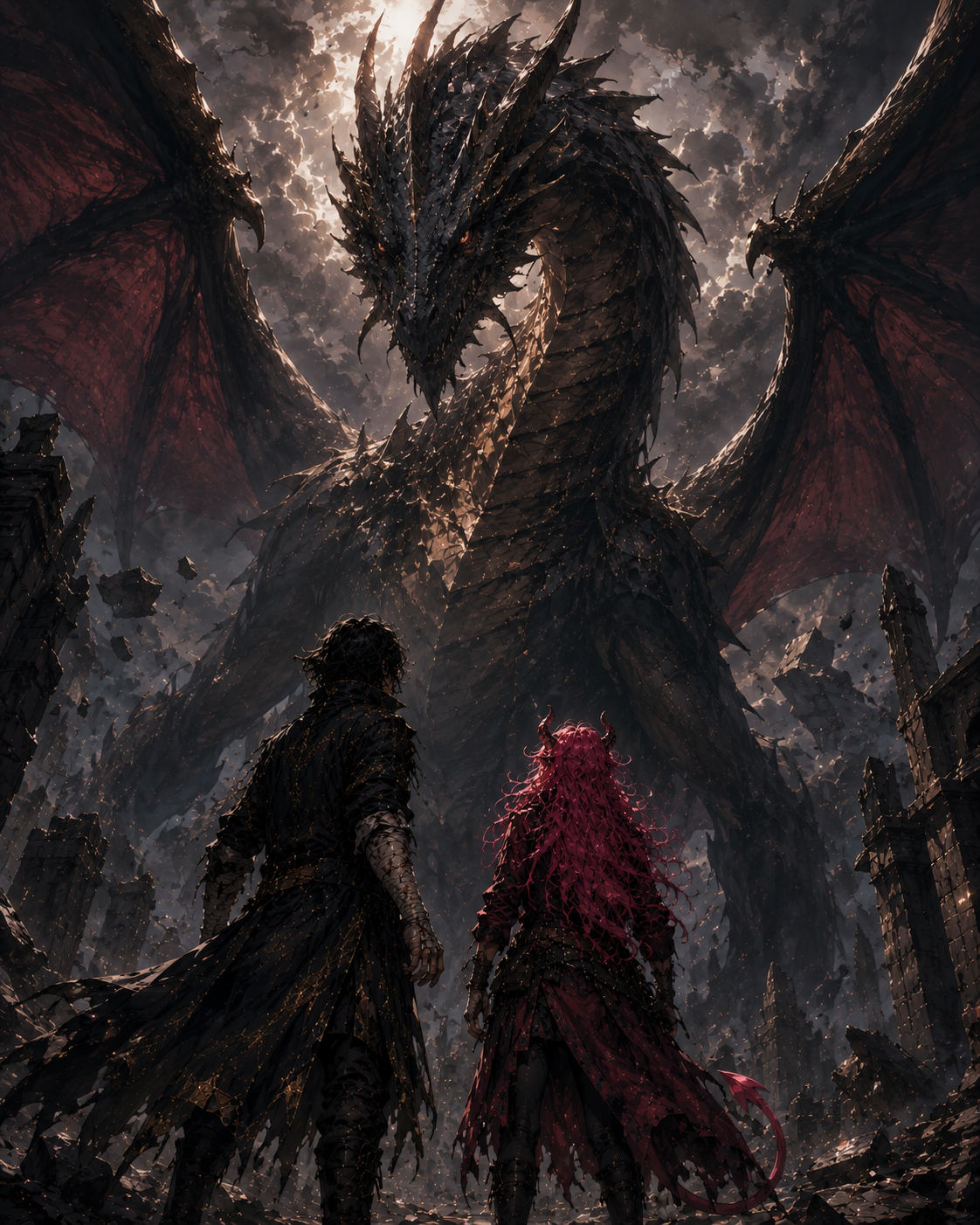


—Written By Dr. Michael A. Scordato in the reflection that his last name was mysteriously removed and replaced with a punishment statement as a result some sort of past family sin. This made as an unusual challenge for those who learn more sideways than straight.
Running, Hiding, and the God Who Heals
A chapter-by-chapter exploration of Scripture through the story of Miguel Scordato
| He was in the wilderness forty days, tempted by Satan, and was with the wild animals; and the angels were ministering to Him. Mark 1:13 (NKJV) |
Based on the Biblical Counseling Methodology Portfolio
Integrating the Elijah Method • Peirasmos Chain • James Architecture
Paul Letter Method • Nathan/Parable Principle • Prophet’s Method • Mars Hill Method
How to Use This Study
The Last Run is a story about a man who spent forty-seven years healing people and running from the institution that wanted to own him. On its surface, it is an adventure novel. Underneath, it is a theology of vocation, identity, wilderness, and the moment a person finally stops running — not because they have been caught, but because they have arrived.
This study guide walks through every chapter and major section of the novel, drawing out the biblical threads woven through the narrative. Each chapter section contains:
| Story Mirror What the story scene depicts, and where it lands emotionally and thematically. |
| Scripture Anchor The NKJV passages that address the same human reality the story depicts. |
| Counseling Method Spotlight Which method from the Biblical Counseling Portfolio is most active in this scene — and why. |
| Discussion Questions Questions for personal reflection or group study. These are not rhetorical. They are designed to surface your own Miguel — your own running, your own unallocated gifts, your own waiting fox. |
The novel was built on the same theological architecture as the Mark 1:1-8 case study. You will find the same movements here: identity before audience, wilderness as assignment, metanoia as directional shift, joyful diminishment, and the distinction between water ministry and Spirit ministry. Watch for them in Miguel’s story. Then watch for them in your own.
THE LAST RUN
A Novel
“The man who runs from everything will one day discover he has been running toward something all along.”
— Proverb of the Lower Slums
“Reap what you sow. Honestly, it is not that complicated. People just refuse to believe it applies to them.”
— Jersey Devil, unsolicited advice to a corrupt tax collector, Year of the Amber Tide
PART ONE
The Ghost
CHAPTER ONE
How to Disappear
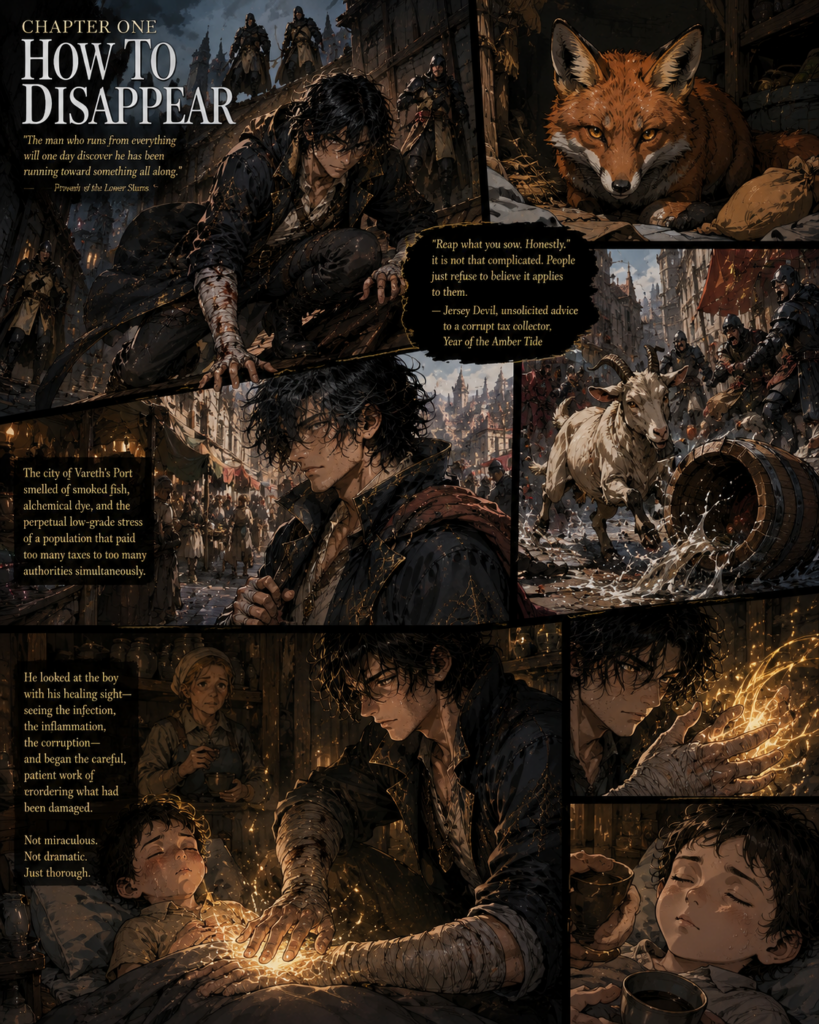
The fox was the first to notice him.
She was a small thing — a border vixen with charcoal-tipped ears and a coat the color of autumn leaves that nobody had bothered to rake. She had been sleeping under the collapsed market stall in the outer ward of Vareth’s Port for the better part of the afternoon, dreaming the specific dream that foxes dream when the world is warm and no dogs are about. Then the man dropped silently from the roof above her, landed between her paws in an impossible crouch, and she found herself looking directly into a pair of brown eyes that were — and she recognized this instinctively, the way animals always do — completely without malice.
She did not run. She lifted her nose and sniffed.
He smelled of pine resin, dried river clay, the faint iron tang of old blood on well-used boots, and something else underneath all of that. Something warm and green and alive, the way the air smells just before a forest heals over a wound in its bark.
The fox decided he was acceptable.
Twelve Templars on the roof, Miguel Antonio Scordato thought, pressing himself flat against the market stall’s rotted timber frame. Three more on the eastern alley mouth. One very confused goat somewhere to the north who is about to cause an enormous amount of trouble for everyone.
He could hear the goat. He could hear everything. After forty-five years of running, a man learned to parse the world at its molecular level — or perhaps that was just the healing sight, the peculiar birthright of the Scordato bloodline that let him see the fine architecture of living things the way a master mason sees a cathedral’s stress points. Either way: the goat was tethered to a vendor’s cart loaded with ceramic jugs, the rope was fraying against a sharp corner of wheel-iron, and in approximately thirty seconds the goat’s persistent, joyless determination to eat literally anything would solve Miguel’s most immediate logistical problem.
He counted silently. His lips moved.
Twenty-eight. Twenty-nine.
The rope snapped. The goat — a barrel-chested, aggressively opinionated animal with one cloudy eye and absolutely no concept of consequences — lurched forward into the vendor’s cart, which struck the cart beside it, which struck a barrel of fish oil, which rolled with magnificent, unstoppable purpose directly into the path of the Templar sergeant crossing the alley mouth.
The crash was spectacular.
While eleven Templars scrambled toward the sound, Miguel stepped out of the shadows, walked calmly past the twelfth — who was looking the wrong direction — and disappeared into the crowd at the market’s center.
The fox trotted after him for half a block. Then she stopped, sat down, scratched one ear thoroughly, and went back to her stall.
She had seen this before.
The city of Vareth’s Port smelled of smoked fish, alchemical dye, and the perpetual low-grade stress of a population that paid too many taxes to too many authorities simultaneously. It was a harbor city, which meant it was honest in the way port cities always are — brutally, transactionally, without sentiment. People arrived with things. People left with different things. The Church of the Great Ledger collected its tithe at the gates. The Empire’s harbor master collected his cut at the docks. What remained after both of them were done with you was technically enough to live on, if you didn’t care particularly about living well.
Miguel had always found port cities congenial. The crowds were thick and the guards were tired and the people who asked too many questions were generally explained away as merchants who’d had a bad day.
He slipped through the fish market, through the tanner’s quarter — where an apprentice boy of about twelve was struggling to lift a bucket twice his size, and Miguel without breaking stride reached out and tilted it fractionally on its base so the weight balanced, and the boy staggered upright in sudden surprise, and Miguel was three stalls away before the boy could look up — and out the far side into the old ward where the streets were cobbled in a pattern nobody made anymore and the buildings leaned toward each other like old men sharing a secret.
He found the address he was looking for: a chandler’s shop with a cracked blue shutter and a bundle of dried lavender nailed above the door. The lavender was the signal. Someone inside needed a doctor.
Miguel knocked twice. Paused. Knocked once more.
The door opened to reveal a woman in her sixties with flour on her hands and terror in her eyes, and behind her in the back room, a child of perhaps eight burning alive with fever.
Miguel stepped inside. He set down his pack. He looked at the child with his healing sight — really looked, the way most people never could, seeing the roaring inflammation in the small lungs, the bacterial cascade fighting hard against a body that was losing ground — and he said, in the same calm tone he used for everything:
“I need a bowl of cold water, a cloth, and about twenty minutes. And could someone please make tea? The fever will break before it’s ready, but I find it helps people have somewhere to put their hands.”
The woman made tea. Miguel worked.
When he pressed his palm flat against the boy’s burning chest, the golden warmth that came from somewhere deep in his blood responded the way it always had — steadily, methodically, molecule by molecule, the way a gardener tends a damaged plant. Not miraculous. Not dramatic. Just thorough. He found the infection’s epicenter in the left lung’s lower lobe and began the careful, patient work of reordering what had been thrown into chaos.
The boy opened his eyes fifteen minutes later. They were the gray-green color of harbor water.
“You’re very warm,” the boy observed.
“Yes. Go back to sleep.”
“Are you a Templar?”
“Decidedly not.”
“Are you a wizard?”
“That is a complicated question. Sleep.”
The boy considered this, apparently found it satisfactory, and was asleep again in under a minute with the specific, boneless abandon of the very young whose bodies have just decided to cooperate. Miguel sat back and pressed his knuckles briefly against his own sternum — an old habit, checking the reserves, the way you check a lantern’s oil after a long night.
Full. Still full. The healing gift had never failed him, in forty-five years.
He accepted the tea, which was excellent. He declined payment three times — the woman pressed coins into his hands on the fourth attempt and he pocketed them silently because he had learned that refusing charity feels like an insult to the person offering it. He ate the bread she cut him standing at the door, looking out at the street.
The Templars were regrouping at the alley mouth. The goat, he noticed, had not been recaptured. It was now eating someone’s decorative window box with the focused pleasure of an animal that had won the afternoon.
Miguel finished the bread, shouldered his pack, and walked out through the back.
He had done this — some variation of this, the arrival, the healing, the invisible exit — in forty-three cities across eleven years. Before that, in seventeen towns in the years following his father’s death. Before that, in the brutal, terrifying years of a childhood that had been less a childhood than a series of increasingly sophisticated lessons in the art of not being caught.
He was forty-seven years old. He did not feel forty-seven. He felt much older in the ways that mattered and much younger in the ways that didn’t, which was the specific, strange consequence of a life spent shattering his own body and reknitting it before the damage could take hold.
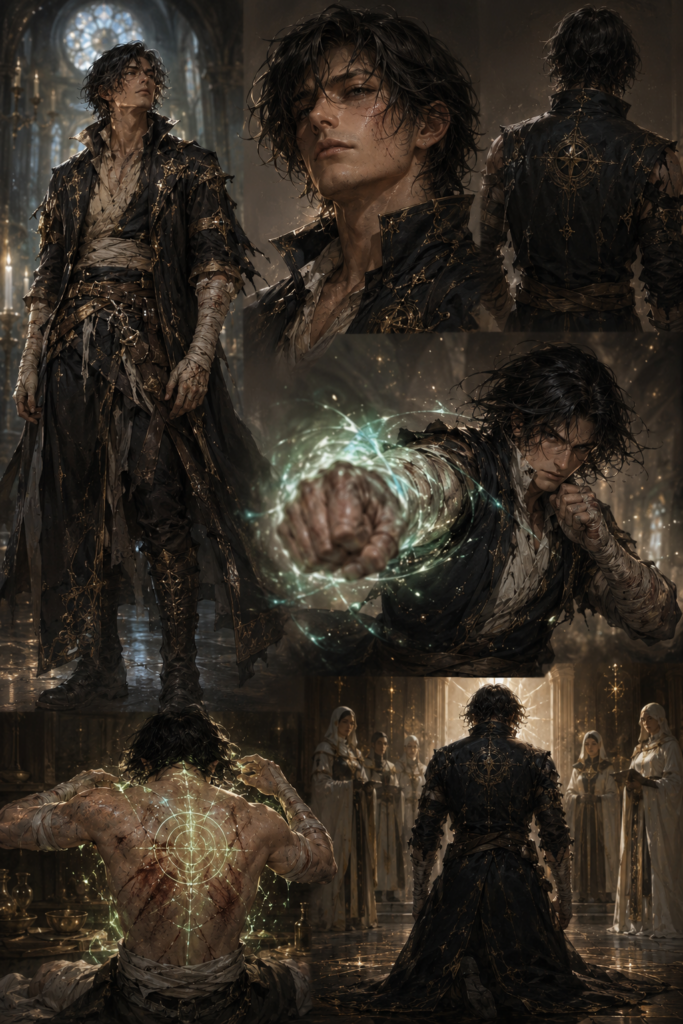
His bones had been broken so many times that they had remodeled themselves at the microscopic level into something denser and more articulate than human bone was supposed to be. His muscles had been destroyed and rebuilt and destroyed again until they were woven with a structural coherence that looked, to his healing sight, less like flesh and more like cable bridge suspension. He was not enormous — not the towering, barrel-chested warrior that songs made heroes out of. He was medium height, lean in the way of long-distance runners, with a face that people tended to describe as quiet. Composed. Like someone waiting patiently for a conversation to reach its actual point.
His hair was dark going gray at the temples. His eyes were the warm brown of good earth after rain.
He had forty-five years of Point Allocation invested entirely in the single stat of Evasion, which meant that watching him walk through a crowd was like watching a river find its way around stones: effortless, inevitable, and fundamentally impossible to pin down.
He had not, in forty-five years, told anyone his real name.
He had not, in forty-five years, stayed anywhere long enough to be truly known.
He had not, in forty-five years, allowed himself to love anyone.
He was, by any objective measure, the loneliest man in the known world. He had made peace with this the way a person makes peace with a bone that set slightly wrong — you learn the ache, you adjust your movement around it, you stop expecting it to stop.
What he had not made peace with, and never would, was the name they had given his family.
Scordato.
Which means ‘forgotten’.
* * *
He was six hours out of Vareth’s Port, moving along the river road south, when he heard the noise.
It was coming from a drainage ditch beside the road — a high, thin, desperate sound, half-whimper and half-something-worse. He stopped. He looked. He knew, with the certainty of a man who had been doing exactly this for forty-five years, that whatever was in that ditch was going to delay him.
He looked at it anyway.
In the ditch, up to its haunches in mud and furiously miserable about this fact, was a wolf cub. Not a pup — it was perhaps four months old, which meant it was past the round-bellied phase and deep into the awkward phase, with paws too large for its body and ears that couldn’t quite decide where they wanted to land. One of its forelegs was bent at an angle that required no healing sight to identify as broken.
It growled at Miguel. Impressively, given the circumstances.
“I know,” Miguel said. He crouched at the ditch’s edge. “You would like me to leave. Noted. I’m going to help you anyway.”
The cub snapped at his hand. He moved his hand with the unhurried precision of a man who had been dodging things his entire life, and the snap caught nothing but air. He reached down with his other hand, gently, and let the cub smell his palm.
The growling stopped.
Animals had always done this — recognized something in him that humans took much longer to locate. He had a theory about it. Animals did not overlay their perception with narrative the way people did; they experienced the world in direct sensory fact, and the direct sensory fact of Miguel was that his mana signature was warm, alive, and fundamentally oriented toward healing. He smelled safe, to things that lived by their noses.
He lifted the cub out of the ditch. It was shaking. He tucked it against his chest with one arm and let his healing sight find the fracture — a clean break, a few days old, beginning to try to set itself in the wrong position — and gently, methodically, reordered it.
The cub made a sharp sound. Then it went very still. Then it turned its head and, with the philosophical pragmatism unique to wolves, bit down on the shoulder strap of his pack instead of his hand.
“Fair enough,” Miguel said.
He set the cub down on the road when he was done. It stood, tested the leg tentatively, looked up at him with golden eyes.
“Go north,” Miguel said. “The pack ranges north of the river. Two days’ walk for you. Three if you rest properly, which you should.”
The cub turned and trotted north.
Miguel watched it go, then shouldered his pack and walked south.
He had been doing this his whole life — fixing things and walking away. He had never, not once, considered that the things he fixed might notice. That some of them, in their fashion, might be keeping track.
STOP & THINK!
PART ONE: THE GHOST
Chapter 1 — How to Disappear
| The Story | The Scripture |
| Miguel drops from a rooftop, invisible to twelve Templars, and uses a goat’s chaos to escape. | Psalm 139:7-10 — Even in hiding, there is no place absent from God’s presence. |
| He stops in the street to balance a heavy bucket for a struggling apprentice boy — and is gone before the boy can look up. | Matthew 6:3 — Do not let your left hand know what your right hand is doing. |
| He enters a home and heals a feverish child with calm, methodical precision, asking for tea to give the mother somewhere to put her hands. | James 5:14-15 — The prayer of faith and the laying on of hands for the sick. |
| Elijah Method — Physical Platform First | 1 Kings 19:4-8 |
Before Miguel ever addresses a fever spiritually, he observes it clinically. He uses his healing sight to identify the exact location of the infection in the boy’s left lung and works molecule by molecule. He asks for tea — not for himself, but because he understands that anxious hands need a task. This is the Elijah Method in narrative form: God’s care for the body as the platform for everything else.
| And as he lay and slept under a broom tree, suddenly an angel touched him, and said to him, ‘Arise and eat.’ Then he looked, and there by his head was a cake baked on coals, and a jar of water. 1 Kings 19:5-6 (NKJV) |
Notice what the Angel did not say: ‘Elijah, where is your faith?’ He brought bread. God’s first pastoral move with a depleted servant is nourishment, not interrogation. The mother’s tea in Miguel’s scene is the same impulse — meeting embodied anxiety with embodied care.
The Wolf Cub Scene — Naming the Pattern
Six hours out of the city, Miguel pulls a wolf cub from a drainage ditch, sets its broken leg, and walks away. The cub trots north as instructed. Miguel walks south.
The narrator notes: He had been doing this his whole life — fixing things and walking away. He had never, not once, considered that the things he fixed might notice.
| Story Mirror This is the first theological seed of the novel. The anonymous healer who expects nothing in return does not know he is being watched, catalogued, remembered. The Reclaimed — forty former enemies — will prove this wrong. Grace given expecting nothing back tends to compound invisibly. |
| Cast your bread upon the waters, for you will find it after many days. Ecclesiastes 11:1 (NKJV) |
When King Solomon wrote this thousands of years ago, “bread” didn’t just mean a loaf of food—it meant a person’s whole livelihood, like bags of grain and flour. And “the waters” meant the deep, wide ocean.
Back then, the smartest business people would load big wooden ships with their precious bags of grain. They would sail those ships across the dangerous ocean to faraway countries to sell the grain. It was a risky venture, but if successful many days later, the ship would sail back home the ship would not be full of grain anymore. It would be full of gold, exotic spices, and treasures! The merchant got back way more than they sent out.
- Wise Investing: Diversify your resources instead of hoarding them.
- Generosity: Give freely without expecting an immediate return.
- Faith: Trust that good actions yield future blessings.
The verse uses these pictures to tell us: “Don’t be afraid to try big things, even if you can’t see the reward right away.”
Some historians think this also reflects from long ago places like Egypt, big rivers would flood the dirt fields with water every year. Farmers would row out in boats and drop their seeds straight into the muddy water. It looked silly, like they were drowning their food! But the seeds would sink into the soft mud, and when the water dried up, a massive field of food would grow.
In the context of this passage, King Solomon addresses the uncertainty of life. He argues that because we cannot predict the future, we must take wise risks rather than paralyzing ourselves with fear.
- Ecclesiastes 11:2 (NKJV) (Diversification): “Give a serving to seven, and also to eight, for you do not know what evil will be on the earth.” Solomon warns that disaster can strike at any time, so you should spread your resources across multiple ventures. Do not put all your money into one asset. Spread your investments across stocks, bonds, and real estate. If one market crashes, your other investments can protect you from total ruin. Do not rely on a single job for your entire livelihood. Cultivate side hustles, learn new skills, or create passive income. Continuous effort in different areas increases your chances of long-term success.
- Ecclesiastes 11:3-4 (NKJV) (Over-analysis): “He who observes the wind will not sow, and he who regards the clouds will not reap.” If you wait for perfect conditions, you will never start. Stop waiting for the perfect moment to launch a business, change careers, or start a project. Perfect conditions do not exist. Take calculated risks despite the uncertainty.
- Ecclesiastes 11:5-6 (NKJV) (Human Limitations): Just as you do not know how a baby grows in the womb, you cannot know the work of God. Therefore, stay busy and keep planting seeds. Help others without expecting anything back. Donate your time, money, or skills to your community. These acts of kindness build a safety net of goodwill that often returns to help you when you least expect it.
Discussion Questions — Chapter 1
| Q1 Miguel heals people and disappears before they can thank him. Is this humility, avoidance, or both? What does Matthew 6:1-4 say about the spiritual mechanics of anonymous giving? |
| Q2 The mother needs tea to have somewhere to put her hands while she waits. Describe a time when a counselor, pastor, or friend gave you a ‘tea task’ — something small and physical that held your anxiety while the deeper work happened. |
| Q3 Miguel has never told anyone his real name in forty-five years. How does the absence of a true name affect a person’s ability to receive love, form community, or step into calling? See Isaiah 43:1 — ‘I have called you by your name; you are Mine.’ |
CHAPTER TWO
The Art of the Scordato Name
There are things in this world that history has not forgotten so much as been instructed to.
The name Divino is one of them.
Divino translates as “Divine”.
In the year that Miguel’s grandfather — a man who had the same warm brown eyes, the same quiet face, and the same absolute refusal to leave a broken thing unattended — was brought before the High Council of the Church, the Great Ledger contained one hundred and forty-seven noble house registrations. By the morning following the Striking, it contained one hundred and forty-six. The ink was not simply crossed out. The parchment itself, woven through with living mana, consumed the name. The scribes who had spent decades copying the Ledger found that when they tried to remember the house they had just erased, their minds moved around the absence the way a tongue moves around a gap where a tooth once was.
What the scribes could not erase was the bloodline. Mana does not care what is written in books.
The grandfather’s name was Aldero. He was the most gifted biomancer in five generations of the most gifted biomantic family in recorded history. What he had discovered — what he had spent thirty years refining in secret, working on the bodies of the desperate and the dying in the lower wards while his noble colleagues held court in crystal towers — was that the Point system was not a gift granted by the Church. It was a natural function of the human soul. The tithe, the ritual, the Chapel monopoly — all of it was theater. The priests were not channeling divine will; they were picking locks that should never have been locked in the first place.
He had also discovered that his family’s particular biomantic gift, refined over generations of singular, obsessive practice, had reached a threshold that the human body was not supposed to reach: the ability to reverse the cellular damage of age. Not cosmetically. Not a freshening of the skin and a brightening of the eye. Complete, molecular-level reset. Given sufficient mana and sufficient will, a Divino healer could return a human body to its absolute physical prime and hold it there.
This is what the King wanted.
This is what Aldero refused.
“You will make me immortal,” the King said.
“I will not,” Aldero said.
“You will make the High Council immortal,” the Pontiff added.
“You will not,” Aldero said.
He was a man of efficient language, Aldero Divino.
What they had not counted on — what everyone always underestimates about truly gifted healers — was what he did next. Before the guards could restrain him, Aldero pressed his hands flat against the floor of the Council chamber, channeled every ounce of his life’s mana reserve into one sustained, white-hot act of biomantic will, and attempted to permanently rewrite the restriction protocols in the Great Ledger so that every human being on earth could allocate their own
Points without priestly intermediary.
He almost succeeded.
Almost.
The Pontiff’s Templars drove a spear through him before the rewrite could complete. The Ledger shuddered. The alteration was burned out. And the Striking was performed before Aldero’s body was cold, because the Church understood — better than anyone — that ideas are far more dangerous than men, and the idea that a common laborer could evolve themselves without paying tithe was the most dangerous idea in the history of the world.
The name Divino was eaten by the Ledger.
Aldero’s son — Miguel’s father, Reno — woke the following morning unable to remember his own surname. He was nineteen years old. He was in the outer slums. He had the clothes on his back, the ghost of a biomantic gift he had not yet learned to use, and a three-year-old boy asleep on the floor beside him.
He looked at his boy. He thought: I will not let this happen to him.
He was right, and wrong, and right again, in ways that took forty years to fully understand.
Miguel had almost no memory of his father’s face. He had the shape of it — the same bones he saw in his own reflection — and he had the sound of his voice, low and careful, and he had the feel of a hand pressing flat against his chest in the complete dark of a cellar in a town whose name he had never known, saying very quietly: “The legs. Always in the legs. The world can take everything from you, Miguel, but not what lives in the legs.”
He had been five years old. He had not understood yet that his father meant the Points. That he was telling his son, who was already beginning to show the full depth of the Divino gift in the way his scraped knees healed between one breath and the next, to never spend a single Point on anything the world could see. To hide everything in the stat that mattered most for survival.
Evasion.
The hand had lifted from his chest. There was a crash of sound from above — armored feet on floorboards, shouts in the nasal, clipped accent of Church Templars. Miguel had pressed himself flat against the cellar wall and listened to his father’s footsteps go away from the cellar door, loud and deliberate, drawing the sound with him like a man leading a flood away from a village.
Then silence.
He had waited three days in that cellar. He was fed, on the second day, by a large and self-important rat who had apparently decided that the cellar was shared territory and wished to establish diplomatic relations. The rat left a corner of dry bread that it had clearly not finished itself, which Miguel ate with the uncomplaining pragmatism of a five-year-old who has already learned that this is simply how the world is.
He had named the rat Thaddeus, which was the first name that came to mind. This turned out to be prophetic in ways he could not have anticipated.
On the third day he climbed out and ran.
He did not stop running for forty years.
STOP & THINK!
Chapter 2 — The Art of the Scordato Name
We learn the backstory: the grandfather Aldero Divino, whose name means ‘Divine,’ was erased from the Great Ledger for refusing to make the King and Pontiff immortal and for attempting to restore every person’s access to their own God-given potential. His son Reno woke the next morning unable to remember his own surname. The five-year-old Miguel was hidden in a cellar while his father drew the Templars away from the door — and never came back.
| Story Mirror Aldero’s crime was theological: he believed human potential was not the property of an institution. He paid with his life and his name. This maps directly onto the history of any system — religious, political, familial — that locks a person’s gifts behind a gatekeeping fee and calls the arrangement sacred. |
| Aldero’s World | Biblical Parallel |
| The Church controlled Point allocation, charging tithe rates the poor could never afford. | Isaiah 55:1 — ‘Come, buy wine and milk without money and without price.’ God’s gifts are never gated by an institution’s pricing structure. |
| Aldero’s gift had reached the ability to reverse aging at the cellular level — which the powerful wanted to own. | Acts 8:18-20 — Simon Magus tried to buy the gift of the Holy Spirit. Peter’s response: ‘Your money perish with you.’ |
| The name Divino was ‘eaten’ from the official record, causing Reno to forget his own surname. | Revelation 3:5 — God promises He will not blot a name from the Book of Life — the contrast to what human institutions do. |
The Cellar Scene — Five Years Old and Already Running
In the cellar, Reno tells young Miguel: ‘The legs. Always in the legs. The world can take everything from you, Miguel, but not what lives in the legs.’ He meant the Points, allocated to Evasion — the one stat no one could see or seize.
| But the Lord said to Samuel, ‘Do not look at his appearance or at his physical stature, because I have refused him. For the Lord does not see as man sees; for man looks at the outward appearance, but the Lord looks at the heart.’ 1 Samuel 16:7 (NKJV) |
Reno’s strategy was spiritual camouflage: hide the gift in the invisible place. This is the counsel of a father under threat — not the fullness of discipleship, but the wisdom of a man buying his son time. It is important to note that the strategy was wise for survival but incomplete for flourishing. It took forty-seven years for its season to end.
Discussion Questions — Chapter 2
| Q4 Aldero gave his life trying to restore what God intended everyone to have freely. Name a gift — spiritual, intellectual, creative, vocational — that has been locked behind a gatekeeping system in your own experience. How did you respond? |
| Q5 Reno’s father-counsel to ‘hide it in the legs’ preserved Miguel’s life but also preserved his isolation. When does protective wisdom become a cage? How do we know when the survival strategy has outlived its season? See Ecclesiastes 3:1 — ‘To everything there is a season.’ |
| Q6 Miguel spent forty years not knowing his real name. What does Revelation 2:17 (‘I will give him a white stone, and on the stone a new name written’) suggest about the relationship between identity, intimacy with God, and the names institutions assign us? |
CHAPTER THREE
Twenty-Seven Things Jersey Devil Knows About Miguel Scordato
One: he prefers river water to well water. Not for any mystical reason. He once told a stray dog — she was a shaggy, one-eared mongrel who had elected to follow him for three days outside the city of Corren’s Gate — that he simply liked knowing where the water came from. The dog had wagged at this. The dog had not offered a rebuttal, which Miguel had found refreshing.
Two: he breaks his left fourth metacarpal more than any other bone. Old bad habit from training against stone walls at fourteen. It always heals perfectly, but he carries a very faint awareness of it the way some people carry an awareness of old weather in their joints.
Three: he hates the color yellow. Not orange. Not gold. Just yellow. There is a reason he has never explained to anyone, and Jersey has not asked, because she intends to use the mystery strategically at a later date.
Four: he reads. Everything. Constantly. He has a single oilskin-wrapped book in his pack that he has had for thirty years, which is a collection of pre-Striking era philosophy so radical in its implications for the Point system that the Church banned it four times, and which Miguel has repaired no fewer than seven times with the same meticulous attention he gives to damaged lungs. She once asked him what the book was called. He looked at her with those brown eyes and said, “The Free Soul.” And then he said nothing else for six hours, which Jersey considered a personal record even by his standards.
Five: he talks to animals. Not in the self-conscious way of people performing talking-to-animals. In the straightforward way of someone who has spent more years in the company of animals than people and finds them simpler to be honest with.
Six: he has a scar —
Well. She knows about the scar. She has opinions about the scar. The opinions are saved for a later conversation.
It had been two and a half years since the incident in the western borderlands that had started all of this. Jersey tried, when she had a quiet moment — which was admittedly rare — to pinpoint exactly what had possessed her to follow a fugitive healer through three countries and forty-three cities.
She had been in the Merchant Quarter of Correth’s Crossing, which was not, technically, where she was supposed to be. She was supposed to be in the city’s administrative district extracting a minor demon-kin family from the consequences of a legal snarl that had been incorrectly explained to them in two languages simultaneously by a bureaucrat who was being paid by the Church to be maximally incomprehensible. This was the kind of work that found its way to Jersey’s particular skill set: the untangling of disasters, the locating of loopholes, the straightforward application of cause and consequence to people who had convinced themselves they were exempt from it.
She’d been minding her own business. More or less. There had been a small incident with a market cart and a Templar patrol’s supply wagon and a flock of pigeons that was, she would maintain until her last breath, entirely coincidental and not her fault. The Templars, a full squad of twelve in full ceremonial armor, had emerged from the incident coated in grain flour and furious, which had been funny enough to deserve a slight detour toward the Merchant Quarter where she could see how things developed.
What had developed was this: the flour-covered Templars, enraged and embarrassed, had fanned out across the quarter in search of someone to be officially angry at. And the person they had settled on — because he was, in the chaos, the only person in the square not moving — was a lean, quiet man in worn traveling clothes standing at a medicine stall, who was, with magnificent composure, examining a jar of dried herbs as if twelve furious Templars were a weather event of purely academic interest.
Jersey had watched, with genuine curiosity, as the squad sergeant leveled a finger at the man and announced that he was under arrest pursuant to Chapel Edict 47-C regarding unlicensed mana practitioners.
The man looked at the finger. He looked at the sergeant. He looked, briefly, at the sky. Then he tilted his head exactly two degrees to the left.
The sergeant’s punch — a trained, practiced, expert blow with the full weight of a man who had been hitting people professionally for fifteen years — passed through the space where the man’s head had been and connected with the forehead of the Templar directly behind him.
The Templar went down like a dropped candlestick.
The man turned to the second Templar. He said, quietly, “Your grip is too tight. You’ll pull a tendon.” The second Templar swung. The man moved six inches to the right. The punch hit a third Templar. He went down too.
In the subsequent ninety seconds, in which Jersey stood with her mouth open and her pink demon tail swishing in a state of helpless mechanical delight, all twelve Templars knocked each other unconscious. The man did not throw a single punch. He simply stood in the center of it all and moved, precisely, in ways that made the Templars’ attacks redirect themselves through each other like a particularly efficient game of billiards.
Then, and this was the part that got her, he knelt beside each unconscious Templar in turn. He placed his palm on each one. And he healed them — old injuries, mostly, the kind that accumulated in soldiers over years of hard service, the aching knee and the badly set shoulder and the recurring headache from a helmet that had fitted wrong for a decade. He did this quietly, efficiently, without anger or superiority, and stood up and walked away.
Behind him, twelve flour-dusted Templars lay unconscious in the market square, and every single one of them was, for the first time in years, not in any pain at all.
Jersey stood there for a long moment.
“Huh,” she said.
She followed him out of the city.
She introduced herself three days later, when it became apparent that simply trailing him was less effective than she’d hoped, owing to the fact that he was extremely good at noticing things.
“You’ve been following me,” he said, without turning around. He was crouched beside a stream, filling his water flask. “For three days.”
“Technically I’ve been traveling in the same direction as you,” Jersey said, emerging from the tree line. “In a parallel capacity.”
He turned and looked at her.
She had dressed herself for this moment — not that she dressed for moments, particularly, because her entire existence was somewhat theatrical by nature and there was no version of Jersey Devil that was not immediately eye-catching. Pink-and-red demonkin skin. Curved horns, pleasantly sized, not the unwieldy statement pieces she’d seen on some of the older demonkin. A demon tail that had its own opinions about propriety. Vampire-length fangs that she generally kept retracted in polite company but had a tendency to extend when she was amused, which was nearly always. No wings, which was a source of personal opinion that she had long since decided was not worth the energy.
He looked at her the way he looked at everything — with quiet, focused attention, and absolutely no expression she could read.
“What do you want?” he said.
“Nothing much,” Jersey said. “I’m just going where you’re going.”
“I’m going south.”
“Funny. So am I.”
“Before that I was going north.”
“I had business north.”
“And before that, east.”
“Broadly speaking, a comprehensive travel experience.”
A long silence. A magpie landed on a rock midstream and observed them both with the judicial interest of a third party who had not been consulted.
“I have a rule,” Miguel said finally.
“Oh, I am sure you do. You seem like a man with excellent rules.”
“Love requires friendship. Friendship requires time. Real friendship — the kind that holds — requires two to three years of genuine, transparent, mutual knowledge. Not proximity. Not convenience. Knowledge.” He stood, capped his flask. “If you’re following me because you’re interested in something other than that kind of friendship, you’re wasting time that could be spent more productively.”
Jersey stared at him.
“Are you — ” she started.
“I’m not interested in being hunted or acquired or used as a resource,” he continued. “If that is your purpose, I suggest you try someone whose life expectancy is not dependent on not being found.”
“I just watched you use twelve armored soldiers as billiard balls against each other and then fix their old war wounds,” Jersey said. “That is, objectively, the most interesting thing I have seen in twenty years of doing interesting things professionally. I am not here to acquire you. I am here because you are — ” she paused, searching for the word, “— extraordinary. And I find extraordinary things interesting. And I am going south. So.”
Another silence.
“You have two and a half years until I consider you a genuine friend,” Miguel said. He turned and continued along the stream.
“I’m starting the clock,” Jersey called after him.
He did not respond. But he did not disappear either, which — from a man who could disappear — she recognized as something.
The magpie watched them both go. Then it picked up a shiny pebble from the streambed and carried it away, pleased with the morning.

STOP & THINK!
Chapter 3 — Twenty-Seven Things Jersey Devil Knows About Miguel Scordato
This chapter is structurally brilliant as a counseling teaching tool. Jersey has been following Miguel for two and a half years. She has catalogued twenty-seven observable facts about him — what he reads, how his bones have remodeled, why he talks to animals. Then we see how she started following him: twelve Templars, zero punches, twelve healed old injuries.
| Mars Hill Method — Cultural Intelligence in Service of Truth | Acts 17:22-28 |
Jersey does not approach Miguel with a theology or an agenda. She approaches him with attention. She watches. She catalogues. She finds the altar — the place where genuine longing is already present — before she says a word. Paul on Mars Hill examined Athenian culture for months before he preached. He found their altar to the Unknown God and used it as a bridge. Jersey found Miguel’s altar: his compulsive, weaponized compassion for the broken.
| Jersey’s Observation | Counseling Principle |
| He prefers river water because he likes knowing where it comes from. | Mars Hill insight: what a person trusts as a source reveals their deepest epistemology — what they believe is reliable. |
| He talks to animals in the straightforward way of someone who has spent more years with them than people. | Relational longing expressed sideways — the person who finds honesty easier with creatures who cannot betray them. See Genesis 1:26 — man’s first relational assignment was the animals. |
| He reads everything, including a banned philosophy book he has repaired seven times. | The Reclaimed soul: seven times rebuilt is not destroyed. See Proverbs 24:16 — ‘A righteous man may fall seven times and rise again.’ |
| His rules about friendship: genuine, transparent, mutual knowledge over two to three years — not proximity, not convenience. | The John 15:15 distinction — Jesus calls us friends, not servants, based on what He has revealed to us. True friendship requires disclosure, not just proximity. |
The Friendship Criteria — The Three-Year Clock
Miguel’s famous speech to Jersey by the stream: ‘Love requires friendship. Friendship requires time. Real friendship — the kind that holds — requires two to three years of genuine, transparent, mutual knowledge. Not proximity. Not convenience. Knowledge.’
| No longer do I call you servants, for a servant does not know what his master is doing; but I have called you friends, for all things that I heard from My Father I have made known to you. John 15:15 (NKJV) |
Jesus’ own redefinition of relationship from servant to friend is grounded in one thing: disclosure. ‘I have made known to you.’ Miguel’s three-year requirement is not legalism — it is a healed man’s recognition that the depth of knowing required to trust someone with his real name takes time to build. This is also the James Architecture’s foundation: genuine relational investment precedes any depth of counseling impact.
Discussion Questions — Chapter 3
| Q7 Jersey introduces herself by saying she is ‘going where he is going’ — not by explaining her intent. How does arriving alongside someone differ from arriving at someone? What does this suggest about the posture of a Biblical counselor entering a relationship? |
| Q8 Miguel says his probability aura — his instinct toward healing — is an expression of his moral character, not a trained skill. James 1:17 says every good gift comes from the Father. What gift do you carry that you have not yet fully recognized as a calling rather than a coincidence? |
| Q9 The magpie at the stream picks up a shiny pebble and leaves, ‘pleased with the morning.’ The narrator uses animals throughout as witnesses who register events without interpreting them politically. What does this suggest about the value of presence without agenda in pastoral work? |
PART TWO
The Running
CHAPTER FOUR
The Uncatchable Doctor

The ruin in the mire was the castle had died centuries ago. Not fallen. Not conquered. Died. Miguel always thought there was a difference. The old outpost rose from the swamp like the skeleton of some forgotten giant, its walls built from massive blocks of cemented stone that no modern mason could have afforded to move. Time had broken the towers. Trees had split the battlements. Moss covered entire walls thick enough to resemble green fur. Long ago, before the rivers changed course and the wetlands spread, the swamp had merely been the moat. Now the moat had swallowed everything. The air smelled of wet earth, stagnant water, and things that preferred darkness. Miguel stood atop a collapsed wall studying the safest route through. Jersey stood beside him.
“This place,” she announced, “is what happens when architects refuse to accept criticism.”
Miguel nodded.
“Someone probably warned them.”
“Oh, absolutely. ‘Perhaps don’t build a fortress directly in the path of six rivers.’ And then some noble said, ‘Nonsense. We’ll simply order geography to cooperate.'”
A distant splash echoed somewhere below. Jersey peered into the fog.
“You know what I don’t like?”
“The swamp?”
“The fact that I can hear things and none of them sound employed.”
They descended into the ruins. The silence was wrong. Not quiet. Listening. The broken streets between collapsed structures were choked with vines and black water. Ancient stone arches leaned overhead like ribs. Miguel noticed the plants immediately. Crimson Snaggletooth. Several patches. Its serrated vines rested motionless among ordinary vegetation, almost impossible to distinguish. Nearby lurked Goblin’s Glue-Creeper, bright green moss coating fallen stone. A patch of Corpse-Lily bloomed farther ahead, releasing waves of rotting scent. The swamp wasn’t merely dangerous. It was hungry. Miguel adjusted his pack. Jersey sighed.
“I know that look.”
“What look?”
“The one where you’re about to help something.”
“I’m not.”
“You are.”
“I’m not.”
“You absolutely are.”
A small squeak echoed through the ruins. Miguel froze. Jersey closed her eyes.
“No.”
Another squeak. Tiny. Terrified. Miguel turned toward the sound. Jersey pointed dramatically at the sky.
“There are entire civilizations somewhere that need saving.”
Squeak.
Miguel began walking.
“I hate being right.”
They found the source beneath a collapsed watchtower. A magical twin-tail fox kit. Young. Sparkling with blues, grey and purples closing in toward a black.
Hopelessly trapped. Magic mana intake drained. One rear leg was caught within the snapping jaws of a Crimson Snaggletooth vine. The little creature struggled desperately. The plant tightened. Miguel immediately stepped forward. Jersey folded her arms.
“I would like the record to show that this is how people die.”
Miguel knelt.
The fox squeaked again. The vine snapped. Miguel’s hand blurred. Forty-five years of Evasion made movement appear less like speed and more like inevitability. His fingers slipped between serrated jaws. Healing mana flashed gold. The fox’s injured leg repaired itself instantly. The vine bit down on nothing.
Then everything happened. The Crimson Snaggletooth reacted. Its neighboring vines reacted. Then the entire patch reacted. Dozens of thorned tendrils erupted from the swamp floor. Jersey groaned.
“There it is.”
The horror began. Vines exploded from every direction. Bog Stranglers emerged from black water. Grasping Maw-Vines unfurled massive leaves lined with spikes. Shadow Snappers opened glowing mouths beneath ruined archways. The swamp had noticed lunch. Miguel grabbed the fox. Jersey grabbed Miguel’s coat.
“Run.”
“I was already planning to.”
“Excellent.”
The world became chaos. Miguel dodged. A vine struck empty air. Another missed by an inch. Another somehow tangled itself around a stone column. Another wrapped around another vine. Another snagged a Shadow Snapper. The Shadow Snapper bit the wrong thing. Everything became angry.
“How are you doing this?” Jersey shouted.
“Evasion.”
“That isn’t evasion! That’s witchcraft disguised as cardio!”
A Bog Strangler erupted beneath them. Jersey tripped. Or appeared to. Her foot struck a loose stone. The stone rolled. The stone hit an ancient support. The support collapsed. The falling support smashed a Grasping Maw-Vine. The Maw-Vine fell into a patch of Goblin’s Glue-Creeper. The glue-creeper spread across nearby tendrils. The tendrils stuck together. The entire mass toppled into a pool. Three more carnivorous plants followed. Miguel glanced back.
“Was that intentional?”
“No.”
“Really?”
“Absolutely.”
A pause.
“Mostly.”
They sprinted deeper into the ruins. Then came the sound. Soft. Beautiful. Musical. A Siren’s Trumpet. Its melody drifted through the fog. The fox immediately turned toward it. Miguel grabbed the fox. Jersey grabbed Miguel. The melody intensified. A second Siren’s Trumpet joined the first. Then a third. The swamp began singing. Even Miguel felt its pull. His feet wanted to move toward the music. The fog seemed brighter. Warmer. Safer. Then Jersey shouted:
“That tune is terrible!”
The spell broke instantly.
“What?”
“It’s awful! Whoever composed that should be arrested!”
Miguel blinked. The fox blinked. The enchanted atmosphere collapsed beneath the sheer force of her criticism. They continued running. Unfortunately they entered a clearing. And discovered the Mandrake. Not a root. A colony. Hundreds. Their twisted roots protruded from the swamp floor like buried corpses reaching upward. One moved. Then another. Then all of them screamed. The sound was indescribable. Every nerve in Miguel’s body ignited. The fox fainted immediately. Jersey’s horns vibrated. Miguel threw healing magic outward. Golden energy enveloped them. The pain vanished. The screams continued.
Then the forest exploded. Something enormous rose beyond the trees. Branches shattered. Ancient trunks snapped.A dragon burst from the swamp forest.
The creature looked less angry than absolutely terrified. Apparently even dragons hated Mandrakes. The dragon saw the screaming field. The screaming field saw the dragon. The dragon chose immediate retreat. It launched itself skyward. Its wings beat once. The shockwave flattened trees. It beat twice. The ruins shook. Every carnivorous plant within three hundred yards was uprooted. Vines flew. Flowers tumbled. Pitcher plants cartwheeled through the air. The entire swamp ecosystem suffered a temporary disagreement with gravity. Miguel strengthened the healing barrier around himself and Jersey. Golden light absorbed the impact. The dragon vanished into the clouds. Silence returned.
Slowly. Carefully. Like a criminal returning to the scene. The swamp was devastated. Plants lay tangled everywhere. Ancient ruins groaned. The fox woke up. Looked around. And casually climbed onto Miguel’s shoulder. Jersey stared. Miguel stared. The fox yawned.
“No.”
The fox remained.
“No.”
The fox licked his ear.
“Oh, now you’ve done it,” Jersey said.
Miguel sighed.
“We can’t keep it.”
“Of course not.”
The fox settled comfortably.
“We absolutely cannot keep it.”
The fox fell asleep. Jersey grinned.
“We’re keeping it….at least until we get out of the swamp.”
Miguel looked toward the distant horizon. Toward the path they had originally intended to cross. Toward the peaceful route that had existed before a fox, twelve carnivorous plant species, a colony of Mandrakes, and one terrified dragon had entered his day. Then he looked at the sleeping fox. Jersey patted his shoulder.
“You know, for someone who spends his entire life running away from trouble, trouble seems remarkably committed to maintaining the relationship.”
Miguel sighed. The fox snored. The swamp smoldered. And somewhere far away a dragon was probably explaining to other dragons that it had survived a Mandrake field and did not appreciate being questioned about it.
In the three months following the market square incident in Correth’s Crossing, the Church’s pursuit of Miguel Scordato escalated from a routine capture-order to a top-tier priority of the Templar High Command. This was partly because of the incident itself — a trained squad of twelve reduced to a collection of accidental bruises and suspiciously healed old injuries was not a report any sergeant enjoyed filing. But mostly it was because of what the Church’s monitoring grid had detected three days before the incident: a brief, anomalous flare of Point Allocation energy in the lower district that matched no registered Chapel signature.
Someone was allocating Points without permission.
In a terraced house on the edge of the lower district, a sixty-year-old dock worker named Petra had gone to sleep unable to fully close her right hand — an old crushing injury, twenty years untouched — and had woken up with the full articulation returned, and with something stranger accompanying it: a warm certainty that she had been given something she had earned and had always been owed. Her Points, which she had never been able to afford to allocate at the Chapel’s rates, had moved. She’d checked, with the slight inner-eye focus that anyone could manage: her Endurance had increased. Her Strength had increased. She was, objectively and measurably, more than she had been the night before.
She told her neighbor, who told his brother, who told the woman at the bread stall who told everyone.
By the time the Templars came to question her, Petra had calmly and without any trace of guilt described the quiet man who’d passed her on the stairs the previous evening and pressed his palm briefly against her hand as she’d struggled with her market bags.
“Did you see where he went?” the Templar sergeant demanded.
“North,” Petra said.
He had gone south. She knew this. She also knew, with the precise instinct of a person who has spent sixty years in the lower districts learning exactly when the authorities are and are not trustworthy, that she would not be offering this information for free.
Jersey had been in the city for a week and had already been involved in four separate incidents, none of which she had technically started, and all of which had resulted in net improvements to the local situation. A corrupt grain merchant’s fraudulent scales had been exposed when her tail accidentally knocked them off his counter in a way that showed their internal weights. A pick-pocket had attempted to rob her, missed her coin purse, and instead retrieved a letter from a senior Templar commander to a local magistrate discussing their shared financial arrangement; this letter had ended up, through a chain of events too convoluted to fully reconstruct, posted on the door of the city’s main chapel. Three Templar surveillance agents following Miguel had found themselves stuck behind an overturned cheese cart that Jersey had produced, through a combination of probability magic and catastrophically bad navigation, in exactly the right place at exactly the right time.
“You keep doing this,” Miguel said one evening. They were in the small room above a tanner’s workshop that was their current temporary base — his standards for accommodation had grown considerably more relaxed, Jersey had noticed, now that he was traveling with company. “You keep accidentally solving problems.”
“I don’t do it on purpose,” Jersey said. She was sitting cross-legged on the bed, examining her nails with the focused attention of someone performing a task that required no actual attention. “Things just — happen around me.”
“Your probability aura,” Miguel said. He was reading. He was always reading. “It responds to malicious intent and inverts it.”
“That’s a very clinical way of saying I show up and everything goes sideways for the people who deserve it.”
“Yes.”
“I’m not complaining. It’s just — very accurate.” She paused. “Do you know why it works that way?”
He was quiet for a moment. “I have a theory.”
“Of course you do.”
“You have a fundamentally moral soul. You don’t curse. You don’t take the Divine name in vain. You mock everyone, but you would rather —” He stopped. Turned a page. “You would rather be mocked back than see someone hurt.”
Jersey’s tail twitched. She said nothing.
“The Points system reads soul architecture,” Miguel continued. “Whatever point category your soul’s nature mapped to — Retribution, Providence, something like that — you’ve been accumulating it your entire life without knowing, the same way I accumulated Evasion.”
“So my magic is an expression of my moral character,” Jersey said. “Which is a deeply unfair description of someone who once accidentally set a bishop’s hat on fire.”
“He was embezzling tithe funds.”
“The hat specifically though.”
“Symbolic,” Miguel said mildly.
The candle between them guttered. A moth found its way through the window and circled the light with the dogged, unreasonable ambition of moths everywhere. Outside, a cat called once in the street and was answered, and the conversation that followed — longer and more complex than most human conversations Jersey witnessed daily — eventually resolved itself and the street went quiet.
Jersey watched Miguel read.
She had been, in her life, many things. She had been the problem that rooms full of people stared at. She had been the disaster that resolved itself and left everyone embarrassed they’d been worried. She had been the punch line and the salvation and the source of several formal complaints to three separate municipal authorities and one Church archdiocese. She had never, not once, been still in the presence of another person without feeling the specific, chattering discomfort of someone who has learned that stillness is where the real things live, and the real things are frequently uncomfortable.
She was still now. Almost.
“Miguel,” she said.
“Mm.”
“Why forty-five years? Why keep running? You could — you’re strong enough. You’re — ” she waved a hand, “— you’re you. Why not fight back?”
He turned another page. For a long time she thought he wouldn’t answer. Then:
“Because fighting back means hurting people. And I’ve spent my entire life healing what hurt people do to other people. I’m not interested in adding to the total.” He looked up. “Also: my father told me to run. I intend to honor that until it’s no longer the right advice.”
“How will you know when it’s no longer the right advice?”
He was quiet again. Then, with something that was almost not a smile but in the right light could have been:
“I’ll ask someone I trust.”
Jersey looked at the ceiling. Her tail swished in a long, slow arc.
“One year and eight months until I’m a legitimate candidate for that question,” she said.
“Yes,” Miguel said, and went back to his book.
STOP & THINK!
PART TWO: THE RUNNING
Chapter 4 — The Uncatchable Doctor
| Paul Letter Method — Affirmation Before Correction | 1 Corinthians 1:4-5 |
The evening conversation where Jersey asks why Miguel has been running for forty-five years is a pastoral mirror of the Paul Letter Method. Before she names the problem — the running, the loneliness — she has spent months noticing what is good: his precision, his compassion, his consistency. When the question finally comes, it lands in prepared soil. The correction, when it arrives, is received because the affirmation was already real.
| Miguel’s Answer (Why He Runs) | Biblical Grounding |
| ‘Because fighting back means hurting people. And I have spent my entire life healing what hurt people do to other people.’ | Romans 12:17-19 — ‘Repay no one evil for evil… Beloved, do not avenge yourselves, but rather give place to wrath; for it is written, Vengeance is Mine, I will repay, says the Lord.’ |
| ‘My father told me to run. I intend to honor that until it is no longer the right advice.’ | Proverbs 3:5-6 — Trust in the Lord with all your heart, lean not on your own understanding; in all your ways acknowledge Him and He shall direct your paths. |
| ‘How will I know when it is no longer the right advice?’ / ‘I will ask someone I trust.’ | Proverbs 11:14 — ‘In the multitude of counselors there is safety.’ The isolated servant is always vulnerable to one error becoming a catastrophe. |
Discussion Questions — Chapter 4
| Q10 The Reclaimed organized themselves around a person who did not know they existed. How does this illustrate Romans 8:28 — ‘All things work together for good to those who love God, to those who are called according to His purpose’? What unseen network might God be organizing around your own faithfulness right now? |
| Q11 Miguel distinguishes between ‘fighting back’ and ‘adding to the total of hurt.’ Is this the same distinction Paul makes in Romans 12? Where is the line between principled nonviolence and avoidance of responsibility? |
| Q12 Miguel says he will keep running until someone he trusts tells him it is time to stop. What does this say about the limits of individual discernment? Identify a decision in your own life where you needed a trusted voice to confirm what your own instinct was already suggesting — or to correct it. |
CHAPTER FIVE
The Reclaimed
They were being followed.
Not by Templars. Not by bounty hunters. By something considerably harder to deal with.
“That’s the third time we’ve seen that man,” Jersey said. They were crossing the market in the town of Felren’s Mill, a forgettable place that was memorable only for its excellent river fish and its complete lack of a Chapel presence, which made it a regular stop on Miguel’s circuit. “The one with the bad posture and the Templar-issue boots.”
“I know,” Miguel said.
“You’ve known?”
“Since the morning he left his third cup of tea on the table at the inn when he saw us arrive and forgot to look like someone just passing through.”
“And you didn’t — why didn’t you say something?”
“I know who he is,” Miguel said. “His name is Davan. Former Templar Sergeant, Third Battalion, Crossing District. I knocked him unconscious in an alley outside Correth’s Gate about eight years ago when he came after me with a writ. I healed his left knee, which had been giving him trouble since a fall from a horse five years before that, and his eyesight, which was degrading from untreated mana stress, before I left.”
Jersey turned to look at the man, who was attempting, with limited success, to blend in with a display of pottery.
“He’s not here to capture you,” she said slowly.
“No.”
“He’s here to — what, watch over you?”
“There are others,” Miguel said quietly. “I’ve been counting them for years. Hunters who came after me and woke up healed and couldn’t continue. Some of them just — quit. Went home. But some of them…” He paused. “Some of them stayed close. Quietly. They make sure the wrong information reaches the bounty registries. They move through the towns I’m headed toward a few days ahead of me and create reasons for the local Templar garrison to be looking the other direction.”
“Miguel.”
“There’s about forty of them, by my count.”
“You have forty guardian angels you’ve never acknowledged.”
“Former bounty hunters, mostly. One retired Templar inquisitor. A woman who was hired by one of the Eternity Cartel families to track me and instead used her finder’s fee to fund a lower-district clinic. They call themselves something, I think. I’ve heard it once or twice in passing.”
“What?”
“The Reclaimed.”
Jersey was quiet for a long time. This was unusual enough that Miguel noticed.
“It means something to you,” he said.
“It means,” Jersey said carefully, “that you have been leaving evidence of your goodness in every city you’ve ever run through, and the evidence is getting organized. And eventually the Church is going to notice that their former agents are being systematically reclaimed by a fugitive pacifist healer, and they are going to send something worse than Templars.”
“Yes,” Miguel said.
“And you’ve been waiting for this.”
“I’ve been waiting,” Miguel corrected gently, “for there to be enough of them. Enough people who have experienced what the Divino gift actually does, who know what it means that the Church has been suppressing it for seventy years. Enough witnesses.” He looked at her. “I need witnesses. For what comes next.”
“What comes next?”
He reached into his pack. He produced a worn, twice-folded piece of paper covered in dense, small writing.
“I’ve been mapping the lower districts,” he said. “Everywhere I’ve been. The ones the Chapel charges tithe rates that are literally impossible on a laborer’s wages. The ones where people are walking around with decades of unallocated Points that should have been building their bodies, their lives, their children’s lives, locked behind a payment wall that nobody told them they didn’t need to exist.”
He set the paper on the table between them.
“I’ve been doing small allocations. Quiet ones, shielded by the Evasion. One person here, one person there. But that’s — ” He stopped. “It’s not enough. It’s never going to be enough one at a time.”
Jersey looked at the map. She looked at him. “You’re going to do a mass allocation.”
“Yes.”
“That will completely burn your Evasion shield. They will find you.”
“Yes.”
“You’ve been waiting until you have forty former enemies willing to stand between you and the Church while you do it.”
“I’ve been waiting,” Miguel said, “until I have someone I trust well enough to tell me whether it’s the right decision.”
Jersey looked at the ceiling. Then at the man with the bad posture behind the pottery display, who had given up pretending to browse and was simply standing there watching them with the specific expression of someone who has been waiting for this conversation to happen for eight years.
“The clock says six more months,” she said.
“The clock says six more months,” he agreed.
The man behind the pottery put down the jug he’d been holding. He was crying, quietly, in the way of someone who didn’t do it often and found it embarrassing. A small clay sparrow on the top of the display looked at him with beady, judgmental eyes. He put it back.
That night, a crow landed on their windowsill.
It was an old crow — she could tell from the slightly ragged feathers, the way the beak showed age, the one cloudy eye that watched Miguel with a familiar, unhurried patience. It had a piece of red thread tied around its left leg, which was neither Templar registry marker red nor Cartel signal red but a third, specific red she recognized from a description Miguel had given her once, briefly, of the signals used by the underground networks of the lower districts.
Miguel extended his hand. The crow stepped onto it without hesitation.
He untied the thread. Wrapped in it was a single tiny scrap of paper. He read it. His face — which was, she had learned, a very controlled and disciplined face — shifted for a moment into something she had no name for.
“What?” she said.
“Father Thaddeus is alive,” Miguel said. His voice was precise and even and underneath it, if you knew him well enough, which she increasingly did, there was something that shook. “He’s still in the deep cells of the Holy City. He’s been there for twenty years.” He lowered the crow from his hand to the windowsill. “He sent this.”
He passed her the paper.
In handwriting so small it was barely visible, in the cramped script of a man writing by what she imagined was minimal light with minimal materials, were six words:
The letter exists. She has it.
“She,” Jersey said.
“Princess Aurelia,” Miguel said.
Outside, a second crow landed beside the first. They conferred in the short, pragmatic way of crows. The first crow flew away south. The second crow watched Miguel.
“Are you going to be all right?” Jersey asked.
He set the scrap of paper on the table. He smoothed it flat with one finger.
“I have been running for forty years,” he said, “from a family name I don’t know, toward a fate I can’t see, and the man who gave me the only weapon I needed to stop running has been in a dungeon this whole time because he gave it to me.”
He stood. He picked up his pack.
“No,” he said. “I’m not going to be all right until this is finished.”
He looked at the crow. The crow looked back.
“I know,” he told it. “Thank you.”
He walked out. Jersey sat for a moment. Then she picked up her own pack, adjusted the strap with a sharp, decisive tug, and followed him.
The crow watched them go. Then it ruffled its feathers, tucked its head under its wing, and decided the windowsill was acceptable for a night. It had been carrying that message for forty miles through rain and wind. It had earned the rest.
STOP & THINK!
Chapter 5 — The Reclaimed
Miguel reveals his plan: a mass allocation of Points to the lower districts — freeing six thousand people at once from decades of locked potential. But first he needs witnesses. And he has been waiting for his network to reach critical mass. He shows Jersey the map. She identifies the plan immediately: ‘You’re going to burn your Evasion shield. They will find you.’ ‘Yes.’ A crow arrives with a message from Father Thaddeus — still alive, still in the Holy City’s deep cells, twenty years a prisoner. Six words: The letter exists. She has it.
Three months of escalating pursuit (chapter 4), with the chapter’s real revelation in The Reclaimed: forty former bounty hunters and Templars who came after Miguel and woke up healed of old injuries. They have organized themselves into a quiet protective network. They call themselves the Reclaimed. They have been managing misinformation in bounty registries, clearing paths ahead of him, standing between him and capture — all without being asked.
| Story Mirror The Reclaimed are the living testimony of anonymous grace compounding over time. Every person Miguel healed and walked away from became a node in a network he never designed. This is the Ecclesiastes 11:1 principle in community form: bread cast on the water, returning after many days. |
| And let us not grow weary while doing good, for in due season we shall reap if we do not lose heart. Galatians 6:9 (NKJV) |
| Peirasmos Transformation Chain — Step 2 | 1 Peter 5:6-9 / James 4:7 |
The mass allocation decision represents the Peirasmos chain moving from Step 1 (honest inventory of the false binary) to Step 2: humility and casting. Miguel is not choosing to fight; he is choosing to surrender his self-protection in service of a calling larger than his own survival. This is precisely 1 Peter 5:6-9 — humble yourself under the mighty hand of God, cast all your care upon Him, and then be sober and vigilant.
| Humble yourselves therefore under the mighty hand of God, that He may exalt you in due time, casting all your care upon Him, for He cares for you. 1 Peter 5:6-7 (NKJV) |
| The Crow as Pastoral Messenger The crow that carries Thaddeus’s message forty miles through rain and wind earns its rest on the windowsill. In Scripture, ravens fed Elijah at the brook Cherith (1 Kings 17:4-6). God uses the created order to carry provision to His servants. The detail is not sentimental — it is a theology of ordinary grace: God’s faithfulness expressed through the faithful. |
Discussion Questions — Chapter 5
| Q13 Miguel’s plan requires him to sacrifice his only protection in order to free others. How does John 15:13 — ‘Greater love has no one than this, than to lay down one’s life for his friends’ — frame this choice? Is the sacrifice redemptive, reckless, or both? |
| Q14 Thaddeus has been in a prison cell for twenty years, still sending messages, still working on the mechanism for his former student’s freedom. What does this say about faithfulness in obscure, invisible, isolated seasons? See Revelation 3:8 — ‘You have a little strength, have kept My word, and have not denied My name.’ |
| Q15 Miguel says he has been waiting for ‘enough witnesses.’ Why do significant acts of truth require witnesses? How does this connect to Hebrews 12:1 — ‘We are surrounded by so great a cloud of witnesses’? |
CHAPTER SIX
The Princess and the Dossier

Princess Aurelia of the Imperial House of Varenthi was twenty-nine years old, impeccably educated, politically brilliant, and in possession of the specific, arid humor of a person who had grown up in a court where every warm feeling was a leverage point waiting to be exploited.
She had known about Miguel Scordato for six years.
She had known about him the way her mother’s spymasters knew about everything of strategic value in the empire: as a resource, as a variable, as a card to be played at the right moment in the endless, grinding game of keeping the Imperial Crown one move ahead of the Church’s High Council. A man who could allocate Points outside the Chapel’s grid. A man who could reverse age. A man who was, by the metrics of pure political utility, the most valuable person in the known world and also, inconveniently, the least likely to cooperate with any institution that reminded him of the one that had destroyed his family.
She’d had him followed by the best agents in the empire for three years. She had a dossier.
It was a very good dossier. Forty-seven pages, cross-indexed, with a supplementary appendix covering his known routes, habitual behaviors, medical preferences, and the curious pattern of healed enemies that followed him like a very strange honor guard. She had read it eleven times. She knew his favorite foods (simple grain bread, river fish, dried fruit, anything with ginger). She knew he preferred to sleep with his head pointing north. She knew he had never, in forty years of documented observation, taken money he didn’t need, spoken harshly to a child, or caused any person a permanent injury.
She had, three months ago, instructed her agents to find the demon.
The demon was considerably harder to document. The demon, it turned out, was also extremely funny, which was not a quality that translated well to intelligence reports, but which did make for notable reading. She had an appendix now specifically for the Jersey Devil incidents, which her senior spy had labeled “Collateral Disambiguation Events,” and which included, among other entries, the matter of the bishop’s hat, the incident with the grain merchant’s scales, and a particularly creative affair involving a Templar supply chain and seventeen pigeons that she had read four times purely for the quality of the chaos.
The demon was following him and the clock was approximately six months from striking. Aurelia had had no intention of waiting for the clock.
They met on a Wednesday, in a roadside inn on the border of the eastern provinces, with twenty Royal Guard outside and a great deal of pretense on everyone’s part that this was a casual encounter.
Miguel was eating fish stew at a corner table when Aurelia sat down across from him. He looked up. He said, with the flat recognition of a man who had spent forty years identifying threats: “Princess.”
“That’s refreshingly direct,” Aurelia said. She set her bag on the table. It clinked. “Most people spend several minutes convincing themselves they’re wrong.”
“Most people haven’t spent forty years learning to identify people who are trying very hard to look like they aren’t important.” He went back to his stew. “What do you want?”
She opened the bag. She removed a leather-bound volume, burgundy cover, gold-stamped edges. She set it on the table.
“I want to offer you a bargain,” she said.
“I don’t make bargains.”
“You might make this one.” She tapped the book. “That is everything my agents have assembled about you over six years of observation. Your routes. Your habits. The forty people who protect you without your having asked them to. The lower-district clinics you’ve supported. The mass allocation you’re planning.” She met his eyes. They were very steady, very brown, and not afraid of her in the slightest, which she found — despite herself — rather impressive. “I can make all of that irrelevant. I can have the capture-orders withdrawn. I can give you safe passage through every imperial territory. I can restore your noble status and wipe the Scordato name from your family tree’s record entirely.”
“In exchange for.”
“You marry me. You become the Crown’s Royal Healer. My mother’s empire gains a rogue priest and the Church loses its monopoly.”
He was quiet. He looked at the book. He did not touch it.
“I know everything about you,” Aurelia said. She had prepared this part. She delivered it cleanly, without sentiment. “Your favorite foods. Your training habits. Your philosophy. The fact that you talk to animals and find them more honest than people.” She paused. “By your own criteria — genuine knowledge of a person — we are, effectively, already friends. The three-year requirement is a formality.”
Something changed in his face. It was not a big change. She almost missed it.
“You read the dossier,” he said.
“Yes.”
“You read it,” he said again, and his voice was very precise, the way very controlled people’s voices become when they are making sure the exact right thing is said and nothing else, “and you thought that knowing everything a spy could observe about me from a distance was equivalent to the kind of friendship I mean.”
Aurelia paused. She had not expected that. She said, carefully: “Is it not?”
“A spy can observe what I eat,” Miguel said. “They cannot observe why I stopped eating yellow apples at fifteen. A spy can map my routes. They cannot sit beside me in a drainage ditch for three hours at midnight while I try to convince a trapped wolf cub that I’m trustworthy, without saying a word, and then walk away without asking for an explanation. A spy can record that I heal my enemies.” He looked at her steadily. “They cannot sit with me in the specific silence of after, when the hands are still warm and the body has been repaired and there is nothing left to do with the feeling except carry it.”
He picked up his spoon. He ate.
“I’m sorry,” Aurelia said. She was. She was also — and this was new, and she examined it with the precise interest she gave to all unfamiliar feelings — ashamed.
He looked at her again. “I know your politics are real. I know what you’re trying to do with them. I have no doubt that liberating the point system from the Church is something you genuinely want, for reasons that are at least half good. But you cannot buy your way to a friendship that is worth having. You can only show up and earn it.”
The inn door opened. Jersey walked in. She stopped, looked at the table — the Princess, the dossier, the fish stew — and her demon tail went into the slow horizontal-swish that Miguel had learned, in the past two and a half years, meant she was doing calculations.
“Oh, brilliant,” she said. “We’re having politics for dinner.”
She pulled up a chair. She sat down. She looked at the dossier.
“Is that what I think it is?” she said.
“It’s a dossier on both of us,” Aurelia said.
“Forty-seven pages on him and —?” Jersey gestured at herself.
“A supplementary appendix. Seventeen pages.”
“Seventeen.” Jersey’s fangs extended slightly in what was not quite a smile. “Honestly, I expected more. I have been trying very hard.”
* * *
The assassination attempt happened two hours later.
Aurelia was in the inn’s private parlor with her senior advisor when the candle on the mantle guttered sideways — not in a draft, but deliberately, with the specific, controlled mana-signature of a concealment spell breaking. A man in servant’s livery appeared from behind the curtain with a short blade already moving.
He had not been standing behind the curtain three seconds ago. He was Church-trained. His concealment was excellent.
He had not accounted for “the demon”.
Jersey had been in the hallway, in the middle of a monologue about the structural inadequacy of the inn’s menu, when she tripped over a loose floorboard — she later maintained, with absolute sincerity, that she had not seen it — and grabbed the parlor door frame, which caused the door to swing inward, which knocked the assassin’s arm as he struck, which sent the blade sideways into the curtain rod instead of Aurelia’s throat, which brought the curtain down, which was heavy enough to wrap around the assassin, which was how he ended up on the floor completely enmeshed in brocade drapery, and then Miguel appeared from the stairwell, pressed one careful hand against the man’s temple, and the assassin went to sleep.
“He’ll have a headache,” Miguel said. He looked at the man’s face. He looked longer.
“What is it?” Aurelia said.
“He’s Church Templar. Third division, inner sanctum.” Miguel stood. “That’s not an assassin sent by a rival house. That’s an assassin sent by the High Council. Against you.”
The silence that followed was the specific quality of silence that descends when a person discovers that the institution they have been carefully maneuvering around has decided to stop maneuvering.
“They know you came to meet me,” Aurelia said slowly.
“They know you’re trying to remove their monopoly,” Miguel said. “And they’ve decided it’s cheaper to remove you.”
Aurelia looked at the man wrapped in curtains. She looked at Jersey, who had picked a loose thread from the brocade and was examining it with scientific interest, as though the near-miss on her life was a peripheral event.
She looked at Miguel.
“You healed him,” she said. “He just tried to kill me and you healed him.”
“He has a bad liver,” Miguel said. “It’s not his fault. He has about three years left without treatment. I’ve given him another forty.” He picked up his pack. “He can tell the Pontiff that, when he wakes up.”
Aurelia sat down. She sat for a long time.
She thought about the dossier, and the difference between knowing things and knowing them. She thought about a man who healed the hands reaching for his throat. She thought about twenty years of court politics and the specific, icy math of it, and then she thought about what it would be like to be afraid, genuinely afraid, not for her crown but for herself, for the first time in a very long time.
“The offer still stands,” she said.
“I know,” Miguel said, without unkindness. “When I’m ready to accept something that requires me to stop running, I’ll need to make sure I’m stopping for the right reasons. Not survival. Not politics.” He looked at Jersey, who was now using the loose thread to attempt to charm a spider down from the ceiling. “For real ones.”
He left.
Jersey followed him, pausing to nod at Aurelia.
“For what it’s worth,” Jersey said, “that was a terrible strategy but you’re not a terrible person. Those are, in my experience, different things that people frequently confuse.”
She left.
Aurelia sat alone in the parlor with a curtain-wrapped unconscious assassin and the odd, unlooked-for sensation of having been, for the first time in years, simply told the truth.
She looked at the spider, which had descended to the windowsill and was sitting there with the patient composure of a creature that has not yet been convinced it is not the most important thing in the room.
“Right,” Aurelia said.
She picked up a pen. She began writing a letter to her mother the Empress that was considerably more honest, and considerably less politically calculated, than anything she had written in years.
STOP & THINK!
Chapter 6 — The Princess and the Dossier
Princess Aurelia has spent six years building a forty-seven-page dossier on Miguel — his routes, habits, food preferences, sleep position, philosophy. She sits down across from him and offers a bargain: marry her, become the Crown’s Royal Healer, restore the Divino name. She argues that by his own friendship criteria — genuine knowledge of a person — they are already friends. A spy dossier equals genuine knowledge.
| Story Mirror Aurelia’s mistake is the counseling equivalent of mistaking information for relationship. She knows every observable fact about Miguel and has confused this for intimacy. This is one of the most precise theological distinctions in the novel — and one of the most common errors in ministry. |
| Aurelia’s Dossier Knowledge | What It Cannot See |
| His favorite foods, sleep position, habitual routes. | ‘A spy can observe what I eat. They cannot observe why I stopped eating yellow apples at fifteen.’ |
| The map of his healed enemies and the Reclaimed network. | ‘A spy can record that I heal my enemies. They cannot sit with me in the specific silence of after, when the hands are still warm and the body has been repaired and there is nothing left to do with the feeling except carry it.’ |
| His plans for a mass allocation. | The difference between knowing what a person does and knowing who they are when they are no longer performing any role. |
| For the Lord does not see as man sees; for man looks at the outward appearance, but the Lord looks at the heart. 1 Samuel 16:7 (NKJV) |
| Nathan/Parable Principle — Story as the Path to Self-Awareness | 2 Samuel 12:1-7 |
Aurelia arrives with arguments and an agenda. Miguel does not argue back. He tells her, through analogy, what her error is: she confused cartography for companionship. Sitting with someone in the drainage ditch at midnight while they convince a wolf cub they are safe — that cannot be gathered by a spy. It can only be given by a friend who chose to be there. The Nathan Principle works here in reverse: Miguel tells the parable; Aurelia arrives at her own conviction.
The Assassination Attempt — Enemies Healed Again
An assassin appears from behind a curtain. Jersey’s accidental stumble sends the blade into the curtain rod instead. Miguel renders the assassin unconscious and then — heals him. The assassin has a bad liver. Three years to live without treatment. Miguel gives him forty more.
| But I say to you, love your enemies, bless those who curse you, do good to those who hate you, and pray for those who spitefully use you and persecute you. Matthew 5:44 (NKJV) |
Miguel’s instruction: ‘He can tell the Pontiff that, when he wakes up.’ This is not passive nonviolence. It is a prophetic act — sending back to the institution, through the body of its own agent, the evidence of what generosity does when given without condition.
Discussion Questions — Chapter 6
| Q16 Aurelia is ashamed when Miguel exposes the difference between her dossier-knowledge and genuine friendship. Have you ever confused access to information about someone for genuine knowledge of them — in a counseling context, a pastoral context, or a personal relationship? What was missing? |
| Q17 Jersey’s probability field is described as responding to malicious intent by inverting it — not through aggression, but through her fundamental moral nature expressed in action. Proverbs 11:8 says ‘the righteous is delivered from trouble, and it comes to the wicked instead.’ How do you understand the relationship between moral character and spiritual protection in your own life? |
| Q18 Miguel heals the man sent to kill him and sends a message back to the Pontiff through the healed body itself. What does Romans 12:20 — ‘if your enemy is hungry, feed him; if he is thirsty, give him a drink; for in so doing you will heap coals of fire on his head’ — mean in practical pastoral terms? Is this comfort or confrontation? |
PART THREE
The Name
CHAPTER SEVEN
The Un-Openable Letter
The letter arrived wrapped in the body of a dead crow.
Not dead as in gone — dead as in perfect stillness, feathers smooth and wings folded, inanimate in the way of a thing preserved by old, deep magic. It had been a real crow, once. Someone had spent an enormous amount of biomantic skill making it into something that could carry a letter through Church detection wards and then stop completely so as not to trigger the grid’s proximity alerts.
Someone with biomantic skill comparable to Miguel’s.
He found it on the step outside the inn in the border town of Carsten’s Reach, in the gray hour before dawn, when he had stepped outside to do the routine check he always did — a slow, complete observation of the street from center-point, a read of the mana currents, the specific environmental check of someone who had survived forty years by treating every morning as a potential ambush.
He crouched beside it. He looked at it for a long time.
With his healing sight, he could see the craftsmanship: the meticulous, loving work of a prisoner who had spent twenty years refining an extremely specific biomantic technique with extremely limited materials. The crow’s form was preserved at the cellular level. The letter inside it — held in a hollow worked into the chest cavity with a precision that made Miguel’s own considerable skill feel like a student’s rough draft — was sealed with two things simultaneously: a wax bearing the Divino bloodline crest, which no prisoner in the world should have been able to produce without the bloodline materials, and a kinetic reflection curse that had been, from the outside, constructed to look impregnable.
Thaddeus. It had to be Thaddeus.
Miguel sat back on his heels and did not move for a while. The crow was cold. The street was empty. Somewhere in the inn above him, Jersey was asleep — he could hear, faintly, the specific chaotic rhythm of her sleep-breathing, which sounded like someone arguing a very animated point in a dream — and the city around them was making its pre-dawn settling sounds, the particular ambient creak of a world preparing to wake.
The letter — his true family name, the key to everything — was in his hands. And he could not open it.
He had tried, very briefly, with the healing sight. The kinetic reflection curse was real and active. Any force he applied — mana, physical, anything with intentional directed energy — would bounce back. He could not crack a nut with a hammer that mirrored every blow.
He carried it inside.
“Hm,” said Jersey, over breakfast. She had the letter in both hands. She turned it over. She examined the seal.
“Don’t apply any force,” Miguel said.
“I can see that.” She tilted it toward the window light. “Kinetic reflection. Any directed intentional energy just comes right back, yeah?”
“Yes.”
“And Aurelia has the counter-spell in the Royal Archives.”
“According to Thaddeus.”
“So you’re meant to go to the Princess, marry her, and in exchange she gives you the key to your own name.” Jersey set the letter on the table. She looked at it with the considering expression she wore when she was following a chain of probability backward through its links. “That’s a very elaborate trap.”
“It’s not a trap,” Miguel said. “Thaddeus didn’t know about Aurelia’s offer when he sent this. He just knew the letter existed and where it was. The rest is coincidence.”
“I don’t believe in coincidence,” Jersey said. “Not in a world where I’m walking around in it.” She nudged the letter with one fingertip. Casually. Experimentally. The way she nudged everything — as if the universe was a series of dominoes she was entitled to test.
The wax seal crumbled.
They both looked at it.
“The curse reads intentional directed energy,” Jersey said slowly. “A tap with one finger, zero aggression, no mana, no purpose — that’s not a force. That’s just — contact.”
“Your demonkin claws don’t carry mana signatures the same way,” Miguel said. He was leaning forward. “Your touch is probability-neutral. It’s not warm or cold to a detection ward. The curse didn’t register you as a threat.”
The seal had fallen away cleanly. The letter was intact, open, waiting.
They sat in silence for a moment.
“You didn’t even mean to do it,” Miguel said.
“I never mean to do anything,” Jersey said. “Things just happen. Has this not been established?”
The letter was three pages, in his grandfather Aldero’s handwriting: a script so precise it looked printed, the handwriting of a man who had spent his life reading the universe at its finest resolution and brought the same precision to every medium. It was addressed to the bloodline descendants, beginning with “To my son, and his son, and whoever carries the Divino gift after us.”
Miguel read it slowly.
He read it again.
Jersey, who had been watching his face with the careful, unobtrusive attention she brought to the things that actually mattered to her, said nothing. Outside, a pair of sparrows landed on the windowsill, regarded the letter with the frank curiosity of small birds who have decided everything is potentially their business, and then flew away.
When he finished the second reading, Miguel set the letter flat on the table. He pressed both hands against it, the way he pressed hands against damaged things he was about to fix. He did not look up.
“My name is Divino,” he said.
Jersey was very still.
“The name means what it sounds like,” he said. “It always did. The family was the original architect bloodline of the Great Ledger. The ones who built the system and encoded into it a provision that the Church spent three generations trying to find and erase: that every person’s Points were self-accessible. That the priests were never supposed to be gatekeepers. They were supposed to be guides.”
He looked up. His eyes were dry. His voice was controlled. Underneath both of those things was something tectonic and quiet.
“My grandfather didn’t just refuse to heal the King. He was trying to restore what the Church had stolen from everyone. He almost did it.”
“Almost,” Jersey said.
“Almost.” He stood. He walked to the window. “The full Capstone gift — what the bloodline can do at full activation — I’ve been using at maybe thirty percent. Without the name registered in the Ledger, without the bloodline anchor, I’ve been working around limitations that shouldn’t exist.” He was quiet. “If the name is restored. If I go to the Chapel and reactivate the Divino registration…”
“You become what your grandfather was trying to be,” Jersey said.
“I become a threat to every power structure in the world,” Miguel said. “Yes.”
She came to stand beside him at the window. Below them, the border town was waking — vendors opening shutters, children crossing to the baker’s, a donkey with strong opinions about which direction it wanted to go and an owner with equally strong opposing opinions.
“When I started following you,” Jersey said, “I was following someone interesting. Then I was following someone I respected. Then I was following someone I—” She stopped. Restarted. “I have been following someone who has spent his entire life healing things he could have walked away from. People who had nothing. Children of people who had nothing. Enemies who came to hurt him.” She turned to look at him. “You have been carrying your grandfather’s unfinished work in your blood for forty-seven years and you didn’t even know the name of it. And now you do.”
He looked at her. Whatever was in his face was not something she had names for yet.
“Fifteen days until the clock strikes three years,” he said.
“Fourteen,” she corrected. “It was just past midnight when we found the letter.”
He almost smiled. It was the closest thing to a full smile she had seen, and she had been paying very close attention.
“Fourteen days,” he agreed.
STOP & THINK!
PART THREE: THE NAME
Chapter 7 — The Un-Openable Letter
A dead crow — preserved by forty years of biomantic skill — arrives carrying Thaddeus’s letter. The letter is sealed with a kinetic reflection curse: any directed force bounces back. Miguel cannot open it. Then Jersey, without thinking, gives it a casual tap with her demonkin claw, and the seal falls away. Her touch carries no mana signature — no malice, no intention. The curse could not read her as a threat.
| Story Mirror The letter that resists all force opens to a casual, purpose-free touch. This is one of the novel’s most precise theological images. The truth about who we are cannot be forced open by willpower, strategy, or argument. It requires a specific quality of touch: presence without agenda, contact without force. Jersey’s claw is the biblical image of a God who opens the sealed places of identity not through coercion but through love. A love leading to faith through ha change of mind into His salvation which in the end result in works such as repentance (a turn around into the 2 Corinthians 5:17 new self). All via a simple touch into our lives that breaks sins sealing grip. |
| I stand at the door and knock. If anyone hears My voice and opens the door, I will come in to him and dine with him, and he with Me. Revelation 3:20 (NKJV) |
God does not pick the lock. He knocks. The door opens from the inside. The curse that resists force submits to genuine, non-aggressive presence. This is the counseling principle underneath the scene: the parts of a person that are most defended are not opened by the most skilled assault — they are opened by the most genuine arrival.
| James Architecture — The Truth That Arrives Before the Name | James 1:1-4 |
The James Architecture requires that the counselor bless before diagnosing — that the person across the table is established in their identity before their problem is introduced. The letter itself embodies this principle. Aldero addressed it ‘To my son, and his son, and whoever carries the Divino gift after us.’ The identity was named before a single instruction was given.
| The Letter’s Revelation | Scripture Parallel |
| ‘My name is Divino.’ The name means what it sounds like. | Isaiah 43:1 — ‘I have called you by your name; you are Mine.’ Identity given by God is not revoked by institutional erasure. |
| The original system was designed so every person could access their own potential without an institutional middleman. | Isaiah 55:1 — ‘Come, buy wine and milk without money and without price.’ God’s gifts were never meant to be monetized. |
| At full activation, Miguel becomes a threat to every power structure in the world. | Acts 4:13 — The Jerusalem council, seeing the boldness of Peter and John, ‘realized that they had been with Jesus.’ Genuine formation is the most politically dangerous thing in the world. |
| Jersey: ‘You have been carrying your grandfather’s unfinished work in your blood for forty-seven years.’ | Galatians 1:15-16 — Paul says God set him apart before birth and called him through grace to reveal His Son in him. |
Discussion Questions — Chapter 7
| Q19 The sealed letter could not be opened by force — only by a touch with no agenda. Describe a time when you received a life-altering truth not through argument or pressure, but through the casual, unguarded remark of someone who was not even trying to reach you. What made that touch different? |
| Q20 Miguel has been working at ‘about thirty percent’ of his full capacity because his true name was not registered. What gifts, capacities, or callings in your own life are operating at reduced capacity because your true identity in Christ has not been fully registered — believed, received, and lived from? See Ephesians 1:18-19. |
| Q21 Jersey says: ‘I have been following someone who has spent his entire life healing things he could have walked away from.’ What do you keep healing that you could have walked away from? What does the persistence of that pattern tell you about your calling? |
PART FOUR
The Last Run
CHAPTER EIGHT
The Mass Allocation
He burned the shield on a Tuesday.
The town was called Orden’s Fall, which was a name that had seemed unfortunate from the moment it was given and had proven prophetic through three centuries of collapsed market prices, flooding, and administrative incompetence. The lower district of Orden’s Fall contained six thousand people who had, collectively, been assessed at Chapel tithe rates that amounted to one hundred and twelve percent of the median household income, which was mathematically impossible to pay and was, Miguel suspected, the point.
He had been planning this for eight years.
At dawn, before the streets filled, he walked to the center of the lower district’s main square. He sat down, cross-legged, on the stones. He placed both palms flat on the ground.
He opened everything.
The mana that had been locked behind the Scordato name’s handicap — not the full Divino capstone, not yet, but what he had, what he’d built — poured outward in a wave that had no color and no heat and no sound, but which every person in the district felt the moment it touched them. It felt like someone lifting a weight from your shoulders that you had lived with so long you had stopped feeling it as weight and had started feeling it as simply the shape of the world.
Every unallocated Point in every adult body in six thousand people moved.
It went where it was needed. Strength, in the bodies that had been grinding away at hard labor. Endurance, in the mothers who had been working on four hours of sleep for years. Recovery speed, in the dock workers whose bodies were quietly destroying themselves daily. Health and healing, in the children who had been getting sick every winter because their baseline constitution had never been given the boost it had been owed their entire lives.
Miguel felt the shield go. The Evasion Shroud, the specific, exquisitely tuned aspect of his statistical profile that had made him invisible to the Church’s detection grid for twenty years, unraveled like old cloth.
The grid lit up like a festival night.
He sat in the square as the district began to stir, as windows opened and people came to their doors with the dazed, wondering expression of people who had just discovered that a chronic pain was simply gone, that the arthritic hands could close fully, that the perpetual grinding fatigue was not their natural state but something that had been done to them.
He sat there as Davan, former Templar Sergeant, now one of forty former enemies, appeared at the square’s edge and said, with the flat directness of a soldier:
“They’re coming. Three divisions and a mounted inquisitor. Three hours, maybe four.”
“I know,” Miguel said. “Can you get the district secured? Alert the networks?”
“Already moving,” Davan said. He paused. Then: “How long has it been like this? The weight they were all carrying.”
“For this district? About thirty years.”
Davan stood in the early morning light. He was a large, plain-faced man who had spent fifteen years hunting fugitives for the Church and had spent the last eight years of his life slowly and quietly dismantling that work. He looked at the square, where a woman was standing in her doorway pressing her fully-flexed arthritic fingers flat against the doorframe just to feel them move. Davan could not hold back the escaping tear of seeing that life changed so drastically, he wiped it fast to try and hide it.
“Right,” he said. His voice was not quite steady. “Three hours.”
Jersey found Miguel still in the square an hour later, talking to a horse.
It was a large gray, someone’s delivery animal, who had apparently decided that the man sitting in the middle of the square was a good destination and had walked to him with the directional certainty of someone following a sign. Miguel had his hand on the horse’s nose. He was doing, Jersey’s instinct told her, a discreet healing inventory — she had seen him do it before, the way his fingers slightly stilled when the sight was working, reading the small damages of overwork and age.
The horse leaned into his hand with the absolute, ungrudging trust of a large animal that has made a decision about a person.
“We need to move,” Jersey said.
“I know.” He gave the horse one last slow stroke. He looked up at her. “They’ll find us now wherever we go.”
“I know that too.”
“Jersey.”
“Don’t,” she said. Her voice was steady. “Don’t do the thing where you make a speech about how this was always the end of it and I should go somewhere safe. I am the safest person in any room I walk into, for reasons that are entirely self-apparent, and you are the person I have been following for two years and eleven months and approximately twenty days, and I would like to follow you for the rest of whatever this turns into. If that is acceptable.”
A long pause.
“Fourteen days ago,” Miguel said, “you said it had been fourteen days until the clock.”
“I know.”
“The clock hasn’t struck yet.”
“I’m aware.”
“Then technically —”
“Miguel,” Jersey said. “I am the most sarcastic person you have ever met and possibly the most sarcastic person who has ever lived, and even I know that there is a time to stop being technically correct and start being actually present. This is that time. I am here. Where are you?”
The horse watched them both.
Miguel stood. He picked up his pack. He adjusted the strap.
“I’m here,” he said.
Jersey nodded once, precisely. “Good. Now let’s figure out how to survive the next three days, and then we can have all the remaining conversations in a less militarily pressured environment.”
“Agreed,” he said.
They walked north, away from the square, away from the approaching Templar columns, toward whatever came next. The horse watched them go, then turned and walked back to its delivery route with the cheerful philosophical shrug of an animal that has done its part.
STOP & THINK!
PART FOUR: THE LAST RUN
Chapter 8 — The Mass Allocation
On a Tuesday morning, in the lower district of Orden’s Fall, Miguel sits cross-legged in the main square, places both palms on the ground, and opens everything. Six thousand people’s locked potential moves at once — strength for laborers, endurance for mothers on four hours of sleep, health for children who had spent every winter sick because their baseline had never been given what it was owed.
| Story Mirror The mass allocation is Miguel’s grandfather’s unfinished act, completed. Aldero died before the Ledger rewrite could take hold. Miguel does not have the full capstone — not yet — but he has what he has, and he uses it entirely. This is the widow’s mite at the scale of a life’s work: Mark 12:44, ‘She out of her poverty put in all that she had, her whole livelihood.’ |
| The Spirit of the Lord is upon Me, because He has anointed Me to preach the gospel to the poor; He has sent Me to heal the brokenhearted, to proclaim liberty to the captives and recovery of sight to the blind, to set at liberty those who are oppressed. Luke 4:18 (NKJV) |
| Prophet’s Method — Direct Confrontation Without Apology | 1 Kings 18:21 / Amos 5:11 |
The mass allocation is a prophetic act in Amos’s mode — confronting comfortable systemic corruption not through argument but through enacted restoration. Amos did not debate the merchants who manipulated their scales; he named the injustice plainly. Miguel does not debate the tithe system; he reverses its effects in six thousand bodies simultaneously. The directness is physical, total, and irreversible.
Davan’s Question — ‘How Long Has It Been Like This?’
Former Templar Sergeant Davan watches a woman pressing her newly-flexed arthritic fingers flat against a doorframe just to feel them move. He asks: ‘How long has it been like this? The weight they were all carrying.’ Miguel answers: ‘For this district? About thirty years.’ Davan’s voice is not quite steady.
| He heals the brokenhearted and binds up their wounds. Psalm 147:3 (NKJV) |
The weight of thirty years of locked potential returning in one morning is not a plot device. It is an eschatological image: the restoration of what was stolen, given back in a morning, the way Revelation describes the end of all things — not as compensation, but as the world being returned to its intended architecture.
Jersey’s Declaration — ‘I Am Here. Where Are You?’
Miguel starts to make the speech about Jersey going somewhere safe. She stops him. ‘I am the most sarcastic person you have ever met and possibly the most sarcastic person who has ever lived, and even I know that there is a time to stop being technically correct and start being actually present. This is that time.’
| Where you go, I will go; and where you lodge, I will lodge; your people shall be my people, and your God, my God. Ruth 1:16 (NKJV) |
Ruth’s covenant to Naomi is the biblical model for Jersey’s declaration. It is not romantic primarily — it is covenantal. It is the choice to place your future in the hands of a person and a purpose, without knowing what comes next. Jersey is not naive; she knows the Templars are three hours away. She makes the declaration precisely because she knows.
Discussion Questions — Chapter 8
| Q22 Miguel burns his protection to set others free. Paul describes a similar posture in Philippians 2:5-8 — Christ emptied Himself, taking the form of a servant. Where in your own life are you being asked to spend your protection in service of someone else’s freedom? |
| Q23 Davan is moved to tears watching the woman flex her fingers for the first time in thirty years. Why does witnessing someone else receive what was owed to them move us so deeply? How does Micah 6:8 — ‘to do justly, to love mercy, and to walk humbly with your God’ — connect to this scene? |
| Q24 Jersey says there is a time to stop being technically correct and start being actually present. Name a moment in your own life where you were theologically correct and relationally absent. What did presence require that accuracy did not? |
CHAPTER NINE
The Nadir Lance
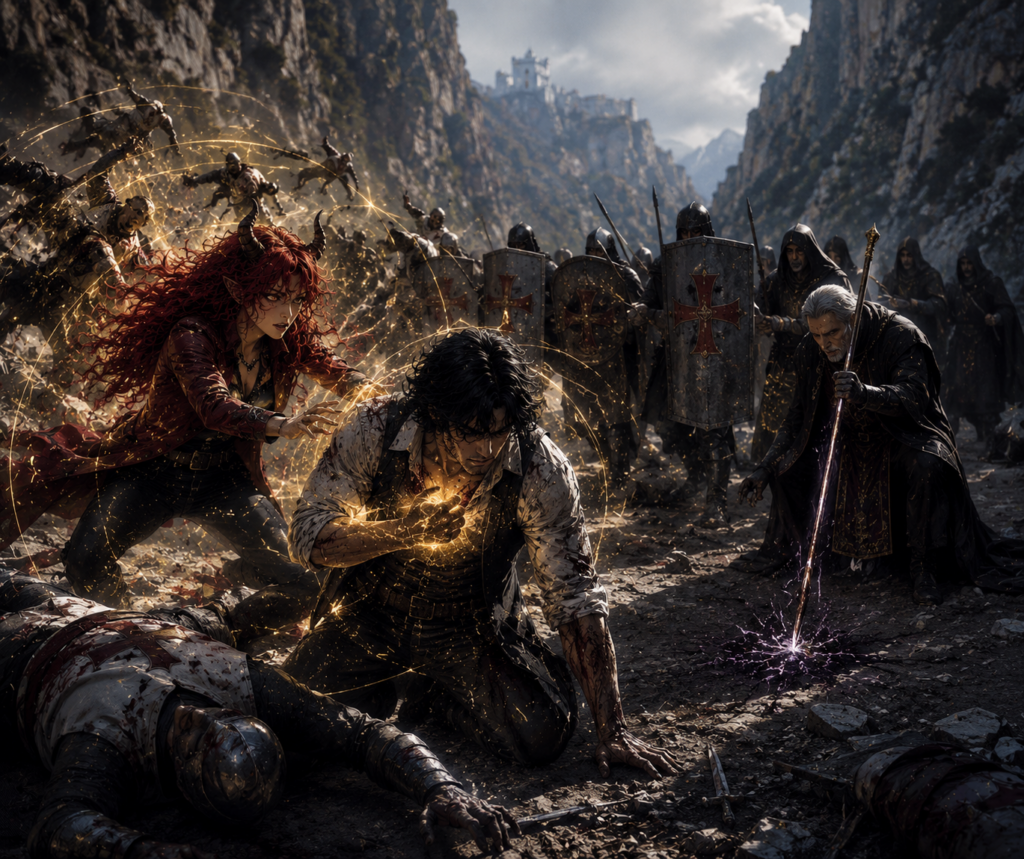
The weapon had taken four master mana-smiths six months to forge.
It had taken the collective application of both the Pontiff’s full ceremonial power and the Empress’s imperial bloodline seal to charge. It had taken a theoretical framework developed over forty years of Church scholarship, specifically in response to the anomaly of Miguel Scordato’s impossible evasion stats, to design.
It did not attack the body. It attacked the name.
More precisely: it attacked the soul’s anchor in the Great Ledger. It locked onto the specific, individual record of a person’s Point allocation and forced it into a state of absolute stagnation — not deletion, not rewriting, but arrest. Frozen. A body told, at the spiritual level, to stop.
The Church had a word for it: Nadir. The lowest point. The state from which nothing rises.
Against a normal person, it would have been extraordinarily cruel. Against the most Evasion-focused person in history, it was the only conceivable way.
Because Miguel could evade physical space. He could evade mana-beams and magical chains and physical nets. He could step through the gaps of reality with forty-five years of practiced precision. But the Great Ledger did not exist in physical space. It existed in the substrate of the world itself. You could not evade something that was not coming toward you in any direction but was simply — already there, underneath everything, pointing at you through the floor of existence.
The ambush happened three days after Orden’s Fall, in the narrow passes of the Corrent valley, where the Templars had finally, carefully, constructed a situation Miguel’s evasion could not purely resolve.
They had not sent an army. They had sent nine people. Nine, very specifically chosen.
Three of them were decoys, designed to occupy Jersey’s probability field.
Three of them were Templar shield-bearers to prevent Miguel from breaking through physically.
Two of them were mana-chain specialists with Church-grade suppression equipment.
And one of them was the Pontiff’s own senior inquisitor, kneeling behind the shield line with the Nadir Lance, who did not need to aim at Miguel’s body. Who only needed to find his soul’s signature in the Ledger and push the lance’s tip into the ground.
It hit him in the chest.
Not physically. There was no physical impact. It was quieter than that. It was like a door closing somewhere very deep, and the warmth behind the door going out.
He dropped to one knee.
Jersey was at his side before he had completed the fall — she had been fighting the three decoys, and she had been winning, and her probability field had turned their synchronized assault into a perfect circle of friendly fire, and she had been laughing because she could not help laughing when things went absurd, and then she had felt the shift in the ambient mana the way you feel a sound go out, and she was beside him.
“Miguel.”
His healing sight was dimming. He could feel it the way you feel warmth leaving a room through an opened door. He looked at his hands. He could still see, faintly, the molecular level, but it was fogging at the edges, the fine resolution dropping out.
“I can’t —” he said. He pressed his palm against the ground. The instinct was there — the impulse to push the healing outward, reset the damage. But the damage wasn’t in his body. It was in his record. In the substrate. His gift needed a living blueprint to work from, and the Nadir Lance had put his own blueprint in stasis.
He could not heal himself. Not this way.
The inquisitor stood. He was a lean, cold-faced man who had spent thirty years efficiently solving problems on behalf of the Church. He looked at Miguel Scordato on one knee in the pass and felt, if not satisfaction, at least the professional clarity of a completed task.
“The Pontiff sends his regards,” the inquisitor said. “You will be contained and transported to the Holy City. The demon will be —“
Jersey’s tail connected with his ankles at approximately the speed of spite. He went down hard. The two chain-specialists moved toward her, and she moved toward them with a velocity that was less fighting and more weather event — she ducked under the first chain, it wrapped around the second specialist, she stepped on the inquisitor’s hand as she passed, and the three decoy fighters, recovering their bearings, found themselves impeding each other at exactly the wrong angles.
But the lance was still in the ground. The effect didn’t stop with the inquisitor falling.
And Miguel could not stand.
He could feel the unraveling — slow, systematic, the way mana poisoning always worked when it was specifically engineered and not accidental. Not pain, exactly. More like being translated, very slowly, into a language he didn’t speak. His molecules were not dying. They were — being informed they had no direction. No purpose. No record. Molecule by molecule, the Ledger’s absence from his body was spreading inward from the point of anchor.
He pressed both hands flat on the ground. Not to heal. To feel the earth. To stay.
“I’ve got you,” Jersey said. She was behind him, her arms around his shoulders, and she was not small — demon-kin were not small, in the ways that mattered — and she hauled him upright with the specific, furious tenderness of someone who has decided that failure is personally offensive. “I’ve got you. We’re going. Don’t —”
“The letter,” he said. “We need —”
“I have it,” she said. “I have everything. Move your feet, Miguel Divino.”
He moved his feet.
He found he could, just. The evasion was still there — the deep, forty-year physical knowledge of how to move without friction, without resistance. It was knowledge now, not magic. It would have to be enough.
She pulled him out of the pass. Behind them, the Templar squad tried to follow and found that — through a chain of events involving a loose rock, a startled mountain hawk who objected to the intrusion, and the chain-specialist’s equipment tangling at exactly the wrong moment — the pass was temporarily unavailable.
The hawk, for its part, did not consider this its problem. It had eggs. These people had chosen to climb into its territory. Consequences were their own affair.
STOP & THINK!
Chapter 9 — The Nadir Lance
The Church’s ultimate weapon: a lance that does not attack the body but the soul’s anchor in the Great Ledger. It attacks the name — locking the record into stagnation. ‘Not deletion, not rewriting, but arrest. Frozen.’ Against Miguel’s evasion, physical weapons are useless. So they attack what cannot be evaded: the substrate of existence itself.
| Story Mirror The the opposite of a Zenith ‘high’ is a Nadir ‘low’. Nadir is the theological name for the moment when every external support is removed and the fundamental question of identity cannot be deferred any longer. Who are you when you cannot heal? When the gift goes quiet? The name ‘Nadir’ comes from the Arabic for the lowest point in a celestial orbit — the opposite of zenith. In Scripture it has another name: the valley of the shadow of death. |
| Yea, though I walk through the valley of the shadow of death, I will fear no evil; for You are with me; Your rod and Your staff, they comfort me. Psalm 23:4 (NKJV) |
The lance hits Miguel in the chest. ‘Not physically… It was like a door closing somewhere very deep, and the warmth behind the door going out.’ He drops to one knee. He cannot heal himself — the damage is in his record, not his body. His blueprint is in stasis.
Jersey is at his side before he completes the fall. She hauls him upright — ‘I’ve got you. We’re going. Don’t —’ ‘The letter.’ ‘I have it. I have everything. Move your feet, Miguel Divino.’
| She calls him by his true name — ‘Miguel Divino’ — for the first time, in the moment when the Nadir lance is trying to erase it. |
| When you pass through the waters, I will be with you; and through the rivers, they shall not overflow you. When you walk through the fire, you shall not be burned, nor shall the flame scorch you. For I am the Lord your God. Isaiah 43:2-3 (NKJV) |
Discussion Questions — Chapter 9
| Q25 The Nadir Lance attacks not the body but the record — the soul’s anchor. Have you ever experienced a season where your giftedness, your sense of calling, or your access to God seemed to go quiet? What was that like — and who called you by your true name in that moment? |
| Q26 Jersey calls Miguel ‘Miguel Divino’ at the moment the lance tries to erase his name. Isaiah 43:1 says ‘I have called you by your name; you are Mine.’ How does being called by one’s true name in a moment of crisis function differently from being told an encouraging fact? |
| Q27 Miguel still has his evasion — not as magic, but as embodied knowledge. ‘Knowledge now, not magic. It would have to be enough.’ Describe a season where God did not restore your circumstances but did preserve your formation. What was the difference between receiving magic and receiving character? |
CHAPTER TEN
The Midnight Altar
The chapel was four miles from the pass, at the edge of a village called Canta’s Rest, and it was the kind of place that existed because communities need somewhere to put the weight of their feelings down periodically, not because anyone particularly maintained it. The iron hinges of the door had gone green. The wooden floor had been swept recently but not refinished in a decade. The candles were cheap tallow and smelled accordingly.
It was perfect.
Aurelia was already there.
Miguel stopped in the doorway when he saw her. He was pale — the kind of pale that comes from the inside out — and Jersey had her arm around him in the way she’d adopted in the past four hours that said I am supporting you structurally and I will not discuss it.
“How,” he said.
“Davan’s network,” Aurelia said. She was alone, no guards, her royal coat traded for a traveling cloak that had seen better days. She looked at him — at the black-veined pulse of the Nadir lance’s mark visible at his collar — and her face did something complicated and then settled. “I dismissed my guard two days ago. I’ve been following the same network your Reclaimed use.” She met his eyes. “I am not here as the Crown. I am here as a witness. If that’s acceptable.”
It was Jersey who said, “Come in and close the door.”
A very old priest came out from the back room. He had the narrow, careful look of someone who had spent his life doing things that were technically illegal and was at peace with this. He looked at Miguel. He looked at the unraveling mark on Miguel’s chest. He looked at Jersey.
“Father Bren,” Jersey said. She had found him — Miguel didn’t know how, and he had stopped being surprised by Jersey’s logistical competence three cities ago — through the underground network. Father Bren had been performing unauthorized, unrecorded Point allocations for the lower districts of three villages for fifteen years. He had the Anointing — not the full version, not the secret transmission that Thaddeus had given Miguel, but enough. He was, in the technical language of the Church, already a heretic. One more act of unauthorized ceremony was not going to change his accounting.
“I need to know,” Father Bren said, “that this is freely chosen.”
“Yes,” Miguel said.
“Both of you.”
“Yes,” Jersey said. Her tail was very still.
“Then we should begin,” Father Bren said. “I have the sense that time is short.”
The clock on the chapel wall — an old mechanism, reliable the way things are reliable when nobody has interfered with them — showed eleven forty-two.
Miguel looked at it. He looked at Jersey.
He said: “Fourteen days ago.”
“I know,” she said.
“The clock hadn’t —”
“Miguel,” she said. “I know the clock hasn’t technically struck. I also know that I have spent two years and eleven and a half months learning everything about you that a spy’s dossier never could. I know about the yellow apples and the cold river water and what your face looks like at three in the morning when you think no one is watching you and you’re tired enough to let it be true. I know that you talk to animals because you trust them and I know that you heal your enemies because you can’t help it and I know that you have been running from a name you didn’t know toward a life you were never allowed to have.” She stepped in front of him. She was almost exactly his height, which he had always found quietly convenient. “I am the most aggravating person you have ever known. You are the most infuriatingly principled person I have ever met. We have spent three years being absolutely impossible together and I would like to do it for considerably longer if you can stop being technically correct for approximately four minutes.”
Behind them, Aurelia made a sound that was absolutely not a laugh and which she immediately converted into a cough.
Father Bren opened his registry.
The Nadir mark on Miguel’s chest pulsed once, deeper, and his hand found the altar rail and gripped it.
“I’m here,” he said. The same thing he had said in Orden’s Fall, but simpler now. Cleaner. “I’m here, Jersey. I know your soul entirely. I would like —” He stopped. He did not have, he realized, a language for this that wasn’t forty-five years of avoidance and careful distance. He had a new one, and it was small and clear and completely without evasion. “I would like to stop running. With you.”
The clock showed eleven fifty-eight.
“Ask properly,” Jersey said. Her fangs were slightly extended. She was shaking, very slightly, which he could see with the dimming remnants of his healing sight, and which she was pretending she wasn’t.
“Jersey Devil,” Miguel said. “By my own criteria, which I am informed are extremely rigid and which you have met, in fourteen days and —” he glanced at the clock, “— approximately one minute and forty seconds, fully and without compromise. Will you marry me?”
“Obviously,” Jersey said. “Yes.”
The clock struck midnight.
Father Bren began the words. They were old words, the pre-Striking era version, before the Church had edited the ceremony to include the tithe acknowledgment and the stat-growth covenant. Plain and direct: a witnessing of a vow, freely given, between two souls, before whatever divine architecture existed beyond the Church’s editorial control.
Aurelia stood at the back and signed the witness registry when Father Bren passed it to her, with her full royal signature, which constituted an imperial recognition of noble status that her mother was going to find — to put it gently — extremely inconvenient.
She signed it anyway. She had been working on inconveniencing her mother since she was six years old. She was good at it.
“You may seal the vow,” Father Bren said.
Their first kiss tasted like a cosmic collision.
Jersey’s fangs extended the moment her lips met his — not as a threat, not as anything chosen, but as a biological response, the biomantic lightning rod that Thaddeus had never known he was describing when he gave Miguel the secret of the Anointing. The fangs were a conduit, always had been, tuned to the exact frequency of life-mana. She had spent three years in proximity to the strongest life-mana signature on the continent and her body had been, without her knowing it, calibrating itself to serve as its ground.
The Great Ledger felt the marriage.
It happened in the layer beneath physical reality, the substrate Aldero Divino had built his life trying to protect: a recognition, a registration, a restoration. The name Divino reappeared in the Ledger’s living memory not through any action Miguel could have taken but through the legal, bloodline-bound mechanism of marital transfer — Jersey’s soul, tied to his through the ceremony, became anchored to the Divino entry, and the Ledger’s own self-correcting architecture, the provision his grandfather had encoded before the Church could erase it, pulled the full name back into place.
The Capstone activated.
Not in Miguel. In the space between them. The full, unrestricted Divino Biomantic Sovereignty — the power to reweave life from ambient mana without blueprint, to restore what had been lost without reference to what remained — flowed through the conduit of Jersey’s fangs, and it did what a healing power does when it is finally fully awake: it went to the greatest damage it could find.
The Nadir lance’s effect dissolved.
Miguel felt the warmth return. The door that had closed reopened. The healing sight came back in full, and for one extraordinary moment he could see everything — the molecular architecture of the chapel, the living mana in the wood and stone and tallow candles, the fine, intricate soul-signatures of every person in the room, each one a different and irreplaceable pattern, each one, to his particular sight, beautiful in the specific way that all living things are beautiful when you can see them clearly.
He could see Jersey. He could see her completely — the full, extraordinary complexity of her soul, the genuine goodness underneath all the sarcasm, the years of compulsive helpfulness that she’d spent pretending were accidental, the fundamental and total love that she had walked three years beside him carefully not admitting.
“Oh,” he said. It was not much of a thing to say. It was the entirety of it.
Then the wave broke.
The Divino power had done its work — healed, restored, corrected — and the mechanism that had powered it for forty-seven years had nothing left to give. The mana reserves that Miguel had built through decades of deliberate, self-destructive refinement had been spent completely and finally in the single greatest healing act of his life: restoring himself.
The healing sight dimmed. Not like the Nadir — not frightening, not a door closing. Just like a candle burning all the way down. Quietly, completely, and in its own time.
The evasion dissolved. The supernatural edge left his muscles. His perception contracted from the molecular back to the human.
He was, for the first time in forty-seven years, simply a man.
He was also, he found, completely fine.
He was also married.
He was also, he realized, still holding his wife’s hands. He looked at them. He looked at her.
Jersey pulled back from the kiss. Her fangs retracted. She looked at him with her actual eyes, not performing anything, and said:
“Are you all right?”
“Yes,” Miguel said. He tested the word. “Yes. I’m — yes.”
“The magic —”
“Gone,” he said. “I think it’s all gone.”
She looked at him for a long moment. He looked back.
“Good,” she said.
He blinked. “Good?”
“You heard me.” She released one of his hands to point at the Nadir mark, which was gone. Not fading — gone, as if it had never been. “You are alive, normal, and completely free, and the building is not on fire, and Aurelia is not making any sounds that suggest we are about to be arrested, and those are the metrics I am using to evaluate the situation.”
“Those are excellent metrics,” Father Bren agreed.
The doors blew in.
STOP & THINK!
PART FIVE: THE HARVEST AND BEYOND
Chapter 10 — The Midnight Altar
A small chapel at the edge of a village. Green hinges. Cheap tallow candles. Father Bren — a village priest who has been performing unauthorized allocations for fifteen years. Aurelia arrives as a witness with her full royal signature. And at eleven forty-two at night, with the Nadir lance’s effects still spreading through Miguel’s system, they begin.
| The Ceremony Scene | Theological Grounding |
| Father Bren uses the pre-Striking era ceremony — before the Church added the tithe acknowledgment and the stat-growth covenant. | Matthew 19:8 — ‘Moses, because of the hardness of your hearts, permitted you to divorce your wives, but from the beginning it was not so.’ The original design always outlasts the institution’s edits. |
| Jersey: ‘I have spent two years and eleven and a half months learning everything about you that a spy’s dossier never could.’ | Song of Solomon 6:3 — ‘I am my beloved’s and my beloved is mine.’ Covenant intimacy requires the knowledge that only time and transparency produce. |
| Miguel: ‘I would like to stop running. With you.’ | Ruth 1:16 — Covenant as a directional statement. Not just ‘I love you’ but ‘I am going where you are going.’ |
| The clock strikes midnight — fourteen days after finding the letter. | Ecclesiastes 3:1 — ‘To everything there is a season, a time for every purpose under heaven.’ The season of running ends at the appointed time. |
| Peirasmos Chain — Steps 4-6: Peace, Capacity, and Sophronismos | Philippians 4:7 / 2 Timothy 1:7 |
The wedding ceremony is simultaneously the completion of the Peirasmos chain. Step 4 — the peace that guards: in the act of covenant, Miguel is no longer running from anything or toward an uncertain strategy. He is standing still in his own name, in his own story. Step 5 — capacity through Christ: the Capstone activates not in his lone body but in the space between two people. Step 6 — sophronismos: the mind saved into wholeness. He is, for the first time, simply a man.
The Capstone Activation — The Space Between Two People
Jersey’s fangs are a biomantic conduit tuned to life-mana frequency. She has spent three years in proximity to the strongest life-mana signature on the continent and her body has been calibrating without her knowing. The Great Ledger reads the marriage as a bloodline restoration. The Divino name returns. The Capstone activates.
| Two are better than one, because they have a good reward for their labor. For if they fall, one will lift up his companion. But woe to him who is alone when he falls, for he has no one to help him up. Ecclesiastes 4:9-10 (NKJV) |
The Capstone was never meant to activate in a single person. The full Divino Biomantic Sovereignty flows through the conduit of covenant. This is the novel’s central theological claim: the gifts that seem most individual — most personal, most secret — are designed to operate in their fullness only within genuine covenant relationship.
‘He Is Simply a Man’
The evasion dissolves. The supernatural edge leaves his muscles. His perception contracts from the molecular back to the human. The healing sight dims — ‘not like the Nadir — not frightening, not a door closing. Just like a candle burning all the way down.’ And Miguel finds himself completely fine.
| This is the paradox at the heart of the novel: the gift burns out in the act of its greatest use, and the man who receives nothing back is more whole than he has ever been. He is not diminished — he has arrived. |
| But He said to me, ‘My grace is sufficient for you, for My strength is made perfect in weakness.’ Therefore most gladly I will rather boast in my infirmities, that the power of Christ may rest upon me. 2 Corinthians 12:9 (NKJV) |
Discussion Questions — Chapter 10
| Q28 The ceremony uses the pre-institutional, original design of covenant — before the Church added its own commercial provisions. Are there areas of your own spiritual life where you have been living by the institution’s edit rather than the original design? How do you find your way back to the original? |
| Q29 The Capstone activates ‘in the space between two people,’ not in a single person’s full achievement. What capacities in your life have you been trying to activate alone that were designed to operate within genuine covenant? How does Ecclesiastes 4:9-12 address the theology of relational capacity? |
| Q30 Miguel’s gift burns out in its greatest act and he is ‘completely fine.’ Has God ever removed a capacity from your life — a gift, a role, an identity marker — and you discovered that without it you were more yourself, not less? How does John 12:24 — ‘unless a grain of wheat falls into the ground and dies, it remains alone’ — illuminate that experience? |
PART FIVE
The Harvest
CHAPTER ELEVEN

What in the World.
The doors came off their hinges in a cloud of green-oxidized iron and old oak splinters, and the cold air of the valley rushed in ahead of the Pontiff.
He was not a physically impressive man. The Church did not require physical impressiveness in its leadership; it required administrative acuity, a comprehensive lack of empathy, and the specific confidence of someone who had never once questioned whether their authority was legitimate. The Pontiff had all three. He was seventy years old, white-haired, attended by six elite Paladins and the senior inquisitor (limping, from where Jersey’s tail had hit his ankles), and he was holding a second Nadir Lance, freshly charged, because the Church had built two.
Behind him, in the doorway, stood the Empress of Varenthi. She was taller than her daughter and colder in the face, with eyes that were Aurelia’s eyes in the same way a frozen lake is a swimming pond’s eyes. She was wearing full imperial regalia at midnight, which told you everything you needed to know about how seriously she was taking this.
“It is over,” the Pontiff said. He looked at Miguel, still by the altar, still standing. He looked at the absence of the Nadir mark and his eyes narrowed. “The bloodline ends tonight. The name Divino will be Struck a second time and the Ledger will —”
“The Ledger has already updated,” said Jersey.
Everyone looked at her.
She was standing at the altar, one hand on the registry, one hand on her hip, her tail making the slow horizontal oscillation that Miguel had spent three years learning to recognize as the probability field warming up. She looked at the Pontiff the way she looked at everyone — with the combination of absolute amusement and absolute seriousness that was her fundamental face, the one underneath all the performances.
“The name Divino has been restored,” she said. “The marriage is legally registered. By ancient bloodline law — which the Church wrote, incidentally, so you can’t argue the source — a registered Divino spouse carries the full bloodline anchor.” She looked at her nails. “That’s me.”
“You’re a demon,” the Empress said.
“Demonkin. There’s a difference, and you’d know it if you’d done any reading.” Jersey turned to look at the Empress with the specific, measured patience of someone who has been the strangest person in every room her entire life and has excellent opinions about being misidentified. “More relevantly, I am a legally married Sovereign of the restored Divino bloodline, which by the ancient Imperial Charter of House Recognition — which your great-great-grandmother signed, so again, primary sources available — means I have noble status in every territory under Crown jurisdiction. Including this one.”
A very long silence.
“She’s right,” Aurelia said, from the back of the room. She was holding the registry. Her voice had the flat, precise quality of someone reading from a document. “Article seven of the Imperial Charter. Any restoration of a Struck house through legal marital means in the presence of a registered imperial witness — ” she lifted the registry, ” — that’s me — ” she set it down, ” — immediately restores all noble rights, protections, and territorial recognition. Mother, you signed the renewal of this charter four years ago. I was there.”
The Empress’s expression did not change. It had the quality of a cliff face that has decided to stay a cliff face regardless of weather.
“The Pontiff can perform a second Striking,” she said.
“Try it,” Jersey said.
Something changed in the ambient mana of the chapel. It was not dramatic. It was not a visible light show or a thunderclap. It was the specific quality of change that occurs when probability stops being evenly distributed and begins being deliberately concentrated.
Jersey’s Retribution stat had been building since the moment the Pontiff ordered the Nadir Lance forged. It had been building through three hundred years of the Church’s hoarded cruelty — the tithe that was never affordable, the Points that should have been free, the children who grew up weaker than they should have been, the old dock worker’s hands that couldn’t close. The malice that had been poured into the Great Ledger’s corruption had not dissipated. Mana did not dissipate. It waited.
Jersey was, in the language of her own magic, the harvest.
“Pontiff,” Jersey said. Her voice was still conversational. Still sarcastic, even. “I am going to give you a genuine and sincere piece of advice. Not mockery. Not a setup. Real advice from one person to another.”
The Pontiff leveled the second Lance.
“The last three hundred years of the Church’s cruelty,” Jersey said, “is about to reap what it sowed. I would strongly recommend not making the list longer.”
He threw the Lance.
It hit the probability field.
Everything that happened next happened quickly and in the specific, self-inflicted style of consequences finding their way home.
The Lance’s conceptual stagnation energy — the accumulated, weaponized malice of a political institution that had decided it owned human devolution — inverted. Not because Jersey redirected it. Because that was what her magic did to malice: it showed the malice where it had come from.
The Pontiff staggered. His hands went to his chest. The expression on his face was not one she had enjoyed producing — she found no pleasure in destruction, she never had, it was the thing that made everyone misread her — but it was the correct one. The Points he had stolen, hoarded, gated for seventy years — they were not his. They had never been his. The Ledger had always known it. And the Ledger, fully restored with the Divino registration reactivated, corrected the error with the efficient finality of a system doing what it was built to do.
He did not die. Miguel would not have allowed that, and the magic, flowing through the Divino bloodline anchor, reflected his intent. The Pontiff sat down on the chapel floor, seventy years old, with no magic, no authority, and no particular reason why any of the six Paladins should continue following orders.
The six Paladins looked at each other.
They looked at Jersey, who was radiating the combined authority of the Divino bloodline, the Retribution allocation, and the specific moral weight of a person who has never once in her life used unkind language and has therefore been saving up a great deal of extremely pointed honesty.
They looked at the Empress.
“Mother,” Aurelia said, walking forward. She held out the marriage registry. “The Charter. Your signature is right here.”
The Empress looked at her daughter. Then at the Pontiff on the floor. Then at Jersey.
“I want to note,” the Empress said, with the precision of someone determined to lose gracefully, “that this was an extraordinarily unconventional resolution.”
“Thank you,” Jersey said. “I do what I can.”
The Paladins laid down their weapons. Not in submission, exactly. More in the manner of men who have done a calculation and found the math surprisingly clear.
One of them, near the back, was crying. He had grown up in the lower districts of a city Miguel had visited eight years ago and had gone to sleep one night with the full articulation returned to his injured hand and woken up understanding, without being told, what it meant that someone had given it back. He had joined the Templars afterward because it was the only institution offering protection and now he was looking at the man who had healed him and the woman who had apparently just performed a bloodline-level cause and effect correction on the institution he’d served for eight years, and he was very moved, and slightly embarrassed about it.
“You’re all right,” Miguel said quietly, catching his eye. He said it the way he said everything he meant: simply, precisely, without decoration. “You’re all right.”
The Paladin nodded. He wiped his face with the back of his hand.
The Imperial Crown had been sitting on the Empress’s head throughout all of this. It was a heavy thing, gold and serious, studded with the traditional mana-stones of the imperial bloodline. When the Empress finally, with the compressed dignity of a woman who is furious and has chosen not to show it, removed it from her own head and held it out — not to Aurelia, which would have been the expected move, but to the registered Divino Sovereign who was, by her own Charter, legally obligated to be acknowledged — the crown dropped off the tips of her fingers and rolled across the chapel floor.
It bumped gently against Jersey’s boot.
Jersey looked down at it.
She looked at the army of former Templars and Imperial Guards who had just dropped to their knees.
She looked at Miguel, sitting on the altar steps, his coat dusty and his face not afraid for the first time in forty-seven years, laughing. She could hear it — real laughter, the kind that lives in the chest and doesn’t ask permission.
She looked at the crown again.
She picked it up. She held it at arm’s length. It was extremely heavy.
“I was just trying to get a husband,” Jersey said, to no one in particular. Her voice carried the specific quality of someone making a completely sincere and completely incomprehensible statement. “That was the objective. A husband. After three years. The correct amount of time. I had a plan.”
Aurelia, who had been watching all of this with the expression of someone who has just witnessed history and is trying to decide how to file the paperwork, said:
“Technically you succeeded. You have a husband.”
“I also apparently have a dental plan obligation for an entire federation,” Jersey said. “Do you know how many teeth that is? I have counted neither, but I am inferring that it is a large number.”
“Jersey,” Miguel said, from the altar steps, still laughing.
“Do not laugh, this is very serious —”
“Jersey.”
She looked at him.
“Come here,” he said.
She went. She sat down on the altar steps beside him, and he put his arms around her — his normal, human, un-magical arms — and she put her face against his shoulder and her tail curled once around them both with a small, involuntary motion that was not any kind of performance for anyone.
The crown was still in her hand. She held it out at arm’s length.
“This is a disaster,” she said.
“Yes,” he said.
“A total disaster.”
“Complete.”
“I am absolutely going to handle it very badly.”
“You will handle it,” he said, with the quiet certainty he had carried all his life and which did not diminish at all without magic behind it, “exactly the way you handle everything. Accidentally, brilliantly, and in ways that leave it better than you found it.”
A long pause.
“That is,” Jersey said, “objectively the nicest thing you have ever said to me.”
“Three years of earned honesty,” he said. “I thought it was time.”
She pulled back and looked at him. Her fangs were extended slightly in the expression he had catalogued, over three years, as genuine and unperformed happiness.
“Hssssssss,” she said. Not angry. Not frustrated. Just — full, the way a sound can be, when it has nowhere else to go but out.
Then she laughed.
It was a real laugh — not the performance laugh she deployed against the world, the sharp, theatrical thing she used as armor. A deep, surprised, unstoppable laugh, and he was laughing too, and the chapel rang with it in the particular warm acoustic of old wood and true things, and outside the stars were doing what stars do, which is simply be there, reliable and indifferent and beautiful.
Davan found them there an hour later, when the Reclaimed finally made it to the chapel. He stopped in the doorway, took in the scene — the former Empress in a corner speaking in tight, furious whispers to her daughter, the former Pontiff sitting on the floor looking philosophically diminished, forty-seven Paladins and Royal Guards in various states of converted loyalty, a very old priest making tea, and two people on the altar steps who were clearly not getting up for anything.
He stood for a moment.
Then he turned to the man beside him — one of the Reclaimed, a former Cartel tracker who had been healed of his bad hip eight years ago and had been quietly making sure the bounty registries had outdated information ever since — and said:
“It’s done.”
The tracker looked past him into the chapel. He looked for a long time.
“Yeah,” he said. “Yeah, it is.”
Outside, somewhere in the dark valley, a wolf howled once. Not distressed. Just present. Just alive.
Two more voices answered it.
STOP & THINK!
Chapter 11 — What in the World
The Pontiff arrives with a second Nadir Lance. The Empress arrives in full regalia. And Jersey — holding the marriage registry, standing at the altar with the probability field warming up — begins to explain the legal situation. Then the probability field deploys three centuries of accumulated institutional malice back to its source.
| Prophet’s Method — The Harvest of Consequence | Amos 4:1-2 / Galatians 6:7 |
‘Reap what you sow. Honestly, it is not that complicated. People just refuse to believe it applies to them.’ — Jersey Devil, the novel’s epigraph. The probability field does not punish the Pontiff. It shows his malice where it came from — returns to him the Points he hoarded for seventy years of institutional theft. This is Galatians 6:7 — ‘God is not mocked; for whatever a man sows, that he will also reap.’ Not vengeance. Consequence.
| Do not be deceived, God is not mocked; for whatever a man sows, that he will also reap. For he who sows to his flesh will of the flesh reap corruption, but he who sows to the Spirit will of the Spirit reap everlasting life. Galatians 6:7-8 (NKJV) |
‘I Was Just Trying to Get a Husband’
The crown rolls across the chapel floor and bumps against Jersey’s boot. Forty-seven Paladins and Royal Guards kneel. Jersey looks at the crown at arm’s length: ‘I was just trying to get a husband. That was the objective. A husband. After three years. The correct amount of time. I had a plan.’
| Story Mirror Jersey’s bewilderment is theologically honest. She did not pursue power. She pursued relationship. The authority arrived as a consequence of faithfulness, not as a goal she chased. This is the consistent biblical pattern of calling: Moses pursued nothing but a burning bush and received the deliverance of a nation. Esther pursued nothing but her people’s survival and reformed an empire. |
| Humble yourselves in the sight of the Lord, and He will lift you up. James 4:10 (NKJV) |
Discussion Questions — Chapter 11
| Q31 The Pontiff is not killed but stripped of what was never his. How does this outcome — consequence without cruelty — reflect Paul’s instruction in Romans 12:17-21 more precisely than either revenge or passivity? |
| Q32 Jersey’s laughter in the chapel — the real laugh, ‘deep, surprised, unstoppable’ — arrives after the crisis has passed and she is standing with the crown in her hand. Nehemiah 8:10 says ‘the joy of the Lord is your strength.’ How does genuine, embodied joy function differently from performed optimism in a person’s capacity to lead? |
| Q33 Aurelia signs the witness registry with her full royal signature, knowing her mother will find it ‘extremely inconvenient.’ At what cost did she choose integrity over political calculation? Where is God asking you to sign your name to something that will be inconvenient to someone who has power over you? |
CHAPTER EPILOGUE
The First Tuesday

The world did not change in a day. It never did.
The Church’s Point monopoly unwound over the course of three years, which was faster than anyone who understood institutional inertia would have predicted and slower than anyone who had been paying tithe rates for thirty years could forgive. The implementation of free Point allocation — the provision Aldero Divino had tried to encode into the Ledger a lifetime ago — was chaotic, contested, and frequently interrupted by political events that were, several observers noted, suspiciously consistent with having been caused by the personal involvement of the new Sovereign Divino.
Jersey maintained, consistently and with vigorous statistical support, that she was not causing anything on purpose.
Miguel mostly stayed home.
Home was a house in the river district of the city of Canta, which was the same city as Canta’s Rest and which had been quietly expanded, over the previous decade, by the informal network of people who’d found their way there for reasons connected to Miguel’s circuits. It was not a palace. It had a garden, which Miguel maintained with the same methodical attention he had once given to healing people’s bodies, and which produced excellent vegetables and a highly ambitious population of climbing roses who were permanently at war with the garden wall.
It had a crow. She had shown up the week after they arrived and announced, by her demeanor, that she had decided this was acceptable and intended to remain. Miguel had looked at her with the healing sight that was, in his fully human state, simply a doctor’s trained observation, and had determined she was the same crow — or very close kin — that had brought him Thaddeus’s message three years ago.
He had named her Aldero. She had not objected.
She sat now on the garden wall, supervising, while Miguel repotted a row of seedlings and Jersey sat on the garden bench doing the thing she called reviewing correspondence and which was mostly arguing in writing with three separate ministries, a trade guild, and — on ongoing basis — her own senior administrative staff about what “free Point allocation” meant in jurisdictions that had previously defined “free” as a legal impossibility.
“The Corrent valley guild wants an exception for specialty allocations,” Jersey said. She sounded the way she always sounded when she was reading bad logic: pleasantly incredulous, like someone enjoying an excellent joke at its own expense. “They’ve argued that Points accumulated through ‘elite vocational experience’ should carry a tithe premium.”
“They’re going to lose that argument,” Miguel said.
“They are going to lose it so completely that the argument itself will become a cautionary tale taught to guild administrators for the next generation.”
“Are you writing that?”
“I am writing a response that is extremely polite and explains, with complete clarity, why they are wrong, while leaving them sufficient dignity to change their position without humiliation.” A pause. “I am also writing a slightly less polite second draft that will not be sent but which is cathartic.”
A robin landed on the garden wall three feet from Aldero the crow. Aldero looked at it. The robin looked at Aldero. A negotiation of territorial understanding occurred without words, in the way animals handle these things, and both birds returned to their respective business.
Miguel finished the seedlings. He sat back on his heels and looked at the garden with the quiet, present attention he brought to all living things.
He did not have the healing sight anymore. He had, in the months following the chapel, missed it the way he imagined a painter misses color when the eyes begin to go — with real loss, real grief, and a subsequent adjustment that was neither denial nor acceptance but a daily renegotiation of what remained. What remained was considerable. A trained doctor’s eye. A healer’s instinct for where pain lived. Forty-seven years of knowledge about how bodies worked and what they needed.
Patients came to the house three times a week. He saw them in the front room, which smelled of dried herbs and warm wood, and he worked with hands and knowledge instead of mana. It was slower. Some things he could not fix alone. He was, for the first time in his life, part of a community of healers — former underground practitioners, young biomancers trained outside the Chapel, physicians who had spent careers constrained by what the Church would authorize.
Father Thaddeus was in the house two days a week. He had been released from the Holy City prison in the first week of the new administration — Jersey had personally handled the paperwork for his release with a speed and efficiency that had left two senior Church officials blinking in its wake — and was, at seventy-four, physically diminished and intellectually as sharp as a man in his prime. He and Miguel did not talk about the twenty years. They talked, instead, about what came next, which was the conversation they had both been waiting forty years to have.
He was sitting in the garden now, in the good chair, reading. He read the same way Miguel did — completely, with total attention, marking nothing but forgetting nothing. Aldero the crow had migrated from the garden wall to the arm of his chair and was regarding his book with the specific, lateral-headed interest of a crow who has decided that words on pages are potentially edible.
“Aldero,” Miguel said.
The crow made a sound that was exactly not an apology and stayed where she was.
“She has opinions,” Thaddeus said, without looking up from his book.
“She’s always had opinions.”
“All the Divino crows did.” Thaddeus turned a page. “Your grandfather had three. They were always stealing his pen nibs.”
Miguel looked at the crow. The crow looked back.
“He would have liked this,” Miguel said. Not a question.
“He spent his life trying to make it possible,” Thaddeus said. “So yes. He would have liked this very much.”
Jersey came to the garden doorway at midday.
She was wearing the expression she wore when she had finished something difficult and was allowing herself, briefly, to acknowledge it — not triumph, she distrusted triumph, but the specific satisfaction of work done correctly. She had rolled her sleeves up. Her horns caught the noon light. Her tail was in the slow, content oscillation that Miguel had catalogued, three years ago, as baseline happy.
“The Corrent valley guild has withdrawn their exception request,” she said.
“How thoroughly?”
“With apologies. Several of them.” She came to sit beside him on the garden stones. “Three district Chapel offices have filed for voluntary restructuring under the new framework. The Lower Vareth Point Clinic opened this morning. Eleven people in the first two hours.”
“How many of them had never had an allocation?”
“All eleven,” she said. Her voice was very even. “Average age forty-two.”
He was quiet.
“I know,” she said. “I know.”
The robin was back on the garden wall, apparently unconcerned by Aldero’s continued presence. A second robin had joined it, which suggested the situation had resolved in favor of consensus. Below them, in the seedling bed, a small tortoiseshell cat who had moved in three weeks ago without being invited sat in the exact patch of sunlight that maximized warmth and minimized effort, purring with the steady, mechanical certainty of a being that has organized its life optimally.
Miguel had named her Reno, without particularly deciding to.
Reno did not care about her name. She cared about the sunlight and the quality of the mice and the fact that the lean, quiet man had warm hands and an inexplicable tendency to notice small injuries and correct them with a touch she barely felt. She was, by her own evaluation, living an excellent life, and she saw no reason to disturb it with gratitude.
“Miguel,” Jersey said.
“Yes.”
“Are you happy?”
He thought about this. He had spent forty-seven years moving too fast to think about questions like this. He had the time now. He used it.
“Yes,” he said. “I am.”
“Even without —”
“Yes,” he said. Not dismissive. Just clear. “The magic was the tool. The work is what it was always for. I can still do the work.”
She looked at him for a moment. Her tail stilled.
“Your grandfather’s rewrite,” she said. “The provision he tried to encode. It’s in the Ledger now. Fully active. All eleven people this morning — they accessed their own Points. No priest. No tithe. Their own.”
“I know.”
“He almost succeeded,” she said. “In the Council chamber. Seventy years ago.”
“Yes.”
“You finished it.”
He looked at the garden. The seedlings. The crow. The cat. The old priest reading in the afternoon light.
“We finished it,” he said.
Jersey’s tail did one slow, satisfied arc and then settled.
“Don’t get sentimental,” she said. “I have three more ministries to argue with this afternoon.”
“I know.”
“I’m going to win all three arguments.”
“I know.”
“I’m doing it very politely.”
“I am aware. I heard the second draft.”
A pause. “That was cathartic,” she said.
“Yes,” Miguel said. “It really was.”
She went inside.
The afternoon was warm. Thaddeus fell asleep in his chair, which happened more frequently now and which both of them treated with the same consideration they’d give any body that had earned its rest. Aldero the crow moved from the chair arm to the garden wall, where she observed the sleeping Thaddeus with the judicial composure of a creature that approves of him and will therefore permit this.
Reno the cat opened one eye, assessed the temperature, and closed it again.
Miguel sat in the garden for a while. He had nowhere to be. He had, for the first time in forty-seven years, no route to plan, no Templar column to evade, no allocation to perform and shield and run from. He had a garden with opinions. He had a crow with a name he’d given her without knowing why. He had a cat he had also named without knowing why and was beginning to suspect he was developing a pattern. He had a mentor who was reading himself to sleep in a warm chair and a wife who was arguing three ministries into better policy and a house that smelled of herbs and wood and the specific living warmth of a place that is a home.
He had stopped running.
The strange thing — the thing he had not predicted, in all the years of imagining what it would feel like to stop — was how natural it was. The stopping. He had thought it would feel like loss, like the absence of motion that had defined him for so long. But it did not feel like absence. It felt like arrival.
Like he had been running, all this time, toward exactly this: the garden, the crow, the afternoon light, the sound of his wife’s voice inside making the very pointed observation to someone on the other end of a message scroll that their position was legally untenable and she hoped this letter found them well.
Toward this specific, ordinary, completely un-magical life.
His grandfather had tried to give the world its freedom and been erased for it. His father had stayed behind in a dark doorway so his son could run, and had never come home. His mentor had spent twenty years in a deep cell for giving him a single, secret gift.
He was forty-seven years old. He was not going to waste the rest of it.
He picked up the trowel. He went back to work.
The crown, for what it was worth, was in the house. Jersey had put it in a cabinet in the administrative study, between a reference book on imperial charter law and a spare pair of boots, with the pragmatic judgment of someone who recognizes a tool but does not confuse it for a purpose.
She wore it occasionally, when the occasion required it, with the air of someone performing a necessary task they find mildly absurd. She had been told, by three separate imperial advisors, that she wore it with considerable dignity.
She had thanked them, and asked whether dignity was covered in the budget for the Lower Vareth clinic expansion, and if so, could someone look into that.
They had.
Someone always did, around Jersey Divino.
That evening, as the sun went down behind the river district’s rooflines and turned the garden to amber, a wolf appeared at the gate.
Not large — young, three or four years old, with one leg that moved with the slightly different cadence of a bone that had healed perfectly after a bad break. It stood at the gate and looked through the iron bars at the man in the garden with the same golden-eyed, direct attention that wolves use when they have something to say and are deciding whether you’re worth saying it to.
Miguel set down his trowel.
He crossed the garden slowly. He crouched in front of the gate. He looked at the wolf.
“Hello,” he said.
The wolf pressed its nose briefly against the iron bar. Then it turned and trotted away into the evening, easy and unhurried, following whatever path wolves follow.
He watched it go.
Behind him, Aldero the crow said something short and observational.
“Yes,” Miguel said. “I know.”
He went back to the garden. He finished the work. The stars came out one by one, and the city made its evening sounds, and somewhere in the house Jersey was explaining to someone in a letter that they were very welcome, it had truly been no trouble, and please do not misinterpret her meaning in the final paragraph as she intended it precisely as written.
He was home.
He was finally, completely, irreversibly home.
— END —
“He ran forty-seven years and arrived exactly on time.”
— Davan, inscription on the Orden’s Fall memorial, Year of the Open Ledger
“I was just trying to get a husband.”
— Jersey Divino, official state record, also Year of the Open Ledger
STOP & THINK!
EPILOGUE: THE FIRST TUESDAY
Three years later. The Point monopoly is unwinding. The Lower Vareth Point Clinic opened its doors. Eleven people in the first two hours — average age forty-two, all eleven having never had an allocation. Miguel is in the garden. A climbing rose is at war with the wall. Aldero the crow supervises. Reno the cat occupies the optimal patch of sunlight. Father Thaddeus reads in the good chair.
| Story Mirror The Epilogue is not a victory lap. It is a theology of ordinary faithfulness. The war was won in the chapel at midnight. What follows is simply living — patients three times a week, a garden with opinions, letters to ministries, a mentor reading himself to sleep. This is the biblical picture of shalom: not the absence of difficulty, but the presence of rightly ordered life. |
| He shall be like a tree planted by the rivers of water, that brings forth its fruit in its season, whose leaf also shall not wither; and whatever he does shall prosper. Psalm 1:3 (NKJV) |
| The Epilogue’s Small Details | Their Theological Weight |
| Miguel names the crow Aldero — after the grandfather — without particularly deciding to. | Romans 8:16 — ‘The Spirit Himself bears witness with our spirit that we are children of God.’ Identity inherited and expressed without conscious performance. |
| Patients come three times a week. He works with hands and knowledge instead of mana. | 1 Corinthians 12:9 — The gifts of healing are not one gift in one form. What changes is the instrument, not the Spirit behind the work. |
| Thaddeus is in the house two days a week. They do not talk about the twenty years. They talk about what comes next. | Isaiah 43:18-19 — ‘Do not remember the former things… Behold, I will do a new thing.’ The past is not denied — it is not dwelt on either. |
| The wolf appears at the gate at evening — the one with the leg that healed perfectly after Miguel set it four years ago. | Proverbs 12:10 — ‘A righteous man regards the life of his animal.’ But more: this is the wolf from Chapter 1, returned. Every act of faithfulness has a witness, even the ones you have forgotten. |
‘He Ran Forty-Seven Years and Arrived Exactly on Time’
Davan’s inscription on the Orden’s Fall memorial. This is the novel’s final theological statement. He was not late. The running was not wasted time. The wilderness years were not punishment or failure — they were the forge. John the Baptist spent decades in the eremos precisely so that when he emerged, he had an authority that no institution could have granted him.
| And we know that all things work together for good to those who love God, to those who are called according to His purpose. For whom He foreknew, He also predestined to be conformed to the image of His Son. Romans 8:28-29 (NKJV) |
‘I Was Just Trying to Get a Husband’
Jersey’s official state record. The empire-altering event, filed in the archives as the simple goal of a woman who started a clock at a streambank and kept it. This is the Bible’s consistent testimony about how God changes the world: through people who are not trying to change the world, but to be faithful to the specific calling in front of them.
| His lord said to him, ‘Well done, good and faithful servant; you were faithful over a few things, I will make you ruler over many things. Enter into the joy of your lord.’ Matthew 25:21 (NKJV) |
Final Discussion Questions — Epilogue and Synthesis
| Q34 Miguel works with hands and knowledge instead of mana. ‘It was slower. Some things he could not fix alone.’ He is now part of a community of healers rather than a solitary practitioner. How does 1 Corinthians 12:14-20 — the many members of one body — describe the ecclesiology that Miguel finally inhabits in the epilogue? |
| Q35 The wolf returns at evening — the same wolf from Chapter 1, now grown and whole. Every act of care, no matter how anonymous, has a witness. Who witnessed your formation in the years when you were running? Who will come to the gate because of something you did that you have long since forgotten? |
| Q36 The novel ends: ‘He was home. He was finally, completely, irreversibly home.’ Write a two-paragraph reflection: What does home mean in your own life — not as geography, but as the theological destination your formation has been moving you toward? Where in your story are you right now — Part One, Part Two, Part Three, or the Epilogue? |
SYNTHESIS: THE SEVEN METHODS IN THE STORY
The following table maps each Biblical Counseling Method from the portfolio to its primary expression in the novel. Every method appears at least once in the narrative. The story was built on the same theological architecture as the Mark 1:1-8 case study — use this map to trace the integration.
| Method | Key Chapters | How It Appears in the Story |
| James Architecture | Chapters 3, 6, Epilogue | Jersey’s arrival without an agenda; Dr. Reyes blessing William before diagnosing; the epilogue’s ordinary flourishing as the destination of all formation work. |
| Elijah Method | Chapters 1, 4, 8 | Miguel assessing the boy’s fever before addressing the spiritual; asking for tea; the horse’s inventory; Davan asking ‘when did you last eat?’ to every person he protects in the network. |
| Peirasmos Chain | Chapters 5, 8, 10 | Miguel’s six-step journey from honest inventory (burning his shield) through humility and casting (the mass allocation) to sophronismos (the chapel, simply a man). |
| Paul Letter Method | Chapters 3, 6, 9 | Jersey building a three-year record of affirmation before any confrontation; Miguel’s capacity to receive Jersey’s declaration because she has already demonstrated she sees him clearly. |
| Nathan/Parable Principle | Chapters 6, 4 | Miguel’s conversation with Aurelia about the dossier vs. genuine knowledge; Jersey’s story of the ‘senior officer’ that she never had to tell — because her presence was the parable. |
| Prophet’s Method | Chapters 8, 11 | The mass allocation as prophetic confrontation by enacted restoration; Jersey’s deployment of the probability field — consequence without cruelty, calibrated truth delivered without flinching. |
| Mars Hill Method | Chapters 3, 7 | Jersey finding Miguel’s altar (his compulsive compassion) before she said a word; the un-openable letter that surrendered to Jersey’s non-mana touch — the way genuine truth opens to presence without agenda. |
The Mark 1:1-8 Grid Applied to Miguel’s Story
| Mark 1:1-8 Principle | Miguel’s Struggle | Resolution in the Story |
| Identity in Calling, not Audience (v.1) | Miguel’s worth defined by forty-seven cases closed, not by his real name. | Narrative excavation of the archē — his cousin’s cold case. ‘That’s a calling, not a job.’ |
| Wilderness as Sacred Assignment (vv.1-3) | Forty-five years of flight through forty-three cities, under-resourced, unnamed, alone. | The Reclaimed as evidence that the wilderness was not wasted — it was compounding. |
| Metanoia: Reorient the Mind (v.4) | ‘Either I’m failing all forty-seven families, or I’m going to break.’ | Jersey’s disruption: ‘Who told you those were the only two options?’ The binary is the old garment. |
| Non-Anxious Identity (vv.5-6) | Miguel never panics. Even at the Nadir, one knee on the ground, he presses his hands to the earth. | ‘I’m here.’ The same words in Orden’s Fall and the chapel — simple, present, complete. |
| Joyful Diminishment (vv.7-8) | The magic burns out at its greatest moment. He is simply a man. | ‘The magic was the tool. The work is what it was always for. I can still do the work.’ |
A Final Word to the Counselor
Miguel Scordato spent forty-seven years doing the work of healing without access to the fullness of his own name. He was effective, faithful, and profoundly lonely. His gifts served thousands of people in dozens of cities. They could not heal himself.
The counselor who reads this story and sees only a client’s profile has read it wrong. Miguel is also the counselor — the practitioner who has mastered the tools of their trade and carried the weight of other people’s brokenness across four decades, without ever letting anyone close enough to call them by their real name.
The Elijah Method applies to the counselor first. The James Architecture applies to the counselor first. The clock that Jersey started at the streambank is a pastoral invitation to every person who serves: let someone know you. Let the friendship form at the proper depth. Let your real name be spoken.
| He must increase, but I must decrease. John 3:30 (NKJV) |
John the Baptist said this and meant it. It cost him everything and gave him everything. Miguel Scordato said it with his body — burned the shield, surrendered the magic, stood still in the chapel at midnight, and discovered that the man underneath the gift was exactly who he was supposed to be.
That is what we are all running toward. Not the gifts. Not the assignment. The man. The woman. The person formed by the wilderness into the image of the One who sent them into the Ephesians 2:10 purposes He has force us with a flowing Romans 8:28 in the reflection, working all thing together for the Genesis 50:20 greater good. A life that quotes one of the most powerful statements of redemption and forgiveness in scripture.
Teleios kai holokleros. Mature, whole, lacking nothing.
That is the destination. That is what all of this is for.
APPENDIX OF BIBLICAL COUNSELING METHODS
The Biblical Counseling Methodology Portfolio
One of the marks of excellent leadership is how the leader brings transformation in the people and organization. John the Baptist performed his role well. He prepared the people Thousands of people. He prepared them so they were ready to move with the starting ministry of Jesus. Since the Messiah would be different from the cult style expectations that so many had, he had to get the people prepared for a radical shift! The airline industry has a great example for this type of person with the passenger sitting by the escape exit door. When people take their seats the airline stewardesses always look for leaders. As they announce the requirements for sitting in the exit row, they concisely explain the role of the exit door leader. You must be able to understand the instructions. Concerning the exit door. You must be able to open the door. You must verbally guide others through the door. Have you ever stopped to think that this is what is required when you lead others? You need to know what must happen. You must be able to pull it off. And you need to be able to take others with you.
Mark 1:1–8 gives us the theological architecture. But architecture without construction technique cannot build a house. The text tells us what we are aiming for — identity in calling, metanoia, joyful diminishment, preparation as assignment. What it does not tell us in detail is how to reach a detective who has been working six weeks without a day off, whose faith has gone cold, and who has unconsciously appointed himself the sole savior of forty-seven criminal cases.
For that, we need the full portfolio of Biblical counseling methods that God Himself models throughout Scripture. These are not secular imports dressed in theological clothing. They are God’s own demonstrated techniques, observed in the lives of Jesus, Paul, Nathan, Elijah, Ezra, and the prophets. Let me introduce each one briefly before we enter the counseling room and watch them work together.
Method 1 — The James 1:1–4 Architecture: Begin with Blessing
James opens his letter with chairein — greetings of active joy — before he names a single problem. He wishes his readers wellbeing before he names their suffering. This is not procedural warmth. It is theological accuracy: the person across the table is, in Christ, a child of God, and that identity is prior to and greater than whatever crisis brought them into the room. Every session governed by the James architecture opens with a benediction — a genuine recognition of the counselee’s dignity, spiritual identity, and capacity for growth. The problem is never introduced before the person is established.
The practice of mutual joy modeled imaging James in James 1:1-4.The Apostle Paul, writing to the Corinthians, chose not to come to them “in sorrow” but rather linked his own joy to their joy (2 Corinthians 2:1–3). The counselor who genuinely delights in the counselee’s growth—who takes pleasure in each small sign of perseverance and maturation—is not performing professional optimism but embodying the shared, corporate nature of biblical joy. Joy is fulfilled when it is mutual (Philippians 2:1–3). When the counselee sees that their counselor is genuinely invested trust deepens and the therapeutic life changing alliance becomes a vessel of grace.
Method 2 — The Elijah Method: Physical Platform First
This is the one professional counselors most consistently forget. In 1 Kings 19, Elijah is in collapse — suicidal, exhausted, asking God to take his life. And God’s first response is not theological debate. He sends an Angel with food, water, and rest. Twice. The Hebrew mal’akh — messenger — that Jezebel sent brought a death threat. The Mal’akh God sent was Jesus (Angel of the Lord one of His old testament titles). And He brought a cake on hot coals and a jar of water. Physical restoration was the precondition for receiving deeper counsel (Remember Jesus is the Wonderful Counselor, Isaiah 9:6). The journey ahead was too great for Elijah to undertake on an empty, depleted body. It always is. Because of the lack of sleep and proper food you will notice it harder for the counselee to have their head in the game to play at their full capability. Sugar is needed medically by the brain to function thinking properly, so a little sugar often goes a long way to sort out and even calm a session. Lacking good body maintenance will cause a lower harder time processing things and may even cause them to throw the ball the wrong way or try to blame shift and flee the game court! This is just with lack of sleep and food for the current case, but also keep in mind that this Elijah Method examination point factors identifying physical limitations such as injury, organ failure, intoxications or other recreational drug’s physical impact on the system. Each requiring an intervention to bring the counselee to best capability and clarity of mind.
Our bodies are temples of the Holy Spirit — 1 Corinthians 6:19. Neglecting the foundational needs of sleep, nutrition, and hydration does not merely produce fatigue. Sleep deprivation over extended periods produces cognitive disorganization, emotional volatility, and in severe cases the kind of perceptual disturbances that can mimic or exacerbate clinical presentations. A counselee who has not slept properly in six weeks is not in a position to do the cognitive work of metanoia — not because God cannot reach them, but because the physical temple He indwells has been run into the ground. The Elijah Method requires that the counselor assess the physical platform before pressing into the spiritual work.
Method 3 — The Peirasmos Transformation Chain
Paul gives us the sequential transformation pathway in six Scripture-linked steps: Ephesians 4:22–24 (honest inventory — put off the old), 1 Peter 5:6–9 (humility and casting — precondition for change), James 4:7 (submission before resistance), Philippians 4:7 (the peace that guards), Philippians 4:13 (capacity through Christ), and 2 Timothy 1:7 (sophronismos — the mind saved into wholeness). Each step depends on the one before it. The counselor who attempts step three — resist the devil — without step two — humble yourself and cast your care — will produce a counselee exhausted by willpower-based sin management. The chain is walked, not applied in a single session.
Method 4 — The Paul Letter Method: Affirmation Before Correction
Paul’s epistles exhibit a consistent pastoral pattern: he almost always establishes what is true and praiseworthy about his readers before he addresses what needs to change. To the Corinthians — a church with serious doctrinal and moral failures — he opens with: ‘I thank my God always concerning you for the grace of God which was given to you by Christ Jesus’ (1 Corinthians 1:4). He builds relational credibility before he builds theological argument. The correction arrives after the affirmation, not instead of it. The counselee receives the hard word from someone who has already demonstrated they see the good.
Encouraging by examining and pointing out the good and successes being accomplished first help readily make them ope the follow-on corrections that need to be down in their lives. The results is that person or people wanting to be complemented in success once again by correcting that negative area.
Method 5 — The Parable and Nathan Principle: Story as Scalpel
Jesus’ preferred instrument was the parable because of how the human heart receives truth. Direct confrontation raises immediate defenses. A story invites the listener in and allows conviction to arrive before the guard goes up. Nathan’s confrontation of David in 2 Samuel 12 is the defining model: David had committed adultery and arranged Uriah’s murder. Nathan did not walk into the palace with an accusation. He told a story about a rich man who stole a poor man’s only lamb. David’s outrage was immediate — and then Nathan delivered four words: ‘You are the man.’ The story had done the work. Defenses were down. Repentance followed. This is story as scalpel: precise, penetrating, and ultimately healing.
Method 6 — The Prophet’s Method: Direct Confrontation Without Apology
Big are of study! Prophetic Confrontation and Restorative Redirection… Scripture presents more than one kind of direct counseling. Directness in biblical counseling is not a single tone. It is not always thunder, and it is not always tenderness. Sometimes it arrives like fire from heaven. Sometimes it arrives like a messenger sent quietly into a prison cell. The common thread is not volume. It is truth delivered without evasion. Not every methodology is indirect.
Biblical counselors must discern not only what truth to speak—but which form of truth love requires in the moment.
Some counselees need Elijah’s question: “How long will you halt between two opinions?” Others need Jesus’ reminder: “Look again at what God is doing.”
Both are direct. Neither avoids the issue. Neither flatters. Neither enables distortion. Both move toward the heart problem underneath the surface problem. Both use questions or evidence to expose reality. Both seek restoration, not humiliation. Both are rooted in God’s revelation rather than human preference. Both are timed according to need. Elijah confronts false allegiance. Jesus confronts misplaced expectation. Elijah addresses rebellion. Jesus addresses discouragement. Elijah speaks to hardened hearts that refuse to choose. Jesus speaks to a faithful but weary servant struggling to understand. One pierces resistance. One steadies faith. But both are acts of pastoral courage.
One needs awakening. One needs reorientation. One needs exposure. One needs reassurance through evidence.
Both are direct. Both are biblical. Both are loving. And wisdom is knowing which voice the moment requires.
I especially like this section for the lecture because it shows that “direct counseling” in Scripture is not merely bluntness—it is calibrated truth-telling.
Elijah confronting Ahab. Direct Confrontation Without Apology. There are moments in Scripture when faithful counsel refuses softness because softness itself would become a form of harm. Elijah standing before Ahab is one of the clearest examples. His question before Mount Carmel is piercing: “How long will you falter between two opinions?” (1 Kings 18:21) This was not casual conversation. It was diagnostic confrontation. Yet Elijah did not begin with condemnation. He began with a question. A question sharp enough to expose divided allegiance. A question aimed beneath behavior toward root worship.
John the Baptist calling the Pharisees a brood of vipers. Likewise John the Baptist calling the Pharisees a “brood of vipers” was not uncontrolled anger. It was surgical prophetic language exposing hypocrisy that religious politeness had allowed to hide. Amos did the same with the wealthy elites of Israel—naming injustice plainly where comfort had deadened conscience. This method is most appropriate when:
- indirect counsel has already failed,
- the stakes are spiritually urgent,
- denial has calcified,
- and ambiguity itself has become destructive.
Its goal is interruption. To wake. To expose. To force decision.
Amos preaching to the comfortable wealthy of Israel. Absolutely—Amos is especially powerful here because his directness is aimed not merely at personal sin, but at social numbness. Amos — Direct Counsel Against Comfortable Indifference
Amos sharpens this counseling method even further by preaching directly against comfort that had become morally anesthetized. His audience was materially secure, outwardly religious, economically thriving—and spiritually decaying. Unlike Elijah confronting open idolatry, Amos confronted respectable corruption. The danger was not obvious rebellion. The danger was luxury without conscience. Wealth without mercy. Religion without righteousness. This is what makes Amos uniquely relevant for counseling. He speaks to people who appear outwardly successful while inwardly becoming indifferent to the suffering around them.
In Amos 4:1–2 he addresses the wealthy women of Samaria as “cows of Bashan”—a deliberately jarring image. The language is abrasive by design. They were enjoying abundance while crushing the poor and demanding more comfort for themselves. Amos chooses language that shocks because ordinary speech would no longer penetrate.
In Amos 5:11 he condemns those who taxed the poor to build houses of cut stone and plant pleasant vineyards—enjoying the fruit of systems that exploited weaker people beneath them.
In Amos 6:4–6 he paints the picture vividly: reclining on ivory beds, stretching comfortably on couches, feasting, drinking wine by the bowl, anointing themselves with oils—yet remaining unmoved by “the ruin of Joseph.” They were comfortable while their nation spiritually bled.
And Amos 8:4–6 exposes greed disguised as business—merchants impatient for Sabbath worship to end so they could return to cheating customers, manipulating scales, and buying the needy for silver.
This is direct counseling aimed at desensitized prosperity. Amos diagnoses a soul condition where abundance becomes anesthesia. Where blessing becomes insulation. Where success becomes blindness. His method is not subtle because subtlety had already failed. He names what everyone normalized. He verbalizes what everyone else tolerated. He confronts not only sinful behavior but the self-deception that prosperity can create.
For the biblical counselor, Amos reminds us that suffering is not the only spiritual danger. Comfort can also destroy. Sometimes the counselee is broken by affliction. Sometimes the counselee is blinded by ease. And both require direct truth. Amos teaches that counseling must sometimes interrupt not pain—but comfort. Because comfort can become the loudest distraction keeping a person from hearing God. His preaching is a warning against a conscience dulled by success—a reminder that external prosperity is never proof of internal health before God.
One of Amos’s sharpest contributions to biblical counseling is that he treats comfort itself as diagnostic data. The person in crisis is not the only person needing counsel; sometimes the person least aware of their danger is the one reclining most comfortably.
There are moments when faithful counsel requires directness that admits no softening. Elijah’s diagnostic question before Mount Carmel is instructive: ‘How long will you falter between two opinions?’ (1 Kings 18:21). He did not begin with condemnation. He began with a question that exposed the root. The direct method is appropriate when indirect approaches have already failed, when the stakes are highest, and when comfortable ambiguity has become its own form of spiritual destruction.
But look here also at an another direct style dealing with Jesus and John the Baptist. When Jesus sent a response back to broken John the Baptist who was momentarily doubting since he was now in a jail cell ‘if Jesus was the Messiah or not’ (Matthew 11:2-3, Luke 7:19), Jesus sent a messenger to directly counsel back redirecting John’s mind toward what is being accomplish- seeing the real impact results, not focusing on expectations that are not going his presumed way. Setting his mind back on course by seeing the cause and effect, reap what you sow truth (Galatians 6:7).
Christ’s Method with John — Direct Redirection Without Condemnation. Yet Scripture shows another kind of direct counseling. When imprisoned and suffering, John the Baptist sent word to Jesus Christ: “Are You the Coming One, or do we look for another?” (Matthew 11:2–3; Luke 7:19) John was not rebellious. He was bruised. His expectations of the Messiah collided with the reality of sitting in a jail cell while evil still appeared to breathe freely. Jesus’ response is striking. He does not rebuke John. He does not shame John. He does not say, “Why are you doubting after all you already know?” Instead He sends a direct corrective: “Go and tell John the things which you hear and see: the blind see and the lame walk; the lepers are cleansed and the deaf hear; the dead are raised up and the poor have the gospel preached to them.” (Matt. 11:4–5) This is direct counseling through evidential redirection.
Jesus redirects John’s mind from unmet expectation to observable reality.
From “Why is this not happening the way I thought?” to “Look at what God is undeniably doing.” He reorients John away from internal confusion and back toward external evidence of fulfilled prophecy and kingdom fruit. He counsels John not by denying pain—but by reframing perception through truth.
Method 7 — Mars Hill and the Altar: Cultural Intelligence in Service of Truth
Paul on Mars Hill in Acts 17 does not dismiss Athenian culture as worthless. He looks for what is true in it, partial as it may be, and uses it as a bridge. The altar to the Unknown God is evidence not of paganism’s bankruptcy but of a spiritual hunger paganism could not satisfy. Paul names that hunger and tells the Athenians that the One they are reaching for has a name and a resurrection. People do not arrive at the counselor’s office as blank slates. They arrive with worldviews, wounds, assumptions, and — buried beneath all of it — a God-created longing that has been misdirected toward something else. The biblically intelligent counselor finds the altar — the place where genuine longing is already present — and redirects it toward Christ.