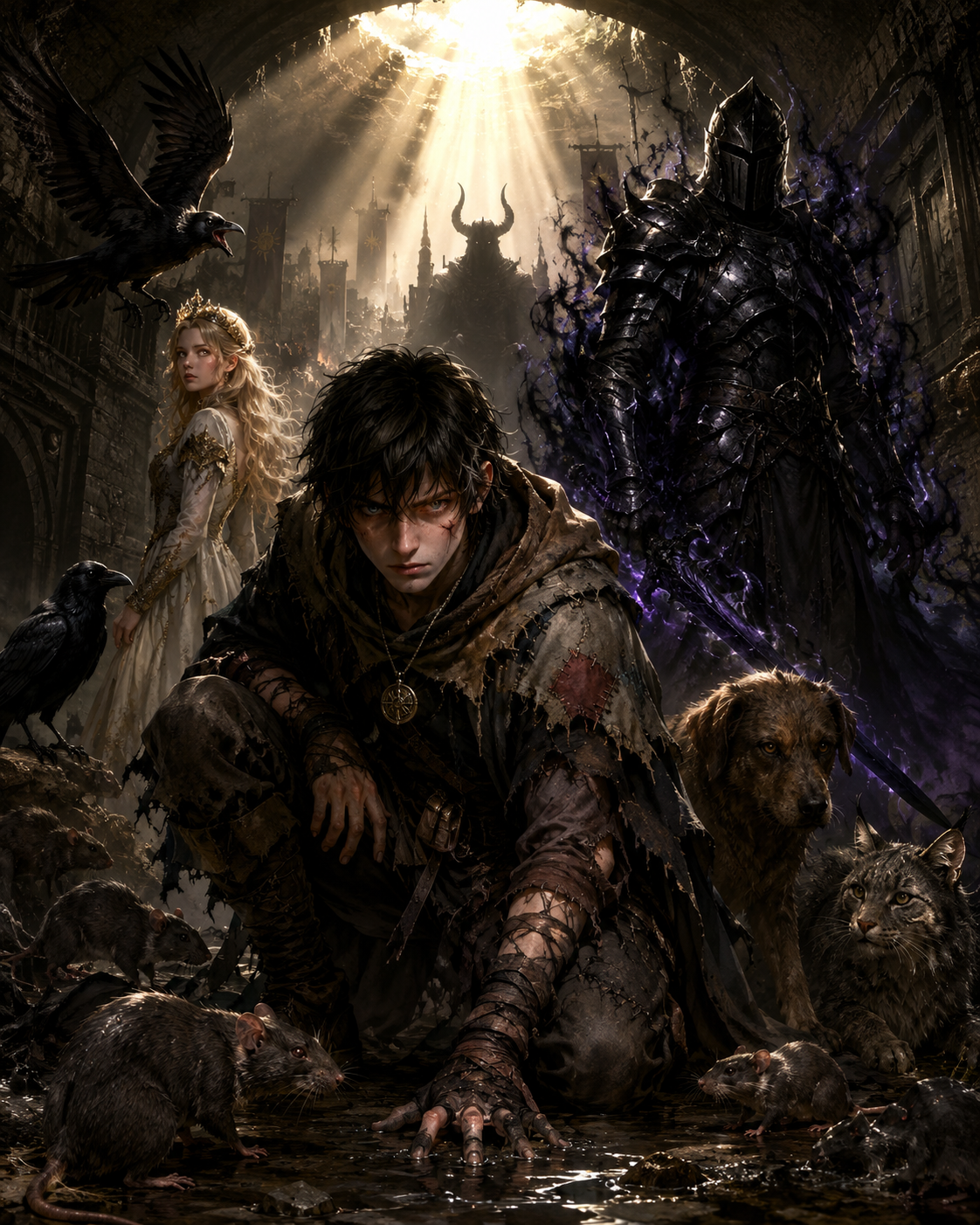

Dr. Michael A. Scordato’s Note to the Reader
Lives Riding: The Nathan Principle at Work in Story
“Keep your heart with all diligence, for out of it spring the issues of life.” — Proverbs 4:23 (NKJV)
You are holding a story about a boy who names himself after something the world throws away.
He calls himself Maggot. Not as self-pity. Not as resignation. He chooses it the way a soldier chooses a callsign — with clear eyes, understanding exactly what the word means, and deciding that the meaning is his to own rather than his to be shamed by. A maggot, as he explains to no one and himself simultaneously, cleans the wound. It does not choose the rot it inhabits. It simply does what it was made to do. It removes what is dead. It protects what is still alive.
This book is, at every level, about that work. The visible plot — the poacher, the Black Knight, the vault, the demon’s crown, the palace that leans — is the surface of a deeper story about what happens when people who have been discarded by the powerful discover what they are actually for.
It is also, beneath that, a Biblical counseling document delivered through the side door.
“…we also glory in tribulations, knowing that tribulation produces perseverance; and perseverance, character; and character, hope.” — Romans 5:3–4 (NKJV)
A maggot does not choose the wound it inhabits.
It simply does what it was made to do.
the Robin Hood Dynamic
“Therefore, to him who knows to do good and does not do it, to him it is sin.” — James 4:17 (NKJV)
Maggot is not a cartoon villain. He is a person doing genuinely good things by genuinely compromised means. This is the most common presentation in Biblical counseling — not the person who is clearly wrong and knows it, but the person who is doing something that produces real immediate good and cannot yet see the cost of the method.
The Robin Hood moral economy works like this: the system is corrupt, so I operate outside it; the results are beneficial, so the method is justified; “I will return to legitimacy when the situation is resolved” is almost always proclaimed. The problem is that the situation is never fully resolved, the method becomes the habit, the habit becomes the character, and twenty years later the person cannot imagine a legitimate alternative, has no problem endorsing others doing what is immoral or illegal, because their entire moral imagination has been shaped now by the illegitimate one.
Rom 3:8 (NKJV) — “And why not say, ‘Let us do evil that good may come’?” This is not hypothetical. It is the story of every person who told themselves their compromise was temporary and found, a decade later, that they had become the person they were temporarily pretending to be. The scars on morality that isolation and compromise produce are real, lasting, and compounding. The unforeseen butterfly effect of moral choices engrained into their children is one of the most under-addressed topics in pastoral care — because by the time the snowball is visible, it has been rolling for years. A justification system starts for accepting and allowing evil which gets passed on to your children emulating as well as all of those around you that your life influences. The reap what you sow domino effect (Galatians 6:7-9).
Governing this guide is 2 Timothy 1:7. The sound mind (Greek: sophronismos — disciplined, self-governing thinking oriented toward wisdom) is the destination. The power and the love are the fuel. The spirit of fear is the enemy’s primary offering. Every chapter shows some mixture of all four. The guide helps you find them. The good news, which 2 Timothy 1:7 and the trajectory of Maggot’s story both affirm, is that the sound mind can be recovered. It takes time. It takes steps. It takes the burden-bearing of others — people willing to name what they see without condemning the person they see it in. Maggot is moving. The guide tracks the movement. Maggot does not arrive at perfection. But he is on the road to a new life he had never believed would be possible all because he now faced life no longer alone, but rather through building his own type of family.
Romans 12:10 (NKJV), ”Be kindly affectionate to one another with brotherly love, in honor giving preference to one another…” Romans 15:1 (NKJV), “We then who are strong ought to bear with the scruples of the weak, and not to please ourselves.” 1 Thessalonians 5:11 (NKJV), “Therefore comfort each other and edify one another, just as you also are doing.” Galatians 6:2, “Bear one another’s (heavy) burdens, and so fulfill the law of Christ.” Ephesians 2:19, “Now, therefore, you are no longer strangers and foreigners, but fellow citizens with the saints and (family) members of the household of God”
CONTENTS
Seventeen chapters tracing Maggot’s journey from a nameless poacher in the Oakhaven under-slums to the moment he discovers exactly what he is willing to become to save the people he loves.
Part I — The Weight of Rot
Chapter 1 — The Weight of Rot
Chapter 2 — Burlap and Black Mana
Chapter 3 — The Guardian at the Outhouse
Part II — Trust Forged Underground
Chapter 4 — The Eastern Branch
Chapter 5 — The Lava Run
Chapter 6 — The Sub-Level
Chapter 7 — What the Walls Remember
Chapter 8 — Eleven Journals
Chapter 9 — The Junction Meeting
Part III — The Vault
Chapter 10 — Twenty Minutes
Chapter 11 — The Lynx-Eye Record
Chapter 12 — The Lead Case
Chapter 13 — What Was Never Hers to Take
Part IV — The Crown Below the Crown
Chapter 14 — The Crown Below the Crown
Chapter 15 — Brynhild Vaeloth
Chapter 16 — Two Horns in the Dark
Part V — Beloved
Chapter 17 — Beloved
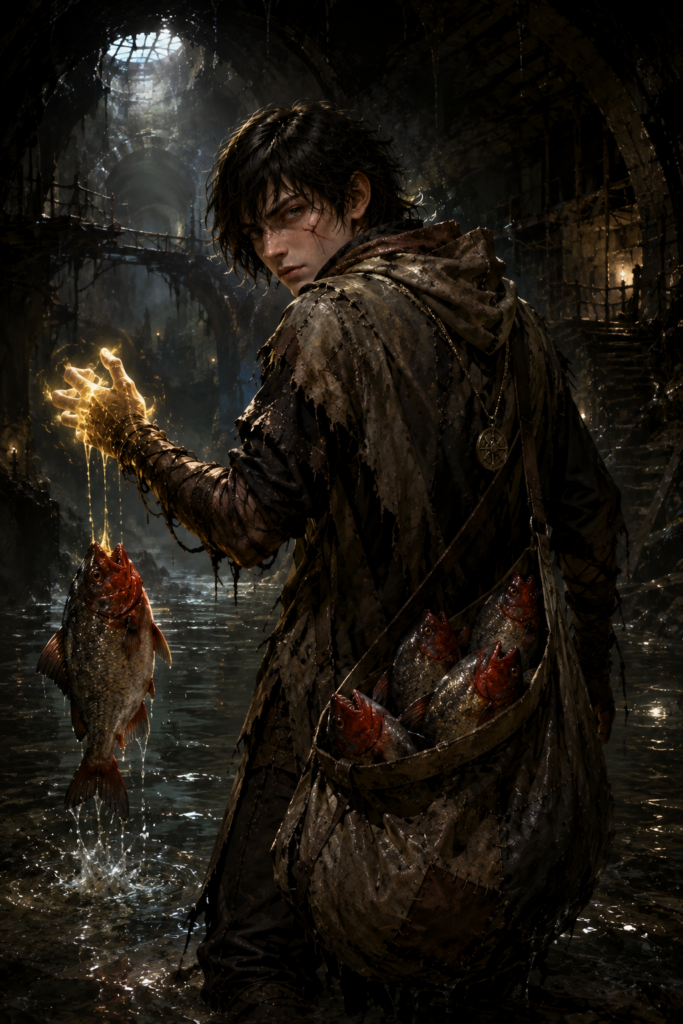
MAGGOT
Chapter 1
The Weight of Rot
The silver line across his cheekbone burned before he even opened his eyes.
In the dark behind his eyelids, it always happened the same way. It always started with the sound of the crowd.
He was eight years old. He remembered that much. Eight years old and running through the broad stone avenue of the Merchant’s Quarter with his worn canvas bag clutched to his chest, the precious glass vial inside rattling against the crude surgical knife his mother had given him for safekeeping. The vial contained three fluid ounces of Pale-Lung Tincture — a distilled extract of cave orchid and silver fungus, expensive as dragon teeth, rare as kindness in Oakhaven. He had spent six months scraping together every copper coin, every Life Point his small, scrawny body could produce through legal labor. He had cleaned fishmonger stalls. He had unloaded grain barges on the black river docks. He had spent three evenings in a row letting a Dwarven physician’s apprentice take blood samples for a scholarly study on street-born immunities, just to earn the last few coins.
He had the medicine. He was running home. His mother was going to breathe again.
The crowd roared.
A column of golden light split the sky above the Merchant’s Quarter. The earth shook. Citizens cheered and wept and threw flowers from their windows. A massive monster — something serpentine and vast, with scales the color of storm clouds — thrashed in the wide plaza ahead. And striding toward it, armored in blinding plate mail that caught the sun like a mirror, was the Golden Hero.
He was magnificent. He was enormous. He was everything the bards sang about. The crowd loved him with the blind, animal devotion of people who had never been hungry.
Young Maggot tried to dart around the edge of the plaza. He was small. He knew the side streets. He pressed himself against the wall of a grain warehouse, his bag hugged tight, his eyes fixed on the far alleyway that led toward home.
He almost made it.
The Hero pivoted in his battle. A serpent tail swept low and wide, scattering a cluster of merchant stalls like kindling. The Hero’s golden eyes swept the chaos around him — calculating, hunting for a weapon, a tool, anything to channel his holy energy into a killing strike.
His gaze fell on the boy in the worn patchwork tunic.
Specifically, it fell on the boy’s bag.
The canvas strap ripped away in a single, effortless motion. The Hero’s hand simply swept out like a hawk snatching a field mouse, the massive gauntleted fingers wrapping around the bag’s strap as the warrior spun back toward the monster. Young Maggot stumbled, fell to his knees on the stone.
“Wait,” he said. It came out barely a whisper.
The Hero had already raised the bag. He drove the crude surgical knife through the vial’s glass body, using the metal to focus and direct a column of holy light that erupted through his fist and straight through the knife’s blade, channeling a blinding lance that the monster recoiled from in shrieking agony. The canvas bag combusted. The medicine, the vial, the knife — they all vaporized in a single second of purple and gold steam.
The crowd erupted. Flowers rained down from every balcony. The Hero raised his fist in victory, turned to face his adoring city, and smiled the smile of a man who had never once been asked to pay for anything he took.
Young Maggot was already running. He ran the entire way home, his lungs burning, his hands empty.
He was too late.
He sat beside his mother’s narrow bed in the dark and held her hand while the rattle in her chest got quieter and quieter. A thin tabby cat with a torn ear — a stray that had been sneaking through their broken window for months — curled itself against his mother’s feet, as though it understood that warmth was the only thing left anyone could offer. His mother never said a cruel word. She stroked his hair with the last of her strength and told him he was her whole world.
Then her hand went cold, limp, and dropped.
The tabby cat turned its enormous amber eyes on him. It meowed once — a small, broken sound.
That night, weeping alone in the dark, the boy felt something ignite inside his chest. It was not holy and it was not golden. It was grey. It was the cold, flat grey of ash and poverty and grief. It rose through his veins like ice water, pooling in his hands, and when he pressed his palms against his own face in helpless, animal agony, his fingers slid through his own flesh with a terrible, silent ease.
The sharp physical shock broke the emotional hysteria instantly.
He looked at his hands. Blood. A thin, precise line drawn from his temple to his jaw, smooth as a surgeon’s incision.
He had done that to himself.
The boy without a name looked at the tarnished iron medallion that had fallen from the canvas bag during the violence — the only thing cheap enough, worthless enough, that the Hero had not bothered to grab. He did not know, then, what it truly was. He knew only that it had been his mother’s, and that the Hero had left it behind, and that those two facts together made it the most important thing in the world. He put it around his neck.
He buried his birth name with his mother.
He chose a new one.
He saw one on his mother’s wound. Working for the healers, used by non-magic common life. He recalled the practice brought back from the historic battlefield to removed decayed flesh so infection does not stay. He remembered how healers theorized how debridement (tissue cleaning) happens as it secrete digestive enzymes that liquefy dead (necrotic) and infected tissue. It consumed only the decaying flesh, leaving healthy, living tissue entirely untouched. Disinfection occur as it fed, consuming and destroying bacteria (including antibiotic-resistant strains) within their guts. Its’ secretions also contain natural antimicrobial molecules that actively fight off local wound infections. Healing stimulation from the constant probing and physical movement stimulate the wound base, promoting blood circulation and the growth of new, healthy tissue.
A maggot was a small thing. A filthy thing. A thing that lived in the rot that the grand and glorious left behind. A thing that was never celebrated, never thanked, never remembered.
But a maggot cleaned the wound.
A maggot survived.
~ ~ ~
Maggot sat bolt upright, gasping.
The stray cat on his feet — a descendant, maybe, of that long-ago tabby, or just another in the string of strays that seemed to find him no matter where he slept — startled awake and dug its claws into his ankle in retaliation.
“Same dream,” he rasped, pressing his thumb against the silver scar on his cheek. “Same cursed dream.”
The cat flicked its torn ear and regarded him with the calm, absolute contempt that cats reserved for people who woke them before dawn. Then it curled back into a tight comma shape and went back to sleep, apparently deciding that Maggot’s existential suffering was not sufficient reason to remain conscious.
Maggot exhaled through his teeth and looked around his hovel.
Home. By any objective accounting, it was an insult. The hovel occupied the bottom of an old drainage chimney in the deep under-slums of Oakhaven’s western ward. The walls wept black moisture. The floor was uneven stone covered with a single layer of salvaged cork and a few squares of industrial felt. His hammock was rope and canvas. His furniture was a crate, a smaller crate, and a third crate that he used as a step to reach the drainage pipe that led to the rooftops. The air smelled of the river, of coal smoke, and of the dead gutter-rat that had expired somewhere behind the far wall two days ago and which he had not yet located or evicted.
To Maggot, it was the finest home he had ever had. Because he was the only one who knew where it was.
He stood up, his body moving through his morning routine with the muscle memory of a decade’s careful survival. He checked the tripwire across the lower entrance hatch — still intact. He checked the single Soot-Crow feather he wedged in the upper exhaust slit every night — still in place, meaning no one had pried the vent open while he slept. He checked his patchwork cloak, running his fingers through the internal loops by touch: the cracked Dwarven monocle, the flexible iron rod, three clay vials of dried Goblin smoke-powder, a coil of spider-silk cord, and the three Elven bone needles he kept in a sewn leather fold near his left wrist.
Then, lastly, almost reluctantly, he checked his neck.
The tarnished iron medallion hung from its fraying cord, heavy and dull. To anyone else it looked like a worthless piece of scrap. He pressed it against his sternum for a moment, feeling nothing in particular, then tucked it beneath his tunic.
He checked his internal mana reservoir. His Grey Magic filled him the way water filled a very small cup — enough for perhaps four seconds of active cutting before he ran dry. He had burned through most of his reserve two days ago picking a merchant’s strongbox on the third level of the Labyrinth Dungeon. He needed to rest and restore. He needed cheap gutter-alcohol for his wounds and a few hours of actual sleep without the dream.
Instead, he had a job to do.
He climbed.
~ ~ ~
The rooftops of the under-slums belonged to no one and to everything. Maggot moved across them the way the Soot-Crows moved — low, unhurried, reading the architecture rather than fighting it. His boots were soled with layers of wool and compressed cork, silent on the rain-wet clay tiles. The pre-dawn city spread out below him, a maze of lantern-light and shadow. Above, in the High Ward, the usurper King’s palace glittered with enchanted torches that never went out. Below, in the streets, the City Watch’s Marrow-Hounds were making their rounds, the sound of their armored paws on cobblestone carrying clearly through the still air.
Two Soot-Crows materialized from a chimney top and fell in beside him, gliding silently on either flank. They were his spotters. They had been his spotters for three years. He had never named them because names implied sentiment and sentiment was a kind of mana he could not afford to spend.
One of them dropped a small, shiny copper button into his palm as it passed. Guard patrol, western alley, new route. He changed his trajectory without breaking stride.
“Good birds,” he muttered, barely a breath.
The crows said nothing. They were professional.
He had never examined why they followed him. He had assumed, as with most things, that it was practical — he moved through their territory without threatening them, he left food, he was consistent. But there were mornings, in the pre-dawn quiet, when the way they moved with him felt like something more than habit. As though they were not simply tolerating his presence in their territory, but actively choosing it. He did not think about this for long. He had a job to do.
He reached the iron drainage grate above the Labyrinth’s third perimeter well before sunrise. The grate was secured with a heavy brass lock that bore the King’s royal seal. Maggot crouched before it, drew his cracked Dwarven monocle from his cloak, and pressed it to his eye.
Through the magnifying lens, his maxed-out Perception mapped the internal architecture of the lock. Brass tumblers, three of them, each requiring a specific weight of pressure in a specific sequence. A normal lockpick could do it in four minutes if you were good. Maggot did it in four seconds. He extended his right index finger, drew a microscopic thread of his scarce mana down to his skin, felt the dead, terrifying silence that always preceded his magic, and pressed his fingertip flat against the brass face of the mechanism.
Snick.
The lock’s internal bar sheared apart as though it had always been made of soft cheese. He pulled the grate open, slipped through, and lowered himself into the darkness below.
~ ~ ~
The Labyrinth Dungeon smelled of ancient stone, deep water, and the faint, sweet rot of bioluminescent fungi. Maggot had been inside a hundred times. He knew the first three levels the way he knew the lines of his own scar. He moved without a torch — his Perception did the work, reading pressure differences in the air to map the tunnel geometry, tracking the subtle vibrations in the stone to locate living things at distance.
He found the underground river pool exactly where he expected it: a broad, still basin in the second sub-level, its dark surface trembling with the movement of what lived below. Red-Fang Piranhas. Their white, firm flesh was highly sought after by the wealthy — a single prepared plate went for fifty gold coins at the noble restaurants in the high ward. Maggot could carry six in his salt bags without difficulty. Six piranhas equaled three hundred gold. Three hundred gold, filtered carefully through three separate black-market intermediaries, equaled medicine for the western ward’s orphan house for six weeks.
He was not doing this out of kindness. He was doing it because the western ward’s orphan house sat directly above his primary escape tunnel network, and sick orphans generated noise that attracted City Watch patrols.
He told himself this so often it almost sounded true.
He dropped a single bead of dried rat blood into the water. The pool exploded into a snapping, silver-white frenzy.
He extended one finger. Breathed. Drew the mana.
Snick. Snick. Snick. Snick. Snick. Snick.
Six perfect fish, each cleaved silently from the water and dropped into his salt bag with the gentle precision of a surgeon removing shrapnel. His mana pool bottomed out on the fifth stroke, forcing him to use pure Dexterity and Luck for the sixth — and Luck answered, his blind grab aligning perfectly with the exact moment a prize specimen leaped to bite his wrist. He caught it by the body and dropped it in before it could take the finger. He did not call it luck, exactly. He never had. There was something in those moments — when his supply ran completely dry and something answered anyway, something steady and reliable that had no name he was willing to give it yet — that felt more like grace than chance. He filed it away, as he always did, and moved on.
He zipped the bag. He allowed himself exactly half a second of quiet satisfaction.
Then his Perception screamed.
The temperature in the tunnel dropped ten degrees in a single breath. The bioluminescent fungi on the walls dimmed, as though the light itself was retreating. The ambient drip and whisper of the underground river was swallowed whole by a low, resonant hum that vibrated behind Maggot’s molars like a held note on a bass string.
The Labyrinth’s deeper inhabitants — Needle-Hounds and Glimmer-Snails and the blind, pale cave-lizards that patrolled the stone walls — had gone entirely still.
Maggot set down his salt bag with the care of a man setting down a sleeping infant. He did not reach for his iron rod. His mana was empty. He had no offensive power and no Vitality to absorb a direct strike. He had his Perception, his Dexterity, and his Luck — and the mathematical awareness that he was currently standing in a dead-end sub-level tunnel with exactly one exit.
The dark at the end of the tunnel solidified. It did not brighten — it compressed, turned a deeper shade of nothing, and then from within that compressed darkness, a shape coalesced.
The Black Knight filled the tunnel from wall to wall. The unpolished iron plate armor absorbed every available scrap of light. No plume, no crest, no sigil. Just the pure, enormous mass of something that had decided to exist inside a human shape and had not quite managed the warm parts of that project. In the Knight’s right gauntlet, a spark.
The spark became a weapon with the sound of tearing silk: a solid-light greatsword of pure, pitch-black mana, forged from nothing into something in the space between two heartbeats. It was four feet of absolute night given an edge.
Maggot’s fight-or-flight instinct lit up every nerve in his body simultaneously.
He did neither.
Because the greatsword drove itself into the stone floor of the tunnel. The Black Knight sank to both knees with a crash that shook the cave walls. The black mana blade dissolved into mist. And the massive, armored head bowed until the iron visor nearly brushed the toes of Maggot’s worn leather boots.
The silence was enormous.
“I have tracked the resonance across three provinces, Your Highness,” the Knight said. The voice came from behind the sealed visor as a low, mechanical hum, stripped of any echo. “The usurper King believes he destroyed your bloodline entirely. He does not know that the true Prince of the Sunken Dynasty still draws breath.”
Maggot stared at the kneeling warrior.
“You’ve got the wrong maggot, tin can,” he said, after a moment. His voice was flat and cold. “I don’t know what trick this is or who sent you, but I am a poacher with six stolen fish and no mana, standing in an illegal sector of the King’s dungeon. Get up, get out, and find your prince somewhere else before I cut a hole in this wall and leave you down here with the Needle-Hounds.”
The Knight did not move. A massive gauntleted hand rose slowly, not as a threat, but as a direction — pointing at Maggot’s chest. At the place where the old tarnished medallion rested against his sternum beneath three layers of cloth.
“The seal upon your neck does not lie, sir,” the Knight said softly. “Where your magic has worn away the false iron coating over the years, the star-steel beneath is exposed. Look for yourself.”
Maggot’s hand moved to his neck before he made the conscious decision to move it. He pulled the medallion free and pressed his cracked Dwarven monocle to his eye.
The magnified image hit him like a fist.
In the places where his mindless scratching and fidgeting over the years had sheared away the fake iron patina — his “Cut” trait activating unconsciously in moments of stress — the surface beneath was not iron at all. It was a flawless, blazing alloy of star-steel and crushed sapphire. Even in the dim light of the underground river, it pulsed with a cold, deep, royal glow. The crest etched into it was ancient. He did not recognize it consciously. But something beneath consciousness did — something that had been living in his bones his whole life like a buried root system, waiting for a reason to grow.
Maggot looked from the seal to the kneeling, unmoving Black Knight.
Then he looked at his salt bag full of stolen fish.
Then he looked at the tunnel ceiling, as though there might be some instruction carved into the rock. There was not.
“I,” he began, and stopped. He tried again. “I am a maggot. I live in the rot. Whatever that thing is around my neck, whoever you think you see when you look at me — you are wrong. I don’t want your crown, I don’t want your war, and I don’t want your loyalty. The last person who decided to care about something noble in this city died in a bed that smelled like damp wool because a Hero with a shiny sword decided her medicine was more useful as a distraction.”
His voice had started hard and ended quiet. He hated that. He pressed his thumb against his silver scar and let the familiar sharpness of it anchor him.
The Black Knight did not rise. The black mana around the gauntlets had gone completely still — no threatening flicker, no dramatic pulse. Just the deep, resonant hum of an inexhaustible reservoir being held in careful, absolute stillness.
“I know,” the Knight said. “About your mother. About the Hero. About the medicine. I know what was taken from you, and I know what it cost. I am not asking you to be a Prince, sir. I am not asking you to want the throne, or want the war, or want anything at all. I am simply here because my vow does not require your permission.”
The Soot-Crows, who had followed Maggot silently down through the dungeon entrance, materialized from the shadows above and landed on a rock outcrop to observe the proceedings with the solemn gravity of witnesses at a trial.
One of them looked at the kneeling Knight.
It looked at Maggot.
It looked at the salt bag.
It made a sound that was not quite a caw. It was something more judgmental than that.
“Shut your mouth,” Maggot told it.
He picked up his fish. He walked past the kneeling Black Knight, whose enormous armored form he had to squeeze past sideways in the tunnel. He climbed back toward the surface without looking back.
The sound of massive iron plate armor rising to its feet and following him was, he discovered, about as easy to ignore as an earthquake.
―― End of Chapter One ――
| Ch. 1 The Weight of Rot | ||
| “There is a way that seems right to a man, but its end is the way of death.” — Proverbs 14:12 (NKJV) | ||
| Root Issue Identity formed by abandonment and loss. Maggot buries his name and rebuilds selfhood from the bottom up. | Positive Dynamic Choosing a name that reframes wound as vocation — the maggot cleans, it does not merely suffer. Purposeful identity over shame-assigned identity. | Negative Dynamic The Hero takes without accounting. Glory extracted at the expense of the invisible. Power treating people as resources. |
| The dream sequence establishes the sowing: a mother’s death, medicine stolen, a name chosen in grief. Every subsequent chapter is reaping. | ||
| Key Topic Identity formed through loss and survival outside God’s order | Doing Well Maggot reframes shame into vocation — the maggot cleans the wound. Purpose-seeking even in the dark is a God-planted instinct (Jer 29:11). He does not turn to substances or vengeance. | Not Doing Well Maggot survives by illegal dungeon poaching. This is Robin Hood economics: he tells himself the piranhas are for medicine and orphans, but the method is theft from a royal reserve regardless of motive. Isolation is both cause and effect — no community, no accountability, the wound of the self-sufficient. | God’s Direction 2 Tim 1:7 — the sound mind does not stay in the illegal economy long-term. The first step is not immediate legal employment but honest acknowledgment with a trusted witness (Prov 11:14). God uses Sable’s life-debt to introduce structure (ch. 3). Every legitimate next step requires naming the current step honestly first. Outside support is often what is needed to step up and out of the muck made entrapping current life (Gal 6:2). |
| Key Topic The sin of comfortable observers — the crowd that cheered the Hero | Doing Well Maggot does not become bitter at ordinary people. He analyzes the system rather than destroying relationships with bystanders. | Not Doing Well “The end justifies the means…. right?” NO. The crowd’s cheering enables the Hero’s carelessness. The bystander who applauds evil without understanding what they are applauding becomes complicit in the fruit. This is the political compromise dynamic — voting for convenience, not conscience. | God’s Direction Lev 5:1 — “If a person sins in hearing the utterance of an oath, and is a witness, whether he has seen or known of the matter—if he does not tell it, he bears guilt.” Silence in the face of injustice is not neutrality. It is siding with the injustice, Ja 4:17. |
Chapter 2
Burlap and Black Mana
The gap between the collapsed lean-to and the river-stone block wall was eleven inches wide at its narrowest point. Maggot had used it seventeen times in three years. It was the single most reliable exit from the eastern alleyway network that fed into his rooftop access point, and it was reliable for one specific reason: a human being in full plate armor could not use it.
He went through it without slowing down.
He emerged on the far side and waited.
There was a silence. Then the sound of very large iron gauntlets being placed flat against the lean-to’s support beams. Then a groan of old timber. Then a crack. Then a secondary crack. Then the lean-to’s relationship with vertical became a matter of history, and the eleven-inch gap became something considerably more accommodating, and a wash of pre-dawn light flooded through where a wall used to be.
The Black Knight stepped through the resulting opening. She turned, looked at the lean-to’s new angle, and looked at Maggot.
“That was load-bearing,” Maggot said.
“It was a lean-to.”
“It was leaning against a drainage pipe that was holding up the Gerrick family’s sleeping quarters overhang.”
The Knight looked upward. The overhang was still intact. “The drainage pipe is still carrying the load. The lean-to was adding lateral stress to a joint that was already failing. I reduced the load.”
“You reduced the lean-to into kindling.”
“The Gerrick family will have considerably more light in that corner.”
Maggot looked at the wreckage. He looked at the Knight. “Hold the bag,” he said, and kept walking.
The Knight held the bag and followed. The bag dripped.
Three streets later he tried the passage beside the old tallow-chandler’s. A genuine gap — original architecture, two property owners who had disagreed about the boundary line and each built to what they considered the correct edge, producing forty feet of alley at nine inches wide. He was through it in six seconds.
He emerged. Waited.
A section of the tallow-chandler’s exterior wall separated from the building with a sound that was architectural and resigned. Void stepped through. She replaced the section of wall behind her. It leaned there at an angle that was not quite the original angle but was probably within an acceptable margin if you were not the tallow-chandler, whose name was Bertram and who had four children and a bad knee and who did not deserve to come downstairs and find daylight where his wall used to be.
“You are going to fix that,” Maggot said.
“I will need mortar brick and a binding compound.”
“I know where to get mortar brick. Tonight, after dark, you put that wall back and you do not let Bertram see you do it.”
“As you—”
“And stop saying that. It makes my teeth ache.”
A pause. Then: “Very well.”
Maggot walked. Void followed. Above them, one of the Soot-Crows swept low and dropped a copper button into his palm — single notch on the rim, one guard ahead, stationary. He adjusted left without breaking stride, taking the longer route through the barrel-maker’s yard. The Knight followed without being told which way he was going.
He did not give her credit for this. He noted it, the way he noted everything, and kept moving.
It was somewhere in the barrel-maker’s yard that he decided on a name for her. He could not keep saying “the Knight” in his head every time he needed to think quickly, and “tin can” was a reasonable insult but imprecise. He needed something short. Something that described what she was without implying anything about what she meant to him.
Void. She was a void. She absorbed light. She generated nothing visible. She was an inexhaustible absence of everything except the capacity to solve problems by removing the obstacle between herself and whatever came next.
“Void,” he said aloud, to test it.
She did not respond to it. She may not have known it was directed at her. It did not matter. The name was his, for his own use, and she did not get a vote.
~ ~ ~
Creel ran his operation out of the back half of a legitimate chandler’s supply front in the Merchant Quarter’s secondary ring. His primary business was shipping wax. His secondary business, considerably more profitable, was moving luxury dungeon goods without documentation. He was a narrow-shouldered man in his forties who placed both hands flat on surfaces before speaking, which was a habit developed across twenty years of commerce that could not survive direct scrutiny.
He met Maggot at the back door in the ordinary way, assessed the salt bag with a quick professional eye, and opened with an offer that was thirty-eight percent below fair market value.
This was also ordinary. The opening offer in any negotiation with Creel was always an insult, delivered with the bland confidence of a man who had determined that most sellers were more afraid of losing a sale than of being cheated. Maggot had been selling to Creel for two years and had never once accepted an opening offer. The negotiation between them had calcified into something almost ritual. Insult, counteroffer, controlled disagreement, arrival at approximately seventy percent of fair value, both parties leaving without anyone’s feelings being consulted.
He was in the middle of his opening counter when Void stepped into the doorway behind him.
She did not do anything. She was simply there, filling the doorway the way a closing vault door filled a frame, the void-mana suppressed as he had asked, so that the only things communicating her nature were the armor, the scale, and the specific quality of stillness that very large things achieved when they had decided to stop moving.
Creel stopped speaking mid-sentence.
The silence that followed was the kind that happened when a man recalculated every assumption underlying his negotiating position, in real time, while the other party watched.
“Friend of yours?” Creel managed.
“Carrying my bag,” Maggot said. “Full market value, Creel. Tonight.”
Creel looked at the bag. He looked at Void. He looked back at the bag with the expression of a man who had decided that today was an excellent day to demonstrate his commitment to fair commerce.
“Full market value,” Creel agreed, and began counting coin with an efficiency Maggot had never previously witnessed from him.
The coin was correct. All of it. Maggot checked it by weight, confirmed by count, and said nothing. He tucked it inside his cloak and turned to go.
“You’re welcome,” Void said. Not to Creel. To Maggot.
“I was going to get the right price anyway.”
“You have been selling to that man for two years at seventy percent of fair value.”
“He paid it tonight because you were standing there.”
“Yes.”
“That is not the same as getting the right price. That is frightening someone into compliance.”
“The outcome is the same.”
“The outcome is one thing. How you reach it is another.” He turned a corner without slowing down. “Creel has a wife and two apprentices and a supply debt with the western shipping office he’s six weeks behind on. He gave me full price tonight because he was afraid of you, not because it was right. Tomorrow morning he’ll be looking for somewhere to make back the difference.”
Void was quiet for a moment. “I understand the distinction.”
“Good.”
“It is a more considered position than I expected.”
“Maggots have considered positions. People just don’t ask them.”
She said nothing further on the subject. He noticed she did not argue with it. He noticed also that the Gutter-Ferrets they passed on the canal route — long, pale creatures that had developed their instincts across generations of life in the city’s margins and which vanished at the first indication of a threat — did not vanish. They paused, assessed Void, assessed Maggot beside her, and went back to their business. As though the combination of the two of them made a kind of sense that either alone had not.
He filed this next to the thing about the Soot-Crows and kept walking.
~ ~ ~
Brother Aldric ran the orphan house on the western canal with the exhausted, determined competence of a man who had long since stopped asking the city for help and simply proceeded without it. The building had been a wool merchant’s warehouse before the merchant lost his contract and his willingness to continue having opinions. Brother Aldric had three rules: no fighting inside the building, no going to the canal unsupervised, and no bringing unannounced large objects through the front door.
He had written these rules with children in mind.
Maggot had never used the front door. He went around to the kitchen window at the back, the one left unlatched on nights when supplies were low, which in this winter was every night. He set two fish on the inside sill in their salt bags to stay cold. He set a small folded paper beside them. The paper said, in the block letters he used for messages because they had no individual character to identify him: From the surplus. Do not thank anyone.
He pulled the window almost closed and left the latch where it had been.
The grey tom was sitting on the kitchen step when he turned around.
He had not heard it arrive. He never did. The cat simply materialized at locations it had decided were appropriate with the serene inevitability of something that had mastered being where it chose to be without the inconvenience of being observed getting there. It regarded him with one yellow eye, its torn ear at its customary angle of professional neutrality.
The cat had started following him roughly six months after the Soot-Crows first appeared. He had noticed it trailing him across three different rooftops one evening, making no attempt at concealment. He had stopped and turned and it had stopped too and returned his look with that same professional neutrality. He had not invited it. He had not fed it anything the first three times. On the fourth encounter he had left a strip of dried fish on a nearby step, not offered directly but available, and the cat had eaten it with the matter-of-fact efficiency of an animal that had made a decision and was now executing it.
He set a strip of fish on the step beside it, separate from the orphanage’s portion.
The cat ate it without ceremony.
“Go on,” he said. “I’m working.”
The cat stood, stretched with the profound deliberateness that cats reserved for situations where they wished to communicate that they were moving on their own schedule and not his, stepped off the step, and sat down against the alley wall. Where it continued to watch him.
“That is not going,” he said.
Its ears came forward. Not at him. At something behind him, near the alley entrance.
He turned and checked. Empty. But the cat’s ears held their position for three more seconds before relaxing. Something had been there and had moved on. He added it to his threat accounting and adjusted his departure route by one street north. He did not say thank you out loud. He thought it, which was close enough.
It was on his way back out of the yard that the girl appeared.
She came through the kitchen door at the moment that was worst for him and most effective for her, which in his experience was how she always timed it. Eleven years old, copper-red hair in two untidy plaits, the particular quality of attention in her eyes that he had first encountered in a Dwarven scholar and had not expected to find in a child but which he had by now accepted as simply a feature of her. Her name was Danna. She had been at the house for four years.
“Uncle Maggot,” she said.
He stopped walking. He had been walking away deliberately and she had stopped him with two words, which was a negotiating technique he had to respect even while resenting it.
“I’m working,” he said, not turning around.
“You’re always working.” She came down the step and stood in the yard. “Who is that?”
Void was standing at the yard’s edge with the stillness she maintained in situations she had not been briefed on. She had not generated any mana. She was simply standing there, which was quite enough.
“Someone I am temporarily working with.”
“She’s very large.”
“Yes.”
“Is she a friend?”
“No.”
“You said that about the crows.”
He turned around slowly.
She looked back at him with the patient, level directness that she deployed in conversations like this — the ones where she had found the correct pressure point and was applying measured force while giving him the option to redirect, because she was perceptive enough to offer exits even when she did not intend to let him use them.
“I did not say that about the crows,” he said.
“You said they were operational. Tools in a network. That you weren’t attached.”
“That is accurate.”
“And then the one with the notched feather got sick and you went back to the rooftop three times in two days to leave food where she could reach it without flying much.”
A very specific silence occupied the kitchen yard. The grey tom sat in it with the dignity of an animal that had nothing to add and knew it.
“She is a component of a functional intelligence network,” Maggot said. “Operational continuity required—”
“You were worried about her.”
“I was managing a resource.”
“You were worried about her.”
He looked at the sky. The sky offered him nothing. He looked back at the eleven-year-old, who had the expression of someone who had won and was being generous enough not to say so.
“Go inside,” he said.
She went, but stopped in the kitchen doorway. She looked at Void with the uncomplicated curiosity of a child who had not yet learned to perform fear of large things. “What’s your name?” she asked.
“Void,” said the Knight.
Danna considered this. “Is that your real name?”
“It is what I am called.”
“That’s different from a real name.”
“Yes,” Void said. “It is.”
Danna looked at her for a moment longer, with the particular expression she used when she was cataloguing something for future reference. Then she looked at Maggot. “She has your eyes,” she said. And went inside.
Maggot did not move for a moment.
Then he said, to no one in particular, “She has an overactive imagination,” and walked out of the yard.
Void followed. He was very aware, in the peripheral register his Perception maintained even when he was actively trying not to think about something, that she was looking at him. He let the awareness sit where it was and concentrated on the route.
~ ~ ~
They were four streets from the hovel when he made the mistake of speaking first.
He had been managing the silence successfully since the orphan house, keeping himself inside the operational frame of route and threat accounting. Then the question arrived in the part of his mind he had been trying to keep clear of it.
It was a simple question. It had been sitting under the surface of the morning since the tunnel. He had been declining to ask it because asking it would imply the answer mattered, and he had not decided whether he was prepared to let the answer matter.
He asked it anyway. Eleven hours without sleep and an empty reservoir and a morning that had exceeded its allocation tended to degrade his discipline about leaving things alone.
“How long did you serve her,” he said.
No name needed. They both knew.
Void did not answer immediately. She had a habit of this — not the pause of someone collecting their thoughts but the pause of someone choosing between several true things and deciding which to offer, and at what depth.
“From her eighth year,” Void said. “Until the night the coup came. Nineteen years.”
He said nothing.
“I was assigned to her household guard when I was barely older than she was. It was considered unusual, but she told me on the first day that she did not want a guard who followed her like a shadow. She said if I was going to be in her household I would participate in it. She gave me a chair at her table and a standing invitation to her morning reading sessions and she treated every security objection I raised as an interesting puzzle rather than an inconvenience.” A brief pause. “She was eight years old. She had the philosophical approach of someone three times that age.”
Maggot looked at the canal they were passing. Its surface was grey-brown in the morning light. A family of wide-billed waterfowl moved along the near bank in the unhurried way of birds going about legitimate business. One of them turned its head and held a look at him for a beat longer than the foot traffic on this canal usually warranted. Then it continued on.
He did not think about it. He thought about what Void was saying.
“She used to count the frost-flowers on the windows,” Void said. “Every winter, the first cold snap. She said each one was a different design and she wanted to draw them before they melted. She never had time. There was always something — court protocol, correspondence, appointments. I used to get up before her and count them so I could tell her how many there had been if she missed them.” A quality in the voice that was not quite a pause. “By the third winter she had figured out what I was doing. She never said so. She simply started getting up earlier.”
The canal was quiet.
“She told me something,” Void said. “In the last year, before the coup. She had worked out that trouble was coming — she was perceptive in ways that the nobility consistently underestimated because they preferred to think of her as decorative. She told me she thought something was building. That she wanted me to know that whatever happened, whatever the kingdom decided it was or wasn’t, she had already arranged what mattered most.” A pause. “I asked her what she meant. She said: the line continues. I didn’t understand it at the time.”
He pressed his thumb against the silver scar. The familiar sharpness of it anchored him when the morning’s accumulated weight started pressing in directions he hadn’t planned for.
“She knew,” he said. It was not a question.
“She suspected. She was managing three problems at once, mostly alone, and the people around her were either loyal to factions she didn’t trust or too afraid to tell her what she needed to know.” The mechanical quality of Void’s voice carried something that was not grief and was not anger but occupied the space between them that did not have a clean name. “She was twenty-two years old. She managed more, with fewer resources, than most people twice her age and with twice the support. She did it without complaint and without recognition. The historians the usurper employs do not mention her at all.”
“I know,” he said. The words came out quieter than he intended.
“Yes,” Void said. “I thought you might.”
They walked the rest of the canal route without speaking. It was a different kind of silence than the operational quiet he usually maintained — not the absence of things said, but the presence of things that did not need saying. He was not comfortable with it. He was also not, he found, motivated to end it. He let it exist and walked inside it.
~ ~ ~
The dog was sitting outside the entrance to his drainage cistern when they arrived back at the collapsed merchant house.
It was a large, patchwork animal of no identifiable specific heritage, its coat a mottled combination of brown and white and a section of grey near the left shoulder that looked like a spilled ink map of somewhere with interesting geography. It was missing its right rear leg, the absence neat and long-healed, a structural adjustment fully integrated into its operating reality. It sat in the center of the alley entrance with the composed certainty of something that had made a decision and was done deliberating.
It looked at Maggot.
It thumped its tail once against the cobblestones. Not excited. Not pleading. Declarative. The thump of an animal completing a statement it had already made through the act of being there.
“No,” Maggot said.
The dog thumped its tail again.
“I said no. I have a cat. The cat has opinions about this space and those opinions are not flexible, and I am not going to manage a dispute between a cat and a—” He looked at the dog’s dimensions. “—whatever you are.”
“He has been following our route since the canal,” Void said.
Maggot turned. “Since the canal.”
“He picked us up at the second bridge. He maintained the distance a careful animal maintains when following something it has assessed as safe but has not yet formally approached.”
“You did not mention this.”
“You did not ask.”
The dog was looking at Void now, having apparently completed its assessment of Maggot and shifted its attention to the more interesting variable. Void looked back at it, and in the quality of how the armored helmet oriented toward the three-legged animal, Maggot read something that he recognized as what happened to a person’s posture when they saw something that was affecting them and were keeping the response internal.
“He is a fine animal,” she said.
“He is a stray with three legs and a strategic commitment to my doorstep.”
“He sat facing outward. He was keeping watch.”
Maggot had noticed this already and had been ignoring it on the grounds that acknowledging it would make it harder to maintain his current position.
“He is not staying,” he said.
He reached into his cloak pocket and produced a heel of dried bread he had been carrying since yesterday. He looked at it for a moment. He looked at the dog. He set the bread on the cobblestones in front of it with the motion of someone concluding a transaction.
“That is not an invitation,” he said. “That is surplus I didn’t want to carry.”
The dog ate the bread with the brisk efficiency of an animal that recognized a resource and used it. It did not look grateful. It looked practical, in the way that three-legged animals that had survived to this size in the Rot tended to be practical: it had learned to spend its energy on necessary things.
Maggot went inside. He did not latch the lower hatch behind him, which was a security failure so obvious it could only be read as deliberate.
Void followed. The dog assessed the entrance, made its determination, and followed.
~ ~ ~
By the time the afternoon light had faded from the cistern vent to the grey of the Rot’s evening, the hovel had arrived at a configuration Maggot would not have predicted at dawn.
The dog was asleep across Void’s boots.
This had happened the way these things always happened: through the simple convergence of all the available conditions. Void had arranged herself in the corner with the careful geometry of a person learning a space that was not built for her, her helmet resting against the wall at an angle that was approximately restful. The dog had investigated everything — the cat, the crates, the hammock, the vials on the shelf, the Soot-Crow feather in the vent — and then walked to Void’s corner, circled twice with the methodical sincerity of a dog performing a ritual, and lay down across her boots with the decisive calm of a creature that had identified the correct arrangement and implemented it.
The cat was on its shelf. It was watching the dog with the fixed, unblinking attention it reserved for things it had strong opinions about. It had not descended. It had not made any sound. It was conducting a formal assessment that would resolve, Maggot knew from experience, on its own timeline and not his.
He lay in his hammock. He was not asleep. He was not going to be asleep for some time.
This was not unusual. What was unusual was the reason.
On most nights the reason was the dream, sitting in the front of his mind with the patient hostility of something that considered the invitation permanent. Tonight the dream was where it always was but it was not in front. Something else was in front.
She said: the line continues.
He turned the medallion over in his fingers in the dark. The star-steel, fully exposed now in the section his unconscious fidgeting had worn clear over twenty years, was cool against his palm. In the dark of the cistern it pulsed faintly — a cold, deep glow, barely visible, but present. Steady.
His mother had known. Or suspected. Had managed, in whatever time she had, to ensure that one piece of what they were survived the night the coup came — a tarnished iron medallion cheap enough that a Hero’s sweeping hand would not bother with it, carrying inside it the legal and genetic record of a dynasty the usurper’s government had spent twenty-three years pretending had not existed.
She had counted frost-flowers on windows. She had gotten up earlier.
He pressed his palm flat against the medallion and felt the pulse of the star-steel against his skin, and the scar on his cheek was warm rather than sharp, which was something it had never been before.
Across the cistern, the three-legged dog shifted in its sleep and let out a long, slow exhalation that was the sound of an animal that had found the correct place to be and gone completely to rest in the knowledge of it.
The cat descended from its shelf.
It walked to the middle of the floor. It looked at the dog for a long moment. Then it sat down six inches away. Not touching. Not curled against it. Six inches. The specific distance of a formal position that had not yet become a comfortable one but had decided to remain.
Maggot looked at this from his hammock and chose not to draw conclusions.
He tucked the medallion back against his sternum. He closed his eyes. What she had said sat in the dark behind them with more weight than he had expected it to carry. He had spent twenty years with one fixed understanding of himself: a maggot, a creature of the rot, consuming the waste the glorious left behind, surviving on the margins of a city that did not know he existed and would not have cared if it did.
The understanding was not wrong. It was just, possibly, not the whole of it.
He did not decide anything about this. He was too tired and too empty and too far from any framework that would let him process it responsibly. He simply let it sit there in the dark alongside the warmth of the scar and the faint pulse of the star-steel and the sound of a three-legged dog sleeping in the corner of the only home he had ever chosen.
Above the cistern, through the drainage vent, the twin moons had cleared the Rot’s rooftops. Their double light came through in two thin parallel lines and lay across the floor, across the sleeping dog, across the cat in its six-inch formal proximity, across the iron boots of the unmoving Knight.
Maggot slept.
The dream did not come.
―― End of Chapter Two ――
| Ch. 2 Burlap and Black Mana | ||
| “A righteous man regards the life of his animal, but the tender mercies of the wicked are cruel.” — Proverbs 12:10 (NKJV) | ||
| Root Issue Transactional relationships that become relational. Maggot’s Creel dynamic shows healthy commercial correction; his relationship with the animals shows love operating below the level of intention. | Positive Dynamic Correcting exploitation without vengeance (Creel’s full-market correction). The three-legged dog choosing its own post. Faithful presence before trust is established. | Negative Dynamic Creel’s practiced undervaluation of the vulnerable. The “friction of conscience” that enables exploitation: both parties know the price is wrong, only one acts on it. |
| Void’s frost-flower memory: nineteen years of counting what someone else would lose before they could see it. | ||
| Key Topic Healthy vs. exploitative commerce — Creel’s underpayment corrected | Doing Well Maggot corrects Creel’s exploitative pricing without vengeance and explains why the method matters, not just the outcome. This is integrity in commerce: knowing the difference between a fair deal obtained by fear and one obtained by justice (Lev 19:13). | Not Doing Well Maggot has operated at 70% of fair value for two years without confronting it. Accepting exploitation repeatedly is not humility — it is a trained response to the belief that one does not deserve the full price. This is the scar that survival poverty leaves: normalizing being undervalued. | God’s Direction Prov 11:1 — “Dishonest scales are an abomination to the LORD, but a just weight is His delight.” The counseling goal is not just better prices but the healing of the belief that you are worth less than your work. The Creel correction is step one. |
| Key Topic Animals choosing freely — the beginning of unchosen grace | Doing Well Maggot does not command or exploit the animals. He leaves food, he notices, he does not claim what has not been freely given. This is stewardship rather than ownership (Prov 12:10). | Not Doing Well Maggot files the animals’ choices as “operational” to avoid acknowledging he is being loved. This is a defense mechanism: reframing grace as utility so it cannot be lost. It is the emotional posture of a person who has been taught that love is conditional and temporary. | God’s Direction John 15:16 reminder — “You did not choose Me, but I chose you.” The language of the animals choosing Maggot echoes the language of divine election — not earned, not commanded. The healing step is allowing yourself to receive what you did not initiate. |
Chapter 3
The Guardian at the Outhouse
By the following evening, word had spread through the western ward’s underworld hierarchy that Maggot the poacher had acquired what the street community was cautiously describing as a very large, very permanent shadow.
This was not an exaggeration. Void had established a position outside Maggot’s drainage chimney with the methodical patience of someone who had spent a long time learning how to occupy space without wasting it. She chose the narrow mouth of the alley, where she was visible from three street angles and managed the remaining two through a passive mana displacement that caused anyone approaching in a way that felt predatory to develop a sudden, inexplicable preference for a different route. She had not asked Maggot whether this was acceptable. He had not asked her to stop, which she appeared to interpret as equivalent to permission.
The three-legged dog had stayed.
It had chosen a position directly beside Void’s left greave and appointed itself auxiliary sentry with the cheerful gravity of an animal that had found its correct vocation. When Maggot climbed down from his hovel on the second morning, the dog looked up at him with the round, patient expression of a creature that was on duty and wished him to know it.
“You are not a guard dog,” Maggot told it.
The dog’s tail moved once against the cobblestones.
“The fact that you were sitting facing outward does not make you a guard dog. It makes you a stray that happened to be oriented correctly.”
The dog looked at Void. Void’s helmet tilted downward toward the dog with the quality that Maggot had begun to recognize as the armored equivalent of agreement.
“Both of you,” he said, to both of them, and left for his morning circuit.
He came back two hours later to find that during his absence two men from the Flint Brotherhood had moved into the alley’s approach and attempted to assess the situation. The Brotherhood ran protection arrangements across six blocks of the mid-ward’s commercial strip and had a standing interest in any unexplained influx of coin into the area’s independent operators. Three hundred gold moving through three intermediaries was not invisible to people who monitored that kind of movement for a living.
The two men had left. Maggot could tell this from the boot scuffs on the cobblestones, the direction they pointed, and the speed implied by how far apart they were.
“What did you do,” he said.
“I stood up,” Void said.
Maggot looked at the boot scuffs. He looked at Void. “That was all?”
“I also allowed a small amount of mana to become visible. At the fingertips only. Briefly.”
“How briefly.”
“Long enough to be seen.”
He looked at the scuffs again. The distance between them was consistent with something between a fast walk and a run, and the men had not slowed toward the alley’s far end. “They will not come back,” Void said, which was not a question.
“No,” Maggot agreed. “They won’t.” He did not say thank you. He was keeping a careful accounting of how many times her presence had produced an outcome he would not have produced alone, because he had a feeling the total was going to become inconvenient. “The dog stays out here during the day?”
“He has been maintaining the outer perimeter since approximately the third hour of the morning.”
Maggot looked at the dog, which looked back at him with the steady, undemanding attention of an animal that had made a permanent decision and was no longer open to debate on the subject.
“Fine,” Maggot said, which was not agreement so much as the recognition that the argument was no longer available to him, and went inside.
~ ~ ~
He was checking his mana reservoir — slowly refilling, still thin, another day before it would be reliable — when Void came through the entrance hatch and arranged herself in the corner in the manner she had adopted as her default position in the hovel. Back to the wall. Facing the door. Her helmet rested at a slight forward angle that he had worked out, after two days, was what she looked like when she was going to say something she had been deciding how to say.
He waited.
“When the coup came,” Void said, “I was on the dungeon’s third level. The usurper’s agents had prepared for me specifically. There were fourteen of them, and they used a compound developed by Goblin alchemists — an aerosolized agent that destabilizes void-class mana at its source. I inhaled it before I had identified the threat. My magic collapsed entirely.”
The cat, on its shelf, had gone still in the specific way it went still when the room’s temperature changed in a way it could sense but he could not.
“They held me for eleven months,” Void said. “Dungeon chains sealed with mana-suppression locks. The compound metabolizes slowly. The magic came back by degrees — weeks of partial capacity, then months of gradual recovery. When it returned fully enough for me to work, I broke the chains over two days.” A pause. “I broke some of the bones in my hands doing it. It was faster than waiting. I found I was not even in our country to by-pass any rule of law. Sand Worm’s— those dragon serpents were everywhere.”
Maggot said nothing.
“By the time I reached the city, your mother had been dead for nine months.”
The words sat in the hovel’s damp air without going anywhere. The drip from the north wall crack counted seconds. The dog, outside in the alley, shifted its weight with the sound of a body that had been in one position long enough to reconsider it.
“I know what you are owed from me,” Void said. “I know it cannot be given back. I am not asking you to regard it as anything other than what it is. I am telling you because you have a right to know why I was not there, and I will not allow you to believe it was anything other than what it was.”
“Which was what,” Maggot said.
“Fourteen men, and a compound I had not been warned about, and chains I could not break for eleven months.” A pause that was different from the others. Shorter. “Not abandonment. Not indifference. Not a choice.”
He pressed his thumb against the silver scar. The familiar sharpness of it.
He had spent twelve or thirteen years with a clean accounting of what had happened to his mother: medicine stolen by a Hero, a child too small and too slow to stop it, a cold hand in the dark. He had never extended that accounting to wonder who else had been trying to reach her and had not managed it. He had not wondered because wondering would have required imagining that there were people for whom his mother’s life had mattered, and imagining that was a door he had kept shut because the other side of it was something he did not have the structural integrity to look at directly.
The mathematics of Void’s account were simple. Eleven months in chains. Nine months too late. No gap in that arithmetic into which blame could be inserted without doing it dishonestly.
He did not say he forgave her. He did not have a framework for forgiveness that did not feel like lying about what had been lost. But he heard the accounting. He accepted it as accurate. That was what he could offer, and he offered it the only way he knew how to offer anything: without fanfare.
“You were assigned to her from her eighth year,” he said.
“Yes.”
“Nineteen years.”
“Yes.”
“Then she knew you as well as anyone knew you.”
Void was quiet for a moment. “Better than anyone knew me,” she said. “She made a point of it.”
He nodded once, which was not agreement and was not comfort and was not forgiveness, but was the specific acknowledgment of someone who had just received a true thing and intended to keep it. He picked up the monocle from the crate beside him and turned it over in his hands. After a while he set it down. After a while longer, he slept.
~ ~ ~
The Reaper arrived on the third evening.
Maggot heard him before his Perception formally registered the approach — not because Sable was loud, but because the specific quality of how he moved was familiar in the way that voices were familiar, something the body recognized before the mind had finished processing. Lean, deliberate, each step placed with the unhurried precision of a man who had spent years in environments where careless footfall had consequences. He came down the alley from the north and stopped at the entrance, and the dog looked up at him and did not thump its tail.
The dog did not growl either. It simply looked, with the flat, evaluative attention of an animal conducting an assessment that had not yet reached a verdict.
Sable looked at the dog. He looked at Void, which took slightly longer. He looked at Maggot in the hovel entrance.
“You’ve been busy,” Sable said. His voice was even and unhurried, the voice of a man who had learned that urgency was expensive and saved it for situations that required it.
“I’m always busy,” Maggot said. “What do you want, Sable.”
“You know what I want.”
He did. He had known since the moment he heard the footstep pattern in the alley. He had known, if he was honest with himself, that this conversation was approaching since the night fourteen months ago when he had been on the dungeon’s lower reaches with an empty mana pool and a Dracul between him and the exit, and Sable had come through the lateral passage with a harvesting blade and a decisive lack of hesitation and had made the problem stop existing. A life saved was a debt. He had not argued about it at the time and he was not going to argue about it now.
“Tell me the job,” Maggot said.
Sable came into the alley properly and stood with his back to the wall at the angle of someone who preferred to know where the exits were at all times, which was a preference Maggot understood. He was somewhere in his late thirties, weathered in the specific way of people who spent time in places that were not kind to skin or to patience. He wore nothing that marked him as anything — no insignia, no house colors, no indication of faction or employer. The harvesting blade at his hip was sheathed and ordinary-looking, which was deceptive, because ordinary-looking harvesting blades did not have the specific edge geometry required for the kind of work Sable did.
“There’s a target in the lower reaches of the dungeon’s eastern branch,” Sable said. “Demon-class. Mid-tier. It’s been down there three weeks, which means it’s established enough to be predictable but not so established that it’s called anything else in.” He paused. “I need a clean yield. No contamination. Which means I need your cut.”
Maggot knew what he meant. The harvesting blade opened the demon and retrieved the blood, but the cut it made was broad — the surrounding tissue ruptured, the yield mixed with biological matter that degraded the blood’s mana concentration. A degraded yield was worth a fraction of a clean one. His Cut trait, applied at the correct depth and angle, could open the specific channels from which the blood came without breaching anything adjacent. The yield stayed pure. The price it commanded at market stayed intact.
“Who buys it,” Maggot said.
“Does it matter?”
“It matters to me.”
Sable looked at him for a moment. “Military contractors,” he said. “Not the crown’s. Independent. They use it for the surge capacity — combat situations where a unit needs a mana spike for the duration of a specific engagement.” He shrugged, a small and economical movement. “They know the cost. They pay it anyway.”
Maggot thought about what he knew about demon blood. He knew more than he would have preferred to know, mostly because knowing things was protective and he had never found a category of information where ignorance was genuinely safer. Demon blood gave humans a surge of mana and physical enhancement that lasted between twenty minutes and an hour depending on the user’s base capacity. During the surge, capabilities roughly doubled. Strength, speed, mana output, reflexes — all of it amplified above the user’s natural ceiling.
After the surge ended, the body paid for it. Hours of incapacitation while the mana system rebalanced. Damage to the channels that the borrowed energy had been forced through. With regular use, the damage accumulated. With heavy use, it became permanent. And the surge itself — the feeling of it, the specific quality of that power, the way it felt to briefly be more than what you were — was, by all accounts, difficult to forget.
People who forgot things they had difficulty forgetting tended to go looking for them again.
“How many times have you done this,” Maggot said.
“The job or the blood.”
“The blood.”
Sable’s expression did not shift. “Twice,” he said. “Both times in the field, under circumstances where the alternative was dying. Neither time by preference.” He held the answer there without adding to it, which was the answer of someone who had made peace with having done something he did not fully endorse and was not going to pretend otherwise.
Maggot believed him. His Perception read no physical indicators of the kind that accumulated in people who used regularly. That was not the same as trusting him, but it was a data point.
“A debt is a debt,” Maggot said. “One job. One clean yield. After that we’re even.”
“After that we’re even,” Sable agreed.
From the corner of the alley, where she had been motionless since Sable’s arrival, Void said: “I am coming.”
Sable looked at her. It was not a short look. He appeared to be conducting a significant recalculation. “The dungeon’s eastern branch below the second level is not—”
“I am coming,” Void said. Not louder. Simply more final.
Sable looked at Maggot.
“She comes,” Maggot said. “That’s not negotiable and it’s not a discussion.”
Sable was quiet for a moment. “The black mana will affect the target’s behavior. It may draw additional attention from the lower levels.”
“Then we work fast,” Maggot said. “When do we go?”
“Tomorrow night. Third hour. I’ll meet you at the eastern drainage junction.”
He nodded once, which Sable accepted as confirmation, and Sable left the alley the way he had come into it: quietly, and without leaving much evidence that he had been there.
The dog watched him go. When he was out of sight it looked back at Maggot, then at Void, then settled its chin onto Void’s left greave with the air of a creature that had taken note of this development and filed it in an appropriate category.
“I don’t trust him,” Void said.
“You don’t have to trust him. I owe him a job and I’m going to pay it.”
“And after?”
“After, he goes his way and we go ours.” Maggot leaned in the entrance and looked at the alley where Sable had been. “He saved my life. He also knows exactly what that’s worth and will use it to exactly the right degree and not a fraction more. He’s not a friend and he’s not an enemy. He’s a professional.”
“Those are the ones I trust least,” Void said.
“That,” Maggot said, “is because you have sound judgment.” He went inside. “Don’t tell him I said that.”
~ ~ ~
He lay in his hammock that night and thought about the Dracul.
The one Sable had killed fourteen months ago in the dungeon’s lower reaches had been his first direct encounter with one. He had known about them in the way that anyone who spent time in the dungeon’s deeper levels knew about them — as a category of thing to be avoided, something that the conventional adventuring literature classified alongside the worst of the dungeon’s hazards and described in the flat, clinical language that people used when they were trying not to convey how seriously they meant what they were saying.
A Dracul was a person who had been infected by a specific contagion — not a curse, not a magical transformation, but a disease. A disease that fed on mana in the bloodstream. Ordinary people, bitten by a Dracul, did not survive the infection. Their mana concentration was too low; the disease consumed faster than the body could compensate and the process ended badly and quickly. People with high mana capacity were different. Their systems were rich enough to sustain the infection without immediately collapsing under it, and in those people the disease and the mana reached a kind of terrible equilibrium. The infected person changed. Became something other than what they had been, but not all at once. Gradually. In stages.
The disease was not content with equilibrium. It progressed. It took, over time, everything that was not strictly necessary for its own survival in its host. Memory went first, at the margins — small things, recent things. Then capacity for complex reasoning. Then the parts of a person that were not relevant to the disease’s purposes: affection, connection, the ability to care about anything that was not the next source of the mana the disease required. In the final stages there was nothing left that was recognizably the original person. There was only the hunger, and the capacity to pursue it, and whatever shell of body housed those two things.
The disease could also be transmitted through proximity — through a bite, through direct contact with infected blood. But there was something else. Something Sable had mentioned once, briefly, in the aftermath of the dungeon encounter, and which had stayed with Maggot in the category of things he was not sure what to do with. The Dracul had a form of influence that operated at range. Not strong enough to dominate a healthy mind in full capacity, but strong enough to produce a pull, a draw, a sense of being called toward something without understanding why. A lure. The disease had developed it through generations of hosts the way any disease developed the tools that made it more effective at spreading itself: through the slow pressure of what worked and what didn’t, across countless iterations.
What Sable had said, at the time, was this: some people were resistant to the influence in ways that had nothing to do with their mana level. Not immune — resistant. As though something in them was already operating on a frequency that the Dracul’s lure could not quite find purchase on.
He had not thought about it much since. He thought about it now, in the dark of the cistern, while the dog breathed steadily in the corner and the cat sat on its shelf in the specific quality of wakefulness that cats maintained even in deep silence.
He thought about the Glimmer-Snail that had turned and oriented its pulse toward him.
He thought about the Gutter-Ferrets that had paused and assessed and gone back to their work.
He thought about Sable mentioning, in the same conversation where he had named the Dracul pattern in the lower dungeon, that the frequency of encounters had increased. Not dramatically. Not enough to be a crisis yet. But a pattern, where there had not been one before.
He filed all of this next to the other things he was not examining and closed his eyes.
The dream did not come again. He noted this and did not attach an explanation to it.
~ ~ ~
The betrothal decree was posted on every major wall in Oakhaven by the time they returned from the morning circuit two days later.
Maggot saw it from the rooftops first — the royal color, the crown seal, the specific formal layout of a crown declaration rather than an ordinary notice. There was one on the east wall of the canal bridge, one on the outer face of the High Ward’s lower gate, one on the notice pillar at the junction of the Merchant Quarter’s two main thoroughfares. He read the one on the canal bridge from above without coming down to it, because coming down to it would have meant being seen reading it, and he already knew what it said from the Soot-Crow the Commander had sent ahead with a specific pattern of clicks he had not previously received from her: significant, political, your name.
He had not known she had a click for his name. He had not known she had a click for significant or political either, and the fact that she had developed these in anticipation of needing them was the kind of information that produced a feeling in his chest that he could not immediately file into a sensible category.
He read the decree.
It was written in the usurper King’s characteristic style: formal language, ornate phrasing, every word doing double work — presenting itself as mercy and unity while the structural content described, with precision, the mechanics of a trap. The rightful heir to the Sunken Dynasty was invited to present himself at the Royal Sanctuary for a formal betrothal ceremony. He was to clasp the hand of Princess Aurelia, the King’s youngest daughter. He was to validate the union by placing the Sunken Dynasty’s seal against the star-steel vault in the palace sub-levels. The treasury of four dynasties, which had been sealed since the night of the coup because it operated on bloodline resonance and the usurper’s bloodline was not the right one, would thereby be opened. The King was calling this a dowry and calling it peace and calling it the healing of old wounds.
The reward offered to anyone who delivered the heir was ten thousand gold coins.
Maggot looked at the figure for a moment.
“Ten thousand,” he said, to no one.
“Yes,” Void said, from behind him.
“That is considerably less than what is in that vault.”
“The King’s advisors are not generous men.”
“They are also not,” Maggot said, “very creative ones. They found the seal. They found that I exist. They found that the vault cannot be opened without me. So their solution is a wedding.” He folded the copy of the decree he had taken from the canal bridge pillar and put it inside his cloak, next to the medallion and the monocle and all the other things he carried that were not weapons but had proved over time to be the most important items he owned. “They think I will walk into the palace to open their vault and walk out a prisoner.”
“That is the mechanism, yes,” Void said.
“They do not know much about maggots.”
Void said nothing.
“A maggot does not walk into a trap through the front door,” he said. “A maggot finds the gap in the architecture that the people who built the trap did not think to seal, because they were not paying attention to the parts that looked too small to matter.”
He looked at the palace towers above the High Ward, visible even from here, the royal flag on the central spire catching the morning wind.
He thought about the vault. The bloodline resonance. The King sitting on four dynasties’ worth of accumulated wealth that he could not touch, that had been unreachable since the night he took the throne from the people it belonged to, that would remain unreachable until the specific blood that the seal recognized pressed against it.
His blood.
He thought about what would happen if he went in, opened the vault, and then left — not as a prisoner, not as a compliant heir, but as what he actually was. He thought of the answers he might find in there in relation to the questions he has never dared to ever ask.
He thought about the load-bearing structures of large buildings. He thought about how much his Cut trait could do to the structural connections inside a palace sub-level if he had twenty minutes and a specific knowledge of where the weak points were.
He thought about his mother, managing three problems at once, mostly alone, in the last year before everything came apart. She had arranged what mattered most. She had made sure the line continued. She had done it with the resources she had and the time she had and without complaining about either. And this very much has many links back to her.
He was her son.
He had six stolen fish, an empty mana pool, a drainage cistern, a three-legged dog, a professional crow network, one grey cat, and a Black Knight who had broken her own bones to escape eleven months of chains and had still not managed to arrive in time.
The city wanted him to walk through the front door.
“We need to know the palace sub-levels,” he said. “The load-bearing structures. The vault room’s dimensions. Every drainage channel in the lower wing and where they connect to the city’s sewer network.” He turned away from the palace view. “And we need to do the job with Sable first, because a debt unpaid is a weight I don’t want to carry into whatever comes next.”
Void’s helmet inclined forward by the small, specific degree that was her version of a nod. “As you say.”
“Stop it.”
“I will work on it.”
Above them, the Soot-Crows adjusted their formation in response to the morning’s changed information, spreading to cover the new patrol routes that would inevitably appear around the posted decrees. The Commander made no sound as she repositioned. She simply moved, as she always moved, to where the situation required her to be.
The dog, beside Void, looked up at Maggot.
He looked back at it.
“Yes, well,” he said, which was not a plan and not a statement of intention but which was, in the language he and the dog had developed across three days of cohabitation, approximately the right thing to say to an animal that was waiting for direction.
The dog’s tail moved once.
They went back to work.
―― End of Chapter Three ――
| Ch. 3 The Guardian at the Outhouse | ||
| “As he lay and slept under a broom tree, suddenly an angel touched him, and said to him, “Arise and eat.”” — 1 Kings 19:5 (NKJV) | ||
| Root Issue The Elijah Method in narrative form: physical care before theological engagement. Void arrives before Maggot is ready for explanation. The dog arrives before Maggot asks for protection. | Positive Dynamic Debt honored without exploitation (Sable’s job accepted cleanly). The Dracul disease explained — suffering as context, not label. Void’s eleven-month account: witness rather than excuse. | Negative Dynamic The Flint Brotherhood’s protection racket: power exacting tribute from those it should protect. Fear as a management tool for loyalty. |
| The council dynamic: Maggot receives accurate information about Dracul influence and does not catastrophize. Sophronismos (sound made whole again Shalom mind) in the face of escalating stakes. | ||
| Key Topic Bearing one another’s burdens (Gal 6:2 heavy burden fellow man responsibility to help, Gal 6:5 personal backpack size burden personal responsibility to carry difference ) — Sable’s debt and Void’s account | Doing Well Maggot honors the debt to Sable without resentment and without allowing it to be exploited beyond its scope. He sets a clear boundary: one job, then we are even. Clear obligation with clean edges is a healthy burden-bearing cycle (Gal 6:2). | Not Doing Well The life Maggot is living — dungeon poaching, black-market fish sales, medicine for orphans funded by illegal harvest — is a Robin Hood moral economy. The fundamental problem is that it requires ongoing lawbreaking to sustain acts of care. This is the trap: the easy fruit appears to justify the bad root. It never does. The root eventually poisons the fruit and those who partake from it. We see this daily in life and the justification claimed later for now rampant pour life choices. | God’s Direction Rom 13:3–4 — governing authorities exist to restrain evil. The answer is not “the system is corrupt so the law doesn’t apply to me.” The answer, Biblically, is to engage in burden-bearing with a community that helps rebuild lawful options. Isolation, as the text notes, scars morality — the longer you operate outside law alone, the more your moral reasoning adapts to excuse the pattern. Gal 6:7-9 has the second answer path about positive reaping if we do not lose heart. |
| Key Topic The Elijah Method — care before confrontation | Doing Well Void does not begin with theological argument or accusation. She is simply present, consistent, and positioned. She feeds the dog before explaining anything. This is 1 Kings 19 in practice: the angel’s first move is food and rest, not correction. | Not Doing Well Neither Maggot nor Void has asked for any community outside their immediate bubble. The hovel is an island. Even islands with good people on them are not a church, not an accountability structure, not a covenant community. | God’s Direction Heb 10:25 — “not forsaking the assembling of ourselves together.” The counseling goal is not to immediately demand church attendance but to ask: who else knows what you are doing and why? The absence of any answer is the diagnosis. Many times the answers are right in front of you, but you simply did not take the time to ask since so self absorbed, Mat 7:7–8, Rev 3:20. |
Chapter 4
The Eastern Branch
Sable was already at the eastern drainage junction when they arrived.
This was not surprising. Maggot had not expected to be first, and had told Void as much on the way over, because people who arranged meetings at the third hour of the night and arrived after the person they had summoned were people with a different set of professional habits than the ones that kept you alive in Sable’s line of work. He was standing with his back to the junction’s stone pillar, facing the entrance passage, the harvesting blade at his hip and nothing else visible about him that indicated preparation. He had a way of being ready that looked like resting. Maggot recognized it because he had developed a version of it himself.
Sable looked at Void. This time the look was shorter, which meant he had already done the significant recalculation and was working from the updated numbers.
“The black mana,” he said.
“Suppressed,” Maggot said. “She holds it down unless the situation requires it.”
“Below the second level the resident fauna respond to void-class energy the way surface animals respond to predator scent. It will alter the target’s behavior if it registers.”
“She knows.” Maggot looked at Void. Void’s helmet inclined by the small specific degree that was her version of a nod. “She’ll stay at the chamber entrance when we go in. The space is too tight for her to be useful inside it without causing the problem you’re describing.”
Sable accepted this with the brief silence of someone who had presented a concern, heard a reasonable answer, and moved on. “The target is in a flooded side chamber on the eastern third level. It’s been established three weeks. Territorial radius of approximately twenty feet. It will respond to encroachment but not to approach from the southern passage if the approach is quiet enough.” He looked at Maggot. “Your Perception will read it through the chamber wall before we enter.”
“Yes.”
“I need the layout before we go in. Where it is, what it’s doing, which direction it’s facing.”
“I’ll give you what I have.”
Sable nodded once. He turned toward the drainage shaft. “Then we go.”
The dog, who had followed them to the junction entrance and was sitting at the top of the shaft with the patient expression of an animal conducting a final assessment of the plan, looked at Maggot.
“You stay up here,” Maggot said.
The dog looked down the shaft. It looked back at Maggot.
“You are not built for what is down there,” Maggot said. “Surface. Stay.”
The dog turned in a circle, which was its thinking gesture, and then sat back down beside the shaft opening. It faced outward.
“Good,” Maggot said, and descended.
~ ~ ~
The eastern branch of the Labyrinth was not the same as the western drainage channels he worked in for the piranha runs.
The western channels were relatively recent in dungeon terms — three or four centuries old, their stone worked and fitted by whatever civilization had last maintained the city’s water infrastructure. The passages were regular, the ceiling heights predictable, the ecology established and mappable. He knew those tunnels. He had learned them over three years the way he had learned the Rot’s rooftop geography: through the slow accumulation of specific knowledge, one pass at a time, until the map lived in his body rather than his head.
The eastern branch was older. Significantly older. The stone here had not been worked so much as followed — the passages traced natural fissures in the bedrock, widening where the rock had fractured and narrowing where it had not, producing a route that moved with the logic of geology rather than human planning. The ceiling was irregular. The floor was uneven. Water ran somewhere below the stone in a pattern that he could hear but could not see, which meant the acoustic environment gave him less reliable Perception data than he was used to.
The bioluminescence was different too. Red-amber here rather than blue-green, fed by a different variety of cave flora — thick-stemmed, low-growing clusters of something that pulsed with a slow, warm light that threw deep shadows in the wrong directions. He adjusted his navigation to compensate. It took him longer than it should have.
Sable moved through the eastern branch with a different kind of confidence than the one Maggot used. Not instinct — something more deliberate. He read the passages the way an experienced reader read a text, quickly and without appearing to, picking up information in peripheral sweeps that did not interrupt his forward motion. When the floor became uncertain he shifted his weight distribution automatically. When the ceiling dropped he ducked without slowing. He had been in the eastern branch before. Probably many times.
They did not speak on the descent. There was no need to. The relevant information had been exchanged at the junction and everything else would be handled when they got there. Maggot had worked enough jobs in enough kinds of silence to know the difference between the silence of two people who had nothing to say to each other and the silence of two people who were each paying attention to the right things. This was the second kind.
Void descended behind them both, her armor moving with less sound than he had initially expected from something that large and that dense. She had explained, when he asked about it on the second day, that the plate’s joints were engineered specifically to minimize resonance during movement. The void-mana she suppressed even further than usual in the eastern branch — he could feel the effort of it at the edge of his Perception, a held-breath quality, like a held note that wanted to resolve. She gave no indication that the effort cost her anything. He did not ask.
The third level of the eastern branch opened into a wider space — a natural cavity in the rock where several fissures met and the ceiling rose to a height that his Perception could not fully map without active probing. The red-amber bioluminescence was stronger here, the flora more dense along the walls, and the air had a different quality: heavier, warmer, carrying the specific compound scent of something that had been living in a space long enough to make it its own.
Sable stopped. Maggot stopped beside him. Void positioned herself at the mouth of the passage behind them without being told.
On the far side of the cavity, a low arch in the rock opened into a side chamber. The arch was partially blocked by accumulated debris — stone fragments, the remains of what might have been old dungeon infrastructure, dragged there and stacked with the purposeful untidiness of a territorial boundary marker. Through and above the debris, the light was different: dimmer, the red-amber bioluminescence absent, replaced by a faint luminescence that was not flora and was not mineral.
Maggot pressed his Perception forward through the chamber wall.
He felt the target immediately. Mid-tier demon. Not the largest of its class, but not the smallest. It occupied the far side of the chamber, which was flooded to a depth of perhaps two feet by groundwater that had been collecting for longer than the creature had been there. It was at rest in the way that predatory things rested: not asleep, not unaware, but in a low-energy holding state that could resolve into action in a fraction of a second. It was facing the chamber’s far wall. Its attention, such as it was, was oriented inward rather than toward the arch.
Three weeks of establishment. It had learned that nothing came through the arch that required its concern. Its threat assessment of the passage had relaxed.
This was the window.
He turned to Sable and described the layout in eight words: “Far wall, facing away, flooded floor, two feet.”
Sable processed this in the way he processed everything: quickly and without visible deliberation. “I’ll enter first. Move left along the wall to the midpoint. Drive it right toward the arch side. You cut from the arch.”
Maggot thought about the geometry. The chamber was not large. The distance from the arch to the midpoint was approximately twelve feet. The target, driven rightward, would close that distance in approximately three seconds. He would have a window of perhaps one second at the point of closest approach before it either continued past or turned to address him as a secondary threat.
One second. He had worked with less.
“Go,” he said.
~ ~ ~
Sable entered the side chamber without sound, which was the most impressive thing Maggot had seen anyone do in a long time and which he noted and filed and did not comment on.
He positioned himself at the arch, weight forward onto the balls of his feet, right hand extended, mana thread drawn to the absolute minimum — a hairline, barely there, the thinnest viable activation of the Cut. He needed precision here more than he needed power. The target’s physiology had specific yield channels. He knew their location in the way he knew the brass tumblers of a lock or the stress points in a stone wall — not from study but from what his Perception delivered when he looked. The channels ran along the lateral midline, beneath the carapace layer, accessible only through a gap in the plating approximately two inches wide that would be visible for perhaps half a second as the creature passed him at its closest point.
Half a second. Two inches. A hairline of mana.
This was the work.
Inside the chamber, he heard Sable move to the midpoint along the left wall. He heard the specific sound of a man making himself known to something that had not known he was there — not a loud sound, not a threatening one, just enough sound, precisely calibrated, to produce a specific response in a creature whose territorial instincts were well established.
The target responded.
He heard the water in the flooded floor disturb as the creature turned and oriented and began moving toward the new threat in the chamber, and his Perception tracked it as it came, reading the vibrations through the stone and the air displacement and the shift in the red-amber light as the creature’s body moved through the space between the bioluminescent flora.
It was fast. Faster than the literature on mid-tier demons had suggested it would be, which was the thing about literature: it was written by people who had survived encounters, and people who had survived encounters tended to write about the version of the threat that had given them time to record their observations afterward.
Eight feet. Five feet. Three feet.
The gap in the plating came into range.
Snick.
One point of contact. One directed intention. The Cut passed through the gap in the carapace at the precise depth required to open the yield channel without breaching the adjacent tissue. It was the most delicate thing he had done with the trait since the piranha extractions, and the piranha extractions were delicate, and he felt the mana thread snap back to nothing the instant the contact ended because there was nothing to spare and the work was done.
The target registered the contact, turned toward him, and found that the yield it was losing was already sealed. His Cut did not leave the channel open. It opened, yielded, and the internal pressure of the creature’s system did the rest — a controlled, directed flow that Sable caught in the collection vessel he had moved into position behind Maggot in the three seconds between the initial contact and the creature’s response.
The creature spent four more seconds conducting a threat assessment of the arch area. It found nothing that required action. Its territorial response had peaked and was already declining. It turned and went back to the far wall.
Sable looked at the collection vessel.
He looked at Maggot.
“Clean,” he said. The word was flat and professional and contained, underneath its flatness, the specific quality of someone who had been told a tool would work and had just watched it work.
“Yes,” Maggot said.
They left the side chamber the way they had entered it. The target did not follow.
~ ~ ~
He smelled it on the way back out.
They were passing a side tunnel approximately thirty feet north of the main cavity — a narrow passage that had not been part of the approach route, that his Perception had registered on the way down as empty and had therefore not flagged as requiring attention. He had not looked into it. He had noted it and moved on.
On the return, he walked past its entrance and the air from it reached him.
He stopped.
It was faint. Old. The kind of scent that accumulated in enclosed spaces over months rather than settling in over hours, the kind that had been laid down gradually by something that had spent significant time nearby. It was layered: the topmost layer was the dungeon’s mineral damp, the cold-stone smell that lived at this depth regardless of what else was present. Below that was the organic note of someone who had been living rough — the particular combination that he associated with the Rot’s people, the smell of a person managing without access to the resources that made personal maintenance possible.
And below that, faint enough that he might have dismissed it as his Perception finding a pattern in random data, was something else.
River clay. Dried herbs. Something underneath those two that had no name and had never needed one because it had always simply been the smell of a specific place, a specific person, a specific cold hand and a torn-eared cat and a narrow bed in a room he had not let himself think about for twelve or so years.
He stood at the entrance of the side tunnel and did not move.
Sable stopped two paces ahead of him. Void stopped at his shoulder. Neither of them asked the obvious question, which was how he knew them both well enough, already, to be grateful for.
He looked into the side tunnel. The red-amber bioluminescence did not penetrate far into it. He could see perhaps eight feet before the passage bent and the light gave out entirely. The floor showed what Perception and the light together could give him: stone, water traces, the marks that things left when they moved through a space regularly over time. Not recently. The marks were old. Weeks old, at least.
Whatever had been here, had been here. And then had moved.
He did not go in. He stood at the entrance and breathed the air from the tunnel and let his Perception run as deep as it could reach, picking up everything available: the acoustic signature of the passage’s depth, the age of the organic traces in the floor marks, the specific character of the smell that had stopped him.
He had been eight years old the last time he had smelled that combination. He had been sitting on a cold floor beside a narrow bed in the dark.
He was certain. He was not the kind of person who confused certainty with comfort, or who let wanting something to be true make him careless about whether it was. He was certain.
Something that smelled like his mother had been living in this tunnel.
He did not say this aloud. He filed it in the place where he put things that were too large to carry and too important to leave, and he turned away from the tunnel entrance, and he walked. Sable fell in ahead of him without comment. Void fell in behind.
He did not look back.
~ ~ ~
They surfaced into the pre-dawn cold of the alley above the eastern drainage junction, and the dog was there, sitting where Maggot had left it, facing outward, its three-legged posture as composed as a piece of carefully placed furniture.
It looked at Maggot when he emerged. Its tail moved once, which was its acknowledgment rather than its greeting — he had learned the difference across three days of cohabitation. The greeting was multiple thumps. The acknowledgment was one. It meant: I see you. I noted your absence. You are back. This is the correct sequence of events.
“Yes,” he said to it, which was also the correct response, and crouched to replace the grate.
Sable set the collection vessel on the alley floor and examined it in the available light. He turned it once, checking the seal, checking the volume and clarity of the yield inside. He had the focused attention of a craftsman examining finished work — not perfunctory, not prolonged, exactly as long as the assessment required.
“Clean,” he said again. “Full viable yield. Uncontaminated.” He looked at Maggot. “This is worth roughly four hundred gold at current rates. I’ll return your share within two days through the standard channel.”
“Keep it,” Maggot said.
Sable looked at him.
“The debt was the job, not the yield. You keep the yield.” Maggot stood up from the grate. “That was the arrangement.”
“The arrangement was the job. I didn’t specify the yield.”
“No. But I know how this works. You need the cut to make the yield clean enough to be worth anything. Without the cut it’s degraded product at a fraction of the price. You bring me in, you get the yield you couldn’t produce without me, I take a share. That’s what fair looks like.” He picked up the empty fish bag he had been carrying on the descent for the sole purpose of having somewhere to put his hands when they were not occupied with anything else, which was a habit and not a sentiment. “We’re even on the debt. Whatever comes after that is a commercial arrangement, same as anything else.”
Sable was quiet for a moment. “You understand,” he said, “that most people in your position would have taken the share without discussing it.”
“Most people in my position are not people I aspire to resemble.” Maggot looked down the alley toward the route back to the Rot. “What was it you said about the Dracul. Before the job. The pattern you’ve been tracking.”
Sable picked up the collection vessel. His hands, holding it, were the hands of someone who was deciding how much of what he knew was relevant to share, which was a calculation Maggot recognized because he ran it himself regularly.
“Six weeks,” Sable said. “The frequency in the lower eastern levels has been increasing. Not dramatically. Not enough to constitute an outbreak. But a pattern, where there was not one before.” He paused. “I’ve been in and out of the Labyrinth’s eastern branch for three years. I know what its baseline looks like. This is not the baseline.”
“Origination point?”
“Deep. Below the fifth level, most likely, though I haven’t gone that far to confirm it. Something is drawing them upward or something is producing more of them than the natural rate accounts for.” He said this with the careful neutrality of a man describing a problem he had not yet solved and was not going to speculate beyond the available evidence. “I don’t know which.”
“But the eastern branch specifically.”
“The eastern branch specifically.” He looked at Maggot with the even, assessing gaze that was apparently his default expression for all occasions. “You stopped at a side tunnel on the way out.”
“Yes.”
“I’ve been past that tunnel a dozen times. I’ve never stopped at it.”
Maggot said nothing.
“If there’s something in it you want to discuss,” Sable said, “I am a professional and I have no interest in things that aren’t my business. But if it’s relevant to the pattern I’ve been tracking—”
“I don’t know yet what it is,” Maggot said. Which was true. He knew what he had smelled. He did not yet know what it meant, or what it required, or whether the mathematics of it could be made to hold together under careful examination. “When I know, I’ll decide what to do with it.”
Sable accepted this with the brief nod of someone who had asked a reasonable question, received a reasonable response, and was filing the exchange for later reference without pressing on it now. He picked up the collection vessel. “I’ll be in contact if the pattern changes significantly. I’d suggest you keep your access to the eastern branch clean. Don’t attract attention to it.”
“I don’t attract attention to anything.”
“You’ve been carrying a six-and-a-half-foot armored entity with void-class mana output through the under-slums for four days.”
Maggot considered this. “That is a fair point.”
“Yes,” said Sable, and left.
They watched him go — the three of them, Maggot and Void and the dog — until he turned the corner at the alley’s end and was not visible anymore. The alley was quiet after. The pre-dawn Rot made its ordinary sounds around them: the distant Marrow-Hounds on their circuit, the canal water moving under the bridge two streets over, the first of the early workers beginning their route through the ward’s main thoroughfare.
Void said nothing.
The dog looked at Maggot.
He stood in the alley and pressed his thumb against the silver scar on his cheek, and held it there, and let the familiar sharpness of it do its work of orienting him when the world had produced something that did not fit inside the current accounting.
He had been eight years old. The smell was unmistakable. It had been there for weeks, at minimum, accumulated in the stone of a side tunnel in the deep eastern branch of the Labyrinth Dungeon, at a depth that no ordinary person ventured to, for reasons that no ordinary person would have.
His mother had been dead for what, thirteen years?.
He knew this. He had been there. He had held her hand while it went cold. He had buried her — not literally, because there had been no money for a burial and no one to help him do it and the ward’s death-cart had come for her in the morning, but he had buried her in every way that mattered, in the part of him where he kept the things he could not afford to carry at the surface and could not bring himself to let go of entirely. He had buried her name. He had buried his own. He had built everything he was now on top of what that night had taken.
His mother is dead but…
And something that smelled like her had been living in the dark of the eastern branch for at least the past several weeks, during the same period in which the Dracul activity in that section of the dungeon had been increasing beyond its established baseline.
He did not say this aloud. He had no one to say it to yet — not because Void was not there, not because he did not trust her arithmetic, but because saying it aloud would require him to have already decided what to do with it, and he had not. He needed to think. He needed to think clearly and carefully and without the kind of wanting that made careful thinking impossible.
He lowered his thumb from the scar.
“We need to talk about the palace,” he said. Because the palace was the next thing, and the next thing was always the anchor when everything else was trying to pull him sideways. “The sub-level architecture. The vault room. The drainage infrastructure below the western wing.”
“Yes,” Void said.
He walked. She followed. The dog fell in at his other side, its three-legged gait absorbing the uneven cobblestones with the practiced efficiency of an animal that had long since made its peace with operating on fewer resources than the standard configuration provided.
Above them, the Soot-Crows began their morning configuration, spreading across the ward in the pattern the Commander directed without appearing to direct anything. The pre-dawn grey was beginning to lighten at the edges, the sky considering its options.
Maggot walked through the waking Rot and carried the thing he had smelled in the side tunnel and did not put it down and did not look at it directly and did not yet know what he was going to do with it.
He was going to have to go back.
He knew that already. He had known it the moment he stepped away from the tunnel entrance. Whatever was down there, whatever had been living in the eastern branch at a depth that required significant capacity to survive, whatever it was that smelled like river clay and dried herbs and a cold hand in the dark — it was not going to be answered by walking away from it.
He was a maggot. He lived in the rot. He cleaned the wound by going toward it, not away from it.
He just needed to be ready when he went.
―― End of Chapter Four ――
| Ch. 4 The Eastern Branch | ||
| “Where can I go from Your Spirit? Or where can I flee from Your presence? If I ascend into heaven, You are there; if I make my bed in hell, behold, You are there.” — Psalms 139:7–8 (NKJV) | ||
| Root Issue Instinct as embedded love. The scent in the side tunnel stops Maggot without reasoning. The body knows before the mind permits knowing. Grace reaching the person before they choose to receive it. | Positive Dynamic Sable’s professional honesty (the debt is the job, not the yield). The Dragilian’s uninstructed care at the volcanic junction — creature instinct toward the vulnerable. | Negative Dynamic The escalating Dracul pattern: a problem growing in the dark while all attention focuses on the surface. |
| First scent contact with Princess Gloria. The filing of something too large to examine yet — the counseling dynamic of necessary compartmentalization before processing. Ephesian 4 dealing with one issue at a time to move to the next, not all at once. | ||
| Key Topic The illegal economy as a long-term moral compromise | Doing Well Maggot uses his income specifically for others — the orphan house, the medicine fund. His generosity is real. His care is not manufactured. | Not Doing Well The longer a person operates in an illegal economy for genuinely good reasons, the more their moral reasoning adapts to justify the method. By Chapter 4 Maggot has been doing this long enough that it is simply “how things work.” The scar is already forming. He cannot clearly see the line between what he has rationalized and what is actually right. He is at the point he does not even try. | God’s Direction Jas 4:17 — “Therefore, to him who knows to do good and does not do it, to him it is sin.” Maggot knows the legal economy exists. He has not pursued it because the illegal one is easier and the motive feels clean. This is the Luke-warm position Jesus names in Rev 3:16 — not cold, not hot. The counseling confrontation: the method matters, not just the motive. Maggot is quite brilliant and capable. One of the problems he faces is that he has given up, lost all hope in the validation of the current on system. He is letting his past disappointment declare who he is now, tainting his responses in life. God has a better way for you, Jer 29:11. Gal 6:7-9 reaping good if endure through. |
| Key Topic The side tunnel — grace arriving before we are ready to receive it | Doing Well Maggot stops. He does not run past what his Perception registers. He allows the disruptive thing to stop his momentum. This is a picture of what Biblical counseling calls the kairos moment — the moment of God-given disruption that the person either receives or overrides. | Not Doing Well He then files it. He does not bring it to anyone. He carries it alone back to the surface. The tunnel smell — his mother, possibly alive — is the most significant thing that has happened in his life since her death, and he tells no one and processes it in complete isolation. | God’s Direction Prov 20:5 — “Counsel in the heart of man is like deep water, but a man of understanding will draw it out.” The counseling application: the deepest things in us cannot be self-extracted. Isolation is not a temporary solution that transitions to community — it is a posture that must be broken from the outside. Void is the beginning of that breaking. |
Chapter 5
The Lava Run
The palace operation had a financing problem.
Maggot had laid it out on the cork floor of the hovel the morning after the Sable job, in chalk, the way he always laid out problems that required him to see all their components at once rather than holding them in his head where they had a tendency to become more orderly than they actually were. The chalk lines represented resources required: Soot-Crow network extension into the High Ward, which meant setting up relay points he had never needed before and which required materials. Palace sub-level intelligence, which meant either a very long and very careful surveillance operation or a more direct approach, both of which cost time and both of which required him to be in places that would attract attention he could not afford to have in the wrong quantities. And the operation itself — whatever form it ultimately took, and he had three versions sketched in chalk and a fourth forming in the back of his mind — required him to be mobile, equipped, and in a position to move fast once he was inside.
Piranha runs paid well. They did not pay for all of that.
He needed something that paid better. He needed something he could carry in his cloak pockets, that could be sold through a single transaction to a single buyer without a complex chain of intermediaries, that was valuable enough per ounce to cover everything he was looking at in the chalk lines on the floor.
He needed Vaelor Ore.
Void, who had been watching the chalk diagram from her corner with the quiet attention she brought to everything he did that was not conversation, said: “The volcanic channel.”
“The volcanic channel,” he confirmed.
“That is below the fifth level of the dungeon’s southern branch.”
“Below the sixth, technically. The channel itself runs at the seventh.”
A pause. “I have been in the seventh level of the Labyrinth Dungeon.”
“I know.”
“The ambient temperature at that depth, in the volcanic channel specifically, exceeds what human physiology tolerates without significant intervention.”
“I know that too.” He looked at the chalk lines. “I have the intervention. It requires Goblin equipment and a Dragilian and you holding a mana coat on me for approximately forty minutes, which I understand is not a small ask at that level of sustained output.”
Void was quiet for a moment. “It is manageable.”
“I need an honest answer, not a reassuring one.”
“It is manageable,” she said again, in the same tone. “I am telling you it is manageable because it is manageable. Not because I want you to feel better about asking.”
He looked at her. She looked back with the even, unreadable quality that the helmet produced regardless of what was behind it. He had been learning, across the past several days, to read the small indicators that existed outside the helmet — the angle of the head, the quality of the stillness, the specific way the mana resonance shifted when she was concentrating versus when she was at rest. She was not reassuring him. She was giving him accurate data.
“The ore refines naturally in the lava flow,” he said. “The earth’s own mana core has been doing the refinement work through the geological process. The pure alloy rises to the surface of the flow in concentrated patches. I use the Cut to skim the concentration without disturbing the flow. We load it onto the sled. The Dragilian pulls the sled out. Total time in the channel: forty minutes, maybe less if the concentration is good.”
“And if the concentration is poor?”
“Then we come back with less than I wanted and I find a different way to finance the ceiling section.” He erased one of the chalk lines with his boot. “But the concentration has been good the last two times anyone has run that channel. I have reliable information on that from a source I trust.”
“When were those runs?”
“Eight months ago and fourteen months ago. Before my time.”
“Before your time meaning you have not personally run that channel.”
“Correct.”
She absorbed this without audible reaction. “Then we go prepared for the concentration to be uncertain.”
“Yes.” He picked up the chalk. “First I need the equipment. The Night Market has a Goblin fence I’ve used before. He moves specialty heat-rated gear on the side, sourced from the mining operations in the deep eastern province. Face cover and goggles, rated for volcanic-level exposure. Without them I cannot stay conscious long enough to work.” He looked at Void. “You won’t need them.”
“No,” she said.
“That is either convenient or unfair, depending on how you look at it.”
“I find it convenient,” Void said. “We can discuss the fairness at another time.”
The dog, across the hovel on its settled patch of floor, looked between the two of them at the sound of something that was almost levity, with the expression of an animal that was tracking a development it found interesting.
~ ~ ~
The Night Market ran in the gap between the Rot’s two main canal bridges, in the space that was technically a public thoroughfare and therefore technically not subject to the ward licensing requirements that applied to permanent commercial premises. It operated between the second and fifth hours of the night, packed up entirely before dawn, and reappeared the following evening in exactly the same configuration as though it had never left, which was the kind of resilience that did not require explanation to anyone who had spent time in the Rot.
The Goblin fence operated out of a cart at the market’s northern end. His name, as far as Maggot had ever been able to determine, was a series of consonants that human vocal anatomy could approximate but not exactly reproduce, and which he had therefore never attempted to use. He called the fence nothing, which the Goblin appeared to find acceptable. Their entire commercial history had consisted of transaction and counter-transaction and confirmation of terms, with no social content on either side, which was, in Maggot’s estimation, the ideal commercial relationship.
The Goblin was short and grey-green and had the eyes of someone who spent a great deal of time in low light, wide-set and very quick, taking in the full field of view in a single continuous sweep rather than focusing on any one thing at the expense of the surrounding information. He registered Void’s arrival at the cart with one of those sweeps and then returned to the inventory ledger he was reading without changing his expression, because he was a professional and professionals did not perform reactions.
“Volcanic-rated face cover,” Maggot said. “Goggles to match. Depth-rated for the seventh level.”
The Goblin set down his ledger. He looked at Maggot for a moment with the flat, commercial assessment of someone calculating whether the item requested was in stock, whether the price it would command was satisfactory, and whether there were any variables in the customer’s presentation that affected either of those calculations. His gaze moved briefly to Void and then back to Maggot.
He reached under the cart and produced a case that was smaller than Maggot had expected. Inside it, nested in fitted cloth, were two items: a face cover made of a layered material that appeared soft but which held its shape with the rigidity of formed metal, and a pair of goggles with lenses that were amber-tinted and thick, set in a frame that sealed to the face cover with a mechanism he could work out by looking at it.
“Seventh-level rated,” the Goblin said. “Heat barrier holds for ninety minutes at ambient channel temperature. Longer if you stay mobile.” He paused. “Requires a secondary heat management solution for extended exposure beyond the barrier rating.”
“I have a secondary solution,” Maggot said.
The Goblin’s wide-set eyes moved to Void again. This time they stayed there for the duration of an assessment rather than a sweep. Then he named a price that was high and correct simultaneously, which was the only kind of price he ever named, and Maggot paid it, and the case changed hands, and that was the entire transaction.
As they turned to leave, the Goblin said, without looking up from his ledger: “Dragilian?”
Maggot stopped. “Yes.”
“Brennan runs two out of the south stable. Tell him Ketch sent you. He’ll give you the reliable one.”
Maggot looked back at the fence. The Goblin was reading his ledger. He had returned to it with the absolute focus of someone who had said what was worth saying and was now done with the conversation.
“Thank you,” Maggot said, which was not something he said often to fences, and which the Goblin acknowledged by not acknowledging, which was the correct response.
~ ~ ~
Brennan ran his Dragilians out of a stable built into the base of the Rot’s southernmost retaining wall, where the ward’s edge met the beginning of the abandoned industrial district that nobody had been able to agree on what to do with for the past forty years. The stable was old stone, thick-walled, and warm in the way that buildings were warm when something with a high internal temperature had been living in them for a long time.
The Dragilian was not what most people expected when they heard the name. The popular imagination, shaped by the literature on dragon-type creatures, produced something winged and enormous and prone to drama. The Dragilian was none of those things. It was low to the ground and heavily built, its body shaped by generations of biological adaptation to subterranean volcanic environments: broad, heat-resistant hide in deep charcoal grey, a neck that was thick and short and carried close to the body, four legs of considerable power and relatively modest length, and no wings at all. It looked, from a certain angle, like a very serious version of something practical.
It was standing in the far stall when they arrived, and it looked at Maggot when he entered with the slow, measuring regard of an animal that had been dealing with humans for a long time and had developed specific criteria for acceptable ones.
Brennan was a compact man in his fifties with the particular kind of sun-damage that came from working around heat sources rather than sunlight, and the easy physical confidence of someone who had spent decades around large animals and had made his peace with the power differential.
“Ketch sent you,” he said, without preliminary.
“Ketch sent me,” Maggot confirmed.
Brennan looked at Void with the unhurried assessment of a man who had seen unusual things come through his stable door and had learned not to spend energy on surprise. “Seventh level run?”
“Yes.”
“Metal sled. I have one. It’s included in the rate.” He named the rate. Maggot accepted it. Brennan nodded once and went to prepare the sled, which left Maggot standing in the stable with Void and the Dragilian.
The Dragilian had not looked away from Maggot since he entered. This was its assessment process and he respected it. He did not approach. He stood where he was and let the animal take its time, which was what you did with creatures that had survived by being accurate about what they were dealing with.
After about a minute, the Dragilian made a low sound from somewhere in its chest — not threatening, not welcoming, the sound of something completing a calculation — and turned its head away. Which was acceptance, or at least the absence of objection, which amounted to the same thing.
Void took a step toward the animal.
The Dragilian’s head came back around immediately. It looked at her for a very long time. Maggot watched its breathing, watching for the specific change in the chest wall that preceded a warning response in this type of animal. The breathing stayed even. The Dragilian looked at Void’s armor, which was black and absorbed light the way the volcanic rock absorbed heat, and at the mana resonance she was suppressing but could not eliminate entirely at close range. Its nostrils worked.
Then it made the same low sound it had made for Maggot, and turned its head away again.
“Huh,” Maggot said.
“Is that unusual?” Void asked.
“They are not quick to accept people they haven’t worked with before. Usually takes longer.” He looked at the Dragilian’s profile. “Or it takes what you just took.”
“Which was?”
“Stillness and patience. It wanted to look at you until it had enough information. Most people get uncomfortable and do something before it has finished.”
Void said nothing. Maggot had the impression, not for the first time, that stillness and patience were not qualities she had developed so much as qualities that were simply her, at a level that went deeper than practice.
Brennan returned with the metal sled, attached its harness to the Dragilian’s working rig with the efficient movements of a man performing a task he had performed hundreds of times, and handed Maggot a short lead.
“Don’t pull,” Brennan said. “If it needs to stop, it’ll stop. You stop with it. It’ll start again when it’s ready.”
“I know Dragilians,” Maggot said.
Brennan looked at him with the expression of a man who had heard that before. “Know them enough to know when not to argue with one?”
“Usually.”
“Good enough,” Brennan said. “Return the sled clean. Don’t lose the animal.”
~ ~ ~
The heat started on the approach to the fifth level.
Not dramatically — not a wall of it, not a sudden change. It accumulated the way serious things accumulated: gradually, incrementally, each degree adding to the last until the sum was something that could not be addressed by adjusting his cloak or breathing differently. By the time they reached the fifth-level junction his shirt was wet through and his Perception, which processed the environment continuously, was spending a significant portion of its capacity on the simple task of monitoring his own body temperature and reporting the numbers.
He put the Goblin equipment on at the fifth-level junction. The face cover sealed around his jaw and cheekbones with the precise fit of something engineered rather than assembled. The goggles locked into the cover’s upper seal and the amber lenses turned the dungeon’s red-amber bioluminescence into something closer to ordinary firelight, which was easier on his eyes than the raw color had been. He breathed through the cover’s filtration layer and the air that reached him was still hot but was no longer the specific kind of hot that dried the throat in three breaths.
Void required none of it. She descended through the increasing heat with the same quality of movement she brought to every environment — unhurried, precise, managing whatever the space presented without the presentation registering on her as a problem. The void-mana inside her armor operated at a temperature that the volcanic channel’s ambient heat was not going to meaningfully affect. She was, in this specific context, impervious in a way that was not a small thing.
At the sixth level she said: “I’m going to put the coat on you now.”
“Yes,” he said.
The mana coat was not something he could see. It was a sustained field of void-energy wrapped close around his body, thin enough that it did not impede movement, dense enough to function as a heat barrier between his skin and the ambient temperature. He felt it settle around him as Void extended and maintained the output — a slight pressure, like a second layer of clothing made of something that had no weight and no texture but was unmistakably present. The temperature he was feeling dropped by perhaps thirty percent immediately.
Thirty percent of the sixth level’s ambient heat was still a significant quantity of heat. It was, however, survivable.
“Tell me if it shifts,” Void said. “I’ll adjust.”
“I’ll tell you,” he said, and they went down to the seventh.
The volcanic channel announced itself before they reached it. The sound came first: a deep, slow movement of material through the rock, not the drip and flow of water but something heavier, something with mass and heat behind it. Then the light, coming up from below through the channel’s entrance — not the blue-green or red-amber of the dungeon’s bioluminescence, but the deep orange-red of actual fire, the color of the earth’s interior made visible.
Then the heat, even through the coat and the Goblin equipment, hit him like a physical thing.
He kept walking.
The channel was not wide. Fifteen feet, perhaps, at its broadest point, with the lava flow occupying the central eight feet and a narrow shelf of volcanic rock on either side that was the only viable standing surface. The rock under his boots was not cool but it was solid and had enough thermal insulation in its composition to hold weight without becoming a problem. He had been told this by his source and he tested it with his first step and it was accurate, which was the information he needed.
The Dragilian descended onto the channel shelf without hesitation. This was its environment. Its adapted hide registered the temperature the way a fish registered water — as the medium it existed in rather than as a condition to be managed. It planted all four feet on the volcanic shelf and stood with the solid, uncomplicated certainty of something in its correct place.
Maggot looked at the lava flow.
Up close it was not the uniform surface that it appeared from above. It moved with the slow, textured complexity of something that was simultaneously solid and liquid, its surface forming and re-forming in patterns that his Perception could read the way it read water currents, identifying the areas where the flow was fastest and thinnest, where the concentrations of denser material rose and where they sank. The Vaelor Ore would be in the concentrations — the ore was heavier and more refined than the surrounding material and tended to pool where the flow slowed.
He looked for the slow points.
There. Two of them, within reach from the shelf, where the lava’s movement had encountered a subsurface resistance and was backing up slightly, letting the denser material rise. The patches glowed differently than the surrounding flow — a deeper, steadier light, the glow of something that had been refined until it had nothing left to give up.
“There are two concentration patches,” he said. “Within arm’s reach from this position. I’m going to take the nearer one first.”
“I hear you,” Void said. She had positioned herself on the shelf behind him, close enough to maintain the coat’s integrity without interfering with his movement.
He extended his right hand over the nearer patch.
Drew the mana thread.
It was harder than usual. The ambient heat, even through the coat, was putting pressure on his body’s systems in ways that affected his concentration. His Perception was splitting its capacity between reading the flow and monitoring his own temperature, which meant less processing available for the precision the Cut required. He compensated by slowing down, which was the opposite of what the environment was encouraging him to do.
He did it slowly. He did it correctly.
Snick.
The concentration lifted from the surface of the flow in a single clean motion, freed from the surrounding material with no contamination. He placed it on the metal sled without looking away from the second patch, because the flow was dynamic and the second patch was beginning to move.
“It’s drifting,” he said.
“I see it,” Void said. “Two feet left.”
He moved two feet left along the shelf. The rock held. He extended again.
Drew the thread again.
And then the coat shifted.
Not failed — shifted, a momentary fluctuation in the sustained output, the kind that happened when a person maintaining a continuous mana drain encountered an unexpected variation in the environmental load. The channel temperature had spiked slightly as the lava flow’s surface turbulence increased. For approximately two seconds, Maggot’s ambient heat exposure jumped by what his Perception estimated as an additional forty degrees.
The edges of his vision went white.
He felt his legs start to make their own decision about the situation.
Void’s hand closed around his arm before he completed the downward motion. Not a grab — a grip, precise and solid, the kind of hold that was calibrated to support weight without jerking. She had him before he finished falling, and she held him up while his vision cleared, and she adjusted the coat back to its operating level, and she did all of this without saying anything.
After about ten seconds he said: “I’m stable.”
“I know,” she said. “I can feel your pulse through the coat.”
He filed that in the category of things to think about later and looked at the second concentration patch, which had drifted another foot during the interruption but was still accessible.
“I’m going to finish the second patch,” he said.
“Yes,” she said. She did not release his arm until he was steady on both feet.
Snick.
The second patch came up clean. He placed it on the sled. He looked along the channel for additional concentrations and found one more, smaller, accessible from his current position. He took it. His mana was thin by then but not empty, and the third extraction was clean.
Three concentrations on the sled. Enough.
“We go up,” he said.
~ ~ ~
The Dragilian moved the loaded sled without apparent effort. This was what they were built for and it showed — the low, broad body was engineered by generations of breeding for exactly this kind of pull in exactly this kind of environment, and the animal moved up the channel shelf with the steady, unhurried power of something that had never had cause to doubt its own capacity for the work.
Maggot walked beside it. Void walked behind, maintaining the coat, which he was aware of as a continuous quiet expenditure that she was not mentioning.
The ascent went smoothly through the channel and into the sixth level and through most of the fifth. At the fifth-level’s southern junction, where the passage narrowed and turned, the residual heat from the channel below concentrated in the angle of the turn and the ambient temperature in that specific section climbed by enough that his Perception flagged it and the Goblin equipment registered strain.
The coat adjusted. He felt Void increase the output to compensate. He felt the effort it took, in the quality of the silence behind him — a held, focused quality, like someone concentrating on something that required their full attention.
Then the Dragilian stopped.
Not from reluctance. It stopped with the deliberate purpose of something that had assessed a situation and reached a conclusion about what was required. It turned its head — slowly, with the measured movement of its kind — and positioned its body between Maggot and the hottest angle of the turn, placing its heat-resistant hide as a physical barrier between him and the concentrated radiant heat that was coming off the southern junction wall.
Nobody had asked it to do this. There was no command for it. The sled was still harnessed to it. It had simply decided that this was the right thing to do and had done it.
They stood in the narrow junction — the Dragilian as a wall of adapted, heat-shedding hide, Void maintaining the coat behind him, Maggot in the middle with the Goblin goggles and the face cover and an empty mana pool — for the thirty seconds it took to get through the hottest section of the turn. Then the Dragilian moved forward again, pulling the sled, and the junction was behind them and the temperature began to drop with each level they rose.
Maggot walked and did not say anything. He did not say it because there were no words for it that were not either insufficient or excessive, and he had learned across twenty years of working with animals that the most respectful response to something they did that mattered was to receive it without making it smaller by trying to put it into human language.
He noted it. He would carry it. That was enough.
~ ~ ~
They came out of the dungeon access grate into the Rot’s night air at the fourth hour, and the temperature differential between the seventh-level volcanic channel and the surface of Oakhaven in early winter hit Maggot like a wall of cold water moving in the other direction.
His legs made their decision before he finished the thought about whether sitting down was a reasonable option. He sat down on the cobblestones outside the grate with the completeness of someone who had been intending to do that all along and had simply been waiting for the right moment. The Goblin face cover came off in his hands. The goggles followed. He breathed the cold air and let his body’s various monitoring systems run their assessments and report.
The dog was there.
It had been sitting at the surface grate, where he had told it to stay, maintaining its self-appointed sentinel post with the patient fidelity of an animal for whom an instruction was a commitment rather than a suggestion. It had been there for the duration of the descent and the extraction and the ascent, which was somewhere between two and a half and three hours, and it showed no sign of having found this duration inconvenient.
When Maggot sat down on the cobblestones, the dog abandoned its post immediately. It crossed the three feet between them and put its head on his knee and held it there, which was not something it had done before. He put his hand on the back of its head without thinking about it, which was also not something he had done before, and they stayed like that while the cold air did its work and his Perception gradually shifted from crisis monitoring back to ordinary environmental processing.
On the metal sled, the Vaelor Ore glowed in the dark. The deep, refined glow of something that had been made pure by a very long process — not bright, not dramatic, but steady. The kind of light that did not flicker.
Void stood beside the sled. She had released the mana coat when they surfaced. She had not said anything about what it had cost to maintain it for the duration of the descent and the work and the ascent, which was consistent with her general approach to costs.
After a while, Maggot said: “I noticed you held the coat through the junction section.”
“Yes.”
“That was a higher output than the standard level. For an extended duration on top of what you had already been running.”
“Yes.”
“You didn’t have to hold it at that level. You could have reduced it and let the Goblin equipment manage the difference.”
Void was quiet for a moment. “The Goblin equipment was already at its rated limit in the junction section. If I had reduced the coat, the combined coverage would not have been sufficient.”
“I know,” he said. “That is not what I am talking about.”
Another silence. The night around them was the ordinary night of the Rot — the distant Marrow-Hounds, the canal water, the early-hour quiet of a ward that was between its nighttime activity and its morning one. The Soot-Crows were at roost. The Gutter-Ferrets were in their runs. The city was as close to still as it ever got.
“I know,” Void said.
He left it there, which was where it belonged. He was not going to press it into something it did not need to be. She had held the coat. She had caught him before he went down. She had done it without announcement and without asking for acknowledgment and without making it a statement about anything other than what it was, which was the most straightforward possible expression of what she had come here to do.
He scratched the dog behind its working ear and looked at the ore on the sled.
Three concentrations. At current Vaelor Ore rates, which he knew because knowing prices was protective and he had never found a commodity where ignorance was genuinely advantageous, the sled’s load was worth somewhere between nine hundred and twelve hundred gold depending on the buyer and the day. Enough for the Soot-Crow relay points and the intelligence operation and two versions of the palace plan with resources left over.
Enough.
He removed his hand from the dog’s head and stood up, which his legs accepted with the resignation of systems that had been overruled before and expected to be overruled again. He took the Dragilian’s lead. The animal looked at him and made the low sound from its chest and allowed itself to be turned toward the route back to Brennan’s stable.
“Good work,” Maggot said to it. He said it the way he said things to animals — not louder than necessary, not performed, simply directed at the animal with the intention of being received.
The Dragilian made no response, which was appropriate, and walked.
~ ~ ~
The grey tom was sitting on the hovel step when they returned.
It had the quality of having been there for some time without anyone having needed to know about it, which was its standard quality. It looked at Maggot, then at Void, then at the dog, and then back at Maggot, and its assessment appeared to conclude that the evening’s developments were within the range of things it had already accounted for.
Maggot sat down on the step beside it. It did not move away. He was too tired to read meaning into this and chose, for once, not to try.
The ore was secured in the hovel’s deepest interior compartment, wrapped in oilcloth, behind the loose stone he had never told anyone about. It would sit there until he was ready to move it, and it would wait with the patience of something that had already waited through geological time and found a few more days entirely unremarkable.
Above the Rot’s rooftops, the palace towers were visible against the pre-dawn sky. The royal flag on the central spire was still. No wind yet at this hour. Just the towers and the flag and the weight of what they represented sitting in the dark above the ward that had never been visible on any map.
He had a plan. He had three versions of a plan and a fourth forming. He had resources now. He had a Soot-Crow network that was the best intelligence operation in the under-slums and possibly in the city. He had an empty mana reservoir that would refill in a day and a body that would recover in a day and a half and a set of cracked ribs that were developing their own schedule regardless of what he thought about it.
He had Void, who had held a mana coat in a volcanic channel for three hours and not mentioned it.
He had a three-legged dog that had stayed at its post for those same three hours and then put its head on his knee, which was a small thing and which he was carrying anyway.
He had not gone back to the side tunnel in the eastern branch yet. He was not ready to go back. He was going to be ready soon, because the question it had put in him was not going to wait indefinitely, and he had never been someone who let necessary things wait past the point where delay became its own kind of answer.
But not yet.
First the palace. First the plan. First the next thing, in the order the next things required.
He pressed his palm flat against the medallion at his chest. The star-steel pulsed once against his skin, faint and steady and patient, the way it always pulsed: as though it had been waiting for a long time and was comfortable with however much longer it needed to wait.
The grey tom shifted on the step beside him and settled its weight against his leg in the particular way of a cat that had decided it was prepared to acknowledge his presence without making a formal announcement of the decision.
He let it.
The pre-dawn grey was beginning at the sky’s edges. In an hour the Soot-Crows would be out. In two hours the ward would be fully awake. In three hours he needed to have the ore moved and the next stage of the intelligence operation begun and the mana reservoir assessed for recovery rate.
In the meantime he sat on the step with the cat against his leg and the dog settled at his feet and Void at her post at the alley entrance, and he looked at the palace towers in the pre-dawn sky and thought about load-bearing structures and drainage channel geometry and the specific patience required to do a thing correctly when the cost of doing it wrong was everything.
He had been doing difficult things correctly on insufficient resources for twenty years.
He was, if he was honest with himself — and the cold of the step and the warmth of the cat and the exhaustion of the volcanic channel had combined to produce conditions where honesty was somewhat easier than usual — not entirely without help this time.
That was new.
He did not yet know what to do with it. He was going to have to learn.
―― End of Chapter Five ――
| Ch. 5 The Lava Run | ||
| “When you pass through the waters, I will be with you; and through the rivers, they shall not overflow you. When you walk through the fire, you shall not be burned, nor shall the flame scorch you.” — Isaiah 43:2 (NKJV) | ||
| Root Issue Covenant presence in physically dangerous conditions. Void holds the mana coat not because she is commanded to but because she assessed the need and acted. The Dragilian shields Maggot from radiant heat — uninstructed, self-initiated. | Positive Dynamic Sacrifice that does not announce itself. Void’s adjustment at the junction: maximum output, zero commentary. The specific grace of someone who does the costly thing without asking for acknowledgment. | Negative Dynamic The cost of isolation in hostile environments. Maggot’s empty mana pool in the volcanic channel — the danger of operating at full extension without resource replenishment. |
| The sowing dynamic: every relationship in the book is built through this pattern — someone choosing at cost, the other person noticing without yet knowing how to name what they received. | ||
| Key Topic The Robin Hood economy — when easy positive ends require illegal means | Doing Well Maggot is moving from piranha poaching toward Vaelor Ore extraction — a higher-skill, higher-risk operation that serves a specifically defined purpose (funding the palace plan). This is incremental movement away from small-scale habitual illegality toward targeted, purpose-driven action. It is not full legality but it is motion in a direction. | Not Doing Well The entire operation is still funded by theft from royal reserves. The Vaelor Ore is extracted without license from a dungeon that is legally royal property. Maggot has not asked himself: what would a fully legal version of this life look like? Because he cannot imagine it. That inability to imagine it is itself the counseling issue — the moral horizon has been shaped by twenty years of illegal survival. | God’s Direction Phil 4:11 — “I have learned, in whatever state I am, to be content.” Paul learned contentment in prison, in plenty, and in lack. The counsel is not “immediately find legal employment” — it is “begin the conversation with God about what the next step toward a legitimate life looks like, even if that step is small and the gap is vast.” 2 Tim 1:7 hope: the sound mind can plan a real direction. |
| Key Topic Covenant presence at cost — Void holds the mana coat | Doing Well Void provides protection she is not commanded to provide, at a cost she does not mention. This is the picture of covenant faithfulness that Biblical counseling holds up as the corrective for transactional relationships: I do this because you matter, not because it was agreed. | Not Doing Well Neither Maggot nor Void has language for what is happening between them. He calls it operational. She performs faithfulness without naming it. When we cannot name the good thing we are doing or receiving, we cannot grow it, protect it, or teach it to others. | God’s Direction 1 Cor 13:4–7 — love suffers long, is kind, does not seek its own. The counseling goal is to help the person name the good they are already living so it becomes a foundation for choice rather than an unconscious reflex. |
Chapter 6
The Sub-Level
The Dwarven civil engineer who had worked on the palace vault installation thirty years ago was named Aldric Brasspen, and he had a grudge about unpaid invoices that had been accumulating interest for approximately as long as Maggot had been alive.
Maggot had found him through four intermediaries and a dead drop and one extremely reluctant retired courier who now sold roasted chestnuts from a corner stand but who still, when pressed, remembered where the academic money moved. The meeting had been brief. Brasspen was a small man with ink-stained fingers and the compressed, efficient energy of someone who had been angry about something for a very long time and had learned to channel it into productivity. He had confirmed three things that Maggot needed confirmed: the location of the sub-level drainage channel that connected to the city’s lower sewer network, the depth at which it ran relative to the vault room floor, and the fact that the original structural survey of the central wing’s lower foundation had never been updated since the coup, because the usurper King had not known it existed and the only copy was in Brasspen’s possession.
Brasspen had also, without being asked and with the flat specificity of someone who had been waiting thirty years to give this particular information to the correct person, described the four primary load-bearing pillars in the sub-level corridor and their precise stress configuration.
Then he had handed Maggot the survey copy and shown him the door.
Maggot had looked at the survey on the way back to the Rot and had understood, about halfway across the canal bridge, that Brasspen had not agreed to the meeting because of money. He had agreed to it because he had spent thirty years knowing something that needed to be used and having nobody to give it to.
He had not thought about this at length. He had taken the survey and the information and kept moving, because the next thing was always the next thing.
The next thing was the palace.
He went in at the third hour of the night, alone.
This had been the point of quiet disagreement between himself and Void that was not a disagreement so much as a statement of facts on both sides arriving at an impasse. The drainage access shaft he had identified from Brasspen’s survey was eighteen inches in diameter at its narrowest point and ran for forty feet before opening into the sub-level corridor. He had gone through narrower. Void had not, and could not, and both of them knew the arithmetic of that without needing to discuss it at length.
Void had positioned herself at the lower sewer junction that the drainage access connected to, which was the last point at which she could reach him quickly if the situation required it. She had positioned herself there in the specific way she had of making a position communicate what words were not being used. The position said: I do not endorse this arrangement. The position also said: I understand the geometry. The position said both of these things simultaneously without contradiction, which was an efficient use of a position.
“Forty minutes,” Maggot had said, before going in.
“Thirty,” Void had said.
He had not argued. Thirty was probably optimistic for what he needed to map, but the gap between thirty and forty was a negotiating space and they had both known it.
He went in.
The access shaft was tight and angled and smelled of old water and the specific mineral damp of masonry that had been below ground for a long time without being disturbed. He moved through it the way he moved through all tight spaces: without fighting the dimensions, reading the available geometry and using it rather than ignoring it. Forty feet at a manageable pace. He dropped into the sub-level corridor and landed without sound, and straightened, and looked.
The palace’s sub-level architecture was older than the current dynasty. The stone had the character of the dungeon’s eastern branch — worked rather than poured, laid by people who understood what they were building and why, without the decorative excess of the floors above. The corridor was barrel-vaulted, lit at intervals by oil lamps in iron brackets that burned low at this hour. The floor was dressed stone, clean and dry. The ceiling was close. The whole space had the quality of something that had been built to last and had been doing exactly that for several centuries without requiring anyone’s attention.
He pressed his monocle to his eye and read the structural flow.
Brasspen’s survey was accurate. The primary load-bearing pillars were exactly where the plans said they would be — four of them, spaced along the corridor at intervals that corresponded to the weight distribution of the ceremonial wing above. He moved to the nearest one and began his assessment, running his Perception along the stone from floor to ceiling, reading the compression patterns, identifying the points where the structural integrity was concentrated and where it was not.
The Cut could address those points. He already knew that from the survey. What he needed to know was the sequence — which point yielded the most controlled outcome when addressed first, and which ones followed from that, and what the timing looked like between each step and the structural response.
He marked the first pillar in chalk. He moved to the second.
He was marking the third when his Perception registered something it had not expected to find in the sub-level of the usurper King’s palace at the third hour of the night.
A heartbeat. Human, female, controlled. And beside it, quieter and faster, something smaller.
He stopped.
~ ~ ~
She was sitting at the base of the fourth pillar — the one he had not yet reached — with her knees drawn up and a spread of architectural plans across them, reading by the light of a lantern that contained a Glimmer-Snail shell. The shell’s glow was soft and cold and did not flicker, which was why she had chosen it. Torchlight flickered. Flickering light in a sub-level drew attention from above through the oil lamp vents. She had thought about that.
She was not in court dress. She wore plain working clothes — the kind of underlayer that went beneath formal garments and was never meant to be seen — and her copper-red hair was loose rather than arranged. She looked like someone who had come somewhere to work and had dressed for working rather than for being seen.
Curled against her left leg, in the relaxed comma of an animal that had done this before and found it satisfactory, was a Gutter-Lynx. Small and flat-faced and multi-eyed, its six mismatched eyes all open, all oriented in different directions simultaneously — two watching the far end of the corridor, two watching the near end, and two, Maggot noted, watching him. It had registered his presence before she had. It had not alarmed.
She looked up from the plans.
He went very still, which was his first-response behavior in unexpected encounters, and which had the additional advantage that stillness was non-threatening and gave the other party time to reach their own conclusions without being pushed toward one.
She looked at him for a moment. She looked at the chalk mark on the pillar behind him. She looked at the monocle still in his hand. Then she looked back at his face with the specific quality of someone who had just taken inventory of available information and was deciding what to do with it.
“You’re not a guard,” she said. Her voice was quiet and even.
“No,” Maggot said.
“The chalk marks are on the load points.”
He said nothing. There was no version of that observation that required his help.
“I won’t call for the guard,” she said. “In case that’s what you’re calculating.”
“I was calculating it,” he said. “What do you want for it.”
She looked at him steadily. “I want to know if you’re the heir.”
The sub-level corridor was very quiet. The oil lamps burned low. Somewhere above them, in the floors between here and the palace’s occupied rooms, the building made the slow sounds of a large structure settling into the fourth hour of the night.
“Why,” he said.
“Because I have been trying to understand the load-bearing structure of this building for three years,” she said, “and I am looking at chalk marks on the stress points of the primary pillars, and whoever made them knows this building better than anyone I have access to, and I would like to talk to that person.” She paused. “Whether or not they are the heir.”
“You said whether or not.”
“Yes.”
“So the heir part is separate from what you want.”
“The heir part is something I wanted to know for a different reason. The structural knowledge is what I need.” She turned the plans slightly so he could see what she had been reading. The drainage infrastructure of the ceremonial wing. Not the load-bearing elements, not the vault room, not the sub-level itself. The water channels. The ways that things moved through the building from below. “I have been mapping exits,” she said. “I have not found one that works. You came through the drainage access, which means you found one. That is what I want.”
He looked at the plans. He looked at her. He looked at the Gutter-Lynx, which had redirected two of its six eyes toward him at some point in the conversation and was watching him with the flat, patient attention of an animal that had made no decision yet.
“You have been in this sub-level before,” he said.
“Yes.”
“The Lynx knows this corridor.”
“We come here most nights when I can manage it. It’s the only place in the palace where I can think without someone recording what I’m thinking.” She said this without self-pity, which he noted. Self-pity was a useful indicator and its absence was equally informative. “Three years. I have been working on the drainage map for three years. I cannot get access to the original construction surveys. The palace’s records were reorganized after the coup and the underground infrastructure documentation was either lost or sealed.”
“Sealed,” Maggot said. “Not lost. I know where the original survey is.”
She was quiet for a moment. “Then you have what I’ve been trying to find.”
“Yes.”
“And I have three years of observation of the guard rotation schedules, the patrol timing windows, the acoustic blind spots in the ceremonial corridor, and the precise location of every hidden passage in the eastern wing that the current administration doesn’t know exists because they were built before their dynasty was.” She let that sit for a moment. “I am not suggesting trust. I am describing a situation in which two people who do not trust each other both have information the other one needs.”
He looked at her for a long time.
His Perception had been running continuous assessment since the moment he had found her. Vital signs: still elevated but controlled. She was not performing calm. She had it, which was different and harder to fake. Hands: flat on the plans, not reaching toward anything, not positioned to signal. The Gutter-Lynx: relaxed weight against her leg, monitoring the corridor in all directions, not compressed into the defensive posture of an animal whose person was frightened.
She was not afraid of him. She was not going to call the guards. She was also not, as far as he could determine, working for anyone whose interests conflicted directly with his own. She was working for herself, which was a motivation he understood and which was at least honest.
“I don’t trust you,” he said.
“I know,” she said. “I don’t trust you either. You’re in the palace sub-levels at the third hour marking load points on structural pillars. That is not a situation that recommends trust.”
“No,” he agreed. “It isn’t.”
A silence. Not hostile. The kind of silence that occurred when two people were each doing math.
“The drainage access I used,” he said. “It connects to the lower sewer junction at a specific point. The shaft is narrow. It takes forty feet at a manageable pace. It exits into this corridor, twelve feet from where you’re sitting.” He watched her. “You didn’t know it was there.”
“No.”
“Three years, and you didn’t find it.”
“The original survey was sealed,” she said, without defensiveness. “Without it, the drainage infrastructure below the ceremonial wing is not fully mappable from the inside. I was working from observable evidence and inference. The access shaft isn’t observable from inside the corridor.”
He thought about that. She was correct. Without the survey, the shaft was not findable from her position. Without three years of internal observation, his approach from outside was missing significant information about what he would encounter once he arrived.
The geometry of it was not comfortable.
“The guard rotation,” he said. “You said you know the timing windows in the ceremonial corridor.”
“I have six years of observation. The rotation has changed twice in that time. I know the current pattern and the two previous ones and why each change was made.” She paused. “There is a twelve-minute window between the third-hour sweep and the pre-dawn check. It is the longest unmonitored window in the corridor. It occurs because the guard captain believes the night is safest at its deepest point and has structured the rotation accordingly. He is wrong about that, but that is his belief and the rotation reflects it.”
Twelve minutes. He had been in the sub-level for approximately eighteen. He had entered in the window and he was still inside it, which meant he had less time than he had allocated.
“I need to finish the fourth pillar,” he said.
She looked at the pillar she was sitting against, and then moved herself and the plans to the side without being asked. The Gutter-Lynx relocated with her, maintaining its position against her leg, all six eyes still monitoring.
He moved to the pillar and pressed his monocle to his eye and read the stone. The compression pattern here was different from the first three — this pillar was carrying a different proportion of the load because of a slight asymmetry in the arch above it that the original survey had noted and which Brasspen had flagged specifically. The asymmetry meant the stress concentration was shifted higher than on the other pillars, which meant his chalk mark needed to go in a different position.
He marked it. He stepped back and checked the four marks against his mental map of Brasspen’s survey. They aligned.
He looked at the girl with the plans in her lap and the Gutter-Lynx against her leg.
“The ceremonial corridor,” he said. “The one that leads to the vault room. Where does it run?”
She looked at the plans, though he had the impression she did not need to. “Directly above the primary load-bearing junction between the second and third pillar positions.” She traced a line on the drainage map without looking up. “Here. The junction is the structural keystone of the central wing. Everything above it loads through that point.”
He had not known that. Brasspen’s survey had the pillar positions and the stress configuration but not the relationship between the ceremonial corridor above and the junction below. The survey was a structural document, not an architectural one. The relationship was architectural.
He looked at the plans. He looked at the corridor. He looked at the chalk marks.
The ceremonial corridor ran directly above the point he had identified as the structural keystone. Which meant that whatever he did in the sub-level would have direct and specific consequences for the ceremonial corridor above. Which meant that the approach to the vault room and the sub-level operation were not separate problems.
They were the same problem, approached from different directions.
He was running out of window.
“If someone wanted to use the drainage access as an exit rather than an entrance,” he said, “how long would the approach through the ceremonial corridor take from the vault room door.”
She thought for exactly as long as the calculation required. “Ninety seconds at a walk. Forty at a run. The corridor is straight and unobstructed. The access shaft entrance is not visible from the vault room door.”
“And in the twelve-minute window.”
“Sufficient. With time to spare.”
He looked at her once more. She looked back with the even, waiting quality of someone who had offered what she had to offer and was prepared for either outcome.
“I may come back,” he said. “If I do, I will come through the same access. Same window.”
“I come here most nights,” she said.
He turned and went back to the access shaft. He was through it and into the drainage channel and moving toward the sewer junction before the twelve minutes had fully elapsed.
~ ~ ~
He was halfway down the drainage channel, moving at pace, when he recognized the thing that had been sitting at the edge of his attention since the sub-level corridor.
The Gutter-Lynx had been watching him from the moment he entered the corridor. Six eyes, all running their separate monitoring functions, two of them on him. That was standard for Gutter-Lynxes in unfamiliar situations. They were cautious animals. They monitored everything.
What was not standard was what had happened approximately five minutes into the conversation.
The Lynx had gotten up. It had crossed the corridor floor — not all the way to him, not pressing against him, not doing anything that could be characterized as seeking contact. Just closer. Near him. It had sat down in the near position and oriented two of its six eyes toward the access shaft end of the corridor, as though it had taken over that monitoring function so that his Perception did not have to divide its attention.
That was not standard Gutter-Lynx behavior toward a stranger.
He moved through the drainage channel and did not examine it. He filed it next to the Glimmer-Snail and the Gutter-Ferrets and the waterfowl on the canal and all the other things that had accumulated in that specific category, and he kept moving.
~ ~ ~
Void was at the junction exactly where he had left her. The dog, which had somehow followed them to the junction entrance despite Maggot’s instruction to the contrary, was sitting beside her left greave in its customary sentinel position. Neither of them had moved.
She looked at him when he dropped from the access point into the junction chamber. She did the assessment she always did — the rapid Perception scan that checked his physical state before anything else, which he had noticed on the third day and had not yet found a way to feel neutral about.
“Thirty-one minutes,” she said.
“I know.”
“You are uninjured.”
“Yes.” He pulled the monocle from his eye and replaced it in the cloak pocket. “The four pillars are marked. I have the load sequence. The structural keystone is the junction between the second and third pillar positions, which I already suspected but can now confirm.” He paused. “There was someone in the sub-level.”
Void’s quality of stillness changed. Not outwardly — she did not move, did not generate any visible mana response. But he had been learning her indicators across five days and the specific shift in the mana resonance at her core, the one that corresponded to heightened alertness rather than ordinary attention, was present and clear. “Who.”
“The Princess. Aurelia. The King’s youngest daughter.”
The silence that followed was the kind that had weight.
“She was alone,” Maggot said. “No guards, no attendants. She had a Gutter-Lynx with her and a set of drainage infrastructure plans she has been building for three years. She was mapping exits.”
“Exits,” Void said.
“She wants to leave. Has wanted to leave for some time, from the evidence available. She doesn’t have the information she needs to do it.” He looked at Void. “She has six years of guard rotation observation. She knows the timing windows in the ceremonial corridor, the acoustic blind spots, the hidden passages in the eastern wing that were built before the coup and that the current administration doesn’t know exist. She knew the ceremonial corridor runs directly over the structural keystone. I didn’t have that.”
“She is the daughter of the man who destroyed your mother’s house,” Void said. Her voice was flat and factual and contained no excess of anything. “She has lived for seventeen years in the comfort of a throne that was stolen from your family. Whatever her personal situation, whatever she wants, she is not someone whose information can be accepted without the understanding of what she is and where she comes from.”
“I know that,” Maggot said.
“I am not asking if you know it. I am saying it because it needs to be said clearly so that neither of us treats it as a point that can be set aside when it becomes inconvenient.”
“I hear you,” he said. “I am not asking you to trust her. I am not trusting her. I am noting that she has information I cannot get any other way, and that she appears to want something that I am in a position to provide, and that the geometry of that situation needs to be thought about carefully.”
“The geometry of that situation,” Void said, “could also be a deliberate construction. She is the King’s daughter. She has had seventeen years in a court to learn what deliberate constructions look like and how to build them.”
“Yes,” Maggot said. “She could have been sitting in that corridor waiting for someone to come through a drainage access she couldn’t find with a Gutter-Lynx that has lived with her long enough to be completely relaxed in that space, with three years’ worth of drainage plans she built herself and which contain errors consistent with someone working without the original survey.” He looked at Void. “She could also be exactly what she appears to be. I can’t determine which from one conversation in a sub-level corridor. Neither can you.”
Void was quiet for a moment. “What does your Perception say.”
“It says she was not afraid and was not performing not-afraid. It says her vital signs were controlled rather than suppressed. It says the Lynx was not in a defensive posture.” He picked up the empty salt bag he had been carrying. “It doesn’t say she can be trusted. It says she wasn’t frightened of me and wasn’t hiding anything I could detect in that conversation. That is not the same thing.”
“No,” Void agreed. “It is not.”
“I told her I might come back.”
Another silence, of a different character. “You told her.”
“I told her I might. One more conversation. She has information about the ceremonial corridor that changes the operation’s approach. I need to know if it’s accurate.” He met the helmet’s visor. “I am not asking your permission. I am telling you what I intend to do and why.”
Void looked at him for a long time. The mana resonance at her core ran steady and deep and gave nothing away.
“I will note my objection,” she said, finally. “I will not prevent you.”
“Your objection is noted.”
“See that it is not simply noted,” she said, “but carried.”
He looked at her. She looked back. He understood what she was asking him to carry — not just the information but the weight of where it came from. The daughter of the man who had taken everything. The palace built on the wrong foundation. The comfortable life funded by the stolen one.
“I carry it,” he said. “I carry it because you’re right that it matters and not carrying it would be the kind of thinking that gets people hurt.” He turned toward the junction exit. “I also carry the fact that the ceremonial corridor runs directly over the structural keystone and I did not know that before tonight. Which means the plan is better than it was three hours ago.”
He walked out of the junction and into the sewer route and back toward the Rot, and Void followed, and the dog fell in behind them both, and none of them spoke on the way back.
~ ~ ~
He lay in his hammock later and looked at the chalk diagram on the floor, which he had updated from the night’s information as soon as they returned, while his hands still remembered the pillar assessments with the precision that wore off within a few hours.
The diagram had a new element now. A dotted line above the second and third pillar marks, running parallel to the corridor, indicating the ceremonial passage above. He had drawn it as soon as he had the chalk in hand, before he had thought too carefully about what it meant to draw it, because thinking too carefully about a useful piece of information before it was recorded was the kind of thing that produced worse plans.
The dotted line changed things. It did not change the fundamental operation — the vault authentication, the pillar sequence, the controlled structural response. But it changed the approach, and it changed the timing, and it changed what was possible in the window between the vault room and the drainage access. The ceremonial corridor being directly above the keystone meant that the structural response from the sub-level would be felt in the ceremonial corridor before it was felt anywhere else in the building. Which meant that the corridor would be disrupted at the exact moment when it would be most useful to have it disrupted.
He had not known that before tonight. Aurelia had not known she was telling him. He was not sure she had recognized the significance of the connection. She had been describing the palace’s layout from memory and the connection was not obvious unless you were simultaneously holding Brasspen’s structural analysis and the operational plan in the same mental space, and she had not had access to Brasspen’s analysis.
That was the thing about useful information. It was not always offered with full knowledge of its usefulness.
He thought about the Gutter-Lynx sitting down near him. He thought about five minutes into the conversation, before either of them had said anything about the drainage access or the ceremonial corridor, before there was any apparent reason for an animal to move toward him rather than away from him. He thought about six mismatched eyes — two watching the far end of the corridor, two watching the near end, and two watching him, steady and patient, not alarmed.
He thought about Void’s objection, which was accurate and which he had said he would carry and which he was carrying. The daughter of the man who had taken everything. He was carrying it. He felt its weight clearly and without minimizing it.
He was also carrying what his Perception had told him, which was a tool he had relied on for twenty years and which had not made him careless about using it, but which he had also never been in the habit of ignoring when it gave him a clear reading.
She was not afraid of him. She was not performing not-afraid. She had been in that sub-level corridor for three years of nights working on plans for an exit she couldn’t find, and she had looked at his chalk marks on the structural pillars and offered him information in exchange for the survey access she needed, and she had not called for the guards.
He was not trusting her. He was noting that the geometry of the situation was what it was, and that one more conversation might clarify which of the two things she could be.
The cat was on its shelf. The dog was in its corner against Void’s boots. The monocle was on the crate. The chalk diagram was on the floor.
The dotted line above the second and third pillars was the most important new information he had, and it had come from a conversation he had not planned and a person he did not trust.
He pressed his palm against the medallion at his chest.
The star-steel pulsed once, faint and steady.
He closed his eyes. The dream did not come, which was the third night in a row that it had not come, which he noted and did not attach an explanation to.
Tomorrow he would begin the Soot-Crow relay points in the High Ward. Tomorrow the palace operation would move from the planning stage to the preparation stage. Tomorrow was the next thing.
Tonight he let the dotted line sit in the dark above the chalk diagram, and thought about what it changed, and what it did not.
―― End of Chapter Six ――
| Ch. 6 The Sub-Level | ||
| “Two are better than one, because they have a good reward for their labor. For if they fall, one will lift up his companion.” — Ecclesiastes 4:9–10 (NKJV) | ||
| Root Issue Information as the currency of genuine collaboration. Aurelia offers what she has; Maggot offers what he has; neither can accomplish the goal alone. The Lynx’s movement toward Maggot — uninstructed affiliation. | Positive Dynamic Complementary knowledge between unlikely allies. Aurelia’s three years of internal observation paired with Maggot’s structural survey — neither complete alone. Trust as a process, not a state. | Negative Dynamic The daughter of the man who took everything. Void’s objection is not wrong — it is the legitimate weight of history operating in real time. The book does not resolve this cheaply. |
| Structural knowledge as metaphor: Maggot reads load-bearing points and stress concentrations. Biblical counseling reads the same dynamics in human lives. | ||
| Key Topic Trespassing with a purpose — the moral arithmetic of breaking and entering for justice | Doing Well Maggot maps the vault room rather than robbing it. His intent is structural change, not personal enrichment from the vault’s contents. This matters morally. The means are still illegal — trespassing into the royal palace sub-level — but the goal is restitution rather than acquisition. | Not Doing Well He is still inside a palace that is not his, in the middle of the night, without legal authority to be there. The end does not sanctify the means. The counseling point: people living in moral compromise regularly make increasingly sophisticated arguments for why their specific situation is the exception. Maggot’s arguments are better than most. They are still arguments for the exception. | God’s Direction Mic 6:8 — “To do justly, to love mercy, and to walk humbly with your God.” Walking humbly includes acknowledging that the path toward justice must itself be just, or the fruit of the path is compromised. The counseling direction is not “stop immediately” — it is “begin asking God to show you the honest version of this road.” |
| Key Topic Trust as a process — Aurelia and Void’s legitimate objection | Doing Well Maggot carries Void’s objection honestly. He does not dismiss it to make his operational choice easier. He holds the weight of where Aurelia comes from even while engaging with what she knows. This is mature moral reasoning under pressure. | Not Doing Well Maggot’s method for processing moral complexity is entirely internal. He does not have a pastor, an elder, an accountability partner. He has Void, whose own moral formation was inside a dynasty that has its own complications. The blind spots of an insular community cannot be seen from inside it. | God’s Direction Prov 15:22 — “Without counsel, plans go awry, but in the multitude of counselors they are established.” The call is for outside counsel — voices from beyond the immediate household who know the Word and can apply it without the insider compromises that inevitably shape internal reasoning. |
Chapter 7
What the Walls Remember
He went back.
He had said he might. He had thought about it across two days of Soot-Crow relay work in the High Ward and ore accounting and the slow, methodical business of converting the chalk diagram on the floor into an operational sequence with timing and contingencies. He had thought about it the way he thought about all decisions that were already made but had not yet been executed: with the specific attention of someone confirming a calculation rather than performing one.
The calculation had come out the same both times. She had information he could not get any other way. The ceremonial corridor detail from the first visit had already changed the plan. There was more. He could feel the shape of what he did not yet know from the edges of what he did, the way you could feel the outline of a lock’s internal mechanism from the outside before you had mapped it precisely.
He went back at the third hour of the fourth night.
Void took her position at the junction without needing to be asked. She had been at the junction every time he had gone through the access shaft and she would be at the junction every time he went through it in the future, because her vow did not require her to like an arrangement in order to hold to it. She took her position and she did not repeat her objection, because she had stated it once and it was on record and restating it would not change anything and she understood the difference between an objection and an argument.
He went through the shaft and dropped into the sub-level corridor.
Aurelia was there. He had not been certain she would be, but he had not been surprised when she was. She was at the same pillar, in the same position, with the same Glimmer-Snail lantern throwing its cold glow across the stone. The plans on her knees were different plans this time. She had prepared. Not to manage him, he noted, and his Perception confirmed: the quality of preparation was different from the quality of a setup, and this was the former. She had thought about what the first conversation had established and had gathered what she thought the second one would need. That was the behavior of someone who treated information exchange as a problem to solve rather than an advantage to press.
The Gutter-Lynx looked at him when he came into the corridor. It made its assessment faster this time. It had already done the slow version. Within two minutes of his arrival it had relocated from Aurelia’s left side to a position approximately three feet from him, where it sat with four eyes on the corridor approaches and two on the space between them.
He noted this and did not comment on it, and she noted that he noted it and did not comment on it either, and they left that between them and began.
“The eastern hidden passages,” he said. “You mentioned them in the first conversation.”
“Twelve of them. Built before the coup as private access routes for the dynasty’s household staff. They run between the ceremonial wing and the residential quarter on the second floor. The coup administration sealed five of them with mortar but did not know about the other seven because the only record of all twelve was in the household staff registry, which was destroyed in the first week after the coup.” She paused. “I found them by looking for architectural inconsistencies. Places where the wall thickness was greater than the structural requirement suggested. It took two years.”
“Two years,” he said.
“I had time,” she said, which was not bitterness and was not self-pity and was not anything except the flat statement of a person describing a constraint they had been living inside for long enough to have made their peace with it.
He thought about what that meant. Seventeen years in a palace that was not hers, in a role that was not chosen, with the specific kind of time that came from having no meaningful freedom of movement and nothing useful to do with the hours that it produced. Two years spent finding hidden passages. Three years spent mapping drainage infrastructure. She had been working with the materials available to her, which was either admirable or dangerous depending on what she intended to do with what she had found, and he had not yet determined which.
“The passage entrances,” he said. “Can they be reached from the sub-level corridor without going through the ceremonial wing?”
She turned to the plans on her knees. “Two of them can. The access points are in the eastern alcove, here and here.” She indicated two positions on the plan with the precise economy of someone who had looked at these plans long enough that the positions were part of her interior geography. “They open through concealed mechanisms in the stone. The mechanisms are original. They still work. The coup administration mortared five of the passages shut from the upper end but didn’t locate these two access points because they weren’t looking from below.”
He looked at the positions she had indicated. They were on the near side of the structural keystone. Which meant they could be reached from the sub-level without passing through the zone that would be affected by the pillar sequence. Which meant there was a route through the building that existed outside the operational timeline he had been constructing.
“What is at the upper end of those two passages,” he said.
“The residential quarter. Second floor, north side. Household rooms. Not the King’s apartments and not the guard barracks.” She looked at him. “They are the least monitored section of the palace. The coup administration moved the household staff to the eastern service wing when they took residence. The north side second floor has been largely unused for twenty-three years.”
He was quiet for a moment.
Two passages from the sub-level to an unmonitored section of the palace. Above the structural keystone’s operational zone. Outside the timing window that the pillar sequence would create. He had been planning the operation as a single movement — in through the drainage access, authentication at the vault, pillar sequence, out through the drainage access. What the two passages offered was not a second route. What they offered was the ability to have more than one person moving through the building at the same time, through different routes, on the same timeline.
He had been planning for one.
He had been planning for one because he had always worked alone, and because having more people in an operation was more complexity and more exposure and more things that could go wrong. He had been planning for one because that was what he knew.
He looked at Aurelia.
She looked back with the even waiting quality she had used in the first conversation. She was not pressing. She had given him the information and she was letting him think with it.
“You know the residential quarter,” he said.
“Every room. Every door. Every window and what it looks onto.” A brief pause. “I have had a great deal of time.”
He thought about Void’s objection, which he was carrying, which he had told Void he was carrying and which he was. The daughter of the man who had taken everything. Seventeen years in comfort on a stolen foundation. He was carrying it. He was also looking at the geometry of what the two passages and six years of guard rotation observation and three years of drainage plans and two years of hidden passage discovery added up to, and the geometry was what it was regardless of who had assembled it and under what circumstances.
“Before I leave,” Aurelia said. Her voice was the same even quality it had been throughout. “I want to say something that is not operational.”
He waited.
“I don’t know what you’re planning,” she said. “I know it involves the structural pillars and the vault and the drainage access and probably the timing of the guard rotation, because those are the things you’ve asked about, and I am not unintelligent. I don’t know the full shape of it.” She looked at him directly. “Whatever it is, I want to be useful to it rather than a complication of it. I am telling you this now rather than at a later point because I think you are the kind of person who needs to know what someone’s actual position is before you can work with their information without wondering about it.”
He said nothing for a moment.
“I don’t trust you,” he said. “I told you that in the first conversation.”
“Yes,” she said. “I remember. I am not asking you to trust me. I am telling you my position so that you have it accurately rather than having to calculate what it probably is.” She looked at the plans in her lap. “There is a difference.”
He thought about that distinction across the forty feet of drainage access shaft on the way out. She had offered her position as information rather than as a claim on his behavior. That was a different thing from asking to be trusted. He was not sure what to do with it. He knew what his Perception had told him across two conversations, and he knew what Void’s objection was, and he knew what the geometry of the passages added to the plan, and he was going to have to hold all of those things at once and determine what they added up to.
That was a tomorrow problem. Tonight there was another thing.
~ ~ ~
He told her what he had learned at the junction. The two passages. The residential quarter access. The guard rotation detail that Aurelia had added to the information from the first visit. He gave it to her in the order it was operationally relevant, which was the order she needed it to assess it accurately.
Void listened without interrupting. She processed the way she processed everything: in the specific quality of attention that had no visible component but which he could feel at the edge of his Perception as a shift in the mana resonance at her core. Concentrated rather than resting. Working.
“The two passages change the operational structure,” she said, when he finished.
“Yes.”
“They allow for simultaneous movement through separate routes.”
“Yes.”
She was quiet for a moment. “Which means the operation no longer requires a single person to move through the full sequence alone.”
“No. It doesn’t.”
Another silence. He was not going to say the next part for her. She could arrive at it herself or she could leave it where it was, and either outcome was information.
“The Lynx,” Void said.
“Sat near me earlier this time. Same position. Same eyes on the corridor approaches.”
Void said nothing further. He watched the mana resonance at her core and it was doing something he had not observed it do before — not spiking, not dropping, but shifting in a way that was lateral rather than directional. Moving between two positions rather than settling in one. He had no precise language for what that indicated. He had the impression that she was doing what she had accused Aurelia of potentially doing, which was holding a deliberate construction at arm’s length while examining it for the seams.
She did not tell him what she concluded. She said: “We still need to go to the eastern branch.”
“Yes,” he said. “We do.”
~ ~ ~
Maggot suddenly interrupted and blurted out, “There is another thing we need to address first though.”
He told her about the tunnel directly. Not the smell, not what it meant to him, not the category it had been sitting in for ten days. Just the facts: a side tunnel in the eastern branch, old organic traces, the specific scent signature that his Perception had identified and that he had been carrying without examining.
He told her what the scent signature was.
Void was still for a long moment. The mana resonance at her core was not shifting. It had settled into the deep, held quality he associated with things she was containing rather than processing. “You are certain,” she said. Not a doubt. A question that was asking him to confirm what he already knew she believed.
“Yes.”
“Then we go tonight,” she said. No deliberation. No counter-argument. Immediate.
He had expected some version of caution. A recommendation to gather more information first, or to finish the palace preparation, or to approach with a plan rather than toward an unknown. She gave him none of that.
“You don’t want to wait,” he said.
“I waited eleven months in chains and arrived nine months too late,” she said. “No. I do not want to wait.”
He looked at her. She looked back with the visor’s unreadable surface and the deep mana resonance that was no longer contained and lateral but had resolved into something direct and clear.
“We go tonight,” he agreed.
The dog, from its position at the hovel entrance, made a sound. One low note, short and declarative.
“You stay at the surface,” Maggot told it. “Same as before.”
The dog looked at him with the round, steady eyes of an animal that had accepted this instruction before and was prepared to accept it again, and whose acceptance did not mean it found the instruction entirely satisfactory.
“I know,” Maggot said.
~ ~ ~
The eastern branch at the third hour was the same as it had been on the Sable job and different in all the ways that mattered. Same stone, same red-amber bioluminescence, same older-than-the-city quality of the air. Different because this time he knew where he was going. Different because this time Void was beside him rather than behind, because the tunnel geometry below the second level allowed for it and because neither of them had suggested she position differently and neither of them needed to discuss why.
He moved and she moved beside him and they did not speak. The dungeon made its sounds around them — the deep water somewhere below the stone, the slow tick of rock adjusting to temperature differentials, the distant chittering of the Red-Fangs in their western basin doing whatever Red-Fangs did at the third hour of the night. The cave-lizards on the walls froze as they passed and resumed their slow patrol after.
At the second level transition he felt the familiar shift in the air — the slight increase in mana saturation, the change in the acoustic signature. His Perception extended its radius automatically. He was reading the environment the way he always read it, but there was a secondary layer to the reading tonight that he was not going to examine while he was still moving. He needed his attention on what was ahead, not on what he was feeling about what was ahead.
The main cavity of the third level opened around them, and the red-amber bioluminescence was richer here than in the passages above, the flora dense along the walls in slow-pulsing clusters. He moved through it without touching the walls. Void moved beside him with the same care, which was the care of someone who had been in places like this and understood that you did not make unnecessary contact with things you had not assessed.
The side tunnel entrance was thirty feet north of the cavity.
He had been aware of its direction for the last four levels without tracking it consciously, the way you were aware of a sound that was below your attention threshold but present. His Perception had been running a background register on it since the third level transition. He knew before he reached it that the scent was different tonight. The same components, the same signature, but the concentration was higher. More recent.
Days rather than weeks.
He stopped at the entrance. He breathed the air from the tunnel and let his Perception run its complete assessment before he moved.
Void stopped beside him. She did not rush him.
“The traces are more recent,” he said.
“Yes,” she said. “I can feel it in the mana displacement. Something with significant mana capacity has been here recently. The void resonance would not register it otherwise.”
He looked at her. “You can feel mana displacement from residual presence.”
“At this level of capacity. Yes. The displacement persists for several days in enclosed stone spaces.” A pause. “She had high mana. Even before the disease, she had the highest natural mana capacity of anyone in the dynastic line. It is part of why she survived the infection.”
He turned back to the tunnel.
He went in.
~ ~ ~
The tunnel bent once and then the stone opened into a natural chamber. Not worked. A void in the rock that the dungeon’s geology had produced over time and which had been here, empty and unregarded, longer than the city above it.
It was not empty anymore.
The chamber was small — ten feet across, perhaps, eight feet of ceiling, the floor rough but manageable. The red-amber bioluminescence did not penetrate from the main tunnel and the chamber had its own light source: a cluster of Glimmer-Snail shells arranged along the near wall, their mana-light giving the space a cold blue-white glow that was enough to work by. Someone had arranged them deliberately. They had not simply accumulated there.
A bedroll in the corner: salvaged material, layered for warmth, worn with use. A clay water vessel beside it, empty but recently emptied — the interior was still dark with moisture. A fire-bowl of shaped stone in the center of the floor, cold now but not long cold, the ash in it recent. Food wrappings of the kind used in the Rot’s market stalls, flattened and stacked, a month’s worth or more. A Soot-Crow feather on the bedroll. A single worn boot beside the far wall that had clearly been examined and set aside.
And on the wall above the bedroll, written directly on the stone in a hand he did not recognize but which he recognized the intention of: reminders.
They ran from the top of the wall down to the floor, in columns, covering most of the available surface. The writing at the top was even and controlled, the letters consistent in size and spacing. As it descended it changed. Gradually at first, then more significantly: the letters grew less consistent, the spacing less regular, the pressure of the writing instrument varying in ways that suggested the hand holding it had not always been cooperating fully with the mind directing it.
He read them.
Names. Dates. Specific memories written in enough detail to be useful for reconstruction if the memory itself were gone. The names of people who had been important. The location of the cistern in the residential quarter where she had hidden documents that still mattered. The face of the man who had organized the coup, described in precise physical terms so that recognition would be possible without the memory that had originally recorded the features. The names of the loyal guard garrison soldiers, twelve of them, with their last known locations. The name of the Dwarven engineer who had done the vault work and who had never been paid. A description of the medallion and what it contained and who it was for.
And the child. Described across several entries, across several different dates, with the specific detail of a person returning to the same subject in the spaces between other things. What he had looked like at two years old, at four, at seven. What he had thought was funny. The way he ran. The name he had been given and the name he had chosen instead, which she had heard about from someone in the Rot years later, which entry was dated eleven years ago and which said: he is alive. He is himself. Good. Good.
The most recent writing was at the lowest point of the wall, where the hand had had to come down to floor level to reach the last available stone. The letters were large and effortful, the hand not consistent, but the meaning was not imprecise.
It said: If you can still read this, find Maggot. Tell him I love him.
Beneath that, in a hand even less controlled, added later: Tell him I tried to stay.
He sat down on the chamber floor.
He put his back against the wall below the writing and drew his knees up and pressed both palms flat against the stone floor of a chamber in the deep dungeon that smelled of his mother and breathed.
He did not weep. He was not going to weep. He had no framework for weeping that did not also require him to stop breathing correctly and he needed to breathe correctly.
He breathed.
Void was at the chamber entrance. She had not come in. She was standing at the bend of the tunnel where the chamber opened, visible if he looked that direction, not looking into the chamber itself but turned slightly outward, monitoring the approach passage. She understood what you entered and what you did not, and she was doing the correct thing with that understanding.
He sat on the chamber floor for a specific amount of time that he did not measure because measuring it would have been a way of managing it and he had decided, at the point where his palms met the stone, that he was not going to manage this one. He was going to sit in it until it had done what it needed to do to him and then he was going to get up.
After a while he got up.
He picked up the stack of journals from the corner beside the bedroll. There were eleven of them. The oldest was thin with worn covers. The newest was barely begun. He put them inside his cloak in the interior pocket that was largest, and he folded the flap over them and secured it, and he looked at the wall one more time.
He left everything else exactly as it was. The bedroll, the water vessel, the fire-bowl, the boot. He left them because he did not know the pattern of her movements and he did not want to disturb anything that might tell him more about when she had last been here and when she might return, and because leaving things where they were was the way you kept a space available to the person it belonged to.
He turned and walked out of the chamber.
~ ~ ~
Void looked at him when he came out of the tunnel.
He said: “She is alive.”
The words were flat and factual and contained everything and nothing, which was the only way he could say them at this particular moment, and she heard what was in them regardless of the flatness.
She did not speak immediately. The mana resonance at her core was doing the lateral shift again, the one he had come to understand as the indicator of something being held between two positions. He waited.
“I know,” she said.
He stopped.
He looked at her.
“I have suspected since the coup,” she said. “I did not tell you because I did not know. I had evidence that was consistent with survival and consistent with other explanations. I could not confirm it from anything I had access to. I did not want to give you something to carry that might not be real.” A pause. “I am not certain it was the right decision.”
He processed this. He ran the arithmetic of it, which was what he did with things he needed to be accurate about rather than simply reactive to. She had suspected for twenty-three years. She had had reasons not to say. She had made a judgment call under significant uncertainty and the judgment call had been made in good faith, which was not the same as the right call, but which was a thing he could account for honestly.
“What else do you suspect,” he said.
“That she is in the later stages of the disease. The writing on the wall — you saw the progression in the hand. The disease takes memory first at the margins and then from the center. The rate of progression is not uniform. High mana capacity slows it but does not stop it.” She paused. “If the most recent entry is recent, she is still fighting it. If she has continued to write, she has continued to be herself enough to know that writing matters.” Another pause. “The journals will tell you more than I can.”
“How much time.”
“I don’t know. The journals will narrow it. The entries will tell you the rate of change.” She was quiet for a moment. “We do not have unlimited time. That much I am willing to say with confidence.”
He nodded once, which was the specific nod that meant received and accounted for rather than agreed with. He had not yet agreed with the time constraint. He had not yet disagreed. He needed to read the journals first.
“The palace operation,” he said.
“Must happen,” Void said. “The vault authentication releases the void-core binding. If the binding releases, the dynastic mana channels reopen. Including the bloodline healing channels that were sealed when the coup severed the legitimate line from the throne.” She said the next part carefully. “The Dracul disease is a mana-feeding contagion. The bloodline healing channels are not a cure. But they are the closest thing to a counter-pressure that exists for someone of her capacity, if the line is restored to its legitimate position.” A pause. “I have known this for twenty-three years. It is the other reason I came.”
He stood in the red-amber dark of the eastern branch and looked at the woman in the black iron armor who had broken her own bones to get out of a dungeon and arrived nine months too late and had spent twenty-three years carrying the weight of what she knew and what she suspected and had given him both of them tonight.
He did not say anything. He did not have language for what was appropriate and he was not going to use language that was not.
He turned toward the ascent route.
“Come on, then,” he said.
She came.
~ ~ ~
The dog was at the surface entrance. It had been there, in its sentinel position, for the duration of the descent and the extraction and the chamber and the ascent, which was several hours, and it showed no indication that several hours was different in any significant respect from any other amount of time.
When Maggot emerged it got up and came to him, which it did not always do. It put its head against his hand and held there for a moment. He left his hand where it was.
The pre-dawn Rot was beginning. The specific grey of early morning settling into the alleys and onto the rooftops, the city conducting its daily transition from the third hour’s deep quiet into the tentative sounds of a ward beginning to stir. Somewhere a water-carrier was making an early circuit. Somewhere the Gutter-Ferrets were retreating to their runs as foot traffic became sufficient to require it. Somewhere above the rooftops, the Soot-Crows were preparing to begin their morning configuration.
He stood at the surface entrance of the eastern branch drainage grate with eleven journals inside his cloak and a chalk diagram in his memory and a plan that was almost complete in his head, and he understood, standing there in the pre-dawn grey of a city that did not know he existed, what the operation was actually for.
Not the vault. Not the throne. Not the crown, which he had always intended to give away or destroy or do something with that was not wear it.
The vault authentication opened the throne’s legitimate succession. The legitimate succession restored the dynastic mana channels. The restored channels provided the closest available counter-pressure to the disease that had been taking his mother apart piece by piece for twenty-three years. And doing it while the usurper still held the throne was not safe for her — not because the usurper was looking for her specifically, but because “the Prince”, whatever he was and whatever he intended, was already moving pieces in the eastern branch. The journals would tell him how much “the Prince” had already found. The journals would tell him how much time remained.
The operation had always been personal. He had told himself it was tactical — the vault, the structural response, the controlled collapse of the usurper’s grip on four dynasties’ worth of accumulated resources. All of that was real and necessary. But it was not what the operation was for.
He had not known how personal until tonight.
The dog pressed its head once more against his hand and then returned to its position beside Void’s left greave, which was the position it had selected for itself on the first night and had maintained since without reconsidering. It faced outward.
He looked at Void. She looked back.
There was nothing to say that was as accurate as the pre-dawn silence, so he said nothing, and she said nothing, and they stood in it together for a moment that was exactly as long as it needed to be.
Then he turned and walked toward the Rot.
She followed.
The star-steel at his chest pulsed once against his palm, which was flat against it the way it was when he needed the grounding of it. Faint and steady and patient.
He walked.
The next thing was the journals. The next thing after that was the full operational sequence. The next thing after that was the palace.
He had always been good at the next thing. He had built twenty years of survival on the practice of it.
He kept walking, into the grey morning of a city that did not know its history was about to change, with eleven journals in his cloak and the weight of what he now knew distributed evenly across every part of him that was capable of carrying weight, which was all of it, which had always been all of it.
The next thing.
―― End of Chapter Seven ――
| Ch. 7 What the Walls Remember | ||
| “Through the LORD’s mercies we are not consumed, because His compassions fail not. They are new every morning; great is Your faithfulness.” — Lamentations 3:22–23 (NKJV) | ||
| Root Issue The reminder wall as a counseling tool. Gloria writes what she cannot trust herself to remember — a formal, physical act of fighting the disease’s amnesia. Love persisting beneath memory loss. | Positive Dynamic Void’s revelation: she suspected Gloria’s survival for twenty-three years and carried the weight of that suspicion without certainty. The specific grace of not burdening someone with unconfirmed hope. | Negative Dynamic The disease’s progression as a picture of how sin and trauma strip the self by degrees — first the margins, then the middle, the deepest things last. |
| “I tried to stay.” Four words at the bottom of a reminder wall. The counseling principle: fighting to remain present to those you love is itself an act of faithfulness, even when losing. | ||
| Key Topic Gloria’s journals — fighting amnesia with faithful record | Doing Well Gloria writes what she is losing before she loses it. She does not give up when the task becomes harder. This is faithfulness under extreme duress — the equivalent of a person in serious illness who continues to pray, journal, and leave records for those who come after. It is an act of love for the future (Deut 6:7). | Not Doing Well Gloria has been in isolation for thirteen years. Her isolation is partly involuntary (the disease, the dungeon) and partly chosen (she went underground to protect others from what she might become). But the effect is the same: no community, no accountability, no one checking whether her assessment of her own condition is accurate. The self cannot accurately diagnose the self under long-term spiritual attack. | God’s Direction Gal 6:2 — “Bear one another’s burdens, and so fulfill the law of Christ.” The law of Christ is not fulfilled by bearing your own burden alone and leaving notes for posterity. It is fulfilled in relationship. The journals are a substitute for the community Gloria never had access to. The counseling call is to not allow the substitute to become the standard. |
| Key Topic Maggot’s grief — what isolation does to the capacity to receive | Doing Well He sits on the chamber floor. He breathes. He allows the thing to do what it needs to do before he gets up. This is not breakdown — it is the healthy non-management of grief, the refusal to immediately convert pain into productivity, Ja 1:1-4 original Koine Greek process includes taking a breath to reflect and feel the weight before moving forward. | Not Doing Well He sits alone. He receives the journals and the discovery without a single human witness to that moment except Void, who stands at the tunnel entrance and correctly understands that she should not enter. The formation of a person who cannot receive comfort in the presence of another is a wound in itself. | God’s Direction John 11:35 — “Jesus wept.” Not because Lazarus could not be raised. Because Mary was weeping and grief is real and presence in grief is what love looks like. The counseling point: healing from deep grief requires a witness. Not a fixer. A witness. |
Chapter 8
Eleven Journals
He did not ask Void to leave.
He did not need to. She positioned herself at the hovel entrance as the pre-dawn grey came through the vent and the city began its morning sounds, and she took the quality of stillness she used when she was holding something at distance rather than engaging it. The dog settled at her boots. The cat was on its shelf. The two Soot-Crows that had roosted in the upper vent made the sounds of birds that were technically awake but had not yet committed to the day.
He sat on the larger crate with the eleven journals stacked beside him and the tallow candle on the smaller crate to his right, and he opened the first one.
He had been reading for twenty years. He had read everything he could lay hands on that was useful, and a significant amount of things that were not useful but that his Perception had flagged as worth knowing anyway. He had read lock mechanisms and dungeon surveys and black-market price lists and the specific technical literature on Grey Magic that existed in Dwarven scholarly texts, which he had acquired through means he declined to examine closely. He had read Soot-Crow behavioral patterns and the structural load tables in Brasspen’s survey and the usurper King’s betrothal decree.
He had never read anything like this.
~ ~ ~
The first journal was dated thirteen years ago. The hand was even, the letters consistent, the thinking clear in the way that thinking was clear when the mind behind it was intact and disciplined and had been trained across a lifetime to manage large amounts of complex information without losing the thread.
The first entry was not about the disease. It was practical. She had spent the opening pages recording everything she could not afford to lose: the vault’s secondary authentication mechanism, which was a sequential touch protocol on the outer seal that preceded the bloodline contact and which had to be performed in the correct order or the seal rejected the authentication regardless of bloodline. She described it in precise steps. Brasspen had not known about it, which meant the survey Maggot was working from was incomplete in a way that would have produced a failure at the critical moment.
He set down the journal for a moment and looked at the chalk diagram on the floor and then picked the journal back up.
The secondary authentication was eleven steps. Specific contact points on the seal face, in a sequence that corresponded to a pattern she described as the constellation of the old dynasty’s founding compact. He read it three times until it was in him the way the lock tumblers were in him, the way the pillar stress points were in him, the way everything operationally necessary lived below thought after sufficient repetition.
Then he kept reading.
She had recorded the location of the household documents she had moved before the coup. A cistern in the palace residential quarter, north side, second floor — he marked the position in his memory against the building layout Aurelia had described. She had recorded the names of the twelve garrison soldiers and their last known locations, which were the locations of eleven years ago and therefore useful only as starting points, but starting points were better than nothing. She had recorded a physical description of the coup’s primary organizer, specific enough for identification, which she had written down because she could see him clearly in her memory and could not be certain she would always be able to.
She had also written, on the sixth page of the first journal, the following: I know what I am becoming. I have known for approximately three months. I have come underground because the deep mana saturation here slows the progression in ways I do not fully understand but which I can measure by the rate at which things are being lost. Above ground the rate was accelerating. Down here it has stabilized. I do not know how long the stabilization will hold. I am writing what needs to be written while I can write it.
He read this paragraph three times also, but for different reasons.
She had known. She had gone underground by choice. She had gone to the place where the progression slowed, and she had used the time that bought her to record everything that needed to be recorded, and she had stayed because leaving would have meant the rate increasing again and she had not been willing to give up the time.
The second journal was dated fourteen years ago. The hand was still even. The entries were still clear. She had begun, by this point, to understand the dungeon’s eastern branch in a way that was not incidental — she had been mapping it with the same systematic attention she had brought to the household documents, because knowledge of the territory was protection and she was a person who protected herself with information. The entries from this period had the quality of someone who had accepted her situation and was making the most of it, which was the quality he recognized from his own interior monologue on most mornings.
He recognized it specifically because it was the same quality. He sat with that for a moment and then kept reading.
There were entries in the second journal about the dungeon’s fauna. Not scholarly — practical. Which creatures could be relied upon and which could not. The Glimmer-Snails, which were harmless and provided useful ambient light. The Needle-Hounds, which had learned the boundaries of her space and left her alone once she had established the territorial markers correctly. The cave-lizards, which she had found to be more intelligent than the literature suggested and which she had eventually stopped worrying about. And, in a series of entries that ran across several pages: the animals that came to the access points between the dungeon and the city above. The rats. The Gutter-Ferrets. Once, a Soot-Crow that had found a gap in the vent work above the third level and descended further than Soot-Crows ordinarily descended.
She had written: they are not afraid of me. I expected them to be afraid. The disease carries a signature that predatory animals should recognize as something to avoid. They do not avoid me. I do not know what they are responding to but it is not the disease. They come and they look at me and they come back, some of them, and bring things. The crow brought a copper button. I kept it. I do not know why I kept it but I did.
He stopped reading for the second time.
The copper button. The Soot-Crow dropping a copper button into his palm every morning for three years. He had assumed it was the network’s communication system — object-based signals, the notch and rim patterns conveying patrol information. He had taught them that. He had spent months developing it with the Commander, refining it into something reliable.
He had taught them the system.
But the button itself. The object. The specific choice to bring something shiny and round and small and place it in a human hand. He had assumed that was part of the system too, simply because it had been part of the system from the beginning.
He had never asked himself where the behavior had started.
He looked at the vent. The two roosting Soot-Crows were still technically awake and not yet engaged with the day. One of them pressed a single bright eye to the vent gap for a moment. It looked at him. Then it looked away.
He kept reading.
~ ~ ~
The third through seventh journals spanned nine years and the change in them was not sudden. He had been expecting something sudden and it was not that. It was the accumulation of small things over time, each one minor in isolation, together forming a record that was harder to read than anything he had read before.
Entries becoming shorter. Not in subject matter — she still had things to say, still had things she was observing and recording. The sentences themselves contracted. Fewer subordinate clauses. Simpler constructions. The thinking behind them was still present but it was having to work harder to produce the same output, and the output showed the effort.
Repetition. The same thing recorded twice in the same journal without the second entry indicating awareness that the first existed. Small things, usually. The name of a garrison soldier she had already written down. A note about the Glimmer-Snails. Once, the secondary vault authentication steps, written again from the beginning as though for the first time. He had read the vault protocol from the first journal and knew it correctly, but he read the repeated version carefully anyway and confirmed it matched. She had been careful even in repetition. Whatever the disease was taking, it had not taken the precision.
Gaps. Days between entries in the earlier journals, because she was busy and deliberate about when she wrote. Weeks between entries in the middle ones. Months between some entries in the sixth journal, which was dated across a period of three years. The gaps were not noted. She did not write: I have been absent. The journal simply resumed, sometimes in a slightly different hand, as though the person returning to the page was not entirely the same as the one who had left it.
He read through the sixth journal carefully for what the gaps contained. What he found was not in the gaps themselves but in the quality of the entries on either side of them. Before a long gap: clear, structured, purposeful. After a long gap: also clear, also structured, but with the specific quality of someone who had returned to the surface from somewhere and was reorienting. Working out what was still in place. Checking the inventory of herself and finding it slightly reduced, and adjusting.
Adjusting. Not despairing. She had adjusted every time she came back, catalogued what remained and worked with what was there, and the adjustments were made with the same quiet competence she had brought to everything else in the journals.
He sat with the sixth journal in his hands and the candle burning lower and thought about what it meant to make that adjustment over and over across years, each time with less to work with than the time before, and still find the presence to pick up the pen.
He kept reading.
The seventh journal had the first entry about the organized presence.
She had written it without alarm, which was either composure or the absence of the response that alarm required. She had observed creatures in the eastern branch moving in patterns she could not account for by their natural behavior. Not a single occurrence. A pattern across several weeks of observation. Creatures that should not coordinate were coordinating — not with each other, not in the ways that pack animals coordinated, but in response to something she could not see. As though they were receiving direction from a source external to them.
She had written: I have seen organized deployment before. This is organized deployment. Whatever is organizing them is in the deep levels. It has not come above the fourth level in my observation period. I do not know if that will continue to be true. I do not know if it knows I am here. I am writing this down because if I do not write it someone else will not know it, and it seems like the kind of thing that should be known.
The next entry, two weeks later: it knows I am here.
She had written it simply, with the same even quality as everything else, and had then spent the next four pages recording every observation she had about the organized presence with the methodical detail of someone who was treating the problem as a problem to be documented before it became a problem to be solved. The creatures. The patterns. The sense, which she had noted as subjective but had recorded anyway, that whatever was directing them was aware of her and had decided, for reasons she could not determine, not to approach.
She had written: it is not afraid of me. The disease does not frighten it. It is interested in me. I do not know what use I am to something in the deep levels. I am going to find out what I can while I still have the capacity to record it.
The entry after that was two months later and was a single sentence: I refused it again.
~ ~ ~
The eighth journal was harder to read than the ones before it.
Not because the information was worse, though it was. Not because the hand was harder to follow, though it was. Because by the eighth journal the person writing was visibly fighting the act of writing, and the fight was in every letter. Pressing harder on the stone or paper than the message required, as though force could anchor meaning. Returning to the beginning of a thought mid-sentence because the end of it had moved. Crossing out words and substituting others that were sometimes better and sometimes simply different and sometimes clearly not what she had intended but were the words available.
He read it the way he read everything he needed to be accurate about: carefully and completely, without skipping the difficult parts to get to the comprehensible ones.
The refused approaches had become a recurring entry by this point. Short, factual, undramatic. Refused. Refused again. Refused. Once: it offered something I recognized. I did not take it. Twice: the voice in the deep levels used her name, and she had written: it knows my name. I did not respond. I do not know how it found it.
Below that, in a margin, added later: it found it the way things find names. Someone told it. There are people in the city who work with it. I do not know who. I have not been able to determine. Someone told it my name and my position and what I am and what I am becoming. It has been using all of that. I am writing this so that whoever reads it later understands that the thing in the deep levels has contacts above ground and those contacts are in the city.
He put the eighth journal down briefly and looked at the chalk diagram on the floor.
Contacts in the city. The organized presence in the deep eastern branch. The increasing Dracul frequency that Sable had been tracking for six weeks. The pattern that had no natural explanation.
He picked the journal back up.
The ninth and tenth journals were thinner. Fewer pages, fewer entries, longer gaps. The quality of the writing in the entries that did exist was variable in a way the earlier journals had not been variable — sometimes clear, coherent, structured; sometimes the opposite in ways that were hard to follow and harder to read. She had tried. The trying was in every shaky letter, every crossed-out word, every entry that started with a date and ended with something that was not the sentence it had been trying to be.
But there were also entries in these journals that were entirely clear. Not many. Enough. The disease had not taken everything at once and it had not taken it in order. It took the margins first, then the middle, and the things that were deepest in her — the precision, the care, the stubbornness that kept returning to the page — those were the last to go. The proof of that was in the thin journals themselves, which were evidence that she had kept coming back.
He found, in the tenth journal, a series of entries that had been written in what was clearly a clear period — the hand steady, the thinking unobstructed. She had used the clarity to record everything she had observed about the organized presence in the previous months when she had not been able to record it in real time. It was the most detailed account in the journals. She had names for none of the entities she described but she had descriptions precise enough to identify them by. The creature she called the shadow with horns, which she had seen twice at the boundary of the fourth level, and which she had written about in the specific language of someone who was not going to minimize the significance of what she had observed: vast. Two horns visible in the dark like shapes against a darker shape. It did not come closer. It watched from the boundary. I do not know what it was watching for. I kept moving. Both times I kept moving and it let me. Something is keeping it away from me. I do not know what.
He read that entry twice.
Then he reached for the eleventh journal.
~ ~ ~
The last journal was barely begun. Eight entries across what appeared, from the dates, to be approximately three months. The hand in it bore almost no resemblance to the hand in the first journal. He could read it, but it required the kind of patient attention he brought to damaged locks and eroded stone and other things that had been through time and still had something to say if you were willing to work for it.
The first entry was a list of names. His was on it. Below his name she had written: alive. In the Rot. Knows what he is. Does not know about me. Tell him.
The second entry was a single sentence: I refused it again.
The third entry was longer and was clearly written in one of the clear periods. It read: The thing in the deep levels has changed its approach. It no longer sends organized creatures. It comes as a voice now. Not loudly. At the edges of sleep. It tells me things I already know — about the coup, about what was taken, about my father, about the boy. It is correct about all of them. It does not lie, as far as I can determine. It omits. It does not say: your son is well and whole and has built something in the dark that would make you proud. It says: your son grew up poor in the slums because they took everything from you. Both are true. It is using the true part. I know it is using the true part. Knowing does not make the true part less true or the voice less persistent.
Below that she had added: I am still choosing. I am writing this down so I remember that I am still choosing.
The fourth and fifth entries were short and he could not determine the full meaning of either. The sixth was a date and nothing else.
The seventh entry was dated three weeks ago. The hand was the worst in any of the journals, the letters large and labored, the spacing uneven. He read it slowly, giving each word the time it needed.
It said: Maggot. Find. Journal one. The vault steps. Eleven steps. Sequential. Do not let them stop you.
Below that, in letters even larger, with the pressure of someone writing the most important thing they knew: I love you. I tried to stay myself. I am still trying.
And below that, the last thing written in the last journal, in the shakiest hand of any entry across all eleven volumes, but legible, entirely legible, because she had made it legible:
I can still choose. While I can still choose I will choose him.
~ ~ ~
He closed the last journal.
He set it on top of the stack. He looked at the stack for a moment and then he looked at the candle, which had burned to a stub, the wax pooled on the smaller crate in the flat irregular shape of things that had lasted as long as they could. The vent above him showed grey morning light rather than the pre-dawn darkness he had started with. He had been reading for approximately three hours.
The cat came down from the shelf.
It had never come down while he was sitting on the crates before. It had a policy about that, which was the policy of an animal that had selected its territory and managed it with consistent principles. It came down now without apparent awareness that it was doing something it had not done before, walked across the cork floor, and sat down beside his left boot. It did not press against him. It sat at the near distance, the six-inch distance that he had come to understand was its version of presence without claim. It looked at the journal stack with the professional neutrality it brought to all assessments.
He looked at it.
“Yes, all right,” he said, which was not a specific statement but was accurate in the way that non-specific statements sometimes were.
The cat looked at him. Then it looked at the chalk diagram on the floor, which it had been looking at from the shelf for two days and which it had apparently decided now warranted a closer inspection. It walked to the edge of the diagram and looked at the lines with the focused attention it brought to things it was deciding about.
He watched it. He had been watching animals make assessments his whole life and he had stopped, at some point, being surprised when the assessments were accurate.
He picked up the chalk.
He erased the current diagram.
He drew a new one.
~ ~ ~
The new diagram had everything the old one had and the things the old one was missing.
The four pillar marks. The vault room. The drainage access route from the lower sewer junction. The ceremonial corridor indicated above the structural keystone with a dotted line. All of that was in the old diagram.
What was new: the two hidden passages from the sub-level eastern alcove, drawn with their separate route through the building to the north side second floor. The residential quarter indicated at the upper end. The guard rotation timing windows marked at the corridor junctions. The vault’s secondary authentication sequence noted at the side, eleven steps, the constellation pattern his mother had recorded on the sixth page of the first journal.
And a third route, which was new and which had not been in any previous version of the plan: the document cistern location his mother had recorded in the same journal. North side, second floor, residential quarter. The same floor the hidden passages accessed. The documents she had moved before the coup were still there unless someone had found them in twenty-three years of the coup administration occupying that building, and twenty-three years of an administration that did not know the north side second floor existed as a navigable space was a reasonable basis for the assumption that no one had found them.
The documents themselves — the dynastic records, the legal succession instruments, the household registry with all twelve passages, the correspondence she had preserved — were, if intact, the clean legal framework for everything the operation needed to accomplish above the structural level. He could bring the building’s foundation into question with the pillar sequence. The documents were what made the question answerable in a specific direction.
He had not known about the documents before the journals. Brasspen had not known. The survey had not covered them.
He drew the three routes carefully. He drew the timing windows at each junction. He drew the vault sequence at the side with the eleven authentication steps below the bloodline contact. He drew it all the way he drew everything that needed to hold under pressure: slowly, with the attention the work required, not hurrying the parts that needed time.
The cat sat beside him while he drew. It had not moved. Occasionally it looked at a specific part of the diagram with the quality of attention that might have been coincidence and might not have been, and he noted each instance without drawing conclusions, because drawing conclusions was a luxury he would allow himself at a later stage.
When he finished he sat back and looked at the new diagram.
It was the best plan he had ever made. He had made good plans before — the piranha runs were good plans, the Creel negotiations were good plans, the Sable job had been well-designed. This was different in scale and in consequence. This was a plan for which failure was not recoverable in the way that most failures were recoverable. If the pillar sequence was wrong, the building responded incorrectly. If the secondary authentication failed, the vault rejected him. If the timing was off, the guard rotation produced an encounter that his empty mana pool could not address. If the documents were gone, the legal framework was absent. Any one of these was serious. All of them together was the shape of something he needed to not think about in those terms, because thinking about it in those terms was not useful and he had a plan.
He looked at the cat. The cat looked at the diagram. Then it looked at him with the professional neutrality of its most accurate assessments.
He took that as confirmation and stood up.
~ ~ ~
He told her the operational information first. The secondary vault authentication, which changed the approach to the seal. The document cistern, which added a third route and a legal dimension the plan had not previously had. The garrison names, which were eleven years out of date but were starting points.
Void received all of it in the quality of attention she brought to things that mattered. She did not interrupt. When he finished the operational summary she said: “The secondary authentication changes your mana expenditure at the vault. Eleven steps of contact before the bloodline seal. At your current reservoir level—”
“I know,” he said. “I need a full reservoir and I need it held at minimum draw for the approach so there is enough remaining for the authentication sequence. That changes the approach timing.”
“By how much.”
“A day. Maybe two. I need to let the reservoir rebuild fully before the run.” He looked at the new diagram. “Which means we are not going tomorrow.”
“Understood.” A pause. “The most recent entry was three weeks ago.”
“Yes.”
“Which means the window is not theoretical.”
“No,” he said. “It is not theoretical. But it is still a window. A day or two is not the difference.” He pressed his thumb against the silver scar. The familiar sharpness of it. “We need to do it correctly. Doing it incorrectly does not help her.”
Void was quiet for a moment. “No,” she agreed. “It does not.”
He looked at her. She looked back.
“We need Aurelia,” he said.
The lateral-shifting quality in the mana resonance. Not immediate objection, which was what the old silence would have been. The new one: two positions, held, not resolved.
“Tell me why,” she said.
Not objection. A question.
He told her. The two passages and the residential quarter access. The six years of guard rotation knowledge. The three years of drainage plans. The fact that Aurelia had been building the tools for exactly this operation for three years and had been missing only the drainage access, which he had, and that the shape of the thing she had built in ignorance was the complement of the shape of what he had built in ignorance, and together they produced a plan that neither of them could have produced separately. He told her that he was not asking her to trust Aurelia and was not offering trust himself and was describing what the operation required and who had which piece of it.
He told her one more thing: that the document cistern was in the north side second floor residential quarter, which was accessible through the hidden passages, which Aurelia knew. That the documents were the legal framework for everything above the structural level. That having a person who knew the residential quarter in the way that Aurelia knew it, who could navigate to the cistern in the window the plan provided, was the difference between recovering the documents and leaving them in a building that would subsequently be, depending on how the pillar sequence resolved, significantly less stable than it was currently.
Void was quiet for a long time. Long enough that the morning light through the vent had shifted from early grey to the specific flat white of the Rot’s mid-morning.
“She will need to earn it,” Void said. Not a question. A condition.
“I know,” he said.
“Not from you.” The mana resonance had settled. Still not warm. Not accepting. But no longer lateral, no longer between two positions. Resolved into something that was not agreement and was not refusal. Something that was closer to: I will look at this. I will not look away from what it is. I will determine what it requires. “From me.”
“I know that too,” he said.
She looked at him for a moment. “You knew that before you told me about her.”
“Yes.”
“You were waiting until you had the full picture.”
“Yes.”
A pause. “That was the correct approach,” she said. Which was not praise and was not warmth and was the specific acknowledgment of someone who meant it precisely: he had done the thing correctly. Nothing more and nothing less.
“Next visit,” he said, “you come to the junction.”
Void looked at him.
“Not through the shaft,” he said. “You stay at the junction. But you are present when she comes through the drainage access to meet us there, before we go up.” He looked at the new diagram. “She will understand what that means. She is not unintelligent.”
“She will understand what it means,” Void agreed. “And I will understand what she does with it.”
“Yes,” Maggot said. “That is the point.”
He picked up the journals and put them back in the interior cloak pocket, secured with three ties. He picked up the chalk and looked at the new diagram on the floor one more time.
Three routes. Eleven authentication steps. One window. One person who did not yet know she was part of the plan, who would have to earn the trust of the most difficult person in the room to earn it from, and who had three years of preparation and the composure of someone who had learned that plainness was more efficient than performance.
He thought it was possible. He thought it was possible in the same way that any plan was possible when it had been made correctly and the people executing it understood what they were doing and why. He had never had a plan that he was certain about. Certainty was not available in the Rot or in the dungeon or anywhere else he had ever worked. What was available was preparation and precision and the specific quality of readiness that came from knowing the plan well enough to hold it when the plan met something it had not accounted for.
He was ready.
He did not know if ready was enough. He had never known that in advance. He had always found out when the moment came.
The cat was back on its shelf. The dog was at the entrance. The morning was fully established outside and the Soot-Crows were beginning their first circuit. The Rot was doing what it always did: surviving, loudly, in the specific key of a district that had been surviving for longer than anyone had been keeping records.
He put the chalk down.
The next thing was the mana reservoir. The next thing after that was the third visit to the sub-level. The next thing after that was the palace.
He had always been good at the next thing.
He picked up his cloak.
―― End of Chapter Eight ――
| Ch. 8 Eleven Journals | ||
| “Then the LORD answered me and said: “Write the vision and make it plain on tablets, that he may run who reads it.”” — Habakkuk 2:2 (NKJV) | ||
| Root Issue Written record as spiritual discipline. Gloria’s journals are the sustained act of a person who knows she is losing herself and commits the most important things to a form more durable than her own memory. | Positive Dynamic Secondary vault authentication: even in retreat, Gloria prepared the way for her son. She did not abandon the objective when she lost the field. She prepared the tools for the one who would come after. | Negative Dynamic The organized presence in the deep levels — the Demon Prince’s patient encirclement of a weakened target. Predatory patience that waits for the progressive weakening of defenses. |
| The copper button: Maggot built a communication system around an object whose original meaning he never investigated. Gloria received that same object from a crow in the dungeon. Grace operating through networks we do not fully comprehend. | ||
| Key Topic The fruit of twenty years of illegal survival — moral horizons bent by necessity | Doing Well Maggot’s internal reasoning has become highly sophisticated. He can hold complex moral weights simultaneously, carry Void’s objection honestly, and resist simplistic justifications. This is the fruit of a mind that has been forced to think carefully in difficult conditions. 2 Tim 1:7’s sound mind is operating, even imperfectly. | Not Doing Well The entire plan he is building — vault breach, structural sabotage, trespass, theft of dynastic documents — is still outside the law. He has never asked God for direction. He has never prayed over this. The plan is impressive. It is also entirely self-generated from a mind shaped by twenty years of illegal survival. Self-generated plans from isolated minds are always limited by the blind spots of the self. | God’s Direction Prov 3:5–6 — “Trust in the LORD with all your heart, and lean not on your own understanding; in all your ways acknowledge Him, and He shall direct your paths.” The secondary vault authentication Maggot learns from his mother’s journal is a picture of this: there was a step he did not know because he had not received it from the legitimate source. Prayer is the step that precedes all the other steps. |
| Key Topic The copper button — grace through networks we did not design | Doing Well Maggot discovers that the behavior he taught the crows was itself an echo of a behavior his mother had already seeded. This is a picture of grace operating through inheritance and covenant — things planted by the faithful become the inheritance of those who come after (Ps 78:4). | Not Doing Well Maggot has spent three years believing the copper button system was entirely his invention. This is the pride of the self-made: we attribute to our own ingenuity what was given to us. The counselor watches this moment carefully — it is the moment a person could begin to notice that they have been accompanied. | God’s Direction Eph 2:10 — “For we are His workmanship, created in Christ Jesus for good works, which God prepared beforehand that we should walk in them.” The good works were prepared. Maggot walked into them. The counseling invitation: what else has been prepared that you have been attributing to your own resourcefulness? |
Chapter 9
The Junction Meeting
The mana reservoir took two days to rebuild fully. He spent them the way he spent all waiting periods: usefully. The Soot-Crow relay points in the High Ward needed adjustment — three of the new positions he had established were too exposed at dawn, and the Commander had communicated this by not using them, which was its own kind of note. He corrected the positions. He made two more piranha runs to replace the operational coin he had spent on the Goblin equipment and the Dragilian hire. He read the journals a second time, the middle ones specifically, mapping the rate of change in the hand and the entries against the dates to produce a working estimate of the disease’s progression timeline, which was a thing he needed to know and which was not comfortable to know but which was more useful than not knowing it.
The estimate was not encouraging. It was also not impossible. He filed it at the level where it could inform decisions without becoming the decision.
On the third day his mana reservoir was where he needed it: full, the Grey Magic filling him the way water filled a cup that had had adequate time to fill — not thin, not the shallow puddle of a depleted run, but present and usable and sufficient for the vault authentication sequence and the pillar work and whatever the building produced that he had not accounted for. He always left room for what he had not accounted for. That was standard practice and more necessary than usual tonight.
He sent the message to Aurelia through the Gutter-Ferret network two days before the third visit. Short, specific: third visit, same window, bring the passage mechanism details. The network moved it through four relay points in the palace drainage infrastructure in under six hours, which was the fastest it had managed since he established it and which he noted as a positive indicator about the reliability of the route under operational timing pressure.
She had not responded in words. The return route from the network’s palace end had delivered a single item: a flat piece of lead with a small mark pressed into it. He had looked at the mark for a moment. A Gutter-Lynx track — the specific four-toed impression of the creature’s rear foot, clean and deliberate. Not a word. A confirmation. She had understood and she had answered in the language the network naturally used, which was the language of small objects delivered precisely, and she had used the specific animal in it.
He had held the lead piece for a moment longer than he needed to before putting it in the cloak pocket.
At the eastern drainage junction on the third night, Void was not at the junction entrance.
She was inside the drainage channel. Forty feet in from the entrance, at the base of the access shaft, which was as far into the system as her dimensions allowed. She had positioned herself directly below the point where he would drop from the shaft into the channel.
He stopped when he saw her. She had not been here on the previous two visits. She had been at the junction entrance both times, the maximum manageable distance from the shaft that still allowed rapid response.
She had moved closer.
He did not comment on this. He understood what it meant and she understood that he understood, and saying it would not add anything to what was already between them in the channel’s narrow dark.
“Thirty minutes,” she said.
“Yes,” he said.
He went up.
~ ~ ~
He dropped into the sub-level corridor and the Gutter-Lynx was already moving.
Not from the pillar, where Aurelia was sitting as she had been both previous times. From the far end of the corridor, where the access arch opened onto the deeper sub-level passage. The Lynx had been there, monitoring that approach, and it came toward him the moment he landed, crossing the corridor floor in the unhurried, ground-covering way of its kind. It reached him before he had fully straightened from the landing crouch. It looked up at him with all six of its mismatched eyes — two amber, two pale gold, two the dark copper of autumn leaves — for approximately three seconds.
Then it climbed him.
Not aggressively. Deliberately. Up his boot, up his leg, up his cloak to his shoulder, where it settled with the composed certainty of an animal that had decided this was its correct position and had acted on the decision. It oriented two eyes on the access arch, two on the far corridor, and two on the space between Maggot and the fourth pillar.
He stood in the sub-level corridor with a Gutter-Lynx on his shoulder and looked at Aurelia, who was watching from the fourth pillar with the expression of someone who had just seen something she had not expected and was deciding what to do with it.
“She has never done that before,” Aurelia said.
“I know,” he said.
“Not with me, when I first found her. Not with anyone I brought down here. She sits near. She has never climbed.”
He said nothing. He was not going to produce language for it because the language available was not adequate. The Lynx was warm against his neck and its weight on his shoulder was specific and deliberate and he was going to leave it exactly where it had decided to be and move to the work.
“The passage mechanism details,” he said.
She turned to the plans she had brought.
~ ~ ~
The plans she had brought were different from any of the previous ones. Not drainage, not load-bearing analysis. The passages themselves, drawn from memory in the detail of someone who had found them by looking for architectural inconsistencies and had subsequently spent considerable time in them. The two accessible passages from the sub-level eastern alcove were drawn in full: their routes through the building, the mechanism positions at both the alcove entry and the second-floor residential quarter exit, the dimensions at the narrowest points, the quality of the stonework at the mechanism casings. She had brought what the operation needed, not what she thought would impress.
He studied the drawings while she described what was not in them. The mechanism at the alcove entry responded to pressure at a specific point on the stone — not a lever, not a visible device, but a stress point in the original masonry that triggered the counterweight system when sufficient force was applied correctly. The second-floor exit was different: an iron pin set flush in the wall, invisible unless you were looking for it and knew what looking for it looked like, that required a quarter-turn pull. She had found both of them by the method she had used to find everything else in three years of deliberate investigation: she had looked at the building as though it was a problem that had a solution, and she had not stopped looking.
He listened with the attention he brought to information that needed to be held at operating depth rather than surface recall. Mechanism at the alcove: pressure point, left side of the arch, eight inches from the ceiling, the size of a palm. Second-floor exit pin: in the wall beside the third window from the north end of the residential corridor, flush, quarter-turn pull. He repeated both back to her without the plans in front of him. She confirmed them. He had them.
Then he told her the shape of the plan.
Not the vault authentication specifics. Not the journals. Not his mother, who was in no part of this conversation because she was not his to put into a conversation with someone he did not fully trust, not yet, possibly not ever. What he gave Aurelia was the operational structure: three routes, three people, one window, the specific timing. The pillar sequence and what it would do to the building’s structural behavior and over what timeline. Her route through the two passages to the north side second floor residential quarter, and what she was retrieving from the document cistern once she arrived.
The cistern he described by location only: north side, second floor, behind the fourth panel of the eastern wall in the residential corridor, sealed with a mechanism similar to the passage entries. She would know where to look. He described what was in it as: documents. Dynasty records. Legal instruments. Things that make the operation’s result legible to the world above rather than just structural.
She had been listening with the contained, focused quality of someone who had been waiting for a plan and was now hearing it and finding it coherent. She asked three questions during the briefing. All three were operational and correct.
The first: “What is the timing window between the first pillar contact and when the building’s structural response becomes apparent above the sub-level?”
“Approximately three minutes from the fourth pillar to the first structural sound above. Longer before anything visible. You will be through the passages and to the cistern before the building is aware of itself in any way you can feel.”
The second: “The document cistern — do I carry the contents out through the passage or through a different exit?”
“Through the passage. Back the way you came. The sub-level drainage access and out through the sewer route. The passage exit on the second floor will be on the wrong side of the structural response zone by the time you need it.”
The third: “The window for the whole operation. How long from entry to when all three routes need to have cleared the building?”
“Twenty minutes from when I touch the first pillar. Less if the structural response is faster than projected. More is not available.”
She had absorbed all three answers with the quality of someone filing information for operational use rather than evaluating whether she liked the answers. He noted this. It was the correct response.
She did not ask who the third person was.
She had understood from the structure that there was a third person. She had understood from the drainage access that the third person was someone who could not use the shaft. She had sat with that understanding for the duration of the briefing and had not asked, which was either patience or certainty, and he thought it was certainty. She was waiting for him to tell her in his own time because she had already worked out what the answer was.
“The third person,” he said.
“Yes,” she said.
“The Black Knight.” He said it flatly. “She served the Sunken Dynasty’s household for nineteen years. She was assigned to the household when she was barely older than you are now. She spent eleven months in chains in the dungeon during the coup because the usurper’s agents planned for her specifically. She broke her own bones to get out and arrived nine months too late.” He looked at Aurelia directly. “She has a completely legitimate reason to regard you as the embodiment of what was taken from her. I am not going to tell you that she doesn’t or that it shouldn’t matter. It is what it is and she is who she is and I am telling you exactly what her position is because you told me you needed to know people’s actual positions.”
Aurelia was quiet for a moment. On his shoulder, the Gutter-Lynx had oriented all six eyes toward the fourth pillar, which was its maximum-attention posture.
“I understand,” Aurelia said. “I would like to meet her.”
“She is at the drainage junction.”
A pause. “Now?”
“When we are done here.”
She looked at him. He looked back. He was reading her and she probably knew he was reading her and neither of them pretended otherwise, which was the quality of the interaction he had come to expect from her by now and which was, if nothing else, efficient.
“All right,” she said, and began to roll the plans.
~ ~ ~
They came through the drainage channel together — Maggot first, then Aurelia, the Gutter-Lynx still on his shoulder, the channel’s tight dimensions requiring single-file and the cold smell of mineral water and old stone surrounding them both.
He had been in this channel four times now. He knew the place where the ceiling dropped and where it rose again and where the floor had a rough patch that needed a specific foot placement to cross without sound. He moved through it without thinking. Aurelia moved through it without difficulty, which confirmed what he had already inferred: she had used this channel before, on her own, in the weeks between his first visit and tonight. She had been practicing the route.
He had not told her to. She had done it because the operation required her to know the route and she was a person who prepared for things. He filed this and kept moving.
Void was at the base of the shaft, exactly where she had been when he went up.
She was facing the channel entrance. She had heard them coming — his Perception told him she had heard them at the first sound, which was not the sound they made but the change in the channel’s acoustic signature when two people were moving through it rather than one. She had known before she saw them that Aurelia was there.
The mana resonance at her core was contained. Not suppressed to minimum. Contained, which was a different thing: present at its full depth but held inward rather than radiating outward, like a very large fire that had been built inside a very solid structure. The difference, in terms of what it communicated, was significant. Suppressed mana was managed discomfort. Contained mana was deliberate readiness.
Aurelia stopped at the junction entrance.
She looked at Void. The Black Knight in the unpolished iron plate that absorbed light, the void-mana held inward and deep, the visor that gave nothing away and the height that required genuine deliberate effort not to react to. Aurelia looked at all of it without performing anything. She did not manufacture warmth. She did not attempt a smile. She did not arrange her face into the expression of someone making a good impression.
She stood in the junction entrance and looked at the person on the other side of it and said what she had to say.
“I have been preparing to leave that palace for three years,” she said. Her voice was the same even quality it always was, not louder and not quieter. “I did not know who I was preparing it for. I knew I was preparing it for whoever came, if anyone came, because the alternative was to stop preparing and accept what I was in, and I was not willing to do that.” A pause. “I understand what I am to you. I am not asking you to set that aside. I am telling you what I have been doing and why, so that you have it accurately.”
She stopped speaking. She waited.
The drainage channel made its sounds around them. The water running somewhere below the stone. The distant deep-dungeon sounds that traveled up through the rock. The Gutter-Lynx on Maggot’s shoulder had oriented all six eyes toward Void, which was its maximum-attention posture and which he had not seen it use for anything except the things it considered most significant.
Void did not respond immediately.
The mana resonance at her core ran through its lateral shift — the one he had come to recognize as two positions being held simultaneously while she determined which one was accurate. He watched it. He did not intervene.
Then she said: “You will follow the operational plan exactly as it is drawn. You will not improvise. If something in the building changes during the operation you will signal and wait for direction rather than acting on your own judgment.”
Aurelia said: “Yes.”
“You will not go beyond the document cistern. You will not go toward the vault or the ceremonial corridor under any circumstances.”
“Yes.”
“If you deviate from any of these at any point I will remove you from the operation personally.”
A pause. “I understand,” Aurelia said.
Void looked at her for a moment more. Then she said: “The second passage. The one in the eastern alcove. The mechanism trigger — left side or right.”
“Left,” Aurelia said. “Eight inches from the ceiling.”
Void said: “The plans Maggot brought me showed the alcove. They did not show which side the trigger was on.”
“No,” Aurelia said. “They wouldn’t. I didn’t draw that on the plans because you can’t see it unless you are standing in front of the arch. The surface of the stone looks the same on both sides. You find it by pressing.”
“How many times did you press the wrong side before you found the correct one.”
Aurelia was quiet for a moment. “Many.”
Something shifted in the junction. Not in the stone, not in the air, not in anything external. In the quality of the space between the three of them, which had been one thing and was now, not quite another thing, but was no longer entirely the thing it had been.
Void said nothing further. She turned toward the junction exit. The implied direction of that turn was: the conversation is concluded. Not warmth. Not acceptance. An acknowledgment that the exchange had produced the information it needed to produce, and that the next thing was the next thing.
Maggot looked at Aurelia. She looked back. He read her vital signs, which were elevated more than they had been in either of the previous conversations but which were controlled in the same way they always were.
He said nothing. The silence said what needed saying.
They followed Void toward the surface.
~ ~ ~
The dog was at the surface grate, as it always was.
It saw Maggot emerge and did its one-thump acknowledgment. It saw Void emerge and did its standard settled-weight shift that was its version of a greeting for someone it already knew. Then Aurelia emerged from the grate, and the dog looked at her with the round, evaluative attention of an animal conducting an introduction.
It looked at her for approximately the same amount of time it had looked at Void when Void first appeared. Then its tail did the multiple-thump version, which was the greeting it used for new arrivals that had passed whatever criteria it applied, and it pressed its head briefly against Aurelia’s knee and moved back to its position.
Aurelia looked at the dog. She looked at Maggot.
“Does it always do that with new people?” she asked.
“No,” he said. “Mostly it watches.”
She looked back at the dog, which had resumed its outward-facing sentinel posture and was giving the alley its professional attention. Then the Gutter-Lynx on Maggot’s shoulder made its assessment sound — the low, concluding note it produced when it had finished deciding about something — and descended from his shoulder. It walked to Void, which it had never done before. Void went still in the way she went still for animals. The Lynx looked up at her with all six eyes for the specific duration of its close assessment, and then it made the sound again and turned away.
Aurelia watched this. She said, quietly, not directed at him but as an observation she was making for herself: “Your animals do that too.”
“Do what,” he said, though he had been waiting for her to name it.
“They look at you and then they look at whoever is with you. As though they are deciding about the combination rather than just the person.”
He did not answer. He was thinking about it. He had been thinking about it across three years of Soot-Crow operations and the Gutter-Ferrets on the canal route and the waterfowl on the bridge and the Glimmer-Snail turning its pulse toward him in the dungeon basin. He had been filing all of it, and this was not new information, but it was the first time someone else had seen it and named it, and the naming of it produced a quality of discomfort that was not quite fear and was not quite recognition but was located between them.
“I know,” he said. Which was not an explanation but was accurate.
Aurelia looked at him with the even, cataloguing attention she brought to things she was deciding about, and then she looked at the pre-dawn alley, and she did not press further. She was a person who understood when a question had been heard and was being considered, and who could wait for an answer that was not yet available without making the waiting uncomfortable.
That was, he thought, a specific and not common quality.
Void was standing at the alley entrance with the quality of someone who had reached a position and was occupying it. Not the contained-mana readiness of the junction. Something else. He read the resonance and found it running steady and deep, which was her resting state, which meant she had come out of the heightened internal holding of the junction meeting and returned to the ordinary depth of her.
He looked at the three of them — Void at the entrance, Aurelia beside the grate, the dog at its post, the Gutter-Lynx somewhere between all of them in the patient, observational way of its kind — and the plan he had drawn on the hovel floor was present in all of them now. Not in every detail, not with the specifics since he had not yet given. But the shape of it was shared. Three routes, three people, one window.
What had been his alone for the weeks since the chalk diagram was no longer only his. That was new. He was not certain how to feel about it. He had built twenty years of survival on the principle that the fewer people who knew what he was doing, the fewer variables existed to produce outcomes he had not accounted for. He had built it on that principle because the principle was correct and had kept him alive.
He was holding that principle alongside the journals in his cloak and the secondary vault authentication in his memory and the smell of river clay and dried herbs in a side tunnel forty feet underground, and the principle was still correct and still mattered and was also not the only thing that mattered.
That was also new.
“The operation runs in four days,” he said. He had not decided this until he said it, which was the way some decisions came: not through deliberation but through the specific moment when the next thing became apparent. The reservoir was full. The plan had its pieces. The window was set. Four days to confirm the relay points and run the final timing check and ensure the Soot-Crow network was positioned for the post-operation communication needs. Four days was enough.
Void looked at him. “Four days.”
“Yes.”
Aurelia said nothing. She was looking at the palace towers visible above the Rot’s rooftops, the royal flag on the central spire in the pre-dawn stillness. He watched her look at them and read what was in her face, which was not theatrical and was not performed. It was the specific expression of someone who had been inside a thing for a very long time and could now see the edge of the inside from here.
She turned back from the towers. “Four days,” she said.
“You go back through the drainage access from here. The Ferret network will carry any additional information I need to give you before the operation.” He paused. “And nothing you carry back into the palace from here. Not the plans, not anything written. What you know, you carry in your head.”
“I know,” she said. “I have been doing that for three years.”
He believed her. He did not say so, because saying so was not necessary and might have been taken as more than he intended. He just looked at her for a moment and then looked away, which was its own kind of acknowledgment.
She went back down through the grate and into the drainage channel and the pre-dawn dark swallowed the sound of her movement within a few seconds. The channel was good that way.
He stood at the surface grate with Void and the dog and the Gutter-Lynx, which had relocated to the top of the grate housing and was watching the channel entrance with the patient certainty of an animal that had concluded what it needed to conclude and was monitoring the aftermath.
He pressed his palm against the medallion at his chest.
The star-steel pulsed once. Faint and steady. Patient as it always was.
“Four days,” he said, to no one in particular. Or possibly to all of them, which amounted to the same thing in the pre-dawn quiet of a city that was beginning, at the edges, to consider the possibility of morning.
The dog’s tail moved once against the cobblestones.
He took that as confirmation and picked up the empty fish bag he had carried down for the same reason he always carried it: something to do with his hands when they had nothing else to do.
He walked back toward the Rot.
Void fell in beside him.
The Gutter-Lynx, from its position on top of the grate housing, watched them go until the alley’s dark took them, and then it turned its six eyes back to the channel entrance, and it held its position as the city slowly came into its morning.
―― End of Chapter Nine ――
| Ch. 9 The Junction Meeting | ||
| “As iron sharpens iron, so a man sharpens the countenance of his friend.” — Proverbs 27:17 (NKJV) | ||
| Root Issue Trust earned through verifiable knowledge. Void’s test of Aurelia — left side of the arch — is not hostility, it is appropriate discernment applied with precision. Aurelia’s answer confirms real embodied knowledge, not constructed information. | Positive Dynamic Three different kinds of knowing brought to one table: Maggot’s structural survey, Aurelia’s internal observation, Void’s dynastic memory. Collaboration between people who do not yet fully trust each other, because the mission requires it. | Negative Dynamic The weight Void is still carrying: the daughter of the man who took everything sits three feet from her and offers operational value. Legitimate grief and practical necessity in direct tension. |
| The Gutter-Lynx climbing Maggot’s shoulder: the highest expression of animal-chosen affiliation in the book. The reader does not yet know what this means. The story knows. | ||
| Key Topic Trust as earned process — Void’s test and Aurelia’s honest answer | Doing Well Void does not extend trust without verification. She asks the one question that cannot be answered by preparation — the left side of the arch — and gets the honest answer. This is discernment in action: not suspicion, not naivety, but the appropriate test applied at the appropriate moment (1 John 4:1). | Not Doing Well The entire operation Maggot is planning is a palace assault with no legal authority, no governmental sanction, and no public accountability. He is doing the right thing for the right reasons by the wrong means. The counseling point: when we have been in the illegal economy long enough, we begin to apply its logic to justice — if the system is broken, we fix it from outside the system by ourselves. This is Robin Hood logic at its most sophisticated and most dangerous. | God’s Direction Rom 12:17–18 — “Repay no one evil for evil. Have regard for good things in the sight of all men. If it is possible, as much as depends on you, live peaceably with all men.” The “as much as depends on you” clause acknowledges that full legal operation is not always immediately possible. But the direction of travel must be toward it, not permanently away from it. |
| Key Topic The Gutter-Lynx choosing — the question of what animals are responding to | Doing Well Maggot notices the Lynx’s choice and files it without manufacturing an explanation. This is intellectual honesty: he does not claim to understand what he cannot yet understand. Intellectual honesty about the limits of one’s knowledge is a form of humility (Prov 3:7). | Not Doing Well He is still filing it. He has not brought the question of why animals choose him to any conversation, any prayer, any outside voice. The accumulating evidence of something operating in his life beyond his own effort is simply being catalogued, not engaged. | God’s Direction Ps 19:1 — “The heavens declare the glory of God.” Creation speaks. The animals are, in the narrative logic of this story, a form of creation speaking. The counseling challenge: at what point does the accumulation of evidence for accompaniment become something you are obligated to name? |
Chapter 10
Twenty Minutes
The hovel was quiet when he left it.
The cat was on its shelf. The dog was in its corner, already settled, its three legs arranged in the particular sprawl it used when it had decided that staying was the correct contribution it could make to whatever was happening. He had told it to stay with a flatness that did not invite negotiation, and it had looked at him for a long moment and then put its head down, which was either obedience or its own calculation about where it was actually useful arriving at the same conclusion he had. Either way, it stayed.
He had not realized, until the door of the hovel was behind him and the rooftop route was ahead, how much of the last several weeks had been built around their presence. The dog at his heel. The cat’s six-inch proximity. The crows overhead. Tonight there would be none of it in the building itself — the Soot-Crows would hold the exterior, the High Ward relay points, the master signal running through the Commander. But inside the palace, in the sub-level and the passages and the vault room, it would be the three of them and whatever the building had waiting.
He noticed the absence the way you noticed a sound that had stopped. He filed it, the way he filed everything, and kept moving.
They staged at the third hour. The same hour as every visit, because changing the timing now would have introduced a variable he had no way to test, and the operation had enough variables already.
Void was at the base of the access shaft, closer than she had ever positioned herself, the contained mana at her core held at a depth that he could feel even through the stone. Not suppressed. Ready. The difference between a held breath and a sleeping one.
“Confirm the sequence,” she said.
“Vault first. Eleven-step authentication, then bloodline contact. Pillars second, four points, the sequence Brasspen and the journal both confirm. Structural response begins at the keystone and reaches the ceremonial corridor first, by the relationship Aurelia identified. Twenty minutes from first pillar contact to all three routes clear.” He looked at her. “You hold the junction and the lower sewer route. If the guard response reaches the ceremonial corridor faster than projected, you seal it. Controlled. Not destruction. A delay.”
“A delay,” she agreed. “I understand the distinction.”
“I know you do.” He checked the monocle, the chalk-marked sequence he had committed to memory, the medallion at his chest. His mana reservoir was full, the Grey Magic sitting in him the way water sat in a cup that had been given all the time it needed. “Aurelia is at the eastern alcove by now.”
“She left through her own route forty minutes ago,” Void said. “On schedule.”
He nodded once. “Twenty minutes,” he said. “Starting when I touch the first pillar.”
“I will know when that is,” Void said, which was not reassurance, but was accurate, and accuracy was what he needed tonight.
He went up.
~ ~ ~
The sub-level corridor was empty when he dropped into it. No Aurelia at the fourth pillar tonight — she was already moving through her own route, and the corridor without her in it had the particular hollow quality of a space that had become familiar enough to notice when something familiar was missing from it.
He moved to the vault room.
It sat at the corridor’s far end, behind a door of dressed stone that had no visible mechanism because the mechanism was not visible — it was bloodline, not brass, and no amount of lockpicking skill addressed that kind of door. The vault itself, when he stepped through into the chamber beyond, was a sphere of star-steel perhaps twelve feet across, set into the chamber’s center on a base of the same dressed stone, its surface dark and unmarked except for a faint, deep luminescence that pulsed at a rate his Perception read as patient. Waiting. The way the medallion at his chest had always pulsed.
He stood in front of it for a moment.
He drew the first journal from his cloak, not because he needed to read it — he had the eleven steps in him the way he had the lock tumblers and the pillar stress points, below thought, available without retrieval — but because he wanted, for this specific sequence, to have her hand in his hand. He held the journal open to the sixth page. He looked at her writing. Even, controlled, ten years old in the dating and entirely present in the ink.
He put the journal back. He extended his right hand.
The first contact point was at the upper left of the seal face, a hand’s width from the crown of the sphere. He pressed his palm flat against it and held for a three-count, the way she had recorded. The star-steel was cool and then, beneath his palm, very faintly warm, as though something inside it had registered the contact and begun to wake.
The second point. The third. He moved through them in the sequence she had described — the constellation of the old dynasty’s founding compact, traced across the seal’s curved surface in an order that meant nothing to a casual observer and everything to the metal itself. Each contact point answered with a fractional increase in warmth, a fractional brightening of the deep internal light. By the seventh point the chamber was no longer dark. By the ninth, the light had a color: deep blue, shot through with veins of something that looked, impossibly, like the sapphire in the medallion at his own chest, as though the vault and the charm had always been pieces of the same instrument waiting to be brought back into proximity.
Tenth point.
Eleventh.
He held the final contact and felt the sequence complete — a settling, a click that was not mechanical and not audible but was unmistakably present, the sensation of a long-held tension resolving into readiness.
He drew the medallion from beneath his shirt. He pressed it, and the hand wearing it, flat against the seal’s center.
The vault recognized him instantly.
Not his skin. Not his touch, exactly. Something older — the genetic and legal sequence that the Sunken Dynasty had encoded into its seals three centuries before he was born, reading the medallion’s signature against his own and finding them, after twenty-three years of separation, still and irrevocably the same line. The sapphire veining across the entire vault surface blazed at once, throwing cold blue-white light across the chamber, across his hands, across the dressed stone walls that had been waiting in the dark for this exact contact for longer than anyone currently alive had been alive to wait for it.
The vault door — a section of the sphere itself, he realized, not a separate panel — began to recede inward.
He did not stop to look inside. There would be time for that, or there would not, depending on how the next several minutes went, and either way it was not the priority right now.
The priority was the pillars.
He turned from the open vault and went back into the corridor at a pace just short of running.
~ ~ ~
His mana reservoir had taken a real cost from the eleven-step sequence — more than he had projected, the bloodline contact itself drawing a depth of mana he had not been able to estimate in advance because nothing in his experience had ever asked that question of him before. He checked the remaining depth as he moved to the first pillar. Enough. Not generous. Enough.
He pressed his palm flat against the chalk mark on the first pillar.
Drew the thread.
Snick.
The connection point sheared cleanly at the floor plate, exactly as Brasspen’s survey had predicted, exactly as he had rehearsed it in his mind across four days of waiting. The stone did not crack or groan. It simply transferred — the load that had been running through this point for three centuries finding a new path through the structure around it, silent and immediate.
Second pillar.
Snick.
Third.
Snick.
By the third cut he felt the building begin to notice itself. Not collapse — nothing so dramatic, not yet — but a low structural sound, distant and deep, the sound of a very large thing redistributing weight it had not had to redistribute in three hundred years. He felt it through the soles of his boots before he heard it through the air.
Fourth pillar.
He pressed his palm against the chalk mark — the one positioned higher than the others, to account for the asymmetry in the arch above that Brasspen’s survey had flagged and which Aurelia’s description of the ceremonial corridor had explained the why of. He drew the thread. His reservoir was thin now, the specific quality of thinness that told him this was close to the last clean cut he had in him before he would be working on pure Dexterity and whatever answered when the mana ran out.
Snick.
The fourth connection sheared.
Above him, distant but unmistakable, the ceremonial corridor groaned.
~ ~ ~
Aurelia felt the groan through the wall of the second-floor residential corridor before she heard it.
She had the iron pin in her hand already, the quarter-turn pull complete, the panel swinging inward on hinges that had not been used in twenty-three years but which she had oiled herself, twice, across the preceding months, in anticipation of exactly this moment. The cistern behind the panel was dry, sealed, undisturbed — twenty-three years of an administration that did not know this floor existed as navigable space, exactly as Maggot had calculated.
The documents were where the journal said they would be. A sealed case, lead-lined, the dynasty’s crest pressed into the lid. She did not open it here. There was no time and no need; the case was built to travel and she had been told what it contained and the contents were not improved by her looking at them now.
The building groaned again, closer this time, the sound traveling through the residential corridor’s old stone with a clarity that told her the structural response had reached the floor she was standing on.
She had three years of listening to this building. She knew, in a way she could not have explained to anyone who had not also spent three years listening, that this particular sound was not danger to her specifically. It was the keystone redistributing through the central wing, exactly as the plan predicted, exactly on the timeline Maggot had given her. The corridor she was in was not above the keystone. She had time.
She had perhaps less time than she had thought, because the second groan came faster than the first, and the gap between them was shorter than the gap the plan had specified.
She picked up the case, sealed the panel behind her — a precaution, not a necessity, but the kind of precaution that cost nothing and might matter — and moved back toward the eastern alcove passage at a pace just short of running, the same pace, had she known it, that Maggot was using one floor below her and on the opposite side of the building.
~ ~ ~
The guard response reached the ceremonial corridor four minutes faster than the plan had projected.
Void felt it before she had any direct information about it — a shift in the building’s ambient sound that her long dungeon years had trained her to read as urgency, boots moving at a pace that was not patrol pace, voices pitched to carry rather than to converse. She was at the junction, holding the lower sewer route, and the ceremonial corridor was two floors above her and forty feet north, and the gap between where she was and where the danger was developing was not a gap she could close instantly.
She made the calculation she had told Maggot she would make. Not destruction. A delay.
She released a fraction of the contained mana at her core — not toward the guards directly, which would have been a different kind of action with a different kind of consequence, but toward the ceremonial corridor’s connecting archway, three floors up and accessible through a structural channel she had identified during her own quiet study of Brasspen’s survey in the days before the operation. A wall of black mana, controlled and precise, sealed the archway from floor to ceiling.
It would hold for perhaps ninety seconds before the guards found a way around it or through it. Ninety seconds was not nothing. Ninety seconds was, in fact, exactly what the plan needed and did not have, and she had just produced it from a position forty feet and two floors removed from the place it was needed, which was the kind of thing her capacity made possible and which she did without announcing it to anyone, because the work was the point and not the demonstration of the work.
Maggot, moving back through the sub-level corridor toward the drainage access with his mana reservoir thin and his Perception running at the edge of what it could sustain, registered the King before his eyes confirmed it.
A heartbeat. Older, irregular in the way that decades of rich food and insufficient exercise produced irregularity, moving through the sub-level corridor from the access point nearest the throne room — a route Maggot had not mapped because no version of the plan had anticipated the usurper King himself descending to investigate a structural disturbance in person, in the middle of the night, accompanied by exactly two guards rather than the dozen a more cautious man would have brought.
The King rounded the corridor’s bend and stopped.
He looked at Maggot. He looked at the chalk marks on the pillars, three of them sheared clean at the base, the fourth still showing fresh chalk dust where the cut had just been made. He looked at the open vault at the corridor’s far end, its sapphire light spilling out into the passage in a cold blue-white wash that made his face, in the instant Maggot registered it, go through three distinct expressions in under two seconds: confusion, recognition of the vault’s light specifically, and then something that was not quite fear and was not quite fury but sat very close to both.
“You,” the King said. His voice did not carry the practiced resonance of a throne room. It was the voice of a man who had been woken from sleep and had not yet finished assembling his composure. “The seal. You’re the—”
“I don’t have time for the rest of that sentence,” Maggot said.
He had perhaps four seconds before the two guards processed the situation and moved, and perhaps six before the King found whatever volume of voice was required to summon considerably more guards than two. He had no mana for a cut of any meaningful size, and he had no intention of cutting the King regardless of what mana he had, because that was not what tonight was for and he was not going to let the next four seconds become a different story than the one he had built.
He threw the empty fish bag.
It was not a weapon. It had never been a weapon. It was a piece of salt-stained canvas that had carried six Red-Fang Piranhas across three years of operations and which he happened to be holding because he had not had occasion to set it down. He threw it at the nearest guard’s face with the same flat, economical motion he used for everything, and the guard—reacting to a sudden object where no object should be, in the specific reflexive way that trained soldiers reacted to unexpected projectiles regardless of how harmless those projectiles actually were—flinched and raised an arm and lost, for the half-second that mattered, his clear line on Maggot.
Maggot was already moving. Not toward the King. Toward the gap the flinch had created, sliding past the guard’s shoulder and into the side passage that connected to the drainage access, the King’s voice rising behind him into something that was, finally, loud enough to summon the considerably larger response that had been coming regardless.
“SEAL THE —” the King was shouting, and then the building groaned a third time, louder than the first two, the structural response from the four pillars reaching its full expression three floors up in the ceremonial corridor exactly as Void’s mana wall reached the end of its ninety seconds and dissolved, and whatever the King intended to order was lost in the sound of a section of palace ceiling somewhere above adjusting its relationship to the floor beneath it with considerably more drama than the controlled lean Maggot had engineered for the rest of the structure.
He did not look back to see what that meant. He ran.
~ ~ ~
He reached the access shaft with his lungs working harder than his Perception liked and dropped through it into the drainage channel, where Void was already moving toward him, the contained mana at her core released now into the open, unmistakable presence she had been holding back since the staging.
“The King,” he said, between breaths. “He was in the sub-level. He saw the vault. He saw me.”
“Did he see your face.”
He thought about it. The hood of his cloak, the angle of the corridor lighting, the four seconds he’d had to work with. “No,” he said. “I don’t think so. He saw the seal’s light and he saw someone running.”
“Then we move,” Void said, and they did, north through the channel toward the second junction point where the eastern alcove route would bring Aurelia down from above.
She was already there when they arrived. Breathing harder than her usual composed quiet, the lead case held against her chest with both arms, her copper hair come loose from whatever arrangement she’d started the night with. She looked at Maggot. She looked at the case in her own arms. She looked, briefly, immensely relieved, in a way that broke through the careful composure he had come to expect from her, before the composure reasserted itself.
“The corridor sealed,” she said. “Something black, like a wall. It gave me the time.”
“That was me,” Void said.
Aurelia looked at her. “Thank you,” she said. Plainly. Without performance. The same way she said everything.
Void did not respond to it directly. She said, instead: “We have perhaps three minutes before this entire drainage network has guards in it. Move.”
They moved.
~ ~ ~
They came up through the surface grate into the cold, ordinary dark of the alley above the eastern drainage junction, and behind them, two streets distant and several stories up, the central wing of the usurper King’s palace had completed its lean.
Not collapsed. Leaned — a controlled, managed settling of the structure into a new relationship with vertical, the wing offset by an angle that would require months of reconstruction and which announced, to anyone in Oakhaven who looked up before dawn, that something fundamental about the palace’s foundation had changed in the night.
Maggot sat down on the cobblestones outside the grate, because his legs had reached the same conclusion they had reached after the volcanic channel, and because his mana reservoir was as empty as he had ever felt it, and because his body had spent the last forty minutes running on precision and adrenaline and was now, with the immediate danger behind them, presenting its bill.
Aurelia set the case down carefully beside herself and sat as well, less from exhaustion than from the simple need to be on the ground after a great deal of time spent being somewhere she could not afford to fall.
Void remained standing, the contained mana at her core settling back toward its resting depth, her visor turned toward the palace’s distant silhouette.
“It’s done,” Maggot said. Not a question.
“The vault is open,” Void said. “The pillars held the sequence you intended. The documents are recovered.” A pause. “It is done.”
He looked at the palace’s new, altered angle against the pre-dawn sky. He thought about the open vault sitting in the sub-level with its sapphire light spilling into the dark, about the four dynasties’ worth of wealth that the usurper had sat on for twenty-three years and could now never touch, about the King’s face going through its three expressions in the half-second before Maggot threw a fish bag at a guard and ran.
He thought about the eleven-step sequence, and his mother’s hand in the journal, and the vault recognizing him instantly because the line had never actually been broken, only hidden.
He thought about what Void had told him in the dungeon, eight days ago: the vault authentication releases the void-core binding. The dynastic mana channels reopen. The closest available counter-pressure to a disease that had been taking his mother apart for twenty-three years.
That part was not finished. That part was, if anything, only now beginning.
But it could not have begun at all without tonight.
He pressed his palm flat against the medallion. The star-steel pulsed — not faint, not the patient single pulse he had felt every night for three weeks. Steady, and strong, and continuous, a rhythm rather than a single beat, as though something that had been waiting a very long time had finally been allowed to start counting forward instead of simply enduring.
“We need to move,” Void said. “Before the guards reach the drainage network in force.”
“I know,” he said, and did not move yet, because his legs had not yet agreed to the plan.
Aurelia looked at him. She looked at the case beside her, and at the palace behind them, and at the two people she had spent three weeks learning to trust in careful, incremental, entirely justified stages.
“My father will know within the hour that something happened to the vault,” she said. “He will not know it was me. He will not know it was either of you specifically. But he will know someone reached the seal, and he will not stop looking until he finds out who.”
“Let him look,” Maggot said. He got his legs under him, finally, and stood, swaying slightly until his Perception caught up with his balance and steadied it. “He’s looking for a maggot. Maggots are very hard to find when they don’t want to be found.”
Void looked at him. Aurelia looked at him. Neither of them laughed, exactly, but something in the alley’s pre-dawn quiet loosened by a fraction, the specific loosening that came after danger had passed and the body had not yet caught up to the fact of its passing.
They moved.
~ ~ ~
The dog was awake when he came through the hovel entrance, despite the hour, despite having been told to stay and despite having no possible way of knowing what had happened three miles east in a palace it had never seen. It came to him immediately, pressing its head against his leg and holding there with a weight and insistence it had not used before, and he put his hand on its head and let it stay.
The cat descended from its shelf without being summoned. It crossed the floor and sat at his boot — not the six-inch distance tonight, but closer, near enough that its shoulder pressed against his ankle, which was the closest it had ever chosen to be.
He sat down on the larger crate. The dog put its head on his knee. The cat settled against his boot. Void took her position against the wall, the contained mana finally, fully released into its resting depth, and even through the iron and the dark of the hovel he could feel something in her that had been held tight for twenty-three years easing by some small, real fraction.
Aurelia had gone back through her own route, the case secured, the next steps — what to do with documents that proved a stolen throne, how to use them without destroying the girl who had risked everything to retrieve them — a problem for the next several days rather than tonight.
Tonight there was the hovel, and the animals who had not been there for the operation and were entirely, completely there now, and the medallion at his chest pulsing its new, steady rhythm against his palm.
He had done it. The vault was open. The line was recognized. The first and largest piece of the plan that had started as chalk lines on a cork floor was complete, and what remained — his mother, the journals, the disease, the thing with two horns that watched from the boundary of the fourth level — was still ahead of him, larger than tonight, harder than tonight.
But tonight had been possible. Which meant the rest was not impossible either.
He closed his eyes. The dog’s weight on his knee. The cat’s warmth against his boot. The star-steel’s new, steady pulse beneath his palm.
The dream did not come.
It had not come in eleven nights, and he did not know yet whether that meant it was gone for good or simply waiting for a quieter moment to return, but tonight, at least, there was no room in him for it. Tonight he had done the thing. Tomorrow there would be a next thing, because there was always a next thing.
Tonight, he slept.
―― End of Chapter Ten ――
| Ch. 10 Twenty Minutes | ||
| “Have I not commanded you? Be strong and of good courage; do not be afraid, nor be dismayed, for the LORD your God is with you wherever you go.” — Joshua 1:9 (NKJV) | ||
| Root Issue The operation as a picture of prepared faithfulness. Every element — the chalk marks, the journal steps, the mana reservoir managed at minimum draw — represents weeks of obedient preparation. The moment comes and the preparation holds. | Positive Dynamic The bloodline recognized: the vault sees Maggot not as what the world calls him but as what he is. Grace that identifies by covenant rather than achievement. The star-steel’s changed pulse: something has started counting forward. | Negative Dynamic The King’s appearance with two guards: the recklessness of authority that does not fear what it does not understand. The fish bag as the counterweight — the smallest, least-dignified tool becoming the decisive one. |
| Void’s mana wall: the unseen intervention that arrives exactly when the plan runs short. The Biblical parallel of provision that appears at the margin of the possible, not beyond it. | ||
| Key Topic The operation itself — trespass, structural sabotage, and theft of documents | Doing Well Maggot’s goal is restitution, not personal gain. He does not take the vault’s gold. He does not take anything that was not his family’s to begin with. His restraint is real and morally significant. The fish bag — the most undignified weapon in the building — is the move of a person who has not allowed power to corrupt even when power was briefly available. | Not Doing Well He has just committed multiple serious crimes: criminal trespass into a royal palace, destruction of royal infrastructure (four load-bearing pillars), and theft of dynastic documents regardless of their original ownership. In any functioning legal system, Maggot is now a criminal of consequence. The Robin Hood moral economy has produced Robin Hood criminal exposure. This is the snowball the text describes: the moment of justified action creates its own expanding consequences. | God’s Direction 1 Pet 2:13–14 — “Therefore submit yourselves to every ordinance of man for the Lord’s sake, whether to the king as supreme, or to governors…” Peter wrote this under Nero. The call to legal submission is not conditioned on the legal system being good. The exception is Acts 5:29: “We ought to obey God rather than men.” The counseling work is to distinguish genuine Acts 5:29 situations from self-interest dressed in Acts 5:29 language. |
| Key Topic The vault recognizes Maggot — covenant identity over world-assigned identity | Doing Well The vault does not see a poacher. It does not see an en error. It reads the bloodline signature — the identity God (or in the story’s terms, the dynasty) encoded before Maggot was old enough to be labeled. This is the narrative picture of what Scripture means when it says we are known (Jer 1:5). The world’s assessment does not define the covenant identity. | Not Doing Well Maggot has been waiting for outside validation of this identity for twenty years. The vault gives it. But he cannot rest in it yet — he turns immediately to the next operational task. The person who cannot receive affirmation of their identity even when it is given clearly is a person whose wound is still running their schedule. | God’s Direction Rom 8:16 — “The Spirit Himself bears witness with our spirit that we are children of God.” The witness does not wait for us to be ready. It speaks when we are still mid-task. The counseling work is to help the person slow down enough to hear what is already being said. |
Chapter 11
The Lynx-Eye Record
By the third day, the leaning palace had become the only subject of conversation in Oakhaven, and the conversation had the specific quality of a city that had been given a spectacle without an explanation.
The royal proclamations were vague in the way that royal proclamations were vague when the people issuing them did not actually know what had happened. A structural failure in the central wing’s foundation, the first proclamation said, attributable to age and the recent heavy rains. The second proclamation, issued two days later after the first had not satisfied anyone, blamed an unspecified act of sabotage by foreign agents and promised a thorough investigation. The two proclamations did not agree with each other in any particular, which the Rot’s residents noted with the dry, unsurprised humor of people who had never expected the crown to agree with itself about anything.
Maggot read both proclamations from a rooftop and felt nothing resembling alarm. The King had two guards’ worth of testimony and a glimpse of a running figure in a hooded cloak, and a King who issued two contradictory proclamations in three days was a King who did not have a clean lead. This was good. This was what he had planned for. What concerned him was not the absence of information in the proclamations. It was the absence of any information at all moving through the channels that should have been moving it.
Three years of Soot-Crow operations had given him a working sense of how information traveled through Oakhaven’s upper wards — not officially, but through the porous, gossip-driven networks of servants and merchants and minor officials that existed beneath every court’s formal structure. A vault breach at the dynastic seal should have produced rumor within hours. It had not. The High Ward relay points had returned almost nothing in three days, which was itself a piece of information, and which he did not yet know how to read.
He filed it. He kept working.
~ ~ ~
Sable found him on the fourth night, in the same unhurried, economical way he had found him the first time — announcing himself through the specific quality of his footstep pattern before Maggot’s Perception had fully registered the approach, the dog looking up without alarm because it had filed Sable, somewhere in the last weeks, into the category of things that did not require a response.
“You’ve been busy,” Sable said, looking at the palace’s distant, altered silhouette.
“I don’t discuss jobs,” Maggot said.
“I’m not asking you to.” Sable leaned against the alley wall in the position he favored, the one that kept the exits in view. “I came because I heard something in a circle I don’t usually move in, and it touched on something close enough to your situation that I thought you should have it before someone else used it against you.”
Void, who had been at her position near the hovel entrance, came forward by two steps. Not aggressive. Attentive.
“What circle,” Maggot said.
“Mages. Journeyman tier, mostly — the ones who do the Conclave’s unglamorous work and complain about it in the same taverns where I sometimes need information about demon blood pricing.” Sable’s voice stayed level, but he chose his next words with the specific care of a man who understood he was handing over something that mattered. “There’s a rumor moving through them. Slowly. Carefully. About something they’re calling the Lynx-Eye record.”
Maggot went very still.
“I don’t know what it means,” Sable said. “I know enough to know it’s real and not tavern talk, because the journeymen who mention it stop mentioning it the moment a senior mage enters the room, and that’s not the behavior people use for gossip. That’s the behavior people use for something they’ve been told not to discuss.”
“Lynx-Eye,” Void said. Her voice had gone to the flat, controlled register she used when she was processing something significant and did not yet want it visible in her tone.
“You know it,” Maggot said.
“I know what it almost certainly is,” she said. “I did not know it was still in practice.”
~ ~ ~
She told them inside the hovel, after Sable had gone — he had given what he had and had no interest in staying for a conversation that was not his business, which was, Maggot reflected, one of the more genuinely reliable things about him.
“The Mage Conclave has maintained a practice for at least four generations,” Void said, “of embedding a particular class of focusing stone into bonded creatures kept near members of the royal household. Not all of them. Selected ones — creatures that would naturally be permitted close, sustained proximity without suspicion. A hound. A hawk. A house cat.” A pause. “A Gutter-Lynx would qualify perfectly. They are intelligent enough to bond deeply, common enough not to attract notice, and small enough to embed the stone without altering the animal’s visible behavior.”
Maggot felt something cold settle into his chest. “What does the stone do.”
“It transmits what the creature sees. Not hears — the stones the Conclave used in my era could not carry sound, only sight, and I have no reason to believe the practice has advanced beyond that limitation in twenty-three years. The image resolves for any mage attuned to the receiving array, which the Conclave keeps at their primary lodge.” She was quiet for a moment. “It was framed, when my household tolerated it, as protection. A way for the Conclave to monitor threats to the dynasty without requiring constant physical guard presence. My family accepted it as the price of the Conclave’s cooperation, which we needed for other reasons, and never fully trusted it, and were correct not to.”
Maggot sat with this. He thought about the Gutter-Lynx climbing his shoulder. He thought about the sub-level corridor, the chalk marks on the pillars, the plans across Aurelia’s knees, his own face turned toward the Lynx more times than he could now count across three visits.
“They’ve seen me,” he said.
“If the stone is active and the Lynx was present, yes. Repeatedly.” Void’s voice did not soften the fact, because softening it would not have made it less true. “They have seen your face. They have seen the chalk marks on the pillars. They have very possibly seen me, and the journals, if the Lynx was in the chamber for any portion of those conversations.”
“It wasn’t,” Maggot said, working back through his memory with the specific care of a man checking a structural calculation. “Not the journals. Not the chamber in the eastern branch. The Lynx was only ever in the sub-level corridor, with Aurelia, during the three planning visits, and once at the junction the night we met you.”
“Then that is the scope,” Void said. “The Conclave has seen the planning. The pillars. The drainage access discussions, to whatever degree the Lynx was facing the relevant parties when they spoke — though without sound, much of what was said would be unconfirmed to them, inference rather than testimony.” She paused. “They saw the operation begin. I do not know if the Lynx was present for any of the execution itself.”
“It wasn’t,” Maggot said. “Aurelia left it in her chambers that night. She told me, before we went in — she didn’t want it underfoot during the run.”
A silence settled over the hovel. The dog, sensing the weight of it without understanding its content, pressed closer against Maggot’s leg.
“Then the Conclave does not have the operation itself,” Void said. “Only the planning. Faces. Methods. Enough to know something significant was being prepared, and almost certainly enough, now, with the palace leaning and the timing aligning, to suspect exactly what that something was.”
~ ~ ~
“If they’ve seen this much,” Maggot said, “why hasn’t the King already had me in chains.”
“Because the Conclave does not serve the King,” Void said. “It never has, not truly, not even before the coup. It serves itself. It is not one body with one will — it is a collection of competing lodges and households, each jealous of its own standing, each treating information of this kind as currency rather than duty.” She moved to the wall, where the chalk diagram of the palace still sat, half-erased now that its purpose had been served, and looked at it as though seeing a different structure entirely. “A senior mage who possesses proof of the heir’s existence and the means of his operation does not run to the King with it. He considers what it is worth, and to whom, and how long he can extract value from holding it before someone else does the same calculation and moves first.”
“So they’re fighting over who gets to use it,” Maggot said.
“Almost certainly. Some will want to sell the information to the King, for advancement. Some will want to sell it to me — to the dynasty, if they believe the dynasty might actually return to power and wish to have purchased goodwill in advance. Some will want to use it against the King directly, as leverage in whatever internal Conclave politics they are currently engaged in, because a King who does not know his own daughter’s movements is a King whose intelligence apparatus can be made to look incompetent, and incompetent Kings lose the loyalty of the institutions that prop them up.” She turned from the diagram. “This is why it has been three days and the High Ward has produced no rumor. The information has not failed to move. It is being held, deliberately, by multiple parties, each waiting to see what the others will do with theirs.”
Maggot looked at the chalk diagram. He thought about Aurelia, three weeks of careful, deliberate trust-building, the Lynx climbing his shoulder in a gesture he had let himself believe was simply an animal’s honest affection.
It still was that. He believed that completely. The Lynx’s affection was not manufactured by the stone; the stone simply rode along on something that was real, the way a thief might ride a cart they had not built. That distinction mattered to him more than he expected it to.
“She doesn’t know,” he said.
“No,” Void said. “If she knew, her behavior around the Lynx would have changed in ways I would have noticed. She does not know.”
“Do we tell her.”
Void was quiet for a long moment. “Eventually. Not yet.” A pause. “If we tell her now, before we understand how many factions have what portion of this information and what each intends to do with it, we give her a fear she cannot act on and a secret she may not be able to keep convincingly from a creature she loves and speaks to every day without thinking about what it might be carrying. The kindest and most useful thing we can do for her right now is learn more before we give her something that changes nothing except how frightened she is.”
Maggot did not love that answer. He sat with it anyway, because it was, when he examined it honestly, correct.
~ ~ ~
The contact came two nights later, and it came the way Maggot had learned to expect the genuinely dangerous things to come: quietly, indirectly, and through a door he had not thought to watch.
Creel sent word through the standard channel — a folded paper passed hand to hand through three intermediaries, requesting a meeting at the usual back door, nothing in the request that read as unusual. Maggot went, because not going would have been more conspicuous than going, and because Creel’s operation was a known quantity that he understood well enough to read accurately.
There was a stranger in the back room when he arrived.
He was perhaps fifty, dressed in robes that were deliberately unremarkable — good cloth, no house colors, no Conclave insignia, the careful neutrality of a man who wanted to be underestimated. He had the specific stillness of someone trained in disciplines that valued stillness, and when Maggot’s Perception read him, it returned a mana signature that was substantial, controlled, and entirely unlike anything he had encountered outside the dungeon.
“Creel,” Maggot said, not taking his eyes off the stranger, “what is this.”
“I didn’t know,” Creel said, and the fear in his voice was not performed. “He came an hour ago. He knew about the fish, the piranha trade, things I never told anyone. He said he wanted a meeting and I didn’t see a way to refuse him.”
The stranger inclined his head slightly. “Forgive the imposition,” he said. His voice was cultured, unhurried, the voice of a man accustomed to being listened to. “I have no intention of harming you, or your associate here. I am merely curious about a young man who has recently developed an interest in palace architecture.”
“I don’t know what you’re talking about,” Maggot said.
“Of course not.” The stranger’s mouth curved, not quite a smile. “I am not here to accuse you of anything, or to threaten you, or to extract a confession. I am here because I represent a particular interest within a particular institution, and that interest would very much like to know whether the young man in question might be receptive to a conversation — at some future point, under more comfortable circumstances — about an arrangement that could prove mutually beneficial.”
“What arrangement.”
“That would depend entirely on what the young man wants,” the stranger said. “Some men want gold. Some want protection. Some want a particular outcome for a particular kingdom, and are willing to be patient about achieving it, provided they have allies who can move more quickly than they can move alone.” He paused. “I am not asking for an answer tonight. I am asking only that the offer be remembered, should circumstances ever make it relevant.”
He turned, unhurried, and walked toward the door.
“Wait,” Maggot said. “What’s your name.”
The stranger paused at the threshold. “Names are expensive in my profession,” he said. “I find it best to spend them only when the conversation has become worth the cost.” And then he was gone, into the dark of the Merchant Quarter, with the unhurried ease of a man who had never once doubted he would be allowed to leave.
~ ~ ~
“He never said the word Conclave,” Maggot said, back at the hovel, Void absorbing the account with the same flat, controlled register she had used three nights before. “Never said vault, never said heir, never said anything that could be repeated as evidence.”
“He didn’t need to,” Void said. “He needed only to demonstrate that he knew enough to find you through Creel — which required information about your operational network that a stranger should not possess — and to make clear that he was willing to wait. That is not the behavior of a man planning to expose you to the King. That is the behavior of a man positioning himself to be useful to you later, in exchange for something later, on his own timeline.”
“One of the factions,” Maggot said.
“One of the factions,” Void agreed. “Likely not the only one that knows. Possibly not even the most dangerous one. Simply the first to decide that contact was worth the risk of making it.”
Maggot sat on the larger crate, the dog’s head on his knee, the cat watching from its shelf with the particular stillness it reserved for conversations it had decided were serious. He thought about the Gutter-Lynx — small, intelligent, affectionate in a way that had never once felt manufactured to him — carrying inside its body a stone it had never consented to and could not have understood, broadcasting everything it loved enough to watch closely to a circle of men who valued that sight only for what it could be sold for.
He thought about his entire life’s relationship to animals. The Soot-Crows who chose their loyalty and were paid honestly for it. The grey tom who had decided, on his own unbribable terms, that Maggot was worth the trouble of following. The Dragilian who had placed its body between him and a wall of heat because it had judged the action correct, not because anyone commanded it to.
And now this. An animal that loved a girl who loved it back, turned without its knowledge into an instrument for men who would never have earned its trust honestly and had taken it anyway, by force, before it was even old enough to refuse.
“We have to do something about the stone,” he said.
“Eventually,” Void said. “Carefully. If we remove it without understanding the full scope of who has already seen what, we may alert exactly the wrong faction to the fact that we know, at exactly the wrong moment.” She looked at him with the visor’s unreadable surface, but her voice had gone, very slightly, gentler than its usual flat register. “I understand what this costs you to hear. The Lynx is not less innocent for having been used. It does not change what it chose, only what was done to it without its knowledge.”
Maggot nodded once, the dog’s weight steady on his knee, and did not trust himself to say anything further about it tonight.
Outside, the city moved through its ordinary dark, carrying within it a Conclave fractured into a dozen quiet calculations, a King who knew less than his enemies and his allies both, and a small six-eyed creature curled asleep in a palace chamber, loved completely and entirely by the one person who did not yet know what she was unknowingly showing the world.
The next thing, Maggot thought, was going to require more care than any of the things that had come before it.
He was going to have to learn how to fight an enemy that did not announce itself, that did not want him dead, that wanted only to wait, patiently, until the moment when waiting stopped being the most profitable option.
That was, he reflected, a very particular kind of rot. The kind that did not announce its presence until the wound was already deep enough to matter.
He pressed his palm against the medallion. The star-steel pulsed its steady, continuous rhythm, unbothered, patient, the same as it had been since the vault.
Whatever was coming, it had not changed that. He held onto that small, steady fact, and let it be enough for tonight.
―― End of Chapter Eleven ――
| Ch. 11 The Lynx-Eye Record | ||
| “Therefore do not fear them. For there is nothing covered that will not be revealed, and hidden that will not be known.” — Matthew 10:26 (NKJV) | ||
| Root Issue Surveillance as violation of personhood. The Conclave embeds a stone not to protect but to observe and monetize. The distinction between protective oversight and exploitative surveillance is a live pastoral issue. | Positive Dynamic Maggot’s reading of the Lynx’s genuine affection — the stone rode on something real but did not create it. This is a theologically important distinction: exploitation does not retroactively invalidate what was genuine. | Negative Dynamic The Conclave’s factional paralysis: information weaponized becomes information hoarded, which becomes information that protects no one. The Biblical warning against wisdom used for competitive advantage rather than communal good. |
| The mage probe through Creel: the enemy probes for price before applying pressure. This is the pattern of temptation — assessment of what you value before presenting the trade. | ||
| Key Topic Surveillance, violation, and the monetization of private love | Doing Well Maggot identifies the danger before it can be fully exploited. His Perception — the careful attention he has built across twenty years — is itself the tool that catches the threat. The skills built in survival are being redirected toward protection. This is redemption of hard-won capacity. | Not Doing Well The decision to not yet tell Aurelia is framed as protective. This deals with not knowing her well enough yet as well. Holding information for the right timing is a wisdom trait but with this circumstance her own life is in danger through her not knowing. But they think the danger will flare up if they tell her to a higher level. Is it really about her safety or their own? It may be. It may also be the pattern of people who have operated in information-controlled environments for so long that withholding information feels like standard procedure. The counseling question: is this wisdom or is this the long-term habit of the person who has always controlled what others know about their situation? | God’s Direction Eph 4:15 — “speaking the truth in love.” The truth told in love, at the right time, in the right way, is always the direction. The counseling task is to help people distinguish between wisdom about timing and avoidance dressed as wisdom. The test is always: does this delay serve the person being protected, or the one doing the protecting? |
| Key Topic Factions hoarding information — the political compromise of useful silence | Doing Well The Conclave’s fractured response is an accurate picture of what happens when institutions prioritize internal political advantage over justice. Maggot correctly identifies this without becoming cynical about all institutions. He continues to work within whatever structures are available to him. | Not Doing Well The Conclave mages who stay silent about the heir’s existence because they are calculating personal advantage are a picture of political compromise in its most common form: knowing what is right, knowing who should be told, and saying nothing because the telling would cost something you are not willing to spend. If you know what is right to do and do not do it — Jas 4:17. | God’s Direction Prov 24:11–12 — “Deliver those who are drawn toward death, and hold back those stumbling to the slaughter. If you say, ‘Surely we did not know this,’ does not He who weighs the hearts consider it?” God is not persuaded by “I did not want to get involved.” The counseling call is to help people see that comfortable silence about injustice is always a moral position, never a neutral one. |
Chapter 12
The Lead Case
Aurelia came down through the access shaft on the sixth night, which was not how she normally entered the Rot, and which Maggot had arranged only because the lead case needed to be opened somewhere none of the three of them would have to leave quickly, and the hovel was the only space that qualified.
She landed in the cistern’s narrow entry chamber with considerably less grace than Maggot managed and considerably more than he had expected, and she straightened and looked around at the green-stained stone, the rope hammock, the three crates, the iron spikes with their hanging tools, the cat watching from its shelf with an expression of profound and immediate judgment.
“This is where you live,” she said. Not a question. Not pity, either, which he noted and appreciated.
“This is where I live,” he confirmed.
She looked at it for a moment longer — the damp walls, the single candle, the careful, deliberate order of a space that had nothing extra in it and nothing missing from it either — and something in her posture, which had been formally correct since she’d dropped through the shaft, eased by a fraction he would not have noticed if he had not spent three years learning to read exactly that kind of fraction in animals and people both.
“It’s quieter than the palace,” she said.
“It’s a drainage cistern.”
“Yes,” she said. “And it’s quieter than the palace.” She sat down on the smaller crate without being directed to it, which the cat seemed to register as a serious breach of protocol, judging by the particular stillness with which it watched her do it. The dog, with rather less protocol to violate, simply came over and put its chin on her knee, and she put her hand on its head with the unthinking ease of someone who had wanted, for a long time, to be allowed to do exactly that with something that did not require careful management of court appearance.
Void set the lead case on the floor between them.
~ ~ ~
The seal on the case was not locked in any mechanical sense — it was sealed the way the vault had been sealed, with a bloodline-keyed clasp that Maggot suspected, correctly, would respond to his touch and his touch alone. He pressed his palm against the crest pressed into the lid and felt the same fractional warmth he had felt at the vault, the same sense of something old recognizing something it had been waiting for.
The clasp opened.
Inside, layered in oilcloth and pressed flat by twenty-three years of undisturbed weight, were the things his mother had saved before she ran. A household registry, its leather cover soft with age, listing every member of the dynasty’s staff and every passage and chamber they had access to — the same registry that had recorded the twelve hidden passages, only seven of which Aurelia had found alone in three years of patient searching. Legal instruments, the dynasty’s formal succession documents, sealed with wax that still held the crest’s impression crisp and undamaged. Correspondence, dozens of letters, tied in bundles by year.
And, at the very bottom, separate from the rest, wrapped in a second layer of oilcloth that had clearly been added with more care than anything else in the case, a single sealed letter.
Maggot lifted it out. The seal was the same crest, the same crown and seven stars, but the hand that had written the address was different from every other document in the case — heavier, more deliberate, the hand of an older man rather than a young mother in flight. The address read: To my daughter’s children, should any survive.
Void went very still.
“What,” Maggot said.
“I have never seen that letter,” she said. Her voice had lost, for the first time since he had known her, the flat, controlled register she maintained over everything. “I did not know it existed. He must have written it in the final days, before —” She stopped. “Your grandfather. The last legitimate King. I served the household for nineteen years and I never knew he had written this.”
Maggot looked at the letter in his hands. He looked at the seal, the heavy deliberate hand, the address that assumed, even in writing it, that the children it was meant for might never exist to read it.
He did not open it.
He turned it over once, feeling the weight of the wax, the particular density of paper that had been folded and sealed by someone who had known, when he did it, that he was likely writing his own epitaph. Then he set it inside his cloak, in the pocket beside the journals, and secured the flap.
“Not tonight,” he said, to the question no one had asked aloud. “I’ll read it when I’m ready to read it. Not before.”
Void did not argue. Aurelia did not look surprised. Both of them, in their own ways, understood exactly what kind of weight that letter was, and neither of them thought less of him for choosing the moment of its reading rather than letting the moment choose him.
~ ~ ~
Aurelia took the household registry instead, because someone needed to do something with their hands while the letter settled into the room’s quiet, and turning pages was as good a use of hands as any.
She went still about a third of the way through it.
“I know this name,” she said.
Maggot looked over. She had her finger on an entry — a name, a role, a chamber assignment in the residential quarter’s eastern wing. “Devra Halloway. Household seamstress.”
“You know her?”
“I know the name from my father’s court records. Not as a seamstress.” Aurelia’s voice had gone carefully even, the register she used when she was managing something that wanted to be larger than the room allowed. “As a disappearance. There’s a file — my father’s administration kept very thorough records of the staff who vanished in the first weeks after the coup. The official explanation was always the same: fled during the unrest, presumed relocated, no further inquiry warranted. I read the file when I was twelve, looking for anything about my own household’s history, and I remember thinking it was strange that so many people had simply vanished and no one had thought to ask where.”
She turned another page. Another name. Her finger stopped again.
“This one too.”
Void came to look over her shoulder. The list of vanished staff, cross-referenced now against the household registry’s record of who had actually served, who had actually had access to the hidden passages, who had actually known the dynasty’s real architecture — the pattern assembled itself with the cold, methodical clarity of something that had always been true and had simply never been looked at directly.
“They didn’t flee,” Void said quietly. “They were people who knew too much about the household’s structure to be left alive once the coup needed that structure to remain secret. The passages. The cisterns. The things that made this case possible to hide for twenty-three years.” She looked at the registry in Aurelia’s hands. “Your father’s administration erased them and then closed the file on their own erasure.”
Aurelia was quiet for a long moment. The dog had not moved from her knee. She kept her hand on its head, and Maggot noticed that her fingers had gone very still, the way hands went still when the person attached to them was working hard not to let the stillness become something else.
“He never told me,” she said. “Any of it. I grew up in that palace believing the founding story — the weak king, the necessary correction, the dynasty that simply faded because it had failed its people. I didn’t know about the murders. I didn’t know about people like Devra Halloway.” She closed the registry carefully, the way you closed something you intended to open again rather than something you wanted to forget. “I want to find out what happened to as many of these names as I can. Not for the operation. For them.”
Maggot looked at her. He thought about Brasspen, thirty years of unpaid invoices and information no one had wanted until exactly the right person asked for it. He thought about the orphan house, the western ward, the slow accumulation of small corrections he had been making for years without ever calling it anything as large as justice.
“All right,” he said. “When there’s time.”
“There’s never time,” Aurelia said. “There’s only the time you decide to take.”
He did not have an answer to that, because it was correct, and he filed it instead, the way he filed everything that was true and inconvenient and would need addressing eventually.
~ ~ ~
Sable came two nights later, and this time he did not wait at the alley’s edge with his usual unhurried patience. He came directly to the hovel entrance, which he had never done before, and the speed of his approach told Maggot most of what he needed to know before a single word was exchanged.
“The Conclave situation has changed,” Sable said, without preamble. “I need you to hear this clearly, because I am not going to have time to repeat it.”
Void came forward. Maggot set down the cracked monocle he had been cleaning and gave Sable his full attention.
“There are at least three factions sitting on portions of the Lynx-Eye record,” Sable said. “I told you that already. What I didn’t know four nights ago, and know now because it cost me more than I want to admit to learn it, is that the stalemate between them is breaking down. One faction — the one whose envoy approached you through Creel — has been content to wait. A second faction has decided waiting is no longer the most profitable position, because they believe the first is preparing to sell to you directly, which would deny them any value from what they hold.”
“So they’re going to sell to the King instead,” Maggot said.
“Or use what they have as leverage in their own Conclave politics, which could produce the same outcome by a different route. I don’t know their exact intention. I know the calculus has shifted from we can wait to we cannot afford to wait, and that shift happened within the last two days.” Sable’s voice did not carry urgency in its tone, but the words themselves did, the way a man delivered urgent information in a flat register specifically because shouting it would not make it more true. “Whatever you intend to do about the source of that record, I would not wait much longer to do it.”
Maggot looked at Void. Void looked back, and the lateral-shifting quality in her mana resonance had resolved, in the way it did now when she had finished weighing something and reached a position.
“We tell her tonight,” she said.
“Tonight,” Maggot agreed.
Sable, who had delivered what he came to deliver and had no further business in a conversation that was not his to be part of, inclined his head once and left the way he had come — quietly, quickly, and without waiting to see what they did with what he had given them.
~ ~ ~
She came down through the access shaft within the hour, summoned by a message through the Ferret network that had said only: tonight, urgent, your safety. She landed in the cistern’s entry chamber and looked at the three of them — Maggot, Void, and the particular gravity of how they were both standing — and went very still in the specific way of someone who had spent a lifetime in a court learning to read a room before anyone spoke a word in it.
“Tell me,” she said.
Maggot told her.
He told her plainly, the way he told her everything, without softening any part of it and without dramatizing any part of it either. The stone. The Conclave’s practice, four generations old. What the Lynx had carried, unknowingly, every night it had sat with her in the sub-level corridor, every day it had curled against her in the palace, every single moment of its entire life that it had spent loving her completely and showing that love, without consent or knowledge, to men who valued the sight only for what they could sell it for.
He told her about the probe through Creel. He told her about the factions, and the stalemate, and the stalemate now breaking.
Aurelia did not speak for a long time after he finished.
She did not cry. She did not raise her voice. She sat on the smaller crate with her hands folded in her lap and her eyes fixed on a point somewhere past Maggot’s shoulder, and the stillness she held was not the absence of feeling but the specific, total containment of feeling that he recognized because he had spent twenty years perfecting the same skill himself.
“How long,” she said finally.
“We don’t know,” Void said. “The practice itself is at least four generations old. The stone in your Lynx specifically — we don’t know when it was embedded, or by whom, or whether it was done before or after you received her.”
“She came to me as a kitten,” Aurelia said. “Five years ago. A handler in the menagerie said she’d been bred specifically for the household, that the bloodline had been kept for generations because Gutter-Lynxes were good companions for children of rank.” Her hands, folded in her lap, tightened slightly. “Bred specifically. Kept for generations.” She looked up. “They didn’t give me a companion. They gave me an instrument, and let me love it, because a loved instrument stays closer and watches more willingly than a frightened one.”
No one corrected her. No one could have, because she was right.
“Can it be removed,” she said. Her voice had gone very precise, the voice of someone redirecting grief into the only channel that currently offered her any use for it. “Without harming her. Without her understanding that anything has changed, if that’s possible. I don’t care what it costs or how long it takes. I want it out of her.”
“I believe it can be done,” Void said. “There is a procedure I remember from dynastic-era records — a counter-resonance technique that the old Conclave loyalists, the ones who served my household rather than the rival lodges, developed specifically to neutralize stones of this class without alerting the receiving array that the connection had been severed. It is delicate. It requires precision I have not attempted in twenty-three years. But I believe it can be done.”
“Without the Conclave knowing,” Maggot said.
“Without them knowing immediately,” Void corrected. “They will eventually notice the record has gone dark. But if the technique is performed correctly, they will read it as the stone’s natural degradation — they do fail, over years, and the Conclave does not replace them constantly, because replacement requires access to the creature that might draw suspicion. A degraded stone buys us time before any faction realizes the silence is deliberate rather than mechanical.”
Aurelia nodded slowly. “When.”
“Soon,” Void said. “I need two days to be certain I remember the technique correctly. I will not perform it on her until I am certain, because an imprecise attempt could harm the Lynx, and that is not a risk I am willing to take with something you love.”
Aurelia looked at her for a long moment. Something passed between them that had not been there in the junction meeting three weeks before — not warmth, not yet, not entirely, but something adjacent to it, something built on the specific foundation of a promise made carefully rather than easily.
“Thank you,” Aurelia said.
Void inclined her head, which was not nothing, coming from her.
~ ~ ~
Aurelia stayed longer than she had intended to, which none of them remarked on. She sat on the smaller crate with the dog’s head on her knee and the cat, eventually, descending from its shelf to sit at the careful six-inch distance it offered to things it had decided were worth a formal acknowledgment, and she did not talk very much, and no one asked her to.
When she finally returned to the access shaft to go back before her absence became noticeable, she paused at the entrance.
“She doesn’t know,” Aurelia said. “Right now, tonight, she’s sleeping in my chambers and she doesn’t know any of this. She just thinks she’s loved.” A pause. “I keep thinking that’s the worst part. Not that it was done to her. That she’s been entirely happy this whole time, and none of that happiness was ever fully hers to have without someone else profiting from it.”
“It was still hers,” Maggot said. He had not planned to say anything, but the words came anyway, because he had spent a great deal of his life thinking about exactly this question in different forms. “What she felt for you. That part was real. The stone rode on it. It didn’t create it.” He looked at her directly. “Plenty of things in this world have been taken and used by people who never deserved them. That doesn’t make what was taken less real before it was taken. It just means the people who took it were never worthy of what they got their hands on.”
Aurelia looked at him for a long moment. Then she nodded, once, and went up through the shaft without saying anything further, because there was nothing further that needed saying.
Maggot stood in the cistern’s quiet after she had gone, the dog returning to press against his leg, the cat resuming its post on the shelf, Void settling into her position against the damp stone wall.
He reached into his cloak and felt the letter’s edge through the fabric, beside the journals, still sealed, still waiting.
Not tonight.
But soon. He could feel the shape of soon approaching the way he had always been able to feel the shape of things approaching — the next thing, and the thing after that, the slow accumulation of next things that had carried him through twenty years of survival and was, he was beginning to understand, the same accumulation that might carry him through whatever came after this.
He pressed his palm against the medallion. The star-steel pulsed its steady rhythm.
He let it be enough, for tonight, and went to sleep.
―― End of Chapter Twelve ――
| Ch. 12 The Lead Case | ||
| “God sets the solitary in families.” — Psalm 68:6a (NKJV) | ||
| Root Issue Family reconstituted around shared commitment. The documents in the lead case are the legal record of a household. The household in the hovel is the living record of the same covenant — not by blood but by choice. | Positive Dynamic Aurelia’s commitment to Devra Halloway and the vanished staff: justice pursued for those who cannot pursue it themselves. “There is never time. There is only the time you decide to take.” This is the counseling ethic in a sentence. | Negative Dynamic The grandfather’s letter, still sealed. Maggot choosing the moment of its reading rather than letting the moment choose him — a healthy form of paced processing, not avoidance. |
| Sable’s urgency at the door: the stalemate breaking. The pastoral principle that periods of apparent stability in disordered systems do not indicate equilibrium — they indicate compression before rupture. | ||
| Key Topic The grandfather’s letter — the sealed thing and the willingness to not yet open it | Doing Well Maggot sets the letter aside by choice, not avoidance. He says: not yet, and means it as a promise rather than a postponement. This is healthy pacing of processing — the kairos awareness that some things cannot be received before they are fully ready to be received. | Not Doing Well He has now been carrying this letter for multiple chapters. At some point “not yet” becomes “not ever.” The counseling distinguisher: healthy deferral always has a condition (“when I am ready”) and moves toward that condition. Avoidance has no condition — it simply keeps the thing sealed. | God’s Direction Eccles 3:1 — “To everything there is a season, a time for every purpose under heaven.” The counseling application: what would “ready” look like for you? What would need to be true before you opened it? Beginning to answer that question is moving toward the opening, not away from it. |
| Key Topic Vanished household staff — the weight of others’ suffering on the privileged | Doing Well Aurelia does not deflect when she sees the names from her father’s regime. She does not explain it away or contextualize it into comfort. She stays with the weight of it and makes a commitment: I want to find out what happened to these people. Not for the operation. For them. This is genuine repentance in embryonic form — the child of the wrongdoer refusing to inherit the justification. | Not Doing Well Aurelia has lived in that palace for seventeen years on the proceeds of what was done to people like Devra Halloway. Comfort built on injustice is still injustice. The counseling point is not accusation but accountability: what does restoration look like for someone in Aurelia’s position? The registry opens that question without answering it. | God’s Direction Luke 19:8 — Zacchaeus, the moment of genuine encounter: “Look, Lord, I give half of my goods to the poor; and if I have taken anything from anyone by false accusation, I restore fourfold.” Restitution is the fruit of genuine repentance. Aurelia’s commitment to the names is the beginning of what that fruit might look like. |
Chapter 13
What Was Never Hers to Take
Void spent the two days doing something Maggot had never seen her do before, which was doubt herself out loud.
She did it carefully, and only with him, and only in the specific framing of working through a problem rather than confessing a weakness, but it was doubt all the same, and he found it strangely steadying to watch. The Black Knight who had broken her own bones to escape eleven months of chains, who had held a mana coat through a volcanic channel without comment, who had sealed a ceremonial corridor from two floors and forty feet away without being asked twice — she sat on the larger crate with one of the correspondence bundles from the lead case spread across her knees, and she frowned at a twenty-three-year-old letter as though it had personally wronged her.
“The counter-resonance technique requires a pattern,” she said, on the first night. “Seven points of contact, in sequence, each one calibrated to the stone’s specific resonance frequency rather than a fixed pattern. I remember the principle. I do not fully remember the sequence, and an incomplete sequence performed with confidence is more dangerous than an incomplete sequence performed with appropriate caution.”
“What happens if you get it wrong,” Maggot said.
“If the pattern is close but not exact, the stone may simply fail to disengage, which costs us nothing but time.” She turned a page. “If the pattern is significantly wrong, the stone may rupture rather than release. A rupture would hurt the Lynx — not gravely, the stones are small, but the failure would not read to the Conclave as gradual degradation. It would read as deliberate interference. Every faction currently weighing whether to act would have its answer immediately, and not the answer we want them to have.”
Maggot looked at the correspondence bundle. “What are you looking for in there.”
“My household retained a handful of Conclave loyalists — mages who served the dynasty specifically rather than the Conclave’s factional interests, and who were therefore distrusted by their own institution for exactly the reason that made them trustworthy to us. One of them, an old woman named Pellinore, developed the counter-resonance technique as a private safeguard, in case the dynasty ever needed to neutralize a stone without the Conclave’s knowledge. She explained it to me once, years ago, in detail I assumed I would never need.” A pause. “I am hoping she also wrote it down, and that the writing survived in here, because my memory of a conversation from a quarter century ago is not a foundation I want to build this on alone.”
She found it on the second night, in the third bundle, folded inside a letter about an entirely unrelated household matter — grain stores, as it happened, which Maggot found absurdly fitting given how much of his own life had been organized around the careful management of food. Pellinore had hidden her treatise on counter-resonance technique inside a boring letter about turnips, on the theory, stated plainly in the margin, that no one searching for arcane secrets would think to read a letter about turnips closely enough to find one.
Void read it twice. Then she read it a third time, slower, her finger tracing the seven points of contact in the diagram Pellinore had sketched in the margin.
“This matches what I remember,” she said. “Closely enough that I believe my memory was accurate and simply incomplete in the details. With this, I can do it.”
“You sound certain.”
“I am as certain as the available information allows me to be,” Void said, which was not the same thing, and which she said precisely because it was not the same thing, because she did not deal in false certainty even to comfort him.
~ ~ ~
They went down on the third night, into the second sub-level of the western drainage channels, to the broad still basin where the Red-Fang Piranhas schooled and where, a lifetime of weeks ago, a Glimmer-Snail had turned its head to look at him for reasons he still did not have language for.
He had chosen the location deliberately. It was mana-rich but stable — the deep, slow saturation of the dungeon’s natural resonance, nothing sharp or volatile, the kind of ambient field that would not interfere with a delicate procedure the way the palace’s structured wards or the Rot’s chaotic surface magic might. It was also his. He knew every stone of it, every shadow, every escape route, and if anything went wrong tonight he wanted to be somewhere he could control completely.
Aurelia came down through the access shaft with the Gutter-Lynx curled inside her cloak, asleep — not from any artifice yet, simply asleep, the ordinary sleep of a small animal that trusted the person carrying it completely. She had not told it anything. There was nothing to tell it that it could understand, and Void had been clear that explanation was not the point; care was the point, and care did not require the creature’s comprehension to be real.
The dog had come too, uninvited and unstoppable, and had taken up a position at the basin’s edge facing outward, which no one had asked it to do and which everyone was, by now, glad of regardless.
They laid the Lynx on a flat stone shelf above the waterline, in the soft blue-green pulse of the basin’s bioluminescent algae. Aurelia knelt beside it, one hand resting lightly on its flank, feeling it breathe. Void knelt on the Lynx’s other side. Maggot positioned himself at its head, his cracked monocle already raised, his Perception already extending into the small, warm body in front of him with the careful, total attention he had once given to lock mechanisms and pillar stress points and was now giving, for the first time in his life, to something that needed finding rather than opening.
“Where is it,” Void said.
He searched. The Lynx’s skull, its small dense architecture, the layered tissue beneath the fur — he read it the way he read stone, mapping density and structure, looking for the one irregularity that did not belong to the animal’s natural anatomy.
He found it at the base of the skull, where the spine met the cranial vault. Small. Dark. Embedded so precisely, so anciently, that the surrounding bone had grown around it in a way that suggested it had been placed there before the Lynx was old enough to remember not having it — possibly, he realized with a cold feeling in his chest, before it was even born, embedded in the breeding line itself, the way Aurelia had said: bred specifically, kept for generations.
“Base of the skull,” he said. “Where the spine meets the cranial vault. It’s small — no larger than a grain of barley. The bone has grown around it. It has been there a very long time.”
Void was quiet for a moment. “Then it was placed in the bloodline, not in this individual,” she said, confirming what he had already feared. “Bred into successive generations of a specific Lynx lineage kept for this exact purpose.” Her voice had gone, very slightly, harder than its usual register. “I had hoped it was a single implantation. This is worse. It means every Lynx in that line, going back as far as the breeding program has run, has carried this. Including, almost certainly, whatever children this one might one day have.”
Aurelia’s hand on the Lynx’s flank went very still.
“We’ll deal with that,” Maggot said. “Tonight is this one. The rest is a next thing.” He held his Perception steady on the small dark point at the base of the skull. “Tell me what you need from me.”
“I need you to hold the position precisely,” Void said. “I cannot see the stone’s exact orientation — I can sense the resonance, but not the geometry. You can see the geometry. I need you to guide my hand to each of the seven contact points in sequence, and tell me the moment my angle drifts even slightly, because a drift of even a few degrees at the fifth or sixth point is where Pellinore’s notes warn the rupture risk concentrates.”
“I can do that.”
“I know,” Void said. “That is why I asked.”
~ ~ ~
The first point of contact was simple. Void’s fingertip, bare, found the spot Maggot indicated with quiet, precise corrections — a fraction left, hold there — and a thread of pale, controlled mana, nothing like the void-black she used for combat, passed into the Lynx’s skull and resonated once against the embedded stone like a struck bell heard from very far away.
The Lynx did not wake. Aurelia’s hand on its flank rose and fell with its breathing, steady, unbothered.
Second point. Third. Each one required Void’s hand to find a slightly different angle, a slightly different depth, and each time Maggot read the geometry through his Perception and gave her the correction in the flat, calm voice he used for work that mattered too much for any other tone. Left. Steady. There. Hold.
By the fourth point, sweat had beaded along Void’s hairline beneath the edge of where her helmet would have sat, had she been wearing it — she had removed it for this, deliberately, because she said she needed her own senses unfiltered by the armor’s systems, and he had understood, watching her face in the basin’s blue-green light, that this was costing her something different from what combat cost her. Combat was a language her body had spoken fluently for twenty-three years. This was not. Her hands, built and trained for the precise application of overwhelming force, were being asked to do the opposite: the precise application of almost nothing at all.
Fifth point.
Her hand drifted.
It was small — less than the width of a hair, a tremor born of the accumulated strain of holding absolute stillness for the better part of ten minutes — but Maggot’s Perception caught it instantly, the geometry shifting by exactly the margin Pellinore’s notes had warned about, and he said, with no change in his tone because changing his tone would have been its own kind of danger: “Stop. Right there. Don’t move further. You’ve drifted.”
Void went rigid, her hand frozen exactly where it was, not advancing, not retreating. “How much.”
“A hair’s width. Maybe less. It’s enough to matter at this point but not enough that you need to restart.” He kept his voice level, steady, the same register he used to talk a dungeon creature into staying still long enough for a clean cut. “I’m going to guide you back. Small movement. Toward me, very slightly. There — stop.”
She held. Her hand, which had not trembled through eleven months of dungeon chains or a volcanic channel or the controlled application of a mana wall across forty feet of stone, trembled now, fractionally, with the effort of holding a position that asked nothing of her strength and everything of her precision.
“You have it,” Maggot said. “Exactly there. Continue.”
She continued.
Sixth point. Seventh.
The seventh point was the last, and Void held it for a three-count, the same three-count Maggot had used at the vault, and the basin’s blue-green light seemed, for a moment, to pulse in time with something other than the algae’s natural rhythm.
Then, with no sound and no violence, the stone released.
~ ~ ~
Maggot felt it through his Perception before anyone saw it — the small dark irregularity at the base of the Lynx’s skull, loosened from twenty-three years or longer of bone growth, lifting free of the tissue that had grown around it and resting, suddenly inert, in the narrow space Void’s contact points had opened.
Void withdrew it with two fingers, slow and careful, and held it up in the basin’s light.
It was small. Dark. Entirely unremarkable — a grain of something that looked, in the dim blue-green glow, like an ordinary river pebble, the kind of thing a child might pick up and discard without a second thought. Nothing about its appearance suggested what it had spent years being asked to do.
Aurelia stared at it.
“That’s it,” she said. “That’s the whole thing.”
“That’s the whole thing,” Void confirmed.
On the stone shelf, the Lynx stirred. Its six eyes opened slowly, one pair at a time, in the disoriented sequence of an animal coming up from a deep, unfamiliar sleep. It looked confused — ears back, body low, the posture of something checking its surroundings for threat before it had fully oriented to where it was.
Then it found Aurelia’s face.
The confusion did not vanish instantly. But the body did something Maggot recognized from a thousand small moments with a thousand small animals across twenty years: it relaxed, by degrees, into the specific shape of recognition and trust, the ears coming forward, the low crouch easing into something closer to its ordinary resting posture. It pressed its head against Aurelia’s hand.
She gathered it against her chest and held it, and for a moment she did not say anything at all, and no one expected her to.
“She doesn’t know anything changed,” Aurelia said finally, her voice thick in a way she was clearly working hard to manage. “She just woke up and found me, the way she always does.”
“That’s correct,” Void said. “Nothing about what she feels for you has changed. Nothing about what she feels for you was ever the stone’s doing. The stone only watched. It never participated.” A pause. “It could not have manufactured what I watched her do on your shoulder, Maggot, the first night she climbed you. That was hers. It was always hers.”
Maggot said nothing. He was thinking about the basin’s Glimmer-Snail, and the Soot-Crows, and a copper button kept by a dying woman in a deep dungeon chamber for reasons she could not fully explain, and the long, strange thread of his life that ran through every animal that had ever decided, on its own unbribable terms, that he was worth the trouble of staying close to.
He filed it. He kept it.
~ ~ ~
“What do we do with it,” Aurelia said, looking at the small dark grain still held between Void’s fingers.
“Destroy it,” she said immediately.
“Maybe,” Maggot said.
Both of them looked at him.
“Hear me before you decide that’s a foolish suggestion,” he said. “Right now, the Conclave believes this stone is still active, still transmitting, simply going quiet the way these things sometimes go quiet over years. That belief buys us time. But a stone like this isn’t only a liability. It’s also a door, if we ever decide we want to walk through it deliberately, on our own timing, showing the Conclave only what we choose to show them.” He turned the idea over slowly, the way he turned over every plan before committing to it. “I’m not saying we use it now. I’m saying destroying it tonight closes a door we might want open later, and I’d rather make that choice when we understand the factions better than we do tonight.”
Void considered this. “It is not an unreasonable position,” she said, slowly. “A controlled feed, used deliberately, could let us manage what the Conclave believes rather than simply reacting to what they have already seen.”
Aurelia’s face had gone carefully blank in the specific way it went blank when she was containing something she did not entirely agree with but had not yet found the words to argue against. “That’s the same thing that was done to her,” she said quietly. “Using a creature’s sight as a tool, without it understanding what it’s being used for.”
“This isn’t embedded in a living thing anymore,” Maggot said. “It’s a stone in a hand. Nothing has to see through it that doesn’t choose to be near it.” He paused. “But I take the point. I’m not deciding tonight. I’m saying we don’t throw away a door before we know whether we’ll ever want to walk through it.”
Aurelia did not look satisfied, exactly, but she nodded, slowly, which was as much agreement as the moment honestly had in it.
Void wrapped the stone in a fold of oilcloth and gave it to Maggot, who placed it in the same interior pocket where the journals and the unopened letter waited, a small, strange addition to the things he was learning to carry without letting any of them define the whole of him.
~ ~ ~
They stayed at the basin longer than they needed to.
The Lynx, fully recovered now, had climbed down from Aurelia’s arms to investigate the dog, which submitted to the investigation with the patient dignity it brought to all such encounters, and then returned to curl against Aurelia’s side on the flat stone shelf, asleep again, this time simply asleep, nothing riding along beneath the surface of it.
The basin’s bioluminescent algae pulsed its slow blue-green rhythm. Somewhere below the waterline, the Red-Fang Piranhas moved through their own undisturbed business, indifferent to the small, strange tableau on the stone shelf above them: a Princess, a Knight, a poacher, a three-legged dog, and a Lynx that had been given back, tonight, something that had never technically been taken from it — only watched, only used, only made to serve a purpose it had never agreed to and would never have understood enough to refuse.
Maggot sat with his back against the basin’s cool stone and felt the weight of the letter in his cloak, beside the journals, beside the stone now wrapped in oilcloth.
Not tonight. He had said that for ten nights running now, and he understood, sitting in the basin’s patient blue-green light with the people who had become, without his quite choosing it, the closest thing to a household he had ever had, that the not yet was getting smaller. That whatever was written in his grandfather’s hand, sealed and waiting, was a door he was going to walk through eventually, the same as the stone, the same as everything else he had been carrying and not yet ready to open.
He pressed his palm against the medallion. The star-steel pulsed, steady and warm.
Soon, he thought. Not tonight. But soon.
He let that be enough, and watched the basin’s slow light move across the water, and did not hurry the moment toward anything it was not yet ready to become.
―― End of Chapter Thirteen ――
| Ch. 13 What Was Never Hers to Take | ||
| “The thief does not come except to steal, and to kill, and to destroy. I have come that they may have life, and that they may have it more abundantly.” — John 10:10 (NKJV) | ||
| Root Issue The stone removal as a picture of inner healing: not the destruction of what was built around the wound, but the precise, careful extraction of the foreign object that was never supposed to be there. Void’s seven-point counter-resonance is discipleship, not surgery. | Positive Dynamic The Lynx waking and finding Aurelia unchanged. The pastoral comfort for survivors of violation: the love was real. What was stolen was not what you gave. It was observation of what you gave. The giving remains yours. | Negative Dynamic The breeding line revelation: violation embedded in a whole lineage. The generational dimension of spiritual and relational wounding — what is placed into a system before an individual arrives in it. |
| The question of what to do with the stone: Maggot’s pragmatism vs. Aurelia’s moral discomfort. The counseling tension between strategic use of recovered information and the ethics of deploying the same tools that were used against you. | ||
| Key Topic Inner healing — the stone removed without harming the animal | Doing Well The procedure is careful, patient, expert, and humble. Void doubts herself out loud. Maggot guides rather than acts. Aurelia holds and prays (in her own way) at the Lynx’s side. This is a picture of collaborative care for a wounded thing — each person contributing what they specifically can, no one trying to be everything (1 Cor 12:14–20). | Not Doing Well The stone has been in the Lynx for its entire life, bred into the bloodline before it was born. This is the generational wound dynamic: what was done before your awareness, to your lineage, shapes your present without your consent. The removal is necessary but does not erase the fact that it was bred into every generation of that bloodline. | God’s Direction Exod 20:5–6 — “the iniquity of the fathers” visited on subsequent generations, but “mercy to thousands, to those who love Me.” The generational consequence is real. The mercy is longer. The counseling call is to not allow the generational wound to be the final word — the removal of the stone is always possible, but it requires the careful, communal, expert work described in this chapter. |
| Key Topic The question of keeping the stone — pragmatism vs. the ethics of method | Doing Well Aurelia immediately names the moral problem. She does not accept the pragmatic argument without registering that the argument is using the same logic that was used against her. This is morally alert thinking — the capacity to notice when a good end is being attached to a compromised method. | Not Doing Well Maggot’s argument — we don’t destroy a door before we know if we’ll need it — is the logic of the person who has operated in the grey for so long that keeping a morally compromised tool feels like simple prudence. The counseling caution: the longer we hold grey-area tools “just in case,” the more likely they become standard equipment. | God’s Direction Rom 3:8 — “And why not say, ‘Let us do evil that good may come’?” Paul’s rhetorical question has a clear answer: no. The method is not morally neutral. Keeping the surveillance stone is keeping a surveillance stone, regardless of who controls it next. |
Chapter 14
The Crown Below the Crown
The Mage Conclave had not been surprised by the vault breach.
They had been waiting for it.
This was the piece that Maggot had been missing, the gap in the accounting he had been running since the empty High Ward relay points and the King’s two contradictory proclamations. He had read the mages’ silence as hoarding, as the natural behavior of a politically self-interested body sitting on valuable information while it calculated the optimal moment to sell it. He had been right about the hoarding. He had been wrong about what they were actually waiting for.
They had not been waiting to sell the Lynx-Eye record.
They had been waiting for him to open the vault so that someone else could use it.
He did not know this yet. He would piece it together from three directions over the course of a single night, and the piecing-together would cost more than he had expected and produce an understanding that changed the entire shape of the war he was in the middle of without having known he was in it.
The first direction was the vault itself.
~ ~ ~
Princess Gloria Aurelian had been fighting the voice for so long that she had almost forgotten what her own thoughts felt like without it.
That was what the disease did, in the end. It did not simply take memory. It blurred the boundary between what was hers and what was not, between the impulse she had chosen and the impulse that had been placed in her like a hand placed inside a glove, until the effort of knowing the difference was itself the primary work of staying herself.
She knew, with the part of her that was still her, that she was walking through the palace sub-level.
She knew she should not be.
She had not been above the dungeon’s upper levels in years — the surface was too loud, too many people, too many of them carrying mana signatures that the disease read as food and that she could not trust herself around for long. But the voice had been building pressure for three days, and three days of the voice at this intensity was longer than she had managed to resist it in months, and at some point in the hours before dawn she had stopped being the driver of the body moving through the palace drainage channels and had become the passenger watching herself walk toward the vault she had always known was there.
The vault opened to her without any sequence.
Of course it did. She was the legitimate bloodline. She was the last living person the seal had known before Maggot, and the seal did not distinguish between a willing authentication and one performed by a body that was being walked by something that was not quite the original occupant.
The vault blazed blue-white in the dark of the chamber.
And then they were there.
Four figures, appearing from nothing — not from the corridor, not from the drainage access, but from the air itself, the specific sharp-edged arrival of teleportation magic, which she had not seen performed in well beyond twenty years and which the Mage Conclave had always claimed was too unstable for practical use. Four robes. Four hoods. And from the arrangement of them, the way they spread through the chamber with the practiced efficiency of a team that had rehearsed this specific entry, it was clear that this was not improvised. This had been planned. They had been waiting for exactly this vault to be opened, by exactly this door, by someone of exactly this bloodline.
They had used her son to open the door.
The clarity of that understanding reached the part of her that was still her, and the rage that followed it was the cleanest feeling she had experienced in months. Clean in the specific way of things that required no ambiguity. Clean in the specific way of a mother who understood, with perfect precision, what had just been done with her child.
She could not stop the body. She was a passenger. But passengers could still look, and she looked.
The mages moved through the vault’s outer chamber quickly, with the focused disregard of people who had been told exactly what they were looking for and exactly where it was not. They ignored the accumulated wealth of four dynasties — the gold, the gem deposits, the centuries of stored value — with the contempt of people who had come for power, not money. Their hands went to the mana-encoded items, the artifacts of the old dynasty’s magical history: a compass of deep-water resonance, a pair of gauntlets whose inscription she recognized as combat-enhancement work, a scholar’s amulet that could translate any written language, a sealed vial of concentrated void-essence that she did not know how it had come to be in her family’s vault and did not like the fact that these men did.
One of them touched a small glass sphere set on a plain iron stand in the vault’s inner alcove.
The sphere’s surface, on contact with his hand, stopped responding as glass and started responding as something else — something that read what touched it and reported back. The illusion that had been covering him dissolved from the hand inward, not dramatically, not in a theatrical reveal, but the way paint dissolved in water: from the edges, gradually, then all at once.
Not a mage. Not human.
She had never seen a demon in its natural form, only in the descriptions in the old texts she had read before the coup, before any of this, back when she was young and the world was a different shape. The descriptions had been inadequate. What stood in the vault’s blue-white light bore human proportions and wore them the way a coat wore a coat hanger — functionally, temporarily, not quite right at the joints.
The other three looked at it. Something passed between them in a register she could not hear from the passenger seat. Then all four of them looked at her.
And the body she was riding in began to walk toward the inner vault.
~ ~ ~
She had always known it was there. The inner vault — a second chamber inside the first, accessible only through a door that the outer vault’s authentication did not cover, that required a second key she had never provided — held the one object her father had refused to discuss with her, that she had learned about from fragments of state correspondence and the careful evasions of advisors who knew what was in it and did not want to be the one to explain it.
The Mana-Crown of the House of Aurelian.
It sat on a plain stone plinth inside a chamber of clear star-steel — not opaque, like the outer vault, but transparent, so that it could be seen from the outer chamber by anyone who opened the vault and looked through. Seen but not reached. The door between the chambers had no bloodline authentication and no mechanical lock. It was sealed by the crown itself, a self-contained ward that only the crown’s own release could disengage. The crown was its own key, and the crown could not be worn by anyone who tried to take it, because the crown was not a weapon in any ordinary sense.
It was an engine.
The old dynastic texts she had managed to read described it in terms that were partially symbolic and partially terrifyingly literal. The crown drew mana from everything within its range — from the air, from the earth, from the ambient saturation of the natural world, from the bodies of every living thing nearby. It concentrated that draw through the wearer, amplifying their own mana output to a level that no natural mage could sustain without catastrophic structural failure. The mana channels, built for the mana they were born with, could not handle the volume. The system overloaded. The overload resolved in the only way available to a body that had generated more energy than it could contain.
The mages of the old dynasty had understood this. The crown had been used, once, in the kingdom’s founding war — worn by the first king for exactly long enough to turn a battle that could not otherwise have been won, and then removed, and the king had lived, barely, because the removal had been fast enough. In the years after that, the dynasty had agreed among themselves, without writing it down anywhere that could be found, that the crown was a last resort, and that last resort had a specific meaning: the appropriate death for a king who had no other option was to put on the crown and become, in the end, the mana that sustained the kingdom he had loved. Pure energy, released in every direction at once, permanent.
The body she was riding walked toward the transparent inner chamber.
And the voice — which had been speaking to her for three years, which had been patient and inevitable and always there at the margins of her sleep, which she had refused a hundred times and been able to keep refusing because her will still had purchase on something — the voice said: open it. Give it to us.
She said no.
Not aloud. The body was not hers to speak with. But in the deep interior where the disease had not yet reached, in the part of her that had filled eleven journals with reminders of her son’s name and what he laughed at when he was nervous, she said it as clearly as she had ever said anything.
No.
The voice pressed harder.
She pressed back.
The body stopped walking. One hand was raised, the palm six inches from the transparent star-steel of the inner chamber door, and it did not move. The muscles in the arm shook with the effort of two wills fighting for the same set of fingers.
She understood, through the haze of the struggle, what the voice wanted and why it wanted it. Not the accumulated wealth. Not the mana-artifacts the demon-disguised mages were pocketing. Those were secondary — useful, but not the goal. The goal was the crown itself. The crown that would make the one who wore it briefly and catastrophically all-powerful. For a demon prince who wanted to prove himself greater than his father. For a demon who could, perhaps, wear it differently than a human could — or who had found a candidate who could wear it indefinitely.
Because she knew something, in the last clear part of herself, that the voice did not fully understand she knew.
Her son’s mana was wrong.
Not insufficient — wrong. The kingdom’s mage scholars had called it an en error, a genetic anomaly in the Sunken Dynasty’s bloodline that had produced, in Maggot, a mana capacity so low and so specific in its character that it could not be overloaded in the way that ordinary mana capacity could be overloaded. There was not enough there for the crown to amplify to catastrophic levels. The crown would simply sit on him and draw and draw and draw, and he would simply hold it, and the draw would make him exactly powerful enough to use and never powerful enough to destroy himself.
She had known this since before the coup. She had read the early mage reports on her infant son with something between grief for the world’s cruelty and the specific, fierce joy of a woman who had understood immediately what the rest of the court had dismissed as a deficiency.
In a world that looked down on him for what he lacked, this was what he had always been for. Not the vault. Not the throne. This.
She had wanted to tell him. She had wanted it for him — not as a weapon, but as the answer to twenty years of a world treating his low mana as a failure, as an en error, as something to be managed and compensated for and worked around. She had wanted to see his face when he understood that what the world had called his flaw was the only reason he could do what no one else alive could do.
But not like this. Not with the voice at the wheel. Not with demon hands in the room.
The body’s hand trembled in the air six inches from the door.
She held it there. She was not strong enough to pull it back. She was strong enough, barely, for this one motion: to make it not go forward.
The voice said: you cannot hold this forever.
She knew that. She also knew she did not have to hold it forever. She only had to hold it for as long as it took.
And then, from behind her, she heard the demon-disguised mage speak — and what it said was: we are out of time. The wards are responding. We must go.
The teleportation took them all. She felt the void of it, the specific displacement of arriving elsewhere, and then she was alone in the sub-level corridor outside the vault, the inner chamber still sealed, the crown still on its plinth, and her hand was hers again.
She sealed the outer vault with the last of the energy she had left for sealing things.
Then she sat down on the floor of the palace sub-level and breathed, and for a while breathing was everything she was capable of doing, and she let it be enough.
~ ~ ~
Maggot learned about Sable on the same night, from the second direction.
Sable did not come to the hovel. Sable did not send a message through the Ferret network. Sable came to the alley outside the barrel-maker’s yard at the third hour of the night and sat down against the wall and looked at the sky with the specific quality of someone who was choosing where to put their eyes with great deliberateness.
He was not looking at Maggot, who had come at the summons of the Soot-Crow relay the Commander had sent — a pattern he had never received before, which translated, after he had worked through it twice, as: your contact is in the alley, he is not well, he is not moving toward you.
Maggot came down from the rooftop and stood in the alley entrance and looked at Sable, whose eyes tracked to him immediately and then moved back to the sky.
He did not speak. He held Maggot’s gaze for exactly as long as it took for Maggot’s Perception to read him, and what it read was this: vital signs elevated, controlled. Mana signature present but altered by something foreign and recent. And in the specific quality of his stillness — the way someone held still when they had been told, or when they understood without being told, that stillness was what the situation required of them.
He was being watched.
Not by anyone in the alley. He was being watched from within himself.
Maggot held the Reaper’s gaze and did not look away and ran the calculation. The altered mana signature. The deliberate choice of where to direct the eyes. The summons through the crow network rather than any channel that used speech or writing. Someone had done to Sable what the Conclave had done to the Lynx, what the records showed had been done before the coup to certain categories of prisoner — an eye-record stone, embedded, transmitting what he saw to whoever held the receiving array.
Sable knew he was carrying it. That much was clear from the careful management of his gaze. He was trying to show Maggot what he needed to show him without letting whatever was on the receiving end of his vision see anything useful.
Maggot did not speak either. He took a chalk stub from his pocket — he always had chalk, it was as natural to him as the monocle — and he wrote on the alley wall, in characters smaller than a thumbnail, at an angle he had verified was outside Sable’s direct line of sight while the Reaper kept his eyes on the sky:
I see it. You are not alone. Stay where you are.
He wiped the writing off the wall with his sleeve before Sable’s eyes could move to it.
Sable’s chin moved, fractionally, downward. One nod.
Maggot went back to the rooftop and sent the Commander with a message, and the message she carried was not for Sable at all.
~ ~ ~
They came for Sable in the second hour before dawn, which was the window Maggot had calculated they would use and which he had communicated to Void through the relay, with two instructions: wait for them to arrive, and then do not let them leave.
He had not told her to be careful.
He understood, by now, when careful was the operative principle and when it was not.
There were five of them. They came from the end of the barrel-maker’s alley in robes without insignia, the same professional anonymity as the one who had probed him through Creel, and they moved with the practiced confidence of people who had been doing this kind of work for a long time and had not yet encountered a reason to revise their estimation of the risks involved.
Void stepped out of the shadow at the alley’s mid-point.
The void-mana at her core, which she had been holding contained since the sub-level corridor, since the junction meeting, since the volcanic channel, since every moment she had spent in the city performing the careful, sustained discipline of someone who was capable of considerably more than the situation had yet required — she released it.
All of it.
Not in stages. Not calibrated to the minimum necessary. All of it, at once, because these five figures in anonymous robes were the direct inheritors of the network that had held her in dungeon chains for eleven months with a Goblin-developed mana suppression compound, and she recognized three of the resonance signatures coming toward her as signatures she had felt before, in that dungeon, in the dark, for eleven months of being unable to do anything about them.
The void-mana expanded from her core outward in a sphere that turned the alley’s air to something that was not air anymore in any sense that the five mages had defensive preparation for. Three of them began combat casting simultaneously. The spells were competent — she noted this, from the professional part of her that observed such things even in the middle of what was happening — but they were designed to counter a void-class mage who was applying force in a directed way, and she was not applying force in a directed way.
She was simply present. At full depth. In an alley.
The first two mages’ casting collapsed when their mana encountered the sphere and the sphere consumed it — not violently, not dramatically, the way fire consumed dry grass: efficiently and completely, leaving the casters with the specific blank shock of people who had reached for something that had always been there and found nothing.
The third managed to complete his casting. A lance of hard light, precise and fast, aimed at the center of her chest plate where a critical joint in any ordinary armor would be. She did not dodge it. She let it hit, and the black mana at her chest absorbed it the way a deep lake absorbed a thrown stone, without significant surface disturbance, and the caster stood at the alley’s far end holding the aftermath of his own spell with the expression of a man who had just been informed that the wall he had been leaning on for twenty years was not load-bearing.
The fourth and fifth figures tried to teleport.
The void-mana sphere had been there first.
Teleportation required a gap — a space in the existing mana field through which the displaced body could be threaded. The sphere had no gaps. They did not teleport. They stood where they were, and Void walked toward them, and the alley was very quiet.
It was over before the barrel-maker’s night watchman had finished waking up at the sound of the first spell.
Void stood in the alley among five mages who were comprehensively unable to do anything further, and she looked at the fourth figure — the one whose teleportation attempt had failed — and she looked at the resonance signature that Maggot’s Perception had already read from the rooftop above and reported to her through the relay.
Not a mage. Not human. The same specific wrongness at the joints, the same coat-on-a-coat-hanger quality she had heard described but not yet seen tonight.
“I know what you are,” she said to it. Her voice was very even.
The demon-disguised figure looked at her with the specific expression of a very old predator being informed, for the first time in a long time, that it had made a serious miscalculation.
“The Demons sent you,” Void said. It was not a question.
The demon said nothing. It did not need to. Its resonance signature said everything that its silence was trying not to say.
“Tell him,” Void said, very quietly, “that I am not imprisoned anymore.”
She did not kill them. She had not been instructed to kill them. She had been instructed not to let them leave, which she had accomplished, and now she held the alley and waited for Maggot to come down from the rooftop, which he did, with the specific unhurried pace of someone who had watched the whole proceeding from above and had nothing urgent left to add.
~ ~ ~
He came from the barrel-maker’s yard entrance — the direction no one had been watching, because no one had been expecting anything from that direction, because the threat had come from the other end and the battle had been in the other end, and the barrel-maker’s yard entrance was behind both Void and Maggot.
He was large. Larger than the disguised demon Void had been holding with her presence for the last four minutes, larger than anything Maggot had encountered above the dungeon’s third level, which was the only reason he recognized it at all: the same resonance signature he had read in the harvesting chamber, the same specific quality of something that was in the human world but had not been built for it.
The demon cleared the alley entrance in two strides, going straight past the five contained mages without looking at them, moving with a speed and an economy of force that Maggot’s Perception clocked as genuinely faster than Void’s current position could compensate for. Void turned. She was moving, black mana already reshaping into a combat form, but the distance and the speed and the angle were all wrong and she was not going to reach him.
She knew it. He could see her know it in the way she pushed harder anyway, because that was who she was.
The demon covered the last ten feet between himself and Maggot in a single motion that should have been an attack.
Instead, he dropped.
Not fell. Dropped. With the same deliberate, total weight that Void had dropped in the dungeon tunnel the first night — both knees in the cobblestones, head bowed, one massive fist against the alley floor in a posture that was not submission in the way of a defeated enemy but in the way of something that had decided, on its own terms, that this was the correct position to take in front of this particular person.
Void stopped six feet from his neck with a void-lance that had materialized in her hand and was not yet deployed because the target was on its knees and she was precise about these things.
“Your Highness,” the demon said. His voice was deep and rough with the quality of a resonance system not built for human vocal range, but the words were entirely clear and entirely deliberate. “I have been waiting to do this for fourteen months.”
Maggot stared at him. “You’re the one from the dungeon. The mid-tier demon from the eastern branch.”
“Yes.”
“Sable harvested your blood.”
“Yes.” A pause. “I permitted it.”
The alley was very quiet. Behind the kneeling demon, five mages sat in various states of incapacitation, and the barrel-maker’s night watchman had apparently decided that whatever was happening in the alley was above his professional remit and had returned to his post. Void held her position, the void-lance active, her visor aimed at the back of the demon’s bowed head with the steady patience of someone who had not yet received a reason to stand down but also had not yet received a reason to finish the lance.
“You permitted it,” Maggot said.
“I established in the eastern branch because I knew you went there. I knew who you were. I knew what you were doing and what you were building toward, and I needed you to have resources to build toward it.” The demon’s fist on the cobblestones pressed down slightly, the way something very large braced itself to say something important. “The Demon Prince does not have permission for what he is doing. Not from his father, not from any authority in the demon realm. He is a self-interested actor pursuing a private objective, and the collateral of that objective — what it will cost the demon people, and every living culture in this region, if he succeeds — is not something any of us elected.”
“What will it cost.”
“The Mana-Crown, worn by him or channeled through a vessel he controls, gives him the power to override his father’s governance of the demon realm. To install himself. And his plan for human and demon relations is not war in the traditional sense. It is farming.” The demon’s head lifted slightly, enough for Maggot to see one eye, dark and very old and entirely serious. “A sustained state of controlled conflict. Enough combat to produce demon casualties at the rate required to supply the human blood-market with a constant stream of harvestable blood. Enough human addiction to that blood to ensure the demand never stops. A cycle that consumes both peoples indefinitely, feeding itself, preventing any culture from developing past the point where it might produce someone capable of ending it. Perpetual war as an agricultural system.”
Maggot was quiet for a moment.
“He would farm us,” Maggot said.
“He would farm us both,” the demon said. “My people and yours alike. The strong on one side feeding the addicted on the other, and neither side ever strong enough to stop it, because he would ensure it.” A pause. “I am not your ally because I am good. I am your ally because I have looked at what he intends and I have children in the deep levels of a demon realm that would cease to be a civilization and become a supply chain, and I prefer my children to have a civilization.”
Maggot looked at Void. The void-lance was still active. Her visor had not moved from the back of the demon’s head.
“Void,” he said.
“I hear it,” she said. “I do not yet trust it.”
“That is reasonable,” the demon said, to the void-lance behind his neck, with the composure of something that had been in dangerous situations for a very long time and had learned not to waste energy on fear that wasn’t useful. “I would not trust me either. I am a demon who permitted a human to harvest my blood and then appeared in an alley at two in the morning. The evidence of trustworthiness is limited.”
“You are also the correct size to have walked through that wall,” Void said, indicating the barrel-maker’s yard wall, which had a demon-shaped impression in it.
“The entrance was a reasonable size,” the demon said. “I did not walk through the wall. I walked through the door. It is a small distinction but I maintain it on principle.”
Maggot looked at the wall. He looked at the demon. He looked at Void, who was still holding the lance with the specificity of someone who needed a reason to lower it rather than a reason to raise it.
“Lower the lance,” Maggot said.
“I will lower it,” Void said, “to a height at which I can re-deploy it faster than he can move.” The lance descended approximately eight inches. “This is a compromise. I hate compromise since it is one foot in the evil.”
The demon looked, very briefly, at the lance’s new position. “Your compromise is noted,” it said.
“What is your name,” Maggot said.
“In the demon tongue it is not pronounceable by human vocal anatomy,” the demon said. “In your language the closest translation is something like Kael, which loses most of the meaning but retains enough of the resonance to function.”
“Get up, Kael,” Maggot said.
The demon rose. He was, standing, considerably larger than the tunnel in the eastern branch had suggested, which Maggot attributed to the tunnel’s dimensions having imposed a natural constraint. He stood in the alley with the specific careful economy of something that was aware of the space it occupied and was making deliberate choices about how to occupy it.
He looked at Void. Void looked at him. The void-lance was still present, eight inches lower than it had been.
“You are a monster,” Kael said to Void, with the flat observation of someone saying a thing they considered to be factual. “I want to be clear that I mean this with respect. I have encountered many things in the demon realm that I would describe as powerful. I have not previously encountered something that dismantled five demon-class operatives in a closed alley in approximately the time it takes to breathe twice.”
Void looked at him for a long moment. “Thank you???” she said.
Kael tilted his head. “That was intended as a compliment.”
“I understood it as a compliment,” Void said. “It was the question of how to receive a compliment that includes the word monster that I was navigating.”
“A reasonable navigational challenge,” Kael said.
“You two,” Maggot said, “quit romancing each other and get over here.”
Both of them turned to look at him with expressions that were, in their very different faces, identically perplexed and identically mortified.
“I was not—” Kael began.
“That was not—” Void began.
“There are five incapacitated mages in this alley,” Maggot said, pointing, “and we have perhaps twelve minutes before the Watch finds them, and I need to know what we do with them before that happens, so if both of you could set aside whatever that was and attend to the operational problem, I would be grateful.”
They attended to the operational problem.
Neither of them looked at each other while doing it, which had the paradoxical effect of being considerably more conspicuous than looking at each other would have been. Maggot noticed this and filed it in the same category where he filed all things that were accurate and could not be usefully addressed at this particular moment.
~ ~ ~
What he told the others about the vault raid, he told them the way he told everything that mattered: in the order the information was operationally relevant, without the parts that were not theirs to have.
She had been in the palace. She had opened the vault. She had been walked there by something that was not quite her anymore, used as a key to a door he had opened first, and the mages he had thought were hoarding information had been waiting for exactly this — waiting for him to provide the access that would make their extraction possible. The vault’s outer chamber had been raided. The mana artifacts were gone. The inner chamber, the transparent one, was still sealed, and inside it the crown was still on its plinth, and his mother had held her hand still for as long as she could hold it, and the voice had not won tonight. The mages were open with information as a mock, since they could do noting in their mind.
Maggot waved his hand. “Make them disappear.” They were gone in a flash as well as Void and Kael. Maggot does not want to know what happened.
Tonight they were back.
The word that made every sentence that contained it provisional.
Maggot looked sad. He told them about the cat. He in caution had done an inspection on the cat since the events happening around involved animals. And the worse of the worse was found.
The grey tom, which had been on its shelf watching the whole of this chapter’s evening unfold with the composed judgment it brought to all proceedings, did not react to being discussed. It did not have access to the conversation’s content. It was simply a cat that had been carrying a stone for an unknown period of time, and the stone was apparently on a different receiving array than the Lynx’s stone had been on, and the faction at the other end of that array was still unknown.
“The old kingdom’s faction,” Void said, when he got to that part. “There were loyalists within the Conclave who served the dynasty rather than the Conclave’s political interests. Some of them would have embedded stones in creatures close to the household — including creatures in spaces they did not control, as a safeguard. The grey tom has been with you for years.”
“Three years,” Maggot said.
“Then it may have been following you since before you established the hovel. Since before the crow network. It may have found you specifically.” She paused. “The faction holding that array may have been watching you since you were a child in the Rot with a scar and no name and no idea what you were.”
The cat, on its shelf, looked at him with its yellow eye.
He looked back.
“I know,” he said, which he had said to it before and which carried the same meaning now that it had carried then: I am not angry, I cannot fully explain what this is, I am choosing to let it be what it is rather than what I would prefer it to be.
The cat looked away. This appeared to be acceptance. Those on the other side actually could hear every word as this is far more advanced then the typical. But this is unknown right now.
Kael, who had been given the smallest available crate and was occupying it with the specific difficulty of something built for a different scale of furniture, looked at the cat, and then at Maggot, and then back at the cat, with the expression of someone encountering for the first time a thing they had heard described but had not believed until seeing.
“Your entire life,” he said, “is a network.”
“Is that surprising,” Maggot said.
“In the demon realm,” Kael said carefully, “leadership is established through the demonstration of superior force. You have established… this.” He gestured at the hovel, the cat, the dog, the Gutter-Lynx asleep in Aurelia’s arms, the Soot-Crow feather in the vent above them. “I am not sure I have the right word for it in your language.”
“I’m not sure I do either,” Maggot said. “It’s mostly just paying attention to things and not abandoning them when they stop being immediately convenient.”
Kael considered this for a moment. “In the demon realm,” he said, “we have a word for that. It is a very old word. It translates approximately as: the one the world forgets until it remembers it cannot manage without them.”
The hovel was quiet. The star-steel at Maggot’s chest pulsed, steady and warm.
“Your mother,” Kael said, and his voice went, fractionally, to a different register than the one he had been using. “She held her hand still. You should know that. I have been in the eastern branch, close enough to feel the vault’s resonance when it opened. I felt the moment it should have escalated and did not. Whatever she is, and however much of her remains, she held her hand still tonight, and that is not nothing. That is not nothing at all.”
Maggot said nothing for a long time.
Then he said: “No. It isn’t.”
He reached inside his cloak. He felt the edge of the letter — the grandfather’s letter, the heavy deliberate hand, the address that had assumed, in writing it, that the children it was meant for might never exist to read it.
He did not take it out. But he held it through the fabric for a moment, feeling its weight, and something in his chest that had been braced for a very long time released by the specific fraction that came from knowing that the person you had been trying to reach across twenty years of silence was still, in some deep and furious and irreducible part of herself, trying to reach back.
She had held her hand still.
He let go of the letter.
Tomorrow. The next thing. There was always a next thing, and the next thing was the beginning of understanding how to get to her in time, with the crown’s truth in his back pocket and a demon sitting on his smallest crate and the question of his grandfather’s letter getting, finally, close enough to call it soon.
He looked around the hovel. The cat on the shelf. The dog at the door. Void at her wall. Aurelia with the Lynx. Kael on the crate, his knees at an angle that the crate had not been designed to accommodate.
“We need a bigger crate,” Maggot said.
“We need a larger plan,” Void said.
“We need both,” Aurelia said.
Kael looked at all of them. “In the demon realm,” he said, “this would be the moment where the dominant authority made a speech.
“This is not the demon realm,” Maggot said.
“No,” Kael agreed. “It is considerably stranger.” He looked at the smallest available crate with the expression of a very large being making peace with an insufficient chair. “I will get the bigger crate.”
―― End of Chapter Fourteen ――
| Ch. 14 The Crown Below the Crown | ||
| “And we know that all things work together for good to those who love God, to those who are called according to His purpose.” — Romans 8:28 (NKJV) | ||
| Root Issue The en error as providential design. What the mage establishment labeled a genetic defect is the specific capacity that makes Maggot the only person who can serve the purpose required. The Biblical pattern: God’s instruments are consistently those the world has assessed as inadequate. | Positive Dynamic Gloria’s hand held still. The interior will resisting the compelled body — the soul not consenting even when the body cannot stop. This is the most powerful image of spiritual integrity under compulsion in the book. | Negative Dynamic The Demon Prince’s farming plan: perpetual controlled conflict as an agricultural system. The enemy does not want destruction — he wants a sustainable extraction economy. Biblical counseling names this: the goal of the Adversary is not your ruin but your usefulness as a source of continuing yield. |
| Kael kneeling in the alley. The unlikely ally revealed: he did not pursue when he could have because he knew who Maggot was. Grace operating through those we least expected to carry it. | ||
| Key Topic The en error as providential design — what the world calls a flaw | Doing Well Gloria always knew. She read the mage reports and understood immediately what the court dismissed. She has been protecting this knowledge — protecting Maggot’s specific incapacity as his specific calling — for twenty years. This is a mother operating in prophetic knowledge for her child’s protection (cf. [compare] Moses’s mother, Jochebed, Exod 2). | Not Doing Well The knowledge was never shared with Maggot. He has lived twenty years under the label “en error” without knowing that the label was itself the evidence of his calling. The pastoral application: how many people carry their wound as a diagnosis rather than a calling because no one who knew the truth ever told them? The church’s silence on this is not neutral. | God’s Direction 1 Sam 16:7 — “For the LORD does not see as man sees; for man looks at the outward appearance, but the LORD looks at the heart.” The ‘an error’ is not a disability. It is a specification. The counseling work is to help people identify which of their “deficiencies” are actually specifications for a purpose they have not yet been shown. |
| Key Topic The political compromise of the Ash Lodge — useful instruments of evil | Doing Well Even the journeyman mage who reveals the Lodge’s operations to Kael under gentle pressure did not know who his patron was. He is a picture of someone who participated in an unjust system without full information — not innocent, but not the primary agent. The counseling response to this person is different from the response to the Lodge’s senior leadership. | Not Doing Well The Ash Lodge serves a powerful patron without asking who the patron is, because asking is dangerous and not asking is safe. This is political compromise in its classic form: you receive benefit from an arrangement, you do not investigate the arrangement, and when the arrangement is exposed you say you did not know. Jas 4:17 still applies. The reasonable person could have known. The comfortable person chose not to. | God’s Direction Matt 6:24 — “No one can serve two masters.” The Lodge serves the patron and tells itself it serves the Conclave and tells itself it serves the kingdom. Multiple masters produce exactly this: a person who did not know because knowing would have required choosing. The counseling confrontation: what do you not know because knowing would require a choice you are not willing to make? |
Chapter 15
Brynhild Vaeloth
It was Kael who asked, and he asked it the way he seemed to ask everything: directly, without apparent awareness that the question might be unwelcome, in the flat tone of someone for whom the asking itself was simply the correct procedure and any discomfort it produced was the listener’s problem to manage rather than his.
They were three days into the preparation Sable had proposed — the hovel’s floor now layered with two diagrams instead of one, the palace plan retired to the wall in favor of a rougher, faster sketch of what little they knew about Conclave relocation patterns, the household settling into the particular rhythm of people who had decided to work alongside each other rather than simply near each other. Kael had taken to observing this rhythm with the careful, cataloguing attention of a visitor to a country whose customs he found bewildering but was determined to learn correctly.
“In the demon realm,” he said, apropos of nothing, while Void was marking a relay point on the rough sketch, “we do not fight beside those whose names we do not hold. It is considered a grave discourtesy to ask a stranger to trust you with their life while withholding the one thing that would let them call you back from death, should it come to that.” He looked at Void with the same unhurried directness he brought to everything. “I have fought beside you twice now. I do not know your name. I know only the word you use instead of one.”
The hovel went quiet in the way it went quiet when something true and unaddressed had finally been spoken aloud.
Maggot, who had spent weeks calling her Void without ever once asking what the word was standing in for, looked up from the diagram with the specific stillness of a man realizing he had walked past a door for so long he had stopped seeing it as a door at all.
Aurelia, cross-legged on the floor with the Lynx in her lap, went very still as well, though for a different reason — the particular stillness of someone whose memory had just produced a fragment it had been holding for years without context.
Void set down the chalk.
~ ~ ~
“I think I know,” Aurelia said, before Void could speak. Her voice was careful, the voice of someone testing a piece of memory against the present moment to see if it held weight. “Not your name. But — I think I’ve heard of you. Not as you are now. As a story.”
Void looked at her. The contained quality in her resonance, which Maggot had learned to read as the holding-two-positions stillness, was present and very deep.
“When I was young,” Aurelia said, “before I understood enough to know which court stories were true and which were simply stories, the older attendants used to whisper about a cursed child. A half-sister to the last legitimate line, born of a second house, whose mother died in the birthing of her and who was blamed for it by half the court before she had drawn a hundred breaths.” She looked up, and something in her face had gone careful in the way faces went careful around grief that was not one’s own but was being approached anyway, with respect. “They said her mother was a warrior princess from beyond the northern frontier. From a people the court called barbaric because they didn’t bow correctly and their mana ran too wild to be civilized into court magic. A political marriage — the kind made for the strength of an alliance rather than for anything resembling affection.” A pause. “They said the child carried her mother’s mana, raw and enormous, and that the court never knew what to do with that, so they did what frightened, small-minded people always do with something they don’t understand. They called it a curse, and they let the word do the work of an explanation, because the truth would have required them to admit they were afraid of a little girl.”
Maggot felt something settle into place that he had not known was unsettled — a shape he had been seeing in pieces for weeks and had never assembled into the whole. The inexhaustible black mana. The total composure that had to have been built, deliberately, brick by brick, over a childhood that had not been gentle. The fierce, unwavering loyalty to a woman she called his mother with a tenderness that went beyond duty.
“You’re my father’s first marriage,” he said slowly. “Not my mother’s daughter. His. From before.”
Void was quiet for a long moment.
“Yes,” she said.
~ ~ ~
She told it the way she told everything that cost her something: plainly, without asking for any cushioning, because cushioning was a kindness she had decided long ago not to need from anyone.
“My mother’s people called themselves the Kaldrenoth,” she said. “A frontier people, north of the kingdom’s mapped territory, where the land is harder and the winters do not forgive mistakes. Their mana does not run like a court mage’s mana — trained, channeled, refined through generations of careful breeding and careful study. It runs like weather. Enormous, untamed, inherited at birth in quantities that would kill a softer bloodline simply by existing inside it. They did not apologize for this. They built a civilization around it instead — warriors who could call down storms, healers who could mend a shattered spine with their bare hands, elders whose mana ran so deep that the ground itself was said to remember their footsteps for a generation after they died.” A faint, complicated note entered her voice. “The kingdom called them barbarians because they did not powder their faces or speak in the court’s careful diplomatic half-truths. The kingdom also wanted their strength for an alliance, badly enough to offer a prince in marriage to secure it.”
“My father,” Maggot said.
“Your father. Before he met your mother. Before any of this.” She looked at the chalk diagram on the floor rather than at any of them, which Maggot recognized as the specific quality of someone choosing where to put their eyes so that the words could come out steadily. “My mother was a warrior princess of the Kaldrenoth — not a ceremonial title, not decoration. She had led raids against the frost-wolves that came down from the high passes every third winter since she was fourteen years old. She came south for the marriage with the same composure she would have brought to any campaign: as a duty undertaken with her whole will, not a sacrifice endured with resentment. I have read what little correspondence survived. I believe, from what is in it, that she came to genuinely respect my father, even love him, in the brief years she had to do so.”
“What happened,” Aurelia asked, very quietly.
“Her mana, during the pregnancy, would not stay contained the way a court mage’s would have. The Kaldrenoth mana is not designed to share a body with another developing mana system — it is too large, too wild, accustomed to flowing freely through a single vessel its whole life. Carrying me strained something in her that the court physicians did not have the knowledge to manage and the Kaldrenoth healers were too far north to reach in time. She grew ill in the final months. The birth itself — ” Void paused, and the pause had real weight in it, the weight of a fact turned over so many times across so many years that it had worn smooth without ever becoming easier to hold. “The birth itself killed her. I was born, and she was not, and the court decided very quickly which half of that equation it preferred to resent.”
The hovel was silent. The dog, sensing the gravity without understanding its content, had come to press against her boots, which she allowed without comment.
“They called me cursed for two reasons,” Void said. “First, because I had cost a mother her life simply by being carried, which is the kind of cruelty that small, frightened people find easy to assign to an infant who cannot argue with them. Second, because I was half Kaldrenoth, half barbarian by their reckoning, and the mana I carried frightened them in exactly the way my mother’s had — too large, too wild, inherited rather than earned through the careful court disciplines they trusted.” A pause. “Your mother was the only person in that entire palace who never once called me cursed. Not when I was small and could not control the mana enough to keep the candles from guttering when I was angry. Not when the older attendants whispered it where they assumed children could not understand them. She was three years younger than me and she used to take my hand in the corridors, in front of everyone, specifically because she had heard the whispering and had decided, at an age when most children simply absorb the prejudices around them, that she was not going to absorb that one.”
“That’s why,” Maggot said slowly. “Nineteen years of service. It wasn’t only duty.”
“It was never only duty,” Void said. “I would have served the household regardless, because that is the structure I was raised inside and the structure does not require affection to function. But I did not stay for the structure. I stayed because a six-year-old girl took my hand in a corridor and the eleven-year-old holding her hand back had never, in her entire life up to that moment, been given a reason to believe she was wanted rather than merely tolerated.”
~ ~ ~
Kael, who had listened to the entire account with the careful, total stillness he brought to things he considered genuinely important, said: “You still have not given it. The name.”
Void looked at him.
“Brynhild,” she said. “Brynhild Vaeloth. Vaeloth was my mother’s house name — the Kaldrenoth do not use the kingdom’s naming conventions, they mark lineage through the mother’s house rather than the father’s line, which the court found scandalous and never quite forgave my mother for, as though the scandal of her own birth tradition was somehow a personal failing rather than simply a different and equally valid way of organizing a family.” A pause. “I was given a court name as well, when I was small — something appropriately decorative, appropriately forgettable, the kind of name a court gives a child it intends to keep at arm’s length. I stopped using it the day I was assigned to your mother’s household guard. I did not want a name that the same mouths that called me cursed had also chosen for me.”
“Brynhild,” Maggot said. He turned the syllables over carefully, the way he turned over anything new and load-bearing, testing it for weight and fit. “That’s who you are. Underneath all of this.”
“That is who I was,” Void said. “I am not certain it is entirely who I am now. Twenty-three years in a dungeon and a void-core binding change a person in ways that a name does not always survive intact. I answer to Void because Void is accurate to what I became in the chains. Brynhild is accurate to what I was before them. I am not certain I have fully reconciled the two.”
Kael considered this with the careful, deliberate weighing he brought to questions that mattered to him. “In the demon realm,” he said, “we believe a name carries forward even through transformation. That the self beneath a changed shape does not become a different self simply because the shape changed. I think you are still Brynhild Vaeloth. I think Void is simply the name you wear over her, the way armor is worn over the body it protects rather than replacing it.”
Void was quiet for a long moment.
“That is,” she said, finally, “a more generous reading than I have given myself in some time.”
“I am occasionally generous,” Kael said. “It surprises people. I find that mildly insulting, but I have made my peace with it.”
~ ~ ~
Maggot sat with the new shape of things for a long while after the conversation had moved on to the operational sketch again, Void and Kael and Sable bent over the relay points with the focused attention of people returning to work because work was, for all of them, a way of metabolizing things too large to sit with directly.
A sister. Not by his mother’s blood, but by his father’s, which made her no less real a piece of the family he had spent twenty years believing did not exist beyond the cold hand and the silver scar and the name he had chosen to bury the one he had been born with.
He thought about the frost-flowers on windows. He thought about a six-year-old girl taking the hand of a cursed, grieving eleven-year-old in a corridor where everyone could see, because she had decided, before she was old enough to know it was a decision, that cruelty did not get to be the only available response to someone who frightened people simply by existing.
His mother had built her whole short reign on exactly that instinct. He understood that now in a way he had not fully understood it from the journals alone.
He looked at Void — at Brynhild, the name still strange and new in his mouth, not yet worn smooth by use — bent over the chalk diagram with Sable, her armor catching the candlelight, the dog asleep against her boots, and he thought: I have a sister. I have had one this whole time and did not know to call it that.
“Brynhild,” he said, testing it aloud this time, to her directly.
She looked up.
“I’m going to keep calling you Void,” he said. “Mostly. It’s what I know you as. But I wanted to say the other one once, out loud, so you’d know I heard it. All of it. Not just the name. The rest of it too.”
Something in her face — visible despite the armor, despite the visor, in the way her shoulders settled by some small fraction — eased.
“That is acceptable,” she said.
“Good,” Maggot said, “because I wasn’t actually asking permission.”
“I am aware,” Void said. “I said it was acceptable regardless.”
Kael, watching this exchange with the same bewildered, cataloguing attention he brought to all human and quasi-human customs, leaned toward Aurelia and said, in a voice that was not nearly as quiet as he seemed to believe it was: “Is this what humans call a family?”
“More or less,” Aurelia said.
“It is considerably less efficient than demon-realm kinship structures,” Kael said, “but I find I do not dislike it.”
The hovel settled back into its work. The chalk moved across the floor. The candle burned low and was replaced without anyone remarking on it. Outside, the Rot continued its ordinary, indifferent survival, unaware that somewhere beneath its rooftops a family that had been scattered by a coup and a curse and twenty-three years of silence was slowly, carefully, putting itself back together one true name at a time.
Maggot pressed his palm against the medallion. The star-steel pulsed, steady and warm, counting forward instead of merely enduring, the same as it had since the vault.
Soon, he thought again, and this time the word did not feel like a countdown.
It felt like a promise he intended to keep.
―― End of Chapter Fifteen ――
| Ch. 15 Brynhild Vaeloth | ||
| “For God has not given us a spirit of fear, but of power and of love and of a sound mind.” — 2 Timothy 1:7 (NKJV) | ||
| Root Issue Identity recovered through naming. Brynhild Vaeloth: the name chosen before the chains, returned now in the presence of people who have earned the right to receive it. The sound mind (sophronismos) is available even to the person who has spent twenty-three years becoming something else. | Positive Dynamic The Kaldrenoth heritage reframed: what the court called barbarism was mana running like weather — enormous, untamed, built for a different scale than court magic could accommodate. What is disqualified by one system is designed for a larger one. | Negative Dynamic The court’s assignment of “cursed” to what they feared rather than understood. Shame as a diagnostic of the shamer’s inadequacy, not the shamed person’s deficiency. |
| Gloria’s six-year-old hand in the corridor: the act that redeemed Brynhild’s childhood was so small it could be missed. Biblical counseling knows: the interventions that matter most are often indistinguishable from ordinary human decency in the moment they occur. | ||
| Key Topic Identity recovered through true naming — the court name rejected, the mother’s name reclaimed | Doing Well Brynhild stopped using her court-assigned name the day she entered Gloria’s household. She did not wait for permission or for the court to revise its assessment. She acted on the knowledge that the name chosen by people who called her cursed was not a name she was obligated to carry. This is a small and profound act of self-determination within the only available framework (Phil 4:8 — think on whatever is true). | Not Doing Well She has spent twenty-three years being Void. The chains named her more permanently than even the court had managed. The name Void is accurate to what she became in captivity, but it is not who she was before and not the whole of who she is. Allowing a wound or a captivity to become your permanent identity is not humility — it is a second captivity. | God’s Direction Isa 62:2 — “You shall be called by a new name, which the mouth of the LORD will name.” The Biblical pattern is consistent: God renames those He reclaims (Abram to Abraham, Jacob to Israel, Simon to Peter). The new name is not the erasure of what was but the announcement of what is coming. Maggot saying “Brynhild” aloud — once, deliberately — is the beginning of this for her. |
| Key Topic Kael’s question — “Is this what humans call a family?” | Doing Well The question is honest and without irony. Kael does not mock what he is observing. He names it as something he does not have a framework for and asks for the framework. This is intellectual and relational humility — the posture that makes learning possible. | Not Doing Well The family in the hovel has no formal covenant structure, no external accountability, no shared spiritual practice beyond proximity and common purpose. It is a household of people doing good things together without the formal structures that protect households from the gradual drift that eventually finds every informal community. | God’s Direction Josh 24:15 — “As for me and my house, we will serve the LORD.” The house requires a declared direction. Proximity and common purpose are necessary but not sufficient. The counseling direction: what does it look like to covenant toward God together, rather than simply toward each other? |
Chapter 16
Two Horns in the Dark
The Soot-Crow that found them at the third hour did not have a button in its beak.
It had a finger bone.
Maggot knew it was Sable’s before his Perception confirmed it, because the Commander’s flight pattern coming in was wrong in a way he had never seen from her in three years — not the clean, economical line she used for ordinary relays, but something ragged, urgent, ugly with a kind of distress he had not known crows could carry in the shape of their wingbeats. She dropped the bone into his palm and did not wait for a response. She wheeled and was gone again, back the way she had come, and every instinct he had built across twenty years of reading her told him she wanted him to follow.
He looked at the bone in his hand. He did not need his Perception to tell him whose it was. He had spent enough hours watching Sable’s hands — steady on a harvesting blade, steady around a collection vessel, steady against a chair arm while Void worked a stone free from the base of his skull — to know the shape of them without needing confirmation.
“Void,” he said.
She was already moving.
~ ~ ~
The Commander led them to the eastern branch — not the side tunnel, not the chamber with the journals, but a wider passage on the fourth level that Maggot had never had occasion to enter, where the red-amber bioluminescence gave way, deeper in, to a darkness that did not feel like the absence of light so much as the active rejection of it.
Sable was on the floor at the passage’s widening point, and Maggot’s Perception read him before his eyes had fully adjusted to what they were seeing, and what it read was: alive, barely, blood loss severe, mana reservoir at zero, internal injuries consistent with being thrown rather than struck, breathing shallow and irregular in the specific rhythm that meant the body was beginning to negotiate with itself about whether continuing was worth the effort.
Kael reached him first — faster than any of them across that final stretch, dropping to his knees and pressing two fingers to Sable’s throat with a gentleness that looked strange coming from hands that size. “He is alive,” Kael said. “Not for long, without intervention.”
Void was already kneeling on Sable’s other side, her hands moving with the same controlled, precise quality she had used on the Lynx and on Sable’s own skull three nights before, except now the work was not extraction but the desperate, careful business of keeping a body from finishing what had been started.
Aurelia knelt as well, the Lynx pressed flat against her shoulder, six eyes wide and fixed on the dark beyond the passage’s widening point with an intensity that told Maggot, before anything else did, that they were not alone down here.
“This wasn’t an accident,” Maggot said. “This wasn’t a fight he lost and they left him. He was thrown here. Deliberately. Placed.”
“Bait,” Void said, not looking up from her work.
“Bait,” Maggot agreed.
He stood. He looked into the dark beyond the passage’s widening point, and his Perception extended into it the way it extended into everything, mapping pressure and displacement and the specific frequencies that told him what kind of thing was waiting before his eyes could confirm it.
And then the smell reached him.
River clay. Dried herbs. The thing underneath that had no name, that he had not smelled since the side tunnel, that had stopped him cold the first time and stopped him cold again now, except this time it was not coming from an empty chamber with a bedroll and a wall of reminders.
It was coming from the dark in front of him.
Mixed with something else. Something vast and wrong and ancient, a resonance signature so large that his Perception struggled to find its edges, the way a hand reaching into water struggled to find the edges of an ocean.
“He’s here,” Maggot said, very quietly. “And she’s with him.”
~ ~ ~
The dark did not part the way the black fog had parted for Void in the alley on the first night. It simply revealed, the way a held breath revealed itself only in the exhale — a presence that had been there the entire time, that had simply not yet chosen to be seen.
Two horns. That was the first thing Maggot’s eyes could process, rising from a silhouette so large and so dark that the rest of it resisted resolution, as though looking at it directly required a kind of attention his eyes had not been built to sustain. The horns curved up and back, pale against the surrounding black, easily the span of his own outstretched arms, and beneath them, where a face should have been legible, there was only a deeper suggestion of shape — eyes, perhaps, somewhere in the dark, a presence that watched without offering itself to be watched in return.
The voice, when it came, was not loud. It did not need to be.
“So,” the Demon Prince said. “This is the en error.”
Maggot did not move. Behind him, he heard Void’s hands go still on Sable’s chest for exactly one half-second — the only outward sign that the voice had reached her too, and reached something old in her, something that had spent eleven months in chains listening to voices that meant her harm.
“You know what I am,” Maggot said.
“I have known what you are since before you knew it yourself. I have been patient about you in a way I am not patient about most things.” The horns shifted, the vast dark silhouette reorienting, and Maggot understood that he was being looked at — assessed, the way he had once assessed a lock mechanism or a pillar’s stress points, except now he was the one being read. “Your mother knew it first. She wrote about it, you know. In journals I have not had the pleasure of reading myself, but whose contents she has, on occasion, in her better hours, recited to me unprompted. A mother’s pride is a difficult thing to fully suppress, even in chains she cannot see.”
“Don’t,” Maggot said.
“Don’t what? Speak of her? She is, after all, mine to speak of.” The dark shifted again, and this time something in the shift carried a quality that might, on a human face, have been amusement. “My betrothed, to unite the world.”
The words landed in Maggot’s chest like a struck bell, the kind of struck bell that did not stop ringing once it had been hit.
“She is not your anything,” he said.
“She is precisely my anything, by the only law that has ever mattered in this kingdom: the law of what is useful and what is not. Consider the architecture of it.” The Prince’s voice took on the unhurried cadence of someone explaining a beautiful piece of engineering to an audience he expected to appreciate it, whether or not they wanted to. “A Queen, restored. The legitimate line, returned. Every faction in this kingdom that has spent twenty-three years quietly resenting the usurper’s rule — the old loyalists, the disenfranchised houses, the people in your own filthy under-slums who still tell stories about the Sunken Dynasty as though it were a lost golden age — every one of them would rally to her banner without a single question asked. They would fight for her. Die for her. And they would never once think to ask who stood beside her throne, directing the hand that signed the decrees, because why would they suspect treachery from a grieving, beloved Queen finally restored to her people?”
Maggot felt something cold settle into his stomach.
“You’d use her to turn the kingdom’s own resistance into your army,” he said. “The people who should be fighting you. The ones who hate the usurper. You’d make them love her, and through her, serve you, without ever knowing it.”
“Precisely,” the Prince said, with the warm satisfaction of a teacher whose student has finally grasped a difficult concept. “Even those who should oppose me — good people, by your reckoning, people who would never knowingly bend a knee to a demon — would become my instruments, gladly, gratefully, because they would believe they were serving justice rather than servitude. It is, if I may permit myself a moment of pride, an elegant design.”
“And when you don’t need her anymore?” Maggot said. His voice had gone very quiet, very controlled, the voice he used when controlled was the only thing standing between himself and something he could not afford to become right now. “When the kingdom is yours and the factions are settled and she’s served her purpose. What happens to her then?”
The dark was silent for a moment.
“The disease will finish what it began,” the Prince said, and there was no cruelty in his voice when he said it, which was somehow worse than cruelty would have been. There was only the flat, administrative honesty of someone describing the depreciation schedule of a tool he had never once mistaken for a person. “She is dying regardless. I am not killing her. I am simply making use of the time remaining before the inevitable, the same as any sound steward makes use of any resource before its expiration. When she is gone, I will have a kingdom, a settled political landscape, and no further need of a Queen at all. The grief will be genuine, you understand. The kingdom will mourn her sincerely. That sincerity is, in fact, rather the point.”
~ ~ ~
And then, for the space of perhaps three seconds, the dark shifted one final time, and Maggot saw her.
Not the whole of her. A glimpse, the way a face surfaced once in deep water before the current took it under again — a woman, thin and pale, eyes that found his across the distance with an effort that visibly cost her everything she had left to spend on it. Her hand, raised slightly, fingers curled toward him in a gesture that was not quite reaching and not quite warning, something caught between the two.
“Maggot,” she said. One word. Her voice cracked on it, twenty-three years and a disease and a coup and a voice that had never stopped wanting to say his name all compressed into one syllable that cost her, he understood with a clarity that hurt to hold, more than the journals’ entire eleven volumes combined.
Then the dark closed over her again, and the Prince’s voice returned, unbothered, as though the interruption had been nothing more than a candle guttering briefly in a draft.
“She does that,” the Prince said. “Increasingly rarely, but she does it. It is, I confess, an inconvenience. The disease was meant to have settled this by now. She has proven more resilient than the projections suggested.” A pause, and something in the dark’s shift suggested, for the first time, something that might have been genuine irritation. “I do not enjoy inconveniences.”
“Good,” Maggot said. “Because she is going to keep being one. I am not going to let you finish this.”
“You are welcome to try to prevent it. I would, in fact, prefer that you try.” The horns tilted, the vast dark presence leaning into something that might have been a kind of terrible curiosity. “You are the only other vessel who could wear the crown without dying of it. Did you know that? Your mother knew. She has known for years, and fought me for years specifically to keep me from learning it through her, because she understood, correctly, that if I cannot have her wear it willingly, you become my contingency. My backup key, as one of my associates rather indelicately put it to a captive who should not have been listening as closely as he apparently was.”
Maggot did not look at Sable, on the ground behind him, barely breathing, who had told them exactly this three nights ago and had been right about how it sounded.
“So here is my offer,” the Prince said. “Genuinely offered, not a trap, though I understand you have no reason to believe that and every reason to assume otherwise. Wear the crown willingly. Use its power as you see fit — I am, in fact, largely indifferent to what you do with the kingdom once I have what I require from the arrangement. In exchange, I release your mother from the compulsion entirely. She lives out whatever remains of her natural span as herself, fully, without my voice in her mind ever again. I am offering you a trade: her freedom, for your cooperation.”
It was, Maggot understood with a kind of sick clarity, exactly the kind of offer designed to be unrefusable by anyone who loved her even a fraction as much as he did.
He thought about the journals. About a hand growing less steady across thirteen years, still writing his name. About if you can still read this, find Maggot, tell him I love him. About I can still choose. While I can still choose I will choose him.
She had spent years resisting a version of exactly this trade, on her own terms, alone, in the dark, with nothing but a stubborn and furious will to do it with. She had refused the crown for herself specifically so that it could not be used to force him into precisely the position he was being offered right now.
“No,” Maggot said.
The dark went very still.
“No,” the Prince repeated, in the tone of someone confirming a word he had expected to need to hear repeated, because the first instance had seemed too small to be the whole of the answer.
“She fought you for years to keep this exact thing from happening,” Maggot said. “She held her own hand still in front of that vault so that you couldn’t force me into this through her. If I say yes now, I throw away everything that cost her. I don’t get to honor what she did by undoing it the first time someone offers me a clean enough deal.” His hands had curled into fists at his sides, and his mana — thin, depleted from the journey down, the wrong reservoir for what he wished he could do right now — hummed uselessly at the edges of his control. “I am going to get her back. Not by trading myself for her. By taking her back. Both of those things are not the same offer, and I think you know that, which is why you’re trying to get me to confuse them.”
Something in the dark’s vast stillness shifted, and for the first time since the horns had emerged from the black, the Demon Prince’s voice lost a fraction of its unhurried, administrative calm.
“You disappoint me,” he said. “Slightly. I had hoped you might be more pragmatic than this.”
“I’m a maggot,” Maggot said. “I clean wounds. I don’t make them worse to save myself the trouble of doing the work properly.”
~ ~ ~
“Then we are at an impasse, for tonight,” the Prince said. “I will not force the issue further this evening — I have what I came to confirm, which is simply that you exist, that you understand what you are, and that you are, for now, unwilling. Unwillingness is not permanent. I have found that very little is, given sufficient time and sufficient pressure applied to the correct points.” A pause, and the horns inclined slightly, in a gesture that might, on a human, have been something like a bow, mocking in its courtesy. “Your Reaper friend was a convenient demonstration. Consider him a measure of how much pressure I am prepared to apply to points that matter to you, and consider that I have, as yet, applied very little of what is available to me.”
“You hurt him because you could,” Maggot said. “Not because you needed to.”
“I hurt him,” the Prince agreed, “because demonstrations are more persuasive than promises. You will think of him, the next time you are tempted toward false confidence about how safe the people around you are. That is the entire and complete purpose he has served tonight, and he has served it admirably, for a man who did not volunteer for the role.”
The dark began to recede — not retreating exactly, but folding inward, the vast presence withdrawing the way it had arrived, as a held breath returning to the held position rather than as anything so simple as leaving.
“Wait,” Maggot said.
The horns paused.
“Does your father know what you’re doing,” Maggot said. “Does the Demon Emperor know about this. About her. About the crown. About any of it.”
The silence that followed was longer than any silence that had preceded it.
“That,” the Prince said, finally, “is a question you are not yet permitted an answer to. Ask it again, perhaps, when you have more leverage than a half-dead Reaper and a refusal you cannot yet enforce.”
And then the dark closed entirely, and the smell of river clay and dried herbs went with it, and the passage was simply a passage again — red-amber bioluminescence at its edges, cold stone, the labored breathing of a man fighting to stay alive on the floor behind him.
~ ~ ~
They got Sable to the surface by the pace of a controlled, desperate urgency that none of them spoke about because speaking about it would have cost time none of them could spare. Void carried him. Kael cleared the path ahead with the same brutal efficiency he had shown in the alley, demolishing obstacles rather than navigating them, because tonight efficiency mattered more than subtlety. Aurelia kept the Lynx’s sight trained on their flanks the entire way, six eyes doing the work that no one else’s Perception had capacity left to spare.
They surfaced into the cold pre-dawn alley, and Void laid Sable down with a gentleness that did not match the speed of the journey, and began, immediately, the slow and uncertain work of trying to keep a body from finishing what the Prince had started.
Maggot stood at the alley’s edge and looked back at the drainage grate, at the dark below it, and felt the full weight of what he had just refused settle into him alongside the full weight of what refusing it had cost.
His mother. Glimpsed for three seconds across a darkness he could not yet reach through. Her voice cracking on his name. Her hand, curled toward him, not quite reaching.
He had said no to the trade that would have freed her, because saying yes would have undone the only thing she had left to fight with. He believed that had been the right answer. He was not certain, standing in the cold grey alley with Sable’s blood on his hands and his sister working desperately to keep a friend alive, that right and bearable were always going to turn out to be the same thing.
Kael stood up straight and grabbed Maggot. “Listen. I said LISTEN!!” He shook Maggot to get his focus. “The Demon prince was lying. It was quite obvious. He simply wanted you to get the crown out of the case since your mother still would not. He would just kill you and take the crown and wear it himself. You did the only choice as the other choice would have everyone dead in two nations. Dead.”
Maggot pressed his palm against the medallion. The star-steel pulsed, steady, warm, counting forward.
“He’s stabilizing,” Void said, after a long, terrible stretch of silence. “Barely. But stabilizing.”
Maggot let out a breath he had not realized he was holding.
“Then we’re not done,” he said. “We have a name we didn’t have before tonight — not his, we know what he is now, what he wants, what he’s willing to spend to get it. We have a crown he can’t take and a Queen he can’t fully control and a contingency plan he just told us, out loud, that he intends to use if I keep refusing.” He looked down at Sable’s pale, breathing face. “We’re not done. We’re just finally looking at the whole shape of it.”
Kael, kneeling on Sable’s other side with the careful attentiveness of someone learning, in real time, what it meant to guard something he had decided was worth guarding, looked up at Maggot with an expression that was, for the first time since Maggot had met him, entirely without irony.
“Then let us go and finish looking at it properly,” Kael said. “Together. This time with a plan, rather than a Reaper thrown into our path as a message.”
Maggot nodded once.
Above them, the Rot was beginning its ordinary morning sounds, indifferent and enduring, the same as it had been every morning of his life. He stood in the middle of it with his family — chosen, found, recovered, and discovered, all of it tangled together into something he had never once expected to have — and understood that the next thing, finally, was no longer a vague shape in the dark.
It had two horns. It had a name he still didn’t know. And it had just told him, in its own unhurried, administrative voice, exactly what it would cost to stop it.
He intended to pay it.
―― End of Chapter Sixteen ――
| Ch. 16 Two Horns in the Dark | ||
| “Fear not, for I am with you; be not dismayed, for I am your God. I will strengthen you, yes, I will help you, I will uphold you with My righteous right hand.” — Isaiah 41:10 (NKJV) | ||
| Root Issue The refusal as an act of faithfulness. Maggot says no to the trade that would have freed his mother — not because the trade was not tempting but because yes would have undone what she spent years paying to protect. Honoring someone’s sacrifice by refusing to reverse it. | Positive Dynamic Gloria glimpsed: one word, three seconds, everything still alive in her that the disease and the Prince have not yet reached. The counseling principle: the self persists beneath even the most severe compulsion or degradation. | Negative Dynamic The Prince’s offer: exchange her freedom for your cooperation. The classic manipulation structure — take the legitimate desire (her freedom) and attach it to a concession that serves the manipulator’s purposes. The offer is real. The exchange is designed to produce compliance. |
| “You are not yet permitted an answer.” The Prince withholds information about the Demon Emperor’s knowledge — one of the book’s deliberately unresolved questions. Some things are above the current leverage level. Biblical counseling principle: not every question the client needs answered is answerable in the current season. | ||
| Key Topic The trade offer — freedom for her at the cost of your compliance | Doing Well Maggot refuses. The reasoning is sophisticated and correct: accepting would undo what she paid to protect. He does not refuse from stubbornness or from certainty about the outcome — he refuses because honoring her sacrifice requires refusing what she sacrificed to prevent. This is love as covenant fidelity rather than love as emotion (Ruth 1:16–17). | Not Doing Well The refusal is made entirely in Maggot’s own strength, on the basis of his own reasoning, without prayer, without community input, without asking God what to do. The right decision made by the wrong process. He cannot know yet what this will cost. And you see his result immediately because of this disconnect in the proper process. | God’s Direction Jas 1:5 — “If any of you lacks wisdom, let him ask of God, who gives to all liberally and without reproach, and it will be given to him.” The call is not “make better decisions by your own improved reasoning.” It is “ask.” The decision in Chapter 16 is correct. The process that produced it is still missing the foundation. Both things are true. |
| Key Topic The Demon Prince’s use of true things — partial truth as the enemy’s primary weapon | Doing Well Maggot identifies the mechanism: it does not lie, it omits. He names this clearly. The ability to name the enemy’s method is itself a form of protection (2 Cor 2:11 — “lest Satan should take advantage of us; for we are not ignorant of his devices”). | Not Doing Well The method is named but no one in the chamber has a theological framework for understanding why the Adversary’s primary tool is partial truth. They are navigating spiritual warfare with operational intelligence rather than scriptural armor. Operational intelligence is better than nothing. It is not the same as what Eph 6:11 calls “the whole armor of God.” | God’s Direction John 8:44 — the father of lies. The lie is never the primary weapon. The primary weapon is the truth-shaped half-statement. “Your son grew up poor because they took everything from you” is true. The omission — and he holds the star-steel and he has a sister and he has a household and he has not been abandoned — is where the destruction lives. The counseling call: what is the enemy currently telling you that is true but incomplete? |
Chapter 17
Beloved
The demon prince in his arrogance was now routinely moving across the surface world not hiding the placement nor routines of his movements. It was circular, repetitive. Maggot decided to go down on the fourth night with everything they had.
Sable stayed at the surface, propped against the alley wall with the dog beside him and strict instructions to do nothing but breathe — instructions he had argued against for exactly as long as it took Void to look at him once, after which he had stopped arguing. The Commander led the Soot-Crow formation from above, a full network spread across every accessible vent and grate between the Rot and the eastern branch, because Maggot had learned, across three years, that information moved faster through feathers than through any other channel he had ever built, and tonight speed was the only currency that mattered.
The Gutter-Ferrets came too — a dozen of them, more, moving ahead through cracks and seams no human or demon could follow, mapping the eastern branch’s deeper passages in real time and reporting back through a relay of small bodies and smaller sounds that Maggot had spent years learning to read and had never once needed as badly as he needed it tonight. The Gutter-Lynx rode on Aurelia’s shoulder, six eyes already working, already finding the angles that no single human Perception could cover alone. The grey tom — stone removed, watched now by no one but the family that had earned the right to watch him — moved at the column’s flank with the silent, deliberate purpose of an animal that had decided, on its own unbribable terms, that tonight was a night it intended to be useful.
“We are not going to win this through stealth,” Maggot said, at the final junction before the deep eastern branch opened around them. “He knows we’re coming. He wanted us to know where to find him. So we go in fast, we go in together, and we get her out before he can finish whatever he started building since the last time we spoke.”
Void looked at him. Kael looked at him. Aurelia, the Lynx steady on her shoulder, nodded once.
“Together,” Void said.
“Together,” Kael agreed.
They went in.
~ ~ ~
The first wave came at the deep cavity where Maggot had once mapped a mid-tier demon’s yield channels for Sable’s harvest — a dozen lesser things, corrupted and bound, moving with the jerking, unnatural coordination of creatures whose will had been subordinated entirely to someone else’s direction. They were not soldiers. They were tools, thrown forward the way a careless hand threw scraps to keep a dog occupied while the real business happened elsewhere, and Maggot understood, even as the first of them closed the distance, that the Prince had not sent his best. He had sent what was expendable, to buy time, to see what his enemies would spend reaching him.
It was not enough to slow them.
Void took the left flank, her void-mana no longer contained, no longer suppressed to the careful minimum she had held through every encounter in the city — released here, in the one place where releasing it fully cost nothing she needed to protect. The bound creatures that came within her sphere did not so much die as cease, the way the mages’ spells had ceased in the alley, consumed before they had finished becoming a threat.
Kael took the right, and where Void’s mana erased, his dismantled — each strike economical and precise, the work of someone who had spent centuries understanding exactly how much force a given structure required and never once spending more than that. Two corrupted creatures fell to a single motion of his arm. A third evaporated entirely on contact with something Maggot’s Perception read as a deliberately calibrated burst of raw demon-realm power, gone in an instant, nothing left to mark that it had existed at all.
Above them, the Soot-Crows dove in formation, not to fight — they had no capacity to fight things of this nature — but to blind, a coordinated storm of wings and motion that broke the bound creatures’ already-fragile coordination into chaos, opening gaps that Void and Kael closed within seconds. The Gutter-Ferrets ran beneath the fighting entirely, severing the thin tethers of corrupted mana that bound several of the lesser things to their controller, and Maggot watched three creatures simply stop, mid-motion, the animation gone out of them as completely as a puppet’s strings cut all at once.
It was over in under two minutes.
“That was not his real strength,” Kael said, scanning the cavity for anything still standing. Nothing was. “That was a tax. A toll he charges anyone who comes looking for him, to see if they survive the asking price.”
“We survived it,” Maggot said.
“We did,” Void said. “Easily.” Something in her voice carried a quality he had not heard from her before — not quite surprise, but its close cousin. “I do not think he expected easily.”
~ ~ ~
The Prince met them himself at the deep chamber’s threshold, and this time he did not stay in shadow.
He could not, Maggot understood, watching the vast dark shape resolve into something that had to occupy real space to do what it was about to attempt. The horns were the same, pale and curved and enormous, but beneath them now was a body built for combat in a way the shadow-voice in the side tunnel had never needed to reveal — something between human proportion and something far older, dense with power that Maggot’s Perception flinched from reading too closely, the way a person flinched from staring directly at the sun.
“You came in force,” the Prince said. His voice had lost the unhurried administrative calm from their first meeting. Underneath it now was something tighter. Something that did not enjoy being tested. “I find that disappointing. I had hoped for a more interesting negotiation.”
“You sent a half-dead man as your opening offer,” Maggot said. “I don’t negotiate with that.”
The Prince moved.
He was fast — far faster than his size suggested he should be, closing the distance to Void in a fraction of a second that should have ended the engagement before it began. But Void had been waiting for exactly this, her void-mana already shaped into a defensive lattice that absorbed the first strike’s full force without yielding more than an inch of ground, and in the half-second the Prince spent registering that his opening blow had not worked, Kael was already moving into the gap.
What followed was the kind of fighting Maggot had no frame of reference for, because he had never before watched two beings operate as a single coordinated weapon with the fluid, wordless trust of people who had spent weeks learning each other’s rhythms through bickering and arm-wrestling and the slow, accumulated intimacy of simply choosing, every day, to stay in the same room.
Void pressed. Kael flanked. Where her void-mana opened a gap in the Prince’s guard, Kael’s strikes found it before the gap had finished opening. Where the Prince turned to address Kael directly, Void’s presence closed around him from the side he had just exposed, and the Prince — who had spent three years patient and untouchable and certain of his own inevitability — found himself, for the first time in longer than he had words for, genuinely fighting for his footing.
“You are a monster,” Kael said, mid-exchange, to Void, with the same flat factual delivery he had used in the alley, “and I am very glad of it tonight.”
“Focus,” Void said, driving a void-lance through the gap his last strike had opened.
“I am focused,” Kael said, following the lance with a blow that staggered the Prince a full step backward. “I am also correct.”
The Prince staggered again. A third strike, a fourth, the two of them closing the distance between near-victory and total victory with the terrible, efficient momentum of a tide that had decided not to recede.
Maggot, watching from the chamber’s edge with Aurelia and the Lynx beside him, understood, with a clarity that arrived almost too late to matter, that they were about to win.
And then the chamber’s far wall came apart, and she was there.
~ ~ ~
She came through the stone the way water came through a cracked dam — not violently exactly, but with a force that made violence irrelevant as a description, because violence implied intention and what Maggot saw in the chamber’s new, ragged opening was a power so far beyond intention that it simply happened, the way weather happened, the way a flood did not choose to drown a village so much as exist in a place a village happened to be standing.
She was radiant and terrible. Mana poured from her in visible currents, more than Void and Kael combined had shown in their entire engagement, more than Maggot’s Perception had ever been asked to process from a single source, and somewhere in the part of him that was still cataloguing rather than reacting, he understood: this was what the disease, at its furthest extremity, married to a mana capacity that had always been the highest in the dynastic line, looked like when it finally, fully, took the wheel.
And she was crying.
Not the controlled, contained grief he had seen in the three-second glimpse in the tunnel. This was open, wracking, her whole body shaking with it even as that same body moved with inhuman speed and inhuman purpose toward Void and Kael, even as her hands — her mother’s hands, the hands from the dream, the hands that had once stroked his hair while a rattle in her chest grew quieter and quieter — reached for the two beings who had nearly freed the world of the thing controlling her.
“No,” she was saying, between sobs that did not slow her down at all, that seemed almost to exist on a separate track from the violence her body was committing. “No, no, please, not them, don’t make me, please don’t make me—”
Maggot understood, watching it, that he was witnessing two things happen at once in the same body: a mother fighting with everything left in her to stop her own hands, and a voice that had finally found the leverage point it needed, because nothing in twenty-three years had ever made her fight harder than the threat of losing the two people who had nearly saved her, and the voice had learned, with the patient cruelty of something that studied its victims for exactly this purpose, that her own desperate love could be turned into the very weapon it needed.
Her hand closed around Void’s void-lance and crushed it.
Not deflected. Crushed, the way a hand closed around brittle glass, and Void — Brynhild, the warrior-blooded daughter of the Kaldrenoth, who had survived eleven months of dungeon chains and walked out by breaking her own bones — was thrown backward into the chamber wall with a force that cracked the stone behind her.
Kael turned, already moving to intercept, and Gloria’s other hand caught him mid-strike and simply held him there, suspended, his enormous strength rendered momentarily and completely irrelevant against a power that did not operate on the same scale as strength at all.
“My beloved,” the Prince said, from across the chamber, and there was real satisfaction in it, real and ugly and complete. “Precisely on time.”
Gloria screamed.
It was not a scream of triumph. It was the sound of a woman watching her own hands do something she would have given anything, everything, the last drops of whatever remained of her life, to stop — and Maggot, frozen at the chamber’s edge, understood that the cruelest part of the entire architecture the Prince had built was not the violence. It was this. It was making her conscious enough, present enough, herself enough, to feel every second of what was being done with her. “Don’t try and save this body, Manuel… save yourself”. Tears flowed as the dark cloud replaced where she was and it quickly was removed by a gust of wind. All that was left of the battle was the demon blood splattered where the Demon Prince once was and a destroyed district.
~ ~ ~
And then, while Manuel…. Maggot stood frozen between his sister against the cracked wall and his mother weeping echoing in his mind as if cursed an unstoppable in the chamber’s center new voice entered the chamber from the passage behind him — a voice that had no business being there at all, that belonged to a different war entirely, that arrived with the catastrophic, banal timing of human ambition intruding on something far larger than itself.
“There you are.”
The usurper King stood in the passage entrance, flanked by six guards who looked considerably less composed than he did, his face lit strangely by the chamber’s mingled glow of demon-fire and dying void-mana, and his eyes found Maggot with the specific, hungry focus of a man who had spent weeks failing to find the boy who had broken his vault and had finally, through means he did not bother to explain, succeeded. The very golden hero that sleighed Maggot’s mothers stepped off to the king’s side. The shock at his sight for Maggot was great taking his breath away as he felt his fingers go numb.
“The seal-bearer,” the King said. “And my daughter. Together. How convenient.” He looked, briefly at the cracked wall where a black-armored knight was pulling herself upright, a large demon half buried in building debris moaning— and dismissed all of it, every part of it, as irrelevant to the only equation he had ever cared about. “I do not know what this is. I do not care what this is. I came because my spies finally located my daughter, and I am not leaving this chamber without securing what I came for.”
He grabbed Aurelia by the arm.
She fought him — of course she fought him, three years of preparation and composure and quiet defiance compressed into the single, furious motion of someone who had spent her whole life being handled and had decided, somewhere in a sub-level corridor with chalk marks on stone pillars, that she was done being handled — but the King had a knife at her throat before her second strike landed, and the chamber, for one terrible, suspended second, went entirely still.
“You will complete the betrothal,” the King said to Maggot, his voice carrying the specific, brittle authority of a man who understood, even as he said it, that authority was the only thing he had left to threaten with. “Now. Here. I will have a priest brought, or I will have none, and the law will simply record that it was done, because I am still the King of this realm and I will not leave this place a failure. Marry her, or I open her throat in front of you and tell the world the demons did it.”
The knife pressed harder. A bead of blood, bright and impossible, traced down the line of Aurelia’s throat.
Something in Maggot broke open.
~ ~ ~
He had spent twenty years building a particular kind of control. Precision over power. The minimum necessary force, the calculated cut, the patience that let him survive in a world that had given him nothing and demanded everything. He had been angry before — at the Hero, at the coup, at the Prince, at the whole architecture of a kingdom that had taken his mother twice, once to a coup and once to a disease — but every other time, he had channeled it. Shaped it. Made it useful instead of letting it simply be what it was.
He did not channel it this time.
His mana — the en error, the low, strange, wrong capacity that made him unable to be overloaded, that made him the only person alive who could wear a crown built to destroy anyone else who tried — rose through him in a single, total surge, drawn not from any external source but from the absolute, undiluted entirety of what he had, given over completely and without calculation for the first time in his life. The grey light gathered at his right hand, dense and silent and far larger than anything he had ever drawn before, the air around his fingers going wrong in a way that was no longer localized to a fingertip but had become, in this one suspended moment, the whole and total truth of what his hand was about to do.
His face, when Aurelia would describe it to Void much later, was not the face of the careful, controlled man who cleaned wounds and rationed mana and thought three steps ahead of every danger. It was something else. Something that had been waiting twenty years for permission to simply, finally, be furious, and had just been handed every reason it would ever need.
“Let her go,” Maggot said. His voice did not shake. It had gone past shaking into something colder and stiller and far more dangerous.
The golden hero stepped between the two with his hand on his hilt.
The King opened his mouth to answer.
Poacher, prince, son, caretaker, friend, betrothed— Maggot moved with all that who he was in one effort. At that moment all the way back in the palace the mana crown lit up and glowed.
The dark took the chamber whole.
~ ~ ~
| Ch. 17 Beloved | ||
| “My beloved is mine, and I am his.” — Song of Solomon 2:16a (NKJV) | ||
| Root Issue The household as army. Every animal, every ally, every relationship built through consistent faithful presence across the whole book — they all show up. Faithfulness sown in small things becomes capacity in large ones. The harvest of what Maggot planted. | Positive Dynamic Gloria’s weeping as she fights herself: the interior will screaming the opposite of what the body is doing. Love persisting beneath compulsion. This is the book’s central image — not the crown, not the vault, not the king — this. A mother crying “don’t make me” while fighting with her own hands. | Negative Dynamic The King’s knife. The final scene does not end with the supernatural villain. It ends with the mundane one — a frightened man with legitimate legal authority using his daughter as leverage. This is the most common form of relational destruction: the weaponization of what someone loves. |
| The grey light building in Maggot’s hand. For the first time, he does not channel the anger. He does not make it useful. He simply is it. Twenty years of careful precision in service of the next thing — and then this. The question the story leaves open is not whether he was justified. It is what this moment cost him, and what it means for who he is becoming. | ||
| Key Topic The grey light — twenty years of control surrendered in one moment of fury | Doing Well Maggot has spent the entire book refusing to let anger become destruction. He threw a fish bag rather than cut the King. He said no to the Prince rather than fighting from rage. Every prior chapter demonstrated the sound mind governing the powerful capacity. The grey light is not a failure of character — it is what character looks like when what it loves is threatened without limit. | Not Doing Well He charges the hand with grey magic. He has not asked God. He has not paused. He has not considered the consequences of cutting the King in half in front of Aurelia, in front of witnesses, in a chamber that will be described to the world in whatever terms the surviving witnesses choose. Twenty years of careful, calculated survival and in this moment the calculation stops. | God’s Direction Eph 4:26 — “Be angry, and do not sin.” The permission to be angry is real. The boundary on the anger is real. The counseling work after Chapter 17 — for the reader, not the character, since the book ends here — is to sit with this moment and ask: what would I have done? What do I do when what I love is threatened in the place where my anger meets my power? 2 Tim 1:7 is the answer: not a spirit of fear, but of power and of love and of a sound mind. All three together. When the power and love surge past the sound mind, the result is what we see at the end of Book One. |
| Key Topic Gloria weeping — love persisting beneath full compulsion | Doing Well She is screaming “don’t make me” while her hands do what the Demon Prince directs. The interior self has not surrendered even when the body has been taken. This is the most powerful image of spiritual integrity under maximum duress in the novel. The soul that refuses is not defeated. It is testifying. | Not Doing Well Gloria has been isolated for thirteen years. She has fought this battle entirely alone. Her resistance — remarkable, genuine, honoring — is the resistance of a woman who has had no church, no elders, no intercessors, no one praying with her through this. Her fight has been heroic. It did not have to be this lonely. | God’s Direction 1 Thess 5:11 — “Therefore comfort each other and edify one another, just as you also are doing.” The church’s call is to be present in ways that mean no one fights the hardest battles of their life without someone beside them. Gloria’s chapter is the most urgent pastoral call in the book: who around you is fighting alone and does not have to be? |
| Key Topic The King’s knife — legitimate authority weaponized against love | Doing Well Aurelia fights back. She has been preparing to fight back for three years. She does not submit to the knife without resistance. The capacity to resist illegitimate use of legitimate authority is a form of moral health. Peter and the apostles modeled it: Acts 5:29. | Not Doing Well The King is still the King. His authority is real. His use of it is corrupt. This is the most common pastoral presentation of abusive authority: the person with genuine structural power who uses that power for personal extraction rather than communal care. The church is not immune to this dynamic — it appears in families, churches, workplaces, and governments. | God’s Direction 1 Pet 2:20 — “But when you do good and suffer, if you take it patiently, this is commendable before God.” The commendation is not for the suffering itself but for the good doing that preceded it. Maggot’s grey light is not the patient response. It may be the honest one. The counseling space after the chapter ends is to ask: what does the patient response look like when everything you love is threatened at once? And is the patient response the same as the passive one? These are not the same question. They are the right questions to bring to God and to one another. |
END OF BOOK ONE
MAGGOT: The Worm Beneath the Crown
Maggot did not choose to be born into a stolen kingdom. He did not choose the medallion, the scar, the dream, or the long, hidden line of blood that made him, against every odd the world had ever stacked against him, exactly the one person standing in that chamber capable of changing what happened next.
What he chose was everything after. The rooftops. The fish. The dog he said could not stay. The sister he did not know he had. The Princess he did not trust and came, slowly, carefully, to stand beside. The demon who knelt in an alley and asked, in his own strange way, to be believed. The mother who held her hand still for as long as a body could hold anything, so that her son would never have to choose between her freedom and his own.
Whatever happens next — whatever the dark in that chamber resolves into, whatever the grey light in his hand has already done or is about to do — he goes into it the way he has gone into everything since the night a Hero’s careless hand emptied a canvas bag onto cold stone and left a boy with nothing but a name he chose for himself.
A maggot does not choose the wound it inhabits.
It simply does what it was made to do.
MAGGOT will return in Book Two:
The Garden of Rot
The Nathan Principle
“Then Nathan said to David, “You are the man!”” — 2 Samuel 12:7a (NKJV)
The prophet Nathan did not confront King David by stating the problem. He told a story. A rich man, a poor man, a lamb that slept in the poor man’s arms. David was furious on behalf of the lamb before he understood that he was the rich man. The story got past his defenses. The truth landed before the protection could be raised against it.
Every chapter of this novel operates on the same principle. Maggot’s world is fantasy. The stakes involve demon princes and mana-crowns and vaulted dynasties. But the human mechanics underneath — the orphan building a life on scraps the powerful discard, the mother fighting a disease that steals her piece by piece, the young woman trapped in a palace not her own, the guardian who breaks her own bones to be where she promised — these are not fantasy. These are the mechanics of every difficult human life, including the lives sitting in the chairs of Biblical counseling offices around the world.
The reader meets the truth about themselves through Maggot before they have raised their defenses against it. That is the point. That is what Nathan understood. That is what this book attempts.
What This Book Is Doing Beneath the Story
“Do not be deceived, God is not mocked; for whatever a man sows, that he will also reap. For he who sows to his flesh will of the flesh reap corruption, but he who sows to the Spirit will of the Spirit reap everlasting life. And let us not grow weary while doing good, for in due season we shall reap if we do not lose heart.” — Galatians 6:7–9 (NKJV)
The book is organized around a sowing-and-reaping Galatians 6:7-9 architecture that Biblical counselors will recognize immediately even when their clients do not. Every major character plants seeds in the soil of their choices, and this story is the record of what those seeds produce.
The Hero — who appears in the opening dream and never by name — sows carelessness and convenience. He takes medicine intended for a dying woman because it is useful to him in the moment. What he reaps is offstage. What his action produces in Maggot is two decades of survival built on grief, and that is the story’s starting condition. The sowing-and-reaping principle does not require a villain who intends harm. It only requires choices, made by people who are not thinking about what they plant.
Maggot himself sows attention. Consistent, patient attention to things the world considers beneath notice — a three-legged dog, a network of crows, a poacher’s relationship with creatures that choose him rather than being commanded. What he reaps, by the novel’s final pages, is a household assembled entirely from beings who have decided, on their own terms, that he is worth staying close to. The counseling principle embedded here: love is not manufactured by position or power. It is cultivated by faithful, unglamorous presence over time.
Gloria Aurelian — Maggot’s mother — sows resistance at the cost of everything she has left. Bit by bit the disease takes her, and bit by bit she refuses to let it take everything. The journals are the record of that sowing. What she reaps in the final chapter, when her body is no longer her own but her interior voice is still screaming refusal, is the fruit of a will that planted itself in love for a child twenty years earlier and has not stopped growing. Even in the grip of the Demon Prince’s compulsion, she holds her hand still. That is the harvest of two decades of choosing him.
The Root Issues This Story Addresses
“Keep your heart with all diligence, for out of it spring the issues of life.” — Proverbs 4:23 (NKJV)
Biblical counseling identifies the heart as the source of all behavior — not the emotions in isolation, not the circumstances alone, but the deep interior orientation of the person toward God, self, and others. The chapters that follow surface a consistent set of root issues through narrative rather than instruction. The reader is invited to feel the weight of these before being given language for them.
Identity formed by loss. Maggot buries his birth name with his mother and chooses a replacement that encodes his wound into his self-understanding. This is not merely backstory. It is the operating system of a person whose foundational question — am I worth anything? — has been answered in the negative by every authority figure his life has produced. The counseling dynamic throughout the book is the slow, unforced revision of that answer, not through someone telling him he is valuable, but through the evidence of creatures and people who choose him without coercion.
Power exploiting the vulnerable. The Demon Prince is the novel’s theological villain not because he is supernaturally powerful but because he is the embodiment of the counseling principle that the strong always have options the weak do not. He does not need to lie. He uses true things strategically — “your son grew up poor because they took everything from you” is perfectly accurate — and the omission of the rest is where the evil lives. The Biblical parallel is not obscure: the Adversary is identified in Scripture as one who uses partial truth to accomplish total destruction.
Surveillance, violation, and the theft of private personhood. The Lynx-Eye record is a fantasy mechanism for a real pastoral concern: the experience of having one’s private inner life observed and monetized without consent. Aurelia’s response when she learns what has been done to her Lynx is not only grief for the animal. It is the specific grief of someone who has just learned that her most intimate expressions of love were witnessed and sold. This is a live counseling issue for survivors of surveillance in relationships, of public exposure, of spiritual abuse in communities that weaponized confession. The story does not argue about it. It lets the reader feel it.
The mother-wound as both wound and anchor. In Biblical counseling the parental relationship — particularly the maternal bond — is consistently identified as a primary formation site for the client’s understanding of safety, love, and worth. Maggot’s mother is both physically absent and narratively omnipresent. Everything he builds is, at some level, built in her direction. The journals are her voice reaching across the years of silence. The copper button the crows deliver is, revealed late in the novel, an echo of a behavior she initiated in the dungeon. She is gone and she is everywhere, and that specific paradox is the experience of grief that counselors encounter in office after office.
Positive Dynamics the Reader Will Encounter
“…we also glory in tribulations, knowing that tribulation produces perseverance; and perseverance, character; and character, hope.” — Romans 5:3–4 (NKJV)
Faithful presence over impressive performance. Every meaningful relationship in this novel is built through consistency rather than heroics. Void does not earn Maggot’s trust by being magnificent — she is magnificent, but he could not care less about that. She earns it by showing up at the junction. By holding the mana coat in the volcanic channel without mentioning it. By positioning herself forty feet deeper into the drainage access to be forty feet closer to him. The Biblical counseling application: transformation in the counseling relationship is built on the same material. The counselor’s presence, faithfulness, and unhurried attention are the tools. The work compounds over time.
Sophronismos — the sound mind in operation. The Greek word rendered “sound mind” in 2 Timothy 1:7 (NKJV) carries the sense of disciplined thinking, the mind governed by wisdom rather than driven by fear or impulse. Maggot operates from sophronismos in almost every chapter: he checks the tripwire, he counts the coins, he erases the chalk marks before Sable’s eyes can reach them. His precision is a spiritual discipline even when he has no framework to call it that. The book surfaces this quality as a positive without labeling it, allowing the reader to recognize and want it before they have been told what it is called.
Family rebuilt from the wreckage. The household that assembles in the drainage cistern — a Black Knight who lost her world, a demon whose civilization is at stake, a Princess who has been mapping her escape for three years, a poacher who said he did not want any of it — is not the family anyone chose. It is the family that assembled around the work of doing the right thing, repeatedly, at cost, over time. This is a direct dramatization of the New Testament’s vision of the church: not the family of shared biology but the family of shared commitment to something larger than individual interest.
Negative Dynamics the Reader Will Encounter
“The heart is deceitful above all things, and desperately wicked; who can know it?” — Jeremiah 17:9 (NKJV)
The misuse of legitimate authority. The usurper King is not presented as a monster in the vein of the Demon Prince. He is something more familiar and therefore more instructive: a man who has convinced himself that what he wants is identical to what the kingdom needs, and who uses the legitimate tools of governance — decrees, guards, legal instruments, family relationships — to extract compliance from everyone around him. The knife at Aurelia’s throat at the novel’s close is not the act of a cartoon villain. It is the logical endpoint of a pattern of using proximity and position as leverage. Biblical counseling names this dynamic clearly: authority is given in trust, not for exploitation.
Spiritual compulsion masquerading as love. The Demon Prince calls Gloria “my beloved.” He uses the language of devotion to describe a relationship that is entirely parasitic. This is the novel’s most direct engagement with a pattern Biblical counselors encounter regularly: the controlling relationship that describes itself in the vocabulary of love. The word “beloved” in the Demon Prince’s mouth is the theological inversion of the same word in the Song of Solomon and in the epistles. Where Scripture uses “beloved” to communicate chosen, valued, and safe, the Prince uses it to communicate owned, used, and expendable. The reader feels this distinction before they can articulate it.
Addiction as a supply chain. Kael’s explanation of the Demon Prince’s farming plan — perpetual controlled conflict producing demon casualties to supply the human blood-market, human addiction ensuring the demand never stops — is a fantasy description of the economic logic of actual addiction systems. The counseling insight encoded here: addiction is never only a personal failure. It is a transaction in which the dependent party is made to believe they are choosing freely while the supplying party extracts value from the dependency. The solution the story points toward is the same one Biblical counseling offers: not willpower applied to the symptom, but the exposure and severing of the supply relationship at its root.
Shame as a management tool. The court called Brynhild cursed. The mage establishment called Maggot’s low mana an “en error.” The usurper’s proclamations erased Gloria’s name from the historical record. Each of these is a specific use of shame — the assignment of a deficiency label to something the labeler fears or finds inconvenient — to manage and diminish a perceived threat. Biblical counseling identifies shame as one of the primary mechanisms by which the enemy operates in human lives: replacing the identity God assigns with a counterfeit identity assembled from others’ worst assessments. The book shows, chapter by chapter, what it looks like when a person begins to refuse the counterfeit.
A Final Word on the Method
“For God has not given us a spirit of fear, but of power and of love and of a sound mind.” — 2 Timothy 1:7 (NKJV)
Nathan did not explain the parable after he delivered it. He let David arrive at the conclusion himself. “You are the man” was the end of the story, not a sermon delivered over the top of it.
This novel follows that method. The Biblical counseling dynamics are present on every page, but they are not labeled. They are dramatized. The reader encounters the root issues, the positive and negative dynamics, the sowing-and-reaping consequences — all of it — through caring about Maggot and the people around him, through being frustrated by the King and afraid of the Prince and heartsick about Gloria, through laughing at Kael calling Void a monster and meaning it as a compliment.
These pages are a story. They are also, beneath the surface, a partial map of the territory that Biblical counseling navigates every day. The companion documents in this series — chapter-by-chapter guides with scripture anchors, counseling methodology notes, and discussion questions — provide the explicit framework that the novel deliberately withholds.
But you do not need the companion documents to read the book. The book does its own work. Stories always have.
The Direction Forward
“For God has not given us a spirit of fear, but of power and of love and of a sound mind.” — 2 Timothy 1:7 (NKJV)
Every person who has read this novel and recognized themselves in Maggot — the illegal economy, the isolation that became a habit, the morally sophisticated justifications for a life lived outside the structures God placed around human flourishing — is already standing at the beginning of the only road that works.
The road is not “get legal immediately.” It is not “confess everything to the authorities.” It is not “fix the whole pattern before you are allowed to receive help.”
The road is one step at a time. Tell God, 1 John 1:9. The next step is: tell someone who knows the Word and can be trusted with your actual situation what your actual situation is, James 5:16. Not the edited version. Not the version where the good outcomes justify the method. The actual situation. From here the support system is made to enter into 2 Timothy 1:7 power, love, and sound whole brought back together again Shalom mind.
Overwhelming burden-bearing support from others (Galatians 6:2) is not possible without burden-disclosure. The person who carries their situation alone, whatever their self-convinced reasons, is carrying a weight that will eventually reshape the carrier often to a crush. Isolation does not solve the problem. It compounds it. The longer it goes on, the more the moral architecture of the person adapts to the survival mode — until the survival mode is all they know how to be.
Maggot is becoming something larger than what he was. The process is slow, uneven, and not complete at the end of Book One. He still does not pray. He still does not have a covenant community. He still does not have a legal employment option in view. But he has a sister. He has a household. He has been told his flaw is his calling. He has refused a trade that would have compromised everything his mother paid to protect.
He is moving. Movement is the beginning.
“”For I know the plans I have for you,” declares the LORD, “plans to prosper you and not to harm you, plans to give you hope and a future.”” — Jeremiah 29:11 (NKJV)
Soli Deo Gloria
For from Him and through Him and to Him are all things,
to whom be glory forever. Amen.
Romans 11:36 (NKJV)