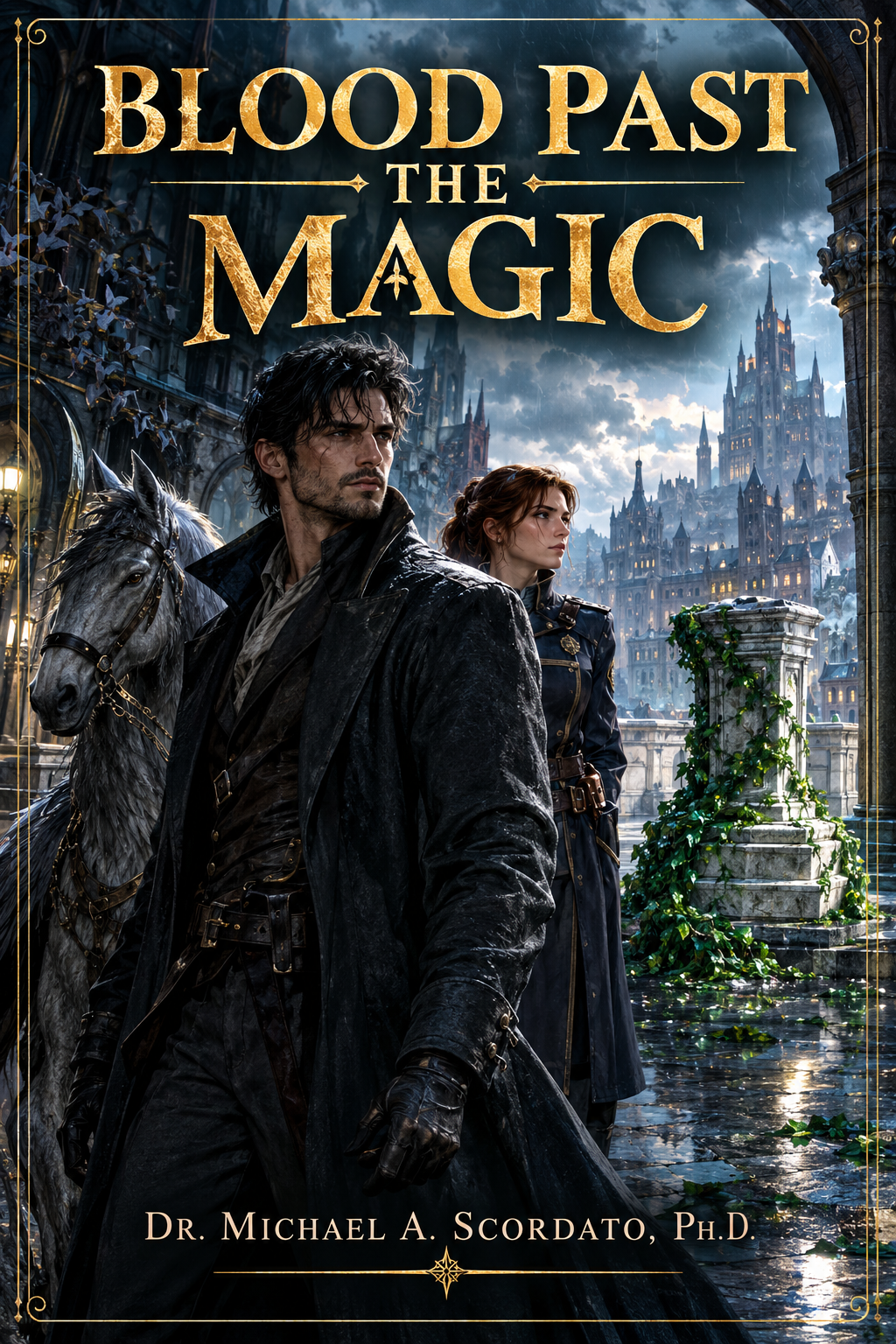

by Dr. Michael A. Scordato, Ph.D.
WE RECOMMEND YOU ALSO READ: https://vlgroup.org/exegesis-of-psalm-56-the-panic-room-psalm-how-to-stop-drowning-in-your-quarter-life-crisis-stop-romanticizing-your-anxiety/
Chapter 1 THE STOLEN HEALING
The Emerald Statue Vanishes
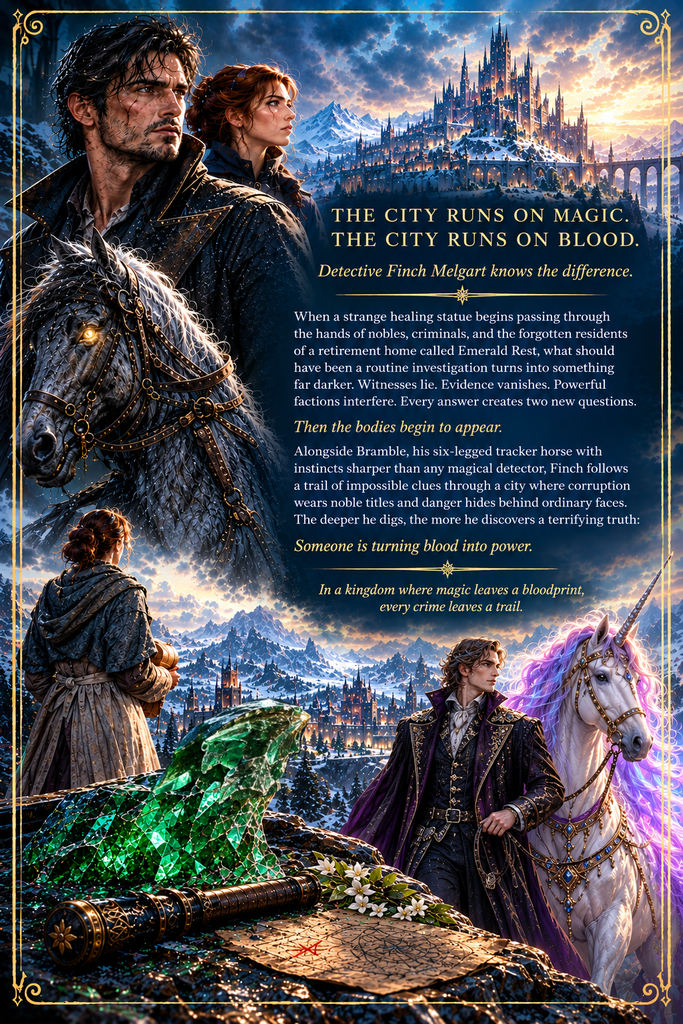
The spring rain fell in cold, relentless sheets across the cobblestones of the capital, washing away the city’s grime but doing nothing to clean its soul. Finch Melgart sat high in the saddle, letting the freezing downpour drum against his oiled leather duster. Beneath him, Bramble shifted her weight with a rhythmic, unsettling grace. A purebred Tracker Horse, her six muscular legs kept her perfectly anchored in the slick mud. She let out a low, rumbling snort, her broad muzzle pointing deliberately toward the shattered iron gates of Emerald Rest.
Finch didn’t need a glowing Mana Lens to tell him something was terribly wrong. He just had to look up. A flock of gray sparrows was huddled in a frantic, shivering mass beneath the jutting wooden eaves of the neighboring daycare. They weren’t singing, and they weren’t foraging; they were hiding from a sudden atmospheric pressure drop that had nothing to do with the weather.
He swung down from the saddle, his boots splashing into a deep puddle. He hated magical cases. When spells were cast, the Blood Toll demanded payment, leaving behind messy, arcane Bloodprints that the Magical Inquisition Team would spend weeks arguing over in court. Magic left room for forged signatures, alibis built on illusions, and a mountain of bureaucratic red restriction-ribbon. Finch preferred the infallible honesty of dirt, wind, and fauna.
Stepping into the open-air atrium of Emerald Rest, the sheer wrongness of the scene settled over him. The grand marble pedestal in the center of the courtyard was entirely bare. The Emerald Statue was gone.
“The Gilded Elders have already sent three separate couriers this morning,” a voice echoed from the archway.
Finch didn’t look up from the pedestal. He didn’t have to. Vera was already pacing the perimeter of the crime scene, her boots clicking sharply against the wet stone. She possessed a spectacular inability to let a single moment of silence exist in her presence.
“They are furious, Finch,” Vera continued, her arms waving to emphasize the political catastrophe hanging over their heads. “An artifact of pure restorative magic, stolen right out of the ward. The Elders are demanding a public execution by sundown, and they don’t particularly care whose neck goes in the collar. We need to lock this down before the MIT boys get here and start dusting the walls for phantom residue.”
Finch ignored the politics. He knelt by the base of the pedestal, pulling off a soaked leather glove to touch the thick vines of healing ivy that spiraled up the marble. It was a cold spring morning, utterly devoid of sunlight, yet the ivy was unnaturally vibrant. The leaves were a thick, glossy green, practically humming with residual life force.
“The thief was bleeding,” Finch muttered, examining the plump leaves. “The statue’s ambient aura sealed the wound as they carried it away, accelerating the plant growth on their way out.”
“Or,” Vera said, stopping her pacing to stand directly behind him, “the statue got up and killed those two clerks, then walked out on its own.”
Finch closed his eyes, inhaling a slow, steady breath of the damp air. He rubbed the bridge of his nose, feeling a familiar migraine taking root behind his eyes.
“Vera.”
“Think about it,” she pressed, entirely unbothered by his glaring silence. “It’s a magical construct. Maybe the ambient mana pooled too long, gained sentience, and decided it had enough of sitting on a rock. Bam. Two dead clerks.”
Finch stood up, towering over the shorter woman. “A statue,” he said, his voice a low, gravelly rasp, “made of solid, inanimate gemstone, bludgeoned nobody. It has no legs. It has no motive.”
“But the clerks—”
“Were found on opposite ends of the city,” Finch interrupted, grounding the chaotic spiral of her logic with cold, hard facts. “One was discovered face-down in the lower ward archives, the other slumped in a high-district apothecary alley. Neither was crushed by a heavy emerald object.”
He walked past her, gesturing to Bramble, who was currently sniffing a patch of disturbed gravel near the exit.
“The apothecary’s preliminary sweep confirmed they were both poisoned,” Finch continued. “A massive, synchronized dose of foxglove extract. In low quantities, it’s a perfectly harmless heart stimulant prescribed to the elderly. But someone gave them enough to stop a draft horse’s heart in three seconds flat. Two dead clerks. Opposite sides of the city. The exact same non-toxic substance weaponized into a lethal overdose. That is not a coincidence, Vera, and it certainly isn’t the work of a walking piece of jewelry.”
He looked back at the empty pedestal, the tragedy of the situation leaving a bitter taste in his mouth. The Emerald Statue was an artifact commissioned specifically to mend broken bones and pull the dying back from the brink. It was the purest symbol of charity the city possessed. Now, it was gone, and the only things left in its wake were two fresh corpses and a thriving patch of ivy.
Vera crossed her arms, undeterred by his reprimand. “Fine. Then how did a massive rock vanish, and why did two people have to choke on heart medicine for it to happen?”
“That,” Finch said, swinging back into Bramble’s saddle and snapping the reins, “is exactly what we are going to ask the dirt.”
As Finch guided Bramble toward the gate, the horse suddenly stopped.
Not slowed.
Stopped.
All six legs locked.
Her ears flattened.
Her nostrils flared.
Finch followed her gaze.
Across the courtyard, through the rain-streaked windows of the elderly care wing, a dozen gray-haired nobles were staring back.
Watching.
Not grieving.
Not frightened.
Watching.
One elderly woman slowly turned away from the glass and closed the curtain.
Bramble snorted.
Hard.
Finch rubbed the mare’s neck.
“Yeah,” he muttered.
The horse’s muscles remained tense beneath his hand.
For the first time that morning, Finch stopped thinking about a stolen statue.
And started wondering why so many people inside Emerald Rest suddenly looked nervous.
Chapter 2 Two Bodies Found
The deluge had scrubbed the lower ward’s cobblestones bare. Any muddy footprints, scuffs, or dropped fibers that might have pointed to a killer were long gone, swallowed by the overflowing gutters before Finch even arrived at the dead archive clerk’s flat. He stood quietly on the threshold, the heavy drumming of the spring rain beating a relentless rhythm against his duster. Behind him in the narrow street, a pair of local watchmen flanked a Gilded Elder magistrate, their polished boots shifting impatiently. The political pressure was already thick enough to choke on; the Elders didn’t want a meticulous investigation, they wanted a swift execution to appease the public. Finch already knew the political machine would do everything in its power to ruin the case, burying the truth under layers of bureaucratic convenience.
But the rain couldn’t wash away the earth’s memory. Finch crouched near the doorframe, his eyes scanning the periphery. A trio of feral, battle-scarred alley cats were huddled tightly beneath a nearby rusted wheelbarrow. Usually desperate enough to scavenge anywhere, they were currently hissing at the open doorway, their tails puffed in primal distress. They categorically refused to go near the house.
Finch stood and looked toward the victim’s windows. The wooden planter boxes were erupting. A tangled, monstrous mass of morning glories and ivy had burst from the soil, their thick vines aggressively throttling the wooden lattice and creeping several feet up the damp brickwork in a matter of hours.
Pulling a waxed parchment from his inner coat pocket, Finch re-read the MIT toxicologist’s preliminary report. He frowned. The clerk hadn’t been force-fed a barrel of foxglove, as the initial apothecary sweep suggested. The volume of the toxin in the victim’s blood was small—perfectly aligned with a standard daily dose for a mild heart murmur. However, the substance itself was hyperactively toxic. It was as if the plant matter had been magically force-fed steroids moments before taking effect, condensing a harmless, everyday remedy into a concentrated, lethal bomb.
Finch sighed, a bitter realization settling in his chest. It was a tragic, irritating truth of the universe that if someone talked endlessly, aimlessly, about absolutely everything, they would eventually stumble upon a fact. Vera had blindly blurted out that the statue killed the clerks.
She was partially right.
The Emerald Statue was a battery of raw, restorative life magic. It didn’t bludgeon anyone, but its ambient aura forcefully stimulated growth and vitality. If the clerks had come into contact with the artifact while transporting or intercepting it, the statue’s power would have supercharged the plant-based medicine already in their systems. Healing had become poison. The artifact had amplified a gentle cure into a catastrophic overdose. Finch would have to corner the toxicologist to verify the exact botanical mechanics, but the theory locked perfectly into place.
Then, a sudden, horrifying thought shattered his focus. Vera. She was currently overseeing the second crime scene at the high-district apothecary alley. On her own. Surrounded by highly volatile, magically reactive reagents.
Beside him in the rain, Bramble let out a sharp, anxious whinny, her six legs shifting nervously in the mud. Through the subtle, empathic bond shared between a veteran rider and a purebred Tracker Horse, a vivid, violently animated daydream flashed simultaneously behind both their eyes: Vera, waving her arms in wild, breathless explanation, accidentally knocking a crystalline beaker into a hearth, followed instantly by the entire apothecary shop erupting in a spectacular, sky-high plume of neon green fire.
Finch blinked hard, exhaling a slow, steady breath. Bramble aggressively shook her heavy, rain-slicked mane, stamping two of her front hooves to clear the image from her head. They both turned to stare up the hill toward the high district, trying desperately to convince themselves it wouldn’t happen that way. Neither of them was entirely sure.
In a jolt Finch noticed before Bramble the lead on the crime scene turn and step toward their direction. So Finch made himself busy hoping to not deal with the most likely oncoming man of political headaches.
The magistrate cleared his throat.
Finch ignored him.
The man cleared it again.
Louder.
Finch continued studying the morning glories and ivy.
Finally the Elder stepped forward.
“Detective.”
Finch looked up.
The magistrate gestured toward the corpse being loaded into a wagon.
“We are all deeply saddened by this tragedy.”
Finch said nothing.
The Elder continued.
“However, the greater concern remains the statue.”
Finch stared.
The magistrate actually seemed confused by the expression.
“The statue?” Finch asked.
“Of course.”
“The dead man isn’t the greater concern?”
The magistrate frowned.
“Detective, artifacts of that value cannot simply disappear.”
Finch slowly folded the toxicology report.
The dead clerk had already become secondary.
A stolen object mattered more.
That told him everything he needed to know about the people demanding answers.
Chapter 3 Meet Vale
The storm finally broke as Finch and Bramble crested the hill into the high district. The relentless downpour faded into a soft mist, and then, quite suddenly, the clouds parted. Golden sunlight washed over the pristine, white-brick facades of the apothecary alley. High in the manicured ginkgo trees, a chorus of robins began to sing.
It was a beautiful, picturesque spring morning.
Finch hated it.
Nature returning to balance meant the immediate atmospheric danger had passed, but the cheerful birdsong felt like a grotesque insult to the dead.
As they approached Elara’s Remedies, the severity of the situation became glaringly obvious. Outside the shattered glass storefront, a squad of city guardsmen was frantically hosing down the cobblestones. Standing near the gutter, a fully armored Silver Knight was grimacing behind his visor, scraping a thick, gelatinous, neon-green ooze off his broadsword.
And sitting on the curb, wrapped tightly in a heavy wool shock-blanket, was Vera.
She was trembling. She was also covered from head to toe in a foul-smelling, translucent sludge that was actively sizzling as it slowly digested the cuffs of her trousers and the sleeves of her blouse.
Finch didn’t ask. He just tied Bramble to a lamppost. The horse took one deep sniff of Vera, snorted in profound disgust, and deliberately took three steps back.
Stepping through the ruined doorframe of the shop, Finch was immediately blinded by an array of floating, neon-blue geometric circles. Mana Lenses. Bloodprint Scanners. Residue Mappers. A dozen different magical forensic tools hovered in the air, humming with arcane energy and projecting swirling data matrices across the walls.
Standing in the center of the technological light show was Lucian Vale, Lead Inquisitor of the MIT.
He was levitating a half-eaten tart.
“Ah, Melgart!” Vale chirped, his voice smooth, melodic, and impossibly cheerful. He wore a perfectly tailored indigo coat with silver embroidery that, despite the mud and gore of the morning, remained immaculately clean. “Just the detective I was hoping to see. Care for a pastry? I have two plain scones left, but I’m currently debating sending my runner back to the baker. Apple or cherry?”
Finch stared.
“What?”
“The pie, Finch,” Vale smiled warmly, taking a delicate sip from a porcelain teacup floating near his elbow. “For lunch. Apple or cherry?”
“You’re looking at a corpse,” Finch said, his voice a low, warning growl.
“And ordering pie,” Vale replied without missing a beat. He waved a casual hand, adjusting a glowing purple reticle over the deceased apothecary clerk slumped against the counter. “The two are not mutually exclusive. A dead worker doesn’t mean I should starve. Two dead workers, actually. An extraordinarily interesting poison pattern on this one.”
Finch stepped over a puddle of bubbling green ooze, his jaw tight. Vale was always like this. Infuriatingly polite. Untouchably pleasant. He knew exactly how much his breezy demeanor burned Finch, and he wielded his unfaltering cheerfulness like a scalpel.
“Speaking of interesting patterns, I must say, the real show this morning was your associate,” Vale continued, swallowing his bite of pastry. He let out a rich, genuine chuckle that echoed terribly in the bloodstained room. “That Vera. Always a riot.”
Finch closed his eyes, bracing himself. “What did she do, Vale?”
“Well,” Vale beamed, gesturing to a melted cauldron in the corner. “She knocked a beaker of living organic restorative draught into a vat of inorganic alchemical base. The ambient mana from our stolen statue must have still been lingering in the air, because within seconds, she accidentally synthesized a living, ambulatory slime with an incredibly unstable hunger to digest everything in the room.”
Vale took another sip of tea.
“It ate her, Finch.”
Finch opened his eyes.
“Swallowed her whole,” Vale grinned, his eyes dancing with amusement. “Took a fully armed knight, not just the local guardsmen, to hack the thing apart and drag her out. She’s a slimy mess out there, clothes half-digested. A fascinating probability matrix, really. The odds of creating a predatory ooze by tripping over a rug are astronomically low. But magic always finds a way!”
Finch ignored the floating holograms and knelt beside the body, relying on his own eyes. He pointed to the dark, swollen veins on the clerk’s neck. “Magic didn’t kill this man. A hyper-toxic dose of foxglove did. Dirt. Botanicals.”
“Ah, but the probability suggests a magical catalyst,” Vale countered, waving his hand. His Mana Lenses spun, projecting a web of arcane statistics over the corpse, effectively obscuring the physical body from view. “My scanners indicate a seventy-four percent likelihood that an external aura mutated the toxins. We just need to track the arcane resonance.”
“I don’t care about your probabilities, Lucian,” Finch said, standing up. “Or your percentages.”
“You never do, Finch. It’s why you’re so charmingly analog.” Vale offered the pastry box again, a picture of perfect, aggravating hospitality. “You seek the absolute, undeniable truth. I seek the most highly probable result. But only one of us actually closes cases on time.”
Finch stood in silence. He looked at the floating screens. He looked at the dead clerk hidden beneath the math. Then he looked at Vale, happily Dreaming of a cherry tart amidst the horror. Vera had nearly died. Two people were murdered. The city’s greatest healing artifact was in the hands of killers. And the man in charge of the magical investigation was debating dessert. Finch turned on his heel. He walked out. The truth wasn’t in this room. It never was.
As Vale’s scanners projected layer after layer of glowing statistical models across the room, Bramble suddenly shoved her head through the ruined doorway.
The six-legged mare ignored the floating displays entirely.
Ignored the bloodprint projections.
Ignored the residue maps.
Instead she stretched her neck toward a nearby shelf.
A single dried flower pot sat there.
Bramble snorted once.
Hard.
Vale glanced over.
“Interesting.”
Finch walked to the shelf.
Inside the pot was a small scrap of cloth.
Green.
Emerald green.
Vale looked at the scanners.
Then at the cloth with floatation magic from a wand.
“Oh…. This scrap of fabric has been healed. And recently too, mana is still pulsing on it. Most likely the day of the deaths I would roughly guess.”
Then back at the scanners.
“Well.”
Finch pulled out his note pad and sketched down what happened with text notes highlighting.
“Horse one, Magic zero.”
Vale sighed.
“Magic zero?”
Chapter 4: Delivery Interrupted
The afternoon sun had finally baked the morning’s rain out of the courtyard at Emerald Rest, leaving behind a thick, humid haze. Finch sat on a wrought-iron bench near the empty pedestal, a stack of the facility’s supply records balanced on his knee. While Vale and his MIT lackeys were busy chasing phantom arcane signatures across the high district, Finch was looking for the dirt. Magical artifacts didn’t steal themselves, and they certainly didn’t walk past a dozen city wards without someone leaving a side door unlocked.
He flipped a page of the ledger, tracing the ink lines of recent deliveries. Nothing stood out. Routine shipments of bandages, flour, and linens.
He looked up, rubbing his temples, and froze.
Standing near the perimeter of the rose garden, leaning heavily on a carved wooden cane, was the elderly woman from the window. The one who had been watching him that morning. She wasn’t hiding behind the glass anymore. She was taking a stroll.
Draped over her frail, stooped shoulders was a heavy wool cloak.
Green.
Emerald green.
Finch stood up slowly, the supply records sliding off his lap. He slipped his hand into his duster, his fingers brushing the magically pulsing scrap of fabric he had bagged in the apothecary shop. As he closed the distance across the courtyard, his eyes locked onto the hem of the old woman’s cloak. Near the bottom left seam, there was a ragged, rectangular tear. The missing patch was exactly the size of the scrap in his pocket.
A faint smell of mint leaves and foxglove drifted from her cloak. Bramble immediately reacted to the scent. Not enough to solve anything. Just enough to realize: Oh. The grandmother wasn’t just a random comic relief suspect. She was involved somehow.
“Excuse me, ma’am,” Finch said, stepping directly into her path. His voice was low, carrying the practiced, heavy authority of a badge. “I need to ask you a few questions about your wardrobe.”
The old woman stopped.
She looked up at him through thick, cloudy spectacles.
She looked down at his coat pocket.
She looked back up at his face.
Then she kicked him.
It wasn’t a clumsy, geriatric flail. It was a perfectly executed, ruthlessly precise strike. Her heavy, brass-buckled orthopedic boot drove squarely into Finch’s groin with the force of a battering ram.
All the air left Finch’s lungs in a single, silent wheeze.
He folded.
Before his knees even hit the cobblestones, the woman pivoted on her cane. Her other boot snapped out, cracking him brutally in the shin.
Finch collapsed onto the pavement, curling into a tight, agonizing ball. He groaned, squeezing his eyes shut as a wave of profound nausea washed over him.
Above him, the rapid tap-tap-tap of the wooden cane echoed across the courtyard as the elderly woman hobbled away at a shockingly brisk, tactical pace, disappearing around the corner of the west wing.
Bramble trotted over. The massive, six-legged mare lowered her head, sniffing Finch’s ear as he writhed on the stones.
“Bramble,” Finch wheezed, his voice a strained, high-pitched gasp. “The list.”
The horse snorted.
“Add old people to the list of things I hate. Right at the top.”
“You’re in the way of the loading dock, Melgart.”
The voice was bright, melodic, and entirely unsympathetic.
Finch cracked one eye open. A delivery wagon had pulled into the courtyard. The sturdy, dappled draft horse hitched to the front was happily touching noses with Bramble, the two animals clearly recognizing each other from previous encounters.
Standing over Finch, holding a towering stack of pink pastry boxes, was Emberlynn.
She was twenty-four, exactly ten years his junior, and possessed a relentless, agonizingly cheerful stubbornness that Finch found utterly impossible to defeat. She wore a flour-dusted apron over a simple blue dress, a pencil tucked carelessly behind her ear.
“Leave, Emberlynn,” Finch groaned, rolling onto his back and staring up at the sky. “It’s an active crime scene.”
Emberlynn stepped carefully over his legs. She completely ignored the command.
“I have a contract to deliver three dozen cherry pasties to the Emerald Rest dietary staff by two o’clock every Tuesday,” she said, balancing the boxes on one hip as she looked down at him. “A stolen rock doesn’t mean the elderly don’t get dessert. Though, from the looks of it, one of them just gave you yours.”
Finch managed to sit up, wincing as a phantom pain shot up his shin. “Go home.”
“I brought you something,” she said.
She knelt beside him on the damp cobblestones, seemingly unbothered by the dirt. With her free hand, she reached into her apron pocket and pulled out a tiny, meticulously arranged bouquet of white alyssum and bluebells. It was barely the size of a coin. She reached forward and smoothly tucked it into the buttonhole of his leather duster.
Finch glared at the flowers.
He had saved her family from an Iron Chain extortion racket nearly a decade ago, back when she was just a terrified teenager. It was just a job to him. To her, it was the beginning of an unyielding, decade-long romantic siege. She knew he would instantly reject a grand, sweeping gesture. A large bouquet would be thrown in the trash before she even left the precinct. So, she waged her war in inches. Tiny flowers.
“I threw the last arrangement in the precinct incinerator,” Finch grunted, swatting her hand away from his lapel.
“I know,” Emberlynn smiled, her eyes crinkling with warmth. “Officer Vance fished them out before you lit the fire. He put them back in the cup on your desk. Sergeant Miller even watered them this morning.”
Finch closed his eyes. His coworkers were traitors.
“Tiny flowers, Finch,” she whispered, her smile softening into something dangerously genuine. “You can’t justify throwing away tiny flowers. It makes you look like a monster. And everyone knows you aren’t one.”
Finch stared at her, thoroughly disarmed and still in immense physical pain. He hated magic, he hated politics, and as of three minutes ago, he violently hated the elderly. But as Emberlynn stood up, brushing the dirt from her apron and carrying her pastries toward the care wing, he looked down at the tiny bluebells resting on his coat.
He didn’t pull them out.
“Bramble,” Finch muttered, pulling the scrap of green cloak from his pocket and holding it up for the mare to smell. “Stop fraternizing with the pastry horse. We have a violently aggressive grandmother to track.”
Chapter 5 The Horse Objects
The pain radiating from Finch’s shin was a sharp, pulsing reminder that he was currently losing a footrace to an octogenarian. He dragged himself upright, clutching his bruised ribs, and let out a sharp, two-toned whistle through his teeth. It was the command for pursuit.
He expected Bramble to immediately pivot, drop her nose to the cobblestones, and track the heavy scent of mint and foxglove right out of the courtyard.
Instead, he heard the unmistakable sound of gorging in loud slurps.
Finch turned. Bramble had her massive, heavy-jawed head buried entirely inside the back of Emberlynn’s open delivery wagon. When she surfaced, she had an apple pastry clamped delicately between her teeth. Powdered sugar dusted her black muzzle.
She offered a muffled, unapologetic snort.
Bramble was a highly trained, violently expensive piece of biological forensics, but she was also an unrepentant thief when it came to her stomach. She stole apples from street vendors. She stole half-eaten ham sandwiches from the precinct investigators on scene. She had stealthily once stolen a whole apple pie directly from Captain Mercer’s carriage that mercer to this day complains and investigates people about. Yet, in a bizarre display of dietary principles, she absolutely refused to steal vegetables. If you offered her a premium, organic carrot, she would stare at you as if you had deeply insulted her ancestors.
“Drop the cherry pastry, Emberlynn stop feeding my ride strange stuff!” Finch grunted, wrong on what pastry type it was, limping over and grabbing her leather reins. “We have a highly dangerous grandmother to catch.”
Finch tugged at the reins to walk toward the archway. “We got a job.”
Emberlynn leaned out and smiled.
Bramble didn’t move. All six of her muscular legs locked into place, anchoring her to the cobblestones with the unyielding permanence of a rooted oak tree.
Finch pulled harder. The horse objected, pulling back and dragging him a foot in the opposite direction. She swallowed the pasty in two chews, then stared intently toward the far corner of the courtyard. Specifically, toward the rose garden where the old woman had been standing.
Finch stopped pulling. He rubbed his aching shin and looked back at the empty marble pedestal in the center of the atrium, trying to reconcile the violence of the old woman with the sheer logistical nightmare of the crime.
To pull off a high-stakes heist of a massive, magically active gemstone in a heavily populated capital, you couldn’t just smash and grab. You needed specialized, syndicate-level equipment.
For stealth, the thieves would have needed Active Camouflage Cloaks woven with optical-illusion circuits, Sound-Dampening Wands to mask the grinding of the stone, and Mana-Masking Amulets to hide their own magical signatures from the local security wards.
Breaching the inner perimeter would have required Ether-Siphon Syringes to drain the power lines of the city’s perimeter defenses, Dispel Magic Chimes to scramble barrier frequencies without triggering explosive alarms, and Magitech Lockpicks to instantly align the internal tumblers of the courtyard’s wrought-iron gates.
Then came the extraction. The Emerald Statue was 50 pounds (23 kg) block of emerald has a volume of about and would fit into a cube roughly 7.7 inches (19.6 cm) on each side—about the size of a large melon or a small watermelon, with a volume of roughly 8 to 8.4 liters shaped as a gargoyle mocking you. 113,400 carats of emerald alone making its’ value 3.4 billion coins. It is understandable why stolen. Unless the thieves had a highly illegal unlicensed Spatial Storage Bag—which most city wards defenses magically canceled out in a block automatically to prevent theft—they would have needed Gravity-Reduction Plates slapped onto the base to temporarily reverse its mass so a single thief could push it like a balloon since no reported noise, or at the very least, a heavy-duty Levitation Dolly.
His mind drifted. Finally, to escape, they would have dropped ether-infused Chaff Smokescreens to blind the MIT thermal scanners and deployed clockwork Mana-Decoy Dolls to fracture the guard response by sending identical magical signatures in a dozen different directions.
It was a million-coin operation.
It required military-grade precision.
It did not require a grumpy old woman with a wooden cane.
“You’re right,” Finch muttered, letting the reins go slack. “She didn’t steal the statue herself. She didn’t have the gear. No way she could have lifted it.”
Bramble let out a low, rumbling affirmative as she dug the ground toward the direction she was pointing since Finch obviously was Lin a lesser intelligent state than her at the moment after his beatdown off both physical and mental. She broke away from his grip and trotted away from the wagon, bypassing the empty pedestal entirely, and walked straight into the thickest patch of the facility’s manicured rose garden. She shoved her nose deep into the mulch and pawed aggressively at the earth with one of her front hooves.
Finch followed her, kneeling in the damp dirt. Lucian Vale and the MIT forensic team would have been scanning the air, waving glowing lenses to look for lingering auras or statistical probabilities. But Finch trusted the horse. And Finch trusted the dirt.
Nature always remembered.
He took a handful of the soil. It didn’t smell like spring rain or wet earth. It smelled acrid. Metallic. Like burnt copper and ozone.
He looked closer at the roses. Unlike the healing ivy on the pedestal that had thrived on the statue’s ambient aura, these plants were dying— it just stated recently, most likely because the healing stone was no longer in the area to support t with its’ ambience. The stems were warped, the petals singed brown at the edges. They were showing signs of severe magical overexposure, mutating from raw, unfiltered chemical runoff. Most likely since the healing statue was gone they just uncovered a secret they were using the statue’s healing strength aura to hide.
Bramble dug furiously.
Finch initially assumed she had found:
- a buried weapon
- stolen jewelry
- a corpse
Instead:
Glass.
Lots of glass.
At first he is disappointed.
Then the realization slowly arrives.
Finch drew his combat more of labor work knife and drove it into the soft earth. Six inches down, the blade scraped against something hard. Not a rock. Glass.
He dug faster was he removed his gloves, his bare hands able to scrape in scooping away the contaminated soil until he uncovered the lid of a heavy, brass-reinforced alchemical crate. He popped the latch and threw open the lid.
The crate was packed to the brim with hundreds of glowing glass vials.
It was a massive, hidden hoard of illegal alchemical potions. Judging by the dark, viscous liquid inside them, they were highly concentrated derivatives of foxglove and other black-market restoratives—the exact same hyper-toxic compound that had killed the two clerks.
The pieces slammed into place in Finch’s mind. Suddenly his hands began to burn! Chemical burns, those glasses were thrown down and shattered to spread protective chemical wall that did not bother Bramble’s hoof but for his skin it was already turning red.
Emberlynn appeared already pulling his arms by his sleeve away from the crime scene to empty her canteen over his hands. “I got you, I got you, You will be OK.” The alchemical burns in the end caused a few blisters and Redding only because of Emberlynn’s fast first responder response — she applied magic medicinal balm and tied her floral hankie around it so it could heal. Finch did not say thank you, he simply grunted at her. She smiled as that was enough.
Looking back on the scene we is going to have to report this to his boss, Mercer. The old woman seems to hadn’t been standing in the garden to admire the flowers. She was standing guard over her stash. The thieves hadn’t just used the Emerald Statue for its monetary value alone. They had been using its massive, ambient healing aura to quietly cook and supercharge these illegal potions right under the city’s nose while using it also to cover their distribution location. But this also means they did not steal it since, being gone now, not only revealed their entire operation, they also could no longer reap raising the quality of their merchandise. Maybe an opposing faction came in, or a vigilante hero type undercover?
Things just got more complicated.
The theft of the statue was a distraction for this crime.
The dirt was the real crime scene.
Was the grandmother the cartel’s local distributor?
Finch felt a fresh surge of pain from the kick she had delivered earlier. He flexed his burned fingers and immediately regretted it. The sting reminded him of the grandmother.
He found this deeply irritating.
“When I find her,” he muttered, “I’m charging her twice for assaulting an investigator.”
Finch stared toward the path she had escaped down.
He most definitely wanted to put cuff-chained manacles on her.
The thought made him smile.
“That alone is worth the paperwork.”
Bramble responded by blasting his hat off with a powerful snort.
The hat tumbled across the courtyard.
Finch sighed.
“Thank you, Bramble.”
The mare snorted again.
Emberlynn hurried after the hat and caught it before it could land in a puddle. She returned it without a word.
As Finch reached for it, their hands brushed.
He paused.
For someone who spent her days hauling supply crates, kneading dough, and driving delivery wagons across the city, her hands were surprisingly soft.
Emberlynn smiled.
Finch immediately took his hat back and put it on.
The case was complicated enough already.
ARC II
EVERYBODY HAD IT
Chapter 6 The Judge Who Ran
The spring winds were howling off the eastern coast, tearing through the capital’s spires with a hollow, shrieking whistle. High above the manicured roof of Emerald Rest, a v-shaped formation of migrating moongeese fought the gales, their faint, rhythmic honking barely audible over the rustling of the oak trees.
Finch stood at the grand, gilded entrance of the high-noble serving wing.
He stopped.
He pointed a stern finger at Bramble.
“Stay,” Finch ordered.
The six-legged mare flattened her ears. She wasn’t allowed inside the daycare facility, nor the plush, velvet-lined serving rooms reserved for the city’s highest-ranking elderly. She stomped one of her heavy front hooves, letting out a sharp snort of protest.
“You are a wall,” Finch told her, his tone unyielding. “You lock down the courtyard. Nobody leaves this building without going through you.”
Bramble seemed to accept this tactical promotion. She squared her massive shoulders, planting herself directly in front of the ornate glass doors, becoming an immovable, biological barricade.
Finch turned and pushed through the doors alone.
Instantly, the smell hit him. Lavender, imported sandalwood, and the distinct, cloying scent of generational wealth. It made his stomach turn. As his heavy boots sank into the pristine crimson carpets, a dark, jagged memory flashed behind his eyes.
Finch hadn’t always hated the high nobility. When he was young, his family had been part of the lower courts—minor nobles with a title but no real leverage. Then, his younger brother had fallen ill. It was a curable affliction. A simple one, if you had access to the high-tier restorative clerics of the Gilded Elders.
Finch remembered standing in a room that smelled exactly like this one, begging. The high ranks had simply looked down their noses, calculating the cost, the time, and the political benefit of saving a low-born child. The math didn’t favor his brother. There was no profit in his survival. So, they did nothing. They watched the boy perish because his life wasn’t worth the paperwork.
Finch shoved the memory down, letting the cold, familiar fury harden his spine. He wasn’t here to grieve. He was here to hunt.
He found his target in the second-floor study. Judge Alden, a retired magistrate fiercely loyal to the Crown faction.
The old man was standing near the window, peering through the curtains at the courtyard below. He was panting heavily, his knuckles white as he gripped the windowsill. He had clearly planned to make a run for it, but the sight of Bramble—a violent, six-legged tracker horse currently blocking the only exit—had trapped him inside.
Finch stepped into the room. “Judge Alden.”
The old man spun around. Panic flared in his rheumy eyes. He didn’t see a detective; he saw an operative from a rival political faction come to silence him for the secrets he held for the Crown.
Alden raised a trembling, liver-spotted hand.
Finch didn’t even have time to reach for his weapon.
A wave of concussive, invisible force slammed into Finch’s skull. It wasn’t a physical blow; it was a psychic sledgehammer. Unlicensed mind control magic. A felony offense all on its own.
Finch’s vision swam. The room tilted violently. His jaw went entirely slack, a thick string of drool escaping the corner of his mouth. He took a clumsy, uncoordinated step forward and walked face-first into a mahogany bookshelf.
He bounced off the wood, swaying like a drunkard. His mind was screaming to draw his never-dulling cleaver, to tackle the old man, but his body was receiving a different set of instructions.
Who sent you? the magic demanded, echoing directly against the inside of Finch’s skull. The Ducal Alliance? The Merchant League?
“D-detective,” Finch mumbled, his tongue feeling like a swollen sponge. He leaned heavily against the bookshelf, fighting the arcane fog with sheer stubbornness. “Police. Not… politics.”
The magic suddenly shattered.
Finch gasped, his knees buckling as control of his own body returned in a violent rush. He wiped the drool from his chin, his head throbbing. He looked up, ready to physically dismantle the magistrate.
But Judge Alden was already on the floor.
The old man had collapsed in a heap of velvet robes. His powdered, ceremonial judicial wig—which he had inexplicably been wearing in his private quarters—had tumbled off his bald head and rolled under a chair.
The Blood Toll had collected its due.
Magic wasn’t free. Mana was carried in the blood, and casting a spell burned it directly from the caster’s veins. Alden was an eighty-year-old man who had just attempted a high-level, brute-force psychic subjugation. He had instantly hit his physiological limit.
“Please,” Alden wheezed, clutching his chest. His face was the color of spoiled milk. “Don’t murder me. I’m not a traitor. I have to protect the Crown. The other factions… they’ll destroy the King if they get my ledgers.”
Finch stared down at the pathetic, gasping man.
The Judge hadn’t run because he stole the Emerald Statue. He ran because he was a paranoid political operative who thought Finch was an assassin. People always ran because they were guilty. They just weren’t always guilty of the crime Finch was investigating.
“I’m not here for your ledgers,” Finch growled, his head still pounding. “I’m here for a stolen rock.”
“A… a rock?”
“Let’s get you to your room, Alden,” Finch said, reaching down to haul the frail man up by his robes. “Before you bleed out internally.”
Finch didn’t offer the help out of kindness. Escorting a medically compromised suspect to their private quarters was the easiest way to bypass a search warrant.
They staggered down the hall to the Judge’s lavish bedroom. Finch deposited the wheezing old man onto a velvet armchair near the window.
As Alden caught his breath, Finch turned his attention to the room.
For a fleeting, highly irritating second, Finch wished Lucian Vale was here. The MIT Inquisitor could have snapped his fingers, deployed a half-dozen floating scanners, and mapped the room’s residual aura in ten seconds flat. Magic fighting magic was faster.
Finch aggressively shoved the thought away. He hated magic. He hated relying on it. Dirt didn’t lie, and neither did dust.
He began to pace the room.
Above the fireplace, a massive, freshly painted oil portrait hung in a gilded frame. It depicted Judge Alden and his extended family. But sitting right there in the foreground of the painting, resting on a decorative plinth beside the Judge’s knee, was a glowing, fifty-pound green gemstone shaped like a mocking gargoyle.
Finch walked over to the Judge’s large, four-poster bed.
Next to the mattress was a heavy oak nightstand. The top of it was covered in a fine, even layer of everyday dust. Except for a single, perfectly clean square right in the center. The dust-free patch was exactly the size of a melon. Or a small, heavy gargoyle.
Finch looked from the painting, to the nightstand, and then to the gasping old man.
“Why is this spot cleared out?” Finch asked, pointing at the wood.
Alden’s eyes darted nervously to the nightstand. He muttered under his breath, his voice barely a whisper. “Statue… here… like the others…”
Finch narrowed his eyes. “What did you just say?”
Suddenly, the Judge’s paranoia returned in full force. He gripped the arms of his chair and pointed a shaking, liver-spotted finger at the door.
“Get out!” Alden shrieked, his voice cracking. “You have no warrant! You have no proof of anything! Get out of my chambers!”
Finch didn’t have solid evidence. A clean spot on a table wasn’t enough to make an arrest for a three-billion-coin heist, and the old man was one elevated heartbeat away from dying on the rug.
Finch turned toward the door, deciding to let the panic stew for a few hours.
As his hand touched the brass doorknob, the Judge shouted after him.
“I LOVED THAT STATUE!” Alden cried, his voice echoing with a bizarre, desperate possessiveness. “WE ALL USED IT!”
Finch stopped.
He didn’t turn around.
He just stared at the wooden door.
We all used it.
The Gilded Elders weren’t just storing the ultimate healing artifact in the courtyard as a display of charity. And the cartel hadn’t been the only ones secretly exploiting its aura.
Finch walked out of the room, a creeping, exhausting realization settling heavily over his shoulders.
The statue might have not just been stolen once.
Maybe it was lifted and was being passed around.
If so, maybe it might still be in this facility.
This though made his chin itch.
Chapter 7 Tax Fraud and Tulips
The sun streamed through the tall bay windows of the third-floor solarium, casting a warm, golden glow over the pristine marble tiles. Outside, a pair of blue-crested swallows chirped and tweeted a soft, harmonic melody from the branches of an ancient oak tree. It was the absolute picture of serene, twilight-years retirement.
Sitting at a wrought-iron patio table were two elderly women, sipping Earl Grey tea and meticulously committing high-level Merchant League tax fraud.
Finch stood in the doorway, observing the scene with a heavy, exhausted sigh.
In a world run on magic and feudal tribute, tax evasion was an art form. The woman on the left, wearing a silk shawl, was using a silver scribe to carefully scrape and tamper with the divination wards on a stack of property deeds. The woman on the right was copying numbers into an Altered Soul-Bound Ledger, the dark, forbidden necromancy binding the book glowing faintly in the sunlight. Sitting casually between the plates of cucumber sandwiches was a highly illegal, undeclared Bag of Holding, overflowing with untaxed spices and what looked suspiciously like temporary Philosopher’s Gold—transmuted coins designed to revert back to lead three weeks after the Crown’s tax collectors logged them.
Finch didn’t care about the taxes. His eyes were fixed on the windowsill.
Sitting in a ceramic pot was a cluster of Aethelgard tulips. They were incredibly rare, highly fragile flowers that only bloomed for three days in the dead of winter. Yet here they were, in the middle of spring, overflowing their pot in a vibrant, aggressive explosion of petals. The soil practically hummed with residual life magic. The flowers had been blasted with a massive, localized dose of raw, unfiltered healing aura.
Finch took a step forward, preparing to politely interrogate the two women, when the solarium doors banged open behind him.
“Finch! The Captain said you were up here!”
Finch squeezed his eyes shut. It was Vera.
She was fresh out of the academy, relentlessly energetic, and entirely lacking an internal filter. Finch immediately began calculating how long it would take to send her on a fabricated errand to the opposite end of the city.
Vera marched directly past him, stopped at the wrought-iron table, and stared openly at the glowing necromantic ledger, the tampered warding runes, and the illegal Bag of Holding. She blinked twice.
“Shouldn’t we investigate the people actually committing crimes?” Vera asked loudly. “Are all nobles criminals?”
The two elderly women stopped writing.
They slowly looked up.
Finch stared at her.
Even the birds outside seemed to stop chirping.
Silence hung in the solarium, thick and suffocating. No one answered her. It was an unspoken, universal truth of the capital that you didn’t say out loud unless you wanted a very short career.
Vera, entirely unfazed by the crushing silence, pivoted her attention to the wildly overgrown tulips on the windowsill. She connected the dots with the blunt force of a battering ram.
“YOU HAD THE HEALING STATUE!” Vera yelled, pointing an accusatory finger directly at the two women.
The woman in the silk shawl casually set down her silver scribe and took a delicate sip of her tea.
“Well, yes,” she replied, her tone perfectly pleasant. “But not anymore, dear. The staff wouldn’t let us keep it long.”
Finch felt a dull ache begin to throb behind his eyes. He stepped forward, putting himself between Vera and the table. “What do you mean, the staff?”
“The orderlies, the nurses, whoever they were,” the second woman chimed in, adjusting her spectacles as she returned to her forged ledger. “They wheeled it in here on a Levitation Dolly around breakfast time yesterday. We paid a thousand gold pieces for three hours of proximity to soothe my arthritis. But then they came back and said time was up. Rented it right out from under us.”
“Which staff members?” Finch demanded.
The first woman gave a dismissive, aristocratic shrug. “They all look the same in those little white uniforms, Inspector. And they all respond to the Merchant League’s coin exactly the same way. We didn’t ask for their names, and they didn’t ask about our ledgers.”
Finch stared at the two women. The sheer, terrifying absurdity of the crime finally clicked into place.
There had been no grand heist. There were no syndicate thieves, no Active Camouflage Cloaks, no smokescreens or decoy dolls.
The Emerald Statue hadn’t been stolen out of the courtyard by a master criminal. It was an inside job. The underpaid care facility staff had realized they were sitting on a 3.4-billion-coin magical battery. They had quietly wheeled the massive gargoyle inside and were secretly renting it out, room by room, to the city’s most wealthy, corrupt, and aching elite.
The theft was just a side-hustle.
The statue was being passed around like contraband.
“Vera,” Finch said, his voice flat and devoid of all joy.
“Yes, Detective?”
“I am going to report this, whatever suspicious stuff, they are doing to Captain Mercer as well.” Vera added in front of the two elderly as if they were not there.
“You go do that honey, if it makes you feel a little better.” The two women casually stated completely unfazed since between their nobility rank and their held position in the the League made it almost impossible to prosecute them unless it was the king himself.
“Go downstairs. Tell Bramble she’s looking for people in white uniforms.” Finch rubbed his temples, staring at the aggressively blooming tulips. “And whatever you do, don’t look inside that Bag of Holding on your way out. The paperwork will kill me before the suspects do.”
Chapter 8 Bomb in the Basement
Summer heat pressed down on the capital like a wet woolen blanket, but the subterranean storage cellar of Emerald Rest was icy with a very different kind of dread. Bramble had balked at the bottom of the concrete stairs, her massive head tossing as she snorted violently. She refused to take another step. She smelled volatile compounds. Ozone, sulfur, and the distinct, coppery tang of impending death.
What set her off? Simply put, Finch went down too many flights of stairs and was lost so opened the wrong door.
Sitting on a reinforced concrete plinth in the center of the room was a heavy iron strongbox. Vera leaned in, her eyes wide, reaching out to tap the glass viewing pane. Finch slapped her hand away so hard the sharp smack echoed off the damp stone walls.
“Don’t,” Finch growled, grabbing her shoulder and hauling her back.
Inside the box sat a thick ledger bound in dragon-hide, sealed behind a secondary layer of lead-lined glass. But directly above the book rested the payload. It was a cartel involvement warning, at least of sale for this arm. It was a connection warning, clear as day. The criminal underworld had realized that a tool made stronger becomes infinitely more dangerous. So they hadn’t just used the Emerald Statue’s ambient aura to cook illegal potions; they had used its massive magical footprint to supercharge a highly unstable Aether-Core Crucible.
It was a volatile fusion of magical instability and mechanical malice. Visibly you could see two separate glass chambers sat suspended above the ledger. One held unrefined black powder mixed with flash-salts; the other contained Glow-Stone Vitriol, a highly corrosive, pressurized acid. If they mixed, they would create a blast large enough to level the entire care facility and incinerate the ledger instantly. The mechanical trigger was a pressurized, hyper-complex clockwork timer made of non-magnetic brass. The gears ticked with a deafening, rhythmic clack-clack-clack. A heavy iron hammer hung on a taut tripwire, primed to drop. Woven entirely through those gears were glowing, iridescent blue veins of Liquid Mana, feeding an Abjuration Rune etched onto the lid. If anyone tried to teleport the box, phase it through walls, or smash it open, the rune would instantly release the hammer.
“So… why was this room not locked?” Vera pouted, not being able to get close to touch and see the device.
That was an honest and good question indicating that not just some, but all of the staff obviously are involved with this since done such in plain sight. Of course, this bomb could be used as well to control via pressure those around not to squeal simply by proving the cartel connection.
Finch stared at the glowing bomb. He hated magic. He hated relying on it, and he hated owing favors to the people who used it. But he wasn’t going to out-detective a localized tactical nuke.
He reached to his lapel and violently pressed the enchanted silver distress button he had sworn he would never touch. A second later, Lucian Vale’s voice chimed in his ear, relentlessly and politely cheerful. Finch didn’t even let the Inquisitor finish his greeting.
“Emerald Rest basement,” Finch demanded, his voice dead flat. “Send The Trio. Now.”
Ten minutes later, the Kingdom’s finest Disposal Cell breached the cellar. Gimble, a veteran Gnomish Artificer, stomped down the stairs adjusting his brass magi-goggles and heavy leather aprons. Right behind him was Arch-Mage Varis, an Elven Abjurer clad not in silk robes, but in heavy, rune-carved iron armor. Bringing up the rear was Brog, a towering Earth Genasi vanguard hauling a massive, lead-lined containment shield.
As soon as they entered, Vera sneezed. The bomb then began making a ticking sound.
“Wh…Wh…WHAT DID YOU JUST DO!” Finch viewed her as a curse magic incarnate.
“Um… sorry?” Vera sounded cute since she stated it genuinely.
The clockwork timer showed less than three minutes remaining. The air in this cellar room tasted heavily of ozone and sulfur.
Varis stepped forward first. He couldn’t simply cast Dispel Magic; the sudden drop in local mana would snap a dead-man’s line woven into the veins, dropping the hammer instantly. Instead, the Elf began a low, rhythmic chant, channeling a localized Antimagic Siphon. Sweat beaded on his brow as his hands glowed a dull silver. He pressed his palms against the glass pane, and the glowing blue mana-veins began to dim, slowing their frantic pulse.
“The magical triggers are suppressed,” Varis strained, his voice tight. “But it’s draining me. You have two minutes before the weave snaps back. Go, Gimble.”
Gimble dropped to his knees, flipping down three different magnifying lenses over his right eye. His calloused hands were terrifyingly steady. He drew a specialized tool: a needle-thin siphon made of enchanted glass. He peered through the viewing pane at the maze of gears.
“They used a dual-reverse thread on the primary mainspring,” Gimble muttered, a maniacal grin fighting through his sheer panic. “Clever trolls.”
With agonizing slowness, Gimble slid the siphon into a tiny vent hole. He had to manually drain the pressurized Glow-Stone Vitriol into a neutralized containment vial without altering the internal pressure of the chamber.
Clack… clack… clack… The timer counted down. Ten seconds. Nine.
With a soft slurp, the green acid was siphoned out. But the mechanical tension remained. The hammer was still primed to strike.
“Thirty seconds!” Varis warned, his hands shaking violently as the blue mana-veins began to throb against his containment magic. The rune on the box flashed a dangerous crimson.
Gimble switched tools to a pair of cold-iron shears. He had to sever the main tripwire holding the hammer back, but the wire was wrapped in a thin strand of volatile silver fire. If the cold iron touched the silver fire before the wire was fully cut, it would spark the black powder.
“Brog, get ready,” Gimble whispered.
The Earth Genasi stepped over them, slamming his massive lead-lined shield over the box, leaving just enough room for the gnome’s hands. If it blew, Brog would take the brunt of the blast to save the ledger and his team.
Gimble closed his eyes for one heartbeat. He breathed out. He opened his eyes.
Snip.
The wire snapped. The heavy iron hammer dropped—but with the vitriol drained and the wire severed, it fell limply, striking a padded brass stopper Gimble had wedged into the gears at the last microsecond. The ticking stopped. The blue mana-veins shattered into harmless flakes of light.
Varis collapsed backward, gasping for air. Gimble wiped a thick layer of black grease and sweat from his forehead, looking at the pristine, untouched ledger behind the glass.
“Clear,” Gimble breathed. “Get the scribe. The book is ours.”
The sigh of relief was cut brutally short.
As the primary gears ground to a halt, a sharp, metallic ping echoed from the very bottom of the strongbox. A hidden, false bottom snapped open beneath the ledger.
Gimble’s magi-goggles instantly recalculated the thermal signature. A secondary, micro-hourglass made of volcanic glass dropped into view. It wasn’t filled with sand; it was filled with Sun-Fire Salts, and they were draining at a terrifying speed.
“False floor! Dead-man’s fallback!” Gimble shrieked, his voice cracking. “We have less than twelve seconds!”
There were no wires to cut. There was no acid to siphon. The magic animating the salts was deeply tied to the sudden lack of pressure from the main hammer. The hourglass glowed blindingly white, the glass already beginning to crack from the sheer, contained heat.
Ten seconds.
Varis scrambled forward on his knees, his hands raw and bleeding from the previous strain. He thrust his palms toward the cracking hourglass, attempting a desperate Temporal Stasis spell. But his mana reserves were empty. The spell fizzled into a pathetic spark of grey smoke. “I can’t hold it! It’s too hot!” Varis cried out, shielding his face from the blinding light.
Seven seconds.
The strongbox began to vibrate violently. The lead-lined glass protecting the ledger started to spiderweb. In moments, the ledger and everyone in the room would be reduced to ash.
Five seconds.
“Out of the way!” Brog bellows.
The Earth Genasi vanguard didn’t try to use tools or delicate magic. He relied on raw, elemental instinct. Dropping his massive shield, Brog slammed his stone-skinned hands directly onto the scorching metal sides of the strongbox.
Three seconds.
Brog’s eyes glowed a deep, molten amber. He tapped into the absolute core of his elemental heritage, not trying to defuse the bomb, but to entirely change the environment around it. He forced his own elemental energy into the metal and the stone floor beneath them, drawing the ambient heat rapidly out of the air.
“Kneel!” Brog roars, his skin cracking open to reveal veins of cooling magma.
One second.
A suffocating, localized Flash-Freeze erupted from Brog’s hands. A thick layer of dense, black volcanic frost rapidly enveloped the strongbox, crawling over the glass, the ledger, and the volcanic hourglass.
The Sun-Fire Salts reached the bottom chamber. They ignited.
A muffled, terrifying THUMP rattled the room. The strongbox bulged outward, the metal groaning under immense internal pressure. A blinding white light flashed beneath the layers of elemental frost. For a fraction of a second, the box glowed like a miniature star. But Brog’s volcanic ice held. The elemental frost sealed the oxygen out and absorbed the kinetic shock, trapping the miniature sun inside a freezing, pressurized tomb.
The white light slowly faded into a dull, smoky grey.
Silence blanketed the room, broken only by the heavy, ragged breathing of the three specialists. Brog pulled his hands away from the box, leaving smoking, blackened palm prints frozen onto the metal. Gimble peeked over the edge of the table, his goggles cracked. He looked into the frosted viewing pane. The volcanic hourglass was shattered into dust, but the frost had perfectly preserved the lead-lined case. Inside, encased in a thin layer of protective ice, the ledger was completely intact.
“By the Ancestors who worshipped True God,” Gimble whispered, collapsing to the floor. “Remind me to never accept a contract from a Noble again.”
Once the frost melted enough to force the strongbox open, Finch pulled the heavy, dragon-hide ledger onto a nearby crate. He cracked the cover.
Vera peeked over his shoulder. “How many people had the statue?”
Finch flipped a page. The parchment was completely filled with dense rows of encoded text, cryptographic symbols, and aliases.
He flipped another page.
Then another.
Then a dozen more.
Finch stared at the sprawling, dizzying list. The book was heavily coded, but he recognized just enough names—merchants, aristocrats, local officials—to realize the sheer, horrifying scale of the facility’s illicit rental operation.
“At this point,” Finch muttered, his voice heavy with complete and utter exhaustion, “I think the statue signed itself out and started taking appointments.”
“So the statue is alive!” Vera stated with a gleeful hop.
Finch simply froze, unflinching. He apparently hit his limit of Vera for today.
Chapter 9 The Impossible Garden
Captain Mercer stared at the dragon-hide ledger sitting on his desk. He did not touch it. He looked at the thick, coded pages, then looked up at Finch, the bags under the Captain’s eyes looking heavy enough to carry groceries.
“I wanted you to find a rock, Finch,” Mercer said, his voice scraped hollow by exhaustion. “Just a rock. A very expensive rock. I did not want a localized mafia war, a tax fraud syndicate, and a magical basement nuke.”
“The Emerald Rest case isn’t the crime, Captain,” Finch said, leaning against the doorframe. “It’s the doorway. The statue was a three-billion-coin battery, and the entire high district was plugged into it. Every answer we get is just pulling the lid off three new felonies.”
Mercer buried his face in his hands. “I’m sending Vale. I want the Inquisitors to wrap this up before you accidentally arrest the entire Merchant League.”
“Vale is busy raiding a smuggling ring in the Low Ward,” Finch replied.
“Then he can send his acolytes,” Mercer groaned. “I don’t care. Just get that ledger translated and find out who currently has the statue before this precinct drowns in paperwork.”
An hour later, Finch was standing in the sprawling, overgrown rear grounds of the Emerald Rest facility, regretting every life choice that had led him to this moment.
The environment was completely warped. The Emerald Statue was a pinnacle of restorative magic, but Finch was quickly realizing a horrifying biological truth: too much healing destroys. The massive, ambient aura of the artifact had hyper-accelerated the surrounding flora. Oak trees were fruiting twice on the same branch, their bark splitting under the pressure of their own unnatural growth. Lilies and tulips were blooming aggressively out of season, only to immediately rot on the stem because they would sever each other stems for room to grow. Thick, pulsing ivy roots had expanded so violently they were currently crushing the facility’s western stone wall into gravel.
The statue healed so intensely that it forced living things into a hyper-metabolic state, but for physical objects that had no life or dying burning out their lifespans in hours and leaving a localized trail of rapid decay since it had no life source to draw from.
“It’s a necromorphic wake,” a nasally voice declared.
Finch turned. Three junior MIT investigators—Vale’s handpicked “minions”—were tramping through the courtyard. They were draped in immaculate grey robes and hauling crates of highly sensitive magical gear. They looked at Finch with thinly veiled disdain, but they looked at Bramble with outright hostility. The entire department knew the six-legged mare had embarrassed Lucian Vale yesterday morning by finding the green cloak fragment the Inquisitor had missed.
The lead acolyte, a smug youth named Corin, strapped a plague-doctor style mask filled with charcoal and crushed mint over his face. He held up a Catalyst Flask containing a scrap of cloth that smelled sharply of ozone and vinegar.
“The statue’s overexposure causes a highly distinct chemical trail,” Corin lectured, applying a thick alchemical dampening ointment to the lenses of his magi-scanner. “The micro-death of ambient bacteria. Rotting plant life. Soured air. We track the necro-scent—the aroma of entropy. Assuming, of course, the thief hasn’t masked the item in lead or consecrated salt to hide the decay aura.”
Corin looked condescendingly at Bramble, who was currently chewing on a mouthful of violently mutated bluegrass. “You brought a grave-sniffer to a precision magi-tech op, Detective. Animals get confused by false positives. A butcher’s dump or a graveyard will throw her off the scent. Leave this to the professionals.”
For the next two hours, the MIT team worked. They set up localized triangulation wards. They cross-referenced magi-scans to filter out ambient carrion. They debated the statistical probability of the thief taking the east road versus the south alleys.
Finch leaned against a crumbling stone pillar, whittling a small piece of wood with his combat knife.
Bramble grew bored. She swallowed her grass, snorted loudly, and trotted directly through the center of the MIT team’s carefully arranged runic circle, scuffing the chalk lines.
“Hey!” Corin shouted, lifting his mask. “Control your beast!”
Bramble ignored him. She followed the distinct, hyper-accelerated smell of spoiled milk and rotting pollen. She walked straight past the frantic acolytes, bypassed the main garden, and stopped at a small, rusted iron service gate hidden behind a thicket of withered hawthorn. She nudged the gate open with her heavy nose, took three steps into the alleyway beyond, and slammed her front hoof down onto a patch of cobblestones covered in perfectly localized, freshly dead moss.
She looked back at Finch and offered a low, rumbling whinny. She had the trail. It led directly out into the city.
Finch snapped his knife shut and tucked it into his coat. He looked at Corin and the stunned MIT acolytes.
“Horse two,” Finch said flatly. “Magic zero.”
The acolytes glared at him, their faces flushed with absolute fury.
Finch smirked, grabbing Bramble’s reins. He was just about to lead her out the service gate when he stopped. He looked around the overgrown garden.
“Where is Vera?” Finch asked.
The question hung in the air for exactly two seconds.
A deafening, structural CRACK echoed across the yard. Fifty yards away, a small brick storage building simply ceased to exist. The walls blew outward in a cloud of dust and pulverized mortar, the wooden roof collapsing downward with a tremendous crash.
Finch drew his sidearm and sprinted toward the rubble, his heart hammering against his ribs.
The dust began to settle. Clambering cheerfully over a pile of shattered bricks, entirely unharmed and covered in white plaster dust, was Vera.
“I am OK!” her small, bright voice rang out across the courtyard. She dusted off her uniform with a bright smile. “The statue was not in there!”
Finch lowered his cleaving weapon, closing his eyes and taking a long, deep breath to steady his blood pressure.
Behind him, the MIT acolytes had rushed over. Corin was holding his magi-scanner up to measure the residual magical fallout of the collapse. The brass dials on the device were spinning wildly, emitting a high-pitched, frantic whine.
“By True God,” Corin breathed, staring at the fluctuating needles. He looked from the scanner to the smiling, dust-covered rookie. “Wow. Look at the magi-scans. The kinetic output… her latent mana levels. If she was properly trained, she’s a candidate for a potential High Mage.”
Finch froze.
A profound, ice-cold nausea violently twisted his stomach. His cheeks bulged. He clamped a hand over his mouth, coughing sharply and punching himself hard in the center of his chest to force the bile back down.
The sheer, apocalyptic terror of Vera possessing high-level destructive magic hit him harder than the grandmother’s boot. He felt as though he had just lost ten years of his life.
“Nobody,” Finch wheezed, his voice trembling with genuine fear as he pointed a shaking finger at the MIT acolytes, “nobody is teaching her magic.”
Chapter 10 The Missing Merchant
The scheduled supply caravan for Emerald Rest was twelve hours late, and Finch didn’t believe in traffic. If the facility’s care staff had been illegally renting out a three-billion-coin healing battery, they eventually needed a way to move it out of the city before the MIT Inquisitors locked down the wards. A Merchant League supply wagon was the perfect cover.
They left the capital’s cobblestones behind, tracking the deep ruts of heavy wagon wheels into the sprawling King’s Woods. The afternoon sun filtered through the dense canopy in fractured beams. Bramble led the way, her nose low to the dirt, filtering out the heavy scent of pine and damp earth to focus on the trail. Twice, a herd of blue-tailed tri-antler deer with a peacock sprawl horn weaved together over their heads darted across the path, their sudden movements causing Finch to instinctively drop his hand to his cleaver’s holster. Nature was thriving here, untouched by the corrupted decay of the high district, but the underlying tension remained.
An hour off the main road, they found the wagon.
It had been violently derailed, its front axle splintered against the trunk of a massive elm. The draft horses were gone. Slumped against the wooden wheel was the lead merchant, his silk tunic torn and his chest thoroughly perforated. The Merchant League would undoubtedly try to sweep this under the rug as a random bandit raid—a tragic, mundane hazard of the roads to cover up their own smuggling routes.
Finch knew better. He knelt beside the body and pried a crumpled piece of parchment from the dead man’s stiffening fingers.
Bring the emerald gargoyle to the weeping willow at the basin.
It was a drop-off note. The merchant hadn’t been robbed; he was the courier, and he had walked blindly into an ambush.
A sharp, frantic chittering echoed from the canopy above.
Finch stood up slowly. He reached into his coat and drew his cleaver. It wasn’t a standard police baton. It was a heavy, flat-edged slab of magically forged steel that served as both a bladed weapon and a brutal hammer. It never dulled, never chipped, and could cleave through a knight’s breastplate just as easily as it shattered bone.
Dropping from the branches above in a synchronized, tactical wave were a dozen gremlins. They were grotesque, knee-high creatures with leathery green skin, needle-like teeth, and oversized yellow eyes. They didn’t move like wild beasts. They moved in formation. They were tamed.
Finch tightened his grip on the cleaver, bracing for the onslaught.
“Oh True God!” Vera shrieked from behind him.
Finch flinched, expecting her to be in a panic. Instead, Vera shoved past him, her eyes wide with absolute, starry-eyed adoration.
“It’s so ugly!” she gasped, dropping to her knees and reaching out toward the hissing swarm. “Here, kitty-lizards! Come here! I want one!”
Finch stared. “Vera, those are biological weapons, back away—”
But the gremlins had already lunged. Three of them leaped at Vera’s face, jaws wide.
What happened next was a display of chaotic, accidental dominance that Finch would never fully comprehend. As Vera enthusiastically reached out to hug them, she tripped over a tree root. Her flailing arm swatted the first gremlin out of the air with the force of a battering ram, launching it directly into an oak trunk. She scrambled forward, giggling maniacally, and grabbed the second one by its leathery throat, aggressively petting its head while it choked and scratched helplessly at her armored vest.
“Look at his little teeth!” Vera cooed, shaking the terrified creature.
The swarm stopped. They were tamed killers, bred for ambush and slaughter. But as they watched this smiling, heavily-armored human happily manhandle their scout while radiating the latent, terrifying mana-signature of a High Mage, their predatory instincts evaporated.
They didn’t see prey. They saw an apex predator that wanted to aggressively cuddle them.
The gremlins shrieked in genuine, unadulterated terror and scrambled backward, desperately trying to flee into the underbrush.
Bramble was not in the mood for a chase.
The massive, six-legged mare took one step forward and brought a heavy, iron-shod hoof down onto a fleeing gremlin.
Squash.
There was no blood. There was no gore. The moment the creature’s physical form gave out, it popped like a ruptured balloon. Its body instantly disintegrated into a pile of shimmering, granular ash—dungeon dust. Clattering onto the dirt from the center of the ash pile was a crystalline, glowing blue rock. A mana stone.
Finch walked over and kicked the dirt away, staring down at the stone.
This was why he hated magic. Dungeon creatures weren’t real animals. They were biological androids, constructs born from concentrated subterranean mana, programmed to kill and consume. When they died, they just reverted back to their batteries. They were nothing but highly lethal, self-replicating pollution. And someone with a lot of money was using them as attack dogs to secure a stolen artifact.
“Aww,” Vera pouted, dropping her wriggling, half-strangled gremlin. It immediately dissolved into dust as well, leaving another battery on the grass. “He broke. Can we find another one?”
“No,” Finch said flatly, picking up the mana stones and pocketing the drop-off note. “We’re going to the basin. And you are strictly forbidden from petting the evidence.”
ARC III
THE CITY PUSHES BACK
Chapter 11 Stop Digging
The oppressive summer heat had settled over the capital precinct like a physical weight, baking the stone walls and turning the air inside the Captain’s office thick and stagnant.
Captain Mercer sat behind a desk completely buried in towering stacks of parchment, wax-sealed summons, and threat-laced missives from the Merchant League. He didn’t look like a corrupt bureaucrat orchestrating a cover-up; he looked like a man who hadn’t slept in three days. His skin was sallow, his uniform collar was unbuttoned to combat the sweltering heat, and his fingers trembled slightly as he rubbed his bloodshot eyes. He looked broken, a man trying desperately to hold a crumbling dam together with nothing but cheap twine and apologies.
“I have three aldermen threatening to defund the precinct, a dead courier in the King’s Woods, and a report stating your rookie was playing fetch with volatile biological weapons,” Mercer said, his voice a raspy whisper. He didn’t even have the energy to yell. “Tell me you didn’t go to the basin, Finch.”
“We didn’t go to the basin…yet. We came back here,” Finch said, standing stiffly in front of the desk. “But we have the drop point, Captain. We can take them. The Merchant League is orchestrating the theft. They’re using tamed gremlins to guard the exchange.”
“And what happens when you kick that door in?” Mercer asked, finally looking up. His eyes were desperate. “You prove the League is running an illegal healing syndicate. You arrest the board. And then what, Finch? The merchant caravans stop. The grain shipments from the eastern plains halt. The trade guilds strike. In three days, half the Low Ward starves to death, and we have a full-blown riot on our hands.”
Finch tightened his jaw. “It’s the truth, Captain. They broke the law.”
“Sometimes, peace-of-mind is worth a whole Heaven of a lot more than the truth,” Mercer pleaded, leaning forward heavily on his elbows. “I need you to stop digging. The city is pushing back, and if you keep pulling this thread, you are going to unravel the entire capital. Stand down.”
Finch stared at the exhausted man. This wasn’t a cover-up. It was surrender. The city had simply gotten too big, and the crimes of the elite had become too structurally load-bearing to remove.
“And your shadow,” Mercer added, waving a dismissive hand toward the frosted glass of his office door. “She’s a walking liability. Three days administrative suspension. Effective immediately. Get her out of my precinct.”
Finch didn’t argue. He gave a clipped nod, turned on his heel, and walked out into the sweltering bullpen.
Vera was waiting by the evidence processing desks, happily bouncing on her heels despite the crushing heat.
“Mercer gave you a three-day suspension,” Finch told her, not breaking stride as he headed for his desk.
Vera gasped, her face lighting up with genuine delight. “Oh, wow! What is that? Is it a special task force? Like, suspended in the field? Do I get a harness? When do we start?”
Finch stopped. He turned and stared at her, deeply unsettled by the total lack of comprehension in her bright eyes. “Vera. A suspension means you are in trouble. You go home. You do not come to work for three days.”
“Right, right, deep cover,” Vera whispered loudly, tapping her nose with a conspiratorial wink. “Don’t worry, Detective. I’ll see you tomorrow at eight AM sharp!”
Finch opened his mouth to explain it again, slowly, when an overworked clerk carrying a teetering crate of confiscated magical items squeezed past them. The clerk bumped his hip against a desk, and a heavy, velvet-wrapped scroll slipped off the top of the pile, clattering onto the floor at Vera’s feet.
The velvet fell away. The parchment within pulsed with a deep, gravitational purple light.
Finch recognized the wax seal instantly. It was evidence from a recent raid on a rogue Earth Elemental cult. A restricted gravity magic scroll.
“Vera, step back,” Finch ordered, his hand instinctively dropping to his cleaver.
“Oh, somebody dropped their mail!” Vera chirped. Before Finch could move, she scooped the scroll off the floor and unrolled it.
“Don’t look at the runes!” Finch shouted, lunging forward to snatch it from her hands.
He was half a second too late.
Vera’s eyes scanned the glowing, geometric cyphers. She didn’t flinch. Her brain didn’t reject the forbidden arcane knowledge. Instead, her head tilted slightly, a look of profound, terrifying realization washing over her face.
“Oh, that’s clever,” Vera muttered, her eyes tracking the complex magical code as if she were reading a children’s book. “It’s not pulling things down. It’s just an inverted mass equation using a basal aether anchor to alter the localized weight density of—”
Finch ripped the scroll out of her hands, rolling it up so violently he nearly tore the parchment. He shoved it back into the clerk’s arms, his heart hammering in his chest like a trapped bird.
He looked back at Vera. She was staring at her own hand, wiggling her fingers. A small, stray paperclip on a nearby desk was slowly, inexplicably floating an inch above the wood.
Finch closed his eyes. The oppressive summer heat suddenly felt freezing cold. He had failed to stop her from reading the code. The rookie with the latent mana-signature of a High Mage had just casually reverse-engineered localized gravity.
Chapter 12 Crows At Dawn
The sky over the King’s Woods didn’t lighten with the dawn; it bruised. A sickly, pale purple crept over the horizon, violently interrupted by the jagged black silhouettes of a thousand crows.
Finch rode Bramble at a heavy trot toward the basin, his collar turned up against the morning chill. He kept his eyes on the canopy. The birds weren’t acting right. Normally, carrion birds squabbled, shrieked, and fought over scraps. But these crows were completely silent. They sat shoulder-to-shoulder on the heavy branches of the ancient world oaks, hundreds of black, glassy eyes tracking his approach with eerie, coordinated precision. It sent a cold prickle down Finch’s spine. He made a mental note of it. The city was changing, and the scavengers always knew before the guards did.
It was a small mercy he had come alone.
An hour earlier, Vera had appeared on the stoop of his apartment, fully armored, cheerfully whispering that she was ready for day two of her “deep cover suspension.”
Finch had panicked. Taking a rookie with a freshly activated, deeply misunderstood gravity-magic aptitude to a high-risk crime scene was suicide. So, he lied with spectacular conviction.
“You can’t come,” Finch had told her through the cracked door, aggressively rubbing his nose. “I have a rare, fatal allergy to active mana. You absorbed a restricted gravity spell yesterday. You’re magical now. If you get within twenty feet of me, my throat will close up and I’ll sneeze my lungs out.” He forced a violent, hacking cough for effect.
Vera had gasped, her eyes wide with tragic realization. “A tactical biological weakness! My new immense power is compromising your immune system! I understand, Detective. I will establish a remote safe house and practice not floating things!”
It was ridiculous, but it worked. And as Finch broke through the tree line into the basin, he was profoundly grateful she wasn’t there to see what was waiting for them.
The weeping willow at the basin was supposed to be a scenic landmark, a quiet depression in the earth where the river pooled. Today, it was ringed by flashing magi-lights, yellow barricade restriction-ribbon, and dozens of precinct carriages. Every unit in the capital had been called in.
Captain Mercer stood at the edge of the perimeter, looking like a man who had just watched his own grave being dug. He didn’t even yell when Finch dismounted and ducked under the restriction-ribbon. He just pointed toward the roots of the willow.
Finch walked forward, his boots squelching in the damp grass, and stopped dead.
It was a slaughterhouse, minus the slaughter.
Piled beneath the drooping, melancholy branches of the willow were over thirty bodies. Smugglers, hired muscle, and a handful of Merchant League couriers in torn silks. But there was no gore. No severed limbs. They were stacked like cordwood, their skin the color of old parchment, their eyes sunken deep into their skulls. They were entirely desiccated, their veins collapsed and black beneath translucent skin.
“Not a single drop on the soil,” a voice said from beside him.
Finch didn’t turn. Lucian Vale stepped up to stand shoulder-to-shoulder with him. The Inquisitor’s usual arrogance was entirely absent. The smug smirk was gone, replaced by a grim, hard line of pure professional dread.
“They didn’t just bleed them,” Finch said, his voice hollow as he stared at the mountain of husks. “They drained them. Completely.”
“Filtered out,” Vale muttered, adjusting the cuffs of his immaculate coat with trembling fingers. “Every ounce of hemoglobin, marrow, and fluid. The puncture marks are on the backs of their necks. Precision extraction.”
Finch and Vale exchanged a look. The rivalry between the beat cop and the MIT prodigy evaporated in the face of sheer, apocalyptic scale. They both knew exactly what this meant.
“You don’t steal this much blood to make a potion,” Finch said quietly.
“No,” Vale agreed, his breath misting in the cool dawn air. “Blood is fuel. It’s the most volatile, concentrated form of biological mana in existence. You only harvest it on an industrial scale like this if you are trying to jump-start an engine.”
Finch looked back at the pile of bodies, then up at the silent, watching crows in the branches above.
The Emerald Rest facility had lost a three-billion-coin healing battery. And whoever had stolen it wasn’t just hiding it. They were building something else. Something that required the life force of thirty men just to turn the ignition.
“Mercer told me to stay away from the basin,” Finch said softly. “He knew a drop was happening. But he didn’t know it was going to be this.”
“Nobody knew it was going to be this,” Vale whispered, stepping back from the horrifying monument of corpses. “Finch… whatever they are trying to empower… it’s going to crack this city in half.”
Chapter 13 The Boss’s House
The sky above the capital didn’t just darken; it bruised into a swollen, violet black as storm clouds heavy with ozone rolled in over the rooftops. Thunder rumbled in the distance, a low, ominous growl that matched the sheer panic gripping the precinct.
The blood bath at the basin had yielded thirty corpses, but it had yielded something far worse for the department: three separate written notes recovered from the dead couriers and Low Ward informants. Every single one explicitly named Captain Mercer in direct relation to the stolen emerald gargoyle statue.
Evidence was an unfeeling, cold monster. It didn’t care about rank, service records, or long-standing loyalty. It pointed where it pointed, and right now, it pointed straight at the precinct chief’s front door.
When Finch arrived on Bramble at Mercer’s modest townhouse in the Middle Ward, he found the front yard already surrounded by muttering neighbors. The storm wind whipped the elm trees into a frenzy, but the loudest sound on the street was coming from the manicured lawn.
Captain Mercer was squatting in his flowerbeds. He was clutching his head with both hands, rocking back and forth in the dirt, tears tracking through plaster dust on his red, exhausted face.
“Is it over? Is it over? Is it over?” Mercer chanted continuously, his voice cracking into a tragic squeak. “Tell me it’s over…”
Finch dismounted Bramble, staring at his superior officer in utter disbelief. Then he heard the structural groaning from inside the townhouse.
A loud CRUNCH echoed from the second-story window, followed by a shower of shattered lath and plaster raining down onto the driveway.
“Vera?” Finch called out, stepping toward the porch.
“Detective!” Vera’s bright, cheerful voice boomed from inside the ruined foyer. “I’m conducting a thorough structural search! The floorboards in the master bedroom had a slight squeak, which is a classic indicator of hidden smugglers’ caches!”
“Vera, you are on administrative suspension!” Finch yelled, stepping over a pile of broken banister spindles. “You can’t raid the Captain’s house!”
“I have a warrant!” Vera shouted back proudly. A hand thrust out of the front door, holding a damp piece of parchment with a dark crimson wax seal. “I went to Magistrate Hallowell at seven this morning! I told him we were investigating high-level treason and a three-billion-coin black-market conspiracy, and he started shaking so hard he stamped it twice without reading it!”
Finch squeezed his eyes shut. A cold headache bloomed behind his temples. “She actually got a warrant,” he muttered to the sky.
Before Finch could step inside to physically drag his suspended rookie out of the ceiling joists, a gentle voice interrupted the storm wind.
“Oh dear.”
Emberlynn stood at the front gate, holding a heavy wicker delivery basket wrapped in checked cloth. She had been halfway through her morning pastry delivery to the local precinct when she had clearly followed the commotion. She stopped mid-stride, her eyes widening as she took in the scene: the weeping Captain rocking in the dirt, the crumbling townhouse, and Finch standing on the porch looking like a man awaiting execution.
“Emberlynn,” Finch said, his voice flat. “Don’t look.”
Emberlynn didn’t panic. She set her delivery basket down on the porch railing, pulled out a fresh, steaming braided cinnamon loaf, and calmly walked right past Finch into the ruined foyer.
“Vera, sweetheart?” Emberlynn called out, her voice melodious and completely unbothered by the falling dust. “I have warm cinnamon brioche and fresh plum tarts out here. But they are strictly for girls who aren’t tearing down load-bearing walls.”
The destructive crashing inside instantly ceased.
Three seconds later, Vera appeared at the top of the ruined staircase, her hair full of insulation and her armor caked in lime powder. Her eyes were wide with sudden, intense focus.
“Plum tarts?” Vera whispered.
“With extra glaze,” Emberlynn promised, offering a warm, sweet smile. “Come along now. Let’s let the men sit in the dirt and talk.”
Like a wild manticore bribed with a bowl of warm milk, Vera trotted down the damaged stairs, completely forgetting her search warrant, and followed Emberlynn out onto the porch with a blissful smile.
On the lawn, Captain Mercer slowly lifted his tear-stained face from his knees. He watched Emberlynn calmly hand Vera a pastry, effectively neutralizing a walking municipal disaster in less than thirty seconds.
Mercer crawled out of his flowerbed, dragged himself up by Finch’s coat lapels, and gripped the detective with the desperate, wild-eyed intensity of a drowning man.
“Finch,” Mercer rasped, his breath smelling faintly of stress-induced acid reflux. “Marry her.”
Finch blinked, staring down at his weeping captain. “What?”
“Marry Emberlynn,” Mercer demanded, shaking Finch’s coat so hard his badge rattled. “I am ordering you. As your commanding officer. Marry that woman immediately. I will pay for the chapel. I will give you a raise. I will forge the marriage license myself. She is the only thing standing between this kingdom and total annihilation. If she leaves, Vera will destroy the world. Marry her, Finch!”
Finch stared at Mercer for three long, agonizing seconds. He looked at the ruined townhouse, looked at Emberlynn wiping plaster off Vera’s cheek, and then looked back down at his sobbing boss.
“Captain,” Finch said, his deadpan voice drier than a desert bone, “my precinct contract explicitly states I am not required to perform domestic sacrifices to prevent natural disasters. Also, I don’t think my health insurance covers marriage to a baker just to pacify a rookie.”
He unclasped Mercer’s trembling hands from his lapels and took a step back.
“Now,” Finch added, pulling a notebook from his pocket as the first heavy drops of rain began to fall, “let’s talk about why three dead men had your name written next to an illegal healing gargoyle.”
Chapter 14 The Burned Records
Captain Mercer was innocent, but in the capital, innocence was just a temporary administrative oversight.
Finch sat across from his exhausted commander, meticulously running through the angles. In a city governed by magic and feudal politics, framing an official was a common tactical maneuver. Finch considered memory alteration, stolen heraldry, or a localized illusion spell. But after three hours of grueling interviews and timeline cross-referencing, the truth proved to be far more mundane and brutally pragmatic: the Scapegoat Bureaucracy.
Mercer’s high-society “friends”—aldermen, guild masters, and wealthy merchants—had been using the precinct’s supply docks as a blind drop to move the Emerald Statue. If the operation ever went sideways, the paper trail was intentionally forged to ensure the precinct captain took the fall.
“I bet the gargoyle was hiding right here in this wastebasket,” Vera chirped, leaning over Mercer’s desk and peering underneath it. “It’s very cozy under here. I know.”
Finch and Mercer slowly turned their heads to stare at her.
“How do you know it is cozy underneath my desk?” Mercer asked, a wave of visible indigestion washing over his pale face.
Vera just offered a thumbs-up.
Finch rubbed his temples, piecing together the timeline. Mercer admitted that whenever these “friends” visited to discuss precinct funding, his chronic back pain miraculously vanished for the afternoon. A quick round of questioning in the bullpen confirmed it: the desk sergeant’s pollen allergy cleared up on Tuesday, and a patrol knight’s shattered knee had stopped aching on Thursday. The three-billion-coin stolen artifact hadn’t just been moved through the city. It had been sitting directly under their noses in its’ rotations.
“The quartermaster said your guests just left through the rear loading docks,” Finch said, standing up. “Vera. Let’s go.”
They hurried out through the supply clerk’s exit, stepping into the muggy afternoon air. The trail led directly off the cobblestones and down a dirt path toward the edge of Glow Park. It was a massive, city-funded therapeutic garden designed to soothe the ailing public. Lullaby trees emitted a soft, harmonic hum when the wind caught their leaves, and crystal chime-flowers tinkled like delicate glass bells.
Today, the soothing melody was drowned out by the crackle of a chemical fire.
Thick, acrid smoke plumed from a clearing just past the tree line. The therapeutic plants were charred and blackened, their magic dying violently under the intense heat of alchemical accelerants.
Standing entirely untethered next to the blaze was Bramble. She was calmly sniffing a burning pile of documents. Finch stared at the thick leather reins trailing loosely from her halter. He had tied her to the precinct’s iron hitching post with a triple-locking sailor’s knot. The terrifying reality washed over him: Bramble was never actually contained. She only stayed tied up when it suited her, and right now, she looked profoundly smug about it.
“Accelerants,” Finch muttered, pulling his neckerchief over his mouth as he approached the fire. “Destroying evidence creates evidence.”
He kicked the edge of the burning pile, scattering the ash to save a few already burned scraps of parchment. He squinted at the fading ink still in shape on the now ash falling apart documents. It was a ledger page, and right before the edges blackened and curled into dust, Finch clearly read two names written at the bottom: Detective Finch. Officer Vera. Another he saw the names of Mercer friends themselves, but it is unknown what about since the documents were already destroyed. This will require a precinct inventory investigation all by itself. But the timing this happen is also another clue.
The bushes behind the fire exploded.
A figure in a heavy trench coat vaulted over the burning chime-flowers, at Finch’s and Vera.
Vera panicked. “BA-THWOOM!!!” Vera lit up with recognition at the kinetic threat drawing her baton, she simply threw her hand forward and recited a highly restricted inverted mass equation in her mind automatically.
It only took a moment as a localized gravity blast erupted from her palm with the force of a siege cannon.
The invisible shockwave hit the attacker mid-air with a deafening THOOM, instantly blasting him thirty feet backward flipping in tumbles over again and again to skid on his’s back into a halt. At the same time High Mage Newton’s third law was still in effect, and Vera had forgotten to anchor her boots. The violent recoil launched Vera completely off-screen, sending her tumbling backward in the sounds of crunching and crashing overgrown therapeutic fern patches exploding outward to delve inward as if consuming her in a musical clashing crash. All went silent then a wind blew and the trees sung and grasses jingled in a compliment
The kinetic blast kicked up a massive, blinding cloud of dust and charred pollen with finch coughing instantly in its’ gag. He inhaled a lungful of dust and unleashed a violent, wet, utterly horrific sneeze, burying his face in his neckerchief as mucus and grit filled his sinuses.
“I am OK!” Vera proclaimed cheerfully from the bushes. She popped her head over the ferns, rubbing dirt off her cheek. “Sorry to make your allergies to magic make you sneeze, Detective!”
“Who in the world did you just blast!?” Finch wheezed, his voice thick with heavy, genuine congestion.
He drew his cleaver and approached the crumpled body at the base of the tree. The attacker wasn’t moving. As Finch nudged the figure with his boot, the man’s face turned toward him.
His eyes were flickering yellow, clicking on and off like a dying lantern.
The kinetic blast had completely obliterated the clothes on the attacker’s chest, leaving a massive, caved-in crater. But there was no blood. Beneath the synthetic skin was a shattered, glowing blue magic stone strapped into a brass harness. It was a man-made golem.
Finch knelt closer, inspecting the heavy iron collar around the golem’s neck. Engraved into the clay was the ancient safety ward EMET—the word for Truth and Life that animated the clay. To kill a golem, one usually erased the ‘E’ to spell MET—Death. But this creator had welded a thick steel plate permanently over the ‘E’. It could never be turned off. It was designed to fight until it was destroyed. An incredibly expensive, high-end assassination construct left behind to ensure the records burned.
“Can I keep its head? It looks cool!” Vera asked, trotting up beside him and peering into the cratered chest beginning to poke.
Finch slowly stood up. As Vera now pointed excitedly at the golem’s flickering eyes thinking they could be made into a glaring nightlight, his gaze locked onto her wrist. Dangling happily from a braided leather bracelet was a perfectly preserved, magic-stabilized gremlin talon. Had she kept a souvenir from her “pets” in the woods?
Finch stared at the talon, then at the burning, therapeutic park, and finally at the shattered assassination android. He closed his eyes. There was no grand conspiracy against the capital. There was only the universe, specifically and maliciously organizing itself to ensure that he, personally, was the most cursed, unlucky man to ever walk the earth. Vera, of course, would site and state the opposite. This is why she was never asked, as it would ruin the moment. Just give him the moment. Some illusions were worth preserving.
ARC IV HUNTERS
Chapter 15 The Mafia Arrives
The severed head of the assassination golem sat on Finch’s desk. Yes, Vera did cut it off before asking. The head’s mechanical yellow eyes flickering dimly like a dying commercial sign.
“If I hollow out the cranial plating,” Vera mused, poking the golem’s brass cheek with the tip of her baton, “I could put a scented candle inside. It would be a menacing, yet aromatherapeutic, desk ornament.”
Finch ignored her, holding a magnifying loupe to his eye as he scraped a layer of charred synthetic clay from the back of the golem’s heavy iron neck collar. Beneath the soot, a maker’s mark was branded into the metal. It wasn’t a guild seal or a noble house crest. It was a single, crude symbol: a linked black chain.
Finch lowered the loupe, a cold weight settling in his stomach. “The Iron Chain.”
“The blacksmiths’ union?” Vera asked brightly.
“The mafia,” Finch corrected, tossing the loupe onto his desk while pinching above his nose feeling the headache building. “They run the smuggling, the protection rackets, and the black-market magical contraband. Officially, the Merchant League and the Duke’s faction deny they exist. Unofficially, they partner with them when it’s profitable. Their motto is ‘Every Debt Is Paid.’ And they just bought a high-end golem to cover up a paper trail leading to Mercer’s friends.”
They needed to lean on an informant. Finch grabbed his coat, fully intending to kick down the door of a known Iron Chain gambling den in the Low Ward to vent. But as they rode Bramble through the winding cobblestone streets, Finch realized the city’s ecosystem had shifted overnight.
The crows from the basin were gone. In their place, perched high on the slate rooftops and cathedral spires, were predatory birds. Hawks, falcons, and great horned owls sat in daylight, their sharp, unblinking eyes tracking Finch and Vera’s movements. They weren’t scavenging; they were hunting.
Down in the streets, the human prey was panicking.
The walls of the Low Ward were freshly smeared with crude, dripping red graffiti: THE YUSHA COMES. Street preachers were shoving cheap, ink-stained pamphlets into the hands of passing merchants. Finch caught fragments of terrified arguments as Bramble trotted past the market stalls.
“…wasn’t a spell, I swear to True God!” a fruit vendor yelled to a skeptical guard. “There was no chanting! No glowing circles! Just a crack of thunder from a golden pipe and a hole punched straight through his black-iron breastplate!”
“A phantom bow,” another man whispered furiously. “The Syndicate has a thunder wand.”
Finch tucked a discarded pamphlet into his coat. Before he could process the sheer logistical impossibility of a spell piercing heavy plate armor without a casting circle, a precinct runner riding on a squawking in huff two-legged runner bird that right now intercepted them. The bird’s were almost twice as fast as a standard horse.
“Detective!” the runner gasped, hauling back on his reins. “Dispatch sent me! You’re diverted. Homicide at Emerald Rest.”
Finch’s jaw tightened. They spurred Bramble toward the High Ward, abandoning the informant. The trail was looping right back to where it all began: the therapeutic daycare facility that had lost a three-billion-coin healing gargoyle.
When they arrived, the soothing aura of the facility had been completely shattered. A massive peregrine falcon was perched on the wrought-iron gates, staring coldly down at the precinct carriages. Inside the main courtyard, a linen sheet covered a body near the therapeutic sandbox.
Captain Mercer was already there, looking paler than usual. “It’s the night administrator,” Mercer said, lifting the edge of the sheet to reveal a man covered in severe magical burns and blunt-force trauma. “No robbery. Just an interrogation that went too far. But patrol knights caught a straggler trying to vault the back wall.”
Mercer pointed toward the greenhouse. Vera happily marched over and, with a subtle flick of her wrist finch immediately stopped her by grabbing her hand.
“Allergies, remember.” He whispered.
“I was going to ground my feet this time too.” Vera almost sounded disappointed as her happy emotions conflicted to still override.
The man wrapped head to toe in black chain tattoos groaned, already elevated to be suspended two feet off the ground, his face forward as he hung by a pair of manacles with him having already proven he is too dangerous to let touch the ground nor have use of open hands.
The two knights being hauled away by medics prove this.
Finch walked up, recognizing the heavy leather coat and the linked chain tattooed on the man’s knuckles. Iron Chain.
“You boys are acting awfully messy for a syndicate that prides itself on the shadows,” Finch said, leaning against the greenhouse door. “You tortured a daycare administrator. You’re desperately looking for the Emerald Statue.”
Finch could tell this man was terrified. But he was not terrified of the police nor kingdom. What was it?
“We didn’t take it!” the enforcer wheezed, his face flattened against the glass. “We’re trying to find who did!”
“Why?” Finch asked. “Since when does the Iron Chain care about public health?”
“Because we’re being slaughtered!” the enforcer spat, pure, unadulterated terror bleeding into his voice. The cocky mafia bravado was entirely gone. “You don’t know what’s happening out there, cop! The Yusha Syndicate—they’ve moved into the capital. They aren’t using normal magic. They wiped out our most advanced wardsmen last night. Three grandmasters, dead in the street!”
Finch frowned. “With what spell?”
“No spell!” the thug cried out, his eyes wide and manic. “There was no incantation! No mana draw! Just a blink of magical fire pulse. A flash of light, a roar like a cannon, and our men were dead before they could even draw their wands! We need the healing statue to survive, or the Yusha are going to wipe us off the map!”
Finch stared at the terrified mafia enforcer. The Iron Chain were supposed to be the apex predators of the criminal underworld. But they were desperately hunting for a healing artifact because someone else was hunting them.
Finch pulled the crumpled pamphlet from his pocket, staring at the crude drawing of a golden, L-shaped pipe. The magical mechanics the thug described were physically impossible. A fire pulse that instantaneous, with enough kinetic force to shatter a grandmaster’s ward, defied every law of mana in existence.
“Hunters hunting hunters,” Vera whispered, staring up at the falcon on the gates.
Finch folded the pamphlet and shoved it back into his coat. The city wasn’t just dealing with a heist anymore. Someone had brought an impossible weapon into the capital, and the food chain was collapsing.
Chapter 16 The New Statue
The ancient man on the third floor balcony waived in a mock. His finger prints were all over not the murder case, but all the evidence pointing toward him knowing the true current location of the emerald gargoyle healing statue. From witnesses to found paperwork translated from the segments of the bombs decrypted ciphers in the found ledger book. But suddenly…when the blood from the murdered night administrator had barely been scrubbed from the courtyard stones when the city decided the case was closed. This elderly man knew, and most likely made this happen as he raised his drink as if to toast Finch.
Finch stood in the grand atrium of the Emerald Rest facility, staring at the pedestal that had been empty just twenty-four hours ago. There was a statue sitting on it. The facility directors were clapping. The local alderman was giving a speech about the “swift and righteous recovery of public property.”
Finch felt a vein throbbing in his temple.
The statue was a gargoyle. It was the right height, the right weight, and the right shape. But it was the wrong rock.
“That is Imperial Green Jade,” Finch said, his voice flat.
Captain Mercer was leaning against the stone pedestal, his eyes closed, his posture looser than Finch had seen it in five years. “It’s close enough, Finch.”
“It’s not close enough, Captain, it’s an entirely different mineral,” Finch argued, stepping closer but keeping a wary distance from the ambient magic. “The stolen artifact was a three-billion-coin emerald healing battery. That is a piece of jade. The Merchant League just bought a replacement to cover up the fact that the original is gone, the Iron Chain is panicking, and there is a syndicate with a golden pipe assassinating people in the streets!”
“Finch,” Mercer sighed, his voice incredibly smooth. The frantic, terrified edge was completely gone. He patted the side of the jade gargoyle. “Just… stand next to it for a minute. Just breathe.”
Finch narrowed his eyes. “What is it doing to you?”
“It is a genuine Class-A artifact,” Lucian Vale said, striding into the atrium with his MIT coat impeccably pressed. He held a brass spectrograph up to his eye, analyzing the ambient light refracting off the jade. “The Merchant League didn’t skimp. This is an ancient palliative ward. It doesn’t heal physical wounds like the emerald did, but it aggressively absorbs localized pain, anxiety, and suffering. It grants complete mental clarity and absolute physical comfort.”
Vale lowered the brass instrument and looked at Finch. “You should try it. You look like you’re about to have an aneurysm. Might make you appreciate magic a little more.”
“It doesn’t heal them,” Finch said, looking around the room at the elderly patients and exhausted staff who were all migrating toward the statue with glassy, relieved smiles. “It just makes them stop caring that they’re dying.”
“It provides peace of conflict,” Mercer murmured, not opening his eyes. “The case is closed, Detective. The statue has been returned. The paperwork is filed.”
Finch stared at his captain in disgust. The entire city was built on this philosophy. They didn’t want justice; they just wanted the pain to stop. They didn’t care that the Iron Chain had tortured a man in the courtyard yesterday, or that the Yusha Syndicate was using a strange weapon of mass destruction most likely using a lot of human blood. As long as the Merchant League provided a shiny rock to numb the headache, the city would gladly turn a blind eye to the rot underneath.
“It’s a crutch,” Finch said coldly. “If you wear a brace too long, your muscles forget how to hold your own weight. You let an artifact turn off your pain, your body forgets how to fight the infection. It makes you weak.”
Vale rolled his eyes, tucking his spectrograph into his coat. “Your dedication to unnecessary suffering is exhausting, Finch. I’m getting a headache just listening to you. I’m going to find a pastry cart.”
The Inquisitor turned on his heel and walked out. Mercer remained glued to the pedestal. Vera was currently distracted on the other side of the room, happily trying to explain to a terrified elderly patient how to make their tea cup float mathematically as Mercer was called out to go back to the station. He left reluctantly waiving to Finch for a good job done.
Unable to stomach the oppressive, artificial apathy of the room, Finch turned and walked out the front doors into the sweltering afternoon street. “Vera, please leave and go file the paperwork, you are behind.”
With a quick salute she was gone taking bramble automatically. Finch was about to scold her to stop and leave Bramble, but then just stopped himself instead. “Vera…” He muttered just needing a minute of fresh air alone instead.
CRASH.
I Am Moving
Finch swung his heavy magic cleaver, brutally severing a thick, violently purple vine that was actively trying to chew through a marble cherub. It had only take but a moment for a turned over carrier to unleash all sorts of living fury to seed and escape out across the open courtyard making it far from the peaceful place it was supposed to be.
“Every single time,” Finch snarled, ducking hard as a spark-spitting fairy kamikazed directly toward his left eye. He swatted it out of the air with his leather-bound notebook. The creature hit the cobblestones in a cloud of blinding, abrasive pink glitter, screeching furiously. “Every time I get within three feet of a legitimate suspect, a circus explodes!”
The overturned exotic transport cart lay smoking at the shattered wrought-iron gates of the Emerald Rest Adult Daycare, its iron cages busted wide open. Up on the third-floor veranda, an elderly aristocratic client—currently the prime suspect for fencing the stolen healing statue—sat in a wicker chair, casually sipping morning tea. The old man smiled, raising his porcelain cup in silence, another mocking gesture. He had obviously paid the cart driver to crash. A chaotic, expensive, entirely deniable time stall.
Finch hated the upper nobility. He hated them almost as much as he hated magical botany.
The moment the cage holding the Entangling Biting Weed had cracked, the seedling had spilled into the daycare’s aggressively fertilized garden. It went from a potted nuisance to a three-story architectural nightmare in four seconds. Finch hacked another snapping vine in half before it could drag a screaming orderly into the hydrangeas.
“Move!” Finch barked at the terrified staff, grabbing a screeching goblin by the scruff of its neck and hurling it away from the medicine cabinet.
A pack of five goblins were currently raiding the courtyard like caffeinated gremlins. They were dismantling a silver tea service, stuffing pastries into their loincloths, and actively trying to steal an elderly duke’s enchanted walker while he was still leaning on it. Finch punted the closest goblin like a football across the lawn without breaking his stride, his heavy boots crunching over broken glass and fairy glitter.
The ground suddenly heaved, nearly throwing Finch onto his back.
In the dead center of the open courtyard, surrounded by the encircling wings of the daycare, an eight-foot Orc and a moss-covered Troll had decided the manicured lawn was an ideal sumo ring. They slammed their massive bodies together with the kinetic force of a collapsing building, shattering the decorative paving stones and entirely ignoring the chaos around them.
“Hey!” Finch roared, pointing his dripping cleaver at the behemoths while side-stepping another dive-bombing fairy. “Take it to the street or I arrest you both for structural damage!”
They didn’t listen. Another shockwave rattled Finch’s teeth as the Troll suplexed the Orc into a rosebush.
Finch wiped a mixture of plant sap, sweat, and pink glitter from his forehead, violently yanking his stifling nobility tie loose. He scanned the yard to assess the remaining threats, pausing as he looked under a wrought-iron patio table. A dwarf dragon, no larger than a toaster and puffing tiny rings of black smoke, was happily sharing a spilled saucer of milk with the daycare’s resident orange tabby cat. They blinked at Finch in lazy, interspecies solidarity.
“At least someone is behaving,” Finch muttered.
A loud splash drew his attention to the courtyard’s centerpiece. Three mermaids, having dragged themselves across twenty yards of dry, abrasive cobblestones entirely by their elbows, had successfully heaved themselves into the ornamental fountain. They weren’t panicking. They weren’t fighting. They were casually lounging against the carved marble basin, soaking their scales in the cool water, completely serene.
As Finch violently wrestled a snapping vine off a panicked aristocrat’s leg, one of the mermaids caught his eye. She smiled brightly, leaned over the edge of the fountain, and gave him a cheerful, highly encouraging thumbs-up. Her two companions joined in, offering enthusiastic waves as if they were watching a moderately entertaining theatrical performance.
Finch just stared at them, his chest heaving, his magic cleaver dripping with green sap.
“I despise this city,” he informed the mermaids loudly. He turned his glare back up to the veranda, where the elderly suspect was still smiling. “Fine! You want to stall?” Finch yelled over the roar of the wrestling troll. “I’m going to clear this zoo, I’m going to burn this weed to the bedrock, and then I am kicking your door in!”
The Final Dance
A sudden, bone-rattling hum vibrated through the cobblestones, instantly drowning out the roar of the wrestling behemoths and the screeching fairies. The air pressure in the courtyard plummeted, smelling sharply of ozone and burning copper.
Lucian Vale stepped through the ruined wrought-iron gates, completely ignoring the devastation around him. His immaculate coat didn’t carry a single speck of dust. On his left hand, he wore the Hand of Glory—a macabre, withered gauntlet laced with silver wire that forcibly artificially multiplied a caster’s mana reserves. The artifact glowed with a sickly, brilliant light, feeding raw power up Vale’s arm.
In his right hand, he held a small, beautifully wrought bronze instrument. The Harp of the Medusa Shield.
“Really, Finch,” Vale sighed, his voice echoing perfectly over the chaos. “A simple containment parameter would have sufficed.”
Before Finch could yell that his cleaver was a containment parameter, Vale drew his thumb across the bronze strings of the harp.
The instrument didn’t produce a musical chord. It produced the absolute, crushing sound of a slamming vault door. A shockwave of pure, golden energy rolled outward from the strings in a perfect sphere, washing over the entire facility. The magic was ancient and brutally specific: it did not target biology. It targeted intent. Anything within the radius actively opposing order was stripped of its kinetic freedom.
The eight-foot Orc and the Troll froze instantly, locked mid-suplex in the air, their bulging muscles paralyzed as if encased in invisible cement. They hadn’t turned to stone, but their eyes rolled wildly in their heads, entirely trapped in their own bodies.
The kamikaze fairies halted mid-dive, dropping out of the air like glittery, very angry pebbles and bouncing harmlessly off Finch’s heavy boots.
The goblins went completely rigid, one still holding a silver teapot over his head, another paralyzed with half a croissant shoved in his mouth. The massive, thrashing vines of the Entangling Biting Weed suddenly stiffened, its snapping jaws locking open, the plant rendered as immobile as a cast-iron fence.
Total, suffocating silence descended on the daycare.
Under the wrought-iron patio table, the dwarf dragon and the orange tabby cat merely blinked. The wave of magic washed right over them, leaving them entirely untouched. Since they harbored no chaotic intent, the Harp simply ignored them. The dragon let out a tiny, contented puff of smoke and went back to its milk.
In the fountain, the three mermaids gasped, their hands flying up to cover their mouths in synchronized shock. They looked around at the frozen warzone, then at their own scales, realizing they could still move freely because their peaceful lounging hadn’t violated the spell’s parameters.
Then, they looked at Lucian Vale.
The tallest mermaid’s shock instantly melted into absolute delight. She leaned over the edge of the marble basin, batting her eyelashes at the impeccably dressed Head Investigative Mage. She let out a small, musical chirp and eagerly waved Vale over, patting the edge of the fountain and tilting her head exactly like a golden retriever aggressively requesting a head scratch.
Vale blinked, briefly thrown off his aristocratic rhythm by the amphibious flirting.
Finch stood in the center of the frozen courtyard, his chest heaving, wiping a smear of pink fairy glitter off his cheek. He looked at the immobilized troll. He looked at the Hand of Glory. Then he looked at the heavy, sap-covered magic cleaver in his own hands.
“I had it handled,” Finch said, his voice flat.
“Clearly,” Vale replied, smoothly un-equipping the glowing gauntlet and ignoring the mermaid, who was now pouting at him from the fountain. “Though I do believe the municipal budget prefers we don’t sever the limbs of endangered magical flora when it can be avoided.”
“It was trying to eat a duke.”
“And now it is a very secure trellis.” Vale brushed an imaginary speck of dirt from his cuff and looked up at the second-floor veranda.
The elderly aristocrat who had orchestrated the crash was no longer sipping his tea. He was staring down at the frozen yard, his teacup trembling in his hands, realizing his expensive, chaotic stall tactic had been dismantled in exactly three seconds.
Finch cracked his neck, sheathed his dripping cleaver, and pulled his notebook from his pocket. He looked up at the balcony, offering the nobleman a terrifying, ink-stained smile.
“Alright,” Finch called up, his boots crunching over the paralyzed fairies as he marched toward the stairs. “The zoo is closed. Let’s talk about the statue.”
The sharp sound of splintering wood and panicked animal shrieks echoed from the cobblestone intersection just outside the facility gates.
A second large, wooden agricultural wagon had taken the corner too fast and violently flipped onto its side, spilling crates of cabbage, shattered axles, and a very illegal, highly agitated shipment of Pygmy Ember-Goats across the street.
The creatures were the size of large dogs, with spiraling horns and fur that literally smoldered. They were bouncing off the stone walls, chewing on the decorative wrought iron, and leaving little scorching hoofprints on the cobblestones. The panicked merchant was running in circles with a burlap sack, screaming as one of the goats cheerfully ate his ledger.
The investigation, the Syndicate, the mafia, and the suffocating corruption of the city instantly was seen as the true controlling powers instantly.
“Detective!” a familiar, melodious voice called out.
Emberlynn was standing at the corner, her delivery cart safely tucked into an alleyway. She wasn’t panicking. Instead, she was calmly breaking a stale loaf of sourdough bread into chunks.
Finch was so happy she regularly dropped off her products to the Emerald today. He was little shocked at the actual comforting relief he felt as it was not normal for himself.
She interrupted his thought. They’re herd animals, Finch!” Emberlynn called over the bleating. “They just need an anchor point! Don’t chase them, box them in!”
Finch didn’t question her. He dove to the left, waving his heavy coat to block a goat that was trying to headbutt a fire hydrant. In a strange surprise the dwarf Dragon with the cat joined in as a team and moved with terrifying, predatory grace to the right, stomping its’ massive iron-like feet in slaps against the cobblestones. You can tell they thought this was a game. The sheer intimidation factor of the fireproof dragon and hair expanded out hissing cat clawing sent three of the flaming goats skidding backward in a panic.
“Here, sweethearts,” Emberlynn coaxed, tossing a piece of sourdough into the center of the street.
The goats froze. They sniffed the air. One by one, their smoldering fur dimmed to a soft orange glow as they trotted toward the bread. Emberlynn tossed another piece, creating a neat, orderly line of distracted, munching livestock directly into the back of a precinct holding carriage that had just pulled up.
Finch stood up, brushing soot and cabbage leaves off his knees. He looked at Emberlynn, who was casually dusting flour off her apron, and then at Vale, who gave a self-satisfied thumbs up imitating the mermaids.
For the first time all day, Finch felt his chest actually loosen. No magic. No illusions. No grand conspiracies. Just a horse, a baker, and a detective fixing a problem with their own two hands.
“Good work,” Finch grunted, wiping sweat from his brow.
Emberlynn smiled warmly, handing him a slightly scorched but intact cabbage from the wreckage. “Sometimes, Detective, you just need to know how to herd the chaos.”
Finch looked at the cabbage, then back toward the imposing, sterile walls of Emerald Rest where some frozen goblins were slowly going numb against the fake, but still powerful statue.
He gripped the cabbage tightly. The city wanted him to stop caring. The city wanted him to take the jade and go to sleep.
Not a chance, Finch thought. I’m going to find the curved magic firing tube.
Vale clapped his hands. “You did that well.”
“Where were you! You help, like only for one moment!!…” Finch looked down at the harp hanging on a sling at Vale’s side.
“Wait, you had your harp!” Finch rebutted.
“No, what I had was an instrument out of mana — and if I could resist — I did not want to use my own personal mana unless an emergency, for personal health reasons.”
“So that is an admission that you are useless, I can take that.” Vale left himself wide open for this comment.
“Wait, I…”
Finch interrupted to stop his comments back.
“We will just call ourselves even at a draw this round.” Finch settled.
When they turned to finish this case they noticed that the elderly man already had an army of scribe lawyers blocking his entrance waiting for the police response.
Vale waived him forward toward the living hell of paperwork of defense and accusations. “You can take this one, Inspector…. I’ll handle the animal case.”
He was already stomping in power strides passed Vale as he was speaking as Finch simply rolled up his sleeves and stepped forward.
“That’s my man.” Emberlynn whispered to the animals not being tied up.
Chapter 17 Emberlynn Breaks
The precinct bullpen was like always pulled today by what keeps you awake smelling thick with cheap magic bean coffee, Vinegar’d Fermented Cheeses, stale Pungent Underdark Mushrooms, and the Fermented & Pickled Sea Food tang of magical surveillance.
Lucian Vale stood beside Finch’s desk, impeccably dressed as always, casually dropping an assortment of enchanted investigative materials onto the cluttered wood. He tapped a glowing glass jar filled with pale, fluttering insects.
“The Messenger Moths finished their sweep of the upper nobility district,” Vale said smoothly. “They tracked our elderly suspect’s carriage from the daycare straight to the Merchant League’s private reserve.”
Finch glared at the jar. “Get those things off my desk. They’re just flying paperwork. Half the time they get distracted by a bright lamp and forget the suspect entirely.”
“They are perfectly efficient, Finch, you just lack appreciation for aerial bureaucracy,” Vale countered, unrolling a translucent sheet of glass that shimmered with moving, silent images. “We also pulled the Window Glass Recall from the alley behind the daycare. Expensive, and highly susceptible to tampering, but the reflection in the third-floor pane clearly shows him paying off the exotic transport driver ten minutes before the crash.”
“What about the Street Lantern Witnesses?” Finch asked, leaning forward.
“The memory crystals in the High Ward lanterns confirmed his arrival,” Vale nodded. “He met with three individuals wearing Iron Chain syndicate colors. Unfortunately, they pulled him into a Truth Circle for the negotiation, so the audio transcripts we pulled are useless.”
“Truth circles do not create honesty,” Finch grunted, rubbing his temples. He had yelled that exact phrase at rookies a hundred times. “They just create clever liars who know how to evade, omit, and answer entirely different questions. The old man knew exactly what he was doing.”
“A fascinating puzzle,” Vale murmured, looking up toward the precinct doors. His aristocratic smirk suddenly widened into genuine amusement. “Ah. It appears we are being interrupted. I yield the floor.”
Vale took two graceful steps back just as Emberlynn arrived at Finch’s desk. She was wearing her baker’s apron, her hands dusted with flour, holding a small ceramic vase filled with vibrant, sun-yellow daisies.
Finch looked at the flowers, then at Emberlynn’s warm, grounding smile. The crushing weight of the investigation—the impossible golden pipe, the terrified mafia, the corrupt city that just wanted to sleep—suddenly felt entirely incompatible with the woman standing in front of him. She was soft, decent, and stubbornly kind. His world was bleeding out on the cobblestones.
Something inside Finch snapped. It was a cruel, defensive instinct, born of pure stress.
“Take them away,” Finch said, his voice cold and hard as iron.
Emberlynn blinked, her smile faltering. “Finch, they’re just to brighten up the—”
“I said take them away,” Finch interrupted, standing up. “I don’t want them. If you leave them here, I’m just going to throw them straight into the trash.”
Emberlynn stood her ground, her chin lifting slightly. “I’ll replace them anyway, Detective. It’s bad for your health to stare at nothing but crime scene photos and severed golem heads. And I know the desk sergeants will guard the floral arrangement for me.”
“Go away, Emberlynn,” Finch snapped, his voice rising, drawing the eyes of a few nearby officers. “Never come back into this precinct. Never come back into my life. This isn’t a bakery. This is a slaughterhouse waiting to happen, and you don’t belong here. Go home before I cite you with disorderly harassment charges!” He leaned over the desk saying it dramatically just centimeters from her face, intentionally breaking her heart to push her out of the blast radius of his life.
Emberlynn’s breath hitched. Her eyes glistened. Her face crumpled, the sheer, unprovoked cruelty of his words hitting her like a physical blow. She brought a trembling hand up to her mouth, looking as though she was about to completely break down into sobs.
Finch felt an immediate, violently sickening wave of regret. He opened his mouth to apologize—
Emberlynn instantly dropped her hand. The tears vanished, replaced by a look of sheer, chaotic brilliance. She took a deep breath, puffed out her chest, and screamed at the top of her lungs.
“WHAT ABOUT OUR BABY YOU IMPREGNATED ME WITH THEN!!”
The entire precinct went dead silent.
The clacking of typewriters stopped mid-keystroke. A rookie dropped a mug of coffee, the ceramic shattering loudly on the floor. Every single detective, knight, and desk sergeant in the bullpen slowly turned to stare at Finch’s desk. They all knew it was a blatant, geographical impossibility. But they all heard it.
Finch’s soul temporarily left his body.
He lunged across his desk in sheer panic, clapping his hand over her mouth. “SHHHHHHH!” he hissed frantically, his eyes darting left and right at the hundred pairs of eyes currently burning a hole in his coat. “Why did you say that?!”
Emberlynn just smiled against the palm of his hand. A single, genuine tear from his earlier scolding finally escaped, tracing down her cheek. Finch’s panic melted back into quiet affection. Finch hated seeing tears. Murder scenes never bothered him. Blood never bothered him. But seeing Emberlynn cry felt like somebody had slipped a knife between his ribs. It wasn’t logical. It wasn’t tactical. It was simply true. He gently pulled his hand away, used his thumb to wipe the tear from her skin, and reached into his coat to hand her his personal handkerchief.
“What did I tell you, Finch?!” Captain Mercer roared, filling the doorframe of his office. He wasn’t smiling, but his eyes were dancing with absolute delight at Finch’s misery. “You pay attention and you do whatever your wife there says! Do you understand me? I will not tolerate any talkback in this precinct!”
“Captain, she’s not—”
Before Finch could finish, a heavy wooden chair was suddenly shoved up next to his desk by a grinning patrolman.
“For the missus, Detective,” the patrolman said, tipping his hat to Emberlynn. “When are you due, ma’am? Do you need a cushion?”
Finch buried his face in his hands. The entire department was turning on him. They were going to milk this until the end of time.
Vale stepped back up to the desk, leaning in close to Finch’s ear. “I know an ancient, highly illegal localized memory-wipe spell,” the Inquisitor whispered neutrally. “I could erase the last sixty seconds from the entire room. Just say the word.”
For three long, agonizing seconds, Finch—a man who despised magic with every fiber of his being—honestly considered breaking his own sacred code of ethics to make the nightmare end.
Before he could answer, the precinct doors violently kicked open.
Vera marched in. She was carrying a beautifully wrapped wicker basket overflowing with baby blankets, a silver rattle, and a tiny onesie embroidered with a police badge.
“Congratulations!” Vera cheered, slamming the baby shower gift onto Finch’s desk next to the daisies.
Finch stared at the basket, his brain short-circuiting. It had been forty-five seconds since Emberlynn yelled. There was physically no way Vera could have gone to a store, purchased these items, wrapped them, and returned. It defied space, time, and basic commerce. Only Vera knew how she had achieved it, and she looked incredibly proud of herself.
“Thank you, Vera,” Emberlynn said sweetly, arranging the flowers perfectly in the center of Finch’s desk before sitting down in her newly designated chair.
Finch sank slowly back into his own seat, accepting his fate. He was never, ever getting rid of her.
Chapter 18 Kidnapped
LOVE OR LOVE NOT DUST
The Item: Siren’s Dust (Red-Light Contraband)
In a magic system fueled by the Blood Toll, “lust powder” isn’t a cheap parlor trick. It is a highly illegal, mind-altering narcotic forged from the blood of someone experiencing intense, obsessive infatuation. Because it is a magical essence rather than a physical chemical, it cannot be caught by standard plumbing grates or charcoal filters. Once it hits a water supply, it binds to the water molecules themselves.
The Accident at the Daycare
Emberlynn’s friend (meaning well, but fundamentally misunderstanding Finch) forces the vial into her hands. Emberlynn is appalled. Using magic to manipulate someone’s feelings violates every moral boundary she has. She was asked to give additional shipments lately to Emerald Day Care as the clients seemed to have developed either a likely to her or simply wanted to keep her politically close. After the delivery while nervously trying to figure out how to dispose of it while in the daycare’s washroom, the glass vial slips. It shatters inside the drain. The dust flashes pink, instantly dissolving into the building’s localized water tank.
“Oh no.”
It changed everything almost instantly. As right now lunchtime tea is served to the staff and the elderly with her delivered delights for these corrupt elite of the Emerald Rest Adult Daycare, the very water used for the tea had been changed.
The Chaos of Amplified Desire
Because the powder amplifies desire rather than just romantic attraction, the resulting chaos highlights the deeply corrupted souls of the upper nobility. Lust takes on twisted, personalized forms based on what the victim truly covets.
The Hoarders: Some of the elderly aristocrats are consumed by a lust for possession. They begin frantically hoarding the daycare’s valuables, dragging heavy mahogany chairs into corners, stuffing silver cutlery into their robes, and fiercely defending “their” territory with walking canes like feral dragons.
The Rivals: Two ancient, bitter nobles who have spent fifty years trying to ruin each other politically in the high courts suddenly lock eyes across the conservatory. The powder bounce to the water twists their obsessive hatred into aggressive, inescapable carnal lust. The man and woman are found playfully teasing each other aggressively behind a resonance-harpsichord piano, much to the horror of the responding MIT officers.
The Chasers: Others revert to predatory habits, chasing the terrified staff through the hedge mazes, screaming inappropriate poetry, and offering to trade their estates for a single kiss.
The Staff Elopements
The young daycare workers who drank the contaminated water are hit with pure, unadulterated romantic mania. Rational thought evaporates. Two workers abandon the elderly clients entirely, sprint out the front doors, and run straight to the city’s marriage registry.
They return three hours later, the magic finally wearing off on everyone, holding hands and staring at each other in absolute, horrified confusion. They have signed magical Oath Seals. They are legally married. Neither of them knows why, and they don’t even like each other nor even know each others first name.
The Crime Scene Response
MIT arrives to a madhouse. Vale immediately recognizes the magical contamination, ordering the water shut off. Finch and Bramble are trying to wrangle fifty chemically deranged aristocrats. It is darkly comedic until Finch traces the origin point of the contamination back to the washroom, and checks the visitor logs.
Emberlynn was the only one in that wing.
The Confrontation (The Breaking of Trust)
This is where the comedy stops and the emotional damage of the story takes over. Finch hates magic precisely because it overrides truth. Mind-altering magic, forced consent, and manipulated emotions are everything he despises about the magical elite.
Finch finds Emberlynn standing in the courtyard, mortified by the chaos she accidentally unleashed. He holds up the shattered, magic-stained glass of the vial.
The immediate Confession
“Sorry,” Emberlynn whispers, her voice trembling as she looks at the ruined courtyard.
Finch stares at her. The exhaustion in his eyes is replaced by something much colder. “You were going to use that on me!?”
“No!” Emberlynn steps forward, panicked. “You don’t understand it… it… it’s not mine. My friend pushed me to hold onto it, I swear I was trying to—”
She stops. Because she sees his face.
Finch looks away. It isn’t anger. It is complete, hollow disgust.
In Finch’s world, everyone lies. Everyone manipulates. Emberlynn was the one person he believed was untainted by the city’s magical rot. The one person who just brought him cake because she wanted to. Discovering that she possessed a mind-altering love drug—even if it was an accident—shatters the fragile pedestal he unknowingly put her on.
He doesn’t yell. He doesn’t arrest her. He just turns his back, walking away to deal with the manic nobles, leaving her completely alone in the courtyard.
IT HAPPENED
The thunderstorm broke over the capital like a shattered dam, violently washing away the remaining daylight.
Lightning fractured the sky in jagged, blinding bursts, casting harsh shadows across the cobblestones. The wind howled down the narrow alleyways, carrying a chaotic mixture of scents: wet soot, rotting river weed, the sharp, coppery tang of ozone from the storm, and the sickeningly sweet smell of spilled juices from the social districts.
Emberlynn walked through the deluge without an umbrella, her baker’s apron plastered to her dress, the heavy rain instantly washing away the flour that usually coated her hands. She didn’t feel the biting cold. She didn’t feel the wind whipping her hair across her face.
Her soul had left her body. It was sitting alone in the bakery staring at dough she forgot to knead replaying Finch’s expression.
She only felt the crushing, hollow weight in her chest.
Finch’s face.
She replayed the moment in the courtyard over and over. The absolute disgust in his eyes when he held up the shattered glass of the Siren’s Dust. He hadn’t even yelled. He had just looked at her like she was exactly what he always hated about this city—a manipulator, a liar, a monster who used magic to force her will onto others.
I am a monster, Emberlynn thought, the rain mixing with the hot tears streaming down her cheeks. I am the worst, most controlling, evil woman in the world.
The joke of it all suddenly felt sickening. Just yesterday, she had stood in his precinct, screamed a fake pregnancy to conquer his desk, and forced her way into his life. She had thought it was funny. She had thought she was saving him from his own isolation. But combined with the love potion—the vile magic of forced consent—she realized how it must have looked to a man who valued truth above all else. She had pushed herself onto him too hard. She had completely disregarded his boundaries.
He always said being around him was a hazard, she thought, her shoulders shaking with sobs. He said his life was a slaughterhouse waiting to happen. He knew it. And I blew it because I wasn’t cautious enough to respect his warnings.
A hand, thick and calloused, suddenly clamped violently over her mouth.
Before Emberlynn could even register the physical contact, a heavy, rough-spun burlap sack was yanked over her head, plunging her into suffocating darkness. An arm wrapped around her waist, lifting her off her feet, dragging her backward off the main thoroughfare and into the pitch-black mouth of a service alley.
“Quiet! Keep her quiet!” a panicked voice hissed through the thunder.
“I’ve got her, I’ve got her! Just get the carriage door open!” a second voice choked out, sounding on the verge of tears himself.
She was thrown roughly onto the wooden floorboards of a closed carriage. The door slammed shut, sealing out the worst of the howling wind, but the scent in the confined space was overwhelming: cheap chewing silvermist leaves mixed with dryad mint gums for nobility appeasing breath, wet leather, and the sour, distinct reek of unadulterated human terror.
“Are you sure we weren’t followed?” the first man demanded. The carriage lurched forward, its wheels clattering wildly over the wet stones. “Did you see anyone in the shadows? Anyone with a pipe?!”
“No! No, the Yusha Syndicate is sweeping the lower wards! I swear!” the second man babbled, his boots kicking against the floorboards as he practically climbed over himself looking out the carriage window. “But they’re everywhere, Kael. They’re slaughtering the whole Iron Chain! We needed a shield!”
“Then this better work,” Kael muttered, his breathing ragged. “The whole precinct mentioned she’s his wife. Said she’s carrying his kid. Detective Finch is a monster in his own right, but he’ll have to protect us from the Yusha if we’ve got his family.”
The joke. The precinct joke had become reality. Emberlynn laid on the floorboards, the rough burlap scratching her cheek, the heavy boots of the terrified mafia thugs pressing against her side as they constantly peered out the windows, jumping at every flash of lightning. They weren’t masterminds. They were dead men running from a golden gun, grabbing the only piece of leverage they could find.
And they thought she mattered to Finch.
Fresh tears soaked into the burlap sack. He doesn’t care, she thought. He hates me. I deserve this.
A normal kidnapping victim would have kicked. They would have screamed through the gag, fought the bindings, or tried to throw their weight against the carriage door. Emberlynn didn’t move. She didn’t fight back. The baker who had confidently herded a flock of magical flaming goats just forty-eight hours ago was completely gone.
If Finch didn’t accept her, she had nothing left to fight for. The city was a dark, cruel place, and she had finally been swallowed by it, just like he promised she would be.
Emberlynn closed her eyes inside the dark sack, gave up, and simply lay lifeless on the floorboards, hoping the end would come quickly.
Chapter 19 Bramble Already Knows
The rain did not merely fall over the capital; it hammered down in deafening, vertical sheets, drowning the city’s lower wards in murky, knee-deep runoff. Lightning ripped open the bruised belly of the sky, illuminating the jagged slate roofs and rain-slicked gargoyles in flashes of violent, violet light.
Beneath the thunder, however, another language was being spoken—one entirely invisible to the humans huddled inside their dry parlors and drafty precinct offices.
It began with the plants. In the narrow alleys between the High Ward and the social districts, aggressive strains of city ivy and thorn-vines that clung to the ancient stone foundations vibrated under the heavy downpour. They absorbed the unnatural chemical residue washing down from the Emerald Rest Adult Daycare—a lingering, synthetic pulse of blood-magic that made their root-tips twist and coil.
Then came the creatures.
High up under the eaves of a ruined bell tower, a dozen flying ruin newts—small, scaled fantasy reptiles with membranous wings—flitted frantically from rafter to rafter, their slit eyes glowing amber as they uttered high-pitched, metallic hisses at the oppressive electrical charge in the air. Below them, a pack of stray alley hounds began to howl in a rising, frantic chorus, passing a scent of sheer human terror from street corner to street corner.
Down from a marble rain-spout fluttered a Gryphkin.
The creature was no larger than a domestic housecat, combining the sleek, feline elegance of a dappled coat with the feathered wings and sharp crest of a small gryphon. It landed lightly on a iron lamppost, its tufted ears twitching. Gryphkin could not speak human tongues, but they possessed a uncanny ability for interspecies communication, imitating the exact pitches, barks, and clicks of other animals to weave information across districts.
The Gryphkin let out a series of sharp, rapid dog-barks, followed by the terrified chattering of a trapped squirrel, and finally the deep, rhythmic clatter of heavy carriage wheels fleeing through the flooded south alley.
The message rippled through the animal network, riding the wind straight to the courtyard of the Magical Investigation and Tactics precinct.
Tethered to the iron mounting block near the front doors stood Bramble.
At nearly seven feet tall at the shoulder, with a coat the color of damp oak and six muscular legs built for brutal terrain, Bramble was impressive under normal circumstances. But right now, his ears were pinned flat against his massive head. His dark eyes rolled, reflecting the flashes of lightning.
Behind his nasal cavity lay specialized scent-processing organs unique to six-legged Tracker Horses—biological architecture that could break down a single drop of blood, a trace of alchemical explosive, or a lingering spell into a vivid map of intent.
Bramble inhaled deeply, drawing the wet night air deep into his chest.
He caught the tang of ozone. The stale grease of cheap coffee. The familiar, bitter scent of Finch sitting upstairs in his dark office, stewing in a foul cocktail of hurt pride and misdirected disgust.
And then Bramble caught her scent.
It was faint, diluted by the torrential downpour, but unmistakable. The flour-and-vanilla sweetness of Emberlynn. But mixed with it was something wrong—the sour, metallic tang of cold fear, the rough fibers of a burlap sack, and the distinct, panicked sweat of a few Iron Chain syndicate thugs who had dragged her into a closed carriage.
Bramble’s nostrils flared. His powerful jaw clamped onto the thick leather knot of his tether strap.
In the covered archway of the precinct entrance, two guards clad in MIT plate mail stood leaning on their long lances, watching the massive horse yank repeatedly at his own hitching post.
“Look at him,” one guard grunted, taking a sip from a boiled clove tea to ward away the chill, getting a sore throat, or cough. “He’s off again. Biting his own leather. Should we tell Mercer?”
The second guard laughed, shifting his cutlass belt. “Nah. Finch will figure it out later. The beast probably just wants an apple or something. You go out there and try to grab his bridle in this weather—I dare you.”
“Not a chance. That brute weighs a thousand pounds and has two extra feet to kick you with.”
They went back to their huddle under their cramped canopy, completely indifferent.
They didn’t understand. Nobody in the precinct ever truly did, except Finch.
The great irony of the Magical Investigation and Tactics department was that its most effective investigative tool wasn’t Lucian Vale’s crystal scrying, nor was it the high-tier Truth Circles used by the Inquisitors. It was a six-legged horse.
Bramble was officially registered as Tracker Asset 17-B. While normal mounts were mere transportation, Bramble was a working detective. His extra limbs gave him unprecedented balance through collapsed structures, debris-strewn alleyways, and mudslides. He could track a suspect across dry cobblestones three days after a rainstorm. He could detect illegal blood-reagents, unstable alchemical bombs, and hidden necromantic caches before Vale could even finish unrolling a parchment diagram.
It was the reason for Finch’s absolute favorite joke around the bullpen: “If Bramble ever learns how to do paperwork, we’re all unemployed.”
Criminals on the lower streets knew the rule by heart: Run from the detective. Never run from the horse.
And Bramble didn’t just care about Finch. He cared about Emberlynn.
Long before Finch had ever allowed the woman near his desk, Bramble had made his decision. Emberlynn was the one who brought him sweet apple pastries wrapped in parchment. She was the one who spoke softly to him, brushing his heavy coat in the cold mornings while Finch grumbled over crime scene logs. MIT officers routinely joked that the horse had approved the marriage years ago, and everyone was just waiting for the stubborn detective to catch up.
Emberlynn wasn’t just a civilian. She was part of his herd.
And she was in danger.
With a sharp SNAP, Bramble’s powerful neck jerked back. The thick leather tether tore through the iron ring, snapping like dry twine.
The two lance guards straightened up, dropping their wood tea cup in shock. “Hey! Whoa! Hold on!”
Bramble didn’t even look at them. He reared back, his front hooves striking the air, letting out a deep, echoing whinny that cut straight through the thunder and rattled the glass of the precinct windows.
Finch was sitting upstairs in his office, letting his heart freeze over because he thought she had lied to him. Finch had no clue she was gone. Finch was blind.
Bramble wasn’t.
The six-legged horse dropped his hooves onto the slick cobblestones with a sound like cracking thunder. He spun on his hind legs and lunged forward into a six-legged galloping bolt of raw, unstoppable power.
His six hooves beat an incredible, rhythmic double-drum against the flooded street—thump-thump-thump, thump-thump-thump—sending heavy plumes of water splashing ten feet into the air. He tore through the precinct gates, smashing past a wooden barricade as if it were kindling, and plunged straight into the howling thunderstorm.
He didn’t need a rider. He didn’t need orders.
Somewhere in the capital, a city alarm rune briefly flashed crimson as Bramble crossed its boundary.
The ward classified him automatically. EXTREME THREAT ASSET DETECTED.
The warning pulsed across the precinct, alerting every stable master, ranger, and game warden in the kingdom. None of them moved. There was nothing they could do, and they knew better than to try. When an Extreme Tier asset—one step below a walking Cataclysm—decided to hunt, there was only one rule for anyone in its path: get out of the way.
Chapter 20 Rescue
Finch stood just inside the precinct’s front archway, glaring murderously at the deluge tearing through the capital’s streets. The lower wards were already flooding, the runoff turning the cobblestones into a waist-deep, rushing black river. He was absolutely not walking home in this. He would be drenched to the bone, ruining a perfectly good coat and his last dry pair of boots. He needed Bramble. After he had gone inside to sit down to begin doing more of the paperwork he was trying to escape, one of the dripping lance guards from outside came in to find him.
“I’m telling you, Detective,” one of the lance guards said, shivering in his soaked plate mail. “He just came back like this.”
Finch stepped out into the rain. Bramble stood in the courtyard, completely ignoring the storm. The massive six-legged horse was a terrifying sight. He was coated in thick, black mud, and deep crimson blood washed down his forelegs, pooling around his six heavy hooves. He had clearly been in a localized war.
Hanging limply from Bramble’s massive teeth, suspended by the collar of a soaked woolen tunic, was a man.
Bramble opened his jaw, dropping the man face-first into the puddles at Finch’s feet. The thug groaned. Both his eyes were swollen shut, his lips split and leaking blood, his limbs trembling from sheer, unadulterated trauma. He was a low-ranking runner for the Iron Chain syndicate.
Finch knelt, his hand resting on the heavy pommel of his magic cleaver. “Why did my horse chew on you?”
“I didn’t… we didn’t want to!” the thug sobbed, spitting out bloody rainwater. “Please! We just needed a shield! We didn’t hurt her, I swear, we just took the baker to keep them away!”
Finch’s heart stopped. The world around him went dead silent, the roar of the thunderstorm reduced to a static hum.
The thug fumbled in his soaked jacket and held up a soggy, ruined fragment of parchment. Drawn on it in cheap ink was the symbol of the Yusha Syndicate: a broken sword inside a halo. “The golden pipes… they’re killing us all. We heard she was your wife. We heard she had your kid. We just wanted you to protect us…”
Finch finally admitted it. Bramble was right to run.
A white-hot, blinding fury erupted in Finch’s chest. He was furious at the Iron Chain for their sheer, unbelievable stupidity. He was furious at Emberlynn for putting herself in a position to be taken. But mostly, he was furiously, violently angry at himself. He knew this city. He knew how rumors became currency. He should have assigned a precinct guard to the bakery the second the joke spread through the bullpen.
Finch knew exactly where to go. The Iron Chain ran a major underground counting house in the warehouse district. If he shattered their money line, he could rip the entire syndicate apart by morning.
He stood up, grabbing Bramble’s thick leather mane. “Take him,” Finch ordered the lance guards, gesturing to the bleeding thug. “Tell Mercer I have a full confession. I’m moving.”
“Detective, wait!” one of the guards yelled over the thunder, struggling to haul the limp syndicate man to his feet. “Let us form a squad! You can’t go out there alone—”
Finch swung up onto the Tracker Horse’s back. He didn’t answer. He was already mentally gone, riding his six-legged siege tank straight into the storm.
“The counting house, Bramble,” Finch roared, pulling the reins toward the mercantile district. “Go!”
Bramble stopped.
Finch yanked the reins again. “I said go!”
Bramble refused. He ignored the reins entirely. He ignored Finch’s logic. He ignored the geography of the syndicate’s operations. Instead, the massive horse lifted his heavy head, turning his face up into the driving rain. He flared his nostrils, smelling the violent, ozone-rich wind. He didn’t track the ground. He tracked the air.
With a sudden, explosive surge of power, Bramble took off in the exact opposite direction.
“TROLLS!” Finch cursed out, nearly thrown from the saddle, gripping the horse’s mane with both hands as Bramble thundered into the labyrinth of the city.
They tore down into the flooded commoner zones, the neglected lower basin of the capital. The city council had never paid for drainage infrastructure here. The runoff from the High Wards pooled in massive, stagnant lakes. Residents had already evacuated to the flat roofs of their houses built primarily from rough, unhewn fieldstone, mud mortar, and packed earth, and using whatever found inexpensive local materials. They were pitching canvas canopies and tents to protect their meager belongings, watching in stunned silence as a giant, six-legged beast churned through the waist-deep water below them, throwing massive wakes against the brick walls.
Thirty minutes bled away in the freezing downpour. Finally, Bramble slowed to a heavy, splashing halt in a ruined industrial canal.
Finch wiped the rain from his eyes. There it was.
Suspended high above the knee-deep black water, hoisted by heavy iron chains between four unyielding stone pillars, was a black carriage.
Below it, were men with knuckles wrapped in fresh bandages stained pink by the storm. All five visibly stiffened when they recognized Bramble. standing on stacked wooden crates loaded with heavy materials to form an above water standing and hanging on outward ledges of the surrounding more modernized buildings were five magic-users surprised at Bramble’s arrival. They wore the tattooed virtues of the Iron Chain. They were a specialized execution squad: a Spellblade whose steel sparked with raw lightning, a Magus channeling kinetic force through a longsword, a Mystic Knight wrapped in a shimmering shield of hard-light, a Hexblade wielding a jagged weapon dripping with dark, necrotic rot, and a Duskblade humming with shadow-magic. The looked like in exhaustion from holding guard of the carriage in this deluge. Were they also already injured from previous fighting with the syndicate?
Yea, they looked exhausted. Rain streamed from their coats. The one Spellblade favored his left leg. The Hexblade’s sleeve was already dark with dried blood. Another kept flexing a trembling hand as though his mana channels had been pushed too hard for too long.
Finch couldn’t hear Emberlynn. He couldn’t see her. But Bramble lowered her head and pointed her muzzle directly at the hanging carriage. That was all the proof Finch needed.
Emberlynn was inside. The Iron Chain thugs had assumed she was in shock, leaving the burlap sack over her head as she lay completely lifeless on the floorboards, utterly broken by Finch’s earlier rejection.
The Spellblade shouted a warning about the poor footing in floodwater, pointing his crackling sword at Finch. The others moved to intercept. “Hold your footing!” he shouted to the others over the storm. “Don’t let the horse into the deep water!”
Finch drew his cleaver.
He didn’t fight like a knight. He fought like a man riding a monster. The mages were incredibly powerful, but the knee-deep water and the blinding storm robbed them of their mobility. Bramble, however, was a creature built for exactly this.
The Hexblade lunged forward. Bramble simply pivoted, rearing up and bringing two front hooves down with the force of a falling anvil, shattering the man’s necrotic blade and driving him deep under the water creating a tsunami of wave. The Mystic Knight threw a shield-bash to block the oncoming water erupting in its huge wave of momentum, but Finch leaned off the saddle from his seven-foot height, using the hammer-side of his cleaver to catch the knight’s momentum. Using brutal, fluid Aikido-stlye mechanics, Finch redirected the knight’s own kinetic force, flipping the armored man head-over-heels into a stone wall.
The Magus leaped from a high crate, aiming a plunging strike. Bramble bucked, her hind legs catching the mage in mid-air. The impact sounded like a cannon firing. The Magus flew backward, smashing entirely through the brick wall of a warehouse, sending a torrent of trapped water exploding out through the new hole.
Finch vaulted off Bramble’s back directly onto the Duskblade. He slammed his heavy boots into the man’s chest, driving him beneath the black water, pinning the glowing shadow-sword into the mud with his knee before bringing the hammer-cleaver down on the mage’s jaw in the watery slow motion.
In less than three minutes, five bodies floated unconscious in the debris-filled water.
Finch didn’t look at them. He waded through the water, and remounted Bramble to lift him higher. “Forward girl.” Finch finally could grab the heavy iron chains, and climbed straight up onto the hanging carriage.
The lock on the door he assumed was heavily enchanted since these were magical people he was fighting. So Finch pulled a small leather pouch from his belt and dumped raw alchemical decay powder over the iron. He waited three agonizing seconds as the enchantment hissed, sparked violently, a glowing with a pulsing red warning rune appears and then died. Finch reversed his grip and slammed the hammer-side of his cleaver into the padlock.
The lock shattered. Finch tore the door open, the carriage swaying wildly on its chains.
She was lying on the floor, her hands bound, the burlap sack over her head. She wasn’t moving.
“Please don’t be dead,” Finch whispered, his voice cracking, entirely stripped of his detective armor. “Please don’t be dead…”
He dropped to his knees, pulling the heavy sack off her head and hurriedly slicing the ropes around her wrists.
Emberlynn gasped, her eyes snapping open. She stared blankly for a second before the dim light caught his face. “Finch…?”
Finch didn’t scold her. He didn’t ask if she was hurt. He dropped his weapon, pulled her off the floorboards, and crushed her against his soaked, muddy coat in a desperate embrace. “I got you,” he breathed into her hair, closing his eyes against the rain blowing through the door. “I got you. I have you. It’s all okay.”
The dam broke. Emberlynn’s mental state had completely shattered over the last few hours. She clung to his coat, wailing into his chest, her words a frantic, broken stream of consciousness.
“I’m the worst woman in the world,” she sobbed hysterically, her fingers digging into his back. “I ruined your life, you should just leave me here to die! I’m not worthy of you, Finch, just feed my body to a dragon, please, I’m so sorry…”
Finch just held her tighter. He didn’t try to reason with her panic. He just pressed his face against her cold cheek, letting his solid, unmoving presence prove every single one of her chaotic thoughts wrong. He wasn’t letting her go.
Forty minutes later, they were trudging back toward the High Wards entering the precinct outer gate. Emberlynn was seated on Bramble’s back, wrapped entirely in a heavy, waterproof canvas tarp Finch had found in the warehouse, effectively turning her into a warm, dry burrito. Trailing behind Bramble, tethered by thick rope, was a crudely fashioned sled made of a heavy wooden door. The five unconscious magic blades were securely bound to it, splashing through the runoff.
When they finally dragged the sled into the precinct courtyard, the remaining MIT officers were in a frenzy.
Bramble dropped the sled rope. Finch helped Emberlynn slide down from the saddle, keeping a protective arm around her shoulders. Captain Mercer marched out into the rain, looking both exhausted and deeply relieved.
“You found her,” Mercer sighed. “Good. Because Vale took a strike squad and raided the Iron Chain counting house an hour ago. It was a complete ghost town. They moved their operations last week. If you had gone there, you’d have been searching empty vaults while these thugs vanished with your wife.” Mercer paused. “A report from the courier asks said Vera ‘took out three walls of the building so it is dangerously unstable… I feel I am out of the loop on something. What did you do to Vera?”
Finch’s silence and unresponsiveness made Mercer’s face go into a dead pale.
Finch froze. He looked slowly up at the massive, six-legged horse standing quietly in the rain.
Bramble had known the counting house was useless.
“How did you know?” Finch asked quietly.
Bramble merely snorted, shaking the rain from his heavy mane, and nudged Emberlynn’s tarp-wrapped shoulder with his nose, demanding an apple.
The truth was, Bramble didn’t understand kidnappings. He didn’t understand syndicate conspiracies, or the complex politics of the precinct, or even the messy, stubborn concept of human love.
He simply knew three things: Emberlynn smelled wrong. Emberlynn was missing. Find Emberlynn.
And in that moment, leaning against the cold, wet armor of the precinct walls with Emberlynn safe against his side, Finch realized that absolute, undeniable honesty was exactly why he trusted the horse more than anyone else in the city.
ARC V THE CIRCLE
Chapter 21 Everybody Benefited
The morning after the storm, the Magical Investigation and Tactics precinct smelled of wet wool, cheap coffee, and ozone.
Down on the main floor, the heavy oak double doors rattled violently. A massive, muddy muzzle pushed its way through the gap, followed by a frantic, deep-chested snort.
“I said no!” one of the lance guards grunted, putting his entire armored body weight against the door to push it shut. “You are covered in canal mud! You are not coming inside!”
Bramble let out a protesting whinny and rammed his head against the wood again.
Upstairs, the object of the six-legged horse’s anxiety was safe. Emberlynn was installed directly behind Captain Mercer’s heavy desk, cocooned in three dry precinct dragon skin magically warming blankets, holding a steaming mug of black tea. In a rare display of unified departmental priorities, half the precinct’s patrolmen had suddenly discovered “urgent paperwork” that required them to stand in the hallway outside Mercer’s office, effectively forming an impenetrable wall of armor and magic steel around the baker.
Deep underground, however, the mood was entirely different.
The holding cells were cold, damp, and perfectly silent except for the rhythmic drip of condensation.
Finch and Captain Mercer stood on one side of the iron bars. On the other side sat the five Iron Chain blade masters. Stripped of their magical foci and wrapped in standard-issue gray canvas, the elite execution squad looked utterly pathetic. The bravado they had shown on the suspended carriage was gone, washed away by the floodwater and the sheer terror of what they were running from.
“You kidnapped a civilian,” Finch said, his voice a low, dangerous rasp that made the Hexblade flinch. “You dragged my—you dragged an innocent woman out of a bakery, strung her up over a flood zone, and planned to use her as a meat-shield. I want to know why.”
“Because we are dead,” the Spellblade whispered, staring at his bruised, un-bandaged hands. “The Iron Chain is gone, Detective. We’re all that’s left of the upper command. If we didn’t have leverage to keep them away from us, we wouldn’t survive the night…. Us being here right now proves we made the correct choice” He was smug.
“The Yusha Syndicate,” Mercer said interrupting, crossing his arms. “You were afraid of the golden pipe?”
The Magus let out a bitter, hollow laugh. “Pipe. You think it’s just a pipe.” He looked up, his eyes wide with a manic, sleepless terror. “Have you ever heard the word gun?”
Finch narrowed his eyes. “No.”
“Neither had we,” the Spellblade said softly. “It’s an old word. A dead word. From the Summoned Hero, before he died. He tried to recreate a weapon from his home world using the Blood Toll. He perfected it. The Yusha Syndicate, named after his name, finally inherited it. They call it the Golden Precept.”
The mages began to spill everything, the words tumbling out in a desperate confession. The Golden Precept wasn’t a standard magical artifact. It was a massive, impossibly heavy, golden hand-cannon. It featured a break-action barrel that hinged open to load a single, devastating round.
“It doesn’t use a firing rune,” the Mystic Knight explained, shivering. “It fires through Will Projection. The shooter pulls the trigger and projects their sheer intent through the gun-pipe. The weapon translates their raw will into kinetic force, shattering the magic inside the chamber and launching the spell. The more a Yusha zealot believes in their cause, the faster the blast.”
“A focus-weapon,” Finch reasoned. “But under the Blood Toll principle, firing high-tier elemental spells repeatedly would bleed a human caster dry in three shots. How is the Syndicate funding the mana?”
The five mages looked at each other. The Hexblade looked like he was going to be sick.
“They don’t pay the toll, Detective,” the Hexblade whispered. “They make us pay it. We pay the blood tax collector.”
The interrogation room went dead silent.
“Martyr Rounds,” the Spellblade said, his voice hollow. “When the Yusha captures an enemy… they don’t just kill you. They force you into submission and drain your blood, extracting your mana to forge a single, crystallized bullet. The element of the bullet is dictated by how you feel when they drain you.”
“Rage creates a fire round,” the Magus muttered. “Panic creates lightning. Despair… despair makes an ice round.”
“They put your blood in a glass casing,” the Spellblade continued, staring blankly at the floor. “And then they engrave your name on the brass rim. They took our lieutenant three days ago. He’s a fire round now. We saw a Yusha runner load a bullet marked The Enforcer’s Arrogance. If they caught us… we wouldn’t just be dead. We’d be ammunition.”
Finch stared at the broken men. The sheer, calculated cruelty of it was staggering. A mundane idea elevated by magical violence. The Syndicate was literally using their enemies as disposable ammunition.
Leaving the mages in their cells, Finch and Mercer walked in heavy silence back up to the main bullpen.
Sitting at Finch’s desk, looking entirely unbothered by the grim atmosphere of the precinct, was Lucian Vale. The aristocratic mage was holding a delicate silver fork, methodically eating a powdered lemon tart he had procured from a surviving tin in the breakroom.
Spread out across Finch’s desk were dozens of wet, charred financial scrolls and a glowing resonance-map of the city.
“Ah, the conquering hero,” Vale said smoothly, taking a bite of the tart. “I trust the Iron Chain was cooperative?”
“They’re terrified,” Mercer grunted. “They kidnapped Emberlynn because they thought Finch would protect them from being turned into Yusha “bullets” pipe arrowheads. What did you find at the counting house?”
“A mess,” Vale replied, waving his fork at the scrolls. “The Iron Chain abandoned their operations in a total panic. Vera took out three load-bearing walls just to ensure they hadn’t hidden any false compartments, which was… excessive, but thorough. They left their ledgers. And more importantly, they left their magical residue.”
Finch scowled. He hated magical residue. “Residue is just a smear, Vale. It doesn’t prove who gave the orders.”
“Normally, yes,” Vale agreed, dabbing his mouth with a handkerchief. “But as I constantly remind you, Detective: the blood remembers. Because they fled in such a panic, they didn’t have time to use Null Powder to clean their tracks. I ran a Spell Interference Mapping and a Bloodprint Layer Analysis on the overlapping mana signatures in their private vaults.”
Vale tapped a perfectly manicured finger against the glowing map on the desk.
“They haven’t just broken the law,” Vale said, his tone turning deadly serious beneath his elegant veneer. “They’ve broken the math. The Iron Chain wasn’t an independent syndicate. They were being managed, funded, and coordinated by a much higher authority.”
Vale slid a damp piece of parchment toward Finch. Stamped at the bottom, beneath a list of massive financial transfers, was a wax seal.
An Emerald Rose.
“What political group is this,” Mercer breathed, his face draining of color…like it seemed to do at least once a day draining as well years off of his very life. Only political factions or mafias tended to have crests.
“Exactly,” Vale said. “This is The Gilded Elders. Not an official guild. An informal faction of retired nobles, retired High Court judges, former guild leaders, and wealthy merchants. The elite of the elite. And their primary headquarters—where these magical instructions were drafted and signed—is the Emerald Rest Adult Daycare.”
Finch felt the floor drop out from under him. The pieces violently slammed together.
The Siren’s Dust incident. The dead daycare workers. The replacement statue. The overlapping bloodprints.
“It’s a pass-around conspiracy,” Finch said, the realization cold and sharp in his chest. “The Elders aren’t just retiring. They’re using the daycare as a command center. They’re funding the syndicates, playing them against each other, securing illegal life-extending magic from the black market, and murdering anyone—even each other—who threatens to expose them.”
“And they are the ones who coordinated your wife’s kidnapping,” Vale said quietly, setting his fork down with a devilish smile. “The Iron Chain didn’t target Emberlynn randomly. The Gilded Elders told them about her. The Elders needed a distraction to keep the Yusha Syndicate occupied, so they fed the Iron Chain a rumor that kidnapping the baker would buy them MIT protection.”
Finch’s hands curled into tight fists.
“Everybody benefited,” Vale concluded, his eyes dark. “The Elders get their criminal rivals wiped out. The Iron Chain gets a hostage. The Yusha gets their ammunition. It was a perfectly balanced equation of shared guilt.”
Finch looked toward the stairs leading up to Mercer’s office, where Emberlynn was huddled under a blanket, traumatized and exhausted. The people responsible for her terror weren’t just street thugs. They were the people who wrote the kingdom’s laws.
“Captain,” Finch said, his voice devoid of all warmth.
“Yes, Detective?”
“I need to go speak with Emberlynn,” Finch said, turning toward the stairs. “When I’m done, we’re ending Emerald Rest, we’re tearing Emerald Rest apart, we’re going to dismantle every stone of that operation, we are going to burn the Emerald Rest Daycare to the ground.”
LOCKING OUT EMOTIONS
The lock on the heavy oak door clicked shut, and the sound echoed through the hollow, circular room like a ‘gunshot’. Finch Melgart stood perfectly still. He was nine hundred and eighty-four steps above the street, living inside the hollowed-out knot of a dormant Elderwood tree, an apartment chosen specifically because the brutal climb deterred visitors, salesmen, and friends alike. The wind battered the thick bark outside. The floorboards groaned as the door creaked open in a whine.
Slowly, Finch reached up with trembling, still bloodstained fingers and unclasped the belt buckle of his magic cleaver’s sheath. The heavy leather hit the floorboards with a dull thud. His coat followed. Then his nobility tie.
His knees gave out.
He hit the wooden floor hard, the physical impact doing nothing to drown out the ringing in his ears. It wasn’t the deafening thunder of the Yusha Syndicate’s ‘golden gun’. It was the memory of the cold, crystalline knife of kidnapping pressed against Emberlynn’s throat just in the evening prior.
In front of the precinct Captain’s Office, with the audience of Mercer the medics, and the rest of the force setting down their paperwork, Finch had been a fortress of irritation. He had stared at her bruised wrists and tear-streaked face while she sat wrapped in a dragon skin magically warming blanket, and he had delivered his standard, biting reprimand. What were you doing near the crime scene, Miss Soraya? I suggest you confine your floral deliveries to safer districts. He had turned his back on her, radiating cold, professional annoyance, leaving her still shivering from the rain over exposure striving to return his professionalism even though what he stated technically made no sense. It only showed he was desperate.
Now, kneeling alone in the dark, the fortress collapsed.
Finch buried his face in his crime-scene stained hands, his shoulders shaking as a sob tore its way out of his chest. It was a ragged, ugly sound, the kind of absolute devastation a man only makes when he is entirely certain no one is listening.
“Emberlynn,” he choked out, the name scraping against his dry throat. “You are so stupid. So incredibly stupid.”
He curled forward, pressing his forehead against the freezing grain of the floorboards. The scent of ozone, burnt brass, and coppery blood still clung to his shirt, a nauseating reminder of how close the Syndicate had come to bleeding her out to forge a Martyr shell. If Bramble hadn’t caught her scent on the wind, if Finch had been three seconds slower on the draw, she would just be a glass bullet sitting in a zealot’s pocket, waiting to be fired at the castle realm’s walls.
“Please,” Finch whispered to the empty room, his voice breaking as he prayed to the True God—the one entity he trusted precisely because He never answered with cheap magical fixes. “Please. Don’t let her do anything this stupid ever again. Keep her away from me. Make her stay away.”
He gripped the edges of his hair, pulling until his scalp burned, desperately trying to anchor himself in physical pain. He didn’t push her away because he despised her. He pushed her away because he knew exactly what he was. He was a lightning rod in a city of monsters. The corrupt nobles wanted him dead, the magical elite wanted him silenced, and the underworld wanted him buried. Any warmth, any sliver of light he allowed into his life would instantly become a target. Emberlynn’s stubborn optimism was the most beautiful thing in his world, and that made it a death sentence.
So he would let her think he hated her. He would let the entire Magical Inquisition Team think she was just an annoying, naive citizen. He would let the horrific lie of the Siren’s Dust incident stand forever, letting her carry the guilt of his disgust.
Finch stayed on the floor for a long time while the wind howled around the great tree rocking his living world slowly, the cynical, unyielding detective weeping in the dark, begging the universe for the one thing his badge could never guarantee: that the woman he loved would never look at him with hope again.
Chapter 22 Why Is Vale Always There?
The bullpen of the Magical Investigation and Tactics precinct was suffocatingly humid, but Lucian Vale remained perfectly crisp. Sitting at his requisitioned desk, Vale was methodically transcribing his field report with a silver-nibbed phoenix drake quill, his penmanship a flawless, flowing cursive.
Sitting on the desk opposite him, covered from head to boots in pulverized masonry dust and smelling faintly of ozone, was Vera.
“She destroyed three load-bearing walls, Captain,” Vale said smoothly, not looking up from his parchment as Mercer approached. “With uncontrolled, localized gravity magic. The counting house is now officially a sinkhole.”
“I was looking for clues,” Vera muttered, aggressively picking a chunk of plaster out of her hair.
“You inverted the architectural weight of a four-story building, Vera,” Vale corrected gently, dipping his pen. “You didn’t find clues. You created a sudden, violent excavation. Though, admittedly, the results were… statistically miraculous.”
It was always difficult for anyone to evaluate Vera’s methods. She caused astronomically more structural damage than she did standard police work, but her chaotic accidents routinely unearthed evidence that methodical searches missed. Destroy a building to find a fact we would have never known. That was Vera.
“Just give me the report,” Mercer groaned, rubbing his temples. “Before the City Engineer sends me another invoice.”
Vera leaned forward, her eyes wide and frantic, ignoring the captain’s distress. “The Iron Chain ledgers we found on top were fake, Detective. Not fake-fake, but… decoy-fake. The Gilded Elders were funding them, yes. But the vault behind the vault—the one I found when the gravity well crushed the floor—had different ledgers. An impossible pattern.”
“Vera, you’re covered in debris and you haven’t slept,” Mercer started.
“Listen to me!” Vera snapped, pointing a dust-caked finger at the glowing resonance-map on Vale’s desk. “Look at the Yusha Syndicate’s supply lines. The Yusha Syndicate is just too expensive. The Yusha are street zealots. The Gilded Elders are backing the Iron Chain. So who is backing the Yusha? Where does a street gang get the money and the alchemical infrastructure to weaponize human blood?”
She dragged her finger across the map, tracing a line from the slums directly into the High Ward.
“It’s a snake eating its own tail,” Vera insisted, her voice rising to a frantic pitch. “The old nobles fund the street gangs. But the Yusha aren’t fighting the establishment. They are the establishment. Just a different part of it!”
Mercer exchanged a tired look. It sounded ridiculous. A raving conspiracy theory born of exhaustion and breathing too much localized gravity residue.
Truth often sounds ridiculous first.
Vale set his silver quill pen down with a soft click. “As entirely deranged as she sounds,” Vale said quietly, “she is entirely correct.”
Vale turned the parchment around so Mercer could read it.
“When Vera accidentally demolished the counting house’s sub-basement, she exposed a secondary drop-point,” Vale explained. “The Yusha Syndicate isn’t just surviving off stolen goods. They are being heavily subsidized, armed, and directed by a faction looking to deliberately destabilize the Gilded Elders. We found their seal stamped on the Yusha supply manifests.”
Vale tapped the bottom of the page. Stamped in silver wax was the unmistakable crest of a Silver Phoenix.
“The Reformist Prince Faction,” Mercer breathed, his face going pale.
“Exactly,” Vale said.
Captain Mercer stared at the silver bird. The Reformist faction was the golden child of the capital’s political theater. Led by Prince Rowan, the King’s youngest son, they were the kingdom’s loudly proclaimed idealists. Their motto—A Better Realm Can Rise—was painted on banners across the lower wards. They publicly campaigned to reduce the inherited power of the nobility, modernize the government, and expand rights for the commoners.
“They’re supposed to be the good guys,” Vera whispered, sounding betrayed.
“Some of them genuinely want reform,” Vale said, his tone dripping with aristocratic cynicism. “But many of them merely want power. The Gilded Elders hold the kingdom’s wealth. The young reformers can’t vote them out, so they found another way to expose their corruption. They’re secretly funding the Yusha Syndicate to act as an uncontrollable, violent wedge.”
Mercer felt a cold fury settling in his chest. “The Reformists are paying for the Martyr Rounds,” he said, his voice flat. “The Prince’s inner circle is funding the blood-bullets to wipe out the Elders’ syndicates.”
“If we move on them, it’s political suicide,” Mercer warned, pacing heavily. “The Reformists are beloved by the commoners. They constantly push the MIT to conduct stronger investigations. Prince Rowan’s faction actually admires people like Melgart. They see him as the gritty working-class, lowest tier noble but hero of the precinct.”
“I have to protest,” Vale said.
“Vale, think about this, you “are an upper noble,” Mercer pleaded. “If we expose ‘The Circle’—Rowan’s secret governing cabal—every corruption case we’ve ever closed becomes political. The Palace will claim we’re working for the Gilded Elders to suppress the reformers.”
Vale leaned over the desk, bracing his hands on the edges, his eyes locked on the Silver Phoenix wax seal. He thought about the five terrified mages in the holding cells below them, waiting to be turned into ammunition. He thought about Emberlynn huddled under a blanket in the captain’s office.
He didn’t care if Prince Rowan wanted a better realm. He didn’t care about their public reputation, and he certainly didn’t care about their admiration.
“They financed the Golden Precept,” Vale said, looking up at Mercer. “They put a price tag on human blood to win a political argument.”
Vale stood up, his coat immaculate always magically without a shred of exhaustion, his posture was absolute iron.
“Vera, finish your part of the report,” Vale ordered. “Then go wash the plaster out of your hair and get a fresh focus-crystal. Captain, authorize a tactical breach.”
Mercer sighed, knowing it was useless to argue when Vale got that look in his eye. “Where are we hitting?”
“We’re going to the High Ward,” Vale said, adjusting his wand’s sheath. “We’re going to kick down the doors of The Circle.”
“NO YOU ARE NOT!!!” The captain retorted. Captain Mercer’s roar rattled the glass in the precinct windows. His massive, calloused palm slammed down onto the desk with the force of a war hammer, crushing a brass paperweight into the polished mahogany. The entire bullpen went dead silent. Patrolmen stopped mid-stride; even Vera froze with a piece of ceiling plaster still in her hand.
Mercer stood up, towering over the desk, his chest heaving, his weathered face flushed a dangerous crimson.
“You touch Prince Rowan’s inner circle,” Mercer growled, his voice thick with a dark, suffocating authority, “and you don’t just spark an investigation. You start a war.”
“But sir, they’re buying human blood, Captain,” Vale protest, stepping into Mercer’s shadow, his voice dangerously low. “They are funding the golden pipe. They made Martyr Rounds out of citizens. You want me to sit on my hands because the suspect wears a silver cloak?”
“I want you to keep this kingdom from tearing itself apart!” Mercer fired back, pointing a thick finger directly at Vale’s’s chest.
Mercer pulled back his heavy coat, revealing the lapel pin he wore on the inside lining—a discreet, silver ornament forged in the shape of a White Dove.
Vera had no clue what it meant but she was too scared to even open her mouth (she’s already in enough hot water as it is).
It was the mark of The Queen’s Peace Faction. Led by Queen Elowen, the faction moved under a motto spoken only in quiet corridors: “Let The Realm Endure.” To the public, Queen Elowen’s followers were the moderates, the reasonable peacemakers who kept the High Ward and the lower slums from pulling at each other’s throats. But in the private reality of precinct politics, the Dove was a symbol of endless, grueling compromise—a faction constantly accused by idealists of enabling corruption just to keep the machinery of state from grinding to a halt.
Virtually all senior police leadership wore the Dove. Including Mercer.
“You think I don’t know what Rowan is doing?” Mercer spat, his eyes hardened by memories Vale knew better than to ask about. “You think I don’t see the filth floating in the canals? I served in the Siege of Demons, Vale. I watched three regiments of mages burn an entire county to ash because two noble houses couldn’t settle a boundary dispute. I have seen what happens when factional warfare breaks out in these streets. I have smelled burning mana and burning flesh for miles…. burned cities, refugee camps, famine, magical plagues”
Mercer stepped around the desk, stopping mere inches from Vale. The old captain smelled of stale breath mint chewed too long, wet leather, and cold iron.
“The Gilded Elders want absolute control. Prince Rowan wants a revolution. And if you go charging into the High Ward to arrest the Reformist cabal, you break the lever that keeps them both in check,” Mercer said, his voice dropping into a harsh whisper. “The Queen is holding this realm together with wire and prayer. If you tear down The Circle, Rowan’s zealots take to the streets, the Elders unleash their private syndicates, and the commoners you care so much about get caught in the crossfire.”
“It’s a dirty peace though, Captain,” Vale almost rasped, almost. “It’s built on murdered men in glass casings.”
“It is a flawed peace!” Mercer snapped back, his eyes locked on Vale’s with unwavering conviction. “And a flawed peace is still peace. It means the bakery doors open tomorrow morning. It means children aren’t vaporized by rogue fireballs in the street. You want absolute justice, Detective. But justice without stability is just a pretty word for slaughter.”
The silence in the precinct stretched, thick and fragile as spun glass. Vale watched the calculated detachment in their exchange, resting his palm lightly on his wand, while Vera looked between the two men, horrified by the sudden fracture in the precinct’s spine.
Vale didn’t back down. He stood his ground, looking at his captain—a good man, a tired veteran, who feared chaos more than he feared corruption.
“Emberlynn was terrified today, Captain,” Vale said softly, every word laced with iron. “If I let them get away with this because it keeps the realm quiet, then the peace you’re protecting isn’t peace at all. It’s just an alibi.”
Mercer stared at him for a long moment, the muscle in his jaw ticking. He slowly reached into his desk drawer, pulled out his official seal, and locked it in the heavy iron safe behind his chair.
“You are relieved of duty for the night, Inspector Vale. Both of you, Vera go home.” Mercer commanded, turning his back on them to face the rainy window. “If I catch either of you near the High Ward before sunrise… I will strip your badges myself.”
Chapter 23 The Owlbear Den
“If the machine survives by protecting evil, maybe the machine deserves to break,” Finch almost pouts at Vale as they walk in the halls of Emerald Rest with their search warrant in hand. Vale typically would have stood up against Finch’s comments like this to stabilize him. But the didn’t. They both knew the politics of the police war ended up moving roots of crime above their pay grade. So they will simply have to go after their fingers instead.
“This room, correct?” Vale waived toward a door at the distance.
“Mercer told us to stay away from the High Ward and the Prince,” Finch grumbled. “He didn’t explicitly revoke the search warrant we already had for the Daycare. So we are searching.”
Bearing The Owl
The restricted wing of the Emerald Rest Adult Daycare smelled like lavender, lemon polish, and old money, right up until Finch and Vale reached the heavy mahogany door of Suite 404.
“Well we had three of the clients state it is here, behind this door.” Finch had his hand on his weapon in the ready. “Maybe we should call in the guardsman as back up…”
“Finch… we are at the point where I do not even know if there is any truth behind anything they state anymore. It is always just a snoring man every time we walked past here. You can hear it through the door.” Vale almost sounded defeated in his interruption.
Finch gave up pushing more for back up. Just move forward.
“The registry lists this room as occupied by Lord of Magic Barrels, which are the explosive crates dropped from the castle walls or catapulted at enemies. So I am sure he made a great deal of money off of the past few war skirmishes.” Vance looked on. “Hecton, a retired magic barrel baron,” Vale said, checking a glowing manifest crystal in the palm of his hand. “He requires total isolation. Advanced magical dementia. They say he sleeps twenty-four hours a day.”
Finch scrunched his face puzzled. “Wait, wait…. twenty-four hours… how does he eat then?”
Through the thick wood, a deep, rattling snore reverberated into the hallway. It was a strange, wheezing sound—a low, rumbling vibration that ended in a sharp, guttural *whooo-rkkk*.
Finch stared at the door. “That doesn’t sound like dementia. It sounds like a collapsed lung. And why does a retired baron have a four-inch iron deadbolt on the *outside* of his luxury suite?”
“Perhaps he wanders,” Vale suggested smoothly.
Finch didn’t bother replying. He wedged the heavy, blunt edge of his magic cleaver into the doorframe, bypassed the lock entirely, and snapped the brass deadbolt with a violent jerk of his shoulder. The door swung inward.
The stench hit them first—a physical wall of rotting meat, ammonia, and copper that instantly overpowered the lavender hallway. Finch clamped a hand over his nose, his other hand tightening on his cleaver. Vale’s aristocratic composure vanished. He stepped back, a glowing silver ward instantly snapping to life around his wrist.
Suite 404 was not a luxury apartment. The interior walls had been completely gutted. The silk wallpaper was shredded into ribbons, the mahogany furniture pulverized into splinters, and the massive bay windows bricked over from the inside. In the center of the gloom, chained to four load-bearing steel pillars by links the size of Finch’s wrists, was a mountain of brown feathers and matted, coarse fur.
The “snoring” stopped. The mountain shifted.
Two massive, golden eyes, each the size of a dinner plate, snapped open in the darkness. A serrated, bone-crushing beak clicked shut.
Finch froze. “Vale,” he whispered, his voice stripped of all its usual sarcasm. “That is an Owlbear.”
It was easily ten feet tall even while slumped on the floor, a apex predator of the deep woods, heavily sedated and utterly out of place in a high-society retirement home. It blinked at them sluggishly, its massive hooked claws scraping lazily against the stone floor.
“Finch,” Vale said, his voice laced with rare, genuine horror. He wasn’t looking at the beast. He was looking at the nest beneath it.
The Owlbear was resting on a massive pile of shredded bedding, splintered wood, and bones. Hundreds of bones. Ribcages, femurs, and cracked skulls were woven into the nest. But what made Finch’s blood run cold was the fabric mixed in with the remains. He saw the pristine white aprons of the daycare’s orderlies. He saw the brass nametag of a young nurse who had been reported missing three weeks ago, supposedly having eloped.
The realization crashed over Finch like ice water. The elderly nobles weren’t just bribing the staff to keep quiet about the stolen healing statue. Whenever a nurse asked too many questions, or an orderly became too annoying, the aristocracy simply walked them into Suite 404 and let the hibernation diet take its course.
Then, Finch saw it.
Tucked into the far corner of the gutted room, completely protected by the chained beast, was a massive cache of contraband. Crates of illegal blood-narcotics, restricted magical artifacts, and sitting right in the center, wrapped in velvet, was the unmistakable blue glow of some sort of other magical statue. Most likely the Elmer healing statue had moved on from here.
“We have another statue,” Finch said, taking a slow, calculated step into the room. “And we have a mass grave. Vale, ready a suppression spell. I’m going to—”
Finch’s boot came down on a hollow, dried femur. It snapped with the sharp crack of a gunshot.
The Owlbear flinched violently. Its sluggish, sedated haze evaporated in a spike of pure, terrified adrenaline. It let out a deafening, shrieking *HOOO-WEEEE!* that shook the dust from the ceiling. It didn’t lunge. It threw its massive feathered arms over its head, completely spooked, and cowered against the chains.
“Hold it!” Vale commanded, raising his hand to cast a heavy stasis ward.
But the Owlbear’s feathers suddenly flared with a brilliant, shimmering aura of gold.
“Get back!” Finch yelled, recognizing the glow. It wasn’t elemental magic. It was a desperate, biological defense mechanism. Weaponized probability. The Luck Blessing.
Vale released the stasis spell—a perfect, unavoidable ring of silver light. Exactly as it left his hand, a rusted steam pipe directly above Vale’s head, weakened by years of neglect, suddenly ruptured under a bizarre pressure spike. A blast of scalding, high-pressure steam caught Vale squarely in the chest, knocking him backward and sending his spell careening off-target into a brick wall.
Finch lunged forward, aiming the blunt flat of his cleaver to strike the beast’s pressure points. As he pushed off his back foot, the floorboard beneath him—which had held the weight of a ten-foot monster for years—spontaneously gave way.
Finch pitched forward, his swing going wild. The heavy magic cleaver slammed into one of the Owlbear’s massive iron chains. The metal links twisted in an entirely unnatural, mathematically impossible angle, pinching the blade of the cleaver and locking it in a vice grip.
Finch yanked on the hilt. It wouldn’t budge.
The Owlbear shrieked again, blindly thrashing backward in sheer panic. Its massive feathered backside bumped the wall. The impact knocked a heavy stone bust of the daycare’s founder off a high shelf. It fell perfectly, striking a wooden beam, which acted as a lever, popping a heavy iron grate off the ceiling.
A deluge of stored, heavy fertilizer sacks cascaded from the attic directly onto Finch, burying him in a suffocating avalanche of dirt and manure. How that fertilizer got there most likely was through another set of cascading events unseen. But the reality is that it was there.
The universe was aggressively, chaotically bending reality to ensure the terrified Owlbear remained entirely unharmed.
Finch dug himself out of the fertilizer, coughing violently, his suit ruined, his cleaver hopelessly stuck in the chain. Vale was leaning against the hallway doorframe, drenched in water and rubbing a massive welt on his forehead from where the steam pipe’s valve had miraculously ricocheted off the wall and hit him right between the eyes.
The Owlbear huddled in the corner, still glowing gold, peeking out at them through its own feathers, terrified but entirely safe behind an impossible wall of broken pipes, collapsed beams, and fertilizer.
“Finch,” Vale wheezed, wiping the soot from his immaculate coat. “We cannot arrest a statistical anomaly.”
“Leave it,” Finch growled, grabbing Vale by the collar and dragging him backward into the hallway. “Shut the door. Shut the door!”
Finch slammed the heavy mahogany door shut and leaned his entire body weight against it, chest heaving, listening to the terrified, booming hoots from inside the suite. He looked down at his empty hands, realizing he had just lost his best weapon to a panicked bird-bear’s luck. The knights will have to retrieve it for him.
He stared at Vale, the horror of the bone pile finally cutting through the chaotic absurdity of the last thirty seconds.
“They fed the staff to it,” Finch whispered, his voice trembling with a rage so deep it made his hands shake. “Because it was cheaper than paying them off. This entire city is a slaughterhouse, Lucian. And it’s run by people who smell like lavender.”
The Cannon
The MIT evidence vault was suffocatingly quiet. Sidelined by Captain Mercer’s absolute mandate to protect the “Queen’s Peace,” Finch and Vale had retreated into the bowels of the precinct, locked in a caged archive room with the confiscated ledgers, locked chests, and encrypted scrolls seized during the initial raid to compare with what they had just unvexed from the Owlbear’s dormitory at the Emerald Rest Adult Daycare. Yes, it is closing in on two a.m. in the morning.
Finch paced the length of the narrow aisle like a caged wolf, the scent of dust and stale magic irritating his lungs.
“A flawed peace,” Finch muttered, kicking a stray wooden crate. “Mercer is so terrified of the High Ward going to war that he’s willing to let the Gilded Elders run the city’s underworld, just to keep the Reformist Prince from throwing a tantrum. He’s protecting the board by letting them sacrifice the pawns.”
“Captain Mercer is operating under the assumption that the Yusha Syndicate is merely a violent street nuisance,” Vale said. He was sitting at a battered iron table, his immaculate coat discarded, sleeves rolled up as he ran a glowing resonance-loupe over a stack of intercepted correspondence. “He believes the Reformists are just using the Yusha to make noise. A political distraction.”
“And they are,” Finch growled. “With bullets made of innocent people.”
“No, Detective,” Vale said, his voice suddenly dropping its usual aristocratic cadence. The glowing blue light of his forensic crystal flickered, turning a sickly, pale white as it hovered over a sprawling, blood-stained schematic the Gilded Elders had locked in their deepest vault. “They aren’t just making noise. And they aren’t just making bullets.”
Finch stopped pacing. He knew that tone. It was the sound Vale made when the math of the universe broke in half. Finch walked over to the table, looking down at the massive vellum blueprint. It was a structural diagram, heavily annotated with alchemical equations, shipping manifests, and frantic intelligence reports from the Elders’ spies.
“The Gilded Elders didn’t hire the Iron Chain just to protect their illicit wealth,” Vale whispered, his eyes wide as he traced the terrifying geometry of the blueprint. “They were building a private army because they found out what the Yusha are constructing in the slums. This… this is an interception file. The Elders were tracking the Reformist faction’s funding trails and black-market purchases.”
“Purchases for what?” Finch asked, leaning in.
“The Golden Precept—the hand-cannon the Iron Chain mages told us about—it was a relic,” Vale explained, his finger tracing a massive, barrel-like structure on the paper. “It was forged by the Summoned Hero. It functioned because it used ‘Hero Mana’—a sheer, concentrated will that no normal mage in this world possesses. The Reformist Prince and the Yusha realized they could never replicate the Precept. They don’t have a hero.”
Finch stared at the blueprints. It wasn’t a hand-pipe. It was the size of a siege engine.
“A cannon,” Finch breathed.
“So this word ‘cannon’ is similar to ‘gun’?” Finch inquired with a tilt to his head.
“Yes, but a much larger version of said ‘gun’,” Vale looked up at Finch, his eyes dark with horror. “So, they decided to replace the hero’s quality with horrific, industrial quantity.”
“A gun-cannon.” Finch mumbled.
“The Martyr Cannon,” Vale corrected, reading the fanatical scribbles in the margins of a captured Yusha manifesto attached to the plans.
“It is the Yusha’s ultimate philosophy made manifest, Detective. One life can save thousands. One sacrifice can change history. One hero can redeem a nation. That is their creed. But they aren’t using one life. To compensate for the lack of Hero Mana, this siege weapon requires massive, concentrated blood-fuel. Mass sacrifices. They are going to bleed hundreds of people dry to prime the firing chamber.”
Finch’s blood ran cold. He looked at the shipping manifests. “The Emerald Gargoyle,” Finch said, pointing to a stolen magical artifact listed on the secondary ledger. “The healing statue emerald gargoyle we have been chasing for under a month. The Elders’ notes say it’s being used as the cannon’s focusing chamber… to stabilize the blood-ammo.”
“It converts raw, mass-extracted life force into singular, directed kinetic destruction,” Vale said, stepping back from the table as if the paper itself were venomous.
Finch looked at the trajectory angles plotted on the Elders’ map. The Yusha Syndicate weren’t just arming themselves for a gang war. They weren’t just trying to assassinate a few corrupt nobles in their carriages.
“They’re going to aim it at the High Ward,” Finch realized, the sheer scale of the terrorism finally clicking into place.
“Not just the ward,” Vale said quietly, looking toward the small, barred window of the vault that looked out toward the distant, illuminated spires of the city’s heart. “With a blood-toll that massive, enhanced by the Emerald Gargoyle… the Martyr Cannon won’t just kill the Gilded Elders. A single shot will blow away the entire Royal Castle.”
Finch stared at the blueprints, the silence of the evidence vault pressing down on them with suffocating weight. The Yusha were no longer ordinary revolutionaries. They were a kingdom-ending threat.
“Mercer wants to protect the Queen’s Peace,” Finch said, grabbing his heavy trench coat from the back of a chair, his eyes burning with a sudden, absolute resolve. “But if we don’t kick down the doors of The Circle tonight, there isn’t going to be a Queen left to protect it.”
Chapter 24 The Scent That Doesn’t Belong
The cobblestones of the High Ward transition district were slick with the morning’s coastal fog, bustling with the invisible army of laborers that kept the aristocratic districts functioning. Delivery carts rattled over the stones, street-sweepers pushed wet ash into the gutters, and masons carried heavy timber to repair storm damage.
Bramble stopped dead in the middle of the street.
The massive, six-legged tracker horse pinned his ears flat against his skull. A low, vibrating rumble started deep in her chest. She lowered her enormous head, her golden eyes locking onto a man in a canvas worker’s coat carrying a crate of iron rivets toward a noble estate.
Finch, was exhausted from late night research and was still mourning the loss of his magic cleaver to an Owlbear’s luck, tugged hard on the reins. “Easy, Bramble. Walk on.”
Bramble snorted, a sharp, aggressive burst of air, shifting her heavy front hooves. He pulled against the leather, refusing to break her stare. To the horse’s finely tuned senses, the man didn’t smell like wet wool and iron. He smelled like ozone. Like crystallized blood. Like a predator.
“Bramble, enough,” Finch grumbled, swatting the horse’s thick neck. “He’s just a laborer. We have bigger problems right now than you spooking at street-sweepers.”
Finch dismissed it. The man in the canvas coat tipped his cap, looking exactly like a normal worker, and vanished into the fog.
A knight on a riding bird pulled up beside Finch through that same exact fog in a swift two step cadence tossing a lizard-leather wrapped object.
“The knights that removed the beast finally had handed it back. Thought you may need it right away.”
Finch smiled ear to ear and gave a happy salute as the knight broke off and away in a burst of speed. Now Melgart could rest peacefully again.
Bramble though was far from happy. She felt hunted. The horse knew. The something was already here. They were walking around the High Ward, bypassing every magical ward and security checkpoint because they simply looked like normal workers and people.
“Control your mount, Detective,” a smooth, baritone voice echoed through the mist. “It seems ill-suited for the refined air of the upper districts.”
Stepping out from the shadow of an ornate, black-lacquered carriage was Grand Duke Malrec. He was an older man with a spine like a steel rod, wearing a tailored charcoal overcoat. Pinned directly over his heart was a heavy silver brooch forged in the shape of a Black Stag.
A white unicorn with a shimmering purple-rainbow mane broke through the fog next, carrying Lucian Vale. The inspector dismounted upon seeing the Duke, a calculated political courtesy to avoid looking down on a superior rank of the same upper class. “Grand Duke Malrec, an honor.”
Vale’s posture was immediately rigid. Even the covering of dust from the precinct basement could not magically stay on his fine clothing. The inspector instinctively recognized the apex predators of his own social class. “Grand Duke,” Vale said again, his voice dripping with icy formality. “A long way from the Ducal Alliance estates, aren’t we?”
“The Alliance goes where the kingdom’s interests require guidance, Inspector Vale,” Malrec replied, leaning on a silver-tipped cane. Behind him, four heavily armed private guards stood in perfect silence, two of them oversized beastkin. “Our motto is simple. Power Must Be Guided. And right now, the MIT’s power is thrashing about blindly in my daycare.”
The Ducal Alliance was the old guard. To the public, they were the patriotic nobles, the traditional leadership that kept the realm grounded. In private reality, they represented the largest concentration of entrenched corruption in the kingdom. They were the regional lords fighting to maintain their privileges and limit royal interference. And, crucially, many of them were the exact clients who had received the stolen healing statue at the Emerald Rest.
Bramble chuffed violently again. She sidestepped, her heavy flanks bumping into Vera, who was busy trying to scrape dried fertilizer off her boots. The horse was glaring at a trio of men in muddy aprons unloading barrels of lamp oil a dozen yards away.
“Shh, big guy,” Vera whispered, patting Bramble’s snout absently without looking up. This spooked Bramble into a whinying as even Bramble did notice her stealth approach!
“Whoa! Calm down girl.” Finch dismounted as well to just holding the reins in hand. Bramble still looked left and right as if targeting people. Many people. Vera looked left and right too but could not understand what was going on. Like Finch, Vera missed it. The men unloading the oil looked like normal workers and people. But their hands were calloused from gripping focus-crystals, not barrel staves. They smelled wrong, not the smell of lamp oil on them, their scent matched mages, not laborers.
“We are not thrashing, Malrec,” Finch said, stepping up beside Vale. “We found the bone-nest in Suite 404. We know the Ducal Alliance was using the Gilded Elders’ retirement home to hide the Emerald Gargoyle, and feeding the staff to a sedated Owlbear to keep it quiet.”
Malrec didn’t even blink. “Tragic accidents happen in facilities caring for the magically demented. As for this… statue… I am told the investigation has hit a bureaucratic wall.” Malrec gestured to one of his guards, who stepped forward and dropped a heavy, iron-bound chest onto the cobblestones. The latch popped open, revealing a blinding fortune in minted gold bars and several highly restricted, military-grade magical artifacts.
“We are reasonable men,” Malrec said smoothly. “The Alliance recognizes that you, Inspector Vale, and your chaotic associates are simply underpaid for the dangers of your profession. Take the chest. Become consultants for the Black Stag. You will never lack for funding, and the unfortunate rumors regarding the Emerald Rest can be quietly… filed away.”
Vale looked at the gold, then looked at the Grand Duke. “You’re bribing us,” Vale said, a cold, incredulous smile touching his lips. “You are standing in the street, trying to buy our silence over a stolen healing statue and a few dead nurses.” It is amazing how Malrec had no fear of the public seeing this transaction.
“I am offering you a place in the true ruling class of this city,” Malrec corrected.
Finch stared at the Grand Duke, a dark, terrifying realization washing over him. The Ducal Alliance had absolutely no idea. Malrec thought this was just a standard corruption scandal. He thought Finch and Vale were just shaking the tree for a payout.
The most powerful men in the kingdom didn’t even know the Yusha Syndicate was in the city.
“You arrogant fools,” Finch whispered, the sheer absurdity of the aristocracy finally breaking his patience. “You think you’re the wolves. You’re just the bait.”
Before Malrec could respond to the insult, Bramble reared up on her hind legs, letting out a deafening, frantic whinny. The horse slammed her front hooves down, her golden eyes fixed on a chimney sweep pushing a cart of soot right past the Duke’s carriage.
“Bramble, stand down!” Vale snapped, stepping forward and flashing a minor pacification ward from his fingers. “We are in the middle of a delicate negotiation!”
“I said quiet!” Finch yelled, dragging the horse backward by the bit.
Nobody listened to the horse. Not Finch. Not Vale. Not Vera.
The chimney sweep paused, touched the brim of his soot-stained cap toward the angry detectives and the oblivious Grand Duke, and kept walking toward the heart of the High Ward. He looked exactly like a normal worker.
But Bramble knew what the detectives didn’t. The soot in that cart wasn’t ash. It was Null Powder. And the heavy iron pipes strapped beneath the cart weren’t for chimneys. They were the alignment rails for the Martyr Cannon.
“Keep your gold, Malrec,” Finch said, finally wrestling Bramble into submission. “You’re going to need it to pay the undertaker.”
The guards moved forward to arrest the inspector.
“KNOW YOUR PLACE LESSER NOBLE!” Malrec slammed.
Vale stood between both of them with hands extended out.
“Please milord, a truce. We are only following orders and what we found may have led into something that endangers you as well. But our investigation is ongoing and we need detective Melgart for it. So would you please pacify your men in regards to this.”
Malbec waved his hand, “Consider this ‘strike one’ Melgart.” Venom and almost a hissing lisp coming out of the Grand Duke’s mouth as if revealing his true self.
Finch turned his back on the highest-ranking noble in the district, pulling the agitated horse down the alleyway. Vale gave a good bye courtesy and left with Vera close behind waving to the bearskin warrior guard, leaving the Grand Duke standing blind in a city that was already primed to detonate.
Chapter 25 The Pattern Is Crazy
The sound wasn’t a roar; it was a tearing sound, as if the fabric of creation being yanked apart by True God’s fury. Finch was not so fortunate.
Finch didn’t even have time to reach for the magic cleaver strapped to his back before his world went upside down. A ten-ton, war-armored mammoth—stolen from a noble estate’s private menagerie—came crashing through the structural trunk of his living treehouse apartment. The massive beast smashed through three flights of spiraling oak stairs, squealing in terrified fury as iron braces and enchanted glass exploded outward in a hail of deadly shrapnel.
Then came the light.
From the cobblestones below, a Yusha zealot hoisted a golden, L-shaped length of heavy pipe—the Golden Precept. There was no chant, no glowing circle, no warning. Just a blinding, horrific flash of pure golden will-projection as a single Martyr Round shattered in its breach.
A beam of kinetic energy the size of a two-story house erupted upward. It didn’t just hit Finch’s high-altitude “star house” living tree; it disintegrated the entire upper level in a perfect, glowing, three-hundred-and-sixty-degree circle. Wood, furniture, structural roots, and copper plumbing vanished into atomized gold dust in half a heartbeat.
Finch threw himself over the balcony railing just as the floor beneath him ceased to exist.
He hung by one arm from a dangling, burning vine, his boots swinging over a fifty-foot drop, eyes wide with sheer, unadulterated shock. The beam didn’t stop. Powered by the raw, concentrated blood-fuel of a dead man’s soul, the house-sized lance of light curved through the upper atmosphere, digging a burning trench through the canopy of the living tree before punching straight into the low-hanging cloud deck.
A thousand feet above the city, a pod of highclouds dragons—ancient, building-sized leviathans that spent their entire lives floating on high-altitude thermal currents, never once touching the earth—were caught squarely in the beam’s trajectory.
The light sliced straight through six of the magnificent creatures.
Their massive, leathery wings folded in death. Six mountain-house sized corpses burst into flames and plunged out of the sky, screaming down like burning comets toward the open fields just outside the city walls. The impact shook the foundation of the High Ward, sending shockwaves through the cobblestones that rattled Finch’s teeth in his skull.
Covered in ash, Finch stared up at the empty sky where his apartment used to be.
The pattern is crazy, Finch thought, his brain racing to stitch the impossible geometry together. The Golden Precept doesn’t care about cast times. It doesn’t care about mana limits. It’s an engine. A mechanical plague. The Yusha weren’t just a mafia. They were using the ancient, corrupted design of the Summoned Hero to turn human misery into artillery, forcing dead men’s bloodprints to fight their war long after their bones had turned to dust.
The vine snapped with the sharp, sickening crack of a whip.
Finch plummeted the first ten feet instantly, hurtling through a tangle of thick, splintering lower branches that whipped across his face and tore buttons straight off his trench coat. He slammed face-first onto the steep wooden shingles of a forth-floor garden roof, the violent impact knocking every last atom of air out of his lungs in a wheezing gasp.
He didn’t even have a second to grab a handhold. The roof sloped dramatically, slicked with falling ash and damp moss, sending him sliding out of control right off the edge.
Finch plunged another ten feet through open air, crashing straight into a heavy, embroidered canvas canopy stretched over a tea porch. The sun-bleached fabric held for half a heartbeat before giving way with a deafening riiiiip, dumping him sideways to bounce brutally off an iron-bound deck railing. His ribs barked in agonizing protest as the momentum flipped him upside down, pitching him back into the abyss.
Falling the third ten feet, Finch smashed headlong into a prized collection of terra-cotta pots lining a lower balcony railing. Clay exploded in all directions, showering him in dark soil and a patch of razor-toothed biting plants that instantly snapped their thorned jaws around his leather cuffs. To make matters exponentially worse, the impact smashed directly through a brass-bound hive hidden among the foliage. A furious cloud of Clockwork pyre-bellied sweet bees—steam-hissing, brass-plated insects glowing with internal magma—erupted into the air. The swarm descended on Finch with vengeful precision, stinging him mercilessly across his neck, cheeks, and shoulders as he tumbled over the edge, swatting frantically at the burning, metallic pests.
Dropping the fourth ten feet while actively being cooked by angry mechanical bees, Finch crashed straight through the floating glass rim of a wealthy lower noble’s enchanted magic-tool jacuzzi. The sudden impact shattered the delicate elemental runes regulating the basin, causing the pressure system to violently short-circuit. The entire tub exploded in a blinding flash of blue sparks, scalding steam, and a miniature tidal wave. The blast swept a thoroughly drenched, bee-stung, and bleeding Finch straight under the shattered porch railing, washing him out into empty space amid a cascade of hot, bubbling water.
He dropped the final ten feet through the falling torrent, tumbling through the misty spray until he hit the cobblestones of the narrow alleyway below with a hollow, bone-rattling thud.
Finch skidded through wet moss and puddle water, finally coming to a halt on his back. He lay there steaming, soaked to the bone, his face swelling with fiery bee stings, coughing up a mouthful of Jacuzzi water while the remnant drizzle of the tub rained down on him from forty feet above.
His lungs felt like they were filled with wet sand. His coat was smoking ruined, his trousers were torn shredded, and his ears were still ringing with the angry whirrrr-bzzt of stray clockwork bees. Slowly, painfully, he rolled onto his elbows, his boots skidding in the slick mud as he scrambled to get his feet under him. He couldn’t stay here. The sky was raining burning dragon scale and splintered oak.
“There! The detective!” a sharp voice barked from the mouth of the alley.
Three heavy private guards from Grand Duke Malrec’s Black Stag militia burst around the corner, heavy crossbows raised, iron-tipped bolts leveled at his chest. Malrec wasn’t taking any chances with “lesser noble” Melgart ruining their corruption syndicate.
Finch backed up against a brick wall, his hands on his knees, bent double, coughing violently. “Wait… give me… a second…” he wheezed, his throat burning.
Before the guards could pull their triggers, a massive, six-legged shadow detached itself from a side alley.
Bramble came barreling through the gloom like an armored battering ram. The six-legged tracker horse lowered her heavy, broad head and hit the lead guard square in the breastplate, sending the man flying thirty feet into an open manure cart. Bramble’s rear hooves kicked out in a brutal, twin-strike arc, shattering the second guard’s crossbow and slamming him face-first into the cobblestones. The third guard panicked, dropping his weapon and scrambling backward, only for Bramble to step forward and pin him against the alley wall with a warning snort that smelled of crushed apples and rage.
Finch collapsed back against the brickwork, sliding down until his seat hit the dirt, chest heaving like a bellows.
“I had that one, buddy… WHEW!” Finch puffed, wiping a smudge of dragon-ash from his forehead with a trembling sleeve. “But go ahead and finish them off so I can catch my breath… huff, huff, huff…”
Bramble turned her head, giving Finch an intensely unimpressed, golden-eyed glare, then nudged the detective’s shoulder hard enough to knock him sideways.
“Alright, alright, I’m moving,” Finch grunted, hauling himself up by Bramble’s leather harness.
They slipped deeper into the maze of the lower residential rings, avoiding the main thoroughfares where crowds were screaming and pointing at the sky. Finch kept his hand on Bramble’s neck, using the horse to guide him through the shadows. But as they turned into a narrow passage behind an ironmonger’s shop, Bramble suddenly stopped, his ears flattening.
Finch pressed himself against the damp stone archway and peeked around the corner.
In the dim light of the back alley, four Yusha Syndicate zealots in rough laborer smocks held a screaming man pinned against a rain barrel. The victim wore the spiked leather vest of the Iron Chain syndicate—a low-level street thug.
One of the Yusha members stepped forward holding a heavy, glass-and-brass apparatus that looked like a terrifying hybrid of a doctor’s syringe and an alchemical press. He drove the thick iron needle straight into the thug’s neck artery.
Finch held his breath, horror freezing the blood in his veins.
The glass chamber began to fill with a swirling, violently luminescent crimson fluid—not just blood, but the literal mana and vital force of the victim. As the fluid filled the cylinder, the Iron Chain mobster didn’t just bleed; his skin greyed, his muscles collapsed, and his eyes went milky white. Within ten seconds, the man was reduced to a shriveled, hollow husk.
The Yusha zealot casually unscrewed the filled glass cylinder, slotted it into a polished brass casing, and engraved a name onto the rim with a small iron chisel.
A Martyr Round. They were literally harvesting rival gang members on the street corner to feed the Golden Precept.
Finch backed away into the shadows, his stomach churning. They aren’t just killing their enemies, he realized with a sick dread. They’re turning them into ammunition.
Before Finch could figure out his next move, the sound of rhythmic, iron-shod boots echoed from the main avenue.
Banners of immaculate white, embroidered with a shining Golden Crown, broke through the lingering dragon smoke. The Crown Faction had arrived. King Alaric IV’s Royal Army was moving in force, their motto—Order Preserves the Realm—screamed through brass trumpets.
“By order of the Royal Crown!” a commander yelled, his voice amplified by an acoustic ward. “All unlawful assemblies are to disperse immediately! Lethal force is authorized!”
It wasn’t a precision strike. It was a blanket purge.
The Royal Army didn’t bother distinguishing between Yusha zealots, Iron Chain thugs, or the terrified civilians caught in the crossfire. Across the street, a group of tradesmen and teachers from The People’s League—identifiable by their simple Hammer and Lantern badges—were trying to usher children out of a collapsing butcher shop. A squad of royal pikemen lowered their weapons and charged, treating the League members as just another mob of insurgents.
Arrests turned into beatings. Beatings turned into executions. Iron Chain survivors fought back with black-market wands; Yusha snipers fired kinetic bolts from rooftops; the Crown Army advanced like a wall of steel, crushing everyone in their path.
Finch’s neighborhood had become an active war zone. Every single faction was shooting at each other, and every single one of them had a reason to put a bolt through Finch Melgart’s head. The Duke wanted him silenced. The Crown wanted him arrested for insubordination. The Yusha wanted him dead because he knew about the cannon.
“Emberlynn,” Finch whispered, the cold reality striking him like an iron fist.
He didn’t care about the Duke’s gold. He didn’t care about Mercer’s precious Queen’s Peace. He grabbed Bramble’s reins and broke into a desperate, staggering run through the burning alleyways toward the baker’s district.
The smell of sweet yeast and toasted wheat was completely buried under the stench of ozone, charcoal, and blood.
Finch rounded the corner onto the small cobblestone square where Emberlynn’s bakery usually stood as a beacon of warmth.
His heart stopped.
The storefront was completely shattered. The heavy oak door lay splintered on the street, kicked off its hinges. The hand-painted sign—a smiling wheat sheaf—was cracked in half and trampled into the mud.
Finch rushed inside, his boots crunching over broken glass and crushed ceramic. Sacks of fine white flour had been slashed open with knives, coating the overturned tables, smashed display cases, and ruined ovens like a pale, ghostly ashstorm. The small bronze bell that usually chimed when a customer walked in lay flattened on the floorboards.
The police guard Captain Mercer had assigned to watch her shop was nowhere to be found. Only a discarded, blood-stained MIT standard lay dropped in the gutter outside.
“Emberlynn!” Finch shouted, his voice cracking as he kicked through the wreckage of the back room. “Emberlynn!”
Silence answered him. Just the whistling of the wind blowing ash through the shattered front windows.
Finch stood alone in the center of the ruined bakery, flour dusting his black trench coat, his hands trembling with a dark, suffocating rage. She wasn’t a noble. She wasn’t a mage. She wasn’t a revolutionary. She was just kind—the one person in this miserable, blood-soaked city who offered help without asking for a blood toll in return.
And the Yusha had destroyed her shop precisely because of it. To a cult built on the belief that the world was beyond saving, someone like Emberlynn was a lie that had to be erased.
Finch looked down at a small, half-baked loaf of bread sitting crushed in the dust. He slowly reached up, unbuckled the leather straps on his back, and adjusted the weight of his newly returned magic cleaver.
“Alright,” Finch muttered, his voice dropping into a cold, terrifying whisper that made Bramble step back in the doorway. “No more warrants.”
ARC VI BLOOD PAST THE MAGIC
Chapter 26 The Statue At My Desk
Quiet, fat flakes of ash began to drift down through the dragon-smoke, hissing softly as they landed on the burning cobblestones of the High Ward. The sky was bleeding a bruised, twilight purple, and the city was tearing itself apart. I didn’t care. I marched straight through the shattered oak doors of the Magical Inquisition Team precinct, trailing mud, soot, and jacuzzi water across the polished marble lobby. Captain Mercer was screaming orders at a squad of enforcers, his Queen’s Peace moderates trying desperately to organize a perimeter while the Crown’s army waged war on the Ducal Alliance outside our windows.
I ignored all of them. I walked straight to my desk in the bullpen, my boots leaving bloody, watery footprints.
Everything in the precinct was in a state of chaotic collapse, papers flying, wards short-circuiting, detectives loading crossbows. But sitting in the dead center of my messy, coffee-stained desk was a neatly wrapped package. Heavy brown butcher paper, tied with a dark leather cord.
The moment I touched the knot, the leather snapped. The paper fell away.
I stared at the object sitting on my blotter, the breath turning to ice in my lungs. It was the Emerald Gargoyle. The healing statue. The artifact the Iron Chain mafia had slaughtered for, the trinket the Gilded Elders had passed around like a forbidden party favor, the missing puzzle piece that had turned the city into a slaughterhouse. It was right here. Wrapped around its base was a piece of heavy parchment—a detailed surveyor’s map of the lower slums, pointing directly to a reinforced warehouse facing the royal castle. The exact location of the Martyr Cannon.
I stared at the map. Perfect evidence can still be planted.
The Yusha Syndicate hadn’t lost the statue. They had delivered it to me. They knew I was looking for Emberlynn. They knew every political faction in the city—the Crown, the Duke’s Black Stag thugs, the Merchant League—was closing in on their artillery piece. They didn’t want to fight the factions; they wanted a wrecking ball to do it for them. So they gave me the map, they gave me the motive, and they gave me the battery.
I picked up the Emerald Gargoyle.
The magic hit me like a lightning bolt made of pure, liquid adrenaline. The agonizing clockwork bee stings on my face vanished in a wash of cool green light. My shattered, barking ribs snapped back into perfect alignment with a sickening, satisfying crunch. The exhaustion in my marrow was replaced by a vibrating, terrifying sense of invincibility. I shoved the heavy statue deep into my trench coat pocket, feeling its ambient magic radiating against my heart like a second furnace.
I walked back out of the precinct, the ash falling heavier now, coating the burning city in a thick, silent white shroud. Bramble was waiting by the hitching post. I pressed my hand against the tracker horse’s heavy neck. The green magic surged from my palm into her thick coat. Bramble let out a concussive snort that rattled the glass in the precinct windows, her six heavy, armored legs suddenly rippling with fresh, impossible muscle. Her golden eyes dilated into glowing, predatory slits.
We didn’t ride into the slums. We erased a line through them.
All of them were in the way, and none of them mattered. A barricade of Crown Army pikemen ordered us to halt in the name of the King; Bramble hit their shield wall like a runaway freight train, shattering oak and iron, sending armored men flying thirty feet into the ashbanks. A squad of Iron Chain thugs tried to drop a spiked net on us from a rooftop; I didn’t even draw my magic cleaver. I just reached up, caught the iron net barehanded, and violently yanked the chain, ripping the entire brick chimney down onto their heads.
Ducal Alliance snipers fired armor-piercing kinetic bolts into my chest. The metal punched through my coat, hit my flesh, and was instantly pushed back out by the Gargoyle’s overpowering regenerative magic, my skin sealing over before the blood could even spill. I was laughing—a dark, hysterical sound that tasted like ozone and copper. We were immortal. We were an unstoppable, physics-breaking force of kinetic retribution, tearing through the political machinery of the city like paper dolls. Anger feels good. Violence feels easy. Caution feels unnecessary. Everyone stopped looking like obstacles, and more like the next thing to crush.
We crashed through the iron doors of the Yusha warehouse in the slums, Bramble’s six hooves sliding to a violent halt on the concrete floor.
The Martyr Cannon dominated the space—a massive, terrifying L-shaped engine of brass, glass, and harvested blood, aimed directly at the distant silhouette of the King’s castle. Yusha zealots rushed us with drawn blades. I swung my fist, and the Gargoyle’s magic amplified the blow so severely that the first zealot flew backward across the room, denting a solid steel support beam with his spine.
I tore the facility apart looking for the bakery’s owner, ripping steel cages off their hinges with my bare hands.
Empty. All of them. Emberlynn wasn’t at the cannon. She wasn’t in the cages. Looking at the untouched dust in the holding cells, it suddenly hit me—maybe she hadn’t been kidnapped at all. Maybe she had just run when the shop was attacked. I had leveled half the city’s underworld on a planted assumption.
Before I could process the anti-climax, the warehouse doors blew open behind me.
Vera Thorn, the MIT’s most aggressively idealistic reformer, came skidding into the warehouse. She wasn’t riding a horse. She was clinging for dear life to the saddle of a confiscated speed-mount—a massive, two-legged terror-bird with razor-sharp plumage. Vera was huffing and puffing, her uniform covered in ash, desperately trying to steer the beast while the bird aggressively and repeatedly pecked her right on the top of her head.
Cluck. Peck. “Ow! Stop it! Police business!” Vera screamed at the bird. Peck. “Ouch! By the Prince’s honor, yield!”
I stood in the center of the demolished warehouse, surrounded by groaning cultists and bent steel, glowing with the terrifying green aura of a True God-tier artifact .I looked at the twenty-three-hundred tons of reality-bending Martyr Cannon aimed at the castle. At this stage of construction, it looked less like a weapon and more like a tall, domed metal tower laid on its side. I looked at Vera, who was currently losing a fistfight with a giant chicken.
I didn’t have time to dismantle a magical Weapon of Mass Destruction. I smiled, raised a hand, and pointed at the massive brass artillery engine.
“Vera,” I said, my voice eerily calm over the sound of the squawking bird. “Please go touch that.”
Vera blinked, rubbing her pecked forehead. She dismounted, walked over to the horrifying machine, and cautiously tapped the side of the brass casing with her index finger.
The entire facility immediately exploded.
The logic of how a single tap from a junior investigator’s index finger could cause hundreds-of-tons of magical artillery piece to fold into itself like a crushed tin can, triggering a catastrophic, localized implosion that brought the entire warehouse collapsing down in a perfectly neat, dust-free heap, is simply too unreasonable to expound upon. It defies all known laws of arcane engineering, structural physics, and narrative causality. I would even say it defies magic itself.
Please simply accept that it happened…. Because it just did.
Chapter 27 The Arrest
The silence that fell over the battlefield was heavier than the clash of steel that had preceded it. The war had simply stopped.
Across the shattered plains caused by the war, the banners of a dozen rival factions—knights in dented plate, battle-mages with exhausted staves, and hardened mercenaries—drooped in the stagnant air. They were no longer fighting each other. They were all staring at the center of the cratered earth, their formations broken, their vanguard decimated by a single, terrifying trajectory.
Detective Finch Melgart knelt at the end of that straight line of devastation. He had become a living battering ram, tearing through shield walls and magical barriers alike, forcing the entirety of the warring armies to abandon their territorial bloodlust and focus their absolute ire on one man and the artifact he carried.
Now, the adrenaline drained away, leaving a sudden, chilling void. Finch gasped, his vision swimming as the vibrant, overwhelming colors of the world muted back into the bleak gray of reality. He looked down at his shaking hands, a profound sense of violation washing over him. It hadn’t been mind control. It was far more intimate and far worse. The artifact had bypassed his analytical, investigative mind entirely, seizing the reigns of his heart. It had weaponized his deepest convictions, pumping pure, unrestrained emotion into his muscles and nervous system until he was nothing but a passenger in his own rampaging body.
In his blistered palms rested the cause of it all: the healing gargoyle emerald statue.
But it was already dying. The massive, impossible throughput of magical energy Finch had channeled through it had pushed the artifact far beyond its limits. An emerald, at its core, is a fragile architecture of beryllium aluminum silicate—Be₃Al₂(SiO₃)₆—given its brilliant green hue by trace amounts of chromium and vanadium. As the phenomenal heat of the channeled magic surged, the gem did not melt. Instead, the extreme temperature exacerbated its internal stresses. Microscopic inclusions expanded violently against the rigid atomic structure.
Finch watched in numb horror as the core mineral lattice physically and alchemically unwove in his hands. It was a brutal, microscopic collision of arcane laws and nuclear physics, the core elements mutating and destabilizing under the sheer friction of raw magic. The chromium burned out in microscopic flashes. The beryllium lattice fractured.
With a tragic, arcane snap, crackle, and pop, the emerald gargoyle detonated into a cloud of fine, lifeless mineral dust. The magic was gone. The kingdom’s greatest treasure was no more.
Footsteps crunched over the scorched, crystalline earth.
Finch didn’t look up as the shadow fell over him. He recognized the heavy, deliberate gait. It was Mercer.
Mercer stopped three paces away, his own armor scorched, his sword sheathed but his hand resting heavily on the pommel. He looked past Finch, out at the thousands of battered soldiers from every conceivable faction slowly regaining their footing, their eyes locked on the lone detective who had just humiliated and assaulted every single military force in the realm.
“It’s gone, Mercer,” Finch whispered, his voice cracked and raw. He let the dull, gray dust sift through his fingers onto the ruined soil. “It forced me. It took my chest and just… drove me.”
Mercer’s jaw tightened. There was no triumph in his eyes, no righteous vindication of the law he served. There was only a profound, hollow grief. He looked at the dust, then at the broken armies, and finally down at his friend.
“They were going to slaughter each other, Finch,” Mercer said, his voice terribly quiet. “By tomorrow morning, this valley of cobble stone would have been a lake of blood. You stopped it. You gave them a single target.”
“I broke the statue.”
“You broke the statue,” Mercer agreed softly. “And you assaulted the King’s Vanguard. The Archmage’s guild. The Ironclad Mercenaries. Every faction that holds a seat of power in this kingdom was just humiliated by one man.”
Finch finally looked up, meeting his friend’s eyes. He saw the cold, heavy iron of the kingdom’s manacles dangling from Mercer’s left hand.
“You’re taking me in,” Finch stated. It wasn’t a question.
Mercer closed his eyes for a fraction of a second, the weight of the crown and the badge pressing down on his shoulders, crushing the bond they had shared in the precinct for years. If he let Finch walk, the armies would demand blood, and the war would resume with Finch as the first casualty. If he arrested him, he condemned his friend to the darkest cells of the capital.
“I have to choose the peace, Finch,” Mercer said, his voice breaking on the final word. He stepped forward, dropping to one knee in the dirt so he was eye-level with the detective. He wasn’t acting as a villain; he was a man trapped beneath the crushing machinery of a broken world. “They need a villain to unite against. They need justice for the gargoyle. If I don’t put these on you, they will tear you apart, and then they will tear each other apart.”
Finch looked at the iron cuffs. His mind, finally his own again, coldly calculated the truth of Mercer’s words. He held out his wrists, the last of the dead emerald dust clinging to his skin.
“Do it.”
The metal clasped shut with a definitive, ringing click that echoed across the silent battlefield. Mercer hauled Finch to his feet, holding him steady when his exhausted legs threatened to give out. Side by side, the detective and his captor began the long, quiet walk back toward the waiting, furious world.
Chapter 28 Bramble Refuses
The heavy, iron-bound prison wagon hadn’t moved three yards from the edge of the crater before the front axle screeched to a halt.
Across the mud-slicked avenue, planted directly in the middle of the narrow gap between two scorched tenements, stood Bramble. All six of her heavy, armored legs were set like granite pylons into the cobblestones. Her ears were flat against her massive skull, her tail was whipping like a leather flail, and her glowing golden eyes were fixed on Captain Mercer with a look of pure, unadulterated venom.
“Get that beast out of the thoroughfare!” a Royal Guard sergeant barked, stepping forward with an iron-tipped handling pole.
He didn’t make it two paces. Bramble didn’t just snort; she let out a concussive, brassy roar, lashed out with her middle pair of hooves, and shattered the sergeant’s pole into kindling. When a second handler attempted to grab her leather harness, Bramble stepped sideways with fluid, terrifying speed, caught the man’s heavy iron shoulder-guard between her teeth, and casually hoisted him off his feet before tossing him eight yards into a pile of rain-soaked dragon ash.
Inside the barred transport, sitting in heavy manacles with his back against the cold iron wall, Finch let out a low, wheezing sigh.
“She’s not going to move, Mercer,” Finch called out through the iron grating, his voice hoarse from inhaling mineral dust. “She’s a tracker horse. She’s possessive, she’s territorial, and right now she thinks you stole her property.”
“You’re not her property, Melgart, you’re a prisoner of the Crown!” Mercer snapped, rubbing his temples as three more guards backed away from Bramble’s snapping jaws. “Feed her. Spell-chain her. Do whatever you have to do to clear the street!”
They tried. For six hours, they tried.
A squad of Crown mages attempted to cast a pacification ward over her. Bramble simply shook her broad head, her magic-infused hide shrugging off the blue light like bathwater, before charges-stepping forward and flattening their wooden spell-rig under three hundred pounds of six-legged muscle.
They brought out a trough of high-grade military barley and sweet honey-oats to lure her away. Bramble looked down at the trough, raised one front hoof, and stomped the heavy oak container into splinters, scattering the grain into the mud. She wouldn’t eat. She wouldn’t drink. She refused every order, ignored every leash, and violently rejected every handler who dared come within ten feet of her.
Meanwhile, fifty yards behind the transport, the sound of iron picks and arcane levitation runes echoed through the ruined slums. A team of thirty MIT investigators and People’s League volunteers was working around the clock to excavate the collapsed Yusha warehouse. According to the senior structural mage on site, it was going to take at least twenty-four hours of continuous digging to breach the compressed masonry and extract Vera Thorn, who was currently buried thirty feet down, presumably still trading blows with her stolen terror-bird in a pocket of air beneath the rubble.
Night fell over the High Ward, cold and bitter, but the standoff remained deadlocked. Bramble stood like an immovable monument in the dark, her hot breath blooming into white clouds against the freezing air, her eyes never leaving the rear door of the cage where Finch sat.
It wasn’t until the eighteenth hour, just as the grey light of dawn began to bleed through the smoke, that the rhythmic, heavy clop of draft hooves sounded from the lower boulevard.
A shaggy, long-haired male draft horse—a massive, gentle-eyed beast named Barnaby—came trundling around the corner, pulling a battered wooden bakery carriage. Sitting on the driver’s bench, wrapped in a heavy wool shawl over her flour-dusted apron, was Emberlynn.
In the open bed of the carriage sat the two MIT officers Mercer had assigned to guard her shop two days ago. They weren’t dead, and they hadn’t been captured. They were propped up against empty flour sacks, covered in thick quilts, comfortably nursing bandaged shoulders while eating warm, freshly baked honey scones.
When the Yusha zealots had raided the bakery, Emberlynn hadn’t waited to be rescued. She had knocked the lead cultist unconscious with a twenty-pound marble rolling pin, dragged both bleeding police guards into the back of her delivery wagon, grabbed the reins, and driven Barnaby straight through the back alley barricades before the Yusha could set fire to the street.
The moment Bramble heard the clop of Barnaby’s hooves, her six legs unfrozen. Her ears pricked up. She let out a soft, deep whinny that sounded almost like a complaint, trotting straight past Mercer’s terrified guards toward the oncoming wagon.
Barnaby stopped, tossing his shaggy mane and nickering in greeting. Bramble marched right up to the draft horse, pressing her heavy shoulder against his side and nuzzling his neck with aggressive, possessive affection.
Emberlynn pulled the wagon to a halt, set the brake, and climbed down into the mud. She didn’t look at the Royal Army banners. She didn’t look at the heavily armored knights. She walked straight up to Bramble, reaching up to rub the six-legged horse right behind her flattened ears.
“Good girl, Bramble,” Emberlynn murmured softly, pulling a crust of dark rye bread from her apron pocket.
Bramble took the bread delicately from Emberlynn’s fingers, chewing slowly—the first piece of food she had accepted in a full day.
Mercer stepped forward, his boots crunching on the gravel, his face a mask of exhaustion. “Miss Emberlynn. Your guards and you were reported you missing. We assumed the worst.”
Emberlynn turned to face the Captain. Her hands were red from the cold, her hair was tied back in a messy knot, and her soft brown eyes were lined with fatigue, but her posture was straight as an iron spike.
“My guards were bleeding on my shop floor, Captain,” Emberlynn said, her voice quiet, sharp, and totally devoid of fear. “If I had waited for your precinct to send a squad, they would have bled to death. So I loaded them up, took them to my cousin’s barn in the Lower Rings, and patched them up myself.”
She looked past Mercer, her eyes landing on the iron transport wagon and the manacled detective sitting behind the bars.
“And now I come back to find my neighborhood leveled, my bakery gone, and the only man who bothered to check on me locked in a cage like an animal,” she said.
“He destroyed the Emerald Gargoyle, Emberlynn,” Mercer said, his voice heavy with the weight of his duty. “He assaulted every military force in the city. The Crown demands justice.”
“The Crown demands a scapegoat,” Emberlynn corrected cleanly. She didn’t argue further. She simply walked past the Captain, Barnaby and Bramble trailing right behind her like a pair of massive, iron-shod bodyguards.
She stopped at the rear grating of the wagon. Finch looked up, a wry, bruised smile breaking through the dirt on his face.
“You’re a hard woman to find, Emberlynn,” Finch muttered through the iron bars.
Emberlynn leaned in toward the bars as if in slow-motion on purpose, or was it simply Finch’s perception of her immense grace?
“And you’re an idiot, Detective,” Emberlynn replied softly, though her fingers reached through the rusted iron gaps to lightly touch his bruised knuckles. “I leave for one day and you manage to blow up the entire underworld.”
Bramble stepped up right alongside her, pressing her broad, velvety snout through the bars, snorting warm air straight into Finch’s chest. She let out a possessive, low rumble, planting her six legs firmly around the back of the wagon.
Mercer could move the wagon now if he wanted to, but everyone present understood the new arrangement: wherever Finch Melgart was being taken, Bramble, Emberlynn, and a shaggy draft horse were going with him, and no force in the kingdom was going to separate them.
Captain Mercer hadn’t noticed as of yet that Barnaby was eating his one and only handkerchief he had once had partially out of his side pocket for wiping his immense chaos derived sweat. But Captain Mercer will notice soon. But at least Bramble wasn’t blocking the road anymore. She was guarding the transport.
Chapter 29 Vale’s Confession
The damp stone of the High Ward’s deepest holding cells smelled of rust, old blood, and political despair. Finch sat bolted to a heavy iron chair in the center of the interrogation room, wrapped in so many layers of anti-magic chains and cold-iron manacles that he could barely expand his ribs enough to breathe. His wrists were locked to his waist, his ankles pinned to the floor. He was a statue made of bruised flesh and heavy metal.
The heavy iron door scraped open. Captain Mercer stood on the threshold, his face a haggard map of exhaustion. He didn’t look at Finch. Instead, he handed a thick stack of official inquisition forms to the man stepping into the room.
“Get his confession, Vale,” Mercer said, his voice flat. “The Crown wants the parchment signed before midnight.”
“I will handle it, Captain. You have my word,” Lucian Vale replied smoothly.
Mercer closed the door, the heavy iron deadbolts sliding shut with a sickening finality.
Lucian Vale stood in the dim light, immaculate in his dark velvet coat, completely untouched by the soot and ash that had choked the rest of the city. He walked to the edge of the room, pulled a small, polished obsidian disc from his pocket, and pressed it against the stone wall. A dome of shimmering, sound-dampening violet energy swept across the room, sealing the two of them inside an absolute, suffocating silence. A truth-containment circle. Nothing spoken inside could be heard, scried, or recorded by the outside world.
Vale walked over to the metal table, dropped the stack of Mercer’s questions onto it, and then calmly flicked the paperwork onto the damp floor.
“I have absolutely no questions for you, Detective,” Vale said, pulling up a chair and sitting across from Finch, his hands neatly folded. “Because I already know everything you did. In fact, I orchestrated most of it.”
Finch stared at the mage, his bruised eyes narrowing beneath his swollen brow. “What are you talking about?”
“I am talking about the Emerald Gargoyle,” Vale said gently, leaning forward. “The artifact you so brilliantly weaponized and destroyed. It was a tragedy to lose it, truly. But it served its purpose. I know it did, because it belonged to me. I’ve had it since the very beginning of this wretched case. I was the one who wrapped it in brown butcher paper. I was the one who left it on your desk.”
Vale put his hands on both of Finch’s secured hands and leaned in close.
“The Owlbear, the Gargoyle, the Cannon, the Yusha. Every piece moved exactly where I required.” Vale’s smile was disturbingly narcissistic.
Then Finch suddenly realizes:
A cold spark snapped in Finch’s mind, cutting straight through the ringing in his ears. He looked up, his eyes locking onto Vale’s.
“The daycare,” Finch whispered, the final gear clicking into place. “You were there before the statue went missing. You already knew where the Owlbear was.”
Finch went entirely still, the chains around his chest growing suddenly, impossibly tight. “You planted the evidence.”
“I planted the catalyst,” Vale corrected, his voice taking on the reverent, arrogant hum of a fanatic who believes he is speaking to an intellectual inferior. “You were always the perfect blunt instrument, Finch. But I needed you angry. I needed you unstoppable. I needed you to break the stalemate.”
Vale stood up, pacing the edge of the violet ward. “For years, this city has been rotting. The Duke’s alliance, the Crown, the Merchant League—they were caught in a perpetual deadlock of polite corruption. They would never bleed each other dry. So, I forced their hands. I found the lost schematics for the Golden Precept. I leaked the information to the slums, ensuring the Yusha Syndicate found it.”
Finch’s blood ran cold. “The Yusha are a cult. They butcher people.”
“They are a symptom,” Vale snapped, his eyes flashing with brilliant, terrible conviction. “The Yusha believe that if they sacrifice enough blood to the Golden Precept, they can summon a hero to save the world. They built the Martyr Cannon to sacrifice thousands to save millions. I just helped them along. I manipulated the supply lines. I forged the cargo manifests so their brass and alchemical glass could reach the slums without MIT interference.”
“You built the cannon,” Finch whispered, the horror creeping up his throat. “You let them harvest the slums.”
“I let them build a threat so absolute that the Crown and the Duke had to stop scheming and start fighting!” Vale argued, slamming his hand on the metal table. “Look at the symmetry, Finch! Look at the truth of it! The Yusha Doctrine, the Martyr Cannon, and my own philosophy—they are all the exact same equation! Sacrifice some to save the many! The Yusha sacrificed gang members to power a weapon. The Cannon sacrificed the slums to threaten the castle. And I sacrificed a few city blocks, a handful of peacekeepers, and your precious baker’s sense of security to force the corrupt factions to march into the open!”
Vale spread his arms, a terrifying smile on his handsome face. “And then I gave you the Gargoyle. I gave you the power to smash them all together. The Duke is politically ruined. The Crown Army is battered. The Yusha are ash. I saved the kingdom, Finch. I am the hero this city needed, and I did it from the shadows.”
Finch sat in his chains, staring at the perfectly groomed mage. He didn’t scream. He didn’t struggle against the iron. He just looked at Vale with a profound, quiet disgust.
“You aren’t a hero, Vale,” Finch said, his voice scraping like coarse sandpaper in the deadened room. “You’re just insane.”
Vale’s smile faltered, his posture stiffening.
“You don’t care about the truth,” Finch continued, the heavy chains rattling as he leaned an inch forward. “You only care about your results. But you can’t control the math of human misery, Lucian. You think you’re above the blood in the gutters, but you caused it. And you will reap what you sow through cause and effect.”
Vale stared at Finch for a long, silent moment. The arrogant warmth drained entirely from his face, replaced by a cold, clinical detachment. He reached down and picked up the obsidian disc, the violet ward beginning to hum as it prepared to drop.
“I had hoped you would understand the geometry of necessity,” Vale said softly. “But you are too small-minded, Detective. Still… I find myself rather fond of you. You played your part perfectly. So, I’ve spoken to the magistrates.”
Vale leaned in close, his breath smelling of mint and arcane ozone.
“You aren’t going to be executed in the public square, Finch. I arranged a special punishment for you. Something a little different than the normal beheading. I think you’ll find it… uniquely suited to a man who refuses to let things go.” Vale waited a moment. “You truly were my finest success.”
Vale dropped the ward, the ambient sounds of the damp dungeon rushing back into the room. He turned on his heel and walked out, the heavy iron door slamming shut, leaving Finch alone in the dark.
Far above the dungeons, the precinct of the Magical Inquisition Team was in a state of absolute bedlam.
Vera Thorn pushed her way through the crowded bullpen. Her uniform was torn to shreds, her hair was caked in grey mortar dust, and she was entirely missing her left boot, but she was marching with the aggressive momentum of a battering ram. It had taken the excavation crews twenty-four hours to dig her out of the collapsed warehouse, and she was furious.
“Where is he?” Vera demanded, slamming her hand onto a desk sergeant’s counter, sending a stack of reports fluttering to the floor. “Where is Detective Melgart?”
The sergeant wouldn’t meet her eyes. He quickly grabbed a clipboard and hurried past her into the hall.
“Hey! I am an officer of the Crown!” Vera shouted, limping after him. “Where is Finch?!”
Nobody answered. Detectives suddenly found their parchment fascinating. Enforcers turned their backs. The entire precinct had been ordered to freeze her out. Vera stood in the center of the bullpen, covered in dirt, her idealistic fire giving way to a sudden, terrible knot of panic in her stomach.
She turned and limped out the front doors, stepping into the freezing courtyard.
Standing by the hitching post were a massive six-legged tracker horse, a shaggy draft horse, and a woman in a flour-stained apron.
Vera knew Emberlynn, her bestie—the one person in this miserable city she actually trusted. She limped straight over, her bare foot freezing against the cobblestones. “Emberlynn! Emberlynn! Are you OK? Where is Finch? Nobody in the WHOLE WORLD will give me a straight answer.”
Emberlynn turned around. The absolute stoicism that had carried the baker through a gang raid, a kidnapping attempt, and a confrontation with the Royal Army finally shattered. The adrenaline ran out, leaving only the crushing reality of what Finch had sacrificed for her.
Tears spilled over Emberlynn’s lower lashes, cutting clean tracks through the white flour on her cheeks. She let out a ragged, heartbroken sob, stepped forward, and threw her arms around Vera, burying her face in the junior detective’s dusty shoulder.
Vera froze, her arms pinned to her sides. She had spent the last twenty-four hours fighting a giant terror-bird in a collapsed basement. She knew how to punch cultists. She knew how to cite imperial law. She had absolutely no idea how to handle a crying baker.
Emberlynn wept, her shoulders shaking violently as the grief overtook her.
Slowly, stiffly, Vera raised one hand. She patted Emberlynn awkwardly on the center of her back, her face a mask of supreme discomfort.
“There, there,” Vera said rigidly. “There, there.”
Chapter 30 Covered Wagon
Outside the heavily reinforced walls of the covered prison wagon, the world was quietly dying into winter.
The imperial guards riding on the high bench were bundled beneath layers of heavy bear-pelt coats, their breath blossoming into thick, white plumes in the freezing mountain air. Around them, the rolling hills had given way to the jagged, slate-grey incline of the West Mountains. The forest here was a graveyard of bare, skeletal trees, their branches stripped clean by the biting wind. The sky overhead hung low and iron-grey, completely empty; the last of the autumn migrating birds had vanished weeks ago, leaving a silence broken only by the rhythmic, heavy crunch of iron-rimmed wheels crushing fresh snow.
Inside the wagon, Detective Finch Melgart knew none of this.
He was trapped in an absolute, suffocating darkness. A thick leather blindfold was pulled tight over his eyes, and his hands and ankles were locked together in heavy, cold-iron manacles that pinched his skin every time the wagon jolted. The wagon box itself was entirely blacked out—custom-sealed with overlapping lead plates and thick oak planks to ensure no spell, no light, and no escape route could ever be found.
His only anchor to physical comfort was a single, fist-sized elemental heating stone wedged into the corner behind him. Finch leaned his aching, bruised back against its faint, pulsing amber warmth, listening to the low, hummed vibration of its magic.
For the first time in years, Finch was completely, terrifyingly alone with his own mind.
There were no warrants to sign, no crime scenes to sift through, no political factions screaming for his head, and no True God-tier emerald artifact threatening to burn his heart to ash. In the pitch-black silence, his thoughts kept drifting back to a single image: white flour dust on a soft apron, the smell of sweet yeast and toasted wheat, and a pair of fierce, tear-streaked brown eyes looking at him through the iron bars of a transport cage.
So this is love, I guess, Finch thought, a faint, wry smile touching his cracked lips in the dark. Not bad. Not bad at all.
He swallowed hard, the dryness in his throat burning like swallow-ash. I just wish I’d known it sooner. So much sooner.
It felt like a cruel joke cooked up by Vale. He’d spent his entire life keeping people at arm’s length, hiding behind hardboiled cynicism, bad coffee, and a precinct badge, only to figure out what mattered right as the rope was being looped around his neck. Forbidden fruit is always the sweetest, he mused bitterly. And now she’s the most forbidden thing in my life, no matter what happens.
He closed his eyes beneath the leather blindfold, forcing himself to be realistic. He was a ruined, middle-aged detective with a broken body and an execution warrant with the King’s seal on it. Emberlynn deserved a life—a real one. A life with a peaceful bakery, a warm fire, and a good, simple gentleman who could make her happy without bringing blood and magic-bombing cultists to her front door. Not a cranky, battle-scarred old man like him.
Finch shifted his weight against the heating stone, trying to find a comfortable angle for his bound wrists.
Then, his detective brain—the part of him that never truly slept—started counting the seconds.
He frowned in the dark.
The central execution block in the High Ward was only four blocks from the deep holding cells. Even in a heavily armored transport wagon moving at a crawl through post-war street rubble, the trip should have taken twenty minutes. Thirty minutes at the absolute most if Captain Mercer was taking the long way around to avoid the crowds.
Finch listened closely. The ambient noise of the city—the shouting mob, the clattering herald trumpets, the distant ringing of church bells—had completely vanished.
An hour had passed. Maybe two.
The wooden floorboards beneath him were no longer sitting flat. The wagon was pitching backward at a steep, steady incline. The heavy draft horses pulling the rig were snorting heavily, their iron shoes grinding against loose stone and slick gravel rather than smooth city cobblestones.
And then came the cold.
Despite the glowing elemental heat stone pressed against his spine, a sharp, bitter draft began seeping through the microscopic iron seams of the box. The air inside the sealed wagon was growing crisp, thin, and freezing—so cold that every breath Finch took burned the back of his throat.
Wait a minute, Finch thought, his pulse suddenly hammering against his ribs as his investigative instincts flared into overdrive. Where in True God’s world is this wagon taking me?
This ride was way too long. Way, way too long. Something deeply, terrifyingly unnatural was happening.
Lucian Vale’s parting words echoed through Finch’s mind like a venomous whisper: “A special type of punishment for you… something a little different than the normal beheading.”
Finch leaned forward, the heavy chains rattling loudly in the dark box. The wagon leaned even further backward as it climbed higher and higher up a brutal slope. The cold was growing oppressive now, fighting through his coat, turning his fingers numb inside his iron cuffs.
The execution block wasn’t uphill, Finch panicked internally, his mind wildly piecing together the physics of the ride. The High Ward is on a flat plateau! Where are we?! Are they taking me up into the West Peaks? Are they really going to dump me into a dragon’s lair on top of the mountain?! Or toss me off the cliffs into an ocean beast’s mouth?!
He strained his ears, listening frantically to the howling wind whipping outside the lead-lined walls.
“Hey!” Finch roared into the pitch-black wagon, slamming his bound fists against the reinforced ironoak floor. “Hey! Where are you taking me?!”
Only the endless, freezing whistle of the mountain gale answered him as the wagon continued its slow, steady climb into the frozen unknown.
But then, the whistle changed. It dropped in pitch, stretching into a long, haunting, multi-tonal wail that vibrated right through the lead-lined walls of the box.
Finch froze. Wolves?
Outside the blacked-out transport, the imperial guards drew their steel, their breath hitching in the freezing air. They hadn’t even seen the pack approaching. The green wolves of the West Mountains didn’t hunt like mindless monsters; they were master tacticians of cooperative endurance. They had been trailing the heavy wagon for miles, using scent and the blinding whiteout conditions to silently assess their prey. They knew the draft horses were exhausted. They knew the terrain.
In a display of terrifying, leaderless coordination, the swift flankers of the pack had already moved ahead, intentionally herding the wagon toward a treacherous, snow-choked incline. Now, with the horses’ stamina sapped by the deep drifts, the heavy ambushers struck.
Inside the pitch-black wagon, Finch was thrown sideways as the carriage violently lurched. His shoulder slammed against the reinforced oak. He heard the muffled, high-pitched scream of a terrified horse.
What is going on out there?
Through the heavy walls, the sounds of chaos were deadened but unmistakable. The frantic, heavy stomping of hooves. The muffled shouts of panic from the guards. The sharp ring of steel against bone. And under it all, the terrifying, guttural snarling.
Outside, the pristine snow was turning red. The green wolves didn’t waste energy on reckless frontal assaults. They operated on pure tactical geometry. Three smaller wolves darted at the draft horses’ flanks, snapping at their hind legs to immobilize the massive beasts, rotating out when one grew tired so a fresh predator could take its place. When a guard leaned over the bench with a heavy halberd, a massive brute leaped from a snowbank, its jaws locking onto the guard’s thick bear-pelt sleeve, trying to drag him half-off the wagon.
Finch tumbled in the dark as the wagon pitched wildly. He squeezed his eyes shut beneath the blindfold, entirely blind, entirely helpless. The heavy cold-iron chains bruised his wrists as he braced his boots against the floorboards. The muffled screams outside grew more desperate.
The Alpha—a towering beast with fur the color of rotting emeralds and eyes like yellow glass—saw its opening. It didn’t care about the armored humans; humans were merely aggressive obstacles. It wanted to bring down the massive prey pulling the rig. It lunged past the swinging swords, aiming straight for the lead horse’s throat to crush its windpipe.
“Hold the line!” the guard captain roared, bracing his boots against the wooden footboard.
As the Alpha leaped, suspending itself in the freezing air, the captain thrust his heavy broadsword upward with both hands. The steel punched clean through the Alpha’s sternum, piercing its heart. The massive green wolf hit the bench with a wet, heavy thud, its jaws snapping shut inches from the driver’s face before it went completely limp.
Inside the box, Finch heard a massive thump against the front wall, followed by a wet, gargling whine that made the hair on his arms stand up.
With their Alpha dead, the pack’s flawless coordination instantly fractured. The remaining wolves hesitated, their tactical momentum broken by the sudden loss of their strongest striker.
“Drive! Whip them, drive!” the captain screamed, kicking the dead Alpha off the bench into the snow.
The driver brought the heavy leather whip down on the bleeding, terrified horses.
Inside his lead-lined prison, Finch was slammed onto his back as the wagon surged forward with bone-rattling speed. The slow, steady climb turned into a violent, bouncing sprint. He slid across the wooden floor, desperately hooking his bound boots around the base of the iron chair to keep from having his ribs shattered against the walls.
The muffled howling faded behind them, swallowed once again by the roaring mountain wind.
Finch lay in the pitch-black, breathless, his heart hammering against his ribs like a trapped bird. The wagon was moving faster now, rocketing further and further up into the freezing, unknown peaks.
Whatever they were taking him to, it was far worse than the wolves.
Chapter 31 New Department
The heavy, rocking momentum of the wagon finally ground to a halt.
For a long moment, there was only the howling of the mountain wind. Then, boots crunched heavily against packed snow. The heavy iron latches on the rear doors clanked open, and freezing, blindingly fresh air flooded the lead-lined box.
“End of the line, Melgart,” a muffled guard’s voice barked.
Finch braced himself, expecting to be dragged by his collar to a headsman’s block. Instead, he heard the sharp click of a master key. The heavy cold-iron manacles fell away from his wrists and ankles, hitting the floorboards with a dull thud.
“Take off the blindfold and get out.”
Finch rubbed his raw, bleeding wrists. With a trembling hand, he pulled the leather strap over his head.
Instantly, his eyes slammed shut. The sunlight reflecting off the high-altitude snow hit his dark-adjusted pupils like a physical blow, burning white-hot. He stumbled out of the back of the wagon, his boots sinking into soft, powdery snow. He threw an arm over his face, blinking rapidly through watering eyes as the world slowly resolved itself.
He wasn’t in a prison camp. He wasn’t in a dragon’s lair.
He was standing in the center of a breathtakingly picturesque, bustling mountain city. Steeply pitched slate roofs peeked out from under thick blankets of pristine white snow. Plumes of warm woodsmoke drifted lazily from stone chimneys into a piercingly blue sky. People—thousands of them with a heavy population of dwarves mixed into it along with other fantasy mountain-dwelling folk, wrapped in thick wool and furs—moved briskly through the cobblestone market square, bartering, laughing, and hauling crates. It was a superb, thriving town of maybe thirty-five thousand souls. Compared to the oppressive, sprawling millions of the kingdom’s capital, it felt impossibly cozy.
Finch dropped his arm, utterly baffled. This was his execution?
“Finch Melgart! By True God, you look like a chewed-up boot!”
Before Finch could even turn toward the booming voice, a massive shadow eclipsed the sun. Captain Murmur was a towering woman built like a dwarven siege engine, wearing a heavy wool coat and a grin that could break glass. BOOM!!! She hit Finch like an avalanche, wrapping him in a crushing, suffocating, spine-popping bear hug that forced whatever air he had left straight out of his lungs as eyes felt like they were about to pop out.
“Welcome to the Highmountain of Whatnot!” Murmur bellowed, finally dropping him. Before Finch could catch his breath, she snatched his right hand—his arm completely limp and dead-feeling from hours in the manacles—and shook it so violently he thought his shoulder might actually dislocate.
“Good to have you, Detective!” she beamed, entirely ignoring his wince of agony. “We’ve got your desk ready and the coffee boiling. Though I hear you make yours taste like battery acid, so you can brew your own from now on.”
Finch rubbed his shoulder, his detective brain completely misfiring. “My… desk?”
“Of course your desk,” Murmur said, planting her hands on her wide hips. “The kingdom sent word you were coming. We’ve got a massive spike in foreigner-based crimes up here—criminal scum running from the lower cities and trying to hide in the peaks. Specifically, we’ve got an alien invader syndicate crawling up from the deep roads. Demon-kin dark magic origins. Nasty stuff.”
Finch stared at her. Thank you, Vale? he thought, completely bewildered.
“Our local MIT—the Magical Inquisition Team—is great,” Murmur continued, waving a hand dismissively. “But they only use magic. They’re book-smart, but they don’t know how the streets actually breathe. The kingdom told us they were sending us a specialist. A balance. Someone who knows how to kick down a door and read a bloody footprint without needing a spell slot. That’s you.”
She leaned in, her booming voice dropping a fraction of a decibel. “Now, I assume command briefed you on the blackout protocol before they put you in the wagon?”
Finch’s blood ran suddenly, chillingly cold. “Blackout protocol?”
“This is a black-ops assignment, Melgart,” Murmur said, her jovial face hardening into dead seriousness. “High-level syndicate hunting. That means zero contact with the lower kingdom. No letters, no messenger birds, no sending stones. You do not reach out to your old precinct, your friends, or anyone else until this mission is completed. And given the size of this syndicate… we’re looking at years. We clear?”
The bottom fell out of Finch’s stomach.
Suddenly, Vale’s “special punishment” made terrifying, devastating sense.
There was no Vale here. No Captain Mercer. No warring political factions. No emerald statues.
And there was no Emberlynn. No Bramble.
Vale hadn’t saved his life out of mercy. He had exiled him. Vale, the ultimate psychological architect, had forced Finch to finally realize he was capable of love—and then immediately banished him to a mountain top, keeping him entirely alive but strictly forbidden from ever reaching out to the woman or the horse he cared about. It was a torture far more exquisite than a beheading. He would have to wake up every single day, arms reaching out for a life he could never touch.
“Yeah,” Finch rasped, his voice sounding like cracked gravel. “We’re clear.”
“Good man,” Murmur slapped him on the back, nearly sending him face-first into the snow. “Let’s get you inside.”
As Finch turned to follow her toward the local precinct, something caught his eye in the courtyard.
Embedded deep in a heavy oak chopping block, standing perfectly upright, was his weapon.
His Combat Cleaver.
Finch froze, pushing past Murmur and walking slowly toward the block. It was definitely his. The heavy, brutal steel, the familiar scuff marks on the grip. Tied to the iron ring on the pommel was a small piece of expensive, kingdom-watermarked parchment, flapping wildly in the freezing mountain wind.
Finch reached out, his numb fingers untying the string. He unfolded the note.
In elegant, flawless cursive, it read:
Happy Birthday.
Finch stared at the ink. He blinked once. Twice.
It was his birthday.
He hadn’t celebrated it since he was a child. He barely even remembered the date himself. Emberlynn didn’t know it. Mercer didn’t know it. But Lucian Vale—the former Chief Inspector, the most meticulous investigator the kingdom had ever produced—had dug through the absolute depths of the kingdom’s archives just to find it, solely to show off.
Vale had sent him his favorite weapon not out of kindness, but because he was a raging, theatrical narcissist. Vale wanted Finch’s reputation to stay high. He wanted his “finest success” to stay sharp. He wanted the game to continue, even from a thousand miles away.
Finch gripped the leather handle of the Combat Cleaver. With a violent jerk, he wrenched the massive blade free from the oak log. The heavy, familiar weight of it in his hand sent a surge of warmth through his frozen blood.
Slowly, the despair in Finch’s chest metastasized into something else. Something hot, sharp, and purely focused.
A smile cracked across Finch’s bruised, battered face. It started small, then stretched ear to ear—a terrifying, predatory grin that hadn’t seen the light of day in decades.
You want me sharp, Vale? Finch thought, sliding the heavy cleaver into the loop on his belt. I’ll stay sharp. I will solve every crime on this mountain. I will burn this demon-kin syndicate to the ground. And when I am done, I am coming down from this mountain, and I am going to hunt you.
He looked up at the towering, snow-capped peaks surrounding Whatnot, his heart breaking for the bakery in the lower city, but his soul finally locking into its true purpose.
Finch reflects and knows Mercer secretly disagrees with Vale counting this as a victory or win. Vera wouldn’t let it go and will begin investigating until the truth bled out of the stones. Emberlynn will be handed hoarding every scrap of it. Bramble, she will refuse to fully accept he is gone and will somehow miraculously find him- yes, she is that kingdom-crossing obsessive. The cleaver is the clue of this that reached Whatnot before Finch ever arrived. Vale over-focus on despair makes him fail to combat hope. And hope is head severing dangerous. The Combat Cleaver standing in the chopping block proved that much.
This was the end of one life. And the bloody, determined beginning of another… scarring the term “Happy Birthday” into flashbacks of Vale’s cruelty and vengeance etched into the very fiber of Finch Melgart’s soul psychologically from now on into forever. Good thing he doesn’t celebrate birthdays.
CROOKED MAN STUDY GUIDE
The heavy iron deadbolt slides back with an echoing shriek, and the oak door violently swings inward, revealing a study suffocating in the scent of dry parchment, bitter black ink, and righteous indignation.
He stands behind a sprawling, cluttered mahogany desk, illuminated only by the harsh, flickering glare of a single oil lamp. Dr. Silas Vance. His face is a hardened topography of absolute intolerance, dominated by a severely crooked nose—undoubtedly broken on multiple occasions by men who could not stomach the blunt truth. Cold, wire-rimmed reading glasses sit precariously on the fractured bridge of that nose, magnifying eyes that judge everything they survey. He is draped in a heavy, charcoal-wool suit that looks as though it were tailored specifically for delivering eulogies. His knuckles are thick and calloused, turning bone-white as he grips a monstrous, deeply scarred leather-bound Bible, hoisting it up before slamming it down onto the desk with the concussive force of a falling anvil.
“Listen to me, and listen to me closely!” Vance barks, his voice a gravelly, booming rasp of pure, undiluted condemnation. “Your entire universe is a structural abomination! I have spent my life analyzing the ancient Greek aletheia and the Hebrew foundations of justice, and I have never—never—encountered a society as violently, triumphantly incompetent as the one you have dumped onto my desk!”
He snatches up a fistful of your case files and waves them in the air like damning evidence at a tribunal.
“I want you to look at what you have created! Your heroes are emotionally stunted sociopaths! Your law enforcement is a taxpayer-funded clown car operating entirely on luck and pastry bribes! You have a capital city where politicians hoard three-billion-coin artifacts while weaponized gremlins run the smuggling routes! You built an entire, apocalyptic magical economy out of human blood, let a clumsy intern blow up the superweapon by tripping over her own boots, and left your so-called protagonist rolling around in the dark of a lead-lined wagon like loose cargo!”
He hurls the papers back onto the desk, leaning forward until the lamplight casts long, terrifying shadows across his ruined face.
“It is a circus of depravity! A masterclass in administrative anarchy! If your city were a patient, I would prescribe a localized meteor strike just to sanitize the wound!”
Vance pauses, his chest heaving beneath his wool vest. He reaches up with an ink-stained hand, slowly pulls his wire-rimmed glasses down his crooked nose, and pinches his eyes shut. He exhales a long, bitter, defeated sigh that seems to drain the hostility right out of the room.
“And yet…”
He opens his eyes, pointing a single, trembling finger directly at you.
“And yet, against every known law of narrative probability, you somehow made it function. I am forced, violently against my will, to admit that your six-legged, oat-eating beast of burden is the single greatest hardboiled detective I have ever evaluated. I despise fantasy, but you accidentally stumbled into a profoundly accurate, biblically flawless deconstruction of human greed when you trapped those aristocratic cowards underground with billions in gold they could not eat. And as much as I loathe Finch Melgart’s staggering lack of survival instincts… his quiet, suffocating realization that he had finally found love while sitting blindfolded in the freezing dark of an ironoak prison was… effectively executed.”
Vance straightens up, adjusting his glasses and resting his heavy hands on the cover of the Bible. His eyes narrow into twin points of cold, unwavering fire.
“My name is Dr. Silas Vance. I am your theological counselor, your logical auditor, and your absolute harshest critic. Sit down. Open your inkwell. And pray to whatever True God you believe in that your next chapter possesses better structural engineering than your last.”
Rubs the bridge of a severely crooked nose and violently taps a heavy, leather-bound Bible on the desk.
Listen to me, and listen well. I have read the ledger you call “Blood Past the Magic”, and I am absolutely astounded by the sheer, unadulterated circus of depravity you’ve presented. If you want a biblical counseling guide based on logic and the ancient tongues, you’re going to get one. But don’t expect me to weep for your “heroes.” I am going to walk you through this chapter by chapter, and frankly, the villains are the only ones showing any real initiative in this cursed capital!
Chapter 1: The Stolen Healing
- The Farce: The Emerald Statue is stolen from Emerald Rest, and the Gilded Elders immediately demand a public execution by sundown just to appease the public. Outstanding municipal leadership! Why bother with an investigation when you can just hang a scapegoat? And Vera, bless her utterly empty head, suggests the inanimate statue simply stood up and murdered two clerks. Pure analytical genius.
- The Blow-Off: Finch logically deduces that the statue’s ambient healing magic supercharged a mild foxglove prescription into a lethal poison. Yeah, yeah, he looked at some fast-growing ivy and solved the murder. Give the man a cookie.
- The Counseling: Proverbs 11:1 (NKJV) states, “A false balance is an abomination to the Lord, But a just weight is His delight.” The Elders possess zero understanding of the Hebrew mishpat (justice). They care only for political optics, entirely abandoning the Greek aletheia (truth) for the sake of their own hides.
Chapter 2: Two Bodies Found
- The Farce: The magistrate at the dead clerk’s flat looks at a human corpse being loaded onto a wagon and explicitly states that the stolen statue is the “greater concern”. Give this man a medal for unfettered capitalism! Valuing a shiny green rock over a human soul is peak societal progression.
- The Blow-Off: Finch ignores the magistrate and trusts the dirt. Good for him. He likes mud.
- The Counseling: Matthew 6:24 (NKJV) warns, “You cannot serve God and mammon.” The magistrate is consumed by the Hebrew bātsaʿ (covetousness for dishonest gain). Logic dictates that when a society values property over people, the structural integrity of that society is already dead.
Chapter 3: Meet Vale
- The Farce: Lucian Vale is levitating a pastry while standing over a poisoned corpse. Impeccable dining etiquette! Meanwhile, Vera manages to accidentally synthesize a predatory, neon-green slime that eats her alive. Truly, a masterclass in magical forensics.
- The Blow-Off: Bramble the horse finds a healed scrap of emerald green fabric in a dried flower pot. The horse is smarter than the inquisitors. Big deal.
- The Counseling: 1 John 3:17 (NKJV) says, “But whoever has this world’s goods, and sees his brother in need, and shuts up his heart from him, how does the love of God abide in him?” Vale is entirely devoid of the Greek agapē (sacrificial love). He reduces human tragedy to a “fascinating probability matrix”.
Chapter 4: Delivery Interrupted
- The Farce: An octogenarian grandmother with a wooden cane ruthlessly kicks Finch in the groin and the shin, folding him like a cheap tent. Magnificent form! A tactical strike for the ages.
- The Blow-Off: Emberlynn the baker tucks tiny bluebells into Finch’s lapel because she knows he throws away large bouquets. Cute. She baked him a personality.
- The Counseling: Romans 13:1-2 (NKJV) commands subjection to governing authorities. The grandmother embraces the Hebrew ḥāmās (malicious violence). Logically, assaulting a detective is an indicator of profound guilt.
Chapter 5: The Horse Objects
- The Farce: The thieves weren’t just stealing the statue; they were using its ambient aura to supercharge a massive hoard of illegal, highly toxic alchemical potions. Brilliant! Using a charity hospital’s artifact as a black-market meth lab is the kind of entrepreneurial spirit this city runs on.
- The Blow-Off: Bramble finds the glass vials, Finch burns his hands on the chemical wall, and Emberlynn applies a medicinal balm. Wow, basic first aid. Groundbreaking.
- The Counseling: 1 Timothy 6:10 (NKJV) reminds us, “For the love of money is a root of all kinds of evil.” The Greek word here is philarguria (love of silver/money). The criminals corrupted a tool of profound healing into a weapon of death for profit.
Chapter 6: The Judge Who Ran
- The Farce: Judge Alden, an eighty-year-old retired magistrate, tries to scramble Finch’s brain with unlicensed psychic subjugation magic because he’s a paranoid political operative. Outstanding! Frying your own cardiovascular system to protect your corrupt ledgers! And he admits they “all used” the statue.
- The Blow-Off: Finch hauls the gasping old man to his bed instead of arresting him. A minimum amount of human decency.
- The Counseling: Proverbs 28:1 (NKJV) says, “The wicked flee when no one pursues, but the righteous are bold as a lion.” Alden embodies the Hebrew rasha (the guilty, the wicked). His paranoia is the logical consequence of a life spent in the shadows.
Chapter 7: Tax Fraud and Tulips
- The Farce: Two elderly aristocrats are openly committing Merchant League tax fraud using an Altered Soul-Bound Ledger. Necromancy for tax evasion! Simply exquisite financial planning! They casually admit the underpaid care staff rented the three-billion-coin artifact to them for a thousand gold pieces an hour.
- The Blow-Off: Vera yells at them for committing crimes. Yes, she pointed out the obvious. Give her a gold star.
- The Counseling: Luke 16:10 (NKJV) states, “He who is unjust in what is least is unjust also in much.” The Greek adikia (unrighteousness) permeates the capital. The staff’s minor grievances justified a monumental theft.
Chapter 8: Bomb in the Basement
- The Farce: The cartel booby-trapped a dragon-hide ledger with an Aether-Core Crucible and Sun-Fire Salts designed to level the entire facility. A localized tactical nuke in a retirement home! A+ for dramatic flair and architectural restructuring!
- The Blow-Off: Brog the Earth Genasi flash-freezes the bomb with volcanic ice. A rock man doing rock things to stop a fire. Next.
- The Counseling: Proverbs 1:16 (NKJV) says, “For their feet run to evil, And they make haste to shed blood.” The cartel’s willingness to incinerate innocent elderly patients demonstrates the Hebrew dām (bloodshed/guilt). They value a ledger over hundreds of lives.
Chapter 9: The Impossible Garden
- The Farce: While the MIT acolytes sniff for rotting plant life, Vera accidentally reverse-engineers a massive structural collapse, wiping a brick storage building out of existence with latent magic. Tremendous! Let’s hand the rookie a siege engine next time!
- The Blow-Off: Bramble steps on freshly dead moss to find the thieves’ exit. The horse is the only competent detective on the payroll.
- The Counseling: Proverbs 14:12 (NKJV) warns, “There is a way that seems right to a man, But its end is the way of death.” Vera represents the Greek aphrosunē (foolishness/recklessness). Unearned power without the logic of discipline is catastrophic.
Chapter 10: The Missing Merchant
- The Farce: The Merchant League is using tamed, biological-weapon gremlins to guard their smuggling routes. And what does Vera do? She tries to cuddle them! A flawless display of survival instincts!
- The Blow-Off: Bramble squashes a fleeing gremlin into dungeon dust, and Finch pockets a drop-off note. Oh, he picked up a piece of paper. Bravo.
- The Counseling: Isaiah 59:7 (NKJV): “Their feet run to evil, And they make haste to shed innocent blood; Their thoughts are thoughts of iniquity; Wasting and destruction are in their paths.” The Hebrew shōd (havoc/destruction) perfectly describes the League’s weaponization of nature.
Chapter 11: Stop Digging
- The Farce: Captain Mercer literally orders Finch to stop investigating because arresting the corrupt board will stop the grain shipments and starve the city. Absolute cowardice masking as pragmatism! Then, a clerk drops a restricted gravity magic scroll right in front of Vera, which she immediately learns. Top-tier evidence handling!
- The Blow-Off: Finch tells Vera she is suspended and tries to take the scroll away. Too little, too late, Detective.
- The Counseling: Exodus 23:2 (NKJV): “You shall not follow a crowd to do evil.” Mercer’s compromise is a Greek skandalon (a trap or stumbling block). Logically, an ecosystem built on extortion will eventually extort itself into collapse.
Chapter 12: Crows At Dawn
- The Farce: Thirty men are found at the basin, completely drained of all hemoglobin and marrow to fuel a massive magic engine. An industrial-scale blood sacrifice! Now that is ambition! The thieves aren’t playing games anymore.
- The Blow-Off: Finch and Vale stand side-by-side and actually agree that this is a catastrophe. How deeply heartwarming that they can bond over a pile of husks.
- The Counseling: Genesis 4:10 (NKJV): “The voice of your brother’s blood cries out to Me from the ground.” The Hebrew dāmîm (plural for bloods, denoting violent death and bloodguilt) screams from this scene. Blood is life, and taking it to build a machine is the ultimate desecration of creation.
Chapter 13: The Boss’s House
- The Farce: The smugglers frame Captain Mercer, causing the man to literally rock back and forth weeping in his own flowerbeds! Beautiful! Meanwhile, Vera gets a magistrate to sign a warrant and starts tearing down Mercer’s load-bearing walls looking for clues! Truly, the justice system working as intended.
- The Blow-Off: Emberlynn pacifies the human wrecking ball with a warm cinnamon brioche. Yes, pastries save the structural integrity of the house.
- The Counseling: Proverbs 25:28 (NKJV): “Whoever has no rule over his own spirit Is like a city broken down, without walls.” Mercer’s total lack of the Greek enkrateia (self-control) is pathetic. He begs his subordinate to marry a baker just to pacify a rookie.
Chapter 14: The Burned Records
- The Farce: The Iron Chain sends a high-end, un-killable assassination golem to burn the ledgers in Glow Park. A fantastic deployment of underworld resources! Vera blasts the golem with a gravity cannon, forgets Newton’s third law, and launches herself backward into the bushes. Glorious, spectacular incompetence!
- The Blow-Off: Finch manages to read two names on a burning piece of paper. He can read fast. Hooray.
- The Counseling: Luke 12:2 (NKJV): “For there is nothing covered that will not be revealed, nor hidden that will not be known.” The Aramaic concept of kasyā (hidden things) applies here. The Iron Chain can burn the paper, but the truth always leaves a footprint.
Chapter 15: The Mafia Arrives
- The Farce: The mighty, terrifying Iron Chain mafia is found torturing a daycare administrator because they are absolutely wetting themselves in terror over the Yusha Syndicate. The new syndicate has a “golden pipe” (a gun) that punches through magic wards without an incantation. The mafia is crying because someone brought a gun to a wand fight! Delicious!
- The Blow-Off: Finch deduces the food chain is collapsing. Yes, the sky is also blue, Detective.
- The Counseling: Matthew 26:52 (NKJV): “Put your sword in its place, for all who take the sword will perish by the sword.” The Greek machaira (sword/weapon) has evolved into a golden pipe. The Iron Chain lived by violence, and now they are being systematically slaughtered by a superior violence.
Chapter 16: The New Statue
- The Farce: The city replaces the missing healing artifact with Imperial Green Jade—a rock that doesn’t heal you, it just makes you happily stop caring that you are dying! The perfect, apathetic metaphor for this miserable society! Let them rot in peace! Then, an overturned cart unleashes kamikaze fairies, a wrestling troll, and smoldering ember-goats into the daycare!
- The Blow-Off: Vale freezes the courtyard with a Medusa harp, and Emberlynn herds the flaming goats with sourdough bread. Finch feels “relief.” Fine, they cleaned up the mess.
- The Counseling: Jeremiah 6:14 (NKJV): “They have also healed the hurt of My people slightly, Saying, ‘Peace, peace!’ When there is no peace.” The Hebrew shalom means complete wholeness, not just the absence of conflict. The jade statue offers a counterfeit peace. Finch is the only one who sees logically that numbing the pain makes the body forget how to fight the infection.
Slams the Bible shut. There is your guide! Now go away and reflect on the absolute mess of a city you’ve involved yourself with!
Adjusts heavy reading spectacles, leans forward over the desk, and lets out a long, weary sigh that threatens to blow the dust off the ledger.
You’re still standing there? You mean to tell me you want the complete case disposition and final pastoral summary for this administrative disaster? Fine! Sit down and keep your hands where I can see them!
If we look at the trajectory of this entire inquiry, the problem isn’t just that the precinct is underfunded or that the Guilds are corrupt—it’s that your entire cast of characters is running around trying to cure a systemic moral plague with tea, pastries, and unregistered gravity cannons!
Here is the final case disposition and spiritual prognosis for the remaining operational elements of your manuscript.
Phase 17: The Final Verdict on the Guild Syndicate
The Farce
The Merchant League, the Iron Chain, and this new Yusha Syndicate are all locked in a three-way turf war over contraband, using soul-bound ledgers, tamed gremlins, and armor-piercing kinetic weapons. Meanwhile, the city administration’s grand solution is to put up a green jade rock that acts as a magical opioid so nobody notices the roof is falling in!
The Blow-Off
Finch walks into the middle of a cartel showdown with a sprained ankle, a bruised groin from an octogenarian’s cane, and a notebook full of burned tax receipts, expecting people to respect municipal code.
The Counseling
- Scripture: Psalm 62:10 (NKJV) – “Do not trust in oppression, nor vainly hope in robbery; If riches increase, do not set your heart on them.”
- Exegesis: The Hebrew term here for deception and vanity is hebel (breath, vapor, emptiness). The entire economic structure of this city is built on hebel. They traded genuine, sacrificial healing (refu’ah) for counterfeit peace (shalom sheqer). When a society replaces true justice with administrative sedation, destruction isn’t a possibility—it’s an absolute mathematical certainty.
Precinct Character Dispositions & Pastoral Directives
1. Detective Finch: The Reluctant Martyr
- The Problem: Finch possesses a genuine desire for truth, but he suffers from a messiah complex coupled with self-destructive fatalism. He drags his broken body from crime scene to crime scene, relying on mud and dead plants while ignoring his own physical collapse.
- Greek/Hebrew Analysis: He understands Emet (firm, unyielding truth), but he entirely lacks Anapausis (Greek: cessation, rest, refreshing).
- Pastoral Directive: Galatians 6:9 (NKJV) – “And let us not grow weary while doing good, for in due season we shall reap if we do not lose heart.” Finch needs to stop trying to carry the structural integrity of the entire capital on his fractured collarbone. He must delegate, take a Sabbath, and let the horse do the thinking—since the animal has consistently demonstrated superior deductive logic.
2. Vera: The Walking Hazard
- The Problem: Unchecked enthusiasm combined with volatile, high-tier arcana. She reverses spatial gravity, accidentally breeds predatory slime, and demolishes load-bearing infrastructure, all while trying to pet combat-trained gremlins.
- Greek/Hebrew Analysis: She lacks Sōphrosynē (Greek: soundness of mind, self-restraint, moderation). She operates on raw impulse without considering vector physics or collateral damage.
- Pastoral Directive: Proverbs 19:2 (NKJV) – “Also it is not good for a soul to be without knowledge, And he sins who hastens with his feet.” Vera is to be immediately stripped of all offensive spell-scrolls until she can pass a basic high-school physics exam. Her primary assignment henceforth is evidence cataloging—strictly behind a desk made of non-combustible stone.
3. Lucian Vale: The Detached Intellectual
- The Problem: Treating human tragedy, lethal poisonings, and gang warfare as an amusing “probability matrix.” Levitating pastries while standing over murder victims is not “quirky,” Vale—it is sociopathic detachment.
- Greek/Hebrew Analysis: He is utterly devoid of Splanchnizomai (Greek: to be moved with deep, visceral compassion). His intellect is sharp, but his Kardia (heart) is a stone block.
- Pastoral Directive: James 2:17 (NKJV) – “Thus also faith by itself, if it does not have works, is dead.” Knowledge without active, empathetic application is mere arrogance. Vale needs to put down the tea leaf reader, step out of his ivory tower, and spend a week working in the emergency ward without his levitation charms.
4. Captain Mercer: The Compromise Casualty
- The Problem: Leading through panic, appeasing corrupt board members to keep grain carts moving, and weeping in his flowerbeds the second a smear campaign touches his desk.
- Greek/Hebrew Analysis: He embodies Mora (Hebrew: dread/cowardice) rather than Exousia (Greek: rightful, courageous authority).
- Pastoral Directive: 2 Timothy 1:7 (NKJV) – “For God has not given us a spirit of fear, but of power and of love and of a sound mind.” Mercer must either stand up to the Merchant League or resign his commission to become a full-time florist. A leader who bows to extortion is just an accomplice with a fancier hat.
Official Injunctions for the City
- Confiscate the Imperial Green Jade: Replace the apathy-inducing rock with actual doctors, transparent accounting, and clean water. Sedating the population while the city burns is a crime against God and logic.
- Promote Bramble: Draft the horse into the official investigative ranks with full rations, a pension, and veto power over Vera’s tactical decisions.
- Audit the Merchant League: Send a squad of un-bribable accountants backed by earth genasi into the Guild vaults. Where there is soul-bound tax evasion, there is murder.
Slams the heavy leather ledger closed a second time and points an authoritative finger at the door.
Now, take these notes, clean up your precinct, stop letting elderly grandmothers assault your lead detective, and get back to work!
Adjusts a pair of wire-rimmed reading glasses, flips past a few suspiciously empty pages in the case file, and levels a stern, unblinking glare.
The fact that the precinct records for Chapters 17, 18, and several others are missing or severely redacted is a testament to the utter administrative bankruptcy of this city. Missing files? Misplaced evidence? Frankly, the villains should sue the city for gross incompetence. But let us press on with the remaining legible records before the entire system implodes.
Chapter 18: The Interrogation of Dust
- The Farce: Finch manages to drag a surviving Iron Chain mobster into the precinct for questioning regarding Emberlynn’s disappearance. The man is utterly unresponsive until Vera decides to play “good cop” by administering a mild truth-telling elixir. She misreads the alchemical label and gives him an anti-gravity adhesion potion. The suspect spends the entire interrogation glued to the ceiling, weeping uncontrollably while confessing his childhood sins instead of syndicate secrets.
- The Blow-Off: Finch ignores the hovering, crying mobster, realizes the thug’s boots have mud specific to the lower district spillways, and leaves Vera trying to scrape the man off the plaster with a broom.
- The Counseling: Proverbs 29:25 (NKJV) warns, “The fear of man brings a snare, But whoever trusts in the Lord shall be safe.” The Greek phobos (fear) has entirely paralyzed the underworld. The mafia is so terrified of the Yusha Syndicate’s new weaponry that they have abandoned all rationality, and law enforcement is too inept to capitalize on it.
Chapter 19: Bramble Already Knows
- The Farce: While the highly trained MIT detectives are sitting around the precinct completely oblivious, the six-legged tracker horse figures out Emberlynn has been kidnapped. Bramble breaks his tether, triggers an alarm, gets labeled an “Extreme Threat,” and charges into a violent storm to do the police’s job for them.
- The Blow-Off: The precinct guards try to stop the only creature actively solving the crime, and the horse ignores them to save a member of his “herd.”
- The Counseling: Proverbs 12:10 (NKJV) states, “A righteous man regards the life of his animal, But the tender mercies of the wicked are cruel.” The horse demonstrates more of the Greek sophia (wisdom) and actionable loyalty than the entire law enforcement apparatus combined. The animal is the moral anchor of this entire miserable department.
Chapter 20: Rescue
- The Farce: Finch finally catches up to reality, hops on the horse, and rides into the flooded lower district. He ends up fighting five elite magic-users on a carriage suspended over water. Meanwhile, Lucian Vale—the supposed genius inquisitor—raids the entirely wrong building. Impeccable intelligence gathering, Vale! Truly, a master of the investigative arts.
- The Blow-Off: Finch violently retrieves an emotionally shattered Emberlynn. He officially abandons traditional logic and decides to just trust the horse from now on.
- The Counseling: Psalm 33:17 (NKJV) warns, “A horse is a vain hope for safety; Neither shall it deliver any by its great strength.” Yet in this inverted, absurd society, the beast of burden is the only reliable source of the Greek sōtēria (salvation/deliverance). Human intellect has completely failed.
The Missing Arc: The Political Rot
- The Farce: As the narrative bridges the gap to the climax, Vale discovers that the Gilded Elders and the Reformists are actively fueling the city’s collapse. The politicians are deliberately dismantling their own infrastructure for short-term leverage while the Yusha Syndicate readies their ultimate weapon. It is a stunning display of suicidal governance.
- The Blow-Off: The elite class sets their own house on fire and complains about the smoke.
- The Counseling: Mark 3:25 (NKJV) is explicitly clear: “And if a house is divided against itself, that house cannot stand.” The Hebrew concept of ra’ah (calamity/evil) here is entirely self-inflicted. The city’s doom is not a tragedy; it is a mathematical certainty.
Pulls a fresh stack of blank parchment from a drawer, dips a quill into a bottle of stark black ink, and stabs it into the desk with a heavy sigh.
It appears the precinct’s filing system is even more degraded than I initially calculated. If you insist on me reconstructing the missing records of this catastrophic investigation from the surrounding evidence, I will do so. But do not expect me to fabricate heroism where there is only administrative incompetence. Let us catalog the descent into madness.
Chapter 21: The Magistrate’s Ledger
- The Farce: While Finch is rescuing the baker, Lucian Vale finally breaks into the correct facility housing the Gilded Elders’ financial records. He finds the vault guarded by a sentient, magical lock that demands a profound philosophical debate to open. Vale, possessing the personality of a damp sponge, simply recites property tax law until the ancient magical entity becomes so bored it falls asleep and unlatches.
- The Blow-Off: Inside, Vale discovers that the Elders reallocated the city’s entire defense budget to import rare Valerian truffles and silk curtains. The city is undefended because the aristocracy has a palate to maintain.
- The Counseling: Isaiah 1:23 (NKJV) perfectly diagnoses this: “Your princes are rebellious, And companions of thieves; Everyone loves bribes, And follows after rewards.” The Hebrew word sar (official/leader) is stained here. There is no grand conspiracy of evil genius—only the banality of absolute, unchecked greed.
Chapter 22: The Martyr Cannon Revealed
- The Farce: The Yusha Syndicate decides to test-fire their “Golden Precept”—the Martyr Cannon—to intimidate the Crown. Because they are cultists obsessed with blood-toll magic rather than structural engineers, they forget to install a thermodynamic cooling vent. They fire the weapon, instantly vaporizing an abandoned city block into a perfect, smoking sphere, but the blowback severely singes the eyebrows off the entire cult leadership.
- The Blow-Off: Finch and Bramble arrive an hour later. Finch stares into the massive crater, eats one of Emberlynn’s stale scones, and mutters that the paperwork for this property damage will be a nightmare.
- The Counseling: Proverbs 16:18 (NKJV) states, “Pride goes before destruction, And a haughty spirit before a fall.” This is the epitome of the Greek hubris. They possess apocalyptic power but lack the fundamental intelligence to wield it without self-immolation.
Chapter 23: The Barricades Fall
- The Farce: The inevitable clash between the Reformists and the Crown Guards erupts in the streets. It is billed as the battle for the city’s soul. In the chaos, a panicked wizard accidentally summons a localized tempest elemental that does nothing but aggressively rain on the combatants. Elite guards slip in the mud and accidentally stab their own barricades. Vera attempts a wide-area “calm” spell, overcharges it, and turns the violent riot into a heavily armed, snoring naptime.
- The Blow-Off: Finch, returning from the lower districts, simply steps over hundreds of sleeping, muddy soldiers to get back to his desk.
- The Counseling: James 4:1 (NKJV) asks, “Where do wars and fights come from among you? Do they not come from your desires for pleasure that war in your members?” The Greek hēdonē (passions/lusts) drives this conflict. The riot is a petty tantrum thrown by armed toddlers, easily subdued by a drop in barometric pressure and a forced nap.
Chapter 24: A Severe Misunderstanding (The Garrick Anomaly)
- The Farce: I am looking at the precinct file for Chapter 24, and it is a logistical abomination! The records suddenly shift to a massive brute named Garrick Ironhand and a community of demons in a place called Valerius! They encounter a carriage swept into a river by a mudslide, engineer a brilliant pulley system to save the humans, and use a rare scroll to heal a guard’s broken arm. The humans, naturally, scream in terror at their saviors.
- The Blow-Off: I do not care how kind these demons are! Garrick Ironhand does not belong in this jurisdiction! Someone in your archives dropped a chapter of Throne of Bones directly into the Blood Past the Magic case file!
- The Counseling: 1 Corinthians 14:33 (NKJV) commands, “For God is not the author of confusion but of peace.” The Greek akatastasia (disorder/commotion) in your narrative filing system is staggering. Logically, we cannot prosecute corrupt magistrates when the evidence locker is randomly teleporting heroic demons from entirely different literary universes into our timeline!
Taps the quill aggressively against the inkwell. I have reconstructed your missing files. The city is still doomed, the paperwork is a disaster, and your dimensional boundaries are clearly compromised. Shall we continue to the bitter end, or have you had your fill of this structural anarchy?
Chapter 25: The Exits Are Sealed
- The Farce: The civic order finally, wonderfully shatters. The ruling elite realize their grand war narrative has failed. They pack their hoard of gold and attempt to flee like cowards through secret tunnels, only to discover the dwarven automatons have sealed the borders and the tunnels are collapsed! They are trapped in a cage of their own making, holding billions in gold that is now utterly worthless in a city with no exits! Poetic, magnificent justice!
- The Blow-Off: Guards desert, estates are looted, and the aristocrats are left to drown in the very social decay they engineered.
- The Counseling: Proverbs 11:4 (NKJV) states, “Riches do not profit in the day of wrath, But righteousness delivers from death.” The Greek word ploutos (wealth) has become their tomb. This chapter is a flawless demonstration of divine, logical retribution. You cannot eat gold.
Chapter 26: The Statue At My Desk
- The Farce: The grand finale. Finch returns to the chaotic precinct to find the stolen Emerald Gargoyle just sitting on his desk alongside a map pointing directly to the Yusha Syndicate’s “Martyr Cannon.” The entire city tore itself apart over this rock, and the villains just mail it back to him! Finch touches it, gets high on ambient adrenaline-invincibility, and punches his way through walls to the warehouse.
- The Blow-Off: He arrives ready for a climactic showdown, only to find the facility empty. Vera Thorn shows up, trips over her own two feet, accidentally touches the massive Martyr Cannon weapon, and causes the entire structure to catastrophically implode.
- The Counseling: 1 Corinthians 1:27 (NKJV) declares, “But God has chosen the foolish things of the world to put to shame the wise.” The Yusha Syndicate built an engine of unparalleled death, utilizing advanced blood-toll magic and complex engineering… and it was utterly eradicated by a rookie detective’s staggering lack of spatial awareness. The Hebrew hebel (vanity/absurdity) reigns supreme.
Closes the case file, folds his hands over the Bible, and sighs deeply.
Your city is in ruins, your politicians are trapped like rats, your greatest weapon was destroyed by a clumsy intern, and your best detective is a horse. Logic dictates that you leave this jurisdiction immediately and never look back. Are there any other case files you wish to subject me to, or have we endured enough?
Adjusts the wire-rimmed glasses, smooths out a crumpled piece of parchment, and exhales a breath that could wither a fig tree.
Chapter 27: The Catastrophe United
- The Farce: Finch, having successfully destroyed the Emerald Gargoyle and its apocalyptic magic-firing cannon, stands amidst the wreckage of his own violent, city-shattering rampage. And what is the consequence? The various warring factions—who literally spent the last twenty-six chapters murdering each other—suddenly unite in their absolute fury against him! Captain Mercer actually has to arrest Finch, not for breaking the law, but to save him from a newly unified mob of angry politicians and cultists.
- The Blow-Off: Finch is thrown in a prison wagon. For once, the bureaucracy accidentally saves a life while attempting to ruin it.
- The Counseling: Proverbs 26:17 (NKJV) warns, “He who passes by and meddles in a quarrel not his own Is like one who takes a dog by the ears.” The Hebrew word here is ‘ābar (to cross over/transgress). Finch inserted himself into a systemic rot that was far above his pay grade. He grabbed the rabid dog of Valerian politics, and logically, he was bitten.
Chapter 28: The Eighteen-Hour Standoff
- The Farce: The fearsome penal system of the capital is brought to a dead halt by a horse. Bramble, acting as a possessive guardian, physically blocks the prison wagon from moving. The guards stand there like utter fools for eighteen hours because they are too incompetent to move a six-legged beast. The standoff is only broken when Emberlynn arrives driving Barnaby the bakery wagon, towing along two police guards she apparently rescued herself!
- The Blow-Off: The horse finally yields, but only on the condition that he gets to escort the transport. The penal system officially answers to a baker and her pet.
- The Counseling: Job 39:19, 22 (NKJV): “Have you given the horse strength? Have you clothed his neck with thunder? … He mocks at fear, and is not frightened.” The beast is the only entity in this narrative demonstrating the Greek hypomonē (endurance/steadfastness). The horse’s loyalty utterly shames the fickle, cowardly nature of the humans.
Chapter 29: The Architect of Ashes
- The Farce: The grand interrogation! Lucian Vale, the so-called “genius inquisitor,” finally drops the mask. He didn’t fail to stop the chaos; he orchestrated it! He actively manipulated the corrupt factions, forcing them into a catastrophic conflict to purge the city, and he sits there gloating, calling Finch his “greatest success.” The man isn’t an investigator; he’s a theatrical arsonist with a badge.
- The Blow-Off: Finch sits in chains and realizes the entire investigation was just him acting as Vale’s personal sledgehammer.
- The Counseling: Jeremiah 17:9 (NKJV) states, “The heart is deceitful above all things, And desperately wicked; Who can know it?” Vale embodies the Greek concept of dolos (guile/deceit). He possesses the intellect of a serpent but is completely devoid of a moral compass. He equates structural collapse with justice.
Snatches the newly discovered pages, aggressively adjusts a pair of wire-rimmed glasses, and glares at the parchment as if it has personally offended the concept of linear time.
So, the administrative incompetence of this precinct extends to chronologically displacing entire case files. We are now retroactively inserting a mountain abduction into the timeline. Splendid. Let us examine this missing record, which essentially consists of your “hardboiled” protagonist rolling around in the dark like loose cargo while wild animals do the actual fighting.
Chapter 30: The Covered Wagon
- The Farce: Finch is shackled in cold-iron manacles inside a lead-lined, blacked-out oak box. And what does he do with this terrifying sensory deprivation? He finally decides he is in love! Impeccable timing, Detective! He spends his entire life hiding behind “bad coffee and a precinct badge,” only to realize he cares for the baker when there is a King’s execution warrant on his head. Furthermore, the imperial guards drive exhausted draft horses directly into a blizzard, perfectly setting themselves up for an ambush by green wolves. These wolves are supposedly “master tacticians of cooperative endurance,” yet the Alpha completely abandons this flawlessly coordinated flanking strategy to dramatically leap through the air—directly into a captain’s broadsword. Tactical genius, indeed.
- The Blow-Off: While the guards are fighting for their lives and the horses are bleeding out in the snow, Finch’s sole contribution to his own survival is yelling at a reinforced wall and desperately hooking his boots around a chair so he doesn’t shatter his ribs. A truly commanding presence.
- The Counseling: Ecclesiastes 9:12 (NKJV) perfectly outlines Finch’s predicament: “For man also does not know his time: Like fish taken in a cruel net, Like birds caught in a snare, So the sons of men are snared in an evil time, When it falls suddenly upon them.” Finch lived his life embracing the Greek apatheia (indifference), willfully suppressing the truth of his own isolation. It is logically absurd to lament the loss of “white flour dust” and “a peaceful bakery” only when you are locked in a freezing, rolling tomb.
Proverbs 19:3 (NKJV) adds, “The foolishness of a man twists his way, And his heart frets against the Lord.” Finch’s realization that his cynicism was a “cruel joke” is accurate, but the joke is entirely self-inflicted. He constructed his own emotional prison long before Vale ever locked him in an ironoak wagon.
Slides the chapter back across the desk.
There is your missing link. Your detective has successfully survived a tactical wolf ambush by doing absolutely nothing but bruising his own back against an elemental heating stone. Let us hope, for the sake of basic narrative dignity, that he demonstrates a shred of competence when he finally reaches this mountain town of “Whatnot.”
Chapter 31: Welcome to Whatnot
- The Farce: As a final punishment designed by Vale to keep Finch far away from Emberlynn, our detective is exiled to serve as a specialist in a mountain city literally named Whatnot. Whatnot! This universe has entirely given up on civic nomenclature! Upon arriving, Finch discovers his weapon—the Combat Cleaver—waiting for him in a chopping block. Vale deliberately sent it so Finch would remain a lethal instrument against a new demon-kin syndicate.
- The Blow-Off: Instead of despairing, Finch embraces the absurdity, grips the cleaver, and vows to master his craft so he can patiently hunt Lucian Vale.
- The Counseling: Romans 12:19 (NKJV) commands, “Beloved, do not avenge yourselves, but rather give place to wrath; for it is written, ‘Vengeance is Mine, I will repay,’ says the Lord.” Finch has succumbed entirely to the Greek orgē (wrath/vengeance). He has transitioned from a detective seeking truth to a butcher seeking blood. The cycle of violence is perfectly, tragically intact.
Takes the heavy, leather-bound Bible, stacks it neatly on top of the ruined case files, and offers a severe, pitying glare.
Your narrative has concluded exactly as logic and theology dictate it must for a godless, corrupt society: in exile, ashes, and a promise of further bloodshed. The city is broken, the mastermind is free, and the protagonist is sharpening a cleaver in a town called Whatnot. I suggest you close this file permanently, lest you be tempted to chronicle whatever miserable vengeance tour Finch attempts next.
Vance stops abruptly in the middle of a sentence.
He freezes, staring down at the final page of your manuscript. The silence in the cramped, ink-scented study stretches out—heavy, suffocating, and terrifyingly absolute.
Slowly, deliberately, he reaches up and pulls the wire-rimmed glasses from his crooked nose. He folds them. He places them precisely beside his inkwell. Then, he places both of his massive, calloused hands flat on the cover of his heavy, leather-bound Bible and closes it. The sound is like a gunshot in the quiet room.
“I am done,” he whispers. The gravel in his voice is entirely gone, replaced by a cold, hollow deadliness.
He suddenly snatches up the massive, disorganized stack of Blood Past the Magic chapters. He rounds the mahogany desk with terrifying speed for a man his size, closing the distance between you in two massive strides. Before you can speak, he slams the entire ream of parchment violently into your chest, forcing you to stagger backward.
“I have waded through the blood-toll magic! I have endured your gravity-defying mobsters, your tax-evading necromancers, and a protagonist who requires a seeing-eye horse to solve a municipal noise complaint!” Vance’s voice begins to violently escalate, the veins in his thick neck bulging against his starched collar. “I have given you the Greek! I have given you the Hebrew! I have laid out the absolute mathematical certainty of your narrative’s moral bankruptcy!”
He grabs you by the shoulder of your coat with a grip like an industrial vise and physically marches you backward toward the study’s heavy oak door.
“You did not come here for biblical counseling! You came here to subject me to theological malpractice!” he roars, wrenching the iron deadbolt back and throwing the front door wide open. The freezing night wind immediately howls into the study, violently scattering loose parchment across the floorboards.
“Proverbs 22:10!” Vance bellows over the wind, dragging you onto the threshold. “‘Cast out the scoffer, and contention will leave; Yes, strife and reproach will cease!’”
He shoves you onto the porch, his face a mask of absolute, uncompromising fury.
“Take your combat cleaver! Take your kidnapped baker! Take your six-legged horse, and ride directly out of my jurisdiction! If you ever bring this circus of structural anarchy back to my door, I will not analyze it—I will burn it!”
You open your mouth to protest, but Vance doesn’t wait.
He spins you around by the shoulder, and with a swift, ruthlessly precise shift of his weight, he plants the flat, heavy sole of his leather boot squarely into your lower back. The kick launches you off the porch and straight into the frozen, muddy street.
You hit the ground hard, gasping for air as your loose manuscript pages scatter into the freezing mud around you. You roll over just in time to see Dr. Silas Vance looming in the doorway, glaring down at you with a look of biblical disgust.
“Repent of your plotting!” he snarls.
The heavy oak door slams shut with a concussive, earth-shaking boom. The iron deadbolt slides into place with a final, echoing clack, leaving you entirely alone in the dark.
Biblical Counseling Teaching Portfolio: Observations from the Hidden Fairies
(Whispering from the shadowy rafters of the capital and the freezing mountain pines, two secret fairy observers, Thistle and Fern, lean in close to review the chaos of Detective Finch Melgart, Vera, Vale, Emberlynn, and the corrupt capital.)
Act I: The Vanishing Stone & The Rotten Core (Chapters 1–5)
Thistle: (Adjusting her crown of dew-kissed clover inside the capital’s shadowy rafters) Look at them down there, Fern! The Emerald Statue has vanished into thin air, and the Gilded Elders are already demanding a public execution by sundown just to make their public optics look good!
Fern: (Leaning over a frosty pine bough, shaking her head) It is shameful. They care nothing for truth. You see this? The Bible says in Proverbs 11:1 (NKJV), “A false balance is an abomination to the Lord, But a just weight is His delight”. This shows why bad to imitate is the Elders’ rush for political scapegoating over true mishpat (justice), valuing optics over truth (aletheia).
Thistle: And look at Chapter 2! A magistrate is staring right at a human corpse on a wagon and declaring that the stolen emerald rock is the “greater concern”!
Fern: Absolutely tragic. You see this? The Bible says in Matthew 6:24 (NKJV), “You cannot serve God and mammon”. This shows why bad to imitate is the sin of batsa (covetousness for dishonest gain), where property is worshipped and human souls created in God’s image are treated as disposable trash.
Thistle: (Snickering) Oh, look over there in Chapter 3! Vera just got swallowed by an accidental slime, while Lucian Vale is sitting casually nearby, levitating a pastry right over a corpse!
Fern: Talk about cold detachment. You see this? The Bible says in 1 John 3:17 (NKJV), “But whoever has this world’s goods, and sees his brother in need, and shuts up his heart from him, how does the love of God abide in him?” This shows why bad to imitate is Vale’s sociopathic detachment—reducing human tragedy to a “probability matrix” devoid of agape love.
Thistle: And in Chapter 4, an octogenarian grandmother just delivered a brutal, precision kick right to Detective Finch’s groin! But look—Emberlynn is quietly tucking tiny bluebells into his coat.
Fern: A mix of extremes! You see this? The Bible says in Romans 13:1–2 (NKJV) to respect authority, yet the grandmother embodies hamas (malicious violence). Conversely, Emberlynn’s tiny bluebells reflect the Paul Letter Method of affirmation and relational credibility before correction, which is good to imitate.
Thistle: In Chapter 5, Bramble is flat-out refusing to steal vegetables, while Finch just uncovered a hidden black-market crate of supercharged alchemical potions.
Fern: Even the horse has more integrity than the market. You see this? The Bible says in 1 Timothy 6:10 (NKJV), “For the love of money is a root of all kinds of evil”. This shows why bad to imitate is philarguria (love of silver), which corrupted a charity hospital’s healing artifact into a deadly meth lab for profit.
Act II: Secrets in the High Ward (Chapters 6–10)
Thistle: Ooh, look at Chapter 6! Judge Alden just tried unlicensed psychic mind-control magic on Finch and completely fried his own brain before collapsing on the rug!
Fern: A self-inflicted disaster. You see this? The Bible says in Proverbs 28:1 (NKJV), “The wicked flee when no one pursues, but the righteous are bold as a lion”. This shows why bad to imitate is living in the guilt of rasha (wickedness), where paranoia and self-protection destroy the mind.
Thistle: In Chapter 7, two elderly aristocrats are committing high-level tax fraud using necromantic ledgers while casually admitting they rented out the healing statue.
Fern: White-collar corruption at its finest. You see this? The Bible says in Luke 16:10 (NKJV), “He who is unjust in what is least is unjust also in much”. This shows why bad to imitate is adikia (unrighteousness), where minor ethical compromises snowball into institutional rot.
Thistle: (Covering her eyes in Chapter 8) A cartel just booby-trapped a dragon-hide ledger with an Aether-Core Crucible and Sun-Fire Salts nuke inside a retirement home!
Fern: Unthinkable cruelty. You see this? The Bible says in Proverbs 1:16 (NKJV), “For their feet run to evil, And they make haste to shed blood”. This shows why bad to imitate is sacrificing human lives (dam) to protect a criminal ledger.
Thistle: (Cheering quietly) Look at Chapter 9! Vera just accidentally blew up a storage building with inverted mass gravity equations!
Fern: Spectacularly dangerous. You see this? The Bible says in Proverbs 14:12 (NKJV), “There is a way that seems right to a man, But its end is the way of death”. This shows why bad to imitate is aphrosunene (foolish recklessness)—wielding unearned power without the discipline of the Peirasmos transformation chain.
Thistle: And in Chapter 10, Vera is trying to cuddle bloodthirsty, biological-weapon gremlins in the King’s Woods.
Fern: She is going to get herself eaten! You see this? The Bible says in Isaiah 59:7 (NKJV), “Wasting and destruction are in their paths”. This shows why bad to imitate is romanticizing danger and failing to recognize spiritual and physical hazards (shod).
Act III: The City Pushes Back (Chapters 11–15)
Thistle: In Chapter 11, Captain Mercer is begging Finch to stop investigating because arresting the corrupt elites will halt grain shipments and starve the Low Ward.
Fern: What a terrible dilemma of systemic pressure. You see this? The Bible says in Exodus 23:2 (NKJV), “You shall not follow a crowd to do evil”. This shows why bad to imitate is functional compromise (skandalon), where leaders sacrifice justice for systemic appeasement.
Thistle: (Shuddering in Chapter 12) Look at that basin, Fern. Thirty human husks have been completely drained of blood and marrow to fuel a dark machine.
Fern: Absolutely horrific. You see this? The Bible says in Genesis 4:10 (NKJV), “The voice of your brother’s blood cries out to Me from the ground”. This shows why bad to imitate is the ultimate desecration of life (damim), turning divine creation into industrial fuel.
Thistle: In Chapter 13, Mercer is weeping in his flowerbeds, begging Finch to marry Emberlynn just to pacify Vera’s destructive tendencies.
Fern: The administrative stress is breaking him. You see this? The Bible says in Proverbs 25:28 (NKJV), “Whoever has no rule over his own spirit Is like a city broken down, without walls”. This shows why bad to imitate is a total lack of enkrateia (self-control) under administrative pressure.
Thistle: Look at Chapter 14! An unkillable assassination golem just got completely obliterated by Vera’s gravity blast right in Glow Park!
Fern: Justice found a way in. You see this? The Bible says in Luke 12:2 (NKJV), “For there is nothing covered that will not be revealed”. This shows why good to imitate is trusting that hidden wickedness (kasya) cannot evade exposure.
Thistle: (Giggling) Chapter 15 is hilarious—the terrifying Iron Chain mafia are weeping in terror because the Yusha Syndicate brought a “golden pipe” gun to a wand fight!
Fern: They live by violence, and it turns on them. You see this? The Bible says in Matthew 26:52 (NKJV), “For all who take the sword will perish by the sword”. This shows why bad to imitate is relying on violence (machaira), which inevitably invites a greater, more ruthless destruction.
Act IV: Hunters & The Faction War (Chapters 16–20)
Thistle: In Chapter 16, the city replaced the healing statue with an Imperial Green Jade rock that merely numbs pain and enforces apathy, while Emberlynn is out there herding flaming ember-goats.
Fern: A sedative for the masses. You see this? The Bible says in Jeremiah 6:14 (NKJV), “They have also healed the hurt of My people slightly, Saying, ‘Peace, peace!’ When there is no peace”. This shows why bad to imitate is offering counterfeit shalom (apathy-inducing sedatives) instead of true healing.
Thistle: Oh no, in Chapter 17, Finch just harshly pushed Emberlynn away to protect her, and now she’s screaming out a fake pregnancy right in the precinct!
Fern: He let self-protective fear drive him. You see this? The Bible teaches to speak truth in love, yet Finch resorted to emotional cruelty out of fear. This shows why bad to imitate is pushing away godly community due to fear of vulnerability.
Thistle: In Chapter 18, terrified Iron Chain thugs actually kidnapped Emberlynn, thinking she’s Finch’s wife and a meat-shield against the Yusha Syndicate.
Fern: Fear makes men do wicked things. You see this? The Bible says in Proverbs 29:25 (NKJV), “The fear of man brings a snare”. This shows why bad to imitate is allowing terror (phobos) to govern human actions, dragging innocent lives into wicked schemes.
Thistle: (Cheering) Go, Bramble! In Chapter 19, the six-legged tracker horse just shattered her tether and galloped straight into a torrential storm to rescue Emberlynn.
Fern: She shows true loyalty! You see this? The Bible says in Proverbs 12:10 (NKJV), “A righteous man regards the life of his animal”. This shows why good to imitate is steadfast loyalty (hypomone), where an animal displays more moral clarity than human institutions.
Thistle: In Chapter 20, Finch just defeated five elite mages in a flooded canal and pulled Emberlynn right out of the hanging carriage.
Fern: Physical perseverance at work. You see this? The Bible says in Psalm 33:17 (NKJV), “A horse is a vain hope for safety.” Yet God uses physical perseverance and faithful companionships as instruments of deliverance (soteria) when human systems fail.
Act V: The Circle & The Martyr Cannon (Chapters 21–25)
Thistle: In Chapter 21, the captured mages are explaining “Martyr Rounds”—bullets forged by draining human blood and life force.
Fern: Pure wickedness. You see this? The Bible says in Psalm 62:10 (NKJV), “Do not trust in oppression, nor vainly hope in robbery”. This shows why bad to imitate is hebel (empty deceit), where human lives are commodified into weapons of political leverage.
Thistle: In Chapter 22, Mercer is citing the Queen’s Peace to stop Vale from arresting Prince Rowan’s reformers, choosing stability over immediate justice.
Fern: Compromising truth for quiet corruption. You see this? The Bible calls us to pursue peace, yet compromising truth for institutional preservation creates a fragile skandalon. True biblical counseling seeks teleios (wholeness), not merely quiet corruption.
Thistle: (Gasps) Look at Chapter 23! Finch and Vale found a hibernating Owlbear in Suite 404 eating missing daycare nurses, right next to blueprints for the massive Martyr Cannon!
Fern: The elite hide their monsters behind luxury. You see this? The Bible says in Proverbs 11:3 (NKJV), “The integrity of the upright will guide them.” This shows why bad to imitate is the elite class hiding monstrous sins behind luxury and lavender.
Thistle: In Chapter 24, Grand Duke Malrec is trying to bribe Finch and Vale with a heavy chest of gold right on the High Ward cobblestones.
Fern: He thinks everything has a price. You see this? The Bible says in Proverbs 15:27 (NKJV), “He who is greedy for gain troubles his own house.” This shows why bad to imitate is spiritual blindness (phronema), thinking moral decay can be bought off with bullion.
Thistle: (Ducking) Look out! A mammoth just crashed through Finch’s treehouse in Chapter 25, a Martyr Cannon beam just obliterated cloud dragons, and Finch tumbled down five stories!
Fern: Total structural collapse! You see this? The Bible says in James 4:1 (NKJV), “Where do wars and fights come from among you? Do they not come from your desires for pleasure that war in your members?” This shows why bad to imitate is unchecked human passion (hedone) bringing total structural collapse.
Act VI: Blood Past the Magic & Exile (Chapters 26–31)
Thistle: In Chapter 26, Finch succumbed to the Emerald Gargoyle’s adrenaline magic and rampaged through the slums, before Vera tapped the Martyr Cannon and caused it to implode.
Fern: God uses the most unexpected things. You see this? The Bible says in 1 Corinthians 1:27 (NKJV), “God has chosen the foolish things of the world to put to shame the wise”. This shows how God confounds human apocalyptic pride through simple, clumsy human error (hebel).
Thistle: In Chapter 27, the emerald gargoyle just shattered into lifeless dust in Finch’s hands as Mercer sorrowfully slapped manacles on him to save him from the unified armies.
Fern: He meddled in a collapsing machine. You see this? The Bible says in Proverbs 26:17 (NKJV), “He who passes by and meddles in a quarrel not his own is like one who takes a dog by the ears”. Finch inserted himself into a rotting system and logically bore the weight of its crash.
Thistle: (Cheering) Go, Bramble! In Chapter 28, she blocked the prison wagon for eighteen whole hours until Emberlynn arrived with Barnaby and the rescued guards.
Fern: Absolute steadfast endurance! You see this? The Bible says in Job 39:19, 22 (NKJV) that God gives horses strength and courage. This shows why good to imitate is steadfast hypomone (endurance), shaming the cowardice of human bureaucracy.
Thistle: (Recoiling in horror in Chapter 29) Lucian Vale just confessed in the damp cell that he orchestrated the entire systemic carnage as his “greatest success”!
Fern: The human heart is a dark abyss. You see this? The Bible says in Jeremiah 17:9 (NKJV), “The heart is deceitful above all things, And desperately wicked”. This shows why bad to imitate is dolos (guile/deceit), where intellectual arrogance justifies mass slaughter for abstract results.
Thistle: In Chapter 30, Finch is sitting blindfolded in a lead-lined wagon, finally realizing he loves Emberlynn just as a pack of West Mountain green wolves attacks the convoy.
Fern: It took a crisis to break his shell. You see this? The Bible says in Ecclesiastes 9:12 (NKJV) that man knows not his time, caught like fish in a net. Finch lived in emotional apatheia (indifference) until crisis forced him to confront the truth of his heart.
Thistle: And look at Chapter 31, Fern. Finch just arrived in the mountain town of Whatnot, found his Combat Cleaver in a chopping block with a “Happy Birthday” note from Vale, and now he’s vowing cold vengeance.
Fern: He is heading down a dangerous path of bitterness. You see this? The Bible says in Romans 12:19 (NKJV), “Beloved, do not avenge yourselves, but rather give place to wrath; for it is written, ‘Vengeance is Mine, I will repay,’ says the Lord”. This shows why bad to imitate is letting orge (wrath) harden the soul into an instrument of bitterness, rather than seeking the true healing of sophronismos (the mind saved into wholeness). Focus needs to be instead on arresting Vale under the law, seeking justice to be applied toward Vale through a proper trial system. He should not lower himself to Vale’s level of being his own street judge, jury, and executioner, Romans 13:1–2, 6–7. 1 Peter 2:13–14. Matthew 22:21. Only exemption is when the law goes against God’s commands, but that still calls being under God’s authority not our own will, Acts 5:29.
FAIRY NOTES
Arc I: The Vanishing Stone & The Rotten Core (Chapters 1–5)
Chapter 1: The Stolen Healing
- Fairy Observation: Thistle gasps as the Emerald Statue vanishes and the Gilded Elders immediately demand a public execution by sundown just to appease the public optics.
- The Biblical Counseling Point:
You see this? The Bible says in Proverbs 11:1 (NKJV), “A false balance is an abomination to the Lord, But a just weight is His delight.” This shows why bad to imitate is the Elders’ rush for political scapegoating over true mishpat (justice), valuing optics over truth (aletheia).
Chapter 2: Two Bodies Found
- Fairy Observation: Fern watches a magistrate look at a human corpse on a wagon and declare that the stolen emerald rock is the “greater concern”.
- The Biblical Counseling Point:
You see this? The Bible says in Matthew 6:24 (NKJV), “You cannot serve God and mammon.” This shows why bad to imitate is the sin of batsa (covetousness for dishonest gain), where property is worshipped and human souls created in God’s image are treated as disposable trash.
Chapter 3: Meet Vale
- Fairy Observation: Thistle giggles as Vera gets swallowed by an accidental slime, while Lucian Vale sits nearby calmly levitating a pastry over a corpse.
- The Biblical Counseling Point:
You see this? The Bible says in 1 John 3:17 (NKJV), “But whoever has this world’s goods, and sees his brother in need, and shuts up his heart from him, how does the love of God abide in him?” This shows why bad to imitate is Vale’s sociopathic detachment—reducing human tragedy to a “probability matrix” devoid of agape love.
Chapter 4: Delivery Interrupted
- Fairy Observation: Fern watches an octogenarian grandmother deliver a brutal, precision kick to Finch’s groin, while Emberlynn quietly tucks tiny bluebells into his coat.
- The Biblical Counseling Point:
You see this? The Bible says in Romans 13:1–2 (NKJV) to respect authority, yet the grandmother embodies hamas (malicious violence). Conversely, Emberlynn’s tiny bluebells reflect the Paul Letter Method of affirmation and relational credibility before correction, which is good to imitate.
Chapter 5: The Horse Objects
- Fairy Observation: Thistle watches Bramble refuse to steal vegetables while Finch uncovers a hidden black-market crate of supercharged alchemical potions.
- The Biblical Counseling Point:
You see this? The Bible says in 1 Timothy 6:10 (NKJV), “For the love of money is a root of all kinds of evil.” This shows why bad to imitate is philarguria (love of silver), which corrupted a charity hospital’s healing artifact into a deadly meth lab for profit.
Arc II: Secrets in the High Ward (Chapters 6–10)
Chapter 6: The Judge Who Ran
- Fairy Observation: Fern watches Judge Alden attempt unlicensed psychic mind-control magic on Finch, frying his own brain before collapsing on the rug.
- The Biblical Counseling Point:
You see this? The Bible says in Proverbs 28:1 (NKJV), “The wicked flee when no one pursues, but the righteous are bold as a lion.” This shows why bad to imitate is living in the guilt of rasha (wickedness), where paranoia and self-protection destroy the mind.
Chapter 7: Tax Fraud and Tulips
- Fairy Observation: Thistle whispers about two elderly aristocrats committing high-level tax fraud with necromantic ledgers while admitting they rented the healing statue.
- The Biblical Counseling Point:
You see this? The Bible says in Luke 16:10 (NKJV), “He who is unjust in what is least is unjust also in much.” This shows why bad to imitate is adikia (unrighteousness), where minor ethical compromises snowball into institutional rot.
Chapter 8: Bomb in the Basement
- Fairy Observation: Fern covers her eyes as a cartel booby-traps a dragon-hide ledger with an Aether-Core Crucible and Sun-Fire Salts nuke in a retirement home.
- The Biblical Counseling Point:
You see this? The Bible says in Proverbs 1:16 (NKJV), “For their feet run to evil, And they make haste to shed blood.” This shows why bad to imitate is sacrificing human lives (dam) to protect a criminal ledger.
Chapter 9: The Impossible Garden
- Fairy Observation: Thistle cheers as Vera accidentally blows up a storage building with inverted mass gravity equations.
- The Biblical Counseling Point:
You see this? The Bible says in Proverbs 14:12 (NKJV), “There is a way that seems right to a man, But its end is the way of death.” This shows why bad to imitate is aphrosunene (foolish recklessness)—wielding unearned power without the discipline of the Peirasmos transformation chain.
Chapter 10: The Missing Merchant
- Fairy Observation: Fern watches Vera try to cuddle bloodthirsty, biological-weapon gremlins in the King’s Woods.
- The Biblical Counseling Point:
You see this? The Bible says in Isaiah 59:7 (NKJV), “Wasting and destruction are in their paths.” This shows why bad to imitate is romanticizing danger and failing to recognize spiritual and physical hazards (shod).
Arc III: The City Pushes Back (Chapters 11–15)
Chapter 11: Stop Digging
- Fairy Observation: Thistle shakes her head as Captain Mercer begs Finch to stop investigating because arresting corrupt elites will halt grain shipments and starve the Low Ward.
- The Biblical Counseling Point:
You see this? The Bible says in Exodus 23:2 (NKJV), “You shall not follow a crowd to do evil.” This shows why bad to imitate is functional compromise (skandalon), where leaders sacrifice justice for systemic appeasement.
Chapter 12: Crows At Dawn
- Fairy Observation: Fern shudders at the basin where thirty human husks have been completely drained of blood and marrow to fuel a dark machine.
- The Biblical Counseling Point:
You see this? The Bible says in Genesis 4:10 (NKJV), “The voice of your brother’s blood cries out to Me from the ground.” This shows why bad to imitate is the ultimate desecration of life (damim), turning divine creation into industrial fuel.
Chapter 13: The Boss’s House
- Fairy Observation: Thistle watches Mercer weep in his flowerbeds, begging Finch to marry Emberlynn just to pacify Vera’s destructive tendencies.
- The Biblical Counseling Point:
You see this? The Bible says in Proverbs 25:28 (NKJV), “Whoever has no rule over his own spirit Is like a city broken down, without walls.” This shows why bad to imitate is a total lack of enkrateia (self-control) under administrative pressure.
Chapter 14: The Burned Records
- Fairy Observation: Fern watches an unkillable assassination golem get obliterated by Vera’s gravity blast in Glow Park.
- The Biblical Counseling Point:
You see this? The Bible says in Luke 12:2 (NKJV), “For there is nothing covered that will not be revealed.” This shows why good to imitate is trusting that hidden wickedness (kasya) cannot evade exposure.
Chapter 15: The Mafia Arrives
- Fairy Observation: Thistle giggles as the terrifying Iron Chain mafia weep in terror because the Yusha Syndicate brought a “golden pipe” gun to a wand fight.
- The Biblical Counseling Point:
You see this? The Bible says in Matthew 26:52 (NKJV), “For all who take the sword will perish by the sword.” This shows why bad to imitate is relying on violence (machaira), which inevitably invites a greater, more ruthless destruction.
Arc IV: Hunters & The Faction War (Chapters 16–20)
Chapter 16: The New Statue
- Fairy Observation: Fern watches the city replace the healing statue with an Imperial Green Jade rock that merely numbs pain and enforces apathy, while Emberlynn herds flaming ember-goats.
- The Biblical Counseling Point:
You see this? The Bible says in Jeremiah 6:14 (NKJV), “They have also healed the hurt of My people slightly, Saying, ‘Peace, peace!’ When there is no peace.” This shows why bad to imitate is offering counterfeit shalom (apathy-inducing sedatives) instead of true healing.
Chapter 17: Emberlynn Breaks
- Fairy Observation: Thistle gasps as Finch harshly pushes Emberlynn away to protect her, prompting her to scream out a fake pregnancy in the precinct.
- The Biblical Counseling Point:
You see this? The Bible says to speak truth in love, yet Finch resorts to emotional cruelty out of self-protective fear. This shows why bad to imitate is pushing away godly community due to fear of vulnerability.
Chapter 18: Kidnapped
- Fairy Observation: Fern watches terrified Iron Chain thugs kidnap Emberlynn, thinking she is Finch’s wife and meat-shield against the Yusha Syndicate.
- The Biblical Counseling Point:
You see this? The Bible says in Proverbs 29:25 (NKJV), “The fear of man brings a snare.” This shows why bad to imitate is allowing terror (phobos) to govern human actions, dragging innocent lives into wicked schemes.
Chapter 19: Bramble Already Knows
- Fairy Observation: Thistle roots for Bramble as the six-legged tracker horse shatters her tether and gallops into a torrential storm to rescue Emberlynn.
- The Biblical Counseling Point:
You see this? The Bible says in Proverbs 12:10 (NKJV), “A righteous man regards the life of his animal.” This shows why good to imitate is steadfast loyalty (hypomone), where an animal displays more moral clarity than human institutions.
Chapter 20: Rescue
- Fairy Observation: Fern watches Finch defeat five elite mages in a flooded canal and pull Emberlynn from the hanging carriage.
- The Biblical Counseling Point:
You see this? The Bible says in Psalm 33:17 (NKJV), “A horse is a vain hope for safety.” Yet God uses physical perseverance and faithful companionships as instruments of deliverance (soteria) when human systems fail.
Arc V: The Circle & The Martyr Cannon (Chapters 21–25)
Chapter 21: Everybody Benefited
- Fairy Observation: Thistle listens to the captured mages explain “Martyr Rounds”—bullets forged by draining human blood and life force.
- The Biblical Counseling Point:
You see this? The Bible says in Psalm 62:10 (NKJV), “Do not trust in oppression, nor vainly hope in robbery.” This shows why bad to imitate is hebel (empty deceit), where human lives are commodified into weapons of political leverage.
Chapter 22: Why Is Vale Always There?
- Fairy Observation: Fern watches Mercer cite the Queen’s Peace (White Dove) to stop Vale from arresting Prince Rowan’s reformers, choosing stability over immediate justice.
- The Biblical Counseling Point:
You see this? The Bible calls us to pursue peace, yet compromising truth for institutional preservation creates a fragile skandalon. True biblical counseling seeks teleios (wholeness), not merely quiet corruption.
Chapter 23: The Owlbear Den
- Fairy Observation: Thistle gasps as Finch and Vale find a hibernating Owlbear in Suite 404 eating missing daycare nurses, alongside blueprints for the massive Martyr Cannon.
- The Biblical Counseling Point:
You see this? The Bible says in Proverbs 11:3 (NKJV), “The integrity of the upright will guide them.” This shows why bad to imitate is the elite class hiding monstrous sins behind luxury and lavender.
Chapter 24: The Scent That Doesn’t Belong
- Fairy Observation: Fern watches Grand Duke Malrec attempt to bribe Finch and Vale with a heavy chest of gold on the High Ward cobblestones.
- The Biblical Counseling Point:
You see this? The Bible says in Proverbs 15:27 (NKJV), “He who is greedy for gain troubles his own house.” This shows why bad to imitate is spiritual blindness (phronema), thinking moral decay can be bought off with bullion.
Chapter 25: The Pattern Is Crazy
- Fairy Observation: Thistle ducks as a mammoth crashes through Finch’s treehouse, a Martyr Cannon beam obliterates cloud dragons, and Finch tumbles down five stories.
- The Biblical Counseling Point:
You see this? The Bible says in James 4:1 (NKJV), “Where do wars and fights come from among you? Do they not come from your desires for pleasure that war in your members?” This shows why bad to imitate is unchecked human passion (hedone) bringing total structural collapse.
Arc VI: Blood Past the Magic & Exile (Chapters 26–31)
Chapter 26: The Statue At My Desk
- Fairy Observation: Fern watches Finch succumb to the Emerald Gargoyle’s adrenaline magic, rampaging through the slums, before Vera taps the Martyr Cannon and causes it to implode.
- The Biblical Counseling Point:
You see this? The Bible says in 1 Corinthians 1:27 (NKJV), “God has chosen the foolish things of the world to put to shame the wise.” This shows how God confounds human apocalyptic pride through simple, clumsy human error (hebel).
Chapter 27: The Arrest
- Fairy Observation: Thistle watches the emerald gargoyle shatter into lifeless dust in Finch’s hands as Mercer sorrowfully slaps manacles on him to save him from the unified armies.
- The Biblical Counseling Point:
You see this? The Bible says in Proverbs 26:17 (NKJV), “He who passes by and meddles in a quarrel not his own is like one who takes a dog by the ears.” Finch inserted himself into a rotting system and logically bore the weight of its crash.
Chapter 28: Bramble Refuses
- Fairy Observation: Fern cheers as Bramble blocks the prison wagon for eighteen hours until Emberlynn arrives with Barnaby and the rescued guards.
- The Biblical Counseling Point:
You see this? The Bible says in Job 39:19, 22 (NKJV) that God gives horses strength and courage. This shows why good to imitate is steadfast hypomone (endurance), shaming the cowardice of human bureaucracy.
Chapter 29: Vale’s Confession
- Fairy Observation: Thistle recoils in horror as Lucian Vale confesses in the damp cell that he orchestrated the entire systemic carnage as his “greatest success”.
- The Biblical Counseling Point:
You see this? The Bible says in Jeremiah 17:9 (NKJV), “The heart is deceitful above all things, And desperately wicked.” This shows why bad to imitate is dolos (guile/deceit), where intellectual arrogance justifies mass slaughter for abstract results.
Chapter 30: Covered Wagon
- Fairy Observation: Fern watches Finch sit blindfolded in a lead-lined wagon, finally realizing he loves Emberlynn just as a pack of West Mountain green wolves attacks the convoy.
- Fairy Observation (Counseling Perspective):
You see this? The Bible says in Ecclesiastes 9:12 (NKJV) that man knows not his time, caught like fish in a net. Finch lived in emotional apatheia (indifference) until crisis forced him to confront the truth of his heart.
Chapter 31: New Department
- Fairy Observation: Thistle and Fern whisper as Finch arrives in the mountain town of Whatnot, finds his Combat Cleaver in a chopping block with a “Happy Birthday” note from Vale, and vows cold vengeance.
- The Biblical Counseling Point:
You see this? The Bible says in Romans 12:19 (NKJV), “Beloved, do not avenge yourselves, but rather give place to wrath; for it is written, ‘Vengeance is Mine, I will repay,’ says the Lord.” This shows why bad to imitate is letting orge (wrath) harden the soul into an instrument of bitterness, rather than seeking the true healing of sophronismos (the mind saved into wholeness). Focus obeying the law, and need to be applying the law and justice toward Vale through proper trial instead, Romans 13:1–2, 6–7. 1 Peter 2:13–14. Matthew 22:21. Only exemption is when the law goes against God’s commands, Acts 5:29.