

What a chained man can teach a generation drowning in status
“Yet indeed I also count all things loss for the excellence of the knowledge of Christ Jesus my Lord, for whom I have suffered the loss of all things, and count them as rubbish, that I may gain Christ.” — Philippians 3:8, NKJV
The Résumé in the Dumpster
If you were to take a brutally honest inventory of your life right now, how much of your daily anxiety is tied to your status?
Think about it. You are exhausted from endlessly curating your Instagram aesthetic, hyper-optimizing your LinkedIn profile, and desperately trying to prove you are successful, relevant, and secure. You are drowning in a culture that tells you to leverage your network, cut out toxic people, protect your peace at all costs, and build your personal empire.
Now, imagine I told you that the ultimate guide to mental resilience and joy in the New Testament was written by a man who took a resume ten times more impressive than yours, threw it in the garbage, and called it literal feces.
I’m not exaggerating. Your English Bible politely translates his words as “rubbish” or “filth,” but the actual word he used is much less polite, as the word he actually used is σκύβαλον (skybalon): dung, excrement, the stuff you scrape off and throw away. He considered all his status, his religious pedigree, and his privilege to be human excrement compared to knowing Jesus.
GREEK WORD STUDY
σκύβαλον skybalon — refuse, dung, scraps thrown to the dogs
Used only once in the entire New Testament—here, at Philippians 3:8. The NKJV renders it “rubbish.” Paul does not say his credentials were small or flawed. He says that, set beside knowing Christ, they were waste.
Counseling point: the problem is not that status is evil. It is that status makes a terrible god.Here is the résumé he threw out (Philippians 3:5–6). Read the right-hand column slowly:
Paul’s résumé interpreted into the twenty-first-century version
“Circumcised the eighth day” means Born into the right family, the right church, the right zip code
“Of the stock of Israel, of the tribe of Benjamin” means The pedigree, the legacy, the last name that opens doors
“A Hebrew of the Hebrews” means The cultural insider—the one who “really gets it”
“Concerning the law, a Pharisee” means The right theology, the right degrees, the right side of every debate
“Concerning zeal, persecuting the church” means Passion for the cause—even when the cause makes you cruel
“Concerning the righteousness which is in the law, blameless” means The flawless record: the curated brand with no visible misstep
Notice what Paul did not do. He did not abandon this résumé because he was failing at it. He was winning. He threw it away because he met Someone worth more. That is the whole book in one move—and it is the first piece of logic we need.
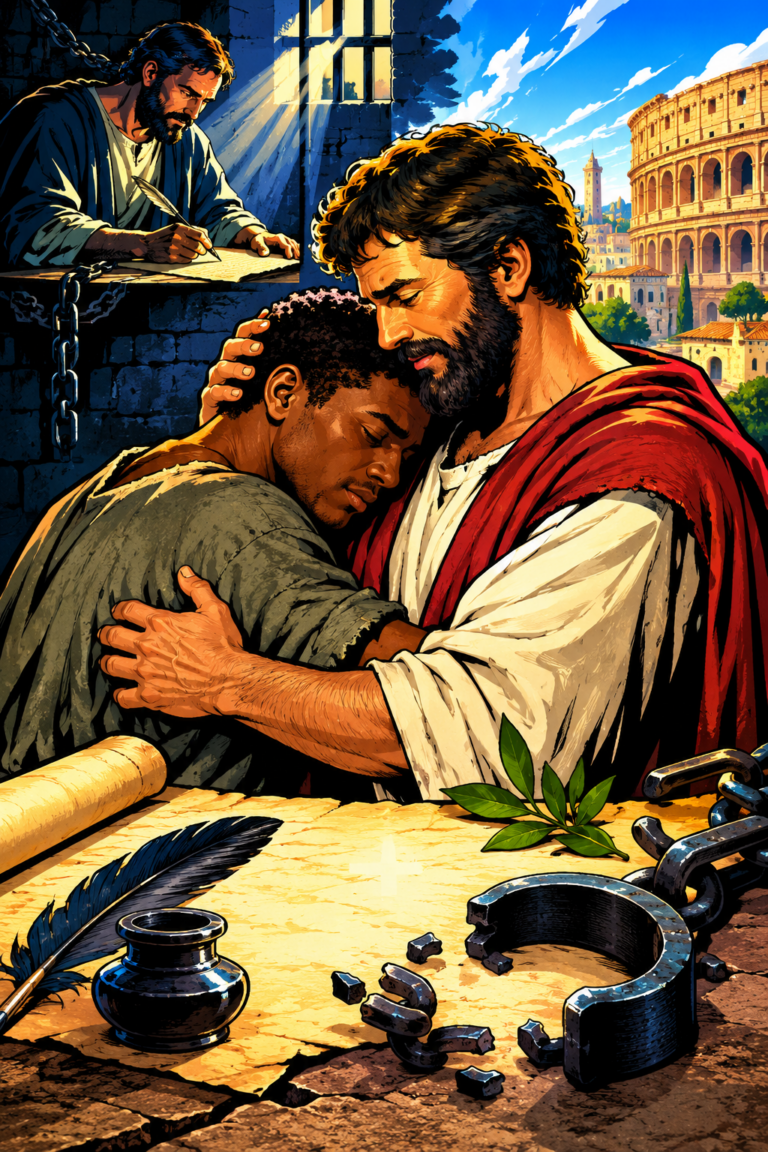
We are not about to read a trendy self-care blog post. We are about to read a letter written from the damp floor of a Roman prison. The author, Paul, is literally sitting on death row, waiting to find out if he is going to be executed. And who is he writing to? A church planted in a hyper-nationalistic city full of retired Roman soldiers who were absolutely obsessed with their patriotism and political status.
And what is the core message a man on death row sends to a city obsessed with power?
He tells them to look at Jesus—a King who had ultimate, cosmic equality with God, but intentionally stripped Himself of all status to be humiliated and slaughtered on a Roman execution rack.
LOGIC MAP 1 · THE STATUS TEST (MODUS TOLLENS)
MODUS TOLLENS equations are simply the “logic of a detective”.
In formal logic it looks like a series of mathematical symbols, but the symbols can be and are replaced by the actual ideas to explain more clearly, not simply show the math behind the thinking of the ideas. Basically putting math numbers on thoughts.
RULE (P THEN Q) then CLUE (YES Q/NO Q) then CONCLUSION.
RULE: If my phone is charging, THEN the little red light is on (YES P/NOT P).
CLUE: The red light is not on.
CONCLUSION: The phone is not charging (NOT P).
BUT if the light was green and not red when charging this would conclude that P does not always mean Q, therefore the assertion is wrong needing a reassessment.
-FOR PHILIPPIANS-
WORLD’S RULE: P If peace depends on status, then Q a person stripped of status can have no peace. The unspoken creed of the “protect your peace” economy.
CLUE: Paul is stripped of status—chained, unsure of his verdict, with no platform—and yet writes of a peace that “surpasses all understanding” and of contentment “in whatever state I am.” Philippians 1:13–14; 4:7, 11.
CONCLUSION: Therefore peace does not depend on status. Valid form: if P then Q; not Q; therefore not P proving that the assumed rule presented at this time was incorrect.
If status is not the source of peace, we had better find out what is. Welcome to Philippians.
Philippians at a glance
Author is Paul, writing with Timothy (1:1).
Audience is The church at Philippi, a Roman colony in Macedonia; the first church planted in Europe (Acts 16).
Written from Prison, most likely in Rome, c. AD 60–62 (1:13; 4:22). A few scholars propose Ephesus or Caesarea.
Occasion is The Philippians sent a financial gift through Epaphroditus (4:18). Paul answers with thanks—and a great deal more.
Theme is The mind of Christ lived out under pressure: humility, joy, and contentment.
Key moving verses Philippians 2:5, Philippians 3:8, Philippians 4:6–7, Philippians 4:11–13.
Shape is Short reflective seven vignettes orbiting the Christ-poem of Philippians 2:5–11; not one linear argument. Key words always reflecting back into this pom in the center.
POEM CENTER (the plot):
Philippians 2:5-11
The Humbled and Exalted Christ
5 Let this mind be in you which was also in Christ Jesus, 6 who, being in the form of God, did not consider it robbery to be equal with God, 7 but made Himself of no reputation, taking the form of a bondservant, and coming in the likeness of men. 8 And being found in appearance as a man, He humbled Himself and became obedient to the point of death, even the death of the cross. 9 Therefore God also has highly exalted Him and given Him the name which is above every name, 10 that at the name of Jesus every knee should bow, of those in heaven, and of those on earth, and of those under the earth, 11 and that every tongue should confess that Jesus Christ is Lord, to the glory of God the Father.
VIGNETTES ENCIRCLING (writings made to describe aspects, show mood, setting, personality without focusing on being the plot itself):
Philippians 1:1-11 Prayer
Philippians 1:12-26 Imprisonment
Philippians 1:27-2:18 Following Jesus Example
Philippians 2:19-30 Two Examples To Learn From
Philippians 3:1-4:1 Paul’s Example Toward Us
Philippians 4:2-9 Challenge To Live The Examples Shown
Philippians 4:10-23 Thank You
Most of Paul’s letters build one long argument. Philippians is different: a series of short, reflective essays, all orbiting a single poem in chapter 2—a condensed retelling of the Messiah’s incarnation, life, death, resurrection, and exaltation. Each vignette grabs words and ideas from that poem and asks: what does this look like on an ordinary Tuesday?
COUNSELING TAKEAWAY
Philippians is the New Testament’s field manual for three things most people are fighting right now: identity (who am I if I’m not winning?), anxiety (why is my mind so fractured?), and contentment (why is “enough” always one purchase, promotion, or relationship away?).
If you are tired of the exhausting rat race of trying to prove your worth, this letter is going to completely shatter your worldview for the better you have been wanting to hear. Paul is about to teach you that true power isn’t found in climbing the ladder; it’s found in climbing down. So put your phones away, forget about your status for the next hour, and open your Bibles to Philippians chapter 1. Let’s see what a dead man walking can teach us about how to actually live.
The story begins about a decade earlier then this letter, about AD 50 in Acts 16. Paul crossed into Macedonia and came to Philippi, which Acts 16:12 calls “a colony”—a little Rome planted on Greek soil, settled with Roman veterans, proud of its Roman citizenship, loyal to Caesar. When Paul announced that Jesus—not Caesar—was the true King, the charge against him revealed everything:
“and teach customs which are not lawful for us, being Romans, to receive or observe.” — Acts 16:21, NKJV
The church in Philippi was the first Jesus community Paul started in Eastern Europe. Situated in ancient Macedonia, Philippi was a prominent Roman colony packed with retired soldiers. It was a city defined by intense, patriotic nationalism. When Paul arrived announcing that Jesus—not Caesar—was the true king of the world, he faced immediate and violent resistance.
Yet, out of that hostile environment grew a vibrant community that remained faithful to the way of Jesus, even as they continued to suffer persecution.
Years later, most scholars place the letter in Rome around AD 60–62. Paul writes this letter to them from inside a Roman prison. Paul tells the Philippians that his “chains in Christ” have become known throughout “the whole palace guard” (Philippians 1:13), and he talks openly about a verdict that could end in his execution (Philippians 1:20–24). Whether he sat in a cell or under guard, he was chained to a Roman soldier.
NOTE these reflections all back into Acts 16: three people met Jesus in Philippi, and they could hardly have been more different. Lydia (Acts 16:14-16, 16:40), a prosperous businesswoman who sold purple cloth; an enslaved girl (Acts 16:16-18, 19-24) exploited by her owners; and a Roman jailer (Acts 16:23-34) whose world fell apart at midnight. Wealth, exploitation, and a stable government job, all at one table. The first church planted on European soil was a status-flattening miracle from day one. And at that midnight, beaten, bleeding, and locked in stocks, Paul and Silas were “praying and singing hymns to God” (Acts 16:25). Hold that picture. Ten years later Paul is in chains again—and the letter that comes out of this second prison uses joy-and-rejoice vocabulary roughly sixteen times in four short chapters.
GREEK WORD STUDY
χαρά chara — joy
χαίρω chairō — to rejoice
The Greek word for joy sits inside the Greek word for grace (χάρις, charis). Joy in Philippians is not a mood that follows good circumstances; it is a response to grace that survives bad ones. Paul even commands it: “Rejoice in the Lord always. Again I will say, rejoice!” (Philippians 4:4). A command can be obeyed, which means joy, at least in its root, is something you can choose to practice.
The Philippians had sent one of their own members, Epaphroditus, with a financial gift to support Paul in his imprisonment. Paul sends this letter back with Epaphroditus to say “Thank you,” but he uses the opportunity to deliver a profound masterclass on joy, mental resilience, and the true meaning of citizenship.
For us navigating a fiercely polarized culture, epidemic levels of anxiety, and constant pressure to build their own status, the Book of Philippians is the ultimate biblical counseling manual.
The Core Structure: The Messiah Poem
Unlike Paul’s other letters, Philippians does not develop one single, long theological argument. Instead, it is structured as a series of short, reflective essays or vignettes. These vignettes all orbit around the letter’s center of gravity: a breathtaking poem in chapter 2.
This poem is a beautifully condensed version of the Gospel. It artistically retells the story of the Messiah’s incarnation, life, death, resurrection, and exaltation, echoing the story of Adam in Genesis 1–3 and the suffering servant in Isaiah 53.
The Ultimate Shift in Status
In Genesis, Adam arrogantly tried to seize equality with God. The Messiah, who already pre-existed in a state of glory and equality with God, chose the exact opposite path.
- Jesus chose not to exploit His equal status for His own advantage.
- He completely emptied Himself of status to become a human and a servant to all.
- He allowed Himself to be humiliated, showing perfect obedience to the Father by going to His death on a Roman execution rack.
Because of this radical humility, God reversed the shameful death through the resurrection, exalting Jesus as King of all and giving Him the name above all names. Quoting Isaiah 45, Paul makes a staggering claim: all creation will recognize that Jesus the Messiah is Lord, to the glory of God the Father.
Counseling Takeaway: The world tells you that success means leveraging your status to get what you want. The Gospel tells you that true power is found in ἀγάπη (agapē)—an unconditional, selfless, and sacrificial love driven by choice and commitment rather than feeling. Jesus had ultimate status and laid it down. You cannot demand everyone bow to your boundaries and preferences while claiming to follow a King who died on an execution rack for His enemies. Boundaries only work when done through Biblical Stewardship, because lines we draw in the sand ourselves will only cause negative isolation and destruction of relationships, not the building up of self nor community that God demands.
The Counseling Vignettes: Living the Jesus Story
Paul takes key words and ideas from the chapter 2 poem and applies them to everyday life, showing the Philippians that living as a Christian means seeing your own life as a lived expression of Jesus’ story.
Reframing Trauma and Hardship (Philippians 1)
“But I want you to know, brethren, that the things which happened to me have actually turned out for the furtherance of the gospel.” (Philippians 1:12, NKJV)
Paul’s status in a Roman prison was no picnic. Yet, paradoxically, it turned out for good. Because of his imprisonment, all the Roman guards and administrators knew he was there for announcing Jesus as the risen Lord, which inspired other Christians to talk about Jesus more openly.
Paul admits he might be executed, but notes, “For to me, to live is Christ, and to die is gain.” For Paul, dying is not a sacrifice because it means he gets to be present with Jesus. Staying alive is the true sacrifice, because it means he must continue to suffer in order to love and serve others more than himself.
Counseling Takeaway: When tragedy or unfair circumstances hit, the human default is toxic φιλαυτία (philautia)—a self-centered love that fixates only on our own victimhood. Paul re-engineers our perspective. Your current hardship is not a dead end; it is a platform for the Gospel.
You cannot threaten a man with the thing he has already counted as gain.
This is not toxic positivity. Paul admits he is “hard-pressed between the two” (1:23), speaks of “weeping” over those who live as enemies of the cross (3:18), and says that losing Epaphroditus would have been “sorrow upon sorrow” (2:27). Reframing is not denial. It is a second look with a bigger frame. And Paul offers a startling gift-word for suffering: “For to you it has been granted on behalf of Christ, not only to believe in Him, but also to suffer for His sake” (1:29)—the verb is built on χάρις, grace.
HEBREW WORD STUDY · THE “YET” OF JOY
אָגִילָה ʾagilah — “I will joy” (Hab 3:18), from the root gil
Habakkuk lists a total economic collapse—“Though the fig tree may not blossom … and the fields yield no food”—and then pivots: “Yet I will rejoice in the LORD, I will joy in the God of my salvation” (3:17–18). The root gil is linked by lexicons with leaping or whirling for delight. The pivot word is “yet.” Philippians lives on that same “yet.”
COUNSELING TAKEAWAY
When tragedy or unfair circumstances hit, the default is φιλαυτία (philautia)—a self-focused love that narrows the whole world to your own pain. Grieve honestly, and then ask Paul’s question: what is God doing with this? Your hardship is not a dead end. It may be a platform.
Living, Breathing Examples (Philippians 2)
The Center of Gravity: Empty Glory vs. Emptied Glory
The poem is introduced by a counseling command, not a theology lecture. Before Paul tells the story of Jesus, he tells you what is wrong with you:
“Let nothing be done through selfish ambition or conceit, but in lowliness of mind let each esteem others better than himself.” — Philippians 2:3, NKJV
Paul’s word for “conceit” is κενοδοξία (kenodoxia)—empty glory. Four verses later he says Jesus “made Himself of no reputation,” and the Greek is ἐκένωσεν (ekenōsen)—He emptied Himself. Same root. Hear the wordplay: you can chase empty glory, or you can be emptied of glory for love. One leaves you hollow. The other makes you like Jesus.
GREEK WORD STUDY · THE MINDSET VERB
φρονέω phroneō — to think, to set your mind, to have a mindset
Philippians uses this verb about ten times (1:7; 2:2, 5; 3:15, 19; 4:2, 10). The command of 2:5 is literally “think this among you which was also in Christ Jesus.” In 3:19 it describes people “who set their mind on earthly things.” Two mindsets, two destinations. Paul treats your thinking as the steering wheel of your life, your heart the engine to give it power.
“Let this mind be in you which was also in Christ Jesus, who, being in the form of God, did not consider it robbery to be equal with God, but made Himself of no reputation, taking the form of a bondservant.” — Philippians 2:5–7, NKJV
GREEK WORD STUDY · THE KENOSIS WORDS
κενοδοξία kenodoxia — empty glory; conceit
ἁρπαγμός harpagmos — something to seize or exploit
κενόω kenoō — to empty; to pour out; to make nothing of
μορφὴ δούλου morphē doulou — the form of a slave
Scholars debate whether harpagmos means something to be seized or something to be exploited for advantage. Either way the point is the same: Jesus, who truly was in the form of God, refused to use His rank for Himself. “Emptied” does not mean He stopped being God. It means He chose not to leverage what He had.
Notice that the emptying is a verb of choice. Nobody stripped Him. That detail will matter later when we talk about Boundaries with Biblical Stewardship.
HEBREW WORD STUDY · ADAM, THE SERVANT, AND THE LORD
צֶלֶם tselem — image (Gen 1:26–27)
כֵּאלֹהִים ke’lohim — “like God” (Gen 3:5)
עֶבֶד ʿeved — servant (Isa 52:13)
In Genesis, Adam is made in God’s image (tselem), yet the serpent’s pitch is “you will be like God” (ke’lohim, Gen 3:5)—and Adam grabs. In Isaiah, God’s Servant (ʿeved) is exalted by way of humiliation (Isa 52:13–53:12). Philippians 2 stitches the two together: the true Image of God does the exact opposite of Adam, in the shape of Isaiah’s Servant. Then Paul quotes Isaiah 45:23—“To Me every knee shall bow”—and places Jesus in the position of the LORD.
Living, Breathing Examples Paul does not leave the poem abstract. Right after it he gives you two people living out Jesus’ story. Timothy is worthy of imitation because he is constantly concerned for the well-being of others more than his own: “I have no one like-minded, who will sincerely care for your state” (Philippians 2:20). Epaphroditus, the courier who carried the Philippians’ gift, nearly died serving Paul, and God had mercy on him and on Paul, “lest I should have sorrow upon sorrow” (Philippians 2:27).
GREEK WORD STUDY
παραβολεύομαι parabouleuomai — to gamble, to stake your life on a throw
In 2:30 the NKJV says Epaphroditus came close to death, “not regarding his life.” The verb is a gambler’s word: he put his life on the table. His name means “favored by Aphrodite,” the goddess of erotic love—and Paul holds him up as a portrait of ἀγάπη. A man named for a love goddess becomes a picture of sacrificial love.
- Timothy: He is worthy of imitation because he is constantly concerned for the well-being of other people more than his own.
- Epaphroditus: He practically risked his life and almost died from sickness trying to serve Paul in prison. God had mercy on him, sparing Paul the loss of a friend.
Counseling Takeaway: You become like the people you admire. Stop idolizing influencers who are obsessed with themselves. Look for the people in your local church who bleed ἀγάπη (agapē) and imitate their quiet, sacrificial service.
Which love is the engine in your life?
Koine Greek has several words for love. Which one is running your decisions? Notice that Paul puts agapē at the proper power for your mind’s steering wheel and every other love in its proper seat.
1. Agape (ἀγάπη) / Agapao (ἀγαπάω)
This is the most common word for love in the New Testament, appearing over 200 times to describe God’s unconditional, willful, and sacrificial love.
John 3:16: “For God so loved [agapaō] the world, that he gave his only Son…”
1 Corinthians 13:4: “Love [agapē] is patient and kind; love [agapē] does not envy or boast…”
Romans 5:8: “But God shows his love [agapē] for us in that while we were still sinners, Christ died for us.”
Galatians 5:22: “But the fruit of the Spirit is love [agapē], joy, peace, patience…”
2. Philia (φιλία) / Phileo (φιλέω)
This represents close friendship, brotherly affection, and deep emotional bonds.
John 5:20: “For the Father loves [phileō] the Son and shows him all that he himself is doing.”
Romans 12:10: “Love one another with brotherly affection [philadelphia]…” (A compound of philos and adelphos / brother).
John 11:3: “So the sisters sent to him, saying, ‘Lord, he whom you love [phileō] is ill.'” (Referring to Lazarus).
Revelation 3:19: “Those whom I love [phileō], I reprove and discipline…”
3. Storge (στοργή)
While the standalone noun storge is absent from the New Testament, it appears prominently in its compound form or as an antonym (opposite):
Romans 12:10 (Compound): “Be devoted [philostorgos] to one another in brotherly love.” (This combines philos and storge, meaning “to love dearly like family”).
Romans 1:31 (Antonym): “…foolish, faithless, heartless [astorgos], ruthless.” (The prefix a- means “without”—describing a severe lack of natural family affection).
2 Timothy 3:3 (Antonym): “heartless [astorgos], unappeasable, slanderous…” (Describing the moral decay of people in the last days).
4. Eros (ἔρως)
The word eros is never explicitly used in the New Testament text. This is largely because secular Greek culture of the time associated eros with base lust and the mythos of the god Eros. Instead, the New Testament uses descriptive concepts to express romantic passion and intimacy within marriage:
1 Corinthians 7:5: “…Do not deprive one another, except perhaps by agreement for a limited time… so that Satan may not tempt you because of your lack of self-control.”
Hebrews 13:4: “Let marriage be held in honor among all, and let the marriage bed be undefiled…”
(Note: While not Koine Greek, the Old Testament equivalent of romantic/erotic love is vividly illustrated throughout the Hebrew text of the Song of Solomon).
The “extended” Greek concepts of love (Mania, Pragma, Philautia, and the Latin-derived Ludus) are modern psychological classifications rather than ancient biblical vocabulary. However, the New Testament frequently addresses the underlying behaviors and spiritual concepts behind them.
Here is how the Bible covers the concepts of these extended forms of love using Koine Greek terminology.
5. Mania (μανία) – Obsessive, Toxic Love
In the Bible, the concept of mania is addressed not as genuine love, but as sinful covetousness, obsession, or capturing someone as an idol.
2 Samuel 13:1-2 & 15 (The Concept): Amnon’s obsessive fixation on Tamar is the ultimate biblical example of mania. The text notes he became physically ill with frustration, but immediately after getting what he wanted, “Amnon hated her with very great hatred, so that the hatred with which he hated her was greater than the love with which he had loved her.”
Acts 26:24 (The Word): The literal word mania appears in the New Testament, though it is translated as madness rather than love. Festus shouts to Paul, “Paul, you are out of your mind [mainomai / mania]; your great learning is driving you mad!”
6. Pragma (πρᾶγμα) – Enduring, Practical Love
While pragma usually means “a matter, thing, or business transaction” in Koine Greek, the underlying concept of a mature, working, covenant-based partnership is heavily emphasized in biblical marriage.
Proverbs 31:10-12 (The Concept): The description of the “excellent wife” and her husband is the definition of pragma—a love built on mutual trust, shared labor, management of a household, and long-term commitment.
1 Corinthians 6:1 (The Word): The physical word pragma is used in the New Testament, but strictly in its literal legal/business sense: “When one of you has a grievance [pragma – legal matter] against another, does he dare go to law…”
7. Philautia (φιλαυτία) – Self-Love
The Bible addresses philautia in two distinct ways: a negative, narcissistic self-love, and a healthy, foundational self-care.
2 Timothy 3:2 (Negative Philautia): The exact compound word appears here as a warning about the end times: “For people will be lovers of self [philautos], lovers of money, proud, arrogant…”
Matthew 22:39 (Positive Philautia): Jesus highlights a healthy, baseline self-love as the metric for how we treat neighbors: “You shall love your neighbor as yourself.” (If you hate or neglect yourself, you cannot fulfill this command).
Ephesians 5:29 (Positive Philautia): “For no one ever hated his own flesh, but nourishes and cherishes it, just as Christ does the church.”
8. Ludus – Playful, Flirtatious Affection
Because Ludus is a Latin word (not Greek), you won’t find it in the Koine Greek text. However, the concept of playful, joyous courtship is beautifully captured in Old Testament wisdom literature.
Song of Solomon 2:8-9 (The Concept): The poetic imagery of a lover leaping over mountains like a young stag, playing hide-and-seek behind walls, and looking through the lattice captures the essence of flirtatious, joyful romance.
Proverbs 5:18-19 (The Concept): Conjugal playfulness is encouraged within marriage: “Let your fountain be blessed, and rejoice in the wife of your youth… let her breasts fill you at all times with delight; be intoxicated always in her love.”
Again Pragma (practical, enduring love) and ludus (playful love; a Latin word) are modern classifications rather than biblical vocabulary, but Scripture describes the realities behind them, in Proverbs 31 and the Song of Songs.
Look at what happens next. Because Jesus went down, God raised Him up:
“Therefore God also has highly exalted Him and given Him the name which is above every name … that every tongue should confess that Jesus Christ is Lord, to the glory of God the Father.” — Philippians 2:9–11, NKJV
That little word “Therefore” is a logical connector. Exaltation follows humiliation, and God is the One who does the lifting. Peter says the same thing to the same kind of reader: “Humble yourselves under the mighty hand of God, that He may exalt you in due time” (1 Peter 5:6). Self-promotion is you trying to do God’s job. James 4:7 submission causes motions to begin to go into actions.
The word nobody said out loud in Philippi.
Look at Philippians 2:8: “even the death of the cross.” To Roman ears that was obscene. Crucifixion was the punishment of slaves and rebels, and a famous Roman orator argued that the very word should be kept away from a Roman citizen’s thoughts, eyes, and ears. Paul takes the most shameful word in the empire, drops it into the middle of a poem addressed to Roman citizens, and writes “Lord” over the victim. In a city that prized loyalty to Caesar, confessing “Jesus Christ is Lord” was a political statement as much as a religious one.
LOGIC MAP 2 · THE PATTERN (MODUS PONENS)
P If Christ’s mind is the pattern for the Christian mind, then Q the Christian pattern is descent (humbleness) first, exaltation by God’s hand second. Philippians 2:5–11
Christ’s mind is the pattern for the Christian mind: “Let this mind be in you.” Philippians 2:5 Therefore the Christian path runs downward by choice and upward by God’s power—never the reverse. Valid form: if P then Q; P; therefore Q. See also 1 Peter 5:6, James 4:7.
COUNSELING TAKEAWAY
The world says power flows up: leverage, climb, protect, brand. The Gospel says the One with every right to the top chose the bottom, and God lifted Him. True power is found in ἀγάπη (agapē)—unconditional, selfless, sacrificial love, driven by choice and commitment rather than feeling. You cannot demand that everyone bow to your boundaries, preferences, and brand while following a King who died for His enemies. Biblical Stewardship Boundaries in our lives are edifying, not tearing down— very different from our own self proclaimed ones.
Radical Kingdom Citizenship (Philippians 3)
“For our citizenship is in heaven, from which we also eagerly wait for the Savior, the Lord Jesus Christ.” (Philippians 3:20, NKJV)
GREEK WORD STUDY
πολίτευμα politeuma — commonwealth, colony, citizenship
πολιτεύομαι politeuomai — to live as a citizen (1:27)
The Philippians knew exactly what this meant. They lived in a colony: hundreds of miles from the capital, yet governed by its laws, its customs, its loyalties. Paul turns the picture upside down. You are the colony—a colony of heaven—so “let your conduct (politeuesthe) be worthy of the gospel of Christ” (1:27).
The Christians in Philippi lived in a hotbed of Roman patriotism, but Paul commands them to let their lives be shaped by another King. He tells them their true citizenship is in heaven. For Paul, heaven is not merely a place we hope to escape to away from Earth; it is the transcendent place where Jesus currently reigns as King. Believers eagerly await Jesus to return from there to bring His kingdom of healing justice, transforming love, and a new creation (Philippians 3:21).
To live this out, Paul abandoned his own impressive past. He used to persecute followers of Jesus and tried to prove his right standing before God through zealous obedience to the Torah. But he gave up all that status and privilege, considering it all “filth” (using a Greek word that is actually much less polite) in order to become a servant like Jesus.
None of this means withdrawing from civic life. Paul invoked his Roman citizenship when it served the gospel (Acts 16:37). It means no earthly tribe—no party, no tax bracket, no brand—gets your ultimate loyalty.
Counseling Takeaway: Stop wrapping your identity in political parties, social status, or your past religious resume. None of it survives the resurrection. Your allegiance belongs to the King of a coming new creation.
The Question Nobody Asks: How Can You Afford to Empty Yourself?
Every person is holding the same objection: “Emptying yourself sounds beautiful for people who already have something. I’m still trying to get started.” Paul answers with two small words you have probably read past a hundred times: in Christ.
“… that I may gain Christ and be found in Him, not having my own righteousness, which is from the law, but that which is through faith in Christ, the righteousness which is from God by faith.” — Philippians 3:8–9, NKJV
GREEK WORD STUDY
ἐν Χριστῷ en Christō — in Christ
Philippians opens with it (“all the saints in Christ Jesus,” Philippians 1:1), closes with it (Philippians 4:21), and threads it through every chapter. It is Paul’s whole counseling strategy: what is true of Christ is credited to those who are in Him.
Christ is blessed—“blessed us with every spiritual blessing … in Christ” (Ephesians 1:3). Christ is chosen—“he chose us in Him” (Ephesians 1:4). Christ is raised and exalted—and we are raised and seated with Him (Ephesians 2:6) and will be “conformed to His glorious body” (Philippians 3:21). Being in Christ gives us both the access and the power source to live this way.
“Therefore, if anyone is in Christ, he is a new creation; old things have passed away; behold, all things have become new.” — 2 Corinthians 5:17, NKJV
LOGIC MAP 3 · THE FREEDOM ARGUMENT
A person can only afford to give away what they do not need in order to survive. Paul’s ledger logic: Philippians 3:7–8
In Christ, your identity, righteousness, and citizenship are already secured by Another—chosen, righteous, seated, enrolled. Philippians 3:9, 20; Ephesians 1:3–4; 2:6; 2 Corinthians 5:17
Therefore you can afford to empty yourself. Status is optional equipment, not the foundation. You can only empty a cup that has been filled from somewhere else.
COUNSELING TAKEAWAY
When you feel anxious about your standing, the instinct is to try harder to build it. Ask instead: do I actually believe what is already true of me in Christ? A great deal of status anxiety is a theological problem wearing a career costume.
Resolving Conflict and Defeating Anxiety (Philippians 4)
“Be anxious for nothing, but in everything by prayer and supplication, with thanksgiving, let your requests be made known to God; and the peace of God, which surpasses all understanding, will guard your hearts and minds through Christ Jesus.” (Philippians 4:6–7, NKJV)
In his final challenges, Paul addresses two prominent women leaders in the church who worked alongside him but are now caught in some kind of conflict. He pleads with them to follow Jesus’ example of humility, to reconcile, and to become unified.
Resolving Conflict and Defeating Anxiety “I implore Euodia and I implore Syntyche to be of the same mind in the Lord.” — Philippians 4:2, NKJV
Paul names two prominent women leaders who “labored with me in the gospel” (Philippians 4:3), now caught in some kind of conflict, and names them in a letter that will be read aloud to the whole church. He does not pick a side. He uses the same verb as the poem: τὸ αὐτὸ φρονεῖν—think the same thing, the mindset of Christ. Pride is the engine of nearly every church fight; the poem is its antidote.
WHEN CONFLICT FESTERS, YOU GRIEVE THE SPIRIT
“And do not grieve the Holy Spirit of God, by whom you were sealed for the day of redemption.” — Ephesians 4:30, NKJV
Paul says in Philippians 2:1 that the church shares “fellowship of the Spirit.” The Spirit is a Person who has feelings, not an impersonal force, and the Greek λυπεῖτε (lypeite) means to cause pain or sorrow. The surrounding verses (Eph 4:25–32) name what grieves Him:
▪ Lying: not speaking the truth to one another
▪ Uncontrolled anger: holding rage past sundown
▪ Stealing: taking what is not yours, or refusing honest work
▪ Bad speech: harsh, foul, or hurtful words instead of words that build up
▪ Bitterness: malice, slander, and unforgiveness
The Old Testament knew the same grief. Isaiah 63:10 says Israel “rebelled and grieved His Holy Spirit,” using the Hebrew עָצַב (ʿatsav), “to pain, to hurt.” And grieving the Spirit does not cancel your salvation: He seals you “for the day of redemption.” It grieves a Person who is staying.
He then pivots to the collective mental health of the church. He urges them not to give in to fear despite their persecution. Instead, they are commanded to vent all their emotions and needs to God, who will give them peace. That peace is sustained by actively focusing their thoughts on what is good, true, and lovely.
Persecution is real, and fear is the natural response. His instruction is one of the most practical sentences in the Bible:
“Be anxious for nothing, but in everything by prayer and supplication, with thanksgiving, let your requests be made known to God; and the peace of God, which surpasses all understanding, will guard your hearts and minds through Christ Jesus.” — Philippians 4:6–7, NKJV
GREEK WORD STUDY · ANXIETY AND ITS ANTIDOTE
μεριμνάω merimnaō — to be anxious, to be pulled apart by care
φρουρέω phroureō — to guard, to garrison
The traditional word-picture links merimnaō with μερίζω (merizō), “to divide”: a mind in pieces, pulled by the fear of missing out, the fear of failure, and the fear of rejection. (Lexicons simply define it as “be anxious, be concerned”; the picture is a helpful illustration, not a proof.) Jesus uses the same verb of worry about tomorrow (Matthew 6:25–34) and says it to Martha (Luke 10:41).
Here is the twist. In Philippians 2:20 Paul uses the very same verb of Timothy, who will “sincerely care” (merimnēsei) for the Philippians. Same verb, opposite direction. Care aimed outward is love. Care aimed inward, with nowhere to land, is anxiety.
And phroureō is a military word: peace will stand guard over your heart and mind like a garrison. Philippi was a garrison-style colony. They knew what it felt like to have soldiers at the gate.
HEBREW WORD STUDY · PEACE, MIND, AND ANXIETY
שָׁלוֹם shalom — wholeness, nothing missing, nothing broken
דְּאָגָה deʼagah — anxiety (Proverbs 12:25)
Isaiah 26:3 is the Old Testament twin of Philippians 4:7: “You will keep him in perfect peace, whose mind is stayed on You, because he trusts in You.” “Perfect peace” is literally שָׁלוֹם שָׁלוֹם (shalom shalom)—peace doubled for emphasis—and “stayed” translates סָמוּךְ (samukh), propped up or leaning on. Anxiety (deʼagah) “in the heart of man causes depression, but a good word makes it glad” (Proverbs 12:25).
LOGIC MAP 4 · THE PEACE CHAIN
Anxiety is care with no place to land: concern that circles back on yourself. Phil 4:6; Matt 6:25–34
Paul gives care an address: prayer, supplication, thanksgiving, requests made known to God. Philippians 4:6; 1 Peter 5:6-7 (“humble self… casting all your care upon Him”)
When care is handed to God, God’s peace stands guard over heart and mind. Phil 4:7
Therefore the road from anxiety to peace is not suppression. It is transfer. If transfer, then peace; transfer is commanded; therefore peace is available.
Peace is then sustained by what you dwell on (Philippians 4:8) and what you practice (Philippians 4:9). There is always something to complain about. But a follower of Jesus knows that all of life is a gift and chooses to see beauty and grace in any circumstance.
COUNSELING TAKEAWAY
You cannot heal μεριμνάω by doom-scrolling or isolating yourself. You heal it by bringing every emotion, terror, and need directly to God, while deliberately naming the grace you already have. Thanksgiving glues a fractured mind back together. You cannot experience the peace of God while letting your mind marinate in the garbage of the world.
Counseling Takeaway: There is always something you could complain about. But a follower of Jesus knows that all of life is a gift and intentionally chooses to see beauty and grace in any circumstance. You cannot experience the peace of God while allowing your mind to endlessly doom-scroll the garbage of the world.
The “Secret” of Contentment (reveal more in detail later)
Paul Does the Math: The Logic of Contentment
Philippians reads like a ledger. Paul reaches for the vocabulary of accountants again and again: κέρδος (kerdos, gain), ζημία (zēmia, loss), ἡγέομαι (hēgeomai, to assess or count), λογίζομαι (logizomai, to reckon), and even “giving and receiving” (Philippians 4:15, δόσεως καὶ λήμψεως), a standard phrase for debits and credits. He is not venting emotion. He is running the numbers.
“But what things were gain to me, these I have counted loss for Christ.” — Philippians 3:7, NKJV
GREEK WORD STUDY
λογίζομαι logizomai — to reckon, calculate, weigh carefully
This is the root of our word “logic.” Paul uses it of himself in Philippians 3:13 (“I do not count myself to have apprehended”) and as a command in Philippians 4:8: “whatever things are true, whatever things are noble, whatever things are just, whatever things are pure, whatever things are lovely, whatever things are of good report … meditate on these things.” The Greek is ταῦτα λογίζεσθε: run the numbers on these.
Paul’s cure for a runaway mind is not “stop thinking.” It is think accurately. Anxiety is often a miscalculation; faith is better arithmetic.
Paul concludes by thanking the Philippians again for their sacrificial gift. But he clarifies something profound: his imprisonments and times of poverty are not true hardships for him. Instead, they have become his greatest teachers. Through these crushing circumstances, Paul has learned the ultimate secret (yes the word secret explained soon) of contentment: simple dependence on the One who strengthens him. He came to see his own suffering as a direct participation in the story of Jesus.
The Book of Philippians provides a unique window into Paul’s mind. You can sense his deep awareness that Jesus’ love and presence are closer than his own skin. This deeply personal, transforming encounter with Jesus is what gave Paul hope and humility in his darkest hours, and it is the exact same encounter he invites us into today.
In about five minutes, you are going to walk out of this room, check your phone, and immediately find something to complain about.
You’ll complain about the traffic, your bank account, your roommate, or your anxiety over your career trajectory. You will slip right back into the exhausting, suffocating rat race of protecting your image, nursing your petty grievances, and trying to prove to everyone that you are successful.
Stop. Look at the text.
A man sitting on the damp, freezing floor of a Roman prison, waiting to see if he was going to be executed, just wrote the ultimate manual on human joy. And his conclusion? “If they kill me, I get Jesus. If they let me live, I get to serve you.”
Compare his death-row joy to your crisis. The contrast is devastating.
Paul didn’t write this letter so you could highlight Philippians 4:13 with a pastel marker, put it in your Instagram bio, and use it to manifest a promotion. He wrote this to a church living in a hotbed of Roman patriotism to demand that they tear down their idols of self-love and political status. He even publicly called out two prominent women in the church who were “beefing” with each other, demanding they drop their pride, reconcile, and follow the humility of Jesus instead of acting like soldiers loudly complaining their grievance about their minimum to no beef rations in the much later 1800’s.
The Kenosis Protocol: Why “Protecting Your Peace” is Destroying Your Mind
GREEK WORD STUDY · THE SECRET WEAPON
αὐτάρκης autarkēs — content; “self-enough” (Philippians 4:11)
μεμύημαι memyēmai — “I have been initiated” (Philippians 4:12)
ἐνδυναμόω endynamoō — to empower, to strengthen from within (Philippians 4:13)
Autarkēs is built from αὐτός (self) and ἀρκέω (to be enough). Greek philosophers, especially the Stoics, prized it as inner self-sufficiency: needing nothing from anyone. Paul takes the word and changes the source. His “enough” is borrowed: “I can do all things through Christ who strengthens me.” Not self-sufficiency. Christ-sufficiency.
And the NKJV’s “I have learned” in Philippians 4:12 translates memyēmai, a word taken from the language of initiation into the mystery religions. Contentment is a secret you are initiated into by experience, not a mood that arrives when your bank balance hits a number. (That is why the English phrase “the secret of being content” is faithful to the Greek, even where a translation does not use the word “secret.”)
Read verse 12 carefully: Paul has learned to be abased and to abound, to be full and to be hungry. Plenty tests the soul as ruthlessly as poverty. Contentment is not about the size of the bank account. It is the settled realization that because your true citizenship is in a coming Kingdom, this present world has nothing to offer that you need and nothing to take that actually matters.
Empty the status. Bring the fracture. Learn the enough.
Right now, you have been aggressively discipled by a culture that worships self-preservation. You are constantly told to “protect your peace,” cut off toxic people, manifest your dream life, and establish rigid self-centered boundaries so nobody can demand too much of you.
The promise of modern self-care is that if you isolate yourself enough from other people’s problems and ruthlessly optimize your own status, you will finally stop being anxious.
But look at the reality: your generation is the most medicated, exhausted, and chronically anxious demographic in human history. The self-care gospel is failing you.
To understand why, we have to look at the exact opposite psychological framework, written by a man sitting on death row in a Roman prison. Paul introduces the ultimate biblical counseling protocol for anxiety and human conflict, and it centers entirely on three radical Koine Greek realities.
1. The Trap of Status vs. The Power of Kenoō (Emptying)
“Let this mind be in you which was also in Christ Jesus… who made Himself of no reputation, taking the form of a bondservant…” (Philippians 2:5-7, NKJV)
- κενόω (kenoō): “To empty, to make void, to strip oneself of privileges and status.”
In the Genesis story, Adam rebelled because he wanted to seize equality with God and elevate his status. The modern life crisis is just a repetition of Adam’s trauma: frantically trying to seize status, seize the perfect job, and seize the perfect relationship to prove you matter.
Jesus did the exact opposite. He already possessed ultimate glory, but He chose not to exploit it for His own advantage. Instead, He executed kenoō. He emptied Himself of status to become a human, a servant, and allowed Himself to be humiliated on a Roman execution rack.
The Counseling Logic: Your anxiety is directly tied to the image you are trying to maintain. You are exhausted because carrying the armor of your own reputation is incredibly heavy. Jesus didn’t find victory by building a bigger brand; He found victory by emptying Himself of the need to have one. You will never experience biblical Shalom until you stop trying to prove your worth to people who don’t care about you and start washing the feet of the people in front of you.
2. (Bring) The Mental Fracture of Merimnaō (Anxiety)
“Be anxious for nothing, but in everything by prayer and supplication, with thanksgiving, let your requests be made known to God;” (Philippians 4:6, NKJV)
- μεριμνάω (merimnaō): “To be pulled in different directions, to be distracted, fractured, or divided into pieces by care.” — Contrasting with 2 Timothy 1:7, “God has not given us a spirit of fear, but of power, love, and a sound mind (a Shalom whole put back together again mind of sōphronismos).” The fractured relationship and the fractured mind are both brought into sōphronismos: disciplined order in place of chaos.
When Paul commands the church to “be anxious for nothing,” he isn’t telling them to just calm down. The Greek word merimnaōliterally means to have your mind pulled apart by competing forces.
When you try to live as a citizen of heaven while simultaneously trying to build a kingdom of Roman-style status on earth, your brain literally fractures. You are pulled apart by the fear of missing out, the fear of failure, and the fear of rejection. Your mind fractures. The antidote is immediate: “prayer and supplication, with thanksgiving.” Vent everything—the terror, the envy, the resentment—to the One who can carry it, then deliberately name the grace you already hold. Prayer gives μεριμνάω somewhere to land.
The Counseling Logic: Notice Paul’s immediate antidote to a fractured mind: “prayer and supplication, with thanksgiving.” You cannot heal merimnaō (anxiety) by doom-scrolling or isolating yourself. You heal it by forcefully venting all of your emotions, terrors, and needs directly to God, while intentionally acknowledging the grace you already have. Thanksgiving glues a fractured mind back together.
3. (Learn) The Secret Weapon of Autarkēs (Contentment)
“Not that I speak in regard to need, for I have learned in whatever state I am, to be content … I can do all things through Christ who strengthens me.” — Philippians 4:11,13, NKJV
- αὐτάρκης (autarkēs): “Content, self-sufficient, entirely independent of external circumstances.”
The Philippians were surrounded by a culture of patriotic nationalism, constantly terrified of losing their rights or safety. Today, we are terrified of economic collapse, political chaos, and social irrelevance.
Yet Paul—who is locked in a dark cell, financially broke, and facing execution—casually states that he has learned the secret of being autarkēs. He is completely unbothered by his external circumstances. He realized that his imprisonments and times of poverty were not true hardships; they were the very tools God used to teach him dependence on Christ.
The Counseling Logic: Contentment is not a mood that magically hits you when your bank account reaches a certain number. It is a learned, battle-tested skill. It is the absolute, unshakeable realization that because your true citizenship is in a coming Kingdom, this present world has nothing to offer you that you need, and nothing it can take away from you that actually matters.
If you want to break out of the exhausting rat race, you have to adopt the mindset of the Messiah. Stop trying to seize equality, status, and control. Empty yourself (kenoō), bring your fractured mind (merimnaō) to the Father, and learn the dangerous, unstoppable freedom of a believer who needs absolutely nothing from this world to be content (autarkēs).
Three Honest Objections
“Isn’t ‘emptying yourself’ just a polite word for being a doormat? What about my boundaries?”
Look again at the verb. Jesus’ emptying was a choice made by Someone with power: “No one takes it from Me, but I lay it down of Myself. I have power to lay it down” (John 10:18). Kenosis is generosity from strength, not collapse from weakness.
Jesus also withdrew to pray (Luke 5:16). Paul insisted on his legal rights when magistrates had beaten him unjustly (Acts 16:37), and he escaped danger when he could (Acts 9:25). Emptying yourself does not mean staying in harm’s way. If someone is abusing or endangering you, get safe and bring in trusted pastoral, medical, and legal help. That is wisdom, not a failure of humility.
A useful test: real boundaries protect people—you and others taught through biblical Stewardship of self. “Protecting my peace” as a personal brand often protects an ego. Ask honestly which one you are doing.
“Can’t I claim Philippians 4:13 for my goals?”
Read the verses just before it. “All things” in Philippians 4:13 points back to Philippians 4:12: being abased and abounding, full and hungry. Paul is not saying “I can win the championship” or “I can land the promotion.” He is saying, I can survive hunger and handle plenty without losing my soul. It is not a prosperity lever. It is a survival rope.
“What if my anxiety isn’t just a thinking problem?”
Bodies and brains matter. Philippians 4:6–7 is part of your professional care. If your anxiety is constant, disabling, or comes with panic, sleeplessness, or hopelessness, see your pastor and get hooked up with a counselor as well along with your praying.
You have a boulder baros crushing sized weight needing others to come along side you to bear up as commanded in Galatians 6:2 (NKJV) “Bear one another’s burdens, and so fulfill the law of Christ.”
It is no longer your daily the one man sized phortion backpack one man load explained in Galatians 6:5 (NKJV) “For each one shall bear his own load.”
Humble self, reach out right now, and tell someone Godly you trust today.
- Proverbs 11:14: “Where there is no counsel, the people fall; But in the multitude of counselors there is safety.”
- Proverbs 12:15: “The way of a fool is right in his own eyes, But he who heeds counsel is wise.”
- Proverbs 15:22: “Without counsel, plans go wrong, But in the multitude of counselors they are established.”
- Proverbs 19:20: “Listen to counsel and receive instruction, That you may be wise in your latter days.”
- Psalm 32:8: “I will instruct you and teach you in the way you should go; I will guide you with My eye.”
So, what is your conflict? What is the “status” you are refusing to empty yourself of?
Your true citizenship is not your political party, your tax bracket, or your carefully curated online brand. If you want the peace of God that actually guards your mind from the chaos of this culture, you have to stop thinking like a Roman patriot trying to build a personal empire. You have to start thinking like a King who willingly walked onto a Roman execution rack.
Here is your assignment for today: Find the one thing you are using right now to prove you are “better” than someone else. Maybe it’s your degree, your flawless theology, your job title, or your right to be offended. I want you to mentally flush it down the toilet. Call it exactly what Paul called it: filth.
Then, before the sun goes down today, go serve someone who can do absolutely nothing to elevate your status. Go be a living, breathing expression of the Jesus story.
Class dismissed.
Some Key Koine Greek & Hebrew Words
| Word | Where | What it means for you |
| σκύβαλον skybalon | Phil 3:8 | Your résumé, weighed next to Christ |
| κενόω kenoō | Phil 2:7 | Emptying yourself of status—by choice, from strength |
| φρονέω phroneō | Phil 2:5 | The mindset that steers your whole life |
| πολίτευμα politeuma | Phil 3:20 | You are a colony of heaven; live by its culture |
| λογίζομαι logizomai | Phil 4:8 | Think accurately: run the numbers |
| μεριμνάω merimnaō | Phil 4:6 | Care with no address; give it one |
| φρουρέω phroureō | Phil 4:7 | Peace on guard duty over heart and mind |
| αὐτάρκης autarkēs | Phil 4:11 | Enough—borrowed from Christ, not manufactured by you |
| ἐν Χριστῷ en Christō | Phil 1:1; 3:9 | Your standing is already secured by Another |
| שָׁלוֹם shalom | Isa 26:3 | Wholeness: nothing missing, nothing broken |
| גִּיל gil | Hab 3:18 | Joy that says “yet” when everything fails |
| דְּאָגָה deʼagah | Prov 12:25 | The anxiety that weighs the heart; a good word lifts it |
| עֶבֶד ʿeved | Isa 52:13 | The Servant who is exalted by going down |
Seven days with the letter
| Day | Passage | The practice |
| 1 | Phil 3:4–8 | Write down the five things you use to prove your worth. Label each one σκύβαλον. Pray over the list. |
| 2 | Phil 2:3–4 | Do one hidden act of service for someone who cannot repay you or praise you for it. |
| 3 | Phil 4:6–7 | Write every worry as a prayer. End each one with a line of thanksgiving. |
| 4 | Phil 4:8 | Fast from scrolling for thirty minutes. Use the time to list what is true, noble, just, pure, and lovely in your life. |
| 5 | Phil 4:2–3 | Reach out to one person you are in conflict with. Own your part first. Do not litigate theirs. |
| 6 | Phil 2:19–30 | Find your Timothy or your Epaphroditus. Thank them, then join them in serving. |
| 7 | Phil 4:11–13 | List what is already yours in Christ. Give something away, in secret, in celebration. |