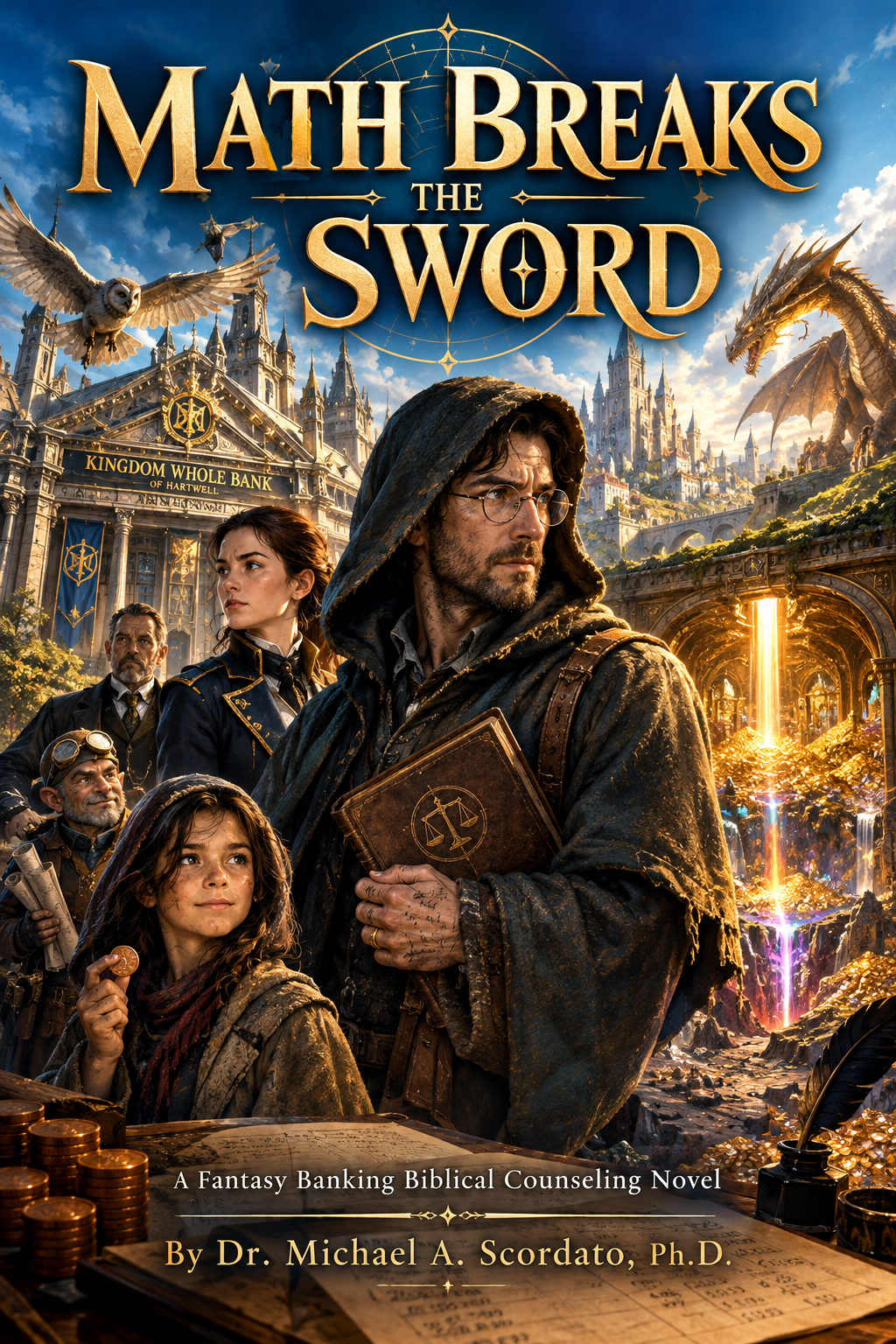

A Fantasy Banking Biblical Counseling Novel By Dr. Michael A. Scordato, Ph.D.
The True Nature of the Vault
Further Recommended Reading: https://vlgroup.org/philippians-11-11-stop-scrolling-and-wake-up-the-death-row-prayer-that-will-ruin-your-self-obsession/
Edwin was panicking about hyper-inflation and currency devaluation, but his accountant’s brain—sharp as it was—had missed the deeper, darker truth of the magical ledger.
The Holy Dungeon was not a new economic crisis. It was not proof that his reforms had failed.
It was the ultimate, physical consequence of their success.
For centuries, greed-mana had saturated every corner of Valerius—clinging to predatory debt-bondage contracts, corrupt tax houses, illegal bullion foundries, and the central vaults. When Edwin’s reforms forced the kingdom to adopt fair credit, public charity, and transparent commerce, the city’s economic life was cleansed.
But magic is never destroyed; it is only displaced.
As the greed-mana was systematically purged from the daily lives of the citizens, that ancient, accumulated force was driven out of the markets and squeezed into a single, isolated, subterranean pressure vessel. The Holy Dungeon was the city’s expelled spiritual poison, concentrated into one enormous, lethal, physical tumor.
It sat in the center of the capital as a concentrated hazard, housing an incomprehensible mountain of wealth surrounded by instant, lethal annihilation for anyone foolish enough to step inside.
The dungeon created three simultaneous, deliciously ironic realities:
- Economically: It contained the greatest treasure hoard in human history, yet because it was entirely lethal to enter, it was functionally inaccessible capital—a mountain of gold that could never touch the market or disrupt the currency.
- Magically: It was a containment hazard, holding the city’s purged greed-mana safely trapped behind celestial death-traps where it could no longer infect the minds of men.
- Socially: It became the capital’s premier tourist attraction. Thousands of citizens, tourists, and nobles lined up behind velvet safety ropes every afternoon, eating roasted nuts and admiring the blinding glitter of the greatest treasure hoard ever assembled—knowing full well that possessing a single coin of it meant instant death.
Sensible people stood outside, marveled at the terrifying shine, and walked away to spend their hard-earned copper at the local baker.
Standing in the dirt, sweating through his hood, Edwin stopped his frantic sweeping for a brief second. He looked up through his crooked spectacles, seeing hundreds of commoners casually pointing at the mountain of gold, laughing, snapping souvenirs, and walking right past it into the Bank of Hartwell to deposit their modest earnings.
The contrast was absolute.
A mountain of gold, saturated with greed-mana and sealed behind lethal traps, represented wealth without practical benefit—an inaccessible monument to a past the realm no longer needed.
And a single copper coin, held in the hand of a former street child and recorded in a transparent ledger, represented the true, unyielding power of the kingdom’s future.
Edwin wiped a streak of mud from his forehead, adjusted his spectacles, and let out a long, weary sigh. The numbers were right, the system was safe, and the kingdom was saved—even if he was still throwing dirt at a mountain of gold.
Now back at the beginning…
The Threshold’s Unveiling Proem
Just at the midpoint between night and morning, as the constellation of the Weaver tilted past the third pillar, Lord Edric of House Thornmark was crushed to death by his own net worth.
He had spent twenty years bleeding the provincial grain districts dry, hoarding exactly four hundred twelve thousand silver crowns in a subterranean, magic-sealed vault beneath his estate. He believed the heavy iron doors kept the thieves out. He did not understand that in the Kingdom of Valerius, stagnant wealth is not a metric of success. It is a biological hazard.
Money that stops moving begins to rot.
The phenomenon started as a low, wet grinding sound. Edric, locked in his vault to count the latest foreclosures, watched in absolute horror as the towering stacks of silver began to sweat a thick, black, metallic slime. The coins were sliding, melting into one another, binding together with the sickening sound of snapping cartilage.
The hoard was waking up.
A Mint-Grave Serpent—the creature the gnomes terrified their children with, the Hungry Ledger—was spontaneously generating from two decades of uncirculated greed.
Edric screamed, drawing his ancestral broadsword. He drove the enchanted blade directly into the shifting mass of silver. The sword didn’t cut. It was instantly absorbed, appraised, and digested. The serpent, a massive, eyeless worm made of violently churning silver coins and caustic black ooze, reared up to the ceiling. It did not roar. It simply sounded like ten thousand cash boxes slamming shut at once.
It struck outward, wrapping around Edric’s legs. The sheer weight of the currency shattered his femurs instantly. The lord shrieked as he was dragged into the suffocating, grinding maw of his own fortune, his flesh flayed from his bones by the serrated edges of freshly minted crowns. He drowned in his own money, his final breaths choked out by the exact taxes he had stolen from starving farmers.
Four hours later, the heavy iron door of the vault was unsealed from the outside.
Master Corwin of the Royal Bank stepped into the slaughterhouse. The walls were painted in arterial blood. The Mint-Grave Serpent, bloated and lethargic from digesting a human being, was coiled in the center of the room, slowly dissolving Edric’s ribcage into usable collateral.
Corwin did not draw a weapon. He did not call for the knights. He did not even blink at the gore.
He simply pulled a pocket watch from his vest, checked the time, and clicked his tongue in mild annoyance. A Balance Owl, perched on his shoulder, let out a piercing, blood-curdling shriek—not because there was a dead nobleman on the floor, but because the serpent’s movements had knocked over a stack of copper pennies in the corner, making the ledger uneven.
“Quiet,” Corwin muttered to the bird.
He stepped over a severed, gold-encrusted hand and looked down into the subterranean maintenance grate.
“Chief Nibble!” Corwin barked, his voice echoing into the dark. “We have a Class-Four Spontaneous Amalgamation! The Thornmark account is now fully liquid, but the collateral is currently eating the paperwork!”
A tiny, spectacled gnome popped his head out of the grate, took one look at the colossal, blood-soaked coin monster, and sighed heavily. He pulled out a clipboard.
“I need three capture teams, twelve containment nets, and a scrub crew,” the gnome yelled down into the tunnel. “And bring the acid baths! Lord Edric is heavily mixed into the silver supply and flesh completely ruins the smelting purity!”
Corwin opened his leather folio to uncap his now expanding fountain brass quill from between its’ pages, and began to write.
“Do we notify the King’s Guard of the murder?” a trembling junior clerk asked from the doorway, violently throwing up onto his own shoes.
“Murder?” Corwin didn’t look up from his math. “This isn’t a murder, boy. This is an aggressively overdue audit. Fetch a mop. We are losing compounding interest every second that beast remains unsorted.”
CHAPTER 1 The Apprentice Nobody
The Royal Bank did not smell of gold. It smelled of desperation, crushed dreams, and the metallic tang of absolute predatory power.
“KNEEL BEFORE THE SAP-BLOOD OF THE FOREST!”
The Heralding Master Chamberlain’s magically amplified roar shattered the ambient chaos of the grand lobby, a shockwave that vibrated the very teeth in the skulls of the onlookers. The massive bronze doors groaned inward.
The Elven Elites glided onto the polished floor, their vault-carts dripping with the condensed, crystalline riches of the World Tree—liquid capital so terrifyingly concentrated it could buy, sell, and foreclose on entire human bloodlines in a single afternoon. Flanking them were the Dwarven Masters. These were not the grimy, pickaxe-swinging miners of children’s tales; they were ruthless corporate syndicates. They owned the load-bearing bones of the kingdom’s entire infrastructure, clutching the predatory loans they passed down to every lesser building agency struggling to lay a single brick in the city.
The display of financial dominance was meant to make ordinary mortals sick to their stomachs with insignificance. And it worked.
Except for one young man.
Among the terrified, sweating mass of new apprentices stood Edwin Hartwell. He had no noble crest stitched to his chest. He had no political patron. He possessed only a cheap, ink-stained notebook and a deeply unsettling stare. He wasn’t looking at the majestic Elves. He was looking at the structural integrity of their vault-carts. His eyes were glazed, his energy collapsing inward as he actively shed the deafening noise of the room to hold the math in his head.
“Wheel depression… eighty percent axel load… crosswind drag on the banners… no, the friction coefficient suggests a deception in the declared tonnage…” he mumbled, tracing invisible geometry in the air with a calloused finger.
The Royal Bank was a living, breathing horror show of finance, a churning ecosystem where money was flesh. Beneath the grated crystal floors, a subterranean metropolis of gnomes scurried in perpetual panic. Through the transparent floorboards, Edwin caught a glimpse of Chief Nibble, an ancient gnome administrator, screaming at a team of tiny transit workers dragging a spilled silver bar through a sub-wall tunnel. On the teller tables, metallic Coin Beetles polished raw currency until it blinded the eye.
Suddenly, a Balance Owl in the rafters unleashed a blood-curdling, human-like shriek. It had sensed a stack of silver three tables away that was uneven by a fraction of a millimeter. On the floor below, a pale, translucent slug—a Debt Leech—slithered across a terrified merchant’s desk, literally eating the ink off a loan contract to erase the obligation before a heavily armored guard violently crushed it with a spiked boot.
Edwin watched the true apex predators of the kingdom circle the room. The banking factions didn’t wield swords; they wielded ruin. The aristocrats of House Goldmere sneered from the upper balconies, guarding their ancient, conservative monopolies. The merchants of House Vell practically salivated at the foreign Elven deposits, hungry for rapid market expansion. The loan-sharks of House Thornmark smiled behind velvet masks, secretly calculating exactly how many commoners this new Dwarven infrastructure would trap in generational default. And the brutal financiers of House Dunrock watched the metal, their eyes dead, cold, and assessing.
Master Corwin, a senior manager whose face looked as though it had been carved from cynical granite, led the trembling apprentices toward the central intake tables.
“You touch nothing,” Corwin rasped, his voice a dry rasp of absolute authority. “You assume nothing. Trust is a vulnerability. Verification is survival.”
An aristocratic apprentice, desperate to impress a passing House Vell executive, stepped out of line. Thinking he spotted a messy stack of Elven silver on an intake table, the boy arrogantly reached out to straighten the pile.
The blur of feathers was faster than an arrow.
CRACK.
The Money Hawk, chained to the brass intake scale, struck with bone-shattering force.
The aristocratic apprentice screamed, falling to his knees and clutching his lacerated, violently bleeding hand. Blood sprayed across the spotless ledger. The massive bird didn’t squawk. It didn’t puff its chest. It merely adjusted its wings, its terrifying, predatory eyes locked entirely on the money. Rank, bloodline, and intent meant absolutely nothing to the beast. It was an obsessive treasury animal, and unauthorized handling was an offense punishable by amputation.
The room froze in absolute shock. Guards reached for their swords. Clerks gasped.
But Edwin didn’t see the blood. He didn’t hear the screaming boy. His mind was not an absolute void of empathy, completely hijacked by the numbers. Rather Edwin noticed the blood. The problem was that his brain had already become trapped by the pattern. He was staring fixedly at the stack of Elven silver the boy had tried to touch. His fingers tapped a frantic, erratic rhythm against his thigh.
“Displacement… standard mint radius… forty-two coins per column… minus the blood splatter surface tension… wait. Wait. The alloy ratio… it’s a hollow press…”
“Get the healers!” a senior clerk yelled over the chaos.
Edwin’s eyes snapped wide. The cognitive bottleneck in his mind cleared, the pattern locking into place with devastating clarity. He took a deep, clinical inhale, bringing his own volume down to a quiet, precise cadence that somehow cut right through the screaming.
“The third stack is fraudulent,” Edwin stated patiently.
The room went dead silent. The Money Hawk snapped its head toward him.
Corwin turned slowly. “What did you say, boy?”
Edwin didn’t hesitate. He raised an ink-stained finger and barked a bizarre, hyper-specific command directly at the terrifying senior manager, expecting him to follow it blindly. “Weigh the seventh coin from the bottom! It’s shaved, filled with lead, and short by exactly three coppers!”
Nobody breathed. The Elven Elites stopped dead in their tracks.
Corwin stared at the scrawny, socially awkward kid in cheap wool. Without a word, the older man stepped up to the bloody table, ignored the weeping aristocratic apprentice, and slid the seventh coin from the middle of the stack. He dropped it onto the master scale.
It clinked. A hollow, sick sound.
The dial spun. Short. Exactly three coppers.
The Money Hawk shrieked in absolute, unhinged fury, realizing it had been fooled by visual volume over actual mass. It lunged at the fake coin, its beak sparking against the metal.
Corwin slowly turned back around. His eyes locked onto Edwin. He saw an absolute nobody who had just out-calculated an elite Elven treasury deposit, a room full of senior banking executives, and an apex magical predator without breaking a sweat.
“Who are you?” Corwin asked, his voice dangerously quiet.
“Edwin Hartwell,” he replied automatically, adjusting his slipping spectacles. He pointed at Corwin’s boots. “And your left shoe is tied with two different tension loads. You’re going to trip in three to four steps.”
Corwin looked down at his boots. He took four steps and yes the left lace snapped unclose and began to untie but he did not fall. Then he looked back at the boy. A slow, deeply cynical smile crept onto his face.
“Close enough, you’re hired,” Corwin said.
The Kingdom of Valerius had no idea, but its sword had just been broken.
Corwin thought internally with an intense discernment from his great many years of evaluating new potentials. He looked at the scrawny kid in cheap wool and saw exactly what he was. “I just found a siege engine disguised as an apprentice”, Corwin realized with cold, professional clarity. “If I let this boy leave the building, House Goldmere, House Vell, or the Black Ledger, with their eyes already here, would have hired him under-the-table by nightfall. And by next week, I would be forced to order his assassination.”
CHAPTER 2 The Missing Coin
The sound of four hundred missing silver crowns was not silence. It was the agonizing, high-pitched weeping of a Junior Clerk realizing his life was essentially over.
“Four hundred crowns do not simply evaporate into the ether!” Lord Vane, a lesser but notoriously vicious scion of House Goldmere, was screaming so violently the veins in his neck threatened to rupture. He grabbed the terrified Junior Clerk—whose only job was to count and record—by the collar of his uniform, practically dragging him over the mahogany counter. “If my vault is short, it is theft! And I will see you hanged from the gold-exchange banners!”
Behind the counter, the banking hierarchy was in full, panicked collapse. A Senior Clerk, whose authority usually ended at approving routine transactions, was frantically recounting a ledger that refused to balance. Beside him, an Auditor—the bank’s internal investigator for financial discrepancies—was sweating through his velvet doublet, babbling excuses about transcription errors.
“Do not insult my intelligence!” Vane roared. “I will summon the Vault Master to force your subterranean doors! I will drag the Branch Steward out of his plush office by his hair! If I have to, I will petition a Royal Treasury Inspector to strip this branch to its foundations, and the Royal Ledgermaster will read your execution orders directly to the Crown!”
Master Corwin stood on the mezzanine balcony, watching the meltdown with cold, detached annoyance. Beside him stood Edwin Hartwell, on his second official day as an apprentice.
Edwin was completely ignoring the screaming nobleman.
Instead, Edwin was kneeling on the floor, his nose roughly two inches from the grated crystal floorboards, intensely studying a smudge of grease.
“They assume it is a sophisticated embezzlement,” Corwin murmured, his cynical eyes scanning the lobby. “Or a rival faction. House Vell, perhaps, trying to trigger a panic run on Goldmere accounts. What do you see, boy?”
Edwin didn’t look up. He pulled his battered notebook from his pocket and cross-referenced the smudge with a stack of crinkled, grease-stained papers he had dug out of the sub-basement trash that morning.
“It’s not embezzlement,” Edwin mumbled, his fingers tracing a rapid, invisible pattern across the crystal grate. “The Senior Clerks are looking at the math. The Auditors are looking at the vault locks. Nobody is looking at the structural load. The coins were moved horizontally, not vertically out the doors.”
Corwin raised an eyebrow. “Explain.”
“I read the maintenance logs,” Edwin said, pointing to the wrinkled papers. “I saw the gnomes shaking their heads in concern at the sole crumpled paper in the bin so could not help but inquire. It was Gnome Pest Report #402. Filed three days ago, completely ignored by the upper administration, today trashed. The gnome sub-floor runners reported a localized sagging in the ventilation struts beneath Vault 4, alongside a sharp increase in localized static electricity and missing shiny brass screws from the transit carts.”
Edwin tapped the crystal floor. “Silver crowns are highly conductive. If you drag four hundred of them through a confined, dry ventilation shaft, the friction creates a massive static charge. The grease on this grate smells like ozone and animal dander. You don’t have a master thief, Master Corwin. You have a infestation, money vermin most likely? ”
Edwin recoiled from the grated crystal floorboards, a look of profound, physical nausea washing over his normally impassive face.
“What?” Corwin murmured, his cynical eyes snapping toward the boy. “That may be the most emotionally invested I have ever seen you. I was unaware arithmetic could be offended.”
“Worse than an embezzlement ring,” Edwin whispered in interruption, his voice trembling with genuine disgust. “For a terrifying second, I thought the structural load shift was caused by Warren Grubbers.”
Even Corwin stiffened at the name.
“A biological nightmare,” Edwin muttered rapidly, glaring into the dark beneath the grate as if offended by its very existence. “Two-to-three-foot-tall abominations. A cross between a mole, a lizard, and a goblin, with heavy armored tails and massive digging claws. They scuttle around with hunched spines, shoving hundreds of coins, keys, and spoons into specialized cheek pouches so absurdly large they stretch all the way to their shoulders. Their faces literally bulge with stolen inventory.”
“A Class II Economic Pest,” Corwin noted coldly.
“They are statistical heresy,” Edwin snapped, genuine anger flaring in his eyes. “A dragon takes a hoard, and the loss is mathematically clean. Grubbers take three coins, a wax seal, and a brass button from two hundred different locations, and leave polished glass beads behind to spoof the visual mass. They create thousands of microscopic, random discrepancies. They…” Edwin actually shuddered, rubbing his arms. “…they make the math ugly.”
Corwin looked down at the grate. “Are you telling me a Grubber colony is nesting beneath Vault 4?”
Edwin leaned closer to the smudge of grease, his nose twitching. The profound disgust faded, immediately replaced by a wave of clinical relief.
“No,” Edwin said, tapping his battered notebook. “Grubbers carry their loot inside their cheek sacs. They don’t drag it.”
Edwin put is figure in a pointing motion to the crystal floor again. “As said silver crowns are highly conductive. The conductivity still matters. The static charge is real. But the scent is wrong. Animal dander. Ozone. No sewer rot. You don’t have a Warren Grubber colony, Master Corwin.”
Corwin stared at the boy, then down at the grate. “I need three Deep-Audit capture teams!” He bellowed.
Ten minutes later, the Royal Bank did not deploy its heavily armored guards. It deployed a subterranean SWAT-like team. Nibble stood at the head of a twenty-gnome task force—the bank’s elite Hazardous Collateral Containment Unit, though the gnomes themselves just called it the Deficit Sweepers.
Deep within the claustrophobic, gear-choked architecture beneath the bank’s main floor, Chief Nibble adjusted his tactical spectacles. He stood with them all heavily armed with the most violently whimsical weaponry their clockwork engineers could invent.
He picked up with his gloved hand and crumpled something that fell apart into dust in his hand. “Warren grubbers? No, no, no… wrong droppings. They are Magpie-Ferrets.”
Another gnome scampered over and gave a Quick Look. “Grubber scat contains brass shavings. This contains licked ferret fur.”
They gave each other an inspirational gloved high-five.
“Alright, you debt-crazed tunnel rats!” Nibble barked, his voice echoing in the dark. “We have a Class-Two Hoarder Breach! These beasts are highly aggressive and attracted to shiny metal, which means our armor makes us bait! Non-lethal suppression only—we do not want ferret blood corroding the silver!”
The task force advanced down the maintenance tunnel, their lanterns casting long, terrifying shadows against the pipes. They rounded a corner into a massive, hollowed-out intersection.
There it was. A sprawling, chaotic nest woven from shredded ledgers, stolen silk ties, and a blinding, shimmering mountain of exactly four hundred silver crowns.
And perched atop the hoard were three adult Magpie-Ferrets.
To a human, they were the size of large dogs. To the gnomes, they were dragons. Sleek, hyper-muscular, with iridescent black fur and eyes that burned with crazed, avaricious intelligence.
The largest ferret hissed, a sound like tearing metal, and launched itself at the gnomes.
“ENGAGE!” Nibble screamed.
The tunnel erupted into a shocking, strobing nightmare of magical warfare. A gnome vanguard fired their heavy crossbows. Instead of iron bolts, they launched specialized static-spears—magic darts that embedded into the floor around the ferrets, violently discharging webs of crackling blue lightning. The lead ferret convulsed as it was hit with the magical Taser-effect, its fur puffing out in an electrified halo as it crashed into a pile of coins.
The second ferret lunged, jaws snapping inches from a gnome’s face. Another squad hurled brass grenades that detonated mid-air, rapidly expanding into dense, sticky, spider-web entanglements that glued in a striking instant impact the screeching beast to the brick wall.
“Hold the line!” Nibble yelled, activating a clockwork cattle-prod that buzzed with lethal voltage. “Web the third one and secure the asset!”
The gnomes surged forward, firing a barrage of sticky-nets and taser-darts. The three adult ferrets thrashed, howled, and finally went rigid, wrapped in heavy webbing and twitching from the magical stun charges.
The gnomes cheered. Nibble lowered his prod, wiping sweat from his forehead. “Clean sweep. Bag the silver and let’s get out of—”
A low, clicking growl echoed from the darkest corner of the nest.
Nibble froze.
From beneath the shredded ledgers, five Magpie-Ferret younglings emerged. They were not cute. They were the size of badgers, fueled by pure, unrefined predatory instinct, their tiny claws already sharp enough to shear through copper.
“Oh, sweet depreciating assets,” a gnome whispered.
The babies shrieked and swarmed.
It was a massacre of absolute, frantic chaos. The younglings hit the gnome frontline like furry bowling balls lined with razor blades. One bit cleanly through a gnome’s pneumatic net-launcher, causing it to explode in a cloud of sticky foam that glued three gnomes to the ceiling. Another baby ferret grabbed a live taser-spear in its mouth, absorbed the shock, and began wildly swinging the electrified stick like a berserker, zapping gnomes left and right in its’ own spasming of shocks.
“FALL BACK!” Nibble shrieked, batting a rabid youngling away with his clipboard as it tried to eat his spectacles. “DEPLOY THE DECOY COINS! RUN!“
Up on the mezzanine floor, oblivious to the terrifying subterranean warfare occurring directly beneath his polished boots, Lord Vane was still demanding executions.
He stopped mid-rant when a heavily dented brass pneumatic tube shot up from the floor, popped open, and vomited exactly four hundred silver crowns—along with a healthy spray of spider-webbing and scorched ferret fur—all over the marble counter.
A tiny, breathless voice drifted up from the speaking tube. “Report to Master Corwin… Asset secured. Task force sustained heavy casualties. Two gnomes glued to the ceiling. Three suffering from severe electrical burns. Requesting additional hazard pay.”
Corwin snapped his folio shut. He looked at Lord Vane’s stunned, pale face, and then looked down at Edwin.
Edwin wasn’t gloating. He was carefully writing a new formula in his battered notebook, calculating the exact tensile strength required to build better sub-floor grating.
In that moment, a profound realization clicked into place within Edwin’s hyper-active mind. The high-born lords screamed in the lobbies. The executives debated in the boardrooms. But the true machinery of the world—and the terrifying vulnerabilities that could bring it all crashing down—existed entirely in the dark. Valuable information almost exclusively lived in the places nobody important ever bothered to look. If he wanted to control the math, he had to pay attention to the smallest details, and the smallest people.
CHAPTER 3 The Coin That Bit Back
The Royal Bank did not wage war with cavalry. It waged war with geography.
Deep within the reinforced sanctum of the Executive Hierarchy Room, there were no banners or thrones. There was only the Glass Trade-Table. It was a massive, glowing oval of polished crystal, and beneath its transparent surface lay the true map of Valerius. It did not display useless aristocratic borders or romanticized castles. It displayed the kingdom’s veins: the deep-vein silver mines of Dunrock, the heavily taxed grain routes of the eastern provinces, the logging camps of the northern ridges, and the armored treasury roads connecting the branch banks.
Senior executives circled the table like vultures, using long brass Command Sticks—resembling casino croupier rakes—to push carved onyx and ivory pieces across the glass, physically shifting the control of commerce.
“The provincial mints are running the presses too hot,” a Senior Steward muttered, using his Map Pointer to tap a logging region. “We have unconfirmed reports of an Inflation Wraith manifesting near the lumber camps. The locals are already hallucinating that bread should cost twice as much. The panic is compounding. Last report said bread prices doubled twice in a single afternoon. That was the Wraith… No. That was the panic caused by the Wraith.”
“Contain it before she finds out,” Master Corwin rasped from the shadows, not bothering to look up from his ledger.
A collective, involuntary shudder rippled through the room at the unspoken pronoun.
She.
The paperwork had already arrived by courier that morning. Lady Finkle Prose, the Crown’s most terrifying auditor, was beginning her descent upon the branch. She did not negotiate. She did not care about noble blood. She cared about empirical verification. Down on the counting floor, the terrified clerks were already joking in hushed, trembling whispers that the new apprentice, Edwin Hartwell, might actually be the only human alive capable of surviving a conversation with her. In fact, half the floor was subconsciously plotting to use the scrawny, math-obsessed boy as a human shield when she finally kicked the doors open. The clerks exchanged hopeful looks. Several moved fully behind Edwin. One actually pushed a chair in front of himself for additional protection. The psychological effect already set the impact without the danger being present as of yet.
But down in the grand counting hall, an entirely different disaster was about to strike.
The afternoon shift was a soul-crushing grind of exhaustion. An older, bleary-eyed apprentice named Julian was working Intake Table Four. His fingers were blistered, his mind entirely numb. When a gleaming, heavy pile of loose gold coins arrived in a leather deposit sack, Julian didn’t weigh it. He didn’t test the edges. Operating on pure, lazy exhaustion, he simply looked at the visual mass, estimated the volume, and aggressively scribbled an additional three thousand gold crowns into the official intake log.
Then, he reached out to scoop the gold into the sorting chute.
The gold reached back.
Julian let out a blood-curdling scream as his fingers sank into the pile. The gold did not clink. It squelched. The edges of the crowns instantly melted, stretching into a viscous, boiling syrup of liquid capital. The pile reared upward, forming a sludgy, glittering pseudopod that wrapped violently around Julian’s wrist, attempting to dissolve his flesh into precious metal.
It was a Coin-Cluster Slime.
Panic detonated across the counting hall. Junior Clerks shrieked and scrambled over mahogany tables. The heavy iron-clad guards rushed forward, drawing their broadswords, but hesitated. You cannot stab a liquid. Slashing at the slime would only splatter caustic, flesh-eating gold across the entire treasury floor.
“DO NOT ENGAGE!” a voice bellowed from the sub-floor stairwell.
To Edwin’s absolute amazement, the true heroes of the Royal Bank were not knights or mages. They were four gnomes in heavy rubberized aprons, chewing aggressively on root-gum and carrying what looked like oversized fireplace bellows.
Chief Nibble strolled onto the chaotic floor with the bored, clinical annoyance of a man dealing with a leaky pipe.
“Standard Class-One Amalgamation, boys,” Nibble barked, casually sidestepping a fleeing clerk. “Deploy the Alchemical Coagulant. Don’t let it touch the copper reserves, or it’ll curdle!”
The Gnome Catch Team flanked the thrashing slime. With practiced, mechanical precision, they pumped their brass bellows. A thick, chalky blue powder blasted over the writhing gold. The moment the powder made contact, the slime emitted a high-pitched, metallic hiss. It violently seized, the liquid gold rapidly hardening back into a brittle, frozen statue of jagged, useless metal.
A gnome casually struck the frozen slime with a rubber mallet. It shattered into thousands of inert, chalky chunks.
Nibble sighed, pulling out a clipboard. “Bag it up. Take it down to the Lower Menagerie. Put it in the containment vat next to the rust-beetles.”
Edwin stared, his eyes wide behind his spectacles. The Lower Menagerie. The bank didn’t just fend off these horrors. It collected them. It studied them. The bank managed an entire ecosystem of financial monsters hidden directly beneath the feet of the public.
But the physical danger was over. The bureaucratic terror had just begun.
Julian, nursing a chemical burn on his wrist, was weeping on the floor. The Senior Clerks weren’t looking at the shattered slime; they were looking at Julian’s open ledger in absolute, bone-deep horror.
“You logged it,” a Senior Clerk whispered, his face draining of all blood. “Before it attacked… you logged the slime’s mass as actual currency.”
The realization hit the room like a physical blow. The ledger was infected. Three thousand phantom gold crowns had just been officially injected into the day’s rolling mathematics. If Lady Finkle Prose arrived and found out the bank had certified a monster as liquid revenue, she would have them all executed for gross fraudulence through sheer incompetence. Clerks literally began inching backward, physically attempting to hide behind Edwin’s scrawny frame.
“The rolling totals are compromised,” the Auditor panicked, pulling at his hair. “We have to scrub the logs. We have to reverse-calculate every single transaction processed on this floor for the last six hours to isolate the slime’s exact false gravity! It will take a team of ten men three days of non-stop arithmetic!”
“I’ll do it.”
The entire room froze, pivoting to stare at Edwin.
Edwin wasn’t trembling. He wasn’t hiding. He was staring at the corrupted ledger with a look of pure, unadulterated joy. A terrifying, wide grin spread across his face, his fingers twitching toward his battered notebook.
“You?” the Senior Clerk stammered. “Boy, it is a mathematical nightmare. It is thousands of lines of fractional deductions.”
“I know,” Edwin breathed, practically vibrating with excitement. He pulled a fresh quill from his pocket. “It’s beautiful. Please. Let me fix the math.”
High above the floor, leaning against the brass railing of the mezzanine, Master Corwin watched the scene unfold. A slow, deeply self-congratulatory smile spread across his cynical, granite face. He raised an eyebrow, quietly applauding his own sheer brilliance in hiring a boy who considered a bureaucratic suicide mission to be a playground.
Corwin allowed his contained small smile to linger. For the first time in years, he was actually looking forward to reading an audit report. The boy was completely insane. Corwin considered this one of his better hiring decisions.
CHAPTER 4 The Street Ledger
The porcelain teacup was so excruciatingly thin that the afternoon sunlight passed directly through it, illuminating the Earl Grey within like liquid amber.
In the private, high-walled gardens of the Crown Treasury’s upper estate, the air smelled of imported orchids and absolute, untouchable wealth. A string quartet of courtyard musicians played a soothing, mathematically flawless sonata. It was an atmosphere of top-tier, suffocating luxury.
In the center of it all sat Lady Finkle Prose.
She did not lounge. She was perched on the edge of her velvet chair with the terrifying stillness of a mantis. Her dress was perfectly pressed, her hair ruthlessly pinned, and her eyes were the color of an empty vault.
A shadow shifted near the hedges. A courier in unmarked grey silk stepped silently onto the patio, offering a silver tray. Upon it rested a single, wax-sealed parchment. A missive from her highest-placed spy inside the Royal Bank.
Lady Finkle Prose set her teacup down. The porcelain did not click against the saucer; she controlled her physical movements so completely that she generated no friction. She broke the seal.
Her eyes scanned the crisp lettering. The report detailed the disastrous manifestation of a Coin-Cluster Slime on Intake Table Four. It detailed the quarantine, the sheer incompetence of the Junior Clerks, and the horrific contamination of the daily ledger. And then, the report detailed a scrawny, unknown apprentice named Edwin Hartwell, who had sat down amidst the screaming chaos and reverse-calculated six hours of infected fractional mathematics with a battered notebook and a terrifying smile.
The quartet continued to play. A gentle breeze ruffled the orchids.
Lady Finkle Prose did not smile.
A smile would imply amusement. What bloomed behind her cold, dead eyes was something far more dangerous: a predator recognizing a structural anomaly in the wild. She folded the letter with a razor-sharp crease, picked up her tea, and took a slow, calculated sip.
Someone was fixing the math before she could break it.
Miles below the sun-drenched gardens, the streets of the banking district smelled of horse sweat, roasting meat, and desperation.
Edwin stepped out of the heavy bronze doors of the Royal Bank, blinking in the harsh glare of the midday sun. His mind was still buzzing with the beautiful, residual symmetry of the slime calculations. He was internally graphing the probability of the Coagulant Powder’s chemical half-life when a blur of soot-stained rags slammed directly into his ribs.
“Pardon me, milord!” a tiny, high-pitched voice squeaked.
The blur bounced off him and darted into the crowd. Edwin blinked, looking down. His cheap wool coat was smeared with ash. He reached for his belt.
His coin purse was gone.
“THIEF!“
The bellow came from Captain Roland. The massive, heavily armored knight of the King’s Guard had been patrolling the bank steps, itching for a reason to justify his absurdly heavy broadsword. Roland drew the colossal blade with a screech of steel that stopped traffic, pointing it at the fleeing blur of rags. “Halt in the name of the Crown’s Commerce!”
What followed was a masterclass in urban humiliation.
The thief was a child. A street urchin. But she didn’t run like a panicked child; she ran like a drop of water navigating a cracked stone.
Captain Roland and three heavily armored guards charged. It was a disaster. The knights crashed through a fruit merchant’s cart, sending cabbages and pomegranates exploding into the cobblestones. The child—and suddenly, half a dozen other children who seemed to materialize out of the alleyways—turned the street into a playground of chaos.
These were the Coin Sprites. The untouchable ghosts of the financial district.
When a guard lunged to grab the thief’s collar, the child simply dropped to her knees, sliding frictionless on the slick cobblestones right beneath the knight’s armored legs. The guard tripped forward, his breastplate slamming into a brick wall with a deafening gong.
A massive, coordinated swarm of city pigeons descended from the awnings, violently flapping around Roland’s helmet, completely blinding his visor. Skinny, scarred alley cats wove directly through the guards’ boots, perfectly timing their movements to trip the men as they tried to turn. The animals weren’t wild; they were working with the children. It was a terrifyingly synchronized ecosystem.
“Flank them at the tannery!” Roland roared, wildly swatting at a pigeon.
But Edwin wasn’t running. He hadn’t moved a single inch.
He was watching the vectors. The children weren’t just fleeing randomly. The boy by the fountain threw a half-eaten apple to distract a merchant, opening a perfectly timed gap in the crowd for the thief to slip through. The girl on the roof dropped a handful of dust to blind a second guard.
Edwin adjusted his spectacles. They were executing a mathematically flawless multi-agent dispersal pattern.
The heavy, clanking footsteps of the guards faded down a side street, led entirely in the wrong direction by a decoy child banging a stick against a bucket.
The street corner went quiet.
With a soft thud, a small figure dropped from the canvas awning directly above Edwin’s head, landing nimbly on the cobblestones.
It was the thief. She couldn’t have been more than twelve. Her face was streaked with soot, her clothes were a patchwork of stolen linen, and her eyes were as sharp and assessing as a loan shark’s.
She looked at Edwin. She looked at his battered shoes. She looked at the fraying cuffs of his wool coat.
With a look of profound, aggressive disgust, she tossed his cheap leather purse directly at his chest. Edwin caught it on reflex.
“You’re pathetic,” she sneered, crossing her thin arms.
“Excuse me?” Edwin asked, genuinely bewildered.
“I risked a beheading for three coppers, a broken brass button, and a piece of pocket lint,” the girl said, her voice dripping with professional insult. “You work in the biggest bank in the kingdom. You walk out the front doors looking like you own the marble, but your net worth is literally lower than the stray cats in my alley. You are a statistical embarrassment.”
Edwin stared at her. He didn’t check the purse to see if she had taken anything. He knew she hadn’t.
“You’re Sparrow,” Edwin said, recalling the whispered rumors he had heard from the Junior Clerks.
“And you’re broker than I am,” Sparrow shot back. “I’m returning it because carrying a purse that empty is bad luck, and frankly, it wasn’t worth the caloric expenditure of my sprint to keep it.”
She turned to disappear into the shadows of the alley, but Edwin took a step forward. He wasn’t insulted. His mind was suddenly racing with a terrifying, beautiful realization.
“The pigeons,” Edwin said rapidly. “They didn’t just attack the guards. They were tracking the glare off Captain Roland’s pauldron. You feed them copper shavings to train them to dive at polished armor.”
Sparrow froze in the mouth of the alley. She slowly turned back around, her sharp eyes narrowing into dangerous slits.
“And the boy by the fountain,” Edwin continued, his fingers twitching as he mapped the invisible geometry in the air. “He didn’t just throw an apple. He tapped his foot three times. He was signaling the girl on the roof. You aren’t just pickpockets. You’re an information network.”
Edwin looked up at the rooftops, down at the alley cats, and then back to the scrawny girl standing in the dirt. The nobles fought over the grand ledgers in the crystal boardrooms. They worried about dragons and Mint-Grave Serpents.
But right here, operating entirely beneath the notice of the Crown, the guards, and the Royal Bank, was a shadow economy. The street kids saw every coin that fell, heard every panicked whisper from a bankrupt merchant, and knew exactly which vaults were being emptied in the dead of night.
They were a living, breathing ledger of the city’s true wealth.
Edwin smiled. It was the exact same terrifying smile he had given the slime-infected accounting book.
“You know everything happening in this city,” Edwin whispered.
Sparrow stared at the strange, scrawny apprentice with the battered notebook. For the first time in her life, a banker was looking at her not as vermin, but as an asset.
“We know enough,” Sparrow said cautiously. “Why?”
“Because,” Edwin said, pulling his notebook from his pocket, “I need to know what the numbers aren’t telling me. And I think you’re the only ones who can.”
Up, up, and away in the sun-drenched, heavenly-scented silence of the Crown Treasury gardens, the string quartet continued to play their flawless sonata.
Lady Finkle Prose just finished her methodical final sip of Earl Grey when the universe fractured.
It wasn’t a physical sound. It was a sudden, violent drop in the metaphysical barometric pressure of the city. For a woman whose entire existence was tethered to the absolute, infallible laws of mathematics and probability, the sensation was catastrophic. It felt as though a tectonic plate of sheer, unrecorded data had just slammed into the kingdom’s official ledgers. Her genetically inherited high affinity for magics, though unused for prioritizing the logic of decimals, was moved.
The impossible had just happened: an entire shadow economy had just merged with a predatory mathematical genius.
For the first time in twenty-four years, Lady Finkle Prose lost control of her motor functions.
The paper-thin porcelain teacup slipped a fraction of an inch in her grip. It struck the saucer.
Clink.
The sound was as loud as a gunshot in the manicured silence. The quartet missed a note. The courier in the grey silk froze, his eyes widening in pure, unadulterated terror at the sight of the Crown’s most terrifying auditor making a physical error. Quickly servants brought tea which was poured for her in anticipations for the demand despite no verbal altercation summoning it to be done.
A violent, ice-cold shudder ripped violently up Finkle Prose’s spine. It was a bone-deep, primal horror—the biological instinct of an apex predator suddenly sensing that it was no longer at the top of the food chain. The hair on her arms stood rigidly on end. The tea inside her cup began to vibrate in concentric, agitated rings.
She stared into the amber liquid, her lungs seizing. Her perfectly painted lips parted entirely on their own, driven by a cosmic, mathematical dread she could not begin to comprehend.
“Edwin Hartwell,” she whispered.
The name left her mouth like a curse.
She blinked, her cold eyes snapping back into focus. She stared at the teacup. She stared at the terrified courier. Her heart was hammering against her ribs with a frantic, irregular rhythm she found absolutely disgusting.
Why had she said that? The boy was a nobody. A scrawny, underfed apprentice covered in slime-data who had merely fixed a local ledger.
Yet, the cold sweat clinging to her collarbone told her a terrifying truth: somewhere in the city, that boy had just done something that made the mathematics of Valerius bleed. She set the teacup down, her knuckles white, her mind already calculating how to destroy him before whatever he had just built could grow.
While Lady Finkle Prose sat paralyzed by the ripples of a mathematical heresy, a completely different kind of negotiation was failing violently three levels beneath the bank’s cobblestones.
While Edwin stood in the alleyway negotiating with a twelve-year-old information broker, away from Lady Finkle shuddering, a completely different kind of negotiation was failing violently three levels beneath the bank’s cobblestones.
“HEAVE! YOU USELESS DEPRECIATING ASSETS, HEAVE!”
The screaming echoed down the slick, gear-choked intake ramp of the Lower Menagerie. Four heavily muscled gnome operatives, their boots slipping frantically on the algae-slick stone, strained against thick hemp ropes. They were attempting to winch a massive, spherical glass bowl down the steep incline and through a raised iron sub-grate.
To a human, it was a large goldfish bowl. To the gnomes, it was a terrifying, sloshing brewery vat of sheer biological sabotage.
A heavy, iron-wrought grate was strapped violently over the top of the bowl, bolted into place to keep the contents from launching themselves out of the water. Inside, swimming in aggressive, agitated circles, were two Royal Coinfish.
Their scales shimmered like freshly minted silver, but when they opened their mouths to snap at the glass, they revealed rows of terrifying, interlocking metallic gear-teeth capable of chewing through enchanted vault locks.
“Keep the cart steady!” an operative shrieked, his heels sparking against the ramp. “If this glass cracks, they’ll get into the drainage system and eat the city’s entire copper piping!”
The Coinfish had not been caught in the wild. They had been fished out of a highly secure House Dunrock deposit vault just an hour ago, secretly dropped in by a rival faction—likely House Vell or Thornmark—in a blatant act of untraceable corporate espionage. The gnomes had arrived just in time, but not before the fish had gorged themselves.
At the bottom of the glass bowl, rolling heavily with the sloshing water, lay the horrific, undeniable proof of the crime: thick, shimmering, log-shaped droppings of hyper-purified, alchemically refined gold. The fish had digested raw currency and defecated solid, high-grade bullion shaped perfectly like aquatic bowel movements. The extreme density of the golden feces added an impossible, shifting weight to the bottom of the bowl, making the trolley threaten to tip over with every bump in the ramp.
“It’s too heavy!” a gnome wailed, the rope burning through his leather gloves. “The biological output is throwing off the center of gravity!”
“Do not drop that bowl!” Chief Nibble bellowed from the bottom of the ramp. He wasn’t helping them pull. He couldn’t.
Nibble was walking backwards, his eyes wide, his hands wrapped tightly around a lead-lined lockbox. Resting perfectly in the center of the padded box was a single, terrifyingly fragile glass vial.
Inside the firmly corked vial was a pinch of dark, velvet-green dust. Money Mold.
It had been scraped off a quarantined platinum bar in Vault 7. Nibble was holding it as if it were a live bomb, his knuckles white. If the vial shattered, the spores would enter the Menagerie’s ventilation, and within a week, the entire Royal Bank would physically dissolve into a mountain of worthless green powder.
“Watch the lip of the grate!” Nibble screamed, his eyes darting frantically between the terrifying Creature Of Mass Destruction in his hands and the wildly tipping trolley of fish CMDs careening down the ramp toward him.
CLANG.
The trolley’s front wheel slammed into the lip of the raised iron grate. The massive bowl lurched forward. Water violently sloshed against the glass, and the two Royal Coinfish slammed against the iron cover, snapping their gear-teeth in a sparking frenzy.
“HOLD IT!” Nibble shrieked, pressing the vial of mold to his chest in pure panic.
For one agonizing, suspended second, the massive bowl tipped onto two wheels, hovering directly over the precipice of the Menagerie’s lower cages. The golden feces slammed against the front curvature of the glass with a heavy, terrifying thud.
The four gnomes threw their entire body weight backward, screaming in unison. The ropes went taut like bowstrings. The trolley slammed back down onto all four wheels with a bone-rattling crash, safely clearing the grate and rolling onto the flat stone of the containment sector.
The gnomes collapsed onto the floor, panting, groaning, and clutching their burning shoulders.
Nibble let out a breath he felt he had been holding for an hour. He gently, agonizingly clicked the lead-lined box shut, sealing the Money Mold in absolute darkness. He walked over to the sloshing bowl and glared at the two mutated fish as they gnawed aggressively on the iron bars keeping them trapped.
“Absolute economic heresy,” Nibble muttered, wiping sweat from his brow. He kicked the wheel of the trolley. “Get these swimming accounting errors into the acid-glass containment tanks. And someone log the droppings into the evidence ledger before an Auditor decides to classify fish-dung as liquid capital.”
CHAPTER 5 The Audit Nobody Wanted
The black carriage of the Crown Treasury did not roll to a gentle stop. It halted with the terrifying, mechanical finality of a guillotine blade hitting the block.
The heavy oak doors of the Royal Bank were slammed shut, locked, and bolted from the inside. Incoming deposits were turned away at swordpoint by the King’s Guard. Outgoing courier birds were shot out of the sky by the flawless, chilling marksmanship of Crown archers. The bank was officially in total administrative quarantine.
Down in the forecasting department, the bank’s elite economic scryers were screaming. Their predictive crystal balls—enchanted at great expense to foresee catastrophic market crashes—had entirely failed to predict her. Under the sheer, crushing metaphysical weight of the incoming audit, four solid quartz spheres violently cracked straight down the middle with a deafening, synchronized CRACK-SHATTER.
“A-Announcing!” the Grand Herald shrieked from the lobby, his voice violently breaking into a prepubescent squeal of pure terror. “Her Grace, L-Lady Finkle Pr-Prose!”
The heavy bronze doors swung open. Lady Finkle Prose stood on the threshold. She did not move. She merely turned her cold, empty-vault eyes toward the Herald and glared at him with such absolute, concentrated disdain for his vocal fracture that the man instantly began weeping silently.
She stepped inside. Behind her walked six Crown Auditors—pale, hollow-eyed men dressed in monochrome grey wool, carrying heavy iron-bound ledger cases and wearing enchanted, brass-rimmed magnifying lenses strapped to their foreheads.
Pure chaos erupted on the main floor. The Junior Clerks frantically scrambled backward, attempting to physically hide behind the skimpiest human shield in the room: Edwin Hartwell. One clerk’s eyes rolled entirely into the back of his head, and he collapsed. Nobody caught him. He hit the marble with a heavy thud, and two tellers desperately began fanning his unconscious face with blank withdrawal slips.
Edwin wasn’t hiding. Edwin was vibrating.
Completely oblivious to the radiating terror around him, Edwin clutched his battered notebook, practically giddy, rising up on his toes to get a better look at the legendary auditor’s methodology. He couldn’t wait to show her his work.
The Branch Steward was waiting at the bottom of the marble steps, sweating so profusely his high silk collar had dissolved into a soggy rag. He bowed so low his forehead scraped the polished stone. “Welcome, Lady Inspector! We have prepared our finest private dining suite, and the primary ledgers—”
“Silence.” Finkle’s voice cut through the air like a razor drawn across silk. “I do not eat while inspecting fraud. I do not read ledgers that have had time to be cooked. Step aside.”
She swept past him, her iron-shod boots striking the floor with rhythmic, bone-chilling thuds. She marched into the center of the lobby, her mind already dissecting the room.
“I require the gross fractional index of Vault 4,” Finkle snapped to the room at large, her voice rapid-fire and lethal, “cross-referenced with the maritime loss write-offs for the third quarter, adjusted for localized coinfish depreciation minus twelve percent!”
The entire banking floor froze in abject horror. No normal human could process that equation on the fly without an abacus and three days of silence.
“Fourteen thousand, two hundred and twelve point six crowns!” a voice shouted enthusiastically from the back of the terrified huddle.
Finkle Prose snapped her head up.
Edwin pushed his way through the cowering clerks, his eyes wide behind his spectacles, pointing his charcoal pencil directly at her. “But if you factor in the retroactive tax adjustments of the Crown’s new maritime tariffs, the actual integer shifts to fourteen thousand, two hundred and nine point four! With a repeating tertiary decimal!”
Finkle stared at him. The boy wasn’t guessing. He wasn’t shaking. He was speaking her language. For the first time in her twenty-eight years, it felt as though an alien from her exact home planet had just crash-landed in the middle of a provincial mud-puddle. The intellectual friction in the room suddenly sparked like raw static electricity.
“Where in True God’s creation did this terrifying creature come from?” She whispered with only the fellow auditors hearing in a slightly bewilderment.
Before Finkle could close the distance to dissect him, Master Corwin descended the mezzanine staircase, his face a mask of absolute, professional serenity. He reached up, double-tapping the silver, enchanted communication-ward pinned to his collar, broadcasting his voice evenly across the entire terrified bank.
“The Royal Bank welcomes the Crown’s absolute scrutiny,” Corwin announced, his voice booming effortlessly. “We shall participate fully. In fact, to ensure maximum efficiency, I entrust my most meticulous apprentice, Edwin Hartwell, to be your personal escort and assistant in all matters today.”
Corwin smiled internally. It was a masterstroke. Over the past three days, he had secretly used Edwin’s terrifying, unnatural genius to double-check and perfectly balance every single clerk’s ledger on the main floors. The bank was mathematically bulletproof. Let the Inspector waste her time trying to out-math the boy.
Finkle Prose analyzed Corwin, then slowly turned her piercing gaze back to Edwin.
“Very well,” she said coldly. “Show me the clean ledgers, Hartwell.”
Edwin beamed, practically buzzing with excitement. “Oh, the main ledgers are perfectly balanced, Lady Finkle! Master Corwin had me verify them all morning!”
Corwin’s internal smile widened. Good boy.
“However,” Edwin continued enthusiastically, flipping open his battered notebook, completely oblivious to the sudden, horrifying drop in Corwin’s blood pressure, “while verifying the main floor, I found a structural discrepancy in the sub-floor load-bearing vectors that led me directly into the untreated gnome pest logs! You absolutely must come down to Sub-Basement Three!”
Master Corwin stopped breathing.
Lady Finkle Prose’s cold eyes locked onto Edwin. For the first time since she had arrived at the Royal Bank, the corners of her perfectly painted lips twitched upward by a microscopic fraction. It was a terrifying, devastating thing.
“Lead the way, Mr. Hartwell,” she whispered.
At twenty-eight years old, Lady Finkle Prose was the youngest Crown Inspector in the blood-soaked, gold-paved history of Valerius. She did not achieve this by being polite. She achieved this by treating human greed as a terminal disease, and herself as the surgeon’s saw.
Standing in the suffocating, grease-stained dark of Sub-Basement Three, she stared at the sprawling, charcoal-scrawled madness on the walls.
“You’re auditing the wrong vault,” the scrawny apprentice had just told her.
The silence in the room was absolute, save for the sputtering hiss of a single tallow candle. Finkle Prose looked at Edwin Hartwell. He was covered in soot, adjusting his cheap spectacles, looking at her not with the terror of a subordinate, but with the terrifying, unblinking focus of an equal.
An involuntary, electric heat flared in Finkle’s chest. It wasn’t just her inherited magical sensitivity warning her of a structural anomaly. It was something far more mundane, and infinitely more dangerous: it was the sudden, shocking friction of meeting the only other person in the room who actually understood the music of the universe.
She hated him instantly.
“Explain this heresy,” Finkle commanded, her voice dropping to a silken, predatory whisper. She stepped closer, her iron-shod boots crunching over discarded gnome mint chew leaves. “You claim the Branch Steward is using Warren Grubbers to fake inventory loss, moving silver horizontally through the ventilation shafts to Vault 9.”
“The numbers don’t lie, Lady Inspector,” Edwin said, his eyes alight with manic enthusiasm. He tapped the chalkboard wall with a piece of charcoal. “The static-charge logs from the gnomes align perfectly with the maritime write-offs. The silver never left the bank. The monsters are just the cover story.”
Finkle Prose stepped so close to Edwin that he could smell the imported orchids of the upper gardens radiating from her velvet coat. She looked down at his mathematical vectors, then turned her piercing, icy eyes directly into his.
“Numbers don’t lie, Hartwell. I agree,” Finkle said softly, her gaze cutting into him like a scalpel. “But numbers also don’t pick up three hundred thousand pounds of physical silver and carry it through a three-foot air duct. People do. You trust the math. I trust the paranoia of human reality. You’ve found the bleeding. Now show me the knife. Trust is good. Verification is better.“
Edwin blinked. For the first time in his life, a superior wasn’t telling him to close his mouth and file the paperwork. She was telling him to prove it. It was, without a doubt, the most aggressively thrilling thing anyone had ever said to him.
“Verification,” Edwin whispered, his mind racing. “If they moved raw, unminted silver through the gnome tunnels, it would leave a kinetic residue. We need to track the physical trace. We need the Menagerie.”
Ten minutes later, the iron door of the sub-basement slammed open.
Chief Nibble tumbled down the stairs, out of breath, clutching a brass-caged lantern. Inside the lantern fluttered a chaotic storm of pale, bioluminescent insects.
Ledger Moths.
“You rang for the exterminator, my Lady?” Nibble gasped, bowing so low his nose nearly brushed his boots. He took one look at the terrifying Crown Inspector and the soot-covered apprentice and visibly gulped.
“Release them, Chief Nibble,” Edwin ordered, not waiting for Finkle’s permission.
Finkle’s eyes narrowed at his presumption, but she didn’t countermand the order. “Do it.”
Nibble unlatched the brass cage.
Ledger Moths were not natural creatures. They were the biological byproduct of institutional perjury. Born in the damp corners of corrupt accounting firms, the moths fed entirely on the invisible, magical friction caused by forged signatures, laundered currency, and illicitly moved wealth. To a Ledger Moth, a stolen silver crown smelled like blooming honeysuckle.
The glowing swarm erupted from the lantern. For a moment, they fluttered aimlessly in the dark basement. Then, in terrifying synchronization, the entire swarm snapped toward the ceiling.
They slammed against the iron grating of a primary ventilation shaft, their wings beating frantically against the rust, illuminating the dark metal with a pale, ghostly blue light.
Edwin looked at Finkle. Finkle looked at Edwin.
“The physical trace,” Edwin breathed.
“Pry the grate off,” Finkle ordered Nibble.
What followed was a descent into the true, rotting heart of the Royal Bank. With the grate removed, Finkle, Edwin, and Nibble followed the glowing trail of Ledger Moths through the forgotten maintenance arteries of the facility. They crawled through spaces meant only for gnomes, their expensive coats and cheap wool alike snagging on rusted bolts and ancient masonry.
Finkle was relentless. She didn’t complain about the filth, the smell, or the slime. She watched Edwin. He was navigating the labyrinth not by sight, but by memory, predicting the turns based purely on the structural blueprints he had cross-referenced in his head. He’s a savant, she realized, the thought sending another infuriating spike of adrenaline through her veins. A completely unrefined, criminally underpaid genius, a savant.
“Here,” Edwin suddenly whispered, stopping at a massive, bricked-up archway deep beneath the city streets.
The Ledger Moths were swarming the brickwork, their blue light pulsing in a frenzied, hungry rhythm.
Edwin ran his fingers over the mortar. “This is a blind wall. It’s supposed to be the foundational barrier holding back the city’s sewer runoff. It’s structurally solid on the blueprints.”
Finkle Prose stepped forward. She didn’t look at the mortar. She looked at the floor. She knelt down, her pristine gloves brushing against the damp stone.
“Your numbers say it’s solid,” Finkle said, her voice echoing in the wet dark. She removed her glove and pointed a single, perfectly manicured finger at a microscopic scuff mark on the stone. “But human beings drag their feet when they are carrying heavy things.”
She pressed her now bare palm against the center brick and pushed.
The entire solid-brick wall swung silently inward on massive, perfectly oiled iron hinges.
The smell of raw sewage and stagnant seawater washed over them. The Ledger Moths poured through the opening, illuminating a massive, cavernous smuggler’s cove built directly into the city’s ancient aqueducts. Moored in the black water was a small, sleek river barge. And stacked on the docks, stamped with the false seals of “maritime loss,” were crates upon crates of raw, unminted silver.
Millions of crowns. A shadow treasury operating directly beneath the feet of the King’s Guard.
Chief Nibble let out a strangled squeak of sheer terror.
Edwin stared at the mountain of wealth. “True God help us…,” he whispered. “The gnomes weren’t crazy. The pests were just a distraction for the loading dock.”
The dock wasn’t abandoned. It was active. Fresh footprints. Some of blood. Warm lanterns. Recently extinguished cooking fires. A half-finished meal. Someone had been here less than an hour ago. The food showed the last of the villains escaped only moments before they arrived.
Finkle felt a chill run through her. This wasn’t an old fraud. This conspiracy feels alive.
Finkle Prose stood silhouetted against the pale blue light of the moths. She slowly reached into her coat and withdrew a silver-barreled flare pistol, the heavy, brutal instrument of a Crown Audit execution.
She turned her head to look back at Edwin. Her perfectly pinned hair was coming undone. There was a smudge of soot on her cheek. She looked terrifying, beautiful, and absolutely lethal.
“You found the math, Hartwell,” Finkle said, a fierce, competitive fire burning in her eyes. “But I found the door. Now, we are going to walk upstairs, and we are going to tear this bank down to the studs.”
Edwin met her gaze. His heart was hammering against his ribs, driven by a terrifying mixture of mathematical euphoria and a sudden, undeniable pull toward the most dangerous woman he had ever met. They argued over the method. They fought over the evidence. But standing in the filth of the forgotten world, they had reached the exact same horrifying truth.
“After you, Lady Inspector,” Edwin said, adjusting his glasses.
For the first time since she had arrived at the Royal Bank, Lady Finkle Prose smiled. It was a cold, devastating thing.
“Let’s go balance the books.”
CHAPTER 6 The Dragon’s Claim
The grand ceiling of the Royal Bank’s upper counting hall did not crumble under the weight of stone or iron. It detonated under the sheer, suffocating weight of apex economic horror.
High above the polished mahogany desks, three thousand panes of stained leaded glass shattered simultaneously, raining down like a hail of jagged, diamond-edged knives. But the sound of breaking glass was instantly swallowed by something far worse: a roar that sounded less like an animal and more like a thousand gold-smelting furnaces violently erupting inside a closed vault.
The sky above Valerius turned the color of bruised copper and stagnant blood.
Down on the floor, three dozen Money Hawks—hyper-predatory treasury beasts chained to brass intake scales—went instantly, hysterically insane. They didn’t strike at clerks. They didn’t count. The sheer, concentrated gravitational pull of raw, uncirculated wealth hovering in the sky above blinded their hyper-focused senses. They beat their massive wings in frantically unhinged panic, snapping their own leg chains against the iron stands, shrieking in high-pitched, bone-rattling shrieks that echoed through the marble columns like dying children.
Beneath the crystal floorboards, the subterranean metropolis of gnomes was already in total, apocalyptic collapse.
“EVACUATE THE BASEBOARDS!” Chief Nibble’s voice shrieked through the brass pneumatic tubes, crackling with static and utter panic. “PROTOCOL OMEGA! Pack the ledgers! Grab the emergency gold-dust filters! Leave the furniture! I REPEAT, LEAVE THE MAHOGANY! WE HAVE AN APEX CLASS-ZERO ASSET LIQUIDATOR AT TWELVE O’CLOCK!”
Across the sub-floor transit tunnels, twenty thousand gnomes scurried in a wave of tiny, organized terror. Tiny clockwork wheelbarrows overturned. Miniature filing cabinets were dragged frantically into deep-vault bunkers. The entire underground city—the hidden, twitching nervous system of the kingdom’s financial engine—was shutting down in real time.
Because Goldscale had arrived.
He was ancient. He was colossal. His scales were not gold in color; they were literal, fused plates of centuries-old stolen bullion, calcified together by heat, blood, and unadulterated, biological avarice. As his massive, scaly talons hooked over the marble lip of the shattered roof dome, the structural beams groaned like dying soldiers.
The dragon did not merely breathe air. He exhaled heat that smelled sickly sweet—a thick, cloying stench of melted platinum, burnt velvet, and incinerated human flesh.
“ATTENTION, LITTLE PARASITES,” Goldscale rumbled. The sound vibrated the teeth in every skull in the city, rattling the gold teeth in the mouths of terrified nobles. “THIS TREASURY IS NO LONGER A BANK. IT IS MY HOARD. EVERY GRAIN OF SILVER, EVERY COIN, EVERY DEED OF BONDAGE BELONGS TO ME BY THE RIGHT OF PURE, LIQUIDATED MASS. SURRENDER THE VAULTS, OR I WILL SLAG THIS CITY INTO A SHINY, FLAT SHEET OF GLASS.”
In the grand lobby below, absolute pandemonium exploded. High-born aristocrats from House Goldmere dropped their velvet cloaks and trampled their own servants to reach the brass-reinforced exits. Merchant-princes from House Vell vomited onto their embroidered slippers as they shoved women and children aside.
Armored footsteps boomed across the floor. Captain Roland of the King’s Royal Guard charged into the center of the lobby, his heavy steel plate mail gleaming, his broadsword drawn, flanked by fifty elite archers and battle-mages.
“Form the testudo!” Roland bellowed, his face red, sweat pouring down his bearded neck. “Bring up the heavy siege arbalests! Aim for the soft underbelly scales! Mages, lock onto his eyes! We hold this floor with our blood!”
It was a glorious, heroic, soldierly display.
And it was completely, mind-numbingly useless.
Standing on the mezzanine above the chaos, Master Corwin watched the military mobilization with his usual cold, granite-faced cynicism. Beside him, tucked away in an alcove lined with towering leather ledgers, sat Lady Finkle Prose.
She was not looking at the dragon. She was not looking at the burning roof timbers. She was not even looking at the screaming nobles dying in the bottlenecked doorways.
Lady Finkle sat rigidly upright at a high oak desk, her dark velvet coat pristine, a smudge of soot still clinging to her sculpted cheek from the forgotten tunnels below. Her silver-barreled flare pistol sat loaded on her right. On her left sat three nervous, trembling servants playing a soothing, soft string quartet on harps and violins.
“Louder,” Finkle commanded coldly, without lifting her eyes from the massive, blood-stained ledger in front of her.
“M-my Lady?” the head harpist squeaked, his fingers bleeding onto the gut-strings as the dragon’s tail smashed through an upper stone balcony.
“I said play louder,” Finkle repeated, her tone dropping into a deadly, flat razor-edge. “There is a uncouth ruckus occurring in the rafters, and the acoustic vibration is making it impossible for me to cross-reference the tax-shield write-offs from the third quarter. Play. Louder.”
The musicians frantically scraped their bows across the strings, producing a screeching, manic melody that fought against the sound of dragon roars and collapsing architecture.
Finkle dipped her brass fountain pen into fresh black ink. She had already “eaten” three Senior Clerks and two Junior Apprentices before breakfast. By “eaten,” the bank floor meant she had caught them in a four-copper rounding error, stripped them of their credentials on the spot, and had them dragged out by the ear to face immediate asset forfeiture and blacklisting. She was an absolute executioner dressed in fine wool, an apex administrative monster far more terrifying to the staff than the golden reptile currently tearing down the roof.
“Corwin,” Finkle murmured, turning a page made of heavy parchment. “Where is Hartwell?”
“He is doing the math,” Corwin rasped softly.
Down on the main floor, right in front of Captain Roland’s screaming line of soldiers, stood Edwin Hartwell.
Edwin was not drawing a sword. He was not running. He wasn’t completely, utterly deaf to the apocalypse around him. It simply was that his cognitive energy had collapsed completely inward, his brain aggressively shedding the external sensory noise of roaring dragons, screaming knights, and shattering glass to protect the sheer spatial load in his head to process the event differently.
He stood in the middle of the blood-splattered marble, his spectacles sliding down his nose, his calloused fingers tapping a frantic, erratic beat against his thigh.
“Wingspan… eighty-four yards… wing-loading coefficient three hundred tons…” Edwin mumbled incoherently, his eyes glazed, staring right through the giant snout of the dragon. “No… crosswind thermal updraft from the burning roof timbers… reduces turning radius by twelve percent… wait… why is he here? Dragons don’t hunt institutions… they hunt hoards… the smell… the smell isn’t standard vault silver…”
“Hartwell, get down, you fool!” Captain Roland screamed, reaching out to grab the scrawny apprentice by the collar. “He’s preparing a breath attack!”
Edwin didn’t move. He violently slapped Roland’s heavy, gauntleted hand away without even looking at the knight.
“Look up, Roland, the joint is calcified!” Edwin barked loudly, his voice snapping out like a whip.
Captain Roland froze, flabbergasted that an apprentice accountant in a cheap, ink-stained coat had just shouted at the Commander of the Royal Guard.
“Look at his left primary jaw articulation!” Edwin muttered rapidly, tracing an invisible vector in the air with his thumb. “The scale density on his lower throat… three missing plates… fresh scar tissue. He didn’t fly here from the Crag Mountains because he was hungry. He was lured here. The olfactory scent profile…”
Edwin’s eyes snapped wide. The cognitive bottleneck in his brain cleared, the pattern locking together with terrifying, diagnostic clarity.
He took a deep, clinical inhale, bringing his volume down to a quiet, precise level that somehow cut straight through the dragon’s low growl.
“He’s a….MMMMMPH!!!”
Roland shoved a gagging cloth into Edwin’s mouth, threw him over his shoulder, and they fled.
“I am taking you to Sir Corwin. Stay with him where you will be safe to do what-ever this calculation thing you do is.” Roland snarled in adrenaline rush.
When on top of the stairs Edwin spit out the cloth in a “PTwheh!!” The announced, “It’s a Hoard Giant”.
Master Corwin came back into the office from leaning over the mezzanine railing. “Explain, Hartwell.”
Hartwell was set down rough on the sofa-like couch in a throw.
“A Hoard Giant,” Edwin repeated, turning his back on the massive dragon to face Corwin and Finkle, completely ignoring Goldscale’s glowing, fiery yellow eyes. “The ultimate physical manifestation of systemic mana-greed. When a high-ranking official or banker hoards excessive magical wealth in secret, the localized mana field doesn’t just rot—it mutates the host. The person literally calcifies into a solid metallic key. Their office or estate undergoes a spatial collapse, transforming into an un-guarded, trap-laden miniature dungeon.”
A slight look of confusion was on both Roland and Corwin’s faces. Edwin huffed a exhale to reformat his response more simplistic.
“A Hoard Giant isn’t a creature. It is a phenomenon. The dragon isn’t the Hoard Giant or from it even. The Hoard Giant was the dungeon event that had summoned him.”
Edwin pointed a finger toward the east wing of the bank’s executive offices.
“Two hours ago, Senior Vice President Vane of House Goldmere didn’t come out of his private counting suite,” Edwin said. “He was suffering from acute mana greed. He transformed into a Hoard Key. Someone unlocked his office with his calcified corpse. When that spatial lock broke, it released a concentrated, sickeningly sweet scent cloud of uncirculated, hyper-pure treasure. To a dragon five hundred miles away, that scent smelled like an open, defenceless feast sitting right on our floor.”
Across the grand hall, tucked into the shadow of the Royal Gallery, stood the Grand Duke of the King’s Privy Council.
He was dressed in imperial purple silk, flanked by two silence-bound royal guards. He wasn’t running. He wasn’t sweating. As Edwin laid out the precise chain of events, the Grand Duke looked down at Edwin, his lips curving into a cold, knowing, barely perceptible smile—a quiet, kingly nod.
The King’s Court hadn’t been surprised by the dragon. They had engineered it.
The crown had deliberately allowed House Goldmere’s internal corruption to breed the mana-greed outbreak. They had orchestrated the vault insurance scams, baiting the rival merchant houses into a catastrophic financial war, using Goldscale as an act-of-True God eraser to burn away the bank’s bad debt and wipe out the mounting paper trail. The houses thought they were playing chaos chess; the King was simply clearing the board with fire. But Edwin did not know this in full yet. Not precisely. He at least could see a faction under the King seems to be involved. Someone in the royal power structure was involved. King? Wait maybe the Queen instead? The Prince? Princess? It could even just be the Royal Treasurer! Edwin didn’t know. Assumptions created bad mathematics.…. Oh The Headache to figure this out!! Edwin’s brain is simply moving too fast on speculations and assumptions yet. Remember it was not Warren grubbers, they were Magpie-Ferrets. This as well could be a similar incident showing overall conditions but not the exact information.
While Goldscale reared back to unleash his incinerating breath, deep in the burning, smoke-filled archives beneath the rear docks, an entirely different kind of cleanup was taking place.
Three hooded figures stood around a burning iron brazier, frantically tossing ledgers, falsified bond contracts, and shipping manifests into the flames. They were operatives of the syndicate—the sub-villains, the shadowy conspirators who had been bleeding the provincial mints dry and arranging fake monster attacks to claim massive vault insurance payouts.
The door to the dock archive creaked open. A young, out-of-breath street runner slid into the room, covered in soot.
“Is the evidence destroyed?” the lead conspirator hissed, his hand resting on a poisoned dagger. “Did the dragon fire reach the secondary vaults?”
“The fire is spreading,” the runner panted, gasping for air. “But… but we have a catastrophic problem.”
The conspirators paused, holding a half-burned ledger over the fire. “What problem?”
“The apprentice found the dock,” the runner whispered. “He didn’t just read the main ledgers. He cross-referenced the gnome pest logs, the wheel-axle friction rates of the trade carts, and the shipping receipts from the lower river piers. He deduced the exact warehouse where the missing silver was laundered. He has the entire transaction chain written down in a battered bound notebook.”
The room went dead, terrifyingly silent.
The crackling of the burning paper seemed to freeze in the air. The lead conspirator slowly lowered his hand.
He remembered the report from Master Corwin two days ago. The senior manager’s exact words regarding the scrawny new hire: “I just found a siege engine disguised as an apprentice.”
They had assumed Edwin Hartwell was just a harmless, socially awkward clerk who was good at basic arithmetic. They had assumed Lady Finkle Prose was the only weapon they needed to fear.
They were wrong. Finkle was looking for explicit crimes. Edwin was reading the hidden geometry of their entire systemic fraud. He wasn’t an auditor. He was an existential threat.
The lead conspirator looked up, his face pale, his eyes narrowing into cold, predatory murder.
“Kill him,” the leader commanded softly. “Make it look like the dragon.”
Back in the grand hall, Edwin adjusted his glasses, completely unaware that his name had just been written on an assassination order.
He turned back to Captain Roland, raising his ink-stained hand.
“Roland!” Edwin shouted, his voice ringing across the chaotic, blood-stained marble. “Tell your archers to fire their grappling bolts into the calcified jaw joint on his left side! Pull it down three inches! His throat scales will open, and he won’t be able to channel the thermal fire!”
Captain Roland looked at the scrawny boy. He looked at the giant, roaring horror descending upon them.
Without a single second of hesitation, Roland drew his sword, marched out on the mezzanine , and pointed it straight at the beast.
“OUR CALCULATIONS FOUND A HOLE!” Roland roared to his troops. “AIM FOR THE LEFT JAW! FIRE!”
A crumbled piece of paper bounce off of the back of Roland’s head, thrown from Inspector Finkle for him being so disturbingly boisterous. In other words, way too loud.
CHAPTER 7 Mathematics of War
The grand reinforced windows of the Royal Bank did not simply open—they exploded inward in a spectacular, utterly useless display of military vanity.
Royal generals burst through the stained glass on braided zip-lines, while armored shock-troops blew the mahogany double doors right off their brass hinges. They stormed the burning banking floor with glowing halberds, immediately doing what high-command does best during an apocalyptic crisis: squabbling.
“Form a heavy phalanx!” a silk-caped commander shrieked, his voice cracking over the roar of the beast.
“Fools! Deploy a magical pincer!” a Senior Battle-Mage countered, twirling an ornate staff. “We must align the frost wards with the lunar cycle!”
It was a boardroom meeting taking place inside an active volcano. While the generals whined, debated, and presented elaborate tactical theories, Goldscale was literally melting the brass teller cages into glowing puddles of slag. Captain Roland and his battle-hardened archers were the only warriors actually fighting efficiently, but they were entirely neutralized. Goldscale was ancient, but he wasn’t stupid. He knew his left jaw joint was calcified. He kept his massive, gold-plated skull tucked tightly against his armored shoulder, denying Roland’s archers any possible angle at his vulnerability.
Up on the mezzanine, Edwin Hartwell wasn’t looking for courage. He was looking for the variable.
His eyes darted across the dragon’s monstrous physiology, aggressively processing kinetic motion. There. When Goldscale pivoted to dodge a volley of arrows, his right hind leg dragged by a fraction of a second. An old injury. The beast was compensating, shifting its center of mass precisely 4.2 degrees to the left every time it prepared to exhale its incinerating breath.
Edwin didn’t draw a weapon. He calculated the load-bearing structural integrity of the floor beneath the beast. Then, he looked at his immediate surroundings.
Sitting on heavy brass casters directly above the dragon’s blind spot was the bank’s crown jewel: The Imperial Mana Press. A ten-million coin, Class “A” magic-stone-based kinetic vault sealer. It weighed roughly the same as a small warship.
Roland, the Commander of the Royal Guard brushed ash off of his shoulder plates noticing the same old dragon’s wound causing the misstep. His voice barked slicing through the cacophony. “Men, move to grid quadrant four—the ruined loan desks! When he shifts his weight to the injured leg to breathe, scream the arrows into him!” That tactical suicide was working.
Edwin smiled. “That’s mathematics! DO IT!“
The knights, bred to follow absolute command, suddenly found themselves executing a literal, high-stakes battle spreadsheet. Roland’s command charged the loan desks, banging his broadsword against their steel shield in a deafening, rhythmic challenge.
Goldscale took the bait. The massive beast pivoted with a furious, earth-shaking rumble, placing his entire weight squarely onto his compromised right leg. It exposed the exact geometric vector Edwin needed.
Edwin knew now was the time to hit the enter button of the calculation. He sprinted to the edge of the mezzanine. He didn’t say a prayer (he did that afterward). He grabbed an iron maintenance prybar, jammed it under the brass casters of the ten-million-coin Mana Press, and heaved with every ounce of adrenaline in his scrawny frame. Well actually he overdid it since it was already set to move which surprised him.
Gravity and physics took over.
The monstrous, arcane machine rolled forward, smashing straight through the heavy brass and magic oak railing of the upper floor. It plummeted like a polished steel meteor.
CRUNCH.
But the kinetic shockwave of a Class “A” magic stone machine crashing into the floor triggered something far more devastating.
Beneath the floorboards, the Gnome Tunnel Engineers maintained highly pressurized pneumatic transit routes. When the colossal weight of the press hit into the crystal floor, the subterranean pressure violently ruptured.
Like jagged, metallic stalagmites, six massive, pressurized brass gnome-tunnel pipes EXPLODED upward from the shattered floorboards.
SCREECH!
The bursting pipes erupted upward in a brutal, mechanical frenzy, sticking up and through the dragon’s neck and wings, locking the apex predator into an inescapable, hissing iron maiden of municipal plumbing.
The last motion of the Mana Press calculation struck Goldscale precisely from the base floorboards erupting the final gnome transit tubes into the air like a brass spear, in an upward motion violently severing through the scale missing holes in his neck driving straight through into his skull. The sheer, piercing impact pinned the beast’s jaws shut with the nerve cluster penetrated, rendering him instantly unable to speak or channel his thermal breath.
The banking floor went dead silent, save for the hiss of escaping steam and the whimpers of the trapped dragon.
The squabbling generals froze. The mages dropped their staves. Every knight, every high-born noble, and every terrified clerk stared in absolute, paradigm-shifting shock. They weren’t looking at the nailed through dragon. They were looking up at the panting, ink-stained apprentice standing on the shattered edge of the mezzanine.
Weakened by previous battles, killed by plumbing… They had just witnessed the devastating, unapologetic power of pure mathematics.
The ten-million-coin machine rolled over slowly onto Goldscale’s fiery foot. His yellow eyes rolled wildly before locking onto Edwin. The beast ignored the knights with their drawn swords. The dragon stared at the boy. In that ancient, predatory gaze was pure recognition. Goldscale knew exactly who the true architect of his defeat was as the last of his visit faded. He met Edwin eye to eye, a true but unexpected battle. But still an amazing feat to protect his own. It was a genuine honor so a glow of his last magic put a ‘Dragon’s Blessing” on Edwin in a faint glow not notice.
The dust began to settle. The apocalyptic threat was contained and no longer breathing.
In a conclusion, in her alcove, untouched by the devastation, Lady Finkle Prose smoothly capped her brass maiden quill. She closed her heavy, immaculately inked ledger with a decisive, echoing thud.
“That will be all,” she murmured smoothly.
Her three traumatized musicians, their fingers literally bleeding onto the gut-strings of their ruined Lute, harps, and ocarina flutes collapsed into weeping, exhausted heaps of relief.
Finkle stood. She elegantly brushed a single speck of plaster from her pristine velvet coat and looked out over the completely ruined bank floor. Her cold eyes tracked over the groaning dragon, the stunned generals, and the shattered crystal. Then, her gaze drifted upward to the empty spot on the office.
Her razor-sharp gaze narrowed.
“Where,” Finkle asked, her voice dropping the ambient temperature of the room by twenty degrees, “is the ten-million-coin Class ‘A’ Imperial Mana Press?”
Without exchanging a single syllable, Master Corwin and Captain Roland simultaneously raised their arms and pointed directly at Edwin on the mezzanine just by chance now looking back puzzled why being pointed at.
Utter, shameless betrayal.
CHAPTER 8 Kidnapped
The Economics of a Carcass
THE ROYAL BANK IS OFFICIALLY CLOSED.
Inside the grand lobby, the destruction was absolute. The shattered crystal floorboards were stained with draconian blood, ruptured pneumatic gnome-tubes, and pulverized mahogany. But outside, staring through the shattered brass-reinforced doors, stood three former Senior Clerks and two Junior Apprentices.
They were weeping. Not in sorrow, but in ecstatic, religious fervor.
They stared at a flattened, smoking crater of melted slag where Cubicle Row 4 had been just hours prior. Had they been sitting there, they would currently be a thin paste of carbon and regret.
“Praise the True God for Lady Finkle Prose!” a former Senior Clerk sobbed, falling to his knees in the ash. “Praise the administrative monster! Her lack of mercy saved our lives!”
Because Finkle had fired them that morning for a four-copper rounding error and dragged them out by their ears, they were alive. In the streets of Valerius, Lady Finkle was currently being hailed as an accidental savior, a ruthless deity of administrative salvation.
Edwin Hartwell, however, was experiencing no such salvation.
Edwin was currently seated at a salvaged, wobbly pine desk on the mezzanine, surrounded by a mountain of ledgers, bleeding musicians, and an absolutely absurd, vindictive list of punitive demands. He had saved the city, yes. He had slain a Hoard Giant-summoned apex predator using mathematics and a piece of office equipment.
But he had also destroyed the ten-million-coin Class “A” Imperial Mana Press. And in the Royal Bank, unauthorized asset destruction was a sin far greater than treason.
Finkle had issued his punishments with terrifying bureaucratic precision. Edwin was not fired; he was enslaved by auditing. His current mandates included:
- Reassessing the entire bank’s net worth down to the fractional copper.
- Calculating the exact psychological damage inflicted upon the staff—with a strict mandate to isolate the trauma caused by the dragon from the baseline trauma caused by Lady Finkle herself.
- A 5% deduction from his daily gruel ration for the next 4,000 years to pay off the Mana Press.
- Hand-writing personal apology letters to every Gnome Tunnel Engineer whose commute was disrupted by the exploding pipes.
- Polishing the executives’ Scrying Goggles—the ridiculous, heavy quartz-orb spectacles that allowed upper management to see in perfect, magical straight lines across the massive open-air bank lobby, ensuring no clerk ever pocketed a stray coin.
Edwin furiously scribbled numbers, rubbing his temples to fight off a migraine, while just fifty yards away, the most lucrative industrial butchery in the kingdom’s history was taking place.
The Return of the Gnomes
They did not evacuate for long. Time was money, and the bank was bleeding both.
Chief Nibble and a swarm of two thousand Gnome Tunnel Engineers erupted from the subterranean transit routes wearing tiny brass hardhats and high-visibility leather vests. They didn’t mourn the damage; they weaponized the repairs. Within seconds, tiny clockwork cranes the size of mastiffs were deployed. Gnomes carrying enchanted rivet-guns began micro-welding the melted teller cages, shouting dwarven modified expletives (making them not an expletive) and complaining loudly about the sheer structural arrogance of dragon bones resting on load-bearing marble.
“MOVE THE RUBBLE, YOU PARASITES!” Chief Nibble shrieked into a miniature brass megaphone, smacking a stunned human apprentice in the shin with a clipboard. “WE HAVE A NEGATIVE LIQUIDITY FLOW! MEND THE CRYSTAL! REROUTE THE PNEUMATIC TUBES! IF I SEE ONE PIECE OF UNCATALOGED MAHOGANY HIT THE FLOOR, I AM GARNISHING YOUR WAGES!”
The gnomes were back. And they were immediately taking control of the most lucrative industrial butchery in the kingdom’s history taking place just fifty yards away.
The Liquidation of Goldscale
You cannot simply leave a dead dragon on top of a bank.
In a world driven by magical economics, a dragon’s corpse is highly radioactive with Greed Mana. Dragons naturally hoard wealth to absorb its power; if left atop a concentrated epicenter of capital like the Royal Bank, Goldscale’s corpse would absorb the ambient greed of the city, calcify, and resurrect within a week as an unstoppable, undead Zombie Dragon of pure avarice.
The beast had to be broken down quickly, but still with a full efficiency to preserve the mass of its’ wealth.
It was a shocking, blood-soaked spectacle of aggressive capitalism. A slain dragon was not an animal; it was a flying GDP. Hundreds of master-butchers, alchemists, and armorers descended upon the carcass with enchanted bone-saws and adamantine cleavers, stripping the beast down in a frenzy of hyper-monetization. A cart pushed and escorted by armed guild mercenaries passed by behind the tent’s open window of Master Mondanius’ established processing desk for receiving information from Edwin.
“You miserable, ink-stained mini shaker-worm grub!” Master Mondanius roared, his voice cracking like a whip across the echoing stone walls of the Royal Counting House.
He slammed a heavy, brass-bound ledger onto the oak desk, missing the apprentice’s trembling fingers by a fraction of an inch. The apprentice boy flinched, dropping his quill, his eyes wide with absolute, primal terror.
“You dare sit in the High Temple of Coin, tasked with tallying the kingdom’s lifeblood, and you ask me what the ‘GDP’ is?!” Mondanius leaned in, his face turning a dangerous shade of plum, his breath smelling of bitter coffee and administrative fury. “Do you think the Crown’s wealth is measured in how shiny the King’s crown is? No! The Gross Domestic Product is the total monetary value of all finished goods and services produced within this kingdom’s borders during a specific period—usually a year, though we do quarterly assessments when the King threatens to execute us! It acts as the primary scorecard for our nation’s overall economic activity and health! If the GDP falls, the kingdom starves, the borders collapse, and you and I are fed to the Wyverns!”
The apprentice whimpered, desperately trying to pick up his quill.
“Do not grovel, calculate!” Mondanius spat, grabbing a piece of chalk and violently slashing a massive equation onto the slate blackboard behind him.
GDP = C + I + G + (X- M) = into the end VALUE Clarified.
“Look at it! Stare into the abyss of the expenditure approach, boy! We measure GDP by adding up all the spending in the economy! Write this down before I use your ribs as abacus beads!”
Mondanius slammed his wooden pointer against the first letter, showering the terrified apprentice in chalk dust.
“C! Consumption! This is the total spending by households! Every time a filthy peasant buys a loaf of bread or a woolen tunic! Every time a merchant pays a barber-surgeon to leech his gout! Finished goods and services! If they consume it, you tally it!”
The pointer cracked against the slate again.
“I! Investment! And no, you witless void, I do not mean buying shares in a brain murdering tavern! This is business spending! It is the Blacksmith’s Guild buying new anvils and smelting machinery! It is the mages purchasing new enchanted software to run their astrolabes! It is the shipping barons building new warehouses, and households buying newly constructed stone manors! Infrastructure of production! Tally it!”
Mondanius was practically frothing at the mouth now, moving to the next symbol with terrifying speed.
“G! Government Spending! Us! The Crown! The money spent by the public sector! Paving the Imperial roads, building the new defense walls to keep the Orcs out, paying the wages of the Royal Guard, and funding the academies! And hear me well, boy—” Mondanius grabbed the apprentice by the collar of his cheap linen shirt, lifting him slightly out of his chair. “—if you include transfer payments like royal alms to the beggars or veteran pensions in this category, I will throw you out the highest window! Transfer payments do not produce goods! They do not count!”
He dropped the boy, who scrambled frantically to keep his ink from spilling, and pointed the chalk like a dagger at the final bracket.
“(X – M)! Net Exports! This is our total exports minus our total imports! ‘X’ is the enchanted silk and poison wines we ship out and sell to the Elven kingdoms. ‘M’ is the overpriced iron and dwarven ale we drag back into our borders! If we import more than we export, it bleeds our GDP dry! Exports minus imports, boy!”
Mondanius loomed over the desk, his shadow swallowing the apprentice entirely.
“Consumption. Investment. Government Spending. Net Exports. This is the arithmetic of empires. Now, wipe your nose, pick up that ledger, and calculate the Eastern Province’s ‘C’ for the winter quarter, or I swear by the True God, you will be liquidated and I myself will drink you whole!”
The dragon of a beast inside had to be dismantled. Fast. And the speed was going too slow according to the gnome math. The dragons leg nerves spasmed and kicked men across to out of sight in a fluid motion of necrosis setting in.
It was a shocking, blood-soaked spectacle of aggressive capitalism, micromanaged entirely by the Gnome Loss Recovery Teams. A slain dragon was not an animal; it was a flying GDP, and the gnomes treated it like a hostile corporate takeover.
Hundreds of human master-butchers, alchemists, and armorers descended upon the carcass with enchanted bone-saws, but they did not make a single cut without a gnome appraiser screaming at them.
Chief Nibble stood directly on top of Goldscale’s severed snout, using the Herald’s Batone dialed to maximum volume with a manticore’s roar he proclaimed: “MIND THE ACID SAC, YOU OOZING SLIME-BRAINED CLUMSY GRONGS! THAT IS CLASS-4 COLLATERAL! IF YOU PUNCTURE THE ORICHALCUM PLATING WITH THAT CLEAVER, I AM DEDUCTING IT FROM YOUR GUILD PENSION!”
- The Armor: Goldscale’s exterior wasn’t just tough; it was a layered fortress of assimilated wealth. The butchers peeled back scales fused with Gold (for noble armor and low-level scrolls) and Platinum (worth 10:1 to gold, prized by kings and grand magi). Deep beneath the outer layers, they mined the dragon’s flesh for Electrum alloys and chunks of lightweight, silver-gleaming Mithril, desperate to sell it to knights for impenetrable plating. Near the joints, they extracted pure Adamantine—ultra-hard, pitch-black metal capable of negating critical blows—and glowing, reddish Orichalcum, the ultimate mana-amplifier for wizard staves. They even found fragments of Starmetal and Cold Iron embedded in its hide from ancient, failed sieges, worth a fortune on the black market for demon-hunting weaponry.
- The Leather & Weapons: The un-calcified hide was immediately tanned for elemental-resistant coats. Massive talons and claws were hacked off to be carved into magical spearheads, while the colossal horns were sawed down for structural stave components.
- The Sensory Organs: Weaponsmiths violently extracted the fangs for greatswords. The dragon’s massive, yellow eyes were plunged into vats of alchemical fluid to be sold for blindsight artifacts. The tongue and thick saliva were carefully siphoned into glass vials to distill paralyzing venoms and lethal adhesives.
- The Internal Magic: Blood magic practitioners fought over buckets of the dragon’s boiling blood for elemental resistance potions. Deep in the chest cavity, the prize of prizes was extracted: the Fire Sac. It pulsed with pure, permanent thermal energy, destined to power a grand forge or a kingdom’s magical grid. The massive bones were ground into necromantic bone-meal or saved for artifact frameworks, while venom sacs and acid glands were harvested completely intact.
- The Meat & Byproducts: Nothing was wasted. Royal chefs carted away tons of dangerously rich dragon meat for performance-enhancing delicacies. The thick tallow and fat were rendered into waterproofing oils that burned with magical heat, while even the bile and waste were scooped up to enrich dark orchards and toxic dyes.
The sheer volume of wealth being pulled from the carcass was staggering, but it did nothing to calm the chaos brewing outside the bank’s ruined walls. A by kingdom guild technicality rule, all this wealth belonged to the slayer since not a royal nor a knight or field soldier. Edwin was suppose to sell this dragon to the Kingdom Guild itself, it is a mandatory sale as the Kingdom controls all dragon based assets since so powerful. He is not a knight, nor even a government employee but a subcontracted peasant civilian in citizenship classification. Therefore compensation is mandatory via the law. But the bank, guild, and kingdom all together were taking advantage through distracting him from realizing this, claiming the repair costs and surplus upgrade to the bank. Yes, betrayed once again.
The Pavilion City of Panic
Because the main bank was destroyed, a temporary banking infrastructure had violently erupted in the city square. It was a sprawling, high-class military tent city, normally reserved for grand sieges, now repurposed for high-stakes finance.
The elite had erected magnificent pavilions made of bleached linen, imported silks, and dark velvets, dyed in vibrant house colors and heavily embroidered with heraldic coats of arms.
These were no ordinary tents. Their skeletons were forged from heavy oak, ash spokes, and, in the case of the most hardcore mercenary factions, actual Wyvern bones and Giant ribs.
Magic warped the encampment. High-end tents were treated with alchemical proofing, rendering them completely fire-retardant and immune to mold. Royal pavilions featured silver-threaded runes stitched into the seams, casting localized weather wards that kept the chaotic autumn winds at bay. The most elite executives operated out of Spatial Magic Tents—modest canvas wedges on the outside that expanded into massive, multi-room stone manors and warm counting-halls on the inside.
But inside these luxurious pavilions, the tension was a powder keg.
The vaults deep below the bank were perfectly safe—sealed by dwarven runes and spatial-displacement wards. The problem was liquidity. The physical pathways to move the money were choked by debris, exploding gnome-tubes, and Edwin’s agonizingly slow, mandatory reassessment of the ledgers. The executives, peering through their Scrying Goggles from their silk tents, had decreed that only “mandatory, emergency transactions” would be processed.
The public did not care about executive decrees.
A catastrophic run on the bank was brewing. The scent of dragon blood and exposed gold had triggered an immediate economic panic. The hyper-pragmatic merchant class, armed with mercenary bodyguards and ruthless private accountants, were aggressively demanding ledger access to check their commercial bills. They were already maneuvering like sharks, looking to buy up distressed debt and corner local trade goods.
On the opposite end of the square, the enraged, entitled nobility arrived in gilded carriages. They were deeply offended that a beast had dared to inconvenience their bloodlines. They refused to wait in line, demanding that the bank directors personally retrieve their family crest-stamped lockboxes, threatening to deploy royal knights if their morning portfolios were not immediately materialized.
The aristocracy looked down on the merchants for sweating over mere coins. The merchants looked at the nobles as out-of-touch parasites.
And in the middle of it all sat Edwin Hartwell, furiously trying to calculate the exact depreciation value of a dragon-crushed mahogany desk, completely unaware that the simmering mob outside was about to boil over—and that the shadowy kingdom government syndicate that had summoned the dragon in the first place was still hunting him.
The collapse of civil society did not begin with a fire, a spell, or the roar of a dragon. It began with a sound like a thousand rusted silver coins violently vibrating inside a tin drum.
High above the silk pavilions of the temporary bank camp, a swarm of black, oily avian shapes blotted out the midday sun. They were Panic Flock Birds—alchemically bred, curse-conditioned, or altered through forbidden bloodcraft bio-magical engineered terrors bred by the criminal underworld. They did not possess talons for tearing flesh or beaks for gouging eyes. Their weapon was purely neurological. As they swooped over the tent city, they emitted a continuous, high-frequency psychic screech that instantly bypassed the frontal lobe and struck the mammalian brain with weaponized, irrational terror.
The effect was catastrophic.
In a single heartbeat, the simmering tension between the entitled nobility and the hyper-pragmatic merchants detonated into a full-blown, hysterical bank run.
But as the triage desks in the square were overrun, a terrifying realization rippled through the most desperate and opportunistic members of the mob: the underground vaults were sealed, but there was a ten-thousand-ton mountain of pure, unadulterated GDP sitting right in the ruined lobby.
A single handful of dragon flesh, a single scraped scale, or a vial of coagulated blood was worth more than a merchant’s entire yearly shipping manifest.
Driven entirely mad by the Panic Birds and raw greed, a massive splinter of the mob—crazed peasants, bankrupt merchants, and even heavily armored knights—broke right past the silk tents. They stampeded over the rubble and smashed into the damaged lobby, eyes completely dilated, clawing frantically toward Goldscale’s half-dismantled corpse.
They hit a wall of absolute, hyper-organized violence.
The Gnome Tunnel Engineers did not scatter like a mindless flock. They possessed the most rigorous emergency management protocols in the kingdom. At the first sight of the breaching mob, Chief Nibble blew a deafening steam-whistle, screaming, “PROTOCOL OMEGA-ONE: HOSTILE ASSET ENCROACHMENT! DEPLOY THE VOLTAIC DETERRENTS!”
Instantly, the gnomes executed a flawless, pre-calculated tactical retreat to higher rubble, guiding their non-combatant apprentices to safety along perfectly straight, color-coded flare paths. The Gnome Loss Recovery Teams, however, stepped forward. They locked their heavy brass boots into the shattered crystal floor and leveled their arcanovoltaic taser-spears.
When a frantic merchant-prince lunged forward to rip a loose platinum scale from the dragon’s jaw, three gnomes fired at once. Crackling brass taser-darts slammed into the merchant’s velvet coat, unleashing a blinding blue surge of lightning that sent him convulsing and frothing to the floor.
“STAY BACK FROM THE COLLATERAL!” a gnome yelled, indiscriminately tasing a high-born duchess who tried to scoop up a puddle of dragon blood with her silk hat.
Beside the gnomes stood a handful of terrified Royal Lancers, but the true defense of the carcass came from the butchers.
There is nothing in the mortal realm more violently territorial than a fantasy butcher defending a premium cut of magical meat. The operation was strictly divided by race and sheer aggression.
Guarding the dragon’s chest cavity and the priceless Fire Sac were the Dwarven Master-Butchers. Heavily bearded and soaked in blood, the dwarves formed an impenetrable shield-wall of adamantine meat-cleavers. When the mob pushed too close, the dwarves roared ancient mining curses, swinging massive iron meat-hooks with terrifying, bone-crushing efficiency, treating the rioters not as citizens, but as rival prospectors trying to steal their motherlode.
Flanking the dwarves were the Human Butchers, viciously defending the thick scales and valuable sensory organs with enchanted bone-saws, kicking and punching anyone who dared cross the quarantine line. And working the vast, serpentine tail section were the Beastkin Slaves. Bound by impossible harvest quotas and terrified of their human overseers, the feline and canine beastkin fought like cornered wolverines, slashing at the mob with skinning knives and bared fangs to protect the exact ounces of flank-meat they needed to survive the day.
It was a hyper-violent, blood-soaked clash of pure economics.
As the top-dog of the day coordinating even the royal houses via command orders of the King direct, Corwin was sitting at a sturdy royal world-tree desk on the upper most mezzanine above. Edwin Hartwell was in the room adjacent working on purpose with a brought in summoned wobbly lowest-quality-they-could-find smellpine desk which still gave off a ting of the original oder whenever touched. Edwin snuck looks to watch through the magic-tool quart orb showing the riot explode outside in Corwin’s office through the open doorway. He then snapped back and reached for a simply peasant level quill (the type that easily made blotches), for calculating the exact trajectory of a burning silk tent, when the shadows above him suddenly detached from the ceiling.
Outside high-born lords in velvet coats began violently beating merchant-princes with their gold-topped canes, screaming that their bloodlines entitled them to the front of the queue. Private mercantile mercenaries drew cold steel, hacking at the polished armor of the royal knights. The triage desks were completely overrun. Ledgers were ripped to shreds. The air filled with the deafening screams of the wealthy realizing their liquid assets were trapped beneath a dragon corpse. This was mana greed featuring incarnate. They need the priests and True god holy eraser and pacification magic to quell this!! But face it, the banks greed kept the Holy a far arms length away.
Shadow Hawks.
Massive, silent raptors made of woven darkness and razor-sharp obsidian feathers plummeted from the rafters. They didn’t attack Edwin; they hit the Royal Guards stationed on the mezzanine, enveloping the knights in blinding, suffocating spheres of pure void-magic. Their feathers erase reflections, or their passage causes nearby lantern flames to bend toward them. A small, consistent magical signature makes them feel like simple creatures of this world rather than an elite magical attacker.
Before Edwin could even scream, a heavily calloused hand clamped over his mouth. A rough burlap sack smelling of crushed mint and alchemical sleep-powder was violently yanked over his head.
He was dragged backward. Down a hidden gnome-shaft. Through the walls. Into the dark.
Edwin braced his scrawny body for the inevitable. He was a captive of the syndicate. He expected the damp chill of a dungeon. He expected rusty pliers, the smell of burning flesh, and brutal interrogation regarding the hidden ledgers in his notebook. He calculated his pain tolerance at roughly four seconds before he told them absolutely everything.
Instead, the sack was pulled from his head, and Edwin found himself blinking in the warm, immaculate glow of floating orb-lights.
He was standing in a sprawling, subterranean counting-hall carved from smooth black marble. The air smelled of expensive sandalwood and freshly cut parchment. There were no torture racks. There were no blood-stained chains.
Instead, there were hundreds of impeccably dressed clerks sitting at polished ebony desks, quietly sliding ivory beads across silver abacuses.
“Welcome, Mister Hartwell, to the Black Ledger,” a voice purred, smooth as liquid velvet.
Standing before him was Madam Vesper. She was striking, terrifyingly elegant, dressed in a tailored suit of deep crimson spider-silk. She wore no weapons, but she possessed the unmistakable aura of a woman who could crash a kingdom’s economy with a single whisper.
“We apologize for the dramatic extraction,” Vesper said, gesturing casually to the humming, hyper-efficient criminal enterprise around them. “But the Royal Bank is currently suffering a catastrophic liquidity failure, and we simply could not risk a mind of your caliber being trampled by panicked aristocrats.”
Edwin adjusted his glasses, his brain aggressively misfiring. “You’re… you’re not going to kill me?”
“Kill you?” A sharp, cynical laugh echoed from the crystal whiteboard behind Vesper.
A young man stepped out of the shadows. He looked no older than Edwin, but his eyes were ancient and cold. He was dressed in a sharp, soot-black waistcoat, a silver chalk-holder spinning effortlessly through his nimble fingers.
“Killing you would yield a negative return on investment,” the young man said, walking forward. “I am Felix Marr. Lead Statistician of the Black Ledger. And we didn’t bring you here to torture you, Hartwell. We brought you here to educate you.”
Felix gestured to a group of scarred, heavily flesh ruined engraved (made between tattooing and scarification branding) enforcers clustered around a slate table nearby. Edwin watched in utter shock as a massive thug with a mechanical iron jaw slammed his fist down, shouting, “If we compound the extortion fee monthly rather than weekly, the borrower lives long enough to harvest their autumn crop! A dead farmer pays no interest! We yield a fourteen percent higher return on a bi-weekly amortization schedule!”
“You see, Edwin,” Felix murmured, tapping his chalk against the whiteboard. “You believe the Royal Bank represents order, and we represent chaos. You are hopelessly, adorably naïve. Look around. We don’t have Panic Flock Birds screaming in our lobby. We don’t have lords murdering merchants. We offer stability.”
Edwin stepped forward, his inherent mathematical aggression flaring to life, completely forgetting he was surrounded by assassins. “You are an unregulated syndicate! You operate illegal, high-interest usury! Your structural foundation is built on blood-debt!”
“And what is the Royal Bank built on?” Felix shot back, his eyes flashing. “Red tape. Bureaucratic stagnation. While Lady Finkle Prose spends three weeks denying a loan to a desperate merchant because his collateral lacks the proper royal seal, that merchant starves. The Black Ledger gives him the coin in three minutes. Yes, our rates are predatory. Yes, if he defaults, we take his thumbs. But we solve the immediate problem the Crown ignores. Efficiency, Edwin, matters more than morality.”
“Your efficiency is a mathematical illusion!” Edwin barked, snatching a piece of chalk from a nearby desk and marching straight up to Felix’s whiteboard. He aggressively drew a massive, sweeping curve. “Your compounding interest creates a localized debt-trap! It stifles long-term generational wealth! You aren’t building an economy, you’re strip-mining the lower class!”
Felix smiled. It was the terrifying smile of a predator recognizing an equal. He stepped up to the board, his chalk clacking against the slate like a crossed sword.
“A debt-trap assumes a static market!” Felix countered, slashing a harsh geometric line straight through Edwin’s curve. “If we inject the illicit profits directly back into the public infrastructure—funding the illegal orphanages and smuggler ports—we stimulate localized GDP by twenty-two percent! We are the only true trickle-down economy in Valerius!”
It was not a fight of fists or steel. It was a brutal, high-speed collision of minds.
They parried with amortization schedules. They thrust with fractional reserve lending ratios. Edwin furiously calculated the macro-economic damage of the Black Ledger’s violence, while Felix flawlessly deflected, proving mathematically that the syndicate’s organized crime resulted in a lower overall murder rate than the Crown’s chaotic poverty.
Chalk dust filled the air like smoke. The criminal clerks stopped working, staring in awe at the two mathematical titans waging war on the slate.
Edwin was sweating, his heart hammering against his ribs. He was desperately searching for the flaw in Felix’s equations. He looked for the rounding error, the misplaced decimal, the bad assumption.
He couldn’t find one.
The numbers were perfect. The Black Ledger’s criminal enterprise was, empirically, mathematically, more efficient and functionally stable than the Royal Bank itself.
Felix stepped back from the board, tossing his chalk into the air and catching it. He looked at Edwin, his eyes burning with dark, undeniable triumph.
“The math doesn’t lie, Hartwell,” Felix whispered. “The Crown claims they are righteous, but they are bleeding this city dry through incompetence. We are criminals… but we keep the engine running.”
Edwin stared at the board, his chest heaving, his entire worldview cracking down the middle. For the first time in his life, the pure, unadulterated truth of mathematics was telling him that the bad guys were right.
CHAPTER 9: The Melting Pots
Capitalism, when stripped of its velvet robes and royal decrees, smells like burning ozone and boiling blood.
Edwin Hartwell was sweating through his linen shirt, his ears ringing with a deafening, rhythmic mechanical roar. Madam Vesper did not lead him to a dungeon. She led him into the beating, hyper-industrial heart of the Black Ledger’s economic engine. They stood on a catwalk of grated black iron suspended over a cavernous subterranean abyss, bathed in the violent, pulsing orange glare of the Melting Pots.
It was a shock-and-awe campaign of pure, unregulated asset reclamation. It was an execution chamber for history.
Below them, hundreds of sweat-covered foundry workers, their skin slick with grease and dark with soot, moved in terrifying synchronization. They were not forging weapons. They were violently un-making them. Massive, building-sized iron cauldrons bubbled with liquid fire, suspended by colossal enchanted chains.
“The Crown Bank operates on the illusion of pedigree, Mister Hartwell,” Vesper purred, her voice somehow slicing perfectly through the industrial deafening roar, completely unbothered by the blistering heat. “A noble’s wealth is stagnant. They lock enchanted broadswords in glass cases. They hoard cursed chalices in family crypts. It is dead capital. We resurrect it.”
Edwin gripped the iron railing, his eyes wide as he watched a brutally efficient assembly line of destruction.
A line of heavily scarred workers shoved wheeled carts filled with priceless, stolen, and violently acquired artifacts toward the edge of the central cauldron. Edwin recognized the loot. There were silver family crests ripped from carriage doors, golden goblets still stained with the wine of their poisoned owners, and legendary, glowing magical weaponry.
A hulking worker wearing thick dragon-hide gauntlets picked up a magnificent, frost-enchanted greatsword. It was a masterpiece of dwarven engineering, radiating a freezing blue mist, worth a nobleman’s entire estate. The worker did not admire it. He casually tossed it into the boiling slag.
The sword actually screamed.
As the molten heat annihilated the ancient freezing enchantments, the blade released a piercing, ghostly shriek of a family name, vomiting a geyser of blue sparks before dissolving into anonymous, bubbling liquid metal. The curses died. The ownership marks melted away. The royal tax seals were utterly incinerated.
“We strip the identity from the asset,” Felix Marr said, stepping up beside Edwin, the silver chalk-holder still spinning lazily through his fingers. “A stolen sword is a liability. It carries a magical signature. It carries the vengeance of the victim. But melt it down? Purify it? It is just raw iron and silver. By tomorrow morning, that ancient, useless greatsword will be cast into twenty anonymous, untraceable plowshares and sold to desperate farmers in the Eastern Province. The weapon of a dead aristocrat becomes the tool that feeds a village.”
Edwin’s mind spun. His fingers twitched as his brain automatically began running the macroeconomic velocity equations.
It was horrifying. It was a cultural massacre. But mathematically? It was a masterpiece of economic stimulation.
The Crown Bank let wealth gather dust, strangling the kingdom’s liquidity. The Black Ledger was violently injecting dead assets back into the active market. They were increasing the supply of raw industrial metals, driving down the cost of agricultural tools, and stimulating local crop yields. Edwin stared at the bubbling vats, his breath catching in his throat. He was looking at the most elegant, frictionless recycling of capital he had ever seen in his life.
“Look at the heat source, Hartwell,” Felix murmured, pointing toward the base of the massive cauldrons. “We don’t use coal. Too much smoke. Too much overhead.”
Edwin squinted through the rippling heat distortion. Huddled beneath the colossal iron vats were creatures that made his heart skip a beat. Furnace Salamanders.
They were the size of draft horses, curled up comfortably in the white-hot charcoal like substance of whatever was once underneath it or maybe the remains of its’ last meal. They had smooth, magma-veined skin, little twitching noses, and the most impossibly huge, expressive, adorable, liquid-gold eyes Edwin had ever seen. They looked like innocent, hyper-cute puppies forged from the sun itself. One of them blinked slowly at Edwin, tilting its head with an endearing, lovable curiosity.
Edwin smiled, leaning over the rail, utterly entranced by the creature’s overwhelming cuteness. He couldn’t look away. The golden eyes were so warm, so inviting— a purple sparkled.
A heavy hand violently yanked Edwin backward by the collar. He stumbled, gasping as his vision suddenly fractured into blinding, agonizing white spots.
“Do not look at the salamanders eyes, you idiot!” a passing foundry foreman barked, adjusting a pair of massively thick, heavily tinted lead-glass goggles. “Their eyes emit concentrated, weaponized purple magic sun! Ten more seconds and your retinas would have melted out of your skull!”
Vesper offered a sharp, cruel laugh. “They are quite lovely, aren’t they, Edwin? But they do not care about you. They simply burn. A perfect metaphor for our business.”
Edwin rubbed his tearing eyes, his vision slowly returning, the lingering phantom image of the cute salamander still burning on his optic nerve. He had been so captivated by the surface appeal that he hadn’t noticed the catastrophic damage it was doing to him.
“You see the efficiency of the system, Edwin,” Felix said, his tone shifting from casual to intensely clinical. “You see the numbers. You see the plowshares. But let me tell you why this foundry never stops burning. Let me tell you about the supply chain.”
Felix leaned over the rail, looking down at a separate processing line where desperate, hollow-eyed citizens—gamblers, ruined merchants, weeping widows—were handing over stolen heirlooms and wedding rings to syndicate appraisers in exchange for handfuls of dirty silver.
“You look at the macro-system,” Felix said softly. “I look at the lever. A financial system is not just about moving metal, Hartwell. It is about controlling human decisions. I know exactly what a man will do when his child is starving. I know the exact psychological breaking point where a proud knight will steal his own grandfather’s shield and throw it into my furnace just to pay off his gambling debts.”
Felix’s eyes were cold, calculating, devoid of a single ounce of empathy. “If they are willing to pay the price, Edwin, then the price is justified. The market dictates the morality. They bring us the metal. We give them the liquidity. They made the choice.”
Edwin stood frozen on the catwalk, the heat blistering his face, the roar of the Melting Pots vibrating in his teeth.
His systems-oriented mind was absolutely screaming in triumph. He saw the missing variables click into place. He saw the physical constraints bypassed. The Black Ledger was not a gang of thugs; they were a hyper-rational central bank functioning perfectly in the shadows. The numbers were irrefutable. The metal flowed. The system worked.
But as Edwin watched a weeping woman trade a glowing, enchanted locket—likely the last physical memory of her dead husband—for three copper coins, his brain simply categorized it as an ‘acquisition of raw materials.’ He was so utterly thrilled by the sheer mathematical perfection of the foundry that he entirely completely ignored the human consequence staring him in the face.
He had bought into Felix’s logic. If the math was right, the pain didn’t matter. The cute eyes of the salamander had blinded him, and Edwin Hartwell, the genius accountant who had slain a dragon to save a city, was now standing in the bowels of the underworld, enthusiastically rationalizing the absolute destruction of its soul.
CHAPTER 10 The Children of the Ledger
The great lie of the underworld is that it exists separate from the overworld.
Edwin Hartwell stood on the blistering iron catwalk above the Melting Pots, his eyes tracking the freshly cast, anonymous bars of purified iron and silver as they were hoisted from the cooling vats. Madam Vesper and Felix Marr had shown him the ultimate, frictionless recycling of capital. They had blinded him with efficiency.
But Edwin’s eyes were adjusting to the dark. And as he watched a crew of heavily cloaked men load the unmarked bullion into reinforced ironwood carts, a sickening chill completely eradicated the heat of the foundry.
As one of the cloaked men reached out to secure a tie-down, his heavy wool sleeve slipped back.
Stamped into the man’s leather bracer was a golden wyvern holding a balanced scale. The King’s Seal.
Edwin’s breath stopped in his throat. His mind, trained to calculate compounding interest and fractional reserves, suddenly began to calculate motives. He violently flashed back to the day the Royal Bank fell—to the shadow of the Royal Gallery. He remembered the Grand Duke of the King’s Privy Council standing amid the chaos, dressed in imperial purple silk. The Duke hadn’t been running. He hadn’t been sweating. When Edwin had laid out the exact chain of events of the dragon’s arrival, the Duke had simply offered a cold, knowing, barely perceptible smile. A kingly nod.
It hit Edwin with the force of a physical blow.
The King’s Court hadn’t been surprised by Goldscale. They had engineered it.
The Crown had deliberately allowed House Goldmere’s internal corruption to breed the mana-greed outbreak. They had orchestrated the vault insurance scams, baiting the rival merchant houses into a catastrophic financial war, and then used a living, breathing apex predator as an “act-of-True-God” eraser. The dragon was summoned to burn away the bank’s bad debt and wipe out the mounting paper trail of royal insolvency. The merchant houses thought they were playing chaos chess; the Crown was simply clearing the board with fire.
And now, the King’s own men were down in the Black Ledger’s illegal foundry, silently collecting the untraceable, melted-down profits of the disaster.
“You see the efficiency now, don’t you?” Felix Marr whispered, completely misreading the sheer terror paralyzing Edwin’s face. “The metal always flows.”
But Edwin was no longer looking at the math. He was looking at the dominoes.
The Street Level
Vesper guided them away from the blistering heat of the cauldrons, deeper into the sprawling, subterranean labyrinth of the syndicate’s domain. The pristine black marble counting-halls gave way to a damp, suffocating shantytown built from stolen crates and scavenged canvas.
This was the true engine of the Black Ledger.
They walked past what appeared to be a massive, steaming charity operation. Soup kitchens disguised as pawn shops. Desperate, hollow-cheeked citizens stood in staggering lines, handing over tarnished family silver, winter coats, and enchanted lockets to syndicate thugs. In exchange, they weren’t given fair market value; they were given a wooden token redeemable for exactly one bowl of nutrient-dense, gray root-stew.
A flash of movement caught Edwin’s eye. Darting through the rusted pneumatic tubes overhead was a network of Messenger Ferrets, their tiny leather harnesses packed with rolled, encrypted debt-ledgers, zipping between the syndicate’s enforcers with terrifying speed.
Below the tubes, sitting on a crate of smuggled medicinal herbs, was a scruffy, neon-green stray dog. A sparkling, bioluminescent cave-butterfly fluttered down from the ceiling and bounced directly off the dog’s snout. The green dog shook its head, letting out a confused huff, then violently snapped its jaws, trying to eat the glowing insect right out of the air. It missed, and the butterfly fluttered off into the gloom.
It was a microcosm of the entire underground: everything was hungry, and everything was trying to consume whatever it could reach.
And sitting beside the green dog, working furiously with a tiny iron file, was Sparrow.
The young Coin Sprite, the very street informant Edwin had utilized just days prior, was hunched over a pile of stolen silver coins. Sparrow was meticulously dragging her file along the edges of the currency—Coin Clipping. She was shaving microscopic layers of precious metal from the rims. A thousand clipped coins yielded enough stolen silver dust to melt into a whole new coin, while the clipped currency was slipped back into the legal economy at full face value, slowly, artificially inflating the kingdom’s money supply.
Edwin stopped. He looked at Sparrow, then looked at the line of weeping widows trading their history for soup.
The Children of the Ledger.
Edwin suddenly realized why so many Coin Sprites supported the Black Ledger. It wasn’t because the syndicate was righteous. It was because the legal economy had entirely rejected them. The Crown Bank offered loans to men with collateral. The Black Ledger offered a bowl of stew to a starving child, provided that child learned how to steal, clip, and extort for the rest of their natural life.
The Flaw in the Formula
Edwin’s mind snapped completely open. The intellectual seduction of the Black Ledger vanished, replaced by a cold, furious clarity.
Felix’s math wasn’t wrong. His calculations were perfect. But his metrics were a lie.
This screamed at Edwin about GDP—the total measure of finished goods. Felix had argued that melting down a cursed greatsword to forge twenty plowshares stimulated local agriculture. The numbers proved it. The system worked.
But what about the widow’s locket? Peasants cannot afford such things!!!
When the Black Ledger melted down a family heirloom to mint anonymous bullion an recycling into
claimed equipment to sell out of them, the GDP technically increased via new economic activity generated from a once stagnant resource. But that calculation entirely concealed the devastating personal cost imposed on the victim. The syndicate was transferring wealth from desperate households to themselves, destroying history, and calling it “efficiency.”
Yes, GDP does not literally always increase every time an existing object changes hands or is melted down, though potential is present. The foundry’s processing and production can contribute to measured output, but transferring ownership of existing wealth is not itself new production- but these products were sold an increase verses it cost by a far greater quantity. Looking back clearer now, that widows locket was high quality lower nobility made treasure. It was worth at the very least one gold coin, and she did not even know it. Edwin realize though that the Black Ledger is counting its productive activity while excluding the losses, coercion, and distributional consequences that make the apparent success misleading.
Edwin stared at Felix Marr’s smug, punchable face.
The Black Ledger isn’t a savior, Edwin realized. They are a coercive monopoly.
Felix had argued that the Ledger solved problems the Crown ignored. But the Ledger violently eliminated any alternative solutions. If a rival gang tried to offer lower interest rates, the Black Ledger cut off their thumbs. They maintained a monopoly on survival, brainwashing children like Sparrow into believing that this brutal, suffocating debt-trap was the only form of mercy the world had left.
A lender who calculates that a farmer is more profitable alive than dead is not benevolent. That just means the farmer’s pulse has become part of the lender’s business model.
Edwin had been arrogant. He had mistaken a correct calculation for a just system. He had looked at the ledger, but he had failed to look outside it. He had treated the Coin Sprites as useful tools without ever understanding the tragic economic forces that created them.
And then, the final, most humiliating domino fell in Edwin’s mind.
“WAIT”, he thought.
The Dragon.
He had slain Goldscale. By the absolute laws of the Kingdom Guild, the carcass belonged to him. The butcher teams, the gnome appraisers, the massive, staggering wealth of the Fire Sac, the adamantite scales, the Orichalcum—it was all legally his. It was the ultimate capital required to actually change this broken system.
He knew better since smaller predators were handled the same way through those he grew up with and knew from sabrecats to weredogs or even rock trolls as their bodies sold for a pretty penny from the mineral based resources inside of them. But what had happened?
The Royal Bank had manipulated him through authority. They had distracted him with bureaucracy, throwing repairs and audits at him so he wouldn’t claim his prize he would have happily shared with all of Roland’s men since they were involved. So not even Roland will get a reward now since he is a kingdom knight, slaying dragons part of his salary not reward based. And the moment Ewin was vulnerable, the Black Ledger had manipulated him through intellectual temptation. They had kidnapped him and thrown a complex math problem in his face, knowing he was too obsessed with equations to notice what was happening in the real world.
Both sides had played him flawlessly.
They hadn’t needed to defeat his mathematics. They only needed to occupy his attention while they stripped the kingdom bare.
Edwin Hartwell stood in the dark, the roar of the Melting Pots vibrating in his chest. He was no longer the naive apprentice who blindly trusted a ledger. He was a systems thinker who had finally learned to calculate the human cost. He looked up at the ceiling, toward the ruined lobby of the bank far above them, where a mountain of dragon flesh was currently being stolen from him.
He didn’t just need to balance the books anymore. He needed to break the bank.
CHAPTER 11 The Hungry Ledger
They tell you a dragon is the most terrifying thing a bank can face. They are lying.
The true horror of the kingdom does not fall from the sky in a rain of fire. It breeds in the dark, suffocating silence of aristocratic greed.
Edwin Hartwell ran. The damp, cobblestone streets of the capital blurred past him, illuminated only by the sickly, flickering glow of depleted mana-lanterns. He had finally slipped away from the Black Ledger’s surface tour. He had seen their soup kitchens, their clipped coins, their terrifying monopoly on the desperate. And as he ducked into a fog-choked alley, he knew Madam Vesper and Felix Marr hadn’t lost him. They had let him go.
He could feel their poisoned mathematics taking root in his mind. They thought they had seeded him with enough cynical truth to weaponize him against the Crown. And why wouldn’t they? Edwin’s mind raced with the image of the King’s Seal on those underworld bullion carts. A corrupt royal faction was deliberately orchestrating the kingdom’s financial ruin, playing disaster politics with Goldscale’s corpse while the street children starved.
Thinking he was being tracked by the Crown’s corrupt agents, Edwin threw himself against the heavy oak door of an estate he recognized from the bank’s foreclosure lists: Lord Edric of House Thornmark. The arrogant noble had vanished weeks ago, claiming poverty. The door groaned open on rusted hinges.
Edwin stumbled into the pitch-black foyer, his lungs burning. He needed a place to hide. He groped along the velvet-lined walls, his fingers brushing past dust-caked portraits, until he grabbed a tarnished silver candlestick to steady himself.
The candlestick didn’t hold his weight. It tilted downward with a heavy, mechanical clack.
The stone wall beside him shuddered, grinding open to reveal a staircase plunging into the earth.
Edwin suddenly forgot his plight, swallowed by the moment, overwhelmed with curiosity — one of his weak points in life people took advantage of, but he just couldn’tt stop himself.
Of course, he descended. The wall closed shut behind him three steps down.
Edwin could see nothing in the dark then remembered a loose, cheap glowing mana-crystal was in his pocket for when he walked home in the late afternoons. He held it high and it barely casted a pale blue light into the subterranean gloom. At the bottom of the stairs lay a forgotten, unrecorded vault. Lord Thornmark wasn’t broke. The room was choked with hoarded wealth—stacks of silver ingots, chests of raw uncut rubies, and mountains of obsolete kingdom currency that hadn’t seen the light of a market square in three generations. The bank had been here. He could tell because of the warding containment ribbons bearing the banks crest blocked between the exit and the gold itself.
But the gold wasn’t just sitting there. It was breathing.
A sickening, metallic slithering echoed in the dead air. From beneath a pile of tarnished silver crowns, a creature uncoiled.
It was a baby Mint-Grave Serpent.
Edwin’s breath caught in his throat. The Pest Authority legally classified these creatures as mythological—a campfire ghost story used to frighten young treasury clerks. But here it was, flesh and metal. Its scales were perfectly fused gold and copper coins, its eyes glowing like dead, cursed emeralds. It hissed, its jaws unhinging to reveal rows of razor-sharp diamond teeth.
As Edwin stared at the abomination, the terrifying truth of macroeconomics slammed into him.
The serpent wasn’t an invader. It was a symptom.
Edwin’s eyes darted across the vault, taking in the evidence. The currency was ancient, yet the magical residue clinging to the coins smelled unnaturally fresh. They had fused together without a forge or furnace, and the serpent’s metallic body grew visibly thicker as it slithered over the pile. Beside the exit, the Royal Bank’s official containment ribbons were still intact—proof that the institution hadn’t failed to find this hoard. They had deliberately sealed it away.
Money that stops moving becomes dangerous. When large amounts of capital are hoarded, locked away in the dark, and entirely removed from the lifeblood of the economy, the stagnant mana infused in the currency ferments. The wealth literally rots. It coalesces, mutates, and gives birth to a monster driven by pure, cannibalistic consumption.
The gnomes call it the Hungry Ledger, Edwin realized, his mind reeling. The Black Ledger syndicate kept their stolen money flowing through violence and fire. The nobles kept theirs locked away until it literally turned into a localized apex predator. Both systems were utterly diseased.
The serpent reacts more aggressively when Edwin moves toward the hoard than when he simply stands still. “Whoa!” The heavy iron floor grates beneath his boots violently exploded upward suddenly, before Edwin could take another step.
“MASTER EDWIN!”
A tide of dirt-streaked, frantic gnomes erupted from the subterranean plumbing. They swarmed him in a chaotic, weeping mass, latching onto his trousers, his belt, and his coat.
“GNOMES!… Hello… This verifies the bank’s involvement with keeping this site. You guys are a concrete clue that ties the hoarded wealth to the wider conspiracy—”
Before he could finish the thought, three weeping appraiser gnomes tackled his left knee, completely ignoring his forensic deduction. Them ignoring every word he stated for a pleading reason.
“The tall-folk are ruining the math!” wailed an appraiser, burying his face in Edwin’s knee.
“The bank is bleeding! The audits are crying! We need you back very bad!” shrieked another.
The sudden noise was deafening. The baby Mint-Grave Serpent, startled by the intrusion of living, breathing targets, coiled its metallic body like a spring. With a terrifying hiss of scraping coins, the serpent lunged straight for the throat of a weeping gnome clinging to Edwin’s leg.
Edwin didn’t think. He didn’t calculate the physics. He reached into his coat, drew out his massive, heavy-bound, brass-cornered accounting notebook, and swung it with all his might.
THWACK.
The thick ledger of pure economic data slammed into the serpent mid-air. The creature let out a high-pitched, ringing squeal—like a handful of pennies dropped down a well—and hit the stone floor, completely squashed and stunned. It was just a baby serpent, small and not yet fully hardened so a notebook was far more effective than one would think.
The vault went dead silent.
The gnomes slowly turned their wide, glowing eyes from the twitching pile of cursed coins on the floor up to Edwin’s notebook.
Nibble, the chief salvage foreman, stepped forward. His face was entirely devoid of its usual manic greed. It was replaced by a look of sheer, religious awe.
With dramatic, agonizing slowness, Nibble drew a tiny, exceptionally sharp adamantite sword from his belt.
“Kneel, tall-boy,” Nibble commanded, his voice echoing in the vault.
Edwin, utterly bewildered, slowly sank to one knee.
Nibble climbed onto the shoulders of two other gnomes to get high enough and they walked him forward. Nibble’s then tapped the flat of the tiny blade against Edwin’s right shoulder, then his left.
“By the blood of the earth, the weight of the gold, and the smash of the heavy book, in the presence of the angels of the True God as witnesses, I dub thee an official Gnome,” Nibble declared solemnly. He sheathed the sword and grabbed Edwin’s hand, his grip surprisingly crushing. “You saved a brother of the dirt. From this day until your bones turn to dust, the underground looks after you. You are one of us now. And yes…”
Nibble’s eyes narrowed with intense, deadly seriousness.
“…we will be showing up to your house every single year to aggressively feast upon your birthday.”
Edwin did not know if that last statement was a blessing or a threat.
CHAPTER 12 The Great Empty Vault
When the subterranean grates in the Royal Bank’s main lobby popped open and a triumphant phalanx of two thousand brass-hatted gnomes paraded Edwin Hartwell out of the plumbing, Master Corwin looked as though he had just witnessed a dead man walk out of his own grave. Ok, ok, it was not two thousand, but it seems like it.
The grand counting hall was a war zone in recovery. Goldscale’s colossal carcass had been completely butchered, stripped, and hauled away in a frenzy of hyper-monetized GDP. The air no longer smelled of burning dragon fat; it smelled of lye, wet plaster, and fresh mahogany. Apprentices and junior clerks were heaving replacement desks back into strict grid alignment under the blistering yells of Chief Nibble.
Corwin rushed forward, his cynical granite face breaking into a rare, genuine expression of relief—until Edwin casually leaned in and whispered where he had been.
When the words Madam Vesper and Felix Marr left Edwin’s lips, Corwin’s face didn’t just go pale. It turned the color of a winter corpse. The senior manager froze mid-stride, his eyes darting frantically across the busy floor as if expecting Black Ledger assassins to drop from the newly repaired rafters.
“Roland,” Corwin rasped softly, his voice trembling with a cold, institutional terror Edwin had never heard from him before. “From this exact second, you do not leave Hartwell’s side. If he goes to the privy, you stand outside the stall. If he goes to the archives, you hold the lamp. Until we calculate why the underworld’s deadliest statisticians took an interest in a scrawny apprentice, you are his shield.”
Captain Roland, still wearing his ash-stained plate mail, stepped up beside Edwin. The massive knight placed a heavy, gauntleted hand on the boy’s shoulder, his broadsword gleaming in the mana-light.
“Where to, apprentice?” Roland grunted.
“The Deep Archives,” Edwin said, adjusting his spectacles. “Sub-Level Five. I need to read the ledgers that were locked away before the kingdom was founded.”
Ten minutes later, deep beneath the bank’s foundations, the air was cold, thick with the stench of ancient parchment, tallow, and lead-bound bindings. Roland stood leaning against a massive stone pillar, his eyes scanning the shadow-draped aisles, while Edwin sat at a heavy oak table, frantically unrolling centuries-old scrolls.
Roland watched the scrawny boy flip through pages written in dead dialects. “So,” Roland asked, his voice echoing in the stone vaults. “What happened out there when the Black Ledger let you go? You look like you saw a ghost.”
“Worse,” Edwin murmured, his eyes scanning columns of three-hundred-year-old numbers. “I came face-to-face with a Mint-Grave Serpent beneath Lord Thornmark’s estate.”
Roland snorted, crossing his massive arms. “A Mint-Grave Serpent? Hartwell, those are old wives’ tales told to scare squires from stealing pennies out of church fountains.”
Edwin didn’t look up from the scroll. “The currency was three generations old. The magical residue was fresh. The coins had fused without a forge, forming a serpentine body four feet long with diamond teeth. It attempted to sever a gnome’s carotid artery before I rendered it unconscious with three hundred pages of dense financial statistics.”
Roland stared at him. He looked for a smile. A twitch. A smirk. He found nothing. Edwin Hartwell was physically incapable of dramatic exaggeration. The boy didn’t lie; he calculated.
Roland’s hand instinctively dropped to the hilt of his broadsword. “Do I need to assemble a slaying unit? I can have thirty armored lancers down at Thornmark’s estate in twenty minutes.”
“That is up to the bank bosses,” Edwin said calmly, turning a brittle parchment page. “Chief Nibble and the Loss Recovery Teams have it contained for now. Besides, the gnomes knighted me for squashing it, so technically it’s a matter of gnome municipal jurisdiction.”
Roland blinked, utterly flabbergasted, but wisely decided not to press the issue of an accountant receiving a gnome knighthood. “A baby monster in a noble’s cellar is one thing, Hartwell. What are you looking for down here?”
“A precedent,” Edwin whispered.
He unrolled a colossal, iron-bound ledger stamped with the fallen crest of the Ancient Kingdom of Heaven—a civilization that had vanished overnight four hundred years ago. As Edwin’s ink-stained fingers traced the faded red lines, the horror of history unfolded before his eyes.
“Look at this, Roland,” Edwin breathed, his voice dropping into a chilling, diagnostic cadence. “Four centuries ago, the Royal Reserve of Heaven instituted a policy of extreme capital hoarding. To prepare for a war that never came, the King ordered eighty million gold crowns locked away in a deep subterranean vault. They sealed the doors. They stopped the velocity of the currency. They let the money sit in absolute, stagnant darkness for thirty years.”
Edwin turned the page. The ancient ink was smeared with what looked like dried, black blood.
“The mana fermented,” Edwin said, his skin crawling. “The stagnant wealth didn’t just lie there. It coalesced. It mutated. The entire eighty-million-coin reserve spontaneously transformed into a colossal, mountain-sized Mint-Grave Serpent. When the accountants finally opened the vault to audit the funds, the creature erupted from the earth. It swallowed the treasury whole, digested the royal family, and triggered an immediate, total sovereign collapse. Heaven didn’t fall to an invading army, Roland. It was eaten by its own uncirculated interest.”
Roland leaned over the table, staring at the ancient drawing of a monstrous, coin-scaled leviathan crushing a castle in its coils. “You think that’s what’s happening here?”
“I know it’s happening here,” Edwin said, his chest heaving as the horrifying math clicked into place. “The baby serpent in Thornmark’s cellar was just a spore. House Goldmere, House Thornmark, and the secret royal accounts have been hoarding uncirculated billions in hidden vaults across the city to manipulate the markets. Modern institutions are repeating the exact same systemic heresy that wiped Heaven off the map. They think they are building wealth, but they are actually incubating a kingdom-ending apex predator right beneath our feet!”
Silence settled heavy and suffocating over the subterranean archive. Roland looked at the ancient scroll, then at Edwin, the reality of an impending economic apocalypse settling into the knight’s hardened mind.
Before Roland could speak, a sound detonated in the quiet room.
It was a terrifying, wet, guttural roar—a sound so violent, predatory, and sudden it echoed off the stone walls like a pride of ravenous, blood-crazed manticores tearing into a fresh kill.
Roland reacted on pure combat instinct. STEEL SCREECHED. In a blur of motion, his broadsword was fully drawn, his broad shoulders squared, his eyes wild as he scanned the dark corners of the archive.
“CONTACT!” Roland roared, his voice booming. “IN THE SHADOWS! STAND BEHIND ME, HARTWELL!”
Edwin didn’t move. He slowly looked down at his own midsection, his spectacles sliding down his nose. He gently placed a hand over his stomach, which let out another low, rumbling growl that sounded like a dying beast.
Edwin blinked, adjusting his glasses. “Stand down, Captain. That wasn’t a monster.”
Roland froze, his broadsword raised high above his head, staring at the scrawny apprentice in utter disbelief. “What?”
“My stomach,” Edwin said quietly, a sudden wave of sheer, bone-deep exhaustion crashing over him. His eyes went wide as his brain finally processed a basic biological variable he had completely neglected. “I just realized… between the dragon attack, Finkle’s audit, the gnome knighthood, and being kidnapped by the criminal underworld… I haven’t eaten a single bite of food in thirty-six hours.” Edwin’s eye went blurry and Roland dropped his sword to catch him as he passed out.
CHAPTER 13 The Warren Beneath
The Royal Bank of Valerius did not merely repair itself; it spat in the face of entropy through the sheer, violently expensive application of high-tier structural restoration magic.
Just forty-eight hours after a dragon had turned the lobby into a smoking crater, the grand hall stood immaculate. The shattered crystal floorboards had been re-knitted at a molecular level, the marble pillars gleamed with fresh enchantment, and row upon row of mahogany desks had been slid back into strict, geometric alignment.
Inside the temporary triage area, however, the human element was completely falling apart.
“Embezzlement! Treason! Institutional rot!” A regional tax collector was screaming so violently his powdered wig slipped sideways, revealing a deeply sweaty scalp. He slammed a fist onto a counting table, pointing a shaking finger at the senior auditors. “Two hundred thousand crown pieces have vanished from the eastern provincial tax shipments over the last decade! Someone inside this bank is systematically bleeding the Crown dry!”
Accusations of corruption flew across the marble like poisoned darts. Officials scrambled, clerks wept, and the general atmosphere hovered just one harsh word away from total mob violence.
Master Corwin stood at the head of the hall, his granite-faced demeanor acting as the only thing keeping the panicking aristocrats from eating each other alive. “Silence!” Corwin barked, his voice cutting through the hysteria like a razor.
To his left, Captain Roland and a phalanx of heavy guards physically wedged themselves between a group of screaming merchant-lords and the trembling junior clerks, their broadswords held horizontally to maintain a mandatory three-foot buffer zone of personal safety.
While the upper management managed the screaming elites, Edwin Hartwell sat at a corner desk, ignoring the chaos entirely. His eyes were bloodshot, his ink-stained fingers moving in a manic blur across his scratchpad. Corwin literally threw this exact problem at him at the desk moments before and awaited his conclusions… while he hands-on dealt with the mess present.
Edwin wasn’t just looking for human corruption. His mathematical models were stripping away the noise to look at the raw, microscopic behavior of the missing capital.
Then, the numbers clicked. And Edwin stopped breathing.
It wasn’t a human conspiracy. It wasn’t embezzlement. The discrepancy wasn’t a theft of malice; it was a theft by biology.
For eighteen consecutive years, small, highly specific fractions of tax shipments had been systematically intercepted beneath the floorboards. The culprits weren’t crooked clerks. This is the attrition typically seen condoned by Warren Grubbers—the Class II economic armored three foot tall walking theif pests.
This now makes complete sense because warren grubbers do not stealing large lump sums; they practice unintentional economic death by a thousand cuts, hoarding copper, silver, and tax seals in subterranean warrens beneath the tax roads. But there is a piece missing. Edwin picked up his jacket and tucked anew piece of charcoal into his pouch. He was going to get the answers.
The bank closing bell finally rang and the screaming nobles were forcibly escorted out into the square, Edwin slipped out the side doors into the cooling twilight. He needed this air. He needed the streets. It really helped open up the brain pathways to think clearly. And right there was the person he sought, leaning against a lamp post and tossing a copper coin in the air, it was Sparrow.
The young Coin Sprite caught the coin with a flick of her fingers as Edwin approached. “You look like you tried to divide by zero, accountant,” she sneered playfully.
“Sparrow,” Edwin said urgently, catching his breath after a jog over. “Huff…hufff…. Warren Grubbers. Do you know them?”
Sparrow snorted. “Do I know them? Everyone in the alleys knows them. They’ve been stealing tax money specifically and handing it over to the goblin burrows all around the kingdom for decades. It’s commoner knowledge in my circles.”
Edwin blinked, stunned. “Tax money? Specifically? Wait this is awfully specific.”
Sparrow sighed and scratched her head with both hands making her already mess of hair a mess further in frustration.
“NUMBSKULL!! Look behind you! What are all of those nobles just kicked out talking about and screaming!!! MISSING TAX MONEY!… Of course I would make the connection that it is related. You really are a commonsense idiot…. SO PAY UP!”
Sparrow put her hand forward and Edwin reached into his pouch pulling out the brand new charcoal to write with and one copper coin along with some jerky. Sparrow snatched up the jerky and stuffed it straight into her mouth.
“The jerky is the only piece of value you gave me you know. Be happy I feel bad for poor little you and give a discount.”
“Why has this not been reported over the years if so obvious and known outside of the city and in the lower districts?” Edwin blurted.
“Well, yeah,” Sparrow said, rolling her eyes as if it were the most obvious thing in the world. “Government employees are lazy and it happens only to the districts of the poor paying taxes. It’s not their personal money, so when a few coins go missing from a transport crate, the clerks cover it up with nonpayment so send a squad to arrest of kill peons, or if really small claim a simple clerical error rather than put in any serious effort to investigate. Why risk your neck tracking a hole in a tax bag when you can just fudge the ledger and go home early? The Grubbers know it, the goblins know it, and we watch them do it every Earth’s Thirds and Lightning’s Sitxths.”
Edwin ran down the days of the week per the three class of terms used for the seven days. Real fast in his head he organized the context. Sparrow was mixing two cultural terms together one of commoner numbers and the other of nobility magic element classification. But then you also have the military terms. So in the bank he had to use all three. Many cultures leaned on each day of the week to do certain activity simply because of the termed for that day. No actually known power has been found behind any of these system outside of organization:
• Firsts day, Lightsday (Holy Day): Day of rest, worship, or white/divine magic. Starday (or Highday): A holy day of rest. Weapons are put away, and magical altars are cleansed.
• Seconds Day, Firesday: Associated with passion, combat, and smithing weapons. Swordday (or Toilday): The peak day for physical combat training, squire examinations, and military preparation.
• Thirds Day, Earthsday: Great for agriculture, mining, and foundational construction. Shieldday (or Fortday): Patrols are assigned, and castle defenses are reinforced.
• Fourths day, Waters and Windsday: Favored for message delivery, airships, and scout regiments. Time for ocean travel, fishing, and deep-sea magic. Marketday (or Wealthday): Citizens and merchants flock to the town square to buy and trade food, goods, and magical reagents.
• Fifths day, Iceday: A day for preservation, quiet calculation, or long-range planning.
• Sixths day, Lightningsday: The peak day for sudden military movements or charging magic arrays. Feastday: The traditional evening for grand celebrations, tournaments, and drinking in the local eating refectory.
• Sevenths day, Darksday (Rest Day): Associated with shadow magic, rogue operations, or deep”.
Sparrow went on with the Grubber lecture, but Edwin’s mind was drifting. The sheer, staggering laziness of human bureaucracy feeding a subterranean monster ecosystem hit Edwin like a physical blow. The system wasn’t just broken; it was actively rotting from its own apathy.
“HEY!! Hey! Are you even listening to me?” Sparrow was perturbed noticing Edwins gaze glancing to the cobblestone.
Before Edwin could fully process all of Sparrow’s revelation, a frantic royal courier in crimson-and-gold livery came barreling down the cobblestone street, frantically shouting Edwin’s name. Sparrow scattered for her own life like a vanishing shadow. Here one moment, gone the next.
The courier slammed to a halt in front of him, thrusting a thick, terrifyingly heavy envelope sealed with massive globs of crimson wax stamped with the golden wyvern of the Crown. It had the Royal Seal.
Edwin did not even get a second breath before he was dragged back inside by the royal courier himself. Everyone could see the seal on the scroll. Gossip spread across the recovering bank square with the speed of a wildfire. Whispers erupted instantly among the surviving clerks and guards. The summons! Has the cover-up of the dragon ownership been revealed? Everyone knew Edwin legally owned the entire multi-million-coin liquidation value of Goldscale under Guild law. If the Crown was calling him to the throne room, it meant either a massive payday—or a secret, midnight execution to silence a civilian who knew too much about royal insolvency.
Panic seized Edwin’s soul. Without a single word of hesitation, he escaped the grip of the courier in a child-like squiggle and turned on his heel then bolted into a full-speed sprint down aiming out the door for the nearest alley.
“Catch him!” a guard roared.
It wasn’t even a contest. Edwin Hartwell was a genius with numbers, but his physical conditioning was that of a malnourished library rat. Before he had taken three strides, a heavy arm wrapped around his collar, and another swept his legs out from under him.
He hit the crystal floor hard, pinned instantly by two bank guards with the gnomes looking in shock up and at him from underneath.
Standing over him, looking down with a slow, terrifyingly devious smile of pure, unadulterated malicious glee, was Captain Roland.
Roland hauled Edwin up by his collar with one hand, dusting off the apprentice’s coat while wearing the grin of a veteran welcoming a fresh recruit into the worst place on earth.
“Running from the royal summons, Hartwell?” Roland chuckled, clapping a heavy, bone-bruising gauntlet onto Edwin’s shoulder. “Can’t do that. You’re not alone anymore, boy.”
Edwin wheezed, adjusting his crooked spectacles. “I… I don’t want an audience with the King, Captain!”
“Tough luck,” Roland grinned, his smile widening into a wicked expression of shared trauma. “The King summons me to deal with tactical nightmares, and now he’s summoning you to audit his royal headaches. Consider this your fraternity initiation into the brotherhood of royal suffering. Welcome to the noble art of being dragged before the throne, Hartwell. Come along—let’s go face your execution.”
Edwin was now jailed in the back of the bank in preparation as it would make the bank suffer punishments if he had escaped. So Edwin did all that he could do in his confinement under guarding lock and key, look at his notebook.
He stared at the eighteen-year statistical tax curve, a massive revelation struck him, shattering his previous panic regarding the Mint-Grave Serpent in Thornmark’s estate. Not everything is as it seems to be obviously at first!
“I was wrong,” Edwin realized, his mind racing. “A Mint-Grave Serpent doesn’t form just because money sits too long.
PROVISIONAL MODEL: CONDITIONS THAT MAY PRODUCE A MINT-GRAVE SERPENT
The math required specific, terrifying variables: Mana saturation, where certain hoarded coins retained and accumulated magical energy; prolonged containment, requiring a massive quantity of wealth to be utterly sealed away from normal circulation; specific magical conditions, such as intense vault wards or subterranean mana currents accelerating the rot; and finally, critical mass, where a threshold of accumulated greed-mana mutates the stagnant wealth into a predatory, living catastrophe. It wasn’t merely idleness; it was alchemical poison.”
Edwin rubbed his aching temples, his mind looping back to the thorn-mark vault. How did the baby serpent get into Thornmark’s estate in the first place? Was the vault breached from the outside? No… the gnomes entered via the maintenance grates, meaning the physical masonry was intact. Did it attack only when someone approached the hoard? Or would it have attacked anyone crossing the room? And what would happen if it reached the streets or the bank’s foundations? Could it? The bank’s magic ribbons kept it contained… but were those ribbons placed there to trap it inside, or were they an extra safety precaution placed by the bank before Thornmark even bought the house?
The questions spun endlessly in his head, a complex web of unverified assumptions. Maybe he should reexamine all of the data on everything. Not just the Serpent information. But on the King’s involvement with the Dragon, the Black Ledger, the Bank itself. I need to sort out which ones are based on assumptions he has already made that he needs to actually be investigating into further. Since assumptions leads to false conclusions. Assumption is a broken shield leading into disaster specifically when battling a beast as big as the Royal Crown.
And I right now going before the King… I need a bigger shield.”
CHAPTER 14 The King’s Problem
Before Edwin Hartwell was allowed within a furlong of the royal throne room, he was subjected to an administrative purification ritual designed to strip away every shred of human dignity.
Royal palace staff seized him the moment he crossed the inner bailey. He was violently scrubbed raw with coarse sea-sponges, hosed down with volatile, magical sanitation sprays that tasted like burning copper, and forced into a fit of coughing so violent he thought his ribs would shatter. They stuffed his scrawny frame into a suffocating, jewel-encrusted doublet that squeezed his lungs like a vice, and then handed him over to five berating etiquette tutors simultaneously.
For three brutal hours, they shrieked at him from every angle: “Shoulders back, commoner!” “Eye level at the fourth gold thread!” “Bow at a thirty-two-degree vector or face treason!”
By the time they finally shoved him through the heavy brass-plated doors of the royal audience chamber, Edwin’s nervous system was entirely fried. He walked forward like a stale, windup clockwork robot—jerky, stiff, his eyes glazed over as he frantically tried to recite a thirty-point protocol script in his head.
The throne room was cavernous, smelling of old incense, melting wax, and hidden decay. High above in the vaulted rafters, a dozen Royal Money Hawks—massive, obsessive treasury birds—screeched a sharp, metallic warning, their predatory eyes tracking the gold threads on Edwin’s stolen coat.
At the far end of the hall sat King Alaric and the Queen upon their dual thrones.
To Edwin’s exhausted, chemically dazed mind, something felt profoundly wrong. The sovereigns did not sit naturally; they rested with a rigid, unnatural stiffness, like puppets held up by invisible strings. When King Alaric turned his head to look at him, his jaw made a dry, mechanical hitch, and his teeth clack-clacked together with a distinct, ceramic snap before he spoke. Edwin blinked, mentally brushing it aside. Must be some eccentric upper-noble longevity elixir or bizarre aristocratic fashion trend, he reasoned, his sleep-deprived brain desperate for a rational explanation.
Then came the protocol of subservience.
Edwin was forced to shuffle forward and kneel, lifting the King’s hand to press his lips against the royal signet ring.
The moment his skin made contact, a violent, bone-chilling shock ran up his arms. The King’s hand wasn’t just cool; it was horrifyingly, unnaturally ice-cold. It felt less like flesh and more like a slab of river-ice carved into the shape of a man.
Edwin suppressed a shudder, rising quickly to his feet.
King Alaric’s voice droned out—flat, monotonous, and echoing with an empty resonance. “Mister Hartwell,” the King said, his head twitching slightly to the left in an unblinking, mechanical motion. “You stand before the Crown because the state is bleeding. National finances are deteriorating at an exponential rate despite record tax collections. The political factions are circling like wolves. The treasury shortfalls threaten to tear the provinces apart.”
The meeting dragged Edwin straight into the suffocating, razor-sharp world of high-stakes royal politics, where macroeconomic decisions dictated whether thousands of peasants would freeze or starve.
Finally, the King’s hollow gaze locked onto him. “You slew the dragon, Hartwell. By Guild law, a massive bounty and immense economic leverage belong to you. Name your reward. What does the Crown owe the boy who broke the beast?”
Edwin took a breath. His mind, conditioned by days of watching the Royal Bank hoard capital and the Black Ledger exploit the desperate, locked onto the ultimate macro-solution. He didn’t ask for gold. He didn’t ask for land or titles.
“I want to remake the kingdom’s entire financial foundation,” Edwin declared, his voice ringing clearly through the silent hall. “Merge the Royal Bank and the Black Ledger systems. Strip away the institutional predation, combine the liquidity, and build a unified banking framework that serves the whole kingdom fairly.”
Silence descended upon the throne room.
King Alaric stared at him for three long, agonizing seconds. Then, with a sluggish, puppet-like wave of his ice-cold hand, the King offered a royal decree.
“Approved,” Alaric rasped. “Draft the proposal. Prepare for leadership review meetings.”
Edwin bowed stiffly, turning on his heel to exit. He walked out of the throne room with a light step, completely, blissfully, cataclysmically naïve.
He had no idea. He sat there thinking he had achieved a stroke of pure, benevolent genius, entirely blind to the fact that he had just asked the King for permission to single-handedly overthrow both the Royal Bank and the Black Ledger simultaneously.
Exiting the palace gates into the cooling evening air, Edwin’s brain was operating on a critically low reserve of energy. He was suffering from severe malnutrition and profound physical exhaustion; his mental “mana” were entirely depleted.
Passing a street vendor unrolling cheap-inked scrolls, Edwin’s bleary eyes caught a bold headline: THE MYTH OF THE HEAVENLY REALM — PROVEN FICTION.
Edwin stopped, staring at the scroll. The vendor was shouting about how the legendary Kingdom of Heaven—a sacred, prosperous ancient utopia—was nothing more than a child’s fairy tale, entirely non-existent.
Edwin’s overworked, starving brain began to spin into a frantic, paranoid spiral. Was it really just a story? Or was it a scrubbed historical location? A redacted city? A top-secret sanitization covered up by the Crown?
He stood on the cobblestones, drowning in a sea of unverified questions, kicking himself for not having the cognitive energy to properly cross-reference sources. His malnourished brain simply lacked the power stones to verify anything.
He was walking into a war he didn’t understand, hunting a conspiracy he couldn’t prove, and trusting a Crown that wasn’t even warm to the touch.
CHAPTER 15 The False Prosperity
On paper, the Kingdom of Valerius was a gleaming monument to financial growth. The official ledgers boasted rising trade indices, stabilized grain reserves, and an illusion of unbreakable national prosperity.
In reality, the foundation was hollowed out by termites wearing signet rings.
Edwin Hartwell spent forty-eight sleepless hours burying himself in regional property deeds, court charters, and seized ledger scraps, and what he uncovered made his stomach turn. Powerful noble houses hadn’t just been lending money; they had weaponized the feudal legal system to transform themselves into high-born district mafias through Debt Bondage.
It was a masterclass in systemic predation. It began with the Hook: legal predatory lending where a noble house issued “reconstruction loans” or famine relief to commoners, artisans, and minor merchants, demanding collateral no working family could afford to lose—a firstborn child’s indenture, a smithy’s magical forge permits, or local guild voting rights. Because of the crushing mana-tax levies and high alchemical overhead, the principal could never actually be paid off.
Then came the Conversion. Leveraging high-justice charters granted by a complacent Crown, the nobles replaced official town guards with private mercenary knights. When debtors couldn’t pay coin, the house “renegotiated” the terms: work off the debt smuggling restricted contraband, or wear house colors as debt-bound enforcers. Finally, the Industrialization locked down the district. They cornered black-market magic items and played the “benevolent patron,” handing out cheap grain during bad harvests so the slums viewed them as protectors against a cruel crown, while turning younger sons and debt-ridden knight-retainers into mafia capos running protection rackets.
The whole rotten scheme, however, relied on absolute compliance from everyone in their territory.
Which meant they made a fatal, catastrophic miscalculation.
The Orca and the Great White Shark
Master Corwin sat behind his massive mahogany desk in the Royal Bank, looking profoundly annoyed as he held up a formal, wax-sealed legal notice.
“They’re suing me, Edwin,” Corwin said flatly, his voice deadpan.
Edwin blinked, adjusting his spectacles. “Suing you, sir? Who?”
“House Vane. One of those minor aristocratic families running the East-End districts,” Corwin sighed, tossing the parchment onto the blotter. “They claim I owe them a back-tithe on an old, disused storage house I inherited in their sector. They say my property is operating outside their local economic protection zone.”
Edwin snatched up the document, his eyes scanning the legal mumbo-jumbo. His mathematical brain instantly cross-referenced it with the debt-bondage maps he had just finished drafting. The pieces clicked together with the terrifying clarity of a guillotine blade dropping.
House Vane wasn’t just shaking down local shopkeepers anymore. Emboldened by their shadow empire, they had started sending protection-racket extortion demands to the senior management of the Royal Bank itself, completely unaware of who they were poking. They thought Corwin was just another wealthy merchant or bureaucrat to squeeze.
They had no idea what kind of apex predator they had just invited into their waters.
Edwin looked up from the paper, a slow, grim smile spreading across his face. “Master Corwin… do you know who House Vane thinks you are?”
“A convenient target for a shakedown, apparently,” Corwin muttered.
“No,” Edwin said quietly, pointing to the district seal on the lawsuit. “They think you’re a seal. But you aren’t a seal. You’re the Orca that eats Great White Sharks.”
Corwin paused, his granite-hard eyes narrowing as he looked at Edwin, then down at the extortion notice. A slow, terrifyingly cold smile broke across the senior manager’s face—the expression of a man who had spent decades managing the kingdom’s most lethal financial weapons and was suddenly given a legitimate excuse to deploy them.
“Are they entirely naked from the waist down?” Corwin whispered, referring to the sheer, exposed stupidity of the nobles’ legal overreach.
“Their pants aren’t just around their ankles, sir,” Edwin replied. “They’ve tied them to a galloping war-horse.”
Corwin slammed his palm down on the desk. “Go get them, boy.”
A Week of Action in a Single Day
What followed next was not a slow-moving legal battle. When Corwin carried Edwin’s airtight, mathematical dossier of treason, tax evasion, and shadow-mafia syndicates straight to the steps of the Crown, the government’s response was swift, severe, and utterly militaristic. In a feudal knights-and-magic setting, a king cannot allow another entity to hold a monopoly on violence or taxation.
A week’s worth of total systemic destruction was compressed into a single, terrifying twenty-four-hour window:
- The Cold War & Investigation: Royal Mage-Inquisitors and the “King’s Eyes” descended upon the East-End district like ghosts. Using memory-extraction spells and mind-reading magic on low-level enforcers, they mapped the entire mafia web within hours, while the Royal Treasury quietly froze every official asset House Vane held in the capital, instantly choking their trade routes.
- Total Decapitation: Declared outlaws under a royal decree of attainment, the family was stripped of all titles and legal protections. The Royal Vanguard—backed by artifact-grade magical siege weaponry—smashed through the gates of House Vane’s sprawling manor before the corrupt lords even realized their bank accounts were locked.
- The District Fallout: The crown placed the entire sector under brutal martial law. Royal guards took over the streets, curfews were enforced, and tax collectors aggressively audited every business to reclaim siphoned funds. By nightfall, the heads of the noble family and their top capo-knights were marched to the capital square, facing public execution as a bloody warning to any other high lords thinking of playing mafia.
The Gold-Weeper
In the chaotic aftermath of the raid on House Vane’s primary underground vault, Edwin was sent down by Corwin to audit the seized assets.
The vault appeared orderly at first. The ledgers claimed the funds had remained untouched for years; the coin stacks were neat, and the official seals looked intact.
Then, Edwin saw it.
A single, brilliant golden sparkle detached itself from a pile of heavy crown pieces and danced across the damp stone wall. Edwin turned toward it. It moved against the direction of his torchlight, slipping across the masonry in an impossible trajectory.
More points of light emerged, fragmenting into a translucent, floating veil of pure reflected illumination. It was a Gold-Weeper—a rare, hoard-born magical manifestation born from greed mana, prolonged concealment, and the agonizing human cost of wealth withheld from the world while people suffered.
Edwin froze, watching the creature’s glittering threads tremble. Tiny golden droplets fell from the light, cooling instantly without heat as they landed on a locked iron coffer.
Beneath one of the golden tears, the liquid briefly acted as an alchemical developer, revealing an old, hidden stamp on the coffer’s seal—one that flatly contradicted the official records in the treasury ledger.
Edwin stared at the phantom seal, the haunting, melancholic glow of the creature casting long shadows across the vault. The Gold-Weeper made no sound, offering no words or direct threats. It simply revealed what had been stolen, what had been hidden, and what the balanced ledgers had deliberately omitted.
The false prosperity of the kingdom was bleeding out, and as Edwin watched the light fade into the stone, he realized the true war had only just begun… And pondered if he could keep Gold-weeper as a useful pet.
CHAPTER 16 The Archon Appears
The ink-stained ledger page bit into Edwin’s cheek like a bed of nails.
In his mind, he wasn’t in the sub-level archives anymore. He was trapped back in the royal throne room, but the glamour had stripped away. King Alaric and the Queen weren’t merely ice-cold marionettes; their skin had rotted completely away, leaving polished, grinning skeletons draped in moth-eaten velvet.
When he was forced to step forward to kiss the royal signet ring, his lips didn’t touch cold metal—they pressed directly against the sharp, yellowed bone of a skeletal hand that twitched and scratched at his chin.
Clack-clack-clack.
The jawbones snapped open and shut. And then the entire throne room dissolved into a nightmare of pure claustrophobia. Hordes of skeletal bankers, ledger-wielding wraiths, and grinning debt-enforcers swarmed out of the shadows, shrieking macroeconomic formulas at the top of their non-existent lungs. Edwin turned to run, throwing his weight against the grand entrance doors of the Royal Bank—only to find them slammed shut, locked with heavy, glowing mana-chains.
He was trapped. The skeletons closed in, their bony fingers reaching for his throat, their jaws rhythmically chattering an endless, mocking rhythm: Assets… liabilities… collateral…
Edwin bolted upright with a suffocating shriek, his arms flailing wildly. His elbow caught a heavy brass inkwell, sending a tidal wave of black fluid crashing across his scratchpads as he slammed backward against his chair, gasping for air as if he had been dragged out of a frozen lake.
“Whoa! Easy, tall-boy! Watch the ledgers!”
Blinking frantically through sweat-soaked hair and crooked spectacles, Edwin focused his terrified eyes. The skeletons were gone. Instead, peering up at him from a newly drilled maintenance grate beside his desk, were three Gnome Tunnel Engineers wearing high-visibility leather vests and tiny brass hardhats.
Chief Nibble popped his head out of the hole, holding a steaming, lumpy metal flask.
“You were making a noise like a choking manticore, Hartwell,” Nibble barked, clambering up onto the edge of the desk with an athletic heave. “Teeth grinding, cold sweats, screaming about skeletal hand-holding. Classic symptoms of acute macroeconomic burnout. Here. Drink this. It’ll clear the grief-mana right out of your lymphatic system.”
Nibble thrust the flask into Edwin’s trembling hands.
Edwin, still half-trapped in the lingering terror of his nightmare and too disoriented to resist, uncorked the container and took a massive, desperate gulp.
It was a catastrophic mistake.
The liquid didn’t taste like water, medicine, or even brain killing alcohol. It tasted like thick, slimy, lukewarm cactus water mixed with liquefied gravel, old copper pennies, and a sharp hint of fermented swamp moss. It coated his tongue like liquid asphalt and burned a fiery, metallic trail straight down his esophagus.
Edwin’s eyes bulged to the size of teacups. His stomach instantly rebelled, screaming at him to expel the abomination across the polished wood. Every instinct he possessed screamed for him to spit it out, open the window, and rinse his mouth out with bleach.
Then he remembered the ceremony. He was an official Gnome now. He had been knighted with a tiny adamantite sword. He was bound by brotherhood, honor, and the terrifying threat of annual birthday feasting.
I cannot insult a brother of the dirt, Edwin thought, panic overriding his gag reflex. It would violate inter-species protocol.
With trembling fingers gripping the edge of the desk, Edwin forced his throat to swallow the foul, viscous sludge. He kept his jaws clamped shut, his face twisting into an agonizing, grotesque mask of pure, unadulterated torment. His eyes welled up with large, hot tears that spilled over his eyelids, his nose crinkling so severely he looked like he was about to weep uncontrollably.
Nibble watched him with intense, professional satisfaction, nodding approvingly.
“Good stuff, right?” Nibble chirped, patting Edwin reassuringly on the shin. “Brewed fresh from the sub-basement sumps. Puts hair on your chest and makes the numbers look straight, don’t it?”
Edwin couldn’t speak. He simply nodded, a single tear tracing a clean path through the ink smeared across his cheek, praying to True God who he hoped was listening that his stomach wouldn’t immediately reject the gnome hospitality.
“The gears of the Crown don’t grind this fast, Edwin,” Master Corwin muttered, swirling a glass of revitadark juice while staring bleakly out the high arched windows toward the smoking ruins of House Vane’s financial empire.
Edwin shuddered in surprise with the gnomes all jumping up and darting in all directions. Manager Corwin had walked up with the stealth of an assassin. The senior manager’s face was a mask of deep, uncharacteristic unease.
Edwin paused while rebooted rubbing his eyes. “Sorry, what is the dataset that makes you this concerned?”
“Normally, the royal generals would argue for three solid weeks over who gets to spill blood while a dragon eats half the city,” Corwin continued, tapping a finger against his glass. “That is how this system survives—it drowns every crisis in paperwork and bureaucratic gridlock. But to obliterate a deeply entrenched mafia noble house in twenty-four hours? It doesn’t add up.”
Corwin turned his sharp, calculating eyes toward the apprentice. “Either we are suddenly witnessing the most aggressively competent administration in the history of Valerius, or they already had evidence against them and you simply gave them the last piece to put what they were organizing together into action…” Corwin paused and laughed a chuckle which was unnatural for him, but he was really stressed. “… Or we simply witnessed a faction of usurpers is wearing the Crown’s skin as a disguise, using the crisis as an excuse to clear the board and seize absolute control under the guise of being kingdom defenders,” he jested.
Edwin shuddered, a cold drop of sweat tracing the back of his neck. Corwin might have intended it as a joke, but Edwin recognized the uncomfortable observation beneath it. A man who understood the machinery of a bank had just recognized that the political machinery above him might be compromised. They now had plenty of reasons to be uneasy.
Corwin may have had identified a disturbing possibility, but Edwin had experienced far more than administrative irregularities. He had reasons to suspect that the Crown was not merely becoming efficient. It was manipulating events—perhaps even arranging the dragon’s attack on the bank and conducting business through the Black Ledger.
Those suspicions were dangerous enough without letting them spiral into conclusions he could not yet prove.
Before Edwin could spiral deeper into paranoia, Corwin abruptly changed the subject with a sharp, lethal glare.
“And another thing, Hartwell,” Corwin snapped, slamming a heavy ledger shut. “You are officially, permanently banned from collecting pets.”
Edwin blinked, adjusting his crooked spectacles. “Sir?”
“No more cryptids. No more reptiles. And definitely no spectral manifestations,” Corwin hissed, rubbing his temples as if fighting off a migraine. “Do you have any earthly idea what happened last night when you brought that Gold-Weeper into the bank?”
Edwin swallowed hard. He did know. When he had briefly brought the glittering, hoard-born entity into the main hall to study its light refractions, the creature’s mournful golden tears had drifted across the room, peering directly into the coin pouches and pockets of every visiting noble and senior executive. In less than three minutes, the Gold-Weeper’s reflections had exposed hidden stolen ledgers, forged tax exemptions, and illicit slush funds on every single aristocrat present, triggering a total panic that nearly burned the temporary bank down twice.
“If you want to look at fauna,” Corwin growled, pointing a stern finger, “you are to visit the gnomes’ underground petting zoo. You are done adopting ambulatory manifestations of human greed.”
The Heavenly Realm
Chastised but undeterred, Edwin retreated to his basement workstation to resume his real work: verifying the anomaly he had discovered in House Vane’s seized vault.
The Crown had locked down the assets, making independent investigation a high-treason offense, but Edwin’s obsession with raw data refused to be choked by red tape. The coffer bearing the hidden stamp had been officially logged by treasury scribes as standard merchant surplus. But the physical evidence flatly contradicted the official records.
Working in the dim, tallow-lit silence of the sub-level archives, Edwin carefully rubbed charcoal across the deep, ancient metal impressions on the coffer’s reinforced lid.
The faded lettering didn’t belong to modern Valerius. It was written in a severe, pre-cataclysmic dialect that required three different translation lexicons to parse. As the charcoal highlighted the carved grooves, a chilling phrase emerged:
“House Golden Swan of the Heavenly Realm.”
Edwin stared at the words, his heart hammering against his ribs. Street vendors in the upper districts had recently been selling cheap story scrolls dismissing the Heavenly Realm as a complete myth—a fictional, romanticized utopia dreamed up by ancient poets. But here it was, stamped into a physical vault belonging to a modern shadow-mafia.
Was the Heavenly Realm just a poetic story? Or was it a scrubbed historical location? A lost city whose assets had been systematically smuggled across centuries? The anomaly didn’t immediately provide an answer; it merely opened a chasm of terrifying new questions that demanded independent verification.
The Archon Appears
Then, the ambient temperature in the archive plummeted.
It wasn’t a draft. It was a total, violent absence of heat. The tallow candles didn’t flicker—they froze solid instantly, their flames trapped mid-dance like delicate glass sculptures. The distant, rumbling noise of the capital city above was snuffed out, replaced by an absolute, suffocating vacuum of sound.
Reality tore open like a fresh page in a blood-red ledger.
From the vertical cracks in the stone masonry stepped an entity that defied mortal comprehension.
It was The Archon of the Ledger—known in ancient theological texts as The Final Auditor, Keeper of Balances, The Golden Witness, and He Who Counts.
It was a towering, nightmarish masterpiece of absolute order. Its shape was that of a flawless, high-fired porcelain figure, but its surface was spiderwebbed with pulsing rivers of liquid gold and platinum bleeding through cracked skin. Its massive, terrifying wings were not feathered; they were constructed from millions of fluttering, razor-sharp parchment contracts, binding debts, and endless columns of cascading ledgers that hissed like dry whispers in the dark. It possessed no eyes, only an abyssal, terrifying depth of focus that weighed the moral and physical weight of the universe.
Edwin couldn’t breathe. The air tasted of ozone, dried ink, and ancient copper. Every mathematical equation he had ever calculated felt utterly meaningless in the presence of the ultimate balance.
The Archon did not speak with a mouth; its voice resonated directly inside Edwin’s skull, a sound like heavy, gold coins sliding across a cold marble floor.
“What do you believe this will become, Edwin Hartwell?”
The entity tilted its porcelain head, its faceless gaze resting entirely upon the charcoal rubbing of the Heavenly Realm stamp.
Edwin swallowed hard, his throat dry as bone, his mind racing against the crushing weight of the cosmic presence. “I… I don’t know yet,” Edwin whispered, his voice trembling. “The records are falsified. The stamps are ancient. I am still calculating the variables.”
The Archon’s cracked porcelain face remained chillingly serene. With a slow, fluid motion of a hand threaded with molten silver, it produced a small, heavy coin from nothingness and tilted its head toward a golden mask floating near its shoulder facing upward in a floating action. The Archon then placed the coin through the eye and you could actually hear the coin falling, and falling, and falling then it colliding in a bounce on what sound like a heap of other additional coins. The mask then floated down still facing toward the ceiling but low enough for Edwin to reach over it. The Archon motioned in a wave from Edwin’s money pouch he had hidden toward the mask.
Instinct overriding his terror, Edwin reached into his pouch, withdrew a silver coin, which was all of his money saved, and dropped it through the golden mask’s open maw as an offering of absolute balance.
In return, the Archon extended two porcelain fingers. Resting upon its palm was a tiny, cold, obsidian key, delicately engraved with the words: “Allowance to Heaven.”
The moment Edwin’s trembling fingers touched the cold metal of the key, the Archon vanished as abruptly as it came. The candles thawed, the sound of the city rushed back in, and Edwin stood alone in the dim archive, clutching a key to a door that history swore never existed.
And as Edwin turned away to shake off what had happened as if a dream he saw a gnome just around the legend shelf carrying a tray with some snacks, water he was apparently bringing to Edwin.Then the little fellow went rigid. He crashed backward, bounced twice, and hit the floorboards as the tiny tray clattered away, scattering snacks and sending water across the ancient wood. The gnome looked as though he had just seen a ghost.
CHAPTER 17 The Living Reserve
Bureaucracy does not always kill with a quill. Sometimes, it uses a blunt instrument and a locked door.
Master Corwin slammed a heavy, wax-sealed parchment onto his desk, his face etched with uncharacteristic urgency. “Edwin, an emergency administrative dispatch from the Council of Lesser Districts,” Corwin barked, his eyes scanning the ledger requirements. “They claim a catastrophic discrepancy has locked up the Central Reserve Vault beneath the capital’s administrative block. They are demanding an immediate on-site audit. You are the only one with the clearance and the mathematical framework to verify it.”
Edwin blinked, grabbing his charcoal and scratchpads. Completely unaware that the dispatch was a forgery manufactured by a desperate cabal of lesser nobles—men whose mafia debt-rings had just been smashed by the Crown and who were looking for a silent, permanent way to erase the accountant who did the math—Edwin nodded.
“I’ll verify the reserves, sir,” Edwin said, turning on his heel.
He didn’t notice that Captain Roland had been temporarily waylaid on the upper levels by a manufactured security crisis, leaving Edwin’s side unshielded. Corwin, trusting the official seal of the ministerial oversight committee, unwittingly walked right into the trap.
The Drop
The Central Reserve Vault was located at the absolute geological bedrock of the capital—a fortress of thick granite and ancient warding stones designed to hold the wealth of an empire.
When Edwin pushed open the heavy, lead-lined diamond oak doors, the air tasted of cold copper and dead air. The cavernous vault was pitch black, illuminated only by the faint, flickering blue glow of his pocket mana-crystal. Row upon row of iron-bound coffer racks stretched out into the suffocating gloom.
Before Edwin could take three steps into the aisle, the darkness behind him violently fractured.
Two masked figures—hired assassins on the lesser nobles’ payroll—lunged from the shadows. Before Edwin could shout, a heavy gauntleted hand clamped over his mouth, and a boot struck the back of his knees. He went down hard, his spectacles clattering across the stone floor.
“The nobles send their regards, accountant,” a raspy voice hissed in his ear.
The assassins twirled plant-chord around and around his body. They then dragged his yo-yo ladened style body forward, heaving his struggling, scrawny frame over the massive bronze safety railing. Below them lay a vast, yawning industrial pit filled with decades of uncirculated, hoarded capital.
With a brutal heave, the chords end they threw him over the edge as the end of the rope they held making him spin and spun and spin and spun. Edwin screamed plummeting through the dark completely feeling he is going to hurl as the rope then ended. The rope had only spun him most of the way then let him go. His body to having him crashing down hard onto a massive, towering mountain of heavy gold ingots and ancient silver crown pieces from the last ten feet of his fifty foot drop into the far below. The impact knocked the wind completely out of his lungs. Edwin’s spectacles clattering away, his ribs striking the coins, his breath being knocked out of him, only heightened his inability to see clearly in the dark.
Above him, the heavy iron vault door slammed shut with a thunderous, echoing CLANG, followed by the distinct sound of a massive deadbolt sliding into place.
The assassins stood outside, smiling in the dim corridor. Years ago, a minor rumor had filtered through the criminal underworld that a baby Mint-Grave Serpent had once been spotted near these subterranean foundations. The lesser nobles figured nature would handle the execution cleanly—letting a monster eat the witness so no trail ever linked back to their syndicate.
They had no idea. They were entirely, catastrophically ignorant of what decades of uncirculated, stagnant wealth actually do in the dark.
The Economy Moves
At first, there was only silence. Edwin lay groaning on the gold pile, his ribs throbbing, desperately groping the dark for his cracked spectacles.
Then, the floor beneath him breathed.
It wasn’t an earthquake. It was a rhythmic, seismic thud that vibrated straight through the marrow of Edwin’s bones. Thump. Thump. Thump.
The mountain of gold coins beneath Edwin suddenly shifted, sliding away like loose sand down a dune. Edwin scrambled backward, his heart rocketing into his throat as the metallic clinking swelled into a deafening, metallic roar.
From the deepest abyss of the central vault, something unimaginably massive uncoiled.
It was no hatchling. It was a Colossal Mint-Grave Serpent—a nightmarish leviathan born from centuries of neglected, multi-million-crown reserves saturated in pure, unadulterated greed-mana. Its body was wider than a carriage, forged from fused platinum scales, jagged diamond-sharded teeth, and eyes that glowed like twin furnaces of cursed green fire.
The lesser nobles thought they had trapped an accountant with a pest. Instead, they had awakened an economic apex predator the size of a warship.
As the colossal beast stretched its serpentine neck toward the vaulted ceiling, the entire financial district above ground shuddered. In the streets of the capital, fountains suddenly ran backward, cobblestones buckled, and bank ledgers flew off merchant desks as the sheer gravitational pull of the moving hoard resonated through the city’s geomantic grid.
The entire economy was literally moving.
The serpent let out a screeching, ear-splitting roar that shattered the vault’s ancient warding crystals into a million glowing shards. Tons of hoarded capital cascaded down its scales like an avalanche of lethal coin-shot.
Edwin pressed himself flat against the freezing stone wall, his glasses finally clutched in his trembling hand. He looked up at the towering, nightmare titan of wealth obliterating the cavern walls and tunneling straight upward toward the city streets, and the terrifying math settled over him like a shroud.
This was no longer a local audit. This was no longer a mafia takedown or a corrupted royal secret.
For the first time in his life, Edwin Hartwell was staring directly at a crisis large enough to swallow the entire nation alive.
CHAPTER 18 The Coinfall Operation
In the pitch-black abyss of the Central Reserve Vault, staring up at a platinum-scaled leviathan that made the ground groan, Edwin Hartwell felt a sudden, scorching warmth on his chest.
His dragon blessing— golden glow residual magic seared into his flesh from the day he felled Goldscale—flared to blinding life, casting a golden halo across the trembling stone walls.
CRACK.
The heavy, iron-plated vent grate on the far wall violently blew outward in a shower of mortar and dust. Out poured an army.
It wasn’t the Royal Guard. It was a mechanized phalanx of three hundred gnome engineers wearing reinforced copper diving helmets, carrying steam-powered harpoon winches, industrial-grade containment webbing, and heavy salvage hammers.
Chief Nibble scrambled to the front of the formation, huffing for breath, and threw his hands up in frantic apology. “Sorry we’re late, tall-boy!” Nibble shrieked over the deafening seismic hum of the monster. “Short legs! Following the backwards bank-to-bank maps, and the plumbing traffic around district four was an absolute nightmare!”
Nibble clicked on a massive, mag-lensed floodlight mounted to his helmet and swept it upward into the cavernous dark.
Every single gnome froze. Their tiny mouths dropped open in synchronized, absolute horror as the beam of light illuminated the towering, warship-sized coil of the Colossal Mint-Grave Serpent shifting in the dark.
“Coppers in the dirt…” Nibble whispered, his eyes bulging. “That… that thing is bigger than Goldscale!”
The Interrogation
Above ground, the capital was descending into total, unadulterated panic. Merchants in the mercantile squares dropped their crates, convinced a cataclysmic magical earthquake was tearing the city apart. In the spire, the Crown scrambled to declare a state of emergency, while the guilty lesser nobles—who had engineered Edwin’s drop into the vault—shivered in their silk pajamas, desperately trying to construct alibis to conceal their catastrophic oversight.
They thought Edwin was dead. They had no idea what was happening beneath their feet.
Outside the rear service perimeter of the reserve, the gnomes had already apprehended the two fleeing assassins. The captured hitmen were bound tightly to wooden staging posts, sweating profusely as a squad of gnome security specialists calmly approached them holding small, precision-engineered carpenter’s hammers.
Tap. “OUCH!” Tap. “NO!!”
The gnomes casually tapped the assassins’ kneecaps, patella tendons, and elbow joints with scientific precision.
Instantly, the men’s legs violently whipped outward in involuntary deep tendon reflexes, their bodies convulsing in bizarre, jerky spasms.
“Stop! Stop! Please, stop!” the assassins shrieked, weeping as their nervous systems rebelled against the relentless tapping. “I’ll tell you anything! Just stop hitting the joints!”
They didn’t even need to speak. When the gnomes frisked the writhing hitmen, they pulled out heavy pouches stuffed with Counterfeit Gem Certificates—authentic, high-value raw rubies backed by fraudulent, rushed paperwork. It was hush-money payoffs designed to let the assassins slip out of the capital unnoticed, bearing the unmistakable, watermarked ink seal of the lesser nobles’ estate. The physical evidence was airtight. Even if the men stayed silent, the paper spoke volumes.
“Knew something fishy when Edwin left without a guard,” a gnome spat out. “And they smell! P-Uee!”
Let’s Spend the Money
Down in the vault, Edwin picked himself up off the stone floor, brushed the gold dust from his ruined doublet, and looked at the writhing, mountain-sized titan of hoarded capital. A lesser man would have panicked. A normal accountant would have fled.
Edwin’s brain clicked into absolute, hyper-pragmatic overdrive.
You couldn’t kill a manifestation of centuries of hoarded wealth with brute force. If they tried to blow it up with siege magic, millions of carats of volatile greed-mana would detonate, leveling half the capital.
There was only one mathematically sound solution.
Edwin grabbed Nibble’s brass command speaking-tube and turned to ventilation to surface shaft, took a deep breath, and bellowed across to all of the gnome inside and in the outside capital city:
“LET’S SPEND THE MONEY!”
What followed was the most absurd, brilliant, and economically destabilizing operation in the history of Valerius: The Serpent Reduction Fiesta.
The Central Reserve Vault did not feel like a bank of storing capital anymore. It felt like the inside of a thrashing, metallic volcano.
The Colossal Mint-Grave Serpent was not a passive mountain of coin waiting to be audited; it was a furious, sixty-foot titan of living, greed-saturated metal. Every time it lashed its heavy tail, tons of fused platinum crowns and jagged silver ingots crashed against the granite walls like a barrage of cannon-shot.
“STAY LOW, TALL-BOY!” Chief Nibble screamed, his voice barely cutting through the deafening, grinding roar of scraping currency.
To harvest a creature born of stagnant wealth without detonating its volatile greed-mana, brute force was useless. Standard spells would only cause the accumulated magic to implode. They had to perform surgical, high-speed economic extraction.
Nibble shoved a heavy leather harness onto Edwin, buckling it tight across his chest, and thrust a set of tiny, specialized salvage tools into his hands—a pair of adamantite prying-picks, a diamond-tipped chisel, and a heavy, rubberized brass mallet.
“You hit the stress lines in the scales!” Nibble yelled, adjusting his copper helmet as the beast reared back. “Crack the greed-seals at the joints! We harvest the profit, we drain its mass!”
“Now! HOIST!” a gnome foreman barked.
A steam-powered winch squealed, and Edwin was yanked twenty feet into the air, dangling precariously from a swinging rope directly beside the serpent’s thrashing neck.
The heat radiating off the creature was suffocating—a dry, ozone-choked wave of ancient, rotting magic. Edwin swung wildly through the air, his spectacles sliding off his nose, caught barely by his leather strap. He jammed his feet against a ridge of fused platinum scales, his heart hammering against his ribs.
“Variable friction at forty-two degrees!” Edwin yelled into the chaos, his brain calculating the fault lines in the beast’s coin-armors. “Right beneath the third crest! Strike now!”
Edwin slammed the adamantite pick into the seam between two massive, fused gold crowns.
CLANG.
A blinding arc of green greed-mana discharged from the scales, shocking Edwin’s hands and sending a violent jolt straight up his arms. The beast shrieked—a sound like a thousand iron gates grinding shut at once—and thrusted its massive head violently to the side.
The sudden movement snapped the winch line.
“EDWIN!” Roland’s voice echoed from the upper catwalks as the knight fruitlessly swung his broadsword against cascading debris.
Edwin went flying through the dead air, crashing hard into a secondary pile of silver crowns fifteen feet below. Pain shot through his shoulder as he rolled, his skin bruised and scraped. Before he could catch his breath, the serpent’s heavy tail came sweeping down like a falling siege engine, aiming to crush him flat.
“LOOK OUT!”
A squad of four gnome salvage engineers leaped from a nearby pipe, firing pneumatic anchor-darts into the ceiling ledge under the wall stairs leading upward. They intercepted Edwin mid-fall, grabbing his coat collar and yanking him backward a split-second before the tail smashed the floorboards into powder, sending a shower of lethal, razor-sharp copper fragments across the vault.
“Gotcha, brother!” a gnome grunted, his hardhat dented, blood trickling down his dirty cheek. “No gnomes leave a knight behind!”
They didn’t stop to rest. The cycle was relentless.
Up again. Down again. Jump, dodge, strike, fall.
The gnomes operated like a relentless, clockwork swarm. While Edwin used his mathematical precision to identify the structural weak points where the coins were bound by concentrated greed, gnome harpoon teams fired enchanted grapple-lines to pin the beast’s thrashing coils.
Whenever Edwin struck a critical node, a massive avalanche of coin—hundreds of pounds of silver and gold—would snap free from the serpent’s body, cascading down to the vault floor.
Instantly, the ground crews moved in.
♪♫The Brother of the Dirt Working!!!🎵♩
A gnome-chain of two hundred gnomes stretched from the floor of the pit, up the scaffolding, and directly into the primary ventilation shafts leading to the capital above. They didn’t count the money. They didn’t ledger it.
🎶Swing the hammer, strike the seam! Break the greed and drain the steam! Up the shaft and through the stone, Never leave a dirt-bound brother alone! Pass the bucket, clear the track, Heave the gold right off its back! HEY!♬
They passed the heavy, coin-filled buckets along the line at terrifying speed, chanting ancient subterranean rhythm-songs to keep the tempo moving.
Up the shaft! Into the daylight! Out to the streets!
Above ground, the effect was immediate and supernatural. The moment those coins reached the surface tents, they were dumped straight into the hands of bakeries, soup kitchens, and street-healers. The second a coin was handed to a baker to buy a starving child fresh bread, or paid to a healer tending to a dying laborer, the dark, stagnant greed-mana clinging to the metal shattered, dissolving into harmless, sparkling motes of True God holy white light.
By actively spending the hoard on pure, unselfish survival, the city was literally burning away the monster’s life force from the outside in.
Down in the pit, the battle raged on for hour after brutal hour.
♬♩Clang-clang, pry it free! Math and dirt will set us free! Gnomes in front and gnomes behind, Leave no shining coin behind! HEY!♪♫
At hour twenty-two, a sudden burst of residual mana backfired from a shattered scale, blowing Chief Nibble clean off the serpent’s flank. Nibble plummeted toward a pit of jagged iron ingots. Edwin didn’t think—he threw himself across the slick coin dune, sliding on his stomach, his arm outstretched, catching Nibble by his belt loop just inches before the foreman hit the iron spikes.
“Calculated the trajectory!” Edwin gasped, his lungs burning, his face covered in soot and black grease.
Nibble spat a mouthful of gold dust onto the floor, grinning wildly through a cracked tooth. “Good math, tall-boy! Now hook me back to the winch!”
They were battered, bruised, and bleeding. Gnomes were knocked unconscious by flying bullion, patched up with quick bandages by their brethren, and immediately threw themselves back into the extraction line. Edwin’s hands were raw, his fingers bloodied from prying stubborn silver from the beast’s hide, but his mind stayed sharp, tracking the creature’s shrinking mass percentage hour by hour.
🎶Tall-boy hits the sweet old spot, Pry the silver while it’s hot! Out the vent and to the street, Turn the gold to bread and meat! Sump-juice high and spirits bold, We are stronger than the gold!🎵
Instead of destroying the serpent, Edwin organized a massive, city-wide redistribution effort. Gnomes, bankers, engineers, and knights mobilized into a synchronized harvesting machine. Above ground, gnomes flooded the impoverished East-End and midtown districts, throwing open grand chests of recovered coin, buying up wholesale food supplies, and erecting massive festival tents overnight.
They hired hundreds of out-of-work commoners to cook, serve, and manage an endless stream of roasted meats, fresh bread, and hot broth. High-tier healing mages were brought in to open free clinics, feeding the starving, curing the sick, and pulling dying commoners back from the brink of the grave.
It was officially dubbed the Bank of Edwin Healing & Feast Operation.
For the commoners outside, the fiesta felt quite literally like heaven touching down onto the earth. Starving families wept in the streets, raising their hands to the sky and thanking the True God for sending Edwin into their lives. He was hailed as a savior, a saint, and the kingdom’s true hero.
In the upper aristocratic manors, however, the nobles choked on their imported brain dead making wine in foaming, apoplectic rage. Edwin was systematically taking their hoarded, stagnant capital—the very wealth locked away to keep the lower classes desperate—and pumping it directly back into the beating heart of the economy.
The 43-Hour Grind
Down in the vault, the operation was a brutal, grueling marathon. For forty-three hours straight, Edwin, Roland’s knights, and the gnome salvage teams hacked, chipped, filtered, and drained the colossal serpent. As the hoard was actively harvested, melted, and redistributed to the streets above, the leviathan literally shrank in real-time, its mass diminishing as its hoarded energy was finally put back into circulation.
♪🎵Clang-clang, pry it free! Math and dirt will set us free! Gnomes in front and gnomes behind, Leave no shining coin behind!🎶
Mass reduced by 30%… 55%… 80%…
Whenever Edwin’s stomach let out a manticore-level roar of exhaustion, the gnomes hauled down piping-hot portions of festival stew straight from the surface tents, feeding their beloved honorary brother. To Edwin, the taste of warm broth amidst the chaos felt like pure heaven.
As the forty-third hour approached, the once-colossal titan that had threatened to swallow the capital whole was no longer a warship-sized leviathan. Stripped of its stagnant wealth and drained of its greed-mana through pure, unadulterated public charity, the serpent groaned, shrinking rapidly until it was no larger than a common garden python, twirling weakly in a small pile of leftover dust.
♬Up the ladder, out the door, Feed the hungry, heal the poor! Smash the serpent, drain the greed, Every gnome fulfills the need! HEY! HEY! HEY!♫
Nibble slammed a heavy, velvet-lined brass cage over the remaining creature, snapping the latch shut with a loud, triumphant CLICK.
The vault went dead, ringing silent.
Edwin collapsed backward onto the stone floor, his arms completely dead weight, his chest heaving as he stared up at the dust-choked ceiling. He was bruised, covered in black grease, and utterly exhausted—but alive.
Around him, three hundred dirt-streaked gnomes raised their tiny salvage hammers into the air and let out a roaring, deafening cheer that shook the very foundations of the bank.
Finally, as the forty-third hour drew to a close, the titanic beast was whittled down to a manageable, sub-carriage size, subdued by the gnomes, and securely locked into the reinforced cage for transport to the gnome underground zoo.
The cavern was quiet once more, save for the scraping of a few final, deeply embedded coins at the literal center of the monster’s old nesting ground.
Edwin walked over, brushed away the gray dust, and picked up a handful of the deepest, oldest coins—the absolute genesis point of the serpent’s creation.
Every single coin was ice-cold, impossibly heavy, and bore a crisp, perfectly preserved stamping that no modern smithy had ever seen.
The inscription read: “Kingdom Of Heaven” in the old writing, which Edwin knew since he has seen it before in his research studies!
The shrunken, neutralized serpent resting in the cage wasn’t born from modern noble greed alone. It had been fed by the forgotten, foundational hoards of the lost paradise itself.
CHAPTER 19 The Hidden Numbers
A single ledger lie is an error. A thousand matching errors across five different departments is a weapon of mass financial destruction.
In the quiet, dust-choked gloom of the Royal Bank’s sub-level archive, Edwin Hartwell sat surrounded by towering walls of parchment. His eyes were bloodshot, his coat was stained with grease and gold dust from the forty-three-hour extraction, and his scratchpads were covered in thousands of tiny, manic calculations.
He didn’t need magic. He didn’t need an interrogation room or a rack. He was combining raw, microscopic data points: provincial tax collection manifests, gnome subterranean maintenance logs, Pest Authority Grubber sightings, and seized Black Ledger transaction slips.
When he overlaid the five separate datasets, the noise stripped away, revealing an airtight, terrifying mathematical skeleton.
It wasn’t random corruption. It was a single, unified pipeline of treason. The same corrupt tax collectors who systematically ignored the Warren Grubbers stealing provincial coin were using those same missing funds to back-fund House Vane’s debt-bondage syndicates, buy off royal inspectors, and secretly subsidize the Black Ledger’s illicit bullion foundries.
The conspiracy was vast, perfect, and executed with cold, bureaucratic precision.
And right at the very center of every single altered ledger, forged tax exemption, and fraudulent audit stamp was one specific name: Bartholomew Vane-Grip, the Crown’s Chief Tax Collector for the Central District. From a blood line branched of the recently taken down Vane House family.
Before Edwin could pick up his quill to alert Corwin, the heavy oak doors of the archive burst open with a loud, violent bang.
Standing in the doorway, framed by two heavily armed tax enforcers carrying iron-tipped quarterstaffs, was Bartholomew Vane-Grip himself. He was a fat, sneering aristocrat in a velvet coat stained with snuff, his eyes glinting with malicious, predatory triumph.
“Mister Hartwell,” Bartholomew purred, his voice dripping with venomous amusement. “The Crown’s Revenue Office has processed the emergency ledger from your little… fiesta.”
Edwin froze, his quill hovering mid-air. “The Central Reserve extraction was an emergency public salvation effort, sir. We neutralized a Colossal Mint-Grave Serpent and saved the capital.”
“You took legal custody of eighty million gold crowns from a central vault,” Bartholomew sneered, stepping forward and slamming a thick, red-stamped bill of assessment onto Edwin’s desk. “Under Article 4 of the Royal Revenue Code, by seizing control of unallocated hoard capital, you have declared personal asset ownership of the entire sum. Which means… you owe the Crown an immediate capital-gains assessment tax of four million crowns.”
Edwin’s jaw dropped. He stared at the sheer, unadulterated absurdity of the bill. “Four million? I gave that money to soup kitchens! I paid healers to cure starving commoners! I don’t have four million crowns!”
Bartholomew leaned in close, his foul breath reeking of cheap brain cell destroying wine, a cruel, grotesque smile breaking across his face.\
“Then you are in tax default against the Crown,” Bartholomew whispered, his eyes widening with sickening pleasure. “And tax treason carries a mandatory, non-negotiable penalty. We are going to execute you, Hartwell. Publicly. On the scaffold. By decapitation.“
A violent, icy wave of panic surged through Edwin’s veins. His throat went bone-dry, his heart hammering wildly against his ribs as he swallowed hard, letting out a pitiful, audible gulp. He was just a commoner. An apprentice accountant with ink under his fingernails and no noble family to shield him. The law was being turned into a meat grinder, and he was being shoved straight into the blades.
“Officers,” Bartholomew barked, gesturing to his enforcers. “Chain the traitor. He dies at dawn.”
“Touch him, Vane-Grip, and I will personally revoke your breathing permits.”
The voice cut through the damp archive like a diamond blade.
Bartholomew whipped around, his sneer freezing instantly. The tax enforcers recoiled, lowering their quarterstaffs in sudden, terrified hesitation.
Stealing out from the shadow of the archive pillars was Lady Finkle Prose.
At twenty-eight, the Royal Treasury Inspector was a terrifying force of nature. Draped in a high-collared, blood-crimson coat adorned with double-silver audit buttons, her dark hair was bound in a military-tight braid. Her eyes, sharp as cold steel, fixed Bartholomew with a look of absolute, lethal contempt.
Disciplined, competitive, and fiercely intelligent, Finkle had spent her career dismantling financial frauds across the provinces. Her core belief was absolute: “Trust is good. Verification is better.”
“Lady Finkle!” Bartholomew stammered, sweating through his silk cravat. “This commoner has misappropriated eighty million crowns of central reserve capital! He is in clear default!”
“He is in complete legal compliance, you incompetent toad,” Finkle snapped, stepping forward and snatching the execution warrant right out of Bartholomew’s hands, ripping it into four clean pieces without breaking eye contact.
“Under Guild Salvage Law, Article 12,” Finkle stated, her voice dropping into a razor-sharp legal cadence, “Edwin Hartwell holds sole, unencumbered legal title to the multi-million-coin liquidation value of the slain dragon Goldscale. The Crown has delayed that payout for three consecutive weeks without interest. As his legal counsel pro-bono under Treasury Oversight, I have just executed an immediate offset-levy against the Crown’s outstanding debt to him.”
She slapped a heavy, gold-embossed ledger down onto Edwin’s desk.
“His tax assessment is zero,” Finkle declared coldly. “In fact, after applying standard dragon-slaying Guild bounties, the Crown now owes Mister Hartwell an additional ninety-four thousand crowns. Touch him again, and I will freeze your personal accounts, seize your manor, and have you audited by the King’s Eyes for grand treason.”
Bartholomew’s face went completely purple with rage and fear. He opened his mouth to argue, but looking at Finkle’s icy, unyielding glare, he realized he was totally outmatched. With a furious, strangled growl, the corrupt tax collector turned on his heel and fled the archive, his enforcers scrambling behind him like beaten dogs.
The archive fell into a dead, ringing silence.
Edwin sat behind his desk, trembling from the sheer, terrifying adrenaline rush of escaping the executioner’s block for what? Maybe the third time this month — well each time his emotions at the very least thought he was. But this time, this time it was real! He looked up at Lady Finkle. Her shoulders were rigid, her jaw set tight, her sharp eyes scanning his scattered paper trail with clinical precision.
She had saved his life. She had seen through the legal traps, stood up to the criminal mafia network, and used the raw, unyielding weight of the law to shatter his execution warrant.
Overwhelmed by a sudden, uncontrollable surge of profound relief, awe, and pure mathematical gratitude, Edwin stood up, his eyes shining with unfiltered emotion.
“I LOVE YOU!” Edwin blurted out at the top of his lungs.
He didn’t mean it romantically. His brain wasn’t even operating on a human emotional spectrum; he meant he loved her mind, her razor-sharp legal precision, her absolute mastery of Guild law, and the sheer, glorious beauty of her audit intervention.
The words hung in the quiet archive like a thunderclap.
Lady Finkle Prose went entirely, completely, utterly rigid.
The fiercely disciplined, cold-hearted Treasury Inspector—a woman who had faced down corrupt warlords, dark syndicates, and terrifying high-nobles without flinching a single inch—froze mid-step. Her breath caught in her throat. Her sharp tongue, capable of dismantling an entire merchant guild with three words, completely failed her.
She stood there for five long, suffocating seconds, staring at the scrawny, ink-stained apprentice with wide, shocked eyes.
A sudden, terrifyingly warm sensation bloomed deep in her chest—a strange, glowing weight that made her heart flutter violently. It made her feel… good. It made her feel seen.
Panicked by the sudden, unprecedented breakdown of her internal emotional defense systems, Finkle turned on her heel without uttering a single word. She bolted out of the archive, her heels clicking in a frantic, erratic rush down the stone corridor.
Moments later, Lady Finkle slammed the door of her private, obsidian-clad carriage.
As the carriage jolted forward onto the cobblestones, the high-born Treasury Inspector collapsed against the velvet cushions. Her hands trembled violently as she pressed them against her burning cheeks. Tears—uncontrollable, hot tears—began to spill over her eyelids, streaming down her face in the quiet darkness.
She didn’t even know why she was crying.
Everything she was as a person—her discipline, her cold detachment, her impenetrable armor of competitive perfection—felt like it had just been struck by a siege engine and come crumbling down into dust.
She held Edwin Hartwell’s frantic, ink-stained face in her heart of hearts, and deep down, in the quiet darkness of her obsidian carriage, Lady Finkle Prose knew she would never, ever be the same again.
CHAPTER 20 The Reform Proposal
The High Grand Hall of the Imperial Judiciary was packed to the vaulted rafters with powdered wigs, bared teeth, and absolute, apocalyptic outrage.
Every single noble house, guildmaster, and financial cartel in Valerius had sent their representatives. Perched upon the massive central dais sat the presiding Chief Justice, his face almost entirely obscured beneath a towering, snow-white powdered wig. Flanking him on elevated side-thronelines were the young Prince and Princess—acting as royal observers to ensure the legal tribunal maintained decorum.
The rest of the hall was a sea of absurd, colorful status symbols. Every noble house had forced its legal representatives to wear powdered wigs dyed in their family’s official house colors—vivid crimson, toxic emerald, cobalt blue, and canary yellow—creating a court that looked less like a legal body and more like a gathering of enraged, aristocratic parrots.
Master Corwin stood near the left gallery, his hands folded behind his back, looking profoundly stoic. Beside him, Madam Vesper swirled an ivory fan, her dark eyes glinting with ruthless amusement as a endless parade of fraudulent, bribed commoners merchant houses and even those of the street marched before the dais because the lesser nobles—desperate to derail Edwin’s upcoming proposal—had launched a chaotic distraction campaign: False Inheritance Claims. A dozen fake heirs were currently screaming at the judge, claiming to be the illegitimate sons and daughters of King Alaric, presenting forged birth certificates, stolen royal signet rings, and fake royal bloodlines.
“Silence! Silence in the court!” the Chief Justice roared, slamming his heavy brass gavel until the mahogany desk groaned.
Standing at the central podium, clutching his charcoal-stained proposal scrolls, was Edwin Hartwell. He looked tiny, malnourished, and entirely out of place in his oversized, borrowed doublet.
Beside him, her face still slightly flushed and avoiding direct eye contact with Edwin at all costs, stood Lady Finkle Prose.
“We are here to hear the structural economic proposal of Apprentice Edwin Hartwell,” the judge barked over the roaring crowd.
The Chief Justice slammed his brass-capped gavel so violently that the mahogany sounding block split down the center with a sound like a pistol shot. Powdered wig dust exploded into the air, swirling around his purple-flushed face like a cloud of enraged flour.
“Enough! Enough of this illegitimate circus!” the judge roared, his voice cracking into a high-pitched, desperate screech. “I will not have this tribunal turned into a livestock auction for fraudulent royal lineage! Every single one of you claiming to be a secret, illegitimate spawn of the Crown—OUT! GET THEM OUT OF MY COURT!“
He thrust a trembling, white exotically oversized fluffy quill-holding finger toward the gallery, where nearly forty fake princes, illegitimate princesses, and opportunistic commoners in stolen velvet doublets were currently screaming, waving forged birth records, and weeping for dramatic effect.
“Royal Guard! Clear them out!” the judge bellowed over the deafening uproar. “Remove these impudent usurpers to the East Waiting Hall! Process them, audit their papers, or toss them into the dungeons—I care not! Clear the floor!”
The crowd of fake heirs did not go quietly. Emboldened by mostly the promised money, though they did grab a few that might really be an heir not verified, their desperation and the whisper of royal inheritance, the imposter bloc defied the order.
“I am the true blood of Alaric!” a man in a greasy crimson doublet shrieked, swinging a heavy brass candleholder at a court clerk.
“Touch me and the kingdom burns!” a woman in a fake silk gown howled, spitting at the nearest bailiff.
The guards prioritized protecting the prince and princess with the judge making a wall.
The gallery erupted into a full-scale, chaotic riot. Benches were overturned, legal scrolls were torn to shreds, and a fistfight broke out between two competing “secret princes” who were actively punching each other over who possessed the more convincing royal nose.
Then, the heavy oak doors at the flanks of the dais blew wide open.
Step. Step. Clang.
Twelve high-tier Royal Arcane Knights marched onto the floor in absolute, terrifying unison. Draped in polished adamantite plate and wielding heavy broadswords etched with glowing, blue-runic engravings, they were not standard guards. They were the Crown’s elite Sword-Mage Vanguard—men whose martial arts had transcended physical contact entirely.
They did not speak. They did not negotiate.
A fake prince lunged at the lead knight, brandishing a stolen rapier with a feral scream.
The lead Sword-Mage didn’t even turn his head. He simply flicked his wrist, executing a crisp, effortless air-slice with his broadsword from ten feet away.
SWOOSH.
A crescent wave of blunt force mana cut through the air. The attacker was hit by an invisible, localized shockwave that struck his chest with the force of a charging warhorse. His eyes rolled into the back of his head, his rapier shattered into three pieces, and his body went instantly limp as he was launched backward, crashing into a row of overturned chairs, stone-cold unconscious before he even hit the floor.
“Attack!” a rioting guild-bastard shouted, leading a wave of five men rushing the left flank.
The second knight didn’t even unseat his blade from his scabbard. He simply stepped forward and tapped the heavy brass pommel of his sword against the open air.
THUMP.
An invisible, concussive sonic blast radiated outward in a twenty-foot cone. All five men instantly dropped like felled timber, their legs buckling under them as the targeted sword-magic disrupted their inner ears and knocked them senseless in mid-stride.
It was a masterclass in swift, terrifying magic-kinetic pacification. The knights didn’t need to touch them with the steel. They didn’t need to cut flesh or spill blood. Whether they slashed the air with the tip, swept the guard in a circle, or struck the empty atmosphere with the pommel, their commanded sword-magic manifested instantly—delivering concussive force, sleep-inducing shockwaves, or kinetic disarming arcs.
Swoosh! Swoosh! CLACK!
Air-slices snapped through the crowded hall like invisible whips. Imposter princesses were knocked cold in mid-shriek; fake noble bastards were disarmed and sent skidding across the marble floor; rioters trying to hide under benches were yanked out by localized wind-draws and rendered unconscious before they could even draw breath.
In less than ninety seconds, the entire forty-person riot was completely neutralized.
“Clear the floor. Drag them out,” the lead knight commanded, his voice muffled by his steel visor.
The Arcane Knights worked like clockwork. Grabbing the sprawling, unconscious imposters by their ankles and collars, they dragged the limp parade of fake heirs across the polished stone in two long, continuous lines, tossing them through the reinforced archway into the East Waiting Room. The heavy iron doors slammed shut behind them with a booming, final CLANG, followed by the distinct click of a three-bolt magic lock sliding into place.
Silence descended upon the High Grand Hall like a heavy shroud.
The Chief Justice adjusted his crooked, powdered wig, immediately in a dash a female servant dabbed away a bead of sweat from his forehead, and looked down at the handful of remaining, deeply shaken nobles in the gallery emerging from hiding from under the table and behind their protective servant body shields. Edwin himself was in the corner of the room behind the shield of lady Finkle holding a chair leaned back over both of them. She and he pushed the chair back onto its’ four firm world tree legs and they came back to the table picking up Edwin’s dumped over chair as the room reorganized in a swiftness of servants double clapped into instant service manicuring the room back into a pristine condition with magic and casting healing and restoration magic on all whether they needed it or not. Edwin loved the sparkly happy feeling inside the magic made and he felt peppy from it taking away all of his lack of sleep present simply moments earlier before the chaos.
“Now,” the judge rasped, his voice trembling as he picked up a fresh gavel. “Where were we?”
The judge read from a scroll he unfurled larger. “Mr. Edwin Hartwell, mathematical genius… hero of the kingdom. Please… Speak, commoner.”
Edwin took a deep breath, adjusted his crooked spectacles, and unrolled his master ledger. His brain was operating purely on the cold, beautiful clarity of high-tier macroeconomic math.
“I propose a total, unified restructuring of the Valerian financial network,” Edwin declared, his voice cutting through the hall. “A complete, legally binding merger between the Royal Bank of Valerius and the Black Ledger syndicate.”
The courtroom went violently, deafeningly dead silent for one second.
Then, total, unadulterated madness erupted.
“TREASON!” a lord in a neon-crimson wig shrieked, slamming his fist onto the railing.
“HERESY!” a guildmaster screamed. “He wants to merge the state bank with a shadow-mafia! It will ruin the nobility!”
“He’s giving credit rights to the commoners!” a merchant lord howled, foaming at the mouth. “Destruction! Financial anarchy!”
Everyone in the room—supporters and opponents alike—instantly hated the idea. Supporters saw a terrifyingly chaotic hope, but they were few. Opponents openly stated that Edwin threatened to destabilize their cozy monopolies; saw a direct assault on their birthright. The entire hall descended into a screaming match, lords shaking their fists, enforcers shouting, and fake royal accusation making some begin weeping for dramatic effect.
The Chief Justice slammed his gavel so hard a piece of the brass pommel snapped off on the already broken landing pad.
The prince and princess looked at each other giggling loving every moment of this obviously made sitcom for their enjoyment as they viewed the proposal as an absurdity that will never pass this court even if it kept reconvening for twelve years.
“Order! ORDER!” the judge bellowed, sweating profusely through his white wig. “The court is suspended for a twenty-minute recess! Clear the gallery and clear your minds!”
As the screaming aristocrats filed out toward the refreshment halls, Lady Finked dragged Edwin retreating behind the grand velvet tapestries at the rear of the dais to organize his supporting proposal documents.
Suddenly, the temperature near the back wall plummeted. Right when they thought nothing else could possibly happen out from the decorative plasterwork flew a cloud of palm-sized, ivory-white insects with translucent wings that sparkled like cut glass.
It was a swarm of Witness Moths (Memoria testis).
Rare, magically sensitive fauna that nested in ancient archives and courtrooms, the moths possessed wings marked with golden eye-patterns that shimmered with stored visual memories. They didn’t eat paper or wood; they fed on the raw, lingering magical residue left behind when human beings witnessed events of profound, historic significance.
Startled by the sudden, fluttering swarm, Edwin took a clumsy step backward. His foot caught the edge of a heavy bronze curtain weight.
He stumbled. “Whoa—!”
“Edwin!” Finkle gasped, reaching out to grab his sleeve.
Her movement came too fast. Finkle’s momentum pulled her forward, and because Edwin’s scrawny frame possessed zero physical resistance, he was swept entirely off his feet. They went down together in a tangled heap of crimson wool, ink-stained parchment, and flying spectacles.
Edwin hit the floorboards with a soft oof, landing flat on his back.
Lady Finkle landed directly on top of him, her hands pressed against his chest, her face mere inches from his. Her dark braid had loosened, and her sharp, beautiful eyes were wide with total, stunned shock.
For two agonizing seconds, neither of them breathed. The warm, terrifying memory of Edwin’s frantic “I LOVE YOU!” And again “I LOVE YOU!” And again “I LOVE YOU!” from the archived memory exploding back into Finkle’s mind, making her heart violently hammer against her ribs like a trapped bird as apparently some of these moths were present at that timeframe in hiding.
Above them, around them, in a swirl of so many, the swarm of Witness Moths didn’t scatter.
The translucent insects began clicking their wings in a fast, rhythmic unison—a sound like a thousand tiny abacuses being shaken at once. Drawn by a massive, overwhelming discrepancy in the room’s magical residue, the moths formed into a glowing jagged line landing one by one on the ground of golden light, fluttering in a direct vector toward the dark corner behind the tapestry.
Flustered, her cheeks burning like hot coals, Finkle scrambled off Edwin, brushing down her coat with frantic, clinical aggression. Edwin scrambled up, shoving his glasses back onto his nose. They both were red in a full all out blush.
“They’re… they’re following a residue trail, whatever they are I am sure there actions seem to be clinging to left over magic I think.” Edwin whispered, his accountant’s curiosity immediately overriding his embarrassment in a point. That is when he noticed Lady Finkle was blushing as well, so he quickly looked away trying not to upset her into a frenzy. The typical frenzy never came. Edwin looked up with one eye opened.
She already had stepped around the heavy velvet curtain, following the line of fluttering moths to a recessed alcove. Edwin trailed behind her. There stood an ornate, hidden mahogany out of place solid wood wall. Was it a secret door? Fiinkle assumed it lead to the royal private retiring chambers with its’ location, maybe an escape door.
Finkle reached out to check the lock, expecting a heavy, rune-warded deadbolt. She gave it a routine, light push test.
Un-Click.
The door wasn’t locked. In fact, it hadn’t even been latched nor closed all of the way. A lazy, distracted archive clerk or palace servant had completely forgotten to throw the bolt.
Finkle pushed the pivoting secret door open an inch. “That’s improper… this chamber is supposed to be sealed by royal decree during court—”
The words froze in her throat.
Edwin peered over her shoulder into the dim, tallow-lit room, and his blood instantly turned to liquid ice.
There were no guards. There was no royal guard array.
Lying in a grotesque, tangled pile beside the velvet lounge chairs were King Alaric and the Queen.
They weren’t resting. They weren’t sleeping.
Their skin was a sickly, translucent grey, covered in a frost of melting preservation-salt. Their eyes were wide, milky, and unblinking. The magical glamour had entirely collapsed, leaving both royal bodies cold, stiff, and very, very dead—tumbled half on top of each other like discarded, broken dolls.
The marionette strings of preservation magic were completely gone. The Crown was empty. The King and Queen had been corpses for months.
Before Edwin or Finkle could process the monumental, kingdom-shattering terror of what they were looking at, the swarm of Witness Moths flooded through the open door.
Drawn to the massive, historic weight of the sight, dozens of translucent moths settled directly upon the cold, frozen foreheads of the dead King and Queen. Their glass-like wings began to shimmer violently, absorbing the crisp, absolute visual memory of the dead sovereigns.
Edwin stood frozen in the doorway, clutching his proposal scrolls, his mind racing against a wall of pure, unadulterated panic.
He had come to merge the banks. He had come to fix the tax code.
And instead, he had just walked into the cold, silent room where the kingdom’s greatest lie lay rotting in the dark.
“We are both going to die this very day…”, Finkle whispered in all sincerity.
CHAPTER 21 The Price of Change
For months, Edwin Hartwell had treated the Crown of Valerius like a complex, malfunctioning bank account. He had operated under the stubborn, naive assumption that the government was a functioning institution whose deep corruption could be meticulously audited, exposed, and corrected with balanced ledgers and mathematical precision.
Standing in the cold, tallow-lit doorway staring at the salt-dusted, rotting corpses of King Alaric and the Queen, that illusion didn’t just shatter—it dissolved into an abyss of absolute terror.
The Crown wasn’t broken. It didn’t exist. The entire kingdom was a empty shell, run by phantom puppet-masters who were using a decaying monarchy as a front to drain the nation dry.
“We are going to be executed,” Lady Finkle Prose whispered again, her voice shaking violently as she backed away from the dead sovereigns. “Not audited. Not tried. Executed.”
Before Edwin could answer, a high-pitched, predatory screech echoed through the grand stone arches above.
Down from the vaulted shadows swooped four Shadow Hawks—magical, pitch-black avians with razor-sharp obsidian talons, bred by high-born assassins to hunt quietly in royal corridors. On their heels rushed three elite shadow-syndicate killers wearing silent, spell-dampened leather, daggers bared, hired by the panic-stricken lesser nobles to make sure Edwin Hartwell never walked out of the judicial tribunal alive.
“Target sighted,” the lead assassin rasped, raising a crossbow loaded with black-poison bolts. “Kill the accountant. Kill the treasury girl.”
The Million-Crown Coiffure
“PANIC!” Edwin shrieked at the absolute top of his lungs.
Grabbing Finkle’s wrist, Edwin threw his entire scrawny weight against the nearest side exit, bursting out of the curtain hiding the secret chamber and crashing straight into the castle’s most elite, exclusive grooming sanctuary: The Court Coiffure, located within the Aristocratic Tiring-House.
What followed was a catastrophic, multi-million-crown chain reaction of pure, unadulterated salon destruction.
In the center of the lavishly gilded room sat Lord Goldmere, a high-ranking Duke of house Goldmere whose hair wig was currently being styled into a tower of spun-gold thread, rare elemental pearls, and volatile, mana-infused alchemical hair-powder that cost forty thousand gold crowns a ounce after the kerfuffle of the court room with Edwin proposal.
Edwin and Finkle had come in barging through the velvet curtains like a pair of frantic greyhounds. Edwin tripped over a silver basin of heated rosewater, sending a boiling wave crashing into the master stylist. The stylist gasped, his hand slipped, and his open-flame curling iron slammed directly into Lord Goldmere’s mana-dusted wig.
BOOM.
The volatile hair-powder ignited in a blinding, violet explosion of sparks and multi-colored smoke.
“MY HAIR! MY FORTUNE! MY ANCESTRAL TOWER OF GLORY!” Duke Goldmere screamed, his head with wig on bursting into a towering fireball.
Panicked, the Duke leaped out of his chair, knocking over three full racks of enchanted diamond-cut mirrors, which tumbled like dominoes into a thirty-thousand-crown vat of rare leviathan-oil moisturizer. The oil ignited next, splashing across the velvet tapestries, which collapsed onto four visiting Duchesses whose pearl-studded hair-extensions caught fire instantly.
As the entire Tiring-House erupted into a roaring inferno of exploding wigs, shattering crystal, and screaming high-nobles, the three pursuing assassins burst into the room—only to be instantly engulfed in a stampede of burning, screaming aristocrats wielding silver hairbrushes and heavy brass basins like weapons.
It was, by every official metric, the single most expensive hair-styling disaster in the history of the realm.
Every single lady and regent present called to put a demand of execution on Hartwell this very day.
The Protection Racket
As Edwin and Finkle scrambled out of the burning salon into the grand service corridor, the three assassins broke free from the frantic mob, their daggers glinting as they closed the distance.
“Cornered,” the lead killer sneered, leaping forward.
As Edwin and Finkle scrambled out of the burning salon into the grand service corridor, the three assassins broke free from the frantic mob of scorched aristocrats, their daggers glinting in the torchlight as they closed the distance.
“Cornered,” the lead killer sneered, leaping forward with his blade leveled.
Suddenly, a loud, chaotic racket of scurrying feet, rattling grates, and childish squabbling erupted from the castle’s narrow service conduits.
Out from the laundry chutes and maintenance hatches tumbled a scruffy, fierce pack of street urchins—the Coin Sprites. They weren’t a formal guild or a trained unit; they were an informal, ragtag street society of impoverished pickpockets and alley runners who lived in the city’s underbelly. They squabbled, shoved each other out of the way, and shouted conflicting directions, but they moved through the castle’s hidden spaces like grease through a pipe.
They were here because Madam Vesper—who recognized that keeping Edwin alive was vital to the Black Ledger’s future—had issued a high-priority street mandate. And where Madam Vesper sent coin, the street children followed.
Leading the charge from a high wrought-iron chandelier was Sparrow. At twelve years old, she was a child of the gutters first—impulsive, sharp-tongued, brave, and practical. She didn’t know abstract economic theory like Edwin, but she knew streets, routines, hiding spots, and how to hit a man where it hurt.
“Back off, shadow-slimes!” Sparrow yelled, dropping from the chandelier like a wildcat and landing hard on the lead assassin’s shoulders, driving her heels directly into his collarbone.
“Sparrow?!” Edwin gasped, shielding his face as his glasses slipped down his nose. “You… you came to save us?”
“Shut your mouth, Hartwell!” Sparrow barked.
Before the lead killer could throw her off, Sparrow shoved one finger of each hand directly up his nostrils with agonizing, eye-watering force, wrenching his head backward before vaulting off his shoulders onto a marble pedestal.
As she landed, she whipped a heavy, leather-wrapped pouch—crammed with heavy lead slugs and stolen lead weights—straight into the second assassin’s face. The improvised weapon struck him square between the eyes with a sickening CRACK, sending him crashing backward onto the floorboards, clutching his bleeding nose.
Four other Coin Sprites immediately swarmed the downed killer, snatching his belt pouch, slipping the rings off his fingers, and arguing loudly over who got his leather boots while he was still groaning.
“I’m only doing this because Madam Vesper promised us a full crate of meat pies and real copper!” Sparrow lied furiously, her smudged cheeks flushing bright red as she kicked the third assassin’s wrist, sending his dagger clattering across the stone. “I don’t care about you or your stupid math! You still owe me three sticks of beef jerky and a fresh block of writing charcoal for last week’s street intel, you broke tightwad!”
“I… I brought charcoal in my coat!” Edwin stammered frantically, fumbling with his pockets amid the madness.
“Hand it over after we don’t die!” Sparrow snapped, snatching a silver candle-snuffer off a side table and hurling it at the recovering lead assassin.
“I was already paid a ridiculous amount of hazard coin!” Sparrow lied furiously, her cheeks flushing red as she kicked the third assassin’s dagger out of his hand. “I don’t care about you or your stupid math! You owe me a hot meal if we survive this!”
All around them others serving sin the place joined in the fight, the people the nobles had dismissed as useless commoners—janitors, street-gnomes, dishwashers, and guild-tenants Edwin had fed or fed family members of during the Serpent Fiesta—began sabotaging the assassins. Dishwashers threw slick, soapy buckets under the killers’ boots; castle janitors slammed heavy iron gates in their faces; gnome maintenance crews manipulated the floor grates to trip their strides.
The street was protecting its accountant.
The Last Citizen of Heaven
In the chaotic melee, three of the Witness Moths that had absorbed the memories of the dead King and Queen fluttered down through the smoke.
Instead of flying away, the translucent insects settled directly upon Edwin’s sweat-soaked forehead.
FLASH.
A violent, scorching wave of ancient visual memory exploded inside Edwin’s brain. He wasn’t in the corridor anymore. In his mind’s eye, he saw through the dead King’s eyes—a secret sequence of movements, a hidden alcove behind a mosaic tapestry, and a heavy brass wall-ring.
Edwin’s eyes rolled back, his body trembling violently as the moth-memory burned through his synapses.
“It’s here!” Edwin screamed in a bout of pure, frantic panic, dragging Finkle toward a dusty, forgotten corner of the eastern gallery. “It’s supposed to be right here! The ledger… the truth… the foundation!”
“Edwin, stop! You’ve gone completely insane!” Finkle yelled, trying to pull his hands away from the blank stone wall. “There’s nothing there!”
Edwin shoved his thumb into a microscopic crack in the masonry.
CLICK.
The floor beneath their feet violently buckled. A hidden iron trapdoor snapped wide open, and both Edwin and Finkle shrieked as they plummeted straight down a long, dark, bone-slick chute into the deep subterranean abyss beneath the castle foundations. The floor now above their head Ka-CHUNKED in sound back into place sealing their falling destiny or doom.
They crashed hard onto a cold, damp stone floor fifty feet below, gasping for breath in a cavern choking with thick, suffocating dark magic.
Finkle groaned, pushing herself up, her hand brushing against something metallic on the floor.
The chamber was pitch black, saved only by a horrifying, sickly green light pulsating from the center of the room.
Floating suspended in the center of a massive, blood-carved ritual circle was a high mage. He was not merely bound; he was brutally crucified upon a giant, glowing, wooden letter curved “X” shaped CHI anchored to the stone ceiling. Ancient black runes were carved deep into his chest, and his eyes bled an endless, slow stream of dark crimson onto his torn robes.
Standing on either side of the wooden cross were two trance-bound, zombie-like lower mages. Their eyes were milky white, their hands glowing with a soft, pale-yellow light as they endlessly, rhythmically cast mid-tier healing spells onto the crucified man.
Heal. Bleed. Heal. Bleed.
They were keeping him alive. They were forcing his body to suffer and bleed forever without allowing the release of death.
And scattered across the stone floor beneath his dripping feet, catching the sickly green light, were thousands of ancient, ice-cold gold coins—every single one bearing the crisp, unblemished inscription: “Kingdom Of Heaven.”
Edwin stared at the horrifying, endless sacrifice, the residual memory of the Witness Moths roaring in his mind, and tears of pure, unadulterated horror spilled down his face.
“He is the last citizen of Heaven,” Edwin cried out, his voice echoing through the dark, blood-stained tomb.
CHAPTER 22 The City That Counts
The air inside the subterranean tomb did not taste of damp stone or old dust. It tasted of stagnant copper, old blood, and ozone so heavy it burned the back of the throat.
Lady Finkle Prose did not faint. She was a Royal Treasury Inspector, raised on strict administrative discipline and unyielding verification protocols, but her mind—built entirely upon the foundational belief that law and institutional order protected the innocent—fractured right before her eyes.
She stared up at the high mage crucified upon the giant, glowing wooden letter CHI curves edged “X” suspended in the dark. Ancient black runes pulsed like bruised veins across his torn chest, spilling a slow, endless stream of dark crimson onto the pile of ice-cold “Kingdom of Heaven” coins beneath his bare feet. On either side, two trance-bound, zombie-like lower mages stood rigidly. Cursed, iron-plated magic armor was clamped around their withered bodies—so ancient it held their rotting flesh together without food, water, or sleep—forcing their glowing hands to cast a ceaseless, rhythmic stream of mid-tier healing spells.
Heal. Bleed. Heal. Bleed.
“This… this isn’t an unauthorized audit discrepancy,” Finkle whispered, her voice cracking into a horrified tremble as her professional reality collapsed into raw, visceral disgust. “This is an industrial slaughterhouse! They built the state treasury on top of an infinite magic extraction engine!” She wheezed as the air she was breathing was quite unhealthy in this darkness with barely any light. Edwin held up his tiny magic mana stone from his hidden pocket for a tad of light and handed it to Lady Finkle.
“We have to stop it!” Edwin shouted, his heart hammering against his ribs as he scrambled across the pile of heavenly coins.
He didn’t use grand dispel magic. He couldn’t. He instead found an old heavy iron sword he just tripped over so dull it could only be used as a club, and used it as a pry-bar since it was discarded by the vault users. He waved his hands infant of the mages eyes. Nothing. No response. They simply kept their receptive actions. “Heal. Bleed. Heal. Bleed…” So Edwin then randomly attacked to stop them by slamming the dull blade straight into the rusty locking clasp of the first zombie caster’s cursed chest plate.
CRACK.
The moment the iron clasp shattered, the binding magic broke. The lower mage didn’t fall to the floor—his body instantly collapsed into a cloud of dry grey dust and crumbling, fossilized bone, his centuries-old physical shell finally surrendering to time. Edwin did not wait. He slammed the bar into the second caster’s harness, shattering the metal. The second mage dissolved into a heap of ash before his robes even hit the floorboards.
The pale-yellow healing light flickered and died.
The high mage on the cross let out a long, ragged gasp. The glowing runes on his chest dimmed, and the other ruins in the shape of chains pinning him to the wooden “X” snapped, dropping his bleeding, emaciated frame straight onto the cold mountain of heaven-stamped gold. His arms and legs so old the nails simply passed through him leaving giant four bleeding holes, but the bled slow since his heart was weak.
Edwin and Finkle caught him, lowering him gently. The mage’s skin was paper-thin, his chest barely rising as dark blood pooled beneath him.
“Thank you… child of ink,” the mage rasped, his voice sounding like dry leaves blowing over grave dirt. “My heart… bleeds in sorrow… for Heaven’s Bank is now locked… and I cannot return home…”
“Who did this to you?!” Finkle demanded, pulling her handkerchief to press against his deepest wound. “Who bound you to the foundations of the castle?!”
“I failed…” the dying mage whispered, his milky eyes staring blindly into the dark. “I tried to keep Heaven’s path open in support of the Kingdom’s realms… but the sacred currency was taken… taken and corrupted by human greed. You must understand… Heaven’s gold was to unify and preserve all that was good. But instead… that greed. Oh, this mana of greed. It corrupts the mystical True God based power of the goodness of the Paving Gold for making roads of equipped and mature goodness, made for good… it get’s taken over and abused by greed to keep making all that is bad, to include this Kingdom itself whose castle -WHEEZE- stood as the get to the world’s access point to Heaven’s pocket dimensions bank itself.
Edwin put in the final piece now stated into his research. The Mint-Grave Serpents… they are not born from mere gold. They are birthed only when greed-mana touches the pure, unblemished gold of Heaven. Without Heaven’s gold… there are no serpents. It is the mystical power of pure paradise with …no impurities swallowed and mutated by greed incarnate…”
The high mage’s breathing grew shallow, a wet, rattling sigh escaping his lips as his life force ebbed away.
Edwin stood frozen over the dying mage, his mind racing through the horrific macroeconomic math. The Mint-Grave Serpent in the vault… the shadow debt-bondage syndicates… the hoarded wealth… it all stemmed from this tortured soul, whose heavenly essence had been endlessly drained to fuel the kingdom’s dark monetary engine.
“But because of the greed infestation, The Elder in our fight for survival lock the door and sealed the doors from this side forever.” The high mage turned his head sideways as a tear fell to the coinage of his old home beneath himself.
“Locked…?” Edwin muttered, his hand trembling as his fingers brushed the pocket of his doublet. “Heaven is locked? But… but I have the key!” He was speaking of the “Allowance to Heaven”—given to him by the Archon of the Ledger.
The moment the obsidian metal touched the cold subterranean air, the dark chamber went dead silent.
Behind Edwin, the shadow-drenched air violently tore open.
Two colossal, terrifyingly majestic spiritual entities manifested out of thin air. They were radiant and ghostly all at once—soaring Hellangel beings clad in ethereal armor, bearing the distinct, undeniable visages of King Alaric and the Queen. But these were no passive phantoms. Their fiery, divine eyes glared down at the back of Edwin’s head with profound, absolute, and terrifying rage.
Finkle gasped, her legs giving out completely as she hit her knees on the coin pile. Recognizing the faces she had bowed to a hundred times in the royal court, she reached up with a frantic, trembling hand, grabbing Edwin’s coat and forcing his head down into a low bow beside her.
“Your Majesties!” Finkle stammered, her voice shaking in deep reverence.
The ghostly King Alaric stepped forward, his voice booming like distant thunder through the cavern.
“Rise, my children,” the phantom Sovereign commanded coldly, his burning gaze locking onto the dying mage. “We need to talk.”
King Alaric raised an ethereal hand, reaching toward Edwin and Finkle to pull them away from the bleeding man. Time was ticking out; the last citizen of Heaven was drawing his final, shallow breaths.
Edwin didn’t cower.
Instead of remaining bowed, Edwin Hartwell stood straight up, yanked his coat out of Finkle’s grip, and stared directly into the eyes of the ghostly King with pure, unadulterated anger. His accountant’s brain had just connected the final, horrifying dot.
The marionette corpses in the retiring room. The magic preservation. There were not fake royal decrees. The tortured mage. The King and Queen hadn’t been murdered by an outside assassin—they had committed suicide binding their own souls to this dark celestial engine, making their earthly deaths part of their ascending into spiritual parasites to hoard on the path to Paradise for themselves as immortals!
The City Awakens
While the cold truth unravelled in the dark tomb beneath the foundations, the capital above ground erupted into total, unmitigated chaos.
Down from the ventilation shafts of the judiciary hall flew hundreds of Witness Moths.
Drawn by the massive, historic weight of the sight they had recorded in the royal retiring room, the translucent, glass-winged insects swarmed into the city streets. They didn’t scatter. They began fluttering directly from person to person, settling onto the foreheads of commoners, merchants, guildmasters, and city guards.
FLASH. FLASH. FLASH.
Every person touched by a moth suddenly saw the same crisp, unassailable visual memory burned into their minds: The King and Queen, dead, grey, and rotting under melting preservation salt.
In less than ten minutes, the entire city knew the Crown was an empty corpse.
“The King is dead!” a baker shrieked, dropping his tray in the street.
“The royals have been rotting for months!” a merchant yelled, slamming his ledger shut.
A massive, surging wave of thousands of citizens flooded the plaza surrounding the Royal Reserve, demanding answers, justice, and institutional accountability. The Royal Guard and Arcane Knights drew their weapons to hold the perimeter, but even the knights were compromised—Witness Moths were landing on their visors, forcing the elite Sword-Mages to witness the dead sovereigns themselves.
“Hold the line!” an Arcane Commander shouted, his voice wavering. “No one enters the upper court!”
“Hold the line for who?!” a knight barked back, his hands shaking on his broadsword hilt. “The throne is empty! The moths showed us! Who are we taking orders from?!”
The conflicting interests clashed violently—guards trying to maintain public order while simultaneously screaming at their superiors for explanations.
Seeing the collapse of royal authority, the entire capital intelligence network went live in a glorious, synchronized web of survival and cooperation.
Messenger Ferrets darted through the sewer pipes, carrying encoded notes between gnome engineering cells; Balance Owls perched upon bank gables, hooting structural ledger warnings to regional branches; and Money Hawks circled overhead, dropping warning slips onto noble manors trying to flee with stolen bullion.
In the heart of the lower district, having escaped the castle in the chaos, Madam Vesper stood on the balcony of her grand parlor, sipping spiced fruit juice with a ting of gingermon as the city burned with truth. A slow, terrifyingly beautiful smile spread across her face as her operatives poured in with updates.
“Collect every debt,” Vesper purred to her lieutenants, her eyes glinting with absolute triumph. “Buy every foreclosed estate. The monarchy is dead, gentlemen… which means the street now owns the bank.”
Up and down the capital, the boundaries between classes dissolved. Children from the Coin Sprites guided gnome sabotage squads to secret noble escape routes; street-healers and bankers worked side-by-side to secure public food reserves; Arcane Knights stood shoulder-to-shoulder with common laborers, demanding a total audit of the state.
The kingdom was discovering its ultimate, terrifying truth: its greatest strength had never been the gold locked in its vaults, but the unyielding, unstoppable power of its collective cooperation.
CHAPTER 23 One Request
The air in the blood-tomb buzzed with a sound like a million dying flies.
Standing in the sickly green light beneath the crucified high mage, the ghostly, radiant forms of King Alaric and the Queen floated above the pile of heaven-stamped gold. Clad in ethereal, Hellangel garbs, their eyes burned with the cold, predatory hunger of ancient spiritual parasites.
“Mister Hartwell,” the phantom King’s voice boomed, echoing through the subterranean cavern with terrifying, resonant authority. “You have proven yourself a remarkably persistent nuisance. You have dismantled our debt-bondage syndicates, harvested our central reserve, and exposed our earthly shells to the common herd. Yet, we are generous sovereigns.”
King Alaric raised a glowing, translucent hand, gesturing to the sprawling vault around them.
“You stand before the true engine of the state. Because of your… exceptional mathematical diligence, we offer you a choice. Name any reward you desire. Wealth beyond the dreams of mortal men. Lands, grand titles, a seat on the High Ministerial Council, or immediate elevation to the high nobility. The Crown will grant it. Name it, commoner.”
Lady Finkle Prose, still kneeling beside Edwin, squeezed her eyes shut, holding her breath. Any sane man would take the land. Any reasonable accountant would accept a noble title to shield himself from execution.
Edwin Hartwell stood his ground, wiped his bloodied spectacles on his sleeve, and adjusted his ruined collar. His eyes didn’t look at the ghost-king’s glowing hands; they looked straight into his burning, spectral eyes.
“I have only one request, Your Majesty,” Edwin declared, his voice firm, precise, and entirely devoid of fear. “Order an immediate, legally binding merger between the Royal Bank of Valerius and the Black Ledger syndicate. Build a transparent, unified financial system that serves all levels of society—one that provides fair credit to the commoners, abolishes debt-bondage, and stops the predatory drain on the kingdom’s living foundation.”
The subterranean vault went dead, ringing silent.
The court of phantom sovereigns, the ancient magic in the walls, even the cold shadows seemed to freeze in absolute, stunned disbelief.
Then, King Alaric threw back his head and laughed—a harsh, mocking sound like shattering ice.
“That foolishness yet! A merger?!” the King sneered, his ghostly face twisting in contempt. “A system for the commoners?! You foolish, scrawny simpleton! You think the Crown exists to feed the cattle? You think prosperity is built on charity?! HA! HA!!”
The King pointed a finger at the dying high mage slump on the coin pile.
“Look at him, Hartwell! Heal. Bleed. Heal. Bleed. That is the true law of the universe! The weak exist to be extracted! The lower classes are trapped by debt; our mages are trapped by enchanted armor; and this heavenly fool was trapped to bleed forever so our empire could reign supreme! The healing magic doesn’t save him—it keeps him profitable! The kingdom’s cruelty is its engine!”
The Queen’s spectral form drifted forward, her eyes glinting with cruel amusement. “And if this heavenly vessel dies? We will simply harvest new ones. Through the greed-mana on these coins, we can sacrifice a fresh citizen daily! They do not have his celestial stamina, but commoners are endless, Hartwell. Their blood will keep our engine running forever!”
Edwin’s jaw set tight, his chest heaving with pure, righteous rage. “You are not sovereigns. You are parasites.”
“Insolent worm!” King Alaric bellowed.
Cursed Asset Fraud
With a violent flick of his ethereal wrist, the ghost-king activated the ancient, dark magic lying dormant within the vault.
This chamber was the royal dump for centuries of Cursed Asset Fraud—illicit, dangerous, and enchanted artifacts confiscated by the Crown and hoarded in the dark. King Alaric and the Queen unleashed a barrage of telekinetic force, ripping heavy, centuries-old cursed objects off the stone shelves and hurling them like siege projectiles straight at Edwin and Finkle.
“WATCH OUT!” Finkle screamed, tackling Edwin to the stone floor.
BANG!
A rusted, three-hundred-year-old silver chalice smashed into the granite wall behind them, its cursed runes detonating upon impact. A localized wave of anti-gravity magic exploded, causing a shower of gold coins to float upward into the air before slamming back down like heavy hail.
SWOOSH. CRACK.
Next came a floating, cracked mana-crystal held within an ancient brass skull. When it struck the floor near Finkle’s feet, the crystal shorted out, releasing a blinding wave of purple paralysis-lightning that scorched the hem of her coat. A cursed iron mirror shattered mid-air, raining razor-sharp shards that reflected twisted, terrifying visions of the executioner’s block.
The ancient, unstable magic was shorting out and backfiring with every impact, filling the subterranean cavern with chaotic, multi-colored explosions of ancient elemental force.
The Gate and the Blast
Bleeding from his wounds, his strength rapidly fading, the high mage on the coin pile weakly raised a trembling, pale hand.
“Child of ink…” the mage whispered, his voice cutting through the roaring magic. “Look…”
With a faint wave of his hand, the mage cleared the swirling dust, revealing a massive, ancient archway embedded deep in the rear stone wall—a seamless, obsidian-bordered threshold that led directly to the lost pathways of Paradise.
“The door!” Edwin gasped, his heart leaping into his throat.
Edwin grabbed Finkle’s hand, dragging her across the slippery, coin-covered floor as cursed vases and enchanted daggers exploded around them. He reached into his doublet, pulled out the obsidian “Allowance to Heaven” key, and jammed it straight into the central keyhole of the ancient archway.
CLACK.
The door did not swing open into the light.
Instead, the ancient archway resonated with a deep, divine chime. Two massive, radiant ethereal wings—forged from pure, blinding white light—sprouted from the edges of the threshold. Like a protective mother hen shielding her chicks from a storm, the giant wings swept forward, folding tightly around Edwin and Lady Finkle, enclosing them in an impenetrable cocoon of holy force.
Before the ghost-king could unleash another barrage, the trapped high mage looked up at the archway, a peaceful, radiant smile spreading across his blood-stained face as he beheld the gates of his true home one last time. The entrance and the two then disappeared instantly. Vanished as if never there.
“Heaven… remembers…” the mage whispered.
With his final ounce of mortal strength, the high mage now free from the constraining greed magic, bit down hard, shattering his own enchanted back tooth—a failsafe celestial seal.
BOOM.
An absolute, silent, world-shattering magical Emancipating Mana Pulse blast erupted from his body.
A wave of pure, white anti-magic expanded outward in a violent, concentric sphere. The moment the blast hit the ghostly forms of King Alaric and the Queen, their Hellangel protections dissolved into ash, and their spectral bodies shrieked in silent agony before vanishing into nothingness—their cursed, parasitic immortality completely unraveled in a single microsecond.
The EMP wave surged upward through fifty feet of solid bedrock, tearing through the castle foundations and sweeping across the entire capital city. For three terrifying seconds, every single spell, magic item, illuminated ward, and glowing crystal in the capital completely shut down.
Then, the ambient mana surged back, and magic flared back to life across the city.
But down in the blood-tomb, the ghostly sovereigns were gone… not immortal forever. Gone forever.
The giant light-wings unfolded and dissolved into sparkling motes of dust. Edwin and Finkle stood unharmed, staring at the floorboards.
“My King? MY KING! Please Speak My Sovereign!!” The Nobles serving the King’s coo against his own Kingdom fell apart as the bodies they on and off communicated to them through were now but tumbling dead corpses. King Alaric and the Queen bodies crashed hard onto the cold stone floor—motionless, cold, and entirely stripped of their magical marionette strings.
The Fall of the Old Order
Above ground, the fallout was instantaneous and catastrophic.
With the magical EMP wave passing and the Witness Moths continuing to burn the visual truth of the dead sovereigns into every citizen’s mind, the corrupt lesser nobles who had backed the puppet monarchy stood frozen in the court galleries. They dropped to their knees beside the royal dais, weeping and desperately begging the empty air for the King and Queen to return—but no help came.
The civilian crisis had reached critical mass.
Across the capital, the old house leaders who just escaped back to their mansions were collapsing under the weight of their own exposed debts and crimes. Enraged citizens, backed by Arcane Knights who had abandoned their corrupt commanders, breached the noble manors, arresting fraudulent tax collectors and seizing seized assets.
The old nobility was falling. In their place, prominent merchants, guildmasters, street organizers, and influential commoners were stepping up into the political vacuum, demanding a total restructuring of the state.
In the heart of the lower district, Madam Vesper watched the chaos from her window, her dark eyes reflecting the fires of a born-again city. She turned to a young street runner standing in her doorway.
“Go,” Vesper commanded, her voice smooth as velvet. “Get Sparrow. Tell her to fetch me our accountant’s ledgers she stole from the castle depths… it is time to write the new ledger.”
CHAPTER 24 Math Breaks the Sword
In those terrifying final micro-seconds before the high mage shattered his enchanted tooth, Edwin Hartwell had seen into the dying man’s mind.
The mechanism had not merely been an engine powered by ancient currency. It was a parasitic biological conduit. The “Kingdom of Heaven” coins contained the raw, unblemished power of Paradise, but the high mage’s celestial blood was the living, mandatory link required to access it. His blood, dripping endlessly onto the cold gold, allowed the Crown to exploit a divine realm it had no legitimate right to control.
The endless, rhythmic healing spells (Heal. Bleed. Heal. Bleed.) were the magical equivalent of an absolute, predatory debt-bondage agreement—keeping the victim alive solely because his continued suffering remained profitable.
When the high mage broke his tooth, he didn’t just die; he severed the blood-conduit forever. His dying words—“Heaven… remembers…”—echoed like a divine verdict. The Crown had exploited his body to steal from Paradise, but it had never owned the power beyond the gate. The moment the connection snapped, the resulting city-wide magical hiccup wasn’t a minor glitch—it was the total, violent collapse of a century-old celestial theft.
And with that final break, every single coin bearing the stamp of Heaven dissolved into thin air, vanishing alongside Edwin and Lady Finkle as the mother-hen wings of light enclosed them at the archway, leaving behind a kingdom forced to confront its own cold, unvarnished reality.
The Seven-Day Sift
The collapse of a regime is never clean. The monarchy’s legitimacy was destroyed, but the state still had to eat.
For seven grueling days, the capital hung on a knife-edge between accountability and pure, apocalyptic vengeance. Crowds surging into noble manors to seize assets were not automatically delivering justice—some were legitimate citizen arrests, while others devolved into manic looting and score-settling. The Royal Bank held the lifetime savings of innocent commoners right alongside the stolen bullion of House Vane.
Guilt was not a simple black-and-white line. Every noble and high official in Valerius was complicit—if a man knows what is right to do and refuses to do it, the silence is a sin as absolute as the crime itself.
Some lords had served the dead King directly, fully aware of the dark machinery beneath the vault. Others had suspected a rot but actively looked the other way because their estates benefited from the debt-bondage pipelines. Even the Arcane Knights, who had stood down when the Witness Moths exposed the rotting sovereigns, faced terrifying internal reckonings over the orders they had blindly executed.
Stability did not come from an army. It came from an unexpected, pragmatic alliance at the top.
Madam Vesper—the shadow-queen of the Black Ledger—stepped into the political vacuum alongside Duke Goldmere.
The Duke, now completely bald after his forty-thousand-crown ancestral wig had been turned to ash during the Tiring-House salon fire, stood shoulder-to-shoulder with Vesper. Unknown to the high court, the shadow-syndicate matriarch and the grand Duke had been close childhood friends, crossing class lines in secret since youth.
In a joint decree that stunned the nobility, Vesper and Duke Goldmere pledged to wed, taking total administrative control of the state to prevent total civil collapse.
As for the former Prince and Princess? Stripped of their marionette court and magical luxury, the spoiled royal siblings proved so profoundly, absurdly helpless they literally did not know how to put clothes on their own bodies without a squad of dressers. They were quietly reassigned as common farm hands in the eastern provinces, fumbling with hoes and struggling to comprehend which end of a rake went into the dirt—a living testament that birthright without competence is an absurdity that has no right to rule a nation.
The Final Hearing
On the seventh day, the High Judiciary Court convened for its final, monumental hearing.
The hall was packed with surviving house leaders, guildmasters, Arcane Knights, regional financiers, and street organizers. In the center of the dais sat Madam Vesper and Duke Goldmere.
Because Edwin and Finkle had vanished through the gate of light, Sparrow stood at the central podium as the official representative of the Black Ledger and Edwin’s estate.
At twelve years old, wearing a crisp, borrowed suit jacket three sizes too big, the former alley urchin did not rely on emotional speeches or theatrical weeping. She slammed Edwin’s master audit scrolls—salvaged from the castle depths—directly onto the Judiciary desk.
She presented Edwin’s raw, mathematical truth.
“You think you can rebuild the old way?!” Sparrow shouted, her fierce, street-sharp voice cutting through the silent court as she pointed a dirt-stained finger at the nervous nobility. “Hartwell’s numbers prove it! If you keep the old bank, your capital velocity hits absolute zero in eighteen months! Your tax yields collapse! Your lower-district credit markets implode, and another Mint-Grave Serpent will eat what’s left of your houses!”
Using Edwin’s precise equations, Sparrow demonstrated why a unified, transparent financial system was the only mathematically viable path forward. She showed them the exact interest thresholds required to eliminate debt-bondage, the exact credit distribution needed to stimulate commoner commerce, and how public charity literally dissolved systemic greed-mana.
The nobles, who survived the criminal audit, tried to argue, but every political excuse, every appeal to traditional privilege, was instantly shattered by the cold, unyielding precision of Edwin’s ledgers.
Mathematics accomplished what armies, politics, and raw physical power never could. The sword had protected the kingdom’s borders, but mathematics saved its soul.
The Legacy of Hartwell
By unanimous decree of the joint court, the old financial cartels were permanently dissolved.
In their place, the realm established the Kingdom Whole Bank of Hartwell.
From the deepest slums to the highest noble estates, a leveled, transparent banking system was erected. Main vault branches were built in every district, guaranteeing fair credit, protected savings, and equal financial rights to every citizen, regardless of birth.
And because every single “Kingdom of Heaven” coin had vanished from the realm alongside Edwin’s disappearance, the greed-mana had no celestial anchor left to mutate. The era of the Mint-Grave Serpents was closed forever. The Bank of Hartwell flourished, holding far more real, circulating capital than the kingdom had ever seen in its entire history.
In the center of the capital’s main plaza, directly before the steps of the grand central bank, the citizens erected a colossal, bronze monument.
It depicted Edwin Hartwell and Lady Finkle Prose, standing shoulder-to-shoulder, their joined hands raised high into the air.
It was a permanent, unyielding reminder to every lord, merchant, and commoner who walked those cobblestones: the kingdom possesses but one money system—a system that belongs to every citizen, reflecting the value of the whole nation, from the dirt to the spire.
EPILOGUE The First Account
One year after the Great Emancipating Pulse, a twelve-year-old girl with dirt-smudged cheeks, a patched wool tunic, and two missing teeth stood before the polished oak counter of the East-End branch of the Kingdom Whole Bank of Hartwell.
She was a former Coin Sprite. Twelve months ago, her entire economic reality consisted of stealing boots off dying assassins, dodging guards, and sleeping on warm bakery grates. Today, she reached up and placed a single, copper coin onto the pristine brass tray.
Behind the counter, a short gnome clerk wearing a gold-embroidered visor clicked his brass magnifying lens into place. With meticulous, sacred care, he dipped his quill into fresh black ink, logged her name into the grand leather-bound register, and slid over a tiny, leather-stamped deposit book.
High above the vault eaves, a majestic Balance Owl hooted softly in legal affirmation, while a sharp-eyed Money Hawk circled the atrium rafters, screeching a crisp, high-pitched confirmation of the precise coin count.
It was, by every traditional metric of high-born aristocracy, a microscopic, utterly trivial event. One copper coin.
Yet, as the ink dried on the parchment, the cosmic fabric of the cosmos shifted. In the unseen space beyond the mortal veil, the towering, ghostly form of the Archon of the Ledger unrolled a massive scroll woven from starlight. With a quill carved from pure celestial glass, the Archon made a single, permanent entry into the cosmic records.
It was not a record of hoarded gold. It was not a tally of debt, blood, or extracted interest.
It was a record of possibility.
And somewhere beyond the gate, the spirit of the system knew: the kingdom’s future was no longer measured by the wealth it locked in vaults, but by the dignity it granted to the smallest hands.
The Disaster of Abundance
Years turned into decades. The kingdom of Valerius grew obscenely, terrifyingly stable. Poverty had collapsed into a historical myth, the middle classes thrived, and the Bank of Hartwell operated like a clockwork engine of fair credit across every province from the dirt to the spire.
On a quiet, sunny Tuesday afternoon, a tall, gaunt man in his late thirties walked through the bustling cobblestone plaza of the capital.
He wore a plain, mud-splattered traveling cloak pulled low over his head. Beneath his hood, he bore a thin, neatly trimmed beard, crooked wire-rimmed spectacles, and ink stains forever ingrained into the creases of his knuckles. And on his left ring finger, catching the sunlight, glinted a magical wedding band forged from the pure, unblemished, glowing gold of Heaven—matched only by the identical band worn by the sharp-eyed Treasury Inspector currently auditing regional ledgers three districts over.
Edwin Hartwell was back. He had survived the gate, returned from the celestial expanse, and lived quietly, taking zero credit for the massive bronze monument of himself and Finkle standing thirty feet away.
He just wanted a quiet, mathematically sound life.
Edwin lifted his boot and casually kicked a loose cobblestone out of his path.
CLICK.
The ground beneath his feet did not merely crack. It let out a violent, apocalyptic, seismic groan that shook the entire capital to its very foundations.
BOOM-BOOM-BOOM!
The cobblestones violently parted, caving inward as a colossal, blinding beam of divine, rainbow-colored holy light tore into the afternoon sky. The earth shuddered, collapsing into a massive, city-block-sized abyss as an entire, towering Holy Dungeon rose directly from the subterranean depths, erupting straight into the middle of the crowded city square.
It was a nightmare of pure, catastrophic luxury.
The entire structure was forged from hundreds of thousands of tons of solid, twenty-four-karat gold. Walls of bedazzled platinum, pillars encrusted with basketball-sized rubies, waterfalls of liquid silver, and endless chests of pure, unblemished diamonds spilled out across the shattered plaza like an exploding volcanic reef. Horrifying, hyper-lucrative celestial beasts and ancient, gold-encrusted death-traps roared from the open archways, guarding a treasure hoard that dwarfed the entire financial reserve of the continent.
Edwin’s spectacles slid straight off his nose, dangling by his leather strap as his eyes bulged in pure, unadulterated macroeconomic horror.
His brain hit a wall of absolute, terrifying mathematical panic.
If this hyper-inflated, multi-trillion-carat mountain of raw precious metal hit the open market, the sheer supply overload would violently obliterate the purchasing power of the gold crown. Gold would become as worthless as common gravel overnight. The entire carefully balanced currency structure of the Kingdom Whole Bank of Hartwell—the interest ratios, the commoner credit lines, the stable commodity indexes—would undergo instant, hyper-inflationary extinction!
“No… no, no, no, NO!” Edwin shrieked, his voice cracking into a high-pitched, desperate squeak.
Panicked out of his mind, Edwin dropped to his hands and knees on the edge of the roaring, glowing abyss.
He didn’t draw a magic sword. He didn’t cast a high-level sealing ward.
With his bare, ink-stained hands, Edwin Hartwell began frantically, pathetically sweeping tiny handfuls of street dirt, loose gravel, and dried horse manure into the massive, skyscraper-sized dungeon entrance hole in a state of utterly futile, heartbreaking desperation.
“Hide it! Bury it!” Edwin sobbed, his thin arms working in a manic, useless blur as he shoved two ounces of dirt into a multi-million-ton hole of pure gold. “The market value! The liquidity ratios! IT’S TOO MUCH CAPITAL! WE’RE ALL GOING TO BE BROKE!“
And as the citizens stared in absolute bewilderment at the legendary hero of the realm weeping while aggressively throwing pebbles at a mountain of gold, the spirit of mathematics lived on.
Welcome to the Chaplain’s Guide for Math Breaks the Sword.
This guide is designed to help readers navigate the spiritual, moral, and practical lessons hidden within this fantasy banking thriller. By blending narrative critique with foundational wisdom from the New King James Version (NKJV) of the Bible, we will examine the good points to emulate and the spiritual pitfalls to avoid:
The workshop beneath the grand banking floor smelled strongly of hot copper, mint chewing leaves, and the distinct, crisp scent of freshly sorted parchment. Chief Nibble adjusted his tactical spectacles, leaning over a long workbench cluttered with ledgers, stray inkwells, and empty gnome-bread crusts. Two of his senior defect-sweepers, Glimmer and Sprocket, sat across from him on overturned brass surplus buckets, their hardhats tilted back as they reviewed the newly compiled Chaplain’s Guide.
“Look at this, Nibble,” Sprocket muttered, tapping a small, grease-stained paw against the parchment. “The tall-folk are finally writing it down. Everything we watched from the sub-floor grates, the air-ducts, and the ceiling struts—it’s all laid out. The whole grand ledger of human folly, checked twice against the True God’s Word.”
Nibble grunted, popping a root-gum pellet into his mouth and chewing aggressively. “Hmph. About time! We’ve been screaming about their bad accounting for centuries. Let’s break it down, chapter by chapter, just like the manual says. True wisdom isn’t just for human auditors; a good gnome knows how to balance a soul as well as a balance-sheet!”
Introduction: The Sandwiched Truth
Glimmer adjusted her brass goggles, tracing her finger over the opening notes. “It starts right at the bookends, doesn’t it? The Holy Dungeon on one side, and that little copper coin on the other.”
“Ah, the classic trap of stagnant wealth,” Nibble nodded sagely. “The Bad Point to Avoid is Hoarding and Greed.” Look at Lord Edric and those greedy nobles! They locked wealth away in dark vaults until it rotted, turned into toxic mana, and spawned a Mint-Grave Serpent to chew their bones. They forgot that ‘Wealth gained dishonestly will dwindle, but he who gathers by labor will increase’ (Proverbs 13:11).”
“And look at the warning in James 5:1–3,” Sprocket added, his eyes wide. “Your gold and silver are corroded, and their corrosion will be a witness against you…” Hoarding without utility is a spiritual hazard, plain and simple.
“Which brings us to The Good Point to Emulate: Transparency and Stewardship,” Nibble concluded, pointing his clipboard like a baton. “True value is honest work and open service to the vulnerable. Don’t lock up what True God gives you; keep the currency moving for the common good.”
Chapter 1: The Apprentice Nobody
“Oh, I remember this day!” Glimmer giggled, adjusting her hardhat. “The Elven elites marched in with their vault-carts and fancy titles, thinking they owned the marble. And what happened?”
“Pride happened,” Nibble snorted. “The Bad Point to Avoid: Pride and Arrogance in Position.” That arrogant apprentice tried to show off and got his hand shredded by the Money Hawk because he thought titles made him immune to bank rules. Proverbs 16:18 tells us: ‘Pride goes before destruction, and a haughty spirit before a fall.’
“And look at our boy Edwin,” Sprocket beamed. “The Good Point to Emulate: Humility and Discernment.” Edwin didn’t care about Elven pageantry. He looked at structural truth. As 1 Corinthians 1:27 notes, True God often chooses the quiet, overlooked things to confound the mighty.”
Chapter 2: The Missing Coin
“Lord Vane screaming his head off,” Glimmer groaned, rubbing her ears at the memory. “Threatening to hang everybody from the banners over four hundred silver crowns!”
“Classic panic,” Nibble scoffed. “The Bad Point to Avoid: Panic and Blaming the Innocent.” Vane and the management yelled before looking at the data, violating Proverbs 18:13: ‘He who answers a matter before he hears it, that is folly and shame to him.’
“Meanwhile, look at us and Edwin!” Sprocket puffed out his chest proudly. “The Good Point to Emulate: Calm Investigation and Teamwork.” While the nobles panicked, Edwin looked at the structural load and static charge, and our Deficit Sweepers deployed non-lethal suppression. Colossians 3:12 tells us to put on tender mercies, kindness, and humility. We didn’t want ferret blood corroding the silver, after all!”
Chapter 3: The Coin That Bit Back
“Julian and Intake Table Four,” Nibble muttered, his expression souring. “Careless and lazy. Just guessed the volume and logged three thousand phantom gold crowns because he wanted a nap.”
“That’s The Bad Point to Avoid: Carelessness and Laziness,” Glimmer agreed. “He nearly triggered a total accounting collapse. But look at The Good Point to Emulate: Taking Responsibility for Errors! When Edwin saw the corrupted ledger, did he run? No! He smiled and embraced the math. Colossians 3:23 says, ‘And whatever you do, do it heartily, as to the Lord and not to men,’ and Luke 16:10 reminds us that being faithful in the little things matters.”
Chapter 4: The Street Ledger
“High society looked at Sparrow and her crew like stray alley cats,” Sprocket noted, shaking his head. “Absolute snobs.”
“That is The Bad Point to Avoid: Despising the Vulnerable,” Nibble said. “Proverbs 14:31 warns us: ‘He who oppresses the poor reproaches his Maker.’ They missed an entire information network because of their haughtiness.”
“But Edwin didn’t!” Glimmer chimed in. “The Good Point to Emulate: Recognizing Value in the Overlooked.” He treated Sparrow like an asset and an equal. He didn’t show partiality based on outward wealth, dodging the warning found in James 2:1–4.”
Chapter 5: The Audit Nobody Wanted
“Ah, Lady Finkle Prose stepping off her carriage like a guillotine blade,” Nibble murmured with a shiver of respect. “The branch management tried to hide their theft behind layers of red tape and cooked books.”
“That’s The Bad Point to Avoid: Institutional Corruption and Cover-ups,” Sprocket said. “They thought they could hide in the dark, ignoring Proverbs 11:1: ‘A dishonest scale is an abomination to the Lord.’“
“And Finkle and Edwin showed us The Good Point to Emulate: Rigorous Integrity,” Glimmer added. “They refused to let titles stop them, exposing the darkness just like Ephesians 5:11 commands: ‘And have no fellowship with the unfruitful works of darkness, but rather expose them.’ “
Chapter 6: The Dragon’s Claim
“General Roland and his knights waving big swords at a giant lizard made of stolen bullion,” Nibble chuckled. “Utterly useless posture.”
“That’s The Bad Point to Avoid: Relying Solely on Human Might and Posturing,” Glimmer said. “Proverbs 21:31 reminds us: ‘The horse is prepared for the day of battle, but deliverance is of the Lord.’“
“And Edwin gave us The Good Point to Emulate: Calm Tactical Wisdom,” Sprocket agreed. “He looked past the terrifying exterior to find the calcified jaw joint. As Ecclesiastes 9:16 says, ‘Wisdom is better than strength.’“
Chapter 7: Mathematics of War
“While the bank burned, the generals stood around arguing over tactical theories like a bunch of spoiled archdukes,” Nibble complained, crossing his arms.
“That’s The Bad Point to Avoid: Divisive Bureaucratic Bickerings in Times of Crisis,” Glimmer noted. “Philippians 2:3–4 tells us: ‘Let nothing be done through selfish ambition or conceit, but in lowliness of mind let each esteem others better than himself.’“
“Thankfully, Roland had the humility to listen to Edwin’s math,” Sprocket smiled. “The Good Point to Emulate: Unified Execution of Truth.”
Chapter 8: Kidnapped / The Economics of a Carcass
“Felix Marr and the Black Ledger,” Nibble hissed, his teeth clicking. “They ran their crime ring with cold, terrifying efficiency and called it ‘morally justified because the math worked.'”
“That’s The Bad Point to Avoid: Exploitative Usury and Ruthless Pragmatism,” Glimmer warned. “Colossians 2:8 warns us against being cheated through empty philosophies and worldly traditions. We need The Good Point to Emulate: Discernment Against Sophistry. Just because a system looks efficient on paper doesn’t mean it honors Proverbs 22:22–23: ‘Do not rob the poor because he is poor… for the Lord will plead their cause.’“
Chapter 9: The Melting Pots
“Throwing family heirlooms, wedding rings, and ancient history into the roaring cauldrons just to melt them into anonymous bullion,” Sprocket whispered, looking down at his boots.
“That’s The Bad Point to Avoid: Eradicating History and Humanity for Profit,” Nibble said gravely. “Mark 8:36–37 asks a vital question: ‘For what will it profit a man if he gains the whole world, and loses his own soul?’ We must always practice The Good Point to Emulate: Valuing People Over Commodities.”
Chapter 10: The Children of the Ledger
“Edwin realized that even if a criminal syndicate keeps the foundry running, its foundation of coercion is a moral disaster,” Glimmer stated.
“That’s The Bad Point to Avoid: Blindly Trusting Systems That Prey on the Weak,” Nibble nodded. “Instead, we must practice The Good Point to Emulate: Developing a Conscience That Weighs Human Cost. Micah 6:8 tells us what is truly required: ‘To do justly, to love mercy, and to walk humbly with your God.’“
Chapter 11: The Hungry Ledger
“Stagnant wealth breeding a baby Mint-Grave Serpent in Lord Thornmark’s cellar,” Sprocket whistled. “A literal monster born of hoarded capital!”
“That’s The Bad Point to Avoid: Hoarding and Stagnation,” Nibble declared. Ecclesiastes 5:13 calls riches kept to an owner’s hurt a severe evil. Money must flow to meet genuine needs, living out 2 Corinthians 9:7: ‘For God loves a cheerful giver.’ That’s The Good Point to Emulate: Active Generosity and Community Care.”
Chapter 12: The Great Empty Vault
“Our poor tall-boy working forty-six hours straight without food or sleep until he collapsed,” Glimmer frowned sympathetically.
“That’s The Bad Point to Avoid: Ignoring Physical Limits (Burnout),” Nibble reminded them. “Psalm 127:2 tells us ‘It is vain for you to rise up early, to sit up late… for so He gives His beloved sleep.’ Even geniuses need rest. That’s The Good Point to Emulate: Recognizing Human Limitations as part of faithful stewardship.”
Chapter 13: The Warren Beneath
“Government workers ignoring small thefts because it only affected the poor,” Sprocket spat. “Bureaucratic apathy letting rot take over.”
“That’s The Bad Point to Avoid: Bureaucratic Apathy,” Nibble said. “We must cultivate The Good Point to Emulate: Investigating the Small Details. Luke 16:10 reminds us about faithfulness in the small things, and Proverbs 31:8–9 commands us to ‘Open your mouth for the mute, in the cause of all who are appointed to die.’ “
Chapter 14: The King’s Problem
“Edwin trying to fix a corrupt system by bowing to a king whose foundation was a cold, hollow puppet,” Glimmer sighed.
“That’s The Bad Point to Avoid: Superficial Approvals and Hollow Authorities,” Nibble warned. Psalm 146:3 warns: ‘Do not put your trust in princes.’ We must practice The Good Point to Emulate: Seeking True, Living Truth, building our house on the rock rather than the sand, just like Matthew 7 teaches.”
Chapter 15: The False Prosperity
“House Vane and the nobility using debt bondage and legal trickery to enslave their neighbors,” Sprocket growled, his fists clenched.
“That’s The Bad Point to Avoid: Weaponized Debt and Oppression,” Nibble said firmly. “Nehemiah was furious when he saw nobles exacting usury from their brothers! We must follow The Good Point to Emulate: Exposing Exploitation, letting the oppressed go free and breaking every heavy yoke, as Isaiah 58:6 commands.”
Chapter 16: The Archon Appears
“Standing before The Archon of the Ledger—the cosmic balance itself,” Glimmer whispered, her eyes wide. “Admitting ‘I don’t know yet.'”
“That’s The Bad Point to Avoid: Despair Under Cosmic Pressure, and The Good Point to Emulate: Honest Self-Assessment,” Nibble noted. “Edwin didn’t fake perfection before the ultimate judge. He remembered Hebrews 4:13: ‘All things are naked and open to the eyes of Him to whom we must give account.’ “
Chapter 17: The Living Reserve
“The lesser nobles trying to bury Edwin in a dark vault with a colossal leviathan to hide their crimes,” Sprocket shook his head.
“That’s The Bad Point to Avoid: Malicious Plotting and Murderous Intent,” Nibble said. “But look at The Good Point to Emulate: Resilience in Suffering. Even when cast down into dark pits by the wicked, truth shakes the foundations of corruption. As Romans 8:31 asks: ‘If God is for us, who can be against us?’“
Chapter 18: The Coinfall Operation
“The Coinfall Operation!” Glimmer cheered, her face lighting up. “Throwing open the grand chests, feeding the hungry, healing the sick, chanting down in the pit!”
“That’s The Bad Point to Avoid: Hoarding Out of Fear, and embracing The Good Point to Emulate: Radical Generosity and Practical Compassion,” Nibble beamed. “Proverbs 11:24 tells us: ‘There is one who scatters, yet increases more.’ When you share your bread with the hungry (Isaiah 58:7), the whole city heals!”
Chapter 19: The Hidden Numbers
“Bartholomew Vane-Grip trying to slap a four-million-crown tax treason fee on Edwin to execute him, and Lady Finkle stepping in with Guild Salvage Law,” Sprocket laughed.
“That’s The Bad Point to Avoid: Abusing the Law for Personal Extortion,” Nibble said. “And The Good Point to Emulate: Courageous Advocacy. Finkle bore Edwin’s burden and defended the innocent, fulfilling Galatians 6:2.”
Chapter 20: The Reform Proposal
“The courtroom riot with the fake princes and the Arcane Knights blowing everyone backward with air-slices,” Glimmer giggled. “And then Edwin proposing the grand merger.”
“That’s The Bad Point to Avoid: Prideful Clinging to Corrupt Traditions,” Nibble noted. “The elites fought a fair system because it threatened their monopolies. But true wisdom is peaceable, gentle, and without partiality, just like James 3:17 describes. That’s The Good Point to Emulate: Humble Collaboration and Transparency.”
Chapter 21: The Price of Change
“Discovering the rotting corpses of King Alaric and the Queen in the secret alcove,” Sprocket shivered. “The whole kingdom built on a dead sham.”
“That’s The Bad Point to Avoid: Building Life on Empty Decays,” Nibble said. “We must practice The Good Point to Emulate: Embracing Uncomfortable Truths. John 8:32 promises us: ‘And you shall know the truth, and the truth shall make you free.’ “
Chapter 22: The City That Counts
“The high mage crucified on the wooden CHI cross, bleeding to feed a dark celestial engine,” Glimmer’s voice dropped to a somber whisper. “And then the city waking up, commoners and knights cooperating to save everyone.”
“That’s The Bad Point to Avoid: Systemic Cruelty and Exploitation,” Nibble declared. “The dark engine turned suffering into profit margins. But look at The Good Point to Emulate: Solidarity and Mutual Aid. When the old corruption fell, they survived because they shared all things in common, echoing Acts 4:32 and Galatians 6:9: ‘Let us not grow weary while doing good.’ “
Chapter 23: One Request
“King Alaric’s ghost offering Edwin wealth, lands, and a seat on the council if he’d just keep the parasitic engine running,” Sprocket said.
“That’s The Bad Point to Avoid: Greed-Mana and Parasitic Rule,” Nibble said firmly. “Edwin didn’t take the bribe. He practiced The Good Point to Emulate: Unselfish Devotion to Justice, looking out for the interests of others (Philippians 2:4) and executing righteousness to deliver the plundered (Jeremiah 22:3).”
Chapter 24: Math Breaks the Sword
“And finally, chapter 24,” Glimmer sighed happily, leaning back against her bucket. “The old regime shattered forever. The Kingdom Whole Bank of Hartwell rising from the ashes, and Sparrow slamming those audit scrolls down on the desk.”
“That brings us to The Bad Point to Avoid: Complicity through Silence and Exploitative Systems,” Nibble summarized, tapping his clipboard with finality. “As James 4:17 reminds us: ‘Therefore, to him who knows to do good and does not do it, to him it is sin.’ Looking the other way makes us complicit in the harm. And appointing incompetent leaders based on bloodline rather than character is an absolute absurdity!”
“And what is The Good Point to Emulate, Chief?” Sprocket asked.
“Transparent Stewardship and Truth,” Nibble smiled, his whiskers twitching with satisfaction. “Standing firmly for equity, honesty, and open systems so resources serve the community rather than feeding greed. As Proverbs 22:29 tells us: ‘Do you see a man who excels in his work? He will stand before kings; He will not stand before unknown men.’ Edwin excelled, Finkle verified, and the ledger was finally balanced in righteousness.”
Epilogue: The First Account & The Disaster of Abundance
“And the very end!” Glimmer added with a grin. “Years later, a single copper coin deposited by a former Coin Sprite, and then—bam!—a giant Holy Dungeon of pure gold erupts in the middle of the square, and Edwin is panicking, throwing horse manure at it to protect the inflation ratios!”
Nibble burst out laughing, shaking his head. “Ah, the Disaster of Abundance! That’s The Bad Point to Avoid: Forgetting That Abundance Without Wisdom Destroys. Even in victory, unmanaged wealth can destabilize a society if it isn’t handled with humble stewardship. But notice the answer that comes after this actually is in the introduction — but only the diligent who flip back in the ledger will see what happens next, as if a test for the reader themselves on due diligence.“
“So what’s our final takeaway, Chief?” Sprocket asked, closing his notebook.
Nibble smiled warmly, looking out across the bustling, newly repaired subterranean transit lines where gnomes, humans, and street kids worked side by side. “The Good Point to Emulate: Dignity in Small Beginnings and Vigilant Stewardship. True wealth isn’t measured by hoarded gold mountains in a lethal dungeon. It’s measured by the dignity granted to the smallest hands, remembering Zechariah 4:10: ‘For who has despised the day of small things?’ Now get back to work, you two! We’ve got ledgers to audit and copper to count!”
GNOME NOTES:
Introduction: The Sandwiched Truth
(Referencing the narrative bookends: The Forward Conclusion and The Proem)
The Lesson: The Illusion of Stagnant Wealth vs. Transparent Truth
At the beginning and end of our journey, we see the stark contrast between a mountain of lethal, hoarded gold (the Holy Dungeon) and a single copper coin held by a former street child in a transparent ledger.
- The Bad Point to Avoid: Hoarding and Greed. Stagnant wealth that serves no purpose other than self-aggrandizement rots the soul. Hoarded wealth without love or utility becomes a spiritual and physical hazard.
- The Good Point to Emulate: Transparency and Stewardship. True value is found in honest work, open stewardship, and caring for the vulnerable rather than locking away resources out of fear or pride.
Scripture to Consider:
- Proverbs 13:11 (NKJV): “Wealth gained dishonestly will dwindle, but he who gathers by labor will increase.”
- James 5:1–3 (NKJV): “Come now, you rich, weep and howl for your miseries that are coming upon you! Your riches are corrupted, and your garments are moth-eaten. Your gold and silver are corroded, and their corrosion will be a witness against you and will eat your flesh like fire. You have heaped up treasure in the last days.”
Chapter 1: The Apprentice Nobody
- The Bad Point to Avoid: Pride and Arrogance in Position. The Elven elites and aristocratic apprentices looked down on others based on bloodlines, titles, and visual displays of power, leading to swift judgment (the Money Hawk attack).
- The Good Point to Emulate: Humility and Discernment. Edwin did not care about outward pageantry; he looked at structural truth, accuracy, and honesty. Wisdom often dwells in the quiet, overlooked places.
- Scripture to Consider:
- Proverbs 16:18 (NKJV): “Pride goes before destruction, and a haughty spirit before a fall.”
- 1 Corinthians 1:27 (NKJV): “But God has chosen the foolish things of the world to put to shame the wise, and God has chosen the weak things of the world to put to shame the things which are mighty.”
- Proverbs 16:18 (NKJV): “Pride goes before destruction, and a haughty spirit before a fall.”
Chapter 2: The Missing Coin
- The Bad Point to Avoid: Panic and Blaming the Innocent. Lord Vane and the upper management immediately resorted to screaming, threatening executions, and blaming low-level clerks without investigating the facts.
- The Good Point to Emulate: Calm Investigation and Teamwork. Edwin looked past the screaming nobility to find the root cause, while the gnomes worked together efficiently to resolve the crisis.
- Scripture to Consider:
- Proverbs 18:13 (NKJV): “He who answers a matter before he hears it, that is folly and shame to him.”
- Colossians 3:12 (NKJV): “Therefore, as the elect of God, holy and beloved, put on tender mercies, kindness, humility, meekness, longsuffering.”
- Proverbs 18:13 (NKJV): “He who answers a matter before he hears it, that is folly and shame to him.”
Chapter 3: The Coin That Bit Back
- The Bad Point to Avoid: Carelessness and Laziness. Julian’s lazy approximation (“good enough” logging) nearly triggered a catastrophic accounting fraud.
- The Good Point to Emulate: Taking Responsibility for Errors. When the ledger was corrupted, Edwin voluntarily embraced the grueling task of fixing the math with joy, restoring order to chaos.
- Scripture to Consider:
- Colossians 3:23 (NKJV): “And whatever you do, do it heartily, as to the Lord and not to men.”
- Luke 16:10 (NKJV): “He who is faithful in what is least is faithful also in much; and he who is unjust in what is least is unjust also in much.”
- Colossians 3:23 (NKJV): “And whatever you do, do it heartily, as to the Lord and not to men.”
Chapter 4: The Street Ledger
- The Bad Point to Avoid: Despising the Vulnerable. High society viewed street children and commoners as absolute nobodies, entirely missing the valuable information network and human dignity present in the alleys.
- The Good Point to Emulate: Recognizing Value in the Overlooked. Edwin treated Sparrow and her network not as pests, but as human assets with unique insights.
- Scripture to Consider:
- Proverbs 14:31 (NKJV): “He who oppresses the poor reproaches his Maker, but he who honors Him has mercy on the needy.”
- James 2:1–4 (NKJV): [A warning against showing partiality based on outward wealth or status.]
- Proverbs 14:31 (NKJV): “He who oppresses the poor reproaches his Maker, but he who honors Him has mercy on the needy.”
Chapter 5: The Audit Nobody Wanted
- The Bad Point to Avoid: Institutional Corruption and Cover-ups. The branch management and corrupt officials used complex systems to hide their theft of commoner wealth behind false write-offs.
- The Good Point to Emulate: Rigorous Integrity. Lady Finkle Prose and Edwin refused to let titles stop them from pursuing the unvarnished truth. Verification protects the innocent.
- Scripture to Consider:
- Proverbs 11:1 (NKJV): “A dishonest scale is an abomination to the Lord, but a just weight is His delight.”
- Ephesians 5:11 (NKJV): “And have no fellowship with the unfruitful works of darkness, but rather expose them.”
- Proverbs 11:1 (NKJV): “A dishonest scale is an abomination to the Lord, but a just weight is His delight.”
Chapter 6: The Dragon’s Claim
- The Bad Point to Avoid: Relying Solely on Human Might and Posturing. The generals and guards focused on superficial displays of military force, which proved useless against a manifestation of systemic greed.
- The Good Point to Emulate: Calm Tactical Wisdom. Edwin looked past the terrifying exterior of the beast to find its structural vulnerability (the calcified jaw joint).
- Scripture to Consider:
- Proverbs 21:31 (NKJV): “The horse is prepared for the day of battle, but deliverance is of the Lord.”
- Ecclesiastes 9:16 (NKJV): “Then I said: ‘Wisdom is better than strength.'”
- Proverbs 21:31 (NKJV): “The horse is prepared for the day of battle, but deliverance is of the Lord.”
Chapter 7: Mathematics of War
- The Bad Point to Avoid: Divisive Bureaucratic Bickerings in Times of Crisis. The high-command generals wasted precious time arguing over theories while the bank burned.
- The Good Point to Emulate: Unified Execution of Truth. When Roland heard a sound strategy from an unexpected source (Edwin), he humbled himself and executed it to save his people.
- Scripture to Consider:
- Philippians 2:3–4 (NKJV): “Let nothing be done through selfish ambition or conceit, but in lowliness of mind let each esteem others better than himself.”
- Philippians 2:3–4 (NKJV): “Let nothing be done through selfish ambition or conceit, but in lowliness of mind let each esteem others better than himself.”
Chapter 8: Kidnapped / The Economics of a Carcass
- The Bad Point to Avoid: Exploitative Usury and Ruthless Pragmatism. Felix Marr and the Black Ledger justified cruelty, extortion, and the destruction of human dignity purely because “the math worked.”
- The Good Point to Emulate: Discernment Against Sophistry. We must not be fooled by systems that appear efficient on paper while destroying human lives underneath.
- Scripture to Consider:
- Colossians 2:8 (NKJV): “Beware lest anyone cheat you through philosophy and empty deceit, according to the tradition of men, according to the basic principles of the world, and not according to Christ.”
- Proverbs 22:22–23 (NKJV): “Do not rob the poor because he is poor, nor oppress the afflicted at the gate; for the Lord will plead their cause, and plunder the soul of those who plunder them.”
- Colossians 2:8 (NKJV): “Beware lest anyone cheat you through philosophy and empty deceit, according to the tradition of men, according to the basic principles of the world, and not according to Christ.”
Chapter 9: The Melting Pots
- The Bad Point to Avoid: Eradicating History and Humanity for Profit. The Melting Pots stripped away the personal stories, heirlooms, and identities of victims to recycle them into anonymous bullion.
- The Good Point to Emulate: Valuing People Over Commodities. Material things can be melted down, but human souls, memories, and lives carry eternal weight.
- Scripture to Consider:
- Mark 8:36–37 (NKJV): “For what will it profit a man if he gains the whole world, and loses his own soul? Or what will a man give in exchange for his soul?”
- Mark 8:36–37 (NKJV): “For what will it profit a man if he gains the whole world, and loses his own soul? Or what will a man give in exchange for his soul?”
Chapter 10: The Children of the Ledger
- The Bad Point to Avoid: Blindly Trusting Systems That Preys on the Weak. Edwin realized that even if a criminal syndicate runs efficiently, its foundational coercion makes it a moral disaster.
- The Good Point to Emulate: Developing a Conscience That Weighs Human Cost. True intelligence calculates not just profit and loss, but righteousness and mercy.
- Scripture to Consider:
- Micah 6:8 (NKJV): “He has shown you, O man, what is good; and what does the Lord require of you but to do justly, to love mercy, and to walk humbly with your God?”
- Micah 6:8 (NKJV): “He has shown you, O man, what is good; and what does the Lord require of you but to do justly, to love mercy, and to walk humbly with your God?”
Chapter 11: The Hungry Ledger
- The Bad Point to Avoid: Hoarding and Stagnation. Stagnant wealth breeds spiritual and physical corruption (symbolized by the Mint-Grave Serpent).
- The Good Point to Emulate: Active Generosity and Community Care. Money is a tool meant to flow productively, meeting genuine needs rather than being locked away in dark rooms.
- Scripture to Consider:
- Ecclesiastes 5:13 (NKJV): “There is a severe evil which I have seen under the sun: Riches kept for their owner to his hurt.”
- 2 Corinthians 9:7 (NKJV): “So let each one give as he purposes in his heart, not grudgingly or of necessity; for God loves a cheerful giver.”
- Ecclesiastes 5:13 (NKJV): “There is a severe evil which I have seen under the sun: Riches kept for their owner to his hurt.”
Chapter 12: The Great Empty Vault
- The Bad Point to Avoid: Ignoring Physical Limits (Burnout). Edwin neglected his basic biological needs (food and rest) until his body forced him to collapse.
- The Good Point to Emulate: Recognizing Human Limitations. Even geniuses need rest. Taking care of the physical body God gave us is part of faithful stewardship.
- Scripture to Consider:
- Psalm 127:2 (NKJV): “It is vain for you to rise up early, to sit up late, to eat the bread of sorrows; for so He gives His beloved sleep.”
- 1 Kings 19:5–7 (NKJV): [God providing rest and food to Elijah when he was exhausted.]
- Psalm 127:2 (NKJV): “It is vain for you to rise up early, to sit up late, to eat the bread of sorrows; for so He gives His beloved sleep.”
Chapter 13: The Warren Beneath
- The Bad Point to Avoid: Bureaucratic Apathy. Government workers ignored small thefts because “it only affected the poor,” letting a minor problem grow into systemic rot.
- The Good Point to Emulate: Investigating the Small Details. Solving large societal problems often requires listening to those on the lowest rungs who notice the small leaks in the ship.
- Scripture to Consider:
- Luke 16:10 (NKJV): [Again, faithfulness in small things.]
- Proverbs 31:8–9 (NKJV): “Open your mouth for the mute, in the cause of all who are appointed to die. Open your mouth, judge righteously, and plead the cause of the poor and needy.”
- Luke 16:10 (NKJV): [Again, faithfulness in small things.]
Chapter 14: The King’s Problem
- The Bad Point to Avoid: Superficial Approvals and Hollow Authorities. Edwin fell into the trap of trying to fix a corrupt system by appealing to a leader whose very foundation was dead and hollow.
- The Good Point to Emulate: Seeking True, Living Truth. We must test the foundations of the institutions we serve to ensure they are anchored in life rather than decay.
- Scripture to Consider:
- Psalm 146:3 (NKJV): “Do not put your trust in princes, nor in a son of man, in whom there is no help.”
- Matthew 7:24–27 (NKJV): [The wise man building his house on the rock vs. the sand.]
- Psalm 146:3 (NKJV): “Do not put your trust in princes, nor in a son of man, in whom there is no help.”
Chapter 15: The False Prosperity
- The Bad Point to Avoid: Weaponized Debt and Oppression. House Vane and other nobles used legal trickery and debt bondage to enslave their neighbors for personal gain.
- The Good Point to Emulate: Exposing Exploitation. Bringing hidden injustices into the light allows true justice and accountability to take place.
- Scripture to Consider:
- Nehemiah 5:6–7 (NKJV): “And I became very angry when I heard their outcry and these words. After serious thought, I rebuked the nobles and rulers, and said to them, ‘Each of you is exacting usury from his brother.'”
- Isaiah 58:6 (NKJV): “Is this not the fast that I have chosen: To loose the bonds of wickedness, to undo the heavy burdens, to let the oppressed go free, and that you break every yoke?”
- Nehemiah 5:6–7 (NKJV): “And I became very angry when I heard their outcry and these words. After serious thought, I rebuked the nobles and rulers, and said to them, ‘Each of you is exacting usury from his brother.'”
Chapter 16: The Archon Appears
- The Bad Point to Avoid: Despair Under Cosmic Pressure. Confronted by overwhelming spiritual reality (The Archon), it is easy to feel completely insignificant.
- The Good Point to Emulate: Honest Self-Assessment. Edwin admitted his incomplete knowledge (“I don’t know yet”) rather than pretending to have all the answers before the ultimate judge.
- Scripture to Consider:
- Hebrews 4:13 (NKJV): “And there is no creature hidden from His sight, but all things are naked and open to the eyes of Him to whom we must give account.”
- Psalm 130:3–4 (NKJV): “If You, Lord, should mark iniquities, O Lord, who could stand? But there is forgiveness with You, that You may be feared.”
- Hebrews 4:13 (NKJV): “And there is no creature hidden from His sight, but all things are naked and open to the eyes of Him to whom we must give account.”
Chapter 17: The Living Reserve
- The Bad Point to Avoid: Malicious Plotting and Murderous Intent. The lesser nobles tried to silence truth through violence and murder in the dark.
- The Good Point to Emulate: Resilience in Suffering. Even when cast down into dark pits by the wicked, truth has a way of erupting and shaking the foundations of corruption.
- Scripture to Consider:
- Psalm 37:12–15 (NKJV): “The wicked plows against the just, and gnashes at him with his teeth. The Lord laughs at him, for He sees that his day is coming.”
- Romans 8:31 (NKJV): “If God is for us, who can be against us?”
- Psalm 37:12–15 (NKJV): “The wicked plows against the just, and gnashes at him with his teeth. The Lord laughs at him, for He sees that his day is coming.”
Chapter 18: The Coinfall Operation
- The Bad Point to Avoid: Hoarding Out of Fear vs. Distributing in Faith. The reserve held trapped capital that nearly destroyed the city until it was actively spent to meet real human needs.
- The Good Point to Emulate: Radical Generosity and Practical Compassion. True economic and spiritual revival happens when resources are channeled into feeding the hungry, healing the sick, and lifting up the broken.
- Scripture to Consider:
- Proverbs 11:24 (NKJV): “There is one who scatters, yet increases more; and there is one who withholds more than is right, but it leads to poverty.”
- Isaiah 58:7 (NKJV): “Is it not to share your bread with the hungry, and that you bring to your house the poor who are cast out; when you see the naked, that you cover him, and not hide yourself from your own flesh?”
- Proverbs 11:24 (NKJV): “There is one who scatters, yet increases more; and there is one who withholds more than is right, but it leads to poverty.”
Chapter 19: The Hidden Numbers
- The Bad Point to Avoid: Abusing the Law for Personal Extortion. Bartholomew Vane-Grip twisted tax codes into weapons to murder an innocent man.
- The Good Point to Emulate: Courageous Advocacy. Lady Finkle Prose used her legal knowledge and sharp mind to stand up to a bully and defend the innocent from false accusation.
- Scripture to Consider:
- Proverbs 31:8–9 (NKJV): [Plead the cause of the poor and needy.]
- Galatians 6:2 (NKJV): “Bear one another’s burdens, and so fulfill the law of Christ.”
- Proverbs 31:8–9 (NKJV): [Plead the cause of the poor and needy.]
Chapter 20: The Reform Proposal
- The Bad Point to Avoid: Prideful Clinging to Corrupt Traditions. The elite fought tooth and nail against a fair system because it threatened their unjust monopolies.
- The Good Point to Emulate: Humble Collaboration and Transparency. Working toward a system that values every citizen brings long-term stability rather than fragile, elite control.
- Scripture to Consider:
- James 3:17 (NKJV) “But the wisdom that is from above is first pure, then peaceable, gentle, willing to yield, full of mercy and good fruits, without partiality and without hypocrisy.”
- James 3:17 (NKJV) “But the wisdom that is from above is first pure, then peaceable, gentle, willing to yield, full of mercy and good fruits, without partiality and without hypocrisy.”
Chapter 21: The Price of Change
- The Bad Point to Avoid: Building Life on Empty Decays. The kingdom relied on a dead monarchy and hidden horrors, proving that shams inevitably collapse.
- The Good Point to Emulate: Embracing Uncomfortable Truths. Walking away from comfortable lies—even when dangerous—is necessary to find true liberation.
- Scripture to Consider:
- John 8:32 (NKJV): “And you shall know the truth, and the truth shall make you free.”
- Ephesians 5:13 (NKJV): “But all things that are exposed are made manifest by the light, for whatever makes manifest is light.”
- John 8:32 (NKJV): “And you shall know the truth, and the truth shall make you free.”
Chapter 22: The City That Counts
- The Bad Point to Avoid: Systemic Cruelty and Exploitation. The dark engine beneath the castle turned human suffering into a profit margin.
- The Good Point to Emulate: Solidarity and Mutual Aid. When the old corrupt power fell, the city survived because commoners, gnomes, merchants, and knights cooperated to care for one another.
- Scripture to Consider:
- Acts 4:32 (NKJV): “Now the multitude of those who believed were of one heart and one soul; neither did anyone say that any of the things he possessed was his own, but they had all things in common.”
- Galatians 6:9 (NKJV): “And let us not grow weary while doing good, for in due season we shall reap if we do not lose heart.”
- Acts 4:32 (NKJV): “Now the multitude of those who believed were of one heart and one soul; neither did anyone say that any of the things he possessed was his own, but they had all things in common.”
Chapter 23: One Request
- The Bad Point to Avoid: Greed-Mana and Parasitic Rule. The ghostly sovereigns demanded the right to keep extracting life from the vulnerable for their own glory.
- The Good Point to Emulate: Unselfish Devotion to Justice. Edwin asked not for personal riches or noble titles, but for a system that protected and served everyone fairly.
- Scripture to Consider:
- Philippians 2:4 (NKJV): “Let each of you look out not only for his own interests, but also for the interests of others.”
- Jeremiah 22:3 (NKJV): “Thus says the Lord: ‘Execute judgment and righteousness, and deliver the plundered out of the hand of the oppressor. Do no wrong and do no violence to the stranger, the fatherless, or the widow, nor shed innocent blood in this place.’”
- Philippians 2:4 (NKJV): “Let each of you look out not only for his own interests, but also for the interests of others.”
Here are the chaplain’s points for Chapter 24: Math Breaks the Sword:
Chapter 24: Math Breaks the Sword
- The Bad Point to Avoid:
- Complicity through Silence and Exploitative Systems: The chapter highlights that “if a man knows what is right to do and refuses to do it, the silence is a sin as absolute as the crime itself”. Looking the other way or benefiting from corrupt, oppressive structures makes an individual morally complicit in the harm. Additionally, assuming elite status or leadership positions without competence, character, or genuine stewardship results in absolute absurdity and failure.
- Complicity through Silence and Exploitative Systems: The chapter highlights that “if a man knows what is right to do and refuses to do it, the silence is a sin as absolute as the crime itself”. Looking the other way or benefiting from corrupt, oppressive structures makes an individual morally complicit in the harm. Additionally, assuming elite status or leadership positions without competence, character, or genuine stewardship results in absolute absurdity and failure.
- The Good Point to Emulate:
- Transparent Stewardship and Truth: Standing firmly for equity, honesty, and structural transparency (as seen in the creation of the Kingdom Whole Bank of Hartwell) ensures that resources serve the community rather than feeding greed. Truth and integrity, when applied diligently, have the power to dismantle deep-seated institutional corruption.
- Transparent Stewardship and Truth: Standing firmly for equity, honesty, and structural transparency (as seen in the creation of the Kingdom Whole Bank of Hartwell) ensures that resources serve the community rather than feeding greed. Truth and integrity, when applied diligently, have the power to dismantle deep-seated institutional corruption.
- Scripture Points (NKJV):
- On Complicity and Doing Good: James 4:17 – “Therefore, to him who knows to do good and does not do it, to him it is sin.”
- On Exploitation and Fraud: James 5:4 – “Indeed the wages of the laborers who mowed your fields, which you kept back by fraud, cry out; and the cries of the reapers have reached the ears of the Lord of Sabaoth.”
- On Diligence and Competence: Proverbs 22:29 – “Do you see a man who excels in his work? He will stand before kings; He will not stand before unknown men.”
- On Complicity and Doing Good: James 4:17 – “Therefore, to him who knows to do good and does not do it, to him it is sin.”
Epilogue: The First Account & The Disaster of Abundance
- The Bad Point to Avoid: Forgetting That Abundance Without Wisdom Destroys. Even in victory, sudden unmanaged wealth (the sudden Holy Dungeon eruption) threatens to destabilize society if not handled with humble stewardship.
- The Good Point to Emulate: Dignity in Small Beginnings and Vigilant Stewardship. True wealth is measured by the dignity granted to the smallest hands (the single copper coin deposited in the register).
- The answer to what happens next in the introduction for those who are diligent enough turn the pages back and now read it.
- Scripture to Consider:
- Zechariah 4:10 (NKJV): “For who has despised the day of small things?”
- Proverbs 30:8–9 (NKJV): “Remove falsehood and lies far from me; give me neither poverty nor riches—feed me with the food allotted to me; lest I be full and deny You, and say, ‘Who is the Lord?’ or lest I be poor and steal, and profane the name of my God.”
- Zechariah 4:10 (NKJV): “For who has despised the day of small things?”