
—Dr. Michael A. Scordato, Ph.D.
Suggested additional Reading:
Target Time Period for Delivery
This letter with scientific magic materialize on the King’s dark marbled writing desk exactly forty-eight hours before the Entity crosses the outer borders of Aethelgard, during the absolute height of the Ministry of Serenity’s enforced peace. This warning letter though was discarded by the staff after the king’s panic from its’ radical instant appearance, and sadly was never even read by the king.
A Letter to the Sovereign of Dust
To His August Majesty, the King of Aethelgard,
Look out your window right now. Look at the trees your Ministry of Serenity has chemically washed to hide the yellow of autumn. Listen to the birds singing in those unnaturally perfect major chords—the ones your mages electrocuted until they forgot how to cry out in pain.
It is a beautiful, suffocating lie, Your Majesty, and your empire is about to choke on it.
This letter comes from a tomorrow that you will not survive unless you burn your own ledger right now. In exactly forty-eight hours, an unstoppable reality-erasing Entity will step across your borders. It moves with terrifying, geometric precision: exactly twelve yards every twelve seconds. It does not care about your sovereignty, your crown, or your laws.
Here is the exact mathematical certainty of your collapse if you choose to do nothing.
You cannot stop the Entity, and you cannot fix a broken state ledger. The architecture of your world is already forgetting how to hold itself up.
If you wish to save even a fraction of your people, order the evacuation into the deep caverns immediately. Strip your citizens of their false comfort. Tell them to grab whatever can be used as a weapon, abandon the dead wealth of your rotting empire, and prepare to drop into the dark.
Do not wait for the green fire. The math does not care about your crown.
— A Voice from the Black Dust
DID YOU THINK EVEN THE APOCALYPSE HAD TO OBEY YOUR RULES?
Imagine being them.
Your perfect government just ordered you to smile while the sky turns the color of a bruised tongue and rains down the burning, black bones of your husbands and sons.
Welcome to Aethelgard. The Ministry of Serenity promised you that peace was a geometric certainty. To maintain this illusion, they chemically washed the trees to prevent yellowing, clipped the vocal cords of the guard dogs so they couldn’t bark, and electrocuted birds until they sang in perfect major chords.
It was a beautiful, suffocating lie.
Now, a reality-erasing Entity is walking through the borders, moving precisely twelve yards every twelve seconds. It doesn’t want your blood. It doesn’t want your land. It just wants the world to stop existing.
- Your greatest weapon? The royal summoned five-hundred-foot King Dragon, a beast of pure solar fire, was turned into a statue of dead grey sand in seconds.
- Your impenetrable defenses? The eighty-foot reinforced granite walls dissolved into cascading black dust the moment they were touched.
- Your civilized neighbors? They are violently gouging out each other’s eyes in the streets over rotting sausages and useless copper pennies, while cold, shadowless green fire burns silently behind their teeth.
- Your protectors? The white porcelain masks of the state guards are melting straight into their own flesh.
FUTURE UNSTOPPABLE isn’t a story about heroes saving the world. The world is already zombie dead, and its very architecture is forgetting how to hold itself up.
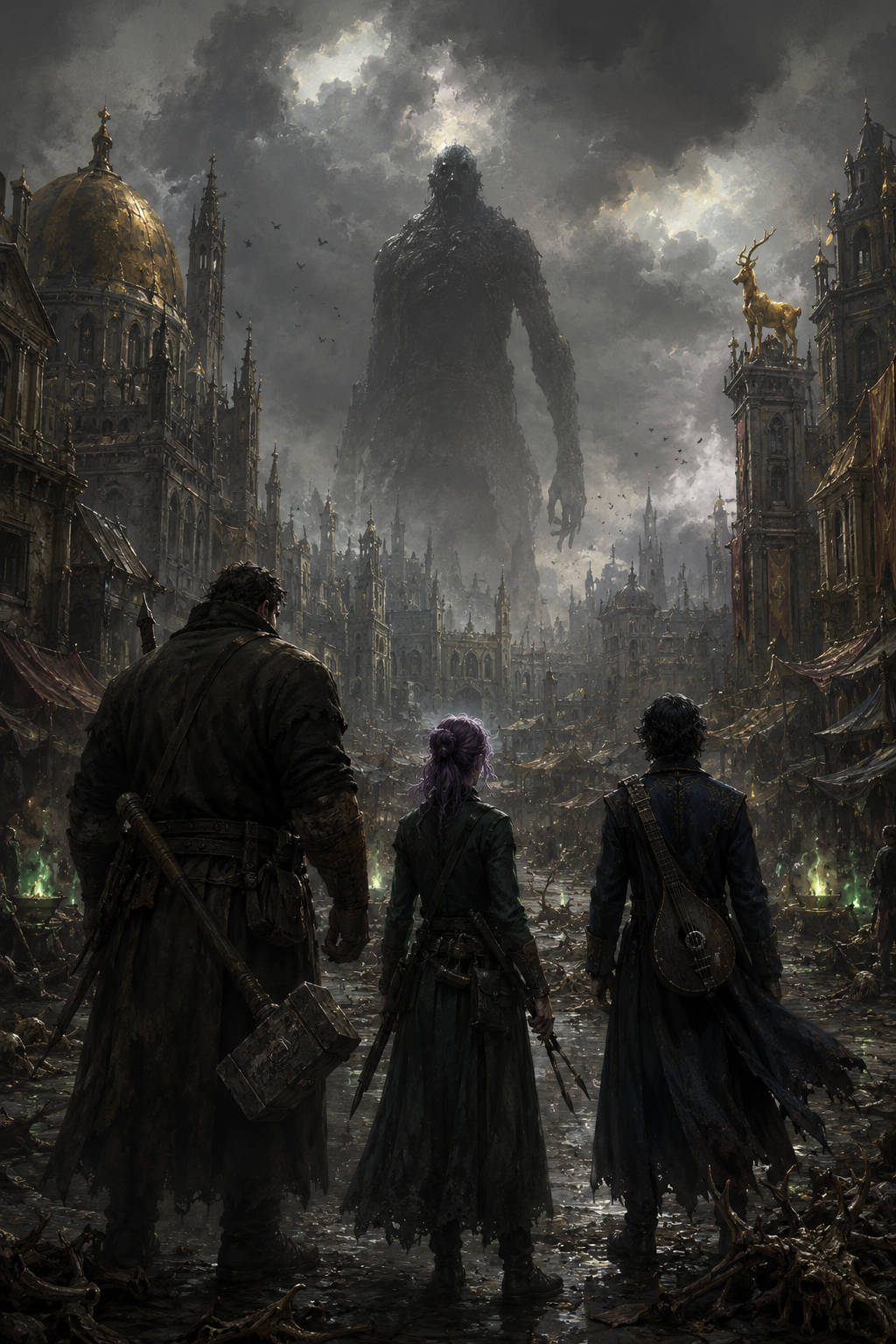
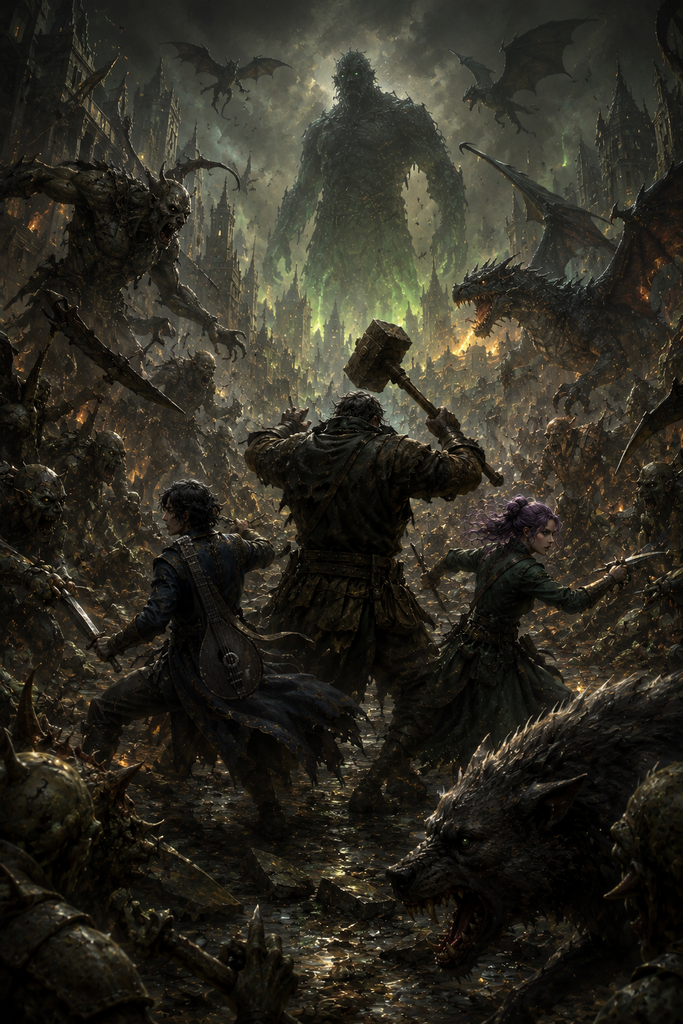
This is the brutal, blood-slicked chronicle of Aldren, Lyssa, and Finn—a builder, an apothecary, and a performer. Stripped of their titles and forced to bludgeon their way through feral, cannibalistic mobs and the fanatical Elven Sylvan-Kin, they aren’t looking for a cure. They are just looking for a place to survive the night.
Stop clinging to the brass cage. The state’s ledger is broken. Grab a stone mallet, abandon the dead wealth of a rotting empire, and drop into the dark.
Read the book. Or wait for the green fire. The math doesn’t care.
Comprehensive Chapter Index
Here is the structured index of chapters tracking the collapse of civilization, the desperate survival of our protagonists, and the approach of the unstoppable force.
Act I: The Golden Lie
- Chapter 1: The Grand Axiom
- Chapter 2: The Sky Runs with Bone
Act II: The Feral City
- Chapter 3: Names Given to the Void
- Chapter 4: Protocol of the Lower Ward
- Chapter 5: The Extraction of the Depository
- Chapter 6: When the Western Gate Dissolved
Act III: The Shared Flight
- Chapter 7: The Silent Carpet
- Chapter 8: The Meat Shield of the Spires
Act IV: The Broken Bastions
- Chapter 9: Calculus of the True God
- Chapter 10: The Loyalty of Foam and Saliva
Act V: The Shadow and the Wake
- Chapter 11: Companions in the Mire
- Chapter 12: The Worst Morning
Act VI: The Last Look
- Chapter 13: A Dream of Heavenly Tongues
- Chapter 14: The Indifferent Hills
LET’S BEGIN….
Chapter 1: The Grand Axiom
The bells of the Ministry of Serenity did not toll; they chimed.
To toll was to acknowledge the weight of iron and the passage of shadows, both of which were considered uncivic metrics in the province named Drax-Valora; representing ‘dragged from the dragon with valor’. Instead, every three hours, the silver-plated carillons in the high towers of Aethelgard struck a sequence of bright, major thirds that drifted down over the white stone plazas like dropped coins. It was the hour of Mandatory Gratitude.
High upon a cedar scaffold braced against the facade of the Palace of Concord, Aldren adjusted his iron spectacles and drove his chisel into the cheek of a limestone cherub. A small flake of stone drifted down, vanishing into the sea of silk parasols and sky-blue cloaks moving through the market square below.
“Smile with the jaw, Master Aldren,” a voice called from the ladder below. “The cheek muscles must remain elevated to project civic alignment. The Third Prefect is crossing the plaza.”
Aldren did not look down. He knew the voice belonged to Master Inspector Vane, a man whose coat was so heavily starched it didn’t wrinkle even when he sat, and whose teeth were so perpetually bared in the Ministry-approved gesture of Harmonious Greeting that his gums had begun to recede.
“The stone does not smile, Inspector,” Aldren muttered, his thumb tracing the rough grain of the cherub’s ear.
“The stone reflects the state, artisan,” Vane replied, his boots clicking rhythmically against the rungs as he climbed down. “And the state is remarkably content today. The contentment index has risen by four-tenths of a percent since the morning bells. See to it that your masonry reflects the surplus.”
Aldren looked out over Drax-Valora, the jewel district of the capital. From this height, the illusion was seamless. The roofs were tiled in blue glaze that caught the noon sun like beetle shells. The avenues were wide, swept clean twice a day by convict-crews who were legally designated as Volunteers for Environmental Order.
Along the limestone promenades grew the great Aethel-Linden trees, their wide, heart-shaped leaves kept perfectly green by the daily application of imperial lime-water, an alchemical wash designed to prevent the unsightly yellowing of late summer. The Ministry had decreed four reigns ago that autumn was an un-coordinated season, and thus, within the city walls, the trees were expected to maintain their vitality until the frost took them cleanly.
Perched within the manicured branches of the lindens were clusters of Chime-Shrikes. These small, silver-crested birds were native to the northern ridges, but the Ministry had imported thousands, breeding them in glass aviary cages until their natural territorial cries had been entirely unlearned. Now, their small, brass-hard beaks clicked open and shut in perfect synchronization with the city carillons, warbling the three-part harmony of the Hymn of the Unbroken Hearth. If a shrike attempted to sing a solitary, un-sanctioned note, the keeper at the base of the tree would touch a copper rod to the trunk, delivering a mild current that reminded the flock of its collective purpose.
[ CIVIC VISUAL OPTIMIZATION: Drax-Valora ]
ELEMENT MINISTRY REGULATION
Aethel-Lindens Chemically washed daily; no yellowing.
Chime-Shrikes Bred for major-chord vocal harmony.
Sunsigh Lilies Planted every six paces; metrics of calm.
Glint-Hounds Clipped vocal cords; polished fur-oil.
Below the scaffold, a Ministry official patrolled the edge of the fountain, leading a Glint-Hound by a braided silver leash. The beast was a massive thing, built like a mastiff but covered in short, bristling fur that had been rubbed with linseed oil until it gleamed like polished slate. Its large, heavy head turned from side to side, its amber eyes scanning the ankles of the passing citizens. By order of the High Council, the dog’s vocal cords had been clipped during its training; it could not bark, nor could it growl. When it detected an individual whose stride was too hurried—an indicator of potential internal friction—it merely stood still and raised its left paw, pointing silently toward the irregular citizen like a bird dog marking a quail.
Aldren wiped the sweat from his brow with the back of his sleeve. Beneath the gold leaf he had been commanded to apply to the Palace frieze, the true stone was soft. It was a porous, pale sandstone fetched from the low river beds, chosen because it was cheap and easy for the cutters to shape quickly into the grand, heroic shapes the Ministry demanded.
Two weeks ago, while repairing a drainage gutter behind the High Vault, Aldren had found three inches of black water sitting in the foundation stone. The mortar had dissolved into something resembling grey porridge, but when he had logged the observation in the ledger, the Ministry clerk had crossed the entry out with a red quill. “Dampness implies structural negligence,” the clerk had told him with that wide, terrifyingly flat smile. “And negligence implies a lack of gratitude for the architecture of peace. The vault is dry, Master Aldren. Write that it is dry.”
So, Aldren had written that it was dry. He had applied a thick coat of lime plaster over the wet rot, painted it the color of bleached bone, and walked away.
A rustle of silk drew his attention to the neighboring terrace. A group of children from the Lower Ward were being led through the square, each wearing a crown woven from Sunsigh Lilies. These blossoms were a particular favorite of the Ministry; their petals remained open and bright as long as the ambient sound remained below a specific decibel level. If someone screamed, or if a wagon wheel cracked too loudly against the cobblestones, the lilies would snap shut like small white fists, revealing their purple, vinegar-scented undersides. It was the simplest way to identify a disturbance: you simply looked for the child whose crown had turned black.
Today, the lilies were perfectly open. The children were singing, their small voices blending with the clockwork shrikes in the lindens.
The hearth is warm, the wall is high,
The shadow passes by.
The King has sworn the geometric law,
The iron shall not draw.
Aldren picked up his mallet again, his fingers stiff from the cold grease he used to seal the stone joints. The text he was currently carving into the lintel above the Palace gate was the First Axiom of the Ministry of Serenity, the foundational truth upon which every schoolbook and tax record in Aethelgard was printed:
PAX AETHELGARDIA: GEOMETRICA, AETERNA, INVIOLABILIS.
Peace is a geometric certainty. It is eternal. It cannot be violated.
He placed the iron tip of his chisel against the final ‘S’ in Inviolabilis. He knew, with the practiced precision of a man who spent his life measuring gravity and weight, that the arch above the gate was out of alignment by nearly two inches. The weight of the upper balcony was pressing down on the central keystone with a slow, grinding force that would, in forty or fifty years, split the sandstone cleanly through the middle.
But the gold leaf looked beautiful in the noon sun. It looked absolute.
“Master Aldren,” a sharp voice called from the edge of the scaffolding.
He turned his head slowly. A young woman stood on the stone balustrade adjoining his platform. She wore the dark, stained linen apron of a licensed apothecary’s assistant, her fingers dyed a deep, permanent purple from handling the crushed berries used to preserve the Ministry’s official ink. Her eyes were not fixed on the grand procession below, nor were they looking at the gilded cherub.
She was looking directly at the wet, dark stain that had begun to seep through the lime paint at the very base of the Palace pillar—a stain that smelled faintly of old river mud and decaying roots, despite the perfume the street-sweepers had scattered an hour before.
“The mortar is weeping,” Lyssa said.
Aldren did not immediately drop his chisel. To stop working while a Ministry official was within the square was to invite an inquiry into one’s Industrial Enthusiasm. Instead, he struck the limestone one more time, letting the mallet echo sharply against the facade, before turning his head toward the apothecary’s assistant.
“Go back to your mortars, Lyssa,” Aldren said in a low, gravelly monotone, keeping his eyes fixed on the horizon rather than her face. “The Palace inspectors have enough quills to write them both into the labor battalions before sundown.”
Lyssa didn’t move. She leaned against the cold marble balustrade, her purple-stained fingers tapping a restless, uneven rhythm against the stone. She smelled faintly of crushed willow-bark and copperas—the bitter components of the permanent black ink used to log the city’s tax receipts. Behind her ears, tucked like a clerk’s pencil, was a sprig of Sweet-Mint, a common urban herb mandated by the Ministry to be chewed by all public servants to ensure that the breath of the citizenry remained uniform and pleasant during transactions.
“I’ve spent the morning analyzing the drainage records from the Lower Ward,” she whispered, her eyes tracking a flock of Vane-Gulls—white, square-tailed birds bred specifically to fly only in straight lines along the city’s grid system, never crossing the imperial avenues diagonally. “The water levels in the cisterns aren’t dropping, Aldren. They’re rising. But it’s not rain, and it’s not the river.”
She reached down, pressed her stained thumb against the dark, weeping fissure at the base of the pillar, and brought it to her tongue. Her brow furrowed.
“It’s brine,” she said, spitting quietly into the bed of Sunsigh Lilies below the balustrade. “Salt-heavy and thick with mineral rot. It’s the kind of water you find three hundred feet beneath the bedrock, where the earth is dead. It’s rising through the foundations like ink through linen.”
“The Ministry says the foundations are laid upon the Great Axiom,” a cheerful, theatrical voice chimed from the terrace steps below them. “And as we all know, logic cannot dissolve in water.”
Finn climbed the last three steps onto the platform, balancing a pristine, lacquer-finished lute under his arm. He wore a doublet of brilliant sapphire silk—the exact shade prescribed for Class-Three Cultural Animators—and his hair was curled in the tight, symmetrical rings currently fashionable among the court performers. Yet, despite his bright attire, his eyes were bloodshot, and his fingers twitched against the silver strings of his instrument.
“Finn,” Aldren grunted, adjusting his spectacles. “You’re supposed to be at the Western Fountain leading the noon madrigal.”
“The noon madrigal has been delayed by executive decree,” Finn said, flashing a wide, glittering smile that didn’t reach his eyes. He leaned against the pillar, his posture overly casual, his knuckles white where he held the neck of his lute. “It seems the Chime-Shrikes in the western orchards have suffered a collective… vocal irregularity. Three hundred of them began singing in a diminished fifth at sunrise. The keepers had to apply thirty volts of correction to the trunks, but the little wretches just sat there and let their feathers turn to ash rather than return to the major scale. It was quite un-civic of them.”
He lowered his voice, his smile freezing into a rigid mask as he looked at the dark stain Lyssa had pointed out. “The Ministry is currently clearing the square near the gate. They’re telling everyone it’s a scheduled maintenance of the public joy, but I saw the Glint-Hounds. They aren’t pointing at citizens today, Aldren. They’re sitting on their haunches, staring at the flagstones, and whining through their teeth. You can’t clip a hound’s whine, it turns out. It sounds like iron scraping on lard.”
[ ANOMALY TRACKING LOG ]
| LOCATION | OBSERVED SYSTEM FAILURE |
| Palace Pillar | High-nitrate brine weeping through lime code.|
| West Orchards | Chime-Shrikes refusing major-scale correction|
| West Plaza | Glint-Hounds failing to mark targets; whining|
| Lower Ward | Sunsigh Lilies closing without acoustic cue. |
Lyssa looked down at the street level. A child had dropped a silk ribbon into the gutter. As the ribbon touched the thin film of moisture creeping across the cobblestones, the silk didn’t simply wet; the blue dye dissolved instantly, turning the fabric a dull, powdery grey. Beside the gutter, a decorative hedge of Glory-Briars—a shrub engineered to sprout golden roses whenever the midday bells rang—remained stubbornly green, its buds tightly sealed like brass knots.
“The state is losing its color,” Lyssa murmured.
“Don’t say that aloud,” Finn whispered quickly, his fingers strumming a bright, loud C-major chord to drown out her words as a pair of Ministry guards strolled past the base of the scaffold. The guards wore polished silver breastplates that reflected the sun like mirrors, their faces hidden behind identical porcelain masks molded into the expression of serene contentment. “Everything is perfect. The empire is eternal. The geometry is absolute.”
Aldren looked at his chisel. The iron tip was dull, blackened by a greasy residue he hadn’t noticed until now. He wiped it against his leather apron, but the stain remained, eating into the metal with a faint, sizzling hiss that smelled of old vinegar.
“The weight is wrong,” Aldren said softly, looking up at the grand arch of the Palace of Concord. “The stone isn’t holding the gold leaf anymore. It’s rejecting it.”
The silver carillons in the high towers began their three-o’clock chime. The sound was supposed to be a cascade of perfect intervals, a mechanical guarantee that time inside Aethelgard moved with the grace of an angel’s breath. But as the third bell struck, the note didn’t clear. It hung in the warm summer air, flat and heavy, dragging down into a dull, iron clang that vibrated through the soles of their boots.
Beneath their feet, within the manicured soil of the Palace garden, five hundred Sunsigh Lilies simultaneously snapped shut. They didn’t turn black from a scream; they turned black in the absolute, suffocating silence of a city that had forgotten how to breathe.
“We need to get to the marketplace,” Lyssa said, her purple fingers clenching into a fist against her apron. “The ink in the registry office didn’t dry this morning. It stayed wet on the parchment. Something is coming through the floor, Aldren.”
Finn adjusted his bright blue cloak, his bared teeth gleaming in the noon light like the teeth of a skull. “Let us go then, my friends. Let us walk down into the beautiful, perfect plaza and pretend we don’t see the grease on the white stone. After all, unauthorized observation is the first step toward an irregular life.”
Aldren climbed down from the scaffold, leaving his mallet on the cedar plank. For the first time in forty years of labor, he did not sweep the stone dust from the cherub’s face. He left it there, a thin layer of white powder masking the gilded smile, while underneath the paint, the porous sandstone continued to drink the bitter water of the deep earth.
Chapter 2: The Sky Runs with Bone
The Great Market Square of Aethelgard smelled of cinnamon, hot sugar, and the chemical vinegar of Lyssa’s fingers.
Every morning, the Ministry of Serenity deployed the Perfume-Wagons—heavy brass cisterns pulled by pairs of six-legged Draft-Stags. These beasts, with their long, pale necks and wide, velvet antlers covered in domestic moss, moved with a slow, hypnotic rhythm, their dual pupils tracking the ground while the vents on the cisterns hissed, coating the cobblestones in a thick mist of artificial lavender. It was designed to suppress the base odors of a crowded city: the sweat of the laborers, the dung of the pack animals, and the iron tang of the butchers’ stalls.
Lyssa stood beneath the striped awning of a grain merchant, her fingers sorting through a basket of Sun-Apples. These fruits were engineered to glow with a faint, internal golden light when ripe, a cheerful addition to the breakfast tables of the Upper Ward. But today, the light within the skins was flickering like a dying wick. When she pressed her thumb against one, the golden rind gave way instantly, revealing a core of black, liquid slime that smelled faintly of old well-bottoms.
“Don’t buy those,” Finn said, stepping out from the shadow of a silk-weaver’s display. He had changed his sapphire doublet for a slightly less conspicuous travel cloak, though he still wore his mandated silver performer’s medallion flat against his chest. His hands were tucked deep into his sleeves to hide the raw, red blisters where his lute strings had bitten into his palms during his forced three-hour recital at the fountain. “The whole shipment from the western farms looks like that. The merchants are calling it an ‘excess of sweetness.’ A Ministry inspector told them that the apples are simply concentrating their joy.”
“It’s not sweetness, Finn. It’s necrosis,” Lyssa said cleanly, wiping her hand on her apron. She pointed toward the decorative Ribbon-Ferns hanging from the merchant’s beams. These long, trailing fronds were usually vibrant and supple, waving in the slightest breeze like green silk banners. Today, they had curled into tight, brittle spirals, their edges blackened and rough, looking less like plants and more like charred hair. “The soil is rejecting the seed. I checked the market well an hour ago. The bucket came up with three inches of grey silt before it even hit the water line.”
Aldren arrived a moment later, his heavy leather boots clicking heavily against the damp stones. He carried a linen sack containing three iron wedges and a short-handled stone-mallet—tools he had no legal right to possess outside the construction yards, but the guards at the market gate had been too busy adjusting their porcelain masks to notice.
“The Western Road is closed,” Aldren said without greeting. He stood between them, his broad frame blocking the view of the passing Ministry patrollers. “They’ve brought up two regiments of the City Guard to throw up a timber barricade across the archway. They’re telling the carters that there is a surplus of gravel on the highway and that traffic must be diverted for ‘aesthetic resurfacing.'”
“Did you see the refugees?” Lyssa asked.
“They aren’t letting them reach the gate,” Aldren growled. “They’re herding them into the low meadows three miles out. But I saw the smoke from the ridge. It isn’t green wood smoke, Lyssa. It’s white. Like lime-kilns.”
[ ECOLOGICAL DISTRESS MATRIX: BAZAAR ]
SUBJECT EXPECTED STATUS CURRENT ANOMALY
Draft-Stags Docile, rhythmic Trembling, dual pupils
dilated, refusing oats.
Sun-Apples Internal gold glow Flickering, black liquid
cores, internal rot.
Ribbon-Ferns Green, waving fronds Curled into brittle,
charred spirals.
Market Well Clear spring water Grey silt at the surface.
The three of them fell silent as a Ministry Joy-Heralder strode past their corner. The official wore a high, conical hat wrapped in silver leaf and carried a long brass sound-tube that amplified his voice across the square.
“Rejoice, citizens of the First Province!” the Heralder shouted, his voice metallic and flat as it bounced off the white stone walls. “The Ministry of Serenity is pleased to report that the Orosian Vanguard has achieved a decisive, multi-layered victory against the western border irregularities. The threat has been completely contained within the regional geometry. A surplus of peace has been declared for the third consecutive week!” The Orosian Vanguard is specifically the leading military unit for frontline strike force of Oros Empirical Highlands.
A few shopkeepers clapped their hands with the rhythmic, practiced enthusiasm required by law. The Draft-Stags hitched to the perfume wagon, however, did not rejoice. One of the massive beasts suddenly reared back, its moss-covered antlers striking the brass cistern with a sharp, ringing clang. It began to thrash in its leather harness, its hooves scraping violently against the flagstones, a low, bubbling scream tearing through its throat—a sound no domestic stag had ever made.
“Look at the birds,” Finn whispered, his voice losing its color.
High above the market square, the Vane-Gulls had broken their strict, geometric flight paths. The hundreds of white birds were no longer flying in straight lines parallel to the grand avenues. They were falling out of the sky. Not dead, but blind—spinning down in erratic, silent circles, their square tails twitching as they struck the slate roofs and slid into the gutters like wet laundry.
Then, the air pressure dropped.
It was not the slow gathering of a summer storm. It was an instantaneous, physical evacuation of the air, a sudden slam that made the eardrums click and the chest tighten as if a giant hand had squeezed the valley. The scent of lavender from the wagons vanished, replaced instantly by that dry, copper-thin reek of old vinegar and rusted iron.
The noon sky, which had been a clear, brilliant sapphire an instant before, did not turn black. It turned a flat, chalky indigo, the color of a bruised tongue.
“Aldren,” Lyssa said, her hand reaching out to grab the builder’s thick sleeve. “The fountain.”
The great central basin of the square, where a marble dolphin shot three streams of clear water into the air, had stopped flowing. The water didn’t drop back into the pool; it appeared to turn into a thick, milky froth that hissed against the stone lips of the basin, boiling without heat. Lyssa moved into a cover action with Aldren flagging a wave to stop her but of course no one ever could.
Thirty paces down she arrived at the herbalist’s stalls, Lyssa Vey was methodically checking the quality of dried madder roots. Her fingertips, still stained a permanent twilight purple, twisted the roots until they snapped. She wasn’t listening to the vendor’s aggressive sales pitch. Instead, her eyes were really fixed on the three Ministry guards standing by the eastern arch. They weren’t leaning on their halberds like usual; their knuckles were white, and one of them was adjusting his breastplate over and over again with a jerky, nervous rhythm.
They’re sweating through their tunics, Lyssa noted silently. And the captain hasn’t touched his typical excess onto brain decay wine. This brain killing wine was used to keep the guards in an addiction of complete obedience to the only provider. The Ministry.
Then, the sky changed.
It wasn’t a cloud. It didn’t get dark. It was a momentary, sickening hitch in the light—as if someone had briefly held a smoky piece of glass over the sun.
A sound followed. It wasn’t the roar of a beast or the thunder of a storm. It was a high-pitched, metallic hiss, like a red-hot iron rod being dropped into a bucket of lard. It grew louder by the second, transforming into a deafening, rhythmic whu-whu-whu that vibrated through the stone flags beneath their feet.
Most people didn’t look up. Why would they? The sky had been safe for three generations. The Ministry guaranteed it.
Lyssa looked. Her sharp eyes tracked the distortion in the upper air. A shape was falling—spinning over and over, trailing a thin, greasy ribbon of grey smoke. It wasn’t an arrow. It was too large. It was human-shaped.
And it was coming down directly on the central fountain line. Directly where the broad-shouldered Aldrin who had turned to help a cart puller with a wagon wheel that popped a rod.
“Move!” Lyssa screamed, but her voice was swallowed by the roar of the descent.
She didn’t think. Her body, originally trained in youth to catch expensive silk before it hit the filthy dye-vat floor, reacted on pure, spatial instinct. She lunged forward, her boots skidding across the wet cobblestones, and threw her entire weight into Aldren’s ribs.
They hit the ground together in a chaotic tangle of limbs, wood, and iron. The massive wagon wheel broke free, rolling erratically into a pyramid of fresh cabbages just as the object struck the plaza.
The impact was absolute.
[ THE IMPACT ZONE ]
[Crater] -> 4 feet deep, centered on the cobblestones.
[Shockwave] -> Shattered 12 market stalls, blew out glass.
[The Object] -> Human skeleton, 7 feet tall, blackened bone.
[The Armor] -> Overlapping grey scales, geometric runes (Non-Imperial).
The sound was a dry, cracking explosion that smelled instantly of old sulfur and charred fat. A wave of heat rolled over the plaza, followed by a rain of pulverized white stone and boiling water from the shattered fountain basin.
For five seconds, the plaza was entirely silent. The screaming hadn’t started yet. The confusion hadn’t turned into fear. There was only the sound of water dripping from the broken stone arches.
Aldren pushed himself up from the mud, his face scraped, his ears ringing like a struck anvil. Lyssa lay beside him, coughing violently, her purple-stained fingers clutching her bruised shoulder.
Slowly, the crowd began to edge forward, drawn by the primitive human need to look at a wound. In the center of a four-foot crater lay a skeleton. It was huge—nearly seven feet long—and its bones were not white, but a greasy, polished charcoal grey. It was still burning with a low, flickerless green flame that didn’t seem to consume the remains.
Most horrifyingly, it was clad in the remnants of heavy armor. Not the bright steel plates of the Ministry, but overlapping, scale-like bands of a dark, dull metal covered in geometric engravings that looked old. Older than the city. This was wrong.
A shadow fell over the edge of the crater. A champion medallion was disintegrating in realtime on the body’s ribcage.
“A…. A hero?” Lyssa and Aldren looked at each other knowing that this was declaration of “not good”. A hero was a State Ministry designated and paid in excess “champion of the people” used to quiet severe threats the typical armies could not quench. Threats like a Demon King with its’ claimed armies, or an out of control Behemoth battling a Leviathan on the shore line.
Finn Merrick stood there, his hidden lute revealed hanging by its strap, his eyes wider than saucers. He wasn’t running away. He was leaning in, his nose twitching at the smell of burned marrow.
“That,” Finn whispered into the dead quiet, his voice trembling with a terrifying sort of glee, “is the most incredible thing I have ever seen in my life.”
The people nearby turned to look at him as if he had lost his mind.
Finn took a frantic step back, his hands gesturing wildly in the air. “Don’t you see? The scale of it! The drama! Someone—someone has to write a song about this immediately. The Ballad of the Ash-Walker. No, the Iron Skeleton of the Solstice!”
Lyssa dragged herself to her feet, her voice shaking with adrenaline and rage as she wiped wet stone dust from her eyes. “Someone just died, you lunatic. That was a person.”
“Yes!” Finn agreed instantly, his teeth chattering from a mixture of shock and excitement. “But what a spectacular way to go! Did you see the trajectory? The angle of entry?”
Aldren rose heavily, his large hands shaking as he looked from his shattered wagon wheel to the burning grey ribs in the crater. He looked at the thin boy with the lute, then at the sharp-eyed woman covered in turnip juice who had just broken his fall.
A long, thin whistle cut through the high air. It sounded like the wind through a keyhole, magnified ten thousand times.
THUD.
The sound was heavy, wet, and metallic. It struck the tiled roof of the grain merchant’s stall directly above their heads, shattering the blue ceramic tiles and snapping a cedar rafter with a loud crack. A shower of splinters and red dust rained down over Lyssa’s apron. A dark object rolled off the eaves and thudded into the wicker basket of Sun-Apples at her feet.
It was a human ribcage.
The bone was completely black, charred to the consistency of charcoal, but it was still encased in the unmistakable, green-enameled bronze chestpiece of the Orosian Vanguard. The imperial eagle stamped into the metal was warped, its wings melted into lumps of slag by a heat so intense it had fused the metal directly into the bone. But there was no flesh. There was no blood. There was only the dry, smoking frame of a soldier, and out of the hollow center of the vertebrae, a tiny, pale green flame was burning—a fire that didn’t smoke, didn’t crackle, and didn’t heat the air.
“It’s a bone,” Finn stammered, stepping back until his spine hit the brick wall of the bakery. “That’s… that’s the High Vanguard armor. Why is it here? The Heralder said they won.”
Before Aldren could answer, the whistling turned into a roar.
The sky over Aethelgard began to rain the remains of its own army.
The roar was not the sound of wind, but the collective scream of thousands of individual pieces of metal cutting through the upper atmosphere.
For three terrifying minutes, the Great Market Square of Aethelgard became a mortar pit. The charred remains of the Orosian Vanguard fell with the velocity of dropped anvils, tearing through the striped silk awnings, smashing timber merchant stalls into kindling, and striking the pristine flagstones with a succession of wet, metallic thuds.
A severed leg, still encased in a greave of enameled bronze, crashed directly into a flower girl’s cart of Sunsigh Lilies. The blossoms didn’t merely snap shut; their stems withered into dry, grey hair instantly, the soil in the cart turning to white salt as the pale green flame flickering within the bone touched the wood.
The panic was immediate, but it was a muffled, terrifyingly disciplined sort of panic. The citizens of Aethelgard had been trained for three generations to avoid Exuberant Spatial Correction—the civic term for running in fear. People scrambled under porticos and inside shop doors with their teeth clenched, their hands clamped over their mouths to stifle their screams, terrified that a passing inspector might log their terror as a sign of un-harmonious alignment.
[ PLAZA IMPACT CASUALTY REPORT ]
IMPACT POINT MATERIAL VALUE CIVIC STATUS
Flower Cart Sunsigh Lilies Soil salinized; plants
turned to grey ash.
Perfume Cistern Melted Brass Lavender oil poisoned
by green marrow-slime.
High Frieze Sandstone Cornice Gilded smile smashed by
falling Vanguard skull.
The Draft-Stags attached to the perfume wagons went completely mad. Their wide, velvet antlers smashed against the limestone pillars as they wrenched themselves free from their leather harnesses, their dual pupils rolling back into their heads. They ran blindly into the square, their hooves slipping on the mixture of artificial lavender oil and the thick, black grease that began to ooze from the shattered skeletons.
Near the central fountain, a Glint-Hound stood entirely still under the falling debris. Its slate fur was pelted by bone fragments, but its clipped vocal cords made it impossible to howl. Instead, the beast stood rigid, its left paw raised, pointing single-mindedly up at the bruised indigo sky, marking the invisible threat above until a falling iron-shod shield struck its spine, silencing it forever.
“Get under the arch!” Aldren roared.
He lunged forward, his thick hand wrapping around the collar of Finn’s sapphire doublet. The expensive silk tore with a sharp rip as Aldren hauled the trembling performer backward, throwing him beneath the heavy limestone lintel of the central bakery. Lyssa followed an instant later, but as she ducked beneath the stone, she kicked over a basket of rotting Sun-Apples and used her long, iron apothecary shears to snap up a piece of a falling ribcage before it could hit the flagstones.
Outside in the open square, the Joy-Heralder was still standing on his wooden box. A falling Vanguard skull—its eye sockets glowing with that cold, silent green fire—had struck his brass sound-tube, crushing the instrument into a flat ribbon of metal. Yet, the official did not lower his arms. His face remained fixed in the mandatory, wide-jawed smile of the Ministry, his eyes wide and vacant as he screamed through the wreckage of his teeth.
“Citizens!” the Heralder shouted, his voice cracking into a wet screech. “Do not be alarmed by the celebratory atmospheric discharge! The Ministry has initiated an unscheduled redistribution of tactical military assets! The victory is absolute! The bones of our brave protectors are merely being… returned to the municipal fertilizer reserve! Maintain your gratitude!”
A falling bronze cuirass struck the box beneath his feet, shattering the wood. The Heralder tumbled into the grey muck of the plaza, but as he crawled on his knees toward the shelter of a colonnade, his fingers were still tracing the geometric sign of the First Axiom in the air.
“Look at it, Aldren,” Lyssa whispered, ignoring the Heralder’s screams. She held the fragment of ribcage within the iron jaws of her shears, bringing it close to her spectacles under the shadow of the bakery arch.
The bone was completely calcified, light as pumice, and blackened through its entire cross-section. The pale green flame within the marrow cavity didn’t give off any heat; when Aldren passed his calloused hand near it, the skin on his knuckles didn’t burn—it grew instantly numb, the hairs turning white and brittle like winter grass.
“The fire didn’t come from a dragon, and it didn’t come from a siege engine,” Lyssa said, her voice dropping to a sharp, clinical whisper. “A dragon burns from the skin inward. It leaves meat. It leaves grease. This bone has been cleared out from the inside. The marrow was turned to salt before the metal even hit the sky.”
Finn was clutching his lacquer lute to his chest like a shield, his teeth clicking together so loudly it sounded like dice in a cup. “They’re dead,” he gibbered as his mind finally caught up with this point past his initial excited response, his eyes fixed on the center of the square where a massive heap of enameled plates and smoking ribcages had formed a crude pyramid. “The whole Vanguard. The High General’s standard just landed in the gutter by the privy. The golden eagle is gone, Aldren. It didn’t melt. The gold simply… un-painted itself. The metal is smooth silver now.”
Aldren looked out at the plaza. The rain of bones was slowing down, the long, terrifying whistles fading into the distance as the indigo bruise of the sky began to retract toward the western horizon.
The square was a charnel house, but it was a charnel house without blood. There was only the dry, grey ash, the black bones, and the thousands of green, cold fires flickering in the ruins of the market stalls.
Already, the iron gates at the edge of the square were swinging open. Three companies of the Ministry Guard—their porcelain masks reflecting the dull, flat light of the dying afternoon—were marching into the plaza in perfect, four-by-four columns. They did not look at the dead stags, nor did they look at the shattered remains of the soldiers.
They carried heavy iron shovels and large wooden barrels pre-printed with the Ministry’s blue label: SURPLUS JOYFUL REFUSE.
“Move along, citizens,” the lead captain shouted through his porcelain grin, his voice amplified by a mechanical breastplate. “The public square is undergoing an aesthetic purification. Unauthorized looking at the sky is now a Class-Two Civic Misdemeanor. Return to your designated rooms of contentment.”
Aldren tucked his stone-mallet back into his linen sack, his broad fingers tightening around the wood until his knuckles turned white. He looked at Lyssa’s purple fingers, then at Finn’s torn sapphire sleeve.
The gold leaf on the Palace was three miles away, but from here, Aldren could see the high towers of Aethelgard. The silver-plated carillons were silent now, their mechanical gears jammed by the grey silt that was continuing to rise from the deep water wells of the city.
“The government isn’t trying to hide something….” Aldren said, his voice flat and heavy as the limestone arch above them. “…. they’re trying to hide the fact that they don’t know what it is.”
“They know what it is,” Lyssa said, using her sleeve to wipe a drop of brine from the apothecary shears. “It’s the end of the calculation. And we’re the remainder.”
Act II: The Feral City
Chapter 3: Names Given to the Void
By the third morning after the rain of bones, the Ministry of Serenity had run out of white lime paint.
The imperial masonry crews had been worked through the night, their hands raw from slapping thick layers of bleached calcium wash over the scorched flagstones and the deep, regular impact craters in the Great Market Square. But the stone refused the remedy. Within hours of application, the new paint would blister, cracking open like dried skin to reveal the greasy, charcoal-grey tint beneath. The city smelled no longer of lavender, but of a desperate, chemical cleanliness layered over the cold, sour reek of calcified marrow.
Aldren sat in the damp cellar of a disused tallow-chandler’s shop in the Lower Ward. Above him, the roots of a common Weeping-Cedar—whose needles were dropping into the street gutters like iron filings—crept through the foundation stones. Wrapped around those roots was a thick, pale mesh of Brine-Ivy, a creeper that usually only grew in the deep sea-trenches of the southern coast. Now, it was clawing its way up into the city’s plumbing, its fat, translucent leaves weeping drops of bitter, concentrated salt that hissed when they touched the floorboards.
[ OFFICIALLY DISTRIBUTED PRINT MEDIA ]
SOURCE: Gazette of Perpetual Alignment (Hourly Issue)
SECTION 1: “The regional high-altitude volcanic tectonic
inversion has been successfully out-flanked by the
Fourth Heavy Infantry near the western valley.”
SECTION 2: “Citizens are reminded that weather patterns
relying on unauthorized thermal vectors will be prosecuted
under the Geometric Harmony Act of the First Reign.”
Finn sat on a three-legged stool, his fingers smoothing out a damp, freshly printed broadsheet he had pulled from a public notice-board before the guards could grease it over. His sapphire silk doublet was gone, replaced by a grease-stained wool tunic that smelled of old lard.
“Listen to this,” Finn said, his teeth clicking against a piece of Sweet-Mint that had long since lost its flavor. “The Ministry has released two different statements in the span of forty minutes. The first says the disturbance is entirely atmospheric—a ‘Convective Thermal Front arising from un-civic seasonal variations.’ But the paragraph right below it claims that General Vael’s rear-guard has ‘successfully cut the supply lines of the front.’ How do you cut the supply lines of a thunderstorm, Aldren? How do you surround a low-pressure system with pikes?”
“They don’t know what verbs to use anymore,” Lyssa said cleanly. She was sitting at the chopping block, using a horn spoon to skim a layer of white oil from the surface of a jar filled with blind Silt-Newts—small amphibians fetched from the public wells. The creatures were dead, their small, clear bellies filled with the same grey sediment that had jammed the Palace carillons. “Their entire language is based on things that can be cataloged, measured, and taxed. You cannot tax an erasure, Finn. You cannot threaten a force that doesn’t look at your uniform.”
“The rumor-mill doesn’t care about their verbs,” Finn whispered, leaning forward until the candle flame caught the hollows of his cheeks. “The market square is quiet, but the alleys are humming like a wasp’s nest. I spent the dawn hours behind the livery stables. A scout from the Third Border Regiment came through the drain-pipes last night. He didn’t have his boots, Aldren. He didn’t even have his toes. They had turned into something resembling grey chalk.”
“What did he see?” Aldren asked, his large hands tightening around the haft of his stone-mallet.
“He saw the King Dragon,” Finn said.
The cellar went perfectly still. Even the blind Silt-Newts in Lyssa’s jar seemed to settle into the grey muck. Ignis Vael, the ancient golden ridge-drake bound to the imperial bloodline by thirty silver chains, was the literal fire of the state. He was a leviathan whose breath could turn an enemy siege line into molten glass in three seconds, a living monument of raw, magical dominance that had kept the outer empires from the gates for three hundred years.
“The scout said they brought the dragon to the edge of the Mirror Wastes,” Finn stammered, his fingers trembling against the print layout. “You know the Wastes—the high sorcery wards that make the western border look like a mountain range from the outside, the great illusion that turns any invader back into their own territory by bending the light itself. The Ministry told the legions the entity was just a rogue mercenary company using illegal cloaking spells.”
Finn swallowed hard, his eyes wide and unblinking. “The entity walked out of the grey mist. It didn’t look up at the mountain illusions. And the moment its stride crossed the boundary line, the Mirror Wastes didn’t just fade—they shattered. The scout said it sounded like ten million windows breaking at the same instant. The sky over the ridge peeled away like wet wallpaper, revealing nothing but a flat, grey void behind it.”
[ THE UNMAKING OF IGNIS VAEL ]
STAGE 1: Deployment at the Mirror Waste Perimeter.
STAGE 2: The dragon ignites its internal solar furnace.
STAGE 3: The entity continues its rhythmic stride (12s interval).
STAGE 4: Contact. The dragon’s fire turns to cold green grease.
STAGE 5: Absolute calcification of the biological frame.
“And the dragon?” Lyssa asked, her clinical voice dropping its edge for the first time.
“Ignis Vael let loose his furnace,” Finn whispered. “Three miles of continuous solar fire. The heat was so great that the common ditch rats three leagues away were cooked inside their holes. The valley turned into a white-hot basin of bubbling slate. The soldiers were cheering. They thought the thing was drowned in gold.”
He looked at Aldren. “Then the fire cleared. The entity was still walking. It hadn’t sped up. It hadn’t slowed down. It moved precisely twelve yards every twelve seconds. When it reached the dragon’s snout, Ignis Vael didn’t roar. He didn’t strike. The golden scales along his neck simply… lost their sheen. They turned the color of dry river mud. The dragon’s fire didn’t stop—it inverted. It turned into a thick, cold green grease that poured out of his nostrils, drowning his own handlers before the beast itself stiffened into a five-hundred-foot monument of grey lime-stone.”
“A monument,” Aldren repeated.
“Like a statue left out in the rain for a thousand years,” Finn said. “The scout watched the beast’s tail crumble into grey sand while the entity walked right through the center of its ribs. It didn’t even turn its head.”
Outside the cellar window, down in the narrow drainage trench of the ward, a pack of common city dogs began to bark. But it was an irregular, broken sound—three short yips followed by a long, flat whistle that sounded like steam escaping a pipe. The domestic animals were losing their instincts, their vocal cords straining against an atmospheric weight they could not identify.
“There’s more,” Lyssa said, her purple fingers tracing the edge of her horn spoon. “The family of Sir Jacen—the captain who led the High Gate cavalry charge—was evicted from the Upper Ward this morning. Not by the Ministry. By their neighbors.”
Aldren looked up. “Why?”
“Because nobody can remember who they are,” Lyssa said, her voice dropping into the cold, flat register of an audit report. “The sister came to the apothecary shop looking for Sweet-Mint to clear her mother’s head. She told me that when they look at Jacen’s portraits on the wall, the canvas is there, the frame is there, but the oil paint has rearranged itself into a smooth, grey smudge. His medals are still in the velvet box, but the silver inscriptions have become flat, un-carved metal. The mother knows she had a son who went to war, but when she tries to say his name, her tongue locks against her palate. The concept of him is being dragged out of the world from the tail forward.”
She reached down, picking up a handful of common winter barley from the merchant’s sack they had used for a seat. She let the grains fall between her purple fingers. Instead of the hard, yellow husks of healthy grain, the seeds fell with a soft, chalky thud. They had been reduced to a fine, grey lime-sand inside their skins, dry and utterly dead.
“The rumors have given it three names now,” Finn said, staring at the floorboards. “The common folk aren’t using the Ministry terms anymore. They aren’t calling it a ‘convective storm’ or an ‘anomaly.’ They call it The Walker, because it only walks. They call it The Black Thing, because the eye slides off the center of it. And the refugees from the ridge… the ones who watched the dragon turn to sand… they call it The End.”
Aldren stood up, his heavy framework of bone and muscle casting a long shadow across the cellar wall. He looked at the Brine-Ivy that was continuing to wrap its fat, wet leaves around the cedar roots above them, drinking the dead water of the deep earth.
“The name doesn’t matter,” the builder said, lifting his sack of iron tools. “The weight is what matters. The King Dragon was five hundred feet of solid muscle and gold leaf, and it didn’t weigh enough to tip the scale. We need to move down into the Lower Ward before the Ministry locks the iron grates. If the city goes feral, the people in the stone houses will be the first to turn into wolves.”
The climb out of the tallow cellar felt like ascending into the throat of a dying furnace.
The Middle Ward of Aethelgard was no longer a network of prosperous trade avenues; it had become an anxious labyrinth of closed shutters and damp, silent crowds. The Ministry’s Perfume-Wagons were gone, replaced by Purification-Sleds—heavy oak sledges dragged by groups of convicts whose porcelain masks were tied directly to their faces with greasy leather thongs. The sledges were piled high with raw sulfur and crushed charcoal, which the crews shoveled directly onto the street corners, creating low, smoldering banks of yellow smoke that stung the throat and made the eyes water.
“Keep your heads down,” Aldren muttered, his hand resting on the linen sack that hid his mallet. “The Ministry is doubling the watch at the intersection of the Weaver’s Row.”
They walked single-file, hugging the damp limestone facades. The city was undergoing a strange, silent unraveling. Citizens stood in long, perfectly ordered lines outside the state bread-stalls, their expressions blank, their lips moving in silent recitation of the Daily Verses of Contentment. But beneath that mandatory calm, their fingers were twitching. A wool-merchant in front of them was methodically ripping the brass buttons off his own coat one by one, dropping them into the gutter without looking down, his face fixed in a rigid, terrifying smile.
[ MINISTRY CIVIC PURITY DIRECTIVE ]
CRIME PENALTY CLASSIFICATION
Unauthorized Looking 10 Years Quarry Class-II Civic
at the Western Horizon Labor Misdemeanor
Reporting Missing Immediate Lexical Seditious Noun
Relatables (Soldiers) Re-alignment Usage
Possession of Grey Silt Eviction to Lower Material
or Calcified Matter Drainage Wards Contamination
“Look at the masonry,” Aldren whispered, stopping beneath a massive flying buttress that supported the Middle Ward’s grand library.
The limestone blocks, laid four hundred years ago by the Guild of the True Plumb, were losing their grain. The sharp, decorative ridges of the gargoyles had smoothed out, their teeth and claws melting away into rounded, featureless lumps of grey chalk, as if the stone were an old piece of soap left too long in the basin. The master mason’s mark—a deep, chiseled triangle that had stood distinct for centuries—was now a faint, oily smear that rubbed off on Aldren’s thumb like soot.
“The architecture is forgetting how to hold itself up,” Lyssa murmured, adjusting her spectacles. She touched a nearby wall where a seam of mortar had turned into a dry, white powder. “The weight isn’t transferring to the earth anymore. The stone is losing its memory of the mountain it came from.”
“It’s not just the stone,” Finn said, his voice rising in a thin, nervous spiral before he forced it back down into a whisper. He pointed toward a public notice-board where a new Ministry broadsheet was being pasted over the old ones.
The ink on the page was wet, but the letters were already drifting. The characters were losing their stems and crossbars, the geometric text of the Ministry dissolving into long, meaningless rows of straight vertical lines that looked like the teeth of a comb. A small crowd of citizens stood before the board, staring at the melting words with wide, vacant eyes, nodding their heads in rhythmic compliance with a message they could no longer read.
Suddenly, a sharp, clanging bell rang out from the end of the avenue.
“The Grates!” Aldren snapped. “They’re dropping the iron ironwork ahead of schedule!”
They broke into a run, their boots clattering against the increasingly soft cobblestones. Up ahead, where the Middle Ward sloped sharply down into the industrial slums of the Lower Ward, the massive Iron Gate of the Third Tier was beginning to descend. The gate was a monstrous piece of engineering—a forty-foot slab of solid, black pig-iron suspended by iron chains as thick as a man’s thigh.
A company of Ministry Guards stood at the winch-housing, their white porcelain masks gleaming in the dim, yellow sulfur smoke. They weren’t looking at the crowd; they were looking up at the western sky, their halberds shaking so violently that the steel points clicked against each other like dry teeth.
“Hold the line!” the Guard Captain screamed through his mechanical breastplate, his voice distorted and tinny. “The Ministry has declared a temporary stabilization of the lower perimeter! The Lower Ward is currently being detached from the imperial registry for… for administrative balance!”
“They’re locking us in the Upper Wards,” Finn cried, his lute bouncing against his ribs as he sprinted. “Or they’re locking them out! Aldren, the gate is halfway down!”
The crowd around them didn’t scatter. Years of civic training kept them from rushing the guards, but they began to pack together against the lowering iron wall like sheep in a pen, their bodies pressing together in a silent, suffocating mass. People were being crushed against the iron bars without shouting; they simply closed their eyes, their mouths still whispering the fragments of the Verses of Contentment as the black iron pressed into their ribs.
“Lyssa, take the mallet,” Aldren growled, shoving his linen sack into her arms.
The broad-shouldered builder didn’t draw a weapon. Instead, he threw his massive frame into the gap beneath the descending gate, his boots digging into the crumbling grey cobblestones. He reached up, his thick, calloused hands catching the bottom iron bar of the grate just as it reached the three-foot mark.
The strain was instantaneous. The iron chains above groaned, the massive links grinding against the bronze gears of the winch-housing with a sound that shook the teeth in Finn’s head. Aldren’s spine arched, the muscles in his back bunching into thick cords beneath his wool coat as the weight of forty tons of pig-iron bore down upon his shoulders.
“Aldren!” Lyssa hissed, dropping to her knees to slide beneath the bar.
“Get through!” Aldren roared, his face turning a deep, dangerous purple, his veins standing out along his forehead like earthworms. “The stones… the stones under my feet are turning to sand! I can’t hold the floor!”
Finn scrambled through the gap next, dragging his lute after him with a frantic, desperate yank that snapped two of the silver strings. Lyssa followed an instant later, her long apothecary shears clutched in her hand like a dagger as she dragged herself onto the grease-stained cobbles of the Lower Ward.
Outside the gate, the Ministry Guards finally noticed the disruption. The Captain turned, his porcelain mask fixed in its permanent, terrifying grin, and raised his heavy iron crossbow. “Civic obstruction!
Release the mechanism! The weight must be balanced!”
Before the Captain could pull the trigger, the iron winch-housing above him gave way.
It didn’t break. It didn’t snap. The massive bronze gears that held the chains simply… stopped interacting. The teeth of the cogs turned into a smooth, grey mush that poured down the side of the wall like wet clay. The chains slipped off the pulleys entirely, falling into the street with a succession of heavy, iron crashes that shattered the pavement.
The Great Gate slammed down into the groove with a sound that echoed through the entire lower valley like a cannon shot.
Aldren rolled backward into the soot of the Lower Ward just as the iron bar struck the ground, missing his ankles by less than an inch. He lay there for a moment, his chest heaving, his hands raw and bleeding where the iron had torn through his calluses.
Slowly, the three of them stood up and looked back through the iron bars.
On the other side, in the Middle Ward they had just escaped, the sulfur smoke was beginning to clear. The crowd of citizens was still standing there, packed tightly against the iron wall. But they were no longer moving. They weren’t breathing.
Through the vertical bars of the gate, Lyssa could see the wool-merchant. His face was still pressed against the iron, his eyes wide and vacant. But the color of his skin had changed—it was no longer the pink of living flesh, nor the white of a corpse. It was the flat, matte grey of unpolished slate. A tiny, pale green flame was beginning to flicker inside his open mouth, burning silently behind his teeth, giving off no smoke and no heat.
Behind him, the great buildings of the Middle Ward were beginning to lose their geometry entirely, their straight lines curving into long, soft spirals that melted down toward the valley floor like grease on a hot stove.
“The calculation is moving faster,” Lyssa said, her voice perfectly level despite the trembling of her hands as she handed Aldren his mallet. “It’s not just the soldiers anymore. It’s the space they lived in.”
Aldren looked down into the narrow, filthy alleys of the Lower Ward. Here, the buildings were made of cheap timber and green thatch, structures that had never been blessed by the Ministry or cataloged by the surveyors. The air here smelled of old cabbage, damp coal, and the honest, sour sweat of people who had never been rich enough to buy the state’s joy.
“Let’s get to the river,” the builder said, turning his back on the melting city above them. “The wood still burns down here. The water still flows. For now, that means we’re still real.”
Chapter 4: Protocol of the Lower Ward
The descent from the Third Tier gate into the Lower Ward was a transition from a silent, cold death into a loud, wet, and bloody one.
Here, the streets were narrow, twisting ravines of leaning timber, sagging thatch, and damp brick. The Ministry’s geometric perfection had never reached this deep into the valley. There were no wide plazas or orderly colonnades; there was only the suffocating press of overpopulation, and that population had just realized the sky was falling.
Aldren pressed his back against the damp brickwork of a narrow alley, raising a single, broad hand to halt the others. He didn’t speak. He pointed two thick fingers at his own eyes, then gestured toward the jagged corner of the building ahead. Watch. Wait.
The builder had spent twenty years in the deep scaffolding of the city, learning how to move through unstable structures where a single heavy footfall could bring down a ton of loose slate. Now, he was applying that same discipline to the collapsing architecture of human sanity.
He moved his hands in sharp, deliberate signals. He pointed at Finn, then pressed a flat palm downward. Keep low. He pointed at Lyssa, then tapped the iron head of the stone-mallet resting against his thigh. Weapons ready.
[ TACTICAL PROTOCOL: THE LOWER WARD ]
RULE 1: Total Silence. Words attract the desperate.
RULE 2: Clear the Corners. Slice the angle wide before turning.
RULE 3: Do Not Engage. A bleeding man is a dinner bell.
RULE 4: Step on Stone. Avoid loose wood or discarded metal.
Finn nodded, his face pale as milk, his hands trembling as he slung the broken lute across his back and drew a small, silver-handled fruit knife from his boot. It was a pathetic weapon, but the way he gripped it showed he understood the new reality. Lyssa stood behind him, the long, iron apothecary shears held out from her hip like a short-sword, her purple-stained fingers wrapped tightly around the fulcrum.
Aldren slid toward the edge of the brickwork, slicing his field of vision around the corner by inches, exposing only his right eye.
What he saw in the Black-Water Bazaar was not a riot. A riot had a direction. A riot had a target. This was a feral, cannibalistic transition of the human into an animal, driven completely mad by the psychic pressure of the anomaly above and the claustrophobia of the locked iron gates behind them.
The market street was a churning meat-grinder of bodies. The thin veneer of commerce had shattered, but the habit of commerce remained, twisting into a grotesque parody. People were not just killing each other for supplies; they were violently, rabidly attempting to force transactions.
Aldren watched a woman with torn silk skirts slam a handful of gold coins onto a cooper’s wooden barrel, screaming for fresh water. When the cooper shook his head—gesturing frantically to his empty vats—the woman didn’t walk away. She let out a guttural, wet shriek, vaulted over the barrel, and sank her teeth directly into the cooper’s neck.
She wasn’t trying to eat him. She was trying to win. She ripped a thick chunk of flesh and muscle from his collarbone, spitting it onto the cobblestones as she violently shoved the gold coins into his bleeding mouth, shrieking, “I paid the premium! Give me the water! Give it to me!”
Across the street, a similar madness was playing out at a butcher’s stall. Two men were tearing at each other’s faces with their bare fingernails, fighting over a half-rotten string of sausages. One man gouged the other’s eye, his teeth snapping like a rabid dog’s against his opponent’s cheek, biting off a piece of the man’s ear simply because his hands were too full of stolen copper pennies to throw a punch. They looked like the undead, covered in blood and filth, but their screams were terrifyingly human: “The price is locked! I saw it first! The price is locked!”
“Aldren,” Lyssa breathed, her voice a barely audible hiss against his shoulder. “They’re sick. The panic is acting like a contagion.”
Aldren didn’t answer. His eyes were locked on a heavily fortified stall thirty feet down the alley—an ironmonger’s shop, built with heavy oak serving bars.
The vendor was already dead, slumped backward over a barrel of nails with his throat cut. A scavenger in a filthy leather vest was frantically rummaging through the dead man’s strongbox, stuffing heavy iron rations and flint strikers into a burlap sack.
Suddenly, a second scavenger dropped from the low thatch roof above.
The attacker didn’t shout a challenge. He landed directly on the first scavenger’s back, wrapping a thick arm around his throat. The two men crashed against the heavy oak serving bar, grappling brutally over the burlap sack. The first man tried to turn, his hand clawing for a dagger at his belt, but the attacker was faster, fueled by an adrenaline born of absolute terror.
The attacker’s hand closed around a piece of rusted structural iron—a jagged, three-foot length of reinforcement bar that had broken loose from a nearby foundation.
With a roaring grunt of effort, the attacker drove the rusted iron rod directly into the center of the first scavenger’s chest. The impact lifted the man off his toes. The rebar punched through his sternum, tore through his lungs, and exited his back with a sickening crunch, driving a full six inches deep into the solid oak of the serving bar behind him.
The impaled man gasped, his mouth filling with bright, frothy blood. His hands went slack, dropping the burlap sack. He was pinned to the wood like a moth on a corkboard, his boots weakly kicking at the side of the stall.
The attacker didn’t hesitate. He didn’t even look at the man he had just crucified. He planted his boot against the dying man’s thigh, wrenched the burlap sack free from his limp fingers, and sprinted away into the chaotic, screaming horde, disappearing into the smoke.
Finn clamped a hand over his mouth, swallowing back a surge of bile. He pressed his back against the brick wall, his chest heaving. “We can’t,” he whimpered. “Aldren, we can’t go through that. They’ll tear us apart. They’ll eat us.”
“They aren’t hungry, Finn,” Lyssa said cleanly, her clinical mind overriding her fear. She kept her eyes locked on the bloody street. “They’re terrified. The Ministry spent seventy years telling them exactly what their lives were worth, exactly what a loaf of bread cost, exactly how to behave. Now the ledger is broken. They’re trying to buy their way out of the apocalypse with blood and teeth.”
Aldren pulled his heavy stone-mallet from the linen sack. The weapon was brutish—a square block of dense, grey granite banded with iron, set on a thick hickory haft. It wasn’t a sword meant for dueling; it was a tool meant to break solid rock.
“We don’t bargain, and we don’t run,” Aldren said, his voice dropping into a low, gravelly register that left absolutely no room for debate. “Running triggers the prey drive. If we run, they chase. If we speak, they argue.”
He turned to look at the performer and the apothecary.
“We stay tight. Back to back. Lyssa on the left flank, Finn on the right. If someone steps into my reach, I break them. If they reach past me for you, you cut the hand off. You do not hesitate. You do not warn them.”
Aldren tightened his grip on the hickory haft, his knuckles turning white. He looked toward the end of the market street, where the dark, oily waters of the river sluggishly wound through the city’s underbelly.
“Step where I step,” Aldren commanded.
Without waiting for a response, the massive builder stepped out from the shadow of the brickwork and walked directly into the feral, screaming mouth of the Lower Ward.
Aldren moved like a siege tower pushing through a flooded marsh.
He didn’t run. Running invited pursuit. He walked with a heavy, rolling, mechanical stride, his thick boots coming down solidly on the slick cobblestones. He held the stone-mallet across his chest, his elbows flared out to create a wide, physical barrier. Lyssa and Finn tucked themselves tightly into his wake, their shoulders literally brushing against his heavy leather apron.
The madness of the street swirled around them like a violent current, but for the first two blocks, the sheer imposing mass of the builder parted the crowd. Desperate, blood-soaked citizens took one look at Aldren’s flat, dead eyes and the square block of granite in his hands, and instinctively threw themselves toward easier prey.
[ SENSORY DATA: LOWER WARD TRANSIT ]
VISUAL: Thick yellow sulfur smoke; blood pooling in gutters.
AUDITORY: Wet tearing, glass breaking, metallic shrieks.
TACTILE: Cobblestones slippery with fat, mud, and panic.
OLFACTORY: Copper, unwashed bodies, sudden blooms of decay.
The ecology of the Lower Ward was reacting to the slaughter in horrifying ways. Between the cracks of the blood-slicked stones, Carrion-Orchids were blooming. These parasitic, pale-yellow flowers usually only grew in the deep slaughterhouse drains, feeding on the runoff. But with so much fresh blood spilling onto the streets, the orchids were erupting in real-time, their fleshy petals unfurling rapidly with wet popping sounds, greedily drinking the crimson puddles before they could drain away.
Above them, the Dusk-Moths—insects the size of sparrows that normally kept the mosquito population in check—were swarming erratically in the sulfur smoke, their navigation senses completely scrambled by the approaching anomaly. They crashed into walls and fell onto the panicked humans like a rain of dry, dusty ash.
The trio reached the bottleneck at the Tanner’s Bridge, a narrow stone archway spanning the black, sluggish water of the drainage canal. The bridge was blocked.
A heavy merchant’s cart had been overturned, spilling hundreds of brass gears and clockwork springs across the bridge. Four men wearing the heavy, stained leather aprons of slaughterhouse workers were frantically trying to gather the gears into burlap sacks, despite the fact that currency and clockwork were now entirely useless.
One of the men—his face smeared with someone else’s blood, his eyes wide and yellowed—looked up as Aldren approached. His gaze snapped past the builder and locked onto Lyssa’s dark, stained apron and her distinctly purple fingers.
“Apothecary!” the man shrieked, his voice raw and wet. He dropped his sack of gears and drew a long, curved flensing knife. “You have the tinctures! Give me the willow-bark! My brother’s legs are turning to salt! Sell it to me!”
He didn’t wait for an answer. The transaction was already complete in his shattered mind; he just needed to take the product. He lunged forward, the flensing knife slashing in a wide, desperate arc toward Lyssa’s throat.
Aldren did not speak. He did not negotiate. He executed the protocol.
The builder stepped forward, pivoting on his left heel to place his massive body between the knife and the apothecary. He didn’t try to block the blade. He simply swung the short-handled stone-mallet in a tight, brutal, horizontal arc.
CRACK.
The iron-banded granite struck the slaughterhouse worker directly in the sternum. The impact sounded like a dry branch snapping under a wagon wheel. The man’s chest caved in instantly, the kinetic force lifting him off his feet and throwing him backward into the overturned cart. He didn’t scream; the air was violently expelled from his crushed lungs, and he slid to the cobblestones, dead before he stopped moving.
The other three workers looked up from the brass gears, their eyes rolling wildly. Seeing their companion fall, the madness consumed them entirely. They didn’t run. They dropped their sacks and charged, screaming incoherently about the price of iron.
“Left!” Aldren barked.
The man on the left lunged at Finn, grabbing the performer by the collar of his ruined tunic. Finn let out a high, terrified gasp, but the fear didn’t freeze him this time. Remembering Aldren’s command, Finn brought the silver-handled fruit knife up from his hip in a panicked, upward thrust. The small blade sank into the fleshy underside of the man’s forearm, severing the radial artery.
The worker howled, releasing Finn as bright red blood sprayed across the performer’s face.
Before the bleeding man could recover, Lyssa stepped out from Aldren’s shadow. Her face was an emotionless, clinical mask. She gripped the heavy iron apothecary shears with both hands, driving the pointed steel tips directly into the meat of the man’s shoulder, right beneath the collarbone. She twisted the iron violently, breaking the joint, and kicked the man in the knee, sending him collapsing to the slick stones.
[ ENGAGEMENT LOG: TANNER’S BRIDGE BOTTLENECK ]
Hostile 1: Neutralized via blunt force trauma (Center Mass).
Hostile 2: Incapacitated via arterial laceration and joint puncture.
Hostile 3 & 4: Fled engagement upon witnessing absolute kinetic response.
Duration: 6.8 seconds.
Verbal Exchange: Zero.
The third and forth worker left skidded to a halt. He looked at the crushed chest of the first man, the spraying blood of the second, and the flat, terrifying silence of the three people standing before him.
Aldren took one heavy step forward, the stone-mallet dripping in his hand. He didn’t raise it. He just stared at the man.
The third worker broke. The feral, economic frenzy dissolved into pure animal terror. He dropped his knife, turned, and bolted back into the sulfur smoke, leaving his dying companions to the Carrion-Orchids.
“Keep moving,” Aldren grunted, not looking down at the bodies. “Step over the brass. Don’t slip.”
Finn was shaking violently, his breath coming in ragged, shallow gasps as he wiped the blood from his eyes with a trembling sleeve. “I cut him. Aldren, I cut him. He was just a worker.”
“He was an obstacle,” Lyssa said cleanly, pulling her shears free from a tangled piece of cloth and wiping them on her apron. “If you hadn’t cut his arm, his knife would be in your lung. You maintained the geometry of survival, Finn. Don’t apologize for gravity.”
They crossed the Tanner’s Bridge, leaving the worst of the market’s cannibalistic commerce behind them. The alleys grew slightly wider as they approached the industrial edge of the ward.
Here, the air pressure dropped again, hitting them with another invisible, suffocating wave. The sulfur smoke from the Ministry sledges was suddenly sucked upward, pulled into the sky by an impossible vacuum. The ambient noise of the dying city—the screaming, the bells, the breaking wood—seemed to mute, as if their ears had been stuffed with wet cotton.
Aldren stopped at the corner of a brick factory, his chest heaving. He pointed the haft of his mallet down the avenue.
Three blocks away stood the grand, square silhouette of the Depository—the heavily fortified textile and record-keeping district where the Ministry stored the regional ledgers. But the building wasn’t just burning.
The flames licking out of the Depository’s upper windows were not red or orange. They were a pale, sickly, shadowless green. The fire was making absolutely no sound, and it was entirely consuming the stone, turning the heavy granite blocks into grey, drifting ash before their eyes.
“They’re inside,” Lyssa whispered, her purple fingers curling into fists. “The master archivist and his family. They were locked in the vault yesterday to preserve the tax ledgers.”
Finn looked over. “Who is that?”
Lyssa sniffed in a wet breathed. “The person my best friend married…. I know their heart. They aren’t like….” She looked away not wanting to think they turned like all of the others.
Aldren looked at the green fire, then down at his iron-banded mallet. The mallet could break a man’s ribs, but it could not break a localized unraveling of reality.
“Then we change the protocol,” Aldren said softly. “We’re not just surviving anymore. We’re breaking in.”
Chapter 5: The Extraction of the Depository
The air in the textile district tasted of burnt sugar and singed hair.
The grand Depository of Aethelgard—a massive, block-long fortress of grey granite and reinforced timber—was caught in two entirely different kinds of destruction. On the lower floors, ordinary, chaotic orange flames licked out of the smashed windows, set by the feral mobs tearing the place apart for state wealth. But on the upper floors, where the roof line met the unnatural indigo sky, the stone was burning with that cold, silent, shadowless green fire. It was unmaking the architecture, dissolving the heavy slate tiles into a fine, pale ash that drifted down like snow.
Aldren, Lyssa, and Finn crouched behind an overturned carriage fifty yards from the main portico. The street was clogged with looters completely consumed by the madness of mammon. Men and women were violently dragging massive bolts of Whisper-Silk and state velvet into the gutters, stabbing each other over textiles that were already beginning to unravel into grey dust at the edges.
“Look at the vines,” Lyssa whispered, pointing to the thick network of Iron-Ivy that usually bound the Depository’s outer walls together. The plant, known for tensile strength greater than steel cables, was writhing. As the green fire touched the upper tendrils, the entire plant network went into shock, violently expelling its sap in a fine, rust-colored mist before turning instantly to dry rot.
Even the Cinder-Moths—insects bred to safely consume chimney soot—were confused. They swarmed toward the orange fires of the looters, but when they fluttered too close to the green anomalies, they dropped out of the air entirely, their wings turning into flakes of salt.
“There are fifty people between us and the main doors,” Finn whispered, his hands gripping his small fruit knife so tightly his knuckles were white. “If we walk into that, we’ll be swallowed.”
“We aren’t going through the front,” Aldren said. He pulled a heavy, cold-chiseled iron wedge from his linen sack, slotting it into his belt next to the stone-mallet. “The Master Archivist’s family won’t be in the sorting halls. They’ll be locked in the Deep Ledger Vault. We go through the coal chute on the north alley.”
[ TACTICAL EXTRACTION PLAN: THE DEPOSITORY ]
ENTRY: North alley coal chute (avoiding primary mob density).
VECTOR: Sub-basement to the Deep Ledger Vault.
BREACH: Kinetic forced-entry via iron wedge and granite mallet.
DISTRACTION: Utilize the mob’s feral greed against them.
They moved swiftly, hugging the shadows of the secondary storehouses. The roar of the looters masked their approach. Aldren kicked in the rusted iron grate of the coal chute, and they slid down into the pitch-black, suffocating heat of the sub-basement.
The basement surprised them as they landed ankle-deep in black, freezing brine—the same dead water rising from beneath the city. They waded through the dark, Aldren leading by memory and touch, until they reached a heavy iron staircase leading up to the vault level.
When they breached the heavy oak door at the top of the stairs, they found themselves in the antechamber of the Deep Ledger Vault. The massive, circular steel door of the vault was sealed shut, the locking wheel spun tight. Outside the thick glass windows of the antechamber, three looters were frantically beating against the reinforced panes with iron pipes, trying to get to the gold reserves inside, stuck outside this section, completely ignoring the fact that the ceiling above them was beginning to warp and drip like wet wax signaling their soon doom.
Ignoring them all, Aldren didn’t waste time on the wheel. He jammed the iron wedge into the seam between the steel door and the stone frame. He raised the heavy granite mallet.
“Cover your ears,” the builder grunted.
CLANG!!!
The sound was deafening in the enclosed space. The wedge bit deep into the lock housing.
CLANG!!
The steel groaned, the inner bolts snapping under the sheer kinetic force of the builder’s blow.
CLANG!!!
The massive vault door cracked open, spilling a wave of stale air into the antechamber.
Inside, in a panicked huddle against the far wall behind stacks of useless Ministry tax ledgers, were four people: Master Archivist Corvan, his wife Elara, and their two teenage children. Corvan was clutching a heavy canvas sack tightly to his chest. The bag clinked—it was full of imperial gold bars.
“WHO ARE YOU!! Stay BACK!!! I will…. Will pummel you!” The Master Archivist spit out in almost a desperate wheeze.
“Get up,” Aldren barked, his massive frame filling the doorway. “The roof is coming down. The city is done.”
Elara tried to calm her husband to signal they were safe as she ran over and hugged Lyssa. “Thank you. Thank you so much for coming.”
Lyssa hugged her acquaintance back giving her a security of hope in this desperate hour.
Corvan scrambled to his feet, his eyes wide behind spectacles identical to Aldren’s. “The ledgers! I have the state gold, the First Province taxes! We have to preserve the wealth—”
Lyssa stepped past Aldren, her purple-stained fingers reaching out to grab the heavy canvas sack of gold from the old man’s trembling hands. Without a word, she hurled the heavy bag out of the vault, throwing it directly against the thick glass window where the looters were still hammering.
The bag hit the floor, bursting open. A tide of bright, stamped imperial gold spilled across the antechamber tiles.
The looters outside saw the gold. The feral, hungry glint in their eyes shifted entirely. They stopped hitting the glass, turned on each other, and began viciously tearing at one another with their pipes, fighting over a path to the door they hadn’t yet breached.
“Are you insane?!” Corvan shrieked, reaching out for the lost wealth.
“Mammon’s chaff,” Lyssa said, her voice a cold, sharp blade slicing through his panic. “Throw meat to the wolves, Archivist. They will eat the gold while we take the exit. Now, where is the Sanctuary? You told the Ministry last week you mapped the un-taxed sectors.”
Corvan blinked, the spell of the state’s wealth breaking as he looked at the cold, green fire slowly eating its way down the vault walls. “The… the True God’s Church. In the old cooper’s district. It’s the only place the Ministry didn’t map because they couldn’t tax the tithes.”
“Move,” Aldren commanded.
They formed a tight column—Aldren at the front, Finn and Lyssa guarding the family in the center. They burst out of the antechamber, running down the service corridors. Behind them, the looters finally broke through the glass, swarming over the gold like rats on a carcass, tearing each other to pieces over coins that would be grey sand by sunset.
The Holy Elder Knights
The old cooper’s district was eerily quiet compared to the slaughterhouse of the markets. The buildings here were simple, unpainted wood and rough stone. At the center of the square stood a small, unassuming stone church with heavy, iron-bound oak doors.
There were no gilded statues here. No Joy-Heralders. Just absolute, disciplined preparation.
Standing before the open doors of the church were four men. They were not wearing the bright, enameled bronze of the Orosian Vanguard or the porcelain masks of the Ministry Guard. They wore heavy, battered chainmail and boiled leather. Their imperial insignias had been violently gouged out of their chest plates, leaving only deep, scarred iron.
These were the Holy Elder Knights—deacons of the True God. Every one of them was a veteran of the state’s endless border wars, men who had broken their own swords in disgust at the empire’s bloodlust. They wielded no blades now; they carried massive, six-foot iron quarterstaffs and heavy wooden tower shields. They had taken vows of penance: to never again draw blood to conquer, only to shed their own sweat to preserve life.
As Aldren’s group broke into the square, panting and covered in soot, the lead Knight stepped forward. He was a giant of a man, nearly as broad as Aldren, missing his left eye, his face a map of old battle scars.
He didn’t raise his staff in a threat. He lowered it, driving the iron tip into the cobblestones to prop open the heavy church doors.
“Get them inside, Brother Vance,” a calm voice called from the darkness of the nave.
“Quickly, builder,” Vance rumbled, his single eye scanning the bleeding, feral city behind them. “The clock on Aethelgard has run out. The Entity crosses the lower wall in less than an hour.”
They hurried into the candlelit interior. The church was stripped bare. The pews had been chopped up for firewood. A dozen other survivors—people who had abandoned their wealth, their shops, and their status—were quietly, efficiently packing heavy canvas rucksacks.
There was no panic here. There was only the grim, focused energy of people who had accepted the end of the world and were preparing for the morning after.
Brother Vance walked over to Finn, who was still clutching his broken, lacquer-finished lute. The old knight gently placed his massive, scarred hand over the instrument.
“You won’t eat wood and wire, son,” Vance said softly. He pulled the lute from Finn’s grip and tossed it onto a pile of discarded velvet cloaks, silver goblets, and useless Ministry ledgers—mammon left behind to distract the wolves.
Vance turned and kicked open a heavy wooden crate. He pulled out three thick, oiled canvas cloaks, three flint strikers, and three heavy leather rucksacks packed tightly with hardtack, salted venison, and boiled water wrapped in gut-skins.
“The empire built a cage of paper and called it peace,” Vance said, tossing a rucksack to Aldren. “The paper is burning. We take only what the earth gives, and we walk into the deep woods. Arm yourselves with wood and water, my friends. The feral city dies tonight.”
The canvas survival cloak felt entirely different from the state-mandated wool Aldren was accustomed to wearing. It was heavy, reeking of waterproofing tallow and woodsmoke, and it possessed no geometric symmetry. It was a garment built for brutal, unforgiving utility.
Lyssa slung her rucksack over her shoulder, adjusting the leather straps until they sat perfectly flush against her collarbones. She didn’t mourn the loss of her apothecary apron or the city she was leaving; her clinical mind had already calculated the mortality rate of Aethelgard, and she had filed the city under Terminal.
Finn, however, stood staring at the pile of discarded wealth near the church doors. His broken lute rested atop a mound of silver chalices, silk tapestries, and Archivist Corvan’s heavy velvet robes. Corvan himself was shivering in a roughspun tunic, his wife holding his arm as he stared at the mountain of mammon he had spent his entire life quantifying.
“It feels like walking out of my own skin,” Corvan whispered, his hands twitching as if seeking the familiar weight of a ledger pen.
“The skin was dead, Archivist,” Brother Vance said, his single eye fixed on the heavy iron-bound doors. He handed Corvan a simple, fire-hardened walking staff. “The state dressed you in a corpse and told you it was a parade. Keep a grip on the wood. It will remind you that the earth is still solid.”
[ TRUE GOD’S SANCTUARY: EVACUATION LOADOUT ]
ITEM FUNCTION REPLACING (MAMMON)
—————– ——————– ——————
Tallow-Canvas Thermal retention / Sapphire silk /
Cloaks Weather shielding Status doublets
Boiled Gut-Skins Sterile hydration Crystal goblets /
Vintage decay-wine for wound cleaning
Iron Flint & Steel Kinetic spark / Ministry-regulated
Base fire creation hearth-matches
Salted Venison High-density caloric Sun-Apples /
sustenance Joy-rations
Chapter 6: When the Western Gate Dissolved
The interior of the True God’s Sanctuary smelled of cold ash, old pine, and quiet resolve.
While the feral madness of the Lower Ward tore itself apart outside, the deep stone walls of the church provided a temporary, muffled sanctuary. The remaining survivors were moving with a grim, practiced efficiency. Aldren knelt in the center aisle, testing the tensile strength of the heavy leather straps on his rucksack, his stone-mallet resting easily by his knee. Lyssa was methodically wrapping her surviving vials of willow-bark and sterile alcohol in strips of thick wool, packing them tight so they wouldn’t clink.
Only Finn stood idle. He looked profoundly empty. His hands, blistered and bruised from his forced recitals, hung uselessly at his sides. Without the silver-stringed lute that had defined his entire existence in the Upper Wards, the performer seemed to have lost his center of gravity. He stared blankly at the pile of discarded wealth near the door.
Brother Vance noticed. The giant, one-eyed Knight paused in his distribution of iron rations, wiping a smudge of soot from his scarred jaw. He walked over to a small, unassuming cedar chest tucked beneath the altar and pulled something from the velvet-lined bottom.
He walked back to Finn and pressed a small, dark object into the boy’s trembling hands.
“A bard shouldn’t walk into the wild with a silent throat,” Vance rumbled softly.
Finn looked down. Resting in his palms was a Traditional Acoustic Ocarina. It was an ancient, handheld clay instrument, shaped like a smooth, heavy teardrop or a resting bird. It lacked the ostentatious brass and gold leaf of the Ministry’s mandated instruments; instead, it was fired from dark, earthen clay, polished to a dull sheen by generations of thumbs.
“It’s old,” Finn whispered, his fingers instinctively finding the tone holes.
“Older than the empire,” Vance agreed. “The Ministry confiscated them eighty years ago because they couldn’t tune them to the imperial scales. It’s a staple of the old bardic lore, son. Perfect for traveling, sneaking, or carrying the old magic. Try it.”
Finn raised the small clay bird to his lips and blew a tentative breath.
The note that emerged was not the bright, commanding blare of a Joy-Heralder’s trumpet, nor the sharp trill of a court lute. It was a soothing, hollow, and hauntingly beautiful sound. It was rustic and ethereal, a pocket-sized wind that felt like the rustle of autumn leaves and deep, unmapped forests. For a moment, the tension in the church softened, the magical, resonant tone cutting through the suffocating dread of the dying city.
The moment of peace did not last.
A sudden, sharp series of mechanical explosions echoed from the upper valley, vibrating through the stone foundations of the church.
Aldren rose instantly, his hand dropping to the haft of his mallet. “That’s not the riot. That’s clockwork artillery. The heavy repeaters.”
Vance moved to a narrow, iron-grated spiral staircase that led to the church’s bell tower. “Up the stairs. Keep low.”
Aldren, Lyssa, and Finn followed the heavy Knight up the winding stone steps, emerging into the cramped, open-air belfry. From this elevation, the old cooper’s district offered a terrifying, unobstructed view of the grand Western Gate—the primary artery leading out of Aethelgard.
The civic conditioning of the populace had finally snapped.
The denial was over. The rigid, mathematical obedience hammered into the citizens for a century had shattered under the overwhelming reality of the indigo sky and the rain of black bone. A massive sea of humanity—tens of thousands of people from the Upper and Middle Wards—was surging toward the Western Gate, desperate to flee into the low meadows.
But the Ministry of Serenity had not broken. Their bureaucracy was a machine, and a machine does not know how to panic; it only knows how to execute its final, fatal instructions.
[ MINISTRY BORDER DISCIPLINE LOG ]
DIRECTIVE: Maintain Geometric Harmony (Code 1-Alpha).
THREAT: Mass unauthorized civilian relocation (Sedition).
RESPONSE: Lethal containment via Clockwork Repeaters.
STATUS: Firing on unaligned populations.
The grand avenue leading to the eighty-foot reinforced granite wall of the Western Gate was blocked. Five phalanxes of Ministry Guards stood in perfect, terrifying formation. Their white porcelain masks caught the sickly light, creating a solid wall of smiling faces.
“Return to your wards!” the amplified voices of the Captains boomed over the shrieking crowd, a horrific, tinny chorus. “Evacuation is an aesthetic violation! The anomaly is under state control!
Maintain your joy!”
The crowd didn’t stop. They couldn’t. The sheer crush of bodies at the rear pushed the vanguard forward, right into the line of the Guards’ halberds.
“They’re firing on their own people,” Lyssa said, her breath catching as she gripped the stone sill of the belfry.
The clockwork repeaters mounted on the gatehouses spun up with a high-pitched whine. Heavy steel bolts tore into the crowd. It was a senseless, methodical slaughter. The state was trying to mandate reality by pinning it to the cobblestones with iron. The screams of the dying rose up to the belfry, a cacophony of absolute, chaotic terror.
And then, the pressure dropped.
It wasn’t a gradual shift. It felt as though a massive, invisible glass bell jar had been slammed down over the entire valley. Aldren stumbled forward, grabbing the stone pillar of the belfry as his ears popped violently. Finn gasped, dropping to one knee, clutching the clay ocarina to his chest as the air was sucked from his lungs.
The most terrifying thing was the silence.
The clockwork artillery was still firing—Aldren could see the muzzle flashes of sparks—but there was no boom. The tens of thousands of citizens were still surging, trampling, and screaming, their mouths torn wide open in agony and terror, but the valley was entirely, completely mute. The ambient noise of the world had been erased.
The Walker had arrived at the perimeter.
Aldren looked past the riot, staring directly at the towering, eighty-foot-tall Western Gate. The wall was a marvel of imperial engineering, built of interlocking blocks of iron-laced granite designed to withstand a century of siege.
It didn’t shatter. It didn’t explode.
A shadow—tall, vaguely humanistic though as well demon as well as reptilian, lacking any geometric sense or discernible edge— it stepped against the outer face of the wall.
The instant the entity made contact, the impenetrable Western Gate simply unraveled.
The granite did not turn to rubble. It turned to black dust. A massive, perfect semicircle of the wall, nearly two hundred feet across, instantly lost its physical cohesion. Millions of tons of stone, iron, and mortar sheared away into a dry, cascading waterfall of fine, dark ash that spilled silently over the screaming, soundless crowds below.
The Ministry Guards nearest the breach didn’t have time to turn. The cold, shadowless green fire flickered across their armor, and their porcelain masks melted instantly into their flesh before they, too, turned into statues of dry, grey salt.
The Entity stepped through the black dust of the dissolved gate, entering the city limits of Aethelgard.
“It’s inside,” Aldren whispered, though the words made no sound in the heavy, dead air. He locked eyes with Vance. The scarred Knight nodded once.
It was time to drop into the dark.
The descent from the belfry was a panicked rush through a world temporarily robbed of its voice.
Aldren’s heavy boots pounded against the spiral stone steps, but he felt only the jarring vibration, not the impact. Finn scrambled behind him, his knuckles white around the traditional clay ocarina, his eyes wide with the sheer trauma of absolute sensory deprivation.
As they spiraled lower, dipping beneath the heavy, vaulted stone roof of the True God’s Sanctuary, the crushing vacuum of the anomaly’s immediate perimeter began to recede. It was as if the ancient, un-taxed stone of the church provided a brief, desperate insulation against the unmaking.
Sound rushed back in with agonizing force.
The transition wasn’t gentle; it hit their eardrums like a physical blow. The synchronized screaming of the outer wards, the dull, wet crump of collapsing masonry, and the mechanical screech of dying clockwork filled the air once more.
“The lower wall is compromised!” Vance roared as they hit the flagstones of the nave, his voice cracking the sudden tension. “The entity is taking the city block by block! Form up by the altar!”
Aldren pulled his stone-mallet from his belt, his eyes darting across the sanctuary. The remaining survivors of Vance’s congregation were clustered near the front pews, their leather rucksacks secured, their faces pale but set with a grim, unwavering acceptance. Master Archivist Corvan was clutching his wife’s hand so tightly his fingers were bruised, his eyes locked on the pile of discarded wealth they had left by the entrance as a decoy.
“Stay clear of the wood,” Aldren commanded, grabbing Finn by the collar and dragging a paralyzed boy toward the center aisle. “When the anomaly hits the plaza, those doors won’t hold.”
Suddenly, the stained glass windows high above the nave began to change.
The brilliant reds, blues, and golds depicting the Ministry’s sanitized version of history did not shatter. They simply drained. The vibrant colors ran down the glass like wet paint in a rainstorm, pooling at the leaded sills until the windows were nothing but flat, opaque sheets of grey slate. The ambient temperature in the church plummeted by twenty degrees in a single second.
The Walker had crossed the lower wall.
Outside the church doors, the chaotic screams of the feral city shifted. The frenzied, rabid shrieking of the looters suddenly pitched upward into a collective, wet gasp.
Aldren moved to the narrow viewing slit beside the main doors, peering out into the cooper’s square.
A mob of nearly two hundred blood-soaked citizens had breached the plaza, their eyes rolling, their hands full of stolen ironmongery and bloody copper coins. But as they rushed the church steps, they hit the pile of discarded wealth Vance’s congregation had left behind.
The trap worked perfectly.
The madness of mammon overtook their survival instincts entirely. Men and women threw themselves onto the pile of silver chalices and velvet cloaks, ignoring the heavy oak doors of the church just ten feet away. They gouged out each other’s eyes over Finn’s broken lute; they snapped each other’s collarbones to claim Corvan’s abandoned robes. They were drowning in the shallow puddle of their own greed.
But they were running out of time.
At the far end of the square, the cobblestones were turning white. It wasn’t frost. It was instantaneous calcification. The roaming feral dogs in the alleyways simply stopped running mid-stride, their fur turning to dry grey dust, their bodies collapsing into piles of heavy ash that blew away in the sudden, dead vacuum of the anomaly’s approach.
“The green fire is in the adjacent blocks,” Aldren stated, his voice flat and perfectly calm. He turned back to Vance. “The stone is unmaking itself. We cannot hold this structure.”
“We do not intend to,” Vance replied.
The giant, scarred Knight slammed the butt of his iron quarterstaff against the flagstones. At the signal, three other Holy Elder Knights grabbed thick iron rings embedded in the floor near the altar and heaved backward. With a grinding scrape of stone on stone, a massive section of the floor slid away, revealing a dark, sloping tunnel that smelled of wet earth and deep tree roots.
“The old smuggler’s drop,” Vance explained, gesturing for the survivors to descend. “It bypasses the city’s drainage network and runs directly beneath the outer walls, terminating in the Deep Pines three miles west. The Ministry never mapped it because the ground here shifts too much to lay their perfect geometry.”
“Move,” Aldren commanded. He grabbed Finn by the shoulder, physically shoving the paralyzed performer toward the dark opening. Lyssa followed immediately, her hand guiding the terrified Archivist and his family down the slick stone steps.
Aldren stood by the opening, waiting for the Knights.
Outside, a heavy, wet thump shook the church doors. One of the looters, a woman clutching a silver goblet to her chest, was slammed against the wood by the crushing weight of the mob. She didn’t scream. Aldren watched through the slit as her skin turned the color of bruised chalk, and a tiny, cold green flame flickered to life behind her eyes.
The silence outside was sudden and absolute. The screaming stopped. The fighting stopped.
The Walker had reached the square.
“Down the hole, builder!” Vance roared, his single eye wide as the heavy oak doors began to warp, the iron hinges instantly rusting into red dust.
Aldren dropped into the dark. Vance and the remaining Knights followed, grabbing the iron rings on the underside of the stone slab. As they pulled the heavy trapdoor shut, sealing themselves into the earth, Aldren caught one final glimpse of the True God’s Sanctuary.
The heavy oak doors didn’t break open. They simply dissolved into gray ash, and the cold, silent green light flooded the nave.
CLANG.
The stone slab slammed shut, plunging them into absolute, suffocating darkness.
“Light the torches,” Vance’s voice echoed in the tight, earthy space.
Flints struck steel. Sparks showered in the dark, and three pitch-pine torches flared to life, casting long, leaping shadows against the rough dirt walls. There was no dressed stone here. No Ministry mortar. It was raw, weeping earth, bound by the thick, living roots of ancient trees.
They walked for what felt like hours. The air was heavy and cold, but it tasted of soil and real water, not the bitter, dead brine that had flooded the city above. Nobody spoke. The only sound was the steady, rhythmic crunch of heavy boots on gravel, a dark contrast to the synchronized chimes and clockwork shrikes of the life they had just buried.
When they finally reached the end of the tunnel, Aldren put his shoulder against the timber barricade and shoved. The rotting wood gave way, spilling them out into the cool, damp night air.
They stumbled up an embankment of wet ferns and pine needles, their lungs burning as they dragged in the crisp, untainted air of the deep wilderness.
Aldren climbed to the crest of the ridge, his heavy boots sinking into the soft moss. He turned and looked back across the valley. Lyssa, Finn, Corvan, and the Elder Knights crested the ridge beside him, standing in a silent, battered line.
Aethelgard was gone.
Where the jewel of the First Province had stood, there was no grand architecture, no blue-glazed roofs, no towering Palace of Concord. The valley was filled with an immense, swirling ocean of flat, grey ash. In the center of the ruins, millions of tiny, cold green fires flickered in the dark—the calcified remains of the Vanguard, the looters, the Ministry, and the King Dragon. It looked like a graveyard of dead stars.
Finn sank to his knees in the wet ferns. He reached for a lute that was no longer there, his blistered fingers twitching against his empty chest. He looked at his dirt-stained hands, then up at the towering, ancient pines that surrounded them.
“What do we do now?” the performer whispered, his voice stripped of all its theatrical pitch, leaving only the raw, frightened tone of a boy.
Aldren adjusted the heavy canvas straps of his rucksack. He gripped the hickory haft of his stone-mallet, feeling the solid, honest weight of the wood and iron.
“We do not build monuments,” Aldren said to the dark forest. “We survive.”
Act III: The Shared Flight
Chapter 7: The Silent Carpet
The Great Weeping Woods did not welcome them. It tolerated their intrusion with a damp, suffocating silence.
Aldren led the line, his stone-mallet heavy in his hand, his eyes scanning the treeline. The trees here were ancient, their trunks thick as cottage walls, draped in long, grey beards of lichen that wept water even when the air was dry. But it was not the size of the trees that made his skin crawl; it was the forest floor.
It was a silent carpet.
There was no sound of scurrying squirrels or chattering birds. In the deep shadows of the fern-brakes, Aldren saw a red fox and a snow-hare standing not three feet apart. They did not attack; they did not flee. They stood side-by-side, their muscles coiled, their ears swiveling toward the horizon from which the refugees had just fled. The predator had no interest in the prey; both were paralyzed by a primal, instinctive knowledge that something much worse was coming.
“They’re marching,” Lyssa whispered, her purple fingers brushing against a patch of glowing, pale fungus on a tree root. “Everything in this forest is moving in the same direction. Away from the valley.”
“Keep your eyes on the brush,” Brother Vance rumbled from the rear. The Elder Knights were alert, their iron quarterstaffs held ready, though they looked as unsettled as the forest itself. “The woods feel… mapped. Like a garden, not a wilderness.”
They had been walking for six hours, deep into the emerald gloom, when the sound began. It wasn’t the thundering of hooves; it was a rhythmic, clicking sound, like thousands of wooden beads striking together.
Aldren held up a fist. The group froze.
From the fog-thickened canopy ahead, figures emerged. They did not walk; they glided out of the mist on the backs of massive, bull-necked male elks. The beasts stood nearly seven feet at the shoulder, their antlers wide, jagged crowns of bone that scraped the low-hanging branches.
The riders were tall and unnaturally pale, their skin the color of river-smoothed quartz. They wore armor made of overlapping beetle-carapace and hardened bark, stitched together with silver thread. They carried long, recurve bows crafted from what looked like living, bent willow, and curved knives of obsidian.
These were the Elven Sylvan-Kin—the reclusive forest dwellers of the deep timber. They had not been seen in the human provinces for a generation.
“Identify!” Vance commanded, stepping in front of the refugees, his tower shield raised.
The lead rider pulled his elk to a halt. The beast chuffed, a low, vibration that rattled the refugees’ teeth. The rider looked down at them, not with anger, but with the chilling, detached curiosity of a gardener inspecting a cluster of aphids. He didn’t speak the common tongue of the city; he spoke in a series of sharp, melodic whistles that sounded like birdsong layered over a human throat.
One of the Sylvan-Kin riders behind him, a female with eyes that held the flat, yellow void of a hawk, drew her bow. She didn’t aim at Aldren or the Knights. She aimed her arrow at the terrified Archivist Corvan, who was cowering behind Lyssa.
“They aren’t hunting,” Lyssa whispered, her clinical gaze darting between the riders. “Look at their positioning. They’re forming a crescent.”
The Sylvan-Kin were silent, efficient, and utterly devoid of empathy. As they fanned out, their elks moving with a grace that mocked the humans’ stumbling exhaustion, Aldren realized the truth. They weren’t blocking the path; they were funneling it.
[ ECOLOGICAL ANOMALY: THE SYLVAN HERD ]
OBSERVATION: Riders utilizing predatory positioning.
TACTIC: The ‘Crescent Drive.’
INTENT: Relocation, not interception.
BEHAVIOR: Herding survivors toward the ‘Gorge of Mourning.’
NOTE: They do not view us as sentient. They view us as
containment material.
“They’re herding us,” Aldren said, his voice dropping to a low, dangerous gravel. He signaled the Elder Knights to adjust their formation. “They’re using us as a barrier.”
“A barrier against what?” Finn whispered, clutching his clay ocarina so tightly his knuckles were white.
“The Entity,” Vance answered, his jaw tightening. “They believe that thing is a divine force—a cleansing flame for the ‘corruption’ of the city-born. They think if they feed it enough of us, it will pass through the woods without burning the trees. We’re just livestock to them.”
The lead rider made a sharp, clicking sound, and the elks surged forward, their massive hooves thudding against the mossy floor. The Sylvan-Kin didn’t attack. They swarmed the edges of the refugee group, snapping whips made of braided vines to keep the humans bunched together.
When Corvan tried to veer toward a narrow, safer-looking trail, the female archer fired a warning shot. It didn’t strike the ground; it whizzed past his ear, embedding itself in a tree with such force that the shaft vibrated.
The message was clear: Stay together. Stay on the path. Stay in the center.
“They’re going to push us right into the path of the Walker,” Lyssa said, her voice remaining perfectly level even as her eyes darted toward the impenetrable wall of thorns and ancient briars that lined the path. “They want the Entity to catch us first. It saves them the effort of killing us.”
Aldren looked at the Sylvan-Kin. They rode with an eerie, rhythmic confidence, their bodies swaying in perfect sync with the lumbering elks. They weren’t just guardians of the forest; they were fanatics of the natural order, and they viewed the refugees as nothing more than meat-shields—a tragic, necessary sacrifice to buy the forest’s survival.
“If we stay on the path, we die,” Aldren said, his grip tightening on his mallet. “The path leads to the Gorge. The Gorge is a dead end.”
“And if we leave the path?” Finn asked, looking at the dark, tangle of thorns where predators were crouching in the shadows, waiting for them to stumble.
Aldren looked at the Elder Knights, then back at the Sylvan-Kin, who were currently whistling a frantic, driving melody to hurry the ‘flock’ along.
“Then we fight the forest,” the builder said. “And the forest guards.”
The Sylvan-Kin grew more impatient as the ground beneath them began to vibrate. It was a low, subsonic hum that made the teeth ache—the Walker was closing the distance. The forest was no longer just silent; it was holding its breath.
“The Gorge is three hundred yards ahead,” Lyssa murmured, her voice tight. She had been observing the riders. “They want us in the bottleneck. The Gorge of Mourning is a natural funnel. Once we’re inside, they’ll drop the timber barriers and lock us in. We’ll be penned like cattle for the slaughter.”
Aldren looked at the Sylvan-Kin riders. They were communicating with each other not through words, but through that rhythmic, wooden clicking—a language of pure control. The lead rider, the one with the obsidian knife, was watching the forest behind them with a calm, predatory vigilance. He wasn’t afraid of the Walker; he was simply calculating the moment of handover.
[ TACTICAL ASSESSMENT: THE HERD BREAK ]
THREAT: Elven ‘Sheepdog’ Formation (The Crescent).
WEAKNESS: Reliance on mount-synchronicity (The Click).
ASSET: Finn’s Ocarina (Acoustic resonance).
OBJECTIVE: Disrupt the acoustic lock. Break the formation.
RISK: High. Abandoning the path invites the forest predators.
“Vance,” Aldren whispered, his voice barely audible over the rising hum of the Entity behind them. “Their mounts are reacting to the clicks. They aren’t controlling the elks; they’re tuning them.”
Brother Vance, walking beside the Archivist, cast a single, sharp look at the lead rider. “If you break the rhythm, the formation shatters.”
Aldren turned to Finn. The boy was shivering, his fingers hovering over the clay holes of the ocarina. “Finn. That instrument you’re holding—it produces a hollow, ethereal frequency. It doesn’t sound like the forest, and it doesn’t sound like the city. Can you play something… disruptive?”
Finn blinked, his eyes focusing. “It’s a scale of shifting air. It’s meant to imitate wind, not rhythm.”
“Make it sound like the wind is dying,” Aldren commanded. “Scream into it. Anything to break that clicking cadence.”
The lead rider suddenly whistled a sharp, staccato burst. The three riders flanking the refugees tightened the crescent, their elks pushing inward, forcing the survivors to crowd together. They were approaching the lip of the Gorge of Mourning—a terrifying, jagged fissure in the earth that looked like a wound in the forest floor.
“Now,” Aldren said.
Finn brought the ocarina to his lips and blew.
He didn’t play a melody. He blew a long, discordant, wavering note that sounded like the shriek of a dying bird, followed by a sharp, staccato pulse of air that mimicked the exact frequency of the Sylvan-Kin’s clicking, but inverted.
The effect was instantaneous and violent.
The massive elks reared up in unison, their ears pinned back, their eyes rolling in panic. The acoustic “lock” holding the formation together shattered. The Sylvan-Kin riders, caught off guard by the sudden rebellion of their mounts, scrambled to keep their seats, their rhythmic clicking dissolving into frantic, guttural shouts.
“Knights, wall!” Vance roared.
The four Holy Elder Knights spun in place, slamming their heavy wooden tower shields outward to form a solid, rectangular barricade. “Move! Through the brush! Abandon the path!”
Aldren threw his shoulder into the thorny wall of briars that the elves had been using as a containment fence. The thorns were thick as iron nails, but he didn’t care. He swung his stone-mallet with all his remaining strength, not at the elves, but at the undergrowth.
CRUNCH!!
The thicket shattered, creating a jagged gap.
“Go!” Aldren shouted, shoving the Archivist and his family through the breach. “Don’t look back!”
The Sylvan-Kin reacted with chilling swiftness. The lead rider drew his obsidian knife and launched a javelin made of solidified sap, aiming not for the Knights, but for the fleeing refugees.
THWACK.
The javelin struck the trunk of a massive oak, missing Lyssa by an inch. She didn’t scream; she dove into the dark, tangled mess of the forbidden woods, rolling over dead leaves and rotting branches.
“They’re not chasing,” Vance called out, backing into the breach with his shield raised. “They’re circling!”
“Let them circle,” Aldren grunted, diving through the gap last. “They won’t follow us into the thickest part of the woods. The forest is too dense for their elks, and they know the Walker is coming. They won’t risk their own blood to fetch us.”
They scrambled into the deep timber, leaving the well-kept, mapped path behind. The forest here was a nightmare of tangled roots, impenetrable shadow, and ancient, suffocating decay. It was the place the Sylvan-Kin avoided, the place where the true, hungry predators of the woods hunted in the dark.
Aldren paused, pressing his back against a massive, moss-covered trunk. He listened.
The clicking had stopped. The Sylvan-Kin were gone, retreating back into the safety of the open timber to find a new herd, or perhaps to sacrifice themselves to the Walker in a final, fanatical act of devotion.
Behind them, the hum of the Entity grew louder. The forest floor began to tremor.
“We’re off the map now,” Lyssa whispered, wiping dirt from her cheek. She looked at her purple-stained fingers, then at the dark, pathless woods stretching out before them.
“Good,” Aldren said, gripping his mallet. He stood up, his joints popping. He looked at Finn, who was carefully wiping the dirt from the clay ocarina. “The map is what killed the city. We walk where the stone doesn’t grow.”
They turned away from the Gorge, away from the path, and vanished into the heart of the Great Weeping Woods, our trio, three refugees, and four knights were all that could escape to walking into the dark to see if the world still had a sunrise left to give.
Chapter 8: The Meat Shield of the Spires
Aldren thought they lost them. That was his first mistake. His second was assuming that in a forest this ancient, the rules of pursuit were governed by line of sight. He looked at the dark, tangled roots and the impenetrable wall of briars, and he convinced himself that the Sylvan-Kin would not risk their mounts in terrain that offered no purchase for a gallop.
He was wrong. The Sylvan-Kin did not need the path. They were the path.
The forest floor behind them didn’t heave or quake with the approach of their mounts. It ripped. A long, clean seam opened in the loamy soil, and from that fissure, they flowed.
They were not elks. They were horrors of chitin and patience.
These Chitinous beasts moved with the terrifying, fluid grace of subterranean land sharks. Their bodies were encased in dense, overlapping plates of atramental-hued exoskeleton, segmented like the armor of a centipede but scaled to the size of a war-horse. They didn’t stomp; they slithered, their serrated, razor-sharp claws acting as stabilizers that allowed them to sink into the earth and propel themselves through the mud as if it were water.
As he watched, one of the beasts approached a cluster of narrow, petrified roots that blocked its path. It didn’t pause. Its head—a jagged, armored skull with faceted, multi-lensed eyes—squeezed through the gap, and the rest of its body simply followed, ribs compressing and exoskeleton plates sliding inward with a wet, grinding sound, only to expand instantly on the other side.
Riding them were the Vanguard. These were not the scouts they had encountered on the path; these were the temple-guard of the deep woods. They wore masks of woven vine that covered the lower half of their faces, and in their hands, they gripped staves of living, pulsing wood.
“Spread out!” Vance roared, but the order died in his throat.
The Vanguard didn’t charge. The lead rider raised his staff, and the wood pulse-flickered with a sickly, bioluminescent green. He squeezed the hollow shaft, and a jet of viscous, golden potion squirted out, landing on the patch of earth directly in front of the Holy Elder Knights.
The ground obeyed.
The soil liquified, turning into a roiling, magnetic sludge that surged upward, forming a cage of heavy, wet earth that hardened instantly, pinning the Knights by their greaves.
“Earth manipulation,” Lyssa hissed, her hands flying to her bag of supplies. “The potion acts as a catalyst for the local soil. They’re reshaping the terrain in real-time.”
The Chitinous beasts surged forward, circling them, their segmented bodies flowing around the trees like liquid armor. They didn’t kill. They simply corralled. Their razor-sharp mandibles clacked in a rhythm that mimicked the Sylvan-Kin’s clicking tongue, a sound of absolute, predatory control.
“They aren’t hunting us,” Corvan whispered, his voice trembling as he looked at the beast that had boxed him in. “They’re gathering us.”
They were forced forward at spear-point, prodded by the Vanguard’s living staves. They didn’t want our blood. They wanted our numbers.
As they were pushed back toward a clearing, the full horror of the Sylvan-Kin’s strategy became apparent. They weren’t the only ones. Emerging from the surrounding gloom were other lines of refugees, all being herded by the Vanguard.
There were humans, gaunt and hollow-eyed, dressed in the rags of the lower city. But there were others, too. They saw a group of dark-skinned Elves, their hair white as bone, wearing the tattered silks of the subterranean Spire-caste that had fled the city’s collapse. They looked as broken as they were, their faces etched with the bitterness of exile. There were even a few armored Vanguards from the city, their porcelain masks shattered, their weapons discarded, marching with the same defeated shuffle as the peasants.
It was a sea of the displaced—a living wall of humanity and kin, forced to march shoulder-to-shoulder toward the high, jagged World Trees in the distance.
[ TACTICAL LOG: THE FORCED MERGER ]
POPULATION DENSITY: Increasing (Approx. 200+ units).
COMPOSITION: Diverse (Human, Spire-Elf, Ex-Vanguard).
ELVEN TACTIC: ‘The Human Sieve.’
INTENT: A massive, layered perimeter of flesh to absorb
the Walker’s advance.
BEHAVIOR: The Sylvan-Kin are discarding their ‘sheepdog’
role and adopting ‘shepherd’ status—leading us to
the slaughterhouse.
The Vanguard herded them into a massive, densely packed formation. Aldren found himself shoved against a Spire-Elf who smelled of stale spice and ozone. He didn’t look at him. He just stared ahead, his hands trembling as he clutched a useless, unstrung bow.
“They call this the World Tree’s Penance,” the dark elf muttered, his voice barely audible over the crunch of hundreds of boots on dead leaves. “They drive us to the high ground. They think if they pile enough of us between them and the Walker, the anomaly will spend its hunger on us and leave the forest floor pure.”
I looked at the Sylvan-Kin circling the perimeter on their Chitinous mounts. They were watching the horizon with cold, religious fervor. They weren’t looking for predators. They were looking for the green fire.
“We aren’t refugees anymore,” Aldren said, his voice heavy. He felt the solid, comforting weight of the mallet on his back, a tool that was starting to feel less like a weapon and more like a heavy, hopeless anchor.
“No,” Lyssa said, her voice clinical and detached, though her hands were shaking. “We’re fuel.”
The forest was no longer a path; it was a grinder.
We were forced into a tight, miserable line—a human barricade stretched thin across the rocky incline of the ridge. There were nearly two hundred of them now, a chaotic soup of Spire-Elves, city refugees, and broken Vanguards. We weren’t a group anymore; we were a material—a barrier of pulse and breath, positioned to be the first thing the Void consumed.
The Sylvan-Kin Vanguard sat high on their Chitinous mounts, watching them with a chilling lack of concern. They had shed their earlier pretense of herding them gently. They sat in a semi-circle, their living staves glowing with a faint, rhythmic pulse that kept the earth beneath them hardened and unyielding. They seemed pleased, watching them shiver in the cold, their faceted eyes flicking back and forth between our terrified faces and the dark, impending wall of the Walker’s arrival.
“They want us to hold the line,” Lyssa whispered, her purple-stained fingers gripping the strap of her rucksack until her knuckles went white. “They think if they can keep us dense enough, our collective heat, our very biology, will act as a buffer against the anomaly. They’re using our lives to insulate their trees.”
“Their grace is a brittle thing,” Vance muttered, his hand resting on the heavy iron pommel of his staff. “Look at them. They aren’t warriors anymore. They’re scared.”
The Sylvan-Kin’s legendary composure was indeed fracturing. I saw the riders checking the horizon every few seconds, their mounts fidgeting, the segmented plates of the Chitinous beasts clicking and sliding in agitation. The forest around them was starting to look… wrong. The ancient pines were turning grey, the needles falling like snow, and the air had grown heavy with the metallic tang of unmaking.
Then, we reached the cliff line—a jagged, sheer drop that overlooked the lower valley and the path to the Tree’s Towers.
The riders stopped.
A collective gasp went up from the two hundred of them. On the narrow, rocky outcrop fifty yards ahead, a scene of impossible grief was unfolding.
A figure stood there, draped in robes of woven spider-silk—a Prince of the Sylvan-Kin, his face pale and shattered. He was on his knees, his hands trembling as he cradled a body. It was the Queen of the World Tree. She was limp, her skin the color of parched parchment, her eyes vacant. She wasn’t just dead; she was empty, as if the vitality of the woods had been sucked out of her by something far larger than the Walker.
The Prince let out a wail. It wasn’t human. It was a high, keening sound that vibrated in our marrow, a song of pure, crystalline despair.
[ ECOLOGICAL COLLAPSE: THE CLIFF OF MOURNING ]
EVENT: Sovereign death confirmed (Elven Sylvan-Kin Queen).
ANOMALY INTERACTION: Forest decay acceleration at 400%.
RIDER STATUS: Panic state imminent.
TACTICAL FORMATION: [SHATTERED].
As the Prince’s wail echoed through the canyon, the forest didn’t just die; it surrendered. The trees around the cliff-line turned to dust instantly, their structural integrity failing in a localized wave of entropy.
The Sylvan-Kin riders watching them broke.
The cold, religious detachment vanished. They didn’t even look back at them—their human wall, their precious meat-shield. They turned their Chitinous and elk mounts in a violent, synchronized panic, the beasts’ claws gouging deep furrows into the rock as they bolted sideways, away from the cliff, away from the martyr of the Queen toward their enclave metropolis of the trees.
“Our city is falling!” one of the riders screamed in the Common tongue, his voice cracking with a mix of vitriol and terror. “The World Trees!” using the human tongue as if it was a cuss of distain and then spit afterwards. They fled, a chaotic wave of stygian armor disappearing into the shadows of the deeper woods, abandoning the shield they had meticulously built.
We were left alone on the ridge. Two hundred people, abandoned by our captors, standing in the sudden, deafening silence of a dying forest.
The path forward was blocked by the dust of dead trees. The path back was blocked by the approaching shadow of the Walker.
Aldren looked at the mallet in his hand, then at the terrified, huddled mass of refugees who had finally realized they were no longer being led to safety, but left to be eaten.
“They ran,” Finn whispered, his voice small. “They just ran.”
Aldren answered. “Then we stop running,” he said, his voice cutting through the panic. He stepped up to the edge of the cliff, looking out at the grey, swirling ocean of ash that was once our world. “They spent their lives building citadels of glass and silk. We build with stone. We build with iron. And we don’t run from the end.”
He turned to the crowd of two hundred. “If you want to survive the night grab a walking branch, grab a stone to fight with, and grab a hand for support. We move north out of this now cursed dark forest into and through the legendary low cave exit below the ridge. The trade route of bypass to the Sanguinity mountain range, now.”
Act IV: The Broken Bastions
Chapter 9: Calculus of the True God
The low, winding trade route tunnel—a jagged vein of stone cutting through the mountains—finally spat them out into the thin, biting air of the Sanguinity Range. They were two hundred strong, a collection of broken spirits, bleeding limbs, and cauterized hope, staggering into the twilight of the high peaks.
And then, they saw it.
It did not sit upon the mountain; it grew from it. The monolithic brass towers of the Deep Dwarves rose like fingers of God, grasping at the horizon, their surfaces etched in glowing geometry that seemed to mock the entropy of the world below. It was a sight that demanded you stop breathing. It was a masterpiece of defiance, a screaming testament to the audacity of living. Against the grey, dying shroud of a world being consumed, here stood a fortress of brass and light, an impenetrable, unyielding bastion that looked not like it was built by hands, but forged by the sheer willpower of a civilization that refused to admit the end had come. It was magnificent. It was terrifyingly beautiful. It was the physical embodiment of the word endure.
The massive, dragon-sized doors, fashioned from plates of hammered, resonant alloy, began to groan open. The sound was not a mechanical grind; it was the deep, bass-thrum of a mountain waking up.
Dwarves poured out.
They weren’t the cold, calculating scholars we would soon meet. They were kin, rugged and stout, their faces etched with the soot of industry and the hard-won kindness of those who know what it is to live in the dark. They surged toward the two hundred refugees, a tide of brass-clad rescuers. They didn’t ask for papers; they didn’t ask for tribute. They grabbed the stumbling, they hoisted the wounded, and they offered water to those whose throats were raw from the trek.
They opened their arms to the broken, and for one fleeting, glorious moment, the impending doom of the world didn’t matter. What mattered was the warmth of a hand, the steadiness of a Dwarven shoulder, and the towering promise of the brass fortress behind them.
The transition from the organic chaos of the Sylvan-Kin’s woods to the monolithic brass towers of the Deep Dwarves was like passing from a fever dream into the cold, sharp light of a geometry proof.
We found the fortress nestled in the high pass of the Sanguinity Range. It wasn’t built of stone that could be easily unmade by the anomaly’s green fire; it was constructed of heavy, interlocking plates of non-reactive brass and reinforced alloy. The towers didn’t scrape the sky; they pierced it, their surfaces etched with intricate, swirling mathematical formulas that hummed with a low, dissonant energy.
Inside, the atmosphere was suffocatingly orderly. There were hundreds of refugees already there, huddled in the shadow of the great brass gears that powered the fortress’s internal climate.
They were welcomed, but not with open arms of hope. They were welcomed with data.
The Dwarves here were more than the smiths of legend, and the miners of myth. They were scholars of the finality. Their leader, a dwarf named Kaelen whose beard was braided with copper wire and tiny, ticking gauges, didn’t ask them about our survival. He invited them to a central dais and pointed to an immense, rotating brass orrery that spanned the ceiling.
“You look for hope,” Kaelen said, his voice grating like metal on metal. “We have none. We have only the Calculus.”
He projected a series of illuminated sigils into the air. They were equations—vectors of the Walker’s movement, density of the calcification, and the rate of entropy.
“The anomaly is not a creature,” Kaelen stated, his flat, dark eyes reflecting the shifting numbers. “It is a mathematical impossibility that has become a constant. It is the end of the sum. We have calculated the decay of every valley, every forest, and every hold. This fortress will be the last to fall, but fall it will. The variable is time, and the variable is nearing zero.”
The room went deathly silent. The Dwarves were preparing to leave. They had packed their archives, their precision instruments, and their most essential kin. They intended to cross the Sanguinity Range, hoping the high, thin air and the natural insulation of the far peaks would delay the inevitable long enough for them to reach the neighboring country.
“You are welcome to join the migration,” Kaelen announced, his gaze sweeping the mass of traumatized survivors. “We cross the mountain pass at dawn. If you remain, the fortress is yours. You have the walls, the supplies, and the structure. But do not deceive yourselves—you are not holding out. You are merely waiting.”
The division was immediate.
A great many stayed. Some were injured, unable to face the brutal ascent of the Sanguinity peaks. Others, perhaps broken by the trauma of the World Tree and the woods, simply froze, unable to contemplate leaving the only “fortress” they had ever known. They clung to the brass walls, convinced that if they just stayed inside, the math wouldn’t apply to them.
Then, there was the three.
“We leave,” Aldren said. He didn’t even have to look at them. He was standing near the exit airlock, his mallet resting on his shoulder, his eyes already fixed on the dark, looming silhouette of the mountain pass. “If I stop moving now, the weight of the last week will bury me. I’d rather be walking toward the end than waiting for it to knock.”
Lyssa was beside him, her hands trembling as she adjusted her pack. She had spent the last hour watching the Dwarven refugees, observing the way they paced, the way they obsessively checked their chronometers. “Staying here is a prison of anxiety,” she murmured, her clinical mind clearly having run the simulation of sitting in a brass cage while the world ended. “The logic of the mountain is unknown. The logic of this fortress is a slow, suffocating decline. I choose the unknown variable.”
Finn was the last, his fingers playing a soft, haunting trill on the clay ocarina. He wasn’t looking at the math, and he wasn’t looking at the walls. He was staring up at the jagged, snow-dusted peaks of the Sanguinity Range.
“The Dwarves have their numbers,” Finn whispered, his voice holding a strange, melodic wonder. “But listen to the mountain. It isn’t singing a song of ending. It’s singing a song of passage. There is a story written in those rocks, and I have to hear it before the final page is turned.”
While the trio prepared, the fortress floor was a portrait of human fragmentation.
In one corner, a group of Vanguards had stripped off their porcelain masks and were weeping, their minds shattered by the realization that their state-mandated order was meaningless. In another, a circle of survivors was frantically piling crates of supplies against the brass doors, building a barricade against a threat that could dissolve granite. They were preparing for a last stand that was really just a suicide note written in desperation.
The Dwarves, meanwhile, were unmoved. They finished their final calculations, closed their brass ledgers, and waited. They were saddened—not by our deaths, for they knew those were statistically inevitable—but by the sheer waste of so many lives clinging to a cage of brass when they could have been climbing.
“Prepare your gear,” Aldren said to them, his voice steady. “The mountain doesn’t care about our calculus. It only cares if we have the strength to climb it.”
Outside, the first light of dawn was beginning to bleed over the jagged, frozen horizon, revealing a path that was not paved with safety, but with the cold, hard promise of the ascent.
The dawn that broke over the Sanguinity Range was pale and unforgiving. By the time the Dwarven gates groaned open to allow the exodus, the final tally had been set.
One hundred and sixty souls of the two hundred that escaped the woods remained inside the brass fortress.
They had chosen the cage. Some were soldiers who couldn’t conceive of a world without their posts; others were merchants guarding nothing; and many were simply terrified to step out into the freezing unknown of the peaks. Only forty of them of the two hundred stood ready to march with the Dwarves.
Kaelen stood by the airlock, his gaze drifting over the huddled, remaining masses with a look of profound, detached pity. He didn’t see people anymore; he saw variables in a failing equation.
“The True God has judged this nation,” Kaelen said, his voice ringing through the cavernous brass hall like a tolling bell. “Well-deserved judgment that it is. They have chosen their anchor.” He gestured toward the barricaded doors. “They will all be turned into Lot’s sadly familiar salt, preserved in their own stubbornness as the world washes away.”
Aldren felt a cold shiver run down his spine, but Lyssa was already shaking, a sharp, ragged sound breaking from her throat.
She turned away from the main group and walked back toward the interior barracks, her boots echoing on the brass floor. We followed, finding Corvan in the dim light of a secondary storage room. The Archivist was standing perfectly straight, adjusting the lapels of his dusty Ministry vest, his wife Elara standing at his side. Their two teenage children were huddled near them, their faces pale but set in expressions of mimicking bravery.
“Corvan,” Lyssa said, her voice fracturing. “Please. The Dwarves are leaving. We are not limited to forty spots—there is still time.”
Corvan didn’t look at the exit. He looked at the wall, at the official Ministry seal still pinned to his chest. “My father served the Ministry for forty years, Lyssa. And his father before him. To leave now… to abandon the post when the state is in its final hour? That isn’t survival. That is cowardice.”
“It’s suicide, Corvan!” Lyssa cried, tears finally spilling over, tracking through the soot on her cheeks. “There is no state left! There is only a void coming to eat everything! Don’t make your children pay for your pride!”
Elara stepped forward, placing a steady, calloused hand on Corvan’s arm. Her loyalty was absolute, a tether that had kept them together through every upheaval of the last month. “We stay together, Lyssa,” she said softly, her voice devoid of any waver. “Wherever he is, we are. That is our duty. That is our family.”
The children looked at their father—not with fear, but with the tragic, misplaced trust of those who believe the adults in the room understand the nature of the danger. They were leaning on him as if he were a mountain, never realizing that the ground beneath them was already dissolving.
Aldren couldn’t watch it. He walked to the door, his hand gripping the cold brass, his knuckles white. He sniffed back the tear that he had to hide from the others. “They have made their choice,” he said, his voice heavy with the crushing weight of the scene. “We cannot carry the weight of a dying nation on our backs, Lyssa. We have to move.”
Lyssa sobbed once, a sound of pure, helpless grief, before she turned away. She didn’t look back at the Archivist or his family. She couldn’t.
They joined the line of forty. The Dwarves didn’t look back either, hearts broken for those left behind. They moved with a synchronized, rhythmic precision, their heavy boots clanking against the brass-plated floor of the mountain tunnel. Behind us, the great doors—those dragon-sized barriers that had felt like the pinnacle of human achievement—began to seal shut.
The last thing they heard before the gears groaned into place was the faint, muffled sound of Corvan speaking to his children about the proper way to catalog the final hours of the records.
They stepped out into the mountain pass. The air was thin, biting, and dangerously cold, but it was clean. Above them, the peaks of the Sanguinity Range loomed—harsh, indifferent, and wild.
They were forty souls now, walking away from a fortress of brass and ego. Behind them, the one hundred and sixty remained in their silent, self-imposed tomb, waiting for the salt to claim them.
“Keep your eyes on the pass,” Kaelen commanded, his voice cutting through the rising wind. “The mountain doesn’t care for the past. And it has no mercy for the stationary.”
They began to climb, leaving the broken nation behind to meet its judgment in the silence.
Chapter 10: The Loyalty of Foam and Saliva
The Sanguinity Range did not yield passage easily. The air at the summit was so thin it tasted like copper, a jagged, freezing draught that burned the lungs with every inhalation. But as they crested the final, frost-sheathed ridge, the world opened up below them.
Beyond the killing frost of the mountains, the landscape leveled out into a verdant, terrifyingly normal valley. In the distance, a small township sat nestled against a river, and far beyond that, a shimmering, grey line of stone rose from the earth—a border wall, marking the boundary of the next nation. It was a sight so mundane, so ordinary, that it felt like an insult to the nightmare they had just fled.
But they were not the only things traversing the pass.
They found them three miles down the slope: the Vanguard of the Sylvan-Kin, or what remained of them.
They were not the terrifying, fluid-moving cavalry they had encountered in the forest. Here, they were a tableau of rot and tragic devotion. Several massive giant elk, their coats matted with burrs and dried blood, were still moving, though they were long past the point of collapse. They were wheezing, dry, rattling sounds that seemed to tear their chests apart.
They were drooling. Thick, ropey strings of saliva mixed with a fine, grey, powdery substance—ash. As they pushed forward, the ash-laden foam coated their muzzles and chests, staining the snow around them.
The elk weren’t carrying living masters. Tied to their backs with vines were the corpses of Sylvan-Kin riders—the Prince, perhaps, or some other high-ranking officer, their bodies stiff and grey. The mounts had clearly been running for days, driven by a primal, unbreakable bond of loyalty. They didn’t know their riders were dead; they only knew they had to keep running away from the encroaching Void.
One of the elk stumbled, its legs buckling. It tried to rise, its mouth hanging open, leaking that grotesque, foaming mixture of spit and calcified ash. Its eyes, clouded and filmy with dehydration, tracked them for a moment—not with aggression, but with a hollow, dying exhaustion. It couldn’t scream. It just shuddered, and then, with a wet thud, it expired, its body cooling rapidly in the mountain air.
“They’re pushing themselves to the point of structural failure,” Lyssa whispered, her eyes fixed on the dead mounts. “Look at the foam. Their internal organs are dehydrating, turning to dust while they’re still running. They’re effectively unmaking themselves from the inside out just to escape the Walker.”
“They died for a ghost,” Aldren said, his hand tightening on his mallet. “Keep moving. If we stay, we become them.”
The descent grew steeper, the path narrowing into a slick, treacherous incline of loose shale and black ice. They were distracted, their minds reeling from the sight of the elk, when the smell hit them—a pungent, musk-heavy scent that cut through the frozen air like a knife.
It wasn’t the scent of rot. It was the smell of a predator.
They didn’t see it until it was among them. It didn’t emerge from the brush; it dropped from a rocky overhang with a force that shook the ground. It was an abominable thing—a giant, earless bear, standing nearly twelve feet tall on its hind legs. Its fur was coarse and matted, shifting in color from charcoal to blood-rust, and its legs were unnaturally long, giving it a lanky, spider-like silhouette.
It didn’t roar. It hissed, a sound like steam escaping a pressurized pipe.
Before the lead dwarf could even raise his copper-braced staff, the creature swiped a massive, clawed hand through the air. The motion was too fast for the eye to follow. It snagged a dwarf—one of the master scholars—and yanked him into the air.
The sound of the crunch was final. The creature didn’t tear him apart; it swallowed, its jaw unhinging with a sickening, wet pop, and the dwarf was gone, reduced to a jagged, bloody lump in the beast’s throat before he could even scream.
“Scatter!” Vance bellowed, but the word was drowned out by the creature’s hiss.
The panic was instantaneous. It wasn’t a tactical retreat; it was a total collapse of order. The Dwarves, designed for deep-earth mining and level stone halls, were never meant for steep, icy inclines. In their terror, they turned and bolted, their short, thick legs churning against the scree.
The physics of their flight was a nightmare. A Dwarf’s center of gravity is low, built for stability, not speed. As they sprinted in a blind panic down the vertical slope, they didn’t run—they tripped.
One dwarf clipped his heel on a jagged rock. He went down, his heavy plate armor hitting the slope. Because of his build—short front limbs and a heavy, rounded torso—he didn’t land. He began to roll. He hit the next dwarf, knocking him over, and they both tumbled.
It became a kinetic catastrophe.
Dozens of them, weighted down by their gear, turned into human cannonballs. They rolled past them, bouncing off the rocky outcrop with bone-crushing impacts, screaming as they careened into ancient, petrified trees. They were smashing into each other, ricocheting off boulders, and tumbling over the lip of the sheer cliffs that lined the trail.
I saw a scholar bounce off a tree, his brass-reinforced helm clattering away as he rolled toward the abyss, unable to stop, unable to brake. It was a chaotic, horrific avalanche of brass, bone, and desperation.
The giant bear-thing didn’t even chase them. It stood on the ridge, watching the carnage with its lidless, unblinking eyes, its long, lanky arms dangling at its sides, waiting for the next one to stumble.
“Aldren!” Lyssa screamed, grabbing my arm as the ground beneath them began to shift. “We have to move! The slope is giving way!”
But the path ahead was gone, buried under the tumbling mass of falling dwarves, and the bear-thing was stepping down from the ridge, its long legs covering the distance with terrifying, fluid strides.
The giant bear-thing didn’t just walk; it flowed, its long, spider-like limbs unfolding and retracting with a silent, hypnotic rhythm. It was closing the distance, its lidless eyes locked on the chaotic tumble of brass and bone that they had left in their wake. It didn’t care about the dwarves who had already fallen off the precipice; it wanted the ones who were still upright.
“Don’t run!” Aldren roared, his voice cracking the paralysis that had gripped the remaining survivors. “The slope kills you faster than the beast! Hold your ground!”
He slammed the butt of his stone-mallet into the frozen scree, creating a physical anchor. He was braced, his broad back a wall of stubborn defiance.
The creature reached them, its long neck craning down like a serpent. It hissed, a wet, rattling sound, and swiped at Aldren. The strike was blindingly fast, a blur of rust-colored fur and bone-scythe claws. Aldren took the hit on the hickory haft of his mallet. The wood groaned, bending under the immense kinetic pressure, and the builder was forced to his knees, his boots carving deep furrows into the ice.
“Finn! Now!” Aldren strained, his muscles bulging under his leather apron as he fought to hold the creature’s limb at bay.
Finn didn’t hesitate. He raised his knife and began jabbing the creature again and again with his clay ocarina in the bite of his lips and he blew. But this time, he didn’t play a melody. He channeled the freezing, whistling wind of the mountain pass, a shrill, piercing frequency that mimicked the scream of a trapped bird.
The creature recoiled. Its earless head thrashed, its faceted eyes dilating in confusion. It wasn’t just a sound; it was a sonic jab, breaking into a design that disrupt the sensitive, vibration-based orientation the predator used in the thin, high-altitude air.
“Lyssa, eyes!” Aldren commanded, twisting his mallet to leverage the creature’s arm away.
Lyssa surged forward, ignoring her own terror. She pulled a glass vial from her pouch—a mixture of concentrated ammonia and pungent, caustic lichen oils she had harvested from the deep woods. She didn’t throw it at the beast’s body; she hurled it directly into the creature’s wide, lidless eyes.
The vial shattered. The creature shrieked, a sound that finally carried the rage of a dying animal. It clawed at its face, its long, lanky legs tangling in its own panic.
“Hit the tendons!” Aldren bellowed.
He didn’t need to say it twice. With a roar of pure, kinetic frustration, he swung the granite block of his mallet in a horizontal arc, catching the creature squarely on the joint of its rear leg.
SNAP!!!
The sound of the femur shattering echoed through the mountain pass like a gunshot. The beast buckled, its front legs slipping on the black ice. For a moment, it teetered on the edge of the slope, its long, spider-like limbs clawing at the empty air.
Then, it tipped.
It didn’t roll like the dwarves had. It tumbled, a chaotic, thrashing mass of rust-colored fur and snapping claws, plummeting down the scree slope until it crashed into a jagged outcrop of rock three hundred feet below. It lay there, a broken, twitching pile, before finally going still.
The silence that followed was heavier than the roar had ever been.
They stood there, panting, their lungs burning from the exertion and the thin air. The mountain pass was littered with the remnants of their flight—the broken, discarded gear of the dwarves, the smears of blood on the ice, and the lingering, terrified stillness of a group that had stared into the throat of the void and survived.
“We move,” Aldren said, his voice quiet, almost hollow. “We don’t look back.”
The rest of the descent was a blur of exhaustion. They navigated the treacherous incline with a slow, agonizing caution, stepping over the frozen bodies of the fallen dwarves and the shattered remnants of their brass gear. They reached the valley floor just as the sun began to dip behind the peaks, casting the shadow of the Sanguinity Range over the world they had left behind.
Ahead, the town waited. It wasn’t a fortress of brass or a city of gold. It was a humble, stone-walled settlement. On arrival its windows had no glow of amber light was real, no crackling fires. Just empty nothingness. So they went on. Beyond it, the border wall—not a masterpiece of imperial engineering, but a rough, functional barricade of local fieldstone and wood. The town had been a grave, not a haven. They didn’t linger. They kept moving, their boots dragging through the mud of the lowlands as the Sanguinity Range faded into a jagged, receding silhouette behind them.
They reached the gate as the guards—men in heavy, wool-lined cloaks, carrying simple iron spears—lowered their lanterns. They stared at them: the giant, soot-stained builder with his granite mallet, the woman with the purple-stained fingers, and the boy with the clay bird-flute. They were the remnants of Aethelgard, the survivors of the Great Weeping Woods, the witnesses to the end of a civilization.
“Who are you?” one of the guards asked, his voice trembling.
Aldren stood straight, the mallet resting on his shoulder, his eyes scanning the horizon where the green light of the Walker had finally ceased to glow. He looked at the town, then back at the mountain pass, and finally, at his companions.
“We’re the ones who walked,” Aldren said.
He stepped through the opening gate, and as the heavy wood swung shut behind them, locking out the night, the weight of the last month finally settled. They were exhausted, they were broken, and they had nothing left of the life we had known.
But for the first time since the sky had begun to fall, the air didn’t taste of ash. It tasted of woodsmoke, of damp earth, and of the terrifying, beautiful uncertainty of a tomorrow that they had built with their own hands. They would not yet dare think they were safe.
Act V: The Shadow and the Wake
Chapter 11: Companions in the Mire
The remaining stragglers caught up—a fractured, silent procession of twenty-five souls. There were dwarves, still wearing the brass-plated armor that had saved them from the mountain; dark-skinned Spire-Elves, their white hair matted with swamp grime; and a handful of humans who had long ago stopped talking. No warriors.
Dire rats scuttled through the marsh in a haste to try and hide from the coming darkness. An smaller owl bear that had been marking trees to show territory looked left then right then fled away from their proximity startled by something greater then themselves.
The trio didn’t offer comfort. They offered movement. They entered the Shadow-Mires, and the world began to compress. There was no choice but forward.
It was an atmospheric anomaly, as if the sky were a heavy, woolen blanket being pulled tighter around the earth. The horizon didn’t stretch out; it huddled. The trees, ancient and black-barked, leaned inward, their branches interlocking like the fingers of drowning men. The air was thick, tasting of stagnant water and cold, metallic ozone. Every step felt like walking through a closing hallway. But it was the inhabitants of the Mires that broke the last of their composure.
They were not alone in their flight. The folklore of the damp places—the nightmare creatures that usually preyed on the unsuspecting—were here, but they were not hunting.
The twenty-five survivors were not a phalanx; they were a procession of ghosts. With the last of the Dwarven Vanguard having succumbed to the mountain or the panic, there were no shields left. No weapons. Just tired feet and hollowed-out eyes.
The Shadow-Mires did not offer a clean end. They offered a slow, agonizing attrition.
The creatures of the Mire were fleeing just as they were, but their desperation was far more volatile. They were cornered, starving, and terrified, reacting to the survivors with the erratic violence of trapped rats.
The first to fall was an old man, one of the few who had made it from the fortress. He stopped in the mud, his breathing ragged, his spirit clearly extinguished. He heard a whimper near the root of a rotted willow—a sound like a hungry infant. He knelt, his hands trembling, and reached out to the Tiyanak.
He wanted, for one last moment, to believe in something innocent.
The creature didn’t cry out in gratitude. It lashed out with serrated, elongated fingers, tearing the man’s throat out in a spray of dark, swampy blood. It didn’t even feed; it just scrambled into the darkness, leaving the man to gurgle his last breath into the black mire.
“Don’t look,” Aldren commanded, his voice like grinding stones. He grabbed the back of Finn’s tunic and pulled him forward. “If you stop to mourn, you become the meal.”
But the Mire wouldn’t let them ignore the slaughter.
Above them, the canopy tore open with the sound of snapping timber. A Manananggal—its lower half left somewhere far behind in the forest—flapped erratically through the branches. It was a chaotic, bleeding wreck of a thing, its entrails trailing behind it like wet, heavy ropes. It wasn’t hunting. It was plummeting. It slammed into a dark elf, pinning the elf against a tree trunk with the force of its own frantic, dying weight.
The elf didn’t even fight back. He simply slid down the tree, staring up at the creature with a detached, glassy expression, letting the darkness take him.
“They aren’t fighting,” Lyssa whispered. She had stopped moving. She was watching a group of survivors simply sit down in the mud. They were surrounded by a Multo—a chilling, frost-laden presence that drew the heat right out of the air. The ghost wasn’t attacking; it was just being, and the survivors were leaning into it, as if the cold was a relief. They were surrendering their pulse to the stillness.
“Lyssa, move!” Aldren barked.
“They’re choosing it,” she said, her voice hollow. “Why are we the only ones who won’t just let the void take us? Aldren, why are we still running?”
“Because we are the ones who walk,” he repeated, though the words sounded strained. He grabbed her arm, his grip bruising.
He didn’t wait for her to agree. He pulled her, and Finn stumbled after them. They left the others behind. They left the survivors who had sat in the mud to be claimed by the ghosts and the monsters. They left the broken.
As they sprinted deeper into the tightening throat of the Mire, the sounds of the dying followed them: the wet tearing of flesh, the soft, rhythmic thud of bodies hitting the bog, and the absolute, terrifying silence of those who had decided that the end was a destination they finally wanted to reach.
The Shadow-Mire was closing its hand around them. They were no longer a group of refugees. They were three people, running from the only reality left in the world: the knowledge that every step they took was just a delay of the inevitable.
“The compression is getting worse,” Lyssa muttered, her eyes darting to the trees that were now so close they could touch them on both sides. “It’s not just the creatures. The path is gone. There’s only the void behind them, and the trap ahead.”
“Then we make a new path,” Aldren said, but even his voice lacked its usual granite certainty. He turned to the right, toward a wall of thorns that looked dense enough to shred bone, and raised his mallet. “We cut through. If there’s no way forward, we break the world until there is.”
“They’re just biology,” Aldren grunted, though he kept his mallet tight in his hand. “Whatever is behind us doesn’t differentiate between man, elf, or bog-fiend. It’s an eraser. Erasers don’t have favorites.”
Lyssa didn’t answer. She was huddled in the center of the group, her purple-stained fingers obsessively tracing the ink-scratched maps they had salvaged from the Dwarven fortress. She looked gaunt, her eyes bloodshot and darting.
“It’s not just an eraser, Aldren,” she whispered, her voice tight with a brittle, hysterical edge. “Look at the path. We’ve changed direction three times. We’ve doubled back. We’ve tried to lose the trail in the Mires. And yet… the calcification starts every time we stop for more than an hour.”
She shoved the map into his chest. “It’s not following a heading. It’s following us. It knows the chemical signature of the apothecary’s tinctures. It knows the sound of the ocarina. It’s hunting me.”
Aldren took the map, his face impassive, his expression unyielding as granite. He looked at the lines, the way the ink blurred against the damp parchment, and then he looked at the horizon—a horizon that was visibly drawing closer, the black trees pressing against the very edges of their vision.
“You’re a variable, Lyssa, not the equation,” Aldren said, his voice flat. “The world is dying because it ran out of room, not because it has a vendetta. If you start believing you’re the target, you’ll start acting like a victim. Victims don’t survive the Mires.”
“Then why does it feel like a noose?” she countered, her breath hitching. “The air is getting thinner, the trees are getting closer. The world is being squeezed, Aldren. It’s folding in on us, and I am the center of the fold.”
She pulled away, clutching her bag of vials to her chest, her movements jerky and erratic. She wasn’t looking at the path anymore; she was looking at the shadows, waiting for the green fire to ignite in the eyes of the trees.
Aldren watched her retreat into the center of the twenty-five refugees, his jaw set. He didn’t believe in her paranoia, but he couldn’t deny the reality of the compression. Every hour, the path grew narrower. Every hour, the sounds of the fleeing folklore creatures grew more frantic.
“Keep your eyes on the trail,” Aldren commanded the group, his voice booming over the stagnant silence of the swamp. “If the world wants to squeeze us, we become thinner. If the world wants to crush us, we become harder.”
He turned to the darkness, his grip on the stone-mallet tightening until his skin turned white.
“We walk,” he said. “And we don’t look back to see if it’s there. Because if we look, we’ve already lost.”
The dark was not merely the absence of light; it was a physical weight. When the last sliver of twilight vanished behind the suffocating canopy of the Shadow-Mire, the world didn’t just grow dim—it ceased to exist beyond the reach of their lamps. They were eleven souls suspended in a void, a fragile, trembling bubble of reality carried through an endless, hungry ink.
Their procession was lit by a discordant, flickering patchwork of survival.
Two of the refugees, their hands trembling, held lanterns fitted with polished mirror-backs that cast sharp, aggressive beams into the gloom. Two others—the only magic users left among them—held their palms outward, generating faint, wavering spheres of amber light that pulsed in time with their terrified heartbeats.
And then, there was Barin.
The dwarf walked in the center of the formation, his chest armored in dull iron, his neck adorned with a mana core pendant that defied the logic of the dark. It hummed—a low, rhythmic vibration that they felt in their teeth—and it shifted colors with every turn he took. When he faced the direction of their movement, it glowed a steady, hopeful cyan. When he turned to scan the flanks, it bled into a jarring, anxious yellow. And whenever he turned back to look at the path behind them, the pendant flashed a deep, violent violet—a color of warning that made the skin crawl.
“Don’t look back at the violet,” Aldren muttered, his voice hoarse. He was leading, his hand resting on the shoulder of the person in front of him, his granite mallet heavy and useless in the dark.
“I can’t help it,” a young woman whispered. She was one of the survivors from the fortress, her eyes wide, reflecting the flickering palm-light. “It’s getting louder. The void. I can hear it breathing.”
“It’s not breathing,” Lyssa said, her voice jagged. She was clutching her bag of vials, her knuckles white. She hadn’t slept in thirty hours. “It’s inhaling. The world is being pulled into a vacuum, and we’re the last bit of debris being sucked into the nozzle.”
They were eleven. Eleven hearts beating in the absolute dark. It felt like a countdown.
The path through the Mires was a nightmare of geometry. Because they couldn’t see the horizon, they couldn’t trust the terrain. They stumbled over roots that felt like calcified limbs and waded through puddles that felt like cold, wet ash. Every few minutes, a branch would snap in the distance—not from the wind, but from the trees themselves, bending and twisting as if trying to shrink away from the encroaching end.
“Barin!” Aldren shouted over the rising wind. “What’s the color?”
The dwarf froze. He turned in a slow circle, the pendant casting a kaleidoscope of light against the black trunks of the trees.
“Cyan ahead,” Barin grunted, his voice tight with fatigue. “Yellow to the left. But… the violet. It’s behind us. It’s gaining.”
“It’s not gaining,” Lyssa snapped, stepping into the circle of light. She grabbed Barin’s arm, forcing him to look at the pendant. “It’s merging. Look at the spread. It’s not a point anymore; it’s a line. The violet isn’t chasing us—it’s replacing the world behind us.”
The magic user at the rear of the line, a man whose light beam had been steady for miles, suddenly gasped. His palm flickered, the amber sphere dying instantly. He collapsed, clutching his hand, his skin turning the color of bruised slate.
“My light,” he wheezed. “It… it went out. It just… faded.”
Aldren grabbed him, hauling him to his feet. “Don’t let it go out! If the light dies, we’re just part of the dark!”
“There is no dark, you fool!” the magic user cried, his eyes wide and vacant. “There’s only the null! It’s eating the energy! It’s eating the magic!”
The darkness seemed to surge at the man’s words. The shadow at the edge of their mirror-lanterns crept closer, the blackness pressing against the glass, straining to get in. The trees on either side of the path began to creak, their wood turning brittle and grey in the seconds that the magic light was missing.
“Keep moving!” Aldren commanded, shoving the group forward.
They stumbled on, eleven people huddling closer together, their light sources overlapping to create a tiny, flickering sanctuary. The dwarf’s pendant pulsed violently, shifting from violet to an impossible, sickly black, then back again.
They were running out of space. The compression was no longer a metaphor; the trees were so close now that they had to walk single file, their shoulders scraping against the bark. The air was gone, replaced by the vacuum of the Walker’s wake.
“I can’t do it!” someone screamed from the back. A woman broke away, pushing past the others, running into the black wall of the trees.
They didn’t hear her hit the ground. They didn’t hear her scream. They just heard the sound of a candle being snuffed out in a vast, empty room.
“Eleven,” Aldren whispered, his voice a broken thing. “Now ten.”
He looked at me—at all of them—his face a mask of iron-willed survival, illuminated by the dying, violet pulse of the dwarf’s pendant.
“We don’t stop,” he said, though there was no path left to walk. “We just keep walking until the light hits the wall. And then… we climb.”
But as the pendant flashed that final, warning violet, they realized the truth. There was no wall left to climb. There was only the dark, waiting to become them.
Chapter 12: The Worst Morning
The dawn didn’t bring hope. It brought a pyre.
they broke through the final, rotting boundary of the Shadow-Mire and hit the ridge line just as the sun cracked the horizon. For a heartbeat, the light felt holy—a golden promise after the endless black.
Then, the vampires saw it.
They were everywhere—huddled in the shade of the Mire’s edge, pale, spindly horrors who had been waiting for the night to return. The sun touched their skin, and they didn’t just burn; they sublimated. They shrieked, their bodies turning to black, oily smoke in seconds, their frantic, blind running carrying them into the path of the encroaching Wake.
“Don’t stop!” Aldren screamed, his voice ripped from his throat by a sudden, violent updraft. “Move or burn!”
The ground didn’t tremble; it screamed.
The Richter 8 earthquake hit with the subtlety of a mountain falling on glass. The earth beneath them—firm, solid ground—instantly became a fluid. The ridge turned into a rolling wave of dirt and stone. Three of their group, a dwarf and two human refugees, didn’t have the instinct to shift their weight. They froze in the sheer, animal type of terror of the sound—a low-frequency thrum that vibrated the marrow in their teeth.
The ground split. A fissure, wide enough to swallow a carriage, tore open directly beneath their feet.
They didn’t scream. They just vanished into the dark, pulverized by tons of collapsing shale.
“Run!” I yelled, grabbing Finn’s arm as he stumbled.
They were no longer a group; they were a scattered set of targets. Ahead, the town they had been aiming for—the town that was supposed to be their sanctuary—was in the process of being erased.
they watched, sprinting on legs that felt like lead, as the reality-shattering sound waves hit the valley. The town’s walls didn’t crumble; they disintegrated. A tornado, black with pulverized stone and roof shingles, tore through the main street, lifting buildings whole and shredding them in mid-air.
It was survival training played out in the red-zone.
A surge of superheated ash, thick as volcanic slurry, choked the air. It was sandpaper for the lungs. I saw the second magic user, his hand still glowing with a pitiful, fading light, try to conjure a shield. He breathed in once, and his lungs calcified. He dropped to his knees, his hands clawing at his throat, and was instantly trampled by the falling trees of the forest line, which had ignited from the friction of the gale-force winds.
The forest fire didn’t start with a spark; it started with the heat of the air itself.
The ash storm thickened, turning the morning into a midnight of choking, abrasive grey. You couldn’t see the sky. You couldn’t see the horizon. All you could see was the back of Aldren’s coat and the terrified, wide eyes of Finn, who was still clutching his ocarina as if it were a talisman.
Another four survivors—two Spire-Elves and a pair of humans—couldn’t keep pace. They were lagging, their lungs burning, their steps faltering in the shifting, liquid earth.
“Aldren!” I cried, pointing behind them.
The earthquake had leveled the ridge. A massive wall of displaced forest—trees, soil, and the bodies of the monsters who hadn’t escaped the Mire—was sliding down toward them. The creatures were being picked off one by one, their supremacy shattered. You saw a Manananggal, caught in the vortex of a tornado, its torso torn from its wings and smashed into the flaming debris of the town.
The remaining four survivors reached the edge of the collapse. They didn’t have the momentum. They stopped to look, to process, to scream.
That second of hesitation was the end.
The ground beneath them liquefied. A sinkhole opened, silent and predatory. They didn’t fall into a pit; as much as they were swallowed by the earth itself. The ground closed over them like a mouth, leaving nothing but dust.
They were the last eleven.
“Don’t look back!” Aldren roared. He was a force of pure motion, his mallet swinging to clear debris, his feet finding purchase where there was none. “If you look, you die! Keep your eyes on the next footstep!”
they were running toward the town, but the town was gone. It was a crater of smoke and fire.
The wind shrieked, a tornado lifting the very topsoil from the ground. they were blind, choking, and running on a collapsing planet. There was no strategy left. There was no calculus. There was only the trio—Aldren, Finn, and Lyssa—huddled together in the center of a world that had decided they didn’t belong in it.
“The fire!” Finn gasped, his voice thin.
The wall of flame was moving faster than them. It was a rolling, infernal wave, incinerating the air itself.
“Climb!” Aldren shouted, pointing to a jagged, outcropping of rock that had been forced upward by the quake—a spire of abyssal void that looked like a needle in the chaos. “Get to the high ground or we burn!”
they scrambled toward it, there boots slipping on the hot, vibrating ground, the sky above them turning a bruised, violent purple as the sound waves continued to hammer the earth, shattering reality with every concussive pulse. They were three. They were all that remained of the walk. And the morning was only just beginning.
A dire rat just flew by in a jerk upward, the dog sized creature clawing at the air to get down as if having been caught by a fish line and yank up and away!
The dark spire didn’t offer safety, only height. they clawed their way up the jagged, glass-sharp surface, their hands raw and bleeding, the heat radiating from the ground below turning the rock into a skillet.
“Tear it!” Aldren shouted, his voice barely a rasp.
He didn’t wait for them to understand. He ripped a strip of fabric from his leather-hardened sleeve, then shoved his canteen into Lyssa’s hand. It was nearly empty—they saturated it with stale, lukewarm water. “Dampen it! Now!”
Aldren soaked the fabric as he coughed heavily trying only to breath through his nose for the moment, passed a piece to Finn who was trying to spit out the air’s soot, and put it on himself. they jammed the wet, filthy cloth against their mouths and noses, tying them tight behind their heads. The difference was instantaneous. The air didn’t get cleaner, but it became survivable. The wet fiber acted as a filter, catching the searing, microscopic volcanic dust that was turning the lungs of the world into concrete.
Below them, the Mire had become a slaughterhouse of failed instincts.
The Tiyanak that had stalked them for miles was huddled in the roots of a burning oak, its face twisted in a look of profound, infantile confusion. It didn’t know how to protect itself. It clutched its throat, its chest heaving, until its skin turned a bruised, vein-popping purple. It died staring at the sky, gasping for air that was no longer there.
Near the base of their spire, a Manananggal was thrashing, its wings shredded by the tornado winds. It clawed at its own neck, trying to tear its way into its own windpipe, desperate to clear the ash. It lacked the hands of a craftsman, the mind of a builder, or the foresight of a survivor. It just choked, its eyes bulging until they burst, collapsing into the mud as the fire swept over it.
They were stronger than them. They were faster. But they were creatures of the dark, tied to the old world, and they died because they couldn’t conceive of a solution that required them to sacrifice a piece of their own clothing to keep breathing.
“Keep your heads down,” Aldren ordered, his voice muffled by his makeshift mask. “If you breathe the dust, you’re dead. If you look at them, you’re next.”
They pressed themselves into the hollows of the obsidian spire, huddling together. The sound waves hit again—a colossal, tectonic THUM that felt like the planet’s heart stopping. The world around them disintegrated. The town, the forest, the Mire—it all dissolved into a swirling, incandescent soup of pulverized earth and flame.
They watched, shivering, as the horizon simply ceased to exist.
The earthquake subsided into a series of jagged, bone-rattling aftershocks, and the tornado winds eventually screamed themselves out, leaving behind a silence so absolute it rang in their ears like a bell.
They stayed there for what felt like hours though most likely it was only seconds. The ash fell like snow, burying the world in a grey shroud.
When the heat finally receded enough for them to move, they climbed down. The landscape was unrecognizable. There were no trees. No Mire. No ruins. Just a flat, smoking expanse of ash that stretched in every direction, dotted with the charred, still forms of things that had once hunted them.
they walked for miles, searching. they called out, their voices raw and cracking against the emptiness.
“Hello!” Finn’s voice was small, swallowed by the vast, dead valley.
There was no answer. No dwarf calling back. No elf. No refugee.
In the still heavy blowing winds they tripped over a boot, half-buried in the hot ash. Then, a scrap of brass armor. But there were no bodies left to find, only the places where they had stood before the ash swallowed them whole.
they were alone.
Aldren stood in the center of the wasteland, the stone-mallet hanging heavy in his hand. He looked at the horizon—a flat, unbroken line of grey, shrouded in the lingering smoke of the wake. There was no green light, no fire, no noise. Just the three of them, standing on the cooling crust of a dead world.
“They’re gone,” I said, my voice shaking. “All of them.”
Aldren didn’t turn around. He just tightened his grip on his mallet, his knuckles white, his shoulders slumped for the first time since the city fell. He looked at Finn, then at Lyssa—They were the woman with the purple-stained fingers, the boy with the ocarina, and the builder with a weapon that had no one left to fight.
“We have each other,” Aldren said. It wasn’t a comfort; it was a fact.
They turned and started walking again, stepping over the grave of the world, three ghosts moving through the ash, the only things left alive in a landscape that had finally, mercifully, stopped screaming.
Act VI: The Last Look
Chapter 13: A Dream of Heavenly Tongues
I, Aldren, was lost in thought. The world didn’t just break; it buckled.
A concussive thud—tectonic and absolute—hit the earth, throwing them now flat against the cooling ash. My mallet flew from my grip, skittering into the haze. Before I could scramble to my feet, the wind returned, not as a breeze, but as a violent, atmospheric vacuum. It was a scream of pressurized air. It all had started up again.
“Lyssa!” I roared, but my voice was stolen by the grit in the air.
I saw her—a silhouette of terror—lifted into the black cloud of falling ash. She wasn’t just blown back; she was erased by the gloom. Finn didn’t hesitate. He lunged into the churning wall of soot to rescue, a small, desperate shadow chasing a ghost.
“Finn! No!”
I was alone. The grey mist pulsed, and for a singular, horrific second, the ash parted. I saw It. It wasn’t a creature of flesh or bone; it was a geometry of wrongness, a shifting form that loomed like an encroaching horizon. It was almost here. It was right behind them.
“Run!” I screamed, the sound tearing at my throat.
I heard the frantic slap of boots against ash behind me. Two sets. Two people alive and following. They’re with me. They’re safe. I didn’t look back; I couldn’t. I sprinted into the blinding, choking dark.
I heard a stumble. Then another. I called out, but the ash swallowed my voice. I stopped, turning, spinning into the emptiness, but there was only the hiss of falling dust. The footsteps had vanished. The silence that followed was louder than the earthquake.
I was alone. Again.
Panic—cold, crystalline, and irrational—became my pilot. I didn’t navigate; I collided. I ran until something—a branch? A falling timber?—smashed into my temple. I went down, the world tilting into a sickening spin, a dull, throbbing pain radiating from the back of my skull.
I pushed myself up. My head swam. Instinct, ancient, full of survival clawed at my brain, pulling me forward. I began to limp, dragging my leg through the ash, fueled by the singular, burning need to reach a place where the air was not dust.
I lost all perception of time. Hours? Days? Minutes? It didn’t matter. My throat was a desert, my tongue a dry stone. I would have lapped at a puddle of stagnant, poisoned water just to wet my lips. I couldn’t yell anymore; the air was too thick, and my will too thin.
Then, the ash grew sparse. The grey fog thinned, the light turning from a bruised, volcanic purple to a clear, honest amber.
I crested the hill, my knees giving way beneath me, and fell onto soft, damp grass.
Below me lay a village. It was small, nestled in a protected pocket of the valley, untouched by the fire, the quake, or the wake. It was cheerful—warm, inviting, and utterly impossible. People were moving between stone cottages, their bodies lithe, their movements graceful.
I looked back. The grey cloud of the Anomaly was stagnant, stalled at the mountain ridge. It was not coming here.
And that was when the crushing weight of it hit me.
[ SURVIVOR’S LOG: THE PRICE OF BREATH ]
I am here.
Lyssa is gone.
Finn is gone.
The world is gone.
I am the only one who made it.
I couldn’t stand the sight of the peace. I wanted to howl, but only a dry, rattling wheeze escaped. I was a butcher’s scrap, covered in the grey ruin of a civilization, standing at the threshold of a paradise I had no right to witness.
The guilt was a physical sickness. Why me? Why did the strongest, the kindest, and the most hopeful fall, while the builder—the man who carried nothing but a heavy mallet and heavy grief—was left to walk into the light?
I didn’t hear them coming.
Children—or things that looked like children—appeared in the grass. Their skin had the luminescence of pearls; their eyes were wide, clear, and terrifyingly kind. They didn’t speak the tongue of Aethelgard.
They spoke in strings of melodic, cascading vowels, a language of light and wind that sounded like music.
They reached for me. Their hands were warm.
I tried to pull away, to tell them to leave me in the ash where I belonged, but I lacked the strength. They dragged me, gently, toward the elders waiting at the village edge.
They placed me in a bed of soft, woven reeds. They brought me balms that smelled of rain and juices that tasted of life, but every drop felt like an accusation. They cooed over me, their celestial language sounding like a chorus of forgiveness I had not earned.
I couldn’t sit up. I couldn’t explain. I just lay there, looking at the ceiling, the sound of their hopeful, musical voices tearing me apart.
I thought of Lyssa’s purple-stained fingers. I thought of the way Finn’s ocarina sounded in the woods. And I began to cry, the tears cutting clean, hot tracks through the caked ash on my face.
I didn’t save them. I didn’t deserve this.
I closed my eyes, and the music of their language became the funeral dirge for everyone I had ever known.
The days bled into one another, measured not by the ticking of clocks but by the slow, rhythmic application of the cool, green balms the villagers rubbed into my lacerated skin. They were patient—an agonizing, suffocating patience. They moved around me with a lightness that felt offensive. They didn’t know the weight of the ash. They didn’t know the sound of a world shattering.
To them, I was a broken bird that had fallen from a storm they couldn’t conceive of.
I lay in the reed bed, my body slowly knitting itself back together, while my mind remained trapped in the mire. Every time I closed my eyes, I saw Lyssa’s fingers, trembling as she clutched the maps, and I heard Finn’s ocarina—a thin, reedy sound fighting against the roar of the end.
I was the only one who had survived. The survivor’s guilt was a cold iron spike driven through my chest. Why had the earth spared me? I was a builder, a man of stone and hammer, yet I had built nothing that lasted. I had only watched as the things I loved were erased.
One afternoon, the eldest of the villagers—a woman with eyes that seemed to catch the sunlight like polished glass—sat beside my bed. She began to sing. It was that same celestial music, a language of soft vowel-slides and melodic hums that felt like water flowing over polished stones.
She wasn’t singing to cure my wounds. She was singing to soothe my mind.
I tried to turn away, to reject the warmth, but she gently cupped my chin. She looked at me, not with pity, but with a profound, curious sorrow. She pointed to my hands—still stained with the ghost of the ash, the skin rough and calloused—and then to her own soft, unblemished palms.
“I am the witness,” I rasped, my voice barely a whisper. I didn’t expect her to understand, but I needed to put the weight into words. “I am the last look.”
She didn’t stop singing, but her tone shifted. It became lower, a vibrating note that felt like the earth itself. She knew. She didn’t know the words, but she knew the song of grief.
I made the decision then. I couldn’t die here. To die in this village, pampered and ignorant of the ruin I had escaped, would be the final betrayal of the ones who had died in the mire. If I was the only one left to remember them, then my survival wasn’t a gift—it was a duty.
I pushed myself up.
My muscles screamed. My legs, wasted by days of atrophy and the trauma of the mountain, shook violently. The Elder didn’t try to stop me this time. She watched as I forced my feet onto the floorboards. I stood, wobbling, a giant of ash and iron standing in a room of silk and light.
I walked to the window.
The village was beautiful. It was a pocket of life in a world that had forgotten how to breathe. But I looked past the village, past the vibrant gardens and the clear, rushing stream, toward the north.
There, barely visible on the horizon, was the dark smudge of the wake. It was a bruise on the sky, a static, grey cloud that marked the grave of everything I had known.
I had no mallet. I had no team. I had no map.
I looked back at the villagers. They were staring at me, their faces illuminated by a sudden, collective understanding. They weren’t just nursing a refugee; they were hosting a ghost.
I looked at the Elder. I placed a hand over my heart, then pointed to the north—to the ash, to the memory of the city, to the grave of the two hundred.
“I have to go,” I said.
She didn’t try to hold me. She stood and handed me a simple walking stick, carved from wood as light as bone. It wasn’t my mallet, but it was enough to carry the weight.
I walked out of the cottage. The air in the village was sweet, but as I stepped past the garden gate and onto the dirt path that led toward the desolate North, I didn’t look back. I wouldn’t seek their comfort again. I would walk until the last of the ash was cleared from my soul, or until the void caught up to finish the work it had started.
I was Aldren, the builder who had run out of things to build, and for the first time in my life, I wasn’t running toward safety. I was walking toward the truth.
I was the last look. And I would keep looking until there was nothing left to see.
Act VI: The Last Look
Chapter 14: The Indifferent Hills
The music stopped. It didn’t fade away; it was choked out by the heavy, familiar smell of rot and dried blood.
I gasped, my lungs burning as if I had just inhaled a lungful of hot sand. I was lying in the dirt, my cheek pressed against something cold, leathery, and unnaturally stiff. I blinked, the afterimage of the village—those beautiful, luminous children with their songs of light—dissolving like smoke in a hurricane.
I wasn’t in a bed of reeds. I was trapped beneath the dead, massive wing of a Manananggal.
I lay there for a long moment, my mind warring with reality. The dream had been a mercy—a final, desperate hallucination of a heart that wanted to be anywhere but the ash. I felt a strange, jarring sense of gratitude. The dream had held me together when my mind wanted to snap, giving me just enough quiet to recover. But now, the silence was back, absolute and suffocating.
I gritted my teeth and pushed. The carcass was dead, stiffened by the unnatural cold of the wake. It felt like trying to shift a tombstone. I shoved my shoulder against the leathery, vein-crusted membrane, straining until my muscles screamed. With a wet, tearing sound of friction, the body shifted. I scrambled out, my movements clumsy, tumbling into the grey, ash-choked dark.
“Lyssa? Finn?” I rasped, my voice sounding like cracking pottery.
I stumbled through the ash, my panic rising. I called their names again, but the sound was flat, swallowed instantly by the grey void. Then, I saw them.
They were standing fifty yards ahead, their backs to me. They were as still as statues. I ran toward them, my heart hammering against my ribs, ready to weep with relief, but when I grabbed Lyssa’s shoulder, she didn’t turn. She didn’t even flinch.
I followed their gaze and my breath hitched, turning into a strangled sob.
They weren’t looking at ash anymore. They were looking at It.
There was no way to explain what was before them. It was a hole in the fabric of the world, a concentration of nothingness so intense it made my eyes ache to perceive it. It didn’t have a face, or a body, or a form that my mind could categorize, yet it was unmistakably present—an incomprehensible void that seemed to be drinking the light out of the air. It was vast, and it was watching.
The sheer, crushing weight of its existence paralyzed them. They were three specks of dust before an infinite dark.
Then, the entity did something that defied the laws of the universe. It silently lifted its head—if that black, churning mass could have a head—and let out a silent sigh of pure, cosmic exhaustion.
It collapsed backward.
There was no sound of impact, only a sudden, violent “boosh”—a vacuum-sealed blast of wind that erupted from the center of the nothingness. It was a cleansing wave, a pressurized gale that swept clean the area in all directions, stripping the grey ash, the soot, and the lingering decay away like a scouring cloth.
The world turned white. The wind roared, a physical force that knocked the air from my lungs and sent them tumbling into the dark.
When I finally regained my senses, the air was cold and clear. My eyes burned as they adjusted to the light.
I blinked, pushing the grit from my lashes. I expected to see the Mire. I expected the ruins of the town or the jagged teeth of the Sanguinity Range.
I saw none of it.
Around them, rolling in every direction, were hills. Just hills. Indifferent mounds of earth under a blue, wide-open sky. The ash was gone. The monster was gone. The void had vanished as if it had never been etched into the world in the first place.
I pushed myself up, my hands trembling. Lyssa and Finn were sitting up a few feet away, their faces masks of pure, hollow shock. They looked at each other, their clothes stained with the grime of a dead world, standing on the a land they didn’t recognize.
They couldn’t comprehend it. They couldn’t explain the lack of survival of the monsters, the death of the void, or the sudden return reset of the sun. They were frozen, three ghosts in a land of the living, waiting for the sky to fall again.
The trio stands amidst the silence of the hills, unable to grasp the shift in reality. They remain motionless, waiting for the nightmare to resume, only to find the silence becoming permanent.
They sat there for a long time—minutes that stretched into hours. The wind blew, and for the first time in an eternity, it didn’t smell of burning flesh or metallic ash. It smelled of damp, living soil.
Aldren was the first to move. He looked down at the stone-mallet, that heavy, brutal extension of his own survival. He looked at the vast, green slope of the hill, then back at us. Without a word, he let it fall. The heavy granite head sank into the soft earth with a dull thud. He didn’t pick it up.
He didn’t need it anymore. The war against the end was over, though they hadn’t won it— they had simply outlasted the hunger of the universe.
Lyssa wiped the soot from her face, her purple-stained fingers trembling. She didn’t look back at the ridge. She didn’t look back at the crater where the void had been. She stood up, her legs wobbly, and took Aldren’s hand. She stood up too. Finn was still clutching the clay ocarina that had seen them through the dark.
They began to walk. They didn’t have a destination, and for the first time in their lives, they didn’t need one. They just walked until the sun set and the stars came out—real stars, unchoked by the green fire of the Walker. They were three broken people in a world that had forgotten how to be broken, and they knew, with a quiet, devastating certainty, that they would never be whole again. But they would be alive and could help others be the same.
Fifty years later.
The sun was now setting. Around the well was packed, the air thick with the smell of roasting meat and good fresh squeezed juice. The lantern flickering candles cast long, dancing shadows against the stone. Sitting on a high ledge, was old man Finn with hair as white as the snows of the Sanguinity Range.
He held a clay ocarina, polished smooth by decades of touch. The crowd quieted as he blew into the instrument, a low, haunting melody that seemed to pull the breath right out of their chests.
When the music died away, he looked out at the faces—young, vibrant, and blissfully ignorant of the ash. He smiled, a jagged, weary expression, and began to speak—not in prose, but in the rhythm of the road. With his lute of fancy he began to strum.
“Gather close, you young ones, and hear of the light,
That turned all their midday to shadow and night.
The Spires fell to silence, the forest to rot, and the world was a furnace that at the moment they felt God might had forgot.
They walked through the brass where the Dwarven gears turned,
While the logic of numbers and hope slowly burned.
They left behind brothers in chambers of salt,
For the end of the world was no mortal man’s fault.
The Mire was a mouth and the mountains a blade,
And they paid every debt that the living had paid.
But the Void is a hungry and hollow-eyed king,
Who devours the bird and the song it might sing.
So take this from me, from the last of the three,
Who outran the darkness to set the soul free:
Though the heavens may shatter and mountains may spill,
There is peace to be found on the indifferent hill.
The ash is all settled, the sky is turned blue,
But the memory of walking belongs now to you.
So love while you can, let your laughter ring loud,
For they were the ones who walked through and then out of that cloud.”
Epilogue: The Architecture of Memory
The three didn’t just walk away from those hills. They walked into them, and for the rest of their lives, they never truly left the shadow of the ash.
The years that followed were not a recovery, but a reconstruction. They became the architecture of their own survival. They settled in a valley that reminded them of nothing—no Spires, no Sanguinity peaks, no brass fortresses. They chose a place of rolling green, soft rain, and small, stubborn trees. A place that didn’t demand to be defended.
Aldren put down the mallet of war. He never swung it in anger again. Instead, he took up the chisel and swung it in peace. He spent his middle years building simple stone hearths and garden walls for the villagers. He was a master of masonry, but he built nothing that was meant to last forever. He understood now that True God in His timing was the only true builder, and he was content to just lay the stones of the present. He would sit on his porch in the evenings, hands calloused and gnarled, watching the sunset—a sunset he always checked, just once, to make sure there was no green fire hidden in the clouds.
Lyssa took the journals she had scavenged from the Dwarven archive and the scribbles she had kept on scraps of hide throughout the trek. She didn’t write a history of the war; she wrote a taxonomy of the void. She became a scholar of the quiet. She taught the children not how to fight, but how to observe—how to read the patterns of the wind, the drift of the seasons, and the behavior of the world. She carried the “Calculus of the True God” in her mind, a secret burden she shared with no one except her apprentices, using the logic of the abyss to solve the problems of the living. She learned that while the world might be a mathematical certainty of entropy, a single human act of kindness was an anomaly that defied the equation.
And Finn… Finn kept the music alive. He never played the haunting, high-frequency whistles of the mountain pass again, but his ocarina found a new, warmer voice. He played for weddings, for harvests, and for the children who sat around the fire. He was the keeper of the history. He didn’t focus so much about the now extinct Tiyanak or the Manananggal. He told them about the Sylvan-Kin who loved too much, the Dwarves who calculated too much, and the three of them who had simply refused to stop walking.
They grew old together, three ghosts who had forgotten how to haunt.
They were never whole, at least that is how they felt since they were a collection of scar tissue, held together by the unspoken knowledge. But in the end this is what shaped the world that had once been erased. Sometimes, on quiet nights, the three of them would sit by Aldren’s hearth, not saying a word. They would just listen to the fire.
The silence wasn’t empty anymore. It was so very full.
In their final years, when their steps slowed and the aches of the mountain finally took root in their bones, they found themselves returning to those indifferent hills. They would sit in the grass, watching the horizon—that beautiful, flat, unthreatening horizon.
They knew the truth: the monster hadn’t spared them because they were special. It hadn’t saved them because they were heroic. It had simply ceased to care. The void had turned away because it found nothing left worthy to consume, or perhaps because it had finally grown bored of the feast.
It didn’t matter.
They had taken the ashes of their lives and built a garden. They had looked into the maw of the end and decided that the only reasonable response was to keep breathing, to keep walking, and to keep playing the music.
When the end finally came for them—not as a green fire, but as the quiet, creeping twilight of age— they were together. They were home. And they were finally, completely, at peace with the silence.
THE END
A BIBLICAL COUNSELING STUDY GUIDE
FUTURE UNSTOPPABLE
[ FULL OF OURSELF ]
Fourteen Sessions on the Anatomy of Pride
and the Grace That Finds Us Anyway
NKJV EDITION
VERTICAL LIFE GROUP
vlgroup.org
How to Use This Guide
Future Unstoppable is a fourteen-chapter parable dressed as an apocalypse. Aethelgard is not a real kingdom, but its First Axiom — “Peace is a geometric certainty. It is eternal. It cannot be violated.” — is a real lie, and every human heart has carved some version of it into its own gate. This guide exists to pull that lie into the light, one chapter at a time, using the tools of Biblical Counseling rather than literary criticism.
THE CENTRAL DIAGNOSIS
Aethelgard does not fall because it is attacked. It falls because it is full of itself — a civilization that manufactured peace instead of receiving it, that punished the messengers who saw the cracks, and that mistook the absence of visible trouble for the presence of God’s blessing. Three anchor texts govern the whole study:
“Pride goes before destruction, and a haughty spirit before a fall.” — Proverbs 16:18, NKJV
“For when they say, ‘Peace and safety!’ then sudden destruction comes upon them.” — 1 Thessalonians 5:3, NKJV
“Therefore humble yourselves under the mighty hand of God, that He may exalt you in due time.” — 1 Peter 5:6, NKJV
The Ministry of Serenity supplies the first two verses’ worth of plot. Aldren, Lyssa, and Finn — through fourteen chapters of loss — are slowly walked toward the third.
STRUCTURE
Each session follows the same six-part pattern: The Scene (a brief, spoiler-light anchor to the chapter’s events); The Exposure (the specific false belief, idol, or counseling issue the chapter dramatizes); The Word (NKJV Scripture with a short word study); The Logic (a tight, three-step argument connecting the narrative to the text, so the truth is reasoned rather than merely asserted); For Reflection (discussion questions for a group or personal journal); and The Next Step (one concrete application to carry out of the room).
This is written for use one chapter at a time, alongside a read-through of the novel, in either a small group or one-on-one counseling setting. Leaders should read the full session before the group meets, since a few sessions sit on load-bearing griefs and deserve unhurried handling — those carry a brief note addressed directly to leaders.
SESSION 1
The Grand Axiom
THE SCENE
Aldren carves the state’s foundational creed into the Palace gate while Lyssa tastes brine seeping through the mortar and Finn reports birds that would rather be electrocuted than sing off-key. All three see the crack. All three are trained not to say so.
THE EXPOSURE
Self-deception as a coping strategy. Aethelgard’s citizens are not stupid; they are managed — trained that naming a problem is a worse offense than having one. This is the counseling issue underneath every addiction, every silent marriage, every unexamined resentment: it is often safer, in the short run, to paint over the wet rot than to say “the mortar is weeping.” Aldren literally writes “the vault is dry” in the ledger, knowing it is not. The heart does the same thing with a private ledger no one else reads.
THE WORD
“The heart is deceitful above all things, and desperately wicked; who can know it? I, the Lord, search the heart, I test the mind, even to give every man according to his ways, according to the fruit of his doings.” — Jeremiah 17:9-10, NKJV
“Therefore whoever hears these sayings of Mine, and does them, I will liken him to a wise man who built his house on the rock… But everyone who hears these sayings of Mine, and does not do them, will be like a foolish man who built his house on the sand.” — Matthew 7:24, 26, NKJV
WORD STUDY — HEBREW
aqob (עָקֹב), Jeremiah 17:9, “deceitful.”
The word is built from the same root as Jacob’s name — it means crooked, uneven, a path that will not run straight. The heart is not described as an occasional liar; it is described as structurally bent, the way Aldren’s arch is out of alignment by two inches before anyone will admit it. A crooked path does not correct itself by being walked on longer or painted brighter gold.
THE LOGIC
1. A structure that is cracked and denied will fail regardless of how convincingly the crack is disguised.
2. The human heart is not merely occasionally mistaken but structurally “deceitful above all things” (Jeremiah 17:9) — it will disguise its own rot given the chance.
3. Therefore, spiritual health does not begin with managing appearances better; it begins with inviting an outside examiner — “I, the Lord, search the heart” (17:10) — into rooms we would rather keep painted.
FOR REFLECTION
1. Where in your own life have you “written that it was dry” — reported something as fine because the true report felt too costly?
2. Aldren, Lyssa, and Finn each notice the same crack through a different skill (masonry, chemistry, listening). Which of their “instruments” is closest to your own way of sensing when something is wrong?
3. What is the cost, in the story and in your life, of being the one who says it out loud first?
4. Read Matthew 7:24-27 aloud. Whose house are you currently building — and on what?
THE NEXT STEP Name one thing this week you have been quietly logging as “dry.” Say the true sentence to one trustworthy person before Sunday.
SESSION 2
The Sky Runs with Bone
THE SCENE
The Orosian Vanguard — the empire’s entire army — falls from the sky as calcified bone while the Joy-Heralder keeps shouting victory through a crushed sound-tube. The Ministry issues two contradictory bulletins in forty minutes.
THE EXPOSURE
Manufactured peace as a substitute for real security. The chapter’s horror is not only the falling bones; it is that the state’s language itself keeps performing normalcy over a catastrophe everyone can see. This is what happens when a person, a family, or a church builds its identity on “we don’t have problems here” — the moment reality intrudes, the only available response is louder denial, because the system was never built to metabolize bad news.
THE WORD
“For when they say, ‘Peace and safety!’ then sudden destruction comes upon them, as labor pains upon a pregnant woman. And they shall not escape.” — 1 Thessalonians 5:3, NKJV
“Woe to those who call evil good, and good evil; who put darkness for light, and light for darkness.” — Isaiah 5:20, NKJV
WORD STUDY — GREEK (NKJV)
aiphnidios (αἰφνίδιος), 1 Thessalonians 5:3, “sudden.”
The word describes what arrives without warning to those who were not watching, not what arrives without warning absolutely. Paul’s very next verse (5:4) says believers are not to be overtaken this way — the suddenness is relative to the sleeper, not intrinsic to the event. The bones did not fall without cause; they fell without anyone in power willing to say the cause out loud.
THE LOGIC
1. A “peace” that is declared instead of possessed cannot survive contact with evidence.
2. Institutions (and hearts) that punish truth-telling as disloyalty guarantee that the loudest voice in a crisis will be the least accurate one.
3. Therefore, real peace with God and others must be built on truth openly examined (1 John 1:7), not on the suppression of anything that would disturb the declared narrative.
FOR REFLECTION
1. Have you ever been part of a group — family, workplace, church — where the “official story” and the visible facts diverged? What did that do to the people who noticed?
2. The Heralder keeps performing his role even as the sky kills him. What is the difference between faithfulness and performance under pressure?
3. Isaiah 5:20 names the moment good and evil, or safety and danger, get relabeled. Where have you seen — or done — this recently?
THE NEXT STEP Identify one place where you have been calling something “fine” that a trusted friend would call by a harder name. Ask them what they actually see.
SESSION 3
Names Given to the Void
THE SCENE
Ignis Vael, the King Dragon — Aethelgard’s ultimate weapon and three hundred years of imperial confidence — is unmade in seconds. A soldier’s family forgets his face. Grain turns to lime-sand in Lyssa’s hand. The trio flees the Upper Wards through a closing gate.
THE EXPOSURE
Trust misplaced in visible strength. The dragon is not a random monster; it is the empire’s proof of its own permanence, the thing that let Aethelgard stop needing God two hundred years ago. Its fall is the story’s clearest statement that ultimate security was never where the state said it was. Every person has a version of the King Dragon — a career, a body, a bank account, a reputation — quietly doing the theological work of “I will always be safe because of this.”
THE WORD
“Some trust in chariots, and some in horses; but we will remember the name of the Lord our God.” — Psalm 20:7, NKJV
“No king is saved by the multitude of an army; a mighty man is not delivered by great strength. A horse is a vain hope for safety; neither shall it deliver any by its great strength.” — Psalm 33:16-17, NKJV
WORD STUDY — HEBREW
gaon (גָאוֹן), used of Babylon’s splendor and pride in Isaiah 13:19.
The same word can mean “majesty” when it describes God and “arrogance” when it describes a kingdom that has confused its own glory for His. The King Dragon is gaon in both senses at once — genuinely majestic, and genuinely misplaced.
THE LOGIC
1. Whatever a person or nation names as its guarantee of safety will eventually be tested against something the guarantee cannot answer.
2. Scripture repeatedly narrates the humbling of the “unbeatable” — Nebuchadnezzar (Daniel 4), Babylon (Isaiah 47), the dragon of Aethelgard — not because strength is evil, but because trusted-strength quietly replaces trusted-God.
3. Therefore, the question worth asking of any strength we hold is not “is it strong?” but “what have I stopped asking God for, because I have this instead?”
FOR REFLECTION
1. What is your personal “King Dragon” — the thing whose presence has quietly made prayer feel optional?
2. The soldier’s family cannot remember his name once he’s gone; identity tied only to visible achievement is fragile. What does your identity rest on that a bad year could not erase?
3. Read Psalm 33:16-17 aloud together. What would it look like to actually live like verse 18 is true instead — “the eye of the Lord is on those who fear Him”?
THE NEXT STEP Write down the one resource you would be most afraid to lose. Pray it back to God by name, out loud, as something borrowed rather than owned.
SESSION 4
Protocol of the Lower Ward
THE SCENE
The city’s thin veneer of order collapses into cannibalistic mob violence the instant the “ledger” — the whole economy of enforced compliance — breaks. Finn, for the first time, wounds a man to protect Lyssa, and it wrecks him.
THE EXPOSURE
External compliance versus internal conviction. Aethelgard trained obedience, not character — and obedience with nothing underneath it turns feral the moment the enforcer disappears. This is the chapter to talk about the difference between behavior management and heart change, a foundational Biblical Counseling distinction: rules can restrain a heart, but only grace transforms one. It is also the chapter to talk honestly about the guilt that follows necessary, protective force — guilt that is real and should be brought to God, not buried or excused away.
THE WORD
“For when Gentiles, who do not have the law, by nature do the things in the law, these, although not having the law, are a law to themselves, who show the work of the law written in their hearts.” — Romans 2:14-15, NKJV
“Learn to do good; seek justice, rebuke the oppressor; defend the fatherless, plead for the widow.” — Isaiah 1:17, NKJV
WORD STUDY — HEBREW
mishpat (מִשְׁפָט), “justice.”
Mishpat is not abstract fairness; it is justice enacted on behalf of someone specific who cannot defend themselves — the fatherless, the widow, the apothecary with a knife at her throat. Aldren’s protocol (“if they reach past me for you, you cut the hand off”) is crude, but it is mishpat, not cruelty: force in the direct service of a vulnerable person.
THE LOGIC
1. Behavior that is only ever externally enforced (Aethelgard’s civic obedience) collapses the instant the enforcement disappears, because nothing was ever internalized.
2. Behavior that flows from a transformed or Spirit-written conscience (Romans 2:15) holds even when no one is watching — which is exactly what Aldren’s trio demonstrates when they keep a disciplined protocol amid total anarchy.
3. Therefore, the counseling goal is never merely better rule-following; it is a heart so reoriented that right action survives the absence of a rule-enforcer.
FOR REFLECTION
1. Where in your life has behavior been held together only by external pressure (a boss, a spouse, a church community) rather than internal conviction? What happens when that pressure is removed?
2. Finn says, “I cut him. He was just a worker.” Lyssa answers, “Don’t apologize for gravity.” Is she right? What do you do with guilt that follows a genuinely necessary act?
3. Isaiah 1:17 lists active verbs — defend, plead, rebuke. How is protecting someone different from merely not harming them?
THE NEXT STEP If you are carrying guilt over something you did to protect someone else, bring the specific memory to God in prayer this week rather than reasoning your way around it. Ask Him to show you the difference between conviction and shame.
SESSION 5
The Extraction of the Depository
THE SCENE
The trio rescues Archivist Corvan’s family from the burning Depository. Corvan clutches a sack of gold “to preserve the wealth”; Lyssa hurls it to the looters as bait and calls it “Mammon’s chaff.” They find refuge with the Holy Elder Knights — deacons who broke their own swords “in disgust at the empire’s bloodlust.”
THE EXPOSURE
The idolatry of financial security. Corvan is not a villain; he is a good man whose life’s meaning has quietly relocated into a ledger. When the building is on fire, his first instinct is still to save the numbers. This is the chapter for a direct conversation about what we reach for first when the roof is actually burning — because that reflex, more than any stated belief, reveals what we have been worshiping.
THE WORD
“No one can serve two masters; for either he will hate the one and love the other, or else he will be loyal to the one and despise the other. You cannot serve God and mammon.” — Matthew 6:24, NKJV
“For the love of money is a root of all kinds of evil, for which some have strayed from the faith in their greediness, and pierced themselves through with many sorrows.” — 1 Timothy 6:10, NKJV
WORD STUDY — GREEK (NKJV)
mamōnas (μαμωνᾶς), “mammon.”
The word is Aramaic in origin and was never a proper name for a god of wealth in the ancient world — Jesus personifies it deliberately. He is not warning against having money; He is warning against money having a master’s claim on loyalty, the way Corvan’s whole identity — “my father served the Ministry for forty years” — has been quietly mortgaged to it.
THE LOGIC
1. Whatever a person instinctively tries to save first, in the moment they have no time to posture, is functioning as their god.
2. Corvan’s gold and Aethelgard’s whole civic religion were never actually about wealth or peace; both were substitute securities standing in for trust in God.
3. Therefore, the test of an idol is not whether we can name it correctly in a doctrine class, but what we grab for when the vault is genuinely burning.
FOR REFLECTION
1. What would you instinctively try to carry out of a burning building, and what does that reveal?
2. Lyssa throws away wealth to save lives — “Mammon’s chaff.” What is one thing in your life functioning as a security you would need to be willing to throw to the wolves?
3. The Elder Knights “broke their own swords” — they gave up a former source of power to build a different kind of strength. What has faith cost you to lay down?
THE NEXT STEP Identify one financial or material security you have never seriously imagined living without. Have an honest conversation with God — not necessarily an action — about why.
SESSION 6
When the Western Gate Dissolved
THE SCENE
The Ministry orders clockwork repeaters to fire on its own fleeing citizens rather than admit the city cannot be saved. The Western Gate dissolves; the Walker enters. The Elder Knights lead the survivors down a hidden smuggler’s tunnel beneath the church, and Aethelgard is erased behind them.
THE EXPOSURE
The provision of an escape that is not earned, only entered. The trio does not defeat the anomaly, out-argue the Ministry, or deserve rescue more than the thousands killed in the plaza. They walk through a door someone else built into the floor of a marginalized, unglamorous church the state never bothered to map. This is the chapter to talk honestly about grace as a way out that was already prepared, not a reward for merit.
THE WORD
“Come, my people, enter your chambers, and shut your doors behind you; hide yourself, as it were, for a little moment, until the indignation is past.” — Isaiah 26:20, NKJV
“You are my hiding place; You shall preserve me from trouble; You shall surround me with songs of deliverance.” — Psalm 32:7, NKJV
WORD STUDY — HEBREW
machaseh (מַחְסֶה), Psalm 32:7, “hiding place.”
It is the same root used of the cities of refuge in the Law — a place a person could run to, not because they were innocent of everything, but because judgment was not meant to be the last word for someone fleeing toward shelter. The trapdoor beneath the altar functions exactly this way: unglorious, hidden, and sufficient.
THE LOGIC
1. When judgment falls indiscriminately on a system, those inside it are not spared by superior merit but by having a door to go through.
2. Scripture consistently narrates rescue this way — the ark, the blood on the doorposts, the cities of refuge — provision made in advance, entered by the desperate, not earned by the deserving.
3. Therefore, the appropriate response to being spared is neither pride (“I was wise enough to leave”) nor guilt (“why not the others”), but gratitude that a way was made at all, and a resolve to tell others where the door is.
FOR REFLECTION
1. Where has an “unglamorous door” — a quiet friendship, a small church, an overlooked habit of prayer — turned out to be exactly what you needed when the main road failed?
2. The Ministry chooses to kill its own people rather than admit failure. What does that same instinct look like on a smaller, personal scale — doubling down on control rather than admitting a plan has failed?
3. Read Psalm 32:7 slowly. What would it mean to actually treat God as your machaseh this week, not just believe the doctrine of it?
THE NEXT STEP Thank God specifically for one “hidden door” He has already built into your life — a person, a habit, a community — and tell one person in it that you’re grateful for them by name.
SESSION 7
The Silent Carpet
THE SCENE
The Sylvan-Kin herd the refugees toward the Gorge of Mourning, intending to feed them to the Walker so their trees will be spared. Finn’s ocarina breaks the acoustic “lock” controlling their mounts, and the group escapes into the deep, unmapped woods.
THE EXPOSURE
False religion that sacrifices others to save itself. The elves are not portrayed as evil for evil’s sake — they are devout, disciplined, and utterly convinced their cruelty is righteous. This is the sharpest possible contrast to the gospel: a religious system that feeds outsiders to its god to purchase its own safety is the precise inversion of a God who gives Himself to purchase the safety of outsiders.
THE WORD
“But God demonstrates His own love toward us, in that while we were still sinners, Christ died for us.” — Romans 5:8, NKJV
“He has shown you, O man, what is good; and what does the Lord require of you but to do justly, to love mercy, and to walk humbly with your God?” — Micah 6:8, NKJV
WORD STUDY — HEBREW
chesed (חֶסֶד), Micah 6:8, “mercy.”
Chesed is covenant loyalty-love — the opposite instinct of a system that treats outsiders as expendable “livestock.” The prophet’s whole point in Micah 6:6-8 is that God was never impressed by how much a worshiper was willing to sacrifice; He wanted chesed toward other people instead.
THE LOGIC
1. Any system — religious, familial, national — that maintains its own safety by treating certain people as sacrificeable is functioning as a false god, whatever language it uses.
2. The gospel is the structural opposite of this pattern: God does not consume the outsider to protect Himself; He is consumed to rescue the outsider (Romans 5:8).
3. Therefore, a reliable test for any belief system, including our own private theology, is this: does it ask me to sacrifice others for my safety, or does it call me to sacrifice for others’ sake?
FOR REFLECTION
1. Where have you seen a group — even a good one — quietly treat certain people as expendable “meat shields” for its own comfort?
2. Micah 6:8 rejects performative religion in favor of justice, mercy, and humility. Which of those three is hardest for you personally right now?
3. How does Romans 5:8 change the way you’d answer the question, “What has God ever sacrificed for me?”
THE NEXT STEP Identify one relationship where you have treated someone as a means to your own comfort rather than a person to love. Take one concrete step toward chesed with them this week.
SESSION 8
The Meat Shield of the Spires
THE SCENE
Two hundred refugees are packed into a human wall meant to absorb the Walker’s advance. The moment the Sylvan-Kin’s own Queen dies, they abandon the “shield” they built and flee, leaving the refugees behind. Aldren steps into leadership: “We build with stone. We build with iron. And we don’t run from the end.”
THE EXPOSURE
The failure of every god that must be carried. The Sylvan-Kin’s devotion was real, but it was devotion to something that could not, in the end, protect even its own worshipers — let alone the people it was using. This chapter names the specific grief of having trusted a system, a leader, or an ideology that abandons you the moment its own interests are threatened.
THE WORD
“They lavish gold out of the bag, and weigh silver on the scales; they hire a goldsmith, and he makes it a god; they prostrate themselves, yes, they worship… It cannot save him out of his trouble.” — Isaiah 46:6-7, NKJV
“Do not put your trust in princes, nor in a son of man, in whom there is no help.” — Psalm 146:3, NKJV
WORD STUDY — HEBREW
hebel (הֶבֶל), “vapor” or “vanity” — the word that titles Ecclesiastes.
It describes exactly the Sylvan-Kin’s “shield”: something that looks solid until the wind of real testing hits it, and then it is only breath.
THE LOGIC
1. Any protector that is itself vulnerable to ultimate threat (an idol carried on shoulders, a herd-god that flees at its own crisis) will abandon its followers precisely when they need it most.
2. Only a protector who is not Himself threatened by the crisis can be trusted in the crisis — which Isaiah 46 explicitly contrasts with idols: “I have made, and I will bear… I will carry, and will deliver you” (46:4).
3. Therefore, the crisis itself is diagnostic: it reveals whether what we trusted was a carrier or a carried thing.
FOR REFLECTION
1. Have you ever been abandoned by a system or person the moment their own comfort was at stake? What did that teach you about where to put ultimate trust?
2. Aldren’s leadership emerges not from title but from refusal to run. What does godly leadership look like when the official structure has already collapsed?
3. Read Isaiah 46:3-4 aloud, noting the contrast with 46:6-7. What is the difference between a god you carry and a God who carries you?
THE NEXT STEP Write down one thing you have been “carrying” — propping up, defending, exhausting yourself for — that was actually supposed to be carrying you. Bring it to God this week instead of continuing to prop it up alone.
SESSION 9
Calculus of the True God
THE SCENE
The Dwarven fortress of brass offers shelter but no hope — only cold math. When the exodus is called, one hundred sixty of two hundred refugees choose to stay inside the doomed fortress. Archivist Corvan refuses to leave his post, calling flight “cowardice.” Kaelen the dwarf names it plainly: “They have chosen their anchor… they will all be turned into Lot’s sadly familiar salt.”
THE EXPOSURE
This is the hinge chapter of the whole book. Corvan’s loyalty is not evil — it looks like duty, honor, and family faithfulness. But it is pride wearing duty’s clothing: an unwillingness to admit that the post he has served his whole life is already dead, because admitting that would cost him his identity. Genesis names this exact temptation in Lot’s wife — not malice, just a backward glance to walk back toward a life she could not yet let be over instead of fleeing.
THE WORD
“Remember Lot’s wife. Whoever seeks to save his life will lose it, and whoever loses his life will preserve it.” — Luke 17:32-33, NKJV
“There is a way that seems right to a man, but its end is the way of death.” — Proverbs 16:25, NKJV
“By faith Noah, being divinely warned of things not yet seen, moved with godly fear, prepared an ark for the saving of his household.” — Hebrews 11:7, NKJV
WORD STUDY — GREEK (NKJV)
mnēmoneuō (μνημονεύω), Luke 17:32, “remember.”
Jesus does not say “consider” or “learn from” Lot’s wife — He says remember her, the same verb used for remembering the Lord’s death in the Supper. It is a command to keep her specifically before the eyes, because the temptation to glance back at a condemned life is not a one-time danger but a recurring one.
THE LOGIC
1. Pride does not always look like arrogance; it can look exactly like loyalty, duty, or love — anything that lets a person avoid admitting a life-defining structure is already over.
2. Corvan calls departure “cowardice” and calls his own paralysis “duty” — a precise inversion of Proverbs 16:25’s warning that a path can feel entirely right and still terminate in death.
3. Therefore, the counseling question is not “does this feel like faithfulness?” but “is this actually Noah’s faith — obeying an unwelcome warning while it is still possible to act — or is it Lot’s wife’s looking back dressed in nobler language?”
FOR REFLECTION
1. Where might you be calling something “loyalty” or “duty” that is really an unwillingness to admit a chapter is over?
2. Elara tells Corvan, “Wherever he is, we are. That is our duty.” Is loyalty to a person always the same as loyalty to their bad decision? How do you tell the difference?
3. Hebrews 11:7 says Noah acted on a warning about “things not yet seen.” What warning have you been given that you have not yet acted on, because the danger isn’t visible yet?
4. This chapter is heavy — sit with it before moving on. What is your own “anchor,” and is it holding you to something alive or something already gone?
THE NEXT STEP Name one “post” you may be guarding out of pride rather than conviction. Ask a trusted counselor, pastor, or friend the honest question: “Am I being faithful here, or am I just afraid to leave?”
SESSION 10
The Loyalty of Foam and Saliva
THE SCENE
Riderless elk are found running themselves to death carrying their dead masters’ corpses — “they died for a ghost.” Moments later, the Dwarves’ own bodies, built for stability rather than speed, betray them on the mountain pass; dozens die in a chaotic fall a more agile people would have survived. The trio and Finn’s ocarina turn back a monstrous predator through teamwork.
THE EXPOSURE
Devotion to something that no longer has life in it, and confidence in a strength that was never built for every terrain. Two temptations in one chapter: obeying a “ghost” — an expectation, a person, a version of yourself that has already died — long after it can lead anywhere but the grave; and trusting a personal strength so completely that its one weakness becomes fatal.
THE WORD
“Stand fast therefore in the liberty by which Christ has made us free, and do not be entangled again with a yoke of bondage.” — Galatians 5:1, NKJV
“He said to me, ‘My grace is sufficient for you, for My strength is made perfect in weakness.’ Therefore most gladly I will rather boast in my infirmities, that the power of Christ may rest upon me.” — 2 Corinthians 12:9, NKJV
WORD STUDY — GREEK (NKJV)
zygos (ζυγός), Galatians 5:1, “yoke.”
A yoke is built for a living ox pulling in tandem with its master; a dead master leaves the yoke on the neck for no reason except habit. Paul’s command is active — “stand fast” — because a yoke does not fall off on its own. Someone has to choose to stop pulling.
THE LOGIC
1. Loyalty is only as good as what it is loyal to; devotion given to something already dead does not honor the dead, it destroys the living.
2. Self-sufficient strength is always terrain-specific — what makes a Dwarf unshakeable underground makes him fatally clumsy on ice, and no strength survives every kind of ground.
3. Therefore, the healthiest posture is neither collapsed devotion to a ghost nor proud confidence in one’s own build, but grace received in the very terrain where personal strength runs out (2 Corinthians 12:9).
FOR REFLECTION
1. Is there an expectation, relationship, or version of yourself you are still “carrying” the way the elk carried their dead riders — out of loyalty to something that no longer has life?
2. Where has a strength that served you well in one season become a liability in a different one?
3. Paul says he will “boast” in weakness. What would it look like for you to actually name a weakness out loud instead of hiding or over-compensating for it?
THE NEXT STEP Identify one “dead rider” you are still carrying. Take one honest step this week toward setting it down — a conversation, a boundary, or simply a prayer of release.
SESSION 11
Companions in the Mire
THE SCENE
The Shadow-Mires close in on the last survivors. Some simply stop — sitting down in the mud, letting cold and monsters take them rather than continuing to run. Lyssa, exhausted past reason, becomes convinced the Void is hunting her specifically. Aldren refuses every invitation to stop: “We are the ones who walk.”
THE EXPOSURE
Despair versus perseverance, and the particular lie that suffering is a personal vendetta. This chapter needs to be handled gently. The survivors who sit down are not written as weak or cowardly — they are written as people who have simply run out of anything left to believe forward with. That is a real, human place, and this session should name it honestly rather than moralize at it.
A NOTE FOR LEADERS
If anyone in your group responds to this session with more than recognition — if despair sounds less like a memory and more like a present description — pause the study. This chapter is a mirror for a real and survivable human experience, but it is not a substitute for a caring conversation, a pastor, a counselor, or, if needed, a crisis line (in the US call or text 988, or in Japan 0800-300-8355 TOLL FREE). Dr. Mike’s own counseling standard applies here: offer the Word, don’t impose it, and get a trusted person in the room if one is needed.
THE WORD
“We are hard-pressed on every side, yet not crushed; we are perplexed, but not in despair; persecuted, but not forsaken; struck down, but not destroyed.” — 2 Corinthians 4:8-9, NKJV
“Why are you cast down, O my soul? And why are you disquieted within me? Hope in God, for I shall yet praise Him, the help of my countenance and my God.” — Psalm 42:11, NKJV
“Through the Lord’s mercies we are not consumed, because His compassions fail not. They are new every morning; great is Your faithfulness.” — Lamentations 3:22-23, NKJV
WORD STUDY — HEBREW
yachal (יָכַל), Lamentations 3:21, “hope” (usually rendered “I have hope” or “therefore I hope”).
It means to wait with expectation, not passive resignation — and it is astonishing that this word appears in the same book as some of the most devastated grief in Scripture. Lamentations does not ask its writer to stop grieving in order to hope; it holds both in the same verse.
THE LOGIC
1. The lie of despair is that the story has no more path — that stopping is the only honest response to how bad things have become.
2. Scripture does not deny how bad things can become (Lamentations 3 opens in genuine devastation) — it denies that devastation is the last word, or that suffering is necessarily a personal, targeted vendetta (Ecclesiastes 9:11, “time and chance happen to them all”).
3. Therefore, perseverance is not the refusal to feel despair; it is the discipline of taking the next step while feeling it — exactly what Aldren embodies and what Lamentations 3 models, three verses after admitting the writer has “forgotten what happiness is.”
FOR REFLECTION
1. Lyssa asks, “Why are we the only ones who won’t just let the void take us?” Have you ever asked a version of that question — why keep going?
2. What is the difference between honestly naming despair (which Lamentations does) and being ruled by it (which the survivors who sit down are)?
3. Read Lamentations 3:19-23 aloud slowly. Notice that hope in verse 21 follows devastation in verses 19-20, not the absence of it.
4. Who is one person you could tell, plainly, “I am struggling to keep walking right now”?
THE NEXT STEP If you are in a genuinely low place, tell one trusted person this week in plain words — not a hint, a plain sentence. If you are not, ask someone you love the direct question, and actually wait for the answer.
SESSION 12
The Worst Morning
THE SCENE
An earthquake, firestorm, and ash-fall annihilate nearly everyone left — dwarves, elves, humans, and the very monsters hunting them — indiscriminately. Two hundred survivors are reduced to three within a single chapter.
THE EXPOSURE
The hardest theological question the book asks: why does calamity fall on the “wicked” and the “innocent” alike, with no apparent moral sorting? The chapter refuses to let anyone — reader included — believe that survival equals righteousness or that death equals judgment. This must be handled without cheap answers.
THE WORD
“There was a report to Him about the Galileans whose blood Pilate had mingled with their sacrifices. And Jesus answered… ‘Or those eighteen on whom the tower in Siloam fell and killed them, do you think that they were worse sinners than all other men who dwelt in Jerusalem? I tell you, no; but unless you change your mindset you will all likewise perish.’” — Luke 13:1, 4-5, NKJV (edited for direct translation)
“For He makes His sun rise on the evil and on the good, and sends rain on the just and on the unjust.” — Matthew 5:45, NKJV
“I returned and saw under the sun that… time and chance happen to them all.” — Ecclesiastes 9:11, NKJV
WORD STUDY — GREEK (NKJV)
metanoeō (μετανοέω), Luke 13:3, 5, “change your mindset.”
Jesus’s answer to “why did this happen to them and not us” is deliberately not an explanation — it is a redirection toward metanoia, a change of mind and direction, in the ones still standing. The question the tower’s collapse should provoke is not “were they worse,” but “am I ready.”
THE LOGIC
1. If disaster only ever fell on the specifically guilty, survival would function as self-righteousness — which Jesus explicitly forecloses in Luke 13.
2. If disaster only ever fell on the innocent at random with no meaning at all, despair would be the only honest response — which Ecclesiastes names honestly but does not leave as the final word (compare Ecclesiastes 12:13-14).
3. Therefore, the right response to indiscriminate calamity is neither “I must have deserved to survive” nor “nothing means anything,” but Jesus’s own redirection: sober readiness, in whichever direction the wind blows next.
FOR REFLECTION
1. Have you ever watched tragedy strike without any apparent moral logic to who was affected and who wasn’t? How did you make sense of it — or did you?
2. Why do you think Jesus refuses to answer “why did this happen to them” and instead says “change your mideset”? Is that a satisfying answer? Why might it still be the right one?
3. What does it mean to live “ready” (Luke 13:5, Matthew 24:44) without living in fear?
THE NEXT STEP Resist the urge this week to build a tidy explanation for someone else’s suffering — yours or another’s. Practice sitting with Ecclesiastes’ honesty and Jesus’s redirection together, without collapsing either into the other.
SESSION 13
A Dream of Heavenly Tongues
THE SCENE
Believing Lyssa and Finn are dead, Aldren stumbles into a vision — or dream — of a peaceful, untouched village. Its people nurse him with total, wordless kindness, and every kindness feels like an accusation. “I didn’t save them. I didn’t deserve this.” He chooses to leave comfort and walk back toward the ash: “I am the last look.”
THE EXPOSURE
Survivor’s guilt and the deep human resistance to unearned grace. This is one of the most theologically important chapters in the book, because Aldren’s exact complaint — this kindness cannot be for me, because I did not earn it — is precisely the objection every human heart raises against the gospel. Grace is never comfortable to someone convinced they must first qualify for it.
A NOTE FOR LEADERS
grief and guilt after loss are common and not a sign of spiritual failure. If this session surfaces real, unresolved grief in your group, let it be slow. The aim here is not to argue anyone out of grief, but to gently separate true grief (which is holy — see John 11:35) from false guilt (which insists on paying for a gift that was never for sale).
THE WORD
“For by grace you have been saved through faith, and that not of yourselves; it is the gift of God, not of works, lest anyone should boast.” — Ephesians 2:8-9, NKJV
“As a father pities his children, so the Lord pities those who fear Him. For He knows our frame; He remembers that we are dust.” — Psalm 103:13-14, NKJV
“Blessed be the God and Father of our Lord Jesus Christ, the Father of mercies and God of all comfort, who comforts us in all our tribulation, that we may be able to comfort those who are in trouble.” — 2 Corinthians 1:3-4, NKJV
WORD STUDY — GREEK (NKJV)
charis (χάρις), “grace.”
Its root sense is simply “gift” — something given, not earned, not owed. Aldren’s instinct — to refuse the reed bed and the balm because he hasn’t earned them — is charis rejected on the grounds of unworthiness, which misses the entire point: grace was never going to be offered to the worthy.
THE LOGIC
1. Survivor’s guilt reasons: “comfort I have not earned must be an accusation, not a gift” — which is emotionally understandable but theologically backwards.
2. Grace, by definition (Ephesians 2:8-9), is only ever given to those who have not earned it; that is what makes it grace rather than wages.
3. Therefore, the healthiest response to undeserved rescue is neither self-punishment (refusing comfort to prove one’s grief is real) nor denial (pretending the loss doesn’t hurt), but receiving comfort in order to become someone who can offer it to others — exactly the trajectory 2 Corinthians 1:4 describes, and exactly what Aldren chooses when he walks back out to bear witness rather than to end his pain.
FOR REFLECTION
1. Have you ever refused comfort, rest, or kindness because some part of you felt you hadn’t earned it? What was underneath that refusal?
2. Aldren decides his survival is “a duty,” not “a gift” — he must go bear witness for the ones who died. Is that a healthy resolution of guilt, or does it need something added to it? What would you add?
3. Read Psalm 103:13-14 aloud. How does knowing that God “remembers that we are dust” change how you’d receive comfort you feel you haven’t earned?
4. Who in your life has walked through real loss and needs to hear that grief and grace can coexist — that receiving comfort doesn’t betray what was lost?
THE NEXT STEP If you carry guilt for surviving, being spared, or simply being loved more easily than you think you deserve, say the sentence out loud to God this week: “I did not earn this, and I receive it anyway.” Then let someone comfort you without correcting them.
SESSION 14
The Indifferent Hills
THE SCENE
Reunited, the trio watches the Void — at the absolute height of its power over them — simply stop. It collapses backward and vanishes, for no reason they can name or claim credit for. They emerge into ordinary, unthreatening hills. Aldren lays down his mallet and does not pick it back up.
THE EXPOSURE
Grace that is genuinely unexplained, and the temptation to read our own survival as proof of our specialness. The narrative is honest enough not to hand the trio — or the reader — a tidy reason for why the Void released them. Biblical Counseling does not need a tidy reason either; it needs a trustworthy God whose ways run higher than an explanation we could audit.
THE WORD
“‘For My thoughts are not your thoughts, nor are your ways My ways,’ says the Lord. ‘For as the heavens are higher than the earth, so are My ways higher than your ways, and My thoughts than your thoughts.’” — Isaiah 55:8-9, NKJV
“The secret things belong to the Lord our God, but those things which are revealed belong to us and to our children forever.” — Deuteronomy 29:29, NKJV
“Unless the Lord builds the house, they labor in vain who build it.” — Psalm 127:1, NKJV
WORD STUDY — HEBREW
chanan (חָ֫נַן), the root behind “grace” and “favor” throughout the Psalms.
Unlike chesed (loyal covenant-love, chapter 7), chanan specifically carries the sense of favor shown to someone with no prior claim on it — exactly the shape of a Void that “simply ceased to care” for reasons never disclosed to the people it spared.
THE LOGIC
1. If the trio could name precisely why they were spared, survival would become a formula to be repeated or a merit to be claimed — and both are pride wearing gratitude’s mask.
2. Scripture consistently refuses to hand over God’s full reasoning (Job 38-41, Deuteronomy 29:29) while still insisting His ways are trustworthy (Isaiah 55:8-9) — mystery and confidence are not opposites here.
3. Therefore, Aldren laying down the mallet — the tool of his own self-sufficient survival — is the correct response to unexplained grace: not triumph, not a demand for answers, but the quiet admission that “Unless the Lord builds the house, they labor in vain who build it” (Psalm 127:1).
FOR REFLECTION
1. Have you ever been spared from something you could not explain — and felt tempted to read that as proof you were owed it, or specially chosen?
2. What is the difference between the false peace Aethelgard manufactured in Chapter 1 (a decree of safety) and the peace the “indifferent hills” offer here (safety with no explanation given)?
3. What is your version of Aldren’s mallet — a tool of self-reliant survival you could lay down now that the emergency has, in some sense, passed?
4. Read Psalm 127:1 aloud as a group. What are you currently building that God has not been invited to build with you?
THE NEXT STEP Choose one thing you have been white-knuckling — a plan, a relationship, an outcome — and consciously “lay the mallet down” this week: name it in prayer as something you are releasing from your own strength into God’s building.
EPILOGUE
The Architecture of Memory
THE SCENE
Fifty years later. Aldren builds simple hearths, not monuments, “content to just lay the stones of the present,” understanding at last that “True God in His timing was the only true builder.” Lyssa teaches children to read patterns rather than fight. Finn becomes the keeper of history, singing the story to a generation that never knew the ash.
THE EXPOSURE
This is the completed arc of the book’s title. Aethelgard was full of itself — a glass-and-gold civilization built to need no one, especially not God. The trio’s fifty quiet years are the opposite: small, humble, handmade, and told forward to children who were not there. Post-traumatic wholeness, in this story, does not look like the wound disappearing; it looks like three scarred people who chose to keep building — smaller, truer things — and to hand the memory to the next generation rather than let it die with them.
THE WORD
“Unless the Lord builds the house, they labor in vain who build it.” — Psalm 127:1, NKJV
“One generation shall praise Your works to another, and shall declare Your mighty acts… I will make mention of the memory of Your great goodness, and shall sing of Your righteousness.” — Psalm 145:4, 7, NKJV
“To console those who mourn in Zion, to give them beauty for ashes, the oil of joy for mourning, the garment of praise for the spirit of heaviness.” — Isaiah 61:3, NKJV
WORD STUDY — HEBREW
pe’er (פְּאֵר), Isaiah 61:3, “beauty,” specifically an ornament or turban.
A garment, not a feeling. The prophecy does not promise ashes will stop having happened; it promises they will be exchanged, publicly and visibly, for something worn where the ashes used to be. Aldren’s hearths, Lyssa’s teaching, Finn’s songs are exactly this: ash-colored lives that God did not erase, but re-clothed.
THE LOGIC
1. A life built on pride (Aethelgard) requires no one — not God, not memory, not the next generation, because it believes itself eternal.
2. A life humbled by having watched pride collapse (the trio) builds smaller things, on purpose, and insists on telling the story to people who will outlive it.
3. Therefore, the truest evidence that someone has learned the book’s central lesson is not the absence of scars but the presence of testimony — Finn’s willingness, fifty years later, to still be singing about the mire.
FOR REFLECTION
1. What does the difference between Aldren’s “monuments” (Chapters 1-9) and Aldren’s “hearths” (Epilogue) teach you about the difference between pride-built and grace-built work?
2. Isaiah 61:3 promises “beauty for ashes” — not the removal of the ash, but its exchange. Where in your own life have you seen this happen, even partially?
3. Finn becomes “the keeper of history” — he tells the next generation the truth about the Sylvan-Kin, the Dwarves, and the three who “simply refused to stop walking.” What story has God given you the scars to tell, and who still needs to hear it?
4. Read the whole book’s arc in one sentence: pride built a cage of glass and called it peace; humility built a hearth of stone and found it. Where are you on that line right now?
THE NEXT STEP Tell someone younger than you — a child, a mentee, a new believer — one true thing you learned by walking through something you did not choose. Do not wait until the story feels finished; Finn didn’t either.
Closing
Aethelgard fell because it mistook the absence of visible cracks for the presence of real peace. Aldren, Lyssa, and Finn survived — not because they were stronger, wiser, or more deserving than the two hundred who did not — but because grace, mysteriously and without full explanation, made a way, and they kept walking through it.
That is the whole of the Biblical Counseling task, session by session: not to manufacture peace by hiding the cracks, but to bring the cracks into the light where the true Builder can be trusted with them.
“Unless the Lord builds the house, they labor in vain who build it.”
Psalm 127:1
Scripture taken from the New King James Version®. Copyright © 1982 by Thomas Nelson. Used by permission. All rights reserved.