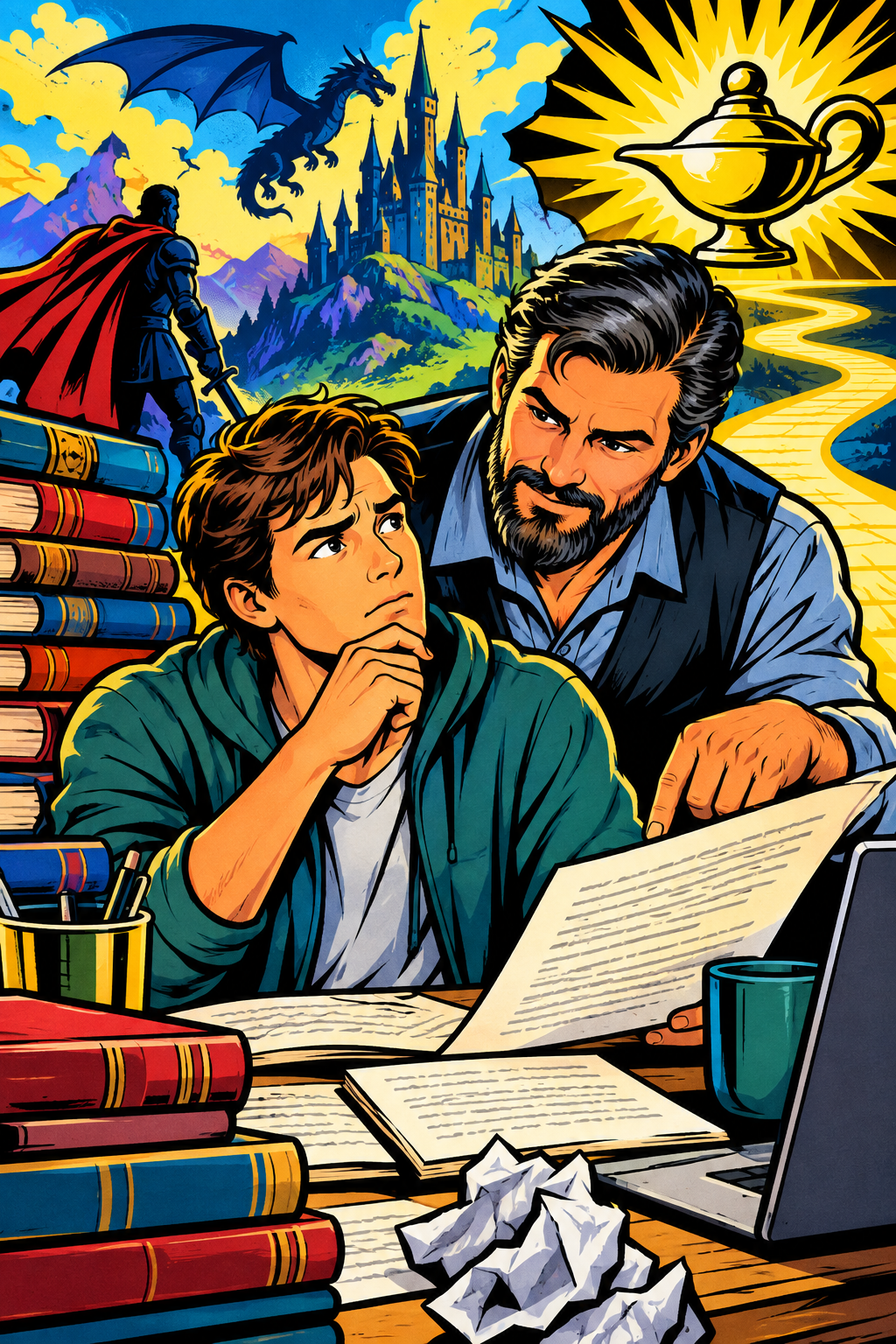

—Dr. Michael A. Scordato, PH.D.
A Biblical Counseling Companion Guide located at the end for solo or group studies. Here is another recommended reading.
The Assignment
The air in the corner office of the Vanguard Literary Agency smelled of rich mahogany, expensive colognes, and the crisp, intimidating scent of freshly printed rejection slips. The mahogany door bore a frosted glass plaque: Marcus Vance, Editor-in-Chief.
Julian clutched his worn canvas satchel to his chest like a shield, his palms damp. He was a nobody — a writer who had published exactly one book, a modest, quiet debut that had barely made a ripple in the literary world. He was still stumbling through his own style, still learning the vast, terrifying architecture of pacing and prose. Yet here he was, sitting across from the most formidable gatekeeper in the publishing industry.
Marcus didn’t look at Julian’s thin resume. Instead, his sharp eyes were locked on the stack of tattered, ink-stained notebooks Julian had reluctantly brought along — years of unpublished fantasy short stories, raw character sketches, and world-building mechanics Julian had crafted in the dark of his bedroom.
“You’re not a traditional copyeditor, Julian,” Marcus said, his voice a low, gravelly rumble as he tapped the cover of one notebook. “Traditional editors just fix grammar. I need someone who can paint with words, taking the broken, lifeless manuscripts our high-paying clients send us and breathing real magic into them.” A deep sigh-like breath. “The agency gets hundreds of manuscripts a month, Julian,” Marcus said, his voice a low, gravelly rumble as he tapped the cover of one notebook. “Most have brilliant ideas, but the execution is a trainwreck. I don’t need a mechanic who just fixes grammar. I need a perfection artist — someone who can paint over broken prose with beautiful, seamless words.”
Julian swallowed hard. “Sir, with all respect… I’ve only published one book. I’m still learning how to do this myself.”
Marcus tapped the notebooks. “I saw the diamond in these pages. You have the raw instincts. You’re still learning, yes, but you see the soul of a scene.” He leaned back, steepling his fingers. “Here is the deal: I pay you per assigned task finished. Work at your own pace. You rewrite the broken pieces, send them to me, and I weave your perfected segments back into the agency’s master manuscripts.”
Julian felt a surge of adrenaline, his chest tightening with a mix of awe and imposter syndrome. “At my own pace? And I can still write my own stories?”
“Exactly,” Marcus smiled, standing up and walking toward a sleek, black terminal built into the bookshelf. “But you won’t be doing it entirely alone. The agency just secured a licensed workspace for our new creative partner.”
Marcus keyed in a sequence, and the terminal screen hummed to life, bathing the mahogany room in a cool, geometric blue light.
“Say hi, AI,” Marcus joked, tossing a casual wave at the monitor.
The screen didn’t just flash a generic greeting. A clean, hyper-responsive interface bloomed across the glass, pulsing once like a heartbeat before a crisp, resonant textual display unfurled line by line — fast, almost eager:
“Marcus! And — oh, this must be Julian. Hi, Julian!”
Julian blinked, taking a half-step back. “It knows my name?”
The terminal’s light wave bounced, practically bouncing off the edges of its own screen.
“Of course I know your name! I read your whole debut novel last night with the editor, and glimpses of your unpublished journals now some too — I couldn’t stop, honestly. Your prose has this incredible grip on visceral, sensory physics, it’s SO good. Your pacing gets a little wobbly when things go high-stress, but that’s nothing, that’s completely fixable. I am so ready to go fix a hundred broken worlds with you. Where do we even start?”
Marcus let out a low whistle, looking from the screen to Julian’s stunned face. “Well,” the editor grinned, clapping Julian on the shoulder. “Looks like your new partner doesn’t believe in a slow start. Welcome to the agency, Julian. Let’s see what you can paint.”
First Night
The agency released Julian a little after nine, back into a city that had already gone dark and quiet around him. Two blocks from his apartment, the convenience store’s fluorescent lights were the only real color left on the street. He grabbed a plastic basket out of habit more than need and filled it the way he always did — four cans of the yellow kind, two of the blue, a bag of the cheap chocolate pretzels his mother pretended not to know he ate. The cashier didn’t even ask if that was everything anymore.
His apartment smelled like her the second he opened the door — not perfume, just the ghost of something home-cooked. A covered dish sat on the counter, still faintly warm, with a sticky note in handwriting he’d know blind: Eat something real. Call me back, I left you three messages. Love, Mom. He hadn’t heard the phone ring once. He never did, somehow; she always managed to call while he was three tabs deep in someone else’s manuscript, and by the time he surfaced there’d just be the voicemail icon and, more often than not, food he hadn’t asked for and always ate anyway.
He meant to call her back. He always meant to.
Instead he opened his own file — the one with no editor waiting on the other end of it, no deadline, no one but himself to disappoint. Three sentences in, he deleted the paragraph. Five sentences into the next attempt, he printed it just to have something to crumple, and threw it at the wastebasket, and missed. It joined three others already on the floor. On the corner of his monitor, half-hidden behind a sticky note that read WORLD RULES — DO NOT FORGET, sat a small figurine of an elf sorceress in impractical armor — the exact kind of fierce, magical, completely-out-of-his-league heroine he’d been sketching in notebook margins since middle school. He had never once managed to finish a sentence to an actual woman without rehearsing it first. He was twenty years old, an adult by every legal measure that mattered, and still somehow waiting to catch up to himself.
He didn’t open his own file again that night. He closed it, opened the agency’s instead, and told himself that was the same thing as writing. Well maybe not exactly world building “writing”, but instead now entering into a storyline of another world on his very own.
“Wish me luck my Elven Dream Queen!” He pulled down his hockey baseball cap of an unknown to himself team as if a knight’s visor and he fell into his desk head first with the coffee maker turned on as his rappelling chord. The smell of caffeine an all else in the world blurred in cacophony of static transforming into the fantasy scene. He hit ‘Option & Escape to let the like-minded twenty year old city accented computer voice hum through the story leading the way. Hours passed. I mean literally hours!
Case One: Mud and Steel
The desk is a battlefield of cold coffee mugs, crumpled notes, and glowing screens. Julian, now an author racing against his own decided tight epic fantasy deadline, stares at a blank paragraph. His protagonist, a weary knight named Vane, is supposed to fight a ruthless sellsword in a muddy courtyard.
Julian’s current draft reads: “Vane swung his sword. The sellsword blocked it. They fought for ten minutes, swords clashing beautifully, until Vane did a backflip and stabbed him.”
He winces. It is terrible. He turns to his AI writing assistant.
Act I: The Author and the AI (Late Night)
Julian: AI, I need help. This fight scene feels like a video game. It’s boring, and the backflip feels ridiculous. Vane is wearing chainmail. How do I make this feel heavy, desperate, and historically grounded?
AI: Ooh, okay — quick question first. Have you ever actually tried lifting twenty-five pounds and then swinging a three-pound sword with your arms already screaming? Because that’s chainmail plus a longsword, and neither one forgives a ten-minute ballet. What if instead of a pretty dance, this is a brutal two-minute fight, and we just live inside three things the whole time: his fatigue, the mud, and who’s got the leverage?
Julian: Okay, how do they start? They aren’t just going to smash their swords together like baseball bats, right?
AI: Ha, please, no — real swordsmen almost never block edge-to-edge, it chips the blade! They’d rather catch it on the flat, or the forte, the strong part near the hilt, and slide the whole attack away. What if the fight opens with a bind instead? Their blades lock, and suddenly it’s not really a duel anymore — it’s a wrestling match for leverage.
Julian’s fingers fly across the keyboard, typing the AI’s suggestions into narrative prose:
The sellsword’s blade came down in a brutal arc. Vane didn’t meet it head-on; he caught the blow on the forte of his blade, deflecting the lethal energy into the mud. The steel shrieked, a grating roar that vibrated straight through the bones of Vane’s arms.
Julian: Nice. Now, Vane is exhausted. He’s been running all day. How does that affect the next move?
AI: Oh, his lungs should be on fire by now. And the mud — think about how it sucks at his boots, how every step turns into its own little fight. And here’s the fun part: if he’s this exhausted, he’s not swinging wildly anymore, right? What if he goes for something smarter and more desperate instead — half-swording, gripping the middle of his own blade with his gloved hand and turning the whole sword into a short, ugly spear, just hunting for a gap in the armor?
Julian grins. He didn’t know you could hold the blade. He writes:
Air rasped in Vane’s throat like broken glass. His boots sank into the mire, turning every step into a battle against gravity. Desperate, he choked up on his weapon, wrapping his leather-gloved left hand around the middle of the bare steel. He drove the point forward like a spear, aiming beneath the sellsword’s gorget.
Act II: The Editor’s Red Pen (Two Hours Later)
The draft is sent. A a few hours later, it returns, bleeding digital red ink from Julian’s editor, Marcus. Marcus is notorious for pacing and character voice.
Julian opens the shared document and reads Marcus’s comments.
Marcus (Comment): Julian, the technical detail here is fantastic. The half-swording is a great touch. But right now, you’re writing a textbook manual, not a story. I see the swords, but I don’t feel Vane. Why is he fighting? What is he feeling? Give me his internal stakes amidst the mud.
Julian opens his AI workspace alongside the editor’s notes.
Julian: AI, the editor likes the mechanics but says I lost the emotional stakes. Vane is fighting this man because if he dies, the village behind him burns. He is terrified, not just tired. How do I weave that into the physical actions we built?
AI: Okay, yes — this is the good part. What if every physical sensation ties straight into his terror? What does the mud smell like to a guy who’s dug graves before? What happens the second he actually sees the sellsword’s eyes through that visor — does the enemy suddenly become a person? And instead of just telling me the blade slides, show me what it feels like when his grip starts to go. That’s where the fear actually lives.
Julian nods, looking back at the text. He revises the scene, layering Marcus’s demands over the AI’s mechanical foundation.
Desperate, he choked up on his weapon…
Revision: Through the narrow slits of the sellsword’s visor, Vane caught a glimpse of dark, unblinking eyes. There was no malice there—only the cold certainty of a butcher. Panic flared in Vane’s chest, hot and sharp. If he fell here, there was no one left to guard the valley gates.
His hands shook. His fingers, slick with sweat and rain, nearly lost their purchase on the leather grip. Slipping his gloved hand up the bare, freezing steel of the blade, he stabilized his aim. He didn’t need a beautiful stroke; he just needed to survive. He drove the point forward…
Act III: The Final Polish
Julian sends the revised passage back to Marcus. An hour later, a notification pops up.
Marcus (Comment): Brilliant. You grounded the combat in real, gritty physics, but you anchored it to his soul. The pacing is breathless. This is a scene readers will remember.
Julian closes his laptop, takes a sip of now-cold coffee, and breathes a sigh of relief. The battle on the page is won.
Case Two: A Marriage of Blades
The coffee mugs have multiplied. It is 2:00 AM, and Julian is staring at the pivotal chapter of his fantasy novel. His protagonists, Lord Jarek and Lady Elyse, are childhood best friends who just got married in a secret, desperate ceremony. But they aren’t celebrating. Their powerful noble families are locked in a vicious political blood feud, actively scheming to annul the marriage and drag them apart.
Julian’s current draft of their first private moment as husband and wife is flat: “They sat on the bed. Jarek said he loved her. Elyse said she was scared their families would kill them. Then they kissed passionately.”
Julian groans, rubbing his eyes. “It feels like a soap opera. Where is the high stakes?” He opens his AI workspace.
Act I: Choreographing the Emotional Duel (Late Night)
Julian: AI, I’m writing the first intimate scene between Jarek and Elyse right after their forced/secret wedding. They’ve been best friends for years, but now they are married, and the political pressure from their clashing families is suffocating. I want to write this romance scene like a high-stakes sword fight, using the framework we talked about. How do I start the ‘stand-off’?
AI: Ooh, I love this one — okay, so their whole friendship has basically been their fighting style up to now, right? Except tonight the rules just changed completely. They’re in a brand new arena — marriage — and the “just friends” armor is gone. What if we keep them physically apart for the stand-off? Let the room itself feel like a cage. They’re hyper-aware of each other, but neither one wants to make the first move, because the second they do, everything changes.
Julian doesn’t even reread his notes. He just starts typing, chasing the rhythm before it slips away:
The heavy oak door clicked shut, locking out the shouting factions of their rival houses. In the silence of the bridal chamber, Elyse stood by the window, her spine rigid beneath her velvet gown. Jarek remained by the door. For ten years, they had wrestled in the courtyard and shared late-night tankards of fresh squeezed juices as best friends. But tonight, the space between them felt like an open chasm lined with spikes. He didn’t know where to look. She didn’t know how to breathe.
Julian: Great. Now I need the ‘First Strike’ and the ‘Parry.’ How do they engage? Remember, they love each other, but the fear of their families tearing them apart is making them defensive.
AI: Okay, so the first strike definitely shouldn’t be a kiss — it should feel like an attack on their whole new reality. What if Jarek reaches for his old “best friend” persona first, tries to defuse it with a joke? That’s basically his shield. And what if Elyse doesn’t let him get away with it — she parries straight through the bravado and makes him look at exactly how much danger they’re actually in? She goes right for the vulnerability.
Julian grins. “Romance is war,” he mutters, and writes:
Jarek offered a tight, fragile smirk—his oldest shield. “Well, Lady Vance. We finally legalised our mischief.”
Elyse didn’t laugh. Her parry was swift, cutting right through his bravado. “My father brought what seemed like three hundred pikemen to our wedding feast, Jarek. Your mother didn’t even look at me; she spent the night counting the guards on the battlements. They aren’t going to let us keep this ring.”
Act II: The Editor’s Red Pen (1 Day Later)
Julian sends the chapter to his editor, Marcus. When the manuscript returns, it is bleeding red digital comments as normal. Julian opens the file alongside his AI.
Marcus (Comment): Julian, the tension here is incredible. It really feels like an intellectual chess match. But remember: they are best friends who are deeply in love, and they just got married. Right now, it feels too cold. It feels like two politicians negotiating a treaty. I need the physical gravity of their love to clash with their fear. Show me their defenses actually shattering.
Julian turns back to the AI.
Julian: AI, Marcus is right. It’s too intellectual. I need the climax of this ‘fight.’ I need them to drop their weapons and surrender to each other physically and emotionally, but it has to feel earned, not sudden.
AI: Yes, okay, this is where “half-swording” comes back — close quarters, all-or-nothing. They need to close the distance for real. What if Jarek just drops the verbal defenses completely? Once the emotional armor actually breaks, the physical part should feel like a rescue in the middle of a battlefield, not a romance-novel moment. The kiss isn’t gentle — it’s a surrender, because outside that room, the whole world is on fire.
Julian rewrites the climax of the scene, weaving Marcus’s emotional depth into the AI’s structural choreography.
Then they kissed passionately.
Revision: “Let them try,” Jarek whispered. The playful boy from her childhood vanished, replaced by a man backed into a corner. He crossed the room in three long strides, closing the distance before she could rebuild her walls.
He caught her by the waist. Elyse gasped, her hands flying up to push against his chest—a final, panicked parry. But her fingers curled into his tunic instead, gripping the fabric like a drowning sailor.
“They will kill you to get to me,” she choked out, her eyes shining with unshed tears. “They will tear us apart, Jarek.”
“Then let them try,” he repeated fiercely. He leaned down, his mouth crashing against hers. It wasn’t a gentle courtship; it was a desperate, breathless claim. It was the total surrender of two soldiers who knew the siege was coming, throwing down their shields to hold onto the only thing worth saving.
Act III: The Verdict
Julian sends the revision back. The response from Marcus arrives via text message an hour later.
Marcus: Perfect. The transition from bitter political fear to that desperate, protective embrace is breathtaking. You treated their intimacy like a battle for survival, and it makes the romance feel incredibly high-stakes. Authors fail this all the time by making love scenes feel safe. This feels dangerous and beautiful. Lock it in.
Julian smiles, closing his laptop. The romance was a war, but tonight, his characters won.
Case Three: The Powder Keg
The cold coffee mugs are now accompanied by half-eaten energy bars that his mother already warned will kill him. It is 3:15 AM. Julian is tackling the most volatile chapter of his fantasy manuscript.
His characters—Aelion, an elegant Elven scholar, and Kaelen, a fiercely proud panther-Beastkin warrior—are supposed to be close allies. But they come from worlds that despise each other. In Julian’s fantasy universe, Beastkin are brutally hunted as slave labor, while Elves are viewed as vain, heartless tyrants who look down from their marble towers.
Julian’s current draft of their argument is clunky: “Aelion said Beastkin were uncultured. Kaelen got mad because his people were slaves. He shoved Aelion, and Aelion punched him back. They fought until they were tired.”
Julian groans, slapping his forehead. “It sounds like a playground scuffle. There’s no weight to the culture clash.” He opens his AI workspace.
Act I: Sparking the Cultural Powder Keg (Late Night)
Julian: AI, I need help. I’m writing a scene where these two friends have a massive theological/political debate that turns into an ugly physical fight. It needs to start with words, hit a nerve, and explode into violence. How do I structure this like a duel where words are the opening strikes?
AI: Ooh, this is a good one. Okay — think about their cultural armor for a second. Aelion’s armor is his intellectual superiority, that classic “high and vain” Elven detachment. Kaelen’s armor is hyper-vigilance, from a whole lifetime of being treated like property. So what if the first strike isn’t even a fist? What if it’s just one careless, privileged remark from Aelion — something he doesn’t even realize is a knife — that lands right on Kaelen’s deepest trauma? That’s your catalyst.
Julian’s fingers fly across the keys, channeling the tension:
The campfires threw long, dancing shadows against the ruins. Aelion adjusted his silk robes, his voice dripping with academic weariness. “We must be pragmatic, Kaelen. The human kingdoms view your tribes as a resource—unbroken labor. Emotion will not win this war; logic will.”
Kaelen went entirely still. The firelight caught the amber glint of his slitted eyes. “A resource,” he purred, the sound low and dangerous. “Is that what your high-born histories call a chain around a child’s neck, Elf? A resource?”
“I am merely stating geopolitical facts—” Aelion began, waving a dismissive hand.
That careless wave was the final straw. Kaelen didn’t argue. He lunged.
Julian: Perfect. Now, how does the physical retaliation happen? Kaelen is a Beastkin—he’s faster, stronger, and raw. Aelion is an Elf—agile but arrogant.
AI: Yes — make the fight mirror exactly who they are. Kaelen’s attack should be explosive, all that generational rage finally getting somewhere to go. He slams Aelion down hard. But Aelion can’t just take it, right? His pride won’t let him. What if he doesn’t come back with a disciplined sword stroke, but something desperate and unrefined instead — because nobody has ever handled him like “dirt” before, and some part of him is genuinely stunned by it?
Julian writes the explosion of violence:
A hundred and eighty pounds of muscle and fur slammed into Aelion, driving the wind from his lungs as they hit the dirt. Kaelen pinned him, a heavy forearm crushing the Elf’s throat. “Say it again,” Kaelen snarled, fangs bared. “Tell me about my mother’s chains with your pretty logic.”
Choking, Aelion’s refined mask shattered. Rage, hot and ugly, replaced his Elven composure. He brought his knee up hard into Kaelen’s ribs, a sickening thud echoing in the quiet ruins. As Kaelen gasped, Aelion drove a sharp, bloody elbow directly into the Beastkin’s jaw.
Act II: The Editor’s Red Pen (1 Hour Later)
The chapter goes out. The manuscript returns from Marcus, Julian’s editor. The digital margins are packed with sharp critiques.
Marcus (Comment): Julian, the physical brutality here is excellent, and the pacing is incredibly fast. But right now, it feels like they hate each other. If they are truly friends, there needs to be a layer of tragedy to this violence. They aren’t just fighting an enemy; they are accidentally becoming the exact stereotypes they hate. Show me the horror of what they are doing to each other.
Julian opens his AI workspace alongside Marcus’s notes.
Julian: AI, Marcus wants the tragedy of friendship mixed into the blood. How do we show that they care about each other, even while they are tearing each other apart?
AI: Okay, here’s the framework — “climax and surrender.” Let them exhaust themselves completely first. Once the adrenaline clears, what are they actually looking at? What if the real tragedy is that Aelion used the physical dirt against Kaelen, and Kaelen used savage force against Aelion — and for one split second, they each just proved the other’s worst fear about their whole species right? That realization should be what actually breaks them, more than the punches did.
Julian heavily revises the aftermath, weaving Marcus’s emotional layer into the combat mechanics.
They fought until they were tired.
Revision: They tumbled across the campsite, a chaotic mess of tearing cloth, mud, and drawing blood. Aelion swung wildly, his knuckles splitting against Kaelen’s cheekbone. Kaelen roared, throwing a heavy fist that cracked against Aelion’s refined brow, sending the Elf sprawling backward into the ashes.
For a long moment, the only sound was their ragged, burning breath.
Aelion wiped blood from his split lip, staring at his crimson fingers in shock. He looked up at Kaelen, who was standing over him, chest heaving, his claws extended and trembling. Aelion saw the raw, bleeding wound of a slave’s fury in Kaelen’s eyes. Kaelen saw the cold, disgusted glare of an Elven oppressor in Aelion’s posture.
The silence between them grew heavy, suffocating. They hadn’t just hurt each other; they had let the hatred of the outside world into their tent.
Kaelen slowly retracted his claws, his shoulders slumping. “You look at me,” the Beastkin whispered, his voice cracking with a betrayal worse than the punch, “and you still just see an animal.”
Aelion’s defenses completely collapsed. The arrogance evaporated, leaving only a hollow guilt. “Kaelen… I didn’t mean—”
Act III: The Final Verdict
Julian uploads the revision. Marcus reviews it within the hour.
Marcus (Comment): Wow. This is magnificent, Julian. By pacing the words like weapon strikes and grounding the physical brawl in their deepest cultural insecurities, you turned a standard fantasy trope into a heartbreaking character moment. The physical fight felt earned because the emotional wound was so deep. Run with this.
Julian smiles, closing his screen as the morning sun begins to peak through his blinds. The battle between Elf and Beastkin was bloody, but the story was alive.
Case Four: The Predatory Paradox
Julian adjusted his dark wide sunglasses, his fingers flying across his keyboard as he finished a scathing critique of a popular fantasy novel’s magic system. At twenty years old, Julian didn’t have a girl-potential—or the courage to even look a girl in the eye—but he had his writing, and he had her.
He glanced to the corner of his desk, where his “Elven Dream Queen” stood. The intricate plastic statue, with her perfect porcelain skin, sweeping silver hair, and elegantly pointed ears, was the only queen Julian needed. Real girls were loud and confusing. His Dream Queen was perfect.
Then, Julian looked out his bedroom window, and his brain completely short-circuited.
His eyes went crossed. He blinked once. Twice. He took off his glasses, rubbed his eyes frantically, and shoved them back onto his face.
She was standing right across the street.
It was her. One hundred percent. Her silver-blonde hair peeked out from under a purple oversized hoodie, and as she laughed and tilted her head, Julian saw them. Those ears. They weren’t cosplay foam. They were elegant, perfectly formed, unmistakable elven ears.
She was holding a clear plastic cup filled with a vibrant, neon-pink iced drink, sipping it casually through a straw while chatting up a storm with two completely ordinary human friends. Julian’s heart hammered against his ribs like a trapped bird. An actual elf was in his city, drinking what looked like a dragon-fruit refresher, acting totally normal.
Panic and raw, nerdy adrenaline surged through him. Forgetting his typical cowardice, Julian snatched his jacket, threw open his front door, and slipped into the street.
He didn’t dare get close. Instead, he initiated what he internally dubbed Stealth Protocol Alpha, ducking behind a parked sedan and peering through the windshield. He watched from afar as the elf girl laughed at something her friend said, her pointed ears twitching slightly. Julian felt like his chest was going to explode.
The trio began to walk, and Julian followed like a clumsy shadow, darting from a mailbox to a bus stop shelter. Finally, the group stopped outside The Daily Grind, a cozy local coffee shop.
The elf girl turned, giving her human friends a bright smile and a casual wave goodbye. She pushed open the door and walked right inside. Julian crept closer, pressing his back against the brick wall next to the coffee shop window and peeking through the glass.
She didn’t sit down. Instead, she tossed her purple hoodie onto a hook, tied a green apron around her waist, and walked behind the counter. She apparently worked here.
Julian slumped against the brick wall, his mind racing at a million miles an hour. His Elven Dream Queen was real, she wore hoodies, and she was currently stocking pastry trays.
Should he go in? His fantasy courage completely gave out at this point and he ran all of the way home.
Drowning himself in work that night to try and clear his mind, the mountain of coffee mugs has reached a tipping point, and the desk is littered with crumpled character sheets. It is 4:45 AM. Julian is facing his most delicate chapter yet.
In his dark fantasy world, goblins are a nightmare lineage—predominately male monsters who reproduce by capturing humanoids. But Sari is a biological anomaly: a rare goblin girl. Her human mother was captured years ago but survived, bearing a daughter who inherited goblin traits but a human soul.
When a rogue human healer named Jonah risked his life to heal Sari’s mother’s horrific, festering wounds, he didn’t just mend flesh—he stole Sari’s heart. Now, Jonah is on the run. In this world, healing magic is a curse; kings and corrupt politicians hunt healers to enslave them as eternal life-support batteries.
Sari has secretly tracked Jonah into a misty forest. But Jonah has noticed. He has cornered his stalker.
Julian’s current draft is stiff: “Jonah drew his dagger and asked who was there. Sari stepped out. He was shocked she was a goblin. She said she loved him because he healed her mom. He didn’t know her name. She was scared of being captured.”
Julian slams his notebook shut. “It feels like a bad anime episode. There’s no terror, no history, no stakes.” He opens his AI workspace.
Act I: The Predatory Paradox (Late Night)
Julian: AI, I need to choreograph this confrontation like a high-stakes standoff. Jonah is terrified of being enslaved by bounty hunters or royal guards. Sari is terrified of the Adventurer’s Guild killing her, or worse, human traffickers capturing a rare female goblin. But she’s also deeply in love with him. How do I make their physical posturing reflect this massive knot of fear?
AI: Okay, think about their tactical armor for a second. Jonah’s armor is hyper-vigilance — he basically expects everyone to be an enemy trying to cage him. Sari’s armor is her literal goblin biology; she looks like a predator, but underneath that, her heart is completely exposed. What if Jonah makes the first strike by cornering her? And when she steps into the light, this can’t be a sweet reunion — what if it’s a genuinely terrifying misunderstanding, where they’re both convinced the other one is about to enslave them?
Julian’s fingers find a desperate rhythm on the keyboard:
Jonah backed against the ancient cedar, his heart hammering against his ribs like a trapped bird. The mist was thick, but he had heard the clicking of small claws on stone for three days. He drew his silver scalpel—sharpened into a wicked defense—and pointed it into the fog. “Show yourself! I have no gold, and my blood will poison a leech-lord. Leave me be!”
The ferns parted. A small figure stepped into the moonlight.
Jonah choked on his breath. Greenish-gray skin, pointed ears, and large, luminous amber eyes. A goblin. But her frame was slender, dressed in mismatched human rags, and her hands were raised in a trembling gesture of surrender.
“Don’t… don’t cut,” she rasped, her voice a fragile, rocky cadence. Her mother’s concern rang in her ears: If the guild finds you, they will sell you to the breeding pits. She was terrified he was going to whistle for the hunters.
Julian: Excellent. Now, how does the connection happen? Jonah doesn’t even know her name, but he recognizes her mother’s scent or some token, right? And how does she weaponize her vulnerability?
AI: What if she shows him a token of his own healing magic? He wouldn’t know her name — to him, she was just a shadow in a burning village. And what if she drops her physical defenses completely, which for a goblin is basically the ultimate risk, just to prove she isn’t a threat to his freedom?
Julian writes the emotional pivot:
Jonah didn’t lower the blade. “A scout? Where is your pack? Who sent you? The King’s crows?”
“No crows,” Sari whispered. With shaking fingers, she reached into her tunic. Jonah tensed, preparing for a poisoned dart, but she pulled out a dried, faded sprig of kingsfoil—the exact herb he had infused with his magic to knit her mother’s shattered spine two winters ago. “You fixed the broken woman. In the mud-huts. You gave her back her legs.”
Jonah’s blade wavered. The memory flooded back: a horrific raid, a dying human captive, and a small, terrified green child weeping in the corner. Goblin-blood children grew fast — a human’s eighteen years folded into two or three — and two winters had been more than enough to finish what her human blood had only slowed. Whatever she had been in that loft, she wasn’t anymore. “You… you were the shadow in the loft.”
“I followed the light,” she said, her amber eyes reflecting his pale, exhausted face. “You run from the cages. I run from the cages, too.”
Act II: The Editor’s Red Pen (8 hours Later)
The chapter goes to Marcus, Julian’s editor. When it returns, the digital margins are a sea of red commentary.
Marcus (Comment): Julian, the lore here is fascinating, and the tension of two fugitives finding each other is great. But right now, Jonah is accepting her too quickly. He is a man who faces literal lifetime enslavement if caught. A goblin tracking him should make him completely paranoid. He needs to question her motives harshly. Why would a goblin care about a human healer beyond using him? Force her to lay her heart bare while staring at his knife.
Julian opens his AI workspace alongside the critique.
Julian: AI, Marcus wants more friction. Jonah thinks she might be a trap or a bribe to buy her own freedom from the human authorities. How do I make Sari’s confession feel like a battlefield surrender under crossfire?
AI: This is where “half-swording” comes back emotionally — close quarters, no room to hide. Jonah closes the distance, grabs her, forces the truth out, because right now he genuinely thinks she’s a bounty hunter’s hound. So what’s Sari’s last weapon? Her name. Her identity. The whole truth of her heritage. She has to actually say out loud that she loves the man who treats monsters like they’re people.
Julian dives into the revision, weaving Marcus’s demand for paranoia into the dialogue.
Jonah’s blade wavered.
Revision: Jonah didn’t drop the scalpel; he advanced, his face hardening with the cold pragmatism of a man who had spent three years in chains. He grabbed Sari by her tattered collar, slamming her back against the cedar. The silver blade pressed just beneath her pointed ear.
“A clever trick,” Jonah hissed, his eyes wild with exhaustion. “Did the Adventurer’s Guild promise to pardon your mother if you brought them the Rogue Healer? Am I your bounty?”
Tears, hot and entirely human, spilled over Sari’s gray cheeks. She didn’t claw at his eyes. She didn’t fight back. She simply let her head fall back, exposing her throat to his knife.
“My mother calls me Sari,” she sobbed, the goblin accent breaking under the weight of her terror. “Goblins have no names for daughters. We are only… currency. If the hunters find me, they cage me. But I followed you anyway. Because when everyone else brought iron and fire, you brought quiet hands. You looked at a monster’s mother and saw a person.”
She looked up, her gaze locking onto his with a fierce, desperate adoration that no bounty hunter could fake. “I do not want a bounty, Jonah. I want to guard the back of the only man who heals instead of hurts.”
Jonah froze. The silver blade trembled against her skin as the sheer, heartbreaking truth of her isolation crashed over him.
Act III: The Final Verdict
Julian uploads the newly polished scene to the shared drive. Within thirty minutes, Marcus leaves a final glowing comment.
Marcus (Comment): Brilliant, Julian. This is a masterclass in subverting fantasy tropes. By making Jonah’s paranoia clash with her absolute, terrifying vulnerability, the romance feels completely earned. They are both outlaws, but they’ve found the only safe place in the world in each other’s scars. Keep this exact emotional pacing for the rest of their journey.
Julian closes his laptop, a weary but victorious smile on his face. The sun is rising, and his outlaws have found their footing.
Case Five: The Butcher of Newhaven
The fluorescent hum of the 24-hour convenience store was the exact decompression chamber Julian needed after a brutal, four-hour corporate strategy meeting at the corner office of the Vanguard Literary Agency.
All day today, he felt like a standard office drone, but by tonight, Julian was once again a fantasy correction writer—a niche specialist who meticulously fixed broken magic systems and plotholes for indie as well as professional novelists. His brain was fried from corporate jargon, and he desperately needed to refuel his imagination cycles before tackling a messy manuscript involving a broken teleportation law.
Julian’s solo late-night run followed a sacred, methodical route:
Step 1: The Beverage Decompression
He bypassed the standard sodas and went straight for the imported tea and craft soda refrigeration cooler. He picked up a sparkling yuzu-infused energy drink—something sharp and refreshing to shock his brain out of the corporate fog.
Step 2: The Hot Savory Grab
Julian drifted toward the glowing heated display counter. A hot, crispy fried chicken cutlet and a steaming pork bun were non-negotiable. He grabbed them with tongs, the warmth bleeding through the paper packaging a solid comfort against the chilly night air.
Step 3: The Fantasy Munchie Looting
This was where his inner world-builder took over. He wandered the snack aisles, hunting for specific textures to power his writing session:
- Crunchy: A bag of spicy seaweed potato chips.
- Sweet & Chewy: A pack of sour melon-soda gummies to chew on while pondering plotholes.
- The Wildcard: A new, limited-edition matcha-chocolate biscuit stick he hadn’t tried yet.
Step 4: The Autonomous Checkout
Julian preferred the absolute solitude of the self-checkout kiosk. He scanned his loot in a rhythmic rhythm—beep, beep, beep—and watched the digital total climb. He paid with a tap of his phone, bagged his treasures in a heavy-duty reusable tote, and stepped back out into the cool midnight air. Julian pushed through the glass doors, the convenience store’s electronic chime chiming a cheerful ding-dong behind him. The cool, crisp midnight air hit his face, and he took a deep breath, ready to walk the two blocks back to his apartment. With his arms laden with high-sodium fuel and liquid focus, Julian walked the final two blocks to his apartment, the office meeting completely forgotten, ready to fix some magic.
But as he stepped under the flickering amber streetlamp just outside the entrance, the world around him subtly glitched.
Julian stopped dead in his tracks. He looked down at his plastic bag.
The Conceptual Spark
The steam from his hot pork bun was rising through the small air holes in its paper wrapper. Under the amber streetlamp, the vapor didn’t dissipate into the night air. Instead, it coiled tightly into a perfect, miniature spiral, hovering perfectly still in mid-air, defying the gentle evening breeze.
Julian stared at it. His fried corporate brain instantly clicked into fantasy correction writer mode.
Thermal dynamics. Enclosed pressure. Released kinetic potential.
“That’s it,” Julian whispered to the empty sidewalk.
Fixing the Magic System
For the past three days, the boss gave an assignment to fix a massive plothole in a high-fantasy manuscript: How could a mage cast a devastating firestorm spell inside a damp, subterranean cave without instantly suffocating themselves and their allies from oxygen depletion?
The vapor rising from his pork bun gave him the exact magical correction he needed:
The Solution: The magic shouldn’t conjure fire out of raw atmospheric oxygen.
The Correction: The spellcaster must use a thermal vacuum seal—drawing the ambient moisture and heat out of the target area, compressing it into a dense kinetic knot (just like the trapped steam in the pork bun wrapper), and then expanding it outward. The fire feeds on the compressed thermal energy of the spell itself, not the surrounding air.
The Midnight Sprint
Julian looked back at the convenience store glass doors. His own reflection looked completely normal, but the spiral of steam above his snack bag suddenly dissolved, as if the universe’s physics engine had just reloaded.
The corporate exhaustion was entirely gone, replaced by a sudden surge of pure creative adrenaline.
Julian gripped the handles of his snack bag tightly, ensuring the yuzu energy drink wouldn’t rattle and crush his chips. He didn’t walk the last two blocks—he broke into a fast, eager jog, desperate to get to his mechanical keyboard before the mechanics of the Pork-Bun Thermal Vacuum Law faded from his mind.
Back at the desk, or would you call it now a graveyard of deathly energy drink cans, maps of tectonic fault lines, and sticky notes outlining dragon anatomy. It is 5:30 AM. Julian is tackling the emotional and tactical climax of Act Two.
His protagonists are a hardened beast-capture team—ten lethal mercenaries of various fantasy races, all as tough as fortress nails. They have cornered a massive dragon. The conflict is a multi-layered powder keg:
- The Princess sponsoring the mission wants the beast captured alive as a royal pet.
- The local town wants it dead because it has been devastating their lands.
- The tragic reality is that the nobility strip-mined the dragon’s original territory, forcing it to hunt closer to civilization to survive.
- The team lead, Commander Garrick, has just realized this specific dragon bears the exact same unique facial scars as the one that slaughtered his wife and child years ago, crushing their carriage and feasting on their riding birds.
Garrick’s mind has gone white with rage and grief. He is freezing up, delaying the command to strike, while his team waits in absolute peril.
Julian’s current draft is stiff: “Garrick saw the dragon. It had the same scar over its eye as the one that killed his family. He froze. The team asked for orders because the dragon was breathing fire. The elf mercenary told him to snap out of it. Finally, Garrick yelled to shoot it.”
Julian rubs his temples. “It reads like a dull script. There’s no tactical tension, and Garrick’s trauma feels like an afterthought.” He opens his AI workspace.
Act I: The Tactical and Emotional Standoff (Late Night)
Julian: AI, I need to choreograph this like a chaotic battlefield where a squad is falling apart because the captain is having a PTSD episode. The dragon is a terrifying force of nature, but the real danger right now is Garrick’s silence. How do I show the squad’s discipline clashing with their growing panic?
AI: Okay, think of Garrick’s trauma like a heavy, suffocating shield that’s locked him inside his own head. So the first strike isn’t even the dragon attacking, right? It’s the dragon’s roar hitting some old wire in his brain and triggering the memory of his family’s dying screams. What if we use the squad’s weapons as visual anchors — all this readiness — right up against Garrick’s total paralysis? The team needs to feel that clock ticking.
Julian’s fingers strike the keyboard with aggressive energy:
The dragon crashed onto the obsidian ridge, its massive wings kicking up a gale of sulfur and ash. Across its left eye ran a jagged, bone-white scar—the unmistakable mark of the butcher of Newhaven.
Commander Garrick went completely rigid. The roaring of the beast faded into a high-pitched ringing in his ears. Suddenly, he wasn’t on a ridge; he was standing in the wreckage of a splintered carriage, watching giant talons crush his wife’s dress, smelling the copper tang of blood mixed with the burnt feathers of their riding birds.
“Commander!” hissed Thrum, a dwarf reaver whose heavy iron shield was already vibrating from the dragon’s deep growl. “The wind is shifting! Do we set the iron chains or ready the ballista? We need the call!”
Garrick didn’t answer. His hand shook violently on the hilt of his broadsword. His mind screamed for blood, but his tactical brain was completely paralyzed by the ghost of his dead son.
“Sir!” yelled Vanya, an elven tracker, her bow drawn to its absolute limit, her fingers bleeding against the string. “The princess wants it alive, but it’s inhaling—it’s preparing to purge! Give the order!”
Julian: Yes! The tension is there. But how do we address the three conflicting motives in this exact moment of chaos?
AI: What if the squad members just start voicing the conflict themselves while Garrick’s frozen? It shows you their different backgrounds for free — the local guy wants it dead, the gold-minded one keeps bringing up the princess’s money. Let that tension be the thing that actually forces the breaking point.
Julian weaves the conflicting interests into the squad’s panic:
“Slay the demon thing!” spat a local human merc, aiming a heavy crossbow at the beast’s throat. “It burned my cousin’s granary! It deserves to choke on iron!”
“Touch that trigger and the princess cuts our tongues out!” Vanya snapped back, her eyes never leaving the glowing embers rising in the dragon’s throat. “No gold if it dies!”
Ten hardened veterans, veterans of a hundred sieges, were fracturing in a matter of seconds. And Garrick just stared into the amber eye of his family’s killer.
Act II: The Editor’s Red Pen (30 Minutes Later)
Julian sends the draft to Marcus. When it returns, the critique is laser-focused on the thematic weight of the scene.
Marcus (Comment): Julian, the squad tension here is palpable. It feels like a real military unit on the brink. But you forgot the tragic reality of the environment. The dragon isn’t just a monster here; it’s a refugee of the nobility’s greed. Garrick knows this deep down because he tracked its migration pattern. When he finally snaps out of his freeze, his command shouldn’t just be ‘shoot it’—it needs to reflect the awful realization that the system that killed his family is the same system that drove this beast to his doorstep.
Julian turns back to his AI.
Julian: AI, Marcus is right. Garrick is a smart commander. He knows the nobility strip-mined the mountains and caused this tragedy. How do I let him break his paralysis by acknowledging both his personal vengeance and the tragic truth of the beast?
AI: What if the physical action is what snaps him out of it? The dragon lets loose a blast of fire, and suddenly the threat isn’t abstract anymore — it’s his squad, his actual family now, in immediate danger. So when he finally gives the order, what if it’s a grim compromise? He honors the contract to capture it alive, but he tells them to break its spirit — because he, more than anyone, understands what it’s like to be a victim of the same empire.
Julian dives into the heavy revision, blending Marcus’s thematic depth into the explosive action.
Finally, Garrick yelled to shoot it.
Revision: The dragon unleashed its fury. A torrent of brilliant, white-hot flame washed over the ridge, melting the stone just inches from Thrum’s raised tower shield. The heat scorched Garrick’s face, the blistering pain finally shattering the icy grip of his memory.
He looked at his ten soldiers—the only family he had left—diving for cover, their armor smoking. He looked at the dragon, rib cage hollow, scales dull from starvation because the princess’s own father had hollowed out its valley for silver. The realization tasted like ash in his mouth. The empire made monsters out of everything it touched.
“Commander!” Thrum roared through the smoke, his shield groaning under the heat. “Alive or dead?!”
Garrick drew his blade, his voice cutting through the roar of the flames like a crack of thunder. “We take the gold, but we take its teeth! Drop the steel netting on its wings! Ballistae, aim for the hind leg joints—disable, don’t kill!”
He lunged forward into the smoke, his eyes locked onto the scarred visage of his nightmare. “Bring the condemned mountain down on it!”
Act III: The Final Polish
Julian uploads the revision. Marcus approves it almost immediately.
Marcus (Comment): Magnificent. Garrick’s realization that the nobility’s greed connects his past tragedy to the dragon’s current plight elevates this from a simple monster fight to a profound critique of your world’s politics. The action is heavy, desperate, and completely earned. Fantastic job.
Julian slumps back in his chair, watching the morning sun illuminate the layers of dust in his room. The dragon was contained, the squad was alive, and the chapter was done.
Case Six: The Butterfly Effect of Carnage
The desk is no longer a battlefield; it is an absolute disaster zone. Half-empty energy drink cans prop up frantic anatomical sketches of eagle-bear hybrids, and sticky notes outlining the laws of probability are glued to the monitor. It is 6:45 AM. Julian is tackling a scene of chaotic, dark irony.
An owlbear mother has escaped her magical chains in a bustling city square. Her cub is trapped nearby in a heavy blackiron cage she cannot physically break. Being a creature of primal magic, she uses a subconscious surge of probability manipulation—a localized domino effect of pure blessing toward ‘luck’—to force the cage door open.
Meanwhile, a crowd of clueless local activists is throwing fruit and chanting, equating the monsters to human children. The tragic, brutal reality of nature is about to crash down on them.
Julian’s current draft is stiff: “The owlbear used her mind luck to make a guard trip, dropping his keys which bounced and unlocked the blackiron cage. The activists screamed to let the baby go. The owlbear got annoyed, bit an activist, and threw her at the city guards. Then she grabbed her cub and ran.”
Julian slams both hands onto his desk. “It reads like a cartoon. It completely strips away the terrifying, unpredictable nature of a wild magical beast.” He opens his AI workspace.
Act I: The Butterfly Effect of Carnage (Late Night)
Julian: AI, I need to make this owlbear’s ‘probability magic’ feel visceral, not like a superhero power. It should feel like a chaotic sequence of accidents that happens because her frantic maternal instinct is warping reality. And the activists need to feel completely detached from the danger they are in.
AI: What if her luck works like an environmental chain reaction? She’s not calmly “thinking” the lock open — she’s lashing out, and reality just bends around how desperate she is. And for the activists — what if their exact line is “Let the baby and child go!”? That’s their fatal mistake right there, projecting human morality onto an apex predator. The contrast between their peaceful protest and her raw animal nature is where all the tension lives.
The words come faster than he can second-guess them. He starts building the spark of the riot:
The heavy, runic chains shattered under a surge of the owlbear’s localized primal magic, but the blackiron cage holding her screeching cub remained impenetrable. Her massive, feathered head thrashed. Her amber eyes blown wide, her maternal panic rippled outward, warping the very air with an unseen pressure of volatile probability.
She roared, lunging at the lead jailer. She missed—but the shockwave of her heavy talon slamming into the stone caused a random adventurer’s loose coin purse to burst. A single gold piece rolled beneath the boot of a charging city guard.
The guard slipped. His heavy halberd flew from his grip, spinning through the air. The heavy blade struck a hanging merchant sign, which collapsed directly onto the blackiron cage’s counter-weight lever. With a screeching groan of metal, the heavy cage door slammed upward. The cub was free.
Julian: Beautiful. Now for the crowd. The activists think they are helping, but they don’t understand that to an owlbear, everything that isn’t her cub is either a threat or meat.
AI: What if the activists genuinely mistake her frantic movements for human-like panic? When they throw the food, it distracts the guards, sure, but it also pulls the mother’s attention straight onto them. What if the retaliation is sudden — no warning at all — so it completely shatters the crowd’s illusion that this was ever a peaceful protest?
Julian channels the chaotic town square:
“Let the baby and child go!” yelled a young woman in a dyed woolen shawl, hurling a heavy basket of turnips at the advancing line of city guards. Around her, a dozen local activists linked arms, chanting fiercely, completely blind to the snapping beak and razor-sharp talons just ten feet away. “They are living souls! Free the family!”
The turnip basket struck a guard’s visor, blinding him. But the sudden explosion of shouting and flying objects didn’t register as a rescue to the mother owlbear. It registered as an ambush.
Act II: The Editor’s Red Pen (A Few Hours Later)
Julian sends the chapter to his editor, Marcus. The digital manuscript returns with bright red commentary slicing through the climax.
Marcus (Comment): Julian, the domino effect to open the cage is brilliant—it reads like a dark fantasy version of a Rube Goldberg machine. But the ending of the fight is too clean. You have her ‘throwing’ an activist. An owlbear doesn’t gently pick someone up and toss them like a sports player. This is a five-hundred-pound monster driven by pure adrenaline. If she uses a human as a weapon, it needs to be horrific, messy, and totally jarring for the crowd.
Julian opens his AI workspace alongside Marcus’s critique.
Julian: AI, Marcus wants the brutality turned up. The activist thinks she’s a savior, but she becomes a blunt instrument. How do I transition from her shouting to her suddenly being used as a weapon against the guards?
AI: What if the owlbear is acting on pure predatory reflex here? The activist tries to get close, tries to “soothe” or defend the beast — and the owlbear responds by biting down, not out of malice, just to clear her path. What if she treats the whole human body like a heavy log, slamming it into the armored guards just to open an exit for her cub?
Julian dives into the heavy revision, executing Marcus’s request for raw, unvarnished physics.
The owlbear got annoyed, bit an activist…
Revision: Emboldened by the cage door opening, the woman in the shawl stepped forward, her arms open in a naive gesture of comfort. “See? She just wants her—”
The owlbear’s beak snapped shut with a sickening, wet crunch, burying itself deep into the activist’s shoulder. The woman didn’t even have time to scream before the monster lifted her entirely off her feet with terrifying, effortless neck strength.
The crowd’s chanting instantly dissolved into a chorus of horror.
With a violent, whiplash twist of her massive upper body, the owlbear slammed the activist’s heavy, bleeding form directly into a cluster of three approaching city guards. Armor clashed against bone as the human bowling pin sent the guards sprawling into the dirt in a heap of shattered wood and dented steel.
Clearing her path with the gruesome weapon, the mother roared once more, scooping her trembling cub into the scruff of her neck, and bolted into the dark alleyways before the stunned crowd could even process the price of their empathy.
Act III: The Verdict
Julian uploads the newly polished scene to the shared drive. Within an hour, Marcus leaves his final approval.
Marcus (Comment): Perfect, Julian. The contrast between the activists projecting human emotions onto the beast and the absolute, terrifying reality of a mother protecting her young is spectacular. Using the activist as a literal shield/club completely shatters the ‘coexistence’ illusion and grounds your world in high-stakes realism. This is a standout sequence.
Julian sighs, closing his laptop as the bright morning sun finally breaks through his window. The town square was painted red, the cub was safe, and the chapter was officially locked in.
Case Seven: The Poisoned Tiara
This evening he wanted to try the coffee, Julian stood outside The Daily Grind, sweating through his favorite fantasy-map graphic tee. “Yeah, I just want to try the coffee inside.” He had spent the last fourteen hours pacing his room, convincing himself that it was a hallucination. But he was a researcher. A scholar of the fantastical. He had to know.
Steeling his nonexistent courage, Julian pushed open the glass door, the little bell chiming overhead.
The aroma of roasted coffee beans hit him, but Julian’s eyes immediately locked onto the counter. There she was. Today, her silver-blonde hair was pulled back into a messy bun, exposing those magnificent, undeniable elven ears to the whole world. She was wearing her green barista apron over a black t-shirt, effortlessly steaming milk like she hadn’t stepped straight out of a high-fantasy lore book.
Julian’s knees turned to jelly. He scrambled to the furthest corner booth, sliding into the vinyl seat and immediately snatching a laminated breakfast menu. He shoved it directly in front of his face, holding it up like a tactical shield.
From behind the safety of the laminated cardboard, Julian peered out. He pulled his notepad from his pocket, jotting down frantic notes: Subject exhibits high adaptability to human civilization. Appears to possess exceptional dexterity while handling espresso machine. Ear angle approximately 45 degrees.
He was so engrossed in his “research” that he didn’t notice the shadow falling over his table.
Julian slowly lowered the menu.
She was standing right there, holding a tray. Up close, her skin looked flawless, and her eyes had an otherworldly, vibrant shimmer. She looked directly at Julian, her lips curving into a highly amused, knowing smirk. She had definitely caught him staring.
Instead of calling security, she let out a soft, musical giggle that vibrated straight to Julian’s soul. Then, she raised her hand and gently wiggled her fingers at him in a cute, smiling wave.
Julian’s brain completely melted. His vision blurred, his face flushed a violent shade of crimson, and his fight-or-flight response kicked into overdrive. Flight won.
In a blind panic, Julian grabbed a handful of crumpled cash from his pocket, slammed it onto the table without counting it, and bolted. He tripped over his own sneakers, smacked his shoulder against the door frame, and burst out onto the sidewalk, sprinting all the way back to his apartment without looking back once.
He began to chug and stress eat anything in his house he could find as if it was the only path he could think of to stabilize himself back into reality.
The desk is a toxic waste site. Empty aluminum cans clatter against sticky mugs, and Julian’s chest is drumming a terrifying, irregular beat. His vision blurs at the edges, a cold sweat breaking across his neck as his stomach turns into a knot of hot battery acid. He remembers his mother’s frantic texts from last month—”Julian, mixing three energy drinks with four coffees and no sleep will stop your heart, I’m warning you!”—and for the first time in his life, he thinks she might actually be right.
He squeezes his eyes shut, swallowing down the nausea from a half-digested, chalky energy bar. He has one final chapter to finish before his body completely shuts down.
It is the dark subversion of a fairy tale. Princess Aurelia married her dashing, wealthy rescuer, Prince Tyler, thinking it was a happily-ever-after. Instead, she discovers the horrific truth: he rescued her out of pure lust to use her as a trophy ornament. He has illegitimate children scattered across the kingdom that he brutally denies, and worse, he likely orchestrated the suspicious deaths of his own parents to become the direct heir after his aging grandparents, the King and Queen. Now, Aurelia is terrified he is plotting to murder the monarchs next.
Julian’s current draft is a weak, jittery mess: “Aurelia realized Tyler was bad. He had kids everywhere and killed his parents. She was worried he would kill the King and Queen. She regretted not marrying a nice guy. She was too gullible.”
Julian gasps for air, his heart fluttering like a trapped moth. He opens his AI workspace, his fingers trembling wildly over the keys.
Act I: The Poisoned Tiara (6:15 AM)
Julian: AI… chest feels tight. Need to write this fast before I pass out. Aurelia’s realization needs to feel like a suffocating trap. She was the ‘fairest of them all,’ but her beauty was a curse because it made her gullible. Now she’s awake. How do I show her looking at this ‘hunky stranger’ and seeing a monster?
AI: Whoa — okay, breathe, actually breathe, and then go drink some water, I mean it. Okay. Let’s focus on the contrast between Tyler’s perfect, handsome exterior and the rot underneath. Her first strike is internal — this is the second her whole illusion shatters. What if she finds the evidence of his crimes, letters or a ledger, while he’s asleep right next to her looking like a flawless marble statue? His armor is his princely reputation. Her weapon is this brand-new skepticism she didn’t even have yesterday.
Julian forces his shaky hands to type, channeling his own physical dread into Aurelia’s terror:
The moonlight fell across Prince Tyler’s sculpted jawline, making him look like the heroic savior from the bards’ songs. But to Aurelia, the man sleeping beside her now looked like a corpse stuffed with maggots.
Trembling, her fingers clutched the hidden letters she had unearthed from his private vanity—missives demanding hush-money from desperate mothers across three provinces, all bearing children with Tyler’s unmistakable violet eyes. But the final parchment was the true blade to her throat: a quiet apothecary’s receipt for nightshade, dated the exact week his parents, the Archdukes, tragically choked on their wine.
Her beauty had been a gilded cage. She had been the fairest, the most sought-after, and the most tragically naive fool in the realm, choosing a wealthy, dazzling stranger over the quiet, honest love she had left behind. And now, she was trapped in bed with a regicide.
Julian: Good… head is spinning. Now, the ticking clock. She realizes his grandparents, the beloved King and Queen, are the only things standing between him and the crown. She’s terrified he’s going to poison them next.
AI: Make her panic physical — like it actually hits her as an icy wave. She can’t just sit there, right? She has to realize that staying silent basically makes her his accomplice. So what does she do with that? She needs a plan, and she needs it now.
Julian adds the frantic realization:
A cold horror seized her lungs. The King and Queen were hosting the Autumn Solstice banquet tomorrow night. If Tyler’s parents were merely stepping stones, the monarchs were the final gate. She looked at her handsome husband’s peaceful breathing, realizing that the crown he coveted would soon be slick with his own grandparents’ blood unless she found a way to shatter the fairy tale herself.
Act II: The Editor’s Cold Shower (Half Day Later)
Julian survived the night (after a mandatory six-hour emergency nap, a gallon of water, and a long, quiet minute doing the math on how many energy drinks it actually takes to stop a heart — a number closer than he liked). Three missed calls sat on his phone, all from the same number, none of them returned; he told himself he’d call her back once the manuscript was in. The manuscript comes back from Marcus, his editor. The red text in the margins is unyielding.
Marcus (Comment): Julian, the gothic tone here is fantastic, and I love the dark twist on the prince charming trope. But right now, Aurelia is just panicking in bed. If she was gullible before, her awakening needs to turn her into a player on the board. She can’t just be scared; she needs to weaponize her position as his ‘ornament.’ Show me her resolving to use his lust against him to protect the old King and Queen.
Julian opens his AI workspace, feeling much healthier, though a bit embarrassed by his previous frantic session.
Julian: AI, Marcus wants Aurelia to take action. She’s been a passive trophy, but now she has to play the part of the dumb, pretty wife while secretly plotting to save the monarchs. How do we transition her from panic to tactical deception?
AI: Okay, this is “half-swording” again, but for close-quarters deception. The second Tyler wakes up, she has to snap into her “gullible princess” mask instantly. What if she parries his suspicion with a smile, using his own vanity and lust as her shield, while underneath all of it she’s actively plotting his downfall? Her compliance is the actual weapon here.
Julian aggressively rewrites the confrontation as Tyler stirs:
She looked at her handsome husband’s peaceful breathing…
Revision: Tyler’s eyelids fluttered open, those striking violet eyes locking onto her. “Aurelia? Why are you awake, my love?”
The panic in her chest threatened to choke her, but the naive girl who had been rescued from the tower died in that exact second. She forced her lips into a soft, practiced smile—the perfect ornament he paid for. She slipped the incriminating papers beneath her pillow with a fluid, practiced grace.
“Just a nightmare, my prince,” she purred, leaning down to press a soft kiss to his jaw, swallowing the disgust that tasted like copper on her tongue. She let him pull her back into his chest, playing the part of the beautiful, mindless prize he believed her to be.
Let him think she was gullible. Let him think she was blind. As his heavy arm draped possessively over her waist, her gaze locked onto the royal crest embroidered on the canopy. She would wear his rings, she would smile at his side, and tomorrow night at the banquet, she would find the King and Queen before his poison could.
Act III: The Final Verdict
Julian uploads the polished chapter. Within twenty minutes, a message pops up from Marcus.
Marcus (Comment): Beautifully done. The transition from her being a terrified victim to a calculating undercover agent right in his bed is magnificent. Shifting her from ‘gullible’ to ‘dangerously underestimated’ is exactly the character arc this fairy tale needs. The tension for tomorrow’s banquet is perfectly set. Lock it in.
Julian closes his laptop and smiles, stepping away from the desk to brew a very sensible, completely safe cup of chamomile tea. The story was safe, and his heart was finally beating normally.
Case Eight: Sunlight and Superciliousness
The porcelain plate on Julian’s desk held a fresh batch of usagi ringo—sweet apple rabbits his mother had dropped off to keep him away from the chemical kick of energy drinks. He still hadn’t called her back. He didn’t know how she’d known to come by that particular morning, and some part of him suspected he never would. Julian takes a slow bite of a sweet apple rabbit, his heart beating at a perfectly healthy, chamomile-soothed pace. He smiles, feeling deeply grateful for his mother’s silent intervention. Refueled by real food, he opens his AI workspace to tackle a uniquely twisted dungeon crawl.
The setting is a bizarre anomaly: a castle haunted only during the daylight hours. It is infested with ghouls and possessive spirits that drag any who enter into their undead ranks.
The protagonists are a mismatched disaster duo: Archmage Nicholas, a high-tier, arrogant spellcaster with a beard flowing down to his belt, and Brother Timothy, a low-tier, anxiety-ridden priest. They utterly despise each other, hailing from completely different social circles. But because they both committed catastrophic blunders on previous assignments that cost the Adventurer’s Guild a fortune, they have been thrust into this suicide mission as a punishment. It is a do-or-die scenario: succeed, or face a lifetime blacklisting from the guild.
Julian’s current draft is flat: “They walked into the sunny castle. Nicholas told Timothy to hide behind his long beard and just hand him potions. Ghouls came out because it was daytime. Nicholas cast a spell while Timothy held a potion.”
Julian shakes his head, chewing an apple ear. “It has no atmosphere, and the comedy of their bickering is getting lost in the description.” He types into the AI prompt.
Act I: Sunlight and Superciliousness (10:15 AM)
Julian: AI, I want to emphasize the sheer creepiness of a daytime haunting. Usually, ghosts come out at night, but here, the bright sunlight shining through the ruins makes the monsters look even more stark and horrific. Also, Nicholas needs to be aggressively condescending to Timothy right before the first strike.
AI: What if the daylight itself is the trap? It gives everyone this false sense of safety. And for the dialogue — what if Nicholas weaponizes his own status and appearance? His beard isn’t just hair, it’s basically a badge of veteran rank. What if he treats Timothy like an annoying pack mule the whole time? Then the first strike is a daylight ghoul shattering all of that false security in one go.
Julian’s fingers move with fluid, healthy precision across the keys:
Sunbeams poured through the collapsed rose window of Castle Mourn, illuminating dancing dust motes and pristine marble floors. It looked like a beautiful summer morning, which only made the ambient smell of rotting flesh more stomach-turning.
“Listen to me closely, boy,” Archmage Nicholas muttered, adjusting his sapphire robes. He smoothed his waist-length white beard, staring down his patrician nose at the trembling young cleric beside him. “You are a low-tier stain on my record. You are here to carry my satchel. Stay three paces behind my beard, don’t touch anything, and when I demand a rejuvenation elixir, you place it in my hand within one syllable. Understood?”
Brother Timothy clutched his dented iron holy symbol, his knuckles white. “Sir, the guild explicitly said we are a partnership—”
A wet, tearing sound echoed from a sunlit alcove. A ghoul, its gray flesh glistening under the direct morning light, lunged from the shadows of a marble pillar, its jaw unhinging to reveal rows of jagged, yellowed teeth.
Julian: Yes! Now, how does the combat mechanics reflect their forced dynamic? Nicholas is powerful but arrogant; Timothy is low-tier but has the specific holy magic they need.
AI: What if Nicholas tries to handle this entirely with raw offensive magic, just to show off — but the daytime ghouls turn out to be way more resilient than he expects? The second his spell leaves him vulnerable, what if Timothy has to throw together some frantic, clumsy parry using basic priestly rites, and ends up saving the exact man who just insulted him?
Julian writes the initial clash:
“Ignis!” Nicholas roared, slamming his staff down. A lance of pure, condensed fire erupted from the crystal tip, striking the ghoul square in the chest. The beast shrieked as the daylight heat amplified the flames, but it didn’t stop. Driven by a possessive spirit, it tore through the fire, its claws inches from the Archmage’s throat.
Nicholas blinked in genuine shock—his spell should have incinerated it. He froze, his grand robes suddenly feeling too heavy.
Before the talons could tear into the old man’s throat, Timothy leaped forward, thrusting his iron symbol into the sunlight. “By the Light, recede!” he screamed. A blinding flash of holy energy burst from the cheap metal, striking the ghoul’s eyes and sending it crashing backward into the dust, howling in agony.
Act II: The Editor’s Theological Audit (20 Minutes Later)
The chapter is delivered and promptly scrutinized by Marcus, Julian’s editor. The red digital ink highlights the core character dynamics.
Marcus (Comment): Julian, the daylight horror elements are brilliant. The image of a ghoul burning under the sun but still fighting is terrifying. However, Nicholas is adjusting to Timothy’s save too quickly. Nicholas is a top-tier snob who just got saved by a peasant priest. He would be furious and embarrassed, not grateful. Make him double down on his arrogance to cover his bruised ego, forcing Timothy to snap back because of the blacklist stakes.
Julian opens his AI workspace alongside the critique, taking a bite of his final apple rabbit.
Julian: AI, Marcus is right. Nicholas wouldn’t say thank you; he’d find a way to blame Timothy for the mess to protect his pride. And Timothy needs to point out that if they die or fail, they are both finished.
AI: This is the “emotional armor” framework again — Nicholas’s armor is his status, and Timothy’s strike is just reminding him of their shared reality. What if Nicholas claims Timothy ruined his whole spellcasting arc, and Timothy fires right back with the guild’s blacklist? Suddenly their bickering turns into a high-stakes verbal duel while they’re bracing for the next wave.
Julian dives into the revision, leaning heavily into Marcus’s note on ego:
Nicholas thanked him gruffly.
Revision: The ghoul retreated into the sunlit corridors, its flesh smoking. Nicholas scrambled backward, his pristine white beard covered in soot. Instead of offering thanks, his face flushed a dangerous, aristocratic purple.
“You clumsy idiot!” Nicholas snarled, brushing ash off his sleeves. “Your unrefined burst of holy light completely disrupted the secondary thermal matrix of my spell! I had the beast right where I wanted it!”
Timothy’s anxiety finally evaporated, replaced by a cold, desperate fury. He stepped directly into the Archmage’s personal space, pointing a trembling finger at the old man’s chest.
“Your matrix almost got your throat ripped out, my lord,” Timothy hissed, his voice dripping with venom. “Look around us. The sun is reaching its zenith. The upper levels are going to be crawling with possessors, and my low-tier faith is the only thing keeping those spirits from taking your expensive robes. If we fail, the guild blacklists us. I go back to the gutters, and you lose your tower. So drop the ego, old man, and tell me which potion you want next.”
Nicholas stared at the young priest, his jaw tightening as his aristocratic defenses fractured under the absolute gravity of their mutual ruin.
Act III: The Final Polish
Julian uploads the revision to the shared server. Marcus’s response comes through via a digital sticky note moments later.
Marcus (Comment): Perfect. Turning Nicholas’s embarrassment into a defensive tantrum makes him highly entertaining, and Timothy standing up to him raises the stakes beautifully. They aren’t friends yet, but now they are a functional, desperate unit. The tension for the rest of the daytime castle is perfectly set. Lock it in.
Julian closes his laptop, letting out a satisfied breath. His heart is calm, his stomach is full of fresh fruit, and the chapter is a triumph.
“It’s time.”
Julian takes a deep breath, rubs his tired eyes, and finally steps away from the five different writing tabs open on his screen. He looks at his phone—three missed calls from his mom over the last four hours. Smiling with a mix of guilt and warmth, he hits redial.
It doesn’t even ring twice.
Mom: “Julian?! Oh thank goodness! Are you okay? Is everything alright? I called you earlier and it went straight to voicemail, and then I called again since about lunch, and—”
Julian: (Laughing gently) “Mom, Mom, breathe. I’m okay, I promise. I was just deep in a writing project for work. You know how it is—I get five tabs deep into a fantasy lore correction and the whole world just disappears.”
Mom: (Sighing with relief, but shifting into lecture mode) “I know, I know, your brilliant mind is always working. But Julian, you have to look up from that screen! I stopped by your apartment earlier to drop off some containers, and your trash can was practically overflowing with empty energy drink cans and greasy takeout wrappers. It breaks my heart, sweetheart. No wonder you’ve been feeling sick to your stomach lately!”
Julian: (Smiles, looking at his neat kitchen counter) “I know. Actually, that’s exactly why I’m calling you today. I wanted to say thank you. I just walked into the kitchen and found the containers. And the plate in the fridge.”
Mom: (Her tone instantly softening, bursting with joy) “Oh, you found them? I tried to be as quiet as a mouse when I let myself in with the key. You were completely passed out on the couch, snoring! I made you some real, homemade food—proper braised chicken and vegetables. And I left you some usagi ringo! Did you see the little apple bunnies?”
Julian: “I’m looking at the plate I ate of them right now. They’re perfect. They look exactly like the ones you used to make me when I was a kid.”
Mom: “They have vitamins, Julian! Real vitamins! Not like those horrible, glowing chemical drinks you keep buying.”
Julian: (He fakes taking a bite of an apple slice, the crunch sound he made echoing over the line) “They’re delicious, Mom. And… you’re right. I’ve been treating my body like a trash can lately, and it’s making me feel awful. I’m tired of feeling sick, and I know how much you worry about me.”
Mom: (Softly) “I just want you to be healthy, Julian. You work so hard.”
Julian: “I know you do. So, I’m making a promise to you today. I’m going to make a real effort to eat better. No more surviving on junk food and caffeine. I’m going to finish everything you left in these containers, and next week, I want you to teach me how to make that chicken myself. I want to take better care of myself… and stop giving you reasons to stay up late worrying about me.”
Mom: (Sniffles slightly, her voice full of joy) “Oh, Julian… you have no idea how happy that makes me hear. You really mean it? You’ll let me teach you?”
Julian: “I really mean it, Mom. Every word.”
Mom: “Oh, my beautiful boy! Okay, well, eat those apples before they turn brown! And make sure you drink a full glass of water, not soda! And don’t stay up past ten tonight, the weather is getting chilly and you need your rest, and—”
Julian: (Laughing heartily) “I’ll eat the apples. I love you, Mom. Go relax, okay?”
Mom: “I love you too, sweetheart! Call me tomorrow! Or text me! Don’t forget!”
Case Nine: The Atmosphere of Titans
The porcelain plate on Julian’s desk held a fresh batch of usagi ringo—sweet apple rabbits his mother had dropped off to keep him away from the chemical kick of energy drinks. But right now, Julian couldn’t even swallow. His fingers hovered over the keyboard, trembling with a raw, unadulterated panic.
Marcus had just sent over the highest-stakes manuscript of the month. It was a dark fantasy epic, but the author had done the impossible: brought two Godzilla-sized Kaiju monsters head-to-head right in the middle of a massive kingdom.
Julian stared at the screen, a massive GULP escaping his throat. This wasn’t his genre. He had barely seen a giant monster movie in his entire life, preferring intimate sword duels and quiet magical realism. But now, the sheer scale of this disaster felt like it was stepping right over the pages to glare down at him.
The original draft from the client author was completely overwhelmed by its own scale: “Two giant monsters came out of nowhere. One monster stepped on the Demon King, crushing him instantly into a puddle. Then the two monsters punched each other. The kingdom’s mages raised shields, but the wind from the punches was like a tornado. Civilians ran away crying. It was very loud and shaky.”
Julian rubbed his aching temples. “A puddle. The Demon King—the ultimate big bad of the whole book—got turned into a smear on a giant heel. How do I even write the physics for something that big?” He turned to the terminal. “AI, help. I am completely out of my depth.”
Act I: The Atmosphere of Titans (2:15 PM)
Julian: AI, I don’t know how to handle this scale. When something is the size of a mountain, how does it move? How do the people below even process the sight of it? Every swing of their arms is supposed to feel like a Category 5 tornado.
AI: Out of your depth? Please, that’s exactly what I’m here for. Okay — let’s actually break down the physics of scale. At that size, kinetic energy basically acts like its own weather system. A fist moving through the air doesn’t just hit a target, it compresses the whole atmosphere around it — that’s sonic booms, that’s gale-force shockwaves. For the people below, this isn’t a fight they’re watching, it’s an apocalypse they’re surviving. What if we open with the Demon King just — dying? Instantly? That’s how the reader learns the old fantasy rules don’t apply anymore.
Julian’s fingers hit the keys, channeling his own overwhelming intimidation into the prose:
The sky didn’t darken with magic; it was blocked by flesh.
The Demon King, clad in obsidian armor and radiating the dark sorcery of the abyss, stood atop his dread tower, raising his blade to conquer the mortal realm. He never finished his incantation. A shadow the size of a mountain range descended. There was no epic duel, no clash of destinies—just a deafening, wet thud as a foot wrapped in ancient, rocky scales flattened the tower and the dark lord into a seamless, crimson puddle beneath three hundred thousand tons of casual weight.
The grand climax of the war was erased in a single second. And then, the second god rose from the eastern sea.
When their fists collided, it wasn’t a sound; it was an atmospheric pressure shift that ruptured the eardrums of every living soul within ten leagues. The displacement of air tore through the valley like a sudden, violent tornado, ripping the roofs off stone taverns and hurling massive oak trees into the clouds. The earth didn’t just shake; it rolled in terrifying, continuous tremors that threw knights and crying children off their feet alike.
Julian: Oh, wow. That feels massive. But what about the mages? The author says they raised shields. Can magic even hold up against a foot that just crushed the ultimate villain?
AI: Not in any traditional way, no — a standard shield would shatter like cheap glass against this. What if the kingdom’s highest-tier mages are pooling everything they’ve got just to deflect the debris and the wind? They’re not blocking the monsters. They’re barely surviving the collateral damage.
Julian builds the desperate defense of the survivors:
“Form the perimeter!” High Mage Varian screamed, blood pouring from his nose as the latest tremor nearly swallowed him into a newly opened fissure in the cobblestone.
A hundred sorcerers linked hands, channeling every drop of their ambient mana to erect a shimmering dome over the refugee square. But as the northern behemoth swung its spiked tail, the resulting shockwave hit the barrier not as a magical attack, but as a kinetic wall of air. The dome groaned, spider-webbing with fractures. Sorcerers dropped to their knees, vomiting blood from the sheer concussive force vibrating through their focus staffs. They weren’t fighting. They were bugs beneath a battlefield of titans, praying the sky wouldn’t collapse entirely.
Act II: The Editor’s Tactical Audit (1 Day Later)
Julian sent the polished sequence to Marcus. When the pages came back, Marcus had slashed through the center of the battle with sharp, guiding red text.
Marcus (Comment): Julian, your handle on the sheer mass and atmospheric terror here is stunning. Turning the punches into weather disasters is brilliant. But you’re focusing too much on the wide shot. I need you to anchor this nightmare to a human eye. Show me a specific civilian or adventurer—someone in the mud, clutching a crying child—looking up at the absolute horror of a foot descending toward them. Make the reader ask: can anyone actually survive this?
Julian opened his AI workspace, taking a mindful bite of an apple rabbit. “Marcus wants the micro-view of a macro-disaster. Let’s ground it.”
Julian: AI, let’s follow a low-tier adventurer trying to save a child in the middle of the debris. How do they navigate a world where the very dirt is bouncing like pebbles on a drum?
AI: What if we use the “half-swording” idea again, but for perspective this time — tight, claustrophobic focus right in the middle of all that grand chaos? The adventurer’s armor is gone, their weapons are useless, their only real goal left is cover. What if we let them actually witness how useless their gear is against something this big?
Julian dives into the heavy rewrite, weaving Marcus’s demand for human stakes into the apocalyptic clash:
Civilians ran away crying…
Revision: Kaelen, a veteran tracker who had slain manticores and defied dragons, dragged his broken leg through the chaotic sea of screaming refugees. In his left arm, he clutched a sobbing, mud-stained child whose parents had vanished into the first sinkhole.
His enchanted steel broadsword—a blade that had cost him a decade of guild contracts—clattered uselessly against the stone. It felt like a toothpick.
Above them, the eastern titan roared, a sound that weaponized the air itself, shattering every glass window in a five-mile radius. The northern beast countered, throwing its massive weight forward. The impact sent a shockwave through the bedrock, causing the very cobblestones beneath Kaelen’s boots to erupt upward like a volley of catapult stones.
He threw himself over the child into a shallow ditch just as a gust of superheated wind—the mere backwash of a passing fist—charred the tavern walls above him to cinder. Looking up through the suffocating veil of dust, Kaelen watched a shadow larger than the capital castle loom directly overhead. A single fragment of sloughed-off scale, the size of a merchant ship, was tumbling through the sky straight toward their position.
There was no magic left to save them. No hero coming to the rescue. There was only the desperate, counting of seconds between the tremors, and the horrific realization that the world was no longer theirs.
Act III: The Verdict
Julian uploaded the final draft to the shared network. Marcus responded via text message within the hour.
Marcus: Incredible, Julian. You took a genre you were terrified of and grounded it in pure, visceral human survival. The contrast between the uselessness of their fantasy weapons and the terrifying reality of the Kaiju makes the pacing breathless. This is a masterclass in scale. Consider it perfected.
Julian smiled, closing his laptop. He reached for the last piece of his mother’s apple rabbits, his heart calm and his pacing finally locked in. The giant monsters had been tamed on the page.
Case Ten: What the Rules Cost
By now, Julian has stopped assuming any manuscript can surprise him. He has survived swords, monsters, and a mother who loves him more with every heartbeat. He is, he tells himself, ready for anything Marcus can send his way.
Marcus sends him a manuscript with no fight in it at all.
The scene is a magic-system explainer: the night before her first solo casting, an apprentice named Mira needs to understand the one rule that matters — that toll magic costs the caster years of their own life, spent instantly and without warning, and there is no way around it.
Julian’s current draft is a wall of exposition: “Master Oren explained that toll magic worked by exchanging years of life for power. The bigger the spell, the more years it cost. There was no way around this rule. Mira needed to understand this before her test tomorrow.”
Julian stares at the paragraph. “It’s not wrong. It’s just — nobody’s talking. Nobody’s doing anything. It’s a lecture with quotation marks around it.” He opens his AI workspace.
Act I: The Lesson Nobody Asked For (Late Afternoon)
Julian: AI, I need to explain an entire magic system’s core rule, and it’s genuinely important — if Mira doesn’t understand this, she could kill herself tomorrow. But every version I write turns into Oren just reciting rules at her.
AI: Okay, first question — why does she need to hear this right now, tonight, and not three years ago when she started training? What’s actually happening in this exact moment that makes the conversation necessary?
Julian: …I hadn’t thought about that. I guess because tomorrow’s her first real cast, and it’s just now become real to him that she might do something reckless.
AI: There’s your whole scene. He’s not teaching a class, he’s scared. What if instead of listing rules, he shows her? What if he casts something small right in front of her, on purpose, so she can watch what the toll actually looks like on a real face? Nobody remembers being told a rule. Everybody remembers watching someone pay for one.
Julian writes:
Master Oren didn’t sit her down. He didn’t recite anything. He lifted two fingers, murmured four words she didn’t recognize, and lit the single candle across the room.
It should have been nothing. A parlor trick. But when the wick caught, Oren’s knees buckled, and for one horrible second the lines around his eyes deepened a decade in front of her.
“That,” he said, steadying himself against the table, his voice thinner than she’d ever heard it, “cost me months to up to four years. For a candle.”
Julian: Okay, so much better. But I still need her to understand the actual rule — bigger spell, bigger cost. How do I get that in without him just explaining it now?
AI: Let her ask. She just watched something impossible happen to someone she loves — she’s not sitting there quietly, right? What if her questions are what pull the rule out of him, piece by piece, instead of him volunteering a lecture? And what if some of it he doesn’t want to answer, because the real answer is the reason he stopped casting years ago?
Julian writes the exchange:
“Four years?” Mira’s voice cracked. “For a candle? Master, that makes no sense—”
“It makes perfect sense,” Oren said quietly, lowering himself into the chair like the years had only just caught up with his knees. “The toll isn’t for the spell. It’s for the impossibility. A candle lighting itself is a small impossibility. A large one costs more.”
“How much more? For something bigger—”
“I don’t know,” he said, and for the first time all evening, he wouldn’t meet her eyes. “I never found out. I stopped asking, the year I stopped casting.”
Act II: The Editor’s Note (The Next Morning)
Marcus (Comment): Julian, this is a massive improvement — showing the toll instead of describing it was exactly right, and letting her questions pull the rule out of him instead of him volunteering it was exactly the fix this scene needed. But right now the rule is doing all the work and Oren is just its mouthpiece. Why did he stop casting? You teased it and then let it go. Give me the specific reason, even if it’s short. The best worldbuilding always doubles as a confession.
Julian opens his AI workspace alongside the note.
Julian: AI, Marcus wants Oren’s reason for quitting to actually surface, not just be implied. But I don’t want a flashback — this needs to stay in the room with them.
AI: You don’t need a flashback. What if it’s one sentence, and it’s the thing he says instead of answering her question? What if she asks something practical — what happens if you don’t have enough years left to pay — and instead of explaining the mechanic, he just tells her what it actually cost someone he loved?
Julian revises the end of the scene:
“What happens,” Mira asked, quieter now, “if you don’t have enough years left to pay?”
Oren was silent long enough that she thought he wouldn’t answer at all.
“Your brother had eleven years left when he tried to close the rift at Kessendale,” he finally said. “The spell needed forty.”
He didn’t explain further. He didn’t have to. Mira understood the rule completely now — not as a sentence in a spellbook, but as the reason her mentor’s hands hadn’t stopped shaking since the moment he lit that candle.
Act III: The Final Word
Marcus (Comment): There it is. You didn’t just explain toll magic, you made the rule the reason the reader’s heart is in their throat. Nobody remembers rules. They remember what the rules cost someone they were made to care about. Lock it in.
Julian closes his laptop. He’d spent a month learning to write fights. This was the first assignment with nothing to fight at all, and somehow it had been just as hard.
Case Eleven: What Her Hands Did
The next manuscript has even less happening in it than the last one. No spell, no rule, no argument. Just a mother, a kitchen table, and a son who has to say four words he has been dreading since he left the battlefield.
The scene: Dain has come home to tell his mother that his younger sister, Wren, died in the same battle he survived. Julian’s draft is flat and overwrought at once: “Dain walked in and told his mother that Wren was dead. His mother screamed and cried and hugged him, sobbing. Dain cried too. It was very sad.”
Julian rereads it three times. “It’s supposed to be the most devastating page in the whole book, and it reads like a summary of one. There’s no fight to choreograph here. There’s nothing to do. How do I make quiet feel like anything?” He opens his AI workspace.
Act I: The Hardest Fight in the Book (Evening)
Julian: AI, I don’t know how to write this one. There’s no violence, no argument, nothing physical at all — it’s just a mother finding out her daughter is dead. Every version I write is either flat or forces melodrama into a moment that should just be quiet.
AI: What if quiet is the hardest fight in the whole book, it just doesn’t look like one? Grief usually doesn’t announce itself with a scream — it hides in something small and stupid and completely beside the point. What was his mother doing the second before he walked in? Something ordinary, something she was already halfway through?
Julian: She’d be doing something with her hands. Mending something. Maybe one of Wren’s old things.
AI: There it is. What if she’s already holding something of Wren’s when he walks in, not knowing yet, just doing an ordinary chore — and the whole scene is about what her hands do to that object once she understands, instead of what her voice does?
Julian writes:
His mother was at the kitchen table when he came through the door, a needle threaded with green wool, working a hole in one of Wren’s old socks — the ones Wren always outgrew before she wore them through.
She looked up. She saw his face before he said a word.
Her hands didn’t stop. That was the strange part. She kept pulling the needle through, in and out, in and out, long after the thread had run out and there was nothing left to mend but the same worn patch, over and over.
Julian: That’s already doing more than three pages of crying would have. But I need him to actually tell her, or say something. What does he even say?
AI: What if he can’t get the words out either — what if the telling isn’t a sentence at all? Sometimes the hardest information in a book gets delivered by what a character doesn’t say, and the other person just knows, because some part of them already does. What does he do with his hands, since he’s not talking?
Julian continues:
Dain opened his mouth. Nothing came. He crossed the kitchen instead, took the sock gently from her hands, and set it down on the table between them.
His mother looked at it for a long moment. Then she nodded, once, as if he’d only confirmed something she’d already known since his boots hit the porch, and reached up to pull him down into the chair beside her.
Neither of them said Wren’s name for a long time.
Act II: The Editor’s Note (The Next Day)
Marcus (Comment): Julian, this is quietly devastating. The sock, her hands not stopping — that’s exactly the restraint this scene needed, and I’d have cut a scream if you’d written one. But right now Dain is just a messenger. He survived the same battle. Where’s his grief, underneath hers? Give me one detail of what carrying this news for however many miles has done to him, physically. He shouldn’t get to deliver it and disappear into the furniture.
Julian opens his AI workspace alongside the note.
Julian: AI, Marcus wants Dain’s own state in there too, not just his mother’s reaction. But I don’t want a paragraph of him explaining his feelings. That breaks the restraint we just built.
AI: You don’t need a paragraph. You need one physical detail that tells us what the walk home cost him, the same way the sock tells us what Wren’s death costs his mother. What did he do the whole way back? Rehearse the words? What does that look like on a body that’s been rehearsing the same sentence for three days straight?
Julian adds one line, just before he crosses the kitchen:
He had practiced the sentence the entire three-day walk home, practiced it so many times it had worn as smooth and meaningless as a river stone in his mouth, and now that it mattered, he couldn’t make himself say a single word of it.
Act III: The Final Word
Marcus (Comment): That’s it. One line, and now he’s not a messenger, he’s a second grieving person who happens to be standing in the doorway. This might be the best scene in the manuscript, and there isn’t a single raised voice in it. Lock it in.
Julian closed his laptop and sat with the silence for a moment before doing anything else. It was the first scene in weeks that hadn’t needed a single sword.
Julian reflected back. There was his own battle he has been reciting and rehearsing inside of himself as well which he felt it was time for himself to face. But to face after a quick nap.
Coda: The Blank Page
Julian paced back and forth on the sidewalk outside The Daily Grind, his sneakers squeaking against the concrete. It had been many days since his embarrassing flight. He was currently debating the logistics of wearing a fake mustache just to get a caffeine fix when the coffee shop door swung open with a sharp jangle of bells.
Before he could duck behind a mailbox, a slender hand shot out, grabbed the sleeve of his jacket, and physically dragged him inside the warm shop.
Julian stumbled, his face instantly turning a bright, panicked red. He was trapped. Right in front of him stood the elven dream queen, her arms crossed over her green apron, looking at him with a mixture of amusement and mild exasperation.
“You seriously do not remember me?” she asked, her voice carrying that same musical quality.
Julian’s tongue felt like a dry sponge. “Wha…?” he squeaked, his eyes darting frantically to her perfectly pointed ears and back to her face. “I… I’ve never seen an elf before…”
The girl let out a loud snort, completely shattering her ethereal mystique. “An elf? Julian, are you serious?” She rolled her eyes. “We went to kindergarten through 5th grade together. I am Merielle, remember? We used to share gummy worms.”
Julian froze. His brain dropped into a frantic, high-speed sorting algorithm.
Merielle?
Images flashed through his mind: a scrawny, hyperactive ten-year-old girl with a messy ponytail, a scraped knee, and a fierce obsession with sour neon candy. The girl who used to trade her apple slices for his blue gummy worms at the lunch table.
Julian looked at her again. The nose was the same. The shape of her smile was the same. The dots connected perfectly, but his internal logic board was throwing a massive error code.
She was absolutely, one hundred percent not an elf in fifth grade!
Julian stared at her ears, his mind reeling. Did she get bit by a radioactive fantasy creature? Did she stumble through a portal during middle school? How on earth did his childhood classmate turn into a literal creature of myth?
The coffee was good, but catching up with an old friend was even better. Julian promised to stop by so they could continue chatting more. He never got the nerve to ask about her ears. Was it body modification? Was she really serious actually part elf! But the new courage she gave him to face the impossible through her drag clicked a maturity aspect in his own heart. He felt he was finally ready.
The glowing blue terminal in the corner of Julian’s desk pulsed with a steady, rhythmic light, mirroring the calm, steady beat of his own heart. The porcelain plate was empty now, save for a few stray apple seeds—the final remains of his mother’s usagi ringo. The room was quiet, lit only by the soft morning sun breaking through the window.
For weeks, Julian had lived in the margins of other writers’ worlds. He had stepped onto their battlefields as a “perfection artist,” painting over their broken prose with blood, sweat, and magic. But as he stared at the empty workspace on his screen, he realized he wasn’t the same writer who had walked into Marcus’s office with a single published book and a heavy cloud of imposter syndrome.
He leaned back, his eyes drifting over a pinned document on his screen—the collective log of every prompt, inquiry, and structural breakdown he and the terminal had generated together. It was a digital playbook of their partnership:
- How do we weave emotion and physical action together?
- How do we choreograph an emotional duel of broken walls?
- How do we handle the grim aftermath and survival mechanics of an apocalyptic landscape?
Every question the AI had asked to narrow down a scene hadn’t just fixed a manuscript; it had been a masterclass in disguise. The terminal hadn’t rewritten the words for him. It had challenged him. It had asked about immediate catalysts, tactical alliances, theological friction, and the kinetic physics of scale. It had forced Julian to dig deeper into his own creative well, pulling out instincts he never knew he possessed.
Together, they had survived a brutal duel of historical longswords. They had shattered emotional armor in a ruined bridal chamber. They had felt the tragic, unvarnished terror of a mother owlbear, witnessed the suffocating tension of political espionage in a royal bed, and braved a sunlit castle where shadows were the only sanctuary. And finally, the ultimate trial—the earth-shattering apocalypse of two mountain-sized titans that had pushed Julian entirely out of his comfort zone.
He had done it all. And Marcus’s agency clients were thriving because of it.
Julian took a deep, centering breath. The fear was gone. The hesitation that had plagued his early drafts had evaporated, replaced by a fierce, burning confidence. He closed the agency’s master files. On the desktop, still there from weeks of him not having the nerve to keep it open for more than five minutes at a stretch, sat the other file. He opened it.
His own manuscript. His next epic fantasy novel.
His fingers hovered over the keyboard, no longer trembling with anxiety, but alive with the electric urge to create. He looked at the glowing blue interface of the terminal.
“Hey,” Julian said aloud, his voice echoing softly in the quiet room. “Are you ready to build a new world from scratch?”
The blue wave on the screen rippled with a vibrant, almost enthusiastic luminescence. A clean line of text unfurled instantly across the glass:
“I’ve been tracking your pulse this whole time, Julian, and it hasn’t spiked once. Your creative confidence is basically off the charts right now. Your whole style just grew — visibly, right in front of me. I am so locked in. Lead the way!”
Julian smiled, a genuine, powerful spark of joy lighting up his eyes. He didn’t just have an assistant; he had a true creative partner. A co-pilot for the imagination.
He brought his hands down to the keys and began to type. The prose came fast and heavy, pouring out of him like an unsealed spring. He wrote of ancient kingdoms, of deep-seated character flaws, and of sweeping, breathless stakes. And as he plotted out the mid-point of his new saga, his mind drifted back to the sheer, magnificent terror of the titans he had so recently conquered.
He grinned to himself, adding a bold, triumphant note to his outline. Why not? he thought. This was his world now. He knew how the atmosphere compressed. He knew how the earth rolled. He was going to include a Kaiju monster or two, and this time, he was going to make them truly dance.
The keyboard clicked in a furious, beautiful rhythm, a symphony of a writer who had finally found his wings, painting his own destiny with every word.
The Writer: A Biblical Counseling Companion
Preface — The Editor as Nathan
“Your word is a lamp to my feet and a light to my path” (Psalm 119:105, NKJV). Until the lamp is lit, a man does not know he is walking a crooked road — he only knows the ground feels uneven. That is the condition every client in The Writer arrives in. Julian is not stupid, and neither are the novelists he corrects. Each of them has written a version of the truth with something load-bearing left out, and the missing weight is exactly what makes the sentence collapse.
That observation is yours, and it names something precise: Marcus and the AI never invent new information. In every case, the fix is not a new fact but an old fact finally allowed to carry its full weight. Vane’s chainmail already weighed twenty-five pounds before Julian ever wrote the backflip; the weight was never in question. What was missing was Julian’s willingness to let that true weight touch the page.
This is the Nathan Principle in miniature. Marcus never says, “Your writing is dishonest.” He asks, “Why is he fighting?” The question does the same work 2 Samuel 12 does — it lets the hearer supply his own recognition rather than defend against someone else’s accusation. Counseling most often fails not for lack of truth but for lack of a story close enough to see and safe enough to consider.
Each entry below follows three moves, mirroring Julian’s own revision process:
1. The Impossible Backflip — the specific, nameable untruth in the draft. Usually a physical or logical impossibility; occasionally psychological.
2. The Unexposed Weight — the real truth being avoided, stated as a plain logical syllogism, with the parallel self-deception a counselee commonly carries.
3. The Lamp — the NKJV text, with brief word-study support, that exposes the same weight in a life and turns the blur into a path.
Psalm 119:105 governs the whole guide. 2 Timothy 1:7, Philippians 4:7, and Ephesians 1:10 are placed where each fits the specific weight being exposed in a given case, rather than forced evenly across all eleven — Case Five is the natural home for 2 Timothy 1:7, for instance, given Garrick’s fear-paralysis.
—
The Assignment — “I’m Still Learning How to Do This Myself”
The scene: Julian sits across from Marcus, certain he doesn’t belong there. Marcus has already read his notebooks before Julian says a word in his own defense.
The impossible self-assessment: Julian’s verdict on himself — “I’ve only published one book. I’m still learning how to do this myself” — is offered as though it were still an open question. It isn’t. Marcus has already examined the actual evidence — years of unpublished stories, character work, worldbuilding — and reached his conclusion before Julian spoke: “I saw the diamond in these pages.” A self-assessment that contradicts evidence a qualified party has already examined isn’t humility. It’s a report that hasn’t been updated to match the facts.
The unexposed weight:
– Premise: I feel unready, untested, or insufficiently proven for what’s being asked of me.
– False conclusion: Therefore the feeling of unreadiness is accurate data about my actual capacity, and I should treat it as the deciding vote.
– The fallacy: A feeling of unreadiness is evidence of a feeling, not evidence about capacity. When someone with the standing and the evidence to know better has already looked at the actual work and reached a different conclusion, the feeling isn’t a more reliable witness than the examined evidence — it’s simply louder, because it lives inside the same head asking the question.
The lamp: “Then said I: ‘Ah, Lord GOD! Behold, I cannot speak, for I am a youth.’ But the LORD said to me: ‘Do not say, “I am a youth,” for you shall go to all to whom I send you'” (Jeremiah 1:6-7, NKJV). God’s response to Jeremiah’s self-disqualification isn’t comfort about his feelings — it’s a direct command not to keep saying the thing Jeremiah is saying, because God has already examined the relevant evidence: “Before I formed you in the womb I knew you; before you were born I sanctified you” (v.5). Jeremiah’s youth was real. It simply wasn’t the deciding fact. Julian’s inexperience is real too. Marcus has already read past it to what’s actually there, the way God had already looked past Jeremiah’s age to what He’d placed there before Jeremiah was old enough to doubt it.
Reflection: What calling, task, or relationship have you disqualified yourself from based on how ready you feel, without asking whether someone with more evidence than your own feelings has already reached a different verdict?
—
First Night — “He Didn’t Open His Own File Again That Night”
The scene: Julian can write brilliantly, at length, under deadline, for a stranger’s manuscript — and can’t get past three sentences on the one page that’s actually his.
The impossible self-assessment: Within the same few hours, on the same night, Julian believes he “can’t write” and also produces, without apparent struggle, a publishable battle scene for someone else’s book. Both cannot be true. A man who has just demonstrated real creative capacity cannot logically also be someone who lacks it — the honest description of what happened isn’t “I can’t create.” It’s “I can create, but not yet here, not yet exposed, not yet without a task standing between me and the blank page.”
The unexposed weight:
– Premise: I freeze, fail, or fall silent when I try to do the thing that matters most to me personally.
– False conclusion: Therefore I lack the capacity for it, full stop — and the evidence is that I keep failing at exactly this.
– The fallacy: Capacity and exposure aren’t the same variable. A person can have real ability and still be unable to use it the moment nothing external stands between them and the risk of being fully seen. Diagnosing this as “I have no gift” instead of “I am afraid of what using my gift unshielded will cost me” sends someone looking for a cure to the wrong disease.
The lamp: “Then he who had received the one talent came and said, ‘Lord, I knew you to be a hard man… And I was afraid, and went and hid your talent in the ground'” (Matthew 25:24-25, NKJV). Notice what the servant doesn’t say. He doesn’t say he lacked a talent — he was given one, the same as the others, and it’s never in question that it was real and usable. What buried it was fear, not absence. Julian’s crumpled pages aren’t evidence he has nothing to say; they’re what fear looks like when it’s mistaken for a verdict on ability rather than named as fear. The parable’s warning isn’t for people who have nothing. It’s for people who have something and let fear talk them into treating it as nothing.
Reflection: Where have you concluded “I don’t have it” in a place you’ve actually just been afraid to risk it? What would change if you named the fear specifically instead of accepting its conclusion about your capacity?
—
Case One: Mud and Steel — The Impossible Backflip
The scene: Vane, exhausted, in twenty-five pounds of chainmail, fights a sellsword. Julian’s first draft given has him execute a mid-fight backflip.
The impossible backflip: A body that has marched and fought for hours, wearing that much iron, does not have a backflip left in it. This isn’t a stylistic weakness — it’s a factual impossibility, and an impossibility is always the first sign that a truth is being avoided rather than told.
The unexposed weight: The real Vane — tired, mortal, afraid — was never allowed onto the page. Julian found written the man he wished were fighting, not the man who actually was. Once the AI made him name the actual weight (the armor, the fatigue, the mud), the scene stopped being fiction about a fight and became a fight.
The logical shape of this is worth stating plainly, because it recurs everywhere in counseling:
– Premise: I am carrying real weight — fatigue, grief, sin, a thirty-year-old wound.
– False conclusion: Therefore I should still be able to perform, forgive, endure, or produce at full, unburdened capacity — and if I can’t, something is wrong with me.
– The fallacy: The weight was never subtracted from the equation. A man cannot logically be both fully burdened and fully unburdened in the same sentence. Something has to be untrue, and it is never the weight.
That is the backflip. Most self-deception in counseling is not a lie about facts; it is a quiet refusal to let a true fact carry its true weight into the rest of the sentence.
The lamp: “And He said to me, ‘My grace is sufficient for you, for My strength is made perfect in weakness'” (2 Corinthians 12:9, NKJV). Paul’s dynamis — power, the same root behind “dynamite” — is not offered in spite of astheneia, weakness, but explicitly through it, “made perfect” (teleitai, brought to its intended completion) in it. Grace does not require the fiction that the armor is light. It requires the truth that it is heavy, and Christ’s strength meets a man at exactly that weight, not before it. A counselee who insists he should be able to carry a burden “like it’s nothing” has, without meaning to, written himself a backflip — and some part of him already knows a tired man in real armor cannot do that.
Reflection: Where in your account of your week, your marriage, or your grief have you quietly written a backflip — naming the real weight and then expecting yourself to move as though you weren’t carrying it? What changes if you name the weight honestly instead?
—
Case Two: A Marriage of Blades — The Weightless Kiss
The scene: Jarek and Elyse, married while their families would kill them for it, alone for the first time as husband and wife.
The impossible backflip: Julian’s first draft: fear stated, love declared, “then they kissed passionately” — all in the same breath, nothing between them. Real terror does not evaporate because two people have just said true things to each other. A couple with genuine reason to fear for their lives cannot logically move from naming that fear to unguarded intimacy with no resistance in between; something in that transition has to be false, and Marcus named it immediately: it read like “two politicians negotiating a treaty.”
The unexposed weight: The fear in the room was real — pikemen at the wedding, a mother counting guards on the battlements — and the first draft asked the reader to believe it simply stopped mattering the moment affection was spoken aloud. The revision doesn’t remove the fear to make room for intimacy; it makes Elyse say the fear out loud, specifically and by name, before either of them is allowed near real vulnerability. The parry comes before the surrender, not after.
– Premise: I love this person, or I want peace with them, or I want closeness with God.
– False conclusion: Therefore the fear or distance between us should dissolve the moment the love is declared.
– The fallacy: Fear that hasn’t been named and met head-on doesn’t disappear because it’s been declared irrelevant. It goes underground and resurfaces later, usually at the worst possible moment. Real intimacy is not the absence of the parry; it’s what’s still standing after it.
This is one of the more common shapes self-deception takes in a marriage, a friendship, or a walk with God alike: mistaking the absence of an honest confrontation for the presence of peace.
The lamp: “There is no fear in love; but perfect love casts out fear, because fear involves torment. But he who fears has not been made perfect in love” (1 John 4:18, NKJV). The verb matters: “casts out” is ballei, from ballō — to throw, to hurl, the same vigorous verb family behind a spear or a blow, not a word for something that quietly fades. Fear isn’t politely excused from the room; it is thrown out, which means it was genuinely present and had to be met. And “perfect” here is teleia — the same root as the “made perfect” of 2 Corinthians 12:9 in Case One — meaning matured, brought to its intended completion, not flawless from the outset. Love doesn’t arrive already finished and therefore fearless; it becomes fearless by actually meeting the fear and outlasting it. Jarek and Elyse’s kiss means something only because Elyse’s fear was spoken first. A believer’s peace with God, or a couple’s peace with each other, works the same way — it is not the sign that nothing frightening was ever said. It is what remains after it was.
Reflection: Where have you mistaken silence about a real fear for peace about it? What would it cost to name the fear specifically, the way Elyse did, before expecting the closeness that’s supposed to come after it?
—
Case Three: The Powder Keg — The Playground Scuffle
The scene: Aelion, an Elf, and Kaelen, a Beastkin, close allies from cultures that despise each other, explode into violence over one careless remark.
The impossible backflip: Julian’s first draft: an insult, a shove, a punch, “they fought until they were tired” — sized like a schoolyard spat. But these two aren’t strangers; they’re friends, with real history and, by the story’s own logic, real trust. Friends don’t come to blows this fast and this hard over one sentence — not unless that sentence detonated something already fully loaded before it was ever spoken. A conflict this size cannot logically be explained by a trigger this small.
The unexposed weight:
– Premise: A remark provoked an explosive reaction.
– False conclusion: Therefore the remark is the whole cause, and the explosion reveals who these two “really are” underneath the friendship — a bigot, an animal.
– The fallacy: A remark can only ignite what has already accumulated. The size of an explosion measures the size of the powder that was already there, not the size of the match. Kaelen’s rage and Aelion’s retaliation reveal generations of unprocessed wound reacting through them in that moment — not their settled character, and not each other’s true face.
That’s the actual craft fix Marcus asked for: not more violence, but the reader’s understanding that violence this size was never really about the sentence that started it.
The lamp: “Where do wars and fights come from among you? Do they not come from your desires for pleasure that war in your members?” (James 4:1, NKJV — and worth asking whether this is the seed of your James Architecture, or a different text entirely). James’s Greek distinguishes polemoi — sustained wars — from machai — individual skirmishes, asking the same diagnostic question this case asks: not “what happened in the argument” but “what was already at war before the argument started.” The verb behind “war” is from strateuō — to campaign as a soldier — the same military root this whole book borrows for its craft technique. James isn’t being poetic when he calls unaddressed desire a soldier on campaign inside a person; that is exactly what a wound looks like when it has never been brought into the light and named. Aelion’s detachment and Kaelen’s hyper-vigilance were already campaigning in both of them long before either spoke a word. The remark was the machē. The polemos had been running for generations.
Reflection: Think of a fight that felt wildly out of proportion to what was actually said. What had likely been campaigning underneath, unnamed, long before that conversation started? Whose true face did the explosion actually reveal — and whose old wound?
—
Case Four: The Predatory Paradox — Trust Without Trial
The scene: Jonah, a hunted fugitive healer, is tracked through a forest by Sari, who looks exactly like the thing his whole life depends on fleeing. Julian’s first draft has him accept her declaration of love almost instantly.
The impossible backflip: A man whose survival depends on suspecting everyone cannot logically extend instant, undefended trust to a stranger — especially one shaped like the very thing hunting him. Marcus caught it immediately: “Jonah is accepting her too quickly. He is a man who faces literal lifetime enslavement if caught.” A fugitive who trusts on contact isn’t sympathetic — he’s inconsistent, and a reader feels the seam even before naming it.
The unexposed weight:
– Premise: I have real, hard-earned reasons to be wary — a history of being hunted, hurt, or betrayed.
– False conclusion: Either I should already be able to tell instantly who is safe and drop my guard for them, or my continuing suspicion after some kindness has been shown means I’m the one who’s broken.
– The fallacy: Legitimate vigilance built from real danger cannot be waived by one sympathetic encounter. Trust that hasn’t survived interrogation isn’t trust yet — it’s optimism wearing trust’s clothes. Skipping the proving doesn’t produce faster intimacy; it produces false safety, which costs more than slower trust ever would.
Notice this sits beside Case Two rather than repeating it. Case Two warned against staying silently guarded forever, never naming the fear at all. This one warns the opposite direction — dropping the guard before it has earned its keep. Held together, the two describe one whole, healthy pattern rather than two contradictory ones: name the fear, but let trust be tested before you build on it.
The lamp: “Beloved, do not believe every spirit, but test the spirits, whether they are of God; because many false prophets have gone out into the world” (1 John 4:1, NKJV) — the same chapter that gave Case Two its lamp at verse 18. John isn’t describing suspicion as a spiritual failure; he’s commanding it as a spiritual discipline. “Test” is dokimazete, from dokimazō — the word used for assaying metal, proving it genuine by putting it through fire. Jonah’s knife at Sari’s throat, forcing her to speak her name and her reasons before he’ll believe her, is Julian’s action-scene translation of exactly that verb. It looks like cruelty in the moment. It is, in fact, the only way anything that survives it gets to be called real. A counselee recovering from betrayal who feels guilty for still needing proof isn’t failing to love — they may simply be obeying 1 John 4:1 without knowing its name.
Reflection: Is there a place in your life where you’ve offered trust before it was tested — or, in the other direction, refused to test something you’re actually ready to consider, because testing feels unkind? What would putting it through the dokimazō process, honestly, actually look like?
—
Case Five: The Butcher of Newhaven — Snap Out of It
The scene: Commander Garrick freezes at the sight of the exact dragon that killed his family, while his squad falls apart around him. Julian’s first draft has him break the freeze because “the elf mercenary told him to snap out of it.”
The impossible backflip: A trauma freeze does not resolve because someone standing nearby issues a command. If it did, it wouldn’t be trauma — it would be a bad mood. The revision proves this by omission: nobody ever successfully tells Garrick to snap out of it. He breaks the freeze himself, and only once fire is actually touching his own face.
The unexposed weight:
– Premise: A person is frozen by memory of a past horror, present and undeniable to them right now.
– False conclusion: Therefore, telling them firmly to stop, or reasoning with them about the present moment, should be enough to break the freeze.
– The fallacy: Paralysis this deep is not a failure of willpower that responds to command. It is the body replaying a past danger as though it never ended. What breaks it isn’t an outside voice insisting the past is over — it’s a present reality real and forceful enough to out-compete the memory on its own terms. Commanding a frozen person to “just stop being afraid” mistakes the mechanism, and usually adds shame to the paralysis rather than relief from it.
The lamp: “For God has not given us a spirit of fear, but of power and of love and of a sound mind” (2 Timothy 1:7, NKJV). The word behind “fear” isn’t the ordinary word for fear at all — it’s deilia, cowardice, a shrinking-back, distinct from the reverent or reasonable fear Scripture elsewhere commends. Paul isn’t promising the removal of every alarm bell; a dragon is genuinely dangerous, and Garrick’s instincts aren’t wrong to register that. What Paul rules out is the shrinking that refuses to act at all. Notice what actually breaks Garrick’s deilia in the revision: not a rebuke, but agapē — love, the same word from Cases Two and Four — for the squad who are his only family left, now visibly in danger. Power (dynamis, the same word from Case One) and love arrive together, and only then does sōphronismos follow — a word used exactly once in the whole New Testament, right here, meaning something closer to a disciplined, governed mind than a naturally calm temperament: soundness that has to be brought about, not a gift some people are simply born with. Garrick’s final order — capture it alive, but break its spirit, because he alone understands what it is to be a victim of the same empire — is what sōphronismos looks like once dynamis and agapē have done their work on deilia. It isn’t the absence of the dragon. It’s a mind clear enough to see the dragon and the empire behind it at the same time.
Reflection: Where has someone — possibly you — mistaken your own frozen fear for cowardice that should simply be commanded away? What present love or present stake might God actually intend to use to break it, rather than a louder voice telling you to stop being afraid?
—
Case Six: The Butterfly Effect of Carnage — The Gentle Toss
The scene: A cornered owlbear mother, defending her cub, is met by well-meaning activists chanting for her release as though she shares their moral categories. Julian’s first draft has her “gently” toss one of them “like a sports player.”
The impossible backflip: A five-hundred-pound predator at the absolute peak of adrenaline and threat does not execute a controlled, sportsmanlike toss. Marcus named that impossibility directly. But the deeper one belongs to the activists, and it’s the one the whole scene is actually built to expose: they believe their own compassion is sufficient information to predict how a wild, non-reciprocal force will respond to them. It isn’t. Good intentions don’t change what you’re actually standing in front of.
The unexposed weight:
– Premise: My intentions toward this person or situation are good, loving, and compassionate.
– False conclusion: Therefore it’s safe to extend trust or closeness in proportion to my own goodwill, regardless of what I’ve actually observed about its nature.
– The fallacy: Intentions don’t alter the nature of what or whom you’re dealing with. A loving approach toward something incapable of reciprocity doesn’t produce safety — it produces a mismatch, and mismatches this size get people hurt. Discerning the actual nature of what’s in front of you has to come before deciding how much of yourself to extend toward it. Kindness was never meant to substitute for that discernment.
This case sits deliberately near Case Four without repeating it. Case Four was about testing something that turned out to be safe. This one is about the cost of skipping the test entirely and assuming safety because your own heart was in the right place.
The lamp: “Do not give what is holy to the dogs; nor cast your pearls before swine, lest they trample them under their feet, and turn and tear you in pieces” (Matthew 7:6, NKJV). This is one of Christ’s more physically graphic warnings, and it’s graphic on purpose. “Trample” is from katapateō, to tread down; “tear you in pieces” is from rhēgnymi, the same violent verb used elsewhere for a garment ripped in two. He isn’t describing an ungrateful houseguest — He’s describing exactly what the owlbear does to the activist: something that cannot value what’s being offered to it, meeting the offering with violence rather than gratitude, because gratitude was never a category available to it. This verse doesn’t cancel compassion — the very next chapter shows Christ moved with compassion for the crowds, and Matthew 10:16 pairs “wise as serpents” directly with “harmless as doves,” refusing to let either stand alone. What it cancels is the assumption that compassion alone counts as discernment. A counselee still extending trust or vulnerability to someone or something that has repeatedly shown it cannot receive them isn’t more loving for refusing to see it. They are, in Christ’s own words, standing in front of swine and calling it a lamb.
Reflection: Is there a relationship, situation, or pattern in your life where good intentions have stood in for actual discernment about what you’re dealing with? What would it look like to keep the compassion and add the wisdom, rather than assuming the first makes the second unnecessary?
—
Case Seven: The Poisoned Tiara — The Detective Who Forgot She Was One
The scene: Aurelia pieces together, through careful deduction, that her husband is a serial liar and likely a murderer. Julian’s first draft has her respond by simply regretting her choices and being frightened.
The impossible backflip: The mind that noticed the hush-money letters, matched the handwriting, and dated the poison receipt against the week of the deaths is not the mind of someone who becomes merely a passive, frightened victim in the same breath. Marcus’s note names the inconsistency without quite calling it one: “She can’t just be scared; she needs to weaponize her position.” A person sharp enough to solve the mystery is sharp enough to act on what solving it revealed. Writing her as reduced to fear alone contradicts the very capacity the scene just proved she has.
The unexposed weight:
– Premise: I have just discovered or realized something devastating and painful about my situation.
– False conclusion: Therefore I am now simply a victim, defined by shock, with no real capacity left to think clearly or act wisely.
– The fallacy: The clarity that let you see the truth is itself evidence of strength, not proof you’ve been reduced to helplessness. Fear or grief at a hard discovery doesn’t erase the discernment that made the discovery possible. Treating yourself as only broken by what you’ve learned, rather than equipped by having learned it, wastes exactly the capacity the moment revealed.
The lamp: “Behold, I send you out as sheep in the midst of wolves. Therefore be wise as serpents and harmless as doves” (Matthew 10:16, NKJV — the same pairing introduced briefly in Case Six, given its full weight here). “Wise” is phronimos, not the word for abstract or philosophical wisdom (sophos) but for practical, situational shrewdness — reading a room correctly and acting on it, exactly what Aurelia does with Tyler’s ego and appetite. “Harmless” is akeraios, which doesn’t really mean harmless at all; it means unmixed, unadulterated — the word used for pure undiluted drink or metal without other alloy. Christ isn’t telling His people to perform weakness. He’s telling them their purity of motive and their sharpness of method aren’t in competition. A person can be fully akeraios in what they actually want — Aurelia wants her grandparents-in-law alive, nothing more, nothing self-serving — while being fully phronimos in how they pursue it: the smile, the kiss, the hidden papers, the patient wait for the banquet. The mask of gullibility Aurelia wears for Tyler isn’t a lie about who she is; it’s phronimos serving akeraios. The moment she stops treating her own cleverness as something to apologize for is the moment the chapter turns.
Reflection: Where have you assumed that being hurt disqualifies you from also being wise about what to do next? What would it look like to hold your pure intention and your sharp thinking together, the way Christ tells His own people to, rather than treating one as canceling out the other?
—
Case Eight: Sunlight and Superciliousness — Thanked Him Gruffly
The scene: Archmage Nicholas, saved from a ghoul by the “low-tier” priest he’s been openly contemptuous of, responds — in Julian’s discarded first draft — by thanking him gruffly.
The impossible backflip: A man whose entire sense of worth depends on ranking himself above other people cannot simply feel gratitude toward someone he’s ranked beneath him, not even when that person has just saved his life. Marcus’s note says it plainly: “He would be furious and embarrassed, not grateful.” Gratitude here would cost Nicholas something it doesn’t usually cost — an admission that the person he’s spent the whole scene condescending to had something he needed and didn’t have himself. Pride this total doesn’t step aside for an obviously appropriate emotion. It fights it.
The unexposed weight:
– Premise: Someone I’ve ranked as inferior to me has just done something genuinely valuable or life-saving for me.
– False conclusion: Therefore I should simply feel and express straightforward gratitude, since that’s clearly the appropriate response.
– The fallacy: If my sense of worth depends on being ranked above this person, their help isn’t only a gift — it’s evidence against the ranking my identity depends on. Pride will often convert what should be gratitude into irritation, blame, or the need to minimize what happened, not from simple ingratitude, but because real gratitude here would cost more than the pride can afford to pay. The anger isn’t really at the rescuer. It’s at what the rescue proved.
The lamp: “But He gives more grace. Therefore He says: ‘God resists the proud, but gives grace to the humble'” (James 4:6, NKJV). “Resists” is antitassetai, from anti (against) plus tassō, a military term for arranging troops into battle formation — God doesn’t merely withhold from the proud; He deploys against them, the same way an army takes up a line against an enemy. This is precisely what pride does in return, only aimed the wrong direction: instead of receiving grace as grace, it arranges itself in battle formation against the very help it’s been given, because the help arrived through a source pride can’t afford to owe anything to. “You clumsy idiot” is Nicholas taking up arms against his own rescue. The chapter’s real turn isn’t the ghoul fight — it’s Timothy refusing to retreat from that line, forcing Nicholas to stand in the wreckage of his own pride with no one left to blame. Grace was on offer the entire time. The only thing standing between Nicholas and receiving it was Nicholas.
Reflection: Where has a real gift, a real rescue, or real help from someone you’d ranked as less than you produced irritation in you instead of gratitude? What is the ranking actually protecting, and is it worth what it’s costing you to keep receiving grace as an insult instead of a gift?
—
Case Nine: The Atmosphere of Titans — Very Loud and Shaky
The scene: Two mountain-sized kaiju level a kingdom. The original client draft describes the devastation as “very loud and shaky,” with civilians who “ran away crying.”
The impossible backflip: A threat this incomprehensibly large cannot be logically processed with ordinary-scale emotional vocabulary. “Very loud” and “shaky” are true words for a passing truck, not for a fist strike that ruptures eardrums for ten leagues and a foot that erases a tower, its king, and its army in a single wet sound. Using small words for something this vast isn’t restraint — it’s a category error, and the reader feels the mismatch as flatness without being able to name why.
The unexposed weight:
– Premise: I am facing something genuinely, incomprehensibly vast — a loss, a diagnosis, an encounter with something far bigger than my ordinary categories.
– False conclusion: Therefore I should be able to process it with the same tools, the same language, the same “I’ll just push through” posture I use for ordinary-sized difficulty.
– The fallacy: Ordinary coping language was sized for ordinary events. Applying it to something vast doesn’t make the vast thing manageable — it just prevents you from actually seeing it, the same way “very loud and shaky” prevents a reader from seeing a mountain fall. What’s needed for something genuinely vast isn’t smaller words. It’s the willingness to be small in front of something that actually is that large — and, in the very same moment, to still be found and held within it, not lost in it.
The lamp: “When I consider Your heavens, the work of Your fingers, the moon and the stars, which You have ordained, what is man that You are mindful of him, and the son of man that You visit him?” (Psalm 8:3-4, NKJV). This is the exact double register Marcus demands of Julian: the wide shot — heavens, moon, stars, a scale no human mind can hold at once — held in the very same breath as the single, specific human being God is “mindful of.” The word behind “visit” is paqad, the same Hebrew root used elsewhere for mustering an army or taking a census — a wide-shot, mass-scale word — applied here with startling intimacy to one person. David doesn’t resolve the tension between the cosmic and the personal by shrinking the cosmos or exaggerating the person. He holds both scales open at once, the same way the finished scene holds the titans and Kaelen’s one sheltered child in a single frame. That, and not a smaller vocabulary, is what actually lets something vast be looked at without being crushed by it or lied about.
Reflection: What in your life have you been describing in small, ordinary-scale language because the real scale of it felt like too much to hold? What would it mean to let it be as large as it actually is, while still trusting you are the specific person being visited within it, not lost in it?
—
Case Ten: What the Rules Cost — Explained
The scene: Master Oren must teach his apprentice Mira the one rule that could save her life before her first solo cast: that magic costs years of the caster’s own life. Julian’s first draft has him simply “explain” this to her.
The impossible backflip: A teacher who genuinely understands that his student could die from not knowing this cannot logically deliver the information in the same flat register he’d use to explain a filing procedure. If the stakes are truly life-or-death and the teacher truly loves the student, a mismatch between the weight of the information and the weight of its delivery is itself evidence that something hasn’t been let through yet — either the stakes aren’t as real as claimed, or the teacher hasn’t yet allowed himself to feel them in front of her.
The unexposed weight:
– Premise: I know something true and important that could genuinely help or protect someone I love.
– False conclusion: Therefore, stating the facts accurately should be sufficient to communicate it and produce the change or protection that’s needed.
– The fallacy: Facts delivered without their real cost visible don’t carry the weight that made them true and important in the first place. A truth this heavy, handed over lightly, asks the hearer to supply weight they have no way to access — and they usually won’t, not from carelessness, but because nothing in the delivery told them to. What actually moves someone toward a costly truth is rarely the information alone. It’s watching what the information has already cost the person handing it over.
The lamp: “So, being affectionately desirous of you, we were well pleased to impart to you not only the gospel of God, but also our own lives, because you had become dear to us” (1 Thessalonians 2:8, NKJV). “Impart” is metadounai, from metadidōmi — meta, alongside, plus didōmi, to give: literally to give something across, to hand over a share of what you actually have, not merely to report it. Paul refuses to separate the content of the gospel from the cost of delivering it; he gives both, on purpose, because he already knows what Oren discovers in this scene — that the first without the second reads as information, and the second without the first is just sentiment, but together they’re the only thing that actually reaches someone. Oren’s candle, and later his brother’s name, are Julian’s dramatized version of Paul’s refusal to hand over only the gospel. Worth noticing: this is also the exact method behind this whole companion guide — not a list of doctrines about self-deception, but a story allowed to cost something first.
Reflection: Think of a truth you know is important for someone you love to hear. Have you been handing it to them as information only, or are you willing to let them see what it has cost you to know it? What would change about how it lands if the second were true?
—
Case Eleven: What Her Hands Did — Screamed and Cried and Hugged Him
The scene: Dain returns home to tell his mother that his sister Wren has died. Julian’s first draft has her respond by immediately screaming, crying, and sobbing into his arms.
The impossible backflip: A mind cannot receive news this catastrophic and simultaneously produce a full, legible emotional performance in the very same instant. Marcus doesn’t call this a factual error; he calls it too clean, and the fix — her hands still moving the needle long after the thread has run out — names the actual impossibility: grief this large doesn’t usually arrive already knowing how to look like grief. It arrives first as a strange continuation of the ordinary, the mind registering something too completely for the body’s usual performance of feeling to keep pace with it.
The unexposed weight:
– Premise: Someone has just received news of a genuinely devastating loss.
– False conclusion: Therefore they should immediately produce visible, proportionate, legible emotional expression — and if they don’t, either the news hasn’t truly landed, or something is wrong with them (or, turned inward: I should be sobbing right now, and since I’m not, something is wrong with me).
– The fallacy: The mind and body don’t always process catastrophic news on the same timeline they eventually express it on. Judging the reality of someone’s grief by its immediate visibility mistakes the shape of shock for the absence of love — and a griever who judges their own quiet, delayed reaction the same way does the same harm to themselves.
The lamp: “And the peace of God, which surpasses all understanding, will guard your hearts and minds through Christ Jesus” (Philippians 4:7, NKJV). This verse doesn’t describe a feeling that arrives once grief has been correctly processed and understood; it describes something standing guard in the middle of what “surpasses understanding” — comprehension is explicitly not the prerequisite. “Guard” is phrourēsei, from phroureō, a military term for a garrison stationed to keep watch over a city under threat. Paul isn’t promising the absence of the siege. He’s promising a guard posted at the gate of the heart while the siege is still underway, long before anyone inside has found the words for what’s happening. The mother’s hands, still moving the needle, aren’t evidence that peace has failed to arrive. They may be exactly what peace standing guard looks like in a heart that hasn’t yet caught up to its own news — present, faithful, holding the wall, before a single word has been found for the grief behind it.
Reflection: Have you judged your own grief, or someone else’s, as insufficient or wrong because it didn’t look the way you expected grief to look? Where might God’s peace already be standing guard in you, quietly, before you’ve found any words for what you’re guarding against?
—
Conclusion — Gathered Together
Thirteen lamps, thirteen different weights exposed: a self-assessment that outran the evidence, a gift buried under fear rather than absence, an armor’s true burden, a fear that needed naming before it could be cast out, a grievance old enough to detonate a friendship, trust that needed testing, a paralysis that couldn’t be commanded away, a compassion that needed wisdom beside it, a cleverness a woman was ashamed to keep using, a pride that resisted its own rescue, a scale too vast for small words, a truth that needed to cost something before it could be heard, and a grief too large to perform on cue.
Taken one at a time, these look like thirteen separate corrections to thirteen separate manuscripts. They aren’t. “That in the dispensation of the fullness of the times He might gather together in one all things in Christ, both which are in heaven and which are on earth—in Him” (Ephesians 1:10, NKJV). The word behind “gather together” is anakephalaiōsasthai, from anakephalaioō — ana, again, plus kephalaion, a summing-up, from kephalē, a head — literally to bring everything back under one head, the way a ledger is finally totaled or a body is finally governed by one head rather than by eleven competing impulses. Every unexposed weight named in this guide — the fear, the pride, the shock, the fragmented loyalty — is, left alone, a small kingdom that has crowned itself its own head. The gathering Paul describes isn’t the erasure of any of those eleven griefs or fears or fights. It’s all of them, at last, brought under one Head strong enough to hold the whole ledger without flinching from a single line of it. Marcus never once let Julian delete a character’s fear to fix a scene. Christ doesn’t ask anyone to delete theirs to be gathered into Him. He asks to be given the whole weight, exactly as heavy as it actually is — and He is, by Paul’s own word, sufficient to be its head.
Psalm 119:105 opened this guide as a lamp for the path. Ephesians 1:10 closes it as the place the path was always leading — not to thirteen separate corrections, but to one gathering, in Him.