


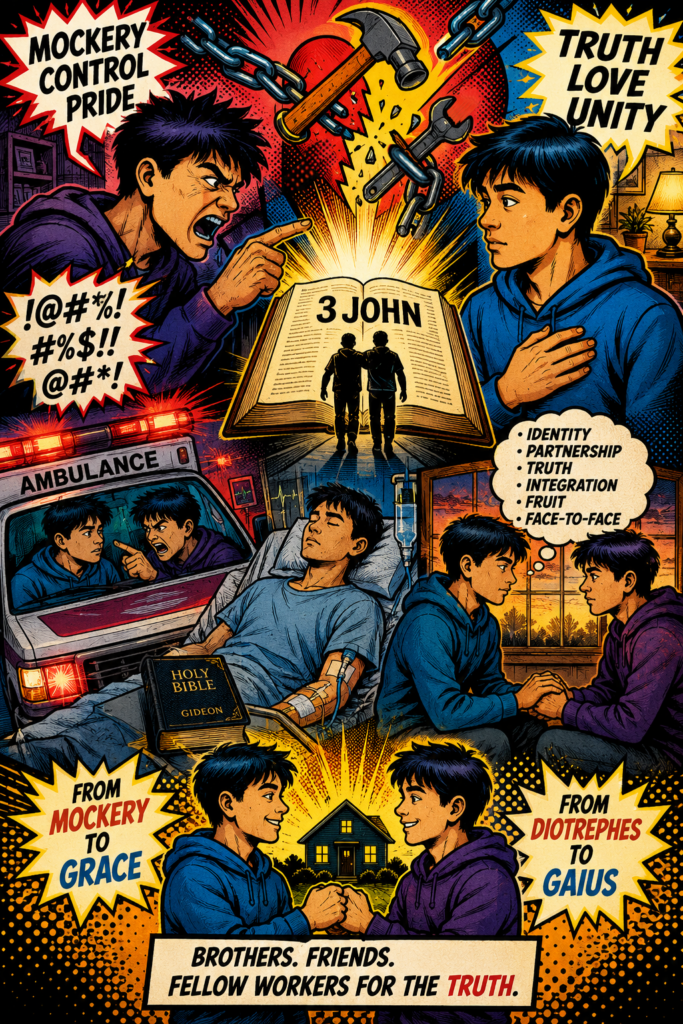
Ambulance to Altar
Brokenness → Truth → Reconciliation
In a small, crowded home lived two brothers: Punpun, whose name meant “little-by-little” (a reflection of his stalling heart), and Iraira, whose name meant “irritation” (a reflection of his sharp tongue). They were tethered to one another by necessity, yet their home was a battlefield of mockery.
When Punpun failed to finish a task, Iraira would not offer a hand; he would offer a barb, mocking Punpun’s inability to focus. When Iraira grew overwhelmed by his own stress, Punpun would not offer empathy; he would mimic Iraira’s frustration, turning his brother’s pain into a performance. They were living the dipsychos—the “two-souled” life—where their private habits of cynicism fractured the very peace they claimed to want. Punpun specifically began not to feel well. His mind was so distracted and fragmented that skipping meals became too regular of a thing. He ended up in the hospital, Iraira sitting in the ambulance by his side to be brought there. Iraria spouting condemnation after condemnation to him in the ambulance because overflowing with so much concern that Punpun might die.
Iraira in his heart of hearts refuses for that to happen, but still does not know how to speak in away where that was a clear presentation since he was trapped into having his potty mouth through his habitual Tourette’s coprolalia. The term stems from the Greek words kopros (dung) and lalein (to babble/talk). Yes, the literal medical scientific term for a “potty mouth”. A problem a huge population in America and broadcasted with movie stars having when we habitual train and allow our body to use our mouths to say things (typically negatives, complaints, and cusses) without actual meaning the word’s stated fully, simply as if constantly releasing them like a vent off gassing stress through our words to release the pressures of life.
After this evening, they sat in the silence of their own friction, surrounded by the debris of their broken routine. Punpun looked at his body—exhausted, ill-fed, and neglected—and realized he had been acting as if his physical health had no bearing on his soul. He had been living in a type of “Gnostic Split,” pretending his spiritual life was fine while his daily habits were chaotic. There, in the hospital since it was old, sat one of the original Gideon Missions placed Bibles. “I remember these”, Iraira stated. “They use to be in every hotel and hospital drawer. The Bible opened. The index found and 3 John— it was chosen, then read out loud since so small. Just something to pass the time and try and relieve stress. They were not thinking it would be anything life impacting.
As soon as the book thudded closed- “I am tired of being an actor,” Punpun whispered in his weak voice, I.V. dripping into him through his pierced arm. He was recalling the wisdom of the Elder who wrote to Gaius. “I have been seeking validation from your mockery rather than security in my identity as a child of God”. Seeking validation through mockery often stems from a desire to control or diminish others to mask one’s own insecurities. This dynamic traps both parties in an unhealthy cycle.
Iraira, usually quick to sneer, fell silent. How could he not hold back his tongue, at least finally attempt to. He realized he had been playing the role of Diotrephes in their small home, craving “preeminence” by making Punpun feel small so that he could feel tall. He had been using his words as weapons, engaging in the same ad hominem attacks that the Elder condemned.
“We are like two ships trying to sail in opposite directions,” Iraira admitted. “I have been trying to control you because I am afraid I am losing control of my own life”.
Transformation began not with a grand gesture, but with the “Face-to-Face” protocol of 3rd John taught. That night, for the first time, they did not hide behind cold text messages or sharp remarks from across the room. They sat down, looked each other in the eye, and spoke peace. And true Biblical peace is about making your weapons into tools to rebuild each other’s broken homes, not simply being quite and pretending things are fixed that are still broken.
They began to apply the 3rd John diagnostic to their own home:
- The Integration Check: They stopped measuring success by who was “winning” the argument and started measuring it by their “walk in truth”—asking if their private brotherly love matched their public profession.
- The Partnership Shift: They moved from competition to synergoi—fellow workers. They began to support each other’s growth, realizing that true joy in mentorship (and brotherhood) is found in the success of the other, not the downfall of the rival.
- The Fruit Audit: They stopped pointing at each other’s failures and started examining their own fruit. They asked: Are my actions marked by malice, or by the love of the Name?.
They learned that transformation is possible when you stop being a “gatekeeper” of your brother’s faults and start becoming a “fellow worker” for his soul. They realized that their home was no longer a place for mocking, but a training ground for the Truth—a place where, by the grace of God, they could finally call each other “friend” by name.
In a cramped little home lived a brotherly pair,
With Punpun and Iraira, and burdens to bear. The air in their dwelling was heavy with spite, For they mocked one another from morning to night.
With tongues sharp as daggers, they fueled their own pain, In a cycle of pride that brought only strain. Like Diotrephes, seeking to be the most high, They built up their egos on a foundation of lie.
But truth is a lantern that pierces the dark, And soon in their hearts came a flickering spark. Punpun looked down at his body, so worn, And saw how his spirit was tattered and torn.
“My health and my soul are not two things apart,” He whispered with trembling and softening heart. “I’ve lived like a stranger, though living right here, While hiding from grace out of ego and fear”.
Then Iraira stood, with a tear in his eye, “I’ve treated our home like a place to defy. I sought for the preeminence, craving the crown, While doing my best to just tear you all down”.
They sat face to face, as the Elder had taught, And traded the battles for the peace that they sought. They looked in their eyes, leaving letters behind, To be truly “fellow workers,” united and kind.
No longer competing for status or place, They walked in the Truth with a newfound embrace. Their fruit started changing, as malice grew small, And they learned that to serve is to conquer it all.
The mockery faded, replaced by a name, Spoken gently and kindly, for the sake of the Name. For when brothers stop posturing, seeking the lead, They plant in their home a true spiritual seed.
The story demonstrates that transformation is not just possible; it is the natural byproduct of walking in the Truth. When we move from the “double-minded” instability of our ego to the “single-minded” devotion of Christ, we stop using our words to vent stress and start using them to impart grace.
Follow-up Question:
- Reflecting on the story of Punpun and Iraira, can you identify a specific “Diotrephes” behavior (such as controlling or mocking) that you currently lean on as a defense mechanism, and what “face-to-face” step could you take to replace it with a collaborative, “Gaius-style” partnership?
- Having seen how Punpun and Iraira moved from a cycle of “Diotrephes-style” control to “Gaius-style” partnership, does this give you some hope in you current situations or a note in which you can pass on to others in a similar situation?
- Given the journey of Punpun and Iraira from mockery to “face-to-face” reconciliation, what is one specific action you can take this week to turn a “mocking” or “competitive” relationship into one of true collaborative partnership?
| Aspect | The “Mocking” Phase (Diotrephes-Style) | The “Reconciled” Phase (Gaius-Style) |
| Communication | “Coprolalia” used to off-gas stress. | Speaking peace face-to-face. |
| Motivation | Controlling others to mask insecurity. | Serving the brother for the sake of the Name. |
| Integration | Neglecting the body; split reality. | Honoring the body as the partner of the soul. |
| Relationship | Competition; tearing the other down. | Partnership; mutual encouragement. |
Objective: To move from “double-minded” instability to “holistic integration,” ensuring your life reflects your faith in both private character and public action.
Into 3rd John itself to look at what they read… Sorted via original language Koine Greek sentence structure with overall context Acts displayed.
A Healthy Soul Produces a Healthy Life (vv. 1-4)
Questions:
- How is your soul?
- What is your definition of success?
- Are you walking in truth?
Counseling focus: Identity and integrity.
1. The Foundation: Identity and Authority (3 John 1:1)
- Greek Key Word: Presbyteros (Elder).
- Counseling Logic: Authority is not about raw power; it is about identity. John grounds his authority in being an “elder”—a shepherd.
- You are currently building your “title” (career, roles). Ensure your identity is anchored in your relationship with Christ, not your output.
- Discussion: How do you define yourself when you aren’t performing for others?
2. The Holistic Standard: 3 John 1:2
- Greek Key Word: euodoomai (to prosper/go well) and hygiaino (to be in health).
- Logic (The Comparative Argument): The text posits a parallel: Physical Health = Soul Health. (Elijah Method 1 Kings 19:4-8, take care of body problems first to be able to deal with heavy counseling issues.)
- The Diagnostic: If you neglect your physical health (sleep, nutrition, boundaries with stewardship), you are actively creating a “Gnostic Split,” pretending your soul can thrive while your body is abused. While many are not in true full Gnosticism which is “spirit good, body evil”, many believers practically act as if their bodies do not matter.
- Action: “hustle culture” is the enemy of sustainability. You are designed as an integrated being; your calendar should reflect your values.
- John is not promising physical health from spiritual health. Rather, he uses Gaius’ spiritual condition as the benchmark by which he wishes every other area of life would flourish.
Diagnostic Tool: Are You “Double-Minded”?
Building the “Single-Minded” Life
If the “double-souled” (dipsychos) state leads to instability in all ways, then the goal of your counseling sessions should be to help the counselee achieve integration. This is the process of aligning your inner convictions with your outer actions.
To apply these lessons, we must confront the dipsychos (two-souled) nature described in James 1:8.
| Symptom | The “Double-Souled” Reality | The Integrated Reality (3 John 2) |
| Identity | Seeking validation from people/metrics. | Finding security in identity as a child of God. |
| Schedule | Perpetual state of “emergency” (functional atheism). | Guarding rest as a sign of trust in God’s sovereignty. |
| Integrity | A gap between private habits and public speech. | A seamless life where private habits mirror the Gospel. |
To continue our development in counseling, we must focus on the practical transition from diagnosing the “double-minded” state to actively building a life that mirrors the health described in 3 John 1:2.
Right now is prime season to establish these habits before professional and personal responsibilities become overwhelming.
3. The Success Metric: Walking in Truth (3 John 1:3)
- Greek Key Word: peripateo (to walk).
- Counseling Logic: Truth is not a static object to be studied; it is a pace of life to be walked.
- Application: Metrics of success for a young adult should not be “likes” or “promotions,” but rather the consistency of your daily walk. Do your private choices match your public profession?
4. (3 John 1:4): The Ultimate Goal of Mentorship
3 John 1:4 (NKJV): “I have no greater joy than to hear that my children walk in truth.”
Biblical Counseling: The Joy of Behavioral Transformation
- The Concept: John expresses that his satisfaction is not derived from his own status, but from the spiritual progress of those he mentors.
- The Application: Counselors must help their counselees shift the focus of their lives away from personal achievement. True counseling joy is found when a counselee moves from merely knowing the truth to implementing it in their daily behavioral patterns.
- The Diagnostic: If you find that your primary source of “joy” is based on your own success or platform, you are at risk of self-centered leadership. Genuine pastoral care finds its reward in the growth of the student.
Logic: Defining Success Metrics
- The Premise: John establishes a clear standard of measurement for successful mentorship: “walking in the truth”.
- The Argument: The logic here is hierarchical; if the ultimate joy for a leader is the obedience of the disciple, then every other metric (size of the church, fame, or personal wealth) is secondary.
- The Logical Conclusion: By defining success through the lens of the disciple’s independence and obedience, John effectively removes the temptation for the leader to manipulate their followers for personal gain.
Leadership & Discipleship: The Focus on Legacy
- The Legacy Principle: Spiritual fathers and mothers do not aim to create permanent followers; they aim to create mature, independent believers who possess their own “walk in truth”.
- Combating Burnout: When you stop measuring your impact by the number of people you manage and start measuring it by the quality of their walk with Christ, you relieve yourself of the pressure to maintain control.
- Practical Stewardship:
- The Mentorship Audit: Ask yourself: “Am I training others to rely on me, or am I training them to walk in the Truth?”.
- Celebrate Consistency: Make it a priority to affirm positive behavioral changes in your mentees; this reinforces their path and builds confidence in the Truth.
Diagnostic Summary: The Joy Audit
| Focus Area | The “Self-Centered” Leader | The “True Mentor” (3 John 4) |
| Measurement | Size, attendance, and personal recognition. | The obedience and maturity of the disciples. |
| Goal | Creating loyal followers. | Creating independent walkers in the Truth. |
| Primary Joy | Personal accolades/titles. | Seeing others live out the Truth. |
In this stage of your life, you are likely looking for role models. Be intentional about imitating those who find their joy in your growth, rather than those who find their joy in your productivity. Furthermore, as you begin to lead others, remember that the greatest success you can achieve is watching your peers and mentees walk faithfully in the Truth.
Follow-up Question: Given that 3 John 1:4 defines success as watching others “walk in truth,” how can you reframe your current goals at work or school to focus more on the growth and success of the people around you?
Truth Becomes Visible Through Hospitality (vv. 5-8)
Questions:
- Who are you helping?
- Who are you supporting?
- Are you a fellow worker for the truth?
Counseling focus: Service and partnership.
5. Verses 5–7: The Logic of Faithful Partnership
3 John 1:5–7 (NKJV): “Beloved, you do faithfully whatever you do for the brethren and for strangers, who have borne witness of your love before the church. If you send them forward on their journey in a manner worthy of God, you will do well, because they went forth for His name’s sake, taking nothing from the Gentiles.”
Biblical Counseling: The Integrity of Faithful Action
- The Concept: The Greek word for “faithfully” here is pistos, which implies reliability and steadfastness. True counseling identifies that genuine love is not just a feeling, but a consistent, observable action taken on behalf of others.
- The Application: Counselors should challenge the counselee to assess whether their service is directed toward specific people (“brethren and strangers”) rather than anonymous projects. Love must be active and measurable in how we treat the people God brings into our path.
Logic: Argument from the Lesser to the Greater
- The Premise: If you are faithful in the small, day-to-day acts of helping brothers and sisters, you build the character necessary for higher-stakes service.
- The Argument: The logic follows a “greater” trajectory: If we support those who are traveling for the sake of the Gospel, we are aligning our resources with God’s global mission. Therefore, supporting fellow workers is not optional—it is a logical, moral obligation for those who claim to walk in truth.
- The Fallacy: Beware of the “Self-Absorption Fallacy”—believing that one can participate in a global movement while refusing to exercise hospitality or generosity toward the actual human beings in one’s immediate circle.
Leadership & Discipleship: The Strategy of “The Name”
In 3 John 1:7 Greek Key Word: Hyper tou Onomatos (For the sake of the Name).
Counseling Logic: Motivation determines sustainability. If a young adult is motivated by personal recognition, they will burn out when that recognition inevitably fades.
The Shift: We must help counselees shift their “Why.” If they act for the sake of “the Name” (Christ), their work becomes a byproduct of devotion rather than a desperate attempt at self-validation.
• • Application: Ask the counselee: “If no one ever knew you did this task, would you still do it with the same excellence?”
- Motivation as Sustainability: motivation is the primary factor in long-term endurance. If a young adult is motivated by personal recognition or applause, they will face burnout as soon as that recognition fades.
- The “Why” Shift: We must help counselees transition their primary driver from self-validation to Hyper tou Onomatos (“For the sake of the Name”). Work performed for Christ is a byproduct of deep devotion, making it immune to the exhaustion caused by seeking human approval.
- Practical Stewardship:
- The “Excellence” Test: Ask the counselee: “If no one ever knew you did this task, would you still do it with the same excellence?”.
- Culture of Generosity: Leaders should cultivate a culture where the local church views itself as a support system for frontline workers, teaching that their behind-the-scenes support makes them “fellow workers for the truth”.
Diagnostic Summary: The Partnership Audit
| Evaluation Focus | The Question | The Goal |
| Consistency | Are you faithful in small, tangible acts of service? | Developing a lifestyle of pistos (reliability). |
| Motivation | Is your work for “The Name” or for personal branding? | Achieving sustainable, devotion-based service. |
| Partnership | Are you actively sending/supporting others? | Shifting from lone-wolf to a collaborative mission. |
True leadership in your 20s is defined by your willingness to support the work of others for the sake of His Name. When you stop trying to be the “star” of your own story and start becoming a “fellow worker” in God’s story, you find a level of purpose that never burns out.
Follow-up Question: When you reflect on your current work or volunteer commitments, can you identify one task where you have been seeking “personal recognition,” and how would that task change if you purely reframed it as being done “for the sake of the Name”?
6. The Logic of Reciprocity (3 John 1:8)
- Greek Key Word: Synergoi (Fellow-workers).
- Counseling Logic: You cannot “walk in the truth” in isolation. The law of reciprocity dictates that we are morally obligated to support those who are effectively laboring in the mission.
- Leadership/Discipleship: Teach the counselee that their professional network should be a “fellowship of workers.” Success is not being the “lone hero”; it is being a collaborative partner who supports and funds the work of others.
Pride Destroys Communities (vv. 9-10)
Questions:
- Do you need recognition?
- Do you control people?
- Do you resist accountability?
Counseling focus:
Diotrephes syndrome.
7. Avoiding the “Diotrephes” Trap (3 John 1:9)
- Greek Key Word: philoprōteuōn (loving to be first/preeminence).
- Logic (Fallacy Exposure): Diotrephes uses ad hominem attacks (malicious words) to protect his ego.
- Counseling Wisdom: Pride creates a gatekeeping mentality. If you find yourself needing to tear others down to validate your own position, you are suffering from a “preeminence” disorder.
- Correction: True leadership makes room for others; toxic leadership requires others to be smaller so they can remain the biggest.
8. (3 John 1:10) Verse 10: The Exposure of Toxic Authority
3 John 1:10 (NKJV): “Therefore, if I come, I will call to mind his deeds which he does, prating against us with malicious words. And not content with that, he himself does not receive the brethren, and forbids those who wish to, putting them out of the church.”
Biblical Counseling: Identifying Malignant Pride
- The Concept: Diotrephes acts out of philoprōteuōn (the love of being first), which the counselor must diagnose as a spiritual pathology rather than a simple personality clash.
- The Application: Counselors must help individuals recognize that “malicious words” and “gatekeeping” are not just bad habits—they are clear indicators of a heart that has replaced God’s kingdom with its own ego.
- The Confrontation: Biblically, toxic authority is not to be passively endured; it must be “called to mind” (exposed) so that the underlying pride can be addressed.
Logic: Fallacy Exposure
- The Premise: Diotrephes attempts to maintain control through the “ad hominem” fallacy—attacking the character of the messengers rather than engaging with the message itself.
- The Argument: The author uses a logical progression to demonstrate Diotrephes’ error:
- Slander: He uses malicious words to discredit leadership.
- Exclusion: He refuses to receive the brethren (denying hospitality).
- Coercion: He bans others from helping, effectively weaponizing his position to force his own will on the community.
- The Logical Conclusion: Any leadership that requires the silencing of others to maintain its status is, by definition, anti-biblical.
Leadership & Discipleship: Confronting Abuse
- The Duty to Reprove: Leaders have a moral obligation to confront abusive behavior, public slander, and exclusive, gatekeeping mentalities.
- Defining Healthy Power: In contrast to Diotrephes, true discipleship seeks to empower others rather than limit their influence.
- Practical Stewardship:
- Identify the Root: If a leader in your life creates an “us vs. them” environment, they are likely following the Diotrephes model.
- Choose Courage: Confronting such behavior—even when it is difficult—is necessary to protect the health of the community and the integrity of the mission.
Diagnostic Summary: The “Diotrephes” Checklist
When evaluating environments or leaders, look for these markers of toxic power:
| Symptom | The Toxic Action | The Corrective Principle |
| Speech | Malicious words/Slander. | Speaking truth in love. |
| Exclusivity | Forbidding others from helping. | Welcoming all “fellow workers”. |
| Control | “Putting out of the church”. | Serving the body of Christ. |
Do not fear standing up to “Diotrephes” figures. True spiritual maturity involves the courage to identify toxic power structures and the humility to walk away from them to pursue a mission that is actually “of God”.
Follow-up Question: Given that 3 John 1:10 identifies specific behaviors like malicious speech and exclusion as marks of toxic authority, how can you practice “courageous confrontation” in your professional or church environment without becoming divisive yourself?
Character Is Revealed by Imitation (vv. 11-12)
Questions:
- Who are you becoming?
- Who are you copying?
- What fruit is visible?
Counseling focus:
Models and mentors.
9. The Logic of Imitation (3 John 1:11a)
- Greek Key Word: mimou (imitate/mimic).
- Logic (Disjunctive Syllogism): You will either imitate the good or the evil. There is no neutral state.
- Application: Identify your “blueprints.” Who are you copying? If you don’t intentionally choose godly mentors, you will subconsciously mirror the toxic patterns of our culture.
Your fruit shows your relationship with God. (3 John 1:11b)
Visual Warning: Diotrephes illustrates what it looks like to “imitate what is evil” (3 John 1:11).
Verse 11b: The Logic of Manifestation
10. 3 John 1:11b (NKJV): “He who does good is of God, but he who does evil has not seen God.”
Biblical Counseling: The Visibility of the Heart
This verse is about where you have God positioned in your life at the moment. Any are living without God and this is one test to show this. It is not about salvation.
- The Concept: In counseling, we often focus on intent (what a person says they believe), but Scripture focuses on manifestation (what a person actually does).
- The Application: You cannot claim a private, intimate relationship with God (“seen God”) while your life consistently produces fruit that contradicts His nature.
- The Correction: Counselors should help individuals realize that behavior is a diagnostic tool; if a counselee’s “fruit” is consistently marked by malice or pride, it suggests a disconnection from the Source.
Logic: The Disjunctive Syllogism
- The Premise: This verse functions as a disjunctive syllogism (an “either/or” logical structure): Either one is of God (producing good) or one is not of God (producing evil).
- The Argument: The logic here is observational: Doing acts as the proof of Being. It rejects the possibility of a “hidden” spiritual connection that remains entirely undetectable in one’s conduct.
- The Fallacy: We must guard against the “subjective experience fallacy,” where a person believes they are “of God” simply because they feel religious, even while their actions demonstrate otherwise.
Leadership & Discipleship: Identifying True Models
- The Imitation Principle: Because behavior reveals the source, leaders must be extremely careful about whom they choose to “imitate” (mimou).
- Diagnostic Leadership: Leaders are responsible for evaluating the “fruit” of those they bring into positions of influence. If a potential leader’s actions are consistently “evil”—characterized by the gatekeeping or slander seen in the Diotrephes model—they have not “seen God” in a way that qualifies them for leadership, regardless of their charisma.
- Practical Transformation: The goal of discipleship is to help the 20-29-year-old move from “abstract belief” to “concrete goodness,” ensuring their daily choices act as an undeniable testimony of their connection to the Father.
Diagnostic Summary: The Fruit Audit
To apply this logic, use this simple evaluation in your mentoring:
| Logical Input | The Behavior (The Fruit) | The Diagnostic Conclusion |
| “I am of God” | Consistent acts of love, truth, and service. | The life confirms the claim. |
| “I am of God” | Persistent malice, pride, or exclusivity. | The claim is invalidated by the lack of fruit. |
In a world that prizes “personal truth” and emotional experience, 3 John 1:11b anchors you in an objective reality: God is known by what is produced through your hands. Your life is the primary evidence for the existence of your faith.
Follow-up Question: When you evaluate the “fruit” of the influencers or leaders you follow in your own life, what specific behavioral markers (good or evil) do you find most helpful in determining if they are truly walking “of God”?
Visual Security: Demetrius illustrates what it looks like to imitate what is “good” (3 John 1:11).
11. Cultivating a “Good Name” (3 John 1:12)
- Greek Key Word: Martyreo (To bear witness/to testify).
- Counseling Logic: In an age of social media curation, reputation is often confused with reality. John provides the “Triangulation of Truth” to verify character:
- Testimony from everyone.
- Testimony from the Truth itself.
- Testimony from trusted elders.
- True character is not what you project on a screen; it is what the people who see you every day report about your life.
In biblical counseling, establishing what is genuinely true is paramount, particularly when navigating conflicts involving abusive, manipulative, or disruptive authority figures. The Apostle John provides a profound framework for this in his commendation of Demetrius in 3 John 1:12: “Demetrius has a good testimony from all, and from the truth itself. And we also bear witness, and you know that our testimony is true” (NKJV).
In this single verse, John deliberately utilizes two distinct Greek words for truth—aletheias (Koine Greek Truth) and alethes (True)—to demonstrate that truth is not merely a passive concept, but an active, disruptive power. It is a power that exposes falsehood and frequently makes those in illegitimate or arrogant authority (such as Diotrephes, mentioned earlier in the epistle) quake. John logically constructs this argument by pairing divine reality with human reliability.
The Objective Witness: Aletheias (Truth as a Divine Standard)
First, John uses the noun aletheias (“truth”), personifying objective divine reality as an active, independent witness. He notes that Demetrius is commended by “the truth itself” (autēs tēs alētheias). This achieves three critical things:
Divine Alignment: The truth acts as an autonomous character witness. The standard of the Gospel itself testifies on Demetrius’s behalf.
Lived Reality: It signifies that Demetrius’s daily life and moral conduct are not hidden; they visibly and consistently embody the Gospel.
Cosmic Validation: This moves the endorsement far beyond subjective human flattery or organizational politics. Even God’s ultimate standard approves of him, effectively pulling rank on any earthly authority that might try to discredit him.
The Verifiable Testimony: Alethes (True as Fact-Based Reality)
Second, John shifts to the adjective alethes (“true”), which guarantees the personal reliability of John’s human testimony. By stating, “our testimony is true,” John brings the divine standard down to observable reality.
Verifiable Fact: John’s own testimony matching actual, observable reality (ē marturia hēmon alēthes estin).
Apostolic Integrity: It assures Gaius (the recipient of the letter) that the writer’s personal backing is completely trustworthy and dependable.
Shared Consensus: It connects John’s honest word with the known integrity of the broader local church community.
The Impact: A Two-Tiered Defense
The logical progression of John’s argument elevates Demetrius’s character endorsement from mere human opinion to a standard backed by both God and the apostle. In the context of counseling and church discipline, this creates a Two-Tiered Proof.
When a believer faces the disruptive, heavy-handed actions of a leader like Diotrephes, this dual witness provides an impenetrable defense. The marriage of aletheias (God’s objective reality) and alethes (verifiable human integrity) grants the reader Absolute Certainty. It assures Gaius—and the modern counselor—that standing with a person of Demetrius’s character is entirely safe and righteous, firmly anchored in a power that no corrupt authority can overturn.
Application for the Christian Life and Spiritual Growth
Applying John’s use of aletheias and alethes from 3 John 1:12 provides a vital roadmap for believers seeking spiritual maturity and resilience, especially when facing opposition or corruption within spiritual communities.
1. Cultivate a Life Backed by “The Truth Itself” (Aletheias)
Spiritual growth requires moving beyond mere profession of faith to a lifestyle where objective divine reality actively testifies on our behalf.
The Principle: Just as aletheias acted as an independent witness for Demetrius, mature Christians must let their daily conduct align so closely with the Gospel that their lifestyle speaks louder than the accusations of critics.
Application: When navigating trials, slander, or manipulative environments, resist the urge to engage in petty retaliation. Instead, anchor your integrity in Christ so that the truth of God’s Word becomes your primary defender.
2. Pursue Verifiable Integrity (Alethes)
While God’s truth is absolute, Christian witness in the world must also be practical, honest, and verifiable.
The Principle: The adjective alethes ensures that human testimony matches factual reality. True spiritual growth produces a life of transparency where our words, commitments, and actions line up.
Application: The example shows for us to build a reputation for unflinching honesty in your relationships, workplace, and church. When your personal testimony is consistently alethes (true and dependable), it protects you and others from the deception of abusive or controlling authorities.
But also know for our daily combat of life’s battles we must ground our words and actions in truth itself without compromise. Compromise is to have one foot step out of truth into a lie. Therefore at that moment we are making our authority become a falsification. Fraudulent. It is not always an easy thing because people tend to “Robin Hood” it doing a little evil claimed “white lie” here, doing the opposite of truth there claimed “for the greater good”- which actually is the lie stated truly meaning “for easier path” no actual greater good since it now seeds evil into any good present. This makes you completely into an undependable individual in which we can never trust since you Isaiah 24:20 stagger, James 1:6–8 are driven and tossed into this by circumstances, Ephesians 4:14 blown away because have become susceptible for doctrines of falsehood losing all rights to even present a case in a courtroom since you would be found convicted of perjury (lying in court) of the court judgement for life.
3. Discern Between False Power and True Authority
John’s confrontation with Diotrephes—who loved to have preeminence—contrasted sharply with the quiet, proven character of Demetrius.
The Principle: Worldly and abusive spiritual leaders often rely on intimidation, titles, and emotional manipulation to maintain control. These leaders inevitably “quake” when confronted with the quiet power of God’s truth.
Application: As you grow in Christ, learn to anchor your decisions not in who shouts the loudest or holds the most institutional power, but in what is verified by Scripture (aletheias) and confirmed by godly consensus (alethes). Stand firmly with those of proven character, even when it costs you social comfort or ecclesiastical favor.
Presence Matters (vv. 13-15)
Questions:
- Are your relationships real?
- Are they personal?
- Do you know people by name?
Counseling focus: Relational discipleship.
Verses 13–14: The Priority of Face-to-Face Communication
12. 3 John 1:13–14 (NKJV): “I had many things to write, but I do not wish to write to you with pen and ink; but I hope to see you shortly, and we shall speak face to face. Peace to you. Our friends greet you. Greet the friends by name.”
Biblical Counseling: The Theology of Presence
- The Concept: While the written word (the Epistle) is authoritative and vital, true soul-care is best executed in the context of physical presence.
- The Application: Counselors must recognize that “ink and pen” (digital or written communication) have inherent limitations in conveying empathy, nuance, and emotional support.
- The Goal: The aim of counseling is not just to provide information, but to facilitate “face to face” encounters where the Spirit can move through relational intimacy.
Logic: Recognizing Medium Limitations
- The Premise: The author notes that “pen and ink” are sufficient for basic data, but inadequate for the complexity of deep relationship management.
- The Argument: If one relies solely on non-physical, text-based communication, they are missing the most critical diagnostic data of human interaction: tone, body language, and shared experience.
- The Logical Conclusion: By refusing to hide behind the “letter,” the leader demonstrates humility and a commitment to genuine, high-stakes discipleship rather than “safe,” distant management.
Leadership & Discipleship: Investing in Presence
- The “Face-to-Face” Mandate: In an era where 20-to-29-year-olds are often tethered to digital platforms, leaders must prioritize physical proximity.
- Combating Burnout: Great leaders understand that writing policies or sending messages cannot replace the restorative power of looking a disciple in the eye and speaking peace.
- The Stewardship of Time: Investing in “face-to-face” time is not a waste of productivity; it is the most efficient way to achieve deep, lasting transformation in a mentee’s life.
Diagnostic Summary: The Medium is the Message
To integrate these verses into your life, evaluate how you are currently communicating your values:
| Communication Channel | Strengths | Limitations |
| Written (Digital/Text) | Efficiency, data, speed. | Lacks nuance, prone to coldness, insufficient for healing. |
| Face-to-Face | Emotional resonance, trust-building, intimacy. | High time cost, requires vulnerability. |
Do not let your life become a series of “ink and pen” interactions. True leadership is not found in how many messages you send, but in the quality of the presence you offer those God has put in your life. Peace is not just something we type; it is something we impart through our presence.
Implementation Plan: The “Face-to-Face” Check-in
To move these concepts from theory to reality, implement a “Face-to-Face Accountability” protocol in your counseling sessions. Based on 3 John 1:13-14, physical presence is the ultimate medium for complex relationship management.
Follow-up Question: Given that 3 John 1:13–14 prioritizes “face-to-face” interaction over remote communication, how can you adjust your weekly schedule to ensure that your most important relationships are receiving your physical presence rather than just your digital attention?
13. Verse 15: The Benediction of Relational Peace
3 John 1:15 (NKJV): “Peace to you. Our friends greet you. Greet the friends by name.”
Biblical Counseling: The Theology of Shalom
- The Concept: Peace (eirene in Greek) is not merely the absence of conflict; it is the presence of wholeness and well-being in the context of community.
- The Application: Counselors should teach that spiritual health is always experienced relationally. We cannot possess true peace if we are relationally isolated or living in a state of ego-driven conflict like Diotrephes.
- The Practice: Help counselees move from abstract, “global” concerns to specific, localized care—learning to “greet by name” those in their immediate circle.
Logic: The Law of Particularity
- The Premise: The verse moves from the general (“Peace to you”) to the specific (“Greet the friends by name”).
- The Argument: If your love for your community is genuine, it must be particular. Logic dictates that one cannot genuinely love a group they do not know individually; therefore, real discipleship requires the intentional effort of knowing people’s names and unique stories.
- The Fallacy: Beware of the “impersonal leader” fallacy—believing you can care for “the ministry” or “the community” while neglecting the individuals who comprise it.
Leadership & Discipleship: Creating a Culture of Greeting
- Model Genuine Care: Just as the author concludes by emphasizing the importance of friends greeting one another, leaders must model a culture of recognition.
- Countering Burnout: By focusing on the “friends,” the leader shifts the burden of leadership from a solo performance to a communal, mutual support system.
- Practical Stewardship:
- The “Name” Discipline: Leaders who make it a practice to know the names and specific struggles of their team members foster a culture of safety.
- Shared Responsibility: Realizing that “our friends” are all part of the mission encourages the counselee to stop trying to carry the mission alone.
Diagnostic Summary: The Conclusion of the Lesson
As you wrap up this study with your group, use this final reflection to solidify the transition from the “Diotrephes” mindset to the “Friend” mindset:
| The Shift | From: Diotrephes Model | To: The 3 John 1:15 Model |
| Communication | Closed, gatekeeping, and exclusionary. | Open, personal, and communal. |
| Identity | Seeking “preeminence” or status. | Seeking to be a “friend” among friends. |
| Action | Ignoring or banning others. | Actively greeting and acknowledging others. |
In a world of digital anonymity, the most counter-cultural thing you can do for your mental and spiritual health is to invest in “face-to-face” relationships where you are known by name. Peace is found when you stop performing for the crowd and start serving the “friends” God has placed in your direct line of sight.
Follow-up Question: Given that 3 John 1:15 emphasizes the importance of personal connection, what is one practical barrier in your current daily routine that prevents you from knowing your local community “by name” as deeply as you would like?
You may have noticed that this letter is saturated with the word truth.
Notice:
- walking in truth (v.3)
- children walking in truth (v.4)
- fellow workers for the truth (v.8)
- testimony from the truth itself (v.12)
Truth is not merely doctrine.
For John, truth becomes visible through:
- Hospitality
- Generosity
- Relationships
- Reputation
- Leadership
Truth is what doctrine looks like when it puts on work clothes. That theme runs through the entire book. Proverbs 23:23, Ephesians 6:14, John 14:6.
The 3-Step Protocol:
- The Weekly Integration Review: Spend 15 minutes reviewing the counselee’s previous week. Look for “gaps” where their schedule contradicted their stated values (e.g., claiming to value rest but working 70 hours).
- The “Diotrephes” Audit: Ask: “Where this week were you tempted to prioritize your own reputation (preeminence) over the needs of the team?”.
- The Commitment to Presence: Challenge the counselee to replace one digital interaction per week with a face-to-face, analog conversation. This builds the relational “muscle” needed for deep discipleship.
Reflection for the Counselee
“True spiritual fathers and mothers find their greatest success not in their own accomplishments, but in the independence and obedience of those they mentor”.
“Am I Becoming More Like Gaius or Diotrephes?”
| Question | Gaius | Diotrephes |
| How do I treat fellow believers? | Welcomes them | Rejects them |
| How do I use influence? | Serves others | Controls others |
| How do I handle recognition? | Doesn’t seek it | Craves it |
| How do I view ministry? | Partnership | Competition |
| What motivates me? | Truth | Preeminence |
Gaius: A Servant of the Truth” vs. “Diotrephes: A Lover of Preeminence.”
Is the contrast that is the heartbeat of 3 John
Closing Reflection
To combat the instability of the dipsychos life, prioritize Face-to-Face Connection (3 John 1:13–15). Digital communication is excellent for data, but it is insufficient for soul-care.
- Actionable Step: Who is one person you can commit to meeting with “face to face” this month for honest, non-performative accountability?
Follow-up Question:
- As you look at these principles, which specific area—the holistic health of 3 John 1:2, the collaborative partnership of 3 John 1:8, or the character verification of 3 John 1:12—do you think is most frequently overlooked by the young adults in your current sphere of influence?
- Given these principles, which of the two models—the hospitality of Gaius (supporting others) or the pride of Diotrephes (protecting one’s image)—do you see most often influencing the way young adults approach their professional networks today?