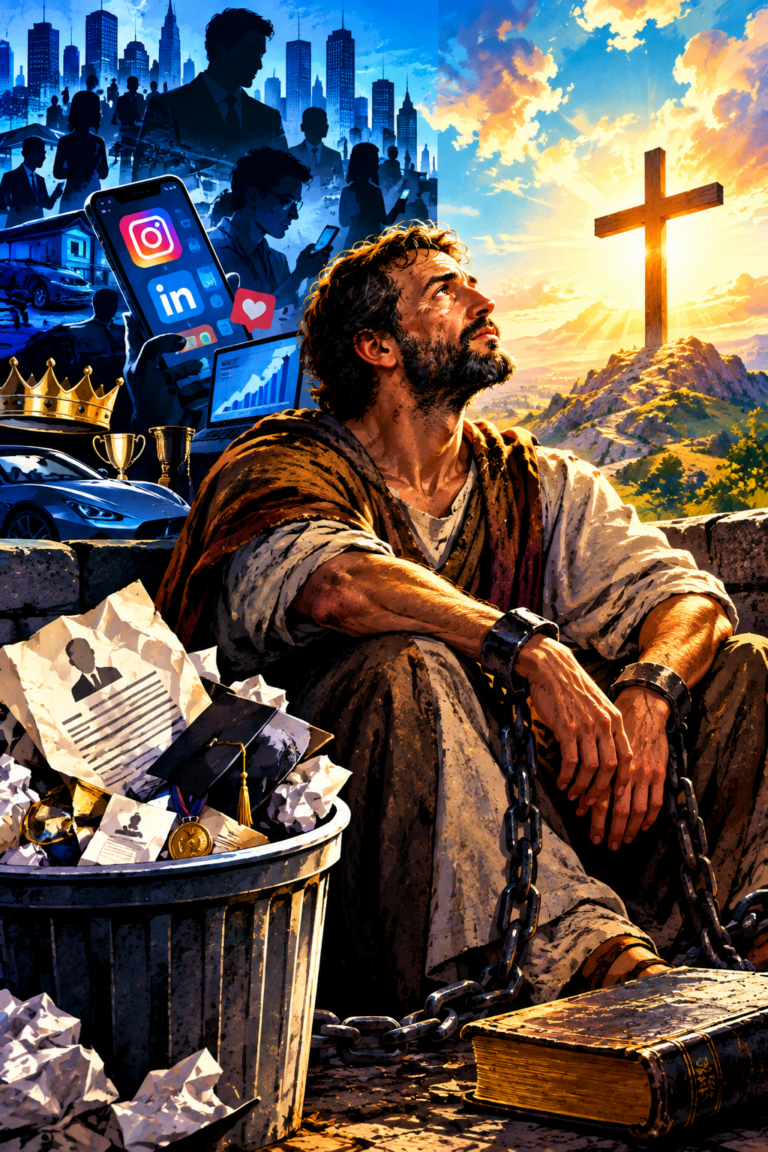


SHOW AND TELL: WHO GOD IS

Σὺ εἶ ὁ υἱός μου ὁ ἀγαπητός
“You are My beloved Son.”
Dr. Michael A. Scordato, Ph.D.
A COUNSELING DIALOGUE
Illustrative, not transcript. A chaplain sits with a ministry leader worn down by the conviction that approval is always one step further ahead.
DAN: I keep waiting to feel like God is pleased with me. Like once I hit some kind of milestone — grow the group, finish the training, stop messing up — then I will finally feel approved of.
CHAPLAIN: Can I show you something in the text? [reads Mark 1:9–11] Notice when the Father speaks.
DAN: Before Jesus has done anything.
CHAPLAIN: Before He’s preached a sermon. Before He’s healed anyone. Before He’s called a single disciple. The word behind “well pleased” is in a form a lot of Greek scholars read as a delight that was already settled — not a reward for what’s coming, but the ground Jesus was standing on before He took a single step of ministry.
DAN: So the approval came first.
CHAPLAIN: The approval came first. Then — only then — the ministry.
DAN: [pause] What if I’ve had that backwards my whole life.
CHAPLAIN: Then it’s worth asking, gently: whose voice have you been listening for instead of the Father’s — and are you willing to let Scripture, not your output, tell you what He’s already said?
A. Burnout & Hustle Culture
- The Symptoms: Chronic exhaustion, inability to Sabbath, boundarylessness, and constant guilt when resting.
- The Internal Logic: “If I stop moving, I am falling behind. If I am not producing, I am losing God’s favor.”
- The Counselor’s Response: Point them to the river. Remind them that Jesus was standing in water—doing literally nothing but receiving baptism—when the Father said, “I am well pleased.” Rest is not a forfeiture of favor; it is an act of trust that God’s love isn’t dependent on your activity.
B. Perfectionism & Doom-Loop Shame
- The Symptoms: Devastating emotional crashes after a mistake, moral failure, or minor flaw; spiral of self-hatred; hiding from community.
- The Internal Logic: “One slip-up ruins my entire standing with God. I have to rebuild my righteousness from scratch.”
- The Counselor’s Response: Show them that agapētos is a completed state of being loved. Your failure did not catch God off guard, nor did it rewrite the Father’s declaration over Christ. Your security is anchored in Jesus’s perfect standing, not your imperfect execution.
C. People-Pleasing & Imposter Syndrome
- The Symptoms: Anxiety around authority figures, hyper-vigilance about others’ opinions, constant fear of being “found out” as a fraud.
- The Internal Logic: “I need human applause to quiet the voice inside me that says I’m not doing enough.”
- The Counselor’s Response: Help them realize that seeking human approval is an attempt to substitute the voice of the Father with the voices of people. If the Creator of the universe has already declared His delight over you in Christ, any human praise is a downgrade.
D. Transactional Faith
- The Symptoms: Bitterness toward God when life goes wrong (“I read my Bible and served, so why did I get laid off / dumped?”).
- The Internal Logic: “Faith is a contract: I perform X, and God owes me Y.”
- The Counselor’s Response: Expose the barter system. God is a Father, not a vending machine. Jesus didn’t obey to get things from the Father; He obeyed because He loved the Father who had already named Him Son.
When a person sits across from you in a counseling setting, they rarely say, “I have an improper exegesis of Mark 1:11.” Instead, their broken framework manifests. Root cause for all of this above manifested? It is performance based worth.
THE WORLD’S MODEL: Work / Hustle ──> Build Personal Brand ──> Earn Temporary Approval
THE BIBLE’S MODEL: Received Love ──> Settled Identity ──> Fruitful Obedience
The Trap: We try to buy God’s delight (or the approval of parents, peers, and pastors) through spiritual hustling, hyper-volunteering, or obsessive moral perfectionism.
The Gospel Truth: Jesus’s public life begins with received identity, not earned status. You do not work toward the Father’s favor; you live from it.
Identity Precedes Output. To understand why you are drowning in burnout, anxiety, and imposter syndrome, we have to trace the biblical text down to its grammatical roots.
I. THE TEXT, TWICE
9 It came to pass in those days that Jesus came from Nazareth of Galilee, and was baptized by John in the Jordan.
10 And immediately, coming up from the water, He saw the heavens parting and the Spirit descending upon Him like a dove. 11 Then a voice came from heaven, “You are My beloved Son, in whom I am well pleased.”
Mark 1:9–11, NKJV
KJLV — an expanded literal rendering that surfaces the Greek’s grammar and the semantic range behind each name and verb
9 And altogether it transitioned into existence to take place in she all from there that in the days motion actively came He Jesus (who name means “I AM [God] Delivers And Rescues [saves]”) performing the action off of she Nazareth (name means “Branch”) she this of Galilee (name means “rolling ring”) to merge to submerge into an immersion near under he John (name meaning I Am [God] is gracious) up to he this motion toward the Jordan (meaning “to descend” — which is a river).
10 Bringing together in unity straightway went up from he of this water, saw in vision he all the wet rising elevation of sky right now being he all divided, together Himself the Manifestation of Breath (Spirit) as if she a dove going down now upon Him, 11 bound with she voice it transitioned into existence to take place out of the he the covering skies, “You, you are He the Son of mine who is in a completed state of being loved (he agape selfless love), in Whom is deemed good and acceptable.”
Mark 1:9–11, KJLV
Two translations of the same three verses, doing two different jobs. The NKJV gives a clean pane of glass — look through it and see the event: a baptism, a torn sky, a voice. The KJLV leaves the tool marks in the glass on purpose. It reads slower, stranger, occasionally awkward to an English ear — and the awkwardness is the point. Where the NKJV reports the scene, the KJLV shows the scene being built, word by word, name by name. Set them side by side and something is hard to miss: this text is not only telling you an event happened. It is telling you, in the grammar of how it happened, who was doing it.
That is the claim behind this essay. Not merely, “here is a moving story about a baptism,” but this: read closely enough, with both lenses open, and Mark 1:9–11 hands over the doctrine of God in miniature — who He is, argued from what He does, in two Koine Greek sentences in three English verses, before a single systematic category ever gets named.
II. THE NAMES ALREADY KNOW
Start where the KJLV pays attention and the NKJV does not: the names.
Jesus’s own name, the KJLV insists on unpacking every time it appears, means “I AM [God] Delivers And Rescues.” Nazareth means “Branch” — not a throwaway village name but the term the prophets had already claimed for the coming King (Isaiah 11:1; Jeremiah 23:5; Zechariah 3:8). John’s name means “I Am [God] is gracious.” The Jordan’s name means “to descend.” Even Galilee, “rolling ring,” or circuit, quietly says: this is not an isolated event; it is one turn in a repeating pattern.
Read the sentence again with that in view, and it nearly translates itself: the Deliverer, out of the Branch, in the circuit, descends near the gracious one, at the place named descend. Before Mark writes a clause of theology, the proper nouns are already doing it. This is not the KJLV inventing meaning that is not there — it is the KJLV refusing to let the reader flatten Hebrew names into mere labels, the way transliteration always tempts an English ear to do. An essay on who God is has to start here, because it is where the text itself starts: the doctrine is present in the vocabulary before it is present in a single verb.
III. ONE ACTION, THREE AGENTS
Now the verbs. Trace who does what, in order, and something logically precise emerges — not vague religious feeling, but a structure plain enough to state like an argument:
— The Father speaks. A voice, from heaven, in the second person — “You are My beloved Son” — direct address, not narration about someone absent.
— The Son receives. Grammatically, He is not the one baptizing; the verb is passive. He is acted upon, seen, and addressed — active in coming, passive in nearly everything that follows.
— The Spirit descends. Not the Father’s voice taking a different shape, not the Son doing something to Himself — a third, distinct movement, carrying its own verb and its own image, likened to a dove coming down.
Three grammatical subjects. Three distinct actions. One moment, one scene, with no narrative gap between them — Mark’s favorite word, εὐθύς, (euthús) means “straight, direct, or immediately” welds verse 9 to verse 10 so tightly that the rising from the water and the tearing of the sky happen, grammatically, in the same breath even though two sentences. And verse 10 “καί” a word as a type of “and together with” combining the two sentence thoughts into one subject of content.
Two easy mistakes are available here, and the text rules out both. The first is to read this as three gods cooperating — three wills that happen to agree. But nothing in the passage treats Father, Son, and Spirit as separate agents reaching consensus; the Spirit’s descent and the Father’s word both converge on the Son without any hint of negotiation between them. The second mistake is to read this as one God wearing three masks in sequence — first speaking as Father, then standing as Son, then descending as Spirit, one actor cycling through roles. The text will not allow that either: all three are present at once, not in turn. The Voice does not become the Dove. The Dove does not become the Son standing in the water. They are simultaneous, and they are distinct.
Rule out three gods. Rule out one God performing three parts. What is left is what the councils would later name Trinity — not a philosophical import laid onto the text by fourth-century argument, but a grammar the text is already performing three hundred years earlier. Mark did not need the word to write the thing.
IV. THE VOICE FROM HEAVEN
Look closer at what the Father actually says, because the tense shifts mid-sentence, and the shift is not accidental. “You are” — present tense: a standing identity, stated as though it has always been true. “In whom I am well pleased” — aorist: a settled pleasure, not a live reaction still in progress. Put plainly: the identity is timeless; the delight is already finished. Neither half of the sentence is waiting on what Jesus does next — and at this point in Mark’s narrative, He has not yet preached a sermon, healed anyone, or called a single disciple. There is nothing yet to react to.
The wording itself is borrowed, and borrowed from three places at once. “My beloved Son” is the Greek Old Testament’s own phrase for Isaac in Genesis 22 — “your son, your only son… whom you love.” “You are My Son” echoes Psalm 2’s coronation language for Israel’s king. “In whom I am well pleased” echoes Isaiah 42’s language for the chosen Servant. King. Servant. Beloved, nearly-sacrificed son. Three identities, spoken through three human authors across centuries with no coordination between them — and Mark’s Father-voice fuses all three into a single sentence at the Jordan.
That convergence is not decoration; it is an argument. A God who simply says whatever suits the moment does not produce this kind of fit. A God whose word through Moses, through David, and through Isaiah arrives, centuries later, at the same point without contradiction — that is a specific claim about His character, made by doing it rather than announcing it: this God is truthful, and He has been saying the same thing all along.
V. TORN, NOT OPENED
Mark’s verb for what happens to the sky is worth stopping on, because a gentler word was available and he did not use it. Matthew and Luke both write that the heavens were “opened” — a door-word. Mark reaches for a verb that means torn, split, rent by force. He uses this exact verb only one other time in his Gospel: at the cross, where “the veil of the temple was torn in two, from top to bottom” (15:38) at the moment Jesus dies.
That is not a coincidence a careful reader is meant to miss. The same violent verb brackets Christ’s whole earthly ministry — heaven torn open at the Jordan, the barrier between God and His people torn open again at Golgotha. Isaiah had prayed for this centuries earlier, in words the baptism seems to answer directly: “Oh, that You would rend the heavens and come down!” (Isaiah 64:1). Mark’s grammar says that prayer did not go unanswered. It was answered by force, at cost, from God’s own side of the barrier.
This matters for who God is because it settles a question a reader might otherwise leave open. Power alone would only need an open door — walking through is easy for someone with power. Tearing, not opening, says something more specific: God is not a distant sovereign occasionally granting access to petitioners who ask nicely. He is holy — set apart, other, behind a real barrier — and He is the one who removes the barrier Himself, by force, from His own side. Transcendence and nearness are not in tension here; the tearing is what holds them together. The same God who is too holy to be casually approached is the God who does the approaching.
VI. GRACE ARRIVES BEFORE THE RESUME
One more piece of the logic, and it may be the sharpest: the sequence itself. The Father’s pleasure is declared before Jesus preaches a sermon, heals a single person, or calls one disciple. The sinless Son enters a baptism built for sinners — John’s own baptism is “of change of mindset for the remission of sins” (…this immersion overwhelming of submerging for her the rethinking transformation to shift perspective of a change of mindset into she this leaving from bondage of she the sin of missing of the bullseye mark again and again Mark 1:4b, KJLV) — and Jesus, though perfect, does this baptism anyway.
Follow that where it logically has to go. If divine approval were something earned by output, it would, by definition, stop being grace — grace and earned approval are not two flavors of the same thing; they are opposites, and no text can coherently claim both at once. Mark’s sequencing forces the choice: either the Father’s pleasure here is a wage for services not yet rendered, which the timeline makes impossible, or it is something given before the ledger ever opens. The text allows only the second reading. That is not a devotional nicety laid on top of the passage. It is what the passage’s own timing requires, if the words mean what they say.
So the doctrine of God this scene yields is not only Trinity and truthfulness and a holiness that tears its own barrier down. It is this too: the Father’s favor toward the Son — and by every extension the rest of the New Testament makes from this Son to those united to Him — runs ahead of performance, not behind it. Grace, rightly defined, could not run any other way.
VII. WHO GOD IS, THEREFORE WHO WE ARE
None of this stays abstract for long, because a biblical counseling essay exists to ask what a doctrine does in a room with a real person in it. Here is what it does: an identity rooted in a performance-based approval system is not merely an unfortunate habit of thought. Read against Mark 1:9–11, it is a category error — a mistaking of what kind of God is actually speaking. A God who is essentially relational, three Persons and not a solitary force; essentially truthful, His word converging rather than contradicting; and essentially gracious, approval preceding achievement as a matter of structure and not exception — does not run the universe on a merit system His own Son was exempted from at the very moment that Son’s ministry began. If the Father’s own declared pattern refuses to make Jesus’s belovedness contingent on output, a counselee’s basic worth was never going to be the one exception to how this God operates.
Session II works through what this looks like across the counseling room itself — burnout, perfectionism, people-pleasing, performance-based faith. What this essay adds is the ground underneath that application: the counseling point is not simply a comforting reading of one passage. It is downstream of who God has always, demonstrably, been.
VIII. WHAT WAS SHOWN, NOW TOLD
Three verses. Two translations. One scene — and inside it: three Persons being and acting as one, without division and without confusion; a voice whose words reach back centuries and land without contradiction; a sky not opened politely but torn, by the Holy One’s own hand, from His own side; and a Son declared beloved before He has done a single thing to earn it. Mark did not sit his readers down to lecture them on theology proper. He showed them a baptism. The doctrine was already inside the showing. It only needed telling.
Yes this is big, theologians still figuring out best ways to explain it. But the reality is that this makes it a good thing. Because if it is a step outside of our complete understanding, how much bigger and beyond than any of my circumstances in life He therefore must be. And it is this God who promises He can handle it. This simply being one proof in signature.
🎯 Audience Reception & Pastoral Care
1. The High-Achieving Perfectionist
Their Initial Reaction: “Wait… I don’t have to earn God’s delight?”
The Underlying Mindset: Raised in a culture of resume-building, GPA maintenance, performance reviews, and social media metrics, they operate on a strict transactional logic: Worth = Performance. When they read Mark 1:11, their instinct is to look for the “catch.”
How to Guide Them
Use the grammar of the text to break their performance-based mindset. The Exegetical Pivot Points out that the main verb in Mark 1:11 is an aorist passive participle (εὐδόκησα, eudokēsa — “in whom I am well pleased”).
In Greek, this indicates a settled, completed reality. The Father’s delight was declared before Jesus preached a sermon, healed a leper, or died on the cross. His ministry started from a place of approval, not toward a goal of earning it.
Break the Transactional Logic. Explain that if God’s delight is something you earn, then God’s favor becomes a wage, not grace.
Challenge the Hustle. Ask them directly, “How much of your spiritual discipline is driven by a desire to love God, and how much is driven by an anxious fear that He’s disappointed in you?”
Give Permission to Sit Still: Help them realize that resting in God’s love isn’t laziness—it’s the foundation of true obedience.
PERFECTIONIST LOGIC: Perform well ──> Secure God’s delight ──> Fear of failure
GOSPEL LOGIC: Receive love ──> Rest in identity ──> Work from security
2. The Deconstructing / Skeptical
Their Initial Reaction: “Is Trinity language just a dry philosophical concept invented by early church councils?”
The Underlying Mindset: People are wary of abstract theology that feels disconnected from real life. If the Trinity is presented as an overly complex math equation ($1 + 1 + 1 = 1$), they will tune out or question its relevance.
How to Guide Them
Bring the doctrine of the Trinity out of the textbook and into the Jordan River. Show them that Mark 1:9–11 is not an abstract formula; it is a relational dynamic in action.
[ THE FATHER ] ── Speaks unconditional love / identity
│
▼
[ THE SON ] ── Receives love in human flesh / models obedience
│
▼
[ THE SPIRIT ] ── Descends to empower / anchor for the journey
Make it Relational & Practical. The Father speaks identity into the world (“You are My Son”). He provides the emotional anchor. The Son takes on real, fragile human flesh and steps into the muddy river to receive that identity. He shows us what a human living in full security looks like. The Spirit descends as a dove to fill, empower, and equip Him for the wilderness testing that follows.
The Logical Appeal Points out that God did not become a Father when He created the universe. God has always been Father, Son, and Spirit—which means at the very core of reality is relational love, not solitary control.
3. The Traumatized / Absent-Father Background
Their Initial Reaction: “If God is a Father, I don’t know if I can trust Him.”
The Underlying Mindset for those whose earthly father was absent, abusive, hyper-critical, or emotionally distant, hearing “You have a Heavenly Father who loves you” does not automatically bring comfort. Instead, it can trigger anxiety, grief, or anger, because their concept of “father” is broken.
How to Guide Them —
Go slow. Never force a counselee or student to swallow “Father language” before validating their human pain.
Pastoral Rule: Earthly fathers should be evaluated by the standard of God, not God evaluated by the standard of earthly fathers.
Acknowledge the Gap First: Validate their experience directly. “It makes complete sense why ‘Father’ feels like a risky word to you. Your experience taught you that fathers fail, leave, or hurt.”
Differentiate Earthly from Heavenly:
An earthly father’s love is often conditional, volatile, or absent.
The Father in Mark 1 breaks open the sky (σχιζομένους, schizomenous) to ensure His Son hears His voice before the work even begins.
Use the Son as the Bridge. If they cannot look at the Father yet, tell them to look at Jesus (The Son). Jesus shows us exactly what the Father is like. Let them build trust with Christ first, and let Christ introduce them to the Father at a pace they can handle.
IX. BACK UP & Let’s Look At This All Through A Different Lens
🚀 Leadership & Discipleship Dynamics
Teaching Script: Mark 1:9–12
1. In the Water, Not on the Sidelines (Incarnational Presence)
Let’s look closely at what is happening in Mark 1:9.
KJLV: “And altogether it transitioned into existence… Jesus came performing the action off of Nazareth… to merge to submerge into an immersion near under John up to the Jordan…”
NKJV: “It came to pass in those days that Jesus came from Nazareth of Galilee, and was baptized by John in the Jordan.”
Notice what the text does not say. It does not say Jesus stood on the dry, clean riverbank, megaphoning instructions to the crowd about how dirty their lives were. He didn’t set up a sign-up table or host a seminar on repentance.
The Son of God—sinless, completely untainted by human failure—walked down into the muddy, murky waters of the Jordan, right where every broken, messy person in Judaea was confessing their sins (Mark 1:5).
THE RELIGIOUS MODEL: Stand on dry ground ──> Point out dirt ──> Issue orders from a distance
THE INCARNATIONAL MODEL: Step into the water ──> Stand alongside ──> Lead from shared presence
The Logic for Leaders:
If you are mentoring, counseling, or leading anyone, the “expert on a pedestal” model is dead. Many have a high radar for hypocrisy and a low tolerance for distant advice. They don’t need another life coach talking down to them from dry ground; they need someone who is willing to get wet.
Leading from dry ground looks like: Dropping quick clichés, giving unsolicited advice, or acting like you have all your relational, financial, and mental health issues completely solved.
Leading from the water looks like: Vulnerability. It means saying, “I’ve wrestled with anxiety too—let’s talk through it.” It means showing up when someone’s life falls apart at 2 AM, sitting in their grief, and walking through the mud with them.
You cannot disciple someone at arm’s length. Incarnational leadership requires presence before platform.
2. Authority Received, Not Grabbed
Look at the grammar and sequence in Mark 1:10–11.
KJLV: “…bound with she voice it transitioned into existence to take place out of the covering skies, ‘You, you are He the Son of mine who is in a completed state of being loved…'”
NKJV: “And immediately, coming up out of the water, He saw the heavens parting and the Spirit descending upon Him like a dove. Then a voice came from heaven, ‘You are My beloved Son, in whom I am well pleased.’”
Notice who acts and who receives:
Jesus does not declare Himself the Messiah. The Father speaks the identity over Him.
Jesus does not manufacture spiritual power. The Spirit descends upon Him.
Jesus does not self-promote, demand a followers count, or negotiate for a platform.
In Greek, Jesus’s state of being loved is expressed in the passive voice (agapētos)—He is the recipient of the Father’s love and validation. His ministry authority flows out of an identity He received, not an authority He seized.
SELF-MADE AUTHORITY: Self-Promotion ──> Hustle for Platform ──> Insecure Leadership ──> Burnout
GOD-GIVEN AUTHORITY: Father’s Affirmation ──> Received Anointing ──> Grounded Leadership ──> Fruit
We live in a culture that tells people to “brand themselves,” “claim their space,” and “build a personal platform.” The subtle danger in leadership—especially Christian leadership—is assuming that if you have talent, drive, or a charismatic personality, you are automatically ready to step into authority.
Scripture gives us a starkly different logic: Unsubmitted talent is a hazard.
When you grab authority through self-promotion, you have to work constantly to maintain it. You become protective, insecure, and prone to burning out because your ministry is built on your own strength.
When authority is given by the Father and affirmed by the church community, you lead from rest. You don’t have to defend your status because you didn’t create it in the first place. So stop hustling for a platform. Focus on intimacy with the Father, and let Him open the doors He wants you to walk through.
3. Expect Testing Right After Affirmation
Look at how Mark transitions from verse 11 to verse 12, which we will get into more detail next time.
Mark 1:12 (NKJV): “Immediately the Spirit drove Him into the wilderness.”
The key Greek word here is the same εὐθύς (euthys), meaning “immediately” or “straightway.”
There is no multi-week delay. There is no grace period. The very next heartbeat after the Father tears open the sky and declares, “You are My beloved Son,” the Spirit drives Jesus into the barren, dry wilderness to be tested by Satan.
[ Peak Affirmation ] ──> εὐθύς (Immediately) ──> [ Wilderness Testing ]
Father says: “Beloved”
Spirit leads to trial
We frequently fall into a logical fallacy when bad things happen right after spiritual breakthroughs. They think: “I thought God just spoke to me… why is everything going wrong now? Did I mishear Him? Did I sin?”
Mark’s narrative sequence destroys that false logic. The Order is Normal: Spiritual clarity is frequently followed by intense testing—not because you failed, but because you were affirmed.
The Wilderness isn’t Punishment, it was the Spirit who led Jesus into the wilderness, not the devil. God uses wilderness seasons to refine and test the dynamic authority He just spoke over you.
Anchor to this. When the enemy tempts Jesus in the wilderness, the battle isn’t over His competence; it’s over His identity (“If You are the Son of God…”). The Father spoke His love in verse 11 so Jesus would have an anchor to hold onto during the testing in verse 12.
Teaching Takeaway: Don’t let the wilderness make you doubt what God spoke to you in the water. The trial isn’t proof of God’s absence; it’s the proving ground of your identity.
- Belovedness is not a hammock; it’s an anchor. A hammock encourages you to lie down and do nothing. An anchor keeps your ship stable so you can navigate violent storms without drifting.
- Identity drives responsibility. In ancient adoption language, being named a “Son” wasn’t just about affection; it meant being entrusted with the Family Business.
- The Sequence:
- Unconditional love provides Security.
- Security eliminates Fear.
- Freedom from fear releases Bold Obedience.
When you know you cannot lose the Father’s love, you are finally free to take bold risks for the Gospel, endure hard discipline, face wilderness temptations, and take ownership of your life—not to earn a title, but because that title was already given to you.
DISCUSSION & REFLECTION QUESTIONS
1. Where in your life have you been waiting for an approval that Scripture says was already spoken over you in Christ?
2. Jesus entered a baptism He didn’t need, to identify with people He came to save. Where might God be calling you to enter the water alongside someone you’re discipling, rather than directing them from dry ground?
3. The Father’s words fuse three Old Testament identities onto Jesus — King (Psalm 2), Servant (Isaiah 42), and Beloved Son (Genesis 22). Which of the three does your own picture of Jesus tend to overlook?
4. If divine approval preceded Jesus’s ministry rather than following it, what would change about how you evaluate your own effectiveness — or your own worth?
5. Affirmation and testing sit back-to-back in Mark’s narrative (1:9–11 into 1:12–13). Has a season of blessing in your life ever been followed by unexpected testing? How did you interpret it at the time?
6. As a leader or discipler: how do you mark significant transitions — a new role, a new believer’s growth, a leader being sent out — publicly and intentionally, rather than letting them pass unnoticed?
A COMPANION STORY
for Mark 1:9–11, The Baptism of Jesus
THE DAY THE SKY
TORE OPEN
A story of a girl, a river, and the family it changed
Tamar was ten the spring her father stopped sleeping.
She noticed it the way children notice everything adults think they’re hiding — not all at once, but in pieces. The lamp still burning when she woke for water in the night. The stories about Uncle Shimon that used to end with his laugh and now ended, more and more, with her father staring at the wall. The way he set his chisel down too hard when the words “Roman garrison” passed through the courtyard on someone else’s tongue.
Eliezer was a stoneworker. Some of the very blocks he had squared and smoothed now held up the Temple porticoes Herod was so proud of, which Tamar thought should have made him glad, and which seemed instead to make something in him go quiet and hard, like the limestone itself before the chisel bites.
“We build his house,” her father said once, not really to her, “and we wait for the day God tears it down and builds His own.”
Her grandfather, Natan, who lived with them and whose eyes had gone milky at the edges but whose mind had not gone anywhere at all, only smiled at that and said nothing. Natan’s silences, Tamar had learned, were not empty. They were more like a held breath — waiting for the right moment to let go.
The news came the way news always came to their street — sideways, through the market, mouth to mouth before it ever reached the synagogue steps. A man had appeared at the Jordan, down past Jericho, at the fords. He wore camel’s hair cinched with a leather belt, ate what the wilderness gave him, and was not asking anyone to fight. He was asking them to change their mindset.
“Change their mindset of what?” spat old Micah, who sold Tamar’s mother her lentils. “Change their mindset to Rome? Let Rome change their mindset first.”
But it was what the wild man was saying about himself that made Eliezer set down his mallet in the middle of the working day and walk home early, his face strange.
“They say he tells the priests he is not the one,” Eliezer said to Natan that evening, low, the way he spoke when he didn’t want Tamar to hear and didn’t try very hard to stop her from hearing anyway. “He says one is coming after him who is greater. He says —” Eliezer’s voice caught somewhere Tamar didn’t understand yet. “They’re saying he might be Elijah.”
Natan’s hands, resting on his knees, went still.
“Malachi said Elijah would come first,” Natan said. “Before the great and dreadful day.”
“Before the Lord comes to His temple. Before He drives out —” Eliezer didn’t finish the sentence. He didn’t have to. Tamar had heard the end of it a hundred half-spoken ways her whole life: before He drives out Rome, the way Joshua drove out the kings of Canaan.
“We should go,” Eliezer said.
Natan looked at his son a long moment. “Yes,” he said. “We should go.”
But Tamar noticed — because she noticed everything — that her father and her grandfather had just said yes to two different questions.
• • •
They left before light, the way pilgrims always left Jerusalem, and by midmorning the city was behind and beneath them, and the road was doing what the road to Jericho always did — falling. Falling past terraced hillsides gone dry and pale, falling into wadis where nothing grew but thornbush and memory, falling until the air itself thickened and pressed down on Tamar’s shoulders like a hand.
“We’re going down,” she said to her grandfather, a little breathless, because the descent made her ears feel strange. “Doesn’t the Messiah come from above? Why is his road going down?”
Natan laughed — a real laugh, surprising her, the kind she hadn’t heard since before winter. “Little bird,” he said, “everything in this story goes down before it goes up. Ask the seed before it becomes wheat.”
She didn’t understand him. She tucked the sentence away inside herself anyway, the way she did with things she didn’t understand yet, for later.
They were not alone on the road. Whole families walked it that week, some with the same brightness in their eyes Tamar had seen in her father’s, murmuring about Elijah, about the great day coming, and — some of them, in voices pitched low enough that even Tamar knew not to repeat them near a soldier — about blades being sharpened somewhere in the hills, about this being how it always started: a prophet first, and then a king.
Twice they passed Roman patrols, small and watchful, counting the crowd with their eyes the way her father counted stone before a job. Tamar watched him watch them back, his jaw tight, his hand resting a moment too long on the strap of his sack, and understood, without being told, that a crowd this size and this hopeful could become something else very quickly if the wrong spark ever caught.
Natan seemed to understand that too, but it did not frighten him the way it frightened her. He only murmured, mostly to himself, about a seed and a serpent and a promise older than any of them — older, he said, than Abraham, older than the flood, spoken in a garden to two people who had just lost everything: that a child would come one day and crush what could not be reasoned with, undone not by armies but by a single wound that would somehow heal the whole world backward to its beginning.
“Is that the Messiah too?” Tamar asked. “The seed?”
“I have wondered my whole life whether they are the same promise,” Natan said. “I am beginning to think I might live to see.”
• • •
They smelled the river before they saw it — green and wet and alive in a way that startled her after a day of dust — and Natan stopped a moment on the last rise, looking down at the water with an expression Tamar couldn’t read.
“Somewhere near here,” he said, “the priests carried the Ark into this river and the water stood up like a wall until the whole nation had crossed over on dry ground. Joshua brought us into the promised land through this water, with an army behind him and twelve stones left on the bank to remember it by.”
“Is that what’s happening today?” Tamar asked. “Is someone bringing an army through?”
Natan was quiet long enough that she thought he wouldn’t answer. “I don’t know yet what’s crossing today,” he finally said. “But I don’t think it’s an army. I think it might be smaller than that, and larger than that, both at once.”
Then they came over the rise properly and the whole valley opened beneath them, and the crowd was already there — hundreds, maybe more, gathered along the banks as if the entire nation had decided, on the same day, to remember it was thirsty.
And there was the man everyone had come to see.
He did not look, exactly, like the Elijah Tamar had built in her mind from her grandfather’s stories — though the camel’s hair cloak and the wild dark hair and the voice that carried over water without seeming to try were near enough that a hush went through her when he spoke. He was not gentle. He called the crowd nearer with words that made grown men flinch — about an axe already laid to the root of the trees, about not resting on the name of Abraham like a pillow, about turning around, all the way around, and meaning it.
People wept in that water. Tamar watched a tax collector she recognized from the city gate go under the surface and come up with his face completely undone, and a woman near her mother confessed something aloud that made Shifra reach over, without looking away from the river, and take Tamar’s hand.
“What is he doing?” Tamar whispered.
“Washing away the old life,” her mother said, “so there’s room for a new one.”
Eliezer stood very still through all of it, and Tamar realized, watching him, that he was waiting — not for the washing, but for what the washing was supposed to announce. His eyes moved over the crowd, the hills, the horizon, the way they moved over a stone before he decided where to strike it. He was looking for soldiers. Not Roman soldiers. His own. The army he had been promised was coming.
• • •
That was when she saw him.
He came down the bank the way anyone came down the bank — tired, dust pale on his feet, his cloak the same undyed wool half the crowd was wearing. Nothing about him asked to be looked at. Tamar might not have noticed him at all, except that Natan’s hand found her shoulder and gripped it, and when she looked up her grandfather’s face had gone the color of old paper, his lips moving without sound.
“What, Saba?” she whispered. “What is it?”
“No beauty that we should desire him,” Natan breathed, so quietly it might have been only for himself. “I have read that line since before your father was born and never understood why the prophet needed to say something so plain. Now I think I understand. He is telling us not to look for a crown.” His fingers found the hem of his sleeve and worried it, the way he did when a thought troubled him more than he wanted to say aloud. “There is a psalm I have never understood either. It begins with a man asking God why He has abandoned him, and ends with the whole earth remembering and turning back to the Lord. I have read it every year of my life and never known how both halves could belong to the same song.” He looked at the man in the water. “I am beginning to think I am about to find out.”
The wild preacher — the one everyone had come to see, the one who had made grown men flinch — stopped his preaching entirely. For one long moment the loudest man at the Jordan said nothing at all. Something passed between him and the ordinary-looking stranger that Tamar couldn’t name, a kind of recognition that raised the hair on her arms though she couldn’t have said why, and then he lowered the man into the river the way he’d lowered a hundred others that week. For a breath, nothing was different. The water closed the same way it always closed. Tamar thought: that’s all. That was the whole thing everyone came for.
Then the man came up.
She would spend the rest of her life trying to describe what happened next and never manage it the way it actually felt, standing barefoot in Jordan mud with her mother’s hand crushing hers. The sky did not open like a door swinging wide. It tore — the way cloth tears when someone has pulled it too hard for too long, a violence and a mercy at once — and through the tear something came down that was not quite a bird and not quite light, settling over the man’s shoulder so lightly that Tamar found herself thinking, absurdly, of the doves that nested in her grandfather’s eaves, how they could land on a branch too thin to hold them and the branch would barely dip, as if the bird had decided, before it ever touched down, not to be a burden to anything it rested on.
And then the voice.
It did not come from any one direction. It came from everywhere the way thunder comes from everywhere, except thunder has never once, in the history of the world, said anything Tamar could understand, and this voice said words so plain that a ten-year-old girl standing in river mud could carry them home whole and never lose a syllable of them for the rest of her life.
“You are My beloved Son, in whom I am well pleased.”
Not: you have earned this.
Not: prove yourself, and then I will say it.
Before he had preached a single sermon. Before he had healed one sick body. Before he had called a single follower or overturned a single table or done one thing the crowd could point to and say, there — that is why God is pleased with him. Before any of it, the words had already been spoken.
Tamar did not understand, at ten, everything that would come to mean. But she felt her father go still beside her the way a held breath goes still, and when she looked up his face was doing something she had never once, in all her memory, seen it do.
He was crying, and not trying to stop it.
• • •
They stood in the thinning crowd a long time after the man had gone up out of the water and walked, still dripping, back into the wilderness the way he’d come — no procession, no soldiers, no crown, nothing that looked like the beginning of the war her father had spent ten years waiting for.
“That’s it?” Eliezer said finally, to no one, to everyone. “That’s how it begins?”
“That is how everything begins,” Natan said. “A seed goes into the ground looking like nothing at all.”
Eliezer turned to his father with something on his face Tamar had no name for yet — she would learn its name slowly, over the months that followed, the way a word becomes familiar from hearing it used correctly a hundred times. It looked almost like grief. It was not grief.
“I wanted him to come with an army,” Eliezer said, quietly, only for them. “I wanted Shimon’s blood to mean something. I wanted Rome on its knees, and I wanted to be the one who watched it happen.”
“I know,” Natan said.
“That voice didn’t say one word about Rome. It said ‘beloved.’ Before he’d done anything to deserve it. It just — said it.”
Natan’s hand found his son’s shoulder, the same way it had found Tamar’s. “Perhaps,” he said, “that is also true of you.”
Tamar watched her father’s face come apart and put itself back together as something she didn’t recognize, right there on the riverbank, with the crowd still murmuring and someone singing a psalm two families down and a heron picking its way along the far bank as if nothing in the world had happened at all.
• • •
They walked back up out of the Jordan valley slower than they had come down, and Tamar noticed her father kept looking over his shoulder at the river until a bend in the road finally hid it, as if he needed to be sure it would go on being true even after he could no longer see the water.
Nothing about their house looked different when they returned. The same lamp. The same half-finished stones waiting in the yard for Eliezer’s chisel. But something in how the house was lived in had shifted, the way a room feels different after the furniture’s been moved, even when you can’t say exactly what changed.
Eliezer still worked the stone. He worked it, if anything, harder — but within days Tamar noticed he had stopped setting his tools down like he was angry at them. One evening she heard him humming over a block bound for the Temple porticoes, actually humming, a psalm tune her mother liked, and when Tamar asked how he could be so at ease with a stone that would only ever hold up Herod’s house, he answered without looking up: “I used to think I was building for the wrong king. Now I think I’m just building, and God can do what He likes with what my hands make. That’s not surrender. That’s rest.”
He was gentler with the apprentice boy who fumbled the mortar. He was owed a debt by a neighbor and, when the man couldn’t repay it, let it go entirely — something Tamar had never once seen her father do, for anyone, for any reason.
And there was a night, not long after, when Tamar woke for water the way she used to, half expecting the old lamp still burning and her father’s shoulders bowed under some private weight — and instead found him kneeling by the window with his eyes open, looking at nothing, talking. Not reciting. She knew the difference; she had heard the Shema and the blessings said correctly her whole life, the words moving fast and sure the way a well-worn path moves under familiar feet. This was slower. This stumbled. This had gaps in it, as if her father were waiting for something to answer back.
“—and I don’t understand yet what You’re going to do with what’s coming,” she heard him say, “but I heard You call him beloved before he’d done anything, so I think — I think I’m allowed to just tell You that I’m still angry about Shimon, and still afraid of what Rome could do to the rest of us, and I don’t have to say it correctly for You to hear it.”
Tamar did not go get her water. She sat very still on the stairs and listened to her father talk to God as though God were actually in the room, listening, instead of somewhere far off keeping score, and something in her ten-year-old chest went warm and strange. She thought: I want that. Not the tears at the river. This — this ordinary, unimpressive, middle-of-the-night honesty.
• • •
The real test came a week later, at the market, when a young Roman soldier — barely older, Tamar thought, than the apprentice boy, when she looked at him properly — stumbled into Eliezer’s cart and sent cut stone sliding into the mud.
The old Eliezer, the one Tamar had grown up watching, would have said something under his breath that Shifra would have hushed, would have carried the offense home like a stone in his sandal for a week. This Eliezer set down what he was carrying and helped gather the soldier’s own dropped pack out of the mud — the boy had stumbled too, Tamar realized; it hadn’t only been her father’s cart at fault — and handed it back without a word more than was necessary.
The soldier blinked at him, wary, waiting for the trap.
There wasn’t one.
“Go on,” Eliezer said, not unkindly, and turned back to his ruined stone as if nothing worth remembering had happened at all.
Tamar, watching, understood she had just seen something rarer than the sky tearing open. She had seen it happen twice now in one season — once at the river, in a moment none of them could have staged even if they’d tried, and once here, in ordinary mud, in a moment her father chose, quietly, on purpose, with no one but her there to know he’d chosen it.
“Why weren’t you angry?” she asked him on the walk home.
Eliezer considered the question the way he considered a stone before he cut it — turning it, feeling for the grain. “I think I still could have been,” he said finally. “The old anger didn’t pack up and leave overnight; I don’t think it ever fully will. But it isn’t running the house anymore. It used to be the first thing that answered whenever something knocked.” He shrugged, almost embarrassed by his own answer. “Now — something else gets there first.”
• • •
That night, Tamar knelt by her own window the way she’d watched her father kneel, and she did not recite the blessing her mother had taught her, word-perfect, since she was small enough to sit in Ima’s lap to say it. She sat with the words unsaid for a long moment, feeling strange and unmoored without them, the way she’d felt on the road down to the Jordan when the ground kept falling away beneath her feet.
Then she said, haltingly, the way her father had said it: “I don’t know if this is allowed. But I keep thinking about the dove. Not the bird — I know it wasn’t really a bird, Saba explained that part twice. I mean the way it looked like it barely touched him. Like it didn’t want to be heavy. I want to know You like that. Not like I have to hold very still and say everything correctly so You’ll stay pleased with me. Like — like I could just be ten, and still Yours.”
She did not hear an answer the way she had heard the voice at the river. She had not expected to; some things, she was beginning to understand, only tear the sky open once, and everything after is meant to be lived rather than witnessed.
But something in her settled anyway, quietly — the way a bird settles on a branch too thin to hold it, and finds, somehow, that it is held.
• • •
Years later, when Tamar was grown, with children of her own crowding her knees the way she had once crowded her mother’s, she would tell them about the day the sky tore open at the Jordan, and they would ask her, every time, to describe the dove. And every time she would say the same thing.
It wasn’t really about the dove.
It was about what came after — her father’s ruined stone left unavenged in the mud; her mother’s hand finding hers before either of them understood why; her grandfather’s quiet coming due at last, after a lifetime of waiting on a promise older than Abraham. It was a whole family learning, slowly, unevenly, on ordinary nights with ordinary lamps, that they were permitted to stop performing a religion and start living inside a love that had already been spoken over them — not because of what they had done, but before it. The way it was spoken over the man in the river. The way, she had come to believe, it is spoken over everyone who finally stops long enough at the water’s edge to hear it.
Soli Deo Gloria
FOR REFLECTION
Where the five shifts live in this story
Motivation — Eliezer’s stonework — resentful at the start, freely worked by the end — and the debt he releases without being asked.
Identity — “I wanted Shimon’s blood to mean something… Perhaps that is also true of you.” Eliezer’s worth stops depending on becoming an avenger.
Prayer — From the Shema recited “word-perfect” to Eliezer’s halting midnight honesty, to Tamar’s own unscripted first prayer.
Grace — Eliezer naming his anger and fear to God rather than hiding them; his answer to the soldier in the mud — “the old anger’s still in there… it isn’t running the house anymore.”
Spiritual fruit — Patience with the apprentice; an unprovoked kindness to a Roman soldier; a peace that surprises Eliezer as much as anyone watching him.
For discussion or counseling use:
Which of the five is currently the hardest shift for you personally? Where in your own life is “religion” still doing work that only a relationship can actually do?