
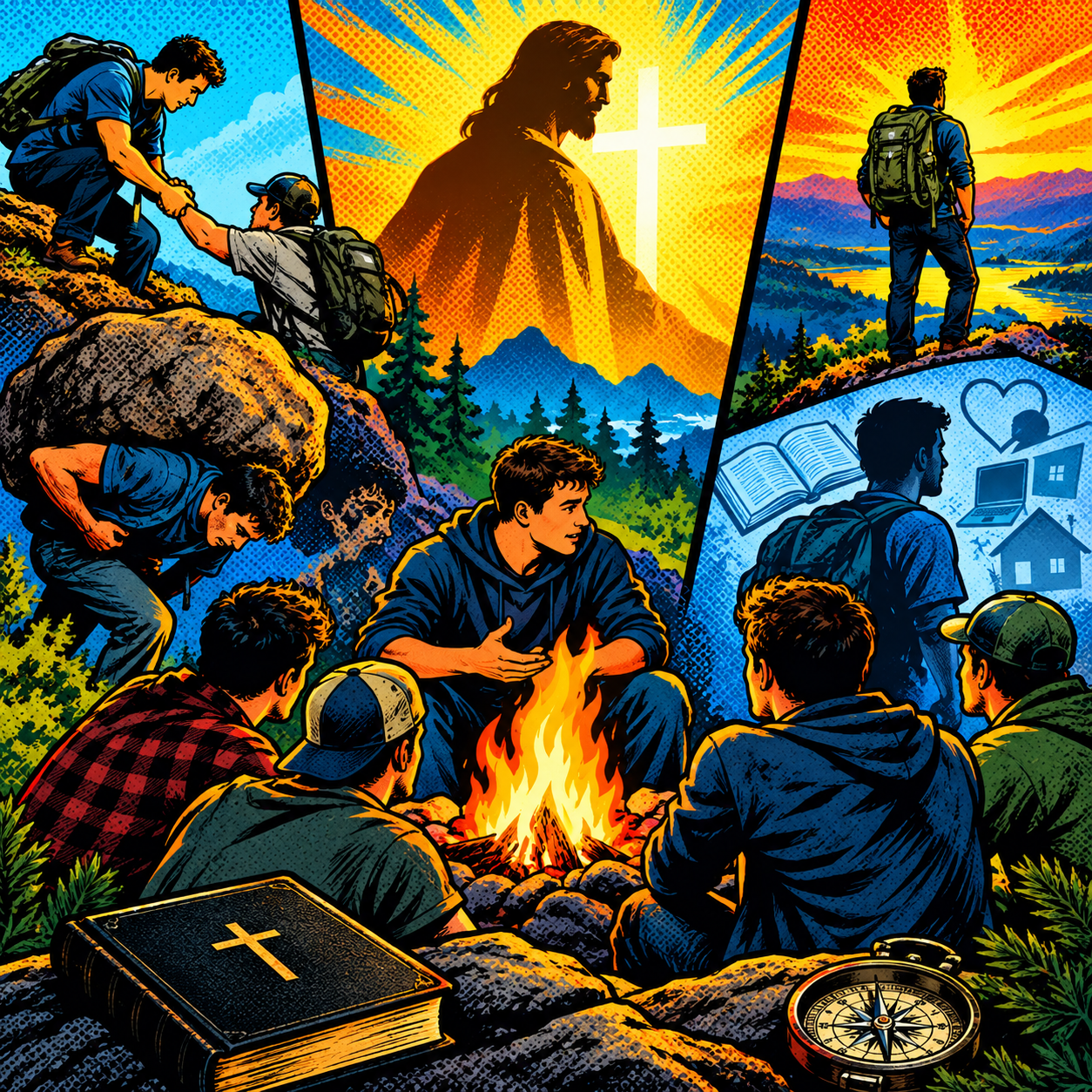

CAMPFIRE LESSON BY DR. MICHAEL A. SCORDATO
PRIMARY TEXT
Galatians 6:2 (NKJV)
“Bear one another’s burdens, and so fulfill the law of Christ.”
Galatians 6:5 (NKJV)
“For each one shall bear his own load.”
Campfire Opening Question
Ask everyone:
“Have you ever helped someone so much that you started carrying their life for them?”
Then ask:
“Have you ever refused to help someone because you thought, ‘They need to figure it out themselves’?”
Most young men have done both.
Paul addresses both mistakes in Galatians 6.
The Apparent Contradiction
At first glance, Paul seems to contradict himself.
Verse 2: “Bear one another’s burdens.”
Verse 5: “Each one shall bear his own load.”
Which is it? Do we carry each other’s burdens? Or do we carry our own?
The answer is: both.
The Holy Spirit inspired Paul to use two different Greek words.
The Greek Words
BURDEN #1 — BAROS
Galatians 6:2 — “Bear one another’s burdens”
βάρος (baros)
Meaning:
- Crushing weight
- Overwhelming pressure
- More than one person should carry alone
- Excessive load
- Heavy hardship
Examples:
- Death of a spouse
- Addiction
- Severe depression
- Crushing guilt
- Financial catastrophe
- A family tragedy
- Spiritual collapse
These are not backpacks. These are boulders. God never intended people to carry these alone. This is why the Bible says, ”do not forsake the fellowship of the saints” in Hebrews 10:25. Fellowship equals togetherness.
BURDEN #2 — PHORTION
Galatians 6:5 — “Each one shall bear his own load”
φορτίον (phortion)
Meaning:
- A soldier’s pack
- Assigned cargo
- Personal responsibility
- Daily duties
- Individual accountability
Examples:
- Going to work
- Paying your bills
- Studying
- Reading Scripture
- Showing up on time
- Caring for your family
- Keeping your word
This is your backpack. Nobody else can wear it for you.
The Big Idea
A mature Christian learns:
Help carry another man’s boulder.
Do not carry another man’s backpack.
And do not make others carry yours.
That one principle will transform brotherhood, fatherhood, mentorship, and servant leadership.
Brotherhood
Young men often confuse brotherhood with one of two extremes.
Extreme #1: “I don’t need anybody.” — Pride.
Extreme #2: “You fix my life.” — Dependency.
Neither is biblical.
Biblical brotherhood says: “I’ll help you carry what is crushing you, but I won’t live your life for you.”
Jesus never enabled laziness. But He constantly relieved crushing burdens.
A true brother helps you stand. He doesn’t become your crutch forever.
Men usually bond over activity — fishing, hiking, work projects, sports, camping. That’s good. But biblical brotherhood asks for more than activity. It asks for honesty — not constant emotional sharing, just honesty.
Brotherhood begins the moment somebody says, “I’m not okay.”
That sentence changes everything. It’s the moment the group finds out who is willing to help carry a baros.
Campfire Illustration
Imagine a hiking trip.
One friend twists his ankle. His backpack weighs 40 pounds. For a few miles, everyone shares his pack.
Why? Because his injury is a baros. An overwhelming burden.
But six months later — if his ankle is healed and he’s still expecting everyone else to carry his gear — that is no longer brotherhood. That is irresponsibility.
Fatherhood
Many fathers fail because they mix up these two burdens.
Bad Father #1: Carries everything for his children. The child never learns responsibility.
Bad Father #2: Carries nothing. The child feels abandoned.
Biblical fathers do both: they help with crushing burdens, and they train children to carry personal responsibilities.
Think of how God fathers us. He carries us through suffering. Yet He still expects obedience.
The Goal of Fatherhood
The goal is not raising dependent children. The goal is raising responsible adults.
A father slowly transfers responsibility. A good father is always asking: “Is this a backpack burden my son needs to carry?” or “Is this a crushing burden he cannot carry alone?” Wisdom is knowing the difference.
This isn’t only a lesson for married men. Fatherhood starts long before your first child.
A future father is being built today. Every time a man keeps his word, serves others, accepts responsibility, learns self-control, and helps the weak — he is practicing fatherhood.
If you’re single, don’t wait for a wedding ring to start becoming the man your future children will need. Start now.
Mentorship
This may be the most important lesson for mentors.
Many mentors burn out because they start carrying backpacks. They become a life manager, a reminder system, an alarm clock, a personal motivation coach — for someone who refuses responsibility.
Soon resentment grows. Why? Because they are carrying what God assigned to someone else.
A mentor’s job is not to replace responsibility. A mentor’s job is to develop responsibility.
Many young men are waiting for a mentor. Few are preparing to become one.
Here’s a challenge: who are you helping?
Even a twenty-two-year-old can mentor an eighteen-year-old. Even a new believer can help someone newer.
Paul’s vision was never a church with a few mentors at the top. It was a church where everyone was helping someone carry a burden.
Jesus as Mentor
Jesus helped people. Fed people. Healed people. Restored people.
But He also said: “Follow Me.” “Take up your cross.” “Go and sin no more.”
He removed crushing burdens. Then He called people to carry their own pack.
Servant of All
Young believers often misunderstand servanthood. They think: “Being a servant means saying yes to everything.”
No.
Jesus washed feet. He did not enable sin. Jesus carried crosses. He did not carry excuses.
Servanthood is not rescuing people from responsibility. Servanthood is helping people become who God created them to be.
The Law of Christ
Galatians 6:2 says: “Bear one another’s burdens, and so fulfill the law of Christ.”
What is the Law of Christ? Love. Not sentimental love. Sacrificial love.
Love asks: “What does this person actually need?” Sometimes they need help. Sometimes they need accountability. Sometimes they need encouragement. Sometimes they need correction.
Love is wise enough to know the difference.
The Example of Jesus
Nobody understood this distinction better than Christ.
What Jesus carried for us: Our sin. Our shame. Our condemnation. Our inability to save ourselves. Those were crushing burdens. Only Christ could carry them.
What Jesus did not carry for us: Our obedience. Our repentance. Our discipleship. Our daily choices. Those remain our responsibility.
Jesus removes the impossible burden. Then He gives us a light pack to carry.
Jesus uses the very same Greek word — phortion:
“For My yoke is easy and My burden is light.” — Matthew 11:30, NKJV
Christ removes the crushing weight and gives us the proper load.
Jesus Carried the Ultimate Baros
Ask the men:
“What was the heaviest burden you have ever carried?”
Let a few answer if they’re willing. Then say this:
No man has ever carried a burden heavier than Christ.
Isaiah says:
“Surely He has borne our griefs and carried our sorrows.” — Isaiah 53:4, NKJV
At the cross, Jesus carried sin. Wrath. Judgment. Death.
No brotherhood could help Him. No mentor could share it. No father could remove it. Only Christ could carry that burden.
And because Christ carried the burden we could never carry, He now gives us burdens we actually can carry.
That’s what turns this lesson from moralism into gospel-centered discipleship. This isn’t ultimately about becoming a more responsible man. It’s about becoming a more Christlike man.
Pride Wears Two Masks
If Christ alone carried the burden that would have crushed us, why do so many men still refuse to bring anything to Him?
Young men usually recognize one mask.
Mask #1: “I don’t need help.” Most men already know that’s pride.
But they miss the second one.
Mask #2: “I need everyone else to fix my life.” That’s pride too.
Why? Because both attitudes avoid dependence on God. One says, “I can do everything.” The other says, “Everyone else must do everything.”
Biblical manhood says something different: “I will do what God assigned me, and I will humbly receive help when I genuinely need it.”
A Campfire Question That Could Hit Hard
Ask:
“Right now, are you carrying a burden God never asked you to carry?”
Many young men are. Consider:
- Other people’s approval
- Your father’s expectations
- Comparison to other men
- Shame from old sins
- Fear of failure
Some burdens are not backpacks. Some burdens should be laid down at Christ’s feet.
Application Around the Fire
Ask everyone:
Brotherhood: Who in your life is carrying a boulder right now? How can you help?
Fatherhood: What responsibility are you carrying for someone that God never assigned to you?
Mentorship: Are you developing dependence, or maturity?
Servanthood: Are you helping people grow stronger — or are you rescuing them from responsibility?
Final Challenge
Every morning, ask two questions:
Question #1: “Whose burden is too heavy for them to carry alone?” Help carry that burden.
Question #2: “What backpack has God assigned to me today?” Carry it faithfully.
Final Campfire Thought
Close under the stars with this:
A boy asks, “Who will carry my burdens?”
A selfish man asks, “Why should I carry theirs?”
A mature Christian asks, “Lord, which burdens have You called me to carry, and which ones have You called me to help carry?”
That question creates brothers. That question creates fathers. That question creates mentors. That question creates servants.
And that question fulfills the Law of Christ.
Closing Thought
The mature Christian learns a beautiful balance:
Compassion without enabling. Responsibility without isolation. Brotherhood without dependency. Servanthood without control.
Because Christ carried the burden that would have crushed us forever, we are free to help carry one another’s burdens while faithfully carrying the pack He has assigned to us.
Amen.