
Adapted from original research by Bob Carnahan (CCBC, 2012)
Echoes of the Substance: Unlocking Types, Shadows, and Christophanies in Genesis
Have you ever read through the book of Genesis and felt a strange sense of déjà vu? You read about a miraculous birth, a willing sacrifice on a mountain, or a beloved son betrayed by his brothers and sold into slavery, and your mind immediately jumps to Jesus.
That is not an accident. It is by divine design.
For young adults diving deep into theology, understanding how the Old Testament fits with the New Testament is one of the most rewarding discoveries you can make. The book of Genesis—derived from the Torah (meaning “Teaching” or “Instruction”)—is not just a collection of ancient historical accounts. It is a masterfully engineered theological blueprint.
By looking at Types, Shadows, and Christophanies, we can see that Jesus Christ did not suddenly arrive on the scene in Matthew 1:1. He has been here since the very beginning.
The Macro View: The Framework of Genesis
Before we can appreciate the microscopic details of prophecy, we have to understand the macroscopic framework of Genesis. The entire book can be logically organized into four major events and four major patriarchs.
The Four Major Events (Genesis 1–11)
- The Creation: God spoke the universe into existence. Right here, we see the Tri-Unity of God. Genesis 1:2 notes the Holy Spirit “hovering over the face of the waters.” Meanwhile, the New Testament confirms Jesus was the active Agent of creation: “In the beginning was the Word, and the Word was with God, and the Word was God. He was in the beginning with God” (John 1:1-2).
- The Fall of Man: Sin entered the world through human rebellion, breaking our initial alignment with God and establishing the immediate need for a Savior.
- The Flood: God judged world wickedness through water but preserved humanity through a covenant with Noah. While God promised never to destroy the earth by water again, scripture warns that the final judgment of this world will be by fire.
- The Nations: God scattered rebellious humanity at Babel and subsequently chose Abraham to establish a covenant nation, out of which the Savior would eventually come.
The Four Major Patriarchs (Genesis 12–50)
- Abraham: The father of faith, called out from his native land to inherit a promise (Genesis 12:1-3).
- Isaac: The son of promise, whose miraculous birth and willing submission defined his life.
- Jacob: Later renamed Israel, he fathered the twelve sons who became the twelve tribes. Christ’s royal lineage uniquely traces back to the tribe of Judah.
- Joseph: The ultimate model of obedience, suffering, betrayal, and ultimate exaltation to the right hand of power.
Defining the Terms: Shadows vs. Substance
What do we mean when we talk about a “type” or a “shadow”?
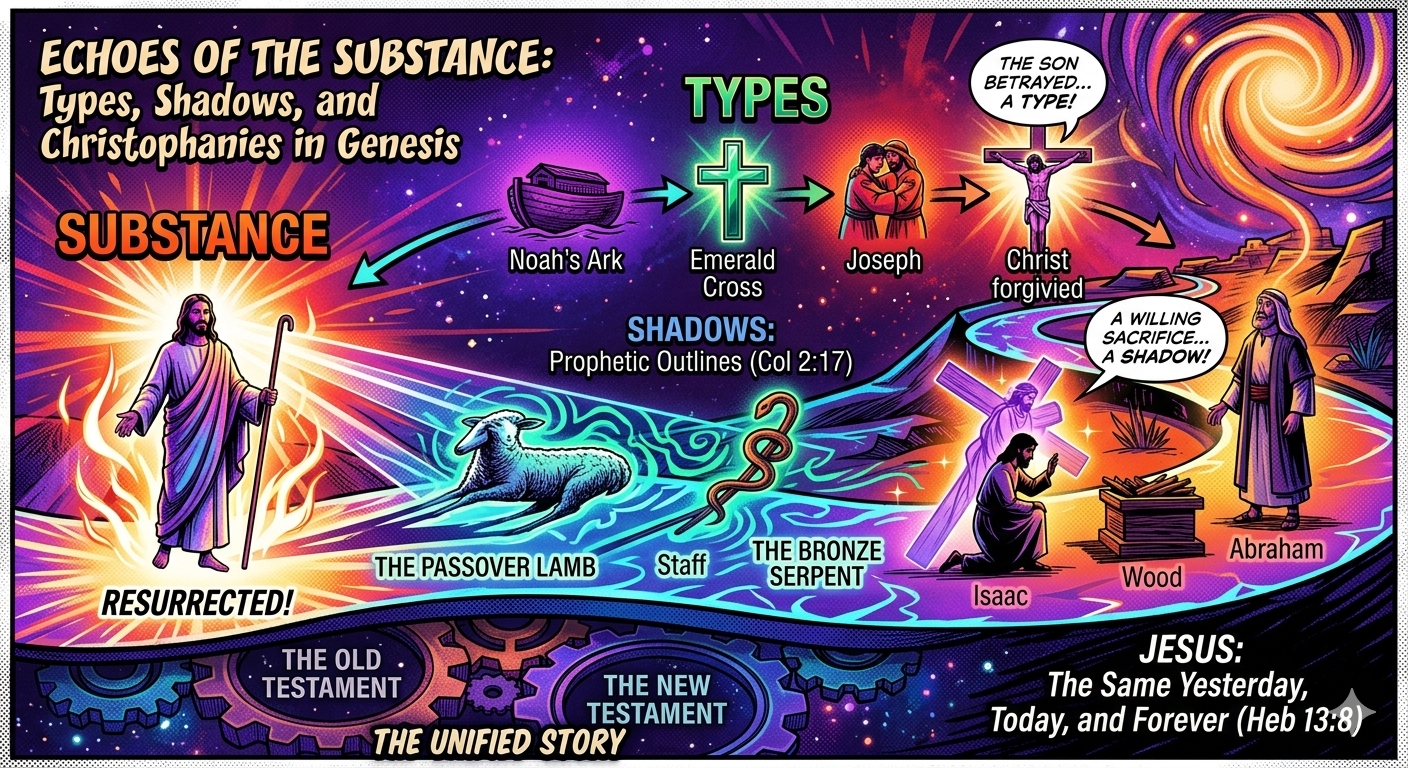
The Apostle Paul gives us a perfect technical framework in Colossians 2:17, writing that Old Testament regulations are “a shadow of things to come, but the substance is of Christ.” The author of Hebrews echoes this, stating that the law had “a shadow of the good things to come, and not the very image of the things” (Hebrews 10:1).
Think of a shadow on the wall. A shadow gives you an unmistakable outline of an object. It lets you know the shape, height, and movement of whatever is casting it. However, a shadow lacks color, depth, and life. It is not the original copy. Jesus Christ is the physical entity casting the shadow from the future back into ancient history.
| Theological Term | Biblical Definition | Practical Meaning |
| Shadow | An outline, copy, or reflection of a future heavenly reality (Hebrews 8:5). | A structural hint in Old Testament laws, rituals, or objects pointing to Jesus. |
| Type | A historical person, event, or institution that serves as a prophetic preview of Christ. | A living object lesson whose life mirrors the mission of the coming Savior. |
| Christophany | An appearance before the incarnation of the second Person of the Trinity. | Jesus physically entering human history before His birth in Bethlehem. |
Living Prophecies: Types of Christ in Genesis
Genesis is packed with individual “types” that preview Jesus. Consider this comprehensive roadmap of Christological types found throughout the book:
- Adam: The first man, who represents the federal head of the old creation, contrasting Jesus as the federal head of the new creation (Romans 5:14; 1 Corinthians 15:45).
- Abel: The innocent shepherd whose righteous blood was shed, though Christ’s blood speaks a better word than Abel’s (Genesis 4:8,10; Hebrews 12:24).
- The Ark: The unique vessel of divine salvation that safely carried believers through the waters of judgment (Genesis 7:16; 1 Peter 3:20-21).
- Melchizedek: The mysterious King of Salem and Priest of God Most High, who had no recorded beginning or end, previewing Christ’s eternal priesthood (Genesis 14:18-20; Hebrews 7:1-17).
- Jacob’s Ladder: The bridge linking heaven and earth, which Jesus explicitly applied to Himself in John 1:51.
If we look deeply at two specific patriarchs, the prophetic clarity becomes undeniable:
1. Isaac: The Son of Promise
Isaac is a vivid, unmistakable type of the Lord Jesus Christ.
- The Birth: Both had births that required divine, miraculous intervention.
- The Submission: Isaac did not fight his aging father on Mount Moriah; he willingly submitted to being bound on the altar, mirroring Christ’s willing obedience to the Father’s cosmic plan.
- The Sacrifice & Resurrection: Isaac was figuratively sacrificed and “raised” from the altar on the third day of their journey, serving as a direct prophetic staging ground for the Gospel (Hebrews 11:17-19).
2. Joseph: The Betrayed Savior
Joseph’s real-world history reads like a literal biography of Jesus’ earthly ministry.
- The Rejection: Joseph was deeply loved by his father but hated and rejected by his brothers.
- The Betrayal: He was stripped of his robe, sold into slavery for silver pieces, and unjustly condemned.
- The Exaltation: Through extreme suffering, God taught Joseph humility and patience. He was raised from the prison dungeon directly to the right hand of Pharaoh’s throne.
- The Salvation: Joseph used his sovereign authority to save the very brothers who betrayed him, declaring: “You meant evil against me; but God meant it for good, to bring it about as it is this day, to save many people alive” (Genesis 50:20).
Christophanies: Jesus Intersecting History
While types and shadows are prophetic previews, a Christophany (often interchangeable with a Theophany, an appearance of God to humans) is an actual, physical manifestation of Christ prior to His incarnation.
Old Testament theology operates on a strict premise: seeing God in His unfiltered, absolute glory is fatal to mortal men. God explicitly told Moses, “You cannot see My face, for no one can see Me and live!” (Exodus 33:20).
Yet, the Genesis record is unmistakable: people did see God and live.
For instance, in Genesis 12:7-9, we read: “Then the Lord appeared to Abram and said, ‘To your descendants I will give this land.’ And there he built an altar to the Lord, who had appeared to him.”
How do we reconcile this? How can man see an invisible, unapproachable God? The answer is found in the Person of Jesus Christ. Whenever God chose to manifest Himself to human sight in a visible, physical form—whether as a man, a vision, or a divine messenger—mankind was interacting with the pre-incarnate Second Person of the Trinity. Jesus has always been the visible face of the invisible Father.
Radical Alignment: Bringing Genesis into the Present
Studying the complex doctrines of types, shadows, and Christophanies is not just an intellectual exercise for Bible study groups. It serves a radical, foundational purpose: it proves the supernatural integration of God’s Word and fortifies your daily faith.
When you see how perfectly God orchestrated history over thousands of years, it changes how you look at your own life. Consider the profound takeaways we can apply directly to our daily walk:
Total Reliance Over Self-Strength
Abraham demonstrated absolute, uncompromised trust when he was willing to surrender his absolute best—his only son, Isaac—to the Lord. For us today, building a genuine relationship with Christ means coming to the end of our own strength. When our old nature tries to take control, we fail. True spiritual maturity means starting every single day in prayer and worship, actively turning our schedules, careers, and trials over to Jesus.
Spiritual Defense in a Relentless Culture
As young adults navigating an increasingly hostile world, we face a non-stop onslaught of cultural and spiritual attacks. Our primary defense mechanism is not our own intellect or willpower; it is relying completely on Christ, staying anchored deeply in His Word, and remaining in constant communication through prayer.
A Collective Mandate
The Old Testament is an intricate, beautifully woven tapestry foreshadowing the grace that has now fully arrived through the birth, death, and resurrection of Jesus Christ. He loved us with an unconditional love and paid the ultimate price so that we could inherit eternal life. Because we know the substance behind the shadows, we carry an awesome, urgent responsibility: to share this good news with a lost and searching generation before time runs out.
Group Discussion Prompts
- Which “Type of Christ” in Genesis (Isaac, Joseph, Adam, Melchizedek) challenges or expands your view of God’s sovereign control over history the most?
- If Old Testament shadows are meant to point us to the reality of Jesus, what are some modern “shadows” (career success, relationships, reputation) that we accidentally mistake for the real substance?
- Abraham was asked to rely on God to the point of sacrificing his ultimate earthly promise. What is the hardest thing for you to surrender to God’s strength right now?
Further Reading Reference Credits: Holman Illustrated Bible Dictionary; Portraits of Christ in Genesis (M.R. De Haan); The Genesis Record (Henry M. Morris).