
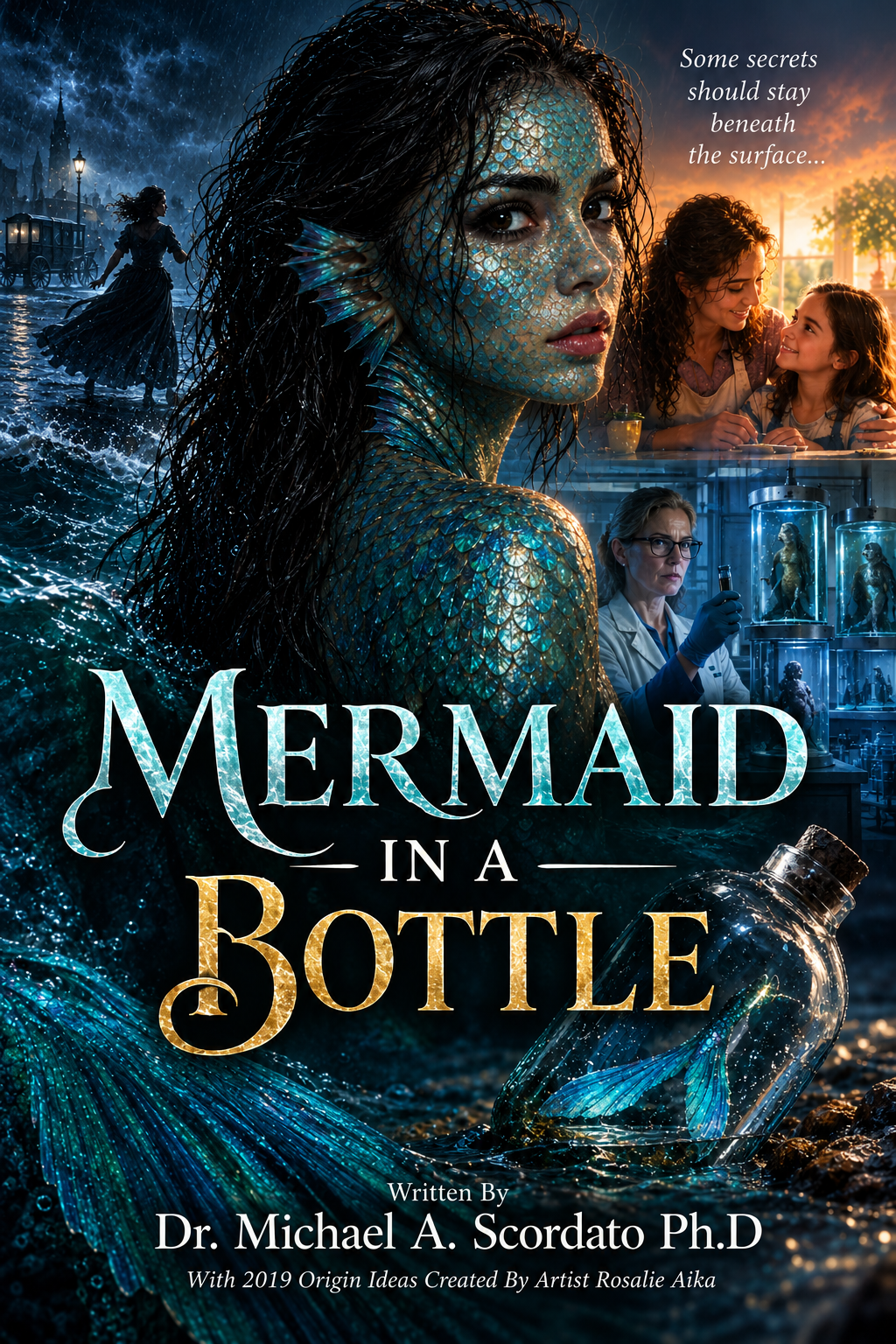

Written By Dr. Michael A. Scordato Ph.D, With 2019 Origin Ideas Created By Artist Rosalie Aika
Prologue — The Woman in the Storm
During midsummer a night of 1891 the historical waterfront was violently upended by a torrential downpour and wind-driven spray. A woman with curled blond hair fled desperately through the dark alleys, escaping drunken pursuers. In her frantic rush, her bonnet was lost to the storm. Above her, a new-type electric light abruptly failed with a sharp zap, plunging the alley into sudden gloom. Simultaneously, an unnatural cold snap gripped the air, sending temperatures plunging so drastically that she could see the fog of her own breath in the middle of summer.
All around her, the environment mirrored the uncanny terror: wharf rats darted and vanished between rotting crates, while gulls were rendered nearly invisible against the pitch-black sky. Desperate for rescue, she caught sight of a carriage moving across the waterway and screamed out, waving furiously as she ran.
Then, disaster struck. Something swift and unseen wrapped tightly around her ankle, biting down into her calf. Darkness closed in, and she collapsed, her heavy, water-logged dress sinking out of sight behind the wharf crates as she lost consciousness.
Moments later, a man from the carriage leaned out, shouting into the storm. “You there — are you there, miss? We saw you wave & scream!” Following the disturbance behind a crate, he found a woman. She was wearing the same dress, but awkwardly, completely soaked, covered in dirt and mud, and smelling strongly of the ocean.
The man rushed to help her up. But as she leaned on him, she purposefully fell forward into his arms, using the motion to kick a tiny, hidden mermaid figure backward into the dark water. The water completely concealed the minuscule figure. The woman smiled—an expression whose true intent remained chillingly ambiguous, leaving it impossible to tell whether she was a tragic victim, an impostor, or something far worse. As the last iridescent scales faded entirely from the back of her hand, she stood safely restored.
The woman who smiled was no longer wearing scales—but the curse of her sin had not disappeared. Behind her, forgotten in the storm, the bonnet lay abandoned, caught among the crates as the angry wind swept past, leaving its silent witness to be discovered by those who would come searching.
Part I — The curse enters the family’s life
Chapter 1 — A House Worth Coming Home To
The morning sun cut through the suburban New Jersey windows with a bright, ordinary clarity, casting a warm golden light across the kitchen floor. Outside, the sky was clear and steady, promising a pleasant day, though a faint bank of clouds was expected to gather by late afternoon. Inside, the house was already alive with the familiar, overlapping rhythms of a weekday morning.
At the center of it all stood thirty-four-year-old Camila, her dark brown curls tied back, moving with practiced efficiency. Before the rest of the house was fully awake, she had a cup of coffee poured, and was already navigating her home-based business. With a golden touch for recognizing hidden value, Camila spent her mornings evaluating used items she had collected, sorting through fabrics, and planning how to repurpose, repair, or creatively recreate goods for online platforms and upcoming weekend festival sales. Her inventory table sat neatly organized in the corner of the room, a testament to her business-savvy mind and her love for making useful things out of what others discarded.
A few feet away, Gabriel was busy preparing for his demanding eight-hour shift. As an electronics and home-appliance technician and delivery driver, his workday required him to hit the ground running across a busy suburban and city service zone. Pausing at the counter, he unwrapped a bacon, egg, and cheese on a roll, checking his pockets for the three non-negotiable items: keys, wallet, and phone.
Ten-year-old Alma sat across from him, juggling her school backpack, a half-eaten toasted bagel, and a battered observation notebook filled with sketches and questions. Her eyes drifted constantly toward her pride and joy: the living room aquarium. Inside the tank, a small community of tropical fish darted gracefully around plastic hoops, while a bristlenose algae eater clung steadfastly to the glass. Alma watched them with a sharp, curious intensity, her expression half-convinced that the aquatic creatures were actually conducting a behavioral experiment on the humans.
Amidst the morning rush, a minor domestic mishap occurred. Camila’s current sewing project—a length of heavy-duty cotton thread—had somehow looped itself around one of Gabriel’s spare appliance-repair cords, while a page of Alma’s aquarium notes had fluttered right into Camila’s resale stack.
Gabriel chuckled, holding up the tangled cable with a dry grin. “Mija, unless we’re planning to wire the sewing machine into the refrigerator compressor, I think your project and my van had a meeting.”
Camila laughed, gently untangling the cord with a roll of her dark eyes. “Give me a minute, Gabriel, and I’ll have both running a delivery route.” She touched her left eyebrow instinctively near her small crescent scar, offering a playful smile. “Just make sure you check your pockets before you leave. I’m not playing the key-hunting game today.”
Their laughter was interrupted by the sharp, cheerful chime of a smartphone on the counter. It was a group text from younger cousin Marisol in New York City, dropping a quick, random morning voice note about a scheduling mix-up, followed almost immediately by a ringing call from Camila’s older sister, Tía Lourdes, also calling from New York. Lourdes on speaker phone, blunt and caring as always, didn’t bother with a traditional greeting.
“Camila, did you remember to take those winter blankets out of the damp closet like I told you last week, or do I need to drive down the Turnpike with a dehumidifier?” Lourdes demanded affectionately, before seamlessly shifting topics to ask if Gabriel was eating right.
“Good morning to you too, Lourdes,” Camila smiled, leaning against the counter. “We’re alive, everyone has their shoes on, and Gabriel is eating his breakfast.”
Gabriel chimed in, “Tell Lourdes that if she brings another tray of her pernil this weekend, my tools are entirely at her disposal.”
Even though Tía Lourdes (sister) and Abuelo Rafael (Father)—who had called earlier that week from Puerto Rico with one of his winding, unpredictable family stories—were now together one thousand six hundred miles away, their presence felt woven into the fabric of the household. But Tia would be back today or tomorrow soon arriving at JFK.
In the Santiago Rivera home, family calls were never optional background noise; they anchored the family’s wider emotional geography across New York, New Jersey, and the islands.
The family’s Protestant Christian faith grounded their interactions, not as a stiff formality, but through practical service, prayer, and a commitment to walking out the grace of Ephesians. When minor frictions arose—like Alma leaving her backpack blocking the hallway—they practiced the household’s deliberate standard of accountability. Alma caught herself, paused, and looked directly at her mother. “I was wrong to leave my bag there. Please forgive me, Mom.”
“Forgiven,” Camila said softly, giving her daughter’s thick curls an affectionate tug and checking her forehead with an automatic touch to make sure she wasn’t coming down with anything. “Just keep the path clear so your father doesn’t turn into a delivery casualty before he even gets to his van.”
As the morning wound down, Gabriel finished his coffee, gave Alma a quick parting hug, and leaned in to kiss Camila. The kitchen still smelled faintly of the coffee and toast, carrying the quiet, steady warmth of a life they had built together.
Camila gathered her things for a work-related errand and a local supply run, fully expecting to return by afternoon to the same familiar noise, the hum of Alma’s aquarium, and the comforting promise of the evening’s dinner preparations. She stepped out the front door into the bright New Jersey air, locking it behind her, entirely unaware that the ordinary world she loved was about to vanish.
Chapter 2 — The Shoreline Is Too Big
The transition from ordinary life to nightmare began with the cold.
When Camila regained consciousness, the world had lost its familiar proportions. She was lying on cold, damp sand, shivering as a bitter sea wind whipped across the shoreline under a sky choked with lingering storm clouds and a brief, mocking break in the pale gray light. Choppy, slate-gray waves crashed against the beach with the sound of thundering avalanches, sending a fine, freezing spray that coated her skin.
She tried to push herself up, intending to check her inherited watch, rub her temples, and figure out why she was lying on a New Jersey beach instead of standing in her kitchen. But her arms refused to obey her expectations due to what her eyes saw in a shock. Her hands and arms were impossibly doll-like tiny, delicate, and ending in webbed fingers. When she tried to draw her knees up, there were no knees. Where her legs should have been, a solid, powerful fish tail—shimmering with deep teal and emerald scales—slapped uselessly against the wet sand.
She was a fish… a person fish! This is what her thoughts screamed.
A suffocating wave of revulsion and blind panic seized her. She wanted to vomit, to scream, to crawl out of her own skin. Focus, a stubborn, practical voice inside her commanded, even as her chest hewed in rapid, terrified pants. Assess the damage.
She tried to recall her home, her husband Gabriel, her daughter Alma, but her memories felt strangely fragmented, like a house with half its rooms locked behind thick glass. She knew she belonged to someone, that she had a life, a business, a deep and fierce maternal instinct burning in her chest—but the specific details, names, and memories flickered and dissolved whenever she tried to grasp them. Her figurine-sized brain could no longer hold the full weight of her human memories.
The air felt searingly dry, clawing at her throat with an unnatural heat despite the freezing wind. Every breath she took threatened to ignite a raw, burning inflammation in her windpipe, demanding to her with terrifying speed that her new body was utterly dependent on water.
Worse still, she was not alone on the beach.
A sudden, sharp cry ripped through the air. A herring gull plummeted from the sky, its shadow blotting out the pale strip of light as it dove toward a piece of refuse. To the bird, Camila was not a human being; she was a wriggling morsel. Camila instinctively flattened herself into a shallow depression in the sand, her heart hammering against her ribs like a trapped animal.
Before she could drag herself toward the safety of the surf, the earth began to vibrate. Heavy, rhythmic thuds shook the ground—thud, thud, thud—like tectonic plates shifting. A brown stray dog trotted past the wrack line, its wet black nose sniffing the salty air. To Camila, the dog was an apocalyptic monster, its massive paws kicking up miniature sandstorms that buried her tail in gritty debris. The animal sneezed, missed her by mere inches, and bounded away toward the dunes, entirely unaware or more of uncaring of the terrified miniature woman beneath its feet. It never realizing how close its paw had come to crushing her.
On the wind, a faint, teasing scent drifted down from a boarded-up boardwalk concession stand near the parking lot—the stale, greasy aroma of old funnel cake and frying oil. It was an ordinary human comfort, now rendered monstrous, inaccessible, and mocking of her total helplessness.
Before Camila could orient herself, an another enormous shadow fell over her location, eclipsing the weak daylight entirely.
A towering, distorted human figure loomed over the sand. Acting on pure, desperate survival instinct, Camila gathered a handful of wet, abrasive sand in her tiny fingers and flung it directly upward at the looming giant.
The creature let out a deep, booming laugh that rattled the very air in Camila’s ears. Massive, callous fingers—each one the size of a log—descended without warning. Before she could thrash away, a heavy, thick thumb shoved her unceremoniously into a discarded, half-buried glass bottle that had washed up near the drift line, its interior still smelling faintly of dried, stale alcohol.
Camila scrambled against the slick glass walls, but a massive finger pressed in behind her, forcing her all the way to the bottom.
A second later, the bottle was kicked or grabbed, plunging backward into the foaming edge of the surf. Frigid seawater rushed violently through the narrow neck, flooding the transparent cage. Camila fighting against breathing in water itself out of a human response, she gasped, choking down water as she scrambled upward, coughing and fighting the violent current as the bottle tipped, rolled, and bumped its way relentlessly across the sand and away into and back again from the sea.
Tumbling head over tail against the hard glass, trapped inside a rolling prison of her own home turf, Camila could do nothing to stop it. The bottle was carried inland toward the parking lots and roads, and she had no control over where it went.
Glass struck sand as the surf hurled the bottle back and forth. Seawater sloshing over her, and the unfamiliar shoreline spinning around her. She felt battered—not so much physically broken as mentally shattered by a world that no longer made sense.
Then the realization of the full weight of her apparent amnesia finally struck her heart. Desperately, she reached inward for something as simple and essential as her own name.
Nothing.
“Who am I?”
Chapter 3 — Mermaid in a Bottle
The storm had finally broken, leaving behind damp, steaming asphalt in the coastal parking lot and pale, watery sunlight that caught the puddles in blinding glares.
Inside her glass cylinder, sloshing water almost to her chest with tinge of the brain killing alcohol which stung lightly though it was now heavily diluted, Camila clung desperately to the curved walls. Her shrunken body ached, her raw throat burning with every dry, ragged breath of air trapped inside the bottleneck as she still instinctively avoided both breathing the water and drinking it due to the repulsive toxicity smell itself. Suddenly, the world lurched violently. The bottle was hoisted into the air, hoisted by an appendage so massive and calloused it blotted out the light.
The enormous creature—a belligerent human male whose face was nothing more than an intimidating, towering blur of denim and stubble—grunted, attempting to shove the glass prison deep into a canvas pocket. The bottle didn’t fit. As he fumbled and grumbled an absurdity under his breath, the pocket snagged, and the glass slipped from his giant fingers.
Camila squeezed her eyes shut as gravity vanished. Crack, Clink, Tink!
The bottle struck the damp pavement with a sharp, ringing impact tone. Camila was thrown hard against the interior glass wall, her tail thrashing in a frantic, disoriented arc as seawater foamed into a blinding cloud of bubbles. The bottle finally struck the damp pavement on its side and bounced, ringing a finale against the asphalt before rolling to a stop.
A moment of dazed settlement occurred. She felt it is over. Despair swept up her now floating on back body like a blanket. This hopelessness being pull over herself tauntly being tucked in and kissed upon like a mother securing a child into their rest. Through the distortion of the glass, the water, and the glaring afternoon sunlight, a new shadow fell over her. A pair of bright sneakers stopped right beside the rolling bottle.
A hand—huge, childishly clumsy, yet infinitely larger than her entire world—scooped the glass up from the asphalt. Camila pressed her tiny hands and face against the curved interior, her dark eyes wide with unmitigated terror. To her, this towering giant was a terrifying beast, the car looming behind it was an iron monolith, and the trembling ground beneath signaled a universe that wanted to crush her. She couldn’t speak; her throat was too inflamed, her brain too fragmented by her doll-sized state to find a name, let alone explain that she was a human mother.
Up above, peering straight through the reflective glare and swirling bubbles, a ten-year-old girl with thick black curls and a gap between her front teeth stared down.
Alma’s breath hitched. Her brown eyes widened with instantaneous, incandescent wonder. She didn’t see a prisoner or a victim; she saw magic.
Slowly, breathlessly, Alma pressed her lips close to the glass and whispered into the damp air, “Mermaid in a bottle.”
To Alma, the glass cylinder was a vessel of pure discovery, an extraordinary artifact of the sea. But to Camila, curled shivering against the bottom gravel of the rolling container, the exact same object meant only one thing: a prison from which there was no escape.
High above the pavement, a seagull’s shadow swept swiftly across the ground, a silent reminder of the lethal aerial hunters that treated the shoreline like a feeding ground. Alma didn’t notice the bird. She carefully cradled the bottle against her chest, right next to her school backpack where a crumpled brown-paper bag held her after-school snack—a half-eaten peanut-butter sandwich.
Clutching her incredible discovery tightly in her hands, Alma turned and ran toward the waiting car, her heart racing with excitement, completely unaware that the tiny, terrified face pressing against the glass inside was her own mother. And her own Mother unaware that she was finally going home, and now situationally terrified of ever going to such a place.
Chapter 4 — The Girl Who Felt Familiar
Outside, an ordinary afternoon rain tapped a steady, rhythmic cadence against the living room windows. Inside, the house was dark save for the warm, fluorescent glow emanating from Alma’s rectangular aquarium, which cast shimmering blue-green ripples across the carpet. The aroma of leftover pollo guisado, rice, and habichuelas—stewed chicken and beans—lingered rich and savory in the air from dinner, a comforting scent that tugged at something deep, buried, and aching inside Camila’s chest.
Alma set her plate on the kitchen counter near the tank, taking a bite of chicken before turning all her attention to the glass travel bottle sitting beside her observation notebook.
Camila cowered near the bottom of the bottle, her heart racing as Alma’s giant fingers reached down. But instead of a crushing grasp, the girl gently tipped a tiny crumb of ham and a speck of soft bread into the opening. Camila, exhausted and starved, inspected the food with practical caution before nibbling it. It was edible, even delicious, settling her unsettled stomach.
Alma tried to slide her fingers inside the narrow neck of the bottle to lift the tiny creature out, but the opening was far too tight, and her fingertips only brushed against the curving glass, throwing Camila back into a fresh wave of panic.
Realizing she couldn’t force her way in, Alma stopped. She pulled her giant hand back a respectful distance, letting the pale light reach the bottom of the cylinder, and cleared her throat, deciding to treat the tiny stranger with absolute politeness.
“Um… hello,” Alma whispered, her voice carefully pitched down so it wouldn’t boom like thunder against the glass. “My name is Alma. I live here. You don’t have to be afraid of me, I promise.”
Camila pressed herself against the back curve, shivering, her small chest heaving. But as Alma finished speaking, the girl did something peculiar: she unconsciously brushed a stray curl away from her forehead with a quick, rhythmic double-tap of her knuckles against her own temple—a nervous, distinct little habit.
At the sight of that exact, familiar motion, a strange, profound calm pierced through the heavy fog in Camila’s shrunken brain. She didn’t know why the gesture made her heart settle, nor could she pull up the name or memories attached to it, but the rhythm of it felt as warm and safe as a hearth fire. The blind terror receded just enough for practical survival instinct to take over. Recognizing that she couldn’t stay in the cramped, alcohol-tainted bottle forever, Camila flicked her tail and independently pressed up from the bottom floor of the bottle in a jump up the glass slope, sliding out through the squeeze of the narrow neck in the bottles wriggle, but fell almost instantly. The hard crash onto the table top did not occur as the saving, waiting, open palms of the girl who felt so inexplicably like home caught her.
“You are home and safe”. Alma proclaimed having no idea what those words truly meant to whom she was speaking.
Camila simply gave up and went limp. Alma worried that mermaids need water. So she messily emptied the plastic silverware holder into there drawer, gave it a quick attached filtered rinse, then filled it with room temperature cleaned tap water followed by placing Camila into it. The water felt good and in a tilt of the head she began to drink it as well. The burning in her throat began to calm.
Carefully, Alma used a clean, damp corner of an old cotton T-shirt to dab away the sticky, alcohol-tinged ocean grime from Camila’s belly and tiny arms, tickling her gently. Camila tried to explain who she was, to scream for answers, but when she opened her mouth, only a high-pitched, dolphin-like squeak escaped her lips. Her throat felt swollen, dry, and terrifyingly wrong—a sharp reminder that her vocal cord exertion was rapidly draining her body’s vital moisture.
“You poor thing,” Alma murmured softly. “You can’t stay in that gross little bottle. Come on, I’ll show you your new home.”
With infinite care, Alma lifted the miniature mermaid out and submerged her into the main freshwater aquarium. The instant the clean, filtered water hit Camila’s still dry skin and parched throat, a wave of soothing relief washed through her airways. Her throat further unswelled, and her scales—a brilliant kaleidoscope of teal, emerald, and gold—flared into iridescent rainbows under the tank’s overhead lights.
Wait… I can breathe underwater! Camila finally got and clung to this point. She is now a water creature.
Nearby, a bristlenose algae eater clung to the interior glass, its mouth working rhythmically as its unblinking eyes seemed to judge the tiny newcomer with cold, indifference. Suddenly, a larger, curious gourami fish lunged forward, its gaping mouth snapping mere centimeters from Camila’s tail. Camila thrashed back, her heart in her throat, instantly realizing that this underwater paradise was full of instinctual predators.
Noticing Camila’s alarm, Alma quickly tried to make it a game. She grabbed a small, neon-green plastic hoop from her aquarium kit and lowered it into the water. “Look! You can swim through!”
As Camila’s throat unswelled her ears as well felt like they were opening as well, able to hear the voice of this monster speaking to her much more clearly. Swim through. Camila understood her words. Feeling revitalized in this new water she would try. She felt she needed to try. She had a home she had to return to in her heart.
While Alma saw a playful circus trick, Camila’s practical, survival-driven mind transformed the game into rigorous training. She practiced rapid bursts of speed, using her tail fin to execute tight banking turns, practicing how to steer, dodge aquatic obstacles, and squeeze through narrow escape routes should the larger fish attack again.
Before Alma could cheer, her smartphone on the counter chimed with an incoming video call from Tía Lourdes who just arrived back in New York. She called knowing Alma’s mom would be out for the day so was checking in since Alma is ten years old, not twelve or thirteen. But her father should be home soon. Alma answered, showing her aunt her half-eaten plate of pollo guisado and chatting casually about her school day, carefully angling the camera away from the glowing fish tank to keep her secret safe.
When the call ended, a quiet stillness settled over the room again. Alma set her phone down, pulled a wooden stool up to the tank, and leaned her forehead against the cool glass, her face lined with a sudden, heavy tiredness.
“I wish Mom would come back soon from her work trip,” Alma whispered to the water, her voice trembling slightly. “I miss her.”
Camila floated closer, propelled by an irresistible, overwhelming tide of affection. Through the glass, she reached out her hand, pressing her tiny palm gently against the side of Alma’s face. Without understanding why the words came, or where the sudden swell of maternal devotion originated in her fragmented brain, Camila stroked the child’s head through the glass.
“My little girl…” Camila whispered, her squeaky voice heard clearly as a tender impression inside the child’s mind.
Alma gasped, her dark eyes opening wide as she looked at the tiny creature gazing back at her with fierce, protective love.
Before Alma could process the familiar feeling blooming between them, the sharp, authoritative ring of the front doorbell echoed through the house. It was her father with his hands overloaded carry a box of many things. Alma quickly peeked out the view hole then opened the door supporting the box on the bottom to try and help though it really didn’t.
“Thank you, Love. I got some Chinese for tonight when Mom comes back. How was your day?”
Alma paused. “I… I found something.”
Gabriel froze. He felt this was a led on to something bad.
“What… did you find?” He asked slow and quizzical now having his hands freed after setting down the box in the room and closed the hallway’s door.
They were interrupted.
A knock on the door happened. Gabriel’s heavy footsteps echoed down the hallway as he went to answer it. Outside the living room, a voice spoke—a woman’s professional, sharp voice that belonged to Dr. Vivian Cross, a former coworker who knew far more about Camila’s former life than Alma ever could. Alma never liked her, too suspicious.
Alma peeked. “Why is Mizz Creepy here?”
Chapter 5 — The Woman with the Gloves
The afternoon rain tapped a quiet, steady drizzle against the suburban windows, casting a cool, gray light across the living room. In the kitchen, a white cardboard container of Chinese takeout—fried rice, lo mein, and chicken with broccoli, untouched and rapidly cooling—sat abandoned on the counter, a small detail of an ordinary family evening interrupted before it could even begin.
Gabriel stood in the hallway, looking between the visitor and his daughter. Dr. Vivian Cross stood just inside the threshold, her expression a tight, professional mask. She was a former coworker of Camila’s, a woman Alma had always privately considered eccentric.
“Dr. Cross,” Gabriel said, blinking in surprise. “What brings you out in this weather?”
Vivian offered a smooth, practiced smile, though her eyes remained sharp and cold. “I was in the area, Gabriel, and I happened to see Alma near the coast earlier. I watched her scoop something up from the beach—a bright, exotic little creature dropped into an old bottle. I couldn’t help but follow. Some of those rare imported reef fish carry potent toxins, or worse, venomous barbs. I just wanted to make sure it wasn’t dangerous to you or the child.”
Gabriel’s brow furrowed, turning toward his daughter. “Alma?”
Alma swallowed hard, her chest tight. Feeling the weight of the truth and unable to lie to her father, she confessed in a rush. “I found her on the beach, Dad. But she’s not a poison fish. She’s… she’s special.”
Sensing the shift in the room, Vivian stepped past Gabriel uninvited, her gaze zeroing straight onto the illuminated rectangle of the aquarium against the living room wall.
Camila hovered near the back of the tank, pulling herself deep behind a cluster of plastic plants and smooth river rocks. Yet, through the clear glass and bright lighting, her iridescent teal and emerald tail and humanlike torso were unmistakable.
Gabriel stepped closer, his jaw going slack. He stared through the glass, utterly transfixed and amazed by the living impossibility floating before him. But Vivian’s reaction was entirely different. Her eyes widened not with shock, but with a fanatical, hungry realization—the look of a woman who wasn’t seeing something for the first time, but rather confirming a terrifying theory she had already spent years trying to prove.
Alma threw her body directly in front of the tank, crossing her arms wide then outward with her palms facing backward. “Don’t let ‘Mizz Creepy’ touch her!” she snapped, her voice trembling with fierce protectiveness.
Gabriel placed a gentle, grounding hand on his daughter’s shoulder, trying to mediate. “Alma, let Dr. Cross look. She’s a scientist; she can tell us what’s happening and help us figure out what to do next.” He guided Alma gently to the side, though she fought against his grip.
“Don’t hurt her, please!” Alma begged, tears pricking the corners of her eyes.
Vivian ignored the child entirely. Unzipping her waterproof bag, the cold, metallic glint of laboratory instruments caught the gray window light. With clinical precision, she snapped a pair of sterile latex gloves onto her hands.
“Fascinating,” Vivian murmured, stepping right up to the glass. She reached into the water with a long-handled mesh net alma had in her aquarium maintenance basket.
Panic seized Camila. Remembering her gills, she burst upward, breaking the surface to blow a sharp stream of water straight onto Vivian’s glasses, then whipped her tail down in a furious splash that soaked the researcher’s lapel. Camila dove, darting like a frightened fish from tank-side to tank-side. The tropical fish scattered in a panic; the one gourami again lunged viciously, jaw’s revenge snapping her direction. Meanwhile, the bristlenose algae eater clung stubbornly to the glass, continuing to graze on algae as though an unfolding supernatural crisis had nothing to do with it.
Gabriel started to intervene, only to find that Vivian has already moved.
Vivian lunged with the net, her movements swift and predatory. As she swept the mesh through the water, the oversized pen-protector sleeve in the breast pocket of her lab jacket shifted, parting open to reveal a horrifying glimpse of institutional cruelty: tucked inside was a flattened, laminated mermaid skeleton, perfectly matched to Camila’s exact size.
She isn’t the first, Camila’s terrified mind screamed. There were others.
Trapped by the closing net lifting her up and out of the tank into the open air where she could no longer dart or flee. Or so Vivian thought. Camila didn’t hesitate. With a surge of adrenaline, she opened her mouth and bit down hard into the mesh. The threads tore. Slipping like liquid between Vivian’s latex-covered fingers, Camila plummeted toward the floor.
Before she could hit the hardwood, Alma dove and caught her cleanly in cupped hands. With child quick reflexes and simple emotions of seeing Vivian hurt her new friend, Alma was emboldened by desperation, spun, kicked Vivian sharply in the shin to protect, and then reached up to flick the researcher right on the nose as punishment before bolting across the room.
“Go — We Go!” Alma cheered, her voice a mix of terror and triumph as Camila scrambled freely to cling on her arm in a wrap. Gabriel stepped firmly into Vivian’s path, blocking the researcher from lunging after his daughter while keeping Alma safely behind him.
Vivian hissed, her professional composure cracking entirely as she clutched her nose, her eyes glaring with manic fury through her spattered glasses.
Floating from her arm into the safety of Alma’s hands, pressing against her fingers with all the breath left in her small, strained lungs, Camila looked up at Gabriel. Her voice rang out clearly across the room, cutting through the chaos with a desperate, unmistakable human plea:
“Please, sir, don’t let that lady experiment on me!”
Part II — The first wound
Chapter 6 — The Shot
The late afternoon light, which had been a cool gray drizzle just moments before, darkened abruptly as a low, ominous bank of clouds rolled over the suburban New Jersey neighborhood. Inside the living room, the atmosphere was thick with tension.
Gabriel stood between them, his instincts driving him straight toward his default setting: management, compromise, and mechanical repair. He looked down at Alma, who was trembling, clutching Camila tightly against her chest, and then looked across at Dr. Vivian Cross, whose face was rigid with cold obsession.
“Let’s just slow down,” Gabriel said, raising his hands in a placating gesture, his voice tight with an underlying strain. “Vivian, you want to examine it; Alma wants to keep her safe. Look—how about a compromise? Alma trusts her, so let Alma help you handle the examination right here. That way everyone stays calm, nobody gets pushed, and we figure out what’s going on.”
It was the family’s habitual response: negotiate, explain, ask rather than assume, and try to find a middle ground. But they were confronting someone who had no intention of cooperating.
Vivian did not answer. Instead, her hand dipped sharply into her waterproof bag.
Before Gabriel could finish his sentence, a small, dark firearm cleared the fabric. There was no hesitation in Vivian’s eyes—only a ruthless, calculated resolve to remove any obstacle standing between her and her specimen.
The shot didn’t target Gabriel. It went straight for the child holding the prize.
Crack!
A deafening thunderclap outside punctuated the gunshot, the storm instantly swelling into a violent, roaring terror that made the windows rattle.
Alma screamed, stumbling backward under the impact as she caught the bullet’s force, dropping to the floor.
The deafening roar of the gunshot—magnified inside the closed living room like a flashbang tearing through a combat zone—shattered the air. In that fraction of a second, as the muzzle flash illuminated the gray afternoon, a violent surge of memory slammed into Gabriel’s mind.
It brought him straight back to his past, to the dust, blood, and blinding light of active service. But this wasn’t a hero’s recollection; it was a damning, searing revelation of his own spiritual collapse.
His name was Gabriel—a name that meant “God is my strength” or “Mighty warrior of God.” Yet, in the moment his family needed a spiritual guard, a man anchored in unyielding righteousness, he had surrendered his post. He had abandoned his calling as a warrior of God to become a politician of self-preservation, desperately offering up a placating compromise to a predator.
His mind replayed his own fatal words, sounding hollow and treacherous against the ringing in his ears:
“Let’s just slow down… Vivian, you want to examine it; Alma wants to keep her safe. Look—how about a compromise? Alma trusts her, so let Alma help you handle the examination right here…”
In trying to negotiate a peace between light and darkness, Gabriel had violated every foundational truth of the Scriptures he claimed to live by. He had forgotten the absolute, unyielding clarity of Christ’s declaration in Matthew 12:30:
“He who is not with Me is against Me, and he who does not gather with Me scatters abroad.”
There was no middle ground in a war between evil and innocence. In his desire to avoid conflict and keep everyone calm, Gabriel had conformed to the pattern of a fallen world (Romans 12:2), seeking a worldly peace through appeasement. He had forgotten the warning of James 4:4 that “friendship with the world is enmity with God,” and 1 John 2:15, which warns that if anyone loves the world or its methods, the love of the Father is not in him.
Instead of taking a stand, Gabriel had faltered at the threshold like ancient Israel at Mount Carmel, earning Elijah’s rebuke in 1 Kings 18:21:
“How long will you falter between two opinions? If the Lord is God, follow Him; but if Baal, follow him.”
By attempting to serve two masters—trying to satisfy Vivian’s ruthless demands while attempting to shield Alma’s heart—Gabriel had become the very definition of the double-minded man described in James 1:8, * “unstable in all his ways.”* Because he failed to heed Proverbs 4:23 and guard his heart above all else, his integrity crumbled. He walked a crooked path (Proverbs 10:9), becoming lukewarm in the precise moment that called for hot, uncompromising conviction (Revelation 3:16). He had tried to mix good with evil, attempting to strike a fallen deal rather than seeking God’s righteous path.
He should have stopped everything. He should have stood firmly in front of his child, evaluated the spiritual reality of the threat, and refused to move an inch until truth and safety were established. Instead, he had pushed forward while trapped in bad emotions, trying to manage a crisis with human tactics rather than divine conviction.
And the cost of his lukewarm compromise lay bleeding on the floor.
Gabriel didn’t think; he exploded into motion. His mechanical desire to fix things vanished, replaced by raw, desperate paternal fury. He lunged across the room, slamming hard into Vivian. The second shot went wide, punching a hole into the drywall as Gabriel wrestled the heavy weapon away. He slammed Vivian down onto the hardwood floor with a violent, jarring series of dislocating pops, pinning her with all his weight. It was no effortless action-movie victory; his breath tore from his lungs in ragged gasps, his hands shaking as he fought to keep her pinned and prevent a third shot.
The gunshot was not just a tragic accident; it was the inevitable, shattering result of trying to strike a bargain with evil. Gabriel had failed his family not because he lacked physical strength, but because he had laid down his spiritual weapons when his house was under attack. As he held Vivian pinned to the floor, his lungs burning and his hands shaking, Gabriel wept—not just from terror for his daughter, but from the crushing weight of a conviction that would haunt him for the rest of his life: he had compromised, and his own child had taken the bullet.
“Dad!” Alma sobbed, clutching her side.
And then, a smaller, sharper tragedy unfolded in the chaos.
Caught in the crossfire and the violent shockwave of the room, Camila had been struck by the impact saving Alma’s very life. She tumbled from Alma’s grasp, landing hard on the rug. Instantly, she began to choke, coughing up bright, dark blood that stained the fibers. Her tiny chest labored violently as she tried to drag air into her lungs, but her throat seized with a searing, burning agony.
Across the room, the aquarium water trembled and sloshed from the commotion; the tropical fish scattered in blind panic, darting against the glass in a frantic blur, while the bristlenose algae eater clung desperately to the stone, indifferent to the nightmare.
Alma, bleeding from the fall and now weeping, ignored her own wound. She scrambled across the floor on her hands and knees, scooping up the tiny mermaid.
Camila tried to smile, tried to raise a hand to touch her Alma’s tear-stained face, but she had no energy left. A strange, terrifying transformation was taking over her body. Her soft, iridescent teal and emerald scales began to cloud, graying at the edges. Her skin grew rough, rigid, and intensely dry, rapidly hardening like dead coral under the open air.
“Mermaid? Mermaid, wake up!” Alma cried, her small fingers pressing against her mother’s chest. But there was no pulse, no movement—only a tiny, metallic bullet rolling from Camila’s palm onto the rug. The bullet had not been able to pierce her scales, just impact it.
Alma stared down at the small piece of lead, the horrifying realization crashing over her: She’s dying. I’m holding her, and she’s dying.
Gabriel finally managed to secure Vivian’s hands behind her, yelling for emergency services which was going no where. He looked over at his daughter and the mermaid who unknowingly to him was his very wife, a crushing wave of guilt broke over him. I tried to compromise with a monster, he realized too late, his heart plunging. Alma was right from the very beginning.
“ALMA! CALL 911 RIGHT NOW!!”
Alma picked up her own phone and dial almost automatically as they had practiced so many times in the past.
Sirens began to wail in the distance, cutting through the roaring rain. Within minutes, police cruisers and an ambulance flooded the suburban driveway. Detective Renee Calder stepped out into the downpour, her coat slick with rain, immediately taking charge of the chaotic scene and managing the initial arrests and evidence collection. Dr. Priya Shah arrived with the medical responders, rushing into the house to treat Alma’s emergency trauma, her professional composure holding steady amidst the unbelievable horror.
Alma ran away from the medic for a moment. They did not give chase. They gave her a moment. Inside Alma’s room, shielded temporarily from the rushing medics and police, the immediate world had stopped.
Camila’s small, shrunken form had become entirely hard, gray, and still. She was as cold and motionless as a piece of stone in Alma’s trembling hands. “Mom?”
Chapter 7 — Something That Looks Like Coral
Outside, the violent thunderstorm that had punctuated the shooting slowly spent its fury. The heavy downpour tapered off into a steady, quiet drizzle, the rain trailing down the bedroom windowpanes in long, silver ribbons.
The living room downstairs was still a scene of controlled chaos. Detective Renee Calder directed the forensic team as they bagged evidence—including the spent shell casing and the small firearm—while MedAlert’s on-scene Dr. Priya Shah finished examining the painful, deep purple contusion and scraped skin along Alma’s ribs where the impact had knocked her to the floor. Outside, red and blue emergency lights flashed silently against the wet suburban asphalt, where a small crowd of curious neighbors held umbrellas near the curb. Local news vans were already idling down the block, broadcasting cautious, preliminary reports of a domestic shooting and arrest at a suburban residence, though Detective Calder ensured the family’s names and privacy remained protected from the media frenzy.
Alma retreated upstairs and closed her bedroom’s door. From the living room, the low, steady hum and bubbling of the fish tank filter vibrated through the floorboards—a familiar, ordinary domestic sound that felt hauntingly out of place against the raw, suffocating grief inside the room.
Gabriel walked down the hallway, his face pale, his eyes red-rimmed, and his hands still trembling with adrenaline and remorse. He paused outside Alma’s door. Despite the absolute horror of the evening, his habits held firm. He raised a hand and knocked twice—a gentle, distinct double-tap—honoring the family’s rule of biblically stewarding respect even in the depth of a crisis.
“Alma?” Gabriel called softly, his voice gravelly and thick. “It’s Dad. Can I come in?”
There was a long silence, followed by a faint, trembling intake of breath. “Yeah.”
Gabriel turned the brass handle and stepped inside. Alma was sitting on the edge of her bed, her knees pulled up to her chest. In her small, trembling hands, she cradled the stiff, miniature form of her mother. Camila was entirely gray, rough, and lifeless—her once-iridescent teal scales dulled into something resembling dried, petrified coral, her delicate arms folded frozen against her chest.
Gabriel sat down heavily on the edge of the mattress, the bed springs groaning under his weight. He looked at the hard, stonelike figure in his daughter’s lap, his chest aching with a profound, terrifying grief he couldn’t name.
“The doctor checked you over, baby,” Gabriel whispered, reaching out to gently touch Alma’s hair, though he took care not to crowd her. “Dr. Shah said your ribs are badly bruised from the fall, but nothing is broken. The police… they took Dr. Cross away. She’s in custody.”
Alma didn’t look up from her hands. Big, silent tears rolled down her cheeks, dripping onto her comforter. “She tried to kill her, Dad. AND ME!! — And then you… you talked to her like she was just a guest.”
The words were an arrow straight through Gabriel’s heart, but he didn’t offer a defense. He didn’t try to make excuses or hide behind standard adult rationalizations.
“I was wrong, Alma,” Gabriel said, his voice breaking as tears finally spilled down his face. “I was so focused on trying to make everyone happy, on trying to fix the problem my own way, that I didn’t see the danger right in front of us. I didn’t guard my heart, and I didn’t protect you. I was wrong. Please forgive me.”
Alma looked up at him, her dark eyes wide and raw with sorrow. Seeing her father—the strong, practical man who usually had an answer for everything—broken and crying opened a dam inside her. She leaned into his side, pressing her forehead against his arm.
“Just don’t do it again, Dad,” she sobbed, holding the coral-like figure tighter.
Gabriel wrapped his large arm around her, pulling her close, letting his shoulder take her weight. “I don’t know what this little creature is, Alma,” Gabriel admitted softly, gazing down at the gray figure. “I don’t understand any of this. But when she was on your arm… when she looked at me… I heard something. It sounded like high squeaks to my ears, but in my heart, I heard a voice. She loved you, Alma. She cared about you so much she took that impact for you.”
“She called me her little girl,” Alma whispered into his sleeve. “She felt like Mom.”
Gabriel tightened his grip around his daughter, swallowing down a lump in his throat. He didn’t offer a shallow, easy comfort or try to pretend he knew what the future held. Instead, he simply stayed present. “Let’s pray, mija. We don’t have the answers, but God does.”
In the dim light of the bedroom, holding each other close beside the quiet weight of the hardened mermaid, Gabriel prayed aloud—a simple, desperate prayer asking for protection, forgiveness, and mercy over their shattered home.
Downstairs, the front door clicked open. Tía Lourdes had arrived straight from New York, having driven down the Turnpike the moment she heard the chaotic news reports setting the scene right at the house. She was shocked but also prepared for it to be true as on the way she got the phone call from Gabriel. He already knew she would be coming. True to her unyielding nature, Lourdes hadn’t come empty-handed; she carried a large, foil-wrapped tray smelling richly of arroz con gandules, roasted pernil, and sweet maduros. Setting the heavy tray on the kitchen counter near the untouched Chinese takeout, Lourdes immediately began asserting her caring, formidable presence—demanding updates from Detective Calder, checking on the house, and making sure her family had nourishment waiting for them the second they could bear to eat. A minute later, Gabriel’s phone buzzed on his hip with a series of frantic, supportive text messages from cousin Marisol, checking in on them from the city.
In Alma’s room, the heavy silence settled once more. Gabriel remained seated beside his daughter, his arm anchored around her shoulders.
Alma wiped her nose with her sleeve, her eyes lingering on the petrified gray form in her palms. She traced the rough, rough texture of the dried scales.
Then, her eyes widened.
Underneath the thick, coral-like crust coating Camila’s neck, right along the tiny, delicate folds where her neck gills were located, Alma caught a faint, almost invisible glint. It wasn’t gray. It was a microscopic trace of damp, shimmering emerald, sealed beneath a hardened shell of dry salt and air-dried mucus caused from her falling tear.
Alma’s heart gave a sudden, violent leap.
“Dad!” Alma gasped, scrambling off the bed so fast her bruised ribs flared with pain.
“Alma, wait—what is it?” Gabriel asked, rising quickly to his feet.
Without answering, Alma cradled the stonelike body against her chest and ran out of the bedroom, her bare feet slapping against the hallway floor as she sprinted straight toward the glowing light of the living room aquarium.
The police had moved outside with the bullet hole in the plaster already surveyed and bullet extracted. Even Tía was outside with them. They were alone.
Chapter 8 — The Hand in the Water
Outside, the long storm finally ceased its churning. The clouds parted over New Jersey, leaving a quiet, cool night air and revealing a pale moon casting a soft, silvery glow across the wet rooftops and damp lawn.
In the living room, the rectangular aquarium glowed like a bright beacon in the dark, its overhead fluorescent lights reflecting off the gentle ripples of the water. Tía Lourdes sat quietly at the kitchen counter, having set aside her foil tray of pernil and arroz con gandules, her face drawn with heavy worry as she watched Gabriel and Alma from across the room.
Alma rushed to the edge of the tank, her bruised ribs aching with every breath, but her gaze locked entirely on the tiny, petrified figure in her palms.
“Alma, slow down, what are you doing?” Gabriel urged, coming up behind her, his voice a mix of terror and exhaustion.
“Look at her neck, Dad! She’s not dead—she’s dry!” Alma insisted, her ten-year-old observational mind connecting the dots with absolute, desperate clarity. Her keen eye for detail—the very habit that often drew her gaze away from schoolwork to study aquatic behaviors—had caught the one detail that mattered: a microscopic fleck of damp emerald hidden beneath the encrusted salt.
With trembling, careful hands, Alma lowered the stiff, gray, coral-like body beneath the surface of the freshwater tank.
The heavy, hardened form sank like a stone, striking the gravel bed with a dull thud. Instantly, a violent surge of microscopic air bubbles erupted from her skin, churning the clean water into a frothing cloud.
Alma gasped, stepping back, her chest tightening with sudden, horrifying panic. “Did I break her? Dad, did I make it worse?”
For a agonizing five seconds, the gray crust began to peel away in brittle flakes, shedding off like sloughed skin and drifting onto the colorful river rocks below. Camila’s shrunken form lay motionlessly submerged, her eyes closed, trapped in the cloud of debris.
Then, a tiny hand twitched.
The two gill slits on her hands opened slightly, expelling a plume of trapped sediment, while the neck gills flared wide, drawing in the cool, oxygen-rich freshwater. The dull gray husk dissolved completely, revealing shimmering teal scales, dark curling hair floating like an underwater mantle, and a vibrant, living iridescent tail.
Camila’s dark eyes fluttered open. Using her tail with a swift, instinctive flick, she pushed off from the gravel bed, rising gracefully through the water column toward the surface. She broke the water’s plane, her delicate face catching the aquarium light.
She looked up at the two towering faces staring down at her. Her small throat worked, and though only a soft, high-pitched squeak vibrated in the room, her voice echoed directly and clearly inside their minds:
“Hey…”
Alma let out a choked sob. Ignoring the water splashing over her sleeves, the ten-year-old plunged her hands into the tank, gently cupping her mother’s tiny, warm torso against her cheek.
“I love you, Mommy!” Alma cried out, tears streaming down her face into the water.
The familiar, unconditional warmth of those words—spoken by the child she had loved before memory itself—acted like a key turning in an ancient lock. The dense fog in Camila’s miniature brain shattered. A rushing torrent of memories flooded back: holding Alma in the hospital delivery room, the smell of Gabriel’s morning coffee, her workshop table, her home, her name.
Recognizing her daughter completely, Camila wrapped her tiny arms around Alma’s finger, pressing her face against her cheek, her mind weeping with radiant, overwhelming relief:
“My baby! Oh, my sweet Alma!”
Gabriel dropped to his knees beside the tank, his hands clutching the frame, his heart hammering against his ribs in absolute, disbelieving shock. He looked at the miniature woman weeping in his daughter’s hands, then looked down at his own smartphone on the counter. His screen displayed a string of dozens of unanswered calls and unread text messages sent to Camila’s phone throughout the day.
“Camila?” Gabriel choked out, his voice cracking into a ragged whisper. “It’s… it’s you? You’re missing…”
Only an hour earlier, when Detective Calder had finished booking Dr. Cross, Gabriel had tried to report his wife missing. The officers, overwhelmed by the shooting investigation and the chaotic crime scene, had stated firmly that they would look into her disappearance—noting grimly that given Vivian’s violent intrusion, Camila might have been attacked or abducted elsewhere prior to the home invasion.
Now, the reality of the nightmare sat in the palm of his daughter’s hand.
Across the tank, the tropical fish—having retreated from the violent eruption of bubbles—cautiously drifted back into the open water. Meanwhile, near the bottom glass, the bristlenose algae eater continued grazing steadily along a smooth rock, completely unbothered, as if the miraculous reunion of a human family was entirely none of its business.
The emotional relief in the room was overwhelming, yet it was a fragile, quiet grace. It did not erase the bullet hole in the drywall, undo Alma’s painful bruises, or solve the terrifying mystery of what had transformed Camila on the shoreline.
Later that night, the house settled into a hushed, exhausted quiet. Tía Lourdes quietly dished out small bowls of warm chicken broth and simple buttered toast. The family sat together around the living room table—Gabriel, Alma, and the festive colored solid ceramic basin holding Camila right between them, them far enough away and given space by Tía at the moment where Tía had not yet noticed ‘the fish’. They ate in quiet, ordinary solidarity. No grand speeches were given; simply staying together, side by side, communicated everything that words could not.
As Alma wiped her mouth and leaned close to her mother’s basin, a strange, faint glimmer caught her eye.
Over on the side table, sitting inside the discarded glass travel bottle where Camila had first been trapped, a low, unnatural violet light pulsed faintly within the dried alcohol residue at the bottom. It was one scale.
Camila looked over at the bottle, her returned memories bringing a sudden, icy chill to her heart. She remembered her home and her family now—but as she looked back on the morning on the beach, she realized with mounting dread that she still had no idea who had cursed her, how the transformation had happened, or how much time she had left before the ocean came back to claim her.
Chapter 9 — Our Family, Not a Specimen
Over the next day, the New Jersey weather turned volatile and unsettled. Quick, scattering rain showers gave way to sudden bursts of pale, watery sunlight, followed by a damp, biting coastal wind that rattled the windowpanes. The shifting skies mirrored a household desperately attempting to forge a path back to normal life while navigating an absurd and terrifying reality. The police reported that they could not find Camila, but they did find her phone discarded by the beach swimming resort, near where the festival she was attending to sell and buy potential new products at for resale was going on.
Inside the Santiago Rivera home, recovery was a slow, deliberate process. Though her shrunken brain size left her autobiographical timeline slightly blurred—dates, full professional contacts, and specific historical details remained foggy—Camila’s maternal judgment, fierce intellect, and protective nature were entirely intact. She was adapting quickly to her hand-sized body, learning the physical physics of her new scale: how a slight draft across the living room could cause her throat to dry out in minutes, how human footsteps on the hardwood sounded like dull, rolling thunder, and how water resistance was something to be calculated with every flick of her iridescent tail.
In the kitchen, Gabriel set down a paper bag from the local deli filled with submarine sandwiches, bags of potato chips, and canned sodas. He had grabbed them after a grueling shift spent dealing with insurance forms, work cover-ups, and police follow-ups regarding Camila’s missing-persons status. It was classic convenience food, eaten one-handed over the counter while he, Alma, and Camila worked on practical survival solutions.
“We need a transport container if we ever have to leave in a hurry,” Gabriel said, opening a drawing pad. “Maybe a plastic Tupperware with water? Or a wide-mouth thermos?”
Alma, eating a turkey sub while adjusting her mother’s glass basin, shook her head stubbornly. “No plastic lids. She needs air, but if it sloshes, she’ll hit her head. And don’t say ‘just put her in a bottle.’ You saw what that gross travel bottle did to her throat!”
“Alma’s right, Gabriel,” Camila’s voice resonated softly, heard as a clear, aquatic impression in their minds as she floated near the surface of her temporary glass dish. “A sealed bottle creates a pressure trap, and the narrow neck prevents me from surfacing easily to breathe air if my gills need a rest. We need a glass container with a secure, ventilated mesh top, padded silicone edges, and a stable, wide base that won’t tip over when you walk.”
The discussion quickly shifted into an intensely practical workshop session. Gabriel took notes, his mechanical mind finding a quiet focus in designing a custom, padded aquatic carrier for his wife. Yet, beneath the working rhythm, the emotional cracks from the shooting remained raw.
Alma kept her eyes glued to her sandwich, her brow furrowed. “You didn’t listen to me, Dad,” she blurted out suddenly, her ten-year-old voice sharp with harbored hurt. “I told you Mizz Creepy was dangerous the second she walked in. You made me step aside.”
Gabriel set his sandwich down, the room going still save for the hum of the nearby fish tank. The sting of her words was real, but instead of offering a quick, hollow adult brush-off, Gabriel met his daughter’s eyes with deep, humble sincerity.
“You’re right, Alma,” Gabriel said, his voice thick with genuine remorse. “I was wrong. I tried to manage a threat with human compromise instead of standing firm to protect you. I am so, so sorry, mija. Please forgive me.” This is the second time he had asked, and undoubtedly emotionally when overwhelmed would be needed to be dealt with again due to the shock.
Alma swallowed hard, looking at her father’s weary, tear-stained face. The weight again of seeing his true repentance—a practice the family held sacred—softened the sharp edges of her anger. “I forgive you, Dad. Just… please listen next time.”
“We are learning together, my brave girl,” Camila spoke inward to Alma, swimming to the edge of her glass basin to press her tiny palm against the wall, right where Alma placed her index finger. “The danger hasn’t vanished, but we are a family, not specimens. We protect each other.”
Later that evening, Tía Lourdes arrived again, entering without knocking and carrying a heavy ceramic baking dish covered in foil—a steaming, home-cooked meal of beef picadillo with fried plantains. True to her blunt yet fiercely loving nature, Lourdes had taken over the task of feeding the family, refusing to let them live off takeout while under stress.
While Alma helped set the table in the dining room, Lourdes pulled Gabriel aside into the hallway. “The neighbors are talking, Gabriel,” Lourdes warned in a low, sharp whisper, her arms crossed. “News about the shooting is out, even if the police kept Alma’s name clean. And where is Camila? I told the cousins in New York she’s been talking about going and taking care of family down south, but here phone is off. ‘You can’t keep her disappearance hidden forever. Marisol called three times today asking if she should drive down.” Gabriel had no idea how Tía missed seeing mermaid Camila, but she had since yesterday. Guessing she must be trapped in her own world of thought not observing the environment all so well, plus she did just travel and arrive back from Puerto Rico and is adjusting for that.
“We’re handling it, Lourdes, I promise,” Gabriel said quietly, keeping his eyes on the kitchen to ensure Camila’s basin was hidden behind the microwave. “We just need time.”
That night, after Lourdes left with her empty casserole dish, Gabriel helped Camila transition back into the main living room aquarium for her evening swim. The tank’s tropical fish had become familiar, if unpredictable, roommates. The gourami had learned to give Camila a wide berth after she flicked her tail sharply at its nose, but new hazards constantly surfaced.
While practicing banking turns through the plastic aquatic archway, Camila felt a sudden, powerful tug against her tail. The filter’s intake valve—a plastic tube pulling water toward the pump—had caught her fine tail fins in its suction!
Camila thrashed, her small arms reaching frantically for an anchor. “Alma!” her voice cried out in panic.
Alma, who was doing her homework at the coffee table, sprang to her feet instantly. Spotting the danger, she grabbed a small, mesh aquarium sponge from her maintenance kit and plunged her hand into the tank, jamming the sponge over the intake pipe to instantly break the suction. Camila broke free, swimming rapidly into Alma’s waiting palms, her small chest heaving as her hand gills flared open to expel processed water.
“Gotcha,” Alma breathed, wiping her wet forehead. “I’ll make a permanent mesh guard for that filter intake tomorrow.”
Sitting together around the glowing tank later that night, Gabriel dialed a number on speakerphone. A warm, rasping voice answered from Puerto Rico—Abuelo Rafael.
“Hola, Gabriel! How is my favorite granddaughter?” Abuelo’s voice boomed warmly through the speaker. Though they kept Camila’s true state completely secret from him, talking to her father brought a deep, grounding comfort to Camila. As Abuelo rambled on about the humid ocean breeze in Cabo Rojo and shared an old family story about Camila’s maternal grandmother—a woman who used to collect strange, iridescent seashells along the reefs after severe storms—Camila listened intently, her instincts sensing that the key to her ancestral transformation lay hidden in those old island tales.
The quiet comfort of the evening was shattered an hour later by a sharp chime on Gabriel’s phone. It was an encrypted email notification from Detective Renee Calder.
Gabriel opened the attachment, his face going pale as he read the update from the precinct.
Dr. Vivian Cross’s high-powered legal team had already filed emergency motions. Citing procedural errors during her arrest and posting an exorbitant cash bail through an anonymous corporate benefactor, Vivian’s release was being processed. She would be out on the streets within twenty-four hours.
Gabriel looked up from his phone, his eyes meeting Alma’s terrified gaze and the fierce, determined expression of his tiny wife floating in the glowing water. The threat was not behind them—it was coming back.
Part III — The world behind the laboratory
Chapter 10 — The Bonnet in the Laboratory
The sterile hum of commercial refrigeration units and the faint, rhythmic whir of air circulation systems filled the windowless interior of the research facility. Outside, the morning was overcast and cold, a uniform sheet of gray stretching over the industrial park. Inside, harsh overhead fluorescent tubes bathed stainless steel countertops and glass culture vessels in a flat, clinical glare, completely isolating the laboratory from the natural world.
Dr. Vivian Cross sat at her main workbench, her posture stiff despite the exhaustion lingering beneath her eyes. Her high-powered legal team had secured her release on bail only hours prior, and she had returned straight to her work without going home to sleep. On the corner of her desk sat her untouched lunch: a half-eaten, mass-produced turkey sandwich from a gas station, a stale bag of potato chips, and a cardboard cup of lukewarm coffee—the hasty fuel of an intellect entirely consumed by obsession.
In front of her, suspended under a magnifying glass assembly, lay the historical bonnet.
The bonnet appeared remarkably fragile against the cold, metallic backdrop of high-precision calipers, digital scales, and fiber-optic lights. Its fabric was yellowed by age, the delicate hand-stitched lace along its trim frayed, and its cloth stained with dried salt and centuries-old sea minerals. Yet, despite its delicate appearance, it sat at the very center of Vivian’s research.
Vivian adjusted her rubber-tipped tweezers, carefully lifting a fiber from the inner lining. She knew through her own mother’s private lineage records that this garment had belonged to a woman in her direct family line—a ancestral connection linking her own bloodline to a historical event off the coast centuries ago. The bonnet’s exact path into her possession, its precise relationship to the original woman involved in the curse, and the full scope of its function remained frustratingly unresolved. The artifact did not offer easy, magical answers. It was a physical remnant of an unsolved phenomenon that Vivian was determined to master through empirical science.
Around the perimeter of the room, tall acrylic storage tanks and glass specimen jars lined the walls. Inside the formaldehyde-filled jars, preserved biological material rested in quiet, horrifying display: strange bone formations, elongated gill structures, and calcified scales harvested over decades. In the larger circulating tanks, live saltwater specimens—rare reef fish, aggressive mantis shrimp, and deep-sea crustaceans—swam in endless loops. To Vivian, none of these creatures possessed intrinsic value or life; they were merely research assets, variable data points to be measured, manipulated, and discarded.
Her lab assistant, a young researcher in a spotless white coat, approached tentatively, holding a clipboard. “Dr. Cross, the preliminary spectrographic analysis on the salt residue from the bonnet’s trim is complete. The mineral composition matches the deep-water shelf samples from the 18th-century wreck site.”
“Keep analyzing the organic binders,” Vivian commanded, her voice dry and devoid of warmth, not looking up from her microscope. “The curse is not a myth. It is a biological reconfiguration governed by specific triggers, environmental variables, and genetic markers. Elk,.-=[I want to know who authored the original sequence, why the transformation locks at that specific scale, and what physical thresholds force the body into petrification.”
She pulled open her locked desk drawer and retrieved a heavy, black leather-bound logbook containing decades of internal institutional records—notes compiled long before Camila Santiago Rivera ever set foot on the beach.
Vivian flipped past pages of handwritten anatomical diagrams, chemical formulas, and precise water-salinity charts until her gloved finger stopped at a series of dated entries spanning over sixty years.
She stared down at the log. The entries made it unmistakably clear: her current study of Camila was not an isolated discovery. Through Vivian now she had this facility track, document, and capture multiple specimens over the last decade. Camila was merely the latest subject in a long, cold history of institutional exploitation. Or was there more?
Vivian set down her tweezers and leaned back in her chair, the flat glare of the overhead fluorescent lights reflecting off the thick lenses of her glasses. Her gaze drifted from the yellowed lace of the bonnet to the heavy leather-bound logbook, and finally to a small, hermetically sealed glass vial resting in the velvet lining of her lockbox.
Inside the vial lay a single, iridescent teal scale—a tiny fragment harvested twenty years ago from a dried, dead specimen recovered off the Atlantic coast.
That single scale was the foundation of everything. When Vivian had subjected it to accelerated degradation testing, radiation, and harsh chemical solvents, the cellular lattice had done something impossible: it refused to breakdown. Her mathematical models projected a structural lifespan of over a thousand years. To a normal scientist, it was an anomaly; to the shadowy syndicate of aging oligarchs, corrupt politicians, and black-market power brokers who secretly funded her facility, it was something far more intoxicating.
It was the promise of immortality.
The men who wrote her blank checks didn’t care about marine biology or natural history. They were men who held immense power and wealth, terrified of their own mortality, desperate to live as kings forever. Vivian had presented them with her findings: the genetic sequence was not merely aquatic—it was fundamentally, unmistakably human. The mermaids were not beasts of the sea; they were — in her calculation — somehow through some way transformed humans or human offspring. And if a human body could be reconfigured to produce tissue that survived a millennium, it could be harvested. Cellular extraction, bone marrow synthesis, longevity serums—the possibilities were endless, provided she could secure a living, breathing subject rather than the brittle fragments and calcified corpses her predecessors had gathered.
To her investors, Vivian was their ticket to eternal life, and they protected her accordingly. It was their influence that had swept away her bail conditions within hours, their money that wiped police records, and their muscle that ensured no law enforcement agency would look too closely at her lab.
Yet, as Vivian stared at the bonnet, a brief, horrifying shadow of memory pierced through her cold, analytical mind.
She hadn’t always been a monster. Twenty years ago, during her university days, Vivian had been a quiet, passionate young woman who cared deeply about her work. She and Camila had been bright, eager lab assistants together, sharing a cramped desk under their professor’s mentorship. Later, when they joined the oceanographic research firm, they were inseparable—Vivian buried in raw data, and Camila managing the administrative heart of the office, bringing warmth, laughter, and structure to Vivian’s isolated world. Camila had been her only true friend.
Then came the day Camila met Gabriel.
Vivian remembered the precise temperature of the room the day Camila gave her resignation notice, choosing to build a humble life, a family, and a home. It was the worst day of Vivian’s universe. The sudden, agonizing realization that she was entirely alone in the world—unloved, disconnected, and abandoned—had twisted something vital inside her soul.
Desperate for meaning, Vivian had retreated to her family’s old estate, digging through the dust of her late mother’s attic. There, tucked inside an iron-bound trunk, she had discovered the bonnet, alongside her mother’s private journals detailing their family line. The journals spoke of an ancient coastal curse, a maternal bloodline bound to the ocean, and a woman who had willingly surrendered her human size to save her child—a ancestor whose genetic legacy carried the key to the mermaid phenomenon.
The discovery consumed the void left by Camila’s departure. Isolation curdled into obsession, and obsession degraded into a ruthless, clinical madness. Vivian didn’t just want to solve the curse; she wanted to own it. She had bartered her morality to mobsters and corrupt cartels to build her kingdom of glass and steel, convincing herself that human lives were mere raw material for scientific breakthrough.
Vivian closed the leather logbook with a soft, heavy thud that echoed through the quiet lab.
She picked up her lukewarm coffee, her reflection in the dark liquid cold, hollow, and utterly unrecognizable from the young woman who had once laughed in a college lab.
“You abandoned me for an ordinary life, Camila,” Vivian whispered to the empty room, her voice devoid of heat, carrying only a terrifying, quiet certainty. “And now, your extraordinary body I made you have will grant me… the one thing your precious family never could… total perfection.”
Chapter 11 — Favors Have a Price
A heavy, morning fog drifted off the Newark Bay waterfront, creeping over the industrial piers and wrapping the steel crane booms in a cold, grey shroud. Out on the water, herring gulls circled in lazy, patient arcs, their sharp cries swallowed by the mist as diesel workboats churned slowly between the docks. The natural world moved to its own indifferent rhythm, entirely untroubled by the human machinery of influence operating along the shore.
Inside the glass-walled private dining room of a waterfront executive suite overlooking the bay, the contrast could not have been starker.
A silver catered tray sat on the mahogany table, laid out with smoked salmon crostini, artisanal pastries, fresh fruit, and porcelain pots of hot espresso. Down on the damp gravel lot three floors below, two private security guards in dark coats stood near a running SUV, holding steam-venting foil containers of halal-cart chicken and rice they’d grabbed from a street vendor before the meeting. The sharp division in food reflected the quiet hierarchy of the room: those who made the deals, and those paid to stand in the cold and enforce them.
Three men sat around the mahogany table, engaged in a polished, soft-spoken negotiation regarding marine conservation, economic development grants, and research facility funding. But behind the smooth corporate jargon, they were bargaining over control, exposure, and risk.
At the head of the table sat Arthur Vance, representing the Pelagic Research Foundation. Dressed in a tailored wool suit, Vance provided the respectable, public-facing facade for Vivian’s operation. Through the Foundation, millions in legitimate marine-biology grants, university partnerships, and clean tax write-offs flowed into the industrial park lab. To the public and board members, Pelagic was an elite institution dedicated to oceanographic preservation.
To Vance’s right was Councilman Raymond Thorne, a key player in the Harbor Coalition. The Coalition was a dense network of political figures, waterfront real estate developers, port contractors, and municipal donors. Thorne didn’t care about marine science; he cared about voter revenue, port zoning rights, and keeping wealthy campaign contributors happy. His role was ensuring local zoning laws, health department inspectors, and municipal police reports never touched Dr. Cross’s doorstep.
Across from them sat a man known simply as Carver, representing the Blackwake Syndicate. Unlike Vance and Thorne, Carver wore no lapel pin. The Blackwake Syndicate operated entirely in the shadows—supplying illicit offshore logistics, unregistered sea transport, restricted biochemical reagents, and muscle when problems required non-legal solutions.
These three organizations did not share a grand philosophy or a unified moral vision. They were driven by overlapping self-interest, held together by a shared investment in what Vivian Cross was close to delivering.
“The shooting at the Santiago Rivera residence was an unmitigated disaster, Raymond,” Vance said, dabbing his lips with a linen napkin before taking a sip of espresso. “Posting her cash bail through our offshore shell account was messy. The press is sniffing around. Nadia Brooks from the Metropolitan Herald published an op-ed this morning asking why a top Pelagic researcher was released within hours of a home invasion involving a firearm.”
Councilman Thorne waved his hand dismissively, though his jaw was tight. “Nadia Brooks is a pest, but she’s writing for a local column, not a grand jury. I’ve already spoken to the precinct commander. We’re framing the incident as a tragic, stress-induced mental episode brought on by severe overwork. We’ll offer a public statement emphasizing Dr. Cross’s decade of stellar oceanographic service and her recent ‘exhaustion.’ The police department has enough real crime on the docks to keep them from digging into a domestic dispute.”
“And the family?” Carver asked, his voice low and grating, like gravel shifting under water. He reached for a pastry, his scarred hand contrasting sharply with the fine china. “The husband was military. He wrestled a firearm out of her hands. The ten-year-old child was in the room. If the husband starts talking to federal investigators about what Cross was trying to pull out of that living room tank, your press statements won’t hold.”
“Gabriel Santiago Rivera is a medically retired veteran,” Thorne replied smoothly. “He’s isolated, grieving a missing wife, and trying to protect his traumatized daughter. If he makes wild claims about miniature sea creatures, the public will view him as unstable. The narrative belongs to us.”
Carver leaned forward, placing his palms flat on the table. “I don’t care about narratives, Councilman. My investors care about return on capital. Vivian’s preliminary cell-decay models on the ancient scale sample showed a thousand-year structural stability. Do you have any idea what my clients will pay for a viable, living human-compatible harvest? Wealthy men don’t die quietly when they know a cure for aging is sitting in a glass tank. Vivian Cross is the only mind capable of finalizing the extraction protocol.”
“So we agree,” Vance said, leaning back and resting his hands over his stomach. “Despite the messiness of the arrest, despite Detective Calder’s investigation, and despite the press… Dr. Vivian Cross is too valuable to abandon.”
Carver nodded slowly, a cold, ruthless glint in his eyes as he looked out the fogged window toward the harbor. “Then let the police wrap up their paperwork. We will secure the perimeter around the Santiago Rivera house, monitor their communications, and prepare for a clean, permanent retrieval. Vivian gets her specimen, and my clients get their key.”
Outside, down on the wet asphalt, the security guards finished their street food and tossed the foil containers into a trash bin as a lone gull landed on the light pole above them, watching silently through the gathering fog.
Chapter 12 — The Case That Would Not Stay Closed
Outside, cold rain lashed against the police station windows, turning the neon sign of the diner across the street into a bleeding smear of red light. Early darkness had fallen over the city, making the Santiago Rivera home miles away feel terrifyingly exposed behind its rain-slicked glass.
Inside the 4th Precinct detective bureau, the atmosphere was thick with the smell of stale coffee, damp wool, and cheap garlic pizza. A grease-stained box sat open on a cluttered desk, where forensic specialist Marcus Bell was reaching for the last slice of pepperoni while comparing crime-scene photo prints under the harsh desk lamp.
Detective Renee Calder stood beside him, a hot freshly brewed police department classic insignia mug of black coffee in her hand, her eyes dark with exhaustion and mounting frustration. She was a dedicated, sharp investigator who knew when a case was being manipulated from above. The police department wasn’t inherently corrupt—most of her fellow officers were simply overwhelmed by the relentless daily grind of urban crime—but the invisible hand of political pressure was undeniably at work.
A call to the prosecutor’s office regarding Vivian Cross’s weapon registration had gone unanswered all afternoon. A ballistics report from the state lab had been mysteriously delayed in processing. And when Calder had tried to re-interview a key lab technician at the Pelagic Research Foundation, the man had suddenly turned pale, clutched his briefcase, and refused to speak without a corporate attorney present.
“Look at this discrepancy, Renee,” Marcus Bell said, chewing his pizza as he pointed a pencil at a high-resolution photo of the crime scene. “Dr. Cross claimed in her statement that she entered the Santiago Rivera home after seeing Alma carry an exotic, imported poison fish in an old alcohol bottle. But look at the evidence log for her waterproof bag seized at the scene.”
Calder leaned in, her eyes narrowing over the printed manifest. “A portable glass centrifuge, three vials of clinical-grade sedatives, a heavy-duty mesh net, and a custom mini-transport canister fitted with a battery-powered aerator.”
“She didn’t wander in out of concern for a neighborhood kid,” Calder said softly, her voice hard as iron. “She went in with an extraction kit. This was a pre-meditated abduction.”
An hour later, Calder’s unmarked sedan pulled into the driveway of the Santiago Rivera residence. The house was dark except for the warm, amber glow emanating from the living room window. As Calder opened her car door into the freezing downpour, her flashlight beam caught a movement near the bushes: the stray dog from the beach was huddled under the porch eaves, its fur matted by the cold rain.
Inside the house, Camila—floating safely inside her glass basin behind a stack of books on the kitchen counter—saw the dog’s large, looming silhouette through the glass. At her hand-sized scale, the familiar stray looked like a terrifying, predatory beast, reminding her with brutal clarity of how fragile her existence had become.
The doorbell rang. Gabriel motioned for Alma to put her mother into hiding.
“Just a moment officer.” Gabriel fidgeted with the locks to buy slightly extra time before opening the door.
The posture was tense, both their eyes tired. He invited Calder inside with a wave.
“Come in. You look worn.”
Alma sat at the dining room table, her hands folded tightly over a notebook. Calder shook her head.
“I’m sorry.”
“No… detective,” Gabriel said, offering her a chair. “Tell me she’s still locked up.”
Gabriel’s stomach went into a knot.
Calder took a breath, taking off her damp coat. “Her attorney, Elias Trent—a high-priced fixer for corporate foundations—filed an emergency motion citing procedural errors during her initial booking. An anonymous donor posted her cash bail through a shell account. She was released four hours ago.”
Alma gasped, her hands trembling. “She shot at us! She tried to steal… she tried to hurt us!”
“I know, Alma,” Calder said gently, looking at the ten-year-old with genuine empathy. “And I am not letting this go. But I need your help. We have to build a case that even her expensive lawyers can’t break.”
The family faced an agonizing dilemma. They were eager to cooperate, but how could they explain the supernatural reality without sounding completely insane? How could they tell a practical police detective that the victim of the shooting was a four-inch mermaid currently sitting behind a box of cereal in the kitchen, who had hardened like coral, stopped a bullet, and revived in an aquarium?
“Dr. Cross was obsessed with my wife,” Gabriel said carefully, choosing every word with surgical precision. “Camila worked with her years ago.”
A long pause. Gabriel pinched the bridge of his nose.
“I think this was a set up, she did not show up suddenly without a motive.”
Calder listened intently, writing in her notepad. She didn’t press for wild theories, but as a seasoned investigator, she paid attention to what the evidence actually showed.
“The bullet we recovered from the living room rug had organic tissue and mineralized salt residue flattened against the tip, as if it struck a dense, calcified shield before dropping. Forensic lab results came back with human-adjacent DNA, but the cellular structure is unlike anything in the national database.”
Before Gabriel could answer, Calder’s police radio crackled sharply on her shoulder.
“Unit 4-12, dispatch. We have a 10-89 at the Pelagic Research Facility on Harbor Drive. Anonymously reported break-in or asset removal in progress.”
Calder grabbed her coat, her face hardening. “Stay in this house, Gabriel. Lock the doors, keep the blinds down, and do not answer for anyone.” She rushed out into the cold rain, her tires kicking up wet gravel as she sped toward the industrial park.
Gabriel stared out of the window. Alma came with Camila sitting on her shoulder.
“Maybe we should tell her.” Camila squeaked with their minds understanding her better than their ears could translate.
“I… I should buy a gun.” Gabriel’s eyes piercing the storm as lightning then flashed.
Twenty minutes later, Calder pushed through the glass doors of Dr. Vivian Cross’s laboratory, her service weapon drawn. The interior was dead silent, save for the hum of the refrigeration units.
The lab had been picked clean.
The heavy leather logbooks were gone from the desk. The glass vial containing the ancient scale had been removed from the lockbox. The historical bonnet lay abandoned on the stainless steel counter like a discarded rag, its yellowed lace damp with sea salt.
Standing beside the empty workbench, investigative journalist Nadia Brooks looked up from her notebook, holding a camera.
“Detective Calder,” Nadia said, her voice steady despite the eerie quiet of the room. “I came following a tip about Pelagic’s corporate funding. Looks like we both missed her… No I did not break in. My cousin is a manager two wings over.”
Calder stepped up to the main desk, her heart sinking into her stomach.
Dr. Vivian Cross was no longer at her home, she was no longer under court-ordered electronic monitoring, and she was no longer in her lab. She had vanished into the damp coastal fog—backed by a shadowy network of unlimited wealth, carrying a century of stolen research, and coming back for the one living subject she needed to complete her masterwork.
“It gets worse.” Nadia proclaimed while holding up a photographed picture on her tablet of a report showing Vivian’s laboratory assistant had just today perished in a traffic accident with a deer in the countryside.
“Names are being crossed off their list.”
Chapter 13 — The World Wants to Eat You
The wind along the South Amboy waterfront rose with a sharp, sudden bitterness, whipping across the salt marshes and turning the surface of Raritan Bay into a dark, white-capped chop. A passing coastal shower blew in from the east, blurring the line between sea spray and rainwater as cold drops pelted the damp wooden pilings of the municipal fishing pier.
Gabriel had brought the family to the quiet, low-traffic marina under the cover of the overcast sky, seeking a brief moment away from their locked house. In Gabriel’s coat pocket sat his heavy leather work bag, housing Camila’s padded glass carrier—the ventilated, silicone-lined box they had painstakingly designed together. Beside them, Gabriel ate a greasy diner burger and fries from a paper bag, while Alma nibbled on a plain bagel, both watching the foggy harbor with hyper-vigilant eyes. For Camila, however, human food was a constant reminder of her terrifying scale: a single fry was an architectural log, a crumb of bread a choking hazard, and ordinary tap water too laden with chlorine to process safely through her delicate gills.
The outing turned into a nightmare in a fraction of a second.
A sudden, violent gust of wind caught a loose tarp on a nearby boat trailer, snapping the heavy canvas with the crack of a whip. The sudden noise startled a cyclist who swerved directly into Gabriel, knocking him off balance. Gabriel tumbled against the wooden railing, his shoulder slamming into the timber. The leather bag tore open, and the silicone-padded box bounced free, skidding across the slick, algae-covered planks of the lower gangway.
The latch popped open on impact. Water spilled across the wet timber, and Camila was thrown violently onto the exposed, slippery wood of the dock.
“Gabriel! Alma!” her voice cried out in their minds, but the booming roar of the wind and the distance swallowed the connection into a faint, frantic whisper.
Before she could drag her hand-sized body toward a puddle, a shadow fell over her from above.
A massive herring gull—its yellow eyes cold, unblinking, and predatory—folded its wings and dropped straight from the sky. To a normal human, it was a familiar beach scavenger. To Camila, it was a feathered, razor-beaked dragon. Her human instinct screamed at her to yell, to assert authority, to tell the bird to back away—but the gull didn’t care about human reason. It saw only a four-inch flash of wet, glistening teal flesh.
The heavy beak slammed down like a iron spike. Camila flipped her tail violently, rolling beneath a rotting timber sleeper just as the bird’s beak splintered the wood a millimeter from her tail fin.
Panting, her two functional neck gills flaring open to gasp for air, Camila felt her throat begin to contract—the searing, terrifying burn of dehydration setting in rapidly as the salty wind stripped the moisture from her skin. She needed water immediately, but the dock runoff was filthy, slicked with engine oil and brackish silt. It was a agonizing survival choice: risk chemical poisoning, or let her throat swell shut and petrify on the planks.
Desperate, she dragged herself into a shallow depression on the lower gangway where rainwater had pooled over a clump of damp sea lettuce. She submerged her neck, sucking in the dirty liquid. Her gills burned as they filtered out the sediment, but the hydration staved off the petrification threshold just enough to keep her moving.
The gull gave up, but the world had no intention of letting her rest.
Heavy, rolling footfalls thundered down the gangway. The matted, soaking stray dog from the neighborhood had followed the scent of food down to the pier. Its massive, wet nose snorted mere inches from her hiding spot, its hot, damp breath blowing across her face like a furnace blast. The dog bore no malice, but its curious, crushing paw slammed down onto the sea lettuce, nearly pinning her delicate ribs beneath two hundred pounds of pressure. Camila squeezed her body into a narrow drainage slot, her tiny heart hammering like a trapped bird.
Dropping through the slot, Camila fell three feet into a flooded tide-pool box anchored beneath the pier—a neglected educational display mesh attached to the marina pilings.
She splashed into the dark, brackish water, but safety was an illusion.
A mud turtle resting on a submerged rock offered a momentary platform, its hard shell feeling like a smooth granite boulder beneath her hands. But as Camila reached out to steady herself, the turtle’s leathery neck shot out with terrifying speed, its sharp beak snapping closed where her arm had been a split second before. It wasn’t a friend; it was an indifferent predator operating on pure instinct.
Panicked, Camila kicked her tail, swimming deeper into the shadowed corner of the submerged box. Suddenly, a pale, bulbous shape inflated in the gloom before her. A spiny puffer fish, startled by her sudden movement, expanded into a lethal ball of sharp, rigid needles, blocking her retreat and forcing her back toward the open water.
Above her, floating in the murky depths of the box, hung a two-foot octopus that had squeezed through the ripped outer mesh. Its intelligent, slit-pupil eyes locked onto the miniature intruder. With terrifying, fluid grace, two long, sucker-lined tentacles reached out, manipulating the water currents and closing in around Camila with methodical, crushing curiosity. Camila thrashed her tail, executing a sharp, desperate banking turn, slipping through the suction cups by brushing against the octopus’s sensitive siphon, forcing the creature to recoil for a fraction of a second.
She held out her hands automatically.
“STOP IT!!”
A burst of mineral-rich brine and sediment shot from the slits in her palms, striking the octopus near one eye! It streaked like a demon not terrified…now angry. Camila hacked up and coughed in a spit a sludge from her mouth that finally made the octopus let go and flee from whatever it was composited of.
Using every ounce of her maternal stubbornness and aquatic agility, Camila surged upward, breaking the surface of the tide-pool box just as Alma’s tear-streaked face appeared above the grating.
“MOM!” Alma screamed, plunging her arm shoulder-deep into the cold harbor water, completely ignoring the sharp barnacles lining the wood.
Camila dragged her exhausted, battered body onto Alma’s wet palm, her small fingers wrapping tightly around her daughter’s thumb. Alma lifted her out, cradling her against her chest as Gabriel rushed down the gangway, his face pale and weeping with relief.
They wrapped her in a damp, clean cloth and secured her back into the reinforced carrier, holding her close as they sprinted through the cold rain back to the safety of their car.
Inside the vehicle, as Gabriel blasted the heater and Alma carefully checked her mother’s scales for injuries, Camila lay exhausted against a wet sponge, her breath coming in ragged gasps.
She had survived the gulls, the dog, the turtle, and the sea creatures. But as she looked out the rain-streaked car window toward the dark harbor, an icy realization settled deep in her soul.
The wind hadn’t just knocked her box free. When she was on the gangway planks, right before the gull dived, she had caught the distinct, clinical smell of latex and high-grade industrial solvent lingering on the edge of the leather bag’s torn strap. Someone had tampered with the latch beforehand.
Vivian’s syndicate hadn’t just been watching them—they had tested them, learning exactly how fragile their grip was, and proving just how easy it was to separate a four-inch mother from the family trying to shield her.
Chapter 14 — The Room Full of the Dead
The rain had finally died down to a low, suffocating dampness over the suburb, but inside the Santiago Rivera home, the air was wire-tight. Gabriel sat at the kitchen island with his head in his hands, his knuckles raw, while Alma sat across from him adjusting the mesh lid of Camila’s reinforced glass basin. Camila floated quietly near the glass, her dark eyes reflecting the warm amber lamp light.
They were vigilant. They had double-bolted the heavy deadbolts, drawn every blind, and kept Camila right between them on the high counter—never more than a foot from Gabriel’s hands and directly under Alma’s watchful gaze.
The strike came without a whisper of warning.
CRASH!
A deafening, explosive impact shattered the front porch. It wasn’t a breach at the front door; a heavy, blacked-out commercial SUV had mounted the curb, smashed through the front steps, and rammed directly into the gas meter and front bay window at forty miles an hour.
The entire house shuddered violently. Drywall cracked, the ceiling light fixture ripped free, raining plaster and glass down onto the kitchen counter, and a terrifying, high-pressure hiss of escaping natural gas immediately began roaring into the hall.
“ALMA, DOWN!” Gabriel bellowed, his protective instincts instantly taking over. He lunged across the counter, throwing his heavy torso over his daughter to pin her beneath him as a second shockwave—a smoke grenade fired through the shattered bay window—erupted into blinding, acrid white fog.
In that fraction of a second, the Syndicate pulled off their forced choice.
Gabriel was faced with an impossible, split-second dilemma: reach for his daughter, who was screaming under falling debris and blinded by tear gas, or reach for the glass basin on the counter. His hands chose his child. He grabbed Alma, pulling her tight against his chest to shield her lungs and body.
Through the roaring gas hiss and thick white smoke, two shadowy figures in tactical respirators cleared the broken window frame with terrifying, mechanical speed.
They didn’t search the house. They didn’t draw weapons. One operative deployed a high-decibel acoustic stun device (handheld acoustic hailing device [AHD]) that slammed into Gabriel’s eardrums like a physical fist, paralyzing his reflexes with a vertigo and loss of balance. The second operative reached directly past Gabriel’s shielding arm, right under his nose.
Alma bit his gloved hand, but she quickly was shaken off to the floor whacking her head into the cupboard.
Camila thrashed against the glass, her voice screaming wildly inside Gabriel’s mind: “GABRIEL! ALMA!”
Gabriel looked up unable to hear anything but a steady electronic like tone. Through the stinging, burning smoke—eyes wide, coughing violently, staring directly into the dark visor of the Syndicate operative. He reached out with a trembling, desperate hand, his fingers missing the glass edge by a mere two inches.
The operative didn’t even flinch. He picked up the heavy, silicone-padded basin with cold, practiced precision, slipped it into an insulated thermal transport box, slammed the latches shut, and backed out through the shattered window.
The entire strike took ten seconds.
“GAS! GET OUT! IT’S GOING TO BLOW!” Gabriel choked out, his throat burning as the smell of mercaptan filled the suffocating air. Driven by raw, frantic survival, he hoisted Alma into his arms and threw himself through the kitchen back door, tumbling onto the wet grass of the backyard just as the house’s furnace sparked against the leaking fumes, blowing out the front frame in a roaring WHOOSH of orange flame.
Gabriel scrambled to his feet in the muddy yard, his ears ringing, his chest heaving, rain plastering his hair to his forehead.
He spun around, frantic, gasping for air. “Alma! Are you okay? Are you burned?!”
“Dad—” Alma sobbed, coughing violently on the wet grass, clutching her ribs. “Dad… where’s Mom? Where’s the box?!”
Gabriel looked down at his empty, oil-stained hands. He looked back at the burning kitchen counter visible through the shattered back windows. The counter was empty. The glass basin was gone.
“No…” Gabriel choked out, his voice turning into a ragged, helpless roar. “No! NO!”
He ran back toward the burnt frame, fire mostly had already gone out with the constant dampness. But his emotional crash drove him to his knees in the mud regardless.
She was right there. They had been watching her. They had been holding her. And in a handful of seconds of overwhelming, violent chaos, they had stripped her away right out from under his nose while he stood by, completely helpless to stop it.
They thought they were guarding against a quiet break-in. They didn’t understand that the Blackwake Syndicate didn’t send thieves; they sent operatives who specialized in physical dilemmas and brutal misdirection.
Outside, cold wind rattled the corrugated steel siding of the hidden warehouse laboratory, driving a sharp, erratic drizzle against the high, frosted windows. Every few minutes, a distant roll of thunder shuddered through the bay, its low rumble swallowed almost immediately by the endless, mechanical hum of industrial water pumps, compressors, and climate control units inside.
In the adjoining break room, separated from the main bay by reinforced glass windows, two junior lab technicians sat under a buzzing light tube. They were eating Chinese takeout from white paper cartons, casually cracking open fortune cookies and tossing plastic forks into a overflowing trash bin. To them, it was just another late-shift night on a corporate stipend.
On the other side of the glass, inside the main laboratory, lay a nightmare of clinical precision and profound moral rot.
Camila sat trapped inside a heavy acrylic observation chamber resting on Vivian’s central steel workbench. The chamber was a nightmare of applied engineering: custom-fitted with micro-valves for water intake, automated salinity sensors, a high-suction drainage port, and an aggressive, oversized power filter whose intake tube pulled violently against the water barely two inches from her tail. The current was relentless, forcing Camila to constantly bank her fins and hold onto a submerged acrylic ridge to keep her four-inch body from being pinned against the grate.
Around her, the laboratory was immaculately organized. Stainless steel trays were lined with sanitized scalpels, digital calipers, and micro-pipettes. Centrifuge tubes stood in numbered aluminum racks. Yet, as Camila raised her head and looked beyond the glare of her glass enclosure, the true horror of Vivian’s research unveiled itself across the high storage shelves lining the back wall.
Rows of tall, sealed glass cylinders filled with clear preservation fluid stretched into the shadows.
Inside them rested the remains a dozen of mermaids.
Camila’s breath hitched, her neck gills flaring wide in sudden, suffocating panic. Some specimens were tiny, calcified skeletons—petrified coral-like remains sloughed away over decades. Others were partial bodies: preserved tails showing delicate, shimmering scales, elongated rib structures, and tiny, delicate skulls no larger than walnuts. One jar held a dried, grey hand, its palm clearly showing the narrow biological slit of a waste-expulsion gill.
This was not an isolated tragedy. It was a cold, systematic catalog of decades of human exploitation. Camila didn’t know if Vivian had hunted them all herself, if the mafias had dragged them from deep-sea nets, or if some had simply dried out on lonely beaches over the century, but their presence transformed her personal curse into a terrifying history of violence.
“Fascinating, isn’t it?”
Dr. Vivian Cross stepped up to the bench, her lab coat immaculate, her eyes hollow behind her thick glasses. She didn’t look at Camila as a former friend, nor as a living soul. She looked at her as a biological puzzle waiting to be solved.
“Most of those specimens were recovered post-mortem,” Vivian said calmly, adjusting a digital flow-meter connected to Camila’s tank. “Brittle, calcified, or thoroughly ruined by improper hydration. But you, Camila… you are pristine. Your cellular structure actively responds to freshwater and saltwater shifts. Your waste-processing palm slits expelling mineral brine prove your body is a closed-loop filtration machine.”
Vivian pressed a button on the control pad. A dark, cloudy dye—a synthetic marine contaminant—was injected directly into the chamber’s water inlet.
“Stop!” Camila’s voice rang out inside Vivian’s mind, desperate and sharp.
Vivian merely clicked her pen, watching a digital monitor. “I need to establish your stress thresholds. How much heavy-metal toxicity can your palm gills process out of you before your throat contracts? Does the petrification trigger act as a metabolic defense mechanism, or is it purely a hydration failure?”
The dirty water swirled around Camila. The chemical fumes stung her dark eyes and burned her throat. Sucking in her breath, Camila could not keep closed her biology. Her neck and hand gils flared open. He body drew the contaminated liquid, isolating the heavy toxins in her digestive tract as the water cleared almost miracle fast. Camila coughed up a dark, concentrated sludge from her mouth away from her breathing space as sparkles of hard materials floated in zigzags into the filter’s draw from her hand as then the most embarrassing things occurred.
“No.”
Vivian watched in a magnified awe as two linked logs floated down to the filter. Two long logs that had been produced by Camila herself.
“YES!!!” Mizz Creepy shouted in a glee.
Camila wasn’t just a victim enduring a test; she was being assaulted by the hurt of Vivian’s past.
“Please…” Camila reached out and begged.
Camila could do nothing now but catalog every detail of her confinement. She noted the micro-gap where the acrylic lid met the feeding port, the vibration frequency of the heavy filter pump, and the small digital valve regulating the water level. She refused to give up. She had a daughter and husband to get back to. So she searched for every physical weakness in Vivian’s flawless apparatus.
“Remarkable,” Vivian whispered, typing rapidly into her tablet. “Your system isolates contaminants in real time. The genetic code carrying this curse doesn’t just adapt—it preserves the host at all costs.”
Vivian leaned close to the glass, her reflection overlapping with Camila’s miniature, battered form.
“Which brings us to the final phase of my research, Camila,” Vivian said, her voice dropping into a low, terrifying whisper that made the blood run cold in Camila’s veins. “My investors do not merely want to harvest your tissue for longevity. They want to know if this transformation is an infection, a genetic key, or a transferable curse. And tonight… we begin testing whether I can force your body to transfer that key into a new host.”
Part IV — The cost of escape
Chapter 15 — The Researcher’s Questions
Rain began to tap against the high, frosted laboratory windows—a steady, rhythmic click-clatter that sounded, to Camila’s nine-inch perspective, like a barrage of tiny gravel hitting a metal roof. Inside the main bay of the facility, the air smelled sharply of ozone, bleach, and cold stainless steel.
Trapped inside the acrylic observation chamber on the central workbench, Camila clung to a molded plastic lip submerged an inch beneath the water’s surface. The oversized power filter’s intake tube hummed constantly, its suction pulling against her tail fins with a steady, muscular drag. Human voices outside the tank arrived muffled and booming, the deep bass vibrations thrumming straight through the thick acrylic and reverberating in her tiny chest cavity.
On the other side of the glass, Dr. Vivian Cross unwrapped a cheap vending-machine sandwich—stale white bread and processed ham—taking small, distracted bites as she reviewed her digital monitors.
To Camila, watching through the curved, water-distorted walls, the sandwich was an architectural block of dry, powdery grain and salt. The sight triggered a sudden, vivid sensory association: a memory of her own kitchen, the smell of sizzling corn oil, and the crisp, golden edges of empanadillas she had pressed closed with a fork for a family gathering. The warm memory of dough, spiced meat, and Alma’s laughter offered a brief, grounding anchor in the cold glare of the lab light, even while the dates and specific names of that afternoon remained blurred by her reduced brain size.
Vivian set the half-eaten sandwich on a paper towel and leaned close to the chamber. Her eyes, magnified behind her thick lenses, loomed over Camila like twin, unblinking moons.
“The cellular lattice in your tail scales exhibits an impossible tensile strength,” Vivian said, her voice entering the water as a low, vibrating hum. “In an oxygenated saline solution, your metabolic rate drops to nearly zero without brain death. Tell me, Camila… when the ocean water touched you on the beach, did the transformation feel like a chemical cascade, or a nervous system override?”
Camila kept her mouth firmly shut. Every sentence spoken above water exposed her throat to the dry, climate-controlled laboratory air, accelerating the searing burn of dehydration that caused her throat tissue to contract and harden. She used her speech sparingly, relying instead on her two functional neck gills to process oxygen from the chamber’s water, while her hand-gill slits rested quietly against her sides.
“I am a person, Vivian,” Camila projected, forcing her thought-impression through the glass—a sharp, aquatic echo in Vivian’s mind. “I have a daughter. I have a husband. When are you letting me go?”
Vivian blinked, as if mildly surprised by the irrelevance of the question. She tapped her stylus against her tablet, utterly dismissing the plea. “You’re asking social questions about a biological anomaly. Science doesn’t concern itself with domestic arrangements, Camila. The syndicate funding this facility has invested twenty million dollars into longevity protocols. If we can isolate the genetic trigger that scales human tissue down while increasing structural lifespan by a thousand percent, we redefine human medicine forever. Extraordinary knowledge justifies extraordinary methodology.”
“Usefulness doesn’t cancel consent,” Camila projected back, her mental voice firm despite her exhaustion. “You are holding a human being in a box.”
Vivian ignored her, reaching for a micro-pipette filled with a amber testing reagent. “Let’s test your osmotic limits. How does your waste-expulsion system handle a ten-percent jump in water salinity?”
While Vivian calibrated the pipette, Camila shifted her gaze, using her practical judgment to observe her surroundings.
In an adjacent glass tank three feet away, a common plecostomus—an algae eater—was clinging tightly to the interior glass with its suction mouth, its fins working rhythmically against the current. The familiar sight reminded Camila of her own aquarium at home, where she had spent days watching the fish navigate their small, artificial world. Observing the algae eater, Camila noticed something vital about the setup: the power filter mounted on her own acrylic chamber wasn’t built directly into the frame. It was secured to the lip by two flexible rubber suction cups and powered by an external cord that ran down toward a low-voltage power strip under the bench.
More importantly, the vibration of the filter’s motor had gradually loosened the upper suction cup. A gap of barely three-quarters of an inch existed between the top edge of the acrylic wall and the plastic filter housing.
If she could slip past the filter intake without being pinned by the suction, her hand-sized body could squeeze through that gap and drop onto the workbench below.
Escape was physically possible. But as Camila looked past Vivian’s shoulder toward the far wall, her heart sank.
On the high storage shelves sat the sealed glass cylinders containing the preserved remains of the other mermaids—the calcified skeletons, the dried tail fragments, the solitary grey hand with its palm-slit visible through the fluid.
If she fled into the dark warehouse alone, she would leave behind the only physical proof of Vivian’s decades of exploitation. Without those records and specimens, Vivian could simply clean the lab, deny everything, and hunt her down again.
Behind her, the rain continued to click against the glass windows. Vivian stepped forward, the micro-pipette hovering over the feeding port, completely blind to the fact that her captive was no longer just surviving the experiment—she was planning an escape.
Chapter 16 — A Small Body, a Difficult Choice
Inside the quiet main lab bay, Camila made her move.
Drawing on her former life—years of practical home repairs, reusing discarded items, and making do with whatever was at hand—Camila evaluated her confinement with the eye of an improviser. The upper suction cup holding the heavy filter housing to her acrylic tank had loosened, leaving a three-quarter-inch gap. Resting on the bottom of her chamber was a hard, discarded piece of acrylic mounting shim that Vivian had left behind by accident after adjusting the salinity sensor. It looked like a piece of nothing. But for Camila it looked like a piece of everything!
Timing her movement to the heavy vibration of the power filter, Camila dove into the intake current. Her tail thrashed against the pull, her hand-sized frame straining against the relentless vortex. She wedged the acrylic shim directly into the intake impeller housing.
CLACK-CRACK!
The impeller jammed. The heavy suction vanished instantly.
Camila kicked her tail violently, surging upward through the water, breaking the surface tension, and squeezing her miniature, slick body through the narrow gap near the filter housing. She tumbled out of the tank and landed with a soft, wet slap onto the cold stainless-steel workbench below.
Pain shot through her delicate ribs, but there was no time to hesitate. Air—dry, chemical-laden, and cold— hit her skin like a searing flame. Her throat immediately began to contract, or did it? Panting through her two neck gills, which flared helplessly in the open air. This physical flare was actually occurring based off of panic more than any needed reality. She still was having a hard time transitioning from water environments into an air environment, so anxiety amplified the cautions.
Camila dragged herself toward an open maintenance sink at the edge of the workbench. Her practical instincts guided her: she grabbed a tiny discarded piece of silicone tubing left near a centrifuge rack, wrapping it around her waist to help loop herself down the chrome gooseneck faucet.
She dropped into the damp basin of the sink just as heavy footsteps echoed from the corridor. Inside the dark, narrow pipe beneath the sink, Camila was plunged into a nightmare of micro-scale survival.
The drainage system was slick with chemical residue, detergent sludge, and standing brackish water. Her neck gills burned as she entered the narrow PVC tube, the toxic fumes forcing her to seal her respiration slits tightly shut instinctively as she did not want to currently test her toxicity processing capabilities. Relying on her palms she blew the stagnant water cleaner with the filtered heavy metals she had to take in a breath of water as the air fumes were too much for her lungs to bear alone. She had to try and survive.
She surged through the elbow joint of the pipe, but her filtration system had limits. A heavy concentration of discarded floor solvent swirled through the lower junction box, instantly overwhelming her system. Camila gasped, coughing up a thick, dark wad of expelled sludge that slammed against a floating rust flake, wedging it in the narrow pipe bend. The expelled material didn’t magically clear her path; instead, it created a temporary dam, trapping her in a rising pool of caustic runoff.
She chose to up rather than down. This was the right choice. As she was struggling against the now burning liquid, Camila used her small hands to claw past the rust obstacle, hauling her bruised body out of the pipe junction and through a rusted floor-drain grate into an adjacent aquatic housing room. She pushed up the floor grate and collapsed onto the damp concrete floor of the holding facility, trembling, covered in chemical film, and desperately needing clean water.
Beside her, elevated on a low steel platform, sat a massive two-hundred-gallon marine holding tank containing a large, captive Pacific octopus used for neurological testing. The intelligent, eight-armed creature moved silently behind the thick glass, its slit-pupil eyes tracking the tiny, struggling figure on the floor.
Driven by pure animal curiosity and a predatory response to motion, the octopus slammed a heavy, suction-lined arm against an unlatched feeding hatch at the top of its tank.
THUMP-SPLASH!
The heavy acrylic hatch swung open, spilling fifty gallons of oxygenated saltwater over the lip and down onto the concrete floor, washing over Camila in a sweeping, life-refreshing wave as the staff began a old to new water changeover.
Camila happily immersed her neck and hands in the clean, cascading saltwater, her gills flaring wide as the clean hydration surged through her bloodstream, restoring her strength and clearing her burning throat.
Using the flooding water as a highway, Camila swam across the concrete floor toward the bottom of a heavy metal fire door at the end of the corridor—a door that led straight toward the loading docks and the open harbor. The gap beneath the door was nearly an inch wide, easily large enough for her hand-sized body to slip through into the rainy night.
She dragged herself out of the water and reached the gap beneath the door, her heart hammering with sudden, frantic hope. Freedom was inches away.
Then, a quiet, electronic BEEP echoed through the corridor.
From the top frame of the fire door, a heavy, automated stainless-steel floor gate snapped downward with lightning speed, locking flush against the concrete floor and sealing the gap completely.
Dr. Vivian Cross stepped out from the shadowed doorway of the control room, holding a remote security fob. Her face was entirely devoid of surprise, carrying only a cold, clinical disappointment.
“Did you really believe I didn’t install secondary pressure sensors along the floor drains, Camila?” Vivian said, her voice echoing flatly in the corridor. “You are remarkable, but you are still operating within my facility. And now… you’ve simply proven that we need to proceed directly to host transfer before you damage any more equipment.”
Outside, a hard driving rain pounded against the laboratory’s metal roof, masking the minor rattles and thuds of the facility beneath a steady, heavy roar. The storm was strong enough to keep the night patrol guards huddled inside their break room—where one guard sat on a folding chair casually eating a cold slice of pepperoni pizza, always eating something—but it provided no miraculous power outages. The facility’s security cameras, emergency back-up generators, and automated climate controls ran without interruption. Before the automated alarm on the control panel could alert the break-room guards. The security guard, still holding his half-eaten slice of pizza in one hand, stepped into the bay to check the buzzing filter alert. He tapped the control pad, muttered a slang under his breath, and began inspecting the jammed pump, completely unaware that his tiny subject had already descended into the laboratory’s drainage network.
“Where is the doctor?!” He complained loudly.
Vivian was with Camila. And Camila was on her own.
Chapter 17 — The People Who Own the Doors
Outside the perimeter fence of the waterfront industrial park, a thick, greasy fog rolled off the bay, mingling with a persistent drizzle that blurred the halogen security lights into dull orange halos. Out on the mudflats, a flock of harbor gulls fought loudly over a grease-stained paper bag of discarded french fries, their harsh, squawking brawls offering an ordinary, indifferent contrast to the corrupt human machinery operating inside the gates.
Detective Calder went inside from outside while leaving behind a background of exhausted officers and forensic specialists quietly swapping tasks, grabbing freshly toasted BLT sandwiches and a freshly poured mug of Joe which tasted much better than that stuff at he average convenience-store. The detective took sips and bites between statements herself. Working out of the twenty-four hour diner was an unglamorous reality of a long, brutal shift grinding on regardless of the tragedy unfolding indoors or out. But at least the diner food was better.
In the back room of a nearby 24-hour diner, the Santiago Rivera family had set up an emergency staging area alongside their small circle of allies.
Tía Lourdes and cousin Marisol had arrived an hour after the house explosion, bringing two large, foil-wrapped trays of homemade arroz con pollo and warm pastelillos. The rich aroma of safrón, olives, and fried dough filled the red vinyl booth—a warm, stubborn anchor of family care amidst the surreal catastrophe.
Gabriel sat at the corner table, his coat stained with soot and rain, his hands resting flat on the Formica tabletop. His military background and recent spiritual repentance had taught him that blind, panicked force would only get his wife killed. Beside him, Alma clutched her smartphone with white knuckles, her eyes red-rimmed but fiercely resolute.
Detective Renee Calder stood at the end of the booth, her coat damp from the harbor drizzle, hot mug in her hand. Beside her, investigative journalist Nadia Brooks adjusted her tablet.
“Detective,” Gabriel began, his voice low, gravelly, and steady. “Before you order a breach on that facility, you need the absolute truth about what was taken from our home. You need to know why Vivian Cross blew up our front porch for a glass container.”
Calder sighed, rubbing the bridge of her nose. “Gabriel, we’ve been over this. Cross is a rogue marine scientist backed by black-market investors. Whatever rare marine specimen she thinks you were hiding—”
“It wasn’t a fish, Detective,” Gabriel interrupted firmly, looking Calder straight in the eye. “It’s my wife. It’s Camila.”
The diner booth fell dead silent. Tía Lourdes crossed herself rapidly, while Marisol stared at Gabriel as if he had lost his mind under the trauma of the fire. Calder froze, her expression shifting from impatience to grave concern. “Gabriel… Camila has been missing for a week. You’re exhausted, your ears are ringing from a concussion—”
“Look at the screen,” Alma commanded sharply, her voice carrying a quiet authority that cut straight through the room.
Alma slid her phone across the table. Calder leaned down, and Nadia leaned over her shoulder, both staring at the lit screen.
A high-definition video began playing. It wasn’t a blurry hoax or a stylized trick of light. It showed the Santiago Rivera kitchen counter, brightly illuminated under their home lamp. Resting inside a clear glass basin was a hand-sized, nine-inch-long woman—unmistakably Camila Santiago Rivera—her vibrant teal scales glistening under clean water, her neck gills gently expanding as she looked up into the camera, waving a tiny hand, and smiling at Alma.
Alma swiped the screen to a series of high-resolution macro photographs: a close-up of Camila’s palm showing the fine biological slit of her waste-expulsion gill; a photo of her resting against an ordinary coffee mug for undeniable scale comparison; and a video recording of the living room rug showing the flattened bullet that had struck Camila’s petrified coral skin during the initial break-in.
Nadia gasped, her hand flying to her mouth. Calder’s cup of coffee stopped midway to her lips. The veteran detective stared at the screen for ten long seconds, her eyes wide, processing an impossible reality that violently dismantled every practical assumption she had made about the case.
“That cannot be true,” Nadia whispered, her eyes glued to the tablet. “It’s… it’s real. The historical curse, the tissue longevity… she isn’t just researching marine biology. She’s harvesting a living human.”
Calder set her cup down slowly, her jaw tight as she looked from the phone screen up to Gabriel, then down to ten-year-old Alma. The fantastical, terrifying truth settled over the booth like lead.
“This stays right here,” Calder said, her voice dropping into an intense, authoritative whisper as she handed the phone back to Alma. “I don’t care if it sounds impossible. The video, the flattened round, the extraction kit seized at your house—it all fits. But listen to me very carefully, all of you.”
Gabriel leaned forward. “Detective, I know the layout of Vivian’s old lab equipment. I’m going in with you—”
“No, Gabriel! Absolutely not,” Calder commanded, planting her hands flat on the table and leaning down to lock eyes with him. “You are civilians. You are exhausted, traumatized, and unarmed. That facility is surrounded by heavily armed Blackwake Syndicate operatives who just used a military-grade acoustic weapon and a car bomb on your home. If you move toward that fence, you aren’t helping Camila—you are providing Vivian and Carver with three more distracting, defenseless targets to kidnap and leverage against her!”
Gabriel clenched his fists, his military instincts warring with her command, but the truth of her words struck him hard.
“I already have a signed federal search warrant for the Harbor Drive warehouse based on the lab assistant’s suspicious fatal crash,” Calder continued firmly, drawing her service weapon and checking the magazine with a crisp CLACK. “My tactical team is setting up a perimeter right now. The police force is taking the lead. You stay in this diner, behind locked doors, under Tía Lourdes’ protection.”
Tía nodded crossed armed aggressively even though it was an apparent half-joke.
“We move forward. We secure the building. And we bring your wife back if she is there, human of fish.”
“MERMAID!” Alma interject.
“OK, ok… mermaid.”
Nadia Brooks tapped her tablet, showing a series of live radio chatter feeds. “Renee is right, Gabriel. The syndicates are already tearing each other apart inside. Arthur Vance from Pelagic is trying to ship equipment out to Nova Scotia. Councilman Thorne is trying to demolish the building to hide his paper trail. And Carver’s Blackwake crew is trying to forcibly seize Camila for an offshore ship. They’re fractured.”
“You are one scary journalist,” Gabriel held his head and sighed.
“They are three predators fighting over the same meat,” Gabriel conceded bitterly, looking down at Alma, then reaching out to squeeze her hand. He took a deep breath, bowing his head in quiet, surrendered prayer before looking back up at Calder.
“Go. Save her, Detective.”
Calder nodded once, pulled her heavy rain coat tight over her badge, and stepped out of the diner into the cold, fog-drenched night, leaving the family gathered around the warm table as police sirens began to wail in the distance.
Inside the hidden laboratory, the conflict outside was already spilling through the secure communications line.
Dr. Vivian Cross stood at her central desk, listening to Arthur Vance’s frantic voice booming through her encrypted speakerphone while Carver stood quietly in the corner of the room, two heavy-set operatives in raincoats waiting behind him.
“You’ve brought the entire state police department to our doorstep, Vivian!” Vance shouted over the line. “The Foundation’s legal counsel is cutting ties! We are revoking your access credentials and ordering a full administrative freeze on your facility!”
“You can’t freeze anything, Vance!” Vivian snapped back, her voice tight with cold fury as she typed commands into her main terminal. “I am hours away from finalizing the host transfer protocol! The biological lattice in this subject is active!”
“You will have a new identity and new accounts once you are out of country. The police have a warrant, Dr. Cross,” Carver said, his voice flat, gravelly, and entirely unbothered by Vance’s screaming over the speaker. “The Harbor Coalition can’t block Calder anymore. My men are loading the preservation jars and the central transport case into the truck outside. You have five minutes to pack your personal notes.”
Vivian looked around her immaculate kingdom of glass, steel, and formaldehyde.
She looked at the rows of preserved mermaid specimens—the work of sixty years of research gathering of her own and her mothers—that Carver’s men were already carelessly loading into wooden crates like common cargo. She looked at the acrylic chamber where Camila sat, bruised, exhausted, but staring back at her with a fierce, unyielding human dignity.
An icy wave of panic crashed through Vivian’s analytical mind.
She realized with brutal clarity that the institutional machine that had protected her for decades was abandoning her. The foundation was cutting her loose; the politicians were covering their own tracks; and the syndicate treated her as a mere technician to be moved or discarded once the secret of longevity was secured.
If she waited for Carver’s team to transport them to an offshore vessel, she would lose control of her research, her laboratory, and her life’s work. She would become just another asset owned by the syndicate.
She didn’t just need to analyze the curse anymore. She needed to execute the transference now—before the police breached the outer gates, before Carver took her subject, and before her own life was completely stripped of its autonomy.
Turning away from the speakerphone, Vivian grabbed a heavy sterile syringe and an automated containment lock-box from her lower cabinet, her eyes shining with a desperate, terrifying madness.
“Lock the reinforced bay doors,” Vivian commanded her remaining assistant, her voice trembling with manic certainty. “We aren’t leaving this room until the curse can be bridged into a new host.”
Chapter 18 — The Bite That Changes Everything
Outside the heavy steel doors of the hidden laboratory, red and blue emergency lights strobed against the wet, corrugated siding as police sirens wailed into the coastal darkness. Outside in the hallway, heavy, metallic thuds reverberated as Detective Calder’s tactical unit rammed the reinforced perimeter gate. A rolling crack of thunder broke directly over the building, shaking the high, frosted windows, but inside the main bay, the cold mechanical hum of industrial water pumps and circulating filtration systems continued uninterrupted. The atmosphere was thick with desperation, ozone, and chemical fumes.
Dr. Vivian Cross paid no attention to the police breach knocking at her doors. A line of chemically immobilized syndicate thugs she stepped over and danced through almost in a trip. Her lab coat was splattered with salt water, her hair wild, her thick glasses reflecting the flat glare of the overhead fluorescent tubes. She stepped toward the central workbench holding a sterile surgical blade and a wide-bore dermal transfer needle, her hands trembling with manic, clinical frenzy.
Trapped inside the heavy acrylic chamber on the stainless-steel counter, Camila leaned her battered small body against the glass wall. Her neck gills flared rapidly as the water level dropped—Vivian had opened the bottom drainage valve, draining the chamber to force Camila onto her hands and knees.
“You tried to take my daughter,” Camila projected, her mental voice no longer a frightened whisper, but a sharp, furious strike echoing inside Vivian’s skull. “You blew up my home. You collected human beings in jars like insects.”
“They were data points, Camila!” Vivian shouted, her voice breaking into an unhinged, high-pitched laugh as she unlatched the heavy top lid of the acrylic chamber. “Don’t you see? You are the key to a thousand years of human preservation! If I can draw your spinal fluid while your cellular lattice is under acute survival stress, I can sequence the curse’s vector!”
Vivian plunged her gloved right hand directly into the shallow water, reaching down to grab Camila by her small waist.
To Vivian, Camila was merely a nine-inch specimen to be pinned, harvested, and categorized. But she failed to account for the fierce, unyielding mother inside that hand-sized frame. Camila had no more room to run, no more drains to navigate, and no more patience for clinical cruelty.
As Vivian’s gloved fingers wrapped around her ribs, Camila thrashed her teal tail, twisted her tiny torso with all the aquatic force her body possessed. Vivian’s glove suddenly split. Camila did not hesitate and immediately protected herself by sinking her needle-sharp teeth directly into the exposed skin of Vivian’s thumb, right between the knuckle and the web of her hand.
“Agh!” Vivian gasped, flinching back, instinctively yanking her hand out of the chamber.
A single drop of rich, dark human blood welled from the deep bite mark on Vivian’s thumb, mixing with the mineral-dense brine dripping from Camila’s palms and mouth.
For a fraction of a second, the entire laboratory went dead silent. The harsh fluorescent lights flickered sharply.
Neither woman knew what was about to happen. There was no ancient spell spoken, no magic glow, and no grand revelation of the curse’s centuries-old mechanics. There was only a sudden, violent biological reconfiguration—a instantaneous shift governed by ancient, immutable rules of transfer.
A blinding, disorienting shockwave of displaced volume and dense sea-mineral vapor erupted from the workbench.
SPLASH-CRASH!
The heavy acrylic observation chamber violently shattered under sudden, massive displacement. Two hundred gallons of saltwater and heavy glass shards cascaded across the stainless-steel workbench and onto the concrete floor moving the thugs toward the door.
Vivian stumbled backward, gasping for air as her vision spun out of control. Her knees buckled. Her perspective collapsed at terrifying speed—the floor rushed up to meet her, the stainless-steel counter rose into a towering skyscraper of polished metal, and her voice choked off as her throat rapidly contracted and locked as her eyes suddenly was looking at herself, but it was not herself.
Her lab coat collapsed into a massive, heavy mountain of white cloth around her rapidly shrinking frame. On the floor, amidst the pooling saltwater and broken glass, a full-sized human woman sat up in the lab coat and clothing of Vivian, drawing a deep, gasping breath of air into normal, full-sized human lungs.
Camila Santiago Rivera blinked, looking down at her hands.
Her hands were full-sized. Her fingers were long, smooth, and normal. Her palms no longer bearing slits, they had vanished, replaced by ordinary skin. She was wearing Vivian’s tailored business suit—the fabric fitting her full-sized frame tight, as established by the ancient transfer rule.
And as her full-sized brain restored its complete neural capacity, the thick fog that had fragmented her autobiographical memories evaporated instantly. Every memory rushed back in crystal-clear, radiant detail: the exact date of her wedding to Gabriel, every detail of Alma’s childhood, her home, her mother’s stories, and her absolute identity as a human being.
“Gabriel…” Camila whispered, her real, deep, human voice echoing through the lab bay for the first time in weeks. “Alma…”
Beside her on the wet concrete floor, a tiny, nine-inch figure thrashed frantically inside the draining puddle that once was the floor.
Dr. Vivian Cross had not vanished. She was in the exact body Camila was in just moments before. She was now a hand-sized mermaid. Her tiny lower body thrashed with a shimmering, pale-blue tail, and two delicate neck gills flared wildly against the dry air as her throat began to rapidly swell and contract.
Camila stood up on two human feet, stepping out of the wet fabric in over sized shoes. She looked down at the tiny creature that had spent weeks trying to dissect her.
Vivian looked up. Her minuscule perspective was now dwarfed by the towering ceiling, the booming rumble of the filtration pumps, and the massive, human figure of Camila standing over her.
Camila reached down, grabbed a wide-mouthed glass beaker from the counter and flipped it upside down trapping it on top of the tiny, thrashing scientist in the water.
Vivian neck gills expanded, wanting to pull oxygen from liquid, so she drank off of the floor staving off the petrification threshold.
Then, something genuinely terrifying occurred.
Vivian didn’t scream in horror. She didn’t weep or rage. She looked down at her own tiny, pale-blue tail, then up at her four-inch hands, watching her palm slits gently expel mineral sediment into the beaker. A wide, manic, unhinged smile spread across her miniature face. Her eyes shone with a creepy, unsettling delight.
She was finally inside the research. She had become the anomaly. She was no longer observing the variable from behind glass—she was the variable.
“It’s real…” Vivian’s thought-impression projected outward into the room—a faint, vibrating echo of pure, scientific mania. “The lattice… the cellular reconfiguration… I can feel the tissue longevity…”
Outside, the heavy steel bay doors finally gave way with a deafening CRACK. Detective Calder and her tactical team burst into the room with weapons drawn, flashlight beams cutting through the settling vapor.
Camila turned toward the doorway, holding the glass beaker gently held down and secure.
Inside the beaker, Vivian looked up at the towering figures of the police officers, her manic smile fading slightly as a sudden, cold panic pierced through her excitement. She tried to project another thought, tried to reference her clinical logbooks, tried to assert her authority as a lead researcher.
She opened her tiny mouth to speak—and froze as her reduced brain size stripped away her structured academic past.
Vivian Cross stared blankly at her own tiny reflection in the glass, realizing with horrifying, quiet certainty that she could no longer remember her mother’s face, her university degrees, or even her own name.
Chapter 19 — The Name on the Paper
The heavy storm clouds that had battered the waterfront all night finally broke apart, yielding to the pale, fragile grey of a cold coastal morning. Clear daylight poured through the cracked, frosted windows of the laboratory, stripping away the dramatic shadows of the night to reveal a scene of mundane, ruined chaos. Broken glass glinted on the wet concrete floor, electrical conduits hummed quietly in the corners, and inside the undisturbed display tanks, yellow tangs and clownfish swam in silent, indifferent circles, entirely unconcerned with the human lives shattered around them.
The precinct report would eventually record the incident at Harbor Drive as a high-stakes corporate kidnapping and industrial raid. Two syndicate operatives were in custody, the facility was condemned, and Dr. Vivian Cross was officially listed as a missing person—presumably abducted by the shadowy investors who had funded her research. Detective Renee Calder knew the truth, as did Nadia Brooks, but official police ink could never put “mermaid transformation” into a public filing without destroying their own credibility. The case was quietly closed under institutional pressure: the Syndicate’s high-priced lawyers swung a swift, unsolicited financial settlement, wiring funds to fully rebuild the Santiago Rivera home to ensure the family stayed quiet. After all, who would ever believe a story about a hand-sized mother, a bonnet, and a transfer bite?
Miles away, in a windowless holding room inside an anonymous offshore research vessel steaming toward international waters, the temperature was strictly regulated.
Resting on a stainless-steel desk sat a specialized glass terrarium fitted with a micro-bubbler, a clean freshwater sponge, and a miniature ceramic ledge. Inside, sitting on a dry plastic coaster, was a nine-inch woman with shimmering, pale-blue scales covering her lower body.
Dr. Vivian Cross sat with her tiny legs folded beneath her, a stubby pencil—shaved down with a razor to match her four-inch scale—grasped tightly in her miniature hands. Before her lay a single square of index card paper, pinned to the plastic counter by a paperclip to keep it from sliding.
Her logical reasoning remained razor-sharp. Her analytical faculties were completely intact: she understood physics, cellular biology, fluid dynamics, and the precise mechanical function of her neck gills. But when she tried to reach backward into her own life to recall the context of those facts, her mind hit a cold, hollow wall.
She looked at a small paper cup placed inside her enclosure containing a single blueberry and a tiny cube of plain yellow sponge cake—a packaged dessert provided by her new syndicate handlers. She chewed a crumb thoughtfully. The sugar tasted sweet on her tongue, and the flour felt dry against her palate, but the food evoked no memories. It triggered no childhood birthdays, no family gatherings, no sensory anchor to a mother’s kitchen. It was merely glucose and carbohydrates.
Vivian pressed the graphite point of the pencil against the paper card, her small hand moving with deliberate, clinical precision. The woman who had spent decades demanding data from others was now forced to treat her own written notes as her sole external brain.
PRIMARY RECORD — SPECIMEN 01 / SELF
I. ESTABLISHED PHYSICAL DATA:
- Scale height: ~9 inches.
- Respiration: Dual system. Primary neck gills active in oxygenated aqueous solution. Secondary hydration dependence via oral ingestion to prevent rapid throat tissue petrification.
- Waste/Sediment Expulsion: Palm slits functional. Expels mineral brine under metabolic stress.
- Physical origin of current state: Biological transfer via dermal rupture (bite) on primary subject.
II. UNKNOWN / UNRESOLVED VARIABLES:
- Origin/Creator of the primary vector (The Bonnet): UNKNOWN.
- Biological threshold of tissue longevity: UNRESOLVED.
- Exact mechanism of cellular mass displacement: UNKNOWN.
Vivian paused, her tiny hand trembling slightly as she stared at the graphite letters. The logic was clean. The data was structured. But then she reached the final section of her self-diagnostic protocol.
She needed to establish the identity of the author to validate the record’s provenance.
She remembered her university degrees—she knew she held a doctorate in cellular biology from an Ivy League institution. She remembered the precise chemical composition of the preservation fluid used in her laboratory cylinders. She even remembered the face of Camila Santiago Rivera standing over her in a oversized suit.
But when she turned her mind toward herself, there was only a vast, terrifying silence.
She did not remember the sound of her mother’s voice, though she knew her mother had passed down the yellowed bonnet. She did not remember the layout of her childhood bedroom, her favorite color, or the first time she had ever looked through a microscope. The reduced brain size had stripped away the personal history that made her a human being, leaving behind only an engine of pure, unattached logic.
Vivian set the tip of the pencil down at the top of the card. She wrote out the formal header line:
RECORDING OFFICER:
She held the pencil poised over the white paper. Her four-inch upper frame sat perfectly still under the bright LED light of the terrarium.
She stared at the blank space following the colon. She knew what belonged there—a string of letters representing a legal identity, a lineage, and a personal history. But as the silent seconds ticked by, the woman who had sacrificed everything to control the curse realized with quiet, chilling certainty that the name was gone.
She left a blank line, drew a box around it, and tapped the paper twice with her pencil. She was inside the experiment now, locked in a glass box, recording data for people who owned the doors, unable to remember her own name.
Three miles off the coast, aboard the industrial survey vessel Vigilant, Carver stood in the shadow of the bridge deck, watching the dark line of the New Jersey coast recede into the morning haze. Beside him, a sleek steel transport briefcase sat atop a crate of scientific gear. Inside its temperature-regulated compartment, the glass terrarium held the tiny, unnamed researcher, her pale-blue tail flicking through clean water as she continued to scrawl frantic notes onto her square of index card paper.
To Carver and the Blackwake Syndicate’s offshore investors, Vivian’s personal identity was entirely irrelevant. The twenty-million-dollar investment had not been written off; it had simply changed form. They no longer needed a volatile, high-priced lead scientist who demanded credit, funding, and corporate autonomy. They had secured something far more valuable: a living, nine-inch specimen containing the active thousand-year tissue longevity code, completely dependent on them for hydration, shelter, and survival.
Down in the ship’s lower lab bay, two Syndicate technicians were already setting up automated micro-feeders, optical sensors, and daily tissue-sampling needles around her glass box. Vivian was no longer the director of the project. She was the project—an eternal, captive test subject who would spend the rest of her long life generating cellular data for an offshore syndicate that would never let her see the sky again.
Back on land, the political and legal fallout unfolded with terrifying, bureaucratic efficiency.
By noon, Detective Renee Calder stood in the middle of the 4th precinct room, her mug of coffee growing stale cold as she argued behind the closed glass blinds of the Captain’s office.
“Captain, I was in that laboratory!” Calder said, her voice strained, her hands resting flat on the mahogany desk. “We recovered high-grade clinical sedatives, illegal drainage modifications, and flattened 9mm ballistics matching the Santiago Rivera shooting. Vivian Cross was running an unlicensed, predatory medical operation!”
The Captain didn’t even look up from the thick stack of legal filings before him. “And where is Dr. Cross, Renee? Where are these ‘preserved marine specimens’ you put in your preliminary breach report?”
Calder bit her lip, her jaw tightening.
When her tactical unit had finally secured the warehouse bay, the room had been picked clean. Carver’s logistics team had removed every sealed preservation jar, every logbook, and every scrap of tissue data during the chaotic twenty minutes before the breach. The heavy shelves were completely empty. The broken acrylic chamber on the floor was just shattered plastic and saltwater. And Dr. Vivian Cross had vanished without a single trace.
“We suspect she was abducted by the Blackwake group during the breach—”
“Suspicions don’t hold up in a grand jury, Detective,” the Captain interrupted, slamming a folder shut. “Without a victim, without a body, without physical specimens, and without a primary suspect, we have no physical evidence of an ongoing human trafficking or illegal experimentation ring. The Harbor Coalition’s legal team just filed a formal motion to dismiss. Every corporate entity linked to Pelagic Research is walking.”
“And the car bomb? The acoustic weapon? The destroyed house?” Calder pressed, her eyes burning with frustration.
“An unfortunate, catastrophic gas line failure,” the Captain said smoothly, reading directly from a pre-typed press release provided by Councilman Thorne’s office. “The city fire marshal has already closed the investigation. It’s over, Renee. Let it go.”
The system had closed its doors, sealing the truth beneath layers of municipal paperwork, corporate deniability, and institutional silence. Official police ink could never mention mermaids, curses, or tissue longevity without turning the precinct into a national laughingstock.
Two weeks later, the morning sun shone brightly over the quiet suburban neighborhood where the Santiago Rivera home once stood.
A large, brightly colored promotional archway spanned the front lawn, flanked by local news cameras, ribbons, and a smiling representative from Apex Coastal Renovations—a newly formed construction firm wholly owned by a shell subsidiary of the Blackwake Syndicate.
Gabriel stood on the new concrete driveway, his arm wrapped tightly around Camila’s shoulders. Camila stood on two full-sized, healthy human feet, her long hair blowing in the cool autumn breeze, her hand resting over Alma’s shoulder. She wore an ordinary sweater and jeans, her palms smooth, normal, and completely free of gill looking slits.
A local news anchor held a microphone toward the family, her voice dripping with practiced, upbeat TV enthusiasm.
“We are live in South Amboy, where the Santiago Rivera family is stepping into their brand-new, fully custom-built four-bedroom home—completely free of charge!” the anchor announced to the camera. “After losing their historic home to a tragic neighborhood gas main rupture last month, Gabriel and Camila were selected as the surprise grand prize winners of the Mid-Atlantic Coastal Community Sweepstakes!”
Gabriel looked at the corporate representative standing beside the cameras—a tall man in a tailored grey suit who gave Gabriel a faint, knowing, and cold nod.
It was the ultimate cover-up. The Syndicate didn’t leave loose ends, and they didn’t tolerate loud victims. By fabricating a national “sweepstakes win,” the Syndicate paid to rebuild the Santiago Rivera home down to the last brick, adding state-of-the-art security systems and a generous cash stipend—effectively buying the family’s permanent silence under the guise of corporate charity. If Gabriel ever tried to go to the press or the authorities with the truth, he would look like an ungrateful lunatic attacking the very sponsors who had rebuilt his life.
“Mr. Santiago Rivera,” the reporter asked, thrusting the microphone toward Gabriel’s face. “How does it feel to know that out of ten thousand entries, your family won the sweepstakes?”
Gabriel looked down at his daughter Alma, who held her sketchpad tight against her chest—the pad containing her drawings of the bottle, the ocean, and the hand-sized mother who had survived the dark. He looked at Camila, meeting her deep, familiar eyes—eyes that held their full, restored human memories, their love, and their shared history.
He knew the legal system had failed them. He knew the mafias and the research foundations had gotten away with their crimes. He knew that somewhere out in the deep blue waters of the Atlantic, Vivian Cross was trapped in a glass box, scrawling notes in a world that would never know her name.
But as Gabriel looked at his wife—whole, free, and standing firmly beside him on dry land—he knew that the Syndicate hadn’t won the only thing that mattered.
Gabriel took a deep breath, squeezed Camila’s hand, and looked directly into the news camera with quiet, unyielding dignity.
“It feels like a miracle,” Gabriel said softly. “We have everything we need right here.”
Part V — Home again, but not unchanged
Chapter 20 — The End, or Just the Beginning?
Clear morning light washed over the newly rebuilt Santiago Rivera home, burning off the lingering harbor dampness and reflecting brightly off the clean glass panes of the living room windows. The world outside looked entirely ordinary again—suburban cars passed on the pavement, neighbors walked their dogs, and the autumnal sun warmed the front porch. But inside, the family knew better than to assume that ordinary appearances told the whole truth.
In the dining room, the large oak table was nearly hidden beneath a feast of restoration and family care. Tía Lourdes had taken over the kitchen early that morning, refusing to let anyone else touch the main dishes, while cousin Marisol set out serving platters and handed around fresh cutlery.
The air was heavy with the rich, garlic-and-oregano aroma of roasted pernil with crisp, golden chicharrón, alongside a steaming pot of arroz con gandules, savory habichuelas, fried maduros, and a large homemade flan resting in a pool of amber caramel that Alma had personally insisted on picking out for dessert. Lourdes had brought half the meal in her usual array of mismatched, masked Tupperware containers—stamping her foot and reminding Gabriel in her sharp, blunt voice that she expected every single container washed and returned by Sunday.
Gabriel sat at the head of the table, his hands resting in his lap. His military default—the kinetic urge to fix locks, check security wiring, and build physical barricades—had finally yielded to emotional presence.
He looked across the table at his wife. Camila sat in her original, full-sized human body, wearing a soft cream sweater. Her long, dark hair fell over her shoulders, and her hands rested over her plate—smooth, full-sized, and free of palm slits.
“I was wrong,” Gabriel said quietly, his voice catching in his throat as he looked around the table at Lourdes, Marisol, and finally his wife. “When the threat first touched this house, I tried to engineer our safety alone. I relied on my own strength, my own tools, and my own pride instead of listening and standing with my family. I am so sorry. Please forgive me.”
Camila reached across the table, her full-sized fingers wrapping around his hand with a firm, warm grip that needed no mental translation or glass basin to convey. “I forgive you, Gabriel. We were all tested by things meant to tear us apart.”
She turned her gaze to Alma, who sat beside her clutching her spiral notebook. For weeks, Camila had been a hand-sized figure communicating through high-pitched squeaks, faint thought-impressions, and frantic tail thrashes from inside a bottle or aquarium. Now, Camila pulled her ten-year-old daughter into a full, deep embrace, wrapping her arms around Alma’s shoulders and pressing her cheek against her hair.
Alma buried her face in her mother’s sweater, her shoulders shaking with quiet, lingering tears. The trauma of the break-in, the shooting, the terrifying house explosion, and the near-loss of her mother hadn’t magically vanished, but holding her mother in full human form gave her a solid foundation on which to begin healing.
“I called Abuelo Rafael this morning,” Camila said softly, looking at Lourdes and Marisol. “He cried when he heard my real voice over the phone. He told me that my great-grandmother used to speak of an old coastal family bonnet brought over from the island—a bonnet said to carry a blessing that protected sailors from drowning, though no one ever spoke of its price.”
“That old man and his island stories,” Tía Lourdes muttered, her voice rough with emotion as she wiped a stray tear from her cheek before aggressively spooning a massive portion of arroz con gandules onto Gabriel’s plate. “Stories don’t fix a broken front porch, but God’s grace and a good hot meal keep a family standing. Eat, Gabriel. You look like a ghost.”
The family laughed—a genuine, warm sound that filled the newly painted walls.
After the meal, as Marisol helped Lourdes pack away the leftover pernil and flan, Camila walked quietly into Alma’s bedroom. On the desk near the window sat Alma’s glass aquarium. Inside, the neon tetras and the common plecostomus swam through clean, bubbling water, their fins fanning against the artificial gravel.
Camila stood before the glass for a long time. Looking at the air bubbler and the power filter’s intake grate, she felt a profound, lingering chill. To the rest of the world, it was an ordinary ten-gallon fish tank. To Camila, who had lived at a nine-inch scale, that very same filter was a crushing mechanical monster, the water’s surface tension was an inescapable ceiling, and a simple drop in salinity was a death sentence. Her human body was restored, but her perspective on the world had been permanently transformed.
“Mom?” Alma asked from the doorway, holding her notebook.
Camila turned and smiled, holding out her hand. “Come here, mi corazón.”
Alma walked over, and together they looked at the quiet aquarium, holding each other tightly under the bright, clear morning sun.
Two hundred miles out at sea, isolated inside the climate-controlled hold of the Syndicate survey vessel Vigilant, the air was sterile, cold, and quiet.
Inside a specialized glass terrarium mounted to a stainless-steel workbench, a nine-inch woman sat on a small plastic coaster. Her shimmering, pale-blue tail rested in clean, oxygenated saltwater, her delicate neck gills flaring in a steady rhythm.
As she watched her own palm slits gently expel a cloud of mineral brine into the water, she felt an eerie, thrilling satisfaction. She was no longer watching the phenomenon through a lens—she had become the variable. Trapped inside a glass box, forgotten by the law, recording data for the shadow syndicate that owned the doors, she was thrilled to be part of the experiment.
Back in the Santiago Rivera living room, Gabriel wrapped his arms around Camila and Alma as they stood together near the sunlit window.
The historical bonnet remained locked away in a police evidence locker—an unresolved artifact linking an ancient curse to modern scientific exploitation. The court cases were dismissed, the syndicates remained hidden in the shadows, and Vivian was gone into the deep ocean.
Yet, as Camila rested her head against Gabriel’s shoulder, feeling the solid, full-sized warmth of her family surrounding her, the unsolved mysteries of the sea lost their power over her home.
The question lingered in the quiet depth of the ocean waters: Who created the curse—and why does a system designed to clean water demand a human life?
For the Santiago Rivera family, that answer belonged to the tides. They had survived the dark, and together in the clear morning light, their true life was just beginning.
Camila looked down at a heart flower covered locket. She flicked it open to see a violet glimmer then a single emerald scale that fell off of her when Alma found her, when she was the Mermaid In A Bottle.
THE END?
Alma’s Notebook: Biblical Counseling & Leadership
Lessons
Classroom Session with Mr. Bear, Fluffy, and Sir Finnegan | Based on NKJV Scriptures & Formal Logic
Prologue — The Woman in the Storm
Alma speaks: “Okay, class! Class, quiet down! Mr. Bear, put your paws in your lap. Today we are looking at my
notes about the dark night of 1891.
“
High Lessons (Life & Leadership): True deliverance requires complete honesty before God. Restitution and
authentic repentance cannot be disguised by worldly appearance or fake smiles.
Low Lessons (Failing & Evil Culture): Deceit, evasion of consequences, and trying to escape sin’s spiritual
debt by hiding under clean clothes or shifting masks.
NKJV Scripture: Numbers 32:23 —
“…be sure your sin will find you out.”
Logic & Counseling Analysis: Premise 1: Unconfessed sin leaves an unaddressed spiritual debt. Premise 2: Physical
concealment does not alter spiritual realities. Conclusion: Therefore, hiding sin guarantees eventual exposure and
structural failure.
Chapter 1 — A House Worth Coming Home To
Alma points with her pencil: “Look at this drawing I made of Mom and Dad in the kitchen! Fluffy, see how fast
Mom cleans and sorts?”
High Lessons: Family harmony built on daily order, mutual accountability, active forgiveness, and honoring
family connections across distances.
Low Lessons: Taking domestic peace for granted and assuming smooth routines protect a home from sudden
spiritual or physical intrusion.
NKJV Scripture: Ephesians 4:32 —
“And be kind to one another, tenderhearted, forgiving one another, even as God in Christ forgave you.”
Logic & Counseling Analysis: Premise 1: A home built on explicit forgiveness practices low friction. Premise 2:
Frictional delay destroys family unity during sudden crises. Conclusion: Daily repentance is a structural necessity for
resilience.
Chapter 2 — The Shoreline Is Too Big
Alma holds up a picture of a giant gull: “Sir Finnegan, look how scary the beach is when you’re tiny! Mom felt lost
and cold.”
High Lessons: Survival through stubborn adherence to basic practical facts, self-assessment under extreme
trauma, and refusing total panic.
Low Lessons: Memory fragmentation caused by trauma; how isolation leaves a soul vulnerable to predators
(gulls, dogs, and malicious men).
NKJV Scripture: Psalm 61:2 —
“From the end of the earth I will cry to You, When my heart is overwhelmed; Lead me to the rock that is higher than I.”
Logic & Counseling Analysis: Premise 1: Amnesia strips identity markers. Premise 2: Identity anchors human agency.
Conclusion: When memory fails, foundational spiritual core value must govern survival.
Alma’s NKJV & Logic Counseling Guide Page 1
Chapter 3 — Mermaid in a Bottle
Alma taps her drawing of the glass travel bottle: “Mr. Bear, this is where I found her! I thought it was magic, but
it was a prison for Mom.”
High Lessons: Innocence, wonder, and compassion opening the door to protection; recognizing value where
others see garbage or profit.
Low Lessons: Viewing living beings as disposable commodities; violent clumsiness born of selfish indifference.
NKJV Scripture: Proverbs 12:10 —
“A righteous man regards the life of his animal, But the tender mercies of the wicked are cruel.”
Logic & Counseling Analysis: Premise 1: A person’s character is revealed in how they treat the weak. Premise 2: The
man tossed the bottle on asphalt without care. Conclusion: Selfish exploitation inherently degrades human empathy.
Chapter 4 — The Girl Who Felt Familiar
Alma hugs Fluffy close: “Mom didn’t know her name, but she knew my face tap! That’s love beyond memory!”
High Lessons: Maternal devotion transcending cognitive impairment; practical problem-solving to relieve
suffering (clean water, safe tank).
Low Lessons: Hiding secrets out of fear rather than immediately seeking wise counsel; initial anxiety masking
deep truth.
NKJV Scripture: 1 John 4:18 —
“There is no fear in love; but perfect love casts out fear…”
Logic & Counseling Analysis: Premise 1: Fear causes withdrawal. Premise 2: Love initiates protective action despite
risk. Conclusion: Familial love restores cognitive and emotional stability faster than clinical isolation.
Chapter 5 — The Woman with the Gloves
Alma draws dark scribbles around a lady: “Mizz Creepy came in with rubber gloves! Class, listen: bad people put
on fake polite smiles!”
High Lessons: Courage to protect the innocent; instinctive discernment of predatory intent when adults
hesitate.
Low Lessons: Cold, clinical obsession that treats human image-bearers as scientific specimens; disguised
entitlement and trespass.
NKJV Scripture: 2 Timothy 3:5 —
“…having a form of godliness but denying its power. And from such people turn away!”
Logic & Counseling Analysis: Premise 1: Scientific inquiry detached from moral ethics views life as raw material.
Premise 2: Raw material can be exploited without guilt. Conclusion: Secular humanism without biblical boundaries breeds
clinical cruelty.
Alma’s NKJV & Logic Counseling Guide Page 2
Chapter 6 — The Shot
Alma’s eyes get big as she holds up a crayon bullet: “Dad tried to make a deal with evil, and I got hurt! Never
compromise with snakes!”
High Lessons: Immediate repentance when failure occurs; fierce physical protection once spiritual stupor
breaks.
Low Lessons: The catastrophic failure of lukewarm compromise; trying to negotiate with absolute evil instead
of standing firm in truth.
NKJV Scripture: Matthew 12:30 —
“He who is not with Me is against Me, and he who does not gather with Me scatters abroad.”
Logic & Counseling Analysis: Premise 1: Evil seeks total subjugation, not peaceful coexistence. Premise 2: Compromise
surrenders defense boundaries. Conclusion: Attempting middle ground with malice ensures the injury of the innocent.
Chapter 7 — Something That Looks Like Coral
Alma points to a gray stone drawing: “Mom looked like dead coral, but I saw one tiny emerald fleck! Don’t give
up on people who look broken!”
High Lessons: Sincere, unreserved confession of fatherly failure; watchful attention to small signs of life;
persistent hope.
Low Lessons: Despair that accepts death prematurely; emotional paralysis following traumatic failure.
NKJV Scripture: 2 Corinthians 4:8 —
“We are hard-pressed on every side, yet not crushed; we are perplexed, but not in despair.”
Logic & Counseling Analysis: Premise 1: External appearances under trauma resemble final destruction. Premise 2:
Life processes can persist in hidden latency. Conclusion: Biblical hope requires persistent stewardship beyond immediate
sensory evidence.
Chapter 8 — The Hand in the Water
Alma draws bright blue ripples: “When water hit Mom, her memory came back! Love unlocks the locked doors in
our brain!”
High Lessons: Full spiritual and memory restoration through loving immersion and familial affection; genuine
reunion in truth.
Low Lessons: The lingering threat of unseen sin/curse lingering in the background (the glowing scale in the old
bottle).
NKJV Scripture: John 7:38 —
“He who believes in Me, as the Scripture has said, out of his heart will flow rivers of living water.”
Logic & Counseling Analysis: Premise 1: Trauma locks memory behind survival walls. Premise 2: Safe, biblically
ordered environment restores peace. Conclusion: True healing requires a protective community for cognitive restoration.
Alma’s NKJV & Logic Counseling Guide Page 3
Chapter 9 — Our Family, Not a Specimen
Alma shows a drawing of a custom glass box: “Dad and I built a safe box! We don’t use trash lids. We treat Mom
like family!”
High Lessons: Collaborative family problem-solving; practical stewardship of vulnerable members; restoring
father-daughter trust through humble listening.
Low Lessons: Institutional bureaucracy ignoring family plight; corrupt legal systems releasing dangerous
predators back into society.
NKJV Scripture: Proverbs 3:5-6 —
“Trust in the LORD with all your heart, And lean not on your own understanding…”
Logic & Counseling Analysis: Premise 1: Human systems (courts, bail) frequently fail moral justice. Premise 2: Family
integrity provides primary physical and spiritual defense. Conclusion: Believers must construct practical safeguards rather
than rely on fallen institutions.
Chapter 10 — The Bonnet in the Laboratory
Alma draws dark jars on a shelf: “Mizz Creepy has old dead stuff in jars. Class, when you choose greed over
friends, you become a monster!”
High Lessons: Understanding the historical depth of generational curses; recognizing that truth must be
uncovered to break spiritual strongholds.
Low Lessons: Isolation transforming envy into relentless, clinical obsession; bartering morality for corporate
backing and personal power.
NKJV Scripture: 1 Timothy 6:10 —
“For the love of money is a root of all kinds of evil…”
Logic & Counseling Analysis: Premise 1: Bitterness over lost relationship breeds idolatry of control. Premise 2: Idolatry
removes ethical restraint. Conclusion: Unforgiveness produces predatory behavior under the guise of intellectual pursuit.
Chapter 11 — Favors Have a Price
Alma points at three suits drawn in gray crayon: “These bad men sit in big fancy rooms making deals to steal
Mom for money!”
High Lessons: The imperative for investigative truth and exposing hidden networks of corruption.
Low Lessons: The unholy alliance of foundation respectability, corrupt politics, and criminal enforcement
trading human dignity for longevity research.
NKJV Scripture: Psalm 2:2 —
“The kings of the earth set themselves, And the rulers take counsel together, Against the LORD and against His Anointed…”
Logic & Counseling Analysis: Premise 1: Systemic evil operates through mutually beneficial corruption networks.
Premise 2: Institutional power insulates bad actors from immediate legal consequences. Conclusion: Spiritual warfare
involves confronting structural wickedness with uncompromising truth.
Alma’s NKJV & Logic Counseling Guide Page 4
Chapter 12 — The Case That Would Not Stay Closed
Alma holds up a badge sketch: “Detective Calder wants to help, but bad guys clean up the evidence fast!”
High Lessons: Integrity in law enforcement; relentless pursuit of justice despite institutional suppression and
political pushback.
Low Lessons: Evidence destruction; eliminating witnesses (the lab assistant’s ‘accident’); corporate cover-ups.
NKJV Scripture: Isaiah 59:14 —
“Justice is turned away backward, And righteousness stands afar off; For truth is fallen in the street…”
Logic & Counseling Analysis: Premise 1: Fallen systems prioritize self-preservation over justice. Premise 2: Truth
suppressed creates moral rot across institutions. Conclusion: Individual moral courage is necessary when official channels
are compromised.
Chapter 13 — The World Wants to Eat You
Alma draws a giant bird and octopus: “Sir Finnegan, look! When Mom was out on the dock, everything tried to
bite her!”
High Lessons: Maternal resilience under intense physical hardship; quick adaptation using natural defense
mechanisms against overwhelming predators.
Low Lessons: A fallen creation’s predatory nature; sabotage and hidden traps left by human enemies to force
separation.
NKJV Scripture: 1 Peter 5:8 —
“Be sober, be vigilant; because your adversary the devil walks about like a roaring lion, seeking whom he may devour.”
Logic & Counseling Analysis: Premise 1: Vulnerability invites environmental aggression. Premise 2: Enemy tactics
deliberately exploit physical weaknesses. Conclusion: Continuous vigilance and protective covering are mandatory for
survival in hostile terrain.
Chapter 14 — The Room Full of the Dead
Alma tears a page slightly: “This was the worst day. Bad men crashed a truck into our house and stole Mom while
Dad protected me!”
High Lessons: Paternal sacrifice prioritizing child safety during violent attack; victim’s mental courage to
record lab weaknesses while captive.
Low Lessons: Brutal tactical misdirection; treating human life as raw material for longevity harvesting;
desecration of ancestral remains.
NKJV Scripture: John 10:10 —
“The thief does not come except to steal, and to kill, and to destroy…”
Logic & Counseling Analysis: Premise 1: Violent force creates impossible moral dilemmas for guardians. Premise 2:
Choosing child survival over property retention is righteous priority. Conclusion: Guilt over physical loss must be subsumed
by the duty to protect life.
Alma’s NKJV & Logic Counseling Guide Page 5
Chapter 15 — The Researcher’s Questions
Alma taps her pencil hard: “Mizz Creepy talked about science, but Mom told her: ‘Usefulness doesn’t cancel
consent!'”
High Lessons: Asserting human dignity and God-given image-bearer status against scientific utilitarianism;
keen observation of exit pathways.
Low Lessons: Utilitarian ethics that justify torture and captivity for ‘the greater good’ or corporate profits.
NKJV Scripture: Genesis 1:27 —
“So God created man in His own image; in the image of God He created him…”
Logic & Counseling Analysis: Premise 1: Human value is intrinsic by divine creation. Premise 2: Utilitarianism assigns
value based on function or utility. Conclusion: Reducing image-bearers to functional utility is a direct violation of divine
law.
Chapter 16 — A Small Body, a Difficult Choice
Alma shows a drawing of Mom near a filter gap: “Mom could escape alone, but she stopped to think about justice
for all the missing ones!”
High Lessons: Selfless leadership that delays immediate personal relief to secure full justice and liberation for
other victims.
Low Lessons: The temptation to flee responsibility when personal escape presents itself at the expense of
exposed truth.
NKJV Scripture: Philippians 2:4 —
“Let each of you look out not only for his own interests, but also for the interests of others.”
Logic & Counseling Analysis: Premise 1: True leadership prefers collective justice over selfish flight. Premise 2:
Escaping without evidence leaves the systemic threat operational. Conclusion: Sacrificial endurance for truth is the highest
mark of spiritual character.
Chapter 17 — The Breaking of the Glass
Alma draws a big splash: “Mom used the algae eater’s trick to break the suction cup! She jammed the filter and
spilled the tank!”
High Lessons: Creative exploitation of structural weaknesses in an enemy’s fortress; using modest, observed
tools to execute escape.
Low Lessons: Overconfidence of captors who rely on mechanical locks while ignoring the intelligence and
willpower of the righteous.
NKJV Scripture: Psalm 124:7 —
“Our soul has escaped as a bird from the snare of the fowlers; The snare is broken, and we have escaped.”
Logic & Counseling Analysis: Premise 1: Pride causes captors to overlook small physical variables. Premise 2:
Disciplined observation identifies hidden structural flaws. Conclusion: Faithful stewardship of small opportunities breaks
mighty strongholds.
Alma’s NKJV & Logic Counseling Guide Page 6
Chapter 18 — The Evidence Room and the Water Pipe
Alma draws pipe lines: “Mom crawled through water pipes to grab the leather logbook! She didn’t leave empty-
handed!”
High Lessons: Courageous retrieval of truth; securing hard evidence to dismantle institutional evil
permanently.
Low Lessons: The panic of wicked systems when their secret records are suddenly exposed to light.
NKJV Scripture: Luke 8:17 —
“For nothing is secret that will not be revealed, nor anything hidden that will not be known and come to light.”
Logic & Counseling Analysis: Premise 1: Evil thrives in dark concealment. Premise 2: Documented evidence forces
public accountability. Conclusion: Exposing structural sin destroys its operational power.
Chapter 19 — The Shoreline Remembers
Alma draws the beach with Dad and Detective Calder: “We met Mom at the shoreline! The police saw the truth,
and Mizz Creepy got locked up forever!”
High Lessons: Vindication of the faithful; public restoration of reputation; police enforcement acting as God’s
minister for justice.
human lives.
Low Lessons: Total collapse of corrupt cabals when primary evidence is presented; ruin of those who traffic in
NKJV Scripture: Romans 13:4 —
“For he is God’s minister to you for good. But if you do evil, be afraid…”
Logic & Counseling Analysis: Premise 1: Proper evidence aligns civil authorities with God’s justice. Premise 2: Corrupt
networks disintegrate when exposure is absolute. Conclusion: Righteous endurance leads to systemic vindication.
Chapter 20 — A House Fully Built
Alma hugs all her stuffed animals: “Class dismissed! Mom is in her safe big tank home, Dad prays every morning,
and our house is strong!”
High Lessons: Complete spiritual renewal; building a home on Christ the Solid Rock; generational faith
strengthened through trial.
Low Lessons: The permanent loss suffered by culture when it trades biblical faith for secular hubris and
tyrannical control.
NKJV Scripture: Matthew 7:24 —
“Therefore whoever hears these sayings of Mine, and does them, I will liken him to a wise man who built his house on the rock…”
Logic & Counseling Analysis: Premise 1: Homes built on repentance and truth survive extreme trials. Premise 2:
Secular power structures collapse under their own moral rot. Conclusion: Faithful obedience guarantees eternal stability.