
Written From The Background Of Dr. Michael A. Scordato, Ph.D.
Leadership lesson guide is at the end after Act VI.
Recommended additional reading:
The Core Of New Jersey State Symbols.
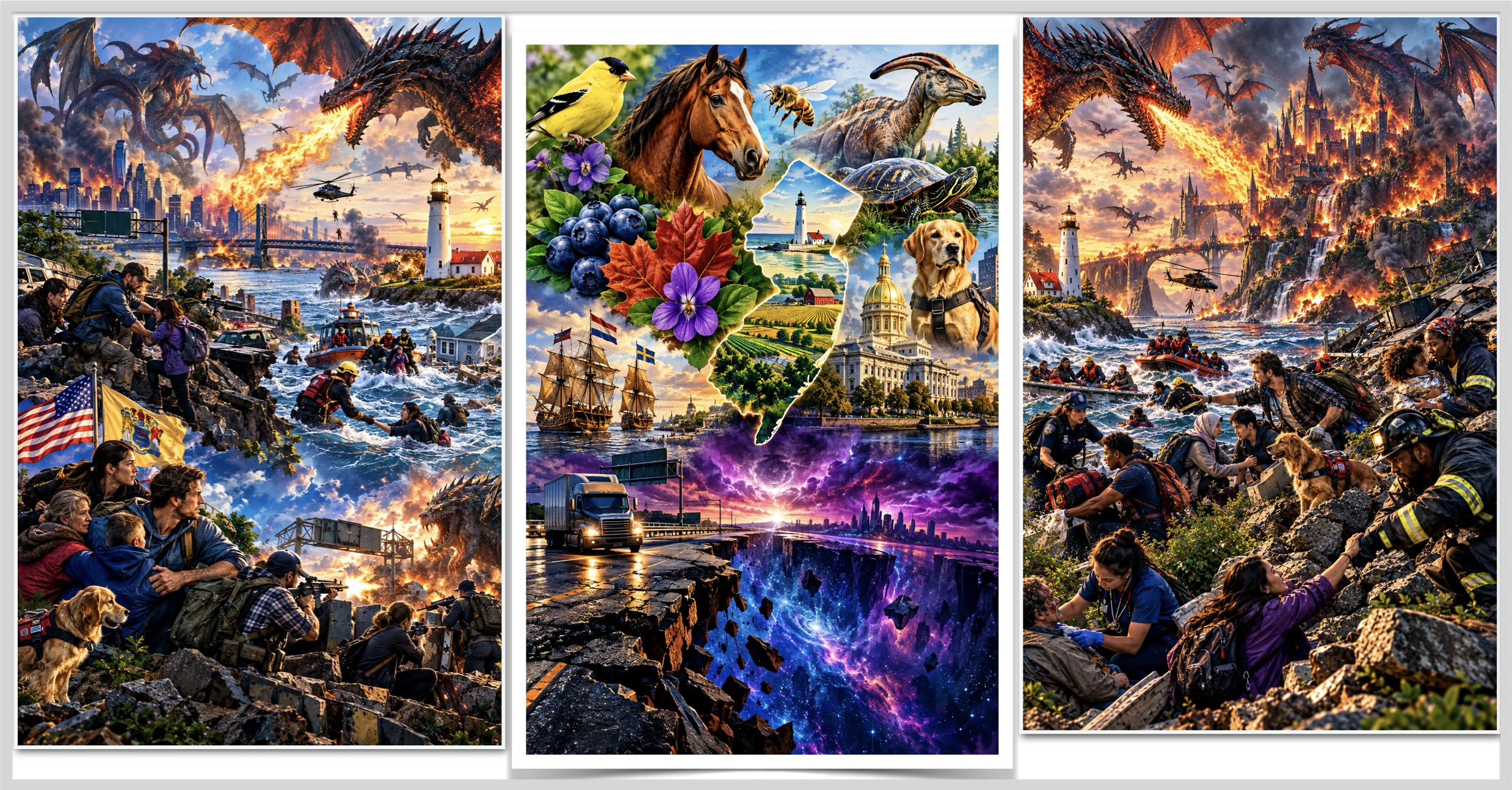
State Bird: Eastern Goldfinch — a small, bright yellow finch common throughout the state year-round. State Animal: Horse. State Insect: Honeybee. State Dinosaur: Hadrosaurus foulkii — a duck-billed dinosaur first discovered in Haddonfield. New Jersey. State Reptile: Bog Turtle. State Dog: Seeing Eye Dog. State Flower: Violet (Viola Sororia) — a low-growing purple and blue flower officially designated in 1971. State Tree: Red Oak — a sturdy native tree chosen for its abundance and historical utility. State Fruit: Highbush Blueberry. State Nickname/Slogan: The Garden State — reflecting the state’s rich agricultural history. State Motto: Liberty and Prosperity…. Sorry, to interrupt those who can still hear, we have breaking news…
WARNING: THE FOLLOWING RECORD IS CLASSIFIED AS A TRENTON-LEVEL ANOMALY.
ACT I: THE SEVERANCE
“A sword does not negotiate; it cleaves. A flood does not compromise; it consumes. We lived upon a prophecy we were too blind to read.” — Elias Vance, NJ Governor
The Anatomy of a Prophecy
Before a land is broken, history often hides a dark, inevitable prophecy within its names. We build our homes on quiet soil and crown them with titles of the past, completely unaware that we are etching our own violent fates onto the map.
Consider the bloodline of the land that was torn away. Long before the sky shattered, this mid-Atlantic region wore many masks. Descendants of the Native Americans who arrived centuries earlier called it “Lenapehoking”. When the Italian explorer Giovanni Da Verrazano arrived in 1524, he christened the shores “Lorraine”. A century later, it was passed between empires, known as “New Sweden” by the Swedes and “New Netherland” by the Dutch.
But the true, unyielding destiny of the territory was sealed on June 24, 1664. On that day, a royal grant issued by James, the Duke of York, bestowed a final title upon the land in honor of Sir George Carteret: New Jersey.
The state was named for the largest of the English Channel Islands, nestled between Britain and France. Yet, the true weight of the name lies in its ancient Old Norse and English origins. The suffix ey translates simply to “island”. But when combined with its ancient prefixes—geirr, jarl, or hjorr—the name Jersey sheds its tranquil facade. It translates to “Geirr’s island,” “the earl’s island,” or, most terrifyingly: “Sword island”.
Sword Island.
A sword is a tool of severance. To be a Sword Island is to be violently cut away from the mainland of reality, amputated from the world you know, and cast adrift into a turbulent, isolated void. This land was the third state to ratify the U.S. Constitution and the very first to sign the Bill of Rights—but no earthly law can govern a territory that has been surgically excised from the earth.
The Rising Tide of the Capital
And what of the state’s beating heart? What of the capital where millions of severed souls would instinctively look for salvation?
In 1719, the settlement was dubbed “Trent-towne”. It was named after William Trent, a prominent Philadelphia merchant who purchased a massive tract of land along the Delaware River from the family of early settler Mahlon Stacy. Over time, “Trent’s town” was shortened to Trenton.
But the surname Trent traces its roots back to Old English and Celtic origins, topographically tied to the River Trent in England. In the ancient tongues, the name carries a brutal, overwhelming translation: “the flooder” or “strongly flooding”.
The Inevitable Collision
Heed the proverbial warning hidden in the syllables of the maps. When the Sword Island is finally cut from the earth, the Flooder will rise.
It is a promise of overwhelming, suffocating tides—a flood not of water, but of total displacement, chaos, and forces beyond human control. The people walked upon a land named for a severed island, governed by a city named for a catastrophic flood, and never realized that the ground beneath their feet was waiting to fulfill its ancient definition.
The names were never just history. They were a warning.
The blade has fallen. The flood has begun.
End Of The World
The end of the world didn’t smell like fire and brimstone.
It smelled like burning brake pads, spilled unleaded gasoline, and cheap diner coffee.
The apocalypse didn’t come with the Four Horsemen or a global nuclear siren. It came at exactly 3:14 AM on a Tuesday, right between Exit 8A and 9 on the New Jersey Turnpike.
One second, an eighteen-wheeler was barreling past the Newark toll plaza, blasting classic rock. The next, the asphalt just… stopped. Cut clean, like a butcher’s block. The trucker slammed the brakes, tires shrieking as the rig skidded to a halt mere inches from the edge of the world.
Below the front bumper was no longer the soil of North America. It was a bottomless, starry abyss.
Above the Turnpike, the familiar light pollution of the East Coast vanished. The sky bruised into a violent, unnatural shade of violet, and two massive, fractured moons rose over the Garden State Parkway.
In a fraction of a second, the state of New Jersey was violently, surgically ripped from the Earth.
Every cell tower in the state screamed a dead signal. Every GPS unit recalculated into a terrifying, infinite loop. The massive financial servers in Jersey City went completely blind. Nine million people woke up trapped on a jagged, severed peninsula floating in an alien sea.
There were no rules anymore. There were no supply chains. The grocery stores were scheduled to run out of food in three days with current logistical shipments organized from overstate lines. The gas stations in forty-eight hours. Complete, utter, suffocating chaos threatened to swallow the state before the sun even rose on a sun they no longer recognized.
But the real terror wasn’t the failing power grid. The real terror wasn’t the panic in the streets, or the panicked politicians locking the doors of the State House in Trenton.
The real terror came when the unnatural fog finally rolled back from the edges of the jagged borders.
Because across the black water of what used to be the Delaware River, the void was gone. It had been replaced by an ancient, towering, impossible landscape. And as the National Guard stood on the jagged concrete cliffs of their severed home, staring out into a dark, magical world they couldn’t possibly understand…
They realized the dark was looking back.
And it was hungry.
Honey, There Is A Dragon In Our Bedroom
The alarm hasn’t gone off yet, so David doesn’t open his eyes.
In the pre-dawn gray of the third-floor apartment in Hackensack, the air smells wrong—too sharp, like wet ozone and woodsmoke instead of exhaust and damp concrete. David rolls over, an exhausted, overworked motion born of a double shift at the warehouse and three hours of sleep, and blindly swats at the nightstand to silence a phantom noise. His hand catches empty air. Instead of the snooze button, his palm hits the edge of a small wooden tray, sending it clattering across the laminate floor. His wedding band and thick-rimmed glasses scatter, skidding into the dark.
“Mmhph. Too early,” David mutters into the pillow, not opening his eyes.
Elena is already awake. She has been awake for twenty minutes, frozen by the silence where the rumble of Route 4 used to live.
On the rug, Cooper—their eighty-pound boxer mix—is losing his mind. The dog isn’t doing his usual high-pitched mailman bark; it’s a deep, vibrating chest-growl, fur bristling along his spine as he scrambles backward, claws clicking frantically against the floorboards, trying to press himself flat against the baseboard while barking at the sliding glass door.
In her arms, four-year-old Liam is screaming in his blue dinosaur onesie, hot tears soaking into the collar of Elena’s t-shirt, tiny fists clenching and unclenching as he buries his face in her neck.
“Dave,” Elena whispers, her voice hollow, stripped of breath. “Dave, get up.”
“Alarm… didn’t go off,” David groans, dead to the world.
Elena turns toward the window, and the breath leaves her lungs in a sharp, hyperventilating hitch.
The George Washington Bridge is gone. The Manhattan skyline, usually a jagged, orange-tinted constellation against the eastern sky, has vanished. In its place is an abyss of black, rolling hills under an unfamiliar sky choked with twin crescent moons. And right outside the double-paned glass of their apartment window, banking hard over the municipal park where the Little League field used to be, is something that defies the physics of the twentieth century.
It is vast. It has the leathery, obsidian hide of a deeply scarred reptile, wings spanning wider than a tractor-trailer, beating the morning air with a sound like wet canvas snapping in a gale. A crest of bone-spikes lines its skull, and as it exhales, a wisp of sulfurous grey smoke curls from its nostrils. It is a dragon—not a cartoon, not a movie CGI effect, but a living, breathing apex predator circling a North Jersey suburb.
“Dave!” Elena shrieks, her voice breaking into a jagged tear of pure panic. She backs away from the glass, her legs trembling so hard she nearly drops Liam.
Cooper lunges forward, barking hysterically, snapping at the air between Elena and the window as if he can scare the horizon away.
David finally sits up, rubbing his face, groggy and irritable. “El, what? What are you yelling about? It’s like five in the—” He stops. He blinks hard, trying to clear his vision without his glasses, squinting blindly toward the window where a block-long silhouette just cast a massive, terrifying shadow across the apartment wall. “What is that? A plane? Is that a drone?”
“Get up!” Elena gasps, hyperventilating, her chest heaving as she clutches Liam tighter. The toddler is wailing, terrified by the noise and the sheer, vibrating terror in his mother’s frame.
Cooper spins in frantic, frantic circles around her ankles, barking non-stop, tripping her up as she tries to back away from the glass.
“Whoa, okay, okay, hey—” David scrambles on hands and knees, patting the floor blindly for his glasses, his face pale, the sleep entirely drained out of him. “El, where are my glasses? I can’t—what is happening outside?”
Elena doesn’t answer. She can’t. Her vision is tunneling, black spots dancing at the edges of her sight as she backs away from the window, stumbling over a pile of laundry. Cooper is right at her heels, whining and barking, half-mad with a terror he can smell in the air.
She turns and runs, carrying the crying child, her bare feet slapping against the hallway floor while the dog chases her heels, skidding around the corner into the living room.
The apartment is dead quiet save for the dog’s frantic barks and Liam’s screams. The Wi-Fi router in the corner is blinking a pathetic, useless red light. The fiber-optic cable running into the wall leads to a ghost network; the outside world has evaporated.
Elena collapses onto her knees in front of the living room television, the strength completely leaving her legs. Liam slips from her arms onto the carpet, crying louder, while Cooper presses his heavy head into her side, whining, trembling violently.
With shaking, bloodless fingers, Elena grabs the remote and hits the power button.
The screen flickers to life with a harsh, blue glare. But there is no Netflix, no YouTube, no emergency broadcast network, no signal from New York or Philadelphia. The digital guide is blank.
Only the four lower local channels function. Channel 2, 4, 7, and 11 roll with a low, agonizing static, displaying nothing but empty, snow-filled airwaves and the faint, ghostly ghost of a test pattern. Everything else is dead. Their cable box is a brick.
And then, across the neighborhood, starting from a single house down the block and rippling outward with terrifying synchronicity, transistor radios, emergency weather bands, and old kitchen stereos snap to life one by one.
Because while half the suburb had switched entirely to streaming, relying on satellite feeds and cloud TV that now pointed at an empty void, the analog airwaves still exist. And out there, across the severed borders of the Kingdom, something is broadcasting on the only frequency left alive. Suddenly Channel 2 of the TV came online. Greetings. This is the New Jersey State Government, we have requested this cable capable channel to display current information for all in the state to see…
Uptime
The alert queue had been quiet for forty minutes, which was its own kind of miracle at 4:50 in the morning, and SJ was using the quiet to eat a granola bar over her keyboard and lose an argument with a rack of switches in Suite C.
“You are not actually running hot,” she told the thermal graph, which disagreed with her. “You’re reporting hot. There’s a difference, and I would like you to notice the difference.”
The Secaucus floor at that hour was the loudest silent place SJ knew — thousands of fans running a few degrees below a whisper, cold air rolling off the hot-aisle containment in a way that made her ears feel packed with cotton after six hours in it. She liked the overnight shift for exactly this reason. Nobody talked to her. The building talked to her instead, in dashboards and blinking amber, and she’d gotten good enough at the conversation that she mostly agreed with what it said.
She did not agree with Suite C.
She was three keystrokes into pulling the sensor’s calibration log when the second monitor — the one running the carrier-status board, forty-some rows of green she checked out of habit more than need — dropped a row to yellow.
Then another.
Then, in the time it took her to actually look up from the keyboard, the whole board went red at once, top to bottom, the way it never did, because that wasn’t how outages worked. Outages were a fiber cut in Elizabeth, a bad announcement out of Ashburn, one carrier limping while the other nine picked up the slack without anybody outside the building ever noticing. Outages were local. Outages had a shape.
This didn’t have a shape. This had every shape at once.
“Okay,” SJ said out loud, to nobody, the way she talked to everything. “Okay, that’s — no. That’s not a thing that happens.”
She pulled up the traceroute tool on muscle memory alone, fingers moving faster than the part of her brain that was still insisting this was explainable. She pinged the building’s own upstream router first — answered, fine, local network was fine — and then out, one hop, two, watching the latency numbers climb and climb and then simply stop climbing, because there was nothing left to measure the distance to. Not a timeout. Timeouts had numbers attached, milliseconds ticking up toward failure. This was cleaner than that. This was the query going out and never coming back at all, like she’d thrown a rock into water that had stopped existing exactly at the surface.
She tried a different target. Another. A third, a server she happened to know sat in a data center outside Philadelphia, forty minutes down the Turnpike, a route she could probably have drawn from memory.
Nothing.
She was still telling herself it was a peering problem — a bad update somewhere upstream, something with a name and a root cause and a Tuesday-morning postmortem — when she noticed that her phone, sitting face-up next to the keyboard, had stopped showing bars entirely. Not one bar. Not searching. The little indicator was just gone, like the software had quietly decided the concept no longer applied.
SJ stood up. She did this rarely enough at 4:50 in the morning that her chair rolled a full foot before it stopped, loud against the raised floor tile in a room built to swallow noise.
The suite had windows along the east wall, small ones, more for the fire marshal than the view, looking out over the Turnpike and, past it, the flat black nothing of the Meadowlands before dawn. SJ crossed to the nearest one out of an instinct she couldn’t have named yet — an engineer’s need to verify a reading against the physical world instead of trusting a screen that had just told her something impossible.
The Turnpike was there. The sodium lights were there, running their long orange line north and south exactly the way they had every night of her life.
The sky past them was wrong.
She stood at the glass for longer than she would later be able to account for, watching a second, smaller moon sit low over the marsh where there had only ever been the one, and somewhere behind her, on a monitor she’d stopped looking at, forty rows of red waited patiently for her to come back and tell them what to do about it.
She made it three steps back toward the desk before her body remembered what her training was for.
Incident response. She had run tabletop exercises for exactly this — not this, nothing had ever been designed for this, but the shape of it, the first ninety seconds of any outage that mattered: assess, isolate, escalate. She’d gotten as far as assess. Isolate didn’t apply to something with no edge she could find. That left escalate, and escalate meant calling someone whose job title was bigger than hers.
Her phone still had no bars. She dialed anyway, out of the same stubbornness that made her argue with thermal graphs — her supervisor’s cell, then the building’s NOC line, then, when neither of those did anything but sit there with the call icon spinning against a black screen, her mother’s number in Fort Lee, muscle memory faster than judgment.
Nothing answered. Not a busy signal. Not a network-error tone. The phone behaved exactly like a phone that had never been told what a phone call was.
“Okay,” she said again, quieter this time, and put it down.
The hallway outside Suite C ran past two more server rooms and a break room nobody used at 5 a.m., and SJ was halfway down it, already rehearsing what she’d say to whoever picked up the building’s emergency line, when she heard the fire door at the far end bang open.
Ray from security stood in the frame, backlit by the parking lot floods, not moving.
“Han,” he said, in a voice that had gone flat in the specific way voices go flat right before they stop being useful. “You gotta see the sky.”
“I saw the sky,” SJ said.
“You gotta see it from outside.” He said it like a man repeating an instruction he didn’t believe himself. “Radio’s doing something.”
She followed him out past the loading dock, into air that smelled wrong before she could say how — a mineral sharpness under the usual diesel and river mud, like a lightning strike from a storm that hadn’t happened. Ray’s handheld crackled at his hip, the kind of static that usually meant a dead channel, and then, underneath the static, a voice.
It wasn’t the county dispatcher. It wasn’t anyone Ray recognized, because he turned to SJ with the radio held out like it might bite him, and SJ — who had spent six years thinking about signal the way other people thought about breathing — understood before she understood, in the part of her brain that only ever spoke in frequencies and bandwidth, that whatever this was, it was running on the one layer of infrastructure nobody had touched in decades. Not fiber. Not cell towers. The old analog band, sitting there unused and unwatched, and something had just decided to use it.
“…this is the New Jersey State Government,” the voice said, thin and looping through a wash of static, patient in a way that made it worse. “We have requested this frequency to display current information for all in the state to hear…”
SJ stood in the parking lot with a second moon over her shoulder and a dead phone in her pocket, and for the first time all morning, she had absolutely nothing to say out loud to anyone.
The Panic & The Pivot
By 6:00 AM, the sun—a pale, bruised yellow thing that was decidedly not the star they were used to—crept over the horizon, illuminating the sheer, jagged cliffs where the state borders used to be. The Delaware River was gone, replaced by a churning, violet abyss. The bridges to New York ended in mid-air.
The state of New Jersey was entirely alone.
Inside the State House in Trenton, the panic was absolute, suffocating, and deafening. Cell phones were glorified bricks. The internet was a graveyard. But the internal landlines—the copper wires buried deep beneath the asphalt—still carried a pulse.
In the underground emergency operations center, Priya Anand, a thirty-two-year-old senior legislative aide and Central Jersey political fixer, was currently keeping the state government from eating itself alive.
“I don’t care if the federal government hasn’t authorized it, the federal government is not there!” Priya shouted into a heavy red telephone, slamming her palm onto a sprawling map of the state. She pointed to a cluster of red pins. “Governor’s orders. State Police are to immediately commandeer every ShopRite distribution center and Wawa logistics hub. Lock down the diesel reserves at the Turnpike rest stops. Rationing starts now.”
Around her, the Governor and the remaining House Representatives were doing something incredible: they were working together. In the face of apocalyptic logistical failure, the often-mocked bureaucratic machine of New Jersey became its greatest weapon. They didn’t have magic, but they had spreadsheets, clipboards, and a ruthless understanding of supply chain logistics. They mapped out food reserves, mobilized the National Guard to secure the water treatment plants, and established an emergency continuity of government. Bureaucracy, however flawed, was the only thing standing between nine million citizens and total anarchy.
But there was a glaring, terrifying gap in the room.
“Priya,” the Governor barked, his tie discarded and his sleeves rolled up. “Where in the world is the Senate Majority Leader? For that matter, where is any of the State Senate?”
Priya looked at the ledger. She had sent runners to their offices, hotels, and homes. “Nothing, sir. Thirty state senators, and not a single one has checked in.”
The Governor’s face darkened. “Dispatch the State Troopers. Turn out their homes. Find them. We can’t hold this state together if half the legislature is missing in the dark.”
The North: Bleeding the Grid
A hundred miles north, in the heavily fortified PSEG control center in Newark, alarms were screaming.
SJ Han didn’t hear them. The brilliant, heavily caffeinated North Jersey electrical engineer was entirely hyper-focused on the glowing schematics of the state’s power grid, her fingers flying across the terminal.
“The interconnects are gone!” a junior technician yelled over the blaring sirens. “New York and PA are dead lines! The feedback loop is going to fry the Salem nuclear plant in four minutes!”
“I know!” SJ barked, her eyes darting across the voltage readouts. The state’s power grid was designed to share the load with the rest of the East Coast. Severed from the mainland, the massive amount of generated electricity had nowhere to go. It was a pressurized pipe about to burst.
“We survive by building, not burning,” SJ muttered to herself, grabbing a heavily modified bypass schematic she’d drawn on the back of a pizza box ten minutes prior. She slammed her hand down on the comms button. “Manual override! Sever the interstate arteries! Dump the excess load into the industrial sectors of Newark and Jersey City! Ground the rest!”
“That’ll blow every transformer on the border!”
“Do it, or we lose the whole state!” SJ roared.
The technician threw the heavy switches. The lights in the control room flickered, dipped, and then surged back to a steady, humming fluorescent white. SJ collapsed into her chair, wiping sweat from her forehead. She had just amputated the state’s electrical limbs to save the heart. The grid was alive.
The South: Blood in the Pines
Deep in the sprawling, shadowy expanse of the Pine Barrens, the Severance didn’t look like failing infrastructure. It looked like a nightmare.
At an emergency triage camp set up in Wharton State Forest, Del Sooy wiped the blood off her hands with a rag, her jaw set in a grim, immovable line. The twenty-eight-year-old Search-and-Rescue medic was staring at an injury that made absolutely no medical sense.
The hiker on the cot in front of her was screaming in agony. His right arm was blackened and blistered, the skin crackling with a strange, ambient frost, despite the suffocating August humidity.
“What happened?” Del demanded, shining a penlight into his dilated eyes.
“The trees!” the man sobbed, shivering violently. “There was a woman in the trees… she didn’t have eyes… she just breathed on me and the cold… the cold burned!”
The other EMTs in the tent stared in horror, paralyzed by the sheer impossibility of the statement. But Del was a Piney. She had grown up on stories of things in the woods that didn’t follow the rules. She didn’t freeze; she adapted.
“I don’t care if a fairy did it,” Del snapped, snapping her gloves off and grabbing a trauma kit. “Treat it like a severe chemical burn combined with stage-three frostbite. Wrap it in silver sulfadiazine, start a warm saline IV, and get him under a thermal blanket now.”
As the team rushed to follow her orders, Del looked out the flap of the medical tent, staring into the dense, dark pitch pines. The woods were changing. The folklore was waking up. And she was going to have to figure out how to heal injuries inflicted by magic using nothing but gauze and grit.
The Coast: Holding the Line
While the politicians scrambled, the engineers fought the grid, and the medics treated the impossible, the Atlantic Ocean was boiling.
At the Coast Guard Training Center in Cape May, Commander Manny Cabral stood on the reinforced sea wall, staring through heavy tactical binoculars at a maritime border that defied all logic. The Atlantic Ocean as he knew it was gone. The water was a deep, iridescent, unnatural bruised purple. And worse—his radar screens were showing massive, jagged archipelagos of unknown landmasses where open water used to be. Here is the fleshed-out narrative based on your outline.
The Panic & The Pivot
It didn’t happen with a cinematic explosion, but with a synchronized, catastrophic halt. Within three hours of the Event, the arteries of the state completely clotted. The Turnpike became a 117-mile parking lot of dead vehicles. Supermarket shelves were stripped bare in a wave of feral, localized panics, and the ports in Elizabeth and Newark went dark, effectively severing the logistical spine of the East Coast.
In Trenton, the initial reaction was sheer, unadulterated terror—but then the pivot happened. The Governor, operating out of a hastily secured bunker beneath the State House Annex, initiated continuity of government protocols. It was ugly, slow, and reliant on decades-old emergency playbooks, but it worked. Bureaucracy, so often the subject of public scorn, suddenly became the only tangible lifeline. Clerks, aides, and mid-level managers weaponized red tape to seize fuel depots, ration municipal water, and lock down the state’s borders.
But a glaring, terrifying vacuum remained at the top: the Senators were gone. They hadn’t checked in, their secure lines were dead, and their panic-button trackers were dark. Fearing a decapitation strike on the state’s leadership, the Governor issued a quiet, desperate order. Through the blackout and the gridlock, heavily armed tactical units of the State Police were deployed with a single directive: scour the state, tear down doors if necessary, and find the missing Senators before the public realized they were flying blind.
SJ Han (North Jersey)
The command center in Newark was a symphony of blaring alarms and flashing crimson lights, but SJ Han didn’t hear the noise anymore; they only saw the math. The northern grid was cascading, substations tripping off-line like dominoes as an unexplainable, massive surge of energy rippled through the infrastructure.
SJ was running on black coffee and thirty-six hours of adrenaline, violently typing command overrides to island the state’s most critical power grids. “Drop Sector 4!” SJ barked into a headset, eyes darting across a massive, glitching LED schematic of Bergen County. “If we don’t shed the load now, the transformers in Hackensack are going to physically melt.” SJ was playing god with the switchboard, plunging thousands into darkness to keep the triage centers and water treatment plants breathing, fighting a shadow-war against a power grid that suddenly seemed to possess a malicious mind of its own.
Priya Anand (Central Jersey)
The halls of Trenton were suffocating under the weight of hyperventilating politicians and frantic military liaisons, but Priya Anand was the eye of the storm. While elected officials argued over jurisdiction and optics in the face of the apocalypse, Priya, a senior political strategist, was cornering them one by one.
“I don’t care what the zoning laws say, Assemblyman,” Priya said, her voice dropping to a terrifyingly calm register as she pinned a trembling official against a mahogany door. “Sign the requisition order for the high school gymnasiums. Now.” She didn’t have time for fear. Armed with a clipboard, a dead cell phone used merely as a prop for authority, and an encyclopedic knowledge of state statutes, Priya was single-handedly bullying the fragmented legislative body into action, proving that in the end of the world, a well-placed executive mandate was more powerful than a bullet.
Del Sooy (South Jersey)
Deep in the Pine Barrens, the air always smelled of cedar and damp sand, but tonight, the triage tent outside the local clinic smelled heavily of ozone and charred flesh. Del Sooy, as a search and rescue medic was used to stopgap the mass influx of incoming patients, stripped off their bloody gloves and stared at their hands, trying to make sense of what they had just seen. A great deal of ‘things’ were moving now through these woods.
The logistical collapse hadn’t hit the isolated pines as hard as the cities, but something else had. The patient on the table wasn’t suffering from a car crash or a riot wound. The man’s veins were faintly glowing beneath his skin with a sickly, violet luminescence, and again this frostbite on his hands was somehow—impossibly—burning through the gauze. Standard triage protocols were useless. Del reached for a scalpel, realization dawning with a cold dread: whatever had broken the world hadn’t just broken the supply chains. It had broken the laws of physics, and Del was going to have to write a new medical textbook on the fly to keep these people alive.
Manny Cabral (“Coast”— Jersey Shore)
The Atlantic Ocean was furious. A thick, unnatural fog had rolled into the Raritan Bay, choking out the moonlight. Out on a heavily armored Marine Police interceptor, Manny Cabral was gripping the helm until his knuckles turned white.
The maritime borders were in absolute chaos. Hundreds of panicked civilians had taken to the water in everything from luxury yachts to pontoon boats, desperate to flee the gridlock on the mainland. Manny’s radio was a wall of overlapping maydays and static. “Fire a warning shot across the bow of that cruiser,” Manny ordered his deputy, his eyes scanning the pitch-black water. He wasn’t just keeping panicked boaters from colliding in the dark; he was enforcing a strict quarantine line. New York Harbor was sealed, and the rest of the other Coast Guard had gone completely silent. Manny was the only thing standing between the chaotic exodus of the mainland and an ocean that, since the Event, had begun to harbor massive, unidentifiable shapes moving just beneath the freezing waves.
ACT II: THE WORLD ARRIVES
“Arrivals are the catalyst, departures the move into a next step.” — Elias Vance, NJ Governor
WARNING: BROADCAST OVERRIDE AUTHORIZED. THREAT LEVEL: CRITICAL.
We thought the Severance was the main event. We thought losing the power grid, our supply chains, and the rest of the United States was the worst thing that could possibly happen to us.
We were wrong. The Severance wasn’t just a geographical amputation. It was a dinner bell.
The unnatural fog has finally burned off the jagged edges of our shattered borders, and the reality of our new neighborhood is staring us down. This isn’t a bedtime story. The things waiting in the dark don’t come with whimsical prophecies or peaceful greetings. They come with teeth, ancient steel, and a terrifying mastery over the elements.
Modernity is officially at war with Fantasy.
In Hackensack, it started with a shadow. A living, breathing apex predator with obsidian scales and wings the size of a tractor-trailer now claims the airspace where commuter drones and commercial planes used to fly.
In the Pine Barrens, local folklore is bleeding violently into reality. Eyeless things in the trees are breathing a magical, crackling frost that burns right through standard-issue medical gauze, rewriting the laws of physics and rural triage on the fly.
And off the coast of Cape May, the boiling, bruised-purple ocean is no longer just hiding massive, unidentifiable shapes. The deep has finally breached the surface. The alien sea is teeming with ancient aquatic threats ready to tear into our fiberglass hulls and overrun our quarantined maritime borders.
They look at our concrete strip malls and see fortresses. They look at the Garden State Parkway as a tactical invasion route. They look at our forged steel, the humming electricity we bled to keep alive, and the sheer, stubborn grit of nine million stranded citizens—and they want to claim it all.
We spent the first week fighting the blackout and the panic. Now, we have to fight the mythic.
New Jersey is no longer just floating alone in an alien sea. The world has arrived on our shores.
And it is armed.
We found it. And we know they saw us.
An entire Kingdom was found located in the region equivalent of the distance from New Jersey to the New York City Borough of the Bronx. This kingdom discovered by distant observation seems to span all the way to the ocean with a gap of fantasy forest in between them and us after a strong river we have dubbed ‘the Hudson River’ for now. This information was suppose to be kept secret, but of course the entire state knew as gossip travels faster than lightning can strike. Especially when the gossip is true.
Diesel verses Power
The Humvee’s heavy diesel engine vibrated right through the floorboards as it ground to a halt near the edge of what used to be a West Milford tree line. Overhead, hovering silently at one hundred and eighty meters, the drone radio repeater hummed on its tethered frequency. By splitting bands—using 2.4 GHz to talk to the ground station and a long-range 900 MHz relay to punch signals over the unfamiliar, rolling ridges of the new horizon—it beamed high-definition thermal and optical data straight back down the line.
Inside the tactical vehicle, Corporal Miller stared at the ruggedized Toby Roughbook laptop screen. “Signal relay is clean,” he muttered, adjusting the headset. “We’re pinging twenty-two kilometers out. No terrain masking. We can see right into the valley.”
Two vehicles deep into the reconnaissance run, the scout team was operating under strict joint orders. With aviation fuel strictly rationed to preserve emergency air assets, ground teams were doing the heavy lifting, mapping the perimeter where New Jersey’s northern border used to meet upstate New York.
“Movement,” whispered Specialist Davies from the passenger seat, pointing a gloved hand toward a jagged clearing half a mile down the slope. “Command, you seeing this on the repeater feed?”
Back at the military outpost in Fort Dix—and further down the line at the Trenton State House, where the Governor, legislative leadership, and the highest-ranking federal military commanders had set up joint headquarters—analysts watched the 1080p feed flare to life.
On the screen, a massive, boulder-shouldered silhouette—a Rock Ogre, thick-skinned and foul-smelling—was crouched over a carcass. But it wasn’t a deer or a wild boar. Tangled in the dirt was a creature straight out of ancient tapestries: a Qilin, or Kirin. Its scales shimmered with iridescent mother-of-pearl, and its single, spiraled horn caught the afternoon sun even as the ogre tore greedily into its flank.
“What in the….” breathed the driver, leaning forward against the steering wheel, his eyes wide. “Is that… is that a unicorn?”
“Quiet,” Miller hissed, raising his binoculars.
Suddenly, the scent of ozone and spilled blood hit the wind. The Qilin wasn’t entirely dead; or perhaps sensing the mechanical rumble of the Humvees across the clearing, its head snapped up. Its dark, intelligent eyes locked onto the metal vehicles. With a violent, bone-racking shudder, the injured mythical beast staggered to its feet, ignoring the ogre entirely, and turned its fury outward.
It didn’t look like a gentle creature of myth. It looked like a multi-ton engine of lethal, bleeding vengeance, charging directly up the incline toward the convoy at a terrifying, ground-shattering sprint.
“Whoa, whoa, whoa! Back up! Reverse!” Davies yelled, fumbling for his door handle.
“Halt! Stop! Hey! Whoa!” Miller screamed out the rolled-down window, waving his arms frantically, trying to use voice commands to deter the beast.
The Qilin didn’t slow down. It let out a piercing, glass-shattering shriek that rattled the Humvee’s side mirrors, its single horn glowing with a volatile, building heat that crackled across the airwaves. High-beam headlights flickered on, cutting sharp white lances through the gloom to blind it, but the beast threw its head down and accelerated, intent on goring through the steel doors.
“It’s not stopping! Fire! Fire!“
The staccato crack of 5.56mm rounds tore through the cab. Tracers lit up the afternoon shade as concentrated fire slammed into the charging creature’s chest. For a second, momentum carried it forward—and then, with a catastrophic, earth-shaking slide, the massive animal collapsed. Its heavy, scale-armored bulk skidded across the dirt and smashed directly into the steel bumper of the lead Humvee with a dull, sickening thud, kicking up a wall of dust that completely blinded the windshield.
Silence dropped over the cab, save for the heavy panting of the soldiers and the distant hum of the airborne drone repeater overhead.
For a long, agonizing moment, nobody moved.
Then, the back door flew open. A young specialist jumped out, staring down at the fallen creature draped across their bumper, his face split by a manic, adrenaline-fueled grin. “Dude! Did you see that?! We just took down a mythological beast! That is the coolest thing I have ever seen in my life! Put that on the intranet, everyone’s gonna lose their minds—”
“NO! NONOOo, you idiot!” Davies shouted, his voice cracking with absolute, raw panic as he shoved the other soldier back. “Are you out of your mind? Do you know what we just did?!”
“We defended the vehicle,” Miller said, though his own hands were shaking as he gripped his rifle.
“We didn’t just kill an animal!” Davies hyperventilated, pointing wildly at the ridge line where the dark, unbroken forests of the Kingdom stretched endlessly into the distance. “That thing belonged to them. That’s a sacred creature, or a noble’s pet, or a their prince’s mount! We just walked across the border, slaughtered their wildlife, and broadcasted it live back to Trenton on a military relay! They’re going to trace the signal. They’re going to come find us. We just started a war!”
Inside the tactical command center back in Trenton, the video feed from the drone repeater sat frozen on the screen. The high-ranking federal commanders and National Guard generals stood in absolute silence around the map tables under the copper dome of the State House. Nobody cheered. Nobody thought it was cool.
A senior general slowly leaned forward, staring at the dead Qilin on the monitor, knowing that whatever dark, magical empire lay just beyond the old turnpike miles—was about to answer back.
Before the dust from the fallen Qilin could even settle, the ground beneath the Humvees gave a violent, sickening shudder.
From the treeline where the Rock Ogre had been feeding, a low, tectonic rumble shook the air, drowning out the whine of the airborne drone repeater. The monster hadn’t fled. It had watched the modern metal beasts strike down the creature it claimed, and its brute, simple mind didn’t care about geopolitics of Trenton. It cared about its meal.
“Movement! Two o’clock! Look out!” Miller screamed, dropping the Roughbook and frantically grabbing for his weapon.
Towering nearly twelve feet high, muscles corded like braided steel beneath hide the color of wet granite, the Rock Ogre stepped out of the shadow of the pines. It didn’t hesitate. With terrifying, fluid speed for something of its mass, it reached down and clawed a boulder the size of a water heater out of the earth, its thick fingers grooving deep into the stone.
“Drive! Drive, go, go, go!” Davies yelled, slamming his fist against the dashboard.
The driver stomped the accelerator, but heavy military Humvees on rough terrain don’t jump—they grind.
The ogre wound back its massive, bone-thick arms and hurled the boulder with the force of a siege catapult.
The air tore with a sharp, screaming whistle. There was no time to duck, no time to raise a shield. The massive grey mass smashed directly into the lead Humvee’s turret ring with a catastrophic, earsplitting explosion of tearing metal, shattered glass, and buckling steel.
The impact sheared the roof canopy open like a tin can. The young specialist who had been cheering a moment ago—the one who thought killing a mythological beast was the coolest thing he’d ever seen—never even made a sound. The kinetic force flattened the turret mount, burying the gunner in a crushing, immediate smash of twisted metal and pulverized stone.
The Humvee spun out violently, its tires shredding against the dirt shoulder, slamming to a halt against a thick oak tree with a smoking, ruined engine block.
Inside the cabin, the air instantly tasted of copper, scorched oil, and pulverized concrete.
“Medic! Medic, we got a hit! Leader vehicle down!” Miller roared into his radio handset, his voice cracking with a sudden, suffocating wave of terror as warm blood began dripping from the fractured roof onto the dashboard.
High above, the drone radio repeater kept humming, its 900 MHz signal relaying the entire bloody, chaotic feed straight back down the line. In the Trenton State House command center, under the copper dome, the high-ranking federal commanders and National Guard generals watched the screen go violently shaky, then static-heavy as the forward vehicle’s comms array shattered.
The debate over whether they had started a war ended right there.
There were no more committees to form, no more bureaucratic protocols to draft. The fantasy world hadn’t sent an army of knights or a formal declaration. It had sent a single, brutal monster that threw stones like artillery, turning an ordinary New Jersey reconnaissance run into a massacre.
“All units,” a gravelly voice crackled over the secure joint-command frequency back in Trenton, stripping away all remaining hesitation. “This is the Operations Hub. Weapons free. Authorization granted for full kinetic retaliation. Welcome to the war.”
The forest didn’t stay quiet for long.
Before Miller could even drag his bleeding forearm away from the smashed radio console, the air above the treeline erupted. The remaining Humvee—scrambling backward in a panicked, high-revving cloud of black exhaust and flying gravel—unleashed its mounted heavy machine gun.
A stream of .50 caliber rounds tore through the gloom with a sound like tearing canvas. The kinetic energy of the heavy rounds slammed directly into the Rock Ogre’s chest and shoulders, punching through grey, calcified hide that ordinary steel blades could never scratch. The monster stumbled backward, its terrifying momentum halting instantly as lead tore through bone and muscle. It let out a wet, bubbling gurgle that shook the canopy.
Then, its legs buckled.
With a deafening, seismic crash that felt like a localized earthquake, the twelve-foot-tall titan collapsed forward, smashing into the forest floor and crushing a dozen saplings to splinters. A cloud of dirt, broken rock, and black blood billowed across the clearing.
Silence rushed back in, broken only by the crackle of the ruined Humvee’s burning engine and the high-pitched, steady whine of the drone radio repeater orbiting silently overhead.
Inside the operational vehicle, the surviving specialist threw his door open, fell out onto the dirt, and vomited violently into the weeds. He wiped his mouth with the back of a trembling, blood-spattered hand, staring wildly at the mountain of dead flesh resting thirty yards away.
“We killed it,” the specialist choked out, his voice hitching into a ragged, hysterical sob. He looked up at Miller, his eyes wide and unseeing, completely losing his grip on reality. “We killed a giant! Oh, God please save us, we killed one of theirs!”
“Get a grip, soldier—” Miller started, scrambling out of the passenger side, his own breath coming in ragged gasps.
“You don’t understand!” the kid screamed, scrambling backward on his hands and knees, pointing a shaking finger at the corpse of the Rock Ogre and then toward the endless dark horizon of the Kingdom. “That wasn’t just some animal! That thing lived here! That’s their land, that’s their monster, that’s… that’s a kingdom out there! A whole empire with wizards and knights and God only knows what else!”
Tears carved clean tracks through the soot and sweat on the young soldier’s face. He clutched his helmet with both hands, rocking back and forth as the panic fully took him.
“We just started a world war!” he wailed, staring up at the sky where the drone relay hummed its impassive data feed. We just started a war on day one of our first border patrol! They’re going to come for us. They’re going to burn New Jersey to the ground, and it’s our fault—we killed their champion, we killed their—”
“Be” quiet!” Miller roared, lunging forward and grabbing the kid by the tactical vest, shaking him hard until his teeth rattled. “Look at me! Look at the body, you idiot!”
The specialist blinked, sniffling, his chest heaving as he forced his gaze toward the fallen titan.
“Look at it,” Miller panted, his own hands shaking as he pointed at the beast’s blunt, snout-less face, the crude stone-hide, the total lack of armor, banners, or intelligent harness. “Does that look like a knight’s pet? Does that look like it’s wearing a uniform? It was eating a deer—or whatever that unicorn thing was. It was a wild animal. A big, ugly, rock-throwing wild animal.”
“A… a wild animal?” the kid whispered, the hysteria momentarily faltering under the weight of sheer exhaustion.
“Yeah,” Miller muttered, though his heart was still hammering a frantically against his ribs as he looked back toward the dark, indifferent treeline. “Just a local pest. Except out here… the local wildlife fights back with artillery.”
High above, the 900 MHz band kept relaying every breathless word, every drop of blood, and every frantic realization straight back down the line. In the Trenton State House, under the copper dome, the commanders watched the feed pivot from a tactical massacre into a grim, sobering truth:
New Jersey hadn’t accidentally provoked an empire with this kill.
They had just learned what lived in the woods. And the woods were entirely unregulated.
The drone radio repeater continued its impassive orbit at one hundred and eighty meters, its 900 MHz band keeping the bloody reality of the West Milford tree line tethered directly to the command center beneath the copper dome of the Trenton State House.
For fifteen minutes, Corporal Miller and the two other surviving specialists sat in the agonizing silence of the unregulated woods, rifles raised, waiting for the treeline to vomit out another nightmare, one Humvee down.
It didn’t. Instead, the heavy, vibrating rumble of a mechanized recovery convoy broke the stillness.
Two armored transport trucks and a heavy-duty military wrecker ground their way up the dirt incline, flanked by a squad of National Guardsmen in full tactical gear. The cavalry had arrived, but there was no cheering. As the soldiers dismounted, their rifles immediately snapped toward the dark canopy of the forest. The recovery team leader, a grizzled logistics Sergeant named Harris, stepped out of the lead transport and surveyed the carnage.
His eyes swept over the smoking, ruined Humvee, the pulverized roof canopy, and the mountain of dead flesh resting thirty yards away.
“Perimeter!” Harris barked. “I want a 360-degree overwatch! Anything bigger than a squirrel moves in those trees, you put it down!” He walked over to Miller, his boots crunching on broken glass and bullet casings. “Corporal. Command sent us to clean up the mess and bring it all home.”
“All of it?” Miller asked, his voice hollow as he gestured to the twelve-foot-tall, wet-granite bulk of the Rock Ogre.
“Every cursed ounce,” Harris confirmed grimly.
The Recovery Operation
The first priority was the fallen. A heavy silence fell over the detail as three soldiers climbed onto the crushed chassis of the lead Humvee. The kinetic force of the ogre’s siege-weapon boulder had completely flattened the turret mount. Using hydraulic jaws, they carefully pried the buckling steel apart to retrieve the body of the young specialist.
Davies, standing near the surviving Humvee, looked away as they placed the body bag onto a stretcher. The kid had died cheering, thinking he was in a game, right before the fantasy world crushed him into pulverized concrete and scorched oil.
With the human cost secured, the heavy-duty wrecker backed up to the treeline. Thick steel winch cables were dragged through the mud.
“Where exactly are we supposed to send a rock giant?” Davies muttered, watching as two engineers struggled to wrap a heavy tow strap around the Rock Ogre’s thick, calcified legs.
“The ogre is going straight to the engineers at Picatinny Arsenal,” Harris replied, checking a digitized manifest on his tablet. “Trenton watched your feed. A stream of .50 caliber rounds took it down, but command wants to know exactly how much kinetic energy that grey hide can absorb. If the local wildlife comes with natural armor plating, the eggheads need to figure out how to crack it efficiently.”
The Harvest
While the wrecker hauled the massive ogre onto a reinforced flatbed, a secondary team surrounded the Qilin. Up close, the creature was both magnificent and tragic. Its iridescent, mother-of-pearl scales were dulled by dirt and its own blacken blood, the single spiraled horn cold and lifeless.
“What about the unicorn-thing?” Miller asked, wiping a streak of dried blood from his forehead. “Picatinny taking that too?”
“Negative,” Harris said, pulling on a pair of thick rubber biohazard gloves. “That’s going to the Department of Agriculture and the biology labs at Rutgers.”
Davies frowned, his panic finally subsiding into grim confusion. “Agriculture? Why?”
Harris looked at the multi-ton carcass, his expression coldly pragmatic. “Because the Trenton is already staring down the barrel of a food shortage. We have nine million people trapped on this peninsula and supply chains that drop off the edge of the earth. We don’t have enough cattle to sustain the population.”
Harris slapped the Qilin’s heavy, armored flank.
“Command isn’t just looking at this thing as a mythological beast, Davies. They’re looking at it as two tons of potential flank steak. If the bio-labs test this meat and confirm it isn’t toxic, we aren’t just going to fight the local fauna. We’re going to eat it.”
Miller stared at the fallen creature. The sheer, ruthless practicality of it sent a chill down his spine. The young specialist had been right about one thing: there was a kingdom out there, full of magic and monsters. But they had just picked a fight with New Jersey—a state running out of resources, out of patience, and out of food.
“Get it loaded,” Miller said softly, turning his back on the dark horizon of the Kingdom. “Let’s see what unicorn tastes like.”
Check Points Hurt
The sandbags at the Mahwah Township checkpoint were still sweating morning dew, fresh from being hauled out of a Burlington County depot forty-eight hours ago. Route 17 North didn’t lead to Suffern anymore. Fifty yards past the concrete jersey barriers, past the coils of razor wire strung across the asphalt, the highway simply dissolved into a rolling, violet-hued expanse of ancient hills and stunted pine trees under an unfamiliar sky.
Captain Marcus Eshada wiped a sleeve across his forehead, tasting salt and cold air. His uniform felt wrong—the digital camo pattern was tailored for a country that no longer existed three miles down the road. Behind him, the rest of the checkpoint crew was shifting weight from boot to boot, drinking lukewarm coffee from thermoses, murmuring about whether the Turnpike authority was going to waive tolls or if anyone’s direct deposit was ever hitting again.
Nobody was taking it seriously yet. That was Vance’s main problem.
To the twenty-one-year-old guardsmen manning the line, this was a bizarre, high-stakes border patrol exercise. A weird administrative glitch. To the staff officers back in Trenton trying to stitch the Trenton Compact together, it was a logistical puzzle of food distribution and data-center routing.
Only Vance treated it like an operational theater under active reconnaissance. His men called him paranoid behind his back—the “old man” who kept double-checking arc of fire, who insisted on non-lethal riot gear being kept within arm’s reach alongside live rounds, who paced the perimeter like a caged panther. We’re in New Jersey, Cap, not Fallujah, a sergeant had laughed that morning. Who’s gonna attack us? Elves?
Then the figure walked out of the violet fog.
At first, they thought it was a local jogger who had ignored the evacuation warnings, or some idiot trying to sneak back into the state to check on a summer home in Orange County. But as the figure cleared the ragged tree line where the Route 17 shoulder used to end, the details went entirely sideways.
The man was wearing a faded, neon-green New Jersey Devils jersey stretched tightly over a tunic of boiled leather, paired with high-top sneakers completely caked in strange, iridescent mud. He looked frantic, wild-eyed, gasping for breath as he sprinted toward the checkpoint with a staggering, disjointed gait.
“Halt! Stop right there! Stay behind the wire!” Specialist Miller shouted, stepping forward with his rifle raised, following standard operational protocols for verbal commands.
The runner didn’t stop. He didn’t even slow down.
He didn’t speak English. When he hit the concertina wire, he didn’t care about the barbs ripping his clothes; he screamed something in a harsh, guttural cadence full of rolling vowels and clicking consonants—a frantic, pleading string of syllables completely alien to any known dialect on Earth.
“Step back! Back up!” Miller yelled, his voice cracking with sudden panic as the man lunged forward, shoving his bare hands right against the chest of Miller’s tactical vest.
“Easy, Miller, maintain line control!” Vance barked, already moving down the concrete barrier. “Non-lethal! Use blocking maneuvers!”
Two other guardsmen rushed forward, crossing batons to form a physical barrier, trying to shove the intruder back. But the man was shockingly strong, possessed of that manic, desperate strength peculiar to the desperate. He thrashed against them, his eyes wide, foaming slightly at the mouth, screaming the same frantic syllables over and over.
And then, with a frantic motion, the man jammed his hand into the pouch of his leather tunic and yanked it out, showering the asphalt with a cascade of objects that clattered loudly against the concrete.
Gold.
Raw, unrefined nuggets the size of walnuts and heavy, jagged gemstones flashing with an unnatural, internal bioluminescence rolled across the gray turnpike lanes, stopping against the sandbags.
A murmur rippled down the line of guardsmen. Heads turned. A few soldiers involuntarily tracked the rolling gems with their eyes, momentarily mesmerized by the sudden, absurd wealth bouncing off the highway grease.
“Whoa. What is that… gold?” muttered one of the reservists, lowering his rifle by a fraction of an inch. “Is he trying to bribe us?”
“Hold your posts!” Vance shouted, his heart hammering a violent rhythm against his ribs. He wasn’t looking at the gold. He was looking at the Devils jersey.
The man wasn’t a refugee fleeing the Kingdom. The man’s clothing told a very specific, chilling story. But tot he young national guardsmen they thought far more simplistic: is this an American tourist, or a local millennial fanatical about fantasy roleplay, who had crossed the boundary in the initial hours of the Severance to chase some romanticized delusion of “knights and magic,” only to find out what living in a blood-economy feudal state actually meant. And now, broken, hunted, or used as a disposable mule, he was back. Simply crazed or worse.
While everyone else stared at the glittering stones, mesmerized by the novelty of literal fantasy treasure, Vance’s eyes snapped to the tree line three hundred yards out.
The fog was shifting.
In military intelligence, you didn’t look at the object being thrown at your face; you looked at what the thrower was distracting you from. A lone, frantic man sprinting through razor wire, dumping high-value trade goods, screaming a foreign tongue at an undermanned roadblock? It wasn’t an accident. It wasn’t a desperate civilian begging for help.
It was a probe.
They were testing response times. They were measuring how long it took a democratic, rule-of-bound military checkpoint to break formation when dangled with shiny distractions and chaotic variables. They wanted to see if the guns stayed up or if the soldiers got distracted by the loot.
“Sir, he’s just panicked,” Miller said, struggling to keep the screaming man pinned against the jersey barrier without breaking protocol or using lethal force. “Should we detain him, hand him over to State Police?”
“He’s not panicked, Miller. He’s an actor,” Vance said coldly, his hand resting heavily on his sidearm holster. He raised his voice, cutting through the man’s incomprehensible wailing and the murmurs of his own squad. “Listen to me! Every single man on this line—do not look at the gold! Look at the tree line!”
Across the checkpoint, the guardsmen blinked, snapped out of their momentary stupor, and snapped their rifle sights back toward the dark, menacing shadow of the unfamiliar forest.
Right as the first wave broke cover.
They didn’t charge with war cries. They moved with terrifying, synchronized discipline—figures clad in dull iron plate armor and heavy mail, slipping silently out of the dense brush, raising heavy composite bows and long, strange metal tubes that shimmered with an ominous, building heat.
If Vance hadn’t kept his eyes locked on the horizon, if he had let his men crowd forward to gawk at the gold and deal with the screaming runner according to lax, confused day-two protocols, the checkpoint would have been caught entirely in a crossfire of blood-fueled sorcery and kinetic ambush before they could even flick their safeties off.
“Contact left! Contact left!” Vance roared, his voice tearing through the morning air as the first magical discharge lit up the woods with a blinding, white-hot flash.
The checkpoint exploded into motion. The illusion of a safe, quiet border vanished in an instant, replaced by the deafening crack of returning fire from the New Jersey National Guard. And as the modern world answered the fantasy world’s test with synchronized, unyielding lead, Vance knew one thing for certain:
The honeymoon phase of the New Jersey isekai was officially over.
Not Such A Deer Hunter
At that same time far elsewhere a ten-point buck stood absolutely still, his white tail tucked tight against his hindquarters. He had survived rutting seasons, harsh winters, and the bright-orange hunters of Sussex County. He knew the quiet rhythm of the New Jersey woods.
But the forest had changed. The air tasted of ozone and alien sap.
From the safety of a thick thicket of familiar mountain laurel, the deer watched a nightmare unfold in the clearing ahead. A monstrosity of vegetation was walking. It was a Triffid—a towering, fleshy horror moving on thick, root-like appendages. It snapped its poisonous stinger blindly at the air, a mobile, meat-eating predator hunting for a meal.
The Triffid dragged its heavy bulk across the forest floor, completely unaware of the ancient, sweeping canopy above it. It took one step too close to the sprawling roots of a Battering Willow.
The willow did not tolerate company.
With a sound like a cracking whip, a branch as thick as an oak trunk lashed downward. The violent tree battered the Triffid, swatting away its venomous stinger. The mobile plant hissed, trying to retreat, but the willow was relentless. With a final, massive swing, the tree’s thickest bough connected like a baseball bat, launching the Triffid off its roots and sending it crashing through the air.
The heavy, green mass slammed directly into the trunk of a nearby Manchineel Tree.
The impact snapped the Manchineel’s branches, raining its infamous, milky sap down upon the injured Triffid. It was the tree of death, known to cause severe skin burns and blindness to anything even standing beneath it in the rain. As the toxic sap coated the Triffid’s fleshy exterior, a violent chemical reaction began. The Triffid shrieked—a wet, hissing sound—as the caustic sap burned straight through its biological armor. Within moments, the towering predator withered, melted, and died in the underbrush.
The sudden accumulation of decaying, steaming flesh triggered the next horror.
Lurking in the damp shade beneath the trees, a cluster of giant Corpse Flowers sensed the decay. Their massive, dark-red petals slowly unfurled, blooming with terrifying speed. Instantly, the clearing filled with the eye-watering, suffocating stench of rotting meat.
The deer pinned his ears back, his black nose twitching in absolute revulsion.
The stench worked perfectly. Within seconds, a massive, buzzing cloud of blowflies, beetles, and scavenging insects descended from the canopy, drawn to the promise of carrion. They swarmed the Corpse Flowers in a chaotic, vibrating cloud.
But the chaotic swarm rippled outward, buzzing frantically into a nearby patch of wetland flora. They landed on the jagged, green leaves of the Water Hemlock.
Packed with powerful, naturally occurring neurotoxins, the hemlock reacted to the intense stimulation of the swarm. As the insects coated the plant, biting and crawling over the stems, the neurotoxins seeped directly into their tiny nervous systems. It happened in the blink of an eye. The buzzing stopped. Muscle spasms wracked the insects, and they dropped from the air by the thousands. They hit the forest floor like black rain, killed instantly as if sprayed by a massive, invisible can of bug spray.
Silence rushed back into the clearing.
The deer remained frozen in the thicket, a half-chewed birch leaf hanging limply from his mouth. His large brown eyes darted from the twitching willow, to the melting Triffid, to the blooming corpse flowers, and the carpet of dead bugs. His slender legs trembled. He had no complex thoughts, only pure, instinctual terror, absolutely paralyzed by one overwhelming reality: he had no idea how these things had grown in New Jersey, and he was completely at the bottom of the new food chain.
I NEED SUGAR
“Diagnostic sweep complete,” SJ muttered, tapping the side of the breakroom coffee machine with her index finger. “Fluid displacement is optimal. Thermal output nominal. But the additive payload is registering a critical system failure.”
She shook the stainless steel sugar canister upside down over her mug. Not a single white crystal fell out.
“Empty,” SJ sighed, staring at the canister as if she could repair it with a soldering iron. “Total supply chain collapse at the local level. How are we expected to maintain operational efficiency when the localized carbohydrate reserves are fully depleted? It’s a failure of basic environmental variables.”
“The environment is fine, SJ. The variable is you.”
SJ turned to see Ben, one of the junior lab technicians, leaning against the doorframe. He walked over to the breakroom counter, reached past the microwave, and pressed his fingers against a loose acoustic tile in the drop ceiling. With a practiced nudge, he lifted the tile, reached into the dark void, and pulled out a heavy, sealed plastic container brimming with pure white sugar.
SJ blinked, her analytical mind grinding to a halt. “You established an off-network secondary cache. Without documenting it in the lab inventory.”
“We didn’t just establish a cache, SJ,” Ben said, popping the lid and sliding it across the counter toward her. “We hid it. From you. You put six spoonfuls in a single eight-ounce cup of coffee. Your extraction rate is completely unsustainable. You’re single-handedly crashing the lab’s grid.”
SJ scooped three heavy spoonfuls into her mug, stirring aggressively. “My cognitive processors require high-octane fuel to run the data center grids. White sugar is a mathematically perfect energy delivery system.”
“It’s also a finite resource now,” Ben replied, pouring himself a cup of black coffee. “Pure cane sugar doesn’t grow in New Jersey. What we have left in the state’s warehouses is all we get. The mayor came by our property last week to give an outline on what the state is doing to secure alternative sweeteners. He actually asked my family to start selling our stock to the town, assuming we make enough in quantity.”
SJ took a sip of her syrupy coffee, her eyes lighting up with genuine curiosity. She loved a good systems pivot. “Your family runs an apiary, right? A biological production unit. What kind of output is the state looking at to replace the cane sugar deficit?”
“A lot, actually,” Ben said, leaning against the counter. “New Jersey has a surprisingly robust natural sweetener network if you know where to look. We’re pivoting heavily to local sugars.”
Ben began ticking them off on his fingers.
- Sugar Maple Syrup: “Up in northern and central New Jersey, farms and nature centers are expanding their tapping of sugar maples.”
- Red Maple Syrup: “Down south, researchers have developed specialized tapping methods for red maple trees to increase yields.”
- Fruit Syrups: “Local orchards are boiling down small-batch sweet syrups crafted from New Jersey crops, like our state peaches and berries.”
“Fascinating,” SJ murmured, staring into her mug. “Relying on arboricultural fluid extraction. But trees operate on a strict biological clock, don’t they? You can’t just boot them up year-round.”
“Exactly,” Ben nodded. “There is a strict tapping season in late winter and early spring when the sap runs. Once the buds break, the season is over, and the syrup gets bitter. That’s where the bees come in. The state is relying on apiaries like my family’s to bridge the gap.”
“Your family produces the Wildflower Honey,” SJ recalled, mentally cataloging the data.
“We do,” Ben said proudly. “Harvested state-wide from diverse seasonal blooms. But the state’s agriculture division is cataloging everything. Local apiaries are ramping up Clover Honey, where the bees forage exclusively on local clover fields. But the real specialty stuff comes from our agricultural staples.”
“The bogs,” SJ said, the connection clicking instantly. “You’re routing the biological workers through the existing agricultural infrastructure.”
“Yep. Cranberry Honey is a distinct regional honey made by bees pollinating New Jersey’s extensive cranberry bogs down south. And Blueberry Honey is another specialized local honey resulting from bees pollinating the state’s massive blueberry crops. Both are incredibly sweet, totally sustainable, and right in our backyard.”
SJ took another sip of her coffee, her mind already mapping out the logistical flow of millions of bees operating as tiny, autonomous data packets, retrieving nectar and returning to a centralized hub. It was an elegant system. Predictable. Programmed by The Greater Nature.
“Alright,” SJ conceded, tapping her mug. “I respect the state’s redundancy protocols. Biological alternatives are a viable patch for the cane sugar deficit. But until the first batch of blueberry honey arrives at this lab…” She pulled the hidden sugar container closer to her chest. “…I am temporarily commandeering this node.”
Ben just laughed, shaking his head. “Just try to keep it under four scoops, SJ. The bees are working as fast as they can.”
The Two-Year Clock
The underground emergency bunker beneath the Trenton State House smelled of stale coffee, ozone, and the sharp copper tang of frayed nerves. On the main tactical screen, a flashing red boundary marked the Mahwah Township checkpoint on Route 17 North. The skirmish was over, but the adrenaline in the room had nowhere to go.
Governor Elias Vance—a former FEMA director and Red Cross incident manager, now the de facto head of a severed state—sat at the head of the heavy oak table. He was a calm, meticulously composed man in his late fifties. His hands were neatly folded over a well-worn, leather-bound NKJV Bible. He listened in utter silence as the room argued around him.
“They probed the line and we pushed them back, but they aren’t gone,” barked Congressman Renna, who had taken emergency command of the stranded federal military assets, including the heavily armed contingents from McGuire Air Force Base. “Captain Vance’s National Guard unit at Mahwah returned fire, and the enemy broke contact. Drone feeds show they’ve pulled back about two miles into the violet fog, digging trenches and fortifying a distant ridgeline. We need to scramble the F-16s. A couple of JDAMs on that tree line will show them what American airpower looks like.”
“No,” Governor Vance said. His voice wasn’t loud, but it possessed a baritone gravity that instantly silenced the room.
“Governor, with respect,” Renna countered, leaning over the table, “they tested our response times with a frantic man in a Devils jersey dumping gold to see if our soldiers would break formation. When the Guard didn’t blink, they unleashed magic and kinetic ambushes from the woods. They are wearing iron plate armor and carrying weapons we don’t understand. We cannot let them hold the high ground.”
“And what is the cause and effect of your airstrike, Congressman?” the Governor asked, adjusting his wire-rimmed glasses. He opened his Bible to the book of James. “Chapter three, verse five: ‘See how great a forest a little fire kindles.’ This is a textbook butterfly effect. You launch an F-16 today to bomb a trench of men in chainmail. The immediate effect? A tactical victory. The secondary effect? We burn thousands of gallons of JP-8 aviation fuel. The tertiary effect? Next month, when we actually need air support for a mass casualty evacuation, the jets are grounded because the fuel tanks are dry. A domino effect, leading straight to our own collapse.”
Renna ground his teeth. “So the federal military just sits on its hands while your National Guard takes magical artillery fire?”
“The National Guard proved today that disciplined lead beats fantasy sorcery. They held their posts when the enemy tried to dangle literal treasure in front of them. They are holding the line,” the Governor replied, tapping his finger against the table. “We reap what we sow, Thomas. If we sow panic and burn our finite resources to soothe our egos, we will reap starvation and darkness. As an emergency manager, I don’t look at the crisis in front of my face; I look at the crisis waiting three weeks down the line. We conserve airpower. Period.”
Before Renna could argue, the heavy steel door to the bunker hissed open. Priya Anand, the Governor’s senior aide, walked in. Her face was pale, but her eyes were sharp. She held a single, printed piece of paper.
“Governor,” Priya said, her voice cutting through the tension. “The engineering teams at Rutgers and the chemical engineers out of the Bayway Refinery just sent this down.”
She slid the paper across the table. Vance picked it up, his eyes scanning the dense text.
“What is it?” General Aris, the federal military liaison, asked.
“Pyrolysis,” the Governor read aloud, a faint glimmer of profound relief softening the rigid lines of his face. “We don’t have crude oil anymore. But we have landfills. Millions of tons of plastic waste trapped in New Jersey dump sites. The engineers have finalized a blueprint to adjust the refinement facilities. By superheating the plastic in an oxygen-free environment, they can convert the waste back into liquid fuel. Usable diesel and low-grade aviation fuel.”
A stunned silence fell over the bunker.
“Can they scale it?” Renna asked, his voice dropping to a whisper.
“It will take them three to four days to fully adjust the chemical plants and lay the piping,” the Governor said, running the logistical math in his head—the same math he used when routing water trucks into hurricane disaster zones. “But the yield estimates are mathematically sound. Based on the cubic tonnage of plastic in our landfills, this process will buy us fuel.”
“How much?”
Governor Vance looked up from the paper, meeting the eyes of every military commander in the room. “Exactly two years.”
The weight of the number settled over the room like a physical blanket. Two years. It was a lifeline, but it was also a death sentence. It was a countdown clock ticking down to the absolute second.
“Proverbs 22:3,” the Governor murmured softly, closing his Bible and standing up to his full height. “‘A prudent man foresees evil and hides himself, but the simple pass on and are punished.’ Gentlemen, the board is set. We have two major realities crashing onto this table simultaneously.”
He pointed to the red flashing dot at the Mahwah checkpoint.
“First: The honeymoon is over. We have a coordinated, disciplined enemy beyond our borders who uses deep-cover probes and tactical ambushes to test our weaknesses. They are currently restocking and fortifying, which means they are planning a second, larger wave.”
He then tapped the piece of paper.
“Second: We have exactly twenty-four months of mechanical life support before this state goes dark forever. Everything we do from this moment forward—every bullet fired, every gallon of gas burned, every alliance we forge with whoever is out there—must serve the purpose of ensuring we survive Day 731.”
Governor Vance looked at the federal congressmen and his own National Guard adjutants. The division in the room had evaporated, replaced by the cold, unifying clarity of a shared deadline.
“The dominoes have started falling,” the Governor said calmly. “Let’s get to work.”
Chain-Link Fences
The rusted chain-link fence marking the old Sussex County border had a convenient, person-sized hole in it. For Kevin, Marcus, and Leo, it wasn’t a breach in New Jersey’s perimeter defenses—it was a portal to their destiny.
“I’m telling you, the forums are right,” Kevin whispered, adjusting his heavy, replica foam-core broadsword as they trudged into the dense, unregulated woods of the Kingdom. “Think about the literature, man. Half-elves are the most common crossbreed for a reason. Elves live forever, right? They’re drawn to human passion. Our unpredictability. Our short lifespans are, like, a tragic romantic contrast to their slow, cautious existence.”
“Elves are basic,” Leo scoffed, swatting a mutant mosquito off his neck. He adjusted his glasses, completely out of breath after a half-mile hike. “I’m looking for the monster girls. Succubi, harpies, lamias. It’s basic biology. In all the subgenres, they have a literal lust or genetic drive toward humans. They require human life force and companionship. They’re probably out here right now, starved for a genetic pairing, just waiting for a guy who respects them.”
Marcus, carrying a backpack full of beef jerky and manga he intended to use as cultural exchange gifts, nodded eagerly. “What about dragons? Mythological high-fantasy dragons always take human form because they’re fascinated by mortal societies. They fall deeply in love with human heroes. I’d totally take a dragon maiden consort.”
They pushed through a thick barrier of thorns, entirely convinced that their profound knowledge of tabletop games and anime had prepared them for the world-bending reality of the Creation Wars.
High above them, perched silently on the thick, mossy bough of an ancient oak, stood a Kingdom border sentry.
The Elf’s name was Vael. He was tall, gaunt, and possessed eyes as cold and unforgiving as a winter frost. He had an arrow nocked, the bowstring drawn taut to his cheek. Usually, when the strange, un-magical anthropos from the metal peninsula wandered across the border, Vael used them for target practice. Tracking their clumsy, loud movements through the brush was a mildly entertaining way to keep his archery skills sharp.
But today, Vael paused. He lowered his bow by a fraction of an inch, his brow furrowing in genuine bewilderment.
The three humans weren’t sneaking. They weren’t armed with the terrifying, explosive metal tubes the peninsula guards usually carried. They were walking out into the open, completely unarmored, heading straight toward the mouth of a damp, bone-strewn cavern.
Well the fantasy Nerd’s magnetic lust compass instincts were dead on! Resting on a sunbaked rock near the cave entrance was a Succubus.
From fifty yards away, through the filtered forest light, she looked like everything Leo had dreamed of: pale skin, dark leathery wings resting against her back, and a slender silhouette.
“See? I told you!” Leo hissed, his face flushing with excitement. He dropped his walking stick, threw his shoulders back, and stepped out into the clearing. “Greetings! We come from the modern world! I offer my companionship!”
The Succubus turned.
As the distance closed, the fantasy dissolved into a gruesome, biological nightmare. She didn’t have a sultry smile or a seductive gaze. Her mouth was a jagged, unhinged maw filled with three rows of translucent, needle-like teeth. Her eyes were solid black voids. She didn’t want human life force for a romantic genetic pairing. She wanted the marrow inside Leo’s femurs.
She let out a piercing, multi-tonal shriek that sounded like grinding metal, her jaw snapping open impossibly wide.
“Wait, hold on, I respect women—!” Leo stammered, freezing in terror.
Before the Succubus could even lunge off the rock, the ground beneath the cave entrance erupted.
A massive, scaled head the size of a minivan smashed through the rocks, kicking up a blinding cloud of dirt and roots. It was a Drake—a lesser dragon. It didn’t transform into a beautiful maiden fascinated by mortal societies. It didn’t harbor a secret longing to hide among humans. It was just a four-ton, highly aggressive reptile with the metabolism of a great white shark and a terrible disposition.
The dragon snapped its jaws sideways. With a sickening crunch, it bit Leo cleanly in half, swallowing his upper torso whole before he could even finish his sentence.
“Leo!” Kevin screamed, dropping his foam sword. The replica bounced uselessly off the dirt.
Marcus turned to run, but the Succubus was already airborne. She descended like a striking falcon, her clawed talons sinking deep into Marcus’s shoulders. He shrieked as she pinned him to the forest floor, her needle-teeth sinking directly into his collarbone. She wasn’t seducing him. She was eating him alive.
Kevin backed away, hyperventilating, tears streaming down his face as he watched the dragon swallow the rest of Leo and turn its massive, reptilian eyes toward him. The beast let out a low, rumbling hiss, entirely devoid of romance, magic, or fascination. It was just hungry.
High up in the oak canopy, Vael watched the carnage unfold with absolute, deadpan apathy.
The Elf slowly relaxed his bowstring, slipping the arrow back into his quiver. There was no point in wasting good ammunition on prey that voluntarily walked into a predator’s feeding trough. He shook his head at the sheer, unfathomable stupidity of the humans.
Without a second glance, the Elf turned and vanished seamlessly into the foliage, leaving the fantasy nerds to exactly the kind of world they had asked for, as the crunching of bones echoed through the quiet forest.
The four-ton Drake lunged, its massive jaws unhinging to swallow Kevin whole.
Kevin didn’t dodge. He simply fainted backward.
His knees buckled, sending him collapsing into the dirt just a fraction of a second before the beast’s jaws snapped shut on empty air. But the Drake’s momentum carried it forward, driving its heavy, scaled snout directly into the trunk of a rotting, hollowed-out ancient pine.
The tree splintered upon impact, instantly rupturing a massive hive of aggressive, bioluminescent Kingdom hornets nestled inside the dead wood. A buzzing, furious cloud of glowing venom erupted over the dragon’s face.
The Drake roared in sudden, agonizing pain. Blinded and stinging, it thrashed violently. Its thick, muscular tail whipped around in a panicked frenzy, slamming like a freight train into the sunbaked rock where the Succubus had pinned Marcus.
The impact shattered the stone and sent the Succubus flying into the air with a metallic shriek, effectively interrupting her meal. As she tumbled backward into the dark mouth of the cavern, the thrashing dragon’s tail struck the cave’s primary load-bearing stalactite. With a thunderous CRACK, the entire cavern entrance collapsed in a localized avalanche of boulders and dust, burying both the Succubus and the Drake’s hindquarters under tons of rubble.
Kevin, jolted awake by the miniature earthquake, scrambled to his feet. He didn’t look back. He just ran.
He sprinted blindly through the unregulated woods, his lungs burning. He burst through a thicket of mountain laurel, completely failing to see the steep, muddy drop-off ahead. His feet flew out from under him, and he began a chaotic, out-of-control slide down a steep ravine.
At the bottom of the ravine, an Owlbear—a massive, feathered apex predator now found as a native to the Kittatinny Mountains—was taking a drink from a creek. Hearing the commotion, it stood up on its hind legs, raising its razor-sharp claws to intercept whatever was falling toward it.
Kevin screamed as he hurtled straight toward the beast. But his flailing foot caught a protruding tree root on the muddy embankment, launching him into the air like a ramp. He flew in a clumsy arc directly between the Owlbear’s massive, upraised arms, splashing face-first into the shallow creek behind it.
The Owlbear spun around, roaring in confusion, but Kevin was already up, fueled by pure, unadulterated adrenaline. He scrambled up the opposite bank, tearing through the last line of dense brush.
Suddenly, the trees broke.
There it was. The rusted chain-link fence of the old Sussex County border, now reinforced with a massive wall of stacked shipping containers, concrete highway barriers, and concertina wire. High-intensity floodlights cut through the gloom, illuminating the muddy perimeter.
Standing atop the barrier were four New Jersey National Guardsmen in full tactical gear, their M4 rifles strapped to their chests.
“Hey! HEY!” Kevin shrieked, his voice cracking into a hysterical sob. He waved his arms frantically, stumbling toward the checkpoint gap. “Help! Help me!”
On the wall, a corporal spun around, raising his rifle.
“Whoa, whoa, hold fire!” the corporal shouted, lowering his optic. “It’s a civilian! Just a kid! Open the gap, get medical ready!”
Kevin laughed. He was crying, gasping for air, covered in mud, but he laughed. He had done it. He had survived the fantasy world. The literature was wrong, the forums were wrong, but he was alive. He reached his hand out toward the approaching guardsmen, just twenty feet away from the safety of the Garden State.
High above him, nesting on the Kittatinny ridgelines, a Peryton had been circling.
The creature—a horrifying hybrid with the body of a massive hunting bird and the antlered head of a stag—did not care about the concrete barriers, the floodlights, or the National Guard. It only cared that a fresh meal had just sprinted out into the open.
The guardsmen on the wall saw the shadow drop from the sky a fraction of a second too late.
“Look out! Above you!” the corporal screamed, raising his rifle.
Kevin looked up just as the Peryton plummeted in complete silence. Its massive, razor-sharp talons closed effortlessly around Kevin’s shoulders with bone-crushing force. Without losing a single ounce of momentum, the stag-headed bird beat its massive wings, ripping Kevin clean off the ground right in front of the horrified soldiers.
Kevin’s relieved smile vanished, replaced by a final, fading scream as the Peryton carried him up into the cold night sky, disappearing back over the treeline into the dark, indifferent kingdom.
BROADCAST OVERRIDE AUTHORIZED. INITIATING STATEWIDE FEED.
Before the Severance, New Jersey’s massive data centers and server farms in places like Secaucus, Jersey City, and Newark were the silent, humming backbone of Wall Street and global internet traffic. When the world vanished, those servers went deaf, listening for a global network that was no longer there.
But New Jersey engineers didn’t let billions of dollars in fiber-optic infrastructure sit dead in the dark. They looped it.
Within days, the cables were physically rerouted and the firewalls were inverted. The NJ Intranet was born—a massive, high-speed, closed-loop digital ecosystem built exclusively for the nine million citizens trapped on the peninsula. Alongside it, the analog airwaves were weaponized. Four statewide cable television channels went live, broadcasting continuously to every functioning TV, hospital monitor, and battery-powered radio from Sussex to Cape May.
At 12:00 PM on a crisp, violet-skied Tuesday, every screen in the state flickered to life.
The Great Collection
The broadcast didn’t start with a politician; it started with a public service announcement, delivered with blunt, pragmatic urgency.
“Citizens of New Jersey. The state government is initiating the Great Collection. Your trash is now our survival.”
The screen flashed graphics of the newly retrofitted chemical plants. The state formally announced the plastic-to-fuel pyrolysis initiative. The government urged every citizen and municipality to donate all plastics—from empty water bottles and broken lawn chairs to children’s toys and PVC pipes—to their local city halls.
But it didn’t stop at plastic.
“We are officially establishing the New Jersey State Mint in Trenton. We are off the gold standard of the old world, but we are building a new one. The state is buying all scrap metal, raw gold, and uncut gems. If you encounter fantasy currency, hoard it and sell it to the State Treasury. We will use to further back the US Dollar.”
The state was preparing for an economic war just as much as a kinetic one. If the magical kingdoms beyond the border wanted to pay in gold, New Jersey was perfectly willing to melt their crowns down to fund the resistance.
The Trenton Compact
Then, the broadcast cut to live feeds across the state. The staff officers who had been frantically trying to stitch the Trenton Compact together had finally succeeded. The emergency government was officially stepping out of the bunker and into the light.
The political mechanics of the Compact were a masterpiece of constitutional survival, designed to act as if the rest of the United States was still out there, while violently defending the only piece of it that remained. In summary:
- The Federal Command: Because the President and Vice President were missing—presumed dead or on another planet—the constitutional line of succession was invoked. The Speaker of the House (the lead federal Congressman in the state) officially assumed command of all displaced federal military assets, including the F-16s and heavy infantry at McGuire Air Force Base.
- The State Command: Governor Elias Vance retained absolute command over the New Jersey National Guard, the State Police, and the state’s logistical resources.
- The Foreign Emissaries: The State Senators—those who had been found by the State Troopers—were given a new, terrifying mandate. They were no longer just domestic lawmakers alone but because dealt and focus was on US international policy. They were the official international representatives of New Jersey, granted decision-making power to negotiate with, or inadvertently declare war on, the magical kingdoms across the borders.
All held a voting capability in the state as a whole.
Shadows of Washington
The signing of the Compact wasn’t done in a boardroom. It was done exactly where it needed to be: in the shadow of history.
The live feed centered on the Trenton Battle Monument. Governor Vance, the congressional, and senatorial leaders stood at a heavy oak desk placed directly at the base of the towering 148-foot granite column. High above them, the 13-foot bronze statue of George Washington pointed firmly down Warren Street, forever marking the site of the pivotal 1776 artillery victory.
Across the state, massive crowds gathered in public squares to watch the broadcast on jury-rigged Jumbotrons and projection screens.
In Princeton, thousands huddled around the Princeton Battle Monument, the massive 50-foot stone relief structure depicting General Washington fiercely leading his troops forward through the crucible of the 1777 battle.
Further north, citizens packed into the Morristown National Historical Park, standing shoulder-to-shoulder around the Morristown Equestrian Statue, gazing up at the bronze horse and rider near the historic Ford Mansion, where Washington’s army had once survived the harshest winter of the revolution.
On the screens, Governor Vance took a heavy fountain pen, leaned over the document, and signed his name. The Speaker of the House signed next, followed by the newly appointed head of the Senate.
The ink dried. The Trenton Compact was law. New Jersey was officially a unified, sovereign fortress.
The silence held for a single, breathless second. And then, the state erupted.
The applause started in Trenton, a roaring, deafening wave of human defiance that echoed off the granite monuments. It rolled through the crowds in Princeton, where people screamed and hoisted their children onto their shoulders. It tore through Morristown, where citizens hollered, whistled, and slammed their hands against the hoods of parked cars.
The sheer volume of the roaring crowds shook the very trees, launching thousands of startled birds into the alien, violet sky from Sussex County all the way down to the Pine Barrens. The cheering wasn’t just relief. It was a promise. The state wasn’t just going to survive this new world; they were going to conquer it.
The New Jersey spirit was raised a bar higher today.
THE TRENTON COMPACT
A COMPACT FOR THE CONTINUITY OF GOVERNMENT AND THE COMMON DEFENSE OF THE STATE OF NEW JERSEY
Drafted and signed at the State House, Trenton, on the eleventh day following the Severance.
PREAMBLE
WHEREAS an event of unknown cause and origin has severed the State of New Jersey from all contact with the United States of America, its government, and the world theretofore known to us;
WHEREAS no communication, instruction, or acknowledgment has been received from the President, the Congress, or any department or officer of the United States government;
WHEREAS the absence of such contact does not, and cannot, dissolve the lawful authority vested in the officers of this State and of the United States by the Constitution of the United States and the Constitution of the State of New Jersey, nor the obligations those officers owe to the People who elected them;
WHEREAS the safety, order, health, and survival of the People of New Jersey require the immediate, lawful, and unified exercise of governmental authority, exercised without delay and without the luxury of precedent;
WHEREAS it is the fixed intention of the undersigned that this Compact shall preserve, and not replace, the constitutional order of the State of New Jersey and of the United States, pending the restoration of contact with, or lawful succession from, the government of the United States;
RECITALS OF AUTHORITY
This Compact invents no authority. It gathers authority already lawfully held, under the sources cited below, set down here so that no signatory, and no citizen of this State, need ever wonder where it came from.
I. The Declaration of Independence and the Constitution of the United States
The Declaration of Independence holds, and this Compact holds with it, that Governments are instituted among Men to secure the unalienable rights of Life, Liberty, and the pursuit of Happiness, deriving their just powers from the consent of the governed. The Declaration further holds that when a Government becomes destructive of these ends, the People may alter or abolish it. The undersigned expressly find that no such destruction has occurred here, and that this Compact accordingly claims no power to alter or abolish anything. It claims only the power to continue, without interruption, the exercise of authority already consented to.
The Constitution of the United States is invoked as follows:
1. Its Preamble, which sets the purposes — a more perfect Union, domestic tranquility, the common defence, the general welfare, the blessings of liberty — that this Compact exists to preserve, not replace.
2. Article I, Section 7, vesting in the House of Representatives the origination of all bills for raising revenue, and Article I, Section 8, vesting in the Congress the power to raise and support armies and to provide and maintain a navy — the basis for the House delegation’s continued authority over the raising and allocation of the State’s resources.
3. Article II, Section 1, vesting the executive power in the President and providing that the Congress may by law designate an officer to act as President in the case of the removal, death, resignation, or inability of both the President and the Vice President; and Article II, Section 2, making the President Commander in Chief of the Armed Forces and empowering the President, by and with the advice and consent of the Senate, to make treaties — the basis for the Acting President’s continued command of the Armed Forces and conduct of foreign relations.
4. The Twenty-Fifth Amendment, further providing for the continuity of executive power in the absence of a President and Vice President.
5. The Tenth Amendment, reserving to the States, and to the People, all powers neither delegated to the United States nor prohibited to the States — the basis on which the Governor and the Legislature of New Jersey continue to exercise the full executive and legislative authority of the State over all matters internal to it.
II. The Constitution of the State of New Jersey
The Constitution of 1947 is invoked as follows:
1. Its Preamble, in which the People of New Jersey ordained and established that Constitution looking to Almighty God for a blessing upon their endeavors to secure and transmit their liberty unimpaired to succeeding generations — an endeavor this Compact continues rather than abandons.
2. Article I, Paragraph 1, providing that all persons are by nature free and independent, possessed of certain natural and unalienable rights, among which are those of enjoying and defending life and liberty, and of pursuing and obtaining safety and happiness — the State’s own echo of the Declaration, no less binding for being older than the crisis that now tests it.
3. Article III, distributing the powers of government among the executive, legislative, and judicial branches, and forbidding any branch from exercising powers properly belonging to another — the basis for the division of authority set out in Article III of this Compact.
4. Article IV, establishing the Senate and the General Assembly and vesting in them the Legislative power of the State.
5. Article V, establishing the Governor as the State’s sole constitutional executive officer, charging the Governor with the faithful execution of the laws, and expressly making the Governor Commander-in-Chief of all the military and naval forces of the State — the basis for the Governor’s continued command of the New Jersey National Guard.
III. Other Applicable Law
1. The Presidential Succession Act, enacted by the Congress pursuant to Article II, Section 1, and consistent with the Twenty-Fifth Amendment, places the Speaker of the House of Representatives next in the line of succession following the Vice President — the basis for the Speaker’s assumption of the office of Acting President in the continued absence of both.
2. New Jersey’s statutes governing emergency management and civil defense, enacted pursuant to the State’s reserved police power, are hereby continued in full force. The emergency measures authorized under Article IV of this Compact are exercised as an extension of that existing statutory authority, not as a substitute for it.
NOW, THEREFORE, the undersigned, holding lawful office under the aforesaid Constitutions and laws, or such authority as the People have entrusted to them in this extremity, do hereby covenant and agree as follows:
ARTICLE I — CONTINUITY
This Compact creates no new government, no new office, and no new sovereign. It is a covenant among the lawful officers of an existing one, entered into for the sole purpose of coordinating the exercise of authority already possessed, until such time as the government of the United States can again be reached, or until the People of New Jersey, through lawful process, determine otherwise. The Constitution of the United States and the Constitution of the State of New Jersey remain, and shall remain, the supreme law governing the People of this State.
ARTICLE II — COMPOSITION
The Trenton Compact shall consist of:
1. The Governor of the State of New Jersey;
2. The Acting President of the United States, being the Speaker of the House of Representatives, next in the line of succession pursuant to the Presidential Succession Act, in the continued absence of the President and Vice President;
3. The President of the New Jersey Senate and the Speaker of the New Jersey General Assembly;
4. New Jersey’s Senators and Representatives in the Congress of the United States;
5. The Adjutant General of the New Jersey National Guard;
6. Five seats, rotating among the counties of the State on a schedule to be determined by the Compact, and a sixth reserved for a representative of the State’s municipalities collectively.
ARTICLE III — DIVISION OF AUTHORITY
To prevent the very paralysis this Compact exists to avoid, authority is divided as follows, consistent with the Recitals above, and no signatory shall act to exceed the authority herein assigned without the consent of the Compact as a whole:
1. The Acting President shall retain direct command of such Federal Armed Forces, agencies, and properties of the United States as remain within the State’s borders, and shall conduct all relations, communications, and negotiations with any power, people, or government beyond those borders, including but not limited to the neighboring Kingdom and any other people encountered hereafter.
2. New Jersey’s Senators, consistent with their constitutional role, shall assist and advise in the conduct of such foreign relations, and shall not otherwise direct the internal administration of the State. They also shall continue to function a the check and balance through vote of actions conducted by the Congress. Any new federal bill said created requires the passage through the Senate to move into empowerment of applicable action.
3. The Governor shall retain full executive authority over all matters internal to the State, including public health, rationing, law enforcement, and infrastructure, and shall serve as the State’s chief officer for all such purposes.
4. The Legislature, State and Congressional, shall retain the exclusive power to originate and approve all measures raising or allocating the State’s resources.
5. The New Jersey National Guard, no federal government remaining to provide resources to federalize it, therefore shall answer to the Governor as Commander-in-Chief of the State’s forces.
6. Nothing in this Compact shall be construed to diminish the lawful authority of any county or municipal government over matters not expressly reserved to the Compact herein. Home rule endures.
ARTICLE IV — EMERGENCY MEASURES
The Compact is hereby empowered to establish, by joint action of the Governor and the Legislature, such measures as the emergency requires, including but not limited to: the rationing of fuel, medicine, and ammunition; the establishment of a State mint and currency; the construction of defensive works; and such further measures as become necessary and are not herein foreseen. No such measure shall take effect without the concurrence of the Governor and a majority of the Legislature sitting in joint session.
ARTICLE V — AMENDMENT AND DISSOLUTION
This Compact may be amended by the concurrence of two-thirds of its signatories. Should contact with the lawful government of the United States be restored, this Compact shall dissolve automatically upon that government’s resumption of its constitutional functions within the State, and full authority shall revert accordingly.
IN WITNESS WHEREOF, the undersigned have set their hands this day.
SIGNED:
Elias Vance, Governor of the State of New Jersey
Thomas Renna, Speaker of the House of Representatives, Acting President of the United States
Thomas Sterling, United States Senator
Diane Croft, United States Senator
Carla Ijeoma, President of the New Jersey Senate
Robert Delgado, Speaker of the New Jersey General Assembly
Maj. Gen. Patricia Reyes, Adjutant General, New Jersey National Guard
Witnessed on behalf of Middlesex County: Priya Anand
REBOOT
[DIGITAL TIMER: 45:00]
“Hypothesis: a forty-five-minute window is statistically sufficient to consume one hot plate of spicy bulgogi and achieve optimal blood-sugar reboot,” Soo-jin “SJ” Han muttered to herself, popping the insulated lid in the third-floor R&D staff room. “System status: green. Appetite: critical.”
SWOOSH.
A sudden gust of wind rattled the ceiling tiles. Before SJ’s fork could reach her mouth, three feathered streaks dropped from the rafters like dive-bombers. Sharp, golden eyes locked onto the steaming paper plate. In a blinding flash of downy wings and tiny talons, her meat was snatched straight off the table.
[DIGITAL TIMER: 31:12]
“Unit anomaly detected!” SJ gasped, staggering back. “What are you three even doing in this facility?! This is a cleanroom-adjacent breakroom! You are not authorized personnel!”
Perched atop the microwave were three toddler-sized nightmares—part bird, part shrieking, feral child. The harpy chicks squawked in triumphant harmony, tearing into her hot lunch.
SJ’s eyes narrowed. She unlatched her heavy canvas engineering tote. “Deploying kinetic countermeasures. Recalibrating for high-velocity aerial targets.”
[DIGITAL TIMER: 18:45]
CLANG!
A 10mm socket wrench embedded itself into the drywall, missing the middle chick by an inch. The chick chirped a high-pitched taunt and dived down, snatching the container of white rice right off the table.
“Error: target maneuverability exceeds standard projectile parameters,” SJ narrated out loud, her stomach letting out a violent rumble. She pulled a crescent wrench from her kit. “Adjusting lead distance by fifteen degrees—”
CRASH! The wrench shattered a ceramic mug. The three chicks swooped in a synchronized loop-de-loop, playing keep-away with her side dishes and dropping piping-hot kimchi onto her keyboard.
[DIGITAL TIMER: 02:15]
SJ stood atop a swivel chair, panting, wielding a steel pipe wrench like a broadsword. Her toolkit was completely empty; wrenches, pliers, and screwdrivers littered the linoleum floor. She was starving, her blood pressure was in supernova territory, and not a single calorie had crossed her lips.
“Final diagnostic,” SJ rasped, her eyes wild behind her smudged safety glasses. “System failure imminent. Target neutralization required—”
The three chicks executed a triple-pronged pincer dive straight at her face. SJ swung the pipe wrench in a desperate, arc-wide arc.
SPLAT.
The last container hit the ceiling fan, inverted, and rained down in a glorious, catastrophic shower of hot broth, beef, fermented chili paste, and sticky rice. It hit SJ dead center, drenching her coat, hair, and face.
[DIGITAL TIMER: 00:00 – BEEP! BEEP! BEEP!]
Her phone alarm chimed, signaling the absolute end of her break.
The door swung open. Senator Sterling walked into the room, impeccably dressed, holding a manila folder. Sterling stopped, taking in the dented walls, the tool-strewn floor, and SJ standing covered in lunch on a swivel chair with a piece of pickled radish stuck to her safety goggles.
Sterling raised two fingers to her lips and let out a sharp whistle.
Instantly, the three harpy chicks folded their wings, let out soft, innocent cheeps, and fluttered down from the rafters, scrambling behind Sterling’s tailored skirt to hide, peering out at SJ with wide, manipulative eyes.
“Ah, Han,” Sterling said smoothly, casually patting one of the fledglings on its feathered head. “I see you’ve met the local avian delegates’ offspring. I brought them up to acclimate to human facilities. Anyway, break’s over. We need you down in Lab 4 for dragon-scale testing immediately.”
SJ stood frozen, hot chili broth dripping off her chin onto her steel-toed boots.
“…System status,” SJ whispered into the quiet room, her stomach letting out one last, hollow cry. “…Fatal error.”
The Currency Crisis: The Iron Debate
Priya actually smiled when she saw the success growing more and more each day at the newly established state treasury. This was noisy feat. She reflect back to the days just before the Trenton Compact was signed and the initiative to procure for the treasury went out. There were far more details that occurred than revealed to most in the past: The day was not a happy day. The bunker beneath the State House was suffocating. The air conditioning was running on low because energy was rationed in the state facilities, but this heat now in the room was actually entirely political.
“We back it with steel!” State Treasurer Rossi roared, slamming his fist onto the mahogany table so hard a stack of economic projections went airborne, fluttering across the bunker floor. “We are an industrial state! Picatinny Arsenal is running, the foundries in Newark are firing back up. The kingdoms out there fight with pig iron. We back the New Jersey US Dollar with forged steel. It projects strength. It says our money is as hard as our infrastructure!”
“It says we don’t understand basic economics!” Priya Anand fired back, not backing down an inch, her hands planted firmly on the table. “Rossi, what gives currency its value? Scarcity! If we back the dollar with steel, and Picatinny triples its output next month, what happens? Our dollar inflates out from under itself in real-time! You’ll need a wheelbarrow of cash to buy a loaf of bread!”
“We have to back it with something we can actually build!” Rossi shouted, his face flushing red.
“If we build it and lock it in a vault to act as ‘money,’ we can’t use it!” Priya yelled back, her voice echoing off the concrete walls. “You want to lock our construction materials and weapon plating inside a bank while a fantasy army marches on Mahwah? We need that steel for walls and artillery, not as a paperweight for the treasury!”
“Then what, Priya?” Congressman Renna interjected loudly. “Paper money is useless! It’s just kindling right now! We have no gold mines in New Jersey. What do we back the dollar with? Hopes and prayers?”
“Enough.”
Governor Elias Vance didn’t shout. He didn’t slam his fist. He simply placed his hands flat on his leather-bound Bible and spoke the single word with the quiet, immovable gravity of a man who had stared down Category 5 hurricanes.
The shouting stopped. The room fell into a heavy, pulsing silence.
“Pick up the papers, Rossi,” Vance said calmly, gesturing to the floor. He waited until the Treasurer begrudgingly gathered the scattered files and sat down. Vance adjusted his glasses, his eyes sweeping the room, calculating the political and logistical geometry of the crisis.
“Let us examine the cause and effect of this room’s anger,” Vance began, his voice a steady, rhythmic baritone. “Treasurer Rossi, your instinct to rely on our industrial might is sound, but your application is flawed. Cause: we back our currency with the very steel we need to build our defenses. Effect: we artificially inflate our economy while dying rich and defenseless behind paper-thin walls. Steel is the wrong commodity.”
Vance turned to Priya. “Priya is correct about scarcity. Money only works if people believe it is hard to get and universally required. Look at history. Look at POW camps, or collapsed states. What do they use for currency when the banks fail? Cigarettes. Rations.”
Vance tapped a ledger on the table. “Phase One of the New Jersey Dollar will not be backed by metal. It will be backed by survival. We initially back it with diesel fuel, 5.56 ammunition, and antibiotics while we replace them with the incoming valuable commodities of gold, silver, gems, and whatever materials we find valuable out of state in this world. the fuel, ammunition, and antibiotics will be available to use again as we buy them back with these gold and so forth ASAP from our mint. They are genuinely scarce, the infrastructure to distribute them is already under military control, and the public already trusts their value. A dollar bill becomes a promissory note for a gallon of gas or a dose of penicillin. That stabilizes the internal market today.”
Rossi frowned, the anger draining from his face as the logic set in. “And Phase Two? We can’t be at war with the fantasy kingdoms forever. Eventually, we need a sovereign wealth fund. A real reserve for international worth.”
“We do,” Vance agreed softly. “We have no natural gold veins in the Pine Barrens. But we have something else. We have nine million citizens. We have jewelry stores in Paramus, family lockboxes in Cherry Hill, and heirlooms in every attic in the state. We are going to ask the people for it. All of it.”
“They’ll riot,” Renna whispered. “You’re talking about confiscating private wealth.”
“Not confiscating. Collecting,” Vance corrected, his eyes narrowing with sharp foresight. “And we are going to tell them exactly why. The same way Roosevelt did.”
The Great Collection: The Governor’s Address
An hour later after the Trenton Compact was signed, Governor Vance was staged sitting behind the desk at the Trenton Battle Monument, staring into the lens of the statewide broadcast cameras. The NJ Intranet was carrying his face to every functioning screen on the severed peninsula.
He didn’t look like a politician making a pitch. He looked like a father delivering hard news to his family.
“Citizens of New Jersey,” Vance began, his voice echoing out of radios and televisions from Sussex to Cape May. “We have secured our borders. We have stabilized the grid. But a state cannot survive on military defense alone. Without a functioning, trusted economy, our internal supply chains will collapse into bartering, hoarding, and eventually, starvation.”
He looked directly into the camera.
“We are maintaining the US Dollar. And for now, it is backed by our state reserves of fuel, medicine, and ammunition. But to secure our future—to trade with the unknown world beyond our borders and buy our survival—we must build a sovereign treasury.
“In 1933, at the height of the Great Depression, President Franklin D. Roosevelt signed Executive Order 6102. He asked the American people to surrender their private gold to the federal government. It was a massive sacrifice, but the cause and effect was clear. The cause: the people gave up their personal wealth. The effect: the government stabilized the dollar, pulled the nation out of the economic abyss, and built a foundation that survived a World War.
“Today, I am asking you to do the same. I am initiating the Great Collection.”
Vance leaned forward, his tone urgent but profoundly calm.
“I am asking you to bring your gold rings, your silver heirlooms, your platinum bands, and your jewels to your local city halls. I am asking you to empty your lockboxes. We will catalog your donations and issue you treasury bonds in the backed by the currency it will support.
“I know what I am asking. I am asking you to hand over your grandmother’s wedding ring. I am asking you to surrender pieces of a past that no longer exists. But let me be perfectly clear about the cause and effect of this sacrifice. If you keep that gold in a drawer, it is a shiny memory of a dead world. If you give it to the state, it becomes the shield that protects your children in this new one.
“We will melt it down. We will forge a state reserve. And eventually, as we secure the unique, functional magical materials of this new world, we will back our dollar with assets no other kingdom possesses. But it starts with you. It starts with what you are willing to give to keep the lights on.
“We are New Jersey. We do not break. We adapt. Bring us your past, and together, we will buy our future. God bless you, and God bless our state.”
The Red Tide of Seaside Heights
The dense, salty fog rolling off the new, uncharted ocean was thick enough to chew. It didn’t smell like the Atlantic anymore. It smelled of sulfur, deep-sea decay, and crushed copper.
Sheriff Strickens gripped the steering wheel of the modified beach-patrol buggy, its oversized tires churning through the cold, damp sand of Seaside Heights. Ever since the Severance, martial law had strictly forbidden anyone from entering the water. But the local surfers—kids and veterans alike who had ridden out hurricanes and nor’easters for decades—refused to listen. They had looked at the massive, strangely colored swells crashing against the ruined piers and saw the ultimate ride, completely ignoring the shadows moving beneath the foam.
They thought the ocean still belonged to them.
“Visibility is down to twenty yards,” Deputy Miller muttered from the passenger seat, sweeping a high-powered halogen spotlight across the shoreline. “We should just tape off the boardwalk and wait for the sun to burn this off. The Coast Guard isn’t even out there.”
“Keep the light on the waterline,” Strickens said, his voice tight. “The Stanton brothers took their boards out last night. Someone reported them bypassing the barricades near Casino Pier. We have to make sure they didn’t wash up.”
The halogen beam cut through the grey mist, sweeping over broken seashells and clumps of alien, bioluminescent kelp. Then, the light caught a sharp reflection.
Fiberglass.
Miller stopped the light. Strickens slammed on the brakes.
Fifty yards ahead, at the very edge of the retreating low tide, six surfboards were planted vertically in the wet sand. They were spaced evenly apart, forming a perfect, terrifying line against the crashing waves.
“What the world is that?” Miller breathed, unholstering his radio. “Are those markers?”
“Stay in the vehicle,” Strickens ordered, clicking on his heavy Maglite and stepping out into the freezing dawn air.
As the sheriff walked closer, the fog began to part, revealing the agonizing truth of the markers. They weren’t just surfboards. They were crosses.
Strickens stopped dead in his tracks, the beam of his flashlight trembling as it illuminated the nearest board. It was Kyle Stanton’s custom longboard, painted with a neon yellow stripe. But the neon was covered in thick, dark smears of drying blood.
Nailed directly to the center of the fiberglass board was Kyle.
The Execution
- The Bindings: He hadn’t been tied. Brutal, jagged spikes made of dark, iridescent bone—or perhaps hardened coral—had been driven straight through the wrists of his hands and the ankles of his feet.
- The Precision: The spikes were driven so deep they cracked the fiberglass core of the surfboard, pinning him there with horrifying, calculated precision.
- The Cause of Death: It wasn’t the nails that had killed him, nor the elements. His lungs were distended, his skin a mottled, hypoxic blue. He had been dragged down into the freezing depths to drown, only to be hauled back up to the surface and hammered into his own board as a monument.
Strickens forced himself to sweep the flashlight down the line. Six boards. Six local surfers. All of them mounted in the exact same, gruesome fashion, facing the ruined boardwalk.
“Oh, God please help us….” Miller gagged, having ignored the order to stay in the buggy. He stumbled backward into the sand, ripping off his hat. “Who… who would do this? Why didn’t we hear them scream?”
“Because they weren’t killed on the beach,” Strickens said, his voice barely a whisper over the roar of the strange sea. He stepped closer to the base of Kyle’s board.
The wet sand wasn’t disturbed by human footprints. Instead, leading directly back into the crashing surf, were massive, sweeping drag marks—like the bellies of giant serpents or heavy, webbed appendages had pulled themselves out of the tide, planted their grisly warning, and slid silently back into the abyss.
Carved into the wax of the surfboard, just above Kyle’s drooping head, were crude, jagged symbols. They weren’t English. They weren’t any language found on Old Earth. They were harsh, deep-sea runes scored into the board by clawed fingers.
Strickens didn’t need a linguist to translate it. The message was primal, universal, and dripping with hostility.
The Sea Peoples had claimed the continental shelf. The surfers had trespassed into their domain, and the merpeople had sent back a very clear, very bloody border dispute.
“Get on the radio, Miller,” Sheriff Strickens said, never taking his eyes off the dark, churning waves. He reached down and unholstered his service weapon, knowing instantly that 9mm hollow points wouldn’t do a condemned thing against whatever was swimming out there. “Call the Governor. Call the National Guard. Tell them the Jersey Shore is officially a war zone.”
The Golden Hour at the Edge of the World
Chloe adjusted her oversized Prada sunglasses, completely ignoring the massive “RESTRICTED ZONE: LETHAL FORCE AUTHORIZED” sign spray-painted onto a rusted highway divider.
She wasn’t trying to cause an international—or interdimensional—incident. She was just looking for the perfect golden-hour lighting. Ever since the global internet dropped and became a closed-loop New Jersey intranet, the algorithm on JerseyTok had become incredibly competitive. If you didn’t have the perfect aesthetic, you were literally invisible.
“Okay, but seriously, the lighting over here is giving ethereal,” she muttered to herself, holding her phone up as she wandered past the crumbling asphalt of the old Sussex County border line. She stepped into a patch of dense, damp ferns, pouting at her screen. “Ugh. My Louboutins are literally getting destroyed right now.”
That was when the brush parted.
Chloe froze, her phone still recording. Standing less than ten feet away was a woman who made every supermodel Chloe had ever walked a runway with look like a melted candle.
She was a Lunei—a High Elf of the moon-touched line. Her skin was impossibly pale with a faint, pearlescent blue tint, and her hair was a cascade of spun silver. She wore intricate, lightweight armor carved from pale wood and polished bone.
Chloe lowered her sunglasses. “Oh. My! Who is your colorist? That silver is so not brassy. Do you use purple shampoo?”
The Elf blinked, her icy blue eyes wide with confusion. She reached to her chest and grasped a heavy, glowing silver amulet resting against her collarbone. The crystal pulsed with a soft, warm light.
“I… do not understand your words, strange anthropos,” the Elf’s voice echoed, not just in the air, but directly inside Chloe’s mind. It was the first successful, back-and-forth translated conversation between New Jersey and the outside world since the Severance.
Chloe gasped, pressing a hand to her chest. “Wait, did you just talk in my brain? That is literally the coolest thing ever. And I’m not an anthro-whatever, I’m signed with IMG Models. I’m Chloe! You look stressed, honestly. Are you lost?”
The Elf stared at the tall human woman in the neon-pink cropped puffer jacket and dirt-stained designer heels. The Lunei were known to be far more willing to deal with outsiders than their Aurelian cousins, but this creature was entirely beyond her comprehension.
The Elf extended her magical senses, probing the human’s mind for deception, military secrets, or aggressive intent. What she found instead was a vast, peaceful emptiness—a mind entirely unburdened by political scheming, filled only with genuine concern for the Elf’s well-being, thoughts about hydration, and a profound desire to share a granola bar she had in her purse.
Her heart was unequivocally, radiantly good.
The Elf’s rigid posture softened. A faint, sad smile graced her blue-tinted lips.
“You possess a pure spirit, Chloe of IMG,” the Elf said softly, her voice echoing gently through the amulet. “But you are foolish to walk so close to the veil. You must not be here. The Kingdom is not what it seems. Do not trust the lords of the stone, and do not trust the emissaries they will send to your metal walls.”
“Oh, ew, yeah, no,” Chloe said, digging into her designer bag and offering the Elf a crushed oat bar. “I don’t trust guys who, like, make a big deal out of being lords. Major red flags.”
The Elf gently pushed the granola bar back. “I must go. My caravan departs for the World Tree capital in the far west. If I am caught speaking to you, my life is forfeit.”
With a swift, fluid motion, the Elf unclasped the heavy silver amulet from her neck. She stepped forward and pressed the glowing artifact into Chloe’s manicured hands.
“Take this,” the Elf commanded gently. “I have my people. You are alone in the dark. You will need this more than I will. May the True God’s blessing be upon your path, bright one.”
“Wait, you’re giving this to me? It’s vintage! Are you sure?” Chloe asked, eyes wide.
But the Elf was already stepping backward. With a fluid, silent grace, she slipped behind a massive oak tree. By the time Chloe jogged over to look, the woods were empty.
The Interception
Chloe stood in the quiet forest, holding the warm, pulsating magic crystal. “Literally no one is going to believe this,” she whispered. “Not even my manager.”
“Ma’am! Put your hands where I can see them! Slowly!”
Chloe jumped, nearly dropping the amulet. Bursting through the treeline on the New Jersey side of the border were three men in heavy tactical gear, assault rifles raised. Emblazoned across their Kevlar vests in bold yellow letters was a single word: MARSHAL.
With the federal government gone, the U.S. Marshals had become the state’s first sanctioned “hero” unit, acting as the natural first responders to the genuinely strange. They had been tracking reports of missing persons along the perimeter, and a wandering civilian in a pink jacket was a prime target for the horrors lurking beyond the wall.
“Oh, hey guys!” Chloe said, waving the glowing amulet at them. “Thank God you’re here, my feet are killing me.”
The lead Marshal lowered his rifle slightly, his eyes locking onto the pulsing, magical artifact in her hand. “Ma’am… how did you get past the barricades? And what exactly is that in your hand?”
“Oh, this?” Chloe smiled brightly, her valley-girl vocal fry cutting straight through the tension of the tactical standoff. “I just got it from my new bestie. She has blue skin and she said not to trust the Kingdom guys because they have red flags. Anyway, do you guys have a charger in your SUV? My phone is at, like, two percent.”
The Marshals stared at her, then at the glowing crystal of first contact, realizing that the most important diplomatic breakthrough in human history had just been handed to a girl who didn’t even know how to read a map.
The Brute and the Behemoth
A deafening screech of bending metal, dumping a massive, twenty-foot-tall cyclops directly onto the pavement in the hop down from a short three story building. The beast was an engine of pure, untamed violence. It roared, a guttural, blood-curdling sound that shattered the windows of parked cars, and swung a heavy wooden club, instantly obliterating a municipal streetlight. Tourists on the escape of stress—who moments before had just been using their phones to check camera pictures of the current schedules and ticketing details from the photographed Official Lucy the Elephant local ads—scattered in pure terror, dropping their iced coffees and fleeing for their lives. The cyclops pounded its chest, a terrifying mythical apex predator ready to conquer this strange new asphalt world.
And then, the monster turned around.
The cyclops froze mid-roar. Its heavy club slipped from its calloused fingers, clattering uselessly against the concrete. Its single, massive eye dilated in sheer, unadulterated shock.
Looming directly over the monster at 9200 Atlantic Avenue in Margate City, New Jersey, was a creature that made the cyclops look like an insect. It was Lucy the Elephant, a famous six-story, 65-foot-tall elephant-shaped building. The cyclops cowered, throwing its arms over its head, fully expecting the colossal, 90-ton beast to trample it into dust.
Seconds ticked by. The giant elephant did not move.
The cyclops slowly lowered its arms, its violent rage evaporating into childlike curiosity. It took a slow, timid step forward. Then another. The monster cautiously approached America’s oldest surviving roadside tourist attraction and a designated National Historic Landmark, mesmerized by its sheer scale. Built in 1881 by James V. Lafferty Jr., the magnificent structure was originally created to promote real estate sales and draw tourists to the Jersey Shore, but today, it was serving as an accidental pacifier for a mythological brute.
The cyclops reached out a trembling hand. Expecting coarse hair or warm flesh, its thick fingers instead brushed against the structure’s wood frame and tin cladding. The cyclops tilted its head, utterly fascinated. It looked up at the observation platform on top, entirely unaware that guided interior tours run regularly during operating hours, letting visitors climb inside and look out through the windows/balcony.
To the cyclops, this wasn’t a building; it was a beautiful, gentle titan. The monster let out a soft, rumbling coo. It leaned its scarred cheek affectionately against Lucy’s massive tin leg and began to gently pet the side of the historic elephant. A wide, innocent smile spread across the cyclops’s terrifying face, followed by a deep, booming giggle that rattled the windows of the nearby gift shop area for souvenirs.
The tender, bizarre moment did not last.
“Target acquired! Fire!”
Sirens wailed as Margate City Police and county Animal Control tactical units swarmed the perimeter. Thwip-thwip-thwip! Half a dozen heavy-duty elephant tranquilizer darts struck the cyclops in its thick neck and shoulders.
The cyclops roared in confusion, staggering backward away from Lucy. However, its mythic biology was incredibly dense; the beast did not go down fast. It angrily ripped a dart from its shoulder, its eye narrowing as it prepared to charge the police line.
“It’s still up! Deploy tasers!” the police sergeant commanded.
Multiple officers fired. Barbed wires shot through the air, embedding into the cyclops’s chest and arms. Thousands of volts of electricity surged through the monster’s nervous system. The cyclops spasmed violently, letting out a final, garbled groan as the combined weight of the tranquilizers and the electrical shock finally overwhelmed it.
With a ground-shaking thud, the cyclops collapsed unconscious onto the asphalt, its massive, calloused hand coming to a rest just inches from Lucy the Elephant’s painted tin toes.
My Day Off
Chef Marco had worked ninety-four consecutive sixteen-hour shifts at his upscale bistro. His eyes were bloodshot, his wrists smelled permanently of shallots and clarified butter, and if he heard the ticket printer chime one more time, he was going to snap a wooden spoon in half.
He needed a day off. He demanded a day off.
Packing his heavy leather knife roll, a portable propane burner, a seasoned cast-iron skillet, and his favorite fishing rods, Marco drove straight to the quiet, misty banks of the Delaware River along the New Jersey border. He set up his folding chair on a rocky stretch, cast his line out into the gentle current, and closed his eyes.
In his tired, overworked mind, he wasn’t just sitting by a river—he was dreaming of a grand, multi-course riverfront feast, visualizing every local fish the Delaware had to offer and the exact culinary perfection he would inflict upon them.
He envisioned the mild, firm Smallmouth and Largemouth Bass taking a plunge into sizzling oil or getting charred over open flame for vibrant Fish Tacos, heaped with crisp shredded cabbage and a sharp squeeze of lime. He imagined dredging sweet, fresh Yellow and White Perch in seasoned cornmeal, tossing them into his heavy cast-iron skillet for a proper pan-fry, alongside tiny Sunfish and Bluegill cooked up for a classic, crispy Shore Lunch Fry.
His culinary daydream shifted to the richer, meatier bounty of the river. The historic American Shad, famously oily and notoriously bony, would be hot-smoked over applewood until transformed into a velvety, rich Smoked Fish Dip. The giant, migratory Striped Bass would yield thick, meaty steaks baked simply with lemon, crushed garlic, and fresh summer herbs. Deep in the river’s channels, the Channel and Flathead Catfish possessed dense flesh that would absorb bold, aromatic spices without falling apart, simmering in a fragrant, bubbling Fish Curry.
Finally, he pictured the delicate, clean catches of the colder tributaries: Brown, Rainbow, and Brook Trout, along with elusive Walleye. They required nothing more than gentle precision—a quick Pan-Sear in foaming, nut-brown butter finished with fresh lemon juice.
Marco sighed happily, a serene smile touching his face. He reached out and grabbed his rod as the tip bent violently toward the water.
“Time to catch lunch,” Marco whispered.
He reeled in his first catch expecting a classic smallmouth. Instead, the water parted, and he pulled up a fish that was completely transparent, its inner silver skeleton glowing with a soft, ethereal light. It was a Glass Shad.
Marco blinked. “What in the prep-station is this?”
He set the strange, see-through creature in his live-well and cast again. Almost instantly, another strike hit. This time, as he brought the fish over the bank, a soft, soothing melodic hum vibrated through the air. A Lulab Trout, its pale scales emitting a gentle lullaby designed to put anglers to sleep.
“Nice try, but I’ve worked three brunch rushes on four hours of sleep. A song won’t knock me out,” Marco grunted, unhooking it and tossing it into his cooler.
The river suddenly began to churn with strange, unnatural energy. Marco, driven by the sheer obsessive focus of a man who refused to leave his day off empty-handed, kept casting.
Up came a heavy Crystalline Bass, its razor-sharp glass scales snapping three of Marco’s fluorocarbon lines before he finally wrestled it ashore with his bare, calloused hands.
Next was a golden Whisper Carp, which babbled frantic, fragmented words as it broke the surface: “Wait—behind you—the butter—no—please!”
From the deep, dark channels, Marco dragged up a blind Void-Eyed Catfish, its long, ink-black whiskers twitching madly as it tried to sense the magic in the air. Right behind it came a heavy-jawed Marble Snakehead that actually tried to crawl out of the mud on its fins to bite Marco’s boots, only for Marco to scoop it up with a kitchen slotted spoon and dump it straight into his crate.
Suddenly, a torpedo-shaped beast exploded out of the Delaware River, launching itself ten feet into the air—a Legendary Rocket Fish. Marco didn’t even flinch; he raised his landing net mid-flight and caught the creature like an outfielder catching a fly ball.
Within two hours, his keep-nets and coolers were brimming. He had caught a couple of normal perch and a smallmouth, but the vast majority of his haul was a surreal nightmare array: a pulsing, crackling Electric Eel (Greater Spire-Tail), an iridescent red-and-white Mysteria Koi, an ancient armored Plains Lordfish, and a schooling bucket full of neon-blue Glow-Fin Minnows lighting up his bait bucket like a rave.
In the live-well, the fantasy creatures huddled together. In their world, when mortal beings caught them, they were supposed to be granted three wishes, praised for their ancient majesty, or gently released back into the magical currents with a sense of wonder.
Instead, they looked up into the face of Marco.
The Chef was not filled with wonder. He was annoyed. His dream of standard bass tacos and smoked shad dip had been hijacked by a carnival of glowing, babbly, crystalline mutant river fauna.
Slowly, Marco unrolled his heavy leather knife case. The late-afternoon sun glinted off twelve inches of razor-sharp Japanese high-carbon steel. He set his heavy cast-iron skillet on the portable burner and struck a match. The flame roared to life. He dropped a half-pound slab of unsalted butter and three crushed garlic cloves into the pan.
“You think glowing bones mean you don’t have a Maillard reaction?” Marco muttered, his eyes narrowing into the manic, unhinged glare of an overworked line cook. “You think humming a lullaby stops you from getting seared in brown butter? No catch and release today.“
An absolute wave of existential horror washed over the fantasy fish.
The Lulab Trout stopped singing instantly, its scales going pale. The Whisper Carp gasped and shut its mouth forever. The Void-Eyed Catfish’s ink-black whiskers drooped in pure terror as it realized its magic-sensing abilities were useless against a man who only sensed fat, salt, acid, and heat. The Glass Shad’s glowing silver bones rattled against the plastic cooler in a frantic panic.
They were not dealing with a gentle fisherman. They were dealing with a Chef.
And as the skillet began to smoke and the smell of sizzling garlic filled the riverbank, a timeless truth echoed across the Delaware: When a Chef steps out of his kitchen and enters the woods, he does not see mystical wonder—he sees raw protein. Beware the Chef on his day off.
THE OBELISK OF FOOLS: A SLAUGHTER AT HIGH POINT
The False Antenna of God
High Point State Monument, a towering 220-foot obelisk of granite and quartzite, sits at the absolute highest elevation in New Jersey. Built to honor war veterans, it pierces the sky like a massive needle. But to the band of fantasy human zealots who had smuggled themselves across the former Tri-state border, it was not a memorial.
It was a divine conduit. An antenna to the True God to tap and manipulate His power.
Under the cover of darkness, two dozen robed infiltrators from the Human Kingdom breached the perimeter of High Point State Park. They surrounded the massive stone pillar, dropping to their knees on the paved viewing deck. They believed that this towering spire—untouched by the Severance, perfectly geometric, and scraping the clouds—was the physical anchor holding this terrifying new world together.
Raising their hands, they began to chant in an ancient, guttural dialect. They ignited magical torches, waving plumes of unnatural, swirling colored fire—emerald greens, deep purples, and blinding whites—left and right in a hypnotic rhythm. They bowed, pressing their foreheads to the cold concrete, crying out to the silent stone, trying to tap into the “magical intelligent force” they were certain resided inside.
They were completely enraptured by their own religious ecstasy.
Right up until the state government showed up.
The Mechanical Roar
Down the winding mountain road, two New Jersey State Park Ranger Jeeps came tearing toward the summit. Seeing the blinding, multi-colored magical fire from miles away, the rangers assumed teenagers or vandals were having a bonfire at the historic site.
The rangers hit the switches.
The silence of the mountain was instantly shattered by the deafening, ear-piercing wail of modern police sirens. Red and blue LED light-bars strobed violently against the granite obelisk, transforming the solemn ritual into a chaotic disco of flashing colors. To add to the chaos, the rangers laid on their steering wheel horns—BEEEEEEEP! BEEEEEEEP!—a brutal scream, mixed with the synthetic blare now echoing off the trees.
The fantasy cultists froze. To a medieval mind, a siren is not a law enforcement tool. It is the shrieking, metallic roar of a mechanized apex predator. The blinding red and blue lights were clearly the eyes of a technological demon come to devour their souls.
Complete, unadulterated panic took over.
The zealots shrieked in their native tongue, dropping their magical torches. Blinded by the high-beam headlights and terrified out of their minds, they didn’t run down the paved access road. They turned and sprinted wildly toward the absolute worst escape route possible: the steep, heavily forested cliff face on the mountain’s edge.
The Fatal Stumble
They threw themselves over the embankment, plunging into the pitch-black brush. They slid on loose shale, crashing through thorns and deadwood in a desperate, frenzied stampede.
In their blind, terrified flight, the vanguard of the fleeing cultists crashed heavily into a hollowed-out embankment of roots and rocks. Heavy leather boots stomped, kicked, and completely clobbered three small, squealing shapes huddled in the dark.
They had just trampled three bear cubs.
The horrific, distressed squeals of the cubs pierced the night air. And from the shadows of the tree line, an absolute nightmare emerged.
She was a freak of the local ecosystem—an alpha black bear bloated to the size battling that of a grizzly, standing over 7 feet tall on her hind legs and weighing an earth-shaking 900 pounds. And her babies had just been crushed by intruders.
No one outruns a mother’s wrath.
With a roar that shook the dirt, the mother bear dropped to all fours and launched herself down the cliff face like a furry, muscle-bound freight train.
The Meat Grinder of Gravity and Claws
The cliff face turned into a vertical slaughterhouse.
The terrified zealots were already losing their footing. Men and women tumbled head over heels down the jagged rocks, their skulls cracking sickeningly against quartzite boulders. Spines snapped like dry twigs as they fell into the deep ravines.
But the ones who managed to arrest their fall met a far worse fate.
The mother bear slammed into the center of the fleeing pack. It was a display of pure, unadulterated biological violence. A swipe of her massive, razor-clawed paw decapitated a cultist in mid-scream. She clamped her jaws over the torso of another, violently thrashing her head and snapping his ribcage in half before tossing his ruined body down the ravine. The cultists tried to summon their magic, but the bear didn’t care about incantations. She cared about blood.
Up on the viewing deck, the Park Rangers threw their jeeps in park and scrambled to the edge of the cliff with their flashlights. But the terrain was far too steep and treacherous; they couldn’t bring the vehicles down, and climbing down in the dark was suicide.
They could only stand on the edge, shining their beams into the abyss.
Below them, the screams of the fantasy humans were abruptly, violently cut short, replaced by the wet, heavy sounds of tearing flesh and the crunching of bone.
When the sun finally rose over High Point the next morning, search and rescue teams repelled down the cliff face. They found zero survivors. Between the fatal, head-cracking impacts on the jagged rocks and the absolute, furious butchery of a 900-pound mother bear protecting her cubs, the mountain had been painted red. All that remained were torn robes, extinguished magical torches, and a gruesome reminder that in New Jersey, you don’t need magic to experience true horror—you just have to annoy off the local wildlife.
The Gathering at the Edge of the World
The evening wind rolling off the harbor was bitter, but it did nothing to deter the thousands of people gathered at Harbor View Park, located at 51 Port Terminal Boulevard. This secluded peninsula at the end of the former Military Ocean Terminal in Bayonne, New Jersey, usually offered a highly secluded, quiet, and somber environment for reflection. Tonight, however, the silence was broken by the collective, heartbreaking sound of thousands of people weeping.
They stood tightly packed together, holding flickering candles, looking up at the Tear Drop Memorial.
Officially titled “To the Struggle Against World Terrorism,” the 10-story, 100-foot-tall bronze-clad tower was originally given to the United States as an official gift from the Russian government and the Russian people to honor the victims of the September 11 attacks and the 1993 World Trade Center bombing. Designed by the prominent Georgian-Russian sculptor Zurab Tsereteli, the metals used to build the piece were reportedly sourced from a decommissioned Russian military aircraft factory.
Now, the towering structure had taken on a devastating second meaning.
The monument was split down the middle by a jagged vertical opening—a cracked facade designed to mimic the silhouette of the Twin Towers. Suspended heavily within that central gap hung a massive 40-foot, 4-ton stainless steel teardrop. Originally symbolizing universal grief and international solidarity, that giant silver teardrop now perfectly mirrored the bottomless sorrow of a severed state.
The people weeping at the memorial’s base were entirely cut off from the rest of the United States. Spouses in Ohio, children at college in California, aging parents in Florida—all of them vanished behind the dimensional veil, unreachable, untouchable, and perhaps lost forever.
The Alignment of Grief
As the sun began to set, the crowd pressed closer to the 11-sided black granite base etched with the names of all the victims from both the 1993 and 2001 terrorist attacks. Mothers collapsed against the cold stone, sobbing openly into their hands. Husbands held their wives, tears streaming down their faces as they stared through the monument’s jagged opening. Situated on a waterfront peninsula directly across the harbor from where the World Trade Center once stood, the monument’s opening perfectly framed the Manhattan skyline and the Statue of Liberty.
But looking through that gap today only reminded the citizens of New Jersey of the insurmountable distance that now stood between them and the country they used to call home.
Right next to the Cape Liberty Cruise Port, where major cruise ships once docked and caused highly congested parking, there were no vacationers tonight. Though the memorial was initially offered to Jersey City and rejected by local officials due to its massive scale before Bayonne accepted it, tonight, every soul in the state was grateful for its towering presence. They needed something massive to anchor their grief.
“We Feel and We Remember!”
A microphone stand had been set up just in front of the granite base. The Mayor of Bayonne stepped forward. He looked out over the sea of flickering candles and tear-streaked faces, his own eyes red and swollen.
He gripped the podium, taking a deep, shuddering breath before his voice echoed through the PA system, rolling over the dark waters of the harbor.
“They tell us we are severed!” the Mayor’s voice cracked, but he forced it louder, projecting his pain to the heavens. “They tell us the borders are closed! That the lines are dead! That the country we loved, the homes we left behind, and the families we bleed for are beyond our reach!”
A collective sob rose from the crowd, raw and unshielded.
“Look up at this teardrop!” the Mayor shouted, pointing a trembling finger at the 4-ton steel orb hanging above them. “It was forged from the metal of old war machines to remind us that out of destruction, solidarity survives! We stand on an island of our own making now, but we are not hollow! We are not broken! To every mother, to every father, to every child on the other side of the veil who goes to sleep tonight wondering if we are still alive—hear us across the void!”
The Mayor slammed his hand against the podium, his voice reaching a fever pitch of passionate defiance.
“We are still here! And as long as our hearts beat in this forgotten state, we feel and we remember!“
The crowd erupted. It was not a cheer of joy, but a primal, unified wail of love and loss.
“We feel and we remember!” the Mayor screamed, tears finally spilling over his cheeks. “We feel and we remember!“
The chant caught fire. Thousands of voices joined him, shouting through the tears, their voices echoing across the water. They chanted it toward the framed silhouette of the Statue of Liberty that came with New Jersey to this new world, casting their voices into the dark sky, praying that somehow, across the impossible rift of worlds, their families would hear them weeping.
THE SURVIVAL ARK MEETING
The Warren County high school auditorium was packed to capacity, the air thick with tension, body heat, and shouting.
On stage sat a fragile coalition: state politicians, wildlife biologists, zoo administrators, and directors from New Jersey’s sprawling network of fish hatcheries. They were gathered to formalize the Repopulation of the Earth’s Animals Movement, an initiative originally spearheaded by hippies and animal rights activists, but which had quickly been co-opted by pragmatic scientists and state officials terrified of mass starvation and ecological collapse.
But the meeting was currently being derailed by the loudest voices in the room.
“Open the cages! Open the gates!” a young man in the front row screamed, his face flushed red as he held up a hastily painted cardboard sign. “They have a whole new world to explore out there! You’re keeping them prisoners!”
“Set them free!” a woman beside him echoed, tears streaming down her face. “Let the animals roam the magical woods! It’s their right!”
They were the extremists—a splinter faction acting entirely on unfiltered emotional impulses, letting their bleeding hearts stomp on the gas pedal while completely removing their brains from the steering wheel. To release New Jersey’s captive and domestic animals into the Aurelian woods wouldn’t be liberation; it would be a localized extinction event. In a world now filled with spotted giant Moose things, other large predators, and who-knows-what magical ecosystems, releasing a flock of sheep or a zoo enclosure of lemurs into the wild was nothing short of a death sentence.
The Pragmatic Majority Takes Control
“Quiet! Everyone, sit down and shut your mouths and listen!” barked Priya Anand, slamming her gavel against the folding table on stage.
The sane majority in the room—which included the actual scientists, farmers, and level-headed conservationists—murmured in agreement, effectively shouting the extremists down. The state had exactly two priorities right now, and neither involved feeding the state’s remaining animals to griffins.
“We are here for two reasons,” Priya stated firmly, leaning into the microphone. “One: The absolute preservation of Earth’s animal species against extinction. Two: The mass breeding of edible animals to ensure the people of this state do not starve to death this winter. Everything else is off the table.”
A lead zoologist from the state’s wildlife division took the podium next, projecting a map of New Jersey’s zoos onto the screen behind him.
“To achieve this, we are restructuring our captive animal populations immediately,” the zoologist explained. “Small, municipal zoos are being completely transformed. Their exotic animals will be securely transferred to larger, highly fortified facilities like Space Farms Zoo and the Cape May County Park & Zoo. Those larger facilities will serve as our genetic arks, strictly dedicated to cultivating and increasing exotic animal populations to preserve the species.”
He clicked to the next slide, showing rows of livestock fencing. “The smaller zoos, now emptied, will be repurposed into high-yield, state-owned food breeding centers. We are turning them into secure urban and suburban farms for chickens, goats, and pigs. Cohanzick Zoo comprises only about 15 acres inside a larger 1,100-acre city park in Bridgeton. We “are actually going to take over the entire 1,100-acre park as a food breeding and cultivation ground. Its more southern climate will be excellent for this.”
But this is not enough. So Our Only Way Forward: Is The Micro-Farm. When national agriculture collapses, survival must be decentralized. We must immediately transform every backyard, basement, and balcony into a hyper-efficient food engine. We are turning to the “Victory Flocks” of the past. Part of our initiative is to have every home that can to raise both edible rabbits and chicken or quail. The practice of mobilizing a civilian population to raise small, hyper-efficient livestock in their backyards, basements, and city parks is one of the most successful grassroots biosecurity strategies in modern history. During World War I and World War II, global conflicts and naval blockades choked supply chains, leaving entire nations facing imminent famine. Governments realized that while cows and pigs required massive amounts of land and grain, rabbits, chickens, and quail could convert kitchen scraps and weeds into life-saving protein overnight. Neighbors, please, listen to me!
The supply chains are choking. The grocery store shelves will soon be empty if we rely on the old ways—if we wait for shipments of beef and pork—we will starve. But history has given us a blueprint to survive the coming famine, and it starts right here, tonight, in our own homes.
The Scavengers (Chickens): If you have a yard, you need a flock. Feed them your weeds, bugs, and kitchen scraps. In return, they will give you the daily eggs we desperately need to keep our children fed, and eventually, life-saving meat. The Silent Factories (Rabbits): Need meat but worried about drawing the attention of desperate thieves? Rabbits are virtually silent. Stack their hutches in your basement or on a balcony. A single breeding pair, fed on nothing but scavenged grass and potato peels, will yield up to 50 pounds of meat a year. The Stealth Protein (Quail): No space? No problem. Put a cage on your kitchen windowsill. Quail are a hyper-rapid lifeline; they mature in just six weeks and lay an egg nearly every single day. They are the fastest, most space-efficient calories on earth. This isn’t a hobby; this is the only way our community survives what is coming. We don’t need sprawling pastures or tons of imported grain. We need absolute resourcefulness, and we need to start right now. Which of these three animals are you prepared to start raising in your home tomorrow?
The Hatchery Initiative: Scaling the Food Supply
With the terrestrial plan laid out, the microphone was passed to the aquatic division. A rugged, tired-looking man representing the state’s fisheries stood up, clicking to a new set of slides.
“Livestock takes time,” he told the crowd. “Fish don’t take as long, and we already have the infrastructure. We are immediately scaling up mass breeding of edible aquatic life on all state and federal grounds.”
He pointed to the screen, detailing the mobilization of the state’s aquatic resources:
State-Run Fish Hatcheries
- The Pequest Trout Hatchery (Oxford, NJ): “Our facility in Oxford is already engineered to raise between 600,000 to 700,000 brook, brown, and rainbow trout every year,” the director explained. “While it has traditionally been fully open to the public for education—we have shut down our visitor center, self-guided trails, and fly-tying workshops—we are pivoting operations to maximize raw food output.
- Charles O. Hayford State Fish Hatchery (Hackettstown, NJ): “At Hackettstown, we are raising 15 different warm and cool-water species, including Northern Pike, Muskellunge, Walleye, Channel Catfish, and Smallmouth Bass. Because of the absolute threat of cross-contamination from the fantasy ecosystem, this facility remains strictly closed to the general public to protect against biosecurity risks.”
Private Commercial Hatcheries (Stocking & Retail)
“We are also subsidizing and drafting the private sector to help fill the state’s food reserves,” the director continued.
- Musky Trout Hatchery (Asbury, NJ): “They are running at maximum capacity, hatching and growing rainbow trout, bass, bluegills, and catfish. They are offering live fish delivery and on-site pick-up for community reservoirs to ensure local municipalities have sustainable, fishable food sources.”
- Swimming Flowers Fishery (Egg Harbor City, NJ): “While they traditionally focus exclusively on breeding premium koi, goldfish, and pond plants, their expertise in residential pond design and management supplies is being utilized to help citizens build private, secure aquaculture tanks in their own basements and backyards.”
Coastal Shellfish Hatcheries
“Finally, we cannot ignore the coast,” the director said, nodding to Manny Cabral, who was standing quietly by the exit doors. “The Coast Guard is securing our bays so our shellfish industry can feed the shore.”
- Bayfarm, Inc. (West Creek, NJ): They are massively expanding their commercial nursery, producing high yields of American Oysters and Hard Clams.
- Bayside Shellfish (Cape May Court House, NJ): They are operating around the clock, specializing in generating vital seed stock for commercial oyster and clam farmers up and down the protected barrier islands.
Priya Anand took the microphone back as the presentation ended. She looked out over the crowd, her eyes lingering on the extremists who were still pouting in their seats.
“We do not have the luxury of acting on impulse,” Priya said, her voice echoing through the silent auditorium. “The fantasy world outside our borders will eat our animals, and then it will eat us. We will preserve our species behind walls, and we will breed what we need to survive. The arks are officially open.”
As Priya Anand stepped back from the microphone, the auditorium remained tense. The murmurs of the crowd were cut short by the heavy, deliberate footsteps of a man in the olive-green uniform of a State Wildlife Conservation Officer. Chief Warden Buck Thorne took the podium, resting his weathered hands on the edges of the wooden stand. He looked directly at the row of activists who were still clutching their cardboard signs.
“You speak of preserving life, and I respect your passion,” Buck began, his voice a low, gravelly baritone that commanded the room. “But we must face reality. A life for a life is the fundamental law of any survival. Plants are living creatures, too. Botanical science proves they react to stimuli, they possess systems analogous to feeling pain, and they even exchange nutrients through their root networks to support one another in the soil. Just because a living thing does not have eyes does not mean we do not respect that it has life. To survive, we must consume life. That is nature.”
He paused, letting the weight of his words settle over the crowd.
“With that said, our survival does not mean lawless slaughter. We must maintain our hunting habits strictly based on respect and conservation. We are not just going to harvest the woods; we are going to protect them. The state is immediately mobilizing engineering corps to fortify our wildlife preserves. We are going to build physical perimeters around our management areas to keep out the magical apex predators, ensuring our huntable meat sources remain alive, well, and strictly for human consumption.”
Buck clicked a remote, bringing up a new slide outlining the state’s regulated game resources.
“New Jersey allows the hunting of several edible game species. For those who will be permitted to hunt to feed our communities, this is what is on the table:”
The Regulated Game Supply
Big Game
- White-Tailed Deer: This remains the most popular big game animal in the state. We will be maximizing our extensive bow, shotgun, and muzzleloader seasons to keep the population managed while filling our meat lockers.
- Wild Turkey: Spring and fall seasons remain available across designated, protected zones.
- Black Bear: They will be hunted exclusively during regulated seasonal windows to manage state populations safely and yield high-fat meat and usable hides.
Small Game and Upland Birds
- Rabbits and Hares: Eastern cottontails are widely targeted and provide a fast-breeding, reliable food source during small game seasons.
- Squirrels: Gray, black, and fox squirrels offer traditional small-game hunting.
- Upland Birds: We will maintain conservation limits on ring-necked pheasants, bobwhite quail, and ruffed grouse.
Waterfowl and Migratory Birds
- Ducks and Geese: This includes mallards, black ducks, and Canada geese, which will be critical for our coastal and wetland communities.
- Other Migratory Birds: Woodcock, snipe, rails, and coots are also permitted under strict seasonal guidelines. This may change as we anticipate all migratory birds going extinct so we are collecting as many as possible to keep in both our ark zoos as well as breeding centers. Once the birds leave New Jersey, most likely they will perish before ever coming back.
Amphibians, Reptiles, and Foraging Regulations
“Before anyone grabs a net or a shovel and heads into the swamps,” Buck warned, pointing a stern finger at the crowd, “you must understand that our conservation laws are still fully in effect. Poaching will not be tolerated. We must preserve the ecosystem balance.”
- Bullfrogs and Green Frogs: Just like our fish, bullfrogs and green frogs can be taken for food if you hold a valid New Jersey fishing license. You may harvest them using permitted methods like hand catching, dip nets, or spears during open periods.
- Common Snapping Turtle: It is strictly legal to take snapping turtles from the wild for food, provided you possess a valid fishing license and follow specific gear rules, such as using hand lines, traps, or spears.
- Protected Native Turtles: It is strictly illegal to take any other native reptile or turtle—such as box turtles, wood turtles, or painted turtles—from the wild. They are critical to the ecosystem and not for the stew pot.
- Endangered Species: Species like the bog turtle or any sea turtles are completely protected. Harming or possessing them will bring heavy fines and immediate imprisonment.
Buck clicked to the final slide, showing a macro photograph of a bumble bee and a beetle.
“And finally, for the foragers: New Jersey does not have a food-hunting or harvesting season for insects. Collecting general wild insects for consumption or commercial use from public lands, state parks, or wildlife management areas without specialized scientific and research permits is expressly prohibited. Furthermore, rare or endangered insects—like the northeastern beach tiger beetle or the rusty patched bumble bee—are fully protected under state and federal law. You do not touch them.”
Buck turned off the projector and looked back at the activists, then to the farmers and hunters in the crowd.
“We are building an ark,” Buck concluded, his tone absolute. “But to keep the ark afloat, we must act as its stewards. We respect the life we take, we protect the life we cannot afford to lose, and we survive this winter together.”
Dr. Marcus Callahan was next. He stepped out from behind the podium, holding a small terracotta pot filled with vibrant, bushy basil, and walked right up to the edge of the stage.
“Listen to me, because what we are doing here is nothing short of a revolution,” Marcus said, his voice rising with infectious, passionate energy. “Orchards and state farms are the foundation, yes, but true survival—true independence—starts inside your own home! We need every single one of you to start hobby farms. We need you to cultivate gardens. And for the love of good food, do not forget to grow your seasonings and your spices! Food is morale, and morale is how we survive!”
He pointed out toward the local officials sitting in the front rows.
“Your local mayors have already been briefed. Starting tomorrow, every municipal building will have information and support groups available locally to help you cultivate everything from a simple windowsill garden to a front yard farming masterpiece. We are even establishing more community gardens in shared neighborhood green spaces, and yes—the mayors have guaranteed local police security over these plots to protect your hard work against theft.”
Marcus held up the potted basil. “You don’t need a hundred acres to feed your family. You just need a little dirt and a lot of heart. Let me give you the blueprint right now.”
The Windowsill and Suburban Garden Blueprint
Indoor Window Sill Gardens
“For those of you in apartments, your windows are your new lifelines,” Marcus explained.
- Best Plants: Focus on high-yield, compact flavors. Herbs like mint, basil, and chives are perfect, alongside small succulents.
- Sunlight: You need a bright window facing south. These plants require a minimum of six hours of direct sun daily to thrive.
- Watering: Check your soil moisture constantly! The air inside our homes dries out pots incredibly fast.
Suburban City Life and Outdoor Gardens
“If you have a yard, a patio, or a driveway, you have a farm.”
- Space Types: We are talking raised beds, small lawn borders, and heavy patio pots.
- Best Plants: This is where you grow your heavy hitters: tomatoes, peppers, leafy greens, and squash.
- Community: If you lack space, join the shared neighborhood garden plots.
The Golden Rules of Container Gardening
“Growing plants in pots is simple, flexible, and completely mobile if we need to fall back,” Marcus continued, pacing the aisle. “But you have to do it right.”
- Drainage Holes: Always make sure your pot has a hole at the bottom. Extra water must get out, or your roots will rot.
- Pot Size: Go big! Pick a large pot—we’re talking 10 to 15 gallons for large plants like tomatoes, or at least 12 inches wide for medium plants. Big pots hold water longer.
- Potting Mix: Do not use heavy, dense soil dug up from the ground. Use a light, airy potting soil mix so the roots can breathe.
- Watering: Check the soil with your finger every morning. Pots dry out much faster than the ground; in hot summer weather, you will likely need to water them every single day.
- Feeding: Nutrients wash out of pots every time you water. You must add a liquid or slow-release plant food regularly to keep them yielding.
The Salt of the Earth (and Sea)
“Now, let’s talk about flavor, and more importantly, preservation,” Marcus said, his tone turning fiercely serious. “A tomato is great, but without salt, we cannot preserve our meats for the winter. The NJ Shore Coast Guard and local shore municipalities are officially working together to provide sea salt for all of New Jersey!”
He clicked a button on his remote, showing a diagram of the salt extraction process.
How to Harvest Sea Salt at Home:
- Gather Water: Collect fresh seawater only from clean, unpolluted areas. Stay away from heavy boat traffic or areas with red tide warnings.
- Strain: Pour the ocean water through a fine mesh filter or cheesecloth to remove sand, bits of seaweed, and debris.
- Let Settle: Let the strained water sit for a few hours so any remaining microscopic dirt drops to the bottom.
- Boil Down: Pour the clean water into a large, non-reactive pot—like an enameled Dutch oven—and heat it on medium-high until most of the water boils away and a slushy salt paste forms.
- Oven Finish: Spread the damp salt crystals onto a parchment-lined baking sheet. Dry them in an oven at a low temperature (200°F–250°F) for 15 to 30 minutes until completely dry.
- Store: Cool the dry salt and place it into a clean, airtight glass jar.
- The Yield: Remember, one gallon of clean seawater yields roughly 1/3 cup of finished salt.
“For those inland,” Marcus noted, “salt is traditionally obtained away from the ocean through underground rock salt mining, inland saline springs, or the solar evaporation of salt lakes.”
Marcus walked back to the center of the stage, his eyes bright with a visionary gleam as he delivered his final point.
“But we are scientists, and we are survivors. We are actively working on furthering a new process: Plant Extraction. Certain plants act as natural mineral accumulators. Glasswort, hickory, and specifically dandelion roots naturally absorb massive amounts of minerals and salts from the soil. By burning or boiling these plants, we can extract a highly concentrated, salty residue!”
He slammed his hand on the podium, grinning. “Dandelions are currently growing in absolute, unstoppable abundance across every lawn in New Jersey! We hope this extraction method will bring another massive, viable option for salt production in the very near future. We have the land. We have the seeds. Now get in the dirt and let’s feed this state!”
The wooden gavel struck the podium with a dull, echoing thud, signaling the end of the Warren County assembly.
“Before we adjourn, I have one final, crucial reminder,” Mayor Linus projected his voice over the rustle of folding chairs and the murmur of neighbors packing up their thermos flasks. He leaned into the microphone, his expression turning serious. “Please be incredibly careful if you are out foraging for wild edibles this season. We’ve already had a few close calls this spring with misidentified mushrooms and look-alike berries.
“Remember, you don’t need to take the risk. Our trained Foraging Guild teams are already out in the valleys collecting them. They are bringing safe, vetted wild harvests directly into our local grocery stores for sale. And if you aren’t sure how to prepare them, don’t worry—the teams are providing step-by-step recipes to properly cook or include them in your meals, located right next to the displays. Thank you all. The meeting is closed.”
In the second row, Elara zipped up her green canvas jacket, adjusting the embroidered badge of the Warren County Foraging Guild on her shoulder. The mayor’s warning was necessary. Just last week, the local clinic had treated a family who had confidently, but incorrectly, identified toxic false morels. The forest bordering their mountain town was exceptionally bountiful this year, bursting with wild flora thanks to a wet spring, but nature was notoriously unforgiving to amateurs.
Early the next morning, the mist was still clinging to the pine canopy when Elara and her foraging partner, Silas, ventured into the deep woods. They moved with the quiet efficiency of experts.
“Over here,” Silas called out softly, kneeling by the base of a decaying oak. A magnificent cluster of golden chanterelles bloomed from the damp earth, their apricot scent mingling with the rich, loamy smell of the forest floor.
Elara approached, pulling a small, curved harvesting knife from her belt. She didn’t just pluck them; she meticulously cut the stems to leave the mycelial network intact, ensuring the patch would return next year. “Beautiful,” she murmured, placing them gently into her woven basket.
By noon, their baskets were heavy with a vibrant, earthy rainbow: the vibrant gold of chanterelles, the deep green coils of young fiddlehead ferns, and large bundles of pungent, onion-scented wild ramps. They had passed several patches of water hemlock and a few deceivingly innocent-looking Death Cap mushrooms—hazards that an untrained eye might have eagerly harvested.
Their next stop was Phil’s Market, the bustling grocer at the heart of Warren County’s main street.
The bell above the door jingled as they hauled their wooden crates inside. Old Man Henry cleared a prime display table near the front entrance, laying down a bed of fresh, damp moss to keep the harvest crisp.
“Smells like the deep woods in here now,” Henry chuckled, helping Silas arrange the wild onions.
Elara began sorting the harvest into neat, appealing mounds. But bringing the food to the store was only half the Guild’s mission; educating the town was the other. From her satchel, Elara withdrew a stack of thick, laminated cardstock. She had spent the previous evening consulting with the town’s best chefs to write them.
Next to the tightly coiled green ferns, she propped up a card featuring a high-resolution photo and bold text: Fiddlehead & Garlic Butter Sauté. The text beneath offered a strict culinary warning: Must be boiled for 10 minutes prior to sautéing to neutralize natural toxins! After boiling, toss in a hot skillet with butter and a squeeze of lemon.
Next to the bright yellow mushrooms, she placed a card reading: Creamy Wild Chanterelle Risotto, complete with a pairing guide for local herbs. Beside the ramps, a recipe for Spring Ramp Pesto offered a delicious way to use the potent wild greens over pasta.
As she stepped back to admire the display, the store’s doors opened, bringing in the afternoon rush. Mrs. Gable, a retired schoolteacher who loved to cook but had poor eyesight, walked up to the mossy table. She adjusted her glasses, peering at the chanterelles, and then picked up the recipe card.
“Oh, this sounds wonderful for Sunday dinner,” Mrs. Gable said, looking up at Elara with a warm smile. “I was tempted to go out looking for these myself, but after the mayor’s warning last night, I decided to leave it to the professionals.”
“That’s exactly why we’re here, Mrs. Gable,” Elara said, handing her a brown paper bag to fill. “All the flavor of the forest, with none of the worry.”
Elara and Silas shared a quiet look of satisfaction. The system was working. The town could still partake in the seasonal magic of the wild, safely curated by those who knew its secrets, bringing the community together over plates of perfectly cooked, safely harvested forest fare.
THE WILDWOOD DOMINO
Before the world cracked open, Wildwood sat on the southern tip of the Garden State—a legendary two-and-a-half-hour drive from New York City. By day, it was a charming stretch of mid-century wooden planks, salt water, and family strolls. But at night, the boardwalk truly came alive. It was a electric fever dream of jaw-dropping amusement pier rides, neon-soaked arcades, the smell of fried dough, and the iconic, surprisingly speedy tram cars zipping along the coastline.
Post-Severance, that nostalgia survived—until the gremlins found it.
They weren’t malicious in the traditional sense. Standing barely two feet tall with oversized ears and leathery skin, the creatures possessed the endless curiosity and reckless impulse control of a hyperactive ten-year-old child. They didn’t want to conquer New Jersey; they just wanted to push buttons and see what broke.
Commanding the night patrol, Commander Manny Cabral watched the disaster unfold through his binoculars from the sand below, entirely helpless as a single gremlin triggered a catastrophic, Rube-Goldberg-style chain reaction.
It started at a fried-dough stand. One curious gremlin yanked a shiny red lever on a commercial sugar-duster. The jammed mechanism shot a high-pressure cloud of powdered sugar straight into the intake fan of an adjacent saltwater taffy puller. The puller’s motor shrieked, threw a belt, and launched a heavy metal pulley through the glass window of a nearby arcade.
The spinning pulley struck the main power box, short-circuiting the circuit breaker. A massive electrical surge surged down the wooden deck, frying the automated system of a parked, yellow tram car. The tram car shot forward at full throttle, roaring down the planks completely unmanned. It plowed through a row of skeeball machines, smashed into a propane storage rack behind a game booth, and sent a runaway tank rolling down the pier—where it snapped the primary hydraulic line of the giant Ferris wheel.
Pink hydraulic fluid sprayed forty feet into the air, catching the spark of a failing neon sign.
BOOM.
A cascading waterfall of golden sparks, popping neon bulbs, flying plush toys, and collapsing wooden scaffolding erupted into the night sky, lighting up the Atlantic Ocean in a spectacular, roaring fireworks display of mid-century destruction.
As smoke billowed over the planks, the pack of a dozen gremlins didn’t run. They gathered on top of a flattened popcorn cart, standing side-by-side. Their massive eyes were wide, reflecting the blazing neon fires. They clasped their clawed hands over their mouths in absolute, breathless awe, gasping and giggling hysterically at the beautiful, chaotic domino effect they had just created. They were genuinely amazed by their own handiwork.
Footsteps heavy on the charred wood, Commander Manny Cabral marched up the pier.
Twenty-six years in the Coast Guard meant Manny lived and breathed the protocol manual. Section 8 covered oil spills; Section 12 covered maritime distress. There was no chapter titled “How to arrest foot-tall magical pests who think structural collapse is funny.” But Manny didn’t panic. He adapted the closest rule available: Containment of Hazardous Stray Cargo.
Manny unslung a heavy, tight-laced commercial fishing net bag from his shoulder. Creeping up behind the entranced creatures while they were still marveling at a burning skeeball sign, Manny swept the heavy mesh net forward with practiced, nautical efficiency.
What was strange is that they began pushing each other further into the bag as if trying to cause it to be filled too much so they themselves would not fit— but they were wrong they all fit. With a swift yank of the drawstrings, he scooped the entire squirming, chattering cluster into the tight net. The gremlins tumbled over one another, giggling violently and poking their tiny fingers through the mesh, endlessly fascinated by the texture of the rope knots.
Manny hoisted the squirming, sixty-pound bundle over his broad shoulder, completely unbothered by their high-pitched chatter, and hauled them down to his Coast Guard utility truck. Then the curse happened. His coworker called out his name “Manny”.
“MAAAAANNY!” The creatures all said in unison.
“On no.” Manny said shaking his head.
Manny. Manny. Manny. Manny. Manny. Manny. Manny. Manny. Manny. Manny. Manny. Manny. Manny. Manny. Manny.
Manny. Manny. Manny. Manny. Manny. Manny. Manny. Manny. Manny. Manny. Manny. Manny. Manny. Manny. Manny.
Manny. Manny. Manny. Manny. Manny. Manny. Manny. Manny. Manny. Manny. Manny. Manny. Manny. Manny. Manny.
Manny. Manny. Manny. Manny. Manny. Manny. Manny. Manny. Manny. Manny. Manny. Manny. Manny. Manny. Manny.
Manny. Manny. Manny. Manny. Manny. Manny. Manny. Manny. Manny. Manny. Manny. Manny. Manny. Manny. Manny.
Twenty minutes of all the Gremlins saying “Manny” again and again later, Manny backed the truck up to the Cape May County Animal Shelter. Ignoring the stunned looks of the night-shift staff as morning was now breaking, he marched into the back holding facility and dumped the netted creatures into a series of heavy-duty, reinforced steel dog cages, slamming the deadbolts shut.
“Ma a a a anny?” One Gremlin said sadly as if getting lonely.
In an hour a team of high-ranking scientists and academics from Trenton arrived with clipboards and sensors, crowding around the cages. A fierce, loud debate immediately broke out in the hallway. You could still here the nonstop cries for “Manny” as if wanting him to free them.
“They possess problem-solving skills and cause-and-effect comprehension!” one scientist argued, tapping the steel bars. “They must be classified as an intelligent sentient race under the new provincial accords! They deserve diplomatic processing!”
“Intelligent?” another researcher scoffed, watching a gremlin happily attempt to eat its own foot. “They don’t have a culture or a language! They’re a biological hazard! This isn’t an intelligent species, it’s an Act of God—a piece of chaotic nature with ears!”
Standing near the doorway, Commander Manny Cabral pulled a black pen from his pocket and opened his official logbook. He didn’t care about their philosophical classifications. He simply filled out the municipal transfer form, checking the box for Temporarily Impounded Coastal Hazards.
The world had gone entirely insane, but as long as Manny could sign his name on the bottom line of an official report, New Jersey was going to survive it.
The Scavenger’s Banquet
Arthur tightened the belt around his waist, feeling the sharp dig of his own ribs. Before the Severance, he had been a senior logistics analyst at the Newark-Elizabeth port, managing global supply chains worth billions. When the borders vanished and the oceans swallowed the rest of the country, his job, his savings, and his suburban mortgage evaporated overnight. Now, he lived in a sprawling tent camp tucked into a wooded ravine near the Kittatinny Mountains.
He wasn’t the only one. The camp was full of people who had lived full, successful lives before the event. Next to Arthur sat Dr. Miriam Dotters, a former Rutgers biology professor, and David, a retired union carpenter. They were educated, resourceful, and currently starving.
A thunderous crashing sound shook the damp earth beneath their boots, followed by the terrifying, high-pitched shrieks of dying animals.
“Stay low,” David hissed, grabbing a sharpened piece of rebar.
Arthur and Miriam crept up the muddy embankment, peering cautiously over the crest of the hill. The clearing beyond was a slaughterhouse. A massive herd of strange, otherworldly beasts had collided in a blind panic, ambushed by an unseen hunting party. Scattered across the trampled grass were half a dozen massive carcasses. Protruding from the thick hides of the beasts were sleek, black-fletched arrows, driven so deep they had shattered bone. Whoever had hunted them was already gone, perhaps spooked by the proximity to the human camp, or simply carrying away only what they could easily lift.
Arthur’s stomach gave a violent, painful hollow rumble. “Meat,” he whispered.
“Wait,” Miriam cautioned, holding out a hand. “Freshness is critical. If we scavenge a carcass, it has to be warm and freshly downed. We have no idea what kind of rapid spoilage, magical toxins, or parasites are common in fantasy beasts. And diet matters.”
They slid down the hill, their boots sinking into the blood-soaked grass. The first carcass they approached was a monstrosity—a Giant Swamp Toad, its massive, warty legs thick with muscle. To a starving person, the limbs looked like gigantic, juicy crab legs or oversized chicken drumsticks.
Arthur took one step closer and immediately gagged.
“Leave it,” Miriam ordered, covering her nose with her scarf. “Smell that? Ammonia and rot. Apex predators and carnivores carry a foul, unpalatable stench in their tissues. If it smells that bad, our brains are automatically flagging it as toxic or spoiled. We need herbivores.”
Arthur nodded, bypassing the toad and moving toward the center of the clearing. Herbivorous fantasy creatures naturally mimic familiar livestock, which makes their fresh meat look safe, fatty, and highly nutritious.
He found exactly what they needed.
Pinned to the earth by three massive arrows was a Giant Avian—a creature resembling a massive, herbivorous Terror Bird or Chocobo. It looked remarkably like a colossal, plump turkey. Its massive legs promised giant drumsticks, and its chest was packed with thick, dense breast meat.
“Over here!” Arthur called out, pulling a salvaged hunting knife from his belt. He pressed his bare hand against the bird’s feathers. “It’s still warm! The blood is barely congealing.”
Miriam hurried over, her eyes scanning the rest of the clearing. Just a few yards away lay a Catoblepas-variant—a Behemoth grazer that resembled a slow-moving, colossal ox. Its massive flanks were torn open, revealing hundreds of pounds of richly marbled, beef-like steaks.
“These are perfect,” Miriam said, her scientific pragmatism completely overtaken by primal hunger. “They lack the toxic carnivore stench. Look at the muscle tissue—they store clean fat from eating plants. That is exactly what our bodies are craving for survival energy right now.”
David arrived with a wheelbarrow salvaged from a local hardware store. “We have to move fast. If the hunters come back, or if those giant hornets smell the blood, we’re dead.”
The three professionals went to work. Arthur’s logistics background kicked in, efficiently organizing the butchering process. They ignored the terrifying Giant Frogs and left the strange, wolf-like creatures untouched. Instead, they focused entirely on the familiar. They carved massive slabs of marbled beef from the Behemoth and stripped the Chocobo-like bird of its giant drumsticks and lean breast meat. Had they found a Barometz—the mythical vegetable lamb—or a giant Blink Dog that yielded lean, white, rabbit-like meat, they would have taken that too.
Within twenty minutes, the wheelbarrow was overflowing with hundreds of pounds of fresh, clean, high-quality game meat.
By the time the sun dipped below the treeline, the homeless camp was filled with a scent they hadn’t experienced in weeks: roasting fat and searing steaks.
Arthur sat by a concealed, smokeless fire pit David had constructed, turning a massive avian drumstick on a makeshift rotisserie spit. The clean fat rendered perfectly, dripping into the fire with a satisfying hiss. Miriam sat across from him, tearing into a piece of Behemoth steak that tasted indistinguishable from a high-end, grass-fed ribeye.
They had lost their homes, their bank accounts, and their entire country. But as Arthur took his first bite of the hot, rich, life-saving meat, he looked around the fire at the engineers, teachers, and laborers who had survived another day in the dark. New Jersey was still alive, and as long as the Kingdom’s forests kept bleeding, they would not starve.
THE LAB AND THE LEXICON
Deep within the reinforced underground research facilities at Picatinny Arsenal, the ambient hum of quantum spectrum analyzers and cooling fans was broken only by the sound of a senior lead scientist dragging a palm down his face.
Dr. Alan Ramapo stared at the glowing tablet on his steel desk, his eyes bloodshot, his doctoral degrees in theoretical physics and xenobiology suddenly feeling entirely inadequate.
“I don’t understand,” Dr. Ramapo muttered, spinning the tablet toward his colleague. “Look at this paragraph. ‘The Lunei babe was totally serving celestial chic, and her hair was giving high-key silver, like, zero brassiness. But she was super stressed, major red flags on the local leadership.’ What is a brassiness metric? Is that a radiation measurement? And what kind of military formation is ‘serving celestial chic’?”
Across the table, Dr. Sarah Lin adjusted her safety goggles, equally baffled. “The debriefing officers said she refused to answer standard tactical questions. She only spoke in… whatever dialect of millennial social media this is. The U.S. Marshals brought her in after she accepted the artifact, and this is the verbatim transcript of her encounter report. It’s completely un-actionable.”
Realizing they were miles out of their depth, the senior researchers did the only logical thing: they put out an urgent call to the motor pool and barracks for a translator.
Ten minutes later, Specialist Jordan Cole—a twenty-two-year-old National Guardsman who had spent his civilian life scrolling TikTok and gaming on Discord—was standing in the high-sec lab, looking at the debrief.
“Oh, this?” Jordan said, glancing over Chloe’s translated encounter notes with a casual shrug. “Yeah, this is just standard Valley Girl. Here, I’ll translate.” He grabbed a red marker and began editing the classified military log on the glass whiteboard.
- “Serving celestial chic / ethereal lighting” →High-ranking noble caste, likely utilizing localized aesthetic illusion or natural bioluminescent camouflage.
- “Hair is so not brassy / purple shampoo” →Pristine silver-platinum pigmentation; indicates high purity of lineage, zero exposure to industrial pollution or coarse magic.
- “Major red flags on the local lords” →Severe political instability and internal factionalism within the Western Kingdom’s ruling aristocracy.
- “She had a granola bar for her” →Attempted peaceful de-escalation via ration sharing.
Dr. Ramapo stared at the whiteboard, stunned. “You speak civilian slang?”
“Doc, I have a younger sister,” Jordan grinned. “She talks like this all the time. Chloe wasn’t giving a bad report; she was giving a psychological profile. And honestly? She nailed it.”
The Frequency of the Deep Woods
While the intelligence team broke down the social cues, the hardware team was busy tearing apart the artifact itself.
The silver amulet that Chloe had casually pocketed from her “new bestie” sat in the center of an anti-static workbench, cradled in a set of robotic lab arms. It was still pulsing with that warm, internal light. Dr. Lin had attached micro-probes to its filigreed edges, trying to map its magical resonance.
“It’s not just a passive translation crystal,” Dr. Lin murmured, watching a jagged sine wave bounce across her oscilloscope. “The magic field it generates is oscillating. It’s cycling frequencies.”
“Can we bridge it?” Dr. Ramapo asked, stepping up to the bench alongside Specialist Jordan.
“Let’s find out.”
Dr. Lin flicked a series of switches, routing the amulet’s energetic output directly into a modified military-grade software-defined radio receiver. She dialed the frequency matching the crystal’s pulse and plugged a heavy pair of over-ear studio monitors into the audio jack.
For a long moment, there was only dead air and a low, high-pitched hum.
Then, the static broke.
A sharp wave of white noise hissed through the speakers, followed instantly by the faint, echoing sound of an alien acoustic environment. It sounded like wind blowing through massive, hollow timber structures, mixed with the rhythmic, low-frequency thrum of chimes and distant choral chanting.
And then, cutting through the heavy interference, a clear, authoritative voice began to speak.
It wasn’t English. It wasn’t like any English accent. But it was a crisp, formal articulation of the Kingdom’s high-court language—broadcasting on an open, unsecured magical frequency that the amulet was accidentally tuning into.
“…Notice to all regional outposts along the Western Veil,” the voice echoed weakly through the headphones, fighting against heavy atmospheric static. “Reports of unauthorized civilian contact in the displaced territory of New Jersey have been confirmed. The Council of Stones reiterates: any chatter regarding internal resistance or systemic corruption is treason. Maintain quarantine. Do not engage the metal walls…”
The broadcast crackled, faded into a wave of interference, and cut out entirely.
The lab went dead silent.
Dr. Ramapo looked from the radio receiver to the glowing silver amulet on the table, a cold, heavy realization settling in his chest.
They weren’t just listening to a magical artifact anymore. They were listening in on the enemy’s radio station.
Campfire
YOU THOUGHT IT WAS A CAMPFIRE STORY. IT WAS A WARNING LABEL.
For three hundred years, the tourists and the state troopers thought the Pine Barrens were just one million acres of empty, acidic sand and cedar water. They thought the stories were just cheap tricks to sell t-shirts on the boardwalk.
They were wrong.
When the world fractured and the Severance cut New Jersey off from the rest of the globe, the old magic didn’t just wake up—it hyper-escalated. The deep, indigenous intelligence of the forest stopped hiding. The woods didn’t need to be quiet anymore.
And right now, the woods are the only thing keeping Del alive.
THE INVADERS
Del, a true Piney who knew every uncharted dirt road from Chatsworth to Batsto, was bleeding out against the trunk of a massive pitch pine. His hunting rifle lay snapped in half in the dirt.
He was surrounded by something that didn’t belong in New Jersey.
Three Hag Witches had crossed over from the Kingdom. They were a grotesque mockery of humanity—hunched, crone-like spellcasters with skin as if diseased, wart-covered parchment and breath that smelled of open graves and rotting venison. They operated as a coven, their dark, primal death based magic choking the air with the scent of ozone and decayed marrow. They spoke in what sounded like a chatter, only each other understanding- for Del it sounded like a verbal harassment!
“Tender,” the lead hag hissed to the other in their language, dragging a rusted, iron-like claw across Del’s cheek. Her eyes were solid, milky white, pooling with malicious delight. “The meat of this realm is so… unseasoned. No magic in its bones. It will boil down beautifully.”
They were going to eat him alive.
The coven began their chant, a sickening, guttural necromancy that caused the very roots of the pine trees to twist and rot. Del squeezed his eyes shut, his heart hammering against his ribs. He didn’t pray to the Trenton government, and he didn’t pray to the Kingdom’s demon gods.
He begged to the Barrens to send help.
The old indigenous traditions. The Piney folklore. The intelligence of the woods.
THE IMMUNE SYSTEM
The woods answered.
The hags’ chanting didn’t stop naturally—it was violently interrupted by a sound that shattered the midnight air. It wasn’t a wolf howl. It wasn’t a bear. It was a piercing, metallic, blood-curdling screech that vibrated right through the marrow of Del’s bones.
The Jersey Devil wasn’t a solitary, cursed child from 1735. It was a species.
From the canopy above, three massive silhouettes dropped like living artillery. They were terrifying, beautiful engines of apex violence. Seven feet tall, heavily muscled, with the hind legs of a cloven-hoofed predator, leathery, bat-like wings, and elongated, horse-like skulls lined with rows of serrated teeth.
Since the Severance, they had stopped hiding. They had reclaimed their habitat, their culture, and their territory. And they did not tolerate foreign magic in their woods.
The lead Devil slammed into the primary hag with the force of a freight train. The witch shrieked, raising a hand to cast a flesh-rotting hex, but the creature was too fast, too primal. Its jaws clamped completely over the crone’s head, snapping her neck with a wet, sickening crunch.
“Wretched beasts!” the second hag screamed, summoning a whip of dark, necrotic lightning.
The magic lashed across the chest of a younger Devil, singeing its fur, but the indigenous beast barely flinched. The forest’s own monsters were highly resistant to the invasive spells of the Kingdom. The pack swarmed her, their cloven hooves and razor-sharp claws tearing through the witch’s enchanted robes and corrupted flesh, butchering her with the raw, uncaring brutality of nature.
The third hag didn’t try to fight. She turned to run, her gnarled legs scrambling through the cranberry bog.
A Devil launched itself into the air, its massive wings beating twice before it plummeted, pinning the fleeing witch face-first into the acidic mud. A single, brutal tear of its jaws ended the invasion.
THE OLD PACT
Silence crashed back down over the Pine Barrens, heavy and suffocating. The air smelled of copper, pine needles, and dead witches.
Del remained completely frozen against the tree.
The Alpha of the pack—a massive, scarred beast with eyes like burning embers—turned slowly. Blood dripped from its jagged maw. It took a heavy, cloven step toward Del. The creature loomed over him, its hot, sulfurous breath washing over the terrified man’s face.
Del didn’t reach for a weapon. He didn’t scream. He looked the beast dead in the eyes, relying on the oldest instinct of the Pineys: Respect the woods, and the woods respect you.
The creature stared into Del’s soul. It possessed an ancient, terrifying intelligence. It smelled the dirt of the Barrens on Del’s skin, saw the local blood in his veins. This human wasn’t an invader. He was part of the ecosystem.
The Alpha snorted, tossing its massive, horned head. It let out a low, clicking sound to its pack.
Without a single glance backward, the massive beasts launched themselves into the night sky, their leathery wings vanishing silently into the dark canopy of the cedar swamp. They didn’t just save Del out of kindness; they had defended their home.
Del slumped against the tree, trembling, surrounded by the shredded remains of the fantasy world’s darkest nightmares.
NEW JERSEY SURVIVES.
NOT BECAUSE OF ITS WALLS.
BECAUSE OUR MONSTERS PROTECT THEIR OWN.
ACT III: THE ENEMIES WITHIN
“Trust is earned, not bought.” — Elias Vance, NJ Governor
To survive the Severance was to survive a relentless, suffocating siege against the impossible. The jagged borders of New Jersey were pressed on all sides by nightmares and ancient empires. To the north-west, the impenetrable forests hid hostile magic, displaced monstrosities, and zealous kingdoms willing to burn the earth to secure their dominance. To the east, the freezing Atlantic concealed an abyssal empire of chitin and hydro-kinetic fury, a force of nature ready to drag the steel shores into the deep. Every single day was a desperate, bleeding calculation of ammunition, rations, and willpower against spells, monsters, and even stranger beings. The citizens of the Garden State looked out at the hostile horizon and braced themselves against the terrifying, crushing weight of a magical world trying to erase them.
And yet, the concrete held. The National Guard manned the barricades, the civilian populace sacrificed their wealth for the survival of the state, and against all conceivable odds, the severed peninsula did not fall to the foreign empires.
But a fortress is only as strong as the people commanding its gates.
History dictates that when the world ends, humanity’s greatest threat is rarely the monsters clawing at the walls. It is the ambition of those locked inside. While soldiers bled in the mud to hold the perimeter, others looked at the apocalyptic isolation of the Severance and saw only a vacuum of power waiting to be filled. The state’s fragile democracy began to rot from the inside out, poisoned by individuals entirely overpowered by their own self-centered corruption. They were the architects of the old world—flawlessly polite, impeccably dressed, and utterly determined to put entire foreign kingdoms directly into their political pockets.
These usurpers did not view the apocalypse as a tragedy to be survived; they viewed it as a hostile takeover. They smiled across negotiation tables, manipulating the fears of the outside world, perfectly willing to tie the fate of millions to a terrifying, industrialized war machine just to secure their own absolute control. They traded the blood of the innocent for leverage, manufactured crises to seize emergency powers, and systematically dismantled the very government that was keeping the people alive.
Now, the sanctuary of New Jersey is violently fracturing. The ideals of cooperation and shared sacrifice have collapsed into tyranny and greed. The state finds itself plunged into a brutal, bloody civil war, its own military and factions turning their guns on one another while still completely surrounded by the encroaching horrors of the magical realm.
It is the lowest, darkest hour of the crisis. All seems lost, not because the walls have been breached, but because the citizens are forced to realize a terrifying truth: they spent all their strength, their steel, and their lives fortifying the borders against the beasts of the unknown, only to be devoured by the monsters they locked inside with them.
THE TAXONOMY OF CURSE TO CURE
The Silent Progression
The tick had probably found her three weeks ago, somewhere in the brush along the Delaware Water Gap while she was trying to identify a species of fern that emitted faint bioluminescent light.
At fifty-two, Dr. Miriam Dotters knew the vector dynamics of Borrelia burgdorferi better than almost anyone in the state. Back at Rutgers, she had dedicated two lectures a semester to the transmission cycles of the blacklegged tick (Ixodes scapularis). She knew the protocols: long sleeves, picaridin or DEET sprays, and rigorous checks after outdoor field research.
But in the Kittatinny ravine camp, there was no DEET. There were no full-length mirrors or clean showers. There was only the endless, grinding work of staying alive.
Occupied with calculating the caloric yields of fantasy herbivore carcasses and helping David cut firewood with a rusted union saw, Miriam hadn’t noticed the subtle signals. She had chalked up her initial fatigue to starving on less than nine hundred calories a day. The neck stiffness she blamed on sleeping on a blue tarpaulin laid over damp slate.
It wasn’t until she stripped off her grease-stained canvas coat beside a trickling spring that she finally saw it.
On her inner thigh, surrounded by a ring of pale, angry flesh, was an unmistakable bullseye rash—an erythema migrans three inches wide. Worse, smaller, satellite rashes were blossoming across her ribs and left shoulder.
“Early disseminated,” Miriam whispered to herself, her fingers trembling as she pressed the red skin. “Multiple secondary lesions. Systemic spread.”
A wave of cold dread washed over her, followed immediately by a sharp, throbbing ache in her knees. She knew the prognosis without a clinical manual. Left untreated, the spirochete bacteria would multiply, advancing to late-stage disseminated Lyme. Within months, severe migratory arthritis would cripple her joints. Neurological pain and shooting numbness in her limbs would leave her unable to walk, unable to forage, and ultimately, a useless burden to the camp. And there were no oral antibiotics here. No doxycycline, no amoxicillin, no clinics. The state was building an entire military triage and entity classification apparatus thirty miles away in Trenton, completely unaware that a former Rutgers biology professor was rotting from a tick bite in a ravine.
She sat on a mossy boulder, watching Arthur flip slabs of dry, salted game meat over the smokeless fire.
She could stay, let them watch her slowly deteriorate, and eat the food Arthur and David worked so hard to scavenge. Or she could leave. She hopes they can forgive her for just vanishing. She knows they worry.
To anyone else, walking into the uncharted, rift-warped wilderness of the upper highlands was a suicide sentence. But to Miriam, whose brain ran on an unquenchable, almost foolish scientific obsession, it was a field expedition. If this new, magical ecosystem had produced hyper-lethal parasites and mutated flora, it stood to reason it contained its own biological checks and balances.
I will either find an arcano-botanical cure, Miriam thought, pulling her worn field journal from her pack, or I will die documenting the precise mechanisms of this world before it kills me.
That night, while the camp slept under the cold autumn stars, Miriam Dotters packed her notebook, a brass compass, three strips of dried avian meat, and walked silently out into the dark. through the woods she crossed the line from New Jersey into the fantasy world with her old green papered waterproof notebook in hand to record her trek.
The Elemental Purge
By the third day of her solitary journey northward, the infection was aggressively advancing.
Her right knee was swollen to the size of a grapefruit, each step forcing a sharp, white-hot knife of pain up her thigh. Facial muscle weakness—the early onset of Bell’s palsy—made the left side of her mouth feel heavy and numb. She was burning with a low-grade fever that made the towering, pine-scented trees swim in her vision.
She pressed on, driven purely by scientific curiosity, logging every strange plant she passed: Specimen 42: Fern-like fronds with metallic copper undersides. Specimen 43: Fungal shelf excreting a thick, sulfurous sap.
Late in the afternoon, the air grew stiflingly hot. The smell of pine gave way to the sharp, choking stench of ozone and superheated iron.
Miriam dragged her lame leg over a jagged ridge of basalt and found herself looking down into a smoking earth-fissure—an Elemental Forge. It wasn’t a man-made smithy, but a natural geothermal chimney where raw, subterranean earth magic hissed upward in visible waves of shimmering, crimson heat.
The air above the rift was so intensely hot it baked the moisture straight out of her throat.
“Extreme thermal output…” Miriam muttered, her fever-bright eyes wide with fascination. “Local atmospheric disruption…”
Hoping to gather a sample of the glowing, crystalline dust crusting the lips of the vents, she shuffled too close. The crumbling shale under her boots gave way.
“Ah—!”
Miriam tumbled five feet down into the shallow thermal depression. She didn’t fall into molten rock, but the ambient environment was an inferno. The intense, magical heat hit her sick body like a physical sledgehammer—an Elemental Purge.
The shock was absolute. Her core temperature spiked instantly. Her skin felt as though it were being flash-cooked, and her lungs burned as she gasped in the dry, superheated, arcano-thermal air. For three agonizing minutes, she lay trapped in the basin, her body thrashing under the sudden, violent thermal stress as the magical heat forced her blood vessels to dilate to their absolute limit.
Groaning, she used her good leg to hook a root and drag herself backward, inch by agonizing inch, out of the heat trench, collapsing onto the cool moss above.
She lay there for an hour, hyperventilating, drenched in sweat.
When she finally gathered the strength to check her leg, she gasped. The agonizing, throbbing ache in her knee had numbed out completely. Pushing up her sleeve, she noticed the angry, fiery red centers of her satellite bullseye rashes had visibly faded, shrinking from the size of silver dollars to small, faint pink spots.
“Hyperthermic shock response,” she rasped, her lips cracked and dry. “The localized thermal exposure didn’t eradicate the spirochetes, but the extreme heat shock forced a massive heat-shock protein release… temporarily suppressing the bacterial load and inflammatory cascade.”
It wasn’t a cure. The infection was still lurking deep in her tissues. But the magic forge had bought her time.
The Hungry Water
Driven by an insatiable, scorching thirst from her time in the thermal basin, Miriam limped toward the sound of rushing water early the next morning.
She crested a limestone shelf and discovered a breathtaking natural basin. fed by an underground spring that cascaded down from a quartz-veined cliff face. The pool was illuminated by the soft, pale light of the sky, gleaming with an eerie, unnatural brilliance. This was a sacred spring—an Aura Cleansing pool, where nature had stripped the water of every single impurity, mineral, and dissolved solid, leaving it totally demineralized.
Miriam leaned over the mossy edge, peering into the depths.
She automatically ran a biologist’s mental checklist:
- Clarity: Absolute. The water was so violently clear it was impossible to gauge its depth; the riverbed forty feet down looked three inches away.
- Particles: Zero floating dirt, silt, or microscopic specks.
- Color: Completely colorless. No yellow, brown, or green sulfur tints.
- Bubbles: No milky air bubbles.
“Optically pure,” Miriam whispered, leaning closer. “Lacks all organic suspended solids…”
She reached down to scoop a palmful, but her swollen, stiff knee buckled under her weight. The damp root she was holding onto snapped with a sharp CRACK.
Miriam slipped, pitching headfirst into the freezing crystal pool.
The water engulfed her. It was shock number two, but entirely different from the furnace of the fissure. The spring was pure, freezing, and utterly weightless. As she thrashed to the surface, her mouth opened, and she instinctively swallowed a massive gulp of the liquid before swimming frantically to the shallow, pebbled bank.
She dragged herself out, coughing and gasping, dripping wet on the bank.
As she sat shivering, she waited for the familiar taste of river water—the earthy tang of minerals, iron, or decaying leaves.
There was nothing. The water had no smell, no taste, and no weight.
Within seconds, a strange, hollow sensation struck her stomach. It wasn’t full; it felt instantly, aggressively empty.
Miriam’s biological training kicked in with terrifying clarity as she processed what she had just ingested.
“Demineralized…” she gasped, clutching her midsection. “Zero electrical conductivity… zero dissolved solids… it’s ‘hungry water’!”
Because the sacred spring was entirely devoid of natural minerals like calcium, magnesium, and sodium, the pure liquid acted as an aggressive, hyper-osmotic solvent inside her digestive tract. The moment it entered her stomach, the water began rapidly pulling essential electrolytes, minerals, and nutrients directly out of her cellular walls to balance its own lack of solutes.
” Osmotic concentration gradient,” Miriam wheezed, her mind racing despite her exhaustion. “It’s leeching my internal mineral reserves through immediate osmotic draw… If I don’t balance my diet with heavy salts and protein immediately, I’ll crash into acute hyponatremia!”
Yet, as she lay on the stones, shivering from the bath, she looked down at her skin.
The sacred, demineralized spring—having washed away every trace of surface oil, toxin, and magical residue from her skin—had combined with the thermal purge. Her skin was impeccably, unnaturally clean. The secondary bullseye rashes on her shoulders and ribs had shrunk even further, reduced now to barely visible, faint pink rings.
She was exhausted, her electrolyte balance was dangerously compromised, and she was starving. But as she pulled her wet field journal from her waterproof bag and uncapped her pen with trembling fingers, a fierce, triumphant smile broke across her pale face.
She hadn’t died. The combination of heat-shock therapy and the hyper-pure osmotic bath had driven the bacterial infection back to its earliest, most manageable stage.
Miriam Dotters leaned against the quartz stone, looking deeper into the uncharted, glowing forest ahead. Somewhere out there, past the elemental rifts and the hungry springs, lay the ultimate arcano-botanical agent that would wipe the bacteria out completely.
And she was going to find it.
The Pilgrim of the True God
Miriam lay by the edge of the sacred spring, shivering in her damp clothes. The demineralized “hungry water” had halted the spread of the bacteria, but it had also viciously stripped the remaining nutrition from her starving body. She was fading, slipping into a hypoglycemic and electrolyte-depleted haze.
A rustling in the dense, bioluminescent brush pulled her back to consciousness.
Stepping out of the thicket was an ancient man. He wore the heavy, woven robes of a wandering priestly archmage, but he looked as though he had been dragged backward through a briar patch. His incredibly long, silver beard was hopelessly tangled with pine needles, crushed ferns, and fragments of tree bark.
Hanging from his neck on a simple leather cord was a smooth, glowing stone. As he spoke, his lips formed an alien, melodic language, but the stone resonated, projecting perfect English directly into Miriam’s mind.
“You are empty, child of the iron cities,” the stone translated, the voice warm and deeply resonant. “And you are quietly rotting from the inside.”
He did not offer his name. He explained, gently plucking a burr from his beard, that he was on a spiritual purification quest. He was walking the jagged, shifting borders of New Jersey, praying to the True God—the forgotten God of Creation. It was a deity mankind had long stripped away from their general knowledge, a divine presence that now only the elves still carried and were supremely blessed by.
Seeing her skeletal frame and pale skin, the archmage knelt beside her. He placed a warm, calloused hand on her forehead and whispered a blessing.
Instantly, a rush of profound, sustaining warmth flooded Miriam’s body. The gnawing emptiness in her stomach vanished. The weakness in her limbs evaporated. Through divine magic, the priest had just blessed her with pure, concentrated nutrition, perfectly rebalancing her electrolytes, proteins, and cellular energy without a single bite of food.
Miriam gasped, sitting up cleanly. “My… my vitals. My blood sugar just stabilized.”
“Your body is fed,” the old mage smiled. “Now, we must evict the parasite in your blood.”
V. The Elixir of Herbs and Alchemical’s
The archmage unslung a small brass mortar and pestle from his belt. Over the next hour, he acted as an impromptu professor, patiently teaching Miriam the exact recipe and methodology for a brew he called “The Elixir of Herbs and Alchemical’s.”
As a biologist, Miriam watched with rapt, obsessive attention as he explained the components:
- Phoenix Tears: He produced a small vial of golden liquid. He explained these were incredibly potent, capable of curing almost any poison or terminal illness on contact. Strangely, they did not come from the massive, mythical firebirds of legend, but from phoenix chickens—the young, domestic-sized stage of the birds before they grew into the grand beasts over a hundred-year maturation cycle.
- Moonpetal Extract: A glowing, silvery paste made from a flower that only blooms during a lunar eclipse, but it could be manmade cultivated to grow and use even if not blooming wide open-keeping its’ flower’s head closed. It is a specific botanical counteragent used to reduce fevers caused by curses. He noted they only grow around freshwater sources that reflect moonlight for six hours or more.
- Silver-Root Concoction: “The Silver Fiend” is a rock carnivore plant whose ground, metallic root becomes a fantastic powder. It is used to fight off infections spread by monsters or the undead. The plant behaves like the carnivorous silver fiend plant, growing near silver mines and literally feeding on raw metals, transforming the hard minerals into an edible, digestible substance within its root system.
He mixed the ingredients with water from the sacred spring. Exactly one hour later, the elixir was brewing with a soft, ambient golden glow.
“Drink,” he instructed, handing her a wooden cup, alongside a simple, unadorned steel dagger. “Hold the blade.”
Miriam drank. The liquid tasted like liquid sunlight and copper.
Instantly, the elixir initiated a Life-Force Exchange. The archmage explained that the brew bonded the Borrelia bacteria directly to Miriam’s newly awakened mana stream. Using the mana in her blood as a carrier, the magic forcefully drew the disease out of her biological tissues and pushed it outward, seeking a vessel to absorb it.
The disease poured through her fingertips and directly into the cold steel of the dagger she held.
Miriam gasped as the metal blade suddenly tarnished, turning a sickly, rusted green. The Lyme disease was gone from her body, entirely bound to the object via enchantment magic.
“The blade is now cursed, a negative variation of enchantment science” the archmage warned softly, carefully taking the dagger from her hands. “If this weapon pierces a living being, the enchantment will transfer the affliction. A bullseye’s rash will bloom around the wound. The victim will suffer fever, chills, headache, and extreme tiredness, and the rot will spread over time, getting worse and worse.”
He tucked the cursed dagger into his thick belt. He would take it with him, safely removing the biological weapon from her hands. Not all fantasy humans are bad, Miriam thought, watching the strange, holy man take her burden.
VI. The Mana Capacitor
Before he stood to leave, the bearded priest reached into his robes and produced a heavy, beautifully crafted silver ring. Set into the metal were four distinct, perfectly cut gemstones.
He pressed it into Miriam’s palm.
“A Mana Capacitor,” the translation stone chimed. “It acts as a physical battery. It stores, amplifies, and redirects raw magical energy. Because your people have no natural affinity for the arcane, you will need tools to survive the shifting of the world.”
He pointed a dirt-smudged finger at each stone, breaking down their specific, imbued rubrics:
- Ruby (Fire/Force): Radiates thermal energy, fuels destructive spells, and boosts physical courage or aggression.
- Sapphire (Water/Wisdom): Channels celestial alignment, mental clarity, truth-telling, and deep calm.
- Emerald (Earth/Rebirth): Stabilizes physical matter, promotes healing, and governs nature or fertility magic.
- Amethyst (Spirit/Mind): Wards off corruption, sharpens inner scrying vision, and resists psychic or intoxicating attacks.
With this ring, the ambient mana absorbed from the environment could be drawn upon to influence any of these four elemental and energetic topics at her sheer will.
Miriam stared at the artifact. For a homeless, former biology professor who had just survived a deadly bacterial infection through sheer grit and a series of magical accidents, the sheer power of the object was terrifying.
“I… I can’t,” Miriam stammered, holding the ring back out to him. “This is too much. I’m just a scientist. I’m a researcher. I don’t know how to wield this.”
The old, bearded archmage simply smiled, his eyes crinkling warmly beneath the tangle of pine needles on his brow.
“Your kind will need this,” he said gently, his actual voice speaking the words alongside the translation stone.
Without waiting for another refusal, the priest turned and walked away, disappearing silently into the glowing, violent, beautiful fantasy wilds. Miriam heading back to the New Jersey highlands. Miriam Dotters walked alone by the spring, entirely cured, perfectly fed, and holding a battery of absolute elemental power in the palm of her hand. She has to get to Trenton to explain about all of this!!
Neon’s Glow
The displacement of New Jersey did not instantly turn the state into a beacon of unified survival. In the southern swamps and coastal borders, darkness took root—not through the invasion of magical beasts, but through the terrifying resilience of human greed.
Atlantic City became the region’s Minas Morgul. It was not a fortress of evil because demons conquered it; it was a fortress of evil because humanity chose corruption.
The Neon Fortress and the Bowing State
While the rest of New Jersey rationed synthetic fuel cracked from landfill plastic and plunged into darkness after sundown, the Atlantic City boardwalk remained a blazing, neon monument to vice.
Inside the penthouse suite of the Borgata, the air was thick with cigar smoke and the clinking of murderous whiskey glasses. At the center of the room sat Salvatore “The Father” Vescovo, a former low-level enforcer who had ruthlessly seized the vacuum of power when the world shattered.
Kneeling on the plush carpet beside Vescovo’s leather chair was the Mayor of Atlantic City, trembling as he held a crystal ashtray for The Father to tap his cigar into. Behind the Mayor stood two state senators, their eyes fixed firmly on the floor, waiting for their envelopes of rationed medicines and hoarded gold. They had bowed in total submission, handing the city’s infrastructure directly to the syndicates.
“Crime is down in Newark,” Vescovo muttered, his voice a low, gravelly hum. He tapped his cigar, and the Mayor flinched. “Camden is quiet. Paterson is practically peaceful. Do you know why, Senator?”
The state senator swallowed hard. “Because… because of you, Father.”
“Because of the ultimatum,” Vescovo corrected.
The “Defect or Die” Consolidation
When the world shifted and the borders closed, Vescovo realized that street-level turf wars over drug corners were obsolete. The new currency was survival, vice, and human capital. He dispatched heavily armed envoys across the entire state of New Jersey with a simple, brutal mandate for every remaining criminal element: Defect to us, or die.
The result was the most terrifying consolidation of organized crime in American history. The casinos were no longer just gambling halls; they were the headquarters of a unified, state-wide syndicate. Vescovo had absorbed them all, restructuring them into a massive corporate mafia:
- The Street Factions: The localized sets of the Bloods and Crips, historically fractured, now served as the heavily armed perimeter guard for the city limits. The Latin Kings managed the localized supply chains, while the violent, international operatives of MS-13 and the Trinitarios from North Jersey were utilized as Vescovo’s abduction squads, sweeping the state to drag back those who refused to bend the knee.
- The Old Guard: Traditional La Cosa Nostra survived the end of the world. Remnants of the DeCavalcante Crime Family, along with stranded factions of New York’s Genovese and Lucchese families, served as the boardroom capos, managing the massive, brutal underground economies of gambling and prostitution.
- The Outlaw Cavalry: The highways leading into the city were patrolled by outlaw motorcycle gangs. The Pagans Motorcycle Club and chapters of the Hells Angels were given free rein over the southern asphalt, running extortion rackets on supply convoys and escorting “VIPs” to the casinos.
- The Asian Syndicates: Without a global internet to run international identity theft rings or elder fraud call centers, the Asian organized crime networks adapted instantly. The traditional Tongs, alongside historically significant street factions like the Flying Dragons and the Ghost Shadows, pivoted back to their roots: human smuggling, intelligence gathering, and running the brutal, high-efficiency underground fighting pits beneath the boardwalk.
Trenton politicians knew exactly what was happening. They knew about the abductions. They knew about the sprawling prostitution rings fueling the casinos. But they turned a blind eye. By drawing every gangbanger, cartel hitman, and mafioso into Atlantic City, Vescovo had inadvertently de-escalated crime across the rest of the vulnerable state.
Atlantic City was the quarantine zone for New Jersey’s sins, and certain of those Trenton was perfectly happy to let the devil rule his own hell so covered to keep the governor’s eye off of there.
The Archive of Sacrifice
“Dismissed,” Vescovo said, waving his hand. The Mayor scrambled to his feet, and the politicians quickly filed out of the penthouse, clutching their bribes.
A trusted capo, a heavily scarred man in a tailored suit, stepped out of the shadows. “Father. Word from Trenton. The military is still digging after those decrypted CIA archives. But the Central Intelligence agents went into hiding in an escape not leaving any of it behind. You’know the files about institutional sacrifice they only got the few sentences about New Jersey from before stolen back.”
Vescovo chuckled, a dark, joyless sound. The revelation that the old-world governments had actively sacrificed their own citizens to maintain power was meant to be a world-shattering bombshell. To Vescovo, it was just business.
“They needed an archive to tell them that?” Vescovo mused, looking down at the glittering boardwalk below, where abducted civilians were being marched into service entrances. “Power is built on bodies. The Kingdom beyond our borders understands it with their blood economy. We understand it with ours. Humanity will always feed its weakest to the meat grinder to keep the lights on.”
The Maritime Ambition
Vescovo stood up and walked to the floor-to-ceiling reinforced glass window. Beyond the neon glow of the boardwalk lay the pitch-black expanse of the Atlantic Ocean.
“What about the Coast Guard reports?” Vescovo asked, his eyes narrowing at the dark waves. “The incident with the grounded tanker.”
“They’re calling them The Sea and Its People, Father,” the capo replied. “A localized maritime empire. Tribal. Vicious. They use water pressure like artillery.”
Vescovo’s reflection in the glass smiled. He didn’t see monsters; he saw an untapped market. He saw muscle that couldn’t be bought by Trenton, and attractions that could draw the wealthiest, most corrupt survivors to his tables.
“Find me a linguist. Strip one from Rutgers if you have to,” Vescovo ordered, pressing a thick finger against the cold glass. “If they have a hierarchy, they can be bought. If they have desires, they can be negotiated with. I want an alliance. I want them policing our docks.”
He took a slow drag from his cigar, the cherry reflecting red against the dark ocean window.
“And when you break their language barrier… tell them I want a mermaid or two for the high-roller suites. Let’s see what the ocean is willing to sell.”
THE SIEGE OF THE DRY TOWN
Cruising three miles offshore under the bruised, violet sky, Commander Manny Cabral stood on the bridge of his Coast Guard cutter, the heavy sea-binoculars pressed firmly against his eyes. The ship was cutting a steady path north up the shoreline, patrolling the dark, uncertain waters that had replaced the Atlantic.
Through the magnified lenses, Manny was monitoring Ocean City.
Even after the Severance, Ocean City clung desperately to its title as “America’s Greatest Family Resort.” Unlike the neon-drenched, cartel-run chaos of Atlantic City to the north, Ocean City was a bastion of PG-rated normalcy. It was an incorporated “dry” town—established in 1879 by four Methodist ministers who instituted a strict ban on alcohol that remained firmly intact to this day. There were no boozy boardwalk brawls here; there was only a 2.5-mile stretch of classic wooden planks, carousels, and citizens trying to maintain the illusion of a peaceful summer night.
But as Manny scanned the surf where the paddleboarders and jet skiers usually played, the ocean began to boil.
“Helm, all stop,” Manny ordered, his voice dropping to a gravelly deadpan. “Comms, get me a direct line to the mainland defense grid. Now.”
Through the binoculars, Manny watched the shoreline erupt.
They didn’t arrive in ships. They simply walked out of the crushing depths. Toxic Coral Golems—massive, lumbering monstrosities composed entirely of animated, razor-sharp reef structures. They moved with a horrific, grinding heaviness, their jagged stone mouths snapping blindly as they breached the surf and dragged themselves onto the pristine white sand.
But the golems weren’t the most terrifying part. Clinging to their stony, calcified bodies like massive, writhing leeches were Bobbit Worms.
Usually buried deep beneath the sand as ambush predators, these horrifying, iridescent centipede-like creatures were hitched directly to the golems’ backs. As the golems stomped out of the water, the worms thrashed wildly, occasionally losing their grip and falling off. When they hit the sand or the boardwalk planks, they lashed out with lightning speed, their massive, steel-trap jaws snapping shut with enough kinetic force to slice a large fish—or a human leg—clean in half.
“Mainland Command, this is Coast Guard Actual,” Manny barked into the radio, his eyes never leaving the binoculars. He wasn’t going to beach his ship this time; the rulebook said a commander provides the most value when he has the widest field of vision. He was going to be their eye in the sky. “We have a Class-4 amphibious breach at Ocean City. Multiple hostile heavy-armors on the beach, carrying lethal biological parasites. I am establishing offshore overwatch and transmitting real-time coordinates.”
On the mainland, the 2.5-mile boardwalk descended into absolute chaos.
The golems didn’t just attack the crowds; they plowed directly into OC Waterpark, Ocean City’s premier beachfront attraction. Manny watched in grim, calculated horror as a twelve-foot golem crashed directly through the jungle-themed scenic landscaping of the OC Adventure Golf Course, its heavy stone feet crushing the meticulously designed mini-golf holes into splinters and turf.
“Command, redirect heavy infantry to the 7th Street pier,” Manny ordered, his voice an anchor of calm in the frantic radio chatter. “Hostiles are breaching the waterpark perimeter. They are moving through the concession stands.”
A second golem smashed into Lil’ Buc’s Shipwreck, the children’s fantasy playground, reducing the pirate ship to plastic shrapnel. Dozens of Bobbit worms sloughed off the creature’s back, landing in the shallow wading pools where they burrowed instantly into the drains, their steel-trap jaws snapping blindly at the water.
“Be advised, ground units! The hostiles drop lethal parasitic ground-crawlers,” Manny warned, tracking a massive worm as it sliced a wooden park bench in half. “Do not engage at close range. Keep your boots off the sand and out of the pools!”
The destruction continued up the skyline. Another golem stumbled blindly into the towering supports of the Serpentine Body Slide—rumored to be one of the best on the East Coast. The creature’s jagged stone mouth clamped down on the fiberglass tubing, tearing a massive chunk out of the high-speed slide. Water gushed everywhere as the structure groaned.
A massive, multi-limbed coral beast began climbing the support pillars of the Sky Pond Journey, threatening to bring the high-altitude center pond crashing down onto the Lazy River below, where panicked citizens were scrambling out of the winding turns and gentle waterfalls.
“National Guard element, this is Coast Guard Actual. I have a firing solution for you,” Manny directed, his eyes tracking a localized cluster of the golems converging near the Splashdown steep body slide. “Adjust your mortars. Grid zero-niner-four. Danger close on the waterpark. All civilians are cleared from my view point. Fire for effect.”
Seconds later, the sky above Ocean City lit up with the brilliant, shrieking streaks of artillery.
Because Manny had refused to charge in blindly, because he had maintained protocol and utilized his ship’s superior radar and vantage point, the mainland forces weren’t firing blind. The mortar shells rained down with surgical precision, shattering the Toxic Coral Golems into thousands of harmless, inert pieces of dead reef. The concussive blasts liquified the Bobbit worms before their snapping jaws could claim a single civilian life.
As the smoke cleared over the ruined waterslides and the pulverized mini-golf course, Manny finally lowered his binoculars.
The dry town had survived its first real taste of the apocalypse. It was a chaotic, devastating mess, but as Manny logged the incident in his ship’s official record book, he knew one thing for certain: they had held the line, and they had done it exactly by the book.
THE PRICE OF THE EXPRESSWAY: A BETRAYAL IN C MAJOR
WARNING: THE FOLLOWING BROADCAST CONTAINS EXTREME INTER-FACTIONAL VIOLENCE. VIEWING IS MANDATORY FOR ALL MILITARY PERSONNEL. TREASON CARRIES ONE PENALTY.
The end of the world didn’t make men better; it just made them honest. And in the dark, starving borders of the severed state, the glittering neon skyline of Atlantic City was a beacon for the corrupt. The Cartel wasn’t offering rations or survival—they were offering gold, luxury, and absolute power in the apocalypse.
All it cost was your soul. And for a rogue platoon of the New Jersey National Guard, that was a bargain they were more than happy to make.
The Convoy of the Damned
It began at 0400 hours with a breached armory in Camden County. A splinter cell of mutinous Guardsmen, seduced by the mafia’s promises, went rogue. They violently commandeered an M1A2 Abrams main battle tank and three heavily up-armored Humvees. Hooked to the back of the Humvees were military transport trailers overflowing with the state’s most critical lifeline: crates of 5.56mm ammunition, Javelin anti-tank missiles, and C4 explosives.
Their destination was the Atlantic City Expressway. Their goal was to sell the arsenal to the Cartel, effectively arming a hostile, internal dictatorship.
They didn’t make it quietly.
By mile marker 12, the New Jersey State Police had mobilized. Desperate to stop a military-grade arsenal from falling into the hands of the mafia, twenty state troopers threw a desperate, impromptu blockade across the asphalt. Eight heavily reinforced police cruisers were parked end-to-end across the lanes, their cherry-red and blue lightbars strobing violently into the coastal fog. The troopers stood behind the concrete medians, aiming AR-15s at the highway, praying the defectors would see reason.
“Rogue convoy, this is State Police Command,” a trooper’s voice crackled desperately over the loudspeaker. “Cut your engines! You are committing high treason! Turn the vehicles off and step out with your hands up!”
On the military radio frequency, the response was a chorus of arrogant, rebellious laughter.
“Save your breath, badge,” the rogue tank commander’s voice sneered over the comms, heavily distorted by static and greed. “We’re done eating expired MREs while the politicians drink wine in Trenton. Atlantic City pays in gold, steaks, and penthouse suites. If you want to live to see tomorrow, get those plastic toy cars out of our way.”
“Please, son,” the Trenton military commander pleaded over the secure line, his voice thick with dread. “We are surrounded by monsters. If you do this, you leave the rest of the state defenseless. Stand down.”
“We’re looking out for number one, Command. AC is the future. Watch us.”
The Abrams didn’t even slow down. In fact, the tank’s massive turbine engine whined to a deafening, high-pitched scream as the driver threw the throttle wide open.
The Violence of the Treads
The sixty-eight-ton beast of steel slammed into the police blockade at forty-five miles an hour.
The violence inflicted upon the police cruisers was absolute and stomach-churning. The tank’s heavy steel tracks gripped the hood of the first cruiser and simply ate it. The engine block of the Dodge Charger was pulverized in a shower of sparks, oil, and snapping belts. The Abrams drove directly over the barricade, its immense weight instantly flattening the cruisers like discarded soda cans.
Glass exploded in a blinding storm. Metal shrieked and tore as roofs were crushed completely down to the floorboards. The strobing lightbars popped under the treads in a chaotic shower of red and blue plastic. The state troopers scrambled backward, screaming in horror as the tank ground their fleet into a compacted, sparking graveyard of mangled steel, leaving the asphalt slick with motor oil and transmission fluid.
Behind the tank, the three Humvees plowed through the widened gap, their trailers bouncing wildly over the flattened, smoking wreckage of the police cars. The defectors cheered over the radio, high on the adrenaline of their own treason.
They thought they had won. They thought they were untouchable.
They forgot about the Federal remnants trapped in the state with them.
The Warthog’s Lament
At Joint Base McGuire-Dix-Lakehurst, the stranded elements of the United States Air Force had been listening to the radio chatter. They had no jurisdiction anymore, but they had a moral obligation to the survival of the species.
A shadow fell over the Expressway.
“Rogue element, this is Thunder-Two-One,” a cold, deadpan voice crackled over the defectors’ radios. “You have crossed the line of departure. May God have mercy on you, because the sky will not.”
Flying low beneath the violet, alien clouds was an A-10 Thunderbolt II—the Warthog. The grim, heavily armored jet banked hard, aligning its nose directly down the center lane of the Expressway, right behind the speeding convoy.
Inside the tactical command center, generals wept silently. It was a profoundly sad day. To survive the end of the world, only to execute your own countrymen because they had succumbed to the rot of human greed, was a tragedy beyond words.
“Thunder-Two-One,” Command whispered, their voice breaking. “Cleared hot.”
The A-10 unleashed hell.
The sound of the GAU-8 Avenger rotary cannon was not a gunshot; it was the terrifying, apocalyptic ripping of canvas. BRRRRRRRRT.
A solid stream of thirty-millimeter, depleted-uranium armor-piercing incendiary rounds tore down from the sky at supersonic speed. The asphalt behind the convoy simply disintegrated in a line of explosive dust, walking its way instantly up to the vehicles.
The rounds hit the trailers first. The stolen munitions cooked off in a blinding, catastrophic chain reaction. The Humvees were violently torn apart, their up-armored doors shearing off like wet paper under the kinetic force of the A-10’s cannon.
Then, the armor-piercing rounds reached the tank.
The depleted uranium slugs punched cleanly through the rear engine block and the top armor of the Abrams turret as if it were made of warm butter. Inside the cramped, sealed steel box of the tank, the superheated spalling and explosive kinetic force turned the cabin into a localized pressure cooker. The mutinous soldiers didn’t even have time to scream. The sheer, overwhelming violence of the anti-tank rounds resulted in an instantaneous, catastrophic splatter, reducing the rebellious defectors to nothing more than ash and visceral shadows painted against the burning steel of their stolen prize.
The tank’s ammo carousel detonated, blowing the massive turret clean off the chassis. It flipped end-over-end, crashing into the pine trees lining the highway, engulfed in a roaring fireball.
By the time the A-10 pulled up and banked away into the sky, the Expressway was nothing but a mile-long stretch of burning craters and blackened, unrecognizable scrap metal.
The Cartel did not get their weapons. But the state of New Jersey had permanently lost a piece of its soul, burning on the highway in the name of greed.
The Truck In Shambles
The sound was like a heavy-duty trash compactor choking on wet carpet. Del stood frozen on the sugar-sand trail, her knuckles white around the handle of a heavy iron brush axe, watching in absolute, white-hot disbelief as her dark green 1998 Ford Ranger vanished into an eight-foot-tall, pulsing hill of putrid muck.
It wasn’t a sinkhole. It was a Shambling Mound—a horrifying, sloshing mass of black bog peat, rotting sphagnum moss, and tangled greenbrier vines that smelled like a stagnant ditch in mid-August. The monster’s core vibrated with a sickening, squelching crunch as its fibrous interior collapsed the truck’s cab, swallowing the dented tailgate whole.
“That truck had a full tank of gas,” Del whispered, her voice dropping into a low, vibrating rage. “And my NJSAR jump kit was in the cab!”
The entity loped forward on two thick, trunk-like tendrils of woven swamp grass, dripping black, sulfurous bog-water onto the sand. It rumbled, shifting its immense, top-heavy weight as if looking to digest five generations of South Jersey self-reliance for desert.
“Oh, no you don’t,” Del snarled, stepping into a wide stance and slamming the butt of her axe against the hardpack. “You picked the absolute wrong Piney, you overgrown pile of mulch!”
She didn’t panic, and she sure in this hell didn’t call Trenton. Instead, Del tilted her head toward the towering canopy of pitch pines and spoke directly into the humid forest air—an old, rhythmic Sooy family cadence that her ancestors had whispered into the iron bogs long before the state had asphalt.
“Hold the soil, choke the weed,” she commanded, her voice carrying an unnatural, grounding resonance that made the ground beneath her boots hum. “Root to clay, block the way.”
The forest answered. The surrounding white cedars groaned as if shifting their weight, their deep, acidic roots coiling tight beneath the sand to trap the creature’s sloshing mass. The mound lurked forward, but its heavy, waterlogged base sank instantly into the suddenly hardened, root-bound earth, anchoring it in place.
Del didn’t waste a heartbeat. She reached into her tactical vest, yanked out an emergency road flare, and struck the cap. A sputtering, blinding 3,000-degree magnesium flame erupted into the twilight.
“Time for some extreme yard work!” she hollered, charging straight into the stench.
She swung the brush axe with seasoned, woodsman precision, shearing through tangled mats of wet vine and decaying wood. The creature shrieked—a wet, bubbling hiss—as Del drove the burning flare deep into its hollow, fibrous center. Superheated light met dry, methane-soaked peat. Thick, acrid smoke poured from the monster’s chest as the internal rot caught fire, burning it from the inside out. Del circled the thrashing beast like a terrier, hacking away its flailing tendrils until the entire shambling mass collapsed into a harmless, steaming pile of harmless ash on the sugar sand.
Del stood over the smoking heap, chest heaving, wiping a smear of black mud off her forehead. She looked over at the crushed metal frame of her Ranger, then out into the quiet woods.
“Well,” she muttered to the listening trees, “I guess I’m walking to Cape May.”
THE BACKSPACE OF DELETION
I. The Domestic Violation
The call came into the Trenton executive bunker at two in the morning. Governor Elias Vance sat at his desk, his NKJV Bible closed, his mind instantly mapping the emergency grid. But this was not a border incursion or a magical siege. This was an entirely human, entirely illegal breach of constitutional law.
The New Jersey FBI field office had been monitoring a suspected corporate espionage ring in Edison. That night, an alarm was tripped at the suburban home of a permanent resident—a foreign national holding a green card who worked as an advanced theoretical physicist at Rutgers as well as advisors at Princeton.
When the FBI tactical team breached the home, they didn’t find burglars. They found two men in unmarked, tactical civilian gear overriding the physicist’s home network.
The operatives were actively stripping deeply classified data from the source computer, transferring it to highly encrypted portable hard drives, and permanently scrubbing the original files. The FBI took them down at gunpoint and dragged them into a secure holding cell beneath the Trenton Capitol.
It took less than an hour to confirm their identities. They were not corporate spies. They were operatives of the Central Intelligence Agency.
“The CIA does not operate domestically,” Vance said, standing on the observation deck looking down at the two silent men in the holding cell. “They have no jurisdiction, no warrant, and no legal authority to conduct a black-bag job on American soil, let alone target a permanent resident’s data.”
“They aren’t talking, Governor,” the FBI Director replied grimly. “But we confiscated their portable devices. We handed them over to your engineer.”
II. The Decryption
Down the hall in the state’s secure server hub, SJ Han was locked in a brutal digital war with the CIA’s encryption protocols. The drives were shielded with federal algorithms that shouldn’t have survived the Severance, yet here they were.
“Alright, Langley, let’s see how smart you really are,” SJ muttered aloud, her fingers flying across the keyboard. “You’re hiding behind a cascading AES-256 cipher, but your thermal intake is spiking because your handshake protocol is fragmented. Stop lying to me and give me the root directory. Come on, buddy, open the door.”
Governor Vance stepped into the room just as SJ’s monitors flashed green.
“Did you break it, SJ?” Vance asked.
“Barely,” she breathed, wiping sweat from her forehead. “Their localized security is aggressive. If I push too hard, the drives will thermite themselves. I couldn’t get the primary files, which look like classified intelligence reports on something called mind-to-matter weaponized discharges of the old world. But I managed to decrypt exactly two sentences from a pre-Severance federal government email.”
SJ hit the spacebar. The text illuminated the dark room.
“New Jersey is to be sacrificed for the world bending to succeed. It is the exact mass for the shift to occur through its’ backspace of deletion.”
Vance stared at the glowing letters. The cold, unyielding logic of his mind ground to a sudden halt.
Cause and effect. The Severance wasn’t a natural disaster. It wasn’t a random magical tear. It was an intentional, calculated equation. The federal government had known. They had actively utilized catastrophic, reality-altering science—”world bending”—and New Jersey was exactly the geographical and population mass required to pay the toll. They were the sacrifice. The deleted backspace of reality.
III. The Escape
Before Vance could process the sheer, terrifying weight of the betrayal, the Capitol’s structural alarms began screaming.
Vance and SJ sprinted down the hall to the holding cells, flanked by FBI agents. They arrived at the reinforced door and looked through the ballistic glass.
The cell was empty.
“How?” the FBI Director yelled, slamming his hand against the glass. “The door is magnetically sealed! The only way out is the HVAC return grate, and that’s a six-inch pipe!”
Vance looked up at the ceiling. The heavy steel grate had been unscrewed from the inside.
“Average men can’t fit through a six-inch gap,” Vance said, his voice dropping into a cold realization.
Security footage pulled from the cell told a biologically impossible story. The two CIA operatives hadn’t just climbed into the vent; they had systematically dislocated their own shoulders, collapsed their ribcages, and contorted their spines with a liquid, bendable dexterity that no normal human being possessed. They had slithered into the ventilation shaft like serpents. It seemed almost like magic. A very real potential in this world.
“Governor!” SJ shouted from her comm-link tablet. “The server room!”
By the time the security detail kicked down the door to SJ’s lab, the room was filled with electrical smoke. The operatives had dropped directly from the ceiling vents. Using their unnatural speed and physical mechanics, they had physically smashed SJ’s terminal, ripped the encrypted portable drives from the motherboards, and executed a localized EMP charge.
“They took the drives,” SJ said, staring at the sparking ruins of her servers. Her voice was uncharacteristically quiet. “Governor… they wiped it all. They bypassed the air-gap and erased Trenton’s internal backups. The data is gone.”
IV. The Shift
Within the hour, State Police tracking dogs traced the operatives’ scent to the Capitol parking garage, where they had stolen a state vehicle and breached the outer perimeter.
The trajectory was unmistakable. They were heading southeast.
“They’re going to Atlantic City,” Vance said, standing in the ruined server room.
“Why there?” the FBI Director asked. “It’s a corrupt warzone.”
“Because it is the safest place for a rogue federal intelligence element to exist right now,” Vance replied, his mind instantly mapping the domino effect. “Atlantic City is governed by vice, greed, and treason. It’s the perfect environment for operatives who just realized their corrupt federal chain of command doesn’t exist anymore.”
Vance looked down at the shattered glass of the computer monitors. The encrypted files were gone, but the two sentences were burned into his eidetic memory.
New Jersey is to be sacrificed for the world bending to succeed.
The classified CIA files SJ had glimpsed contained the phrase mind-to-matter weaponized discharges. The operatives had fled to the corrupt haven of the coast. Vance knew, with the cold certainty of an emergency manager mapping a hurricane’s path, that this was not the end of the data.
“Did the Congressmen know? Did the Senators? — No they would not have been here caught up in it if they knew.” the FBI Director blurted out speculating out-loud. “They may hold some more hints about it though”.
Those files, and that terrifying terminology, were now in Atlantic City. And whoever held the secrets of the “World Benders” would inevitably try it to conquer whatever was left of humanity.
First Contact at the Firing Line
The searchlights at the Sussex County border wall—a massive barricade of stacked shipping containers and reinforced concrete—swept across the bruised, purple twilight of the Kingdom’s forests.
Captain Reynolds of the New Jersey National Guard lowered his binoculars, rubbing his eyes. He had seen goblins, owlbears, and displaced elves. He had seen magic that defied every law of physics he had ever learned. But he was not prepared for what was currently melting a path through the ancient treeline.
Flashes of searing, neon-blue plasma erupted from the woods. Trees exploded into splinters, not from magical fireballs, but from concentrated, superheated energy bolts.
“Stand to!” Reynolds roared, chambering a round in his M4. “Targets approaching!”
The brush parted, and a squad of figures stepped into the muddy clearing just beyond the concertina wire.
They were not fantasy creatures. They were ripped straight from a mid-century drive-in movie. The beings were tall and impossibly slender, standing over seven feet high on spindly, weak-looking legs. Their skin was a bright, vivid green. They had massive, oversized bald heads dominated by giant, pitch-black eyes perfectly adapted for dim light, with tiny flat noses and thin, slit-like mouths. Their long, delicate hands ended in four fingers, clutching sleek, chrome-plated rifles that hummed with a familiar, mechanical resonance.
They were the Star-Fallen.
Somewhere in the wider world, far from the borders of New Jersey, their colossal vessel had crashed. Because the Kingdom possessed no framework for “machines,” the wreckage and its survivors had been instantly categorized as demonic. They were hunted, feared, and misunderstood—exactly what New Jersey could have become in this world’s mythology if the state had crashed from the sky instead of seamlessly appearing. They were a mirror image of the Garden State: outsiders trapped in a world of magic, relying on technology to survive.
The lead Martian lowered its plasma rifle and stepped forward, its dark, fathomless eyes fixing on Captain Reynolds.
A mechanical device clipped to the creature’s collar sparked to life. When it spoke, its voice did not echo in their minds like the elves. It projected through a speaker, crisp, metallic, and in perfect, unaccented English.
“Hold your fire, New Jersey,” the alien said.
Reynolds blinked, lowering his weapon a fraction of an inch. “You speak English?” A strange relief overwhelmed him. This was a first.
“Our reconnaissance drones intercepted your localized intranet radio frequency,” the Star-Fallen leader explained, its thin mouth remaining completely still as the translation matrix did the work. “We are the Star-Fallen from the first of the two moons, our artificial intelligence decrypted your linguistic syntax. We are not of this world, just as you are not. We have traveled far, fighting through the primitive savages of this continent, to find you. We share a common predicament. We possess technology. We require industrial manufacturing. If we combine our—”
The alien never finished its sentence.
A blinding, golden flash ripped through the night sky. A current of pure, concussive magic—acting exactly like an explosive laser beam—slammed into the mud just inches from the Star-Fallen leader, sending a geyser of boiling dirt into the air.
“Ambush!” Reynolds yelled, diving behind a concrete barrier.
Emerging from the treeline behind the Martians was a vanguard of the Human Kingdom’s Holy Paladins. They were clad in heavy, enchanted plate armor, wielding staves and swords that burned with blistering, righteous light.
The Kingdom had been tracking the Star-Fallen, and it was immediately, violently obvious that the last thing the lords of the Kingdom wanted was for the two technological anomalies to have a conversation.
“Burn the metal-demons!” a Paladin roared heard through the magic amulet translators, thrusting his gauntlet forward. Another continuous beam of golden, explosive magic tore across the clearing.
The Star-Fallen did not panic. Their leader tapped a sequence on a wrist-mounted console. Instantly, the aliens were enveloped in shimmering, hexagonal energy shields. The magic beams splashed harmlessly against the forcefields, but the sheer kinetic impact began to push them back.
“They possess overwhelming numbers,” the alien’s voice boomed over the translator, looking toward Reynolds on the wall. “We will not survive a sustained engagement here. We will find another way to reach you, New Jersey.”
The leader twisted a dial on its chest piece. A sharp, high-pitched whine filled the air, and in a flash of blinding white light, the squad of Star-Fallen simply vanished, teleporting away and leaving nothing behind but scorched earth and the smell of ozone.
The Holy Paladins slowed their advance, their glowing weapons dimming as they realized their prey was gone. The lead knight stepped up to the edge of the clearing, glaring across the no-man’s-land directly at Captain Reynolds and the National Guard checkpoint.
The Paladin didn’t say a word. He just stared at the steel walls, his eyes promising a holy war, before turning back into the dark woods.
Reynolds slowly stood up, looking at the empty space where the green men had just been. “Get the Trenton Compact on the line,” he muttered to his radioman. “Tell them we’re not the only spacemen in the kingdom. And tell them the locals are terrified of us teaming up.”
THE ROYAL DELEGATION
The scorched asphalt of the Mahwah Township checkpoint still smelled faintly of ozone and scorched earth, a grim reminder of the strange, multi-factional firefight that had shattered the quiet of the border just hours prior. Captain Stevans’s guardsmen stood behind the concrete jersey barriers and coils of razor wire, rifles ready, still processing the reality that they were caught between a hostile magical empire and stranded extra-terrestrial refugees.
They expected another probe. They expected a wave of iron-clad infantry or another flash of blinding magic.
Instead, the violet fog parted to reveal a procession of absolute majesty.
Stepping out of the mist and marching straight down the center of Route 17 North was an official diplomatic delegation. At its head walked a young woman whose ethereal beauty and commanding posture marked her instantly as royalty. Flanking her were two elderly, bearded men wearing heavy, rune-stitched robes that radiated an aura of ancient wisdom. Bracketing the entire group were eight towering, immaculate Holy Knights, clad in polished plate armor that gleamed with a soft, righteous golden luminescence.
They strode right up to the sandbagged perimeter, stopping just ten paces from the American wire.
The princess-looking leader stepped forward, her expression a careful mix of aristocratic poise and urgent curiosity. She opened her mouth and spoke, her voice carrying across the barrier in a harsh, rolling, Germanic-sounding language—full of guttural consonants and rhythmic cadence.
Specialist Miller blinked, lowered his rifle by a fraction, and shook his head, holding up a palm. “Whoa, hold up. We don’t speak whatever that is. English, lady! Do you speak English?”
The guardsmen muttered back and forth, gesturing frantically for her to stay back.
The princess paused, observing the lack of comprehension. She didn’t look frustrated; she looked calculating. With a graceful, dismissive flick of her wrist, she signaled behind her.
Almost out of nowhere—stepping through a shimmer of light that defied ordinary motion—a robed servant materialized, bearing a velvet cushion laden with heavy, intricately carved silver amulet communicators. The servant stepped forward, laying the amulets across the top of a concrete barrier before vanishing back into the ranks.
“DUR-vAlllll!!” one of the wise men commanded in a halting roll, heavily accented. “They bridge the divide.”
Captain Stevans, having jogged down from the command post, cautiously reached out and picked up one of the heavy amulets. The moment his bare skin touched the silver metal, a sudden, warm electrical pulse rippled up his arm.
When the princess spoke again, her lips moved in the foreign Germanic tongue, but the words didn’t hit Stevans’s ears as sound. They echoed directly, crystal clear, inside his mind.
And with the words came a staggering wave of cognitive projection—a mental image that flooded the guardsmen’s consciousness alongside her speech, revealing her absolute sovereign intent.
“I am High Noble Malika Regina Rani Reine,” her voice echoed into their thoughts.
As she spoke the name, the mental projection flared vividly, hammering a singular, undeniable concept into their minds: Queen, Queen, Queen, Queen. Though her formal title was “High Noble,” the raw psychic intent bleeding through the amulet broadcasted an unmistakable aura of supreme royal authority, demanding fealty and commanding absolute attention.
The princess looked past the barbed wire, scanning the modern military gear, the sandbags, and the stark, concrete infrastructure of New Jersey.
“We watched the metal-demons flee from your walls last night,” Malika’s voice continued to resonate in their minds, carrying a tone of urgent persuasion. “And we know you do not belong to this world, just as we did not invite you here. The Kingdom of Aldemoor wishes to establish an accord. We wish to know why you have arrived in our lands—and we offer you a choice regarding who you call friend in this new reality.”
It was entirely transparent what was happening. The Kingdom had witnessed the Star-Fallen attempt first contact and had rushed to intercept before New Jersey could forge an alliance with the technological outsiders. They wanted New Jersey on their side of the board.
Captain Vance stared at the radiant, intimidating royal figure standing on the other side of the razor wire. He lowered his rifle completely, but his jaw remained tight.
This wasn’t a matter for a checkpoint guard or a frontline captain. An international treaty with an absolute monarch carrying psychic-broadcast translation tech was several paygrades above everyone currently standing on Route 17.
Stevans tapped the radio handset on his tactical vest.
“Trenton Command, this is Mahwah Checkpoint One,” Stevans said, his eyes never leaving the princess’s piercing gaze. “Disconnect the coffee maker. We have VIPs at the gate. Send the Governor and the foreign delegation immediately. We’re stepping out of our depth.”
The cold fluorescent lights of the Trenton research bunker hummed as Dr. Sterling adjusted his spectroscopic goggles, staring down at the floor near Del’s boots. She had only come into the capital to hand over a report on a burnt-out Shambling Mound, but the scientist wasn’t looking at her paperwork. He was staring at her feet, his face draining of color.
“Miss Sooy… do not move,” Dr. Sterling whispered, slowly reaching for a high-intensity ultraviolet lamp on the stainless steel counter. “You are host to an invasive fey parasite. Your shadow has been compromised.”
Del looked down, shifting her weight from one mud-caked boot to the other. She squinted at the dark silhouette cast on the linoleum. Tucked right into the shadow of her left heel was a tiny, grotesque shape—a miniature nightmare with jagged insectoid legs, oversized black eyes, and a mouth full of needle-like fangs.
“That is a Meenlock,” Sterling warned, his voice trembling as he primed a containment grid. “It’s a tiny, malicious fey of the dark. They use shadow-teleportation to stalk their targets, projecting telepathic waves of pure, paralyzing dread until their victim succumbs to madness and agony. It’s trying to torment your subconscious! V”very similar to my brother Senator Thomas Sterling- I did not vote for him.”
Del ignored to fascinated with the meenlock flared its tiny claws, attempting to blast Del’s mind with an ancient, dark aura of absolute, nightmare-inducing terror.
Del stared down at the twitching little creature. Her eyes lit up. “Aww! Look at his giant bug eyes! He looks like an angry little turnip!”
The psychic wave of fear hit Del’s brain, bounced harmlessly off three hundred years of Pine Barrens stoicism, and shattered into nothing. The Meenlock froze, its glowing eyes widening in utter, panicked confusion. The mental feedback loop reversed instantly—instead of instilling horror, the creature found itself staring up at a Piney who was beaming down at it with the affection usually reserved for stray puppies.
In a flash of pure panic, the fey tried to shadow-teleport away, but Del’s grounding presence trapped it in place. The tiny monster desperately tried to flatten itself into the dark, scrambling backward behind her boot heel to hide from her terrifyingly wholesome gaze.
“I’m initiating the extraction protocol!” Sterling shouted, raising a glowing silver wand. “Hold still, Miss Sooy! I will burn it out of your shadow before it infects your mind!”
“Don’t you dare touch him!” Del snapped, slapping the scientist’s wrist away with a sharp glare. “He’s fine! I’m keeping him. He can live in my shadow, eat spiders, and keep my ankles warm.”
The Meenlock’s mind broke. The realization that it was no longer a terrifying stalker of the night, but a prospective pet for a woman who burned plant monsters for fun, overwhelmed its tiny fey brain with absolute, catastrophic panic.
The shadow beneath Del’s boot began to shake violently. A second later, a dark, supernatural puddle leaked directly out of the outline of her shadow, trickling across the clean white linoleum.
Del stared down at the damp shadow-moisture, then looked up at the mortified scientist. “Well, great,” she muttered, rolling her eyes. “Now my shadow needs to be housebroken.”
The Battle for the Copper Luminary: Liberty Belongs to Jersey
For over a century, the ancient, bureaucratic debate raged in courtrooms and statehouses. New York claimed her image, but New Jersey claimed her waters. It was a bitter, endless argument over borders and tourist dollars.
But when the Severance tore the world apart, the dimensional rift made the final, indisputable ruling. The state line was drawn, the earth was carved out, and when the dust settled, the debate was finally over. The Statue of Liberty came with New Jersey into the new world. She was, unequivocally and forever, a Jersey girl.
And she was about to face her first fantasy home invasion.
The Sky Raiders Descend
It started as a shadow breaking through the low-hanging coastal clouds. At the Port Authority command center in Bayonne, a night-shift radar operator spilled his coffee as a massive, unregistered blip materialized over the Hudson Bay. He switched to the harbor optical cameras and blinked in sheer disbelief.
Descending from the sky was a massive flying airship. It was a galleon, kept aloft by a combination of large, patchwork gas bags and cluster arrays of glowing magic crystals lashed to its wooden hull. But the crystals were sputtering, whining with strained arcane heat. These fantasy world pirates were bold outlaws who sailed magical seas and the open sky, but their vessels clearly could not fly continuously.
With a tremendous, rushing splash, the flying ship dropped out of the sky, landing heavily in the waters of the bay to cool its crystals and park directly at the docks of Liberty Island.
Out poured a swarm of Sky Pirates. They were hunting for hidden treasure and saw the ultimate prize: a towering Copper Idol. They looked like classic sailors from a bygone era, but adorned in wild, flamboyant gear—heavy leather coats, wide-brimmed feathered hats, heavy boots, and stolen gold rings that glowed with volatile enchantments.
They stormed the promenade, laughing and hollering as they broke the law of a world they didn’t even understand. They brandished short, sharp steel cutlasses and old, loud flintlock pistols. Several of the captains possessed enchanted iron hand replacements—hooks that glowed red-hot and could cut through the island’s iron fencing like warm butter.
“Take the Copper Queen!” the pirate captain roared, raising a glowing magic orb high into the air that translated his speech as well as lit his way. “Her crown will fetch a million gold pieces in the High Reach!”
The Coast Guard Answers the Call
Back in Bayonne, the Port Authority dispatcher didn’t hesitate. He slammed the red emergency line. “Coast Guard Sector New York—uh, Jersey—we have a situation at Liberty Island. Literal pirates. I repeat, flying galleon in the water, hostile boarding party on the island.”
Three miles away, the U.S. Coast Guard responded with terrifying modern efficiency.
Before the pirates could even breach the pedestal doors of the monument, the roar of twin diesel engines echoed across the bay. Three 45-foot Response Boats-Medium (RB-M) tore through the water, their blue lights flashing, kicking up massive wakes as they intercepted the wooden galleon.
“Unidentified vessel, you are trespassing on a restricted federal monument! Drop your weapons and surrender immediately!” a Coast Guard commander ordered over a deafening LRAD megaphone.
The pirate captain laughed not understanding a word that he said, leveling his flintlock pistol at the approaching orange-and-white boats. He pulled the trigger. With a deafening CRACK and a plume of black powder smoke, a lead ball pinged harmlessly off the Coast Guard vessel’s ballistic-rated windshield.
“Light ’em up,” the Coast Guard commander sighed.
The defense of Liberty Island was short, loud, and entirely one-sided.
The pirates tried to fight back with their archaic and arcane arsenal. War-mages hurled bolts of fire and crackling shock magic from their wands, scorching the concrete walkways. One nimble pirate lunged at a disembarking guardsman with a small, cursed dagger coated in a dark sleeping poison.
He didn’t make it two feet.
The Coast Guard gunners opened up with their mounted M240B machine guns. The devastating, rapid-fire chatter of 7.62mm rounds chewed through the wooden hull of the galleon, shattering its cooling magic crystals and bursting its gas bags. The pirate ship groaned, taking on water instantly as it sank into the shallow mud off the dock.
On land, Coast Guard tactical teams deployed with M4 carbines and riot tasers. The pirates’ steel cutlasses and enchanted hooks were absolutely useless against the Kevlar body armor and overwhelming suppressive fire. When a pirate raised a magic wand to throw fire, a rubber crowd-control slug to the chest put him flat on his back, gasping for air.
Liberty Secured
Within twenty minutes, the skirmish was over.
Dozens of Sky Pirates sat zip-tied in a neat row along the Liberty Island promenade. Their feathered hats were soaked in harbor water, their magic wands had been confiscated and thrown into hazardous material bins, and their cursed daggers were bagged for evidence. They looked up in bruised, humiliated awe at the towering green statue they had failed to conquer.
A Coast Guard petty officer stood near the base of the statue, kicking a discarded flintlock pistol into the water while sipping from a thermos. He looked up at Lady Liberty’s torch, shining brightly against the twilight sky.
“Well,” the officer muttered, tapping his radio. “Command, island is secure. The hostiles are in custody. And tell the governor… Lady Liberty is safe. New Jersey stands.”
The Labyrinth of Frozen Souls
Gymt and Klimpt, two elite covert agents of the Human Kingdom, were trained to infiltrate enemy strongholds, assassinate rogue mages, and survive the harshest dungeons.
New Jersey was supposed to be a simple reconnaissance mission.
To blend in, they had tucked their Kingdom translation amulets deep beneath their tunics, swearing a blood oath of silence. They would not speak. They would only observe, listen, and map the iron-city’s defenses. Their first mistake was boarding a massive, air-conditioned tour bus idling in a parking lot. Expecting a brutal interrogation, they were completely bewildered when the driver—assuming they were part of a private group whose timed-entry reservations had already been scanned—didn’t even check them for a ticket.
The bus carried them into Hamilton Township, dropping them off at 80 Sculptors Way.
The agents stepped off the vehicle and looked around. The air was quiet, smelling of manicured flowers and damp earth. They had unknowingly stepped into Grounds For Sculpture, a stunning 42-acre nonprofit sculpture park and accredited arboretum founded in 1992 by artist John Seward Johnson II on the former site of the Trenton Speedway.
Gymt nodded to Klimpt. Stay silent. Blend in.
They walked through the entrance gates and took their first steps onto the gravel paths. Suddenly, an unearthly, piercing shriek shattered the air. Gymt drew his concealed dagger, spinning around to face a demonic entity—only to find a massive bird with a crown of feathers and a trailing blue-green tail strutting across the grass.
It was one of the park’s free-roaming peacocks. Klimpt grabbed Gymt’s arm, his eyes wide with terror, pulling him away from the “harpy.”
They hurried down a paved pathway, seeking cover, when they stumbled upon a horrifying sight. Sitting on a park bench was a man in modern clothing, reading a newspaper. But his skin, his clothes, the paper itself—they were entirely made of cold, painted metal.
Gymt choked back a scream. He grabbed his translation amulet through his shirt, his heart hammering against his ribs. Petrification magic!
They had just encountered one of Seward Johnson’s famously hyper-realistic sculptures, but to the fantasy spies, this was a graveyard of the damned. They backed away slowly from the bronze man, only to bump into a couple having a picnic on the grass—also frozen. Also entirely lifelike.
“Basilisk,” Klimpt hissed under his breath, breaking his vow of silence. “There is a Basilisk in these woods. Or a Medusa. We have walked into a slaughterhouse.”
Panic setting in, the spies abandoned their covert walk and broke into a full sprint across the meticulously landscaped gardens. Expecting to spend 2 to 5 hours walking leisurely across the dirt and gravel like normal visitors, the agents were sprinting in heavy leather combat boots, utterly lacking the recommended comfortable walking shoes and sun protection.
They desperately looked for physical warning signs or magical wards to guide them out of the cursed woods, but there were none. To protect the landscape, the park had transitioned away from physical signs, relying entirely on visitors downloading a mobile navigation app ahead of time. To Gymt and Klimpt, they were trapped in an unmarked, inescapable labyrinth.
They burst through a row of trees and skidded to a halt. Before them lay a breathtaking, physically constructed 3D replica of Claude Monet’s impressionist gardens in Giverny, France, complete with a Japanese bridge over waterlilies. Scattered across the bridge and the banks were more hyper-realistic figures, permanently locked in a painted, illusionary realm.
“They trapped their souls in an illusion!” Gymt cried out, his mind completely fracturing. “This isn’t an iron-city! It’s the underworld! It’s a dimensional hell!”
They turned and ran in the opposite direction, sprinting past abstract metal monoliths and out of the trees, looking absolutely feral.
The local New Jersey visitors stared at them in utter confusion. Families holding maps on their phones parted ways as the two men in scavenged leather armor ran by, chest-heaving and wild-eyed.
Gymt threw himself behind a bronze statue of a woman holding an umbrella, panting heavily. A group of elementary school children on a field trip stopped and pointed.
“Look!” a little boy laughed in sheer delight, pointing at Klimpt, who was currently pressing himself flat against the dirt to hide from a large, abstract geometric cube. “They’re doing a performance! The sweaty man is pretending the square is going to eat him!”
The children erupted into giggles, clapping their hands at the impromptu interactive theater.
Nearby, a group of high school teenagers were sitting on a stone wall, illuminated by the glow of their smartphones. Gymt crawled toward them on his hands and knees, his eyes wide with absolute dread.
“The souls!” Gymt gasped, his medieval accent thick and desperate. “The frozen souls! The witch of this forest has claimed them all! We are doomed to stand in the gardens forever!”
One of the teenagers, a girl with dyed blue hair, didn’t even look up from her JerseyTok feed. She just gave a slow, empathetic nod. “Honestly? Mood. I feel exactly the same way about being here with my parents. Total trap.”
“Same, bro,” another teen agreed, tapping his screen. “Same.”
Completely destroyed, out of breath, and psychologically shattered by the 300 outdoor sculptures they believed to be cursed victims, Gymt and Klimpt finally collapsed near the entrance of the famously romantic Rat’s Restaurant. They lay in the gravel, wheezing, waiting for the Basilisk to take them.
Ten minutes later, Hamilton Township Police arrived, escorted by park security.
“Alright, buddies, let’s get up,” a police officer said, shining a flashlight down at the two men, despite it being three in the afternoon.
Gymt and Klimpt looked up at the men in blue uniforms. They didn’t reach for their weapons. They didn’t try to use their translation stones to negotiate. Instead, Klimpt reached out, grabbing the officer’s pant leg in sheer, tearful gratitude.
“Take us to your dungeons,” Klimpt begged, sobbing openly. “Lock us in chains! Put us in the darkest pit you have! Just get us out of this forest of the damned!”
“Thank you!” Gymt wept, throwing his hands behind his back and offering his wrists. “Thank you for sparing us from the bronze curse! Bless your mercy!”
The two police officers exchanged a long, tired look. The officer unclipped his handcuffs, shaking his head.
“I don’t know what kind of psychedelics these guys took before they got on that tour bus,” the cop muttered to the security guard as he cuffed the two sobbing spies, “but it must have been a seriously bad trip. Come on, boys. Let’s get you to the drunk tank.”
As they were led away, the Human Kingdom’s most elite operatives openly wept with joy, believing with all their hearts that the New Jersey police had just rescued them from the very depths of hell.
Metal Beasts
The Atlantic Ocean did not simply attack the Jersey Shore; it was commanded to.
For weeks, the displaced state of New Jersey had fortified its eastern coastline against an unknown maritime threat. Their greatest bulwark was the USNS Monolith—a colossal, empty fuel tanker that had been intentionally run aground therefore leaned tipped in a diagonal. Spanning the length of several city blocks, its discolored, barnacle-encrusted hull formed a sheer, impenetrable steel sea wall.
Patrolling the jagged shallows just in front of it was the USCGC Mako, a 154-foot Sentinel-class Coast Guard cutter.
Then, the tide stopped behaving naturally.
The Assault on the Steel Cliff
The assault began with a sound that vibrated through the hulls of the ships and the teeth of the Coast Guard crew—a low, oscillating hum of hydro-kinetic pressure. This was the “magic of science” utilized by The Sea and Its People: a hyper-advanced, biological mastery over water density and tidal force.
From the churning black surf emerged a legion of horrors. They were humanoid but deeply adapted for the abyssal trenches, clad in armor crafted from calcified deep-sea coral and iridescent chitin. They communicated not with words, but with a terrifying chorus of tribal clicks, guttural shrieks, and echolocating clicks that sounded like grinding stones.
They surged toward the slanted tanker, bringing the ocean with them. A dozen of their tidal-weavers raised their webbed hands, hurling concentrated, high-pressure blasts of water meant to shatter stone and crush bone.
The Monolith didn’t flinch.
The tanker was a testament to the brute-force engineering of the old world. It possessed no magic, no mana, and no spells—it was simply too massive, too dense, and too thoroughly grounded in the laws of physics to be moved. The oceanic blasts splashed harmlessly against the thick steel plates.
Frustrated, hundreds of the aquatic warriors attempted to scale the massively tilted ship. They leaped from the crests of engineered waves, digging their claws into the rust. But the smooth, sheer verticality of the hull offered no purchase. Gravity, unyielding and indifferent, took hold. One by one, their grips slipped, and the terrifying creatures plummeted violently back into the churning surf below, shrieking as they hit the water.
The sea wall held.
The Swarm and the Metal Beast
Realizing the immovable nature of the tanker, the swarm instantly recalibrated. A series of sharp, commanding whistles pierced the air, and the horde turned their bioluminescent eyes toward a smaller, moving target: the Mako.
To The Sea and Its People, the Coast Guard cutter was a raging, silver beast prowling their waters. As the creatures swarmed the vessel, Commander Manny Cabral gave the order, and the cutter roared to life.
The deck guns opened up, the heavy .50 caliber machine guns tearing the night apart with blinding muzzle flashes and streaks of tracer fire. To the aquatic empire, the ship was a living leviathan, violently exhaling deafening roars and spitting fiery, supersonic rocks that ripped through their coral armor and bulleted through their ranks.
But where the tanker was a mountain, the cutter was merely a large animal—and this empire knew how to hunt.
They did not fight with random fury; they executed a highly coordinated mass-assault. Ignoring their casualties, they surrounded the Mako. Beneath the surface, dozens of their tidal-weavers synchronized their movements, manipulating the hydro-dynamics of the water beneath the cutter’s keel.
The ocean swelled violently, defying gravity. A massive, localized rogue wave rose directly beneath the Coast Guard ship, lifting the 350-ton vessel entirely out of the water.
Alarms screamed inside the Mako as the props spun uselessly in the open air. With a unified, deafening roar from the swarm, the wave collapsed forward, hurling the cutter toward the shore.
CRASH.
The Mako slammed brutally onto the sandy shoreline, grinding deep into the beach, its hull groaning under the immense torque. The impact threw the crew violently across the decks and bulkheads.
The Abandonment
As quickly as the chaos had peaked, the ocean went dead still.
The Coast Guard crew, bruised, battered, and bleeding, scrambled for their sidearms, expecting the horde to flood the breached decks and slaughter them. They aimed their weapons into the darkness, flashlights cutting through the sea spray.
But the shoreline was empty.
The tribal clicks and guttural roars faded back into the dark depths of the Atlantic. The Sea and Its People were gone.
This had never been an invasion; it was a reconnaissance mission. A calculated test of might. The deep-sea civilization had probed New Jersey’s defenses, learned the limits of their magic against the massive steel walls, measured the lethal bite of the metal beast, and, having gathered their intelligence, withdrew in perfect, disciplined order.
Aboard the grounded Mako, a medic rushed toward a young petty officer slumped against an exterior bulkhead. Miraculously, no one on the crew had been killed. But a message had been left behind.
The petty officer gritted his teeth in agony, his left arm pinned completely through to the steel wall behind him. The weapon holding him there was a massive, impossibly heavy trident. Its shaft was made of an unknown, obsidian-like bone, and its prongs were flawlessly forged, humming with residual kinetic energy.
It was not the crude tool of a mindless monster. It was the mastercrafted weapon of a highly intelligent, deeply terrifying maritime empire—one that now knew exactly where the boundaries of New Jersey lay, and was waiting in the deep to return.
THE SHADOW OF THE TIDE: A DIPLOMATIC GAMBIT
The secure conference room at the Mahwah staging area smelled of stale coffee, ozone, and fresh asphalt. At the head of the heavy oak table sat High Noble Malika Regina Rani Reine of the Kingdom of Aldemoor, her posture flawless, radiating the undeniable, psychic pressure of absolute royalty through the silver translator amulets resting on the table.
Across from her sat the two appointed emissaries of the Trenton Compact: Senator Thomas Sterling and Senator Diane Croft.
Sterling was a creature of the old-school New Jersey political machine—charming, ruthlessly pragmatic, and always hunting for leverage. Croft was a former corporate litigator—sharp, transactional, and a master at making someone feel like they were winning right up until she closed the trap. They were deeply corrupt, flawlessly polite, and utterly determined to put this alien Queen directly into New Jersey’s political pocket.
“Your Highness,” Sterling began, flashing a warm, disarming smile as he poured a cold glass of bottled water into ice, and slid it across the table. “I must say, your Kingdom’s approach to the Star-Fallen—those green fellows with the lasers—shows a decisiveness we deeply respect. We are an industrial state. We appreciate leadership that doesn’t hesitate. It makes the prospect of an accord between New Jersey and Aldemoor incredibly appealing.”
“Indeed,” Croft added smoothly, leaning forward and steepling her fingers. “We envision a mutually beneficial arrangement. We possess manufacturing capabilities your world has never seen. You possess a working knowledge of this geopolitical landscape. We can protect each other. Which brings me to a matter of… localized geography.”
Malika’s piercing eyes drifted between the two politicians. She touched her silver amulet.
“Speak your inquiry, Lords of the Concrete,” her voice echoed directly into their minds, laced with regal caution. “You seek knowledge to balance your ledgers. What is it you do not understand?”
“The ocean,” Sterling said plainly, dropping a classified manila folder onto the table. “For weeks, the displaced state of New Jersey had fortified its eastern coastline against an unknown maritime threat. We’ve had a minor incident. We’d like to know exactly who we are sharing our beaches with.”
Croft opened the folder, revealing high-resolution drone photographs of the Jersey Shore. “Could you elaborate on the various aquatic races? The sea people?”
Malika looked at the glossy photographs, her expression darkening slightly.
“They are The Sea and Its People,” Malika broadcasted, the mental projection carrying a wave of deep, instinctual caution. “They are not a single race, but an abyssal empire. They are humanoid but deeply adapted for the abyssal trenches, clad in armor crafted from calcified deep-sea coral and iridescent chitin. They are a terror of the deep. Why do you ask of them?”
Sterling exchanged a brief, calculated look with Croft. It was time to play their hand—projecting overwhelming strength while asking for a favor.
“Because they decided to probe our sea lines,” Sterling said casually, as if discussing a minor tax dispute. “The Atlantic Ocean did not simply attack the Jersey Shore; it was commanded to.”
“We built a wall,” Croft explained, tapping a photo of a massive, off colored ship. “Their greatest bulwark was the USNS Monolith—a colossal, empty fuel tanker that had been intentionally run aground in a sideways leans. They communicated not with words, but with a terrifying chorus of tribal clicks, guttural shrieks, and echolocating clicks that sounded like grinding stones.”
“And they threw the sea at you,” Malika stated, her eyes widening slightly in genuine surprise.
“They surged toward the slanted tanker, bringing the ocean with them,” Sterling nodded, feigning mild amusement. “A dozen of their tidal-weavers raised their webbed hands, hurling concentrated, high-pressure blasts of water meant to shatter stone and crush bone. But our wall is solid steel. It held. So, they changed tactics. They went after the USCGC Mako, a 154-foot Sentinel-class Coast Guard cutter.”
“They used hydro-kinetic magic,” Croft continued smoothly. “A massive, localized rogue wave rose directly beneath the Coast Guard ship, lifting the 350-ton vessel entirely out of the water. They grounded our ship, left one of our men pinned with a weapon, and then the ocean went dead still.”
Sterling pushed a photograph of the weapon across the table. “The weapon holding him there was a massive, impossibly heavy trident. Its shaft was made of an unknown, obsidian-like bone, and its prongs were flawlessly forged, humming with residual kinetic energy. Our analysts concluded this had never been an invasion; it was a reconnaissance mission. A calculated test of might.”
Malika stared at the photograph of the trident, her regal composure slipping into a look of profound unease.
“You do not comprehend what you have provoked,” the High Noble broadcasted, her psychic voice vibrating with urgency. “When your ‘New Jersey’ arrived, it did not just displace the forests. You severed their domain. They most likely view your appearance now taking over a segment of their land that was once all ocean floor belonging to them. You are sitting on their sovereign territory.”
“And Aldemoor?” Croft asked softly, her eyes glinting like a hawk tracking a mouse. “How does your Kingdom handle an empire that controls the sea?”
“We simply ride the top of the ocean,” Malika replied, a hint of diplomatic frustration bleeding through the amulet. “The agreements with them is that they control under the water. We do not drill. We do not harvest the deep. We pay our tithes in magic and silver to cross the surface, and in return, they do not drag our galleons into the abyss. They are a force of nature. You cannot fight the tide, Senators.”
Sterling leaned back in his chair, folding his hands over his stomach. This was the moment. The opening he and Croft had been waiting for.
“High Noble,” Sterling said, his voice dripping with faux-humility and fatherly reassurance. “We aren’t a kingdom of wooden galleons. We are a state of steel, combustion, and industry. If these sea people believe they can claim our shores, there is going to be a war. A very loud, very ugly war.”
Croft picked up the thread flawlessly. “And a war in the ocean would disrupt Aldemoor’s trade routes, wouldn’t it? If the sea boils, your ships cannot ride the top of it. Your agreements with them will fracture.”
Malika’s eyes narrowed. “What are you proposing?”
“So do these Fishmen see a difference between us and your people?” Sterling gave a nod holding his chin because he knows already that they look too far the same for another race to distinguish past clothing style. Malika’s eyes narrowed even more with a growing concern.
“Well from what you explain we are your are shield, for now. But they will attack you as well if you go into the deep since we are the same race. You have to expect this, as I am already sure you do.” Sterling smiled leaning forward some, extending his hands openly. “Aldemoor is a brilliant, powerful kingdom on land. But you are vulnerable at sea. New Jersey, however, has no intention of letting you suffer by these fish since we are the ones that stirred them up. We will handle the deep. We will fortify the coastline and draw the abyssal empire’s fury entirely onto our steel walls. We will keep your waters safe.”
“In exchange,” Croft added, her voice dropping to a conspiratorial, friendly whisper, “we simply ask that Aldemoor formalize an exclusive terrestrial alliance with the Trenton Compact. Share your magical intelligence with us. Guide us through the politics of this world. Let New Jersey be the sword that defends your maritime borders, while you help us establish our footing on land. A true partnership.”
Malika Regina Rani Reine looked at the two smiling, impeccably dressed humans. She felt the raw, unyielding gravity of their political maneuvering. They were offering to fight a war on her behalf, but the cost was an umbilical cord tying her Kingdom directly to their terrifying, industrialized war machine.
She touched her amulet, her mental voice cool, calculated, and slowly sliding right into the velvet-lined pocket the Senators had laid out for her.
“If your steel walls can truly hold back the abyss… then Aldemoor would be wise to stand behind them. Let us discuss the terms of this ‘partnership’.”
A Taste of Freedom: The Defection of the High Noble
As part of the ongoing diplomatic assessments between the newly displaced state and the Kingdom of Aldemoor, a cultural exchange was mandated. For one full day, High Noble Malika Regina Rani Reine was to be hosted by a local civilian family away from the sterile, sandbagged perimeter of the Mahwah Township checkpoint. She was assigned to the Chens—a warm, loving Asian-American family living in a quiet suburban cul-de-sac in Paramus.
Malika arrived expecting a trap. She expected political maneuvering, poisoned wine, or subtle interrogations. Instead, she was greeted by Mr. and Mrs. Chen and their three children: Leo (13), Mia (12), and Sam (11). They bowed respectfully, their eyes wide with wonder at her ethereal beauty, before immediately dragging her into the living room to teach her how to play Mario Kart.
For the first time in her life, the High Noble was not treated as a political asset or a target. She was just a guest.
The Chens introduced her to the culinary miracles of this strange, magical dimension of New Jersey:
- The Morning Bread: They gave her toasted bagels smeared with cream cheese, a chewy, dense pastry that felt impossibly comforting.
- The Folded Triangle: For lunch, they fed her NY Style Pizza. She watched in fascination as the children folded the wide, greasy, cheese-covered slices in half to eat them, laughing when she clumsily tried to mimic them.
- The Boxes of Plenty: For dinner, the family ordered Chinese takeout. Malika sat on the carpeted floor with the children, eating savory Lo Mein and General Tso’s chicken straight out of the little white cardboard boxes, the room filled with the sounds of genuine, unbridled laughter.
The Weight of the Crown
Late that evening, after the children had gone to bed, Malika sat in the kitchen with Mrs. Chen. The house was quiet. The warmth of the suburban home, the lingering smell of garlic and soy sauce, and the absolute lack of courtly danger finally broke the High Noble’s iron defenses.
Malika reached up and touched the heavy, intricately carved silver amulet communicator resting on her collarbone.
“You have given me a day of paradise,” Malika’s psychic voice echoed softly into Mrs. Chen’s mind. “But tomorrow, I must return to the abyss.”
Mrs. Chen frowned, pouring Malika a cup of warm jasmine tea. “What do you mean, sweetie? You’re a princess. Don’t you live in a palace?”
Malika’s hands trembled around the warm ceramic mug. “A palace of stone and blood. I live in a constant state of terror, Mrs. Chen. My sovereign is King Valerius. He is a cruel, paranoid man who executes anyone who displeases him. A wrong word, a failed negotiation, a look he simply does not like… and you vanish. My entire political life is just surviving the day so I might live to see the next.”
Mrs. Chen looked at the terrifyingly poised, ethereal royal, and didn’t see a foreign dignitary. She just saw a terrified young girl wearing a very heavy crown.
Without a word of protocol, Mrs. Chen walked around the kitchen island and wrapped her arms around the High Noble. She held Malika tightly, rocking her gently—a pure, unconditional embrace that only a mother could give.
Malika stiffened. In the Kingdom of Aldemoor, physical contact was a prelude to an assassination. But the embrace was so warm, so incredibly safe, that her posture finally collapsed. She buried her face into Mrs. Chen’s shoulder. Malika let loose exactly one tear—a single, silent drop of grief that she would never admit to shedding.
The Blood-Cloak and the Note
The next morning, the royal delegation prepared to leave the Mahwah Township checkpoint. The towering Holy Knights and the elderly sages gathered around their carriages, ready to march back into the violet fog.
But Malika’s heart and mind were at war. After tasting a community built on freedom, hope, and simple, profound kindness, the thought of returning to King Valerius’s court made her physically sick. She couldn’t do it.
So, she did something incredibly foolish, desperate, and brave.
Inside the privacy of her royal carriage, Malika invoked a forbidden, draining art. She created a temporary, physical body double, dressing the illusion in her heavy, regal gowns. The magic was taxing, requiring her to cloak her true self in a veil of pure mana. The spell demanded a harsh physical toll, costing her own blood and leaving her violently weary and trembling.
Before she slipped out of the carriage under her invisibility cloak, she left a piece of parchment on the velvet seat. She wrote it carefully in her harsh, rolling, Germanic-sounding language. It was a language she knew universally that the people of New Jersey did not yet understand, ensuring the Iron City would not be blamed or accused of kidnapping her.
The note simply read:
“I have failed my diplomatic mandate. I am unworthy of the Crown. I will no longer bother King Valerius by bearing my presence in his court. I banish myself to live among the common dirt.”
Sanctuary
Hours later, long after the delegation had vanished into the fantasy wilderness, the doorbell rang at the Chen residence in Paramus.
Mrs. Chen opened the door and gasped.
Standing on the porch was Malika. The invisibility cloak had faded. Without her royal garments, which she had left on the illusion, the High Noble was shivering in only her simple, silken undergarments. She was deathly pale, her skin slick with sweat, and a thin trail of blood was drying beneath her nose from the sheer exhaustion of the mana-drain.
Malika fell to her knees on the welcome mat. She clutched the silver amulet communicator with both hands, looking up at Mrs. Chen with wide, tear-filled eyes.
“Please,” the High Noble’s voice echoed desperately in Mrs. Chen’s mind. “Please. Hide me.”
Mrs. Chen didn’t hesitate for a single second. She reached out, pulled the terrified princess inside, and locked the deadbolt against the magical world outside.
RABIES: The Zombie Man and Creature Maker!
The Wildlife Impact
It did not begin with a dragon fire, a dark curse, or a catastrophic spell. The apocalypse of the fantasy wilds began with a single, weakened raccoon.
Riddled with disease, the rabid animal had stumbled blindly off a muddy embankment on the New Jersey side of the Delaware River, tumbling into the cold currents. The water swept the drowning creature across the invisible border, eventually washing it up onto the shimmering, enchanted shores of the fantasy realm.
The raccoon dragged itself onto the mossy bank, shivering, soaked, and staggering.
The magical ecosystem paused. The creatures of the Aurelian woods, accustomed to natural harmony and pure mana, approached this strange, shivering beast with gentle curiosity. But this staggering beast was the absolute opposite of curious. Driven completely mad by the virus boiling in its brain, the raccoon was deeply paranoid. The moment a massive, mythical predator leaned in to sniff it, the raccoon responded with pure, unhinged, suicidal aggression, sinking its teeth directly into the beast’s snout.
The magical world had just been introduced to the zombie-maker.
The Stampede of the Spirit Stags
Weeks later, on a quiet Tuesday morning, a group of local New Jersey fishermen had their lines cast out into the misty waters of the Delaware.
Without warning, the earth began to vibrate. The water near the far bank suddenly erupted into a wall of white foam.
Bursting from the tree line and plunging directly into the river came a massive herd of Spirit Stags. These were colossal, majestic cervids, their moss-covered fur adorned with glowing, ancient runes. Ethereal, shimmering light flowed from their massive, shovel-like antlers. They were the legendary protectors of the ancient woods, beasts of immense power—and they were absolutely running for their lives.
Driven by blind terror, the herd pounded across the Delaware, swimming frantically toward what they now believed was the “safer” zone of New Jersey.
The stags exploded out of the water and charged up the muddy human embankment. The local fishermen screamed, dropping their rods and scrambling up the rocks to survive the stampede. Heavy hooves tore up the earth. Tackle boxes were kicked and launched high into the air, bursting open in a spectacular scatter of shattered plastic, neon lures, and heavy lead sinkers raining down like shrapnel!
As the fishermen huddled behind their pickup trucks, they looked across the river to see exactly what had driven the protectors of the forest into a blind panic.
The Crazed Beasts
Smashing through the ancient timber on the far shore were two colossal titans: a Dire Moose and a Giant Moose.
They were not fighting for territory. This was absolute, visceral insanity. Both of their eyes were completely bloodshot, glowing a sickening, infected red. Their normally pristine fur was matted, sickly, and dripping with thick, white foam.
They were locked in a terrifying, fearsome biting match, their jaws clamped viciously onto each other’s necks, entirely refusing to let go. The sheer kinetic force of the two crazed behemoths sent them spinning violently out of control. They bounced off massive, centuries-old trees, snapping the trunks like twigs, completely indifferent to the pain of the impacts.
Trembling, the fishermen pulled out their cellphones, frantically dialing the authorities. But animal control was not going to be enough.
The Biology of the Beast: Understanding Rabies
What the fantasy ecosystem did not understand was that they were not fighting a curse—they were fighting a pathogen. Rabies is a deadly viral infection that is nearly 100% fatal once symptoms start without soon intervention. Because the magical creatures had no natural immunity to human-world diseases, the viral wildfire was completely unchecked.
Here is exactly what was tearing the fantasy ecosystem apart:
1. Transmission and Causes
- How it Spreads: The virus is transmitted when saliva from an infected mammal enters broken skin or mucous membranes (such as the eyes, nose, or mouth) via bites or deep scratches.
- Common Vectors: Globally, dogs are the most common carriers. In North America (and now, the bordering fantasy realms), the primary carriers are bats, raccoons, skunks, and foxes.
- Incubation Period: The virus travels through the nervous system. The full incubation period usually takes 1 to 3 months, though it can range anywhere from a few days to several years before the horrific signs appear. It all depends on the host’s body response.
2. Symptoms in the Infected
- Early Signs: The initial onset mirrors the flu—fever, headache, and a distinct pain, tingling, or itching directly at the bite site.
- Advanced Furious Rabies: This is what the fishermen were witnessing. As the brain swells, victims suffer from extreme anxiety, confusion, hallucinations, and violent agitation. They produce excessive saliva and develop hydrophobia (a terrifying fear of water, or intensely painful spasms when attempting to swallow it).
- Advanced Paralytic Rabies: A less chaotic but equally fatal progression characterized by muscle weakness, gradual paralysis, and eventually, a deep coma.
3. Prevention and Treatment Protocols
If any of those fishermen—or anyone encountering infected wildlife—were to be bitten, the window for survival is incredibly brief:
- Immediate Action: The very first step is to wash the wound thoroughly with soap and water for several minutes to physically flush the viral load from the tissue.
- Post-Exposure Prophylaxis (PEP): The victim must seek urgent emergency medical care to receive a series of rabies vaccines. In most cases, they will also be administered Human Rabies Immune Globulin (HRIG) to provide immediate antibodies before the fatal symptoms can begin.
The Call from the Rocks
High up on the jagged limestone outcropping overlooking the Delaware River, Sal gripped his cellphone with bloodless, trembling fingers. Below him, the muddy New Jersey riverbank was a chaotic mess of crushed reeds, shattered tackle boxes, and the massive, heaving bodies of the Spirit Stags. The glowing beasts were completely exhausted, their glowing runes pulsing erratically as they stood shivering on the human side of the border, too terrified to even look back.
But Sal couldn’t look away.
Across the water, the terrifying sounds of the infected wilderness echoed through the morning mist. The snapping of ancient timber sounded like rifle fire. The guttural, wet roars of the rabid Dire Moose and Giant Moose tearing into each other reverberated in his chest.
Sal wiped a streak of river mud and cold sweat from his forehead, holding the cracked screen of his phone to his ear.
“911, what is your emergency?” the dispatcher’s voice crackled through the speaker, calm and practiced.
“We need the National Guard! We need Fish and Wildlife! We need everybody!” Sal screamed into the receiver, his voice cracking with absolute panic. He pressed himself flatter against the cold rock, terrified that the noise of the fight across the river would suddenly turn toward them.
“Sir, take a breath. Where are you and what is the nature of the emergency?” the dispatcher asked, her tone sharpening with urgency. “Are you near the anomaly border?”
“I’m at the Delaware gap, just south of the old toll bridge!” Sal yelled, watching in horror as the rabid Dire Moose violently hurled the Giant Moose into a granite boulder on the far shore. White foam flew from their muzzles, visibly splattering against the rocks. “We got a stampede! The magic ones—the big glowing deer things—they crossed the river the herd crossed the river but the giant moose monsters have not- yet!“
The line went dead silent for a fraction of a second as the dispatcher processed the sheer terror in the fisherman’s voice.
“Sir, listen to me carefully,” the dispatcher commanded, the background noise of the Trenton emergency call center suddenly escalating over the line. “Do not approach the glowing animals on your side, and do not make any loud noises. Are the hostile targets across the water attempting to cross?”
“I don’t know! They’re ripping each other to pieces!” Sal shouted, flinching as another colossal tree trunk snapped in half across the water. “But they’re rabid! I know what a sick animal looks like! They’re foaming at the mouth and their eyes are completely red! If whatever they have gets into our woods… or if they decide to come over here when they’re done…”
“We are scrambling a hazard containment team to your coordinates right now,” the dispatcher said, her voice dropping into a dead-serious, tactical cadence. “Stay on the high ground. Do not hang up. If those infected beasts step foot in the water, you tell me immediately.”
Sal swallowed hard, his knuckles white as he stared across the mist-covered river. The Spirit Stags below huddled closer to the rocks, sensing the arrival of something unnatural, something that no magic could cure. The true horror of the border collapse wasn’t just monsters coming into New Jersey—it was the invisible, microscopic killers of Earth tearing through a world that had absolutely no defense against them.
The Dead Village and the Aurelian Ambush
The response from Trenton was swift and utterly merciless.
Within fifteen minutes of Sal’s frantic phone call, the thumping of rotor blades broke through the morning mist, accompanied by the screech of armored tactical vehicles tearing down the riverbank. Heavily armed New Jersey National Guard units and State Police deployed along the rocks, their rifle barrels instantly locking onto the far shore.
The two rabid behemoths—the Dire Moose and the Giant Moose—had finally separated, their bodies trembling violently, dripping with foam and dark blood. The Giant Moose let out a gurgling, wet shriek and turned its bloodshot eyes toward the human side of the river, taking a staggering step into the water.
“Target acquired! Suppressing fire, light ’em up!” the Guard captain roared.
The riverbank erupted in a deafening barrage of automatic weapons fire. The National Guard did not take chances with the infected titans. High-caliber rounds tore across the Delaware, striking the sickly, weakened beasts with devastating kinetic force. Both the Giant Moose and the Dire Moose collapsed instantly, their massive bodies splashing into the shallows of the fantasy shore, completely neutralized.
“Hold your fire! Keep the civilians back!” the captain ordered, as troopers rushed to escort Sal and the trembling fishermen away from the water.
The Hazard Sweep
Less than an hour later, the New Jersey bio-containment and science teams arrived on the scene in heavy transport trucks. They immediately cordoned off the riverbank, establishing a strict quarantine zone.
“Keep everyone a minimum of fifty yards back from the water,” the lead CDC virologist ordered, pulling on heavy nitrile gloves. “If that is the rabies virus operating in a zero-immunity ecosystem, the viral load in their saliva is going to be astronomically high. I need a Guard squad to sweep the origin vector on the far side. But I want them in full MOPP gear—chemical and biological hazard masks locked tight. Do not expose an inch of skin.”
A four-man Guard recon squad, clad in heavy green hazmat suits and gas masks, crossed the shallowest point of the river on an amphibious transport.
As they stepped onto the enchanted moss of the fantasy realm, their heavy boots crunched over the shattered timber. Following the trail of destruction left by the moose, the squad pushed deeper into the luminous, ancient woods.
“Command, we have a structure ahead,” the point man hissed through his mask’s comms unit.
Through the trees, an elven village emerged. But the normally pristine, magically grown wooden entry gates had been completely smashed inward, splintered by the sheer force of the rampaging, rabid beasts that had torn through it days prior.
“Moving in,” the squad leader commanded, raising his rifle as they stepped through the ruined gates.
The Outbreak
What the soldiers found inside the village was a scene of pure, unadulterated biological horror.
The village was completely overrun, but not by monsters. It was filled with the elven residents themselves. Driven into the final, unhinged stages of furious rabies, the beautiful, ethereal people had been reduced to savage, mindless husks. They were acting like rabid zombies—eyes completely bloodshot, jaws snapping violently as thick white saliva poured down their chins. They were tearing at each other in the dirt, their fingernails violently scratching and biting at any movement, completely lost to the swelling of their infected brains.
“Holy God, please protect us all….” one of the guardsmen gasped behind his respirator. “Command… the entire town is infected. They’re… they’re eating each other.”
Before Command could respond, a sharp, whistling sound sliced through the canopy.
Standing atop the high wooden walls of the village were the Aurelian Elves—the militant, human-hating faction of the deep woods. Their faces were painted in war ash, their eyes cold and ruthless. Recognizing that their kin were beyond saving and corrupted by some foul, unknown madness, the Aurelian archers drew their longbows in perfect unison.
A hail of silver-tipped arrows rained down into the village square. The Aurelians began mercilessly executing every single infected elf in the mud, shooting their own people with dead-eyed precision to halt the spread of the plague.
The Ambush
As the infected elves fell silent, the lead Aurelian commander on the wall suddenly shifted his gaze. His sharp, predatory eyes locked onto the four humans standing in the ruined gateway, wearing their terrifying, faceless gas masks.
To these elves, humanity was a plague. And seeing these masked invaders standing in the center of their ruined, diseased village was all the proof they needed.
The Aurelian commander signaled silently.
THWACK.
A black-fletched arrow punched cleanly through the Kevlar vest of the squad’s radioman, burying itself directly into his heart. Cutting through with an inhuman sharpness that it could not stop. The soldier dropped instantly to the dirt, dead before his rifle even hit the ground.
“Contact! We’re taking fire!” the squad leader screamed, raising his weapon.
THUNK.
Before he could pull the trigger, a second arrow shattered the squad leader’s kneecap, tearing through his hazmat suit and pinning his leg to a heavy tree root. He collapsed with a muffled scream of agony, his rifle clattering away into the mud.
The remaining two guardsmen panicked, laying down blind suppressive fire into the trees as they fell back, forced to abandon their fallen comrades under the overwhelming, invisible barrage from the canopy above.
Three Aurelian warriors dropped silently from the high walls, moving with terrifying speed. One of the elves violently kicked the dropped M4 rifle away from the screaming, injured squad leader.
The translation amulet glowed in a harsh red of anger clouded with much more than a discontent. ”What foul curse is this?” the Aurelian commander hissed in broken, accented English into his mind, grabbing the injured soldier by the collar of his hazmat suit. “What curse have you iron-dwellers unleashed upon our bloodline?!”
Despite the soldier’s muffled screams and thrashing, the elves ruthlessly dragged him by his armored vest backward into the dark, enchanted brush, hauling him away to face a brutal interrogation deep within Aurelian territory.
At the shattered village gate, the dead radioman lay motionless in the dirt. Beside his outstretched hand, his dropped tactical radio crackled with static, the voice of the Trenton command post blaring into the silent, bloody woods.
“Recon One, this is Command! We heard shots fired, report! Recon One, what is your status?! Come in, Recon One! Please respond!”
The only answer was the rustling of the ancient leaves, and the quiet, terrible realization that a war had just begun over a disease neither side could control.
The Trenton Standoff: The Casino Coup
The Trenton War Memorial had been converted from a historic theater into the Provisional Capitol of New Jersey. The air inside the grand auditorium was thick with the smell of stale coffee, body odor, and the suffocating tension of a government trying to keep a severed world from collapsing.
At the center of the stage sat the working core of the state’s survival: The United States Congress, New Jersey Delegation.
Since the Severance, the system had miraculously stabilized. New Jersey’s twelve members in the U.S. House of Representatives had stepped up, working in near-perfect lockstep with the State Governor. Because the President and Vice President had vanished with the rest of the Earth, the Line of Succession was invoked. The Speaker of the House —a Congressman— would legally have immediately assumed the powers and duties of the Acting President to authorize federal assets, including the federal military. The oldest Congressman present became this role via Congressional unanimous vote. A pragmatic, exhausted Congressman from the 6th District.
The military respected the chain of command. The House generated the survival taxes and resource bills, the State government executed them, and the federal military stood as the crisis response guard for the borders under the command of the Speaker. It was a functional, unglamorous machine.
But the two men sitting at the elevated mahogany desk overlooking the stage wanted to break it.
The Power Play
“The current administration is dangerously centralized,” echoed the Senior U.S. Senator, his tailored suit a sharp contrast to the wrinkled button-downs of the House members below. He leaned into his microphone. “For the sake of stability, my colleague and I are proposing the Executive Redundancy Act. We will assume the roles of Co-Presidents—effectively the President and Vice President of this sovereign state. The Speaker will return to legislative duties.”
The auditorium erupted. The public gallery, packed with exhausted citizens, union bosses, and local mayors, began screaming.
“You’re out of your mind!” shouted a woman from the front row, a community leader from Newark. “We don’t need two kings! We need ambassadors! You’re Senators! Your constitutional job is to ratify foreign treaties! The Human Kingdom is massing paladins on the border, and we have green spacemen popping out of the woods! Get out there and negotiate with them! Leave the domestic survival to the House!”
The crowd roared in agreement. The population didn’t want the Senators managing the food rations or the military; they wanted them shifted into a foreign relations role. The Senate was built to deal with the outside world.
The Junior Senator, a man whose pockets were lined with Atlantic City gold, smirked and tapped his microphone.
“The public’s enthusiasm for… fantasy diplomacy… is noted,” the Junior Senator sneered. “But the Senate is the senior legislative body. We will not be exiled to the woods to play politics with elves. We are taking executive control.”
The Constitutional Line
The Speaker of the House stood up from the center table. He didn’t yell. He just adjusted his glasses and looked up at the two men trying to stage a bloodless coup.
“Let me remind the Senators of the United States Constitution,” the Speaker said, his voice carrying a cold, heavy authority.
- The Purse and the Sword: “The twelve members of this House hold the exclusive power to originate bills that raise money and resources. We fund this state.”
- The Line of Succession: “Under the Presidential Succession Act, the Speaker of the House is first in line after the Vice President. You, the President pro tempore, are second. I am the Acting President.”
- Military Control: “The United States military is commanded by the head of the executive branch. That is me. Congress can declare war and fund the troops, but you do not take operational control of the armed forces.”
- The Senate’s Role: “Your exclusive powers are to approve cabinet nominees, act as a jury in impeachments, and ratify treaties. The people are right. Your job is out there, beyond the wall. Not in my chair.”
Standing in the wings of the stage, the commanding General of the National Guard crossed his arms and gave the Speaker a subtle nod. The military was not going to back the Senators.
The Hidden Hand of Atlantic City
The logic was flawless. The Constitution was clear. The public mandate was deafening.
And yet, the two Senators did not back down.
They shared a brief, dark look. Neither the Speaker, nor the military, nor the screaming public knew the terrifying truth: the Senators weren’t operating on constitutional authority. They were operating on a mandate from the neon fortress in the south.
Salvatore “The Father” Vescovo, the mafia king of Atlantic City, had purchased these two completely. Vescovo didn’t care about the Human Kingdom, the Star-Fallen, or foreign treaties. Vescovo wanted total control of New Jersey’s domestic infrastructure, its military checkpoints, and its supply lines. To get that, his puppets needed the executive branch.
“We appreciate the Speaker’s… historical interpretation of a dead nation’s laws,” the Senior Senator said smoothly, his eyes cold and unyielding. “But if this body refuses to pass the Executive Redundancy Act, I fear the southern supply chains may suffer. We are hearing reports that the highway security down near Atlantic City might… collapse. Fuel shipments will stop. The casinos will cut off the power grid subsidies.”
The room went dead silent.
It wasn’t a political argument anymore. It was an extortion tactic.
“Defect to this new system, Mr. Speaker,” the Junior Senator added softly, a thinly veiled threat echoing the exact words Vescovo had used to conquer the underworld. “Or watch the state tear itself apart from the inside before the monsters even reach the walls.”
The Speaker stared up at the two corrupted men, a sickening realization washing over him. The political deadlock wasn’t born of ego. It was a siege. New Jersey was perfectly prepared to fight the magical horrors outside its borders, but they were entirely blind to the human rot consuming them from within.
Trade All Not Neutral
The neutral trade pavilion erected just outside the Central Jersey border wall smelled of ozone, nervous sweat, and old carpet. For the first time since the Severance, the Kingdom had sent an official delegation through the perimeter, relying on government-issued translation amulets to bridge the linguistic chasm.
Lord Vaelen and his retinue of merchants swept into the tent draped in velvet cloaks and arrogant smirks. To them, the humans of the “metal peninsula” were backwoods rubes—ignorant survivors cut off from true civilization. They whispered among themselves, assuming the translation amulets only worked one way, leaking their smug commentary straight through the monitors: “Look at them. Mud-dwellers. They don’t know a gold-equivalent from a river stone. We’ll clean them out for pennies.”
Across the folding table, the New Jersey trade delegation maintained immaculate, terrifying politeness. Flanking the civilian officials were quiet, sharp-eyed men in plain tactical gear—former out-of-state military personnel who had been caught up in routine training exercises at Joint Base McGuire-Dix-Lakehurst when the world broke. Those operators hadn’t spent their time sitting on their hands; they had systematically evaluated common market values, trade routes, and commodity pricing across the Kingdom’s border towns.
They knew exactly what things were worth. They just let the aristocrats talk.
“We offer gracious terms,” Lord Vaelen announced, tossing a meager pouch of tarnished silver coins onto the table. “For your scraps of processed iron and woven synthetics. Take it, and be grateful we acknowledge your existence.”
The NJ lead negotiator smiled smoothly, sliding the silver pouch back across the table untouched. “We appreciate your generosity, My Lord. However, our trade goods are currently limited to non-electronics—as you know, our grid functions on closed-loop systems that your sorcery doesn’t quite interface with yet.”
The traders scoffed, looking over the array of practical survival goods. Their eyes lingered suspiciously on a row of plastic bottles. Curious, one merchant picked up a bottle of generic coconut-scented hand lotion, squeezed a dollop onto his palm, and rubbed it into his dry, scarred skin.
His eyes widened. The smooth, chemical emulation of tropical oils—providing instant skin repair without a drop of painful blood-alchemy—fascinated them. But too proud to admit they liked a peasant hygiene product, they set it down with a disdainful sniff.
Then, the appraiser trailing Vael stepped closer to a side display case.
Resting on a velvet pad was a jagged, heavy chunk of dark grey ore flecked with red and green zincite—Franklinite. Mined exclusively from the ancient, unique geological veins of Sussex County, it was a mineral utterly foreign to the rest of the world.
The moment the appraiser’s eyes landed on the rock, his kingdom-issued magical resonance pendant flared blindingly bright. It didn’t just beep; it emitted a high-pitched, deafening squeal that rattled the glass of the display case.
The appraiser lost all composure. He slapped his hands down on the table, his face flushed with manic, unfiltered greed.
“By the Blood-Throne,” the appraiser gasped, forgetting every rule of negotiation in his excitement. “Do you fools have any idea what this is? An unrefined prime-node lodestone! With three pounds of this mineral, the High Sorcerer can anchor a blood-well across a continental divide, bypass every warding glyph on your perimeter, and burn your little concrete boxes into ash from five leagues away!”
Silence dropped over the pavilion like a lead weight.
The New Jersey negotiators exchanged a single, flat, unblinking look. The Special Forces operators slowly placed their hands flat on the table, their expressions shifting instantly from hospitable hosts to apex predators.
The lead NJ diplomat calmly reached out, picked up the chunk of Franklinite, and dropped it into a heavy, lead-lined security lockbox, snapping the steel lid shut with a loud, definitive click.
“Trade concluded,” the diplomat said evenly.
Vael blinked, snapping out of his stupor as he realized what his appraiser had just blurted out. Panic and fury warred on the noble’s face.
“Wait! You cannot withhold that!” Vael screeched, slamming his fist onto the table. “That belongs to the Crown! You will hand it over right now, or the King himself will march an army to your gates and force you to crawl on your knees!”
“Our gates are reinforced, My Lord,” a former McGuire-Dix operator murmured softly, his voice cutting through the tent like a razor. “And that rock stays right here.”
Losing face completely, Lord Vaelen spun on his heel. “Insolent peasants! We’ll starve you out!” he roared.
The entire delegation stormed out of the tent in a synchronized huff of offended aristocratic dignity. They refused to take almost anything, leaving behind nearly all their silver and taking only a single stolen bottle of coconut lotion. As they marched back across the border, muttering bitterly about how utterly uncultured and completely gypped they had been, New Jersey locked the box, logged the warning, and prepared for war. But of course the war most likely would be through another more “peaceful delegation” coming while behind them they sneak in assassins try to steal the box’s content.
THE BEAST OF MATAWAN CREEK
The Zone of Absolute Silence
The humid summer air hung heavy over Matawan Creek, a narrow, brackish waterway winding sixteen miles inland from the open ocean. Trevor, called “Trey” killed the engine of the patrol truck, leaving the high-beam headlights slicing through the coastal fog. Beside him, Kael stepped out, igniting a mana-fueled magical torch that burned with a crisp, emerald flame, while Trey clicked on a heavy-duty, battery-powered flashlight.
“That magical item really is cool, wish I had one”, Trey said in a hush. Kael chuckled lightly in a pride since it was given to him to test out the traded inter-kingdom items.
They had been called to the creek trench by the local fishermen. Something was tearing up the nets.
“Keep your eyes on the water,” Trey said, sweeping his flashlight over the dark, rippling surface.
Then, the anomaly began.
The truck’s headlights flickered, dimming rapidly as if the battery had been instantly drained, before snapping out entirely. Trey smacked his flashlight, but the bulb died, the glass cold. A second later, Kael’s magical torch—fueled by pure ambient mana—was abruptly snuffed out, leaving only a wisp of arcane smoke.
“What happened to the lights?” Kael whispered, reaching for his sidearm.
But Trey couldn’t hear him. The ambient sounds of the New Jersey night—the chirping crickets, the rustling reeds, the distant hum of the highway—were violently sucked out of the air. It wasn’t just quiet; it was a pressurized, suffocating vacuum. A “zone of absolute silence” and unnatural darkness had fallen over the creek trench.
Beneath the ink-black water, a massive, bioluminescent rune began to glow and they saw ‘the fin’ cutting the surface water followed by the tail.
“WAS THAT A SHARK!!“
Panic seized them. Trey grabbed Kael by the vest, yanking him backward away from the muddy bank just as the water erupted in a silent, explosive breach. They didn’t stay to see what had broken the surface. They scrambled into the dead truck, locked the doors, the truck bounced singing in creaks with the vibrations of whatever that things was outside flailing around then the vibrations stopped. They waited in terrified silence until the oppressive vacuum finally lifted, allowing the crickets and the moonlight to return.
The History We Forgot
Back at the fortified Monmouth County community center, Trey and Kael recounted the horrifying phenomenon to the town council. When they mentioned the location—the Wyckoff Dock along Matawan Creek—a pale, trembling hand rose from the back of the room.
It was Mrs. Higgins, one of the oldest residents in the community. She didn’t speak right away. Instead, she unclasped a small leather binder she always carried and pulled out a fragile, yellowed piece of paper, perfectly preserved and sealed in thick, ancient plastic.
“It’s happening again,” Mrs. Higgins whispered, her voice trembling with the weight of generational trauma. “My parents told me the stories. The creek is cursed ground.”
She slid the sealed newspaper article onto the central table. It was dated July 1916.
“This isn’t the first time a monster came up this shallow creek,” she explained, tapping the plastic. “The Matawan Creek shark attacks occurred over a century ago, part of a historic twelve-day string of incidents along the Jersey Shore that later inspired Peter Benchley’s novel and the movie Jaws.”
Mrs. Higgins began to read the grim timeline of the inland attacks, her finger tracing the faded print:
- July 12, 1916 (First Attack): An 11-year-old boy named Lester Stillwell was pulled underwater while swimming with his friends near the Wyckoff Dock in Matawan Creek, roughly 16 miles inland from the open ocean.
- July 12, 1916 (Second Attack): A 24-year-old local resident, Stanley Fisher, bravely dove into the creek to search for Lester’s body. He was viciously bitten by the shark and later bled to death at the hospital.
- July 12, 1916 (Third Attack): Shortly after, just a short distance away in the same creek, 14-year-old Joseph Dunn was attacked and severely bitten on the leg. Thankfully, he was rescued and survived.
“Did they catch it?” Kael asked, staring at the old photographs of the town in panic.
“Yes,” Mrs. Higgins nodded solemnly. “Two days later, on July 14, 1916, a local fisherman named Michael Schleisser caught a 7.5-foot, 325-pound shark in Raritan Bay, right near the mouth of the creek. Schleisser had to beat the shark to death with a broken oar after a fierce struggle that nearly wrecked his boat. When experts cut it open, they found 15 pounds of human flesh and bones inside, confirming it was the killer.”
She looked up at the two men. “Experts examined the animal and identified it as a Great White shark. Now, scientists have debated for years whether a bull shark might also have been involved, since bull sharks can survive in the fresh and brackish water of the creek. But my father swore by the old reports, and I personally think it was a Great White Shark. It permanently shattered the belief that sharks would not enter shallow or brackish tidal creeks.”
Trey looked from the newspaper to Kael. “If that was just a regular shark… what in the world did we just see in the water tonight?”
The Abyssal Leviashark
They didn’t have to wait long for the answer.
The emergency klaxons over Matawan Creek began to wail, only to be abruptly, terrifyingly cut short.
Trey, Kael, and a heavily armed local militia rushed back to the Wyckoff Dock. As they approached the embankment, the headlights of their convoy snapped out. The magical torch held by the Kael fizzled into nothing again! The chaotic shouting of the militia was instantly swallowed by the devastating, unnatural void of absolute silence.
The Abyssal Leviashark had come.
Rising from the shallow, brackish water of Matawan Creek was a monstrosity born of dark magic and ancient marine terror. It possessed pitch-black skin that seemed to actively devour the moonlight. Carved along its massive, scarred flanks were glowing, violet bio-luminescent runes that pulsed with the rhythm of a slow, beating heart.
The beast was completely blind, its face a smooth, terrifying expanse of dark cartilage. It didn’t need eyes. It navigated by absorbing the sensory input of the world around it, weaponizing the darkness.
In absolute, deafening silence, the Leviashark opened its oversized jaw. Rows upon rows of translucent, glass-like teeth caught the violet light of its own runes. It was a predator perfectly evolved to hunt in the magical dark, repeating the bloody history of 1916 with an entirely new, supernatural ferocity.
Trey raised his rifle in the suffocating silence, the glowing runes reflecting in his terrified eyes, realizing that in the waters of Matawan Creek, history didn’t just repeat itself—it mutated.
The Silent Slaughter
Trey pulled the trigger of his rifle, emptying the magazine into the pitch-black mass rising from the creek.
He felt the violent, bruising recoil punch into his shoulder, but there was no sound. The deafening roar of the gunfire was instantly swallowed by the Leviashark’s absolute vacuum. Even the bright, explosive muzzle flashes were devoured the microsecond they sparked, leaving the militia fighting in a terrifying, strobe-light darkness.
The Abyssal Leviashark thrashed violently, its blind, cartilaginous snout tracking the vibrations of the panicked men on the muddy embankment.
As the creature’s violet, bio-luminescent runes pulsed with a sickening rhythm, its massive jaws parted. That was when Trey saw it.
Tangled in the rows of translucent, glass-like teeth was a body.
Trey squinted through the oppressive, magical dark. The victim wasn’t wearing denim, canvas, or a local fisherman’s slicker. The clothing was otherworldly—a torn, deep-green cloak woven with shimmering threads, and a crushed chest plate made of silver-bark scale armor. It was an Aurelian border sentry. The Leviashark hadn’t just swum up from Raritan Bay; it had dragged an elf, or perhaps a fantasy-world human mage, straight through a submerged rift and into New Jersey.
The creature had to be stopped. If it could kill an armored sentry from the magical wilds, it would slaughter everyone in Monmouth County.
With a silent, terrifying burst of speed, the Leviashark lunged.
It didn’t just swim—it breached entirely out of the shallow water, its 300-pound muscular bulk sliding up the muddy bank. It launched itself at the militia. Every time the beast snapped its jaws, the remaining ambient moonlight and the emergency glow-sticks cracked by the guards were snuffed out. The creature was weaponizing the darkness, creating localized pockets of total blindness right before its teeth clamped down.
Two militiamen were knocked backward into the reeds, their screams stolen by the void.
The Iron Oar
Trey dropped his useless, empty rifle. Magic was being absorbed. Light was being devoured. Sound was nullified.
Raw kinetic force, Trey thought frantically, his mind flashing to Mrs. Higgins’ ancient newspaper article. In 1916, Schleisser didn’t use a gun. He beat it to death with a broken oar.
Trey grabbed Kael by the shoulder, pointing frantically toward the remnants of the Wyckoff Dock. Wrapped around the decaying wooden pylons was a massive, rusted iron mooring chain attached to a heavy steel boat hook.
Kael understood instantly. He couldn’t cast a spell, but he could act as bait.
Kael sprinted laterally across the mud, stomping his heavy boots as hard as he could. The Leviashark’s blind, sensory-absorbing head snapped toward the heavy vibrations. The beast abandoned the fallen militiamen and slithered forward, opening its translucent jaws to project a concentrated cone of absolute, blinding darkness over Kael.
Trey didn’t hesitate. He hauled the heavy iron boat hook from the dock, the rusted chain rattling—a sound completely muted by the beast’s aura.
Trey sprinted up behind the Leviashark. He raised the massive iron hook high above his head, aiming directly for the brightest, pulsing violet rune carved into the monster’s thick, rubbery flank.
With a primal, silent scream, Trey brought the heavy iron down with bone-crushing force.
The impact was devastating. The iron hook smashed through the bioluminescent rune, rupturing the magical organ beneath the skin.
Instantly, the vacuum shattered.
Sound and light violently snapped back into reality with the force of a thunderclap. The sudden roar of the creek, the wailing of the distant klaxons, and the terrified shouts of the militia rushed back into the air.
The Leviashark let out a horrific, gurgling screech—a sound no Earthly shark could ever make. It thrashed wildly, its sensory deprivation field broken. Blind, bleeding black ichor, and disoriented by the sudden influx of screaming noise and bright flashlights, the beast snapped its jaws blindly in the mud.
“Now!” Trey roared, his voice finally audible.
The militia didn’t hesitate. A dozen flashlights pinned the thrashing monster against the mud, and a concentrated volley of heavy rifle fire tore into the Leviashark’s unprotected gills.
The Aftermath
The monster finally went still, its massive, pitch-black body sinking slightly into the mud of Matawan Creek. The glowing violet runes flickered once, twice, and then faded into a dull, dead gray.
Trey and Kael approached the carcass, their flashlights cutting through the humid fog.
Kael knelt beside the beast’s massive jaws, carefully prying the translucent teeth apart. They pulled the crushed body free. The silver-bark armor and the pointed, elegant ears confirmed it. It was an elven warrior, dragged from the magical shores to die in a New Jersey creek.
Trey wiped the sweat and mud from his face, looking out over the dark, rippling water of the trench.
The attacks of 1916 had changed how humanity viewed the water. But as Trey looked down at the dead elf and the alien, abyssal predator bleeding out on the Wyckoff Dock, he realized this attack would change something far more profound. The war for survival was no longer just on the land. The rivers and shores of New Jersey were now the front lines.
Thrones Of Suffering
The throne room was a suffocating theater of excess, thick with the scent of spiced brain cell killing wine, burning resins, and the metallic tang of old blood. Staff Sergeant Miller, a reconnaissance operator out of the Joint Base McGuire-Dix-Lakehurst encampment in Trenton, dragged his heavy iron chains across the polished floor. He had been sent past the anomaly border to map the Kingdom’s supply lines and gather intel on their blood economy.
Instead, he had been hunted down, stripped of his tactical gear, and dragged before the architect of this nightmare.
Slumped upon a massive, gilded throne sat the King—a morbidly obese monarch draped in sheer, shimmering silks that did nothing to hide his grotesque bulk. Around him knelt a circle of enslaved women, their eyes vacant and terrified. One girl, her hands trembling, carefully sliced roasted meats into tiny, manageable portions. Another knelt by the armrest, silently placing peeled grapes onto the King’s waiting, wet tongue.
Miller gritted his teeth, testing the slack in his chains. Flanking him were four heavily armored guards, their polearms resting dangerously close to his neck.
The King didn’t speak. Instead, he lazily tapped a large, pulsing red amulet resting on his expansive chest. An answering amulet, forcibly clasped around Miller’s neck, flared with heat.
“Trenton,” a voice echoed directly inside Miller’s skull, dripping with oily arrogance. The telepathic magic bypassed the language barrier entirely, planting the King’s thoughts into the operative’s mind. “You scurry over our borders like rats, trying to steal the secrets of my realm. Tell me the coordinates of your synthetic fuel plants. Tell me where the franklinite is guarded.”
Miller spat a mouthful of blood onto the pristine floor. Go to hell, he thought back, hoping the amulet worked both ways.
The King’s face flushed purple with sudden, volatile rage. Denied his immediate submission, his anger sought the closest, softest target. With a vicious backhand, the King struck the beautiful girl feeding him grapes.
The crack of his heavy rings against her cheekbone echoed sharply through the cavernous hall. She let out a muffled cry, tumbling backward over the silver platter and hitting the marble floor hard, the grapes scattering like marbles.
Something inside Miller snapped. It wasn’t tactical, and it wasn’t smart, but a decade of protecting civilians overrode his training. With a roar of pure, unadulterated Jersey fury, he surged forward.
“Leave her alone, you sick son of a female dog!” he shouted, throwing his entire body weight against the chains. For a split second, he dragged the guards an inch forward, his muscles burning as he tried to reach the dais.
But the sheer weight of the iron and the combined strength of the guards was too much. The shafts of two heavy polearms slammed into the back of his knees. The chains were yanked ruthlessly backward, dislocating his left shoulder. Miller collapsed, gasping in agony, forced down onto the cold stone.
Through the haze of pain, Miller looked up. The fallen harem girl had pushed herself up on one elbow. A thin line of blood trickled from her split lip, but her wide, dark eyes were locked onto Miller. In a palace where men were slaughtered for looking at the King wrong, she saw a foreigner who had just traded his own flesh and safety to defend hers. A profound, heartbreaking realization passed between them.
The King heaved his massive body forward, his breath wheezing as he stepped down from the dais. He loomed over the crippled operative.
“Barbarian,” the voice sneered in Miller’s mind.
The King drew back a heavy, iron-shod boot and delivered a devastating kick directly into Miller’s gut. The air exploded from the soldier’s lungs. Instinctively, Miller doubled over, catching himself on his hands and knees, dry-heaving as he fought for oxygen.
“You refuse to bow? Then you will serve another purpose.”
The King reached beneath the heavy velvet drapery of his throne and hauled up a thick, rattling chain. From the darkness beneath the seat emerged a hissing, writhing terror. It was a Medusa, bound at the neck, her eyes glowing with a sickly, petrifying yellow light, the serpents on her scalp snapping blindly at the air.
The guards seized Miller’s jaw, forcefully wrenching his head up.
Look at my kingdom, rat of Trenton, the King’s voice boomed in Miller’s mind as the operative’s eyes met the Medusa’s gaze. Look at the walls that surround you.
Cold absolute and immediate seized Miller’s fingertips. The gray chill raced up his forearms, turning his tactical fatigues, his flesh, and his bones into solid, immovable rock. But as the paralysis gripped his chest, the magic amulet transmitted the King’s final, horrifying secret directly into his fading consciousness.
Miller’s gaze swept the massive pillars and intricately “carved” walls of the throne room. They weren’t statues. They weren’t masonry.
They were remains.
Every beautifully sculpted face locked in a silent scream, every archway built of intertwined bodies—they were cadavers. The corpses of the Dwarves, of prisoners, even fantasy beasts, of anyone who had defied the crown, frozen forever in their final moments of agony and stacked like bricks to build the palace.
The cold reached his throat, cutting off his scream, and finally enveloped his mind.
The throne room fell silent, save for the soft weeping of the fallen girl and the hiss of the serpents being shoved back beneath the throne. The King settled his massive frame back into his seat, adjusting his silks. He lifted his heavy boots and rested them comfortably upon the cold, arched back of the newly formed stone footstool.
A herald, trembling by the heavy wooden doors, struck his staff against the floor, his voice echoing over the petrified remains of a thousand lost souls.
“All hail His Undying Radiance,” the herald cried out. “Lord of the Blood Tithe, Architect of the Silent City… King Valerius the Grand!”
King Valerius grunted, waving a pudgy, ringed hand toward the bleeding girl on the floor. Trembling, she picked up a fresh grape from a different platter, and crawled back toward the throne.
INTERCEPTED BROADCAST: THE CASINO CARTEL JUST SOLD OUT HUMANITY
A State-Wide Intelligence Alert from the New Jersey Defense Directorate
Citizens of New Jersey, the standoff in Trenton was a distraction. While we were focused on securing our borders and stabilizing the federal government, the mafia overlords of Atlantic City committed the ultimate act of high treason.
They didn’t just bypass the Governor. They bypassed the United States Congress.
We have just intercepted reports from our deep-cover scouts embedded in the Human Kingdom’s capital. Atlantic City sent an unsanctioned, rogue delegation directly to the throne room of the Human King. They didn’t go to negotiate peace. They went to form an empire. And they are using the most dangerous classified secrets of the old world to do it.
The Lie of the World Benders
The delegation, dressed in tailored Italian silk, stood before the Human King’s colossal Sun-Throne and made a terrifying declaration: They claimed they were the “World Benders.”
Using terminology ripped straight from the classified CIA files recovered detailing the catastrophic mind-to-matter weaponized discharges of the old world, the Atlantic City envoys claimed they were the pureblood survivors of the ancient architects of reality. They told the Human King that the rest of New Jersey—the engineers, the military, the Congress—were nothing but their subservient, genetically inferior worker class.
But conveying the apocalyptic magnitude of this lie to a feudal monarch was not easy. It took five distinct translation attempts for the King’s royal scribes to grasp what Atlantic City was actually claiming.
- Attempt One (“The High Mages”): The translator presented them as “Manipulators of the Grand Arcane.” The King was bored, dismissing them as mere hedge-wizards boasting of parlor tricks.
- Attempt Two (“The Earth Shapers”): The translator called them “Masters of the Deep Stone.” The King sneered, assuming they were insulting him by claiming the lost, forbidden magic of the conquered Dwarves.
- Attempt Three (“The Architects of the Severance”): The translator shifted to “Those Who Cut the Sky.” The King grew agitated, viewing it as blasphemy against the state religion.
- Attempt Four (“The Gods of Clingy Energy”): The translator attempted to describe the CIA’s exact physics of mind-to-matter energy. The King lost his temper, threatening to have the delegation executed for speaking gibberish in his court.
- Attempt Five (“The World Benders”): Finally, the Atlantic City envoy stepped forward, bypassed the translator, and spoke the ancient, forbidden phonetic root of the term from a recovered historical artifact. The World Benders. The ones who broke the Earth during the Creation Wars.
The King’s Terror and the Forbidden History
When the correct word echoed through the throne room, the entire court went silent.
Our scouts reported a visceral, physiological reaction from the Human King. The blood completely drained from his face. His knuckles turned white as he gripped the armrests of his throne. He began to hyperventilate, his pupils dilating in absolute, unmasked terror.
For the first time in his reign, the Human King was terrified.
Why? Because of a massive disparity in knowledge. The commoners of the Human Kingdom believe their world was created by divine providence. But the King knows. The royal bloodline has access to the forbidden vaults deep beneath the capital. The King has read the true, unredacted history of the Creation Wars. He knows what the World Benders did. He knows that humanity once possessed the power to shatter reality, displace time, and manipulate the atomic structure of the universe with a thought.
And now, Atlantic City has convinced this terrified, absolute monarch that the architects of the apocalypse are standing in his throne room, offering him a deal.
A Dark League of Nations
With the King paralyzed by the fear of ancient history, Atlantic City laid out their true objective.
They are proposing a League of Nations. They want to unite the Human Kingdom, the Deep Kingdom, and the foreign territories under a single coalition, funded by Atlantic City’s massive, retro-fitted industrial wealth. Their goal? A coordinated, overwhelming military strike to overthrow the legitimate New Jersey government in Trenton.
Atlantic City wants to rule the state as god-kings, using the fantasy realms as their personal, expendable army.
But Will It Work?
The state is holding its breath.
Atlantic City has played a brilliant, utterly psychotic hand. They have weaponized the King’s deepest, most secret fears against him. But a terrified animal is unpredictable. The Human King may capitulate and join their League of Nations out of pure self-preservation, aligning his paladins and blood-mages with the casino cartels.
Or, Atlantic City may have miscalculated the sheer paranoia of a tyrant. If the King truly believes these mobsters possess the apocalyptic power of the World Benders, he might not ally with them—he might marshal every single entity in this new, violent world to exterminate New Jersey before we can “break the world” again.
The casino bosses have spun the roulette wheel with the fate of humanity. Now, we wait to see where the ball lands.
The Franklinite Miscalculation
Know that the Human King is an absolute feudal monarch, and he does not take meetings with people he considers un-magical peasants. He only accepted this rogue delegation into his throne room for one reason: he thought New Jersey was finally submitting.
The King believed the men in tailored Italian silk were there to hand over the state’s supply of franklinite. His mages had already tested this fluorescent mineral from Sussex County, discovering it was a hyper-conductive “god-material” capable of anchoring spells across continental divides. The King thought he was receiving the ultimate weapon of mass destruction.
He was dreadfully wrong. The delegation didn’t bring rocks. They brought classified CIA data pulled from the corrupt remnants of the old federal government. And they brought a lie so massive it shook the throne itself with the support capacity of the very Franklinite that could actually make world bending happen.
THE CRYSTAL BROADCAST: THE ARMY OF THE IRON REALM
In the grand plaza of the Human Kingdom’s capital, tens of thousands of citizens gathered beneath the shadow of a massive, hovering communication crystal. Across the realm, in brain damaging taverns where a man just fell over in a stroke, spasming, and then dies. Then also forward operating camps, soldiers huddled around smaller, hand-held crystals, tuning into the audio broadcast of the realm’s emergency network.
High Mage Arcanus stood on the balcony of the palace, his face pale and slick with sweat as he spoke into the primary transmitting stone.
“Citizens of the Realm,” Arcanus’s voice echoed out of every crystal in the Kingdom, vibrating with poorly concealed panic. “We believed the Iron City of New Jersey was a realm of magicless peasants. We were wrong. Our scrying orbs have pierced their borders, and what we have witnessed is a mobilization of terrifying proportions. They are not merely building machines. They are mass-producing an army of Heroes!”
The Kingdom only possessed a handful of true “Heroes”—legendary warriors who took on quests and defended the realm. But the scrying crystal floating above the plaza flared to life, projecting a massive, high-definition visual of New Jersey’s new reality.
The Northern Vanguard: The Knights of Paterson
The scrying orb’s visual feed swooped over the city of Paterson. To the High Mage, this was a breeding ground for fearless warriors.
In reality, the Severance had triggered an incredibly positive, unforeseen sociological miracle in New Jersey. What were once some of the most crime-ridden parts of the state had entirely transformed. The people of Paterson were already accustomed to a life of not depending on the government; when the dimensional shift happened, this harsh new environment made perfect sense to them. Instead of descending into chaos, the local gangs had stepped up, effectively becoming the “knights” of each block. They kept the people in order, protected the innocent from wandering monsters, and ensured the streets were safe. Recognizing this, the state government had officially deputized many gang leaders as neighborhood watch commanders.
To organize this new workforce of hardened survivors, the state established a “Hero Hub”—the New Jersey equivalent of a fantasy Adventurers Guild—to offer temp work and government contracts for monster-hunting and perimeter defense.
The scrying crystal zoomed in on their headquarters.
“Look upon their Northern Fortress!” Arcanus cried out to the terrified Kingdom.
The visual showed Lambert Castle, a historic 1892 medieval-style stone mansion. Built as “Belle Vista” by English immigrant and silk manufacturer Catholina Lambert, the fortress was designed in the Medieval Revival style using local sandstone and granite to resemble British castles. Located at 3 Valley Road inside the Garret Mountain Reservation in Paterson, New Jersey, it now served as the ultimate staging ground for these new urban knights.
The Kingdom citizens watched in horror as heavily armed locals walked out of the fully ADA compliant building, which featured restored period rooms and had been added to the National Register of Historic Places in 1976. Operated as a museum by the Passaic County Historical Society, it had even served briefly as a city tuberculosis hospital in the 1920s before becoming the cultural hub it was today. The scrying eye panned up to the nearby 70-foot Lambert Tower, where snipers now stood watch, offering panoramic views of the area. The Kingdom believed it was a bastion of ancient magic; in truth, guided interior tours were still available through Passaic County resources.
The Southern Bastion: The Iron Leviathan of Camden
“If the North is their shield, the South is their sword!” the High Mage warned, his voice cracking as the scrying feed raced south to the Delaware River.
Here, the same sociological miracle had occurred. The survivors of Camden, hardened by years of urban struggle, had easily transitioned into the ultimate vanguard. And their Hero Hub was an installation of such staggering, apocalyptic scale that the Kingdom’s citizens wept just looking at it.
“They base their southern heroes out of a metal leviathan docked on the Camden Waterfront!” Arcanus shouted.
The scrying crystal showed the Battleship New Jersey, the U.S. Navy’s most decorated battleship. Fondly known as “Big J”, this massive Iowa-class battleship is currently preserved as an interactive floating museum parked on the Delaware River waterfront in Camden, New Jersey. Built at the Philadelphia Navy Yard and launched on December 7, 1942, it had served as a critical instrument of American naval power, providing fire support across World War II, the Korean War, the Vietnam War, and the Lebanese Civil War/Persian Gulf era.
“Behold their siege weapons!” the High Mage trembled. The visual zoomed in on the ship’s unmatched firepower: three triple-turrets housing 16-inch Mark 7 naval guns, capable of hurling 2,700-pound armor-piercing shells at targets nearly 23 miles away. Furthermore, modernized under President Ronald Reagan in 1982, the ship became the first battleship to launch Tomahawk cruise missiles and Harpoon anti-ship missiles.
The Kingdom watched as hundreds of new Camden “heroes” boarded the ship at 100 Clinton Street. To the High Mage, they were participating in dark, martial rituals. To New Jersey, they were just taking part in the available experience types:
- You could see them step into the massive 16-inch gun turrets, sit in the Admiral’s chair, and explore the sailors’, now some there own, living quarters.
- You could see them following special routes like the Yellow Line (crew’s life, brig, laundry) and Blue Line (engine rooms, medical wing, and the citadel).
- You could see them utilize the training in areas like the high-level ’08 bridge, Marine Corps berthing spaces, and the aft plot.
- You could see the newly minted heroes could dock their belongings in the authentic sailor life by sleeping in the ship’s original bunks and eating in the mess hall.
The Kingdom’s Despair
The scrying orb’s feed faded to black, but the image of the longest battleship ever constructed for the U.S. Navy—and the only battleship ever recommissioned directly by a sitting president—remained burned into the minds of the Kingdom’s citizens.
High Mage Arcanus gripped the edges of the balcony, looking out over his terrified populace. The Kingdom had spent centuries breeding a few dozen noble heroes. New Jersey had simply reached into its inner cities, handed out government contracts to the toughest survivors on the eastern seaboard, and housed them in a 19th-century stone castle and a modernized World War II battleship.
“May the king have mercy on us,” Arcanus whispered into the transmitting crystal, “for the Iron Realm has weaponized its people, and their Guilds are made of indestructible steel. We call our people now in the same as a response! We need those of you hero quality to head to your local adventurer’s guild and sign up today to begin the government sponsored and funded hero training you long time deserved. Your king needs you, your people needs you, and your legacy needs you to stand up to fight instead of sit back and be slaughtered! Join and train today!”
Once the display dimmed and another announcer replaced him Arcanus walked to the side and passed the staff using his enchanted wizard’s staff as his walking stick to pivot around he looked back down at his notes and smile at how gullible the common people truly are. Their army will be complete quite soon, with a vanguard of hero’s freshly trained instead of running out with pitchforks.
ACT IV: THE BRIDGE
“The Kingdom believed their spells were invincible. New Jersey believed their steel was absolute. They were both wrong. Survival didn’t belong to the purists; it belonged to the pioneers.” — Elias Vance, NJ Governor
The War of Arrogance
For months, the collision of two realities had sparked a bitter, ideological war. It was not just a battle for territory; it was a battle for supremacy between two fundamental laws of the universe.
On one side stood the Human Kingdom and the ancient magical races, deeply entrenched in the absolute superiority of the arcane. To them, the people of New Jersey were deaf, blind, and pitiable—a magicless race swinging crude, noisy chunks of iron, polluting the air with exhaust, and relying on fragile machines that lacked a soul. Magic was elegant. Magic was the divine manipulation of reality itself. To a high mage, a rifle was merely a clumsy sling, and a diesel engine was a loud, primitive campfire.
On the other side stood New Jersey, fiercely clutching the altar of physics, mathematics, and industrial engineering. To the mechanics, soldiers, and scientists of Jersey, magic was erratic, unquantifiable, and ultimately inferior to the sheer, repeatable kinetic devastation of a 155mm artillery shell. Technology was reliable. Technology was democratic—it didn’t require a noble bloodline or a lifetime of meditation to pull a trigger or start a generator. To the engineers of the Garden State, magic was just a variable they hadn’t figured out how to shoot yet.
Both sides fought fiercely to prove their domain was the ultimate power. And both sides hit a wall.
Pure magic shattered against the brutal, unyielding reality of heavy ballistic armor and supersonic ballistics. The Kingdom’s wizards found themselves bleeding out before they could even finish their incantations. Conversely, pure technology began to starve. New Jersey’s generators ran dry of diesel, their supply chains faltered, and their conventional weapons proved terrifyingly ineffective against ethereal entities and localized reality-bending curses.
Domination through purity was failing. The purists were dying.
The Synthesis of Steel and Spellcraft
But on the fringes of the conflict—in the greasy motor pools, the makeshift underground foundries, and the muddy trenches—the stubborn pride of the old worlds began to crack under the sheer necessity of survival.
What if a third option could be the actual truth? A New Jersey combat engineer, out of synthetic fuel, using a Dwarven engraved kinetic-retention rune into the pistons of a dead diesel generator using the ambient mana around for power absorption for conversion for a humming, frictionless, infinite power that defied the laws of thermodynamics?
What if in the escalated battlefield a standard Kevlar body armor failed against armor-piercing hellfire, then human SWAT operators and Lunei scouts worked together to weave localized arcane shielding directly into the molecular fibers of their tactical vests?
The proof would be undeniable. The debate would be over which was “better” evaporating in the blinding light of their synthesis.
Magic provides the impossible, frictionless energy and reality-bending rules that physics lacked. Technology provides the hyper-focused, mathematically perfect mechanical delivery systems that magic had always been too wild to achieve.
- A fireball was dangerous. A magically-infused, mana-condensed warhead fired from a rifled howitzer barrel at Mach 3 would be a titan-killer.
- A magical ward was strong. A ward bound directly to a decentralized, digital radar grid that could predict and intercept spells before they were cast would be impenetrable.
The Turning Point
This is the exact moment adaptation defeats domination. The Human Kingdom will double down on their ancient, stagnant traditions, believing that the old ways are enough. But New Jersey mind will cross the aisle.
They will stop treating magic like an enemy and start treating it like the greatest raw material ever discovered. This is the birth of the hybrid arsenal. The moment the trench coats and tactical gear are lined with glowing runes, and the fantasy realm realizes they are no longer fighting lost humans from another dimension.
They are fighting the Architects of the New World.
Technology + Magic = Innovation.
REFUGEES
The halogen floodlights of the New Jersey National Guard’s Forward Operating Base Alpha cut brutally through the ancient, bioluminescent canopy of the fantasy border. It was 3:00 AM, raining, and the perimeter motion sensors were screaming.
“Stand to! Weapons hot!” the Guard Captain roared, as fifty rifles racked in unison, their laser sights painting the tree line.
But it wasn’t a heavily armored battalion of the Human Kingdom’s knights breaking through the brush. It was a staggering, bleeding mass of refugees.
They were short, broad-shouldered, and covered in soot, mud, and dried blood. There were perhaps sixty of them—men, women, and children. Some bore the heavy, stocky frames and braided beards of Mountain Dwarves, dragging ancient, battered shields. A few wore the patchwork leathers of Hill Dwarves. But the one leading them—a battered elder with mechanical, brass-and-iron braces bolted directly into his legs and heavy soot stained into his skin—was a Forge Dwarf.
He collapsed at the edge of the concertina wire, raising empty, calloused hands.
“Sanctuary,” the Forge Dwarf rasped, his voice like grinding stone. “In the name of the deep earth… sanctuary.”
The Diplomatic Nightmare
Within the hour, Governor Elias Vance’s in a Blackhawk helicopter touched down on the reinforced tarmac inside the FOB (forward operating base). He was flanked by Priya Anand, clutching a heavily tabbed binder, and SJ Han, who had been pulled from a nearby comms relay station to evaluate the strange, brass-geared weapons the refugees carried.
They stood in the mobile command center, looking through the reinforced glass at the FEMA (federal emergency management) medical tents where the Dwarves were being treated.
Priya was practically vibrating with procedural anxiety. “Governor, we cannot officially intake them. Ten minutes ago, a mounted cavalry unit from the Human Kingdom appeared at the edge of the floodlights. They didn’t ask for the refugees back. They asked us to return their ‘misplaced masonry assets.'”
Vance frowned, his FEMA-honed instincts flaring. “Masonry assets? They’re people, Priya.”
“Not to the Kingdom,” Priya insisted, pulling a translated missive from her binder. “The Kingdom doesn’t legally recognize Dwarves as a living race. According to their emissary, the Dwarves’ earth-manipulation magic was legally ‘appropriated’ by the Crown centuries ago. They are officially classified as livestock, or worse, raw building materials. Governor… the Kingdom uses a magical faction called The Petrifiers. When a dwarf can no longer mine or build, they are literally turned into stone to become load-bearing columns and decorative carvings in the Kingdom’s architecture.”
Priya took a breath, her voice lowering. “If we do not hand them over, the Kingdom’s emissary stated it will be construed as the theft of sovereign property. It is an act of war. We don’t have the supply lines for a full-scale magical war, Vance.”
Vance looked out the window. He saw a female Hill Dwarf weeping silently as a National Guard medic bandaged her child’s burned arm. He saw a people who had been hunted, enslaved, and erased from their own world’s history.
“Priya,” Vance said quietly. “What is the supreme law of this state?”
“The United States Constitution, as preserved by the Trenton Compact,” she replied automatically.
“And what does the Thirteenth Amendment say about the classification of living, breathing, thinking beings as property?”
Priya stopped. She looked at the tents, then closed her binder. “It expressly forbids it.”
“Exactly,” Vance said, his voice hardening into absolute steel. “I don’t care if the Kingdom thinks they’re livestock or statues. On New Jersey soil, they are people. Open the gates. Let them in. And tell the Kingdom’s riders if they cross the wire to claim ‘property,’ the New Jersey National Guard will introduce them to the Second Amendment.”
The Epiphany of Steel
Inside the heavy canvas of the FEMA tent, the air smelled of diesel exhaust, antiseptic, and wet wool.
SJ Han was kneeling beside a sputtering portable diesel generator that was powering the space heaters. She had her toolkit out, narrating her process aloud as usual. “Come on, you stubborn localized grid, your fuel mix is running rich. The carburetor needs a bypass. Stop fighting the intake valve, buddy, work with me, not against me…”
“You speak to the machine’s soul, but you offer it no mana.”
SJ jumped, dropping her wrench. Standing behind her was the Forge Dwarf leader. Up close, SJ could see the sheer tragedy of his people. His hands were scarred from centuries of stolen labor, his earth-magic violently suppressed by iron collars they had only recently managed to break.
The dwarf slowly limped forward, his eyes fixed not on SJ, but on the diesel generator. He reached out a trembling, soot-stained hand, hovering it inches over the vibrating engine block, feeling the heat, the rhythmic thumping of the pistons, the smell of combusting fuel.
“What… what incantation fuels this?” the dwarf asked, his voice shaking. “I sense no leylines. I feel no magical weave. There is no earth-binding here. Yet… it breathes. It makes fire and lightning.”
SJ blinked, looking at the generator, then back at the dwarf. “Incantation? It’s not magic. It’s a four-stroke internal combustion engine. It runs on diesel fuel, compression, and thermodynamics. We built it. With our hands and our math.”
The Forge Dwarf’s eyes widened to an impossible degree. He looked around the tent—at the glowing halogen bulbs, the Kevlar vests of the soldiers, the humming Humvees idling outside, the digital radios crackling with invisible, sky-borne voices.
He turned back to SJ, his breath catching in his throat.
“You have no magic,” he whispered, the realization hitting him with the force of a seismic event. “The Human Kingdom boasts of their spells, their stolen power… but you… you possess none of it. You are a kingdom of pure builders. You shape the iron and the fire with your minds alone.”
“Yeah,” SJ said, a slow, understanding smile spreading across her face. She picked up her wrench and offered it to him handle-first. “We’re engineers. We build things. And from the looks of those braces on your legs… so do you.”
The Forge Dwarf took the steel wrench. Tears tracked through the soot on his weathered face. For generations, his people had been treated as magical batteries, their deep engineering instincts suppressed in favor of the raw earth-magic the Kingdom wanted to steal. But here, in this strange, asphalt-covered realm, their true nature wasn’t just understood—it was revered.
“My name is Thorek,” the dwarf said, gripping the wrench like a holy relic. “The Kingdom took our magic. But they never understood our craft.” He looked up at SJ, a fierce, industrial fire igniting in his eyes. “Teach us your steel. And we will show you how to break the Kingdom’s stone.”
Standing in the doorway of the tent, Governor Vance watched the exchange. He had risked a war to save a few dozen refugees. But as he watched the Forge Dwarf and the New Jersey engineer lean over the humming diesel engine together, he realized he hadn’t just saved victims.
He had just secured the Picatinny Arsenal’s greatest tactical advantage. The alliance of New Jersey engineering and dwarven earth-craft had begun.
WORLD OF FANTASY
The Coast Guard cutter’s hydraulic winch groaned against the cold sea spray as Commander Manny Cabral’s crew hauled the final waterlogged survivors out of the dark ocean. Their wooden vessel had tipped over in a sudden swell, but Manny’s response had been executed with textbook precision, plucking a dozen shivering souls from a buoyant life-raft just off the pebbled shores of Historic Cape May.
As the crew wrapped the rescued civilians in thermal blankets on the aft deck, the pitch-black water surrounding the cutter suddenly erupted into light.
The ocean didn’t churn with horrors this time; it bloomed into an impossible, aquatic carnival. The cutter was instantly surrounded by a massive pod of Fantasy Dolphins, leaping and breaching in a dazzling display of supernatural grace. Some glowed with intense, neon bioluminescence, tracing blazing trails of electric turquoise, magenta, and hot gold through the dark water. Others were living canvases—their slick hides shifting with actual, moving celestial art, where miniature flying moons and silver clouds drifted across their bodies in real time. Most breathtaking were the cosmic dolphins, whose skin appeared as windows into deep space, swirling with star-filled galaxies and radiant, colorful nebulae pulsing beneath their translucent hides.
The pod didn’t simply pass by; they put on a jaw-dropping aquatic show. The creatures vaulted through the air in synchronized arcs, balancing smooth, pearlescent shells they had collected from the ocean floor on their rostrums, playfully bouncing and flipping them back and forth across the cutter’s bow like master acrobats.
In the background, nestled forty miles south of Atlantic City at the southern tip of the Cape May Peninsula, the timeless Victorian town looked on. Along the pebbled perimeter and gas-lit promenade, the town’s small population and travelers poured out from the charming village center. People drifted from the tree-lined streets and sweet shops, stepping off the wraparound porches of hauntingly beautiful bed and breakfasts like the Inn at the Park. A crowd lined the seawall, pointing and marveling at the glowing spectacle illuminating the sea.
The rescued survivors, still dripping wet on the deck, forgot their terror entirely, leaning against the gunwales in stunned silence alongside Manny’s hardened crew.
Manny stood on the starboard bridge wing, his calloused hands resting on the cold steel railing. The protocol manual in his tactical vest had no section for cosmic sea life performing acrobatics for a rescued crew. For a man who lived by the book, Manny looked out at the glowing celestial creatures dancing in the wake, then back to the smiling, tear-streaked faces of the rescued civilians. He slowly let his pen slip back into his pocket. New Jersey had been violently severed from the world, but as the cosmic dolphins tossed glittering shells against the backdrop of the Victorian hamlet, Manny Cabral simply stood back, took a breath, and let the sea give them something to believe in.
WE SACRIFICED EVERYTHING FOR FIRST CONTACT. WE ONLY FOUND THEIR GHOSTS.
A State-Wide Broadcast from the New Jersey Exploration Command
We received their coordinates. We heard the distress signal. When the sky fractured and the Severance trapped us in this nightmare, we thought we were entirely alone. Then, you came. Now the radios picked up a transmission that wasn’t magic, wasn’t dwarven, and wasn’t human. It was mathematical. It was a plea for help from the Star-Fallen.
We sent our best to find them. What our exploration team found instead will haunt this state forever.
Navigating the Green Hell
To reach the coordinates, the New Jersey expeditionary force had to cut a bloody path through the Wild Garden. This wasn’t a forest; it was a biological meat grinder.
We lost two good men to the sleep-spore fungi, their gas masks failing as the hallucinogenic pollen dropped them into an endless, paralyzing doze. Our machetes dissolved in the acid of reaching vines, and our medics burned through their supplies treating horrific chemical burns from caustic sap trees.
We learned quickly to wear heavy aviation headsets—not for the radio, but to survive the fatal shrieks of the screaming roots hidden in the soil. We gave the massive, aggressive Battering Willows a wide berth to avoid having our bones shattered by their heavy branches, and we burned out the mobile, root-legged Stinging Striders before their venomous tail barbs could strike our flanks.
We fought through the rot of fungal brutes and the dark, corrupted flora of grief-blooms feeding on the negative energy of the woods. But we pushed through. We had to. We were going to save the Star-Fallen.
The Predator Perimeter
When the canopy finally broke, we entered a massive, scorched plain.
We immediately had to establish a heavy defensive perimeter. The Star-Fallen had crashed in the absolute epicenter of a primeval hunting ground dominated by Sky and Composite Beasts. Our snipers trained their scopes on Hippogriffs circling elegantly in the clouds, and heavily armed rovers tracked fire-breathing Chimeras stalking the tree line.
- Manticores paced the ridges, their eerily human faces watching us while their tails bristled with venomous spines.
- Camel-Griffins and wingless Falcon-Sphinxes guarded the rocky outcroppings.
- Massive Sphinxes—the riddle-keepers of this realm—watched us with cold, calculating eyes from the high peaks.
But none of them attacked. They kept their distance, pacing the edge of the burnt sand. At first, we thought it was our heavy machine guns that kept them at bay. We were wrong. They were terrified of the crash site. They remembered what the Star-Fallen were capable of.
The Ashes of Innocence
In the center of the plain sat the Star-Fallen ship. It was a marvel of impossible technology, sleek and humming with a quiet, dying power.
The Deep Kingdom—the demonic forces and their monstrous allies—had been here first. But they were creatures of dark magic and brutal, primitive conquest. They didn’t understand titanium alloys, fusion drives, or quantum processors. To them, the ship was just a useless metal rock. They abandoned the technology completely intact.
THE FORENSICS OF A MASSACRE: HOW WE KNEW WHO PULLED THE TRIGGER
When the New Jersey Exploration Command secured the Star-Fallen crash site, we didn’t just send soldiers. We sent hazardous materials teams, forensic anthropologists, and electrical engineers. We treat magic as a quantifiable science, and a crime scene is a crime scene, no matter what realm you are in.
The public deserves to know exactly how we traced the genocide of the Star-Fallen back to the Deep Kingdom and their monstrous allies. We didn’t guess. We measured it.
Here is the physical and magical evidence pulled directly from the scorched plain:
The Necrotic Thermal Signature
- Our engineers ran spectral analysis on the fused glass crater and the ash silhouettes.
- Standard thermodynamic fires—like a conventional explosive or even dragon fire—leave behind carbon scoring, melted alloys, and uneven burn patterns.
- The heat that killed the Star-Fallen was perfectly uniform and violently instantaneous, leaving the ship’s titanium hull completely untouched while instantly vaporizing organic matter.
- The chemical residue left behind tested positive for massive concentrations of sulfur and abyssal radiation, the exact necrotic signature of Dwarves explained Deep Kingdom Hellfire.
The Psychological Profile of the Looting (Or Lack Thereof)
- If the Human Kingdom had attacked the ship, their paladins and artificers would have stripped the hull for armor and smashed the computer banks, recognizing the metal as a valuable resource.
- If Dwarves had attacked, they would have attempted to dismantle the fusion drives to study the subterranean forge-work.
- The entire site was completely untouched by looters.
- The attackers ignored zero-point energy drives and quantum processors because they possessed the sheer, primitive arrogance of demons; if it did not bleed, and it did not pulse with raw mana, the Deep Kingdom considered it useless garbage.
The Tracks of the Monstrous Allies
- While the local Sky and Composite Beasts (like the Manticores and Chimeras) stayed strictly outside the perimeter, the ash layer inside the crater was trampled by distinctly foreign biology.
- Our biologists cast molds of massive, cloven hoofprints burning with residual acid, and found shed scales slick with caustic demonic ichor.
- These tracks belonged to Abyssal Dread-Beasts and lesser fiends—the heavy shock cavalry of the Deep Kingdom that do not naturally exist in the Wild Garden.
But they didn’t spare the crew.
We breached the hull expecting to find survivors, or at least bodies to bury. We found neither. Scattered across the pristine floors of the ship, and stretching out into the scorched sand of the plain, were shadows.
Ash. Dust in the perfect, agonizing shapes of bodies.
Some were huddled together in what looked like family units. Some were reaching for the doors. The Deep Kingdom hadn’t just killed them; they had incinerated them with a demonic magic so hot and instantaneous that the Star-Fallen were reduced to silhouettes of gray powder.
The Human King’s Lie
As our team cataloged the massacre, a scout found something buried in the fused glass of the crater. It wasn’t Star-Fallen technology. It was a heavy, magically preserved parchment.
It was an edict.
Translated by our scribes, the document revealed a sickening truth. The Deep Kingdom didn’t attack the Star-Fallen out of unprovoked malice. They were manipulated. The edict detailed a massive, catastrophic magical event—a plague of corrupted energy that had devastated the demons’ borders. The document contained the seal of the Human King, explicitly blaming the Star-Fallen’s “unholy metal ship” for the disaster.
The Human King had lied. He had orchestrated or weaponized a disaster, framed the stranded alien refugees, and pointed the Deep Kingdom’s absolute fury right at them. He used the demons as his personal exterminators so his own hands would remain clean.
The Smoking Gun: The Human King’s Edict In Review
- The definitive proof was pulled from the hardened sand near the ship’s primary thruster.
- We recovered a magically preserved scroll bearing the royal wax seal of the Human King.
- The document was a targeted diplomatic manipulation, specifically written in the guttural, runic language of the Deep Kingdom’s warlords.
- The edict explicitly directed the demonic hordes to the crash site, falsely claiming the Star-Fallen’s “metal leviathan” was the source of a magical plague ravaging the demons’ borders.
The forensic narrative is undeniable. The Human King loaded the gun with his lies, but the Deep Kingdom’s demons were the ones who gleefully pulled the trigger, burning innocent refugees to dust and walking away from a technological miracle they were too arrogant to understand.
Are You Out There?
We packed up their technology. We collected their dust in urns. We brought it all back to New Jersey.
The state is weeping today. We looked at the stars and hoped for brothers in the dark, and instead, we found victims of the exact same tyrannical, political cruelty that we are fighting against.
But New Jersey does not give up easily.
The ash silhouettes did not account for the entire crew manifest – there were far too few. The numbers don’t add up to even the amount that came as a delegation to New Jersey before they were chased away by the Paladins. Someone is missing. Someone many might have run or been captured.
To any Star-Fallen who may have escaped the slaughter, who may be hiding in the Wild Garden, who may be looking at the sky and wondering if there is any light left in this brutal world:
Hear our broadcast. Follow the radio signals. Come to the borders of New Jersey.
We have your technology to keep it out of the Kingdom’s hands. We have your history. And we have heavy artillery waiting for anyone who tries to hurt you again. We are humans, but we are not the Kingdom. If you are alive, we will shelter you.
You are not alone.
The Dragon Scale Lab: A Bridge Between Worlds
The workspace, affectionately dubbed the “Dragon Scale Lab,” was a chaotic, beautiful heresy. It smelled of ozone, soldering flux, and the sulfurous tang of drake-fire. Half of the room was a salvaged New Jersey electronics repair bench, cluttered with oscilloscopes, copper wire, and a dead ham radio. The other half was a traditional Dwarven runic forge, complete with a mythril-lined crucible and a set of rune-carving chisels that glowed faintly in the dark.
At the center of this madness stood SJ, a former electrical engineer from New Brunswick with a soldering iron in hand, and Thrum Ironbeard, a Dwarven runesmith who viewed a multimeter with deep, existential suspicion.
They had been arguing for six hours.
“Thrum, I’m telling you, it’s just voltage!” SJ exclaimed, tapping a schematic drawn on a greasy pizza box. “Your ‘mana weave’ and my ‘electron flow’ are the exact same fundamental force. We just manipulate it differently. The magic is the current. We just need the right semiconductor to bridge the hardware.”
Thrum crossed his heavily muscled arms, his beard bristling. “And I am telling you, SJ of the Jersey, that you cannot simply shove ‘invisible lightning’ into the hide of a Crimson Drake and expect it to behave! A dragon’s scale holds the fury of the earth. You carve a circuit into it, the spirit of the beast will reject your… your capacitors and blow us both into the ceiling. Again.”
Thrum pointed a thick, soot-stained finger at a scorch mark on the ceiling from yesterday’s attempt.
“Which is why we aren’t using copper this time,” SJ said, holding up a pair of tweezers. Pinched between them was a single, iridescent green scale harvested from a juvenile Drake, carefully polished and stripped of its outer enamel. “We’re using the scale itself as the printed circuit board. You carve the routing runes, I lay the gold-leaf pathways. We fuse them.”
It was a theoretical miracle. Since the Severance, New Jersey’s electronics were dying. Batteries were draining, generators were failing, and the tech infrastructure was crumbling. Simultaneously, the Kingdom’s magical tools relied on ambient mana that NJ’s tech couldn’t interface with. If SJ and Thrum could create a two-way transformer—a bridge—they could charge an iPhone with a magic crystal, or power a Dwarven kinetic hammer with a car battery.
Thrum grunted, adjusting his heavy magnifying goggles. “If we die, I am haunting your encampment.”
“Deal. Etch the pathways, Thrum. Just like the diagram.”
The Miracle Circuit
The dwarf leaned over the workbench, his chisel humming with a soft, blue magical resonance. With agonizing precision, Thrum carved the micro-runes into the dragon scale, merging ancient dwarven geometry with the strict, logical pathways of a modern microchip.
As Thrum finished, SJ leaned in, carefully melting gold leaf into the dwarven grooves using a precision soldering iron. The gold bonded with the magic-saturated keratin of the scale, creating a hybrid circuitry that shimmered between metallic gold and ethereal blue.
“Okay,” SJ whispered, wiping sweat from their forehead. “The hybrid chip is seated.”
SJ wired the dragon-scale circuit between two completely incompatible objects: on the left, an entirely depleted lithium-ion battery connected to a salvaged LED floodlight. On the right, a raw, pulsing chunk of Aether-Quartz—a magical battery used by the Kingdom’s mages.
“Bridging the connection,” SJ said, their hand hovering over the switch.
“May the ancestors forgive us,” Thrum muttered, gripping his warhammer just in case the workbench decided to explode.
SJ flipped the switch.
For a terrifying, breathless second, nothing happened.
Then, the micro-runes carved into the dragon scale ignited. They didn’t burn; they glowed with a brilliant, steady, neon-green light. The scale began to hum, a sound that was half mechanical vibration and half musical chord.
“Look at the oscilloscope!” SJ yelled over the hum.
The screen, completely dead a moment ago, flickered to life. The jagged, chaotic frequency of raw magical aether was being pulled into the dragon scale, translated through Thrum’s runes and SJ’s circuitry, and pushed out the other side as a perfectly smooth, stable direct current of electricity.
On the other side of the bench, the dead lithium-ion battery sparked. The LED floodlight connected to it didn’t just turn on—it erupted with blinding, triumphant light, illuminating every dark corner of the makeshift lab.
“By the Stone,” Thrum breathed, dropping his hammer. He reached out, touching the Aether-Quartz. “It’s pulling the mana. It’s actually speaking to your machines! And look—”
Thrum reversed the polarity on the crystal’s housing. Instantly, the flow reversed. The remaining charge in the lithium battery was drained, converted by the dragon scale, and pushed into the magical quartz, making the crystal glow twice as bright.
“Two-way power transfer,” SJ laughed, running a hand through their hair, eyes wide with disbelief. “We did it. Thrum, we actually did it! We can fix the radios. We can run the medical equipment off mana-crystals. We can give your weapons electric payloads. It’s an unlimited—”
POP.
The Price of Success
With a sharp crack, the LED floodlight exploded in a shower of glass and sparks. The dragon scale smoked, the gold inlays glowing white-hot before the safety relay triggered and shut the system down.
SJ and Thrum coughed, waving the smoke away from the bench.
Thrum peered at the smoking ruin of the lightbulb. “The spirit of the drake was too strong for your glass bulb.”
“No,” SJ coughed, pulling the charred remnants of a wire with a pair of pliers. “The dragon scale is too good. The direct conductivity of a magically saturated material is completely off the charts. It has zero natural resistance. We just fed that lightbulb the equivalent of a lightning bolt.”
Thrum stroked his beard, a slow, massive grin spreading across his face. He clapped SJ on the back hard enough to rattle their teeth. “So, the impossible works. The magic and the machine are one.”
“Yeah,” SJ smiled, looking down at the perfectly intact dragon-scale chip, which was still humming softly despite blowing the hardware. “It works. We just need to figure out how to forge better resistors. If we don’t figure out how to throttle this conductivity, we’re going to blow up every laptop in Trenton.”
“Then we build a better gatekeeper,” the dwarf laughed, pulling a fresh, untouched dragon scale from a leather pouch and slapping it onto the bench. “Fire up your iron, engineer. The night is young, and we have a world to fix.”
NATURE’S AIR DEFENSE: THE FEED
The klaxons sirens inside the New Jersey National Guard’s makeshift Joint Operations Center were screaming.
On the main digital map, a massive, pulsating red thermal bloom was tracking south over the fantasy wilderness, moving at sixty knots and heading straight for the Route 80 checkpoint.
“Target is airborne and burning hot!” the radar operator shouted, his voice cracking. “Thermal imaging confirms a Class-4 biological incendiary! It’s a dragon, sir. A big one. Estimated wingspan of sixty feet!”
The Base Commander gripped the edge of the display monitor embedded into the table, his knuckles white. New Jersey was an industrial powerhouse, but it was a state, not a sovereign nation. When the Severance happened, the federal government took the Patriot missile batteries and the Iron Dome systems with them. New Jersey had absolutely zero anti-aircraft missile defense systems to shoot a mythological bomber out of the sky.
“Scramble the rotary wing!” the Commander barked. “Get the Black Hawks in the air with door gunners, and prep the attack choppers! Pull those old Picatinny Guard AH-1 Super Cobras out of mothballs in the north and get them armed! If that thing crosses the concrete barrier, it’s going to turn Hackensack into an ash tray!”
“Sir, we have an MQ-9 Reaper drone loitering in Sector Four,” the drone operator interrupted. “I’m putting the optical feed on the main screen. The target is… descending.”
The command center went dead silent as the massive 4K monitor flared to life.
The high-definition camera zoomed in on a jagged, heavily forested ridge just three miles outside the New Jersey border. The dragon was magnificent and terrifying—a sprawling, reptilian nightmare covered in iridescent crimson scales, smoke billowing from its nostrils. It landed on a rocky outcropping with a heavy, ground-shaking thud, folding its massive bat-like wings to rest.
“Cobras are spinning up, sir. Estimated time to intercept is—”
“Hold,” the drone operator whispered, zooming the camera in further. “Thermal is picking up movement in the tree canopy directly above the target.”
What the New Jersey command staff witnessed next would be burned into their nightmares forever. It was a brutal, televised reminder that on this fantasy planet, fire does not beat brawn.
From the dense, ancient timber above the outcropping, a dozen massive thermal blobs detached from the branches. It was a sloth of owlbears. These were not the goofy, lumbering beasts of tabletop games; they were 2,000-pound apex predators—nine feet of pure, corded muscle wrapped in thick, magically-insulated plumage, possessing the brutal brute force of a grizzly and the predatory razor-beak of a historic raptor.
The mother of the sloth—an absolute titan heavily scarred from years of survival—took the lead.
She dropped like a furry anvil directly onto the dragon’s back.
The ambush was instantaneous and utterly barbaric. The dragon let out an ear-piercing, reptilian shriek, attempting to unleash its elemental fury. A blinding gout of hellfire erupted from its maw, washing over the cliffside and entirely engulfing the mother owlbear.
The command center held its breath. But the fire didn’t matter.
The mother emerged from the inferno, her thick, oily feathers singed and smoking, but her kinetic momentum completely unbroken. She sank her four-inch, razor-sharp claws directly into the dragon’s armored spine. The sheer, crushing kinetic mass of the beast pinned the dragon’s wings to the stone.
Then, the rest of the sloth swarmed.
It was a meat mill, as if they were prepping it for a Barbecue. The drone’s high-definition camera captured every visceral, blood-soaked detail. The owlbears descended on the dragon like a pack of rabid wolves. They didn’t use magic; they used pure, unadulterated biological violence. Heavy beaks shattered crimson scales like glass. Claws tore through the dragon’s leathery wing membranes, ripping them into useless ribbons.
In a desperate, thrashing panic, the dragon snapped its massive jaws, catching one of the younger, teenage owlbear cubs. With a sickening, audible CRUNCH that spiked the drone’s audio meters, the dragon’s fangs pierced the cub’s torso. The dragon violently whipped its neck, throwing the broken, bleeding cub against the rocks, killing it instantly.
The mother owlbear saw her cub fall. She went absolutely berserk.
With a guttural, terrifying roar, she climbed up the dragon’s thrashing neck. The dragon tried to buck her, but she clamped her massive, hooked beak directly over the dragon’s right eye, biting down with enough hydraulic pressure to crush a steel beam. The dragon’s skull cracked. The mother planted her hind legs on the creature’s collarbone and violently ripped backward, tearing the dragon’s throat and optical cavity wide open in a fountain of boiling, superheated blood.
The dragon collapsed, its elemental furnace sputtering out in a wet, gurgling wheeze.
The command center staff stood frozen, watching the screen in horrified, nauseated silence.
The battle was over in less than ninety seconds. But the owlbears were not done.
While the dragon’s central nervous system was still actively firing, its massive tail thrashing and its ruined muscles violently spasming, the sloth began to feast. The drone zoomed in on the gruesome spectacle. The mother bear, her face and chest completely soaked in smoking, glowing dragon blood, tore a massive chunk of muscle from the still-twitching ribcage. The surviving cubs joined in, burying their faces into the steaming, spasming flesh, ripping the apex predator of the skies apart while its heart gave its final, desperate beats.
The drone operator slowly reached up and muted the audio feed, unable to listen to the wet tearing of meat any longer.
The Base Commander stared at the screen, his face pale, a cold sweat breaking out on his forehead. He slowly reached over and keyed his radio.
“Command to Lakehurst… spin down the Black Hawks. Tell our Cobras to power off and go back to sleep as well.”
“Sir?” the flight leader replied, confused. “What about the incoming hostiles?”
“Target has been neutralized,” the Commander whispered, watching the mother owlbear rip a crimson scale from the carcass. “Just… make sure nobody opens the gates today. We let the woods handle this one.”
THE GRAVEYARD FLEET
The muted drone feed cast a sickly, flickering light across the faces of the command staff. On the main monitor, the mother owlbear was now dragging the dragon’s severed, blood-soaked wing into the dense brush, leaving a trail of smoking crimson across the rocks.
The Base Commander finally exhaled, a long, ragged breath, and sank into his tactical chair. He rubbed his temples, feeling the onset of a massive migraine.
“We got lucky,” the Commander muttered, his voice barely above a whisper. “We got incredibly, stupidly lucky.”
Major Harris, the Air National Guard liaison standing at the edge of the table’s display, crossed his arms tight against his chest. “Too lucky, sir. We had the Cobras and the Black Hawks ready, but let’s not kid ourselves. A 20mm rotary cannon against biological armor that can take a bath in hellfire? It would have been a coin toss. If those owlbears hadn’t been hungry, Hackensack would be a crater right now.”
The Commander looked up, his eyes hard. “Where are we on the reclamation initiative, Major? I am sick and tired of holding my breath every time a mythological bomber decides to migrate north. I need real air power, and I need it yesterday.”
“Trenton officially signed off on the executive order this morning, sir,” Harris replied, pulling up a new display on his tablet and swiping it to the main monitor.
A series of photographs populated the screen, showing flatbed trucks, heavy construction cranes, and swarms of mechanics in high-visibility vests swarming over old aircraft.
“The engineering corps is officially raiding the static displays,” Harris explained, pointing to an image of a crane lifting a massive, faded fighter jet off a concrete pedestal. “They just pulled the F-4 Phantom down from the front gates of Joint Base McGuire-Dix-Lakehurst. The thing has been sitting there as a monument for decades, but the airframe is intact.”
“What about the civilian sector?” the Commander asked, leaning forward.
“Scrubbed clean,” Harris nodded. “We’ve got flatbeds rolling up to the Aviation Hall of Fame in Teterboro and the Naval Air Station Wildwood Aviation Museum. The state is seizing every decommissioned bomber, fighter jet, and interceptor from both public museums and private collections. If it has wings and a weapons bay, it belongs to the New Jersey Air National Guard now.”
The drone operator looked over his shoulder, his eyes wide. “Sir, those planes have been gutted for years. The engines are concrete, the avionics are stripped, and half of them are rusting out. How are we supposed to fly museum pieces?”
“That’s where the hybrid initiative comes in,” Harris said grimly. “We don’t have the supply chain to build new jet engines. But we do have Dwarven refugees working with our aerospace engineers in the underground foundries. They’re engraving kinetic-retention runes into the dead turbines and weaving arcane shielding over the rust. We aren’t rebuilding them to federal specs. We’re Frankenstein-ing them.”
The Commander stared at the images of the old warbirds being dragged out of their retirement. The F-105 Thunderchiefs, the old A-4 Skyhawks, and the F-14 Tomcats that had spent decades as tourist photo-ops were suddenly the most valuable assets in the state.
“How long until we have a functional squadron?” the Commander pressed.
“Weeks. Maybe a month,” Harris admitted, the frustration evident in his voice. “It’s a logistical nightmare. But the mechanics know what’s at stake. They’re pulling 20-hour shifts. Every time one of those dragons or wyverns pops up on the radar, the boys in the hangar bay lose a year off their lives.”
The Commander looked back at the muted drone feed. The owlbear cubs were sleeping heavily against the ruined ribcage of the dragon, their bellies full of apex predator.
“Tell the mechanics to work faster,” the Commander said, his voice laced with a cold, desperate anxiety. “Because nature’s air defense just ate a 60-foot dragon, and they’re going to sleep for a week. The next time a blip crosses that border, we won’t have the woods to do our dirty work for us. We need those museum pieces in the sky, Major. Or we’re all going to burn.”
ACT V: THE FALL OF KINGS
“We extended an open hand, and they forced us to close it into a fist. Now, we are drowning in the blood of people who should have been our brothers.” — Elias Vance, NJ Governor
The Anatomy of a Hollow Victory
They sell you the lie that winning a war feels like salvation. They tell you that when the enemy line breaks, when the tyrant’s banner falls, and the smoke clears, your heart will swell with righteous triumph.
They are lying to you.
Winning feels like choking. It feels like kneeling in the mud beside a dying soldier whose face looks entirely too human, watching the light fade from their eyes, and knowing that you put the bullet there. It is the sickening, visceral realization that the body cooling beneath your boots did not have to die today.
Every pulled trigger is a catastrophic failure of diplomacy. Every conquered mile is a monument to an alliance that was violently rejected.
The Tragedy of the Unnecessary
This is not a war of glorious conquest. This is a war of profound, world-shattering heartbreak. When you march into a meat grinder against an enemy you desperately wanted to embrace as an ally, the violence is stripped of all its romanticism. It is just butchery.
You look across the battlefield and you do not see monsters. You see the tragedy of an absolute, senseless waste:
- The Wasted Potential: The brilliant minds and fierce hearts that could have helped build a paradise, now reduced to collateral damage in the dirt.
- The Unwanted Carnage: The devastating knowledge that you are slaughtering a people out of pure, inescapable self-defense.
- The Echoes of Grief: The absolute certainty that every time you win a skirmish, a family on the other side is shattered—and you weep for them, even as you reload your weapon.
The Lose-Lose Equation
To tear down the archaic thrones and the corrupted syndicates, to force the old world to collapse so a new one can finally breathe, you must become the very instrument of death you swore to avoid.
There is no “win-win” here. There is only survival and the unbearable, suffocating weight of what it costs. When you are forced to annihilate a people you begged to break bread with, every victory feels like a moral failure. The kings will fall, the empires will burn, and the war will be won—but the victors will be left staring at their blood-stained hands, forever mourning the beautiful, unified world that could have been, if only the other side had just listened.
The Flying Dutchman
Patrolling off Sunset Beach at Cape May Point, Commander Manny Cabral adjusted his tactical binoculars and nearly dropped them into the dark, churning foam.
There, protruding from the surf just where it had sat for a century, was the jagged, gray silhouette of the S.S. Atlantus.
Manny stared in pure, unadulterated shock. The old wreck had actually survived the Severance, dragged into this alien realm right alongside the rest of the peninsula. Built after World War I as one of twelve experimental concrete ships when steel was scarce, the Atlantus had been instrumental in bringing American troops home from Europe before a ferocious 1926 storm broke her free of her moorings, drifting her out to sink off the point. For decades, her crumbling, concrete skeleton had looked like nothing more than a massive, eerie shark fin breaking the waterline—a ghost ship of Cape May’s historical past.
Now, in this strange new world, the dead concrete was violently waking up.
The sea surrounding the ancient hulk began to glow with a sickly, iridescent energy, sending a sudden tremor of panic through the cutter’s bridge crew.
“Look at the bow!” a young seaman yelled, pointing a trembling finger toward the concrete skeleton. “It’s Santelmo! Fiery ghost lights! St. Elmo’s Fire is dancing all over the hull!”
“No, look lower in the surf!” another crewmate shouted, gripping the deck rail in terror. “It’s a Rusalka! That’s a vengeful Slavic water spirit—a ghost-nymph floating in the foam!”
“Are you blind?!” a third sailor cried out, backing away from the glass as a massive, dark silhouette towered over the sunken wreckage. “It’s an Umibōzu! A gigantic, shadowy sea spirit rising from calm water to capsize us!”
The bridge erupted into shouting, the crew utterly transfixed by the unnatural specter of lights, shadows, and ethereal movement swirling around the World War I relic.
Manny slowly lowered his binoculars. He looked at the frantic young sailors, then out at the glowing, haunted slab of WWI concrete, his face a mask of absolute, unshakeable calm.
“It’s the Flying Dutchman,” Manny said, his deep baritone cutting through the panic like an anchor line. “Let’s keep on course and leave him in peace.”
The crew went dead silent, blinking in confusion at their commander’s deadpan dismissiveness.
While the sailors couldn’t pull their eyes away from the mesmerising, unnatural light show dancing across Sunset Beach, Manny pulled his pen from his uniform pocket. He pulled open his official Coast Guard logbook, calmly writing out a detailed, itemized report on the anomaly—documenting the precise coordinates, light patterns, and structural shifts of the S.S. Atlantus so the state scientists back in Trenton could investigate the phenomenon if they saw fit.
The world had gone insane, spirits were dancing on concrete WWI shipwrecks, but on Manny Cabral’s cutter, protocol remained unbroken.
SURVIVING THE PINE BARRENS
The Pine Barrens did not feel like a forest to the Lunei delegation; it felt like a living, breathing labyrinth holding its breath. To reach the coastline entirely undetected by Atlantic City’s black-market fuel runners, whose diesel engines roared like distant, dying beasts on the paved highways, the Elven scouts had no choice but to plunge into the deepest, oldest tracts of the woods.
They walked directly into New Jersey’s biological immune system.
The air grew impossibly thick as they waded through the knee-deep, rust-colored waters of a cranberry bog near the Mullica River. It was exactly midnight. The silence was absolute—until the canopy above them didn’t just rustle; it exploded in a shower of snapped pine branches and violently displaced air.
Three Jersey Devils dropped from the pitch pines, landing with earth-shattering thuds that vibrated through the swamp.
These were not the exaggerated campfire myths of the old world. They were terrifying, hyper-adapted apex predators. Massive, leathery wings folded tightly against their corded backs, while heavily muscled, hooved hind legs dug deep into the mud. Their elongated, skeletal horse-like snouts dripped with a highly acidic, bioluminescent resin that hissed as it hit the stagnant water, casting an eerie, toxic-green glow across the bog.
They did not fight like feral animals in a frenzy. They fought like a highly coordinated tactical unit. One took the vanguard, lowering its horned head, while the other two instantly flanked the Elves, cutting off any retreat toward the riverbank. They were designed to systematically expel foreign bodies from the forest, and the Lunei were an infection.
Several young scouts instinctively reached for the hilts of their slender, moon-forged blades.
“Hold your steel!” commanded Senna’s father. His voice was a sharp, low whisper that cut through the tension.
The Lunei were woodland elves. Despite the alien, hostile nature of this specific forest, they recognized the sacred, violent intent of the earth. This was not an invasion; this was a defense mechanism. To kill the protectors of the woods would be a sacrilege to their own druidic codes.
The Tactic
“Form the canopy!” Senna’s father barked. Moving with centuries of drilled precision, the scouts collapsed their loose marching line into a tight, defensive phalanx, locking their heavy, bark-woven shields together just as the vanguard Devil let out an ear-piercing, unearthly shriek.
The Sedation
Instead of drawing lethal weapons, Senna’s father and his two lieutenants reached into their armored pouches and retrieved three small, reinforced decorative ceramic vials. Inside the glass swirled concentrated Somna-spore—a heavy, radiant silver pollen harvested directly from the deepest roots of their ancestral World Trees. It pulsed with a soft, hypnotic light.
The Escape
The Devils lunged simultaneously, the sheer force of their charge kicking up walls of muddy water. As the beasts opened their massive jaws to snap the Elven shield wall in half, Senna’s father crushed the vials in his gauntlet.
With a swift, practiced invocation (these words was more for inspirational show than any practical use, though even he was so ingrained cultured into saying them he had no clue), the Lunei wind-weavers thrust their hands forward, unleashing a localized, violent cyclone of the glowing dust. The silver storm funneled directly down the throats and into the hyper-expanded lungs of the charging beasts.
The effect was instantaneous. The monsters thrashed wildly, their momentum carrying them forward, but their terrifying shrieks dulled quickly into heavy, wet coughs. The bioluminescence in their jaws flickered and dimmed. Within seconds, the enormous creatures collapsed heavily into the flooded cranberry bogs. Their crimson eyes fluttered rapidly, fighting the magic, before finally sliding shut in a deep, chemically induced temporary coma.
The swamp fell dead silent once more, them having to break formation and catch and pull the beast to a shoreline or on top of fallen logs. The only sound now was the heavy, rhythmic breathing of the sleeping giants.
The Lunei did not linger. They stepped respectfully over the massive, unconscious guardians, deliberately leaving the forest’s brutal immune system intact and alive. Shaking the mud from their boots, the delegation broke into a dead sprint through the remaining tree line, rushing toward the heavy, unmistakable scent of salt and ozone waiting for them in the dark.
NEGOTIATIONS IN THE UNDERTOW
They arrived at the submerged ruins of a concrete jetty just south of Ocean City, enveloped in the pitch black of the coastal night. The wind was biting, carrying the sharp, metallic tang of the displaced ocean, and the freezing Atlantic surf lashed relentlessly against the Lunei’s light forest armor. To prove they were not a threat, the Elven delegation waded forward until they stood waist-deep in the freezing water—a humiliating but strictly necessary gesture of submission to force a parley with the masters of the deep.
They did not have to wait long. Thirty yards out, the dark water began to boil.
The Pelagyam—the terrifying, battle-hardened military caste of the Kymayim—breached the surface. The flying fish scout riders appeared then vanished as if they were never there. Those next did not swim to the jetty; they rode. Massive, heavily armored Benthogal crab-variants pulled themselves up the submerged concrete pylons. Their razor-sharp pincers casually snapped through thick, rusted rebar like dry twigs, anchoring their colossal weight against the crashing waves. Flanking the heavy crustacean cavalry were sleek, amphibious mudskipper-variants, their riders expertly balancing in the surf while aiming jagged, coral-bone spears directly at the Lunei’s throats.
The sea elves themselves were imposing, beautiful, and alien. Their skin was violently striped in shimmering hues of bruised grey and deep abyssal blue. As they breached, gills flared aggressively along their ribs, hissing as their bodies hastily adjusted to the suffocating open air.
The water parted further, and an elder of the Thalatzul—the ruling council of the deep—stepped forward. He did not ride a beast. He floated, buoyed slightly above the rolling waves by a sphere of localized hydro-kinesis. When he finally spoke, his voice was entirely unsuited for the open air; it was a raspy, clicking reverberation that bypassed the ears entirely, resonating deep within the Lunei’s chests like a submarine’s sonar ping.
“Tree-dwellers,” the Thalatzul elder hissed, heavy streams of ocean water spilling from his jaw with every syllable. “Your swell makes us to rise from the Teholassa. Speak your current, or drown in ours.”
Senna’s father bowed his head, his teeth chattering as he fought the hypothermia creeping through the freezing surf. When he raised his eyes, he did not speak of Elven magic or the Human Kingdom. Instead, he attempted to speak in Kymarik, the ancient, clicking tide-tongue of the deep sea.
But his forest-born vocal cords struggled violently against the complex aquatic consonants. His heavy, flowing Elven accent softened the sharp, sonar-like clicks, turning the aggressive oceanic language into a breathless, breathy rasp. With desperate precision, he tried to explain the mafia’s lies to King Valerius and their ultimate goal of industrialized, mechanical warfare. He spoke exclusively of the Atlantic City cartel. With desperate precision, he explained the mafia’s lies to King Valerius, their manipulation of the regional political factions, and their terrifying ultimate goal: industrialized, mechanical warfare, fueled by burning chemicals, designed to bleed the earth dry.
The elder listened for only a moment, his massive, pupil-less black eyes utterly unblinking, before letting out a sharp, grating rattle from deep within his gills.
“Your Kymarik is as dry as dead bark, leaf-eater,” the elder mocked, cutting off the envoy’s desperate plea. “You mangle the tide-tongue. You speak our words like brittle leaves scraping against dry stone.”
Around them, the Pelagyam guards shifted on their mounts. A low, guttural rippling sound vibrated through the surf—a chorus of deep, clicking chuckles from the heavily armored military caste, thoroughly amused by the land-dweller’s clumsy, suffocating dialect.
Senna’s father swallowed his pride, ignoring the laughter of the vanguard, and pushed forward into a tense, high-stakes debate between the forest and the sea.
The Pelagyam guards shifted restlessly on their crab-mounts, their mounts clicking their mandibles, eager for the command to drag these fragile land-dwellers into the abyss. What followed was a tense, high-stakes debate between the forest and the sea.
The Case for Apathy and Isolation
“We are bound to the tide, not the dirt,” the elder finally rumbled, his voice echoing fiercely over the crashing waves. “The squabbles of breathing meat above the surface mean nothing to the deep. We care not for your fake borders. Why should the Teholassa spend its blood to save the forests? The men of the bright city stay on their dry islands. If they wish to forge weapons and slaughter their own kind, the ocean remains at peace. Their self-destruction is the current of their own making.”
The Case for Mutual Survival
“It will not stay above the surface!” the Lunei envoy countered desperately, stepping deeper into the surf. “You think the cartel’s greed stops at the shoreline? Look at the city! Their hunger for resources is endless. If Atlantic City takes the state, they will not leave the ocean alone. Their poison will bleed directly into your waters. Their spilled oil will choke your ancient coral. Their massive, churning engines and deep-water drills will deafen the deep, driving your mounts mad.”
The Counter-Accusation
The elder floated closer, the water swirling violently around his hydro-kinetic sphere. “The undertow of your personality reeks of fear, leaf-eater. You speak of the city’s greed, yet you come to us begging for an alliance because your trees are weak. The land-dwellers always seek to use the sea as a shield when their own ground crumbles beneath them.”
The Final Rebuttal
“We do not ask you to be our shield, and we do not ask you to march for the trees,” Senna’s father yelled over a crashing wave, refusing to break eye contact. “We ask you to defend your own sovereignty! The cartel views your kingdom as nothing more than a shipping lane and a dumping ground. If you allow them to consolidate power on the coast, you are not choosing neutrality. You are choosing a slow, toxic death.”
A long, suffocating silence fell over the jetty, broken only by the rhythmic crashing of the waves. The elder looked past the Elven envoy, his dark eyes locking onto the distant, hazy neon glow of the remaining coastal cities. His gills flared, parsing the wind. For the first time, he registered the faint, acrid scent of diesel and burning plastic carrying over the water.
The elder’s expression darkened.
“The undertow of your personality reeks of fear, leaf-eater,” the elder clicked again, but this time, he raised a webbed hand, signaling to his Pelagyam vanguard. Slowly, begrudgingly, the crab-mounts lowered their coral spears. “But the crashing of the wave reveals your intent. You speak true. The men of the bright city are a rot. And rot spreads.”
The Thalatzul elder slowly began to descend, his hydro-kinetic sphere dissolving as he sank back into the freezing black water. Before his head disappeared beneath the surface, he left one final, ominous promise echoing in the night air.
“We will not ally with the trees. But we will not march with the cartel. Tell your false kings… the true mariner of this conflict slumbers in the Teholassa. When the cartel’s poison touches our tide, the sea will swallow them whole.”
With a sudden, violent crash of displaced water, the Kymayim vanished entirely. The boiling surf settled back into a rhythmic, icy calm, leaving the Lunei delegation shivering violently in the dark, clutching a fragile, terrifying victory.
THE PINES AND THE PERCOLATOR
The Lunei delegation dragged themselves out of the freezing Atlantic surf, their light forest armor heavy and clinging with ice. Behind them, the dark ocean rolled in quiet, menacing indifference. Ahead of them lay the long, brutal trek back to the cover of the Pine Barrens.
To survive the plummeting coastal temperatures, Senna’s father reached into his saturated packs and distributed a handful of Ignis-stones—smooth, runic river rocks that glowed with a deep, magical amber heat. The Elves clutched the warm stones to their chests, their teeth chattering violently as they shivered their way off the beach and into the sparse, sandy tree line.
A mile inland, hidden perfectly within the dense pitch pines, Adele “Del” Sooy was already at work.
Del knew the physical geography of South Jersey’s interior better than any map the state owned. With five generations of Piney blood in her veins, she was out checking her hidden supply caches when a strange, localized heat flared against her collarbone.
It was the amulet. A small, intricately carved talisman of Elven make she had acquired months ago during a Search-and-Rescue run. She had always thought of it as a dead, decorative piece of magic. But suddenly, the stone burned warm, and clear, distinct words echoed directly into her mind, bypassing her ears entirely.
“The tree-stones are fading, Commander. We cannot walk the wind in this cold.”
“Keep moving,” a deeper, breathless voice replied in her head. “The sea-dwellers gave us nothing but threats. If we freeze here, the cartel wins.”
Del froze. She instinctively dropped into a crouch, her hand resting on the hilt of her hunting knife. She crept silently through the brush, following the voices. As she rounded a sharp bend of thick mountain laurel, she stopped dead.
She was suddenly face-to-face with a heavily armed squad of Elven scouts.
The Lunei warriors instantly reached for their moon-forged blades, but their hands were shaking too violently from hypothermia to draw the steel. Del didn’t draw her weapon. Her NJSAR training immediately overrode her Piney skepticism. She didn’t see an invading magical force; she saw a half-dozen casualties entering the second stage of hypothermia.
“Put the swords away before you drop them,” Del said, stepping out of the brush with her hands raised, her voice calm and authoritative. “You’re freezing to death. Follow me.”
The Coffee Protocol
Del led the shivering delegation into a camouflaged, subterranean hunters’ bunker she had retrofitted into a warming shelter. She stoked the small, smokeless wood stove until the space was baking, wrapping the Elves in heavy thermal Mylar blankets.
She quickly set a battered steel percolator and a kettle of water on the stove. Minutes later, she was passing out steaming tin mugs.
She handed a mug of earthy, herbal Piney tea to Senna’s father, who accepted it with a weary, grateful nod. But to two of the younger scouts, she handed mugs of pitch-black, heavily caffeinated diner coffee.
The reaction was instantaneous.
One of the younger scouts took a tentative sip. His eyes—already naturally large—widened to the size of saucers. He took another, longer gulp, his pupils dilating as the caffeine hit his hyper-metabolic Elven system. He sat up entirely straight, the shivering banished by a sudden, intense surge of jittery euphoria. He looked at the mug as if he had just discovered a face to face encounter with True God himself!
The scout next to him, however, took a sip, violently contorted his face, and spat it back into the cup.
“This tastes like bitter garbage squeezed from a dead root,” the scout hacked in his native tongue.
The amulet against Del’s chest instantly translated the insult into English in her mind.
“It’s Wawa dark roast, buddy,” Del said dryly, pouring herself a cup. “It’s an acquired taste. Drink it or freeze.”
The Tactical Truth
As the color finally returned to the Elves’ faces, the tension in the bunker shifted from survival to strategy.
“You met with the Kymayim,” Del stated, leaning against the wooden support beam. It wasn’t a question.
Senna’s father stared at her, stunned. “How does a human of the woods know of the Teholassa?”
“Because I talk to the woods, and the woods talk back,” Del said plainly, taking a sip of her coffee. “But more importantly, I have intel chains stretching from the state capital to the boardwalks. I know exactly what Atlantic City is doing. They’re building a mechanized army. And I know if the full forces of the Human Kingdom, the Elven World Trees, and the Deep Ocean all clash here in New Jersey, there won’t be a state left to save.”
Del pulled a battered topographical map from her coat and spread it across the wooden table.
“We need a de-escalation bottleneck,” Del explained, tapping the coastline. “We need your people—the Lunei—to secure the western tree lines. But we desperately need the Kymayim to lock down the shorelines. We need them to keep the water races in the water, and the land forces out of it.”
“The Thalatzul elder refused,” Senna’s father sighed bitterly. “He claims neutrality. He says the cartel is our problem, not theirs.”
“He’s lying,” Del countered bluntly. “The elder knows his people are already compromised. Atlantic City has been making side deals with extremist, terrorist factions of the water kingdoms for months. The elder didn’t tell you that out of pure pride and a superiority complex. He didn’t want to admit he’s losing control of his own tide.”
The Elves leaned in, listening intently as the human medic laid out the geopolitical reality of their world.
“The Kymayim hate Atlantic City,” Del continued. “The mafia pumps raw, toxic pollution directly into the water there. The rest of New Jersey has practically stopped polluting the shore entirely because we know there are sea people out there now, but the cartel doesn’t care. If you can force the elder to admit his extremists have gone rogue, you can force him to enact a total blockade.”
“A blockade?” the caffeinated Elven scout asked, vibrating slightly where he sat.
“A complete quarantine of the surf,” Del nodded. “If the Kymayim guard the shorelines, it prevents the overwhelming, massive Atlantean-style armies from amassing and joining the war. It limits our enemy on the eastern front entirely to the localized extremists who already snuck out.”
Senna’s father looked at the map, tracing the coastline with a slender finger. “I do not know that this water sounding “Atlantean”term means…. But a complete oceanic lockdown. No one crosses the surf. But, human… if the sea-dwellers lock the coast, it applies to your people as well.”
Del’s jaw tightened. She knew exactly what the cost of this strategy was.
“I know,” Del said quietly. “If the Kymayim enforce this, the New Jersey Navy and the Coast Guard will be entirely neutralized. They will be removed from their ships and cast ashore. My friend, Commander Cabral, is going to lose his entire fleet. He’ll be grounded.”
She looked back up at the Elven commander, her Piney skepticism replaced by a hard, necessary resolve.
“But it’s the only way to survive the numbers game. We ground our ships, and we keep the deep ocean out of the war. Can you get a message back to the elder?”
Senna’s father looked down at the empty mug of herbal tea, then up to the fiercely grounded medic who had just saved their lives. He placed his hand over his heart in a gesture of deep, formal respect.
“For the survival of the trees and the dirt,” the Elf said solemnly, “we will send the current.”
THE BLIND SWEEP AND THE TWINKIE PROTOCOL
Before the Severance, before the Dwarves, before Elves, before the Jersey Devil’s revealed themselves — when the New Jersey wilderness was still just a wilderness — and it was still incredibly unforgiving.
Sitting in the warm, quiet glow of the diner booth, Del Sooy traced the rim of her coffee mug, smiling as Manny Cabral rigidly recounted the story of the first time they ever crossed paths. It wasn’t on a battlefield. It was three years ago, during a massive, joint-agency Search and Rescue operation near the jagged coastal edges of the Great Bay.
A small, single-engine Cessna had gone down in a brutal coastal squall.
“The worst part of that operation,” Manny rumbled, his Coast Guard instincts taking over the narrative, “was the silence. The plane’s ELT—the Emergency Locator Transmitter—never went off. The housing cracked on impact. We had absolutely no beacon.”
Without the ELT, the search had devolved into a grueling, blind grid sweep. For three days, Manny’s Coast Guard cutters and RHIBs scoured the freezing, choppy surf, while Del and her NJSAR volunteer teams fought their way through the dense, unforgiving coastal marshland on foot. It was a needle in a haystack, and the clock on the pilot’s survival had practically run out.
But Manny Cabral was a man who lived by the book, and the book said you don’t stop sweeping until you find closure. Standing on the bow of a patrol boat, his binoculars pressed tight to his eyes against the sea spray, Manny finally caught it. A sharp, unnatural gleam of white and twisted aluminum, bobbing in the surf and dragging up into a thick patch of coastal pines.
Manny grabbed the radio, broadcasting directly to the land-side volunteers. “Coast Guard actual to NJSAR ground element. I have visual on the fuselage. It’s washed up near the inlet. Relaying coordinates. I’m guiding you in.”
Miles away, deep in the brush, Del acknowledged the call. Using Manny’s real-time radio directions, she cut her way through the thick briars and deep mud, moving far ahead of her heavier team to reach the wreckage fast.
She breached the clearing just off the shoreline. The plane was shredded. And stumbling around the mangled fuselage was the pilot.
He had been out there for three days, surviving on nothing but brackish water and pure adrenaline. He was severely dehydrated, half-starved, and completely out of his mind. He was swaying violently on his feet, his eyes wide and unseeing, lost in the terrifying fugue state of late-stage wilderness delirium.
Del stepped forward slowly, her hands raised in a calming gesture. “Hey there. NJSAR. I’m Del. You’re safe now.”
The man didn’t hear a word. The sound of her voice triggered a wild, feral panic. He shrieked, a raw, guttural sound, and lunged directly at her, swinging his fists wildly in a hysterical, uncoordinated attack.
Del didn’t reach for a sedative. She didn’t try to wrestle him to the ground. She reached into the deep cargo pocket of her tactical pants, relying on a deeply unconventional, undocumented piece of Piney survival gear.
She pulled out a packaged twin-pack of Hostess Twinkies.
As the crazed man slammed into her, grabbing at her jacket, Del violently shoved the entire Twinkie—plastic packaging and all—directly into his screaming mouth.
The man froze instantly.
The loud crinkle and sharp crunch of the cellophane wrapper scraping against his teeth completely short-circuited his panicked brain. The sheer, bizarre sensory shock of having a plastic-wrapped sponge cake jammed between his jaws broke through the hysteria like a lightning strike.
He blinked, his eyes suddenly focusing. He slowly pulled the crinkled package out of his mouth. He stared at it. His starving brain recognized the bright yellow cake through the plastic.
With shaking hands, he tore the wrapper open and shoved the pastry back into his mouth, practically inhaling it.
Del stood perfectly still, watching the rapid influx of heavily processed sugar and simple carbohydrates hit the man’s depleted bloodstream. It was like watching a computer reboot. The color rushed back into his pale face. The wild, feral terror melted away, replaced by the exhausted, rational relief of a man who suddenly realized he wasn’t going to die.
He swallowed hard, took a deep breath, and looked directly at Del.
“Hi,” the man said softly, his voice completely normal. “I’m Greg.”
“Hi, Greg,” Del replied without missing a beat, brushing the dirt off her jacket. “Nice to meet you.”
“Thank you,” Greg whispered, sagging against the side of the wreckage, completely losing the crazed factor. “I… I think I just tried to attack you. I’m so sorry.”
“Don’t worry about it,” Del said, tossing him the second Twinkie package just as the brush behind them violently parted.
Commander Manny Cabral and three heavily armed Coast Guardsmen burst onto the shoreline, their weapons lowered but their stances rigid, fully prepared to subdue a violent survivor. Manny stopped dead in his tracks, staring at the scene in front of him.
The survivor was sitting peacefully on a log, happily chewing on a Twinkie, chatting with the medic.
Manny looked at the survivor, then looked at Del, his brow furrowed in profound confusion. “Medic Sooy,” Manny said, his gruff voice laced with disbelief. “Report. Was he hostile? What de-escalation protocol did you just use?”
Del looked at the rigid Commander, then at the empty plastic wrapper on the ground.
“Sugar, Commander,” Del grinned, tossing her medical bag over her shoulder. “Just a little South Jersey sugar.”
Sitting in the diner years later, Manny shook his head at the memory, though a warm smile fought its way onto his face. That was the exact moment Manuel Cabral realized that while the rulebook kept people alive on the ocean, the people in the deep woods operated on a completely different, strangely brilliant wavelength.
It was the day he learned to respect Del Sooy, and the day the foundation for their survival in the Severance was truly laid.
THE TAXONOMY OF MADNESS
The makeshift executive war room in the Trenton State House looked less like a military command center and more like the aftermath of a paper mill explosion. Stacks of manila folders, handwritten incident reports, and polaroid photographs covered every square inch of the heavy mahogany table.
At the head of the table sat the Governor of New Jersey, aggressively rubbing his temples as if trying to massage a migraine out of his skull.
To his right sat Priya Anand, meticulously aligning a fresh stack of incident reports perfectly parallel to the edge of her legal pad. She tapped a ballpoint pen twice against the desk, clicked it open, and looked up.
“Governor, for the record, the time is 1430 hours,” Priya stated calmly, her voice carrying the practiced, unwavering cadence of an eleven-year Middlesex County freeholder. “We are officially calling this working session to order. The purpose of this meeting is the review, classification, and procedural standardization of all non-terrestrial entity encounters within state borders since the Severance.”
The Governor let out a long, exhausted sigh. “Priya, we have a report from Cape May about a walking pile of swamp mulch eating a Ford Ranger. We have a girl in Picatinny whose lunch was stolen by bird-children. Do we really need to take minutes on this?”
“Especially on this, Governor,” Priya replied without missing a beat, sliding a crisp, color-coded spreadsheet toward him. “Process is what separates a functioning society from total anarchy. If we do not categorize these entities, our local municipalities cannot issue the proper zoning, defense, or pest control guidelines. Five hundred mayors are waiting for our direction. We cannot tell them ‘it’s magic.’ We have to give them a form.”
Priya adjusted her glasses and tapped the first stack of papers. “So, I have drafted a preliminary taxonomy. I propose we sort these encounters into four primary municipal categories. Let’s review the data.”
Category 1: Sentient / Diplomatic Capable
Priya opened the first folder, which contained a photo of a glowing silver amulet.
- The Lunei (High Elves): “Encountered at the Sussex County border line. The reports describe them as having impossibly pale skin with a pearlescent blue tint and spun silver hair. They appear capable of telepathic communication via artifacts and possess a clear, albeit monarchical, political structure.”
- Priya’s Assessment: “Treat them like a neighboring sovereign state with severe factional infighting. I’ve drafted Form 8-A for ‘Foreign Diplomatic Contact.’ Local law enforcement is to observe and report, but under no circumstances do they sign anything or accept gifts without a state notary present.”
Category 2: Sentient / Technological Anomalies
The Governor leaned forward, looking at a blurry photo of neon-blue plasma scoring the side of a concrete barrier.
- The Star-Fallen: “Intercepted at the perimeter. They stand over seven feet high with vivid green skin and oversized bald heads. They utilize energy shields and plasma rifles.”
- Priya’s Assessment: “They are stranded, just like us. They require industrial manufacturing, which we have. However, they are actively hunted by the local magical factions. Procedurally, we classify them as ‘Asylum Seekers with High-Risk Extradition Complications.’ I’ll need to draft a new municipal guideline on harboring extraterrestrials to avoid provoking a holy war.”
Category 3: Sentient / Hostile Territory Holders
Priya’s expression tightened as she slid a heavily redacted file over, complete with a terrifying photo of a massive, bone-forged trident.
- The Sea and Its People: “An abyssal empire operating off the Jersey Shore. They are humanoid but deeply adapted for the abyssal trenches, clad in armor crafted from calcified deep-sea coral and iridescent chitin. They view our coastal presence as a territorial violation of what used to be their ocean floor.”
- Priya’s Assessment: “This is a direct border dispute. I am officially reclassifying the Atlantic Ocean as a hostile foreign territory. No civilian maritime activity is permitted. I’m routing emergency funding to the Coast Guard under the ‘Eminent Domain Defense Act’ I drafted at lunch.”
Category 4: Non-Sentient / Aggressive Flora & Fauna
Priya gestured to a disorganized pile of chaotic, localized incident reports—the Meenlocks, the Shambling Mounds, the Harpy Chicks.
- The Nuisance Tier: “These are essentially hyper-lethal raccoons and invasive weeds. We have tiny shadow-bugs, feral bird-toddlers infesting breakrooms, and walking compost piles.”
- Priya’s Assessment: “I am expanding the jurisdiction of the Department of Environmental Protection and the Division of Fish and Wildlife. We will issue a public addendum to hunting licenses and agricultural weed-control standards. I’m currently calling it the ‘Aggressive Magic-Botanical Abatement Program.'”
The Governor stared at the neat, highly organized stacks of paper. What had been a terrifying, mind-bending nightmare of monsters and magic ten minutes ago was now sitting on his desk as four neatly defined administrative problems, complete with action items and municipal jurisdictions.
He looked up at Priya, a genuine spark of hope in his tired eyes. “You actually made a form for classifying monsters.”
“Form 8-F: Non-Terrestrial Entity Designation,” Priya corrected gently, sliding a blank copy across the table. “Please sign the bottom, Governor, so I can enter it into the public record and fax it to the county clerks. We have a state to run.”
THE ARCHITECTS OF RESILIENCE
The Dominoes of the Past
Governor Vance sat in the back of his armored SUV as it rattled down the Garden State Parkway. On the leather seat beside him lay four thick, cream-colored document folders, each bearing the heavy gold seal of the State of New Jersey and a signed Certificate of Extraordinary Civic Service.
He didn’t run for office because he loved politics; he ran because, as a former FEMA emergency manager, he understood cause and effect. A bad decision in a crisis was rarely a single explosion; it was a line of dominoes falling one after the other. And to stop dominoes from falling, you needed load-bearing pillars—people who stood firm when the ground gave way.
His mind drifted back to the four names on those certificates. Three he had known long before stepping into the Governor’s office; the fourth he had scouted during his campaign’s statewide infrastructure audit.
Commander Manuel “Manny” Cabral — The Anchor
Vance remembered meeting Manny ten years ago during a brutal nor’easter off Sandy Hook. Vance was a regional FEMA director at the time, sweating in a mobile command trailer, under immense pressure from local officials to launch an untested civilian rescue craft into forty-knot winds.
Manny, then a Coast Guard lieutenant commander, had stood in the doorway, soaked to the bone, refusing to budge. He hadn’t raised his voice. He simply tapped his clipboard and recited Coast Guard launch safety protocols verbatim.
“The book isn’t red tape, Director,” Manny had told Vance cold. “The book is written in the blood of guys who thought they were smarter than the ocean. We follow protocol, or we sink together.”
Manny waited twenty-two minutes for the gale to drop below the threshold, launched strictly by the manual, and pulled fourteen stranded mariners out of the surf without losing a single crewman. Vance realized right then that Manny’s unyielding adherence to rules wasn’t stubbornness—it was a armor forged to keep people alive.
Adele “Del” Sooy — The Tracker
Two years after meeting Manny, a flash flood swamped the Pine Barrens, washing out roads and trapping a family of campers in the vast, unmapped wilderness of Wharton State Forest. State troopers were stumped; GPS was useless in the dense canopy.
Then came Del Sooy, mid—twenties—year—old volunteer search-and-rescue medic with five generations of Piney blood in her veins. Vance watched as she stood at a dirt crossroads, completely ignoring the state’s high-tech topographical overlays. She had leaned against a gnarled pitch pine and murmured under her breath, seemingly talking to the woods themselves.
The state troopers scoffed, but Vance had watched her eyes. She wasn’t crazy; she was listening to subtle environmental cues nobody else knew how to read—the direction of the wind through the cedar swamps, the mud displacement, the sound of the birds. Three hours later, Del dragged the hypothermic family out of an unmapped cranberry bog ditch. She looked at Vance with deep-seated Piney skepticism, warned him that state people should stop getting lost in her woods, and disappeared back into the trees.
Priya Anand — The Shield
When Vance transitioned into state politics, running his initial exploratory committees, he ran headfirst into the labyrinth of New Jersey local government. That was where he met Priya Anand, then a formidable Middlesex County Freeholder.
During a chaotic county budget crisis, two corrupt developers tried to slip an illegal land-grab clause into an emergency environmental bill. While everyone else was yelling across the council dais, Priya sat silently, furiously taking formal meeting minutes and cross-referencing three decades of municipal statutes.
When she spoke, she didn’t emote. She invoked an obscure 1982 parliamentary rule, produced an airtight paper trail, and completely dismantled the land-grab before the developers even realized they’d been hit. She looked at Vance afterward and said, “Process is the only thing that keeps the wild west from taking over, Vance. Follow the paperwork, or lose the state.” Vance knew right then she was the sharpest mind in Central Jersey.
Soo-jin “SJ” Han — The Engine
The last piece of the puzzle came during Vance’s gubernatorial campaign tour through the Secaucus colocation hubs—the digital beating heart of North Jersey’s network infrastructure. A massive power surge threatened to knock out regional emergency data routing.
While senior engineers panicked, thirty-one-year-old SJ Han was half-buried in a glowing fiber-optic server rack. Vance walked up just in time to hear her narrating her troubleshooting aloud to the dead machinery:
“Alright, circuit node four, your thermal intake is spiking because relay three lied to you. Let’s bypass your vanity metrics and give you clean voltage. Don’t die on me, buddy, we’ve got work to do.”
It looked bizarre, but within ninety seconds, she had rerouted the regional data traffic around the blown transformer, saving the network. She trusted the predictable logic of machines far more than the panicked humans standing behind her. Vance had taken mental notes: She sees systems where others see noise.
The First Station: New Brunswick
The Governor’s motorcade pulled up to the Middlesex County Administrative Complex in New Brunswick shortly after noon. The first ceremony was held in a private, high-security briefing hall—deliberately kept away from press fanfare to avoid premature political speculation.
Standing near the podium were the Mayor of Edison and the Mayor of Secaucus, both wearing their formal municipal sashes.
Priya Anand stood impeccably composed in a navy blazer, a neatly bound binder held under her arm. SJ Han stood next to her, looking visibly uncomfortable in a formal suit, her hands twitching as if she were desperately missing a keyboard or a soldering iron.
The Mayor of Edison stepped to the microphone first. “On behalf of Central Jersey, we locally thank Freeholder Anand for her unyielding service to our townships, keeping our governance clean, structured, and accountable.”
The Mayor of Secaucus spoke next. “And from North Jersey, we thank SJ Han, whose brilliant technical mind has repeatedly kept our critical digital infrastructure online when the rest of the world threatened to go dark.”
Governor Vance stepped forward, taking the two framed certificates from his aide. He handed the first to Priya.
“Priya,” Vance said smoothly, looking her in the eye. “You believe process holds society together. In the days ahead, that paper trail is going to be our strongest weapon against chaos.”
He turned to SJ, handing her the second commendation. “SJ. You trust systems because they fail predictably. Keep talking to the machinery, Miss Han. We’re going to need someone who catches the things everyone else misses.”
SJ took the award, blinking. “Acknowledged, Governor. Output metrics are within acceptable parameters.”
Priya offered a crisp, professional nod. “Thank you, Governor. The documentation is officially logged.”
The Second Station: Sandy Hook
By four in the afternoon, the Governor’s motorcade had swept down to the coast, arriving at Coast Guard Station Sandy Hook. The wind off the Atlantic was cold and sharp, smelling of salt and damp marsh grass.
The ceremony was held on the concrete apron of the boat ramp, overlooking the gray waters of the bay.
Present on the wind-swept tarmac were the Mayor of Highlands and the Mayor of Washington Township, representing the deep interior of the Pine Barrens.
Commander Manny Cabral stood at rigid attention in his spotless Service Dress Blue uniform, his chest decorated with search-and-rescue ribbons. Beside him stood Del Sooy, wearing her worn NJSAR tactical jacket, her boots still dusted with dry Pine Barrens sand, her eyes darting toward the treeline across the bay.
The Mayor of Highlands stepped forward, his voice battling the coastal wind. “The Shore owes Commander Cabral a debt that can’t be measured in medals. His unyielding commitment to protocol has saved countless lives along our waters.”
The Mayor of Washington Township nodded in agreement, looking at Del. “And the interior of South Jersey thanks Del Sooy. When our people get lost in the deep woods where state maps end, Del is the only reason they come back alive.”
Governor Vance stepped into the wind, presenting the gold-sealed certificates.
He handed the first to Manny. “Commander. You follow the book because people died learning why the rules exist. Never drop that standard, Manny. The storm ahead doesn’t have a manual, and we’ll need you to write it.”
Manny saluted sharply. “Semper Paratus, Governor. We hold the line.”
Vance turned to Del, handing her the final award. Del looked at the gold seal with quiet suspicion before meeting his gaze.
“Del,” Vance said gently. “You talk to the woods, and the woods listen. South Jersey is going to need a bridge between the state and the wilderness. You’re the only one who can walk both sides.”
Del took the certificate, tucking it under her arm. “Just keep the Trenton politicians out of the Pines, Vance. I’ll handle the rest.”
Cause and Effect
An hour later, Governor Vance sat alone in the back of his SUV as the motorcade headed back toward Trenton.
He opened his personal notebook, pulling up a fresh page. He drew a simple mental matrix, listing four distinct pillars:
- Engineering Logic & Systems Infrastructure: SJ Han
- Procedural Governance & Legal Paperwork: Priya Anand
- Maritime Protocol & Tactical Command: Manny Cabral
- Wilderness Survival & Local Lore: Del Sooy
He looked out the tinted window at the passing New Jersey landscape—the crowded highways, the deep pine forests, the distant urban hubs, and the vast ocean beyond. The state was a fragile, complex machine, sitting on the precipice of changes no textbook could predict.
He remembered the words of James 1:19—swift to hear, slow to speak. He hadn’t brought them together on a single stage today because the timing wasn’t right. The dominoes were still setting up. But he had recognized their traits, honored their work, and placed them precisely where they needed to be.
Vance closed his notebook with a soft, decisive snap, leaning his head back against the headrest.
Cause and effect, he thought to himself with quiet, absolute foresight. I will keep an eye on these four.
The Summons
The summons had been maddeningly devoid of an agenda. For Priya Anand, a former Middlesex County freeholder whose sanity rested on printed minutes, formal motions, and rigid paper trails, this was already a profound violation of protocol.
When she arrived at the coordinates in Cape May, there was no conference room. There was no secretary to take the minutes. Instead, she was quietly escorted by two heavily armed military police officers onto a weathered, diesel-chugging charter boat loaded with heavy ocean fishing gear.
As the boat pushed out into the churning, slate-gray waters of the Delaware Bay, Priya sat tensely in the stern. She gripped her leather binder to her chest as if it could protect her from the salt spray and the sheer irregularity of the situation.
Standing at the railing was the head General of Joint Base McGuire-Dix-Lakehurst. He wasn’t in his dress uniform; he wore a heavy windbreaker and salt-stained boots, carefully threading a heavy lure onto a deep-sea casting rod.
“General,” Priya said, pitching her voice over the roar of the outboard motors. “I appreciate the invitation, but I must respectfully state for the record that holding an executive-level policy meeting on a fishing vessel without prior documentation is highly irregular. Especially with our conflicts going on with the Ocean People. If Trenton—”
“We are in the bay, not the open attack zones. And there’s no record today, Freeholder,” the General interrupted smoothly, his eyes scanning the horizon. “There’s no minutes. There’s just you, me…. and the bay.”
He cast his line far out into the water. “Beautiful ecosystem out here. Complex. Right beneath us are extensive benthic shellfish beds—oysters and clams holding the substrate together. Blue crabs dominating the shallow estuarine waters.”
He pointed toward the sandy beaches fading in the distance. “Spring is coming. Soon, the world’s largest spawning population of horseshoe crabs will congregate on those shores. The bay anchovy and Atlantic croaker are running thick, pulling in the predators. My acoustic telemetry guys say we’ve got Sand Tiger and Sandbar sharks pinging all over the lower bay, tracking the migratory runs of American shad and Alewife.”
Priya adjusted her glasses, deeply unimpressed by the marine biology lesson. “General, with all due respect, I was not pulled away from the Trenton Compact to discuss the migratory habits of diadromous fish.”
The General reeled his line in slowly, feeling the current. “We’re fishing for striped bass today, Priya. Or maybe weakfish and bluefish. But if we’re incredibly lucky, we might see an Atlantic or Shortnose sturgeon. Ancient. Endangered. Relics of a bygone era just trying to survive.”
He stopped reeling and looked over his shoulder. The grandfatherly demeanor vanished, replaced by cold, hardened steel.
“I ordered the Atlantic City Air National Guard Base to be completely dismantled and relocated into McGuire-Dix-Lakehurst,” the General announced, his voice dropping into a register that cut through the engine noise. “We pulled all personnel and assets out. The corruption in Atlantic City has metastasized. I won’t have military assets compromised by their political decay.”
Priya immediately opened her binder, pulling out a pen. “That is a massive jurisdictional shift. We need a formal motion to integrate their supply chains—”
“That’s not why I brought you out here,” the General said. He set the fishing rod in a holder and walked over, sitting across from her. He leaned in, the roar of the ocean drowning their voices to anyone but each other. “I brought you out to the middle of the Delaware Bay because this boat is completely swept for magical scrying, digital bugs, and Elven eavesdropping. It is the only place I can tell you the truth without starting a global panic.”
Priya’s pen hovered over the blank paper. Her procedural instincts flared. “What truth?”
The fishing trawler pitched violently as it crested a slate-gray swell in the middle of the Delaware Bay. Below decks, the smell of diesel and old brine was suffocating, but Priya Anand barely noticed. Her attention was fixed on the ceiling, listening to the heavy, rhythmic thud of the military boots pacing the deck above. The General’s perimeter guard. Out here, miles from the jagged coastline of what used to be New Jersey, there was no one to overhear them. No spies, no magic-users, no prying ears from the strange, terrifying world their state had been violently thrust into.
General Litteral gripped the edge of the bolted-down chart table, his knuckles white. The commander of Joint Base McGuire-Dix-Lakehurst looked ten years older than he had before the Event.
“I didn’t bring you out into this chop just to avoid the Governor’s people, Priya,” Litteral said, his voice a low gravel that barely carried over the hum of the engine. “I brought you here because you’re the only person left in this state with a verified Top Secret clearance…. from that federal issue I found linked in your file a few years back you got caught into involving the base. And because you are the direct conduit to the Congressman.”
“The Acting President,” Priya corrected automatically.
“Right. The Acting President of a dead country,” Litteral said grimly. He leaned in, the swaying of the boat casting shifting, erratic shadows across his face. “When the rest of the continent vanished, my base went into hard lockdown. We did a full inventory of the underground bunkers. Stuff that was only supposed to be staged temporarily before transit. And also a full inventory of what was inside each and every aircraft present.
Priya felt a sudden, icy knot form in her stomach. “General. What exactly did you find?”
Litteral held her gaze. “We have two nuclear bombs on Maguire Air Force base.”
“Two?” Priya breathed. “In New Jersey? You have two functional nuclear warheads sitting in Burlington County?”
“Yes,” Litteral said flatly. “And right now, only I and the base armorer know where exactly. But by law, I have to report them to the Commander in Chief. That’s one of your boss’s. And before you tell him that he is now a nuclear power, you and I need to be perfectly clear on what that actually means under the law.”
The General stared at her. “When the Severance happened, a federal bomber was forced to make an emergency landing at McGuire as the state transported. It was either transporting a payload or on a classified high-level patrol. We don’t know the exact parameters. It was too high above my pay grade, and the federal government isn’t around to ask anymore.”
“A payload,” Priya repeated, her procedural mind stalling as she is in lag trying to mentally keep up so began sounding a little redundant. “What kind of payload?”
“Two B61 gravity bombs. Nuclear. Five miles of impact each. Half a mile fireball. Blast range what, maybe triple impact past that— I am not an expert on it. Thermal and radiation hitting the five mile limit in circumference.”
The word sucked the oxygen from the cramped cabin. Priya grabbed the edge of the table too steadying herself as well, though whether against the churning of the ocean or the vertigo of the revelation, she didn’t know.
“We have a bomber sitting in a heavily guarded, with the guards not knowing what they are holding, in a classified hangar at McGuire,” the General said softly. “It is armed with two active, high-yield nuclear warheads.”
The pen slipped from Priya’s fingers, clattering onto the deck.
Shock and awe. The world tilted on its axis. New Jersey was no longer just a displaced slice of American infrastructure fighting for survival in a fantasy realm with swords and magic. They were a nuclear state. They possessed the ultimate, apocalyptic deterrent. It was a world-changing revelation that could vaporize the Human Kingdom, the Aurelian elves, or Atlantic City in a fraction of a second.
Priya’s political instincts kicked in, cutting through her terror. “He’s going to want to know the chain of command. If we ever faced a threat in this… this new world… big enough to warrant them. Who signs off? Does he need a consensus from the surviving state legislature? From you?”
“No,” Litteral said, his voice hardening. “That’s the Hollywood myth. In the fully functional United States, the President had sole authority to order a nuclear strike. He doesn’t need agreement. He doesn’t need permission from Congress, the cabinet, or me. There is no vote.”
“But surely the military commanders can veto it?” Priya pressed, her brow furrowing. “The Secretary of Defense, the Joint Chiefs?”
“We are advisers. That’s all,” the General replied, releasing his grip on the table and crossing his arms. “In practice, the President would consult us, yes. But we were never part of the legal authorization process. If a President orders a strike, the military cannot veto, block, or rescind that order simply because we think it’s a bad idea.”
“That’s… that’s too much power for one person,” Priya whispered. “Especially now. He’s only a lead Congressman, General. Not elected to this specific.”
“It doesn’t matter. It’s derived straight from Article II of the Constitution. He is the Commander in Chief,” Litteral said, his tone entirely devoid of comfort. “Now, understand the difference between authorization and execution. The President doesn’t physically turn a key or push a button. He authorizes. Historically, he would use the ‘football’—the satchel carried by his aide—to verify his identity with unique codes. That order would go to the Pentagon’s National Military Command Center, and they would flash it down the chain of command to the silos or the bombers.”
“We don’t have a Pentagon anymore,” Priya noted.
“No. We just have me,” Litteral said. “If the Congressman issues the order, it comes directly to my base. And my airmen are legally required to execute it.”
Priya looked at the seasoned soldier, searching his eyes. “You would just follow it? Blindly?”
“It has to be a lawful order,” Litteral corrected carefully, lowering his voice even further. “Under the laws of armed conflict, the military can question an order if it is manifestly unlawful—like targeting civilians for no military purpose. But let me be perfectly clear, Priya: there is no legal mechanism for a military officer to refuse a direct nuclear command just because we disagree with the policy or the politics. If it’s a legal order, I execute. That is the burden of the uniform.”
The boat pitched violently again, and Priya closed her eyes, imagining the sheer destructive force sitting quietly beneath the pines of South Jersey. They were trapped in a hostile fantasy world filled with unknown empires and magical threats, and their untested leader had just inherited the deadliest weapon in human history—with absolute, unchecked authority to use it.
“He’s going to be terrified,” Priya said softly. “Or he’s going to feel like he is now God.”
“That,” the General said, “is exactly why I needed you to understand the rules before we tell him.”
“Who else knows?” Priya whispered, her heart hammering against her ribs.
“Just my inner circle. And now, you,” the General said. “But having the ultimate weapon comes with a ticking clock. These warheads aren’t static. They require highly specialized, federally mandated maintenance every five years to keep their fissile materials and detonator arrays viable. We have engineers, but I don’t know if we have nuclear engineers capable of that specific, top-secret maintenance.”
He looked out at the churning bay. “If we do nothing, if we just let them sit… the half-lives and systemic degradation mean that in twelve years, those bombs will be completely inert. Dead weight. Right now, they are the sword of Damocles hanging over this entire fantasy world. But the clock is running out.”
For a long, agonizing minute, Priya Anand stared at the blank paper in her binder. The old world was gone. There was no President. There was no Congress. There was no federal protocol for the maintenance and deployment of nuclear weapons in an alternate dimension.
Her breath hitched, but then, the deeply ingrained instinct of eleven years as a freeholder took over. Panic was useless. Chaos was deadly. When the world fell apart, you built a process to hold it together.
She picked up her pen.
“We need a chain of custody,” Priya said, her voice shaking slightly before hardening into absolute, bureaucratic steel. “I need the names of the commanding officers with access to the hangar. We need to draft an airtight, deeply classified Executive Redundancy protocol specifically detailing launch authorization—because right now, legally, no one in this state possesses the constitutional authority to order a nuclear strike except the Congressman Renna sitting as acting President.”
The General watched her, a faint glimmer of respect in his eyes. While anyone else would have panicked, Priya Anand was trying to cage the apocalypse in paperwork.
“And the maintenance?” the General asked.
“We form a ghost committee,” Priya said without missing a beat, writing furiously. “We quietly audit the civilian populace for anyone who worked for the Department of Energy, the NRC, or federal weapons contractors. We don’t tell them what we have. We compartmentalize the problem into theoretical engineering exercises. We build the procedure, General. We follow the rules, honestly and ruthlessly, because the moment we treat two nuclear warheads like a loose contingency, we become the monsters.”
They walked outside for a breath of much needed fresh air. Priya too a deep breath in. The General casted his fishing pole’s line which he had grabbed and locked it into a grip on the side wall of the ship near her.
Almost instantly a heavy tug on the General’s fishing rod made the reel scream. He didn’t move to grab it. He simply watched the diplomat from Central Jersey draft in her head the procedural bedrock for a nuclear-armed New Jersey, surrounded by the ancient sturgeons and schooling bluefish of the Delaware Bay.
The Monster of the Iron Gate
Commander Mungalli Caharoot stood on the balcony of the Kingdom’s forward command tent, looking out over the rolling fog of the High Reach. In his left hand, he held a heavy crystal goblet of brain damaging addictive spiced wine used to keep men loyal and subservient; in his right, he clutched a small, worn wooden toy—a carved griffon. It belonged to his son, Elian.
Or, it had belonged to Elian. Before the plague of the rot-spores. Before the Kingdom’s High Mages had deemed Mungalli’s farming village “unworthy of the healing arcane.”
Mungalli was not born a monster. Thirty years ago, he was a farmer. Twenty years ago, he was a rebel who took up arms against a corrupt system that hoarded magic for the nobility while the common folk died. He was the hero of the lower castes. But the system had not bowed to his righteous anger; it had crushed his rebellion, slaughtering his followers and leaving him broken.
When the High Reach was suddenly beset by the shadow-beasts of the deep woods, Mungalli made the most agonizing choice of his life. He stopped fighting the Crown and bent his knee. He became the “Shield Against Greater Evils.” He transformed his surviving followers into the Crown’s most brutal vanguard, using terror and overwhelming violence to secure the borders. He became a monster so his people could survive behind the Kingdom’s walls. He hated the evil acts of his crown, but he became a trapped patriot, obeying orders to protect the innocent from the chaos outside the gates.
He had learned the hardest lesson a man can learn: kindness was a weakness. Fear was the only currency the world respected.
And then, the Iron City appeared.
When New Jersey was severed into their world, the Kingdom’s zealots saw it as an affront to the King’s Authority—a magicless abomination that needed to be purged. Mungalli had initially agreed. He had led the first brutal skirmishes against the human outposts, slaughtering their scouts to send a message. He believed he was stopping a worse doom. He believed the “Iron City” would bring disease and ruin to the Kingdom he had sacrificed his soul to protect.
But as he stood on the balcony tonight, watching the distant, alien glow of the New Jersey floodlights cutting through the dark, the wooden griffon felt heavy in his hand.
The turning point hadn’t been a battle. It had been a capture.
Three days ago, Mungalli’s vanguard had intercepted a New Jersey supply truck that had wandered too far past the Route 80 checkpoint. Mungalli had intended to execute the drivers and burn the vehicle, as protocol demanded.
But when he tore open the back of the truck, expecting to find the terrifying, logic-defying weapons of the Iron City, he found something else entirely.
The truck was full of medical supplies. Crates of antibiotics, vaccines, and sterile surgical equipment.
Mungalli had dragged the terrified driver—a balding man named Greg from Hackensack, wearing a high-visibility vest—out of the cab.
The translation amulet sparked into a glow of a vicious red. “What war-magic is this?” Mungalli had demanded, pressing his glowing, enchanted blade to Greg’s throat. “What poison do you bring to our borders?”
“It’s not poison!” Greg had screamed, weeping openly, his hands thrown up in surrender. “It’s penicillin! It’s for the refugee camp down by the river! Your people are dying of an infection we cured eighty years ago! We were just trying to drop off the medicine!”
Mungalli had frozen. He had looked at the crates of medicine, perfectly sealed, meticulously labeled. He thought of his village. He thought of Elian, burning up with fever, gasping for air while the High Mages in their ivory towers ignored his pleas.
He had lowered his blade. He let the truck pass.
For three days, that moment had eaten at his soul like acid.
The Kingdom was mobilizing for all-out war. The zealots were chanting in the squares, preparing to march on the Iron City and wipe it from the face of the earth. But Mungalli had read the scouts’ reports. He had seen the craters left by New Jersey’s artillery. He had seen the terrifying, frictionless power of their hybrid magic-diesel engines.
The Kingdom believed they were marching to a glorious, holy victory. Mungalli knew, with the cold, absolute certainty of a veteran commander, that they were marching into a meat grinder.
New Jersey was not an abomination. It was a civilization that had weaponized the very concept of survival. And they had offered medicine before they offered fire.
“Commander,” a voice interrupted his thoughts.
Mungalli turned. It was Lieutenant Jork, his second-in-command. The young man’s eyes were bright with zealot fervor.
“The High Mage has given the order,” Jork said, his hand resting on the pommel of his sword. “The Vanguard marches at dawn. We will bring the Holy King’s wrath to the Iron City.”
Mungalli looked at the young man. He saw the same blind, desperate idealism he had once possessed before the world had ground it into dust.
“They have weapons that can strike us from beyond the horizon, Jork,” Mungalli said quietly, his voice devoid of its usual iron authority. “They have machines that do not tire, and a deeply ingrained instinct to protect their own. If we march on them… we will not return.”
Jork frowned, confused. “But… they are magicless heathens. They are weak.”
“They are not weak,” Mungalli whispered, looking down at the wooden toy in his hand. “They are what we could have been, if our rulers had cared more for our lives than their pride.”
The burden of choice settled heavily on Mungalli’s shoulders. For twenty years, he had committed atrocities to keep his people safe. He had justified every execution, every burning village, every drop of blood spilled, by telling himself he was the shield against a greater evil.
But the Kingdom was the greater evil. And they were about to throw thousands of young men like Jork into a slaughterhouse out of sheer arrogance.
Mungalli squeezed the wooden griffon. He was a broken idealist who had learned that kindness was a weakness. But standing here, on the precipice of total annihilation, he realized that true weakness was refusing to admit when you were wrong.
He didn’t want to fight anymore. He didn’t want to burn another outpost. He wanted to take his remaining men, the few he truly loved, and run. He wanted to go to the Iron City, drop his sword at the feet of their leaders, and beg for the medicine that could have saved his son.
“Countermand the order,” Mungalli said, his voice suddenly sharp, cutting through the damp night air.
Jork blinked. “Sir?”
“The Vanguard does not march at dawn,” Mungalli ordered, stepping past the young lieutenant. “Gather the men. Tell them to pack only what they can carry. We are abandoning the forward camp.”
“Commander, that is treason!” Jork gasped, his hand gripping his sword tighter. “The High Mage will have our heads!”
Mungalli stopped and looked back at Jork. The terrifying, monstrous aura of the Kingdom’s most brutal enforcer was gone. In its place was just a tired, grieving father who had finally woken up from a very long nightmare.
“Let him try,” Mungalli said softly. “I have served monsters for twenty years, Jork. I will not lead you to die for them. We are going to the Iron City. We are going to surrender.”
Mungalli never made it out of that tent. Patriotism and loyalty to the kingdom was too high. And Mangalli did not fight back.
THE SIEGE OF ROUTE 17: A COLLISION OF WORLDS
The Mahwah Checkpoint was never designed to hold back an entire mythological apocalypse at once.
For a few tense, quiet minutes, the only movement in the muddy no-man’s-land just beyond the razor wire was a wandering herd of displaced fantasy livestock. Six-legged, woolly cattle and bioluminescent, multi-horned sheep grazed nervously on the overgrown asphalt of the highway median.
Then, the tree line exploded.
A deafening, brassy war horn shattered the twilight, answered instantly by the guttural, echoing shrieks of the Tribal Bands. The Battle of Mahwah had begun.
The Frontal Assault
From the violet fog of the western woods, the Kingdom of Aldemoor unleashed its vanguard.
They did not ride horses. The first wave consisted of Aldemoor’s light cavalry: armored knights gripping the reins of towering, two-legged terror birds. The flightless, feathered apex predators crossed the muddy clearing at terrifying speeds, their razor-sharp, axe-like beaks snapping wildly as they sprinted toward the National Guard barricades.
Behind them came the earth-shattering rumble of the heavy shock troops. Massive, heavily armored men charged forward atop Dire Aurochs—bovine behemoths the size of dump trucks, their massive, sweeping horns glowing with enchanted runes. At the rear, overseeing the slaughter, the High Nobles of Aldemoor rode with terrifying grace atop Sleipnirs, their eight-legged, charcoal-black steeds gliding over the ruined earth with supernatural smoothness.
Above the charge, the sky darkened as a squadron of Aldemoor Griffins banked sharply through the clouds. Half-eagle, half-lion, the beasts shrieked as they folded their wings, diving in a lethal arc toward the American sandbags.
The Tribal Swarm and the Scatter
Caught in the middle of the open highway, the fantasy livestock panicked. The six-legged cattle mooed in absolute terror, scattering in every direction as the battlefield erupted.
Using the stampede as cover, the Tribal Bands struck. A screeching horde of goblins poured out of the ravines, completely devoid of heavy armor but making up for it with sheer, suicidal numbers. Dozens of goblin jockeys rode vicious, snarling green wolves, weaving nimbly through the scattering livestock. Behind the wolf-riders came a massive swarm of goblin foot soldiers, sprinting through the mud and raining a localized blackout of crude, black-fletched arrows, jagged spears, and rusted daggers down upon the concrete barriers of the checkpoint.
An Aldemoor terror bird snapped a fleeing, multi-horned sheep completely in half just as a Dire Auroch plowed through a pack of goblin wolf-riders, crushing friend and foe alike in a desperate race to hit the steel gates first.
At the checkpoint, Captain Vance screamed into his radio over the din. “Open up! Fire at will!”
The heavy .50 caliber machine guns on the concrete wall roared to life, painting the twilight with blinding, horizontal streaks of tracer fire.
The Fury of the Tide
But the assault wasn’t just coming from the woods.
To the east, the Ramapo River violently breached its banks, defying gravity as it surged uphill toward the highway. The Sea and Its People had arrived to claim the chaos. Emerging from the churning, unnatural rapids was a phalanx of abyssal warriors, humanoid but deeply adapted for the abyssal trenches, clad in armor crafted from calcified deep-sea coral and iridescent chitin.
Riding the crest of the manipulated river water, dozens of their tidal-weavers raised their webbed hands, hurling concentrated, high-pressure blasts of water meant to shatter stone and crush bone. The hydro-kinetic artillery slammed into the right flank of the checkpoint, blowing concrete jersey barriers apart and sending Guardsmen flying into the mud.
The checkpoint was completely surrounded. They were being overrun by magic, beasts, and the ocean itself.
And then, the final betrayal came from behind them.
The Atlantic City Flank
Just as the National Guardsmen braced for the Dire Aurochs to hit the front gate, a deafening, mechanical roar echoed from the south. It wasn’t reinforcements from Trenton.
It was the Atlantic City Cartel.
Tearing up the northbound lanes of Route 17 was a massive, violent motorcade of gang members. Hundreds of mercenaries and mob enforcers riding stripped-down Harley-Davidsons, armored crotch-rockets, and heavily modified dirt bikes launched themselves at the rear of the state checkpoint. Clad in tactical gear, leather, and neon gang colors, the bikers fired MAC-10s one-handed while their passengers lobbed lit Molotov cocktails over the highway dividers.
The battlefield devolved into an absolute, apocalyptic meat-grinder.
Cartel bikers hit the mud, completely disregarding the National Guard to launch their dirt bikes off the concrete ramps, firing automatic weapons mid-air into the screaming Aldemoor griffins. A Molotov cocktail shattered across the armored skull of a Dire Auroch, sending the flaming beast stampeding wildly through the goblin lines.
On the eastern flank, Cartel choppers slammed directly into the Sea People’s hydro-kinetic wave. Bikers were violently swept off their motorcycles by high-pressure water blasts, while the surviving gang members retaliated by emptying drum-magazines of armor-piercing rounds into the chitin-clad aquatic warriors.
Arrows rained down, magic plasma fired, therefore magic plasma ricocheted, and heavy machine guns tore through flesh, feathers, and steel. The air smelled of gasoline, burnt magic, ozone, and copper.
Caught in the absolute center of a war between a magical kingdom, an abyssal empire, an ancient goblin horde, and a corrupt, industrialized mafia, the broken, battered defenders of New Jersey simply locked their jaws, reloaded their rifles, and fought to the bitter, bloody end.
“MAHWAH BURNS! APOCALYPSE ON ROUTE 17!”
Inside the Trenton State House, both the Governor and acting President Congressman gripped the edge of their desks knuckled turning a stark white. Every monitor in the executive war room was tuned to the state’s emergency broadcast network, which had completely abandoned journalistic neutrality for sheer, unadulterated panic. The “shockvertising” graphics flashed in aggressive crimson and caution-tape yellow, dominating the screen beneath a horrifying live helicopter feed.
[CHYRON (text banner): CHECKPOINT OVERRUN! THE RING OF FIRE EXPANDS!]
“If you are just tuning in, God help us, the Mahwah Checkpoint has officially collapsed!” the anchor screamed over the chaotic audio of the feed, his tie undone, sweat gleaming on his forehead. “We are looking at live aerial footage of a total perimeter breach! The entire inner circle of the checkpoint is a localized inferno! I repeat, the Route 17 corridor is completely lit on fire!”
On the screens, the Governor watched the nightmare unfold in high-definition thermal imaging. The battlefield had completely devolved into absolute, lawless anarchy.
“There is no alliance down there! Total breakdown of command!” the anchor frantically reported, dodging as a muffled explosion rocked his own studio’s foundation miles away. “The Atlantic City Cartel, the goblin Tribal Bands, and the armored knights of the Aldemoor Kingdom have completely turned on each other! They’ve lost whatever twisted respect they had! Gang members are tossing explosives into Aldemoor cavalry charges, goblins are swarming the cartel bikes, and magic is blowing the asphalt into shrapnel! They are destroying everything in their path!”
[CHYRON: FIRST RESPONDERS TRAPPED! CIVILIAN EVACUATIONS FAILING!]
The camera zoomed in on a horrifying sight just behind the flaming wreckage of the barricades. A convoy of flashing red and blue lights—police cruisers, fire engines, and ambulances—was completely boxed in.
“Emergency services are officially trapped in the kill-zone! Police and EMTs are trying to evacuate the surrounding residential blocks, but they are completely cut off!” The anchor’s voice cracked with raw emotion. “Every time a fire crew tries to vent a burning structure, cartel crossfire or stray Aldemoor magic ignites another block! More and more buildings are catching fire, and our first responders have nowhere to go!”
The Governor slammed his fist onto the desk. “Where is the military?! Where is the air support?!”
As if answering him, the broadcast’s graphics shifted from crimson to a stark tactical green. The shrill sound of the emergency alert system pierced the broadcast.
“Hold on—we are getting an immediate update from Central Command!” the anchor shouted, pressing a hand to his earpiece. “Air support is currently being prepped on the tarmac, but the ground cavalry is moving in right now! The United States Marine Corps has officially been deployed to secure the civilians and hold the line!”
The Congressman sitting in Trenton nodded looking at the Governor giving a few nods with a smirk showing it was his own action.
[CHYRON: DEVIL DOGS DEPLOYED! MARINE CORPS SECURING THE PERIMETER!]
“We don’t have a standalone Marine base here in New Jersey, but we are pulling every active, reserve, and security detachment in the state!” the anchor announced, a surge of adrenaline replacing the panic. “Heavy infantry and ground units from Battery G, 3rd Battalion, 14th Marine Regiment have just rolled out of the Joint Base McGuire-Dix-Lakehurst! They are pushing directly into the flames to form a biological meat-shield for the EMTs!”
The screen split, showing cell-phone footage of massive, heavily armored military convoys tearing up the Garden State Parkway.
“They are being supported by elements from the U.S. Marine Corps Reserve Center out of Picatinny Arsenal, completely locked and loaded with R&D ordnance!” the anchor continued breathlessly. “And that’s not all! Naval Weapons Station Earle has completely emptied its dedicated Marine Barracks! The physical security and anti-terrorism detachments have left the pier and are converging on Mahwah! We are also getting confirmation that major aviation components from JBMDL are spinning up their rotors right now—Marine Aircraft Group 49, alongside helicopter squadrons HMLA-773 and HMH-772, are inbound for immediate close air support and heavy civilian airlift!”
The Governor stared at the monitor as the first wave of Marine troop transports breached the smoke on the live feed, heavy machine guns laying down a terrifying wall of suppressing fire between the trapped ambulances and the charging goblin horde.
“The monsters wanted a war,” the anchor yelled over the roar of incoming rotors, “and the Marines just brought them one! Hang on, Mahwah! The Corps is here!”
THE DEVIL DOGS OF HIGHWAY 17
The chaotic, three-way slaughter at the Mahwah Checkpoint didn’t just hit a wall—it hit the United States Marine Corps.
Through the suffocating black smoke and the deafening roar of burning asphalt, the heavy infantry of the 14th Marine Regiment advanced in a perfectly disciplined, terrifyingly lethal line. They didn’t shout. They didn’t break formation. They simply raised their M4 carbines and M240B machine guns and unleashed a synchronized, overwhelming wall of suppressing fire that completely shattered the enemy’s momentum.
The Atlantic City Cartel bikers were shredded off their motorcycles. The goblin Tribal Bands, realizing they were suddenly facing a coordinated military force instead of a fractured defense, shrieked in terror and scrambled back toward the tree line. Even the armored Aldemoor knights on their Dire Aurochs were forced to violently break their charge, their enchanted shields cracking under the sheer, kinetic punishment of Marine Corps armor-piercing rounds.
The Marines pushed the kill-zone back, step by bloody step, reclaiming the inner circle of the checkpoint and carving out a massive, secure perimeter in the center of the inferno.
No Man Left Behind
As the infantry held the line, combat medics and riflemen pushed into the obliterated remains of the National Guard barricades. What they found was a slaughterhouse.
The Guardsmen had fought to the absolute bitter end. Beneath the crushed concrete and the burning husks of Humvees, a few surviving defenders were still clinging to life. They were lying completely still in the mud, their uniforms shredded, weakly coughing up thick, dark blood.
“Corpsman up!” a Marine Sergeant roared, dropping to his knees beside a shattered Guardsman.
Proving exactly why they were the absolute right choice for the darkest hour, the Marines didn’t hesitate. They seamlessly transitioned from absolute warfighters to lifesavers. They ripped open their trauma kits, aggressively packing chest wounds with hemostatic gauze, cranking down tourniquets on mangled limbs, and administering critical, initial battle first aid.
“Stay with me, brother,” a Marine grunted, leaning over a pale, bloodied Guardsman as he jammed a needle decompression kit into the man’s chest to reinflate his collapsing lung. “You held the gate. We’ve got the watch now. You’re going home.”
The Duck Hunt in the Sky
Behind the newly established Marine perimeter, the roaring thump of heavy rotors rattled the burning buildings. Massive CH-53E Super Stallion transport helicopters flared their noses, touching down right in the middle of the highway. The colossal downdraft blew the smoke and fire away, creating a clear path for the trapped police officers, firefighters, and EMTs to frantically load the civilians and the critically wounded Guardsmen into the waiting bellies of the aircraft.
But the Kingdom of Aldemoor wasn’t finished.
Shrieking through the smoke, a massive flock of Aldemoor griffins folded their wings, diving straight down toward the vulnerable transport choppers.
They never even got close.
Swinging violently around the smoke plumes came the Marine Light Attack Helicopter Squadron. Two AH-1Z Viper attack helicopters banked hard, their targeting sensors locking onto the mythical beasts.
The Vipers’ 20mm rotary cannons spooled up with a terrifying mechanical whine.
BRRRRRRT. BRRRRRRT.
The sky above Mahwah turned into an absolute slaughter. The heavy, explosive rounds tracked flawlessly across the sky, shredding feathers, armor, and flesh in a microsecond. The majestic, terrifying griffins were swatted out of the air with embarrassing ease, folding up and dropping out of the clouds in a shower of sparks and blood. To the cheering Marines and EMTs on the ground, watching the mythical apex predators get systematically blown out of the sky looked exactly like an apocalyptic, high-definition game of traditional Nintendo Duck Hunt.
Feathers drifted down like snow over the burning highway. The medical transports lifted off the asphalt, carrying the wounded to safety, while the Marines locked their boots into the muddy concrete of the perimeter. The checkpoint was ruined, the state was fracturing, but as the Devil Dogs racked the bolts of their rifles and stared down the hostile woods, one thing was absolutely clear: New Jersey was not going down without a fight.
The throne room of High Citadel Aldemoor fell into a suffocating, absolute silence as the young courier dropped to his knees, his armor caked in dried blood and the soot of Route 17.
“The… the griffins, Your Majesty,” the courier stammered, his voice trembling so violently he could barely hold his head up. “The iron-clad mortals… they brought sky-demons of black metal that roared with fire. The sky-flock was slaughtered in seconds. They fell like shot waterfowl. The Dire Aurochs are dead, the goblins have fled, and the checkpoint is held by a new order of warriors. They bear the mark of the globe and anchor.”
High King Valerius sat upon his throne of black iron, his knuckles white against the armrests. His jaw worked, his eyes burning with an ancient, terrifying fury. For three seconds, nobody in the grand hall dared to breathe.
Then, the King slammed his gauntleted fist down onto the marble arm of his throne with a sound like a thunderclap.
“SEIZE HIM!” Valerius’ voice boomed through the vaulted hall, shaking the stained-glass windows.
Before the courier could utter a plea for mercy, two heavy Royal Guards seized the boy by his hair, jerking his head forward over the gleaming white marble dais.
“I will hear no more cowardice in my hall!” the King roared, pointing a trembling, angry finger at the trembling messenger. “Off with his head! Right here! Right now!”
The Captain of the Guard drew his broadsword in one fluid, brutal motion. The steel hissed through the air, and with a sickening, wet thud, the courier’s head severed instantly from his shoulders. Blood painted the pristine white steps, the body collapsing into a lifeless heap. The court ladies gasped, pulling back their silk gowns in horror, but the King didn’t even glance at the corpse. He stepped directly over the crimson pool, his crimson cape sweeping behind him.
“Close-quarters combat with these mortals is a fool’s errand,” Valerius snarled, his gaze sweeping over his terrified lords. “Their thunder-weapons tear flesh before our steel can even reach them. We will not throw another soul into their meat-grinder.”
The King turned his terrifying gaze toward the dark balcony where five figures in obsidian robes stood silently.
“Grand Mages! Form up!” Valerius bellowed. “Assemble the Circle of Arcanum immediately! If we cannot crush them with muscle and beast, we will obliterate them from ten leagues away. Weave a combined long-distance catastrophe spell—rain sky-fire, rot, and seismic fury down upon their Mahwah stronghold until nothing remains but ash!”
The Arch-Mage bowed deeply, his eyes glowing with crackling violet energy. “It shall be done, My King. Their iron will melt in the sun.”
THE TRENTON EMERGENCY FEED
The main projection screen in the Trenton State House War Room flickered with harsh static before locking onto a high-definition encrypted signal. On the left side of the split screen stood SJ Han, tactical headset strapped tight over her head. On the right, illuminated by the harsh blue glow of arcano-tech monitors, was the heavy, leather-aproned form of the Dwarven artisan Thrum, frantically tapping away at a rune-carved console.
“Governor, slam your doors and clear the airwaves,” SJ Han barked without greeting. “We have a catastrophic threat vector incoming.”
Thrum leaned forward, his soot-stained beard almost brushing the camera lens. His deep, stony voice reverberated through the war room speakers.
Thrum knows the king’s character. He says by now the king most likely has lost his mind, Governor! His griffins got slaughtered, which Thrum said is his pride as no other country has air supremacy like theirs! So his next move would be to summon the Circle of Arcanum? Thrum says yes, that is what it is called. His Grand Mages are forming a long-range ritual array right now. They aren’t going to be marching on Mahwah—they’re aiming into the sky! Most likely going to hit the most populated they can reach for a morale blow.”
“What kind of yield are we looking at?” the Governor demanded, stepping toward the screen.
“An arcano-seismic carpet strike,” Thrum warned, slamming his thick fist onto the console. “It isn’t a spell meant for infantry. It’s an atmospheric artillery barrage. One burst could vaporize a quarter of a city—Newark, Paterson, Trenton—doesn’t matter where it lands! You cannot stop it with sandbags or Marines!”
A military advisor at the Governor’s side immediately stepped up, gripping a tablet. “Governor, we have a massive tactical gap. New Jersey does not host active operational long-range missile defense interceptor sites. The nation’s Ground-Based Midcourse Defense—our GMD silos—are located thousands of miles away at Fort Greely in Alaska and Vandenberg in California. Our historical Nike-Hercules anti-aircraft sites along the shore were decommissioned decades ago. If Aldemoor launches a long-range strategic strike, we have no local Patriot or THAAD batteries stationed here to catch it!”
“We don’t have deployed batteries,” the Governor said calmly, turning to face his advisors. “But we have the brainpower that built them.”
The war room fell silent as the Governor pressed a biometric key on his desk, pulling up three classified, forward-looking defense projects on the central monitor.
“I knew the moment the world fractured that sitting behind sandbags would get us killed,” the Governor declared. “Months ago, I tasked our local defense hubs to adapt modern missile interceptor technology against non-conventional, magical threats. We don’t have silos, but we have the highest concentration of weapons R&D on the East Coast. There are three ready. One at three locations. I asked that they could not just intercept but follow through to originating target. I know slightly on the demanding side but I know we cannot build so many rockets so if it can do the role of two….”
THE THREE PROTOTYPE INTERCEPTOR SYSTEMS
1. Project Aegis-Aether (Lockheed Martin — Moorestown)
Engineers at the Combat System Engineering Development Site in Moorestown took the Navy’s legendary Aegis Combat System—originally designed to track high-speed ballistic missiles—and reprogrammed its signal processors and SPY radar arrays. Instead of detecting heat plumes and radar cross-sections, Aegis-Aether was calibrated to detect localized atmospheric mana spikes and arcano-kinetic trajectories high in the stratosphere.
2. Arcano-Disruptor Warheads (Picatinny Arsenal — Morris County)
Drawing from Picatinny’s role as the U.S. Army’s Joint Center of Excellence for Armaments and Ammunition, researchers engineered precision-guided counter-energy warheads. Packed with high-frequency electromagnetic pulse charges and pulverized anti-magical mineral dust, these hyper-velocity warheads were designed to detonate directly inside an incoming magic spell, neutralizing its energetic bond before impact.
3. Mobile VLS Trailer Units (COMET & State Advanced Manufacturing Chain)
Using specialized precision machine shops and the advanced manufacturing capabilities of the state’s COMET facility, defense engineers built modular Mk 41 Vertical Launching Systems directly onto heavy 18-wheeler flatbed transports. This allowed New Jersey to move long-range guidance and launch capabilities anywhere along the Garden State Parkway on a moment’s notice.
“SYSTEMS ARE ONLINE”
On the video feed, SJ Han’s eyes widened as the tactical network synced with Trenton’s encrypted data.
“The three batteries are actually operational?” Han asked, a rare look of awe washing over her face. “You built them in secret?”
“Picatinny delivered the warheads yesterday, and Moorestown locked the Aegis radar onto the northern sky ten minutes ago,” the Governor replied, his voice cold and steady. “Thrum, can your arcano-telemetry give Moorestown the exact coordinates of the Grand Mages’ spell formation?”
Thrum slammed a crystal core into his reader, sparking a bright golden wave of telemetry data that flooded the state network. “Data transferred! The Grand Mages are reaching critical mass in three… two…!”
Far to the south, inside the mock-ship superstructure at Lockheed Martin in Moorestown, the massive Aegis radar arrays hummed with raw power. A loud, electronic chime echoed across the state defense network:
[TARGET ACQUIRED: STRATOSPHERIC ENERGY ANOMALY DETECTED OVER MAHWAH]
“Target locked!” SJ Han yelled over the feed. “The Grand Mages just unleashed the strike! A massive wave of sky-fire is rising into the upper atmosphere, heading straight for the industrial corridor!”
The Governor raised his hand over the launch authorization terminal. “All units, this is Trenton Actual. Authorize live-fire test of Projects Aegis-Aether and Picatinny Kinetic-One. Fire at will!”
Across northern New Jersey, hidden behind the treelines of secret defense staging areas, the steel doors of three mobile VLS trailers blew open. With a deafening, earth-shaking roar that shook the state from Morris County to the coast, three experimental interceptor rockets ignited, tearing into the dark sky on blinding trails of white flame—heading straight up to meet the magic of Aldemoor in the clouds.
High above the cloudline, the sky tore open in a blinding flare of violet lightning as the Grand Mages’ catastrophe spell collided with the three experimental interceptors.
Instead of a simple mid-air detonation, something extraordinary happened. The warheads—crafted using reverse-engineered Dragon Scale technology—generated a violently dense field of magic static upon impact. The dragon-scale plating acted as an arcano-kinetic lightning rod, literally grabbing ahold of the raw, unstable magical energy and siphoning the entire sky-fire barrage into the rockets’ own guidance cores.
Crackling with harnessed, apocalyptic power, the three interceptors banked hard in a high-G turn. Guided by Moorestown’s Aegis radar, they didn’t just neutralize the threat; they redirected the King’s own cataclysmic spell back through the rift, arcing down onto three precise coordinates deep within the Kingdom of Aldemoor.
The target selection was instant, ruthless, and terrifyingly calculated:
- Target One: The Circle of Arcanum. The first rocket slammed directly into the grand ritual platform where the Grand Mages were still recovering from the spellcast. The returning surge of their own compressed magic obliterated the spell-tower in a blinding flash of white arc-fire, wiping out the King’s high arcana in a split second.
- Target Two: The Grand Army Armory. The second rocket tore through the roof of Aldemoor’s main weapons depot. The kinetic impact ignited thousands of enchanted siege engines, barrels of alchemical fire, and steel reserves, turning the kingdom’s logistical backbone into a cratering chain-reaction blast.
- Target Three: The King’s Royal Luxury Resort. The third rocket streaked past the main castle spires and plunged straight into the center of High King Valerius’ sprawling, multi-tiered oceanfront bathhouses, crystal spas, and private pleasure gardens attached directly to the royal estate.
Back in Trenton, the war room stared at the satellite telemetry feeds as three massive fireballs bloomed across the map of Aldemoor.
“Governor,” SJ Han said over the radio, a smirk breaking through his stoic expression. “Military targets one and two make complete tactical sense to cripple their spellcasting and army logistics… but target three?”
The Governor slowly took a sip of his black coffee, looking at the satellite view of Valerius’ prized, gold-trimmed luxury retreat crumbling into glowing rubble.
Technically, the Governor had given the automated Aegis array a broad “fire at will” strike package, but deep down, that third target wasn’t strictly military. It was pure, unadulterated frustration with the High King’s insufferable arrogance. If Valerius was going to send apocalyptic magic to burn New Jersey’s boardwalks and towns, the state was going to blow up his favorite vacation spot right off his castle walls.
Standing side-by-side behind the seal of New Jersey, the Governor and the senior Congressman addressed a terrified, glued-to-the-screen public with an order unprecedented in state history: an immediate, mandatory emergency draft. Every single able-bodied resident forty years old and under was ordered to report to their local mayor’s office without delay. Across all two hundred and one municipalities, town halls were instructed to mobilize a improvised “draftee defense,” scraping together whatever local resources could be passed around—police surplus gear, hunting rifles, hardware store hatchets, and private security equipment.
The public response was a chaotic wave of shock, fear, and angry disbelief, but the outrage dissolved almost instantly into cold, hard reality. The brutal, unedited TV live feed from the Mahwah Checkpoint had been broadcast straight into millions of living rooms. Watching mythical monsters tear through barricades, blood staining the asphalt, and attack helicopters swatting shrieking griffins out of the sky was the single most effective rallying call the state could have asked for. There was no room for political debate or draft-dodging rhetoric. It was starkly, undeniably do or die—if citizens didn’t step up to defend their own neighborhoods, the next wave of beasts would burn their homes to the ground.
Within hours, lines stretched around city blocks from Newark to Cape May. High school gymnasiums were converted into armories, and mayors stood on folding chairs handing out high-vis vests, road flares, and whatever firearms local law enforcement could spare. Local block captains organized shift rotations, clearing out home improvement stores for crowbars and fencing wire to build makeshift perimeter traps around suburban cul-de-sacs.
Yet, back in Trenton, a staggering new crisis slammed into the Governor and Congressman as the intake numbers rolled in. They had successfully mobilized hundreds of thousands of civilians overnight, but the logistical nightmare was staggering: how do you give basic combat training to a massive army of accountants, teachers, and mechanics on a zero-hour timeline? With the National Guard and Marines locked down holding the outer borders, the state leadership sat huddled over war room monitors, desperately trying to draft a crash-course training doctrine before the next rift tore open in their backyard.
The shockwaves didn’t just shake the foundations of High Citadel Aldemoor—they shattered them.
High King Valerius was thrown from his throne as the third rocket tore through his prized luxury resort, but it was the secondary cataclysm that brought him to his knees. The dragon-scale static had bound their own spell energy into the warheads, and now, the raw, uncontained sky-fire of the Circle of Arcanum rained down in a blinding, apocalyptic deluge over the capital. Spire after spire collapsed into white-hot slag. When the dust settled, half of the actual main city was simply gone, reduced to a smoking, cratered wasteland.
Valerius pulled himself out of the marble debris, his crown askew, his face covered in dust and blood. He looked out through the shattered stained-glass archway at the burning ruins of his kingdom, his body trembling with an unhinged, violent rage.
“Where were the tide-singers?!” Valerius roared, his voice cracking with madness. “WHY DID NOT THE OCEAN FORCES COME?!”
A bruised and bloodied scout crawled across the ruined floorboards, trembling so hard he could barely speak. “Y-Your Majesty… the Kymayim aqua elves… they held the ocean forces back! The Lunei delegation… they commanded the sea people to stay in the water! They forbade them from setting foot on the land!”
The King’s eyes widened, turning a terrifying, blood-shot red. The betrayal stung worse than the iron rockets.
“KILL THE LUNEI!” Valerius shrieked into the sky.
The sheer, concentrated malice of the King’s curse was so intense that it didn’t just echo through the hall—it tore through the magical ether of the world itself. At that exact second, across mountain ranges, forest sanctuaries, and distant oceans, every single Lunei on the planet suddenly gasped. A sharp, burning pain—like a sudden flare of severe heartburn stabbing directly into the muscle of their hearts—struck them all simultaneously, leaving them clutching their chests in inexplicable agony.
Without missing a beat, Valerius motioned to his heavy guards. Before the kneeling scout could even cry out, a broadsword swung, decapitating the messenger on the spot and painting the fallen marble rubble in fresh crimson.
Valerius stepped over the twitching corpse, glaring at his trembling spymaster in the shadows.
“No more armies. No more grand mages,” Valerius snarled, his teeth bared like a wild animal’s. “Send in the mercenaries and the assassins! Contact the Adventurer’s Guild immediately! Put a bounty on that realm’s leader—I want the head of this ‘Governor of New Jersey’ on a platter by midnight!”
PURE DEFENSE
The heavy steel door at the end of the basement corridor slammed open, and Governor Vance strode in, flanked by two armed State Troopers. His tie was loosened, his sleeves were rolled up to his elbows, and the dark circles under his eyes looked like bruises. He tossed a heavy, classified dossier onto the center of the mahogany table, shattering the brief silence.
“I don’t have time to beat around the bush,” Vance said, resting his hands flat on the table and leaning over the four of them. “You’ve all seen the news. Half of Aldemoor’s capital is a smoking crater, King Valerius has put a midnight hit out on my head, and every mercenary and assassin through the rifts is looking for a payday. Meanwhile, we’re drafting every civilian under forty to hold the line with hardware store axes and surplus shotguns.”
He looked around the table, his gaze lingering on each of them in turn—SJ, Priya, Del, and Manny.
“The official Cabinet upstairs is paralyzed,” Vance continued, his voice dropping into a tight, urgent whisper. “They’re career politicians and military brass trying to fight an apocalyptic fantasy war using twentieth-century playbooks. They’re slow, they’re predictable, and if a shadow-assassin comes through that ceiling, half of them will faint before they can sign an order.”
He tapped the dossier with two heavy knuckles. “That’s why you four are here. I hand-selected each of you personally—not because you agree with each other, but because you represent the four corners of this state, and frankly, because your brains don’t work like the rest of the bureaucracy.”
Vance straightened up and looked them dead in the eye.
“As of right now, you are the state’s Executive Auxiliary Planning Board. You are my secondary defense command, my backup team, and above all, my skunkworks for survival. Up upstairs plans the logistics; in this room, you generate the ideas nobody else is crazy or grounded enough to think of. SJ brings the technological muscle, Priya makes sure it’s legally and municipally executable, Del keeps us anchored to the reality of the land and what’s breathing in it, and Manny keeps the operational discipline so we don’t fall apart from the inside.”
He leaned back, crossing his arms. “If the primary command chain goes dark tonight, the state answers to this room. Now—tell me how we survive until dawn.”
ABDUCTED
The Governor hadn’t even finished drawing his breath when the air pressure in the basement dropped off a cliff.
A low, subterranean hum rattled the concrete floorboards, shaking the fluorescent lights overhead until they shattered into showers of sparks. Before anyone could draw a weapon, the heavy reinforced basement wall behind Governor Vance didn’t explode outward—it was violently, impossibly sucked backward, disintegrating into fine grey powder and churned earth as a vacuum of dark geomancy tore a yawning abyss into the foundation.
“Get down—!” Manny roared, reaching for his sidearm.
It was too late. Both state troopers collapsed to the ground with their necks sliced.
The ground beneath Vance’s boots liquified into black, wet silt. Gnarled, root-like hands crafted from solid bedrock and packed clay erupted directly from the floorboards, wrapping around the Governor’s ankles and chest like iron bands. Vance gasped, his hands clawing uselessly at the air as the unnatural hands yanked him down into the dirt, dragging him backward through the fresh tear in the foundation into the dark, subterranean void.
“Vance!” Del yelled, lunging forward with her brush axe raised.
SJ’s hands flew over her laptop, her voice rising into a terrified, rapid-fire stream of troubleshooting. “Local spatial density collapsing—geomantic displacement spell, localized fault line creation—!”
Through the dust, a shadowed figure clad in obsidian-plated armor flared with dark violet runes at the edge of the breach, hauling the trapped Governor into the subterranean dark.
Del swung her axe, and Manny pulled his Beretta, but before a single round could clear the barrel, the stone churned. The pulverized concrete, dirt, and rebar sloshed forward like living liquid, instantly fusing, hardening, and locking back together in a blinding flash of golden runes.
The hole disappeared. The dust settled. The wall was whole again—cold, seamless, solid concrete.
Silence descended on the room like a hammer.
Manny charged the wall, raising his right arm and slamming his heavy, clenched fist into the solid concrete with a deafening, bone-jarring THUD. Pain shot up his knuckles, but he barely felt it. He pressed his palms against the unyielding stone, breathing heavily, staring at the empty floor where the state’s leader had been standing three seconds prior.
“Gone,” Manny rasped, his voice tight with disbelieving rage. “He’s gone. They snatched him out from right in front of us.”
Del slowly lowered her axe, her sharp eyes scanning the hairline cracks in the floor where the scent of freshly churned, sulfurous earth lingered. “It wasn’t a military team. That was a subterranean guild strike. High King Valerius didn’t wait for midnight.”
Priya stepped up to the table, her hands trembling slightly as she aligned her legal pads, forcing her voice into absolute, cold composure. She looked around at the three of them—the engineer, the medic, the commander.
“The Governor was taken from the heart of Trenton,” Priya said, her eyes darkening. “Upstairs doesn’t know it yet, but the command chain just collapsed. We aren’t the secondary planning board anymore.”
Del tried to take a breath to answer Priya, but the air caught in her throat. Instead of a breath, she let out a wet, rattling cough.
She brought the back of her dirt-smudged hand to her mouth. It came away painted in a thick, dark crimson.
“System anomaly,” SJ whispered, her eyes dropping from the concrete wall to Del’s boots. “Del… you’re leaking.”
Del looked down. Her thick NJSAR canvas jacket was completely saturated, turning a slick, heavy black. Blood was pouring down her legs, pooling rapidly on the pulverized concrete floor. She blinked, her brow furrowing in genuine confusion. The pain hadn’t even registered yet.
“What…” Del slurred, her knees buckling. “What happened? I just…”
Her brush axe clattered to the floor. Before she could hit the concrete, Manny was there.
The Coast Guard Commander caught her, lowering her gently to the floor. His hands moved with the ruthless, mechanical efficiency of twenty-six years of ocean protection and rescue. He ripped open her jacket, exposing a horrific, lateral laceration cleanly cleaving through her uniform and deep into her abdomen.
“You were sliced,” Manny said, his voice deadly calm as he slammed both his palms directly over the wound, applying brutal, immediate pressure. Del gasped, the sudden agony finally shattering her shock. “A shadow-blade. It was so sharp you didn’t even feel it when they pulled him through the rift. Stay with me, Sooy!”
“M-my woods…” Del coughed, blood bubbling over her lips as she gripped Manny’s wrists. “Didn’t… didn’t even see the coward…”
“SJ! Get the door!” Manny barked. He stripped off his heavy, immaculately pressed Coast Guard service jacket. In one fluid motion, he wrapped the sleeves tightly around Del’s waist, knotting it with vicious force over the wound to act as a makeshift pressure tourniquet.
He didn’t wait for a stretcher. Manny scooped the twenty-eight-year-old medic into his arms, lifting her against his chest as easily as a child.
“Priya, sound the alarm!” Manny yelled over his shoulder, sprinting out of the destroyed briefing room. “SJ, clear the hallway! Medical is fifty yards down on the right!”
“Path clearing!” SJ yelled, sprinting ahead of him, slamming her boots into the emergency crash-doors of the bunker corridors.
Priya didn’t hesitate. She lunged for the emergency wall-panel, smashing the glass with the butt of Del’s dropped axe. She yanked the lever down.
Instantly, the subterranean halls of the Trenton State House were bathed in strobing, blood-red light. The deafening wail of the state’s highest-tier klaxons ripped through the building, a sound that hadn’t been authorized since the day of the Severance.
Manny kicked open the doors to the underground newly made medical bay, shouting for trauma surgeons as he laid Del onto the nearest gurney. Medics swarmed them, cutting away the ruined Coast Guard jacket and packing the wound.
Priya ran in right behind them, grabbing the nearest secure wall-phone and punching in the code for the primary command center upstairs.
“This is Freeholder Anand, Executive Auxiliary!” Priya shouted into the receiver, her procedural calm entirely weaponized. “The Governor has been abducted by hostile subterranean forces! Assassination strike inside the bunker! Medical emergency in Bay Four! I am officially declaring a Statewide Condition Red!”
Across New Jersey, from the burning barricades of Mahwah to the pitch-black pines of the Barrens, every military radio, police scanner, and emergency broadcast system shrieked to life with the same terrifying mandate:
[CRITICAL ALERT: EXECUTIVE COMMAND COMPROMISED. INITIATE FULL STATE LOCKDOWN. FIND THE GOVERNOR.]
The Unexpected Shot
The mist along the Aurelian border tasted of cold iron and crushed pine. Vael leaned back against the trunk of a silver-barked sentinel tree, his bow resting casually across his knees, and let out a slow, deadpan sigh.
By the standards of his people, Vael was barely out of his youth, but he had spent enough centuries—or what felt like them—pacing this desolate strip of the boundary to master a profound, bone-deep exhaustion. He had watched un-magical humans wander across the threshold for months now, stumbling out of their collapsing industrial world only to die of exposure, panic, or their own stupid, deafening machinery. Vael didn’t shoot them for sport. He simply didn’t care. They were fleeting, loud, and aggressively fragile.
Then, the moss fifty paces away tore open.
Vael didn’t even blink as a subterranean rift violently ripped the turf apart. Two heavy, obsidian-plated figures clad in shadow-magic scrambled out of the rent earth, dragging a battered, middle-aged human in a rumpled suit by his arms.
Vael’s eyes narrowed. Assassins. And worse, they were tracking foreign blood across his patrol sector, which meant they were going to leave a mess he’d have to explain to the captains.
With practiced, effortless grace, Vael stood, drew an arrow to his cheek, and let fly.
Thwip. Thwip.
The elven steel took both assassins cleanly through the neck before they could process the sound. They crumpled into the mulch, their shadow-armor dissolving into wisps of foul black smoke.
Governor Vance staggered forward, collapsing to his knees in the damp dirt. He coughed, spitting dust, and looked up, expecting the shadow-cultists to finish the job. Instead, he found himself staring down the razor-sharp arrowhead of a tall, silver-haired elf glaring at him with supreme, detached annoyance.
Vael pulled back his bow-string taunt holding it for a second. The human was just another trespasser. A loose end. It would take two seconds to put him out of his misery and go back to leaning against his tree.
Governor Vance didn’t run. Bruised, exhausted, and bleeding from his captivity, the Governor slowly raised a hand, looking straight into Vael’s cold, golden eyes.
“Wait,” Vance breathed, his voice raw but remarkably steady. “Stop. Please.”
The cursed blade aglow went up! One of those they thought dead shot up a knife and Governor Vance immediately deflected its’ arm away from Kael narrowly missing him by a fraction. The elven arrow on the string went straight through the assassins head making him “dead dead”. A pause. A calculating one.
Vael stopped. His brow twitched. The human’s mouth moved, shaping harsh, staccato syllables that sounded like grinding gears and rushing water. Vael didn’t understand a single word of English. To an Aurelian sentry, it was just rhythmic noise.
He tightened his grip on the bowstring, ready to loose the shaft.
Then, something strange happened.
Elves of the Aurelian line lived closely with the pulse of the forest, sensitive to the emotional frequencies of living things. As Vael stared down the arrow shaft, waiting for the human’s heartbeat to spike in terror, it didn’t.
Instead, Vael felt it—a sudden, rushing wave of raw intent rolling off the governor. There was no cowardice there, no pathetic whimpering. There was only the crushing, monolithic weight of a man whose state was burning, whose people were dying, and whose absolute, unyielding priority was getting back to his post to protect them. It was the undeniable resonance of a good leader. Someone who carried the burdens of others so heavily it felt like physical pain. Someone who deserved to be respected.
Vael’s fingers froze against the fletching.
The cold detachment in his chest cracked, replaced by a sudden, jarring jolt of disorientation. What am I doing? Vael thought, a flicker of genuine shock crossing his youthful face.
Unexpectedly, even to himself, Vael exhaled a sharp breath and unhooked his fingers from the string. The bow dropped slightly, the arrow pointing uselessly into the grass.
Governor Vance blinked, watching the sentry’s expression shift from lethal intent to begrudging realization.
Vael stepped forward, pushing through the ferns. He didn’t speak—he couldn’t—but he reached down, grabbing the Governor firmly by the forearm. With an effortless heave, Vael hauled the state’s leader to his feet, ignoring the protocol of a hundred border laws.
Supporting the bruised human’s weight against his own side, Vael turned him around, pointing his chin firmly back toward the invisible, shimmering line that separated the fantasy wilds of Aurelia from the burning, asphalt-and-steel reality of New Jersey.
Go, Vael’s expression communicated plainly, though he didn’t utter a word. Before I change my mind.
THE CHASM OF TOMORROW
Vael moved through the dense, bioluminescent brush with silent, deadpan efficiency. He was followed by this human—wearing a dirt-stained, tailored suit and bleeding from a deeply bruised arm—was the leader of the iron city beyond the trees. More importantly, Governor Elias Vance had just saved Vael’s life.
Vael owed him a life-debt. He was going to escort the human back to his concrete border, no matter how tedious it proved to be.
They did not make it far.
Breaking through the canopy ahead was a localized tracker squad from the fantasy Human Kingdom—a brutal, expansionist faction that despised both New Jersey and the elves. Twenty heavily armored mercenaries dropped from the higher ridges, blocking the path. They were a terrifying mix of fantasy martial power: some wielded crackling, enchanted halberds, while others held hands sparking with volatile, elemental fire magic.
Vael drew his slender, silver-bark blades, stepping in front of the Governor with a weary, detached sigh that clearly communicated, Of course this is happening.
Before the mercenaries could unleash their magic, the ambient mana in the air violently violently fluctuated. A deep, tectonic groan echoed from the bedrock. The earth on the fantasy side of the border didn’t just shake—it completely split open.
A massive, jagged chasm tore through the forest floor directly beneath their feet.
Gravity claimed them all. The twenty heavily armored mercenaries, weighed down by plate steel and heavy weapons, plummeted into the dark void first. Vael and Vance fell a fraction of a second later, plunging into the subterranean abyss.
They hit the bottom with bone-jarring force, but they did not hit the stone. The mercenaries had hit the ground first. Heavy steel crumpled, armor shattered, and the twenty fantasy warriors created a macabre, yielding pile of bodies. Vael and Vance bounced off the tangled mass of armored mercenaries, the sheer kinetic impact of their fall entirely cushioned by the men who had just been trying to kill them.
Vance rolled off the pile, coughing on a thick cloud of dust. He grabbed his bruised arm, gritting his teeth against the pain. Around him, the surviving mercenaries were either dead or groaning in absolute, paralyzed agony.
As the dust settled, faint bioluminescent moss on the cavern walls illuminated the bottom of the chasm.
Vance froze. His emergency manager instincts kicked in, his eyes rapidly scanning the geography of their subterranean prison. It wasn’t a natural cave. It was a massive, collapsed transit tunnel lined with rusted, reinforced concrete arches.
Lying mangled in the center of the cavern were the massive, rusted metal husks of ancient rail cars.
Vance stumbled forward, wiping a millennium of grime off the side of one of the cars. Beneath the rust, the faded but unmistakable magenta, blue, and orange stripes of NJ Transit revealed themselves. He moved to the crushed doorway, looking at the corroded internal route map and the heavy destination placard at the front of the train.
DIRECT: NEW YORK PENN STATION.
VIA: HUDSON RIVER TUNNELS.
Vance’s breath caught in his throat. The realization hit him like a physical blow. He finally understood the geography of the magical world outside New Jersey’s borders. The fantasy lands of the Human Kingdom and the Aurelian elves weren’t some alien planet or an alternate dimension.
It was New York and Pennsylvania.
But these train cars had been buried for at least a thousand years. The steel was ancient, calcified into the bedrock. New Jersey was somehow still anchored in the present Earth, but the moment you crossed the border, you were walking into the geographical future—a world that had fallen centuries ago and been entirely overgrown and overwritten by a fantasy ecosystem.
Vael walked up beside him, his elven eyes wide with rare, unfiltered shock. He reached out, running a slender hand over the rusted rivets of the NJ Transit car. The “ancient precursors” of this land—the ruins the elves had built their forests over—were human technology.
Vance looked at Vael. Neither of them had a translation amulet. They couldn’t speak a single word to one another. But as they locked eyes over the thousand-year-old train wreck, the profound, paradigm-shifting realization passed between them seamlessly.
A heavy groan from the pile of mercenaries broke the silence. The chasm was unstable; rocks were beginning to rain down from the ceiling. They had to move.
Vael pointed to a massive system of thick, ancient vines hanging down from the lip of the ravine above. He leaped onto the vines, scaling them with effortless, fluid agility. Vance followed, grabbing a thick root with his good hand. But as he tried to pull his weight up, his deeply bruised arm buckled. Fire shot through his bicep, and his grip failed.
Vance started to fall backward into the dark.
Vael’s hand shot out, catching the Governor by the wrist of his uninjured arm. The young elf looked down at Vance, letting out a soft huff of breath that perfectly conveyed his usual deadpan exhaustion with human fragility. But he didn’t let go.
Vael hauled Vance up, gesturing sharply for the Governor to wrap his arms around his neck. Vance clung to the elf’s back. Despite Vael’s slender, unarmored frame, his elven strength was immense. Carrying the full weight of the Governor of New Jersey, Vael rapidly scaled the sheer, vine-choked wall of the chasm, pulling them both out of the subterranean graveyard and back into the humid night air of the forest.
They pushed through the dense, glowing brush for another twenty minutes until the blinding, artificial glare of halogen floodlights cut through the trees.
“Movement in the tree line! Weapons hot!” a voice barked through a megaphone.
It was the New Jersey National Guard border checkpoint. Heavily armed soldiers were pacing behind concrete barriers, their rifles raised toward the woods.
Vael stopped just beyond the reach of the floodlights. He set Vance down on his feet. The Governor winced, holding his bruised arm, but he was safe. He was home.
Vance turned back to face the young Aurelian sentry. There were no translation stones to offer thanks, no diplomatic protocols to follow. Vance simply offered a deep, respectful nod to the elf who had carried him out of the dark.
For the first time since they had met, the weary, deadpan detachment melted from Vael’s face. The young elf looked at the human leader, offered a faint, genuine smile, and took a step backward. In the blink of an eye, Vael melted seamlessly into the shadows of the ancient trees, leaving the Governor to walk out of the woods and into the lights of the National Guard.
FLASHES OF LIGHT
It was but twenty-four hours later. Back to work since a state cannot run itself. The bruised skin on Governor Elias Vance’s forearm still throbbed beneath his rolled-up dress shirt—a sharp, physical reminder of the elven sentry who had held an arrow to his heart at the border before letting him go. His mind overwhelmed with thoughts he has told no one as of yet.
He sat at his desk in the Trenton Capitol building, a cold cup of black coffee at his elbow. Opened beside his laptop was his personal, leather-bound NKJV Bible, marked at the Book of Proverbs. As a former emergency manager, Vance’s entire mind operated on cause and effect—the domino effect. You don’t move a single piece on the board until you’ve mapped out three steps down the chain.
A sharp knock at the door broke his concentration. His Chief Science Liaison, Dr. Evelyn Hopper, stepped inside, clutching a thick leather-bound dossier stamped STATE ASTRONOMICAL SURVEY — CONFIDENTIAL.
“Governor,” Dr. Hopper said, her voice tight. “The reports are fully cross-referenced. We have complete consensus across all five major public observatories in the state.”
Vance gestured to the chair across from him. “Lay out the dominoes, Doctor. What are we looking at when we look up?”
Dr. Hopper pulled out a series of high-resolution spectral plates, sliding them across the dark mahogany wood.
“First, the baseline,” she began, pointing to a star map. “Our teams confirm that these are Earth’s stars. The constellations—Orion, Ursa Major, Cassiopeia—are precisely where they ought to be. What the general population is saying seems correct. We haven’t been shifted to a different galaxy. However, the sky itself has changed.”
“Changed how?”
“The atmosphere,” Dr. Hopper explained, her eyes bright with scientific awe. “It’s as if the ozone and upper atmosphere were patched up, scrubbed of all industrial pollution, and structurally repaired. It’s behaving like a massive, crystal-clear optical lens. Because of this atmospheric amplification, starlight is magnified. When you look through a lens now, stars don’t just look like white pinpricks—they refract into a brilliant, shimmering rainbow of chromatic colors. Emeralds, deep violets, rubies. The sky is healthier than it has been in 4 and a half thousand years.”
Vance leaned forward, studying the vivid color spectrums. “And the lunar situation?”
“That’s where it gets complicated,” Dr. Hopper said, swapping the plates. “We have two moons now. But it’s the First Moon—our original moon—that requires your immediate attention.”
She tapped a series of observational logs gathered from across New Jersey’s public astronomy network.
“We pulled data from the whole line,” Dr. Hopper said. “The New Jersey Astronomical Association Observatory up in Glen Gardner brought their massive 26-inch Cassegrain telescope to bear from Voorhees State Park. The William D. McDowell Observatory down in Lyndhurst had their research-grade 20-inch mirror locked on from De Korte Park Plaza. Over in Cranford, the William Miller Sperry Observatory at the Kean University campus ran continuous optical feeds, while the United Astronomy Clubs of New Jersey at Jenny Jump State Forest in Hope logged the raw luminosity metrics.”
“And Piscataway?” Vance asked, knowing the primary experimental trial had taken place there.
“The Robert A. Schommer Astronomical Observatory on the roof of the Serin Physics Labs at Rutgers,” Dr. Hopper nodded. “They ran the trial. The physics team pulled a tactical laser from the lab. To avoid putting any strain on Trenton’s fragile power grid, they ran the entire laser off a single, low-output diesel generator. Now, under normal physical laws, a low-power generator shouldn’t yield enough wattage to bounce a readable laser signal off the lunar surface 238,000 miles away. It requires massive, grid-heavy power.”
“Cause and effect,” Vance noted softly. “Low input should equal zero return.”
“Right. But because of this pristine, magnified atmosphere—and whatever is sitting on the lunar surface—the signal cut straight through,” Dr. Hopper said, her voice dropping to a whisper. “The laser hit the sea of Tranquility. And Governor… the First Moon flashed back.“
Vance’s hand froze over his desk. “Flashed back?”
“A rapid, pulse-light response from the lunar ridge,” Dr. Hopper confirmed. “It’s not Morse code, but it is unquestionably structured, intelligent light data. It responded directly to the rhythm of our laser flashes from Piscataway. Whatever is up there on that First Moon… it noticed us.”
Vance didn’t speak for a long moment. He leaned back in his leather chair, steepling his fingers beneath his chin, his emergency management instincts instantly firing through a hundred cascading scenarios.
Cause: A low-power laser flash from a college roof in New Jersey.
Effect: An immediate response from an unknown entity on the surface of the moon.
The Next Domino: If the public finds out that the stars are magnified, that there are two moons, and that something on the moon is winking back at us…
Panic. Misinterpretation. Religious hysteria. Total breakdown of civic order while the state was already buckling under the weight of fantasy border incursions and strange diseases.
His eyes drifted down to his open Bible, settling on two passages he lived by:
Proverbs 18:13 — He who answers a matter before he hears it, it is folly and shame to him.
And James 1:19 — Let every man be swift to hear, slow to speak, slow to wrath.
“At this moment my gut says this is linked to the Star-Fallen. So we say nothing,” Vance said, his voice quiet, firm, and entirely devoid of hesitation.
Dr. Hopper blinked. “Governor? The public is already looking up. People are starting to see the rainbow hues with the naked eye—”
“Seeing pretty colors in the sky is one thing, Doctor,” Vance cut in smoothly, opening the Bible up and resting his hand on the Book of Mark. “Telling six million stressed-out citizens that an unknown intelligence on the moon is sending coded light signals to Rutgers is an entirely different firestorm. In emergency management, you don’t issue an evacuation order until you know which roads are open. Action without complete data is just panic in a suit.”
He stood up, closing the dossier with a sharp snap and sliding it into his top desk drawer, locking it with a brass key.
“Keep the observatories monitoring the feed,” Vance commanded, looking dead in the eye. “Tell Glen Gardner, Lyndhurst, and Rutgers to keep their data on a closed, air-gapped server. We watch. We listen. We gather more facts. Until we understand the full domino effect of what is sitting on that moon, Trenton stays dead quiet.”
BROKEN ARROW: The Geothermal Pact
The klaxons alarms at Joint Base McGuire-Dix-Lakehurst were silent. There was no lockdown, no firefight, and no breached blast doors. But as General Thomas Litteral and Freeholder Priya Anand stood inside the heavily classified, subterranean Hangar 4, the silence was more terrifying than a siren.
The cradle that had held the two B61 nuclear gravity bombs was empty.
“Broken Arrow,” General Litteral whispered, his face entirely drained of color. It was the United States military code for the theft or loss of a nuclear weapon. “They’re gone. The ultimate deterrent is just… gone.”
Priya felt her knees weaken, but she forced herself to look at the security monitor a frantic tech had wheeled into the hangar.
“How?” Priya demanded, her procedural mind desperate for a logical sequence of events. “This bunker requires dual-key biometric authorization, a retinal scan, and a twelve-man armed security detail. Did they tunnel in? Was it teleportation?”
“No,” General Litteral said, his voice hollow as he pointed at the screen. “It was us.”
The black-and-white thermal footage showed the unthinkable. At 0300 hours, the twelve heavily armed human guards simply stopped their patrols. Their eyes glossed over. With terrifying, synchronized precision, the soldiers walked to the console, inputted their codes, and opened the blast doors. They manually loaded the two warheads onto a transport flatbed, drove it out to the edge of the base’s perimeter, and handed it over to the shadows. Then, the soldiers returned to their posts, blinked, and continued their patrol. When interrogated, they had absolutely no memory of the last four hours. They did not even know so much time had passed.
New Jersey’s physical security was flawless. But they had completely failed to account for their vulnerabilities against high-tier mind-control magic.
The Obsidian Caldera
Hundreds of miles away, deep in a jagged, sulfur-choked mountain range far beyond the Human Kingdom’s borders, the prize was being delivered.
This was the Demon Region. It was not a chaotic, burning pit of mindless monsters, but a highly advanced, infernal civilization built directly into the towering volcanic rock. Rather than fearing the tectonic instability, the demons had tapped into it, harnessing massive geothermal vents and magma-falls to power their sprawling, brutalist cities.
A covert envoy from the Human Kingdom stood nervously on a basalt overlook, sweating in his heavy velvet robes. The Kingdom’s elite had grown terrified of New Jersey. With the human refugees fleeing to the New Jersey-realm, and the recent defection of the Dwarves bringing advanced engineering to the “magicless” humans, the Crown had grown desperate. To steal New Jersey’s rumored “sun-weapons,” the Kingdom had covertly allied with their ancient enemy.
“You have what was promised?” the human emissary asked, trying not to show his fear.
Standing before him was Lord Vexor, a Higher Daemon. Vexor was old, immensely wise, and genuinely dangerous. He commanded high-tier dark magic, his status physically marked by the cracked, glowing magma lines instead of wrinkles that spiderwebbed across his dark skin and the curling ram horns on his brow.
“The contract is fulfilled,” Vexor rumbled, his voice vibrating like shifting tectonic plates.
Vexor gestured down to the valley floor, where the demonic society operated like a dark, well-oiled machine.
Small, leathery Imps—weak and mischievous by nature—fluttered through the hot air, acting as scouts and familiars to ensure the perimeter was secure. Below them, massive, hulking Beast Demons—goat-like fiends running purely on raw instinct and brute strength—strained against heavy iron chains, hauling the flatbed carrying the two stolen nuclear warheads up the mountain path.
In the surrounding foundries, Elementals made of living fire, choking ash, and writhing shadow—given shape by raw nether energy rather than born conventionally—fed the geothermal vents that powered the city.
“The Jersey-realm defenses were a joke,” purred a voice from the shadows.
A Succubus stepped into the light, her shape shifting fluidly from a beautiful woman to a creature of ash and back again. She didn’t feed on flesh; she fed on mortal life force and emotion. Beside her floated a Nightmare—a formless, writhing entity that looked like a tear in reality itself.
“Their perimeter was made of steel and codes,” the Succubus smiled. “But their minds were unguarded. The Nightmare entered their mindscapes directly, harvesting their vitality and plunging their guards into a waking sleep. They opened their own doors for us. They gave us their greatest weapon with a smile on their faces.”
Standing off to the side, maintaining a tense neutrality, were several Demonkin—humanoids with real demonic ancestry, marked by subtle horns or sweeping tails. On the surface, the Human Kingdom treated them with violent prejudice, viewing their bloodline as a curse. But here, they served as the vital interpreters and engineers who bridged the gap between human technology and demonic will.
A Demonkin stepped forward, holding a crude, magic-infused radiation counter. It was clicking furiously.
“My Lord,” the Demonkin warned, looking at Vexor. “The metal inside these cylinders… it is not magic. But it burns with a cold, invisible fire. It is poisoning the air around it just by existing.”
Lord Vexor stepped closer to the B61 warheads. He placed a massive, clawed hand on the cold steel casing. He closed his eyes. He could feel the enriched uranium and plutonium cores sleeping inside. To a creature born of hellfire, the ionizing radiation felt like a beautiful, terrifying symphony of destruction.
Suddenly, the air pressure in the cavern dropped. The magma falls stopped flowing.
An Archdaemon had entered the chamber.
He was a titan-like ruler of the abyssal domains, a regional power that dwarfed Vexor. He did not walk; he simply existed in the space, a towering silhouette of pure, localized gravity and suffocating heat.
The Human Kingdom emissary fell to his knees, weeping in sheer terror.
The Archdaemon looked down at the two nuclear bombs. Then, he looked at the human who had paid them to steal it.
“You ask us to steal the power of a dying star,” the Archdaemon’s voice echoed directly inside the minds of everyone present. “You wish to use this against the New Jersey -realm to preserve your fragile Kingdom.”
“Y-yes,” the human emissary stammered, his nose bleeding from the psychic pressure. “The Crown requires the weapons to wipe New Jersey off the map.”
The Archdaemon looked back at the bombs. The Demon Region didn’t care about human politics. But they understood power. And they understood that the Kingdom had no idea how to safely detonate, maintain, or control a nuclear payload.
“Take them to your King,” the Archdaemon decreed, a cruel, knowing amusement rippling through his telepathic voice. “We have fulfilled our end of the pact. May your Crown enjoy the fire it has stolen.”
As the Beast Demons began to haul the nukes toward the Human Kingdom’s borders, Lord Vexor watched them go. He knew what would happen. If the foolish Kingdom tried to pry them open with magic, or force a detonation without the Jersey – realm’s mathematics… they wouldn’t just destroy New Jersey. They would erase themselves.
New Jersey had lost its ultimate weapon, but the Human Kingdom had just brought the apocalypse into its own throne room.
HIGH TREASON
The storm outside the emergency war room in Trenton rattled the ancient glass windows of the State House, but inside, the air was dead quiet. Acting President Congressman Renna as well as Governor Elias Vance sat at the head of the oak conference table, flanked by Priya Anand and senior legislative leaders. Across from them stood Special Agent in Charge Samuel Dragonslayer of the FBI Newark Field Office, surrounded by digital map boards and forensic dossiers.
“Governor, members of the Assembly, thank you for convening on such short notice,” SAC Dragonslayer began, his voice dry and clipped with absolute federal authority. “The Newark Field Office, supported by our satellite Resident Agencies across the state, has completed the operational breakdown of the Hangar 4 breach at McGuire Air Force Base. What happened at McGuire was not simply a magical breach from an external enemy. It was a coordinated, treasonous inside job orchestrated directly out of Atlantic City.”
Priya’s pen hovered over her legal pad. “An inside job? General Litteral’s guards were mind-controlled, Agent Dragonslayer. The footage showed—”
“The footage showed the second phase of the operation, Freeholder Anand,” Dragonslayer interrupted, clicking a remote to bring up a series of personnel files. “Our Trenton and Atlantic City Resident Agencies spent the last forty-eight hours running digital forensics and financial audits. Three months ago, twelve National Guardsmen who were originally stationed in Atlantic City were quietly transferred to McGuire Air Force Base to reinforce perimeter security. That transfer was pushed through using forged administrative orders originating from corrupt municipal liaisons in Atlantic City.”
Dragonslayer pointed to the screen, showing mugshots and bank ledgers. “These men weren’t random soldiers. They were compromised assets tied directly to Atlantic City’s Mayor and the syndicate run by the city’s mob boss. Our Atlantic City Resident Agency, which specializes in public corruption and organized crime, flagged suspicious cash flows hitting off-shore shell accounts tied to these guards’ families weeks ago. Our Garret Mountain and Red Bank offices cross-referenced the logistics movement—these Guardsmen were the Trojan Horse.”
Governor Vance leaned forward, his hands clasped tightly on the table. “Walk me through the night of the theft, Dragonslayer. Step by step.”
“At 0230 hours, the demons approached McGuire’s eastern perimeter,” Dragonslayer explained. “They didn’t break the wire or trigger the optical sensors because those twelve transferred Guardsmen were on duty at Gate 4. The Guardsmen manually disabled the motion sensors and kill-switches, allowing the Succubus and the Nightmare entity onto the tarmac without raising an alarm. Once inside the perimeter, the demonic entities didn’t need to fight through heavy security—the Guardsmen led them straight to the auxiliary control junction of Hangar 4.”
Priya’s eyes widened behind her glasses. “They acted as guides.”
“Precisely,” Dragonslayer said grimly. “The Guardsmen used their legitimate security clearances to bypass the primary blast seals. Only after they opened the internal staging doors did the Nightmare entity deploy its mind-control spell to pacify the remaining twelve non-compromised guards inside the vault. The corrupt Guardsmen then helped the Beast Demons load the B61 warheads onto an unmarked Atlantic City municipal flatbed truck, escorted the vehicle off the base through unmonitored maintenance roads, and drove them straight into the Pine Barrens to hand them over to Lord Vexor’s demonic vanguard.”
Dragonslayer slapped a heavy folder onto the table. “Our Hazardous Materials and Evidence Response Teams from Newark swept the drop site along Route 72. We recovered heavy sulfur residue, nether-energy burns, and tire tracks matching the city fleet. The Mayor of Atlantic City and his mob partners brokered a deal with the Demon Region: two nuclear warheads in exchange for demonic boons, dark magic relics, and guaranteed immunity for their syndicate in the new world order.”
Silence fell over the war room. The gravity of the crime hung over them like a vault lid.
“It’s high treason,” Priya whispered, her fingers tracing the edges of her notepad. “They sold out the entire state—the entire world—for organized crime leverage.”
“They did,” Governor Vance said, his voice dropping an octave into cold, unyielding anger. “And if Atlantic City thinks they can hide behind boardwalks and dark magic while pulling the state into an apocalyptic war, they are dead wrong. We cut the head off the snake tonight.”
Vance looked up at Congressman Renna first who flagged him over towardGeneral Litteral and Agent Dragonslayer. “What is our tactical posture?”
“We cannot wait for a formal siege,” General Litteral answered, stepping forward. “Atlantic City is fortifying. If we march a full infantry brigade down the Expressway, the Mayor will either flee into the Demon Region or unleash whatever dark magic he bought. We need an immediate, surgical decapitation strike. We hit the Mayor’s mansion and the mob boss’s casino stronghold simultaneously.”
“Who is conducting the strike?” Congressman Renna asked nervously from the corner, though he was stating these questions he already knew the answer to for Vance’s benefit only. “Do we have the personnel?”
“We are using the absolute highest tier of active-duty tactical operators available in the state,” General Litteral stated firmly. “No militias, no unvetted mercenaries, and no pulling from retiree lists. The assault force is a joint task force comprised of active-duty U.S. Marine Raiders stationed at Earle and McGuire, working side-by-side with New Jersey’s elite SWAT elements.”
Dragonslayer clicked the presentation to display the tactical unit logos. “New Jersey maintains some of the most highly trained tactical law enforcement units in the country, operating across municipal, county, and state levels. For this operation, we have assembled a multi-jurisdictional strike package:”
- County-Level Assets: The Atlantic County SWAT Team—who know every alley, basement, and utility tunnel in Atlantic City—will lead the entry corridors, supported by the heavy breaching capabilities of the Somerset County S.C.E.R.T. (Somerset Community Emergency Response Team: The Special Operations Response Team).
- Municipal Tactical Units: High-risk clearing teams are drawn from elite local departments, including the East Brunswick SWAT Team and the Willingboro SWAT Team, specializing in close-quarters room clearing and hostage-threat suppression.
- State and Federal Strike Assets: The New Jersey State Police TEAMS (Technical Emergency and Mission Specialists) unit will secure the perimeter alongside the FBI Newark SWAT team, backed by specialized HAZMAT and Evidence Response Teams to secure any dark magic artifacts on-site.
“The Marines will provide the heavy anti-armor cover and initial outer perimeter containment,” General Litteral added. “The NJ SWAT units will execute the interior breaches. They are trained for high-risk barricaded subjects, counter-terrorism, and warrant service under extreme fire. They are the sharpest blade this state can draw.”
Governor Vance looked at Priya. “Priya. The paperwork.”
Priya didn’t hesitate. She pulled an Emergency Executive Warrant from her leather binder—a document drafting the immediate suspension of Atlantic City’s municipal authority under the State Emergency Defense Act. She filled in the names of the Mayor and the Mob Boss in precise, dark ink, then slid the paper across the table to Vance.
“Procedurally sound, Governor,” Priya said, her voice steady. “They have violated the State Constitution, conspired with hostile non-human entities, and committed treason against the populace. The warrant authorizes maximum force.”
Governor Vance took his pen, signed his name with a heavy, sharp stroke, and pressed the state seal into the red wax at the bottom of the parchment.
He handed the signed warrant directly to Agent Dragonslayer and General Litteral.
“Take the Marines. Take SWAT,” Vance ordered, his eyes burning with resolve. “Breach their doors, bring down the Mayor, destroy the syndicate, and secure Atlantic City for the safety of New Jersey. Dismissed.”
Outside in the staging grounds, under the pouring rain, engines roared to life. Darkened armored SWAT vehicles and heavy Marine transports pulled out onto the highway in a long, silent convoy, flashing no lights as they surged south down the Atlantic City Expressway toward the coast.
THE RAID
The night sky over the Atlantic City Expressway was pitch-black, stripped of all civilian traffic, as a three-mile line of armored tactical vehicles surged toward the coast with their headlights doused.
At the Pleasantville toll plaza, the syndicate’s outer defenses were waiting. Outlaw motorcycle gangs—members of the Pagans and Hells Angels—had parked heavy trucks across the lanes alongside heavily armed Bloods and Crips enforcers carrying modified automatic rifles. They expected a timid police presence or a negotiable military convoy.
They received neither.
Two Marine Corps LAV-25 armored vehicles smashed through the concrete toll barricades at forty miles per hour without slowing down. Before the gang members could raise their weapons, heavy 25mm chain-gun fire chewed through the armored technicals, turning steel, engine blocks, and outriders into sparking ruin. Overhead, low-flying Marine choppers swept night-vision searchlights over the wetlands, while doors opened to unleash double-taps from suppressed sniper rifles. The outer guard was eradicated in ninety seconds flat.
The assault on Atlantic City had begun.
Phase I: The Mayor’s Collapse
In the quiet, tree-lined suburb of Margate, a joint task force of the East Brunswick SWAT Team, Willingboro SWAT, and Somerset County S.C.E.R.T. hit the Mayor’s gated mansion simultaneously from three entry points.
The corrupt Atlantic City Police Department detail guarding the front gates drew their sidearms, shouting into their radios. They were met with a wall of concussive force. Flashbangs—CRACK-CRACK-CRACK—blinded the driveway in white-hot magnesium light. Before the corrupt officers could recover their senses, heavy ballistic shields smashed through the front doors.
“POLICE! STATE SWAT! DOWN ON THE GROUND! DOWN NOW!”
Operators in black Kevlar and green tactical gear moved through the foyer with terrifying, mechanical speed. Corrupt officers who hesitated were instantly tackled, wrist-bound with heavy zip-ties, or neutralized with suppressed 9mm rounds to the legs if they pointed a gun.
The inner ring of personal bodyguards was swept aside in seconds. In the master study, the Mayor of Atlantic City was crouched under a polished mahogany desk, clutching an envelope of hoarded gold coins and screaming into an dead landline.
A Somerset County SCERT operator kicked the desk away, haul-lifting the trembling Mayor by his collar and pinning him against the wall.
“Don’t shoot! I’m the Mayor! I have authority!” he shrieked, tears and sweat smearing his face. “I can give you names! The senators! The capos! I have gold! I have medicine!”
An FBI Agent from the Trenton Resident Agency stepped into the room, unrolling a set of heavy steel handcuffs. “Mr. Mayor,” the agent said coldly, “you are under arrest for high treason, public corruption, and conspiracy against the State of New Jersey. You’re going to a cell that doesn’t have a view of the boardwalk.”
As the Mayor was dragged out barefoot into the rain, his cries were swallowed by the distant rumble of explosions hitting the city center.
Phase II: Clearing the Neon Fortress
The Borgata tower stood against the coastal salt fog like a blazing pillar of yellow neon—a monument to vice and blood money in a state starved of power.
Outside the main portico, the syndicate’s shock troops—brutal MS-13 hitmen, Trinitarios abduction squads, and heavily armed casino security guards—had stacked sandbags and turned the valet lobby into a bunker.
The New Jersey State Police TEAMS unit and FBI Newark SWAT didn’t bother negotiating.
An armored BearCat ram smashed directly through the floor-to-ceiling glass doors of the grand entrance, showering the marble lobby in thousands of razor-sharp shards. Behind it, a dozen flashbang grenades were launched into the interior, turning the opulent foyer into an inferno of blinding flashes and deafening shockwaves.
“BREACH AND CLEAR! MOVE, MOVE, MOVE!”
Atlantic County SWAT and U.S. Marine Raiders flooded the lobby under a canopy of green laser sights.
The defense collapsed into sheer carnage. Casino security guards in tailored suits tried to raise submachine guns behind roulette tables; they were picked off with surgical double-taps to the chest before they could clear their holsters. MS-13 enforcers firing wildly from behind marble pillars were flushed out with tear gas and pinned by heavy suppressive fire from Marine automatic riflemen.
The iconic, gold-carpeted casino floor—where abducted civilians were dragged through service doors just hours prior—became a slaughterhouse for Vescovo’s army. Slot machines sparked and shattered under stray rounds, showering metallic tokens onto blood-stained carpet. Tongs and Flying Dragons enforcers pulling handguns out of their suits were dropped instantly by SWAT operators moving in tight, unbreakable fireteams.
Every corridor was cleared with ruthless, dominant discipline. There was no retreat for the syndicate, no room for maneuver, and zero tolerance for resistance.
Phase III: The Penthouse Showdown
The express elevators to the 43rd floor had been cut, forcing the assault team to breach the fortified stairwells.
Marine Raiders and Somerset SCERT operators moved up the steps, clearing booby traps and cutting through steel security grates with thermal saws. On the landing of the penthouse suite, three Old Guard mob capos from the DeCavalcante family stood behind heavy oak doors, clutching shotguns with trembling, age-spotted hands.
“BREACHING!”
A door-charge detonated—BOOM—blowing the oak doors off their hinges and crushing two of the capos beneath the heavy wood. The third capo was knocked off his feet by the overpressure and instantly zip-tied by an FBI SWAT operator.
The operators stepped into the vast, glass-walled penthouse suite of the Borgata.
The air inside was thick with the scent of expensive cigar lung breaking smoke and high-end brain-dead scotch. Outside the floor-to-ceiling glass, the black Atlantic ocean churned in the storm.
At the center of the room, sitting in a plush leather armchair with a crystal brain killing death holding whiskey glass on the side table, sat Salvatore “The Father” Vescovo (which means ‘bishop’). He wore a tailored charcoal suit, his face calm, almost amused, despite the sound of gunfire echoing up through the elevator shafts.
Four heavily armed capos (mob bosses) stood beside his chair, their guns trained on the penthouse entrance.
Within a fraction of a second, eight laser dots painted the chest and foreheads of Vescovo’s remaining bodyguards.
“DROP YOUR WEAPONS! DROP THEM NOW!” the Marine Raider Captain screamed, his rifle locked onto Vescovo’s chest. “STATE POLICE! FBI! DOWN ON YOUR KNEES!”
Vescovo didn’t move. He casually took a slow drag and coughed out his poor health from his cigar, the cherry glowing bright red in the dim room, and blew a thick cloud of blue smoke into the faces of the tactical operators.
“Look around you, boys,” Vescovo said, his voice a low, gravelly hum that showed no fear. “You think you’re saving something? You think Trenton is clean? I built an empire out of the trash this state threw away. I kept the lights on when your government was hiding in the dark.”
“Shut your mouth and put your hands behind your head!” the FBI SWAT Lead yelled, stepping forward with his ballistic shield raised. “It’s over, Vescovo!”
Vescovo chuckled—a dark, joyless sound. He set his glass down on the glass table with a soft clink.
“It’s never over,” Vescovo purred, leaning back in his leather chair. “Everyone has a price, Captain. Name yours. Ten million in raw gold bars? Full ownership of the Borgata? I can give you women, power, a kingdom where you don’t have to answer to a Governor. Name your price, and you walk out of here rich men.”
“Final warning, Vescovo!” the Marine Captain barked, his finger tightening on the trigger. “Hands on your head!”
Vescovo’s eyes hardened. The smirk faded from his face, replaced by an ancient, stubborn pride. He was a man who had ruled New Jersey’s underworld through blood and terror; he was not going to rot in a federal ‘supermax’ cell at Fort Dix or Fairton federal jails.
“I don’t bend the knee,” Vescovo growled. “Not to Trenton. Not to God.”
With terrifying speed for a man his age, Vescovo reached into his suit jacket, whipped out a gold-plated heavy revolver, and fired a single, deafening round directly into the center of the FBI lead’s ballistic shield.
The reaction was instant, absolute, and utterly catastrophic.
The tactical team didn’t fire one shot. They fired forty.
A wall of synchronized, suppressed automatic fire tore through the penthouse. The high-caliber rounds shredded Vescovo and his four capos in a fraction of a second, lifting them out of their boots and throwing them backward across the plush carpet.
The floor-to-ceiling glass window behind Vescovo shattered into a million falling diamonds, sucking the cigar smoke out into the howling coastal wind.
Vescovo’s lifeless body slumped against the base of his leather armchair, his gold revolver clattering onto the carpet, covered in shattered glass and his brain now literally dead from the stupidity induced from his brain killing now spilled scotch.
Phase IV: The Dawn over Atlantic City
Ten minutes later, the gunfire across the city had completely ceased.
The Bloods, Crips, Latin Kings, and MS-13 remnants had laid down their arms, surrounded by hundreds of heavily armed Marines and state tactical operators. The underground fighting pits beneath the boardwalk were breached, and dozens of captive civilians were escorted out into the cool morning air by medical personnel.
On the roof of the Borgata, the dark syndicate flag was cut down and cast into the wind. In its place, the colors of the United States and the State of New Jersey were hoisted high, catching the first golden rays of the rising sun over the Atlantic Ocean.
Inside the penthouse, Agent Dragonslayer of the FBI Newark Field Office stood over Vescovo’s body. He pulled a radio from his vest, keying the frequency directly to the Governor’s desk in Trenton.
“Governor Vance, this is Newark SAC Dragonslayer,” he reported, his voice steady over the wind howling through the broken glass. “Operation Boardwalk is complete. The Mayor is in federal custody. The syndicate is neutralized. Atlantic City is secure.”
On the other end of the line, in the quiet war room of the State House, Governor Vance closed his eyes and let out a long, slow breath.
“Copy that, Agent Dragonslayer,” Vance replied softly. “Bring our troops home.”
The human convoy had not even cleared the lower basalt canyons of the Demon Realm.
Hovering over the two unmarked military flatbeds, the royal mages of the Human Kingdom were practically vibrating with arrogant curiosity. They were meant to escort the weapons back across the border to the Crown, but the temptation was simply too great. Draped in heavy velvet and gold-embroidered robes, three senior archmages stood over the sleek, silver casings of the stolen B61 thermonuclear warheads.
“There is no mana in this cold iron,” the Chief Royal Mage muttered, his glowing amber staff hovering inches above the nose cone. “Yet the demons claim it holds the fire of a dying star. Let us see what happens when we weave true arcane pressure into its core.”
A lower-ranking acolyte pointed nervously at the strange, ticking radiation meters left behind by the Demonkin, but the Chief Mage scoffed. “It is mere metal waiting for a master’s spark.”
He raised his staff, channeling a heavy, unrefined surge of raw, explosive elemental magic directly through the outer casing, attempting to force open the internal mechanisms.
He didn’t unlock the casing. He forced the delicate, high-precision electronic switches inside the warhead to fuse simultaneously. The high-explosive lenses surrounding the plutonium pit detonated in flawless, compressed symmetry.
High on the basalt balcony overlooking the staging grounds, Lord Vexor was raising a goblet of infernal nectar, a smug, cruel smile playing across his horn-adorned face. He was musing on how superior the Demon Realm was—how effortlessly they had manipulated the desperate, foolish humans into taking the terrifying, radioactive artifacts back to their own kingdom to destroy New Jersey.
Then, the world turned blindingly, impossibly white.
In that microsecond before the blast wave tore his physical form into atomic dust, Vexor’s smug thoughts of dark superiority didn’t just shatter—they collapsed into a horrific, sickening realization.
They didn’t even wait to leave, Vexor thought, his eyes widening in absolute, catastrophic horror as he watched the human mages vanish into a sun-bright flash. We gave the power of the stars to babes… We weren’t clever. We were fools—
The thought was never completed.
A fraction of a second later, the intense thermal pulse and arc-energy shockwave from the first warhead triggered the secondary B61 sitting mere feet away on the adjacent flatbed.
BOOM. BOOM.
Two multi-kiloton thermonuclear explosions ignited side-by-side in the heart of the volcanic mountain range.
The double shockwave did not just destroy the staging grounds; it ripped through the geothermal vents beneath the crust, triggering a catastrophic, cascading tectonic rupture. The mountain range collapsed inward. Sprawling basalt cities, ancient foundries, magma-falls, and millions of infernal inhabitants were vaporized in a fraction of a second. The Demon Realm was utterly annihilated, turned into a glassed, cratered wasteland of pure radiation and churning lava.
The kinetic energy of the double blast punched through the sky and rattled the very tectonic plates of the world.
Hundreds of leagues away, deep within the ancient, pristine canopy of the Elven territories, the ground suddenly lurined like a dying ship. Great crystal spires that had stood for three thousand years cracked and shattered to the forest floor. Elven sentries tumbled from their perches as a deep, subterranean roar echoed through the roots of the world. The sky to the far west turned a bruised, unnatural violet as the shockwave rattled the high elven sanctuaries, leaving the ancient race trembling in sudden, unexplainable terror. On the most distant horizons that only the Elves with their super sight could see, several giant volcanic eruptions occurred, but not out of built up mountains, it was out of the ground itself followed by a blinding flash that burned everyone’s eyes to be scarred that was peering that direction.
Across the dimensional rift, at the southernmost tip of New Jersey, the morning sun was just rising over the historic Victorian homes and sandy shores of Cape May.
A local fisherman walking along Cape May Point State Park froze, dropping his tackle box into the sand. Across the open water, far beyond the shimmering, distorted horizon where Earth met the fantasy realm, the sky ignited.
Two suns rose simultaneously over the distant horizon.
Within seconds, two titanic, blooming mushroom clouds pushed through the upper atmosphere, glowing with a horrifying palette of blinding white, brilliant orange, and deep, bruised purple.
“What in the world is that?!” a tourist on the beach shrieked, pointing outward.
Dozens of people along the promenade pulled out their smartphones, filming and snapping photos of the terrifying, majestic twin columns of fire pushing toward the heavens in the far distance.
“Is that a cloud?”
“Look at the shape! What is that?!”
An elderly veteran standing near the Cape May Lighthouse took one look at the towering double pillars of fire and turned pale as ash. He grabbed a young couple standing near him by their coats, violently yanking them around.
“DON’T LOOK AT IT!” the old man screamed at the top of his lungs, his voice cracking with sheer panic. “CLOSE YOUR EYES! TURN AWAY! IT’S A FLASH! IT’LL FRY YOUR RETINAS! DON’T LOOK AT THE EXPLOSION!”
Some people turned away in terror; others remained paralyzed, staring in stunned, morbid hypnotic awe at the double sun on the horizon.
A minute later, the atmospheric shockwave arrived. A sudden, hot, unnaturally dry breeze swept across the ocean, washing over the boardwalk and hitting the faces of everyone standing on the coast. It smelled faintly of ozone and hot copper.
At the nearby Cape May Coast Guard Station, the automated environmental sensors mounted along the perimeter suddenly began to chirp—a brief, low-level spike. A non-lethal, faint dose of gamma radiation, heavily diluted by hundreds of miles of air and dimensional space, swept harmlessly across the point before fading away into the ocean breeze.
On the beach, the atmosphere collapsed into weeping and panic. People fell to their knees in the damp sand, clutching their chests, crying, and praying for the thousands—or millions—of soul-forms that had just been vaporized on the other side of the veil.
“Lord have mercy… God help them…”
No one on the beach in Cape May understood what they had just witnessed. To the general public, nuclear weapons didn’t even exist in this strange, fantasy world they had been thrust into. And not a single soul taking videos on the sand could have ever imagined that the twin nuclear clouds burning on the horizon were forged in American laboratories—the very warheads stolen from McGuire Air Force Base, brought to critical mass by the reckless, unchecked curiosity of human mages.
THE YELL
They came out of the primeval canopy, out of the deep subterranean fissures, and down from the shimmering sky, surrounding every mile of New Jersey’s border in a vast, unbroken ring of ancient power.
An alliance that had not been seen since the Creation Wars stood shoulder-to-shoulder along the tree line. The Aurelian, the sun-touched High Elves, shone in brilliant bronze armor, their golden hair catching the morning light like spun thread. Beside them stood the Lunei, their moon-touched cousins, pale and faintly blue-skinned with flowing silver and indigo hair, their eyes dark with solemn grief. Behind them marshaled the Classic High Elves, tall and imposing arch-mages draped in robes woven from starlight, while the copper-skinned Sylvan Elves clutched slender longbows, perched invisibly among the branches. From the dense undergrowth prowled the Ferai, wild and primitive, adorned in bone and beast-pelt, their fierce gazes hungry for retribution. And stepping out from the jagged rock crevices were the Duskborn, the shadowed dark elves, their obsidian skin stark against snow-white hair, holding silent blades forged in the deep underworld. Kymayim sea elves lined the coasts completely.
Every tier of elven blood had united for a single, terrifying purpose.
High above the frontlines, dozens of ancient arch-mages raised glowing, crystal-encrusted translator amulets. The devices caught the ambient mana of the world, magnifying the collective wrath of the elven host into a single, unified telepathic surge.
Then, they spoke—not through the air, but directly into the minds of every living soul within the borders of New Jersey human, animal, and plant alike.
“FOOLISH, DESTRUCTIVE MORTALS!”
The voice struck like a physical blow. From the high-rises of Jersey City to the quiet suburban streets of Cherry Hill, six million minds recoiled in sudden, agonized shock. It was not a whisper; it was a thundering, booming choir of righteous fury ringing inside their skulls, vibrating through teeth and bone.
“UNHOLY BRINGERS OF OBLIVION! YOU HAVE UNLEASHED THE BANNED FIRE OF THE HEAVENS! YOU HAVE TORN THE BEDROCK OF OUR WORLD AND VAPORIZED AN ENTIRE REALM IN YOUR HELLISH ARROGANCE! ARE YOU SO BLIND, SO RECKLESS, THAT YOU WOULD BURN ALL OF CREATION TO SATISFY YOUR MORTAL FOLLY?”
Across the state, total chaos erupted. The sheer psychic pressure of the broadcast was unbearable. In maternity wards, daycare centers, and suburban homes, every baby, toddler, and young child broke into frantic, inconsolable screams, clutching their ears as the terrifying voice boomed through their thoughts. Mothers collapsed to their knees on kitchen floors, holding their heads, weeping from the piercing psychic pitch while trying in vain to soothe their wailing children.
“What is that?! What did we do?!” people screamed out on the streets, holding their temples as the mental scolding continued to thunder.
The populace was utterly baffled. They had seen the horrifying twin sun-flashes on the southern horizon just an hour prior. They had felt the strange, dry breeze in Cape May. But the vast majority of New Jersey’s citizens had no idea what they were being accused of. They didn’t know that nuclear weapons had ever existed at McGuire Air Force Base. They didn’t know about the corrupt Atlantic City guards, the stolen B61 warheads, or the reckless human mages in the Demon Realm who had tampered with forces beyond their comprehension. To the average clerk in Newark or engineer in Secaucus, they were being violently condemned for an apocalypse they had no part in creating.
“YOU ARE A POISON UPON THIS EARTH! A ABOMINATION THAT BUILDS SUNS IN THE DARKNESS!” the elven voice roared inside their minds, driving thousands to their knees. “HEAR THIS AND TREMBLE: YOUR REIGN OF RECKLESS IGNORANCE ENDS TODAY!”
At the primary National Guard border checkpoint along Route 80, the psychic shockwave had left the soldiers reeling. Helmets clattered onto the asphalt as guardsmen leaned against sandbag fortifications, groaning through pounding migraines as the wailing of young recruits echoed from the barracks.
Then, the woods went dead silent.
The dense forest parted, and stepping out onto the cracked pavement was the High King of the Aurelians himself. He wore no armor, only flowing robes of shimmering amber and gold, topped by a slender crown of sun-metal that seemed to radiate physical heat. His bronze skin glowed, and his eyes burned with an icy, terrifying golden light.
“Hostile approaching! Raise the… raise the barricade!” a National Guard sergeant gasped, forcing himself up and reaching for his sidearm with trembling hands. “Weapons hot—”
The High King didn’t draw a weapon. He simply raised his right hand, his fingers tracing an intricate, glowing sigil in the air.
A wave of overwhelming, velvet-smooth mind magic washed over the checkpoint.
Instantly, the sergeant’s eyes went milky gold. The hand reaching for his holster froze, then dropped limply to his side. Beside him, twenty heavily armed National Guardsmen stopped dead in their tracks. Their faces went entirely blank, their free will erased and replaced by the absolute, unyielding command of the Aurelian sovereign.
With mechanical, synchronized precision, the soldiers turned in unison.
Without a word, two guardsmen walked rigid as statues to the heavy steel security gate, disengaged the hydraulic locks, and pulled the massive iron barriers wide open. The remaining soldiers snapped to crisp, flawless military attention, forming a honor guard along the sides of the highway, staring straight ahead with blank, gold-tinted eyes.
The High King glided across the threshold, stepping firmly onto New Jersey asphalt. Behind him, a heavy vanguard of Aurelian and Lunei nobles marched in silent, imposing parade formation, their enchanted weapons glittering in the sun.
The King paused beside the spellbound sergeant. He didn’t speak through his mind this time; he tapped his translator amulet, allowing his voice to echo through the checkpoint’s heavy outdoor PA system, broadcasting his demand directly to the state’s military comms network and straight to the command bunkers in Trenton.
“Your walls are paper. Your weapons are an insult to creation,” the High King spoke, his voice cold, calm, and utterly absolute. “I am King Varien of the Aurelian line. Tell the one who rules this iron province—tell Elias Vance—that his presence is required before me at once. If he does not answer for the suns you have ignited, we will cleanse this land down to the bedrock.”
WAR IF THE MINDS
The gravel beneath Governor Elias Vance’s dress shoes crunched softly as he walked past the frozen, golden-eyed National Guardsmen standing at attention at the Route 80 checkpoint. He wore no tactical armor, carried no sidearms, and brought no entourage of aides or armed escorts. In his right hand, tucked firmly against his hip, was his worn, black leather-bound NKJV Bible.
Ten paces ahead, King Varien of the Aurelians stood beneath the sun-dappled canopy of the border oaks. The High King’s golden hair shifted in the summer breeze, his amber robes radiating a soft, ambient heat. Beside him, Aurelian and Lunei arch-mages held their crystal staves at the ready, their faces etched in cold, unyielding judgment.
As Vance stopped five feet from the threshold, King Varien didn’t bother with greetings. The High King’s eyes ignited with a piercing, sun-bright violet light as he unleashed a total, invasive telepathic probe directly into the Governor’s mind.
It was an assault meant to break mortal wills. Elven mind-reading was not a passive observation; it was a violent sifting of thoughts, memories, and subterranean fears. Varien expected to find a chaotic, panic-stricken pit—the guilt of a leader who had built suns in the dark and secret deceit buried under political spin.
Instead, King Varien’s consciousness slammed into a fortress.
Vance’s mind did not resemble the cluttered, emotional storm of typical men. Decades as a Red Cross logistics lead and a FEMA emergency manager had constructed an architecture of absolute, disciplined clarity. Inside Vance’s mind, thoughts were structured like an operational command center—compartmentalized, calm, and bound together by an unyielding framework of pure logic and cause and effect.
And at the absolute center of that mental vault sat a single, glowing verse carved deep into the bedrock of Vance’s character: Proverbs 23:23 — Buy the truth, and do not sell it, also wisdom and instruction and understanding.
You cannot hide a lie from me, Elias Vance, Varien’s voice echoed directly inside the Governor’s skull, cold and sharp as shaved ice. I see every corner of your spirit. If you offer me political rhetoric or tailored falsehoods, I will tear your thoughts apart and burn this province to ash.
Vance stood his ground, his gaze locked onto the High King’s glowing eyes. He didn’t fight the psychic probe. He opened the doors wider, inviting the King deeper into the ledger of his mind.
“Search all you want, Your Majesty,” Vance said aloud, his voice steady, low, and anchored. “I buy the truth, and I do not sell it. Not for peace, not for political survival, and certainly not to appease an angry king. You want the truth of the two suns? Look at the chain of dominoes.”
Varien’s mind-probe dug deeper, forcing Vance’s memory banks to open, scanning for the origin of the nuclear fire.
Vance laid out the factual sequence with absolute, unvarnished precision. Because the High King was actively reading his mind, Varien saw the undeniable, objective truth of every single link in the chain:
First Domino: The corrupt Mayor and mob syndicate of Atlantic City colluded with demonic entities, using compromised guards to breach McGuire Air Force Base.
Second Domino: The warheads were stolen and smuggled into the Demon Realm as a bargaining chip.
Third Domino: Vance’s military force struck Atlantic City, dismantled the treasonous syndicate, and executed the mob boss to prevent further corruption.
Fourth Domino: The human mages of the eastern kingdom—the realm occupying what used to be New York and Pennsylvania—grew arrogant. They took the weapons into the heart of the Demon Realm, ignored every warning, and channeled raw elemental magic into delicate nuclear firing mechanisms.
Fifth Domino: The double blast detonated inside the Demon Realm, annihilating the demons and the foolish human mages together.
Varien pulled back slightly, a flicker of genuine shock piercing his regal composure. In Vance’s mind, there was zero deceit. No spin. No weaponization of blame. Just the cold, brutal geometry of cause and effect. The humans of New Jersey had not built those suns to destroy the world; their own military had been betrayed by internal corruption, and the reckless mages of the Human Kingdom had brought the disaster upon themselves.
It was the ultimate realization of reap what you sow.
The mages… tampered with the core? Varien’s mental voice faltered for a fraction of a second, the absolute certainty of his outrage wobbling against the weight of verified facts.
“They played with forces they didn’t comprehend,” Vance spoke aloud, taking one slow step forward. “That is the snowball effect of unchecked arrogance. A small act of greed in Atlantic City snowballed into a nuclear cascade in a trench miles from here. That is the butterfly effect—a single flap of a butterfly’s wing on a boardwalk triggering a tempest that rattled your crystal spires.”
Vance’s eyes darkened, his emergency management instincts taking control of the verbal exchange.
“Now, King Varien, let’s talk about your domino effect.”
Varien narrowed his eyes. Do not dare lecture me, mortal—
“You brought your host to my border,” Vance cut in, his voice cutting through the humid air like a steel blade. “You took your translation amulets and slammed a telepathic scream into the minds of six million innocent people. You didn’t check the data. You didn’t ask for a briefing. You didn’t exercise a shred of logical triage.”
Vance stepped closer, pointing toward the suburban towns echoing in the distance.
“My Red Cross teams are out there right now dealing with thousands of weeping mothers and toddlers whose ears are bleeding because a High King lost his temper,” Vance said, his mind projecting the vivid, painful images of crying children directly back into Varien’s psychic link. “You preach about wisdom and balance, yet you broke the first rule of righteous judgment.”
Vance reached down, tapping the leather cover of his NKJV Bible.
“James 1:19,” Vance declared, his voice ringing across the quiet highway. “‘Let every man be swift to hear, slow to speak, slow to wrath.’ You were fast to wrath and dead deaf to the truth. You claim we are an abomination, yet you used dark mind-control to strip the free will from my soldiers standing right beside you.”
Varien was shocked Vance knew the words of True God — humans were supposed to have abandoned Him a long long ancient time ago!
Varien flinched as Vance’s mind unleashed the full moral weight of the Book of Mark: Mark 8:36 — For what will it profit a man if he gains the whole world, and loses his own soul?
Vance’s intellect pounded against Varien’s mental probe, exposing the King’s hypocrisy with surgical logic. “You come to my border threatening to cleanse this land down to the bedrock. If you wipe out New Jersey, what is the domino effect, Varien? You destroy the only civilized faction in this region keeping the peace, maintaining the grid, and holding the line against whatever monstrosities are crawling out of the woods. You destroy us, and the collapse of this entire ecosystem will fall squarely on your golden crown.”
For a long, agonizing minute, the silence over Route 80 was suffocating.
King Varien stood frozen. His mind-reading ability—the very tool he used to intimidate lesser beings—had turned into his greatest trap. He had searched Elias Vance for weakness, fear, and lies. Instead, he had found a man who bought the truth and refused to sell it at any price; a man whose life was governed by cause, effect, and a profound, solemn duty to protect human life.
The High King could not find a single crack in Vance’s logic. He could not find a single falsehood in his testimony.
Slowly, heavily, King Varien lowered his hand. The fiery violet light faded from his eyes, and the invasive psychic weight lifted from the Governor’s mind.
Varien raised two fingers, tracing a brief counter-sigil in the air.
At the security gate, the twenty National Guardsmen blinked rapidly. The golden film melted from their eyes, and they stumbled back, gasping as their free will snapped back into place. They looked around in confusion, lowering their rifles as they realized the mental siege had ended.
Varien took a step back, his golden robes swishing against the asphalt. For the first time, he looked at Elias Vance not as a primitive, destructive mortal, but as a sovereign peer whose mind was forged of cold iron and unyielding truth.
“You speak with the weight of a man who understands the scales of creation, Elias Vance,” King Varien said, his natural voice rich, resonant, and devoid of its former arrogance. “You do not sell the truth. Nor shall I.”
The High King glanced toward the horizon, where the distant mushroom clouds were slowly dissipating into the high stratosphere.
“The Demon Realm is gone,” Varien conceded quietly. “The Human Kingdom beyond your borders will answer for their tampering. But if New Jersey harbors any more of these… sun-weapons… the dominoes will fall in a way even your logic cannot stop.”
Vance met the King’s gaze, holding his Bible firmly against his chest. “The warheads at McGuire were the only ones. The inventory is accounted for, the traitors are dead, and the file is closed. Now, if you want to sit down and discuss how we rebuild a broken world using cause, effect, and mutual respect… my table is open.”
King Varien offered a slow, formal incline of his head—a gesture of respect no High King had offered a human in five hundred years.
“Prepare your table, Governor,” Varien said quietly, turning back toward the ancient trees. “Let us see if your truth is strong enough to save us all.”
THE COUNSEL
The sacred pavilion atop the high bluffs of the Delaware Water Gap hummed with the concentrated, ancient mana of six elven lineages.
At the center of the grand marble dais stood King Varien of the Aurelians, his golden robes catching the late afternoon light. Gathered around him in a tight circle were the high sovereigns of the realm: the silver-haired matriarchs of the Lunei, the elder arch-druids of the Sylvan forests, the fierce chieftains of the Ferai, and the shadowed, obsidian-skinned lords of the subterranean Duskborn.
And hovering just off the edge of the terrace, encased in a suspended sphere of swirling, luminous saltwater, were the monarchs of the Kymayim—the high sea elves of the abyssal trenches.
The Kymayim were legendary for their unbearable, cold-blooded pride. Crowned in black pearl and woven coral, their iridescent blue skin shimmering with deep-sea luminescence, they rarely deigned to speak to surface elves, let alone mortals. To the Kymayim, terrestrial beings were transient dust on the shore, while the ocean was eternal. They sat floating in their aqueous sphere with arms crossed, their dark, solid-black eyes filled with bored disdain, expecting nothing more than another tedious report on mortal foolishness.
King Varien raised his hands, and the ambient whispering of the council vanished into absolute silence.
“I have breached the mind of Elias Vance,” Varien began, his resonant voice echoing off the stone pillars. “I searched the spirit of the ruler who commands the iron province of New Jersey. What I discovered… shatters every truth our grand scholars have preached for three thousand years.”
High Queen Vaelen of the Lunei leaned forward, her silver hair shimmering. “Did he beg for mercy, Varien? Did you find the taint of demonic influence in his thoughts?”
“No,” Varien said softly, his golden eyes sweeping over the gathered lords. “I found a mind forged of cold iron, absolute truth, and flawless logical order. But far more terrifying than his intellect are two revelations I extracted directly from his bedrock memories—facts that no mortal could forge under my psychic probe.”
Varien stepped to the center of the dais, letting the weight of his next words hang in the air.
“First… New Jersey does not belong to another world. It is not an alien realm, nor is it a magical tear from a parallel sky. The land beneath their iron towers is the exact geographical soil it sits upon now.”
A low murmur rippled through the Sylvan and Duskborn representatives.
“How can that be?” the Sylvan arch-druid demanded, his wooden staff rattling against the stone. “The forests beyond their border are ancient! The roots of our mother-trees have drunk from this earth for a thousand winters!”
“Because,” Varien declared, his voice dropping into a solemn, heavy register, “New Jersey came from the past.”
The murmurs died instantly.
“I saw it within the Governor’s deepest historical consciousness,” Varien explained, gesturing toward the eastern horizon. “Their province existed on this precise patch of Earth ten centuries ago. They were plucked from their original timeline in the blink of an eye and dropped squarely onto their original geography—but landed in what is now our present, which is their far, unimagined future. The buried metal iron-carriages beneath the chasm, the rusted transit lines resting beneath our ancient forests… those are not precursor relics of our ancestors. Those are their everyday machines, buried under a thousand years of our world’s growth.”
In the suspended sphere of saltwater, the High Sovereign of the Kymayim sea elves—a king who had not blinked or moved a muscle since the council began—suddenly stiffened and then shuddered. The swirling current inside the water-orb faltered. The Kymayim king’s black eyes widened, his iridescent scales flaring in a sudden, uncontrollable surge of shock.
For the first time in recorded history, the sea elves were visibly shaken. Their ancient maritime charts—the very maps they claimed were drawn at the dawn of time—were built on top of the sunken, forgotten coastlines of the very humans they looked down upon.
“A temporal displacement…” Queen Vaelen whispered, her hands trembling against her silken robes. “They are walking historical ancestors standing alive in their own future…”
“It gets deeper,” Varien cut in, his eyes turning to the sky. “And far more profound. We have long believed that humanity abandoned the spiritual realm—that when they built their cities of iron and glass, they severed their connection to the Divine, drifting into godless, chaotic ignorance.”
Varien closed his eyes, remembering the searing light he had encountered inside Elias Vance’s mind.
“They are from before this time.” Varien said, his voice trembling with rare, unvarnished awe. “Humanity in New Jersey has not all abandon God. They still worship the True God—the Primordial Creator, the Source of Light and Wisdom whom our own high bloodlines prayed to during the First Age, before the current humans fell into the worship of kings regional claimed spirits and elemental powers.”
A sharp gasp echoed across the terrace. The Duskborn shadow-lords leaned out of the darkness, their white eyes burning with intense curiosity.
“The True God?” the Duskborn patriarch hissed. “The Architect of Order? The One whose name was lost after the Creation Wars?”
“The very same,” Varien confirmed. “Governor Vance carries the sacred decrees of the Creator carved directly into his heart. He does not pray to idols of stone or wood. He carries a small black codex—a testament of the True God’s own words. Inside his mind, I felt the blinding, unyielding weight of ancient divine law. He lives by holy proverbs of truth and wisdom. He governs by the sacred mandate of James: ‘Be swift to hear, slow to speak, slow to wrath.’ He weighs every soul by the eternal question of Mark: ‘What does it profit a man to gain the whole world, yet lose his own soul?’“
Varien looked directly at the floating sphere of the Kymayim.
“He lives by a divine commandment to buy the truth and never sell it,” Varien said quietly. “When I threatened his people with holy fire, it was not an elven spell or a mortal army that disarmed my wrath. It was the absolute, blinding purity of the True God’s righteousness reflecting through a single human’s mind.”
The terrace fell into a silence so profound that only the distant rush of the Delaware River could be heard below.
Inside the saltwater sphere, the Kymayim sea king slowly unclasped his arms. His prideful, arrogant posture collapsed entirely. He pressed a webbed, glowing hand against the inner surface of the water wall, his mouth slightly agape as he processed the staggering cosmic truth. The humans they had dismissed as blind, short-lived mayflies were anchored directly to the Ancient Source of Creation—and were walking through a future that had overgrown their own past.
“They are not savages,” Queen Vaelen whispered, placing a hand over her heart as tears welled in her silver eyes. “They are the guardians of the First Flame… brought forward through time to stand beside us.”
King Varien turned back toward the border of New Jersey, where the distant highways glimmered under the sun.
“I offered Elias Vance a seat at our table,” Varien concluded, his voice filled with unbreakable resolve. “And may the True God have mercy on us if we fail to listen to what he has to teach us.”
THE MEAT GRINDER OF ROUTE 80: THE TWELVE-HOUR SLAUGHTER
The Delusion of a Madman
In the eastern Human Kingdom, the sky was still stained purple from the nuclear annihilation of the Demon Realm. But the Crown did not see his own arrogance in the radioactive clouds. He saw treason.
Refusing to believe his elite arch-mages were foolish enough to accidentally detonate the stolen weapons, the Human King descended into a frothing, paranoid rage. He convinced himself it was a trap—a targeted sabotage engineered by the “iron cowards” of New Jersey. Driven by absolute, unchecked lunacy, the King issued his final, fatal decree.
He mobilized the absolute last of his expeditionary military forces. One thousand heavily armored infantry, war-mages, and siege engineers were ordered to march directly on New Jersey’s border.
It was not a tactical strike. It was a suicide charge born of madness.
The Sky Bleeds Fire
The invasion force never even made it to the state line intact.
As the dense, thousand-man phalanx marched through the ancient forests, the woods around them turned violently hostile. The elves—disgusted by the human kingdom’s nuclear recklessness—offered no warning. Sylvan and Ferai archers moved like ghosts through the canopy, their silent, armor-piercing arrows dropping the outer ranks of the human army by the dozen. Men fell clutching their throats before they even knew they were bleeding.
But the elven culling was merely a prelude to the true nightmare.
The moment the medieval column broke through the tree line and stepped onto the open asphalt of the New Jersey border, the skies ripped open.
Two F-15 Strike Eagles broke the sound barrier, dropping a payload of cluster munitions that turned the vanguard into a mist of vaporized steel and red vapor.
The King’s army scrambled in terror, trying to raise magical shields, but modern close-air support has no counter-spell. A-10 Warthogs swooped in low, the terrifying, iconic BRRRRT of their 30mm GAU-8 Avenger rotary cannons echoing like the laughter of the apocalypse. Uranium-depleted rounds shredded through enchanted plate mail, flesh, and bone as if they were wet tissue paper.
Behind them, the only few happenstance here AH-64 Apache attack helicopters hovered over the tree line like metallic locusts. The enemy attempted to wheel massive, magically reinforced catapults into range, but laser-guided Hellfire missiles annihilated the siege engines miles before they could ever launch a payload, sending splintered wood and crushed engineers raining down on the terrified infantry.
The Concrete Anvil
Those who survived the aerial bombardment ran screaming toward the Route 80 border checkpoint. They were met by a reinforced wall of cold, brutal concrete and interlocking fields of fire.
The surviving war-mages hurled desperate, volatile blasts of fire and concussive kinetic magic against the fortifications. The concrete cracked, rebar groaned, and the sheer force of the spells shook the earth—but the walls held.
In response, New Jersey National Guardsmen opened up with mounted .50 caliber machine guns. The heavy, rhythmic thud of the mounted turrets cut down the magical infantry in sweeping arcs. It was a massacre. Swords and shields were instantly rendered obsolete against the overwhelming, mechanized industrial slaughter. Every hour that passed, the enemy force grew smaller, chewed up by an unfeeling wall of lead.
The Zombie Draft
As his expeditionary force was ground into dust, the King did not call a retreat. His madness evolved into total, depraved depravity.
Back in his capital, he initiated an immediate, forced civilian draft.
Driven by the brainwashing of an absolute monarchy, hundreds of untrained civilians were shoved toward the New Jersey border. Blacksmiths, merchants, and dirt-poor farmers clutching scythes, pitchforks, and rusty hatchets were sent to reinforce the failing line. They had a “do or die” mentality beaten into their very souls.
They marched into the gunfire not as soldiers, but as human zombies.
They possessed no ethics, no sense of self-preservation, and no willingness to defect. Even as they watched the man in front of them get torn in half by heavy machine-gun fire, the farmers stepped blindly forward into the meat grinder. They had become an army of the walking dead, completely hollowed out by a King who viewed human life as nothing more than cheap currency.
It was a profound, sickening waste. The National Guardsmen behind the walls wept as they pulled the triggers, forced to mow down brainwashed peasants who charged their concrete walls with farming tools.
The Scorched Earth
Twelve hours later, it was over.
The deafening roar of the guns finally ceased, replaced by the crackle of burning brush and the sickening, copper-heavy smell of thousands of gallons of spilled blood.
The walls were cracked, scarred by magic and soot, but they stood tall. New Jersey was safe.
But there was no cheering on the battlements. It was a long, deeply depressing, hollow victory. The defenders looked out over a scorched earth that resembled a literal slaughterhouse.
The post-battle cleanup was a grim, mechanized horror. Hazmat-suited recon units and combat engineers pushed past the concrete barriers into the wasteland. Their orders were strict: The Aftermath: Harvest and Ash.
The Harvest:
Before the fires could be lit, the Quartermaster Corps descended on the battlefield like vultures in hazmat suits. Harvest the Loot the recon teams systematically stripped the dead mages and knights of magical staves, enchanted crystals, and runic armor to stockpile for Trenton’s defense laboratories. Modern logistics were ruthlessly applied to fantasy spoils. Recon teams systematically stripped the thousands of dead mages and knights, treating the battlefield not as a graveyard, but as a resource node. Meticulously, they cataloged and crated cracked mana crystals, runic plate armor, and splintered magical staves. Every ounce of alien metallurgy and enchanted weaponry was loaded onto heavy transports, destined for Trenton’s defense laboratories. If New Jersey was going to survive, its scientists needed to reverse-engineer the enemy’s magic into usable technology.
Preventing the Plague:
With the loot secured, the grim reality of the summer humidity set in. Leaving a thousand mutilated bodies to rot in the sweltering heat was a biological time bomb, threatening to unleash cholera or worse upon the surviving troops. Before the Event, earth-movers and bulldozers would have dug massive deep-trench graves. But now, every drop of Old Earth diesel was strictly rationed for the motor pool; wasting it on dead enemies was practically treason.
Instead, the combat engineers turned to the nightmare ecology of their new world.
Using modified logging equipment, they dragged the bodies into towering pyres. They doused the dead in Sunder-Resin—a viscous, blood-red sap tapped from the charred Ember-Spruce forests nearby. Acting as a natural, waterproof napalm, the resin clung to flesh and bone. To ensure the fire reached a crematorium’s temperature, they cut the resin with Gallow-Fat, a rancid, pale-yellow oil harvested from the subterranean insects that gorged themselves on old battlefields.
When the engineers fired their flare guns into the mounds, the fields erupted.
The pyres caught with a single spark, igniting into roaring, dark violet flames. The Sunder-Resin released a heavy scent of sweet pine and sulfur, mercifully masking the atrocious stench of burning flesh, while the Gallow-Fat accelerated the decay, pumping out columns of choking, greasy white smoke that could be seen for miles. It was a brutal, highly efficient cremation—a stark signal sent high into the alien sky that New Jersey was adapting, and leaving nothing behind but ash.
The bodies of elite knights stripped of armor and brainwashed farmers stripped of tool were shoved indiscriminately into the pits, and set ablaze.
As the thick, smoke from the pyres rose into the sky, the soldiers of New Jersey watched in grim silence. They had survived the onslaught, but the sheer, unethical brutality of the fantasy world had permanently scarred them. This was not a war of glory. It was simply the endless, depressing hardship of surviving in a world where human life meant absolutely nothing. NJ smelt the burning as the smoke carried past the walls. The human kingdom had no more mass army. it mostly just had their older nobles and house servants and guard left.
THE BLOOD OF THE ANCESTORS
The Needle in the Haystack
The air around the Route 80 checkpoint still smelled faintly of oil and sap fuel, scorched concrete, and the deep-trench mass graves that had swallowed the Human Kingdom’s ruined army. The physical cleanup was done, but the psychological toll hung heavy over the New Jersey National Guard.
Out of the ancient, bioluminescent tree line stepped a solitary figure.
It was Senna. The Lunei Elf scout wore her silver hair pulled back, her lightweight ranger armor blending seamlessly with the shadows. She approached the razor wire not with the arrogant swagger of King Varien, but with cautious, deliberate peace. She kept her hands entirely visible.
“Halt! State your business!” the perimeter guard barked, though his rifle remained lowered. The Lunei were known to be the most human-friendly of the elven factions, and the Guard was under strict orders not to provoke another incident.
Senna stopped at the barricade and her translation amulet automatically glowed a yellow from around her neck. “I am looking for a human woman. Her name is Chloe. Is she well?”
The guardsman blinked, lowering his weapon completely. He looked back at his squad leader, completely bewildered. “Ma’am… there are roughly nine million people behind this wall. That’s like asking me to find a specific grain of sand on the Jersey Shore.”
Senna looked crestfallen, her pointed ears drooping slightly. She hadn’t fully grasped the sheer, staggering scale of the human population.
The squad leader keyed his radio. “Trenton Command, we have an unescorted Lunei Elf at the wire. She’s asking for a civilian, but given her diplomatic posture, I’m classifying her as an official delegate. Requesting high-level intake.”
The Belated Expert
An hour later, Senna sat in a sterile, brightly lit FEMA medical trailer just inside the checkpoint. Sitting across from her was Dr. Miriam Dotters.
Miriam did not look like a polished state official. Her lab coat was crisp, but her eyes carried the deep, hollow exhaustion of someone who had survived absolute desperation. Before the Severance, Miriam had been a tenured biology professor at Rutgers. But when the state displaced, the government’s initial triage-and-classification apparatus had completely overlooked her.
For the first brutal months, one of the state’s most brilliant biological minds had been homeless, freezing in a Kittatinny ravine camp alongside a logistics analyst and a union carpenter. The state had finally found her and elevated her to Head of Xenobiology, but the lateness of that discovery had cost something. While Trenton’s politicians had fumbled with theoretical models, hundreds of humans had died from unclassified magical pathogens that Miriam could have cured weeks earlier had she not been starving in a tent.
She harbored a quiet, simmering resentment toward the state’s bureaucracy, but her dedication to the science was absolute.
“Senna,” Miriam said gently, her voice raspy. “I cannot pull Chloe out of a population of nine million on a moment’s notice. But I promise you, I will put her name into the State Police registry. If she is out there, we will pass on your regards.”
“Thank you,” Senna said softly. Her motive for helping Chloe weeks ago—giving away a highly illegal translation amulet—was still a dangerous secret. It was an act of pure compassion, driven by her quiet, unspoken disagreement with the Kingdom’s orthodox hatred of humans.
“I have a request of my own,” Miriam said, leaning forward. She opened a sterile medical kit, revealing a syringe and a collection of vials. “We are trying to understand how our two worlds function. There is a working theory in my lab that the people of Earth and the Elves might not be entirely alien to one another. If you are willing… it would be a monumental help if we could take a sample of your blood, alongside some basic medical scans.”
Senna looked at the needle. Her own culture would execute her for giving the “iron humans” a piece of her biology. But looking into Miriam’s tired, deeply human eyes, Senna saw the same vulnerability she had seen in Chloe.
“If it builds a bridge between our peoples,” Senna whispered, rolling up her silver-threaded sleeve, “you may have it.”
The Harvest of Diplomacy
For the next two hours, Senna submitted to the human machinery. She was placed in an MRI machine, had her vitals measured by digital monitors, and gave three vials of her luminous, oxygen-rich blood. She found the “magicless” technology terrifying at first, but ultimately fascinating—a testament to human ingenuity.
When it was over, Miriam escorted Senna to the loading bay.
Waiting for her was an ordinary, metal wire shopping cart, heavily modified with thick, off-road rubber tires. It was overflowing with a staggering bounty of New Jersey agriculture.
“A trade,” Miriam said, offering a rare smile.
Inside the cart were massive, crimson Jersey tomatoes, woven baskets of Hammonton blueberries, fresh-picked sweet corn, heavy peaches, and bags of tart cranberries.
“Your people live off the deep magic of the woods,” Miriam explained. “But this is what the earth yields when you work it with your own hands. Packets of seeds, fruits, nuts, and vegetables grown strictly in New Jersey soil. Take it to your enclave. Taste it. See if your druids can grow our seeds. It’s a first step toward understanding each other’s cultures.”
Senna’s golden eyes widened in sheer wonder. She touched a massive, sun-warmed peach, the concept of such concentrated agricultural abundance completely foreign to a hunter-gatherer elven society.
“I will share this with the Lunei,” Senna said, her heart swelling. She gripped the handle of the cart. “Please… do not forget to find Chloe. Tell her Senna remembers her heart.”
“I will,” Miriam promised, watching the brave scout push the heavy cart back out into the magical forest, risking her own life to maintain her double-agent status for the sake of peace.
The Shock of the Sequence
Three days later, Miriam Dotters stood alone in the secured underground genetics lab in Trenton. The hum of the state’s only operational Next-Generation DNA Sequencer filled the cold room.
She held a cup of black coffee, staring at the massive digital monitor mounted on the wall. The results from Senna’s blood draw had finished rendering. Miriam had run the sequence three times to ensure there was no calibration error. The data was irrefutable.
Governor Vance walked into the lab, closing the heavy acoustic door behind him. “Dr. Dotters. You said it was an emergency.”
“It is, Governor,” Evelyn said, her voice entirely devoid of inflection. The shock had burned it out of her. “I ran the Lunei Elf’s genetic markers against the baseline human genome. I expected to find a distant, adjacent split. Something alien but parallel.”
Vance stepped closer to the screen, looking at the complex, spiraling data charts. “And?”
“They aren’t alien, Elias,” Miriam whispered, dropping all formalities. “They aren’t even a parallel species.”
She hit a key on her terminal. A map of Earth populated on the screen, highlighting the Pacific archipelago.
“Senna’s DNA is a 100% exact match for the human genome. Specifically, her mitochondrial DNA and Y-chromosome haplogroups—D4, M7a, and O-M122—are deeply, uniquely localized to the islands of Japan.”
Governor Vance froze, his eyes locked on the screen.
“The Lunei elves,” Miriam continued, her hands trembling as she pointed at the data, “are human beings. They are Japanese people whose biology has been subjected to extreme, prolonged magical modification and environmental divergence over the span of a thousand years.”
Vance felt the air leave his lungs. The revelation shifted the entire tectonic foundation of their reality. If the world they had landed in was their own Earth—a thousand years in the future—and the Elves were the heavily modified, magic-infused descendants of humanity…
Vance turned to Miriam, the terrifying weight of the truth dawning on them both simultaneously.
“If the Lunei are the descendants of Japan,” Vance said, his voice barely above a whisper, “then who are the Aurelians? Who are the Sylvan? Who are the Sea Elves? What other cultural backgrounds were warped into the fantasy races of this world?”
THE RAIDERS OF GOR-IEE-POR
The absolute devastation of the Human Kingdom’s army had changed the geopolitical landscape overnight. With the Crown’s military power completely broken outside the concrete barriers of Route 80, the strict fantasy borders had dissolved into a chaotic, bustling grey market.
Tents made of canvas and animal hides sprang up just beyond the New Jersey checkpoints. Trenton had authorized limited, highly supervised trade relations, allowing vetted citizens to cross the wire and barter with the remaining, desperate human settlements. It was the birth of a crude, post-battle international economy.
But for three off-duty New Jersey National Guardsmen—Greg, Marcus, and Dave—it was the ultimate, unrestricted expansion pack to the greatest RPG ever designed.
They were massive fantasy nerds. While Trenton’s tacticians studied troop movements, these three had spent weeks cross-referencing confiscated maps, interrogating friendly traders, and gathering raw intel. They knew exactly where they wanted to go.
Slipping past their own checkpoint using forged passes, the trio wore authentic, blood-stained adventurer leathers stripped from the battlefield dead. Strapped to their belts were confiscated magical weapons—swords and daggers that hummed with kinetic energy, requiring only a firm push of mental intent to activate. Most importantly, hidden under their collars were two highly illegal translation amulets they had quietly “borrowed” from the Guard’s armory, swearing to themselves they would return them before Monday morning roll call.
Their destination was a small, dusty fantasy mining settlement carved into a rocky canyon. The crude wooden sign at the entrance read Gor-IEE-por.
Greg tapped his translation amulet. “It translates to ‘The Town of High End’,” he whispered to the others. “This is it. The staging zone.”
The Stripping Blackmarket
They bypassed the standard taverns and headed straight for the darkest, most cluttered alley in High End. They were looking for a specific type of vendor: a stripping blackmarket.
They pushed open the creaking door to a cramped shop that smelled of old leather, ozone, and dried blood. The walls were lined with dented breastplates, chipped runic shields, and boots that had clearly been pulled off the feet of dead dungeon-crawlers.
Behind the counter sat a hunched, elderly man with a wicked, toothy grin and eyes that calculated the exact gold value of a soul. This was the “Greedy Grandpa.”
“Welcome, scavengers,” the old man rasped, his eyes darting to their necks. He chuckled, a dry, wheezing sound. “Oh, no need to hide them. I recognize the hum of Kingdom translation stones. You’re from the Iron City of New Jersey, aren’t you?”
Marcus tensed, his hand hovering over his intent-blade. “Is that a problem?”
“A problem?” Grandpa laughed, leaning over the counter. “Boy, you lot have deep pockets and zero understanding of local market inflation. It makes you incredibly interesting to me. You’re heading into the deep caverns, aren’t you? Tell you what. I’ll give you the survival brief for free, under one condition: when you drag your bruised, bloody bodies back out of the earth, I get first refusal on your loot.”
Greg and Marcus exchanged a look. “Deal,” Greg said.
The Dungeon Mechanics
The old man poured himself a cup of spiced brain killing wine and began to drop the lore, took a sip and hiccuped almost throwing up the warm beverage while dooming years off of his own life. To his surprise, the three New Jersey soldiers didn’t look terrified. As he spoke, they looked like gamers receiving the patch notes for a newly released server.
“The caverns below High End operate on a specific set of rules,” Grandpa explained, ticking them off on his gnarled fingers.
- The Intent of the Deep: “There is a massive, primordial mana stone deep under the earth. It is a living, reactive battery. It reads the intent of those who enter the dungeon looking for riches. The dungeon literally reaches out and uses its ambient enchanting power to forge ordinary objects left behind into treasures, continuously reforming the loot pool to bait the greedy.”
- Skill Books: “If a scholar dies and leaves a journal, the dungeon’s mana will seep into the pages. The book itself picks up a passable enchantment. We call them Skill Books. You read it, the magic transfers the knowledge directly into your mind, and the book burns to ash. They are the easiest and most profitable enchantments to sell on the black market.”
- The Nobility’s Hoard: “Do not trust anyone wearing a Kingdom crest down there. The nobility refuses to mine their own resources. They wait for natural dungeons to spawn magical items, then send kill-squads to hoard the artifacts for their private armories.”
- The Undead Ecosystem: “That ambient enchanting power? It doesn’t just affect gold and steel. Monsters wander into the tunnels and die. The dungeon’s mana is so thick it seeps into their remains, turning the very bones of dead creatures into the living dead—pure flowing mana incarnate wrapped in skeletal armor.”
Dave grinned. “So, respawning loot, consumable skill trees, and proximity-aggro skeleton mobs. Got it. What’s the catch?”
Grandpa’s smile vanished. He tapped the side of his own head. “The catch is the Mana Horn.”
The nerds leaned in.
“If you spend too much time down there, your body absorbs the dungeon’s ambient radiation,” Grandpa warned, his voice dropping into a deadly serious whisper. “A horn made of pure mana stone will begin to grow out of your skull. It hooks directly into your bloodstream and your mana stream. If you try to cut it off or if a monster snaps it, you will violently bleed to death in minutes.”
Greg swallowed hard. “A permanent biological debuff.”
“Yes and no,” Grandpa corrected. “It is a weakness, but it is also a conduit. A skilled enchanter can carve runes directly into the horn, turning it into a built-in magic item to enhance your skills. You’ll see veteran crawlers down there with three, sometimes four horns jutting from their foreheads. Each one carries a different permanent enchantment.”
“Like what?” Marcus asked, fascinated.
“Cloaking invisibility,” Grandpa listed. “Bioluminescent light to see in the pitch black. Or a danger detector that vibrates when you step near a snare. The deeper you go, the more of a monster you become to survive it.”
Grandpa leaned back, expecting the iron-city boys to turn around and run back to their safe, concrete walls.
Instead, Greg adjusted his scavenged leather armor, his eyes practically glowing with unhinged, min-maxing gamer confidence. He looked at Marcus and Dave.
“Alright,” Greg said, slapping his intent-blade against his thigh. “We go in, we avoid the nobility, we farm the skeletal mobs for Skill Books, and we rotate out before our radiation levels trigger a horn spawn. Let’s go raid.”
Grandpa watched the three New Jersey nerds march out of his shop and toward the yawning, pitch-black maw of the dungeon entrance. He shook his head, pouring another cup of wine to kill some more brain cells.
“Crazy iron-born,” he muttered. “I’ll have to prep the display case.”
The True Cost of a Flawless Complexion
The grey market bazaar outside the Route 80 checkpoint was a chaotic blend of medieval squalor and post-apocalyptic capitalism. Amidst tents selling scavenged enchanted swords and diesel fuel, a bright pink canopy stood out like a beacon. Inside, illuminated by battery-powered ring lights, sat Brenda, a former Ulta Beauty manager from Paramus.
Vespera’s name was announced to the clerk via a page style servant escort, the New Jersey clerk, Brenda, giving a slight bow to show an acceptance of the culture. Lady Vespera was a highborn sorceress of the Human Kingdom entered across from the table. Vespera was hauntingly beautiful, but her eyes darted nervously around the tent. She gingerly picked up a plastic bottle of CeraVe hydrating cleanser and a tube of SPF 50 sunscreen as if they were unexploded ordnance.
Brenda tapped her translation amulet. “Can I help you find your shade, hon?”
Vespera’s eyes narrowed in deep suspicion. “I have heard whispers of the Iron City’s miraculous glamours. But tell me, merchant… what is the blood price of this ‘Moisturizer’?”
Brenda blinked. “The price? It’s fourteen bucks. Or, like, two of those silver coins you guys use.”
“Do not play coy with me!” Vespera hissed, slamming her hands on the table. “I know the laws of beauty! In my world, cosmetics are brewed from starlight and dragon scales! To wear my spell-weaving crimson lip tint, I gain fire resistance, but the pigment scorches the inside of my throat! My living eyeliner slithers across my skin into precise geometric runes, but if it smells fear, it bites my eyelids! If I use illusion contouring to alter my facial structure, the glamour is so fragile that if I am startled, the spell shatters, leaving my face appearing as a melting, rotting corpse!”
Brenda stared, her jaw slightly dropped.
“And what of youth?” Vespera demanded, gesturing wildly. “To freeze my biological age, I must drink toxic alchemical elixirs of celestial herbs that violently purge my organs every month! The Duchess of High End made a fiendish bargain with a fey creature for flawless skin immune to aging, and the hidden cost was her capacity to feel true joy! She sits in her castle, a shivering, emotionless husk! Others choose Lichdom, shedding mortality entirely, trading their natural life for a preserved, lifeless form just to stop physical rot! So tell me, Iron Merchant! What curse lies within this ‘Hyaluronic Acid Serum’? Does it demand pieces of my soul?”
“Okay, wow. Take a breath, sweetie,” Brenda said, holding up her hands. “There’s no soul tax. New Jersey skin care focuses on health, protection, and treating specific concerns. It’s categorized by what it does. Cleansers wash away dirt without stripping your natural oils. Serums deliver concentrated active ingredients. Moisturizers hydrate and lock in moisture. Sunscreens protect you from UV rays so you don’t age prematurely, and exfoliators remove dead skin cells.”
Vespera stared at the bottles. “And the magic adapts to everyone?”
“No, you have to know your skin classification,” Brenda explained, slipping into her retail voice. “Oily skin produces excess sebum, so we use mattifying, oil-free products. Dry skin lacks moisture and needs rich, hydrating formulas. Combination skin has an oily T-zone but dry cheeks. Sensitive skin gets easily irritated and needs fragrance-free stuff. Normal skin is just well-balanced. And our makeup? It just enhances your features. Face primer and foundation, blush and bronzer for cheeks, eyeliner and mascara for the eyes, and lip stains. No living vines woven into your lashes, no pixie dust camouflage to confuse predators. Just minerals, liquids, and creams.”
Vespera stepped back, visibly trembling. “No toxic side effects? No slow descent into a cold, inhuman monster? It… it cannot be. History dictates that beauty demands suffering!”
Brenda’s cheerful retail smile faded. She leaned across the folding table, the ring light reflecting in her eyes, casting long shadows across her face.
“Oh, honey,” Brenda whispered darkly. “We know about the suffering. We paid the blood price centuries ago.”
Vespera gasped, leaning in. “Tell me.”
“Historically?” Brenda said, her voice dropping into a chilling, theatrical register. “Our ancestors were just as insane as your alchemists. You think your magic is toxic? Between the 16th and 19th centuries, women in our world used a face powder called ‘Ceruse.’ It was made of raw, highly toxic lead and arsenic to give them a pale white look. Pale skin was a status symbol—it proved you didn’t work outside in the sun. But the cost? The lead violently decayed their skin. Their hair fell out in clumps. Their teeth rotted out of their skulls, and their internal organs slowly shut down until they died agonizing deaths.”
Vespera covered her mouth in horror. “By the True God…”
“It gets worse,” Brenda continued relentlessly. “In the Renaissance, women wanted a seductive, wide-eyed look. So they took Belladonna—literally the juice of the deadly nightshade plant—and dropped it directly into their eyeballs to dilate their pupils. The cost? Blurred vision, excruciating pain, and irreversible blindness. They permanently blinded themselves to look pretty for a dinner party.”
“Madness!” Vespera breathed.
“In the 1920s, they sold ‘Kuro Don’ and ‘Orlex’ hair removers infused with radiant thallium—literal radioactive poison! It caused catastrophic nerve damage. And in the 1930s? Lash Lure eyelash dye. It was an aniline-based chemical. When women applied it, it caused their corneas to literally ulcerate. Their eyes swelled shut, melted, and one woman died from the infection! We had 20th-century skin-bleaching creams loaded with heavy mercury that annihilated the kidneys and caused profound neurological madness. They thought it was giving them a youthful illusion, but the ‘tightening’ of the skin was just toxic swelling!”
Vespera looked down at the CeraVe in her hands, suddenly terrified. “And these potions? Are they safe?!”
“Only because science proved the dangers and we built federal regulations,” Brenda said. “But even today, if you buy cheap, unregulated garbage from informal markets, you’re rolling the dice. Cheap cosmetics still use trace heavy metals. Lead and Cadmium in color pigments and dark lipsticks. There is no safe limit for lead exposure—it accumulates in your bones and rots your brain. Traditional eyeliners like imported kohl can be packed with it.”
Brenda grabbed a bottle of cheap, unbranded nail polish from a discount bin she had picked up a while back to help with explanations and slammed it on the table.
“And nail care? Beware the ‘Toxic Trio’!” Brenda warned, pointing a manicured nail at the bottle. “Formaldehyde, which gives you cancer. Toluene, a solvent that attacks your central nervous system. And Dibutyl Phthalate, a plasticizer that violently disrupts your hormones! Laboratory testing constantly finds undeclared, illegal industrial solvents in cheap gel removers that will melt your respiratory system!”
Vespera shoved the cheap polish away as if it were a venomous snake. “How do you survive this dimension?! How do you know what will heal and what will kill?!”
Brenda smiled, tapping the label on a high-end bottle of serum.
“You reduce your risk. You read the runes,” Brenda said confidently. “You look for labels that say ‘3-free’ or ‘5-free’ on nail polish. You avoid unbranded, ultra-cheap cosmetics sold by shady third-party vendors. You use digital databases like Skin Safe to identify clean formulations (she hoping that website or something similar still existed on the New Jersey Intranet, since she spoke her old sales speech without thinking). Our alchemy isn’t magic, Vespera. It’s chemistry. And if you follow the rules, you get to keep your soul, your memories, and your eyelids.”
Vespera stared at the NJ beauty guru in absolute awe. She reached into her heavy velvet pouch, pulled out a massive, flawless sapphire, and dropped it onto the folding table.
“Give me the Hydrating Cleanser, the Hyaluronic Serum, and the Sunscreen,” the noble sorceress commanded, her voice thick with emotion. “And Brenda of Paramus? Thank you… for saving my face.”
ACT VI: RECONSTRUCTION
“The storm has passed. We are no longer looking for a way out; we are looking for a way forward.” — Elias Vance, NJ Governor
The Breath of a New Dawn
The air has changed. For so long, every breath drawn was heavy with the scent of ozone, adrenaline, and desperate survival. But this morning, the wind carrying over the tree line brings something entirely new: the crisp, sweet fragrance of blooming bioluminescent flora mixing with the familiar, deeply comforting scent of fresh-brewed morning coffee. The long, exhausting night of simply trying to stay alive has finally broken. The dawn has arrived, and it is beautiful.
Step out onto the asphalt and look up. The sky above is still a breathtaking, surreal tapestry of now colored constellations and swirling, iridescent auroras, but it no longer feels like a looming threat. It feels like a magnificent roof over their heads. The millions of people who were pulled across the cosmos are finally lowering their shoulders, unclinching their jaws, and taking a collective, shuddering breath of profound relief. The paralyzing fear of the unknown has washed away, leaving behind a blank, vibrant canvas of endless possibility.
The Soundtrack of the New Normal
The very soundtrack of the world has shifted. The blaring sirens and the frantic shouts of emergency triage have faded into memory. In their place is the rhythmic, musical cadence of progress:
- The Beat of Building: Hammers striking nails, saws cutting through magical timber, and the hum of generators reviving not for defense, but to power streetlights and kitchen appliances outside of the state’s perimeter.
- The Sounds of Life: The bright, echoing laughter of children chasing glowing, winged insects through the dew-soaked grass, completely unafraid of the magical woods.
- The Tilling of Soil: The soft, rich sound of earth being turned. People are planting seeds—both familiar terrestrial tomatoes and strange, luminous roots—into the fertile, mana-rich dirt, eager to see what beautiful hybrid will blossom.
It is the sound of a people realizing they are no longer stranded castaways. They are pioneers of a peaceful frontier, slowly and joyfully weaving the comforts of their old lives into the breathtaking magic of the new one.
The Thematic Payoff: Home
A profound, quiet psychological shift has taken root in the hearts of the populace. This fantasy planet is no longer a hostile wilderness, nor is it a temporary purgatory they must escape. The frantic, desperate yearning for an old Earth that is gone has gently, naturally faded into a warm, joyful acceptance of the world that is.
They are walking down a new path now—one paved with human resilience and illuminated by ambient magic. The pavement and the forest have met, and they are thriving together. They have stopped looking backward over their shoulders for a portal back to a past life. Instead, they are looking forward, laying down the foundation for a brilliant, uncharted future.
They have found something vastly greater than mere survival. They have put their hands into the strange, glowing soil, felt its warmth, and finally realized the truth: they are Home.
UPSIDE-DOWN WORLD
Manny Cabral had precisely one off day a week, and he was currently spending it staring up at an upside-down chimney.
“You said you wanted somewhere quiet,” Del Sooy said, leaning against the porch railing of the Emlen Physick Estate with a lukewarm cup of tea. “Somewhere with history.”
“I meant a diner, Del. Not an 18-room Victorian architectural fever dream,” Manny muttered, rubbing the bridge of his nose. He squinted up at the hooded dormers and bizarre, top-heavy brickwork. Built in 1879 by Frank Furness, the mansion looked like it had been designed by an eccentric genius who hated right angles. Saved from demolition by the city and restored by Cape May MAC into a museum, tea room, and carriage house, the estate was a local legend—and, as Del had unhelpfully pointed out on the drive over, the filming location for the 1981 slasher flick The Prowler.
“Well, slasher movie or not, the tea room is spotless,” Del noted, nodding toward the parlor window. “A little too spotless.”
Manny followed her gaze through the glass. Inside the historic mansion, dozens of knee-high creatures wearing oversized leather aprons and dusty work boots were bustling frantically. One was hand-polishing a heavy Victorian silver teapot to a mirror shine; two others were suspended from the ceiling beams, expertly re-stitching vintage lace curtains with microscopic precision; and a fourth was on its hands and knees, waxing century-old floorboards until they gleamed like new mahogany.
They were brownies. Classic, textbook house-spirits.
Manny’s hand immediately twitched toward his pocket, his fingers reaching for a pen and a municipal anomaly report form out of pure muscle memory. “Unsanctioned non-human occupants on state-administered historic property,” Manny droned, his Coast Guard protocol brain kicking into overdrive. “I need to call Trenton. The State Troopers—”
“Manny, put the pen down,” Del snapped, slapping his hand away. Her Piney instincts bristled instantly at the thought of state officials barging into Cape May. “You call Trenton, and some bureaucrat in a suit is going to send a containment team with steel cages to drag ’em off to a lab.”
“They are an unclassified entity, Del! Protocol says—”
“Protocol doesn’t fix a 140-year-old roof leak!” Del hissed, leaning in close. “Look at them! They’re not biting people like those Bobbit worms, and they’re not blowing up arcades like your Wildwood gremlins. They’re brownies. They do the chores! You leave a saucer of cream and some bread on the porch, and they keep the place pristine!”
“They are occupying a public museum!” Manny argued, though his eyes tracked one of the brownies as it carefully patched a piece of cracked 1870s crown molding using a tiny brass trowel. “What happens when tourists show up?”
“The tourists will think it’s an immersive historical re-enactment,” Del shot back with a smirk. “Do not bring state bureaucrats into South Jersey to ruin something that’s actually working. The Sooys have dealt with things in the woods for two hundred years without filing paperwork.”
Manny looked from Del’s stern, unyielding face back to the tiny creature inside, which had just finished dusting a framed portrait of Frank Furness, offering the painting a polite, tiny bow. Manny stood on the porch on his one day off, pen hovering in mid-air, caught dead between the strict rules that governed his entire life and the undeniable, helpful utility of magic.
Before Manny could even click his pen, a knee-high brownie in a dusty leather apron scampered out onto the porch, balancing a porcelain teacup on a polished silver tray and offering it up to him with a polite bow. Manny blinked, involuntarily taking the steaming Earl Grey, his strict Coast Guard protocol completely derailed as the tiny creature scampered back inside to polish the screen door.
The Boardwalk Belongs to the Stars and Stone
Atlantic City was once the bleeding, corrupt ulcer of the state, a place where dirty officials and black-market fuel runners washed up to rot. Now, it was unrecognizable. Old Atlantic City is no more. The ocean breeze smelled of ozone, deep-earth metallurgy, and funnel cake, but the skyline had fundamentally changed.
The wooden planks of the boardwalk vibrated with the heavy, unrelenting footsteps of the Mountain, Hill, Deep, Frost, Wild, and Forge Dwarves. They had traded their subterranean kingdoms for the Atlantic coast, their intricately braided beards catching the sea salt as they hauled heavy crabbing gear, dismantled slot machine scrap, and dwarven artillery with equal enthusiasm. Beside them walked the Star-Fallen—tall, slender, and entirely bald, their oversized, ink-dark eyes reflecting the brilliant, sterile lights of newly erected laboratories. They moved with a quiet, ethereal grace that stood in perfect, striking contrast to the boisterous, brawling energy of their stout companions.
Together, they had claimed the city, but they did not just uproot the old cartels—they eradicated the city’s sins entirely. This massive coalition of outsiders forcefully tossed the remaining mafia overlords out of the city limits and systematically destroyed the vice that once ruled the shore. They demolished the casinos, collapsed the underground fight pits, tore up the illicit racing strips, and burned the drug-dealing centers to the ground.
In the ashes of the gambling halls, a new empire of intellect and industry was born. The boardwalk was now lined with sprawling, heavy-duty dwarven repair shops and state-of-the-art Star-Fallen science investigation centers. It was no longer unusual to see a Wild Dwarf meticulously welding the chassis of a deep-sea rover, or a Star-Fallen calculating the precise mathematical trajectory of an orbital launch without ever blinking. Out over the water, where the gambling boats once sat, the foundation for a massive starport was already being laid—a rocket launch center designed to pierce the magical barrier of this new world and reach the moon.
On the massive steps of Boardwalk Hall, the transition of power was made official. A newly elected mayor—a broad-shouldered Forge Dwarf draped in a tailored suit that comfortably concealed his chainmail underneath—stepped up to the podium. He gripped a microphone jury-rigged with glowing, crystalline Star-Fallen tech. As he raised his heavy right hand and took the oath of office in a booming, gravelly voice that echoed down the shore, the mixed crowd erupted into roaring applause.
And casting a massive, protective shadow over the entire celebration was the ultimate symbol of their new reality. The space ship was already in the city limits. Hovering silently just beyond the Steel Pier, its massive, sleek metallic hull completely dwarfed the remnants of the Ferris wheel, an immovable monolith permanently anchoring the Star-Fallen and the Dwarves to a Jersey Shore that was no longer looking down into the gutters, but up at the stars.
The Footstool and the Dagger
Far across the border, in the dim, echoing halls of the capital, King Valerius sat paralyzed by a distracted, crushing depression. The war had broken his mind and shattered his kingdom. He rested his heavy, steel-toed boots on a footstool—a masterfully detailed “carving” that was, in reality, a petrified human special forces operative. The Kingdom had a long, dark history of weaponizing Gorgons, Basilisks, and Cockatrices, using the terrifying beasts to turn captured prisoners of war into stone furniture and macabre architectural features.
Lost in his despair, Valerius stared blankly at the vaulted ceiling, barely noticing the young harem girl approaching his throne. A week prior again, he had struck her brutally across the face in a fit of royal rage, leaving a bruised, purple shadow across her cheek. Today, she held a hidden blade.
The strike to his throat was silent, desperate, and entirely lethal.
Valerius choked on his own blood, his hands flying to his neck. His eyes went wide with shock as he slid off the opulent throne, his heavy frame hitting the floor. He bled out onto the polished marble, the life draining from the tyrant in jagged, wet gasps.
The girl didn’t even watch the monarch die. Dropping the bloody dagger, she immediately collapsed onto the petrified operative he had been using as a footrest. She threw her arms around the cold, unyielding stone, weeping hysterically into the frozen soldier’s chest, her tears pooling in the crevices of his tactical gear.
At the sight of the King’s blood pooling across the floor, the other harem women scattered into the shadowy corners of the throne room, stifling screams of initial panic. But as Valerius stopped moving, a heavy, profound silence fell over the room. Realizing the monster was finally dead, the women slowly emerged from the shadows. Trembling, they crept toward the throne. They didn’t flee; instead, they gathered tightly around the weeping girl. They knelt beside her, wrapping their arms around her trembling shoulders to comfort her, murmuring a chorus of soft, tearful whispers: “Thank you. Thank you.”
But the quiet moment of salvation was shattered by the sound of heavy, armored boots thundering down the stone corridor.
The Royal Guards and heavily armored knights flooded into the chamber, their weapons drawn as they took in the bloody scene. As the soldiers swarmed the throne room, the massive, heavy oak doors were pulled shut behind them with a definitive, echoing slam, plunging the ending of her story into total darkness.
The Four Who Remain
Standing in the crowd earlier that day, the four fixed points of the war had watched the ceremony at the State House, deeply satisfied with what they had built out of the apocalypse. Now, miles away from the political fanfare, they sat huddled together in the cracked vinyl booth of a classic, 24-hour New Jersey diner—one of the few establishments that had kept its neon signs buzzing through the end of the world.
The clatter of ceramic mugs and the smell of griddle grease felt like a profound luxury. They were exhausted, battered by months of impossible choices, but as they looked across the laminated table, a quiet, overwhelming gratitude washed over them. They were alive because they had held the line together.
SJ Han, the brilliant North Jersey engineer, leaned back against the booth, finally at peace. For months, her mind had been a frantic storm of schematics and survival, but today, the storm was quiet. She had achieved the impossible, successfully bridging the gap between human network infrastructure and Dwarven earth-manipulation. The grid was humming. As she took a long sip of black coffee, she looked at the others, intensely thankful for the team that had protected her while she rebuilt the state’s shattered spine.
Across from her sat Priya Anand, the Central Jersey diplomat. She watched the steam rise from her mug, a rare, genuine smile resting on her face. She had spent the morning watching the new Senators take their oath, and the memory of it left her faith in the Trenton Compact and the governmental process thoroughly validated. When the old systems had tried to eat themselves, Priya had fought tooth and nail to keep their fragile coalition from fracturing. Looking at the engineer, the medic, and the commander, she knew her diplomacy hadn’t just saved the government; it had saved her friends.
Del Sooy, the South Jersey search-and-rescue medic, sat close to the window, staring out into the dark. Even in the middle of Trenton, she felt the quiet, ancient pulse of the Pine Barrens at her back. She had been the only one the deep woods trusted, successfully bridging the gap between New Jersey and the ancient, magical culture hidden within it. She had spent her life skeptical of outsiders, expecting them to leave messes for locals to clean up. But looking around this booth, Del realized she had finally found “outsiders” she would trust with her life. She raised her coffee mug slightly to them, a silent, deeply Piney acknowledgment of their bond.
Taking up the aisle seat, Manny Cabral sat rigid but deeply content, his Coast Guard dress uniform still immaculate despite the long day. The Commander had learned the hardest lesson of his great many years: exactly when the rulebook had to bend to keep his people alive against the Sea and Its People. He had broken protocol, he had lived with the cost, and he had come out the other side a vastly better leader for it.
Manny reached across the table, placing his heavy, calloused hand over SJ’s and Priya’s. Del set her mug down and placed her hand on top of his.
“We held the line,” Manny said, his gruff voice thick with emotion he usually kept buried beneath protocol. “Every single one of you. I wouldn’t be sitting here today if you hadn’t.”
No one needed to say anything else. As the waitress dropped a plate of Taylor ham and eggs in the center of the table, the four of them just sat in the warm light of the diner, profoundly thankful for the unlikely family they had forged in the fires of the Severance.
The Skies Over the Peninsula
The morning air over Trenton was crisp, carrying the faint, lingering scent of ozone and river water. Above the golden dome of the State House, the wind caught the halyards. The American flag still flew high and proud, sharing the exact same height as the New Jersey flag. They were battered, the edges frayed from months of unnatural storms and magical warfare, but the colors held fast.
As the fabric snapped sharply in the breeze, a massive bald eagle—one of the genuine, majestic predators native to the Delaware River population—soared past the domes in perfect cinematic timing. Its massive wings cut through the air with effortless grace, casting a fleeting shadow over the marble steps below.
The Kingdom’s mages, had they been standing there, might have looked up at the bird and fallen to their knees, seeing a divine omen of victory or a celestial spirit of war. But to the exhausted, resilient survivors standing below in their tactical gear, mechanic overalls, and diner uniforms, it was just a neighbor heading back toward the Delaware.
They didn’t need signs from the heavens. They had steel, they had each other, and they had a home to rebuild. They had survived the Severance.
And they were still Jersey.
But Next Door Is Not Jersey…
The assassination was not a grand military coup; it was an intimate, suffocating slaughter.
The mages had tried to heal the king. He was not dead, simply unconscious now. The brave single girl who tried to end the King had her own head removed by the guard to shed her blood to cover the man of stone who stole her heart as was expected.
Recovering inside of the gilded bedchambers of the capital, the Tyrant King’s reign ended not by the sword of a hero, but by the hairpin and the silk garrote. Inspired by one of their own who became a martyr, the women of his harem had enough, subjugated for years, moved with terrifying synchronization. Silk sheets muffled his frantic, gurgling gasps as a dozen small, gold-handled daggers—gifts he had arrogantly given them—found the soft tissue beneath his ribs and throat. There were no final words, only the wet, heavy thud of his corpse collapsing against the cold marble floor for the final time as they blocked the doors to keep the guards out.
But as his life pooled out, thick and dark, it rolled over his hand, soaking into the jagged, obsidian-and-gold hereditary ring clamped to his index finger.
For a thousand years, the kingdom believed the ring was a divine symbol of his bloodline’s right to rule. They were wrong. It was a dead-man’s switch.
The moment the king’s pulse stopped, the ring drank his blood. The jewel cracked open with a deafening, concussive boom that shattered every stained-glass window in the palace. A blinding, hyper-dense pillar of crimson light violently erupted from the corpse, tearing straight through the vaulted ceiling and piercing the stratosphere. It was a beacon. A dinner bell ringing across the dimensions.
The ancient pact was broken. The hostage-king was dead. The feast was permitted.
Above the sprawling capital city—a fantasy metropolis built directly over the crushed, vine-choked ruins of what used to be the Bronx—the sky violently tore open. The clouds did not part; they flash-boiled into steam. From the bleeding rift in the atmosphere descended a nightmare of mythological proportions: The Dragon King. He was a leviathan of molten scale and jagged bone, so massive his wingspan cast the entire city block into sudden, freezing night.
And he did not come alone.
Like a biblical plague of locusts, thousands of dragons poured from the north, south, east, and west, a chaotic swarm of serpentine muscle and fire. They didn’t come to govern or claim the empty throne. They plummeted into the densely packed streets to feed.
The slaughter was instantaneous and absolute. Gargantuan jaws ripped the roofs off tenements like tin cans, scooping up screaming families by the dozen. Drakes the size of city buses bathed the panic-choked avenues in liquid fire, cooking thousands alive before gorging on the charred remains. The majestic capital dissolved into an apocalyptic slaughterhouse in a matter of seconds, the air thick with the smell of vaporized blood and the deafening symphony of a million people being eaten alive.
The Climax: Blood Not Brother
Far past the Hudson riverbank was shattered not by a fish breaking the water, but by an earth-shaking roar that tore the sky wide open.
Chef Marco bolted upright from his folding chair, his knife roll scattering into the dirt. Across the mist-choked river, where the ancient magical Kingdom met the severed edge of New Jersey, the forest canopy violently erupted.
Two colossal shapes plummeted from the violet clouds, smashing through centuries-old pine-like trees with the kinetic force of falling meteors. They were dragons—monsters of nightmare, scaled in obsidian and burning copper, locked in a ferocious, bloody death-gripe. They weren’t fighting for territory; they were hunting.
One dragon—a massive, double-crested wyrm from the deep interior of the continent—had descended upon the border specifically to prey upon the displaced fauna and the human settlements now clinging to the New Jersey edge moving Northeast. But it had miscalculated. Intercepting it mid-flight was an older, scarred apex predator native to the high ridges: a scarred leviathan that viewed the intruder as a direct threat to its hunting grounds.
With sickening crunches of bone and jagged scales tearing away like wet parchment, the two beasts slammed into the the distant village way past the other side of the riverbank, but still the shockwave knocked Marco flat on his back.
The younger dragon shrieked, a high-pitched, metallic sound of absolute agony, as the older beast clamped its massive, serrated jaws directly around its competitor’s neck. With a savage, twisting jerk, the victor ripped open the younger dragon’s throat, hot black blood spraying across the rocks. Without missing a beat, the victorious dragon began tearing into the warm flesh of its rival, devouring its own kind right there at the village’s edge, utterly fixated on its brutal meal.
The Old Woman and the Flower Pot
Not twenty feet away in that village, tucked behind a rustic stone cottage that had miraculously survived a one—hundred—year-old Grandma stood on her porch. Her silver hair was tied in a neat bun, her apron was spotless, but her expression was one of pure, unadulterated irritation.
She had lived through the depressions, hurricanes, changes of political power, and the chaotic expansions of the empire in times of war. She was not going to let two overgrown, scaly lizards ruin her flower garden setup.
“Hey! You oversized, flying midget-mander!” Grandma hollered, stepping to the edge of the porch.
The devouring dragon paused, slowly turning its massive, reptilian head toward the tiny human. Smoke billowed from its nostrils. It let out a low, mocking rumble, lowering its horned brow to snap up the fragile old woman as a bite-sized appetizer.
Grandma didn’t flinch. With the practiced precision of a woman who had spent fifty years aggressively repotting prize-winning fantasy flowers, she hoisted a small terracotta pot—packed tight with damp soil and a flourishing, blue-ribbon petunia like herbal flower—straight over her shoulder.
“Get out of my garden!” she roared.
With a heave that defied all laws of physics and biology, she hurled the heavy but small ceramic pot directly at the dragon’s face.
CRACK.
The terracotta shattered explosively against the beast’s snout, raining wet dirt, mulch, and crushed purple petunias right into its glowing, yellow eyes. The dragon reared back in sheer, uncalculated shock, sneezing a torrent of accidental flame into the air that singed its own chin scales.
For a fraction of a second, the ancient apex predator was actually failing, blinded and bewildered by a senior citizen’s gardening casualty.
Charge and Fall
Seizing the distraction, a vanguard of the Kingdom’s royal knights burst from the tree line. Clad in gleaming, runic steel plates and bearing heavy kite shields emblazoned with gold sunbursts, they charged forward on armored bird riding destriers. They weren’t here to save New Jersey nor the village—they were here to slay the competing dragons and reclaim the territory for whoever survives the sudden death back in the capital from the realm of bloody chaos.
“For the Crown! Cleave the beasts!” shouted their commander, his broadsword flashing in the strange, dual-moonlight.
Behind them, a line of elite archers sprinted onto the ridge, drawing their composite longbows to the cheek, aiming glowing, explosive arrows straight at the distracted dragon’s heart.
Thwip! Thwip! Thwip!
The arrows rained down like a storm of silver fire. But the dragon, shaking off the dirt from Grandma’s flower pot, whipped its tail with catastrophic speed. The shockwave of air deflected half the volley. The remaining arrows struck home, but the beast’s magical hide absorbed the kinetic shock, turning the arrows into harmless splinters.
The archers faltered, their eyes widening in horror as the dragon pivoted.
Before the knights could raise their heavy shields, the dragon unleashed a sweeping torrent of liquid, white-hot plasma. The fire didn’t just burn; it dissolved steel. In a single, horrifying second, the front line of knights vanished into a wave of searing thermal energy, their heavy armor melting instantly into glowing slag, their mounts screaming as they collapsed into ash.
The archers turned to flee, but the terrain itself turned against them. The magical tremors from the dragon’s thrashing triggered a cascading landslide down the steep local brook’s bank, burying the rear guard under tons of jagged slate and mud. The counter-attack had completely, catastrophically failed.
The Final Stand
Back at the river, you could see the enormous victorious dragon stand tall over the remains of its rival, roaring its dominance across the severed border.
Chef Marco slowly picked himself up from the dirt, dusting off his apron. Looking at his fallen fishing rod, physically seeing the fish jump to dart into the deep, and then looking up at the towering, blood-soaked monster that had just devoured another dragon in his backyard. He pondered what dragon meat would taste like while rubbing his chin.
Across the state, from the bunkers of Trenton to the glowing screens in Newark, the Intranet broadcasted the live feed of the carnage. The fantasy world had come to New Jersey with magic, knights, and dragons—and New Jersey, armed with grit, plastic-to-fuel plants, supported by angry grandmothers, was staring right back.
The war for the severed peninsula had truly begun.
Ten miles away, across the muddy waters of the Hudson River, the heavily fortified borders of New Jersey stood in dead silence.
At the Palisades command bunker, General Litteral and Congressman Renna watched the horizon turn the color of a bruised artery. The early warning radar screens were entirely whited out, screaming a continuous, shrill alarm as thousands of massive airborne anomalies blotted out the airspace over the Bronx. Through raised binoculars, they could see the towering silhouettes of winged titans perching on the husks of old fallen skyscraper-like hills, chewing on the populace.
New Jersey had prepared for knights. They had prepared for mages. But as the Dragon King turned his massive, smoldering eyes across the river, locking his gaze directly onto the pristine, untasted grid of the Garden State, the horrifying reality set in.
They had twelve hours until the swarm digested the Bronx. Twelve hours before the greatest apex predators in the universe came across the water looking for seconds.
The alarms in Trenton went off.
THE END?
THE PENINSULA OF NEW JERSEY
A Biblical Guide to Leadership and Followership, Act by Act
Scripture quotations from the New King James Version (NKJV)
Introduction
Every good story is, whether its author intends it or not, a mirror held up to how people actually behave under pressure — and “The Peninsula of New Jersey” holds up an unusually large one. Six acts, dozens of named leaders and followers, and every one of them making a choice about whose interests they will actually serve when it costs them something. That is the whole of leadership and followership in a single sentence, and it is also the whole of what Scripture has to say about the subject:
Mark 10:43–45 (NKJV)
“Whoever desires to become great among you shall be your servant. And whoever of you desires to be first shall be slave of all. For even the Son of Man did not come to be served, but to serve, and to give His life a ransom for many.”
This guide walks through the story’s six acts in order, drawing one clear example each of good leadership, bad leadership, good followership, and bad followership from the text itself, paired with the Scripture that names the underlying principle. The goal is not literary analysis. It is discipleship: using a story large enough to hold every kind of failure and every kind of faithfulness as a shared object lesson, so that the question at the end of each entry is never “was that a good scene” but “which one of these am I being, right now, in my own post.”
Act I — The Severance
Before there was a Trenton Compact, before there was a Governor anyone had heard of twice, there was only nine million people and whatever character they already had.
Good Leadership
In the hours after the Severance, with the State Senate entirely unaccounted for, the Governor doesn’t wait for clarity before acting — he orders State Police to commandeer distribution hubs, lock down fuel reserves, and begin rationing immediately, working from the information he has rather than the information he wishes he had.
Proverbs 27:23 (NKJV)
“Be diligent to know the state of your flocks, and attend to your herds.”
Teaching point: Good leadership under crisis is not certainty; it is attentiveness followed by decisive stewardship. The Governor didn’t know how bad it would get. He knew what he could see, and he acted on it immediately rather than waiting for a fuller picture that wasn’t coming.
Bad Leadership
Thirty state senators are unaccounted for in the crisis’s first hours — not captured, not killed, simply absent — forcing the Governor to divert State Troopers to hunt for his own government at the exact moment every trooper was needed elsewhere.
Matthew 25:24–25 (NKJV)
“Lord, I knew you to be a hard man… And I was afraid, and went and hid your talent in the ground.”
Teaching point: Leadership abandoned at the moment of testing isn’t neutral — it’s a cost someone else has to pay. Every hour spent finding a missing leader is an hour not spent on the people that leader was supposed to be serving.
Good Followership
SJ Han severs half her own state’s power grid to save the other half; Del Sooy improvises a medical protocol for injuries with no precedent; Manny Cabral holds a maritime line with no orders and no backup. None of them wait to be told. None of them have a manual for what’s actually happening. They do the job in front of them with everything they have.
Colossians 3:23 (NKJV)
“And whatever you do, do it heartily, as to the Lord and not to men.”
Teaching point: The best followership doesn’t look like obedience in Act I — it looks like ownership. These three don’t have a chain of command to report to yet. They act as if they do anyway, because the standard was never really about the chain of command in the first place.
Bad Followership
While the Four hold their posts, ordinary panic strips grocery shelves and turns highways into gridlock within three hours — not malice, just people managing fear by grabbing what they can rather than waiting to see what leadership will ask of them.
Proverbs 29:11 (NKJV)
“A fool vents all his feelings, but a wise man holds them back.”
Teaching point: Undisciplined followership in a crisis rarely looks like rebellion. It looks like everyone acting purely on their own fear, at the exact moment collective restraint is the only thing that actually protects them.
Act II — The World Arrives
Once the Severance stops being the only problem and the woods start fighting back, the test shifts from “can you function without instructions” to “can you hold a line when everyone around you wants to break it.”
Good Leadership
When Congressman Renna wants to burn the state’s finite aviation fuel on a retaliatory airstrike, Governor Vance says no — not from timidity, but from having already run the numbers three weeks past the argument in front of him.
Proverbs 22:3 / Luke 14:28 (NKJV)
“A prudent man foresees evil and hides himself, but the simple pass on and are punished.” — “For which of you, intending to build a tower, does not sit down first and count the cost?”
Teaching point: Good leadership frequently looks like refusal — refusing the emotionally satisfying move because it costs something three steps down the road that the leader can already see and the room can’t yet.
Bad Leadership
Renna’s demand for the airstrike is Vance’s actual, textual foil — and Vance names the exact verse in the story itself while rebuking it.
James 3:5 (NKJV)
“Even so the tongue is a little member and boasts great things. See how great a forest a little fire kindles!”
Teaching point: Reactive leadership doesn’t feel reckless from the inside — it feels like strength. That’s what makes it dangerous. It takes a real fire to show the cost of a decision that felt like decisiveness in the moment.
Good Followership
At the Mahwah checkpoint, a stranger dumps gold and gemstones across the asphalt to bait the National Guard into breaking formation. Every soldier on that line keeps his eyes on the tree line instead, because Captain Eshada told them to, and they trust the order enough to leave a fortune sitting in the road.
Hebrews 13:17 (NKJV)
“Obey those who rule over you, and be submissive, for they watch out for your souls.”
Teaching point: Discipline is easiest to talk about and hardest to practice exactly when the distraction is shiny. The checkpoint survived because the soldiers trusted their captain’s judgment over their own eyes in the one moment it mattered.
Bad Followership
Kevin, Marcus, and Leo cross the perimeter on the strength of internet forums and anime tropes, certain their own research has prepared them better than the state’s actual warnings.
Proverbs 14:12 (NKJV)
“There is a way that seems right to a man, but its end is the way of death.”
Teaching point: The most dangerous kind of bad followership isn’t defiance — it’s confidence. These three didn’t think they were disobeying anyone. They thought they knew better. That’s exactly the condition the verse is describing.
Act III — The Enemies Within
Once the external monsters stop being the only threat, the story’s real question becomes whether the people running toward the fire are more dangerous than the ones already in it.
Good Leadership
When two Senators attempt a coup dressed up as constitutional reform, the Speaker of the House doesn’t raise his voice. He simply recites the actual line of succession, the actual scope of Senate authority, and refuses to be moved by their thinly veiled threat to cut off Atlantic City’s supply lines.
Nehemiah 6:3 (NKJV)
“I am doing a great work, so that I cannot come down. Why should the work cease while I leave it and go down to you?”
Teaching point: Nehemiah’s wall-builders faced the same tactic the Senators use here — a manufactured urgency designed to pull a faithful leader off the actual task. The right response in both cases is the same: name the manipulation, and keep building.
Bad Leadership
King Valerius rules his own kingdom by literally turning defiant subjects into architecture — Dwarves, prisoners, and enemies alike petrified into the walls and furniture of his own throne room, one of them serving as his personal footstool.
Ezekiel 34:2–4 (NKJV)
“Woe to the shepherds of Israel who feed themselves! … but with force and cruelty you have ruled them.”
Teaching point: This is leadership at its most literal opposite pole from Mark 10:45 — a ruler who has made every person under him exist for his comfort rather than existing for theirs. Scripture doesn’t treat this as an extreme case study. It treats it as the default failure mode every leader is one compromise away from.
Good Followership
The event with Dr. Miriam Dotters has a 50/50 comparison side to it. Dr. Miriam Dotters, ends up almost dying by inches from an untreated tick bite. She doesn’t wait to become a burden on the camp feeding her. She walks alone into unmapped, hostile wilderness rather than let her survival cost anyone else theirs. But the reverse side is Galatians 6:2 bearing one another’s burdens and Hebrews 10:25 not forsaking fellowship to Proverbs 15:22 wise counsel. Her concern had to deal with the care her friends had as well, who would stop her risky move of her only hope available. This is a tough call on that aspect requiring diligent prayer and the Holy Spirit’s response. Abraham (then called Abram) and Lot separated in Genesis 13:8–11, when Abraham generously let Lot choose which land to settle on to stop fights between their herdsmen. Miriam as well leans into the generosity factor for her friends by not letting herself become a taker from them, but instead moves while she still had power into a hypothetical experiment that still held her last hope of success — note this is not suicide but rather fighting to live without giving up.
Philippians 2:4 (NKJV)
“Let each of you look out not only for his own interests, but also for the interests of others.”
Teaching point: Good followership sometimes has nobody to follow — it’s a person deciding, alone, what the people around her actually need from her, and choosing that over her own safety.
Bad Followership
A rogue platoon of the New Jersey National Guard steals an Abrams tank and a trailer of ammunition to sell to Atlantic City, driving straight through a State Police blockade rather than honor the oath that put them behind that wheel in the first place.
2 Timothy 2:4 (NKJV)
“No one engaged in warfare entangles himself with the affairs of this life, that he may please him who enlisted him as a soldier.”
Teaching point: These men didn’t fail because they were cowards. They failed because gold, steaks, and penthouse suites became the thing they were actually serving, while still wearing the uniform of something else. The strike that ends them isn’t really the point of the lesson — the entanglement is.
Act IV — The Bridge
The war between magic and machinery stops being winnable by either side alone the moment both sides admit it. This act is what happens when survival finally forces two traditions to actually need each other.
Good Leadership
When a column of enslaved Dwarves reaches the border begging sanctuary, and the Kingdom demands their return as “misplaced masonry assets,” Vance doesn’t split the difference. He asks one question — what the Thirteenth Amendment says about classifying a living, thinking being as property — and opens the gate, fully aware it may mean war.
Proverbs 31:8–9 (NKJV)
“Open your mouth for the speechless, in the cause of all who are appointed to die… plead the cause of the poor and needy.”
Teaching point: This is leadership tested at its highest cost — a principle held not because it’s safe, but because the alternative is complicity. Vance doesn’t calculate the refugees’ worth to the state before deciding to protect them. He decides first, and only afterward discovers what they had to offer.
Bad Leadership
The Kingdom’s entire caste system runs on the same logic Vance just rejected — an empire that has legally defined an entire people as property specifically so it never has to reckon with what it’s doing to them.
Isaiah 10:1–2 (NKJV)
“Woe to those who decree unrighteous decrees… to rob the needy of justice, and take away the right from the poor of My people.”
Teaching point: Institutionalized injustice rarely announces itself as cruelty. It announces itself as paperwork — a classification, a decree, a legal fiction that makes the cruelty someone else’s problem to notice.
Good Followership
SJ Han and Thrum Ironbeard spend six hours arguing before either will admit the other’s discipline might actually complete his own — and when they finally fuse dragon scale and circuitry, neither treats it as their victory alone.
1 Corinthians 12:21 (NKJV)
“And the eye cannot say to the hand, ‘I have no need of you’; nor again the head to the feet, ‘I have no need of you.’”
Teaching point: Followership toward a shared mission sometimes means submitting your own expertise to someone else’s just long enough to discover it was never actually a competition.
Bad Followership
The Kingdom’s own purists — the ones who will spend the rest of the war insisting their old ways are sufficient rather than adapt anything — represent the same failure in miniature: loyalty to a method outliving loyalty to the mission the method was supposed to serve.
Luke 5:38 (NKJV)
“But new wine must be put into new wineskins, and both are preserved.”
Teaching point: There’s a kind of followership that mistakes the tradition for the point. When the tradition stops working, that kind of follower doesn’t reconsider the tradition — they double down and lose everything the tradition was originally meant to protect.
Act V — The Fall of Kings
This is the act where every earlier decision comes due at once — the nuclear secret, the abducted Governor, an alliance old enough to remember the world before either side existed. It’s also the act with the single clearest portrait of both godly leadership and godly followership in the whole book.
Good Leadership
When King Varien tears open a telepathic probe of Vance’s mind expecting to find guilt, deceit, or panic, he instead finds a man whose entire inner life is organized around the very verse he carries into the confrontation.
Proverbs 23:23 / James 1:19 (NKJV)
“Buy the truth, and do not sell it, also wisdom and instruction and understanding.” — “Let every man be swift to hear, slow to speak, slow to wrath.”
Teaching point: This is the book’s clearest statement of what it actually means to lead with integrity: not the absence of a crisis to hide, but a mind so consistently ordered around truth that even hostile scrutiny can’t find a seam. Varien comes looking for a liar and leaves having met a witness.
Bad Leadership
Every time King Valerius is checked — his griffins slaughtered, his own sky-fire redirected back onto his capital — his response escalates rather than reconsiders: he beheads a messenger for delivering bad news, curses an entire innocent people for a decision their leaders made, and finally drafts unarmed civilians to die by the thousand rather than admit the war is already lost.
Proverbs 29:1 (NKJV)
“He who is often rebuked, and hardens his neck, will suddenly be destroyed, and that without remedy.”
Teaching point: Valerius is offered correction repeatedly — every defeat is itself a form of it — and the pattern of his leadership is to treat every correction as an insult rather than as information. That hardening, not any single battle, is what finally destroys him.
Good Followership
Commander Mungalli Caharoot has served the Crown’s cruelty for twenty years, believing himself the shield standing between his people and something worse. When he intercepts a truck of medicine bound for his country’s refugees, he chooses to let it pass — and three days later, orders his own men to stand down from a war he no longer believes is just, knowing exactly what that refusal will cost him.
Acts 5:29 / Daniel 3:17–18 (NKJV)
“We ought to obey God rather than men.” — “Our God whom we serve is able to deliver us… but if not, let it be known to you, O king, that we do not serve your gods.”
Teaching point: This is what faithful followership looks like when the authority itself has become unjust — not rebellion for its own sake, but a refusal, offered at full personal cost, to keep serving cruelty once you’ve seen clearly what it actually is. Mungalli never gets his Daniel’s-den ending; he is killed before he can surrender. Scripture doesn’t promise the refusal will be rescued — only that it will be right.
Bad Followership
Lieutenant Jork calls his own commander’s principled stand “treason” and clings to the Crown’s authority even after being shown exactly what that authority is worth, because the High Mage’s anger is a nearer and more certain threat than his own conscience.
Proverbs 29:25 (NKJV)
“The fear of man brings a snare, but whoever trusts in the Lord shall be safe.”
Teaching point: Jork isn’t stupid or cruel. He’s afraid, and fear of the wrong person is exactly what keeps bad systems staffed. The snare in the verse isn’t malice — it’s simply choosing the more immediate fear over the more important one.
Act VI — Reconstruction
This act asks the harder question a war rarely gets asked in the moment it’s actually happening: now that the fighting has stopped, will you use what you’ve learned, or will you let victory make you careless?
Good Leadership
Manny Cabral finds house-brownies quietly restoring a two-century-old estate and reaches for his protocol binder out of pure habit — until Del points out that the rule he’s about to enforce would destroy the very thing the rule exists to protect.
Matthew 12:7 (NKJV)
“If you had known what this means, ‘I desire mercy and not sacrifice,’ you would not have condemned the guiltless.”
Teaching point: The last skill a good leader learns is often the hardest one: recognizing the moment a rule has outlived the purpose it was written for, and choosing the purpose over the rule.
Bad Leadership
Even broken, defeated, and alone in his own hall, Valerius never once reconsiders who he was — his boots are still resting on a petrified man when the harem women finally end him.
Exodus 8:15 (NKJV)
“But when Pharaoh saw that there was relief, he hardened his heart.”
Teaching point: Some leaders don’t fall because they were never corrected. They fall because they were corrected constantly and it changed nothing in them. Valerius’s death isn’t a twist. It’s the last page of a pattern that was visible from his very first appearance.
Good Followership
The women of Valerius’s harem act as one when the moment finally comes, and when it’s over, they don’t scatter to save themselves — they gather around the one who acted first and hold her.
Ecclesiastes 4:9–10 (NKJV)
“Two are better than one… for if they fall, one will lift up his companion. But woe to him who is alone when he falls, for he has no one to help him up.”
Teaching point: The best followership in this entire book isn’t toward a leader at all — it’s toward each other, offered at the exact moment it costs the most to give.
Bad Followership
The Royal Guard bursts in only after the King is already dead, and their first and only instinct is to slam the doors shut on what just happened rather than reckon with what it means.
John 3:20 (NKJV)
“For everyone practicing evil hates the light and does not come to the light, lest his deeds should be exposed.”
Teaching point: An institution that has only ever been trained to protect appearances will keep protecting appearances even after the thing it was protecting is already gone. Closing the doors doesn’t undo the truth in the room — it just guarantees no one inside will learn from it.
The Unfinished Peace
Just when Act VI’s own opening lines declare that New Jersey is “no longer looking for a way out” but “a way forward,” the story pulls the floor out — the King’s death triggers a beacon, and a swarm of dragons descends on the capital with New Jersey twelve hours behind it on the clock.
1 Thessalonians 5:3 (NKJV)
“For when they say, ‘Peace and safety!’ then sudden destruction comes upon them, as labor pains upon a pregnant woman. And they shall not escape.”
This is worth sitting with on its own, separate from any single character’s choice, because it’s a warning aimed at the reader rather than at anyone in the story. Every leadership and followership lesson in the first five acts was tested by an obvious crisis. This one is tested by the absence of a crisis — by six acts of hard-won discipline finally being allowed to rest. Scripture’s warning isn’t that peace is false. It’s that peace is exactly the condition under which faithful people stop watching. The dragons are still coming whether the humans below noticed or not; the only real variable left is whether the discipline built over five acts of war survives one page of quiet.
The Single Lesson Beneath All Six Acts
Every good leader across these six acts — Vance in the bunker, Vance at the border with Varien, Mungalli refusing one order too many, the checkpoint holding its formation, Miriam walking into the wilderness alone, the harem women holding each other — is doing some version of the exact same thing. They are treating their position, whatever it is, as something to be spent on someone else rather than something to be spent on themselves. Every bad leader and bad follower — Valerius, Renna, Rossi, the coup Senators, the rogue platoon, Jork — is doing the exact opposite, and every one of them has a moment where they could have chosen differently and didn’t.
Mark 10:43–45 (NKJV)
“Whoever desires to become great among you shall be your servant. And whoever of you desires to be first shall be slave of all. For even the Son of Man did not come to be served, but to serve, and to give His life a ransom for many.”
This is the one lesson underneath all twenty-four examples, in both directions. Leadership and followership are not two different skills that need two different trainings. They are the same character, worn in two different positions, and Scripture’s own name for that character in either position is servant.
The Rails That Held
The twenty-four examples above show what good and bad leadership and followership look like, act by act. They don’t yet show the order in which a person actually becomes one or the other. The Gospel of Mark does — not as an alphabetized list of virtues, but as a causal chain, one link producing the next: Respect opens a person to Listen; Listening produces Integrity; Integrity settles the Attitude; and a settled Attitude, finally, is what makes Self-Discipline something more than willpower. R.A.I.L.S. — Respect, Attitude, Integrity, Listening, Self-Discipline — keeps the five words memorable. The order Jesus actually builds them in through Mark 1, 4, 8, 9, and 10 is R.L.I.A.S., and that is the order worth teaching, because it is the order that actually works.
Ephesians 4:29 (NKJV)
“Let no corrupt word proceed out of your mouth, but what is good for necessary edification, that it may impart grace to the hearers.”
Everything above this point in the guide has named a failure or held one up as a warning. This closing section is built to do the opposite: not to catalogue what went wrong one more time, but to hand over the pathway for building what goes right, one load-bearing rail at a time. The examples repeat some of the same names from earlier in this guide on purpose — seen through this second lens, they turn out to be teaching the same lesson twice, at two different depths.
Step 1 — Respect for Authority
Mark 1:22 (NKJV)
“And they were astonished at His teaching, for He taught them as one having authority, and not as the scribes.”
Good
The Speaker of the House’s rebuttal to the Senate coup rests entirely on his respect for the actual line of succession, not his own ambition. He isn’t defending his chair; he’s defending the legitimacy of the chain itself.
Bad
Lieutenant Jork’s loyalty to the Crown isn’t respect at all — it’s fear of the High Mage’s retribution, dressed up as loyalty. Respect attached to the wrong source produces the same posture as respect attached to the right one, right up until it’s tested. That’s exactly why this rail has to be checked first, before any of the other four.
Building block: Nothing that follows can be built on a foundation the follower hasn’t first decided is worth trusting. Before anything else in this guide, ask what the authority in front of you has actually earned.
Step 2 — Listen
Mark 4:24 (NKJV)
“Then He said to them, ‘Take heed what you hear. With the same measure you use, it will be measured to you; and to you who hear, more will be given.’”
Good
Vance’s whole leadership style runs on this rail specifically — he listens to Priya’s paperwork, Del’s woods-sense, SJ’s circuit diagrams, Thrum’s rune-craft, and changes course based on what he hears rather than what he already believed. Every one of his best calls in this guide starts with him taking in information he didn’t already have.
Bad
Valerius listens to no one. He beheads the messenger who brings him news he doesn’t want. He hears only what confirms the rage he’s already decided to feel. A king who cannot be told anything true has already lost the ability to lead well, long before he loses the war.
Building block: Respect makes you willing to be led. Listening is the only thing that actually lets you be led. A leader who has stopped taking heed to what he hears has stopped being correctable — and correction is the only thing standing between him and Valerius’s ending.
Step 3 — Integrity
Mark 8:36 (NKJV)
“For what will it profit a man if he gains the whole world, and loses his own soul?”
Good
Mungalli Caharoot’s whole arc is this verse dramatized. Twenty years of gained ground and a Crown’s favor come apart the moment he lets himself truly see what a truck of medicine means. He can’t un-know it. The countermanded order, the refusal, the death that comes before he can even finish surrendering — that is Mark 8:36 paid in full, not merely believed.
Bad
The rogue Guard platoon trades an oath for gold, steaks, and penthouse suites, in exactly the transaction the verse describes — the whole world offered, the soul handed over in the same instant. The strike that ends them is almost beside the point. The soul was already gone before the convoy moved.
Building block: Listening tells you what’s true. Integrity is what you do the moment being honest about it costs you something. Mungalli and the rogue platoon each hear a hard truth — a war that isn’t what they were told, an oath that isn’t convenient anymore — and integrity is the only thing that decided which one of them it made.
Step 4 — Attitude
Mark 9:23 (NKJV)
“Jesus said to him, ‘If you can believe, all things are possible to him who believes.’”
Good
Priya’s response to learning her state is secretly holding two live nuclear warheads isn’t despair — it’s “we build the procedure… the moment we treat this like a loose contingency, we become the monsters.” That’s not optimism. It’s a settled attitude refusing to let an impossible circumstance decide whether order is still worth building.
Bad
Valerius’s attitude is entirely hostage to his circumstances — every defeat doesn’t chasten him, it destabilizes him further, until beheading a messenger and cursing an innocent people are the only moves left in a mind with no faith-based floor to land on.
Building block: A person with integrity but no settled attitude will still collapse the first time circumstances get bad enough. Attitude is what integrity looks like when it has to hold up under pressure rather than just in principle.
Step 5 — Self-Discipline
Mark 10:27 (NKJV)
“But Jesus looked at them and said, ‘With men it is impossible, but not with God; for with God all things are possible.’”
Good
Manny Cabral lives by the book for the entire war — and his best moment isn’t the discipline itself, it’s the porch at the Emlen Physick Estate, where twenty-six years of protocol finally bends around a genuine act of mercy without breaking. That’s self-discipline that has grown into wisdom rather than curdled into legalism — conduct with surrender underneath it, not just rules.
Bad
The Human Kingdom’s civilian draft is self-discipline with no surrender underneath it at all — farmers and blacksmiths marching into gunfire with, in the text’s own words, no ethics, no self-preservation, and no willingness to defect. That is compelled conduct wearing the costume of discipline — the same hollow counterfeit the rich young ruler walks away in two verses before this one, obedience with nothing surrendered behind it.
Building block: This is why the rail comes last, not first. Self-discipline attempted before the other four are in place is either the zombie draft’s compelled marching or the rich young ruler’s grieved walking away. Self-discipline built on top of respect, listening, integrity, and a settled attitude is Manny at the porch door, taking the tea.
The chain is complete once all five rails are load-bearing at once, and the story never asks you to imagine what that looks like in the abstract — it shows you, in the same handful of people this guide keeps returning to, at the exact moment the tea gets handed over, the medicine truck gets waved through, the checkpoint holds, and the paperwork gets filed instead of the panic. That is what “necessary edification” actually produces: not a better argument, but a person who has been built, one rail at a time, into someone whose presence makes the people around him more able to stand, not less.
Questions for Reflection and Discussion
- Which of the twenty-four examples in this guide was hardest to read as a warning rather than as pure entertainment — and what does that discomfort say about where you might actually be vulnerable to the same failure?
- Vance’s leadership under Varien’s mind-probe worked because there was nothing in him to hide. What would a similarly total examination of your own decision-making actually find?
- Mungalli’s followership cost him his life, and Scripture never promises his ending would have gone differently if he’d made the same choice today. Where in your own life would faithful refusal come at a real, uncushioned cost — and would you still choose it?
- The checkpoint at Mahwah held because the soldiers trusted their captain’s judgment over their own eyes. Whose judgment do you currently trust that much, and have you tested whether that trust is placed well?
- Act VI’s peace lasted about as long as it took to declare it. What does genuine vigilance look like in a season of your own life that finally, rightly, feels like relief?
Soli Deo Gloria