


“…the love of God has been poured out in our hearts by the Holy Spirit who was given to us.”
— Romans 5:5 (NKJV)
YOUR CHURCH IS A MUSEUM OF UNUSED SALT—AND PEOPLE ARE DYING HUNGRY OUTSIDE THE DOORS
Let’s stop congratulating ourselves for keeping the salt shaker polished while an entire generation starves to death three feet away from the table.
You walk into a clean sanctuary, sing songs about changing the world, take neat theological notes, and then lock the truth of Jesus safely inside your Christian bubble from Monday to Saturday. You call it “humility.” You call it “staying focused.” You call it “waiting for the church to launch a program.”
Jesus calls it useless.
Look at His exact words in Matthew 5:13: when salt loses its distinctive punch, it isn’t gently set aside on a shelf for admiration—it is thrown out and trampled underfoot by men.
Right now, while believers sit around debating church metrics, comparing crowd sizes, and treating their Monday-through-Saturday businesses and workplaces like second-class secular distractions, the real battle for human souls is happening out in the street, across the café counter, and in the breakroom. A barber, a nurse, a shop owner, or a coworker touches more bleeding, anxious lives in five ordinary days than most church buildings see in an entire month.
Yet instead of letting the Holy Spirit pour agapē love through us like a living river, we choke the line with bitterness, fear, religious performance, and self-reliance. We hand starving people dry theological lectures without the love of Christ—turning the living revelation of God into mere clanging noise. Worse still, we pour our best energy into looking impressive on a platform while feeding our own spouses and children cold love-leftovers at home.
Wake up.
The building is not the salt of the earth—you are. The church gathering is not the finish line; it is the staging ground. If the love of Jesus is not actively flowing out of you into the dark, messy, everyday world where people actually live and hurt, then all your religious activity is nothing more than a tidy shaker sitting untouched in the middle of a starving room.
It is time to unscrew the cap, clear the kinks choking the Spirit’s flow, and pour the agapē love of Christ out onto the earth where it belongs.
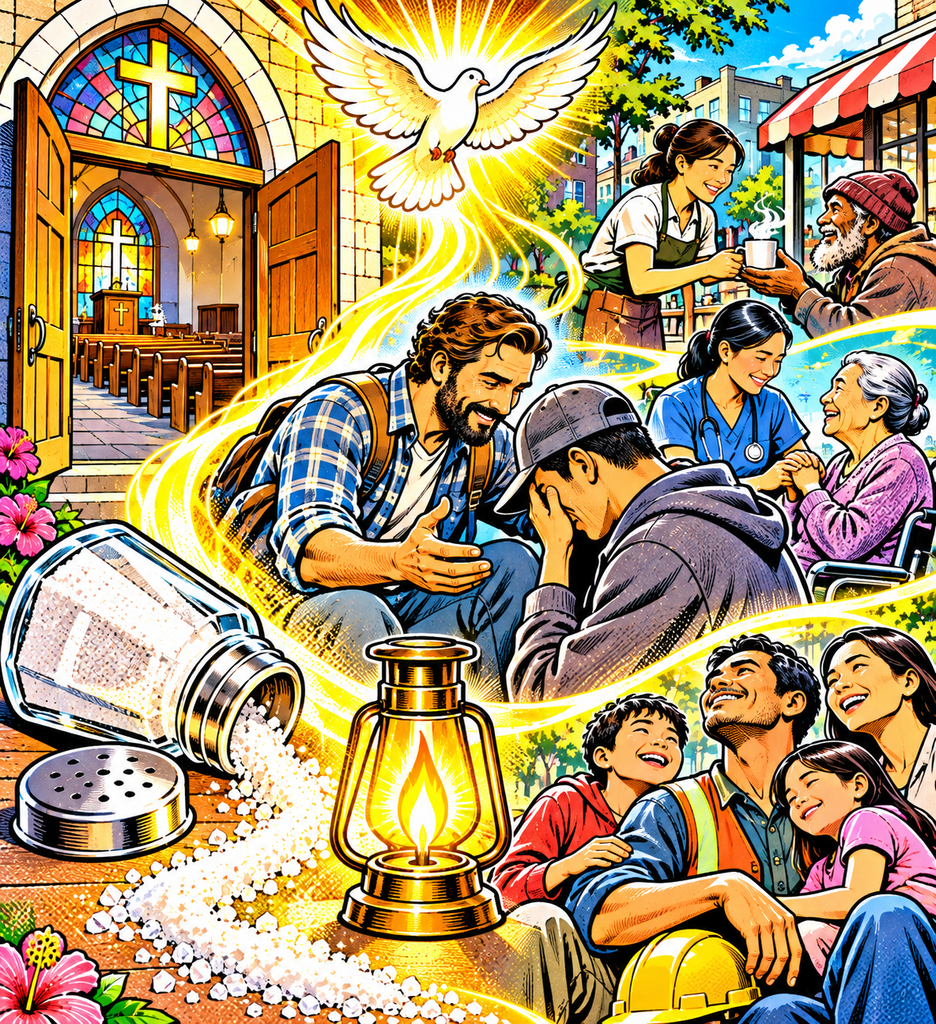
The Salt Is Still in the Shaker
Picture a table set for dinner. In the center sits a salt shaker: full, clean, and carefully labeled. Nobody has ever complained about it. It has also never seasoned a single bite.
That is a sobering picture of what happens when believers confuse being in a church building with being the salt of the earth. Again, Jesus did not say the building is the salt. He said, “You are.” And He did not say the earth should come to the shaker. He called His followers the salt of the earth, which means the earth—and the everyday places where people live and work—is where the salt belongs.
The dynamic of the world has shifted dramatically around that shaker. A shop owner, a nurse, a barber, a teacher, a café owner, a freelancer: in an ordinary week, people through their personal business and daily vocations touch more lives than most congregations do inside a sanctuary on Sunday. Through their ordinary work and relationships, believers are already sitting right in the middle of the meal. The question is not whether they will be near people. The question is whether the agapē love of Jesus will actually be flowing through them when they are.
Pastors, missionaries, volunteers, counselors, and every believer who has never held a formal title must know this central thesis straightforward: the Holy Spirit’s work is to pour the agapē love of God through us, and being salt and light is what that love looks like when it leaves the shaker. Its worth does not depend on how large our platform looks or how impressive our numbers appear. A believer who feels small is not less salty; a believer who feels successful by crowd metrics is not more luminous. Love is measured by its source and its quality, never by its quantity.
I. You Are the Salt, You Are the Light (Matthew 5:13–16)
“You are the salt of the earth; but if the salt loses its flavor, how shall it be seasoned? It is then good for nothing but to be thrown out and trampled underfoot by men. You are the light of the world. A city that is set on a hill cannot be hidden. Nor do they light a lamp and put it under a basket, but on a lampstand, and it gives light to all who are in the house. Let your light so shine before men, that they may see your good works and glorify your Father in heaven.”
— Matthew 5:13–16 (NKJV)
Before Jesus gives a single imperative in this passage, He makes two declarative announcements: “You are the salt of the earth.” “You are the light of the world.” These are statements of identity, not earnable badges. The command comes only afterward: “Let your light so shine.” That sequence matters deeply for every Christian, specifically anyone in ministry. You do not become salt by grinding harder or light by manufacturing brightness. You already are what He names you, and your calling is to function as what you are.
The surrounding salt-and-light texts fill out the portrait:
- Mark 9:50 connects salt to relational peace: “Have salt in yourselves, and have peace with one another.”
- Luke 14:34–35 repeats the stark warning about salt that loses its flavor and becomes useless.
- Colossians 4:6 places salt on our words: “Let your speech always be with grace, seasoned with salt, that you may know how you ought to answer each one.”
- Ephesians 5:8 calls believers to live out their new nature: “Walk as children of light.”
- Philippians 2:15 sets that light against cultural darkness: in the midst of “a crooked and perverse generation,” believers “shine as lights in the world.”
Original Language Foundation (Hebrew, Aramaic, and Koine Greek)
- Melaḥ (מֶלַח — Hebrew, “salt”, Leviticus 2:13; Numbers 18:19): In the Old Testament, salt is tied to covenant fidelity. Offerings were seasoned with “the salt of the covenant of your God” (Leviticus 2:13), and Numbers 18:19 speaks of “a covenant of salt forever.” Because salt resists corruption and endures, it pictures faithful, preserving commitment.
- Mĕlaḥ (מְלַח — Aramaic, “eat the salt / receive support”, Ezra 4:14): In Imperial Aramaic idiom, eating the king’s salt signified receiving royal provision, loyalty, and protection (rendered in the NKJV as “we receive support from the king’s palace”). Believers live under the provision and loyalty of a greater King, carrying His reality wherever they go.
- Mōrainō (μωραίνω — Koine Greek, “loses its flavor”, Matthew 5:13; Luke 14:34): Literally, “to become foolish” or lose distinctive potency. Notice what Jesus identifies as the failure: not smallness, but losing the very quality that makes salt salt.
- Artyō (ἀρτύω — Koine Greek, “seasoned”, Mark 9:50; Colossians 4:6): To season or give appropriate flavor. Speech “seasoned with salt” carries grace that makes truth fit to be received—neither insipid nor harsh.
- Kala erga (καλὰ ἔργα — Koine Greek, “good works”, Matthew 5:16): Kalos points to what is noble, winsome, and genuinely good. These are deeds with an attractive beauty that points onlookers toward the Father.
- Phōstēr (φωστήρ — Koine Greek, “lights”, Philippians 2:15): A light-bearer or luminary (used in the Septuagint for the heavenly lights of Genesis 1:14–16). Paul envisions stars shining in a dark night sky—distinct points of light placed right where the darkness is.
Biblical Logic & Counseling Application
- Premise 1: Jesus declares believers to be salt and light by identity before commanding them to shine (Matthew 5:13–16).
- Premise 2: Salt preserves and flavors only through contact, and light illuminates only when uncovered, pointing observers to glorify the Father (Matthew 5:14–16; Colossians 4:6).
- Conclusion: Therefore, remaining isolated inside the shaker—or hiding light under a basket—is not spiritual humility; it is a failure to fulfill the purpose of what you already are.
The gathering of the church is essential—Hebrews 10:24–25 calls believers together to stir up love and good works—but the shaker is a staging ground, not the final destination. When the salt stays clumped inside the shaker, it never seasons the table. And when believers treat their daily workplaces, businesses, and neighborhoods as secondary to “church ministry,” they overlook the very tables God has already placed them beside.
The Glass Salt Shaker and the Woven Basket
Pastor Daniel stood before the young adult table group with two ordinary objects sitting on the scarred oak table between them: a clean glass salt shaker, half-full of white crystals, and a woven reed basket turned upside down with a small oil lantern resting beside it.
“Look at the shaker first,” Daniel said, picking it up and giving it a gentle rattle. “It looks spotless. No fingerprints, no dust, sitting right in the middle of the room. If you are a believer who loves your church attendance, knows your doctrine, and keeps your life tidy inside Christian circles, you can easily feel like this shaker is the goal.”
He unscrewed the metal cap and tapped a pinch of salt into his palm.
“In Matthew 5:13–14, Jesus does not say, ‘Try to become salt someday if you pass enough tests.’ He announces a settled identity first: ‘You are the salt of the earth’ and ‘You are the light of the world’ (NKJV). That order changes everything. You don’t grind yourself into becoming salt, and you don’t manufacture brightness out of thin air. You already are what Christ names you in Him, and your calling is to function as what you are.”
Daniel set the shaker down and picked up the reed basket.
“Now watch what happens if someone lights a lamp—phōstēr (φωστήρ), a luminary set in the dark like stars in a night sky (Philippians 2:15)—and drops this basket right over it (Matthew 5:15). Sometimes young believers put a basket over their faith out of fear or awkwardness at work, and they call it ‘being humble’ or ‘keeping things private.’ Jesus calls it pointless. A lamp is meant to give light in the house so people see kala erga (καλὰ ἔργα)—noble, winsome good works—and ‘glorify your Father in heaven’ (Matthew 5:16, NKJV). The spotlight isn’t supposed to land on you; it is supposed to point straight to the Father.”
A Practical Question for Your Week
Where is one specific place—your workplace, business, neighborhood, or group chat—where you have been keeping the lid on instead of letting Christ’s grace and good works make contact?
II. Do Not Quench the Spirit: Let Agapē Flow (1 Thessalonians 5:19; John 7:37–39; Romans 5:5)
“On the last day, that great day of the feast, Jesus stood and cried out, saying, ‘If anyone thirsts, let him come to Me and drink. He who believes in Me, as the Scripture has said, out of his heart will flow rivers of living water.’ But this He spoke concerning the Spirit, whom those believing in Him would receive…”
— John 7:37–39 (NKJV)
Jesus does not picture the Holy Spirit as a private trophy case to guard; He pictures a river. A believer is meant to function as a channel rather than a stagnant reservoir—receiving from Christ so that living water flows outward to others. Paul tells us what fills that channel: “the love of God has been poured out in our hearts by the Holy Spirit who was given to us” (Romans 5:5). This is not self-manufactured affection; it is agapē—self-giving, covenantal, action-oriented love rooted in Christ’s own sacrificial love for us while we were still sinners (Romans 5:8; John 15:13).
Original Language Foundation (Hebrew and Koine Greek)
- Rûaḥ (רוּחַ — Hebrew, “Spirit / wind / breath”)Zechariah 4:6: “Not by might nor by power, but by My Spirit,’ Says the LORD of hosts.” Sustaining the flame depends on the Spirit’s supply, not human force as you can see here. A lampstand is supplied continuously with oil from olive trees in those days of old, here through golden pipes, as explained in the word of God, Zechariah 4:2-14.
- Ekcheō (ἐκχέω — Koine Greek, “poured out”, Romans 5:5): To pour out generously. In the perfect tense (ekkechytai), it points to a decisive pouring out whose ongoing result abides in the believer.
- Rheō (ῥέω — Koine Greek, “flow”, John 7:38): To flow or stream forth from koilia (κοιλία — the innermost being or core, translated “heart” in the NKJV).
- Sbennymi (σβέννυμι — Koine Greek, “quench”, 1 Thessalonians 5:19): To extinguish or put out a fire. In the present imperative, it warns against a continuing habit of smothering the Spirit’s work.
- Anazōpyreō (ἀναζωπυρέω — Koine Greek, “stir up / rekindle”, 2 Timothy 1:6): To fan a dying ember back into a blaze. Paul pairs this rekindling with the Spirit’s gift of “power and of love and of a sound mind” (2 Timothy 1:7).
Biblical Logic & Counseling Application
- Premise 1: The Holy Spirit pours God’s agapē love into believers’ hearts and produces an outward flow of life (Romans 5:5; John 7:38).
- Premise 2: Believers are commanded not to quench the Spirit (1 Thessalonians 5:19) and to walk in the Spirit rather than the flesh (Galatians 5:16 and Galatians 5:25).
- Conclusion: Therefore, effective ministry is not produced by forcing human energy or rule-keeping (the flesh, Galatians 3:3; 2 Corinthians 3:6), but by staying in Christ (John 15:4) and removing what chokes the Spirit’s flow.
Ephesians 4:30–5:8 traces that exact sequence: do not grieve the Holy Spirit with bitterness, wrath, anger, clamor, and slander (4:30–31); instead, “walk in love, as Christ also has loved us” (5:2), and “walk as children of light” (5:8). Notice that when the Spirit’s love is absent, even impressive teaching or busy activity becomes mere noise (1 Corinthians 13:1–3). A person can deliver accurate biblical information without revealing the heart of God. Real soul care moves from information to revelation of Christ’s love in action—and the highest compliment a minister or church can ever receive is not “What a brilliant speaker,” but “I feel so loved by you.”
The Object Lesson: The Garden Hose, the Kink, and the Pitcher
Pastor Daniel set two things on the table in front of the young adults: a glass pitcher filled to the brim with clear water, and a coiled section of green garden hose with a heavy brass clamp squeezed tightly across the middle—alongside a small bowl of dry sand and a candle snuffer.
“Look at the difference between a pitcher and a hose,” Daniel said, tapping the glass. “A pitcher is designed to hold water until it goes stale or runs dry. When young believers try to do ministry in their own strength—relying on human willpower, strict rule-keeping, or sheer emotional grind—they act like a tiny pitcher trying to water an entire dry field. Two hours into the week, they’re empty.”
He lifted the coiled garden hose.
“Now look at what Jesus actually describes in John 7:37–39: ‘If anyone thirsts, let him come to Me and drink. He who believes in Me, as the Scripture has said, out of his heart will flow rivers of living water.’ (NKJV). Jesus doesn’t picture the Holy Spirit as a stagnant reservoir you hoard. He pictures a river—a living channel (rheō, ῥέω) streaming outward from your innermost being (koilia, κοιλία). And what fills that channel? Romans 5:5 tells us: ‘the love of God has been poured out in our hearts by the Holy Spirit who was given to us’ (NKJV).”
Daniel pointed to the heavy clamp choking the middle of the hose.
“You can hook this hose up to an inexhaustible mountain spring, and not a single drop will reach the dry ground if a kink or a clamp is choking the line. That is why Paul writes in 1 Thessalonians 5:19, ‘Do not quench the Spirit’ (NKJV)—using the Greek verb sbennymi (σβέννυμι), meaning to smother or extinguish a fire. You don’t generate the water, and you don’t invent the fire. Your responsibility is to stay connected to the Source and clear out whatever is blocking the flow.”
A Practical Question for Your Week
Where have you been trying to minister out of your own “pitcher” of willpower—and what specific “kink” (bitterness, fear, hurriedness, or self-reliance) needs to be unclamped so the Spirit’s agapē can flow freely through you?
III. The Priority and Protection of Love: Beyond Quantity and Comparison
In 1 John 3:16–23 and 1 John 4:8, 16, Scripture establishes an unshakeable priority: “God is love.” Methods may shift, structures may change, and leadership roles may evolve, but the priority of agapē never changes. And in Galatians 5:22–23, the fruit of the Spirit is singular—love (agapē)—manifesting across interconnected qualities like joy, peace, longsuffering, kindness, goodness, faithfulness, gentleness, and self-control.
The Greek singular grammatically proves that love is the only fruit and that every other quality is merely a subdivision of love.
Paul names eight qualities coming together in full to produce genuine selfless love. Look at this quick peek:
—Love without patience becomes impatient sentiment. A feeling of restlessness, irritation, or frustration caused by delays, waiting, mistakes, or opposition, as well as a restless eagerness for action or change.
—Love without truth becomes permissiveness. The tendency to allow freedom of choice and behavior, especially actions or habits that others might disapprove of or forbid. It comes from the Latin permittere, meaning “to let go” or “let loose”.
—Love without self-control can become possessive or destructive. A spectrum of self-centered behavior—ranging from wanting to control or keep things exclusively for oneself to actively tearing down or harming others.
—Love without kindness becomes difficult to recognize. Without kindness, love often turns into attachment, control, or obsession rather than genuine care.
You can now see clear that the fruit of the Spirit belongs together. And this fruit of love activates through Ephesians 2:8-10 power of God’s grace in the motion of our faith into the actions of our good works of love God has prepared for us before hand.
Faith is never a dead theory; as James teaches, living faith moves and acts (James 1:22; James 2:17). First John 3:17–18 presses this home: true love sees a real need and responds generously. Yet God never asks us to give what we do not have; He calls us to steward what He has placed in our hands—whether resources, comfort, time, or simply an attentive, unhurried ear.
Original Language Foundation (Koine Greek)
- Agapē (ἀγάπη — Koine Greek, “love”, 1 John 3:16; 4:8, 16; John 13:35): Unconditional, self-giving, covenantal love—demonstrated supremely when Christ laid down His life for us (John 15:13; Romans 5:8).
- Stegō (στέγω — Koine Greek, “bears / protects / covers”, 1 Corinthians 13:7): To cover, hold out against pressure, or protect. In 1 Corinthians 13:7, agapē covers and guards rather than exposing or exploiting.
Biblical Logic & Counseling Application
- Premise 1: Jesus identifies His disciples by their agapē love for one another (John 13:35), and Scripture anchors assurance and obedience in God’s love (1 John 3:19–23; 4:16).
- Premise 2: External metrics—crowd size, event counts, or outward applause—cannot substitute for the presence of Christ’s love (1 Samuel 16:7, Revelation 3:1).
- Conclusion: Therefore, faithfulness in ministry is measured by obedience to the command to love and the Spirit’s fruit produced, not by human quantity metrics.
Consider the practical nuances that trip up many servants of Christ:
- Smallness vs. bigness: Whose church is it? It belongs to Christ, not to our ego or metrics. Even if attendance looks small or a community feels slow to respond, we win when we obey the command to love (1 John 3:23) and let the love of Jesus be tangibly felt around us.
- Love as a wall and refuge: Proverbs 25:28 warns that a person without self-control over their spirit is like a city broken down without walls—vulnerable and exposed. By contrast, Scripture portrays God’s love and presence as a protective wall and refuge (Zechariah 2:5; Psalm 46:1; Psalm 91:1–2; 1 John 4:18). Love protects, covers offenses (Proverbs 10:12), and drives out paralyzing fear.
- Love your family first, not from leftovers: One of the clearest testimonies in ministry is how a servant loves their own household. Spouses and children should never be fed love-leftovers after everyone else gets the best energy, while outsiders are told to wait (Ephesians 5:25, 1 Timothy 5:8).
- Care for fellow laborers: Ministry can be isolating, and workers often hide discouragement behind a strong front. Fellow workers in the gospel need genuine connection—checking on one another, bearing burdens (Galatians 6:2), and remembering that Christ loved us before He ever called us to serve (John 3:16–17; Romans 8:38–39). When ministry loses that love, it turns from a blessing into a crushing burden—a pattern seen all too often among weary pastors and cross-cultural workers alike (Proverbs 27:23–24).
The Object Lesson: The Raspberry, the Brass Scale, and the Miniature Stone Wall
Pastor Daniel placed three items on the wooden table in front of the group: a fresh red raspberry, an old-fashioned brass balance scale, and a small horseshoe-shaped wall built out of miniature gray stones.
“Look at the raspberry first,” Daniel said, holding it up between his thumb and forefinger. “Notice that it isn’t a basket of separate fruits—it is one single berry made up of dozens of tiny, connected bumps. That is the exact picture Paul gives us in Galatians 5:22–23: ‘But the fruit of the Spirit is love, joy, peace, longsuffering, kindness, goodness, faithfulness, gentleness, self-control’ (NKJV). Notice the word fruit is singular. The core reality is agapē (ἀγάπη)—God’s unconditional, self-giving, covenantal love—and joy, peace, patience, and self-control are the living, interconnected bumps that make up that one fruit.”
He set the berry down and pointed to the brass balance scale.
“Now, here is how modern ministry culture tries to measure success: we pile crowd numbers, event counts, social media reach, and budgets onto one side of this scale. When the numbers look big, we feel validated; when the numbers look small, we feel like failures. Yet Scripture flips the scale completely upside down. 1 John 4:8 and 4:16 declare the unchangeable anchor: ‘God is love’ (NKJV). Methods shift, buildings change, and leaders come and go, but the priority of agapē never changes. Jesus did not say, ‘By this all will know that you are My disciples, if you pack out an auditorium.’ He said in John 13:35: ‘By this all will know that you are My disciples, if you have love for one another’ (NKJV).”
Daniel then tapped the miniature stone wall resting on the table.
“Finally, look at this little wall. In the ancient world, a city without walls had zero defense—every enemy could walk right in and pillage it. Proverbs 25:28 warns: ‘Whoever has no rule over his own spirit is like a city broken down, without walls’ (NKJV). By contrast, Scripture portrays God’s love and presence as an impenetrable wall of fire and a refuge around His people (Zechariah 2:5; Psalm 46:1; Psalm 91:1–2, NKJV). When agapē flows through a believer, it acts like that first-line wall—covering, guarding, and protecting others rather than exposing or exploiting them.”
A Practical Question for Your Week
Where have you been measuring your worth by “quantity metrics” instead of agapē—and who in your own household or circle of fellow workers needs your first-fruits of love rather than your leftovers today?
IV. Building on the Rock: Truth, Humility, and Sustainable Soul Care
In Matthew 7:24–27 (and Luke 6:47–49), Jesus contrasts two builders: the wise builder who hears His words and acts on them, establishing a house on the rock that endures storms and floods, and the foolish builder who hears without obeying, building on sand that collapses under pressure.
Biblical Logic & Counseling Application
- Premise 1: Hearing God’s Word without practicing it leaves a life vulnerable to collapse under pressure (Matthew 7:24–27; James 1:22).
- Premise 2: Humbling oneself before God (James 4:7; 1 Peter 5:6–9) allows the Spirit to work through us rather than competing with our pride.
- Conclusion: Therefore, lasting soul care combines clear, loving biblical truth with humble dependence on God—equipping others to rest in Christ rather than making them dependent on us.
In practical counseling and discipleship, this means:
- Point people to Jesus, not to your own expertise: You do not have to win every argument or prove you are the smartest person in the room. Aim for restoration in love and equipping the saints (Ephesians 4:12, 15).
- Serve where the need actually is: Look for where people need the love of Jesus—whether in a home, a workplace, a local church council, or a city—and ask humbly, “How can I serve you?”
- Receive so you can give: Jesus Himself withdrew to pray and be with the Father. Trying to run ministry on your own steam leads to burnout. Receive from Christ first so your service flows from the overflow of His love.
The Object Lesson: The Solid Slate Slab, the Loose Sand Tray, and the Small Brass Bell
Pastor Daniel set three things on the scarred oak table in front of the young adults: a flat, heavy slab of dark slate rock, a shallow tray filled with loose, dry sand, and a small, polished brass bell.
“Look closely at these two bases first,” Daniel said, tapping his knuckle against the slate slab. “In Matthew 7:24–27—and its parallel in Luke 6:47–49—Jesus closes the Sermon on the Mount by contrasting two builders. Both hear His words. Both construct a house. The difference isn’t whether they listen to sermons or attend Bible studies. The difference is obedience—doing what Jesus says.”
He shifted his hand over the shallow tray of loose sand.
“If you build your life or your ministry on hearing truth without practicing it, you are setting your footings onto dry sand. Everything looks fine on a calm sunny day. But when rain falls, floods rise, and winds beat against that house—grief, betrayal, financial shock, or spiritual pressure—a house on sand collapses completely, and great is its fall. Why? Because sand shifts in the storm, it is not constant. By contrast, the wise builder hears Christ’s words and acts on them, anchoring the house on the rock so it stands when the storm hits. Why”? Because no matter how hard the storm hits, a well placed earthed rock does not move.
Daniel then picked up the small brass bell and gave it a single, crisp tap.
“Now look at this bell. A bell exists to ring out a clear tone—and then fall silent so the sound carries. In ministry and counseling, your voice is meant to point people to Christ, not call attention to yourself. If you treat biblical counseling like a debate stage where you have to prove you’re the smartest person in the room, you’re clanging for your own ego instead of equipping people in love.”
A Practical Question for Your Week
Where have you been leaning on “sand” (knowing truth without acting on it, or relying on your own ego and steam)—and what one step of humble obedience or quiet rest with Christ do you need to take today?
UNLOCK THE SHAKER AND GET OUT THE DOOR: Stop Protecting Your Comfort While People Starve
Enough talking about salt. Enough admiring the lamp. Enough hiding behind church attendance, doctrinal debates, or waiting for a committee to hand you permission to love.
Jesus did not hand you a trophy or invite you to a comfortable lounge—He named you salt and light and pointed you straight at a rotting, dark world (Matthew 5:13–16, NKJV). Salt that never leaves the shaker seasons nothing. A lamp covered by a basket illuminates no one. And a believer who hoards information while choking the Spirit’s agapē flow with pride, bitterness, or self-reliance is just making noise (1 Corinthians 13:1–3; Ephesians 4:30–31).
Stop measuring your worth by crowd sizes or platform applause. Stop feeding your spouse and children cold leftovers while chasing external approval. Stop treating your workplace, your shop, your classroom, or your neighborhood like a second-rate secular chore when it is the exact table where real people are sitting hungry right now.
Get out of the shaker. Unclasp the kink in the hose. Let the Holy Spirit pour the sacrificial agapē love of Christ through you—not as a theory in your head, but as living action in your hands, your words, and your daily obedience (1 John 3:16–23; James 1:22).
Do not sit still another week. Walk through that door today:
- Step into the everyday tables you already sit beside: Bring Christ’s grace, peace, and agapē love into your actual job, business, home, and neighborhood—not just when a church event is scheduled.
- Clear out what chokes the Spirit’s flow: Repent of bitterness, fear, pride, and self-reliance, and receive from Christ first so you serve from His overflow rather than your own burning steam (John 15:4; 1 Thessalonians 5:19).
- Anchor your life in obedience, not noise: Do what Jesus actually says (Matthew 7:24–27), point people to Christ rather than your own ego, and love the people in front of you until the world cannot miss whose disciples you are (John 13:35, NKJV).
The door is open. The world is starving. Get out there and live like the salt and light you already are.
Step Out of the Shaker and Let Love Speak
You do not need a massive stage, a famous name, or an extraordinary resume to be salt and light. You need a heart yielded to the Holy Spirit, a life anchored in the agapē love of Jesus, and the courage to step out of the shaker into the everyday places where people live, work, hurt, and hope.
Whether your sphere feels small or wide, whether your visible results look modest or abundant, never stop letting the Spirit pour Christ’s love through you. Speak truth with grace seasoned with salt; love your family first; stand beside your fellow laborers; and build your life on the rock of hearing and obeying the Lord.
Shocking? Look at this… based on two real-life stories merged together, one from my youth I witnessed and another when I got much older:
Lightning Over the Fence Line: A Wake-Up Call Between the Chickens and the Paddock
The Sunday morning rain was light—a steady, cool drizzle drifting over the farm—as three twenty-somethings stood on the wet gravel path wedged between the chicken coop and the horse running area. Earlier that morning, all three had made the same comfortable calculation: driving into church fellowship felt inconvenient, so they had stayed home to watch the livestream online, half-listening while scrolling on their phones.
The pastor had preached straight from this essay Out of the Shaker: Letting the Spirit’s Agapē Flow Through You as Salt and Light, hammering on Matthew 5:13–16, John 7:37–39, Romans 5:5, and 1 John 3:16–23 (NKJV). Ten minutes ago, all three of them had essentially agreed to shrug it off—treating the sermon like nice background noise while planning to keep their faith tucked neatly inside their routine, coasting on convenience and treating their everyday lives like separate turf from real ministry.
Then the sky tore open.
A jagged bolt of lightning slammed directly into a tall metal fence pole just yards from the horse paddock. The strike hit with a deafening, metallic crack and blasted chunks of stone out of the low rock wall sitting right beneath it, sending a violent shower of sparks arcing through the damp air across the wet ground between the chickens and the horses.
None of them had time to think before instinct took over. The flash, the concussive roar, and the flying stone fragments hit with terrifying proximity—literally feet away from where all three stood. For a split second, every casual excuse evaporated as their lives seemed to flash before their eyes in the blinding glare and flying sparks.
Silence dropped over the farm except for the hiss of rain on hot metal and the startled movement of livestock across the fence.
I. The Shock of Proximity: When Convenience Meets Reality
Toby was the first to speak, his voice shaking as he gripped the wet wooden post beside the chicken run, staring at the shattered stones along the wall.
“That was… six feet away,” Toby breathed, his chest heaving. “If that bolt had jumped two inches differently, we wouldn’t be standing here.”
Elana gasped, “Its’ because I was going to blow it off wasn’t it!?”
Marcus, “Blo…blow what off?” Looking around nervously yet keeping his head tucked low in case another bolt was about to strike down.
Elena pressed both hands over her mouth, still trembling from the shockwave. “I saw the sparks hit the rock wall right in front of us. Ten minutes ago I was sitting on the couch thinking that sermon didn’t really apply to my week—that I could just watch church online when it’s convenient and keep living my normal life.”
Toby shook his head, “Oh so not cool… I… we all…” Toby was too in shock to finish his thoughts.
Marcus looked from the smoking metal pole to the exploded stones, his jaw tight. “This was a wake up call man! Straight from Him upstairs to us down below. We were going to blow it off. All three of us. We heard the pastor say we’re supposed to be salt and light out in the world—not locked in a shaker or hiding under a basket—and we literally just sat there planning to do nothing. I know all three of us were thinking the same thing.”
II. Challenging Each Other: God’s Warning and the Logic of Obedience
The shock didn’t stay quiet; it turned into a sharp, mutual challenge among the three friends standing in the rain. The thunder roared with Elena squeaking as they all jumped to run to the covered porch.
“Do you think that was just random weather, or a wake-up call?” Elena asked, looking straight at Marcus and Toby. “Look at what the pastor just preached on from Matthew 5:13–16 (NKJV)” She held out her phone and pressed the play button for audio on the online essay:
“You are the salt of the earth; but if the salt loses its flavor, how shall it be seasoned? It is then good for nothing but to be thrown out and trampled underfoot by men. You are the light of the world. A city that is set on a hill cannot be hidden. Nor do they light a lamp and put it under a basket, but on a lampstand, and it gives light to all who are in the house. Let your light so shine before men, that they may see your good works and glorify your Father in heaven.”
“Think about the logic of what we were just doing,” Marcus interrupted, his voice hardening with conviction. “First, Jesus says ‘You are’—salt and light are who we are in Christ, not a Sunday hobby we stream when it’s convenient. Second, if we stay comfortable at home, treat our real-world workplaces and relationships as separate from ministry, and keep our light covered, we aren’t being humble—we’re acting like salt sitting in a shaker doing nothing for anyone around us.”
“And look at what happens if we just hear truth without acting on it,” Toby added, glancing toward the shattered rock wall. “In Matthew 7:24–27 (NKJV), Jesus says the person who hears His words and does them builds on the rock, while the one who hears and doesn’t act builds on sand—and when the storm hits, it collapses. We were building on sand five minutes ago. We heard the word on a screen and planned to ignore it.”
III. Clearing the Kinks: Letting the Spirit’s Agapē Flow in Action
“It’s not just about showing up to a building,” Elena said, stepping closer as the drizzle continued to fall outside the porch. “The pastor kept coming back to Romans 5:5 and 1 John 3:16–23 (NKJV). The Holy Spirit pours God’s agapē love into our hearts so it flows out of us like rivers of living water (John 7:37–39, NKJV). If we choke that flow with laziness, comfort, pride, or self-reliance, we’re quenching the Spirit (1 Thessalonians 5:19, NKJV) and making noise instead of loving people in deed and truth.” She was scrolling down the online essay as she spoke seeing each point.
Marcus nodded slowly, looking at both of them. “We challenged each other earlier to take life easy. Now I’m challenging both of you—and myself: no more coasting. If we actually believe God spared us feet from death just now, we stop treating our daily lives like a sideline. We let the Spirit pour agapē love through us where we actually live and work—loving our families first, not from leftovers, and stepping out of the shaker instead of waiting to be pushed.”
“Agreed,” Toby said, wandering in a small voice beside the coop across the wet gravel. “We don’t need another lightning bolt to prove we belong to Christ. Let’s start living like salt and light today—not just talking about it when it’s easy.”
Call to Action: Don’t Wait for Lightning to Wake You Up
You do not have to stand inches from a lightning strike to realize that convenient, passive, armchair Christianity is a trap. Every day you treat church as a convenient stream or treat your ordinary Monday-through-Saturday life as separate from God’s mission, you leave good salt sitting inside the shaker while hungry people sit right beside you.
Do not brush off the Word you hear. Apply the logic of Scripture right now.
“By this all will know that you are My disciples, if you have love for one another.”
— John 13:35 (NKJV)